
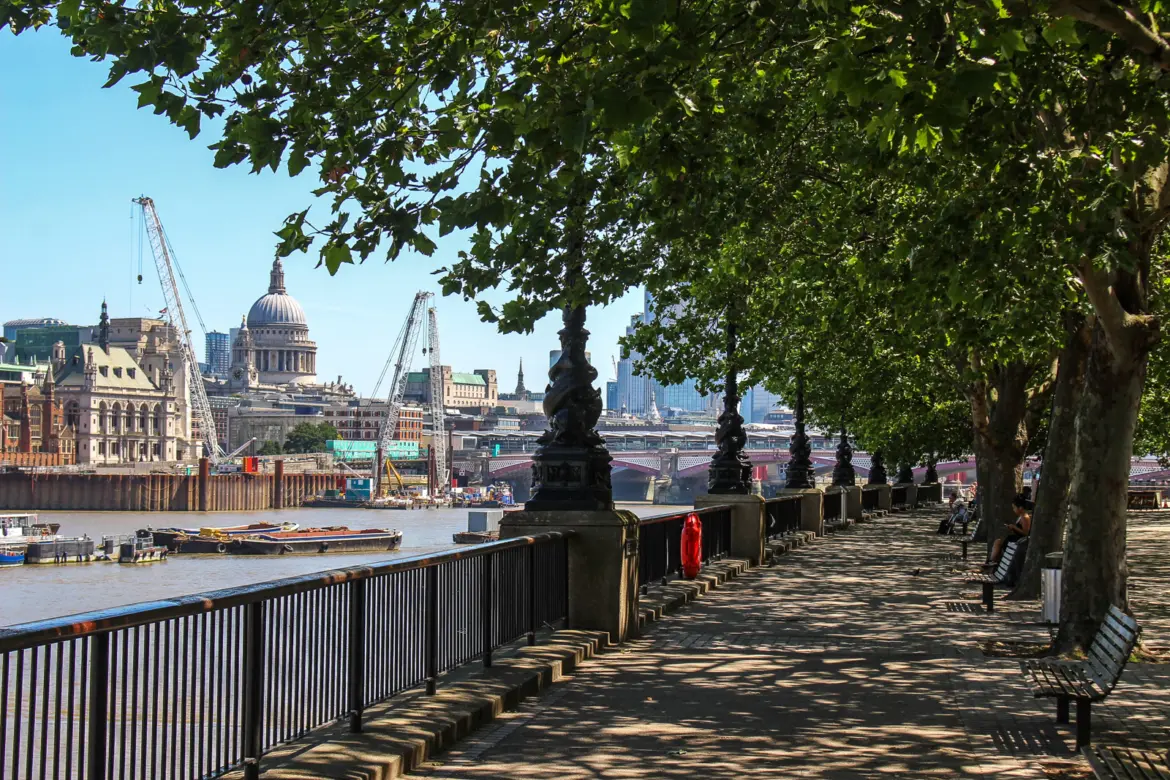
The South Bank is the southern edge of the River Thames in central London, running roughly from Lambeth Bridge in the west to Tower Bridge in the east. The stretch most people mean when they say “South Bank” sits between Westminster Bridge and Blackfriars, taking in County Hall, the London Eye, the Southbank Centre, the National Theatre, the BFI, and the OXO Tower. It is a walking district more than a sightseeing district. You don’t visit the South Bank the way you visit Westminster Abbey. You walk it.
I have walked the South Bank in late August, in shorts and sunglasses, ducking under the plane trees for shade. I have walked it in December, hands wrapped around a paper cup of mulled wine, watching the lights of the Winter Market reflect off wet pavement. It works in both seasons, but for different reasons, and this post covers what I noticed in each.
South Bank at a Glance
🌊 Where · Southern bank of the River Thames in central London, between Lambeth Bridge and Tower Bridge. The core stretch is Westminster Bridge to Blackfriars Bridge.
🎭 Cultural district · Born from the 1951 Festival of Britain. Now houses the Southbank Centre, National Theatre, BFI, Hayward Gallery, and OXO Tower.
🎡 London Eye · Opened March 2000 as a five-year temporary millennium installation. 26 years and counting. 135 metres tall, 32 capsules, 800 passengers per rotation.
📚 Book Market · Eight stalls under Waterloo Bridge since 2 July 1983. Open daily, weather dependent. Second-hand, mostly cash.
🛹 Undercroft · The world’s longest continually used skate spot. Skateboarders have used the space beneath Queen Elizabeth Hall since the early 1970s.
🎄 Winter Market · Alpine chalets along the riverside from mid-November through early January. Free entry, open daily.
🚇 Nearest stations · Waterloo (Northern, Bakerloo, Jubilee, Waterloo & City lines). Embankment is across Hungerford Bridge.
From Industrial Wharves to the Festival of Britain
For most of London’s history, the South Bank was the city’s working side: warehouses, breweries, wharves, and dockyards along the river, while the north bank held the monarchy, the law courts, the City, and Parliament. That divide held for centuries. The transformation into a public cultural district happened in a single concentrated event in 1951.
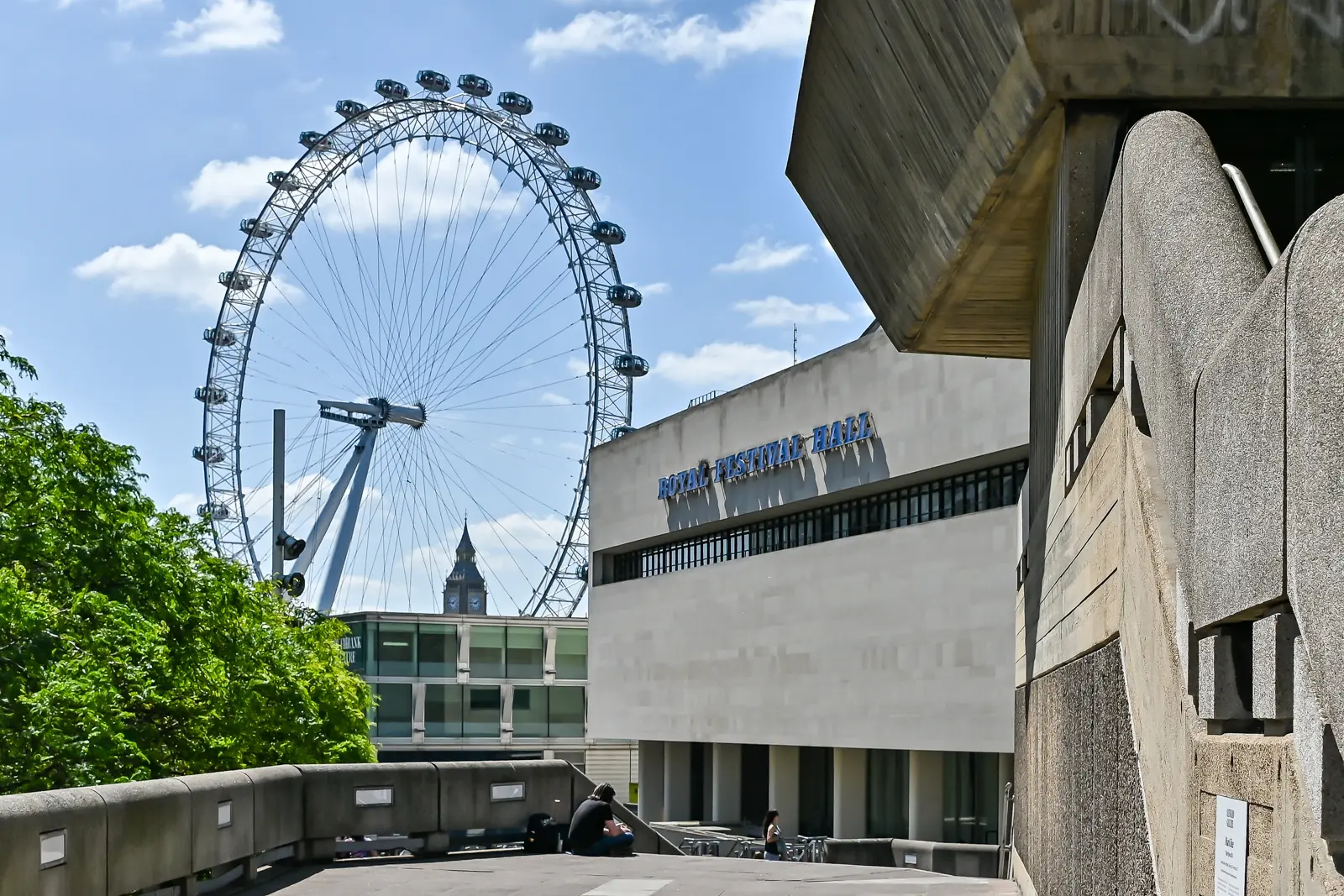
The 1951 Festival of Britain was conceived as a national exhibition with two purposes: marking the centenary of the Great Exhibition of 1851, and giving a post-war country something to celebrate after a decade of rationing and bombed-out streets. Held in the summer of 1951, it was billed as “a tonic for the nation” and drew 8.5 million people to its main South Bank site. The architectural showpieces were demolished when the Festival closed in September. The Skylon was a 90-metre steel needle that appeared to float in the air; the Dome of Discovery was a 111-metre-wide concrete dome, the largest in the world at the time.
The Royal Festival Hall is the only Festival of Britain building still standing. After Churchill’s Conservative government returned to power that autumn, most of the temporary structures came down. The reasons are often framed politically (Churchill is widely quoted as calling the Festival “three-dimensional socialist propaganda”, though the line has never been properly sourced), but in practice the buildings had been designed as temporary from the outset. The site was eventually rebuilt with the brutalist Southbank Centre extensions: Queen Elizabeth Hall, the Purcell Room, and Hayward Gallery, all added in 1967.
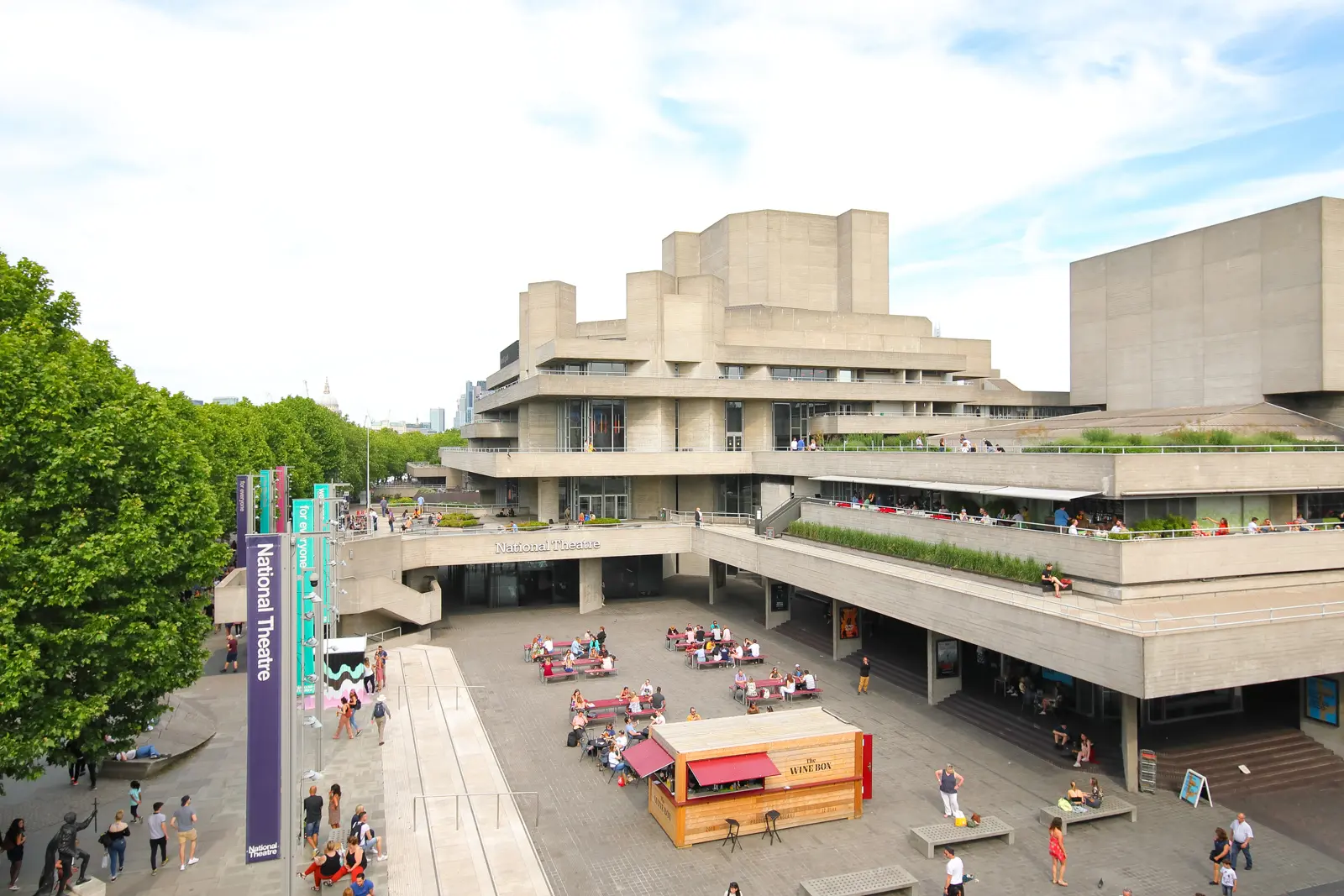
The National Theatre, just east along the river, came later. Designed by Denys Lasdun and completed in 1976, it is one of London’s most divisive Brutalist buildings; Prince Charles famously compared it to a nuclear power station. The building holds three auditoriums: the Olivier (1,160 seats), the Lyttelton (890), and the Dorfman (400), and was Grade II* listed in 1994. Lasdun called his design “architecture as urban landscape”, which is the most accurate way to describe what walking around it is actually like. You don’t enter through a front door. You climb terraces.
The Southbank Centre Food Market
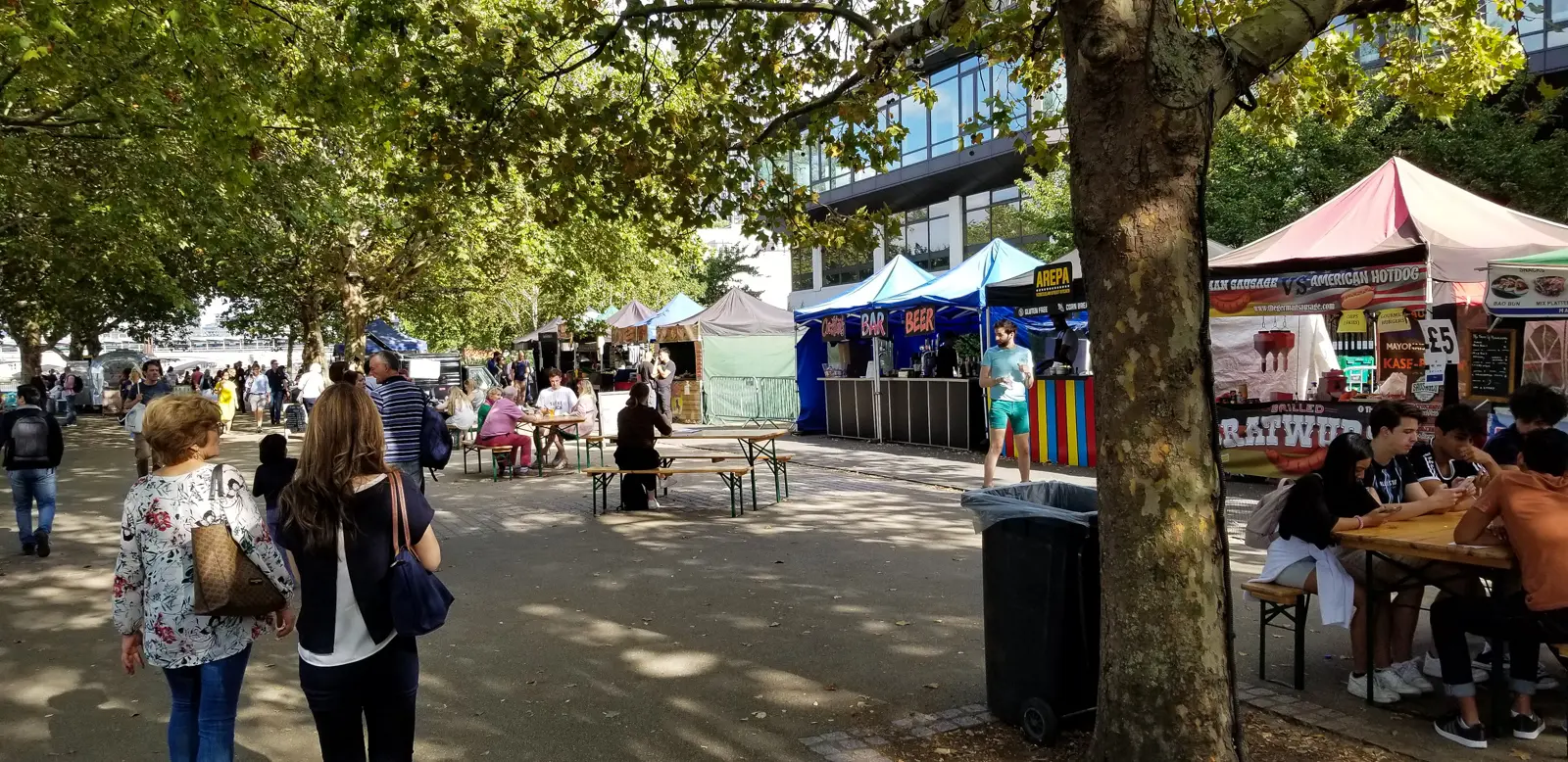
The food market sets up behind the Royal Festival Hall throughout the warmer months. On a hot Friday in August, it pulled the busiest crowd I saw on the South Bank that whole trip. Bratwurst with sauerkraut for £5. Arepas at the Venezuelan stall. A bar tent serving beer in plastic cups. Communal picnic benches under the plane trees, mostly full by lunchtime.
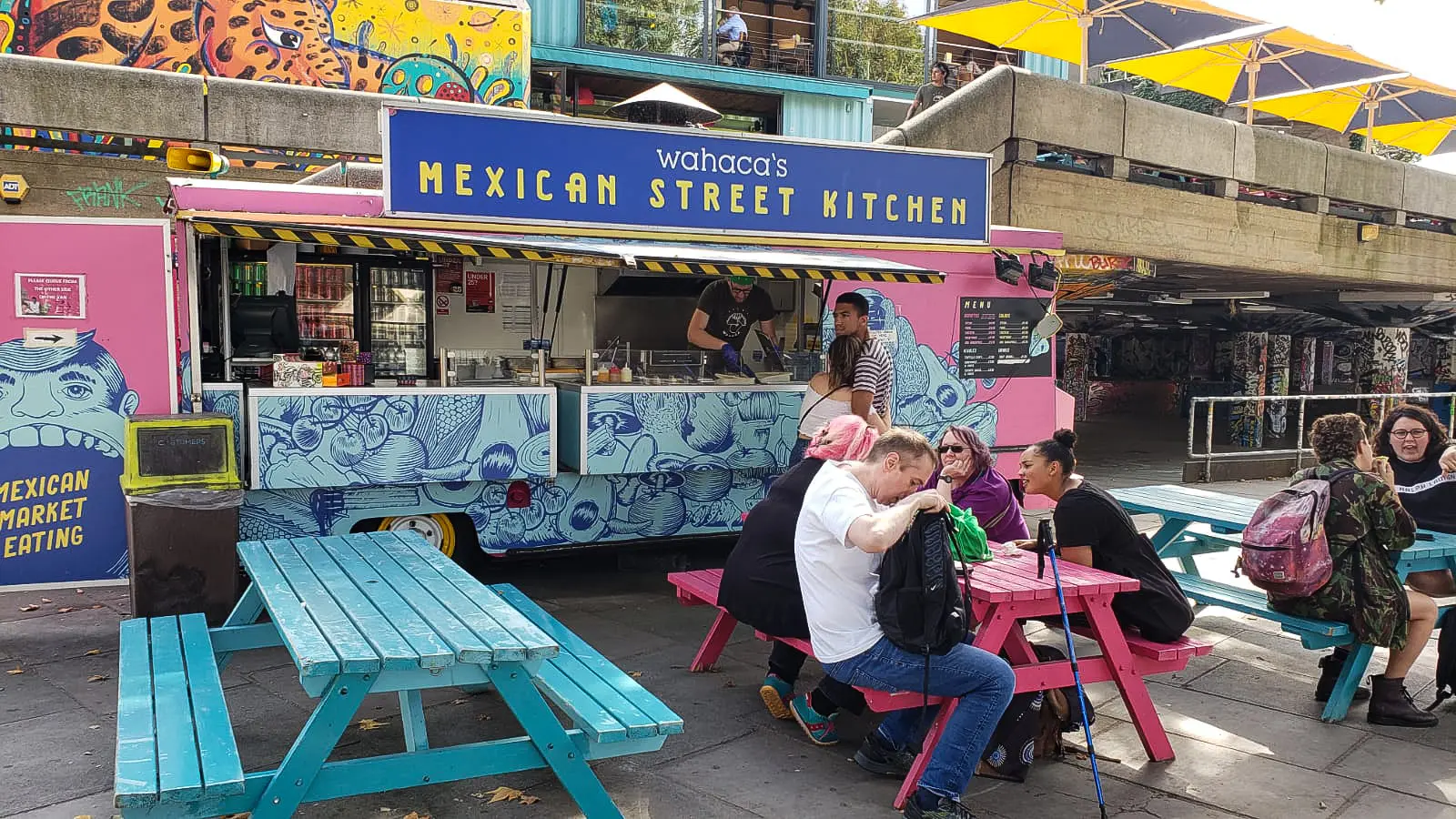
The food I came back for was at the Mexican street kitchen truck parked beside Wahaca’s main restaurant. Wahaca was co-founded by Thomasina Miers and Mark Selby, opening their first venue in Covent Garden in 2007, and the South Bank location is built into eight stacked shipping containers next to the Queen Elizabeth Hall. The takeaway truck (pink and turquoise, easy to spot) serves burritos, tacos, and salads to people who don’t want to sit down. I ordered a chicken burrito and ate it on a picnic bench facing the river. The Undercoft skate spot is right behind, so the soundtrack was wheels on concrete.
The Book Market Under Waterloo Bridge
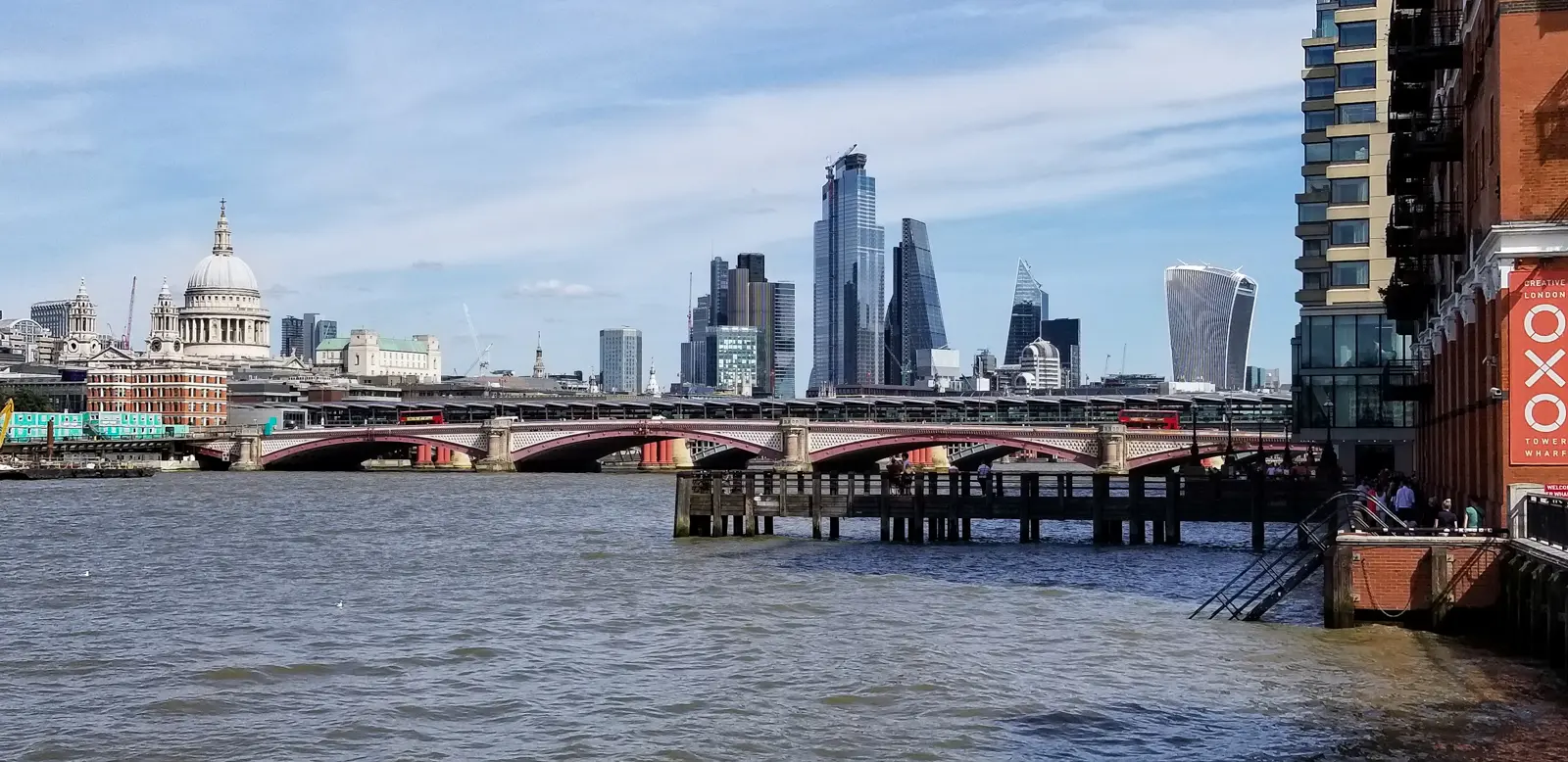
The walk between the Royal Festival Hall and the BFI gives you the cleanest skyline view on the South Bank. St Paul’s on the left, the City of London cluster on the right. The Walkie-Talkie (20 Fenchurch Street), the slanted Cheesegrater (Leadenhall Building), the Scalpel (52 Lime Street), and the square block of 22 Bishopsgate sit close enough together to read as a single skyline cluster from this distance. On the right edge, behind the wooden pier, you can just see the OXO Tower’s red lettering.
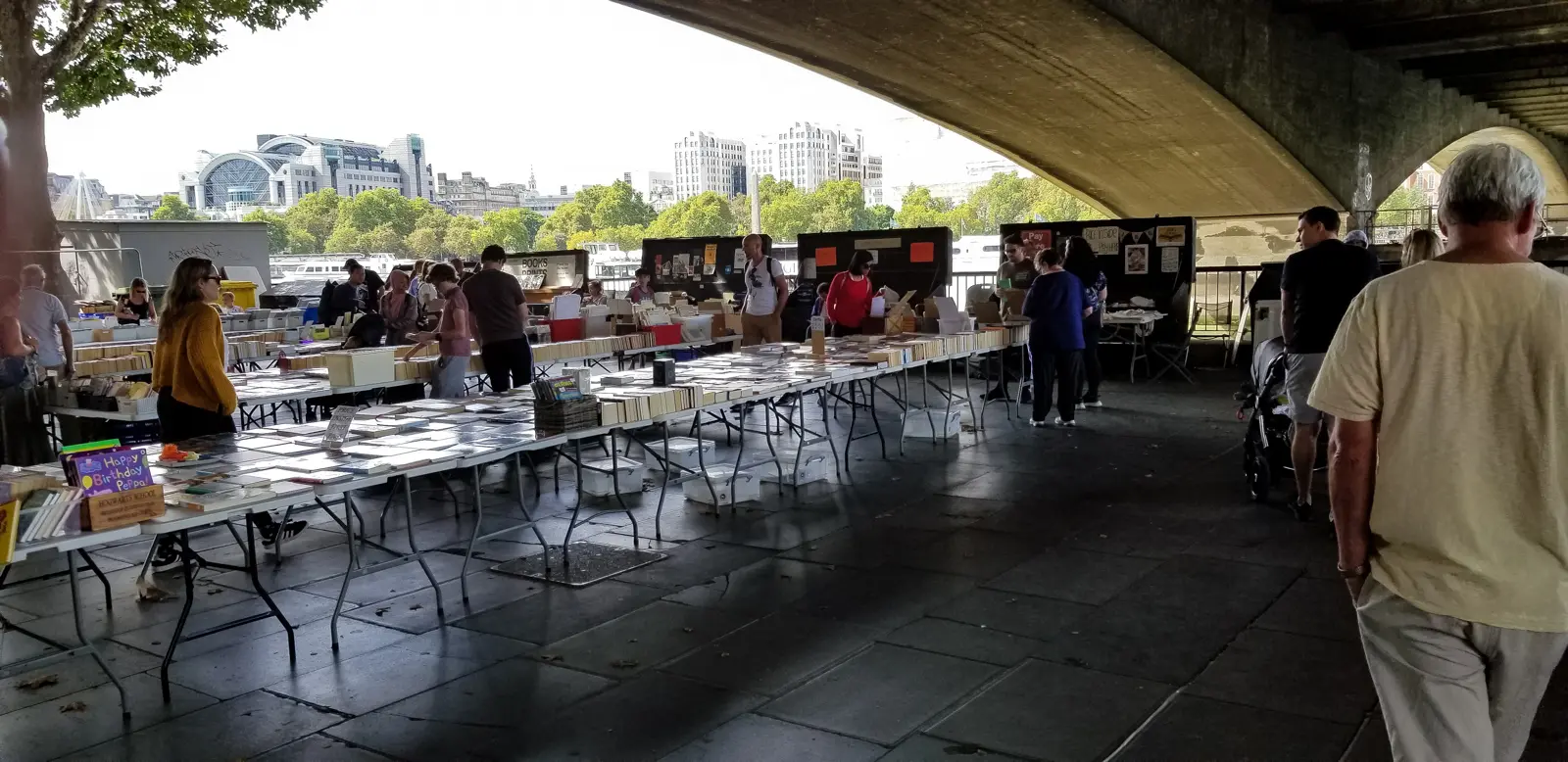
Underneath Waterloo Bridge itself, you’ll find the Southbank Centre Book Market. It is easy to walk past if you’re rushing toward the National Theatre. Slow down. The market opened on 2 July 1983, the idea of Leslie Hardcastle, then controller of the BFI, who wanted to bring some life to the dark and empty space beneath the bridge. Eight stalls now stock second-hand fiction, antiquarian editions, children’s books, comics, maps, and prints, and some of the traders have been there since opening day.
I went looking for nothing in particular and came out with two Sherlock Holmes paperbacks. The selection is endless if you’re willing to browse – second-hand, of course, but the kind of second-hand that rewards anyone who reads. Give it half an hour. The market opens daily (summer hours roughly 11am to 7pm, winter noon to 6pm), weather depending. Bad weather closes the stalls.
The Undercroft Skate Space
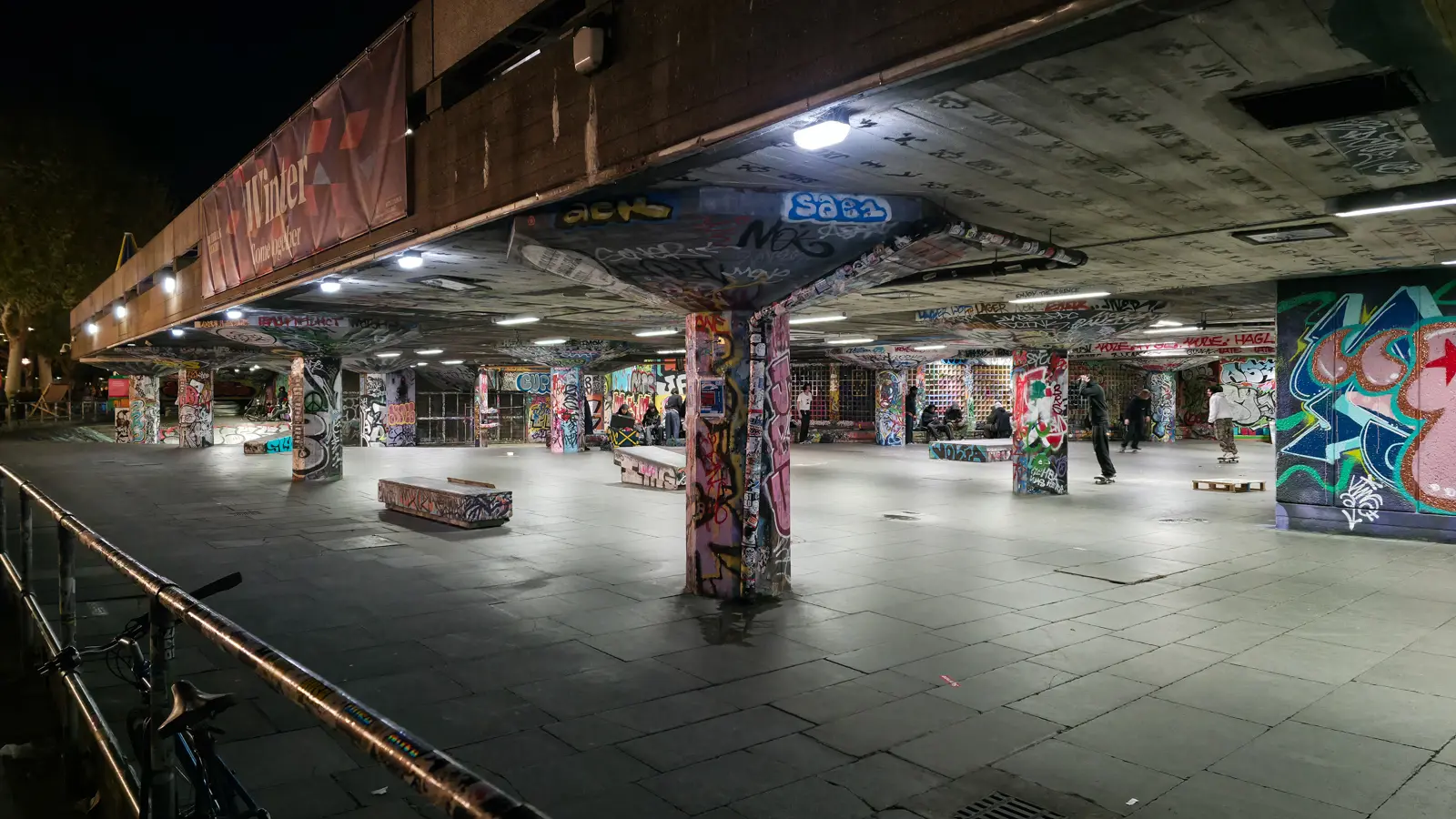
Beneath the Queen Elizabeth Hall, an open area of concrete columns and stairs was left unprogrammed when the building was completed in 1967. Skateboarders found it in the early 1970s. The Southbank Centre now describes the Undercroft as the world’s longest continually used skate spot, and the concrete is covered in layers of graffiti that have built up over fifty years of skaters, BMXers, photographers, and writers using the space.
In 2013, plans to redevelop the Undercroft into retail units prompted the Long Live Southbank campaign, which saved the space the following year. A major restoration completed in 2019 added lights and resurfaced sections without changing the feel. On a Saturday afternoon in summer the crowd watching is two-deep along the railings. On a November evening it’s quieter, but there are always skaters there, doing what one of them on the railing described to me as “creative gravity”. The vibe is unlike anywhere else on the South Bank, and quite different from anywhere on the north bank. Sharper, looser, more youth-coded.
The London Eye
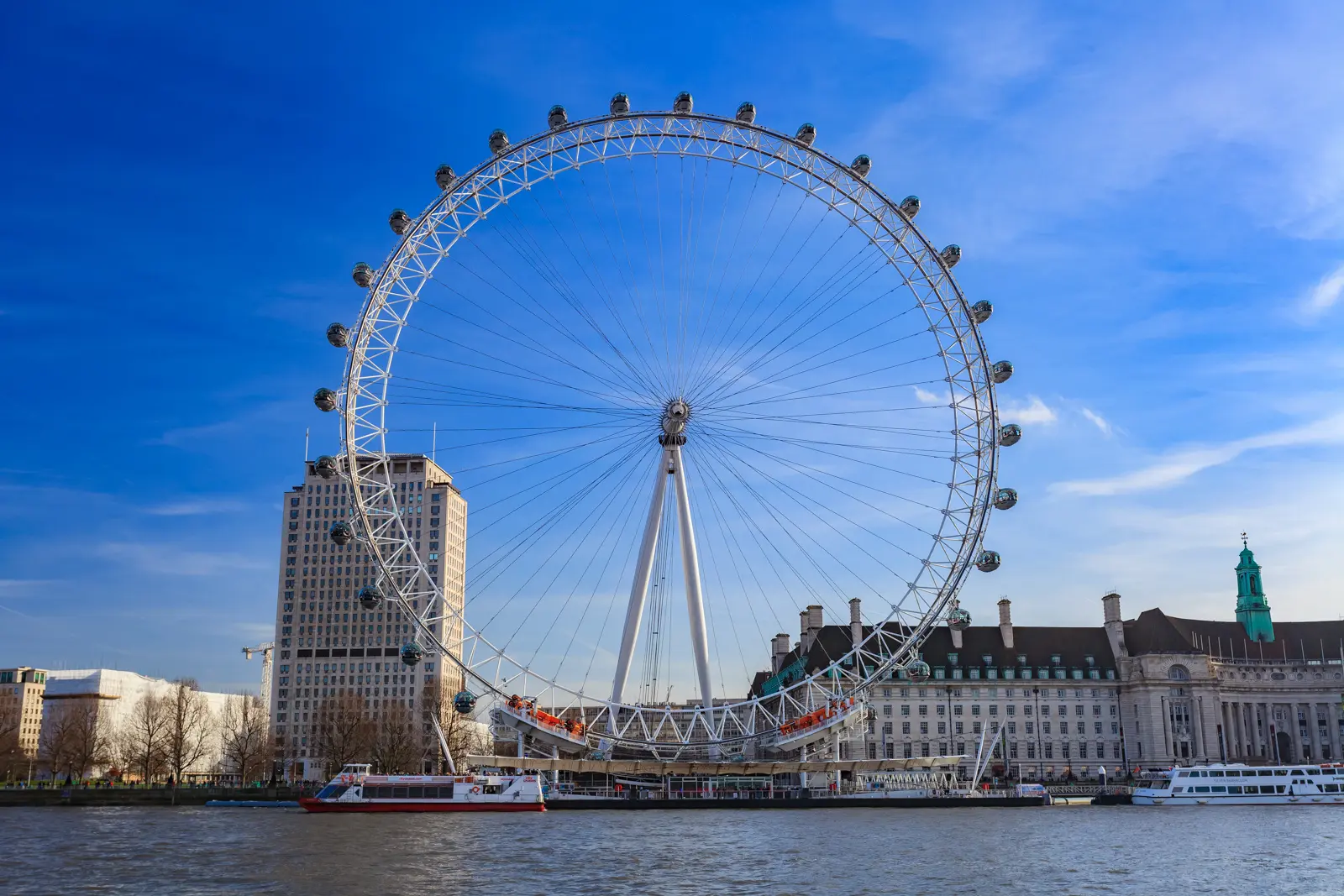
The London Eye opened in March 2000 as a millennium landmark and stayed. It was designed by Marks Barfield Architects, the husband-and-wife team of David and Julia Barfield, who originally proposed the idea in a 1993 competition for a new London landmark; no winner was ever officially announced, but they built it anyway. It was given planning permission as a temporary five-year installation. Twenty-six years later, it’s still here.
The structure stands 135 metres tall and carries 32 sealed, climate-controlled capsules, each holding up to 25 people, with a total capacity of 800 per rotation. The capsule count nods to London’s 32 boroughs (the City of London, being its own thing, doesn’t get one). The Eye sits beside County Hall, the Edwardian-baroque building that once housed the Greater London Council until its abolition in 1986, and is best photographed from across the river on the north embankment, which is where this shot is taken from. From that angle you get the wheel’s full circle against the sky.
The ride takes about half an hour for a full rotation. The wheel rotates continuously and slowly enough that you step onto the moving capsule without it stopping; it only pauses for passengers with reduced mobility. The capsules are sealed glass, air-conditioned, and reasonably steady. On a clear day, the visible horizon stretches as far as Windsor Castle, around 40 kilometres west.
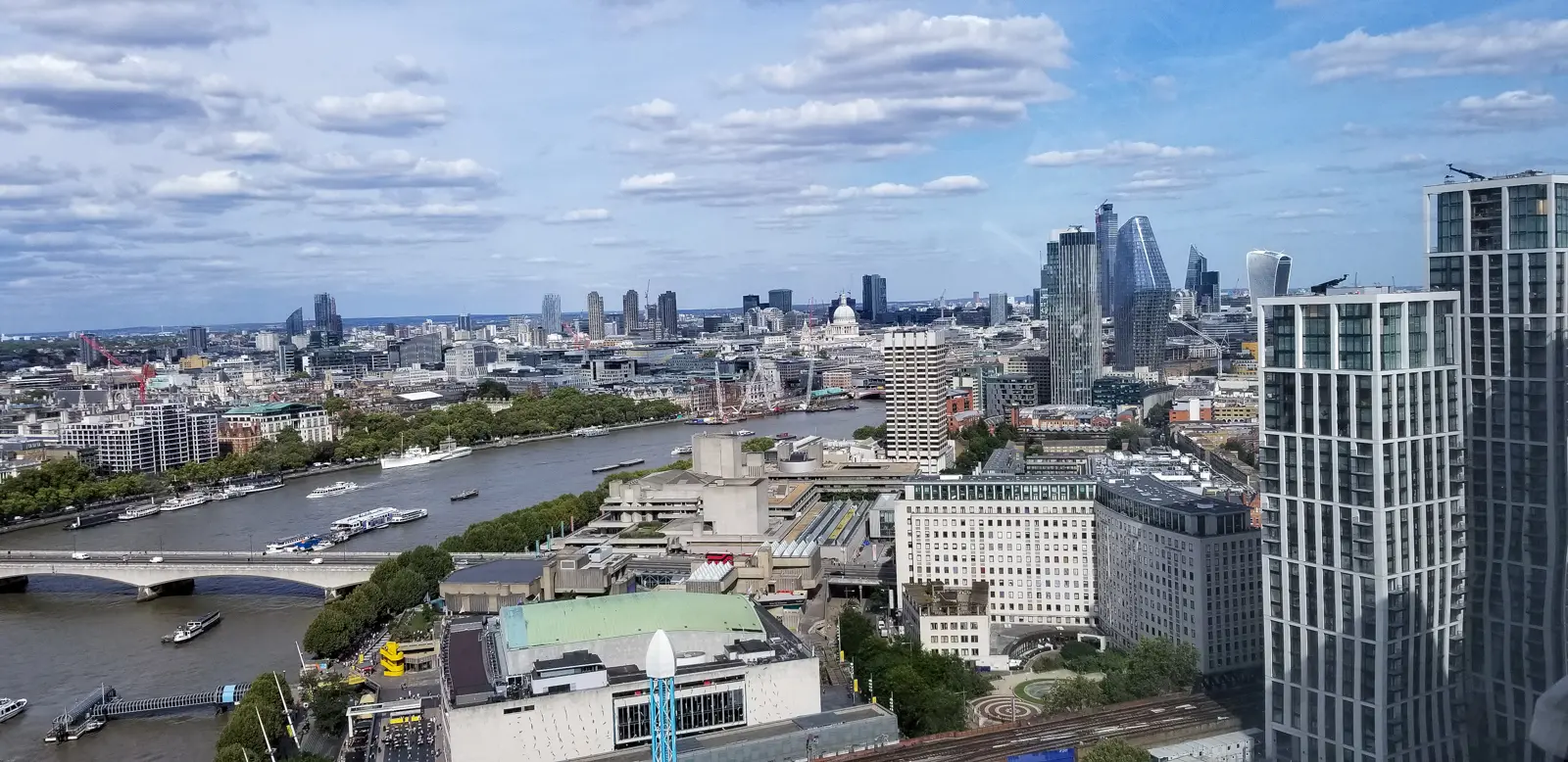
Looking northeast, the river opens up toward the City: Waterloo Bridge in the foreground, the brutalist Southbank Centre and National Theatre on the right, St Paul’s Cathedral in the middle distance, and the City cluster on the far horizon. The view I’d photograph if I had to pick one is this one, with the Thames bending out toward Tower Bridge.
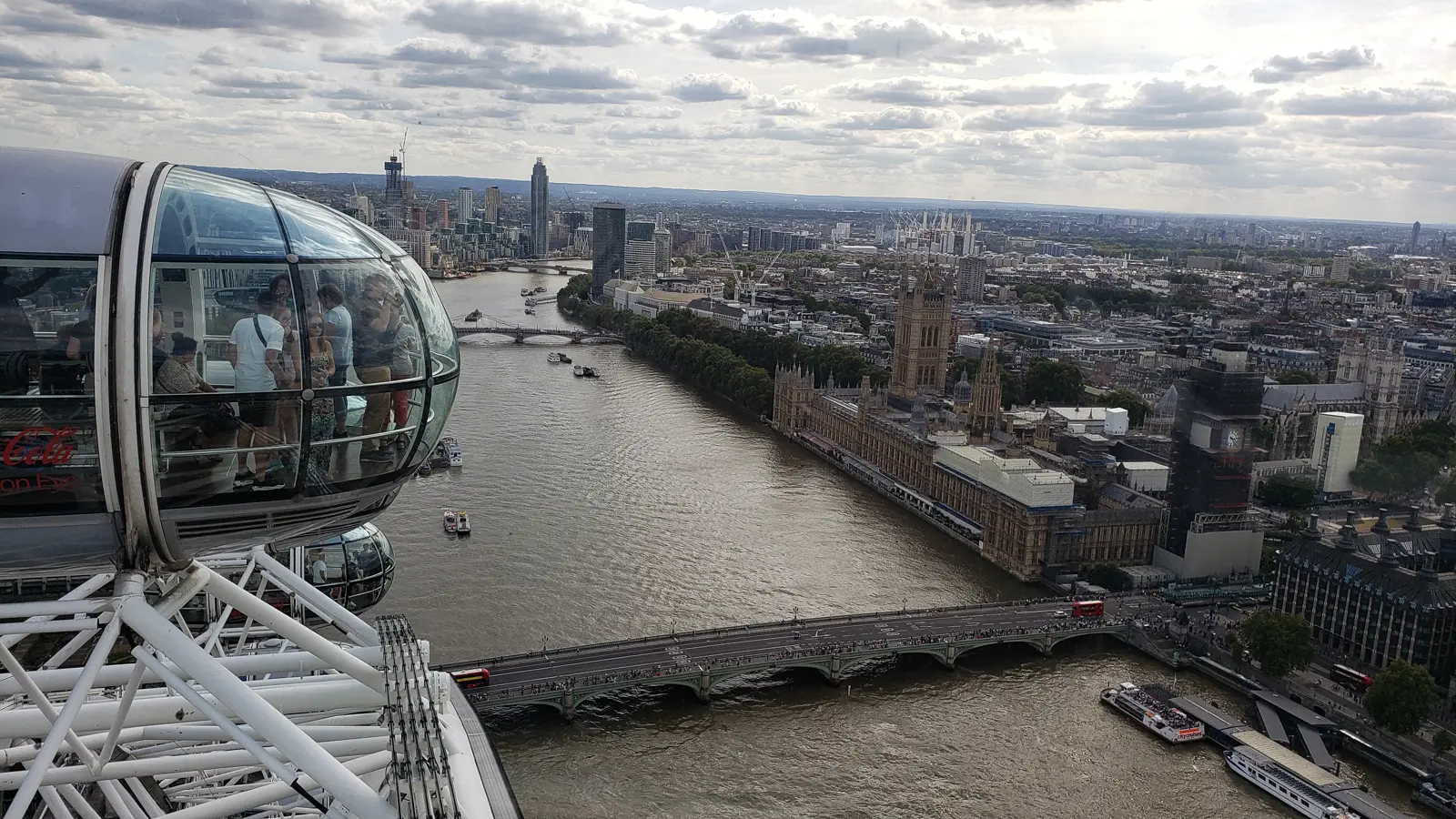
The view in the opposite direction is dominated by Westminster: the Palace of Westminster running along the embankment, the Elizabeth Tower at its southern end, and Westminster Bridge crossing toward Whitehall. When I went up in 2019, the tower was halfway through its conservation project and wearing scaffolding all the way to the clock face. The gilt pinnacle was hidden completely, the dials peeking through the framework. It’s the kind of detail that dates a photo precisely, if you took yours sometime between 2017 and 2022, this is what your shot looks like too.
Jubilee Gardens and the Carousel
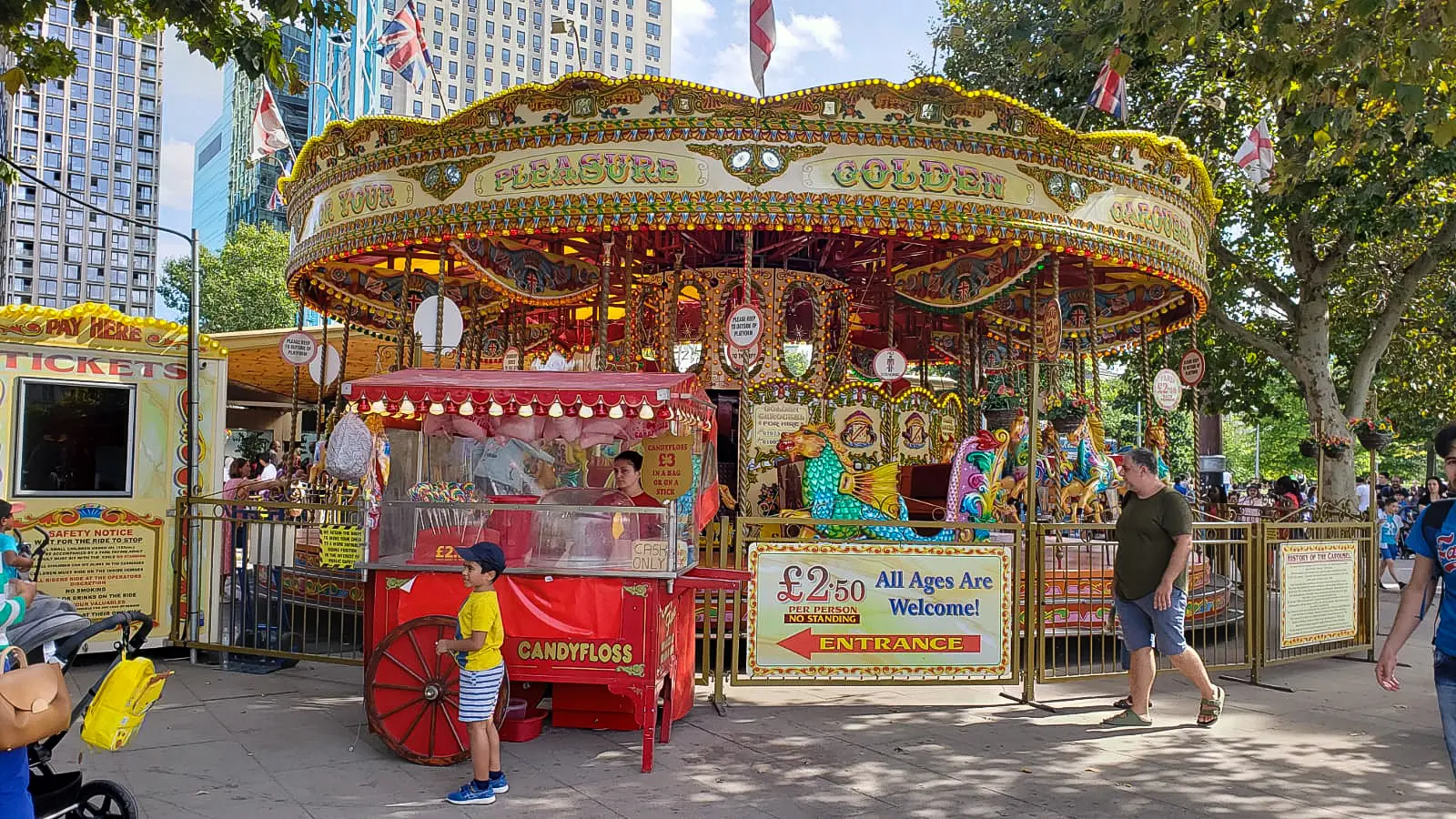
The patch of grass between the London Eye and County Hall is Jubilee Gardens, opened for the Queen’s Silver Jubilee in 1977 and rebuilt for the Diamond Jubilee in 2012. In summer, a vintage-style fairground carousel sets up beside it, with hand-painted sea-creature mounts in place of the usual horses and a candyfloss cart parked outside the gate. Rides were £2.50 when I went. The crowd is mostly families with small children, and it adds to the family-feel of this stretch of the riverside in a way that the rest of the South Bank, with its theatres and bars and food stalls, doesn’t quite cover on its own.
South Bank in Winter: Mulled Wine, Christmas Markets, and Illuminated Lights
The South Bank in winter is a different post entirely. From mid-November through early January, the Southbank Centre Winter Market sets up alongside the Royal Festival Hall: Alpine-style wooden chalets in two rows, strung with warm white lights, selling raclette and bratwurst and crêpes and gluhwein.
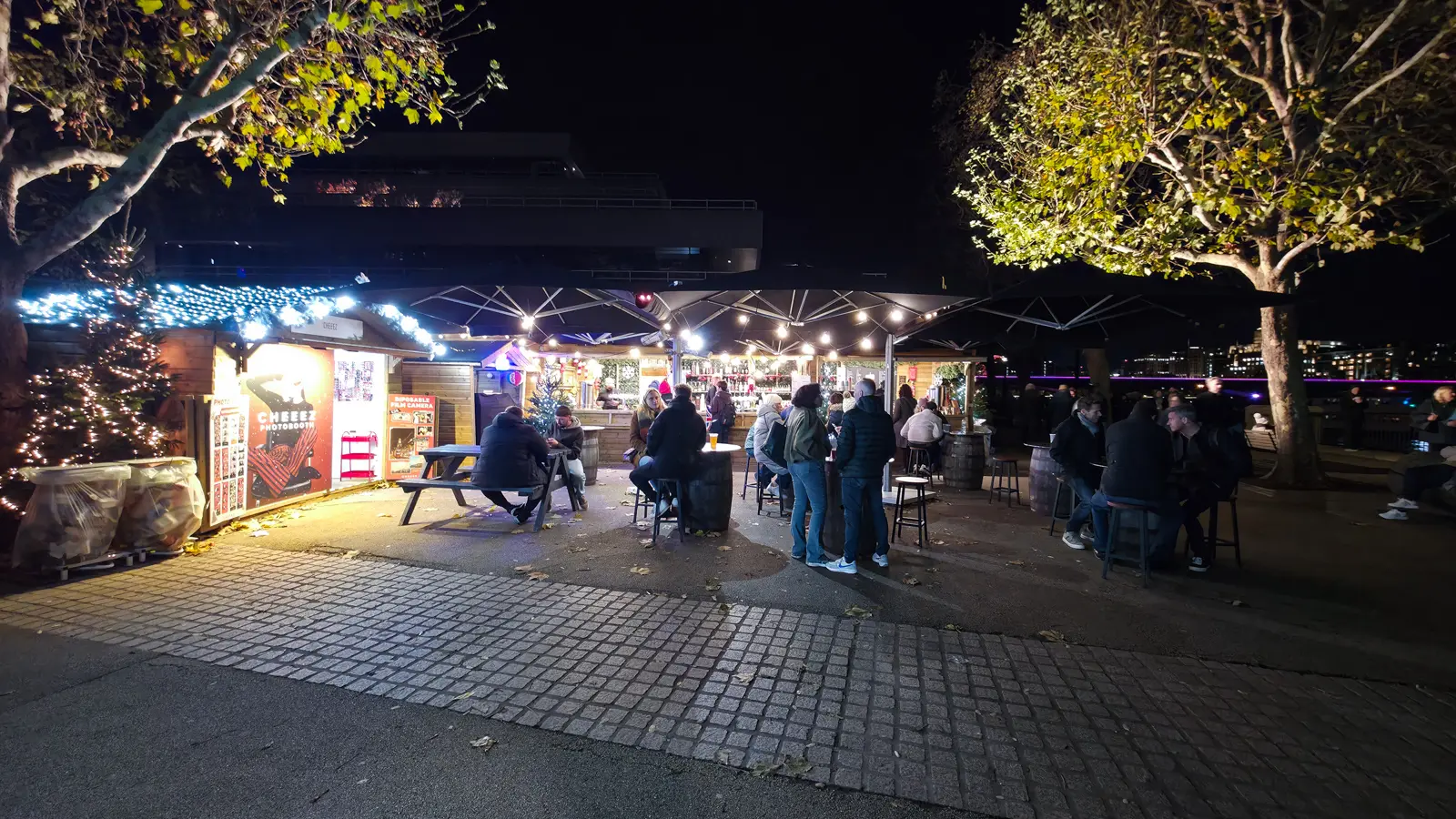
What I like about this market more than the others in central London is the rhythm of it. Compared to Winter Wonderland in Hyde Park, the Southbank version is less of an event and more of a hangout. People stand at wine-barrel tables under the strings of bulbs with a raclette in one hand and a gluhwein in the other, in no rush to go anywhere. The crowd builds in the late afternoon and stays through the evening, but it doesn’t crush. Bar stools usually have seats if you don’t mind eating on your feet for the first ten minutes.
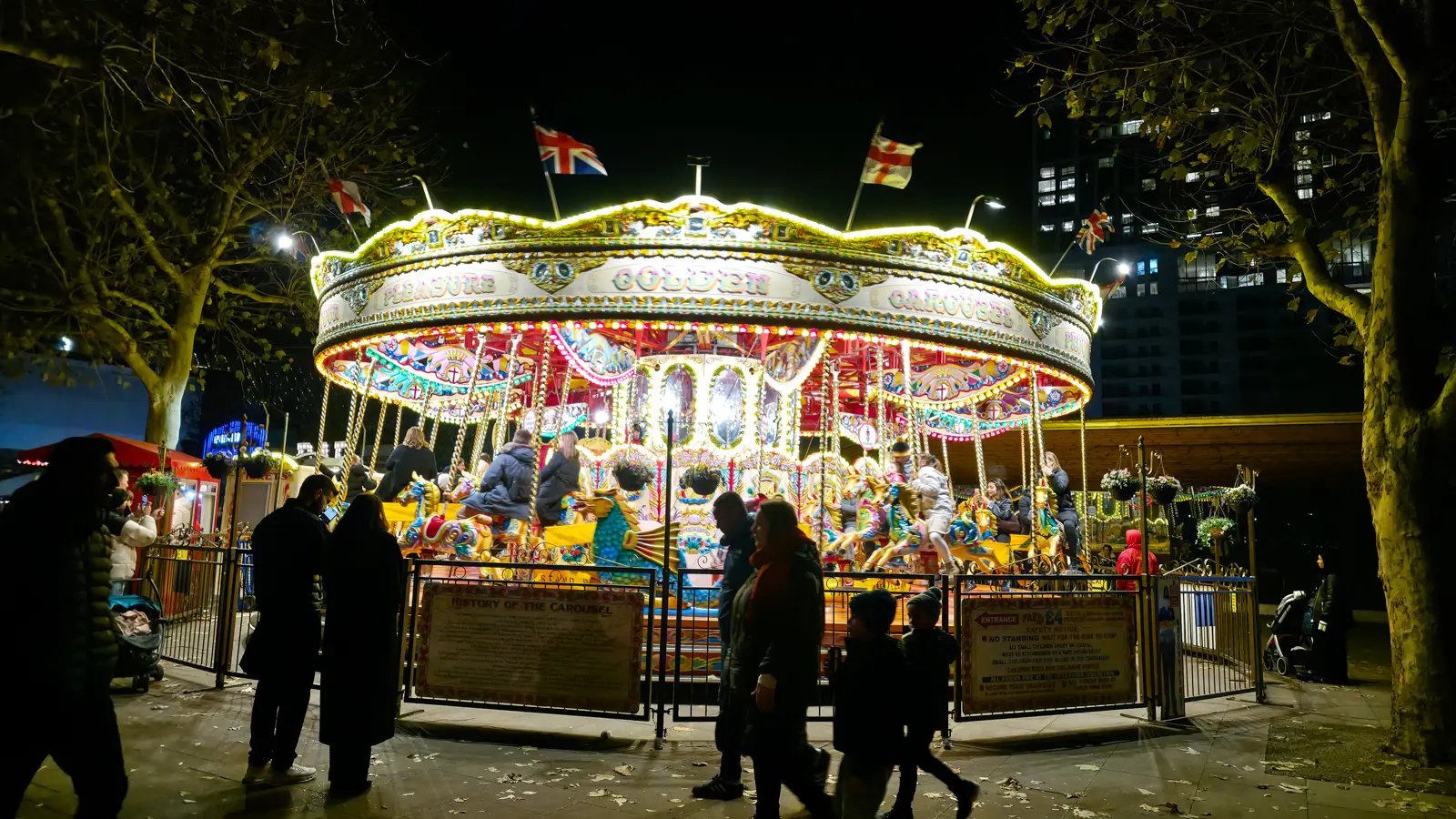
Just past the chalets, the same carousel that runs here in summer is back, but lit up now. The sea-creature mounts glow under the bulbs strung around the canopy, and on a cold December evening it pulls a steady crowd. I watched parents helping toddlers onto the mounts. I watched a group of teenagers climb on like it was an inside joke. I watched a couple in their thirties ride it without any kids at all. The kid in me wanted to get on too, but I had a mulled wine I wasn’t ready to put down. Next year.
The whole stretch from Hungerford Bridge to the National Theatre takes on a different rhythm in winter: slower, denser, the crowds bundled in coats, stopping at stalls for food and mulled wine and the kind of evening that doesn’t need a plan. The mulled wine cups are deposit-return, and you can keep the cup if you want.
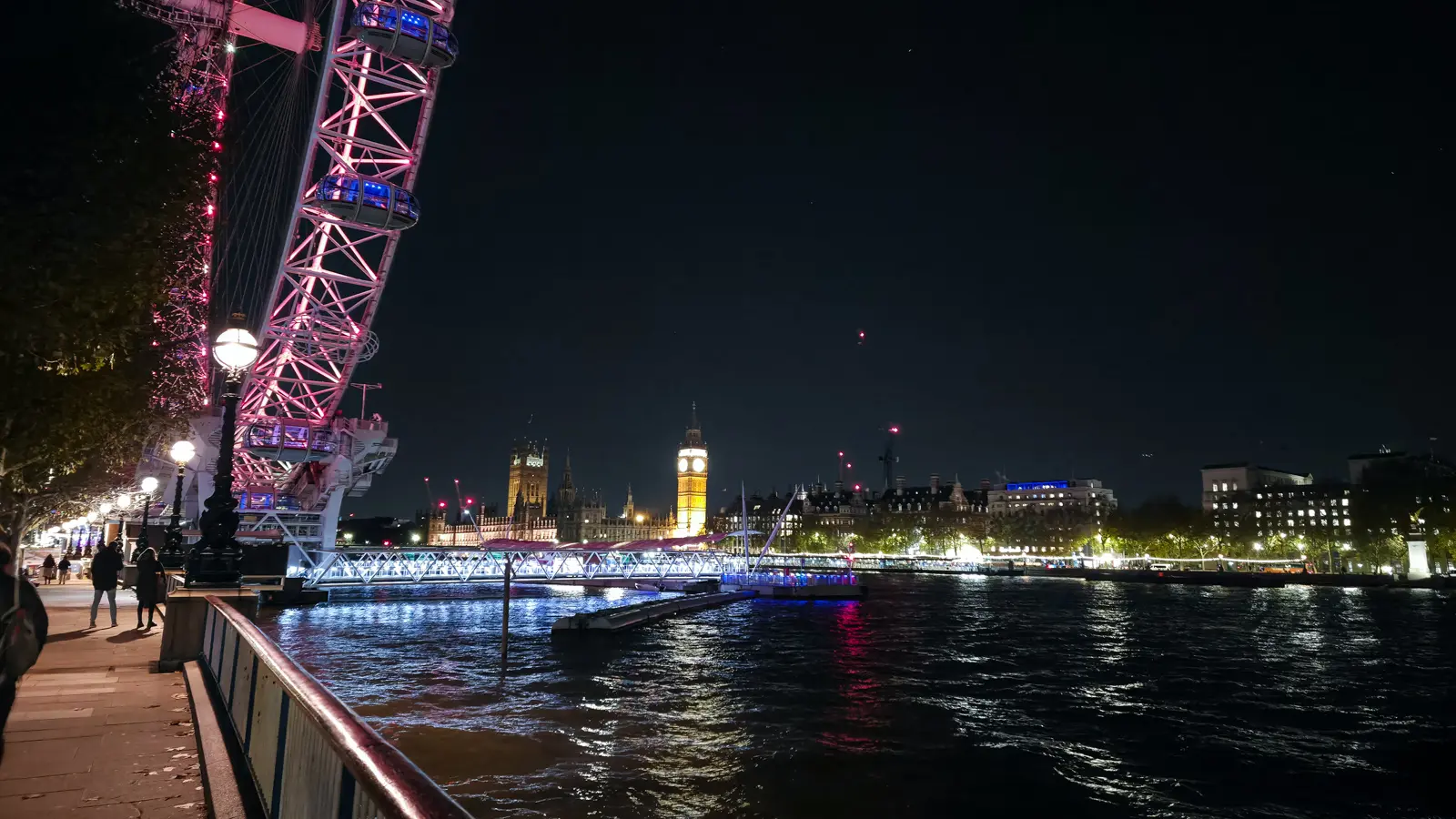
The Eye picks up coloured lighting after dark. On this December evening it was lit in pink and red. From the South Bank Queen’s Walk you get the view across the river: Big Ben‘s clock face glowing warm gold against the dark sky, the Palace of Westminster running along the far bank, the river holding both colours back as reflections. The Eye’s lighting changes by date and event. The Elizabeth Tower’s lighting is steady.
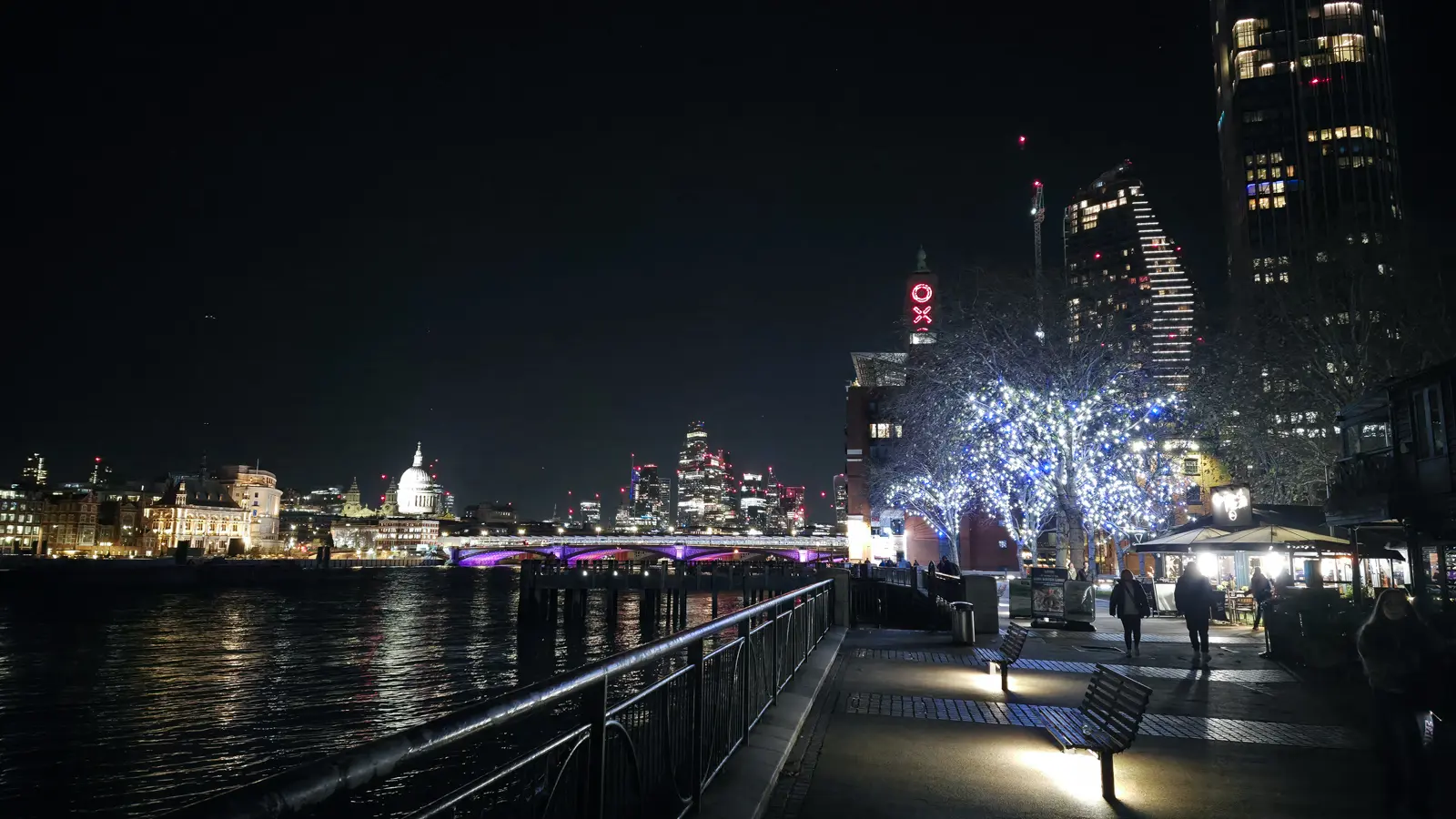
Walking east past the National Theatre, the South Bank quietens and the Christmas lighting takes over. The plane trees along the riverside between the OXO Tower and Tate Modern are wrapped in white string lights from mid-November onward, and the OXO Tower’s red lettering glows over the Thames opposite St Paul’s. Uber Boats by Thames Clippers run later into the evening, the piers stay lit, and the river itself reflects everything back. It’s calmer than the summer South Bank but not empty. Just thinner.
Bubbly Tips for Visiting the South Bank
- Go in both seasons if you can. Summer is the food market, the book browsing, and the skyline shots. Winter is the Christmas market, the illuminated carousel, and the mulled wine. They’re two different posts in two different moods, and a one-season visit only gets you half of it.
- Wahaca’s Mexican Street Kitchen truck is by Queen Elizabeth Hall, not at the main restaurant entrance. Walk along the riverside terrace and look for the pink and turquoise truck. The takeaway burritos are smaller and quicker than the sit-down menu, fine for eating on a bench.
- The book market under Waterloo Bridge is best on weekends. Not all eight stalls open every day, and the weather affects whether anyone trades at all. Bring cash; some stalls don’t take card. The selection is densest if you go before noon.
- Cross to the north embankment for the best London Eye photo. The full wheel only fits in the frame from across the river. Walk over the Golden Jubilee Footbridge from the Eye side and shoot back from in front of the Whitehall Gardens.
- The Undercroft is busier on Saturday afternoons. If you want to watch the skating without crowding the railings, weekday evenings are quieter. The lights come on around dusk and the brutalist concrete looks especially good when half-shadowed.
- The Southbank Centre Winter Market typically runs mid-November to early January. Open daily, busiest in the late afternoon and evening. The mulled wine cups are deposit-return; you can keep the cup if you like. Bring layers – the river wind cuts.
- Walk west of Westminster Bridge for emptier views. Most tourists stop at the Eye. Keep walking past County Hall toward Lambeth Bridge for a quieter promenade with smaller crowds.
- Plan three to four hours minimum for the central stretch. Westminster Bridge to Waterloo Bridge takes about thirty minutes at walking pace if you don’t stop. Add the food market, the book market, the Undercroft, and either the Eye or a walk down to Tate Modern, and you have an afternoon.
Final Thoughts
The South Bank is the only stretch of central London I would tell someone to walk twice: once in summer to find the food and the books and the open river, and once in winter to find the lights and the markets and the steam off a paper cup. Most landmarks in London give you one good visit. This one gives you two.
The Sherlock Holmes paperbacks I picked up at the book market in 2019 are still on my shelf. The chicken burrito I ate by the river that same afternoon is the one I think of when someone asks me where to eat on the South Bank. The mulled wine I drank by the illuminated carousel last December was the moment that whole winter trip pivoted on. None of these are landmark experiences. They’re walking experiences, and the South Bank rewards them.
Until next time!

🌟 Everything You Need to Plan Your Dream Trip in 2026
- 🌟 Luxury Hotels - Find premium stays with Booking.com & Hotels.com
- 🏡 Vacation Rentals - Discover unique properties on VRBO
- 🏞️ Guided Tours - Explore with Viator or GetYourGuide
- 🎫 Attraction Tickets - Skip the lines with Tiqets
- 🚢 Ocean Cruises - Set sail with Cruise Direct
- 📱 International SIMs - Stay connected with Saily
- 🚗 Car Rentals - Budget-friendly options from Discover Cars
- 🌐 Secure VPNs - Browse safely with NordVPN
- 💶 Currency Exchange - Best rates with Wise
- 🗣️ Learn Languages - Master the local language with Babbel and Rosetta Stone