
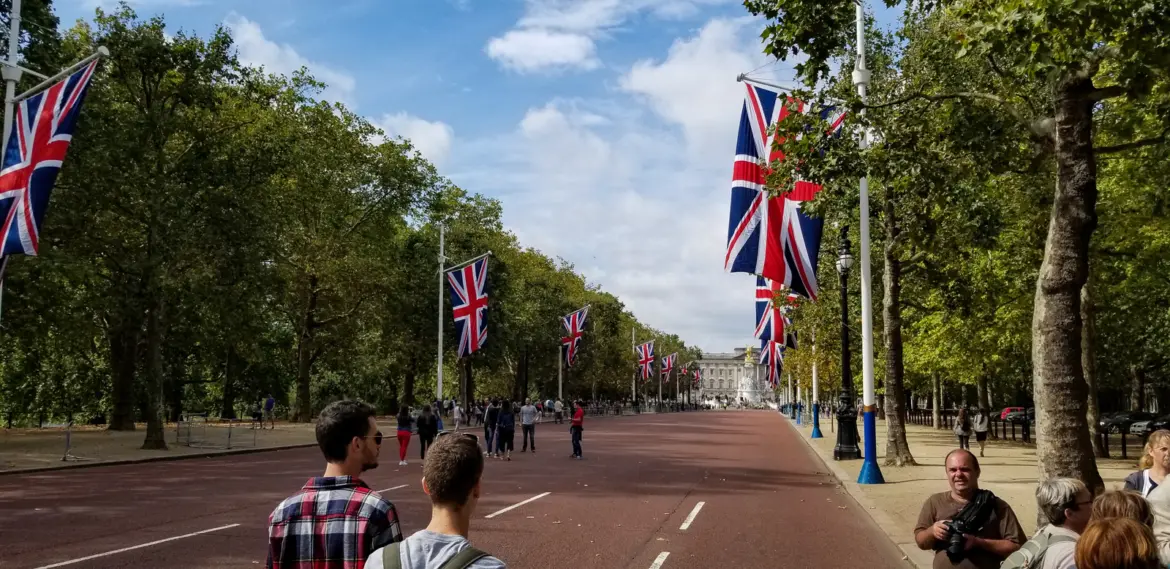
I had heard the name for years. Whenever something big was happening in London, a royal wedding, a jubilee, a state funeral, the cameras always seemed to be pointing down the same broad, flag-lined road, with Buckingham Palace sitting at the far end like a full stop. I knew it was called The Mall. What I did not know, until I walked it myself, was that this is not an ordinary street at all. It is a purpose-built ceremonial avenue, laid out on purpose as a grand approach to the palace, and once I understood that, the whole place read differently.
I walked it on a bright morning, starting near Trafalgar Square and heading west toward the palace, which turns out to be the same direction a royal procession travels. The road runs a straight kilometre under two long rows of plane trees, its surface a deep oxblood red, with Union flags hanging from poles the whole way down. St James’s Park sits on one side, Green Park and St James’s Palace on the other. And because this is the working route between the soldiers’ barracks and the palace, there is no need to wait for a coronation to see the pageantry. On a normal weekday morning, it comes marching straight down the avenue.
The Mall at a Glance
📍 Where · The City of Westminster, running from Admiralty Arch at Trafalgar Square to Buckingham Palace, between St James’s Park and Green Park.
📏 Length · Exactly half a nautical mile, about 0.93 km, of oxblood-red road, coloured since the 1950s to read like a red carpet to the palace.
🎺 The spectacle · Changing the Guard, properly Guard Mounting, normally Mondays, Wednesdays and Fridays at 11:00. Free, no tickets. Check the Household Division schedule on the day.
👀 Best view · Palace railings for the close handover, the Victoria Memorial steps for the raised view, the Mall or the St James’s side for the marching and the band.
🍁 Don’t miss · The Dominion Gates, including the grand Canada Gate, and the Latin inscription and hidden nose on Admiralty Arch.
🚫 Closed to traffic · Weekends, public holidays and ceremonial days, when you can walk the red road itself.
🚇 Getting there · Green Park or St James’s Park Underground, a short walk from either end.
A road built for processions
The Mall began life as something far more frivolous. King Charles II had it cut through St James’s Park in 1660 as a long alley for playing pall-mall, a French game a bit like croquet that gave both the Mall and nearby Pall Mall their names. For a couple of centuries it was a fashionable place to stroll and be seen, lined with those same avenues of trees.
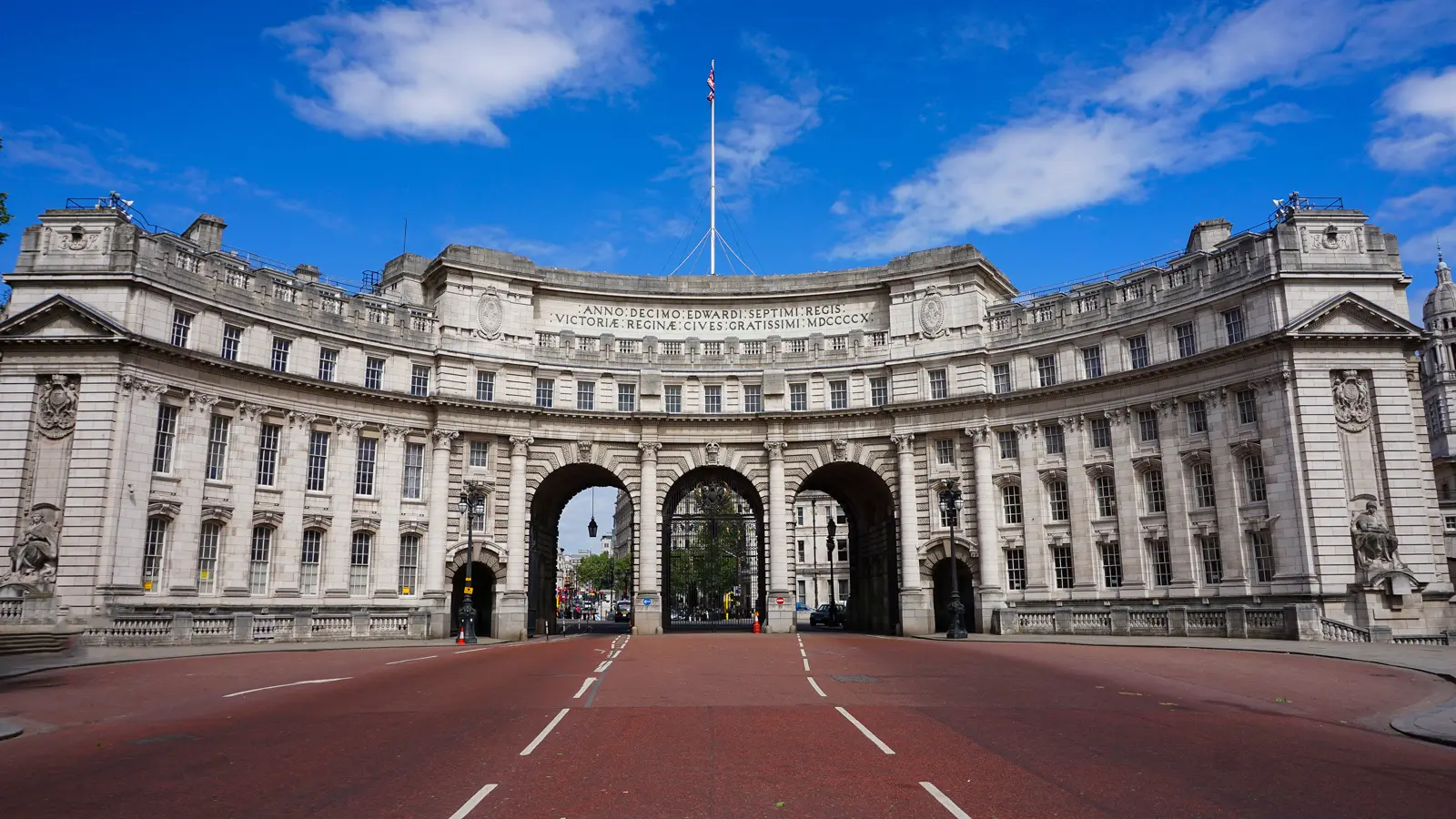
Its grand makeover came much later. After Queen Victoria died in 1901, a vast memorial scheme was commissioned in her honour, and the architect Sir Aston Webb was put in charge of the whole thing. Between 1901 and 1911 he reworked the Mall into a formal processional route running from Trafalgar Square to Buckingham Palace, gave the palace a new front façade to face down the avenue, and set the Victoria Memorial at the palace end. The same scheme gave the road its eastern gateway, Admiralty Arch, the great curved stone building that frames the view on the way in from Trafalgar Square.
The famous red surface came later still. The road has been coloured this deep oxblood red only since the 1950s, using a synthetic iron oxide pigment, the idea being to make the whole avenue read like a giant red carpet rolled out toward the palace. The decision is credited to David Eccles, the Minister of Works at the time. On ceremonial days and at weekends the Mall closes to traffic completely, and the flags do a lot of the talking: Union flags for most of the year, the flags of a visiting country flying alongside them during a state visit, and flags lowered to half-mast during periods of mourning.
The daily formality
Here is the part nobody told me about. Because the Mall is the route the soldiers actually use to get between Wellington Barracks and the palace, the spectacle happens on ordinary mornings, and it is completely free to watch. I had stumbled into it without planning a thing.
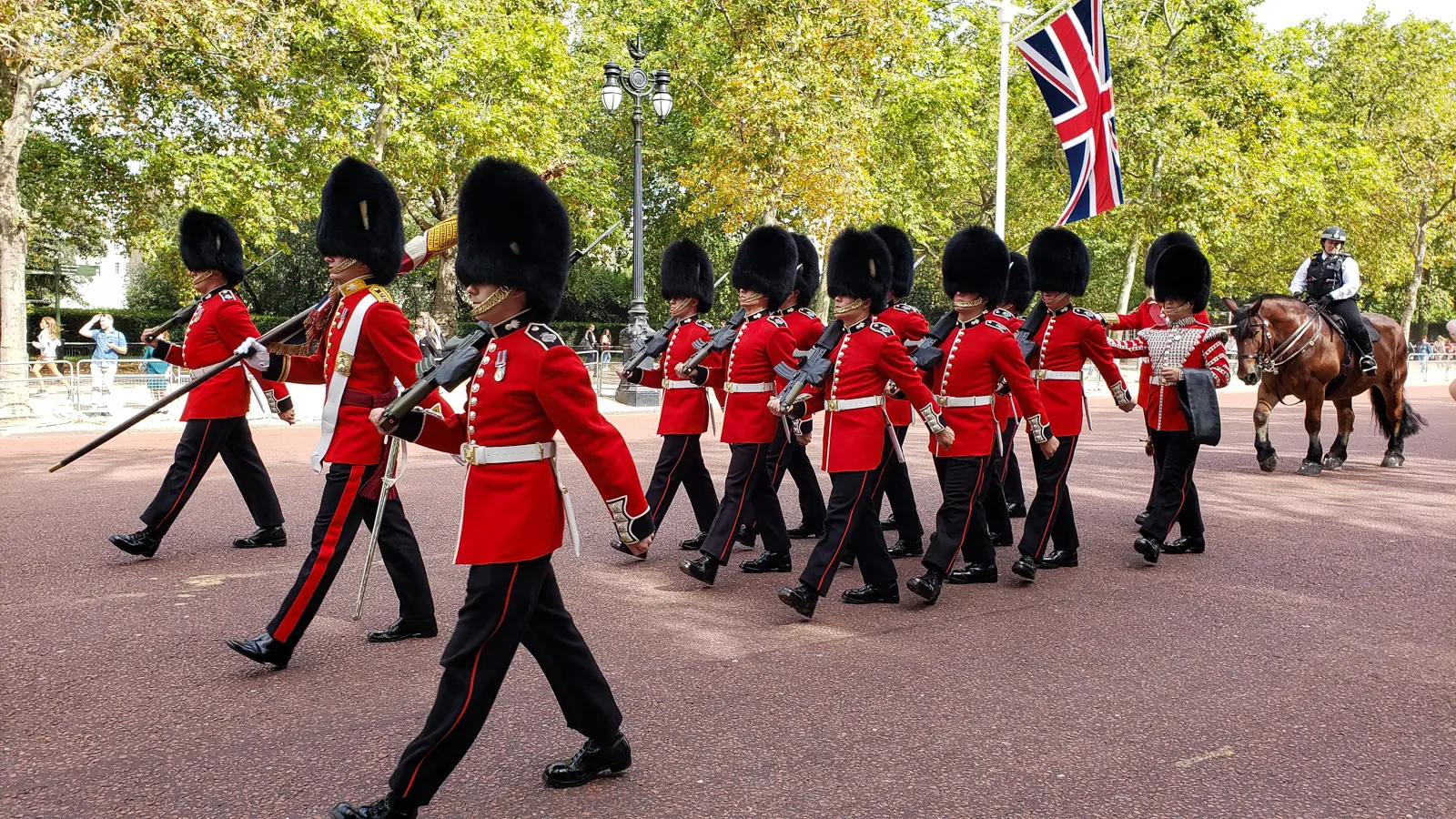
First came the Foot Guards, the soldiers in the scarlet tunics and tall black bearskin caps that everyone pictures when they think of Buckingham Palace. They marched in tight formation down the centre of the red road, an officer with a drawn sword at the front, a mounted police rider keeping pace alongside, the whole column moving with that precise, unhurried rhythm that brings everyone nearby to a standstill.
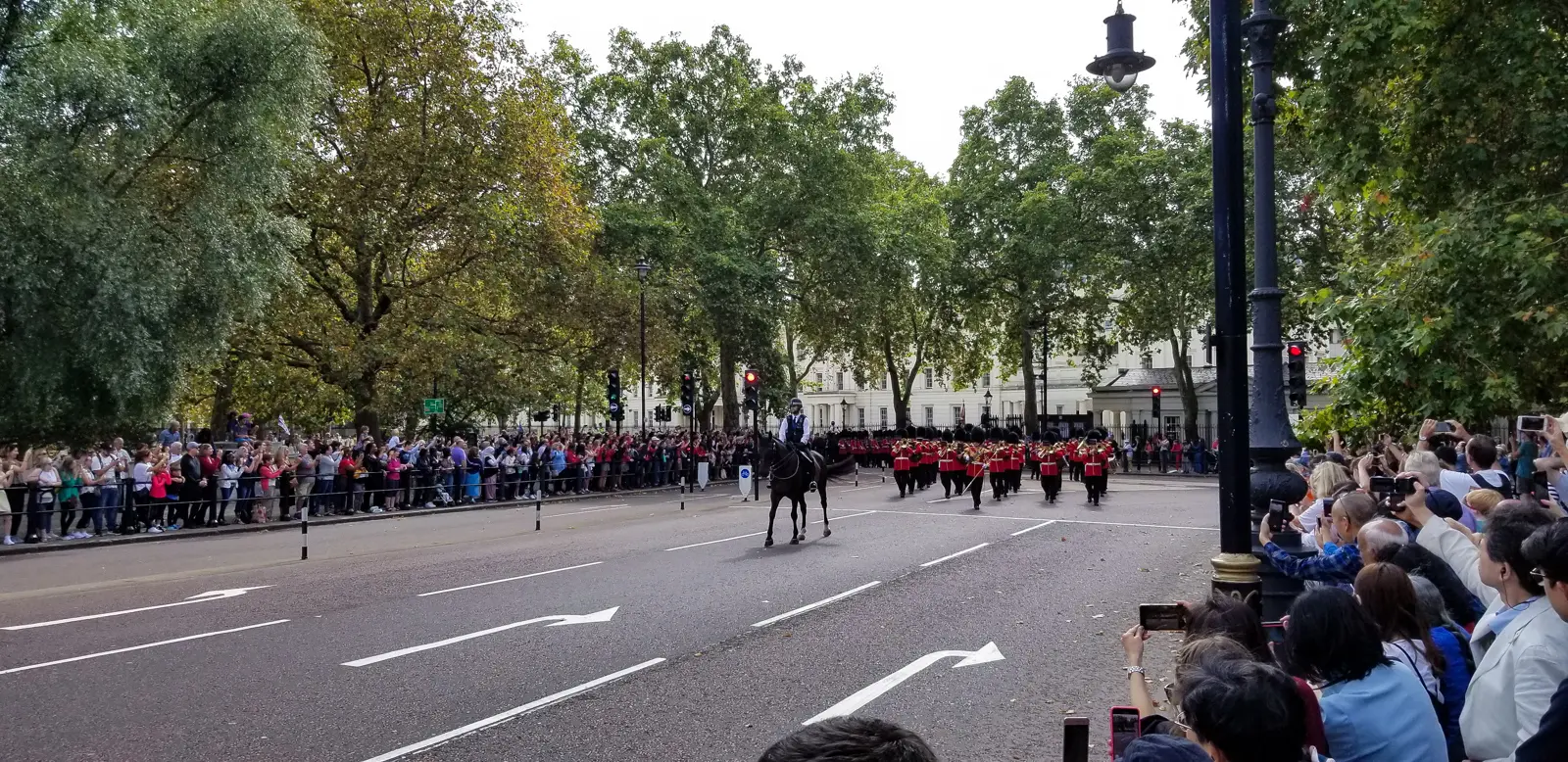
A little later the band came through, and the crowd thickened along the railings, phones up. The musicians wore the same red and bearskins, led by their own drum major, with another mounted officer clearing the way and a wall of onlookers pressed in on both sides. This handover of duty between the outgoing and incoming guards has a formal name, Guard Mounting, though most people know it simply as Changing the Guard. The full ceremony spreads across three sites, Buckingham Palace, St James’s Palace and Wellington Barracks, and runs about forty-five minutes from start to finish.
Red coats and a Canadian eye
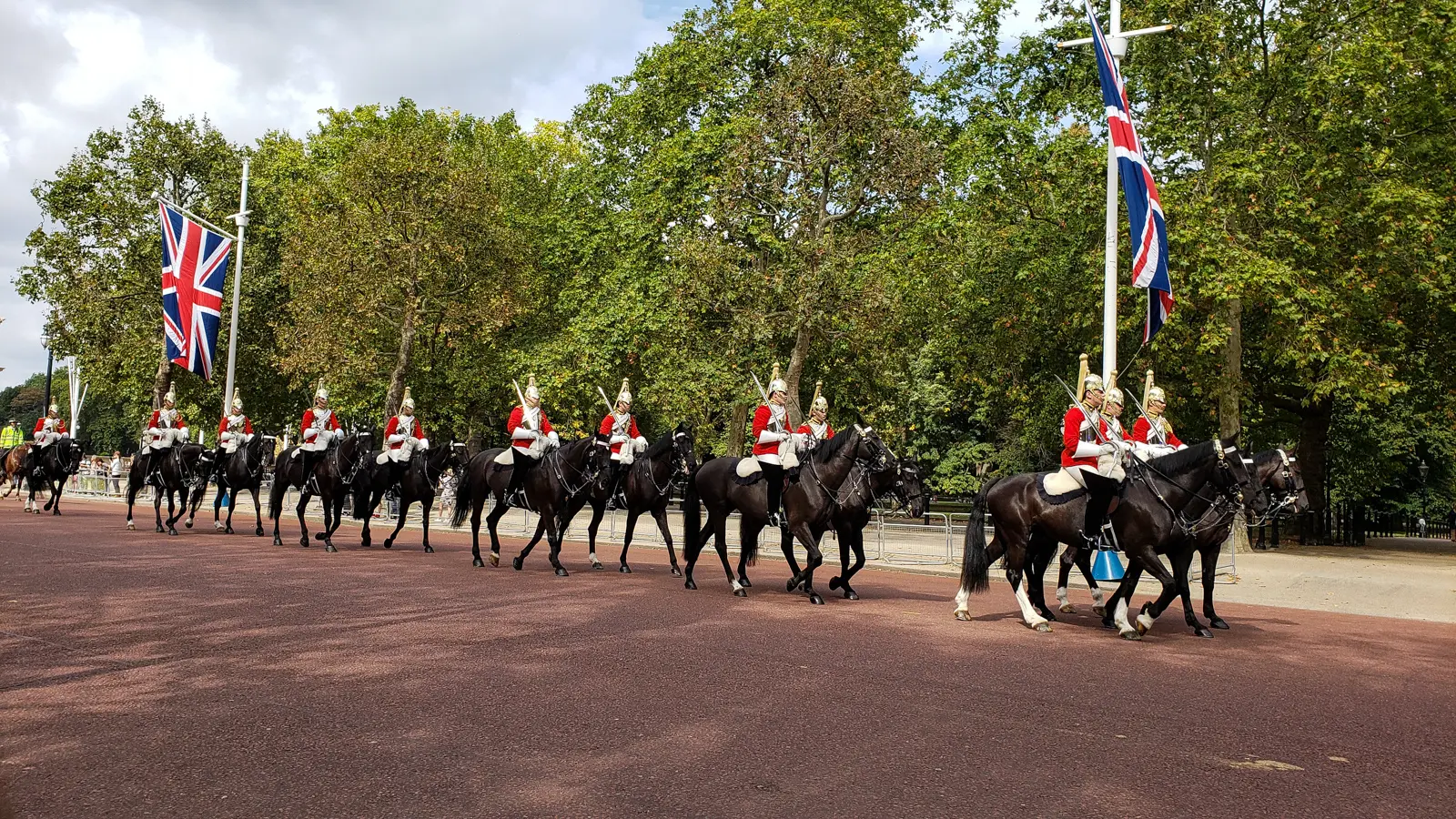
Then the cavalry arrived, and as a Canadian, this was the moment that caught me off guard. A column of Household Cavalry came riding down the Mall on dark horses, the troopers in gleaming scarlet tunics, white breeches and plumed metal helmets, swords drawn and upright. Something about all that red on horseback looked oddly familiar from home.
The resemblance to our own Mounties is no coincidence, though it is not a copy either. The Royal Canadian Mounted Police‘s famous red serge traces back to the North-West Mounted Police of the 1870s, who adopted a scarlet tunic in the British Army pattern. The colour was chosen partly to set the Canadian force apart from the blue uniforms of the United States Army across the border, and partly for the long weight of the red coat in British military tradition. The Mounties are a mounted ceremonial force too. Their Musical Ride, scarlet officers wheeling on black horses, is based in Ottawa, tours widely through the summer, and still rides as a royal escort: in 2025 the Ride escorted King Charles III to the opening of Canada’s Parliament. The link runs both ways across the Atlantic, and at her own request, RCMP riders led part of Queen Elizabeth II‘s funeral procession through London in 2022. So the scarlet riders coming down the Mall were closer to home than they first looked.
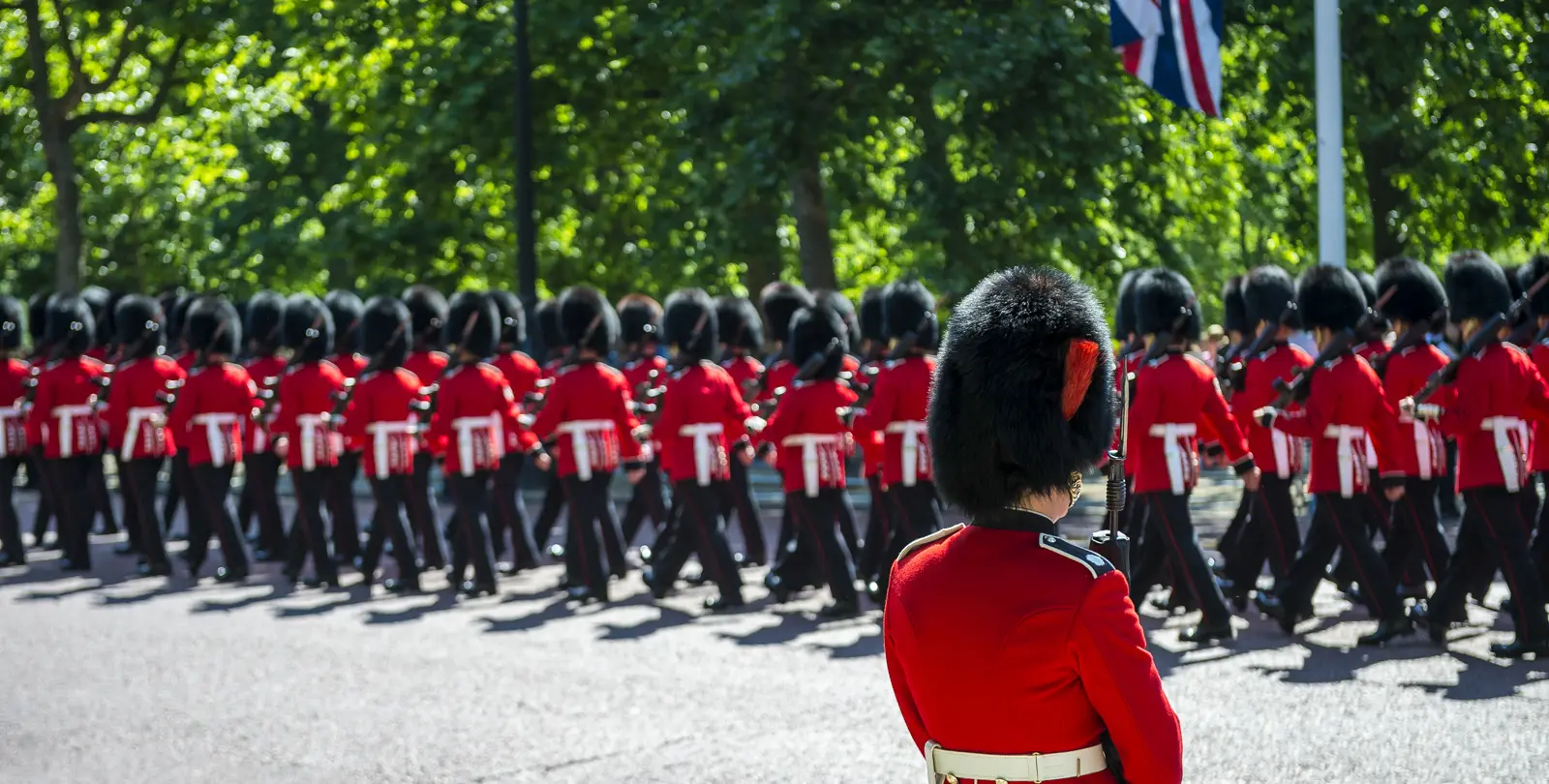
The foot guards add a second Canadian thread, and this one surprised me. Their plain scarlet tunic is the closest in cut to the red serge, even if the tall black bearskin cap goes its own way, since the Mountie’s own signature hat is the wide-brimmed Stetson. The cap holds a Canadian secret all the same. The bearskins worn outside Buckingham Palace are made from the fur of the Canadian black bear, so a small piece of Canada rides on the heads of the King’s Guard every day they parade.
The Commonwealth at the gates
The closer I got to the palace end, the more the wider British and Commonwealth story started showing up in the ironwork. Around the great traffic circle in front of Buckingham Palace stand a set of ceremonial gates known as the Dominion Gates, given by countries that were the senior dominions of the empire when the memorial was built.
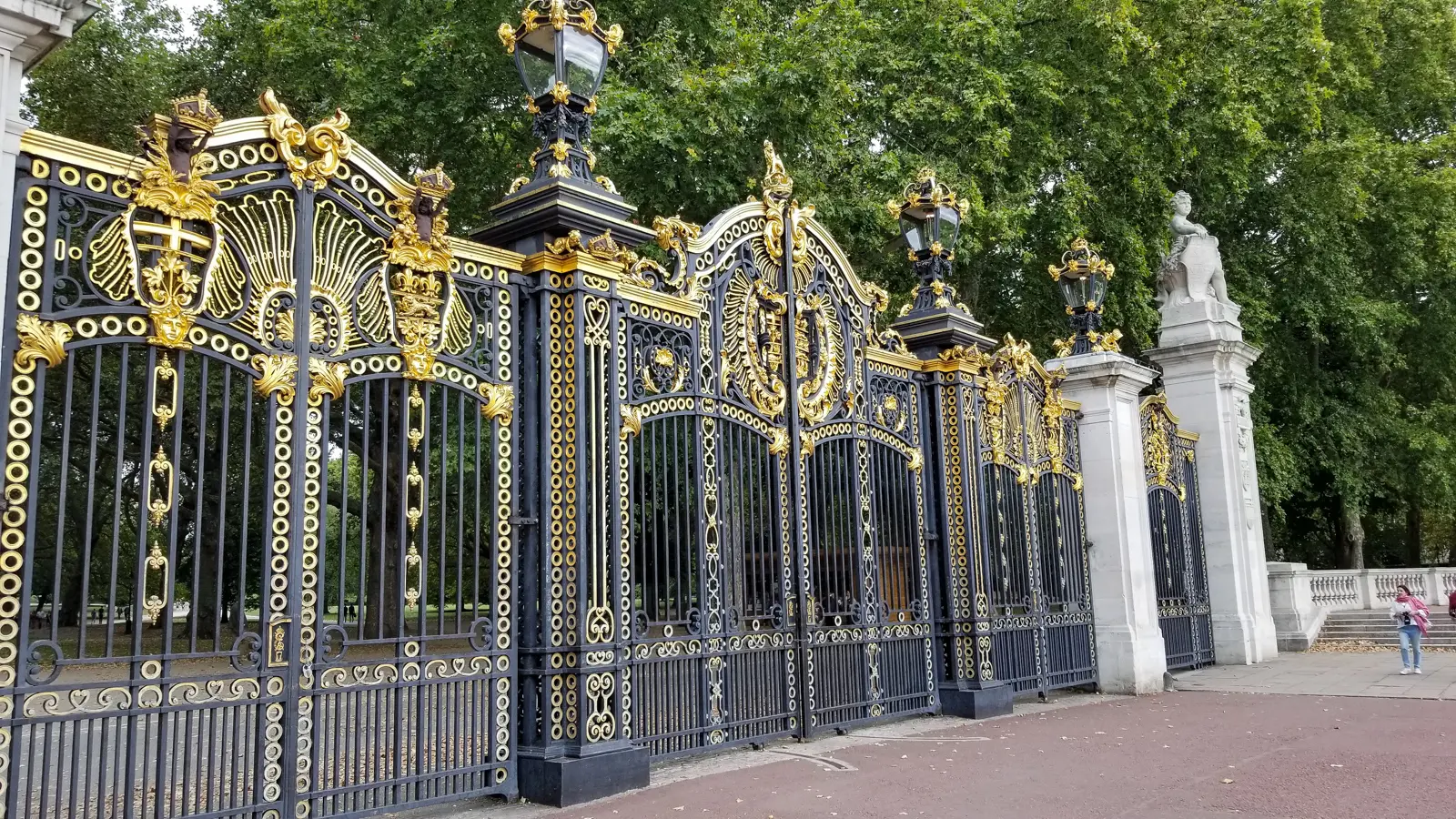
The grandest of them is the Canada Gate, and I will admit I was a little proud to find it. It was a gift from Canada, at the time the most senior dominion, presented as part of the Victoria Memorial scheme. It forms the main ornamental entrance into Green Park, a tall screen of black wrought iron picked out in gold, in the same style as the gates of the palace itself, and it carries the coats of arms of the Canadian provinces of the day. The shield I could pick out near the left reads as the cross of Saint George above a maple sprig, the arms of Ontario, and the big gilded crest in the centre is Canada’s old coat of arms.
Canada was not the only nation to contribute. Australia and South and West Africa gave their own gates too, smaller than Canada’s, set on the St James’s Park side of the memorial. Together they turn the approach to the palace into a quiet map of the old empire, with each country’s heraldry worked into the gold. It is the kind of detail most visitors walk straight past on their way to photograph the palace, but it rewards a slower look.
The palace end
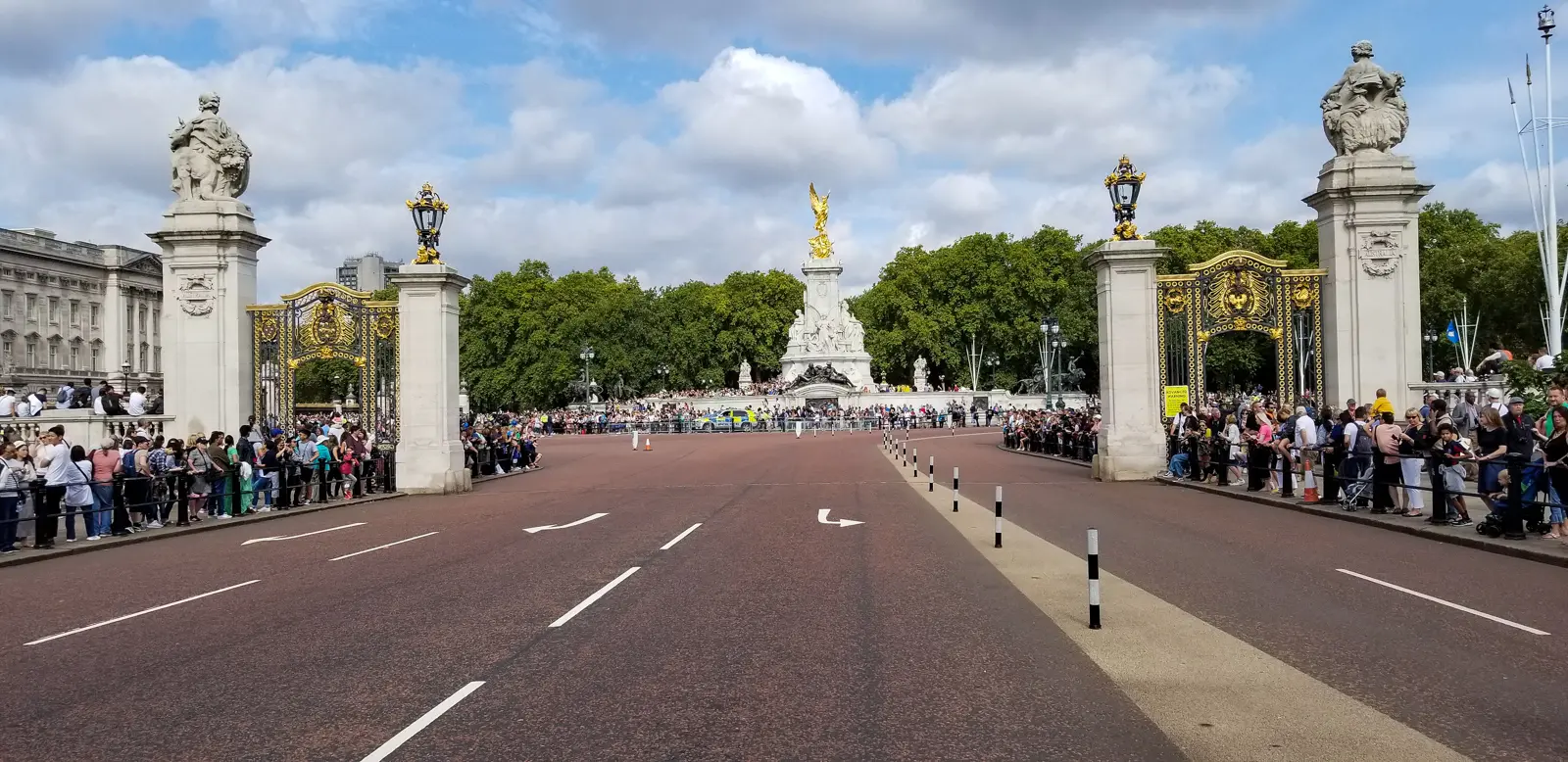
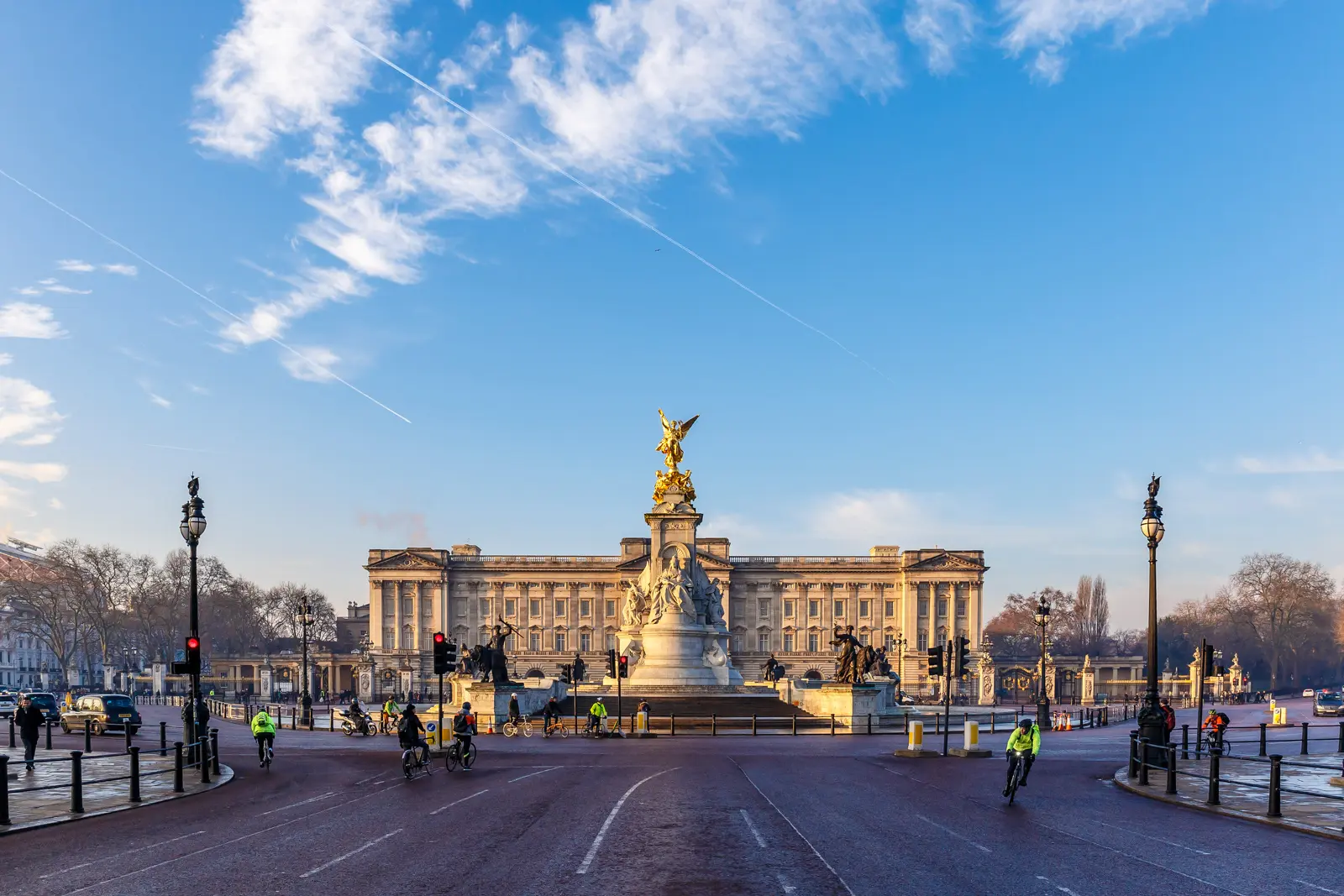
And then the road simply arrives. The Mall opens out into a broad circle, and there, closing the whole vista, is Buckingham Palace, with the white marble Victoria Memorial rising in front of it and its gilded figure catching the light at the very top. After a kilometre of red road and flags and marching soldiers, the destination lands exactly as Aston Webb intended it to: as the grand full stop at the end of a sentence written for processions.
It is worth standing here for a moment and looking back the way I had come, because this is the view a monarch sees when escorting a visiting head of state up the avenue in a carriage, the flags running away into the distance toward the arch.
Bubbly Tips
- Time your visit around Changing the Guard. The ceremony normally runs on Mondays, Wednesdays and Fridays at 11:00, though in recent years it has moved to selected dates rather than every one of those days. Check the official Household Division schedule on the morning of your visit, as it can change at short notice or be cancelled for weather or state events.
- It is free, and you do not need tickets. Anywhere along the railings or the Mall is fair game. The only currency is arriving early.
- Pick your spot for what you want to see. The palace railings give the closest view of the handover, the steps of the Victoria Memorial give a raised view over the whole circle, and the Mall or the St James’s Palace side are calmer and far better for photographing the soldiers and band marching past.
- Watch the march, not just the forecourt. Much of the best action happens in the open street. The New Guard steps off from Wellington Barracks at around 10:57, and the Household Cavalry ride along the Mall past the Victoria Memorial at roughly 10:45 on their way to Horse Guards, then again near 11:37 on the way back.
- Arrive early on busy days. For a front-row place at the palace railings in peak season, give yourself sixty to ninety minutes. Quieter spots along the Mall need less.
- Make a morning of the whole area. The Mall sits between two royal parks, with St James’s Park on the south side and Green Park reached through the Canada Gate on the north. You can easily fold in a park walk before or after.
- Look up at the gates and the arch. The Dominion Gates and the Latin inscription on Admiralty Arch are easy to miss in the rush toward the palace, and they carry a lot of the avenue’s history.
- Getting there. The nearest Underground stations are Green Park and St James’s Park, both a short walk from either end of the Mall.
- Wear comfortable shoes. It is a full kilometre end to end, the road and parks can be hard going underfoot, and you will likely be standing for a while if you wait for the guards.
Final Thoughts
What struck me most about the Mall is how openly it performs. This is a road designed to make us look at the monarchy, to roll out a literal red carpet to the palace door, and more than a century after Aston Webb drew it up, it still works. The pomp and pageantry that draw so many of us to London are concentrated here, on this one straight red kilometre, and our fascination with royalty has not faded even as the monarch’s role has become a largely symbolic one in a modern democracy. Personally, I think that fascination is no bad thing. It brings millions of visitors to the city every year and keeps a piece of living history on public view, for free, on an ordinary weekday morning.
For me there was an extra layer to it, standing on that red road as a Canadian. The gate given by my own country, the scarlet riders who share an ancestry with our Mounties back home, the flags and the marching: it all seemed both very British and quietly familiar. The Mall is London showing off, and somehow it manages to do that while still making a visitor from across the Atlantic part of the story.
Until next time!

🌟 Everything You Need to Plan Your Dream Trip in 2026
- 🌟 Luxury Hotels - Find premium stays with Booking.com & Hotels.com
- 🏡 Vacation Rentals - Discover unique properties on VRBO
- 🏞️ Guided Tours - Explore with Viator or GetYourGuide
- 🎫 Attraction Tickets - Skip the lines with Tiqets
- 🚢 Ocean Cruises - Set sail with Cruise Direct
- 📱 International SIMs - Stay connected with Saily
- 🚗 Car Rentals - Budget-friendly options from Discover Cars
- 🌐 Secure VPNs - Browse safely with NordVPN
- 💶 Currency Exchange - Best rates with Wise
- 🗣️ Learn Languages - Master the local language with Babbel and Rosetta Stone