
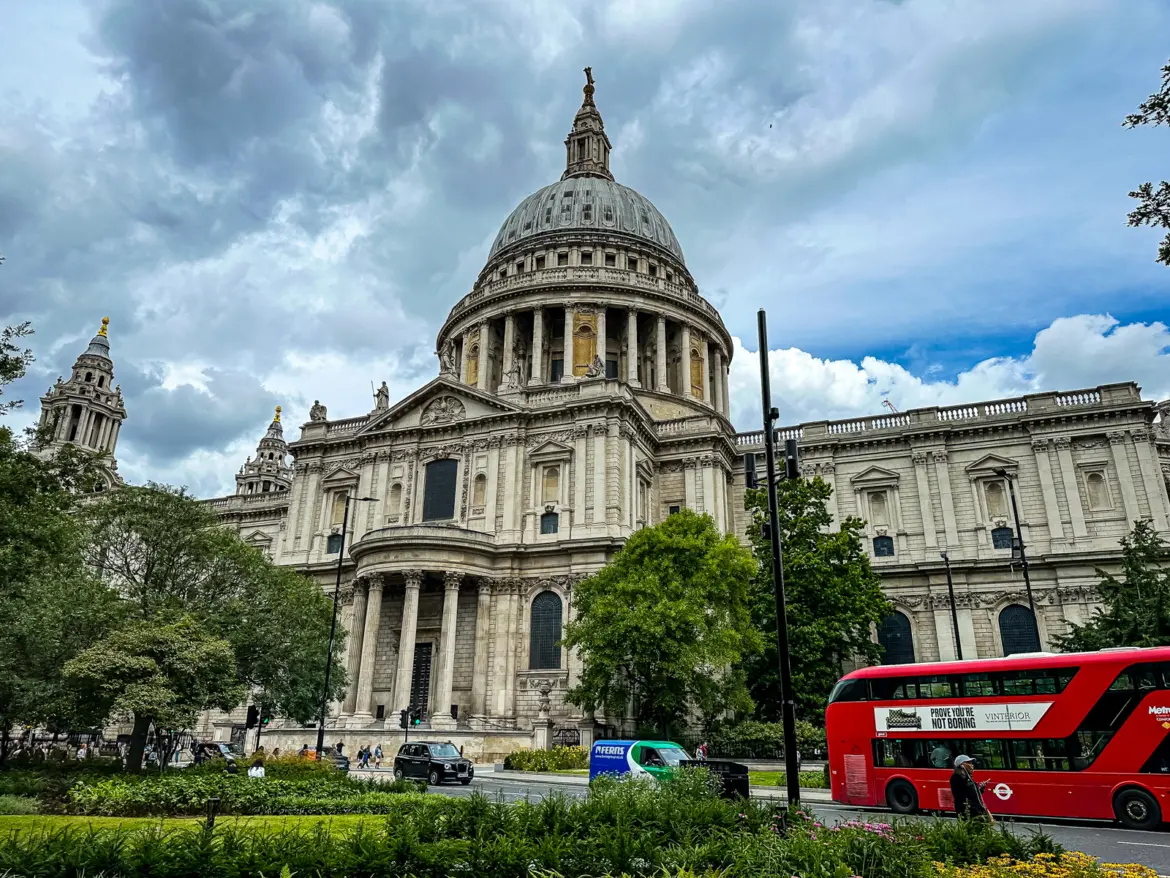
After a morning at the Tower of London, I took a cab to St Paul’s Cathedral. The rain was coming down hard enough that walking the half-hour along the Thames, the better route in good weather, was out of the question. The cab dropped me on Ludgate Hill, and the cathedral appeared the way it always does for anyone arriving on foot or by car from the east: bigger than expected, paler in the winter light, and somehow not quite real.
I’ve been twice. Once in August 2019, on a warm afternoon with the dome rising against fast-moving summer clouds and the trees of Festival Gardens in full leaf. The visit this post mostly draws on is the other one, December 2025, in the kind of pre-Christmas London afternoon where the cathedral lights are already coming on by mid-afternoon and the crowds inside are thin enough that you can sit in the nave without anyone walking in front of you.
St Paul’s Cathedral at a Glance
📍 Location · Ludgate Hill, City of London, EC4M 8AD. Nearest tube: St Paul’s (Central line). Roughly 30 minutes on foot from the Tower of London along the Thames.
⛪ Architect & dates · Sir Christopher Wren designed the cathedral and oversaw construction from 1675 to 1710. The final stone was laid by Wren’s son. Wren is buried in the crypt below.
🏛️ The dome · Rises 365 ft (111 m) to the cross — the height nods to Wren’s interest in astronomy. Tallest building in London from 1710 until 1963, when Millbank Tower narrowly overtook it.
🪜 Galleries · 257 steps up to the Whispering Gallery (inside the dome), 376 to the Stone Gallery, and 528 to the Golden Gallery at the summit.
🕯️ What’s inside · Sir James Thornhill’s eight scenes from the life of St Paul painted inside the dome (1715–1719), Byzantine-style icons of the Virgin and Christ in the nave, the Wellington Memorial in the north nave, and the high altar with its 1958 baldacchino.
🇺🇸 American Memorial Chapel · Behind the high altar, dedicated 26 November 1958 by Queen Elizabeth II in the presence of Vice President Richard Nixon. Funded by British public donations, it commemorates 28,000 American servicemen who died while based in Britain during the Second World War. A page of the Roll of Honour is turned every day.
⚰️ The crypt · The resting place of Wren, Admiral Lord Nelson (under the centre of the dome), the Duke of Wellington (Cornish porphyry sarcophagus), Holman Hunt, and over 200 memorials.
💡 Tip · Photography is allowed inside (no flash, not during services or after 4.30 pm). Buy tickets online in advance — cheaper than at the door, and you skip the entrance queue.
A Cathedral on Ludgate Hill
Christopher Wren‘s St Paul’s Cathedral is the fifth cathedral on this site. The first was founded in 604 AD by the East Saxons. The fourth was Old St Paul’s, a Gothic cathedral with what was once Europe’s tallest spire, which burned down in the Great Fire of London in September 1666 alongside about 80 percent of the medieval city.
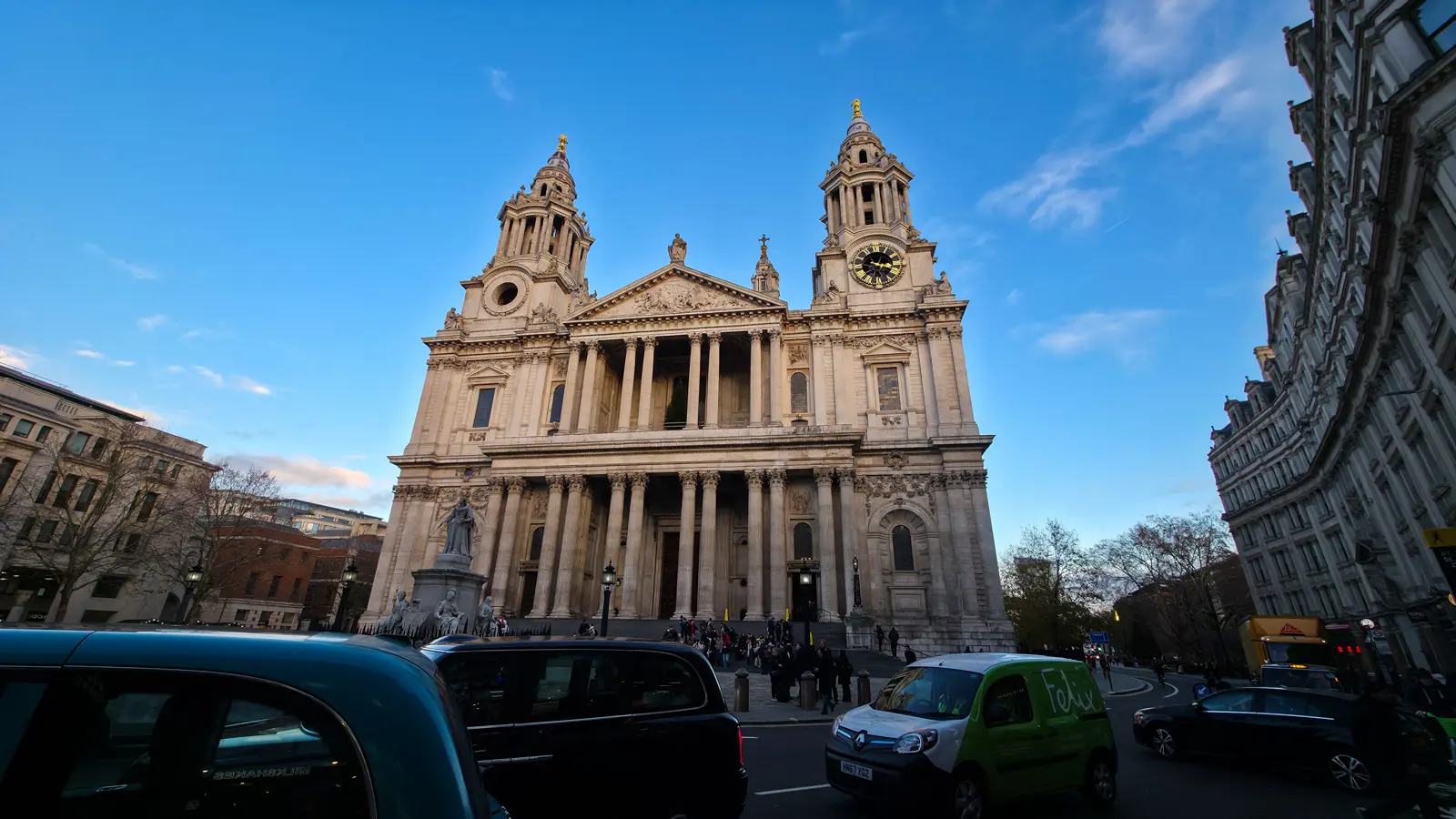
The cab dropped me at the intersection at the top of Ludgate Hill, which on a wet December afternoon is busier than you’d expect for the foot of a cathedral. I was disoriented for a minute. I’d assumed the entrance would be on the long south side facing the gardens, since that’s the elevation most photographed from across the river, but the main entrance is on the west front, under the two towers, looking down the hill toward Fleet Street.
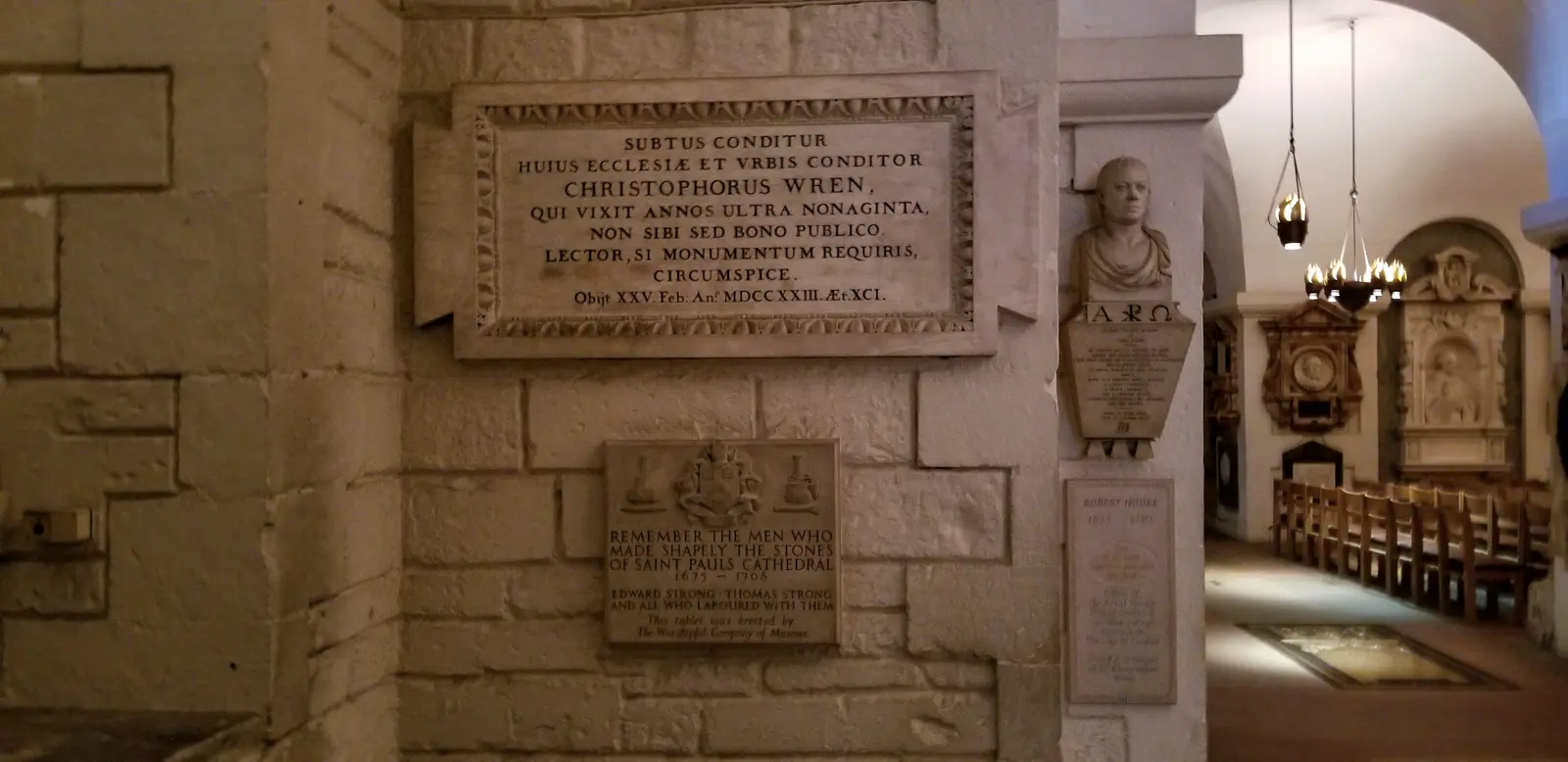
Wren began work on the replacement in 1675. Construction ran for thirty-five years. The final stone was laid in 1710 by Wren’s son, also called Christopher. Wren is buried in the crypt below, and a wall inscription nearby reads, in Latin, Lector si monumentum requiris, circumspice, which translates as “Reader, if you seek his monument, look around you”. Written by his son. It is probably the best epitaph any architect has ever received.
The cathedral was the tallest building in London for 250 years, from 1710 until 1963, when the now-renamed Millbank Tower in Westminster narrowly overtook it. The Shard, completed in 2012, now dwarfs both.
The Dome
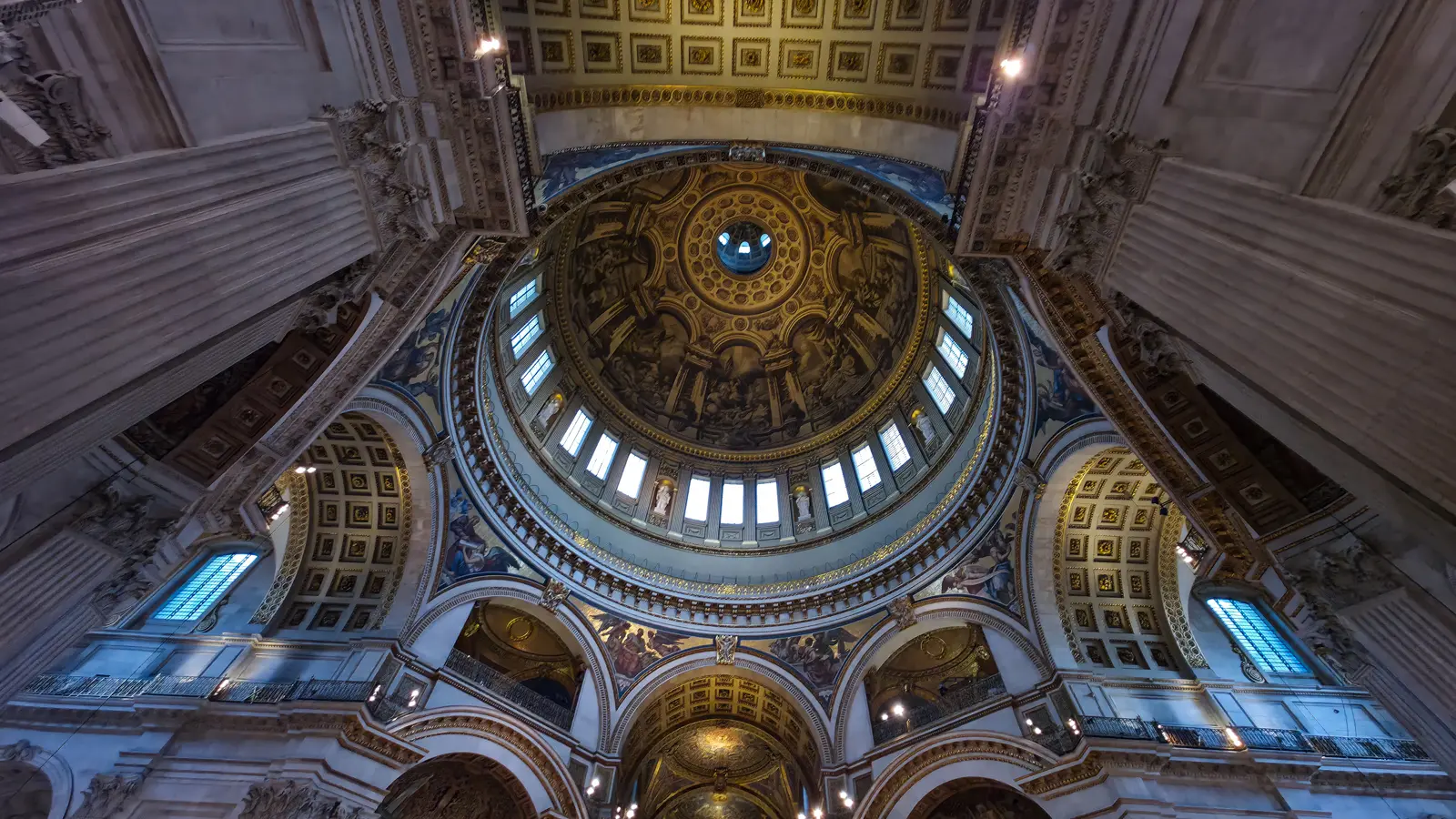
The dome is what every Londoner thinks of when they think of St Paul’s. It’s also not actually one dome but three: an inner dome you see from inside, a hidden brick cone in the middle that takes the structural load, and an outer dome of lead-clad timber that gives the building its famous silhouette. Wren consulted Isaac Newton and the Royal Society on how to make it stand up. The brick cone is reinforced with a wrought-iron chain at its base, eighteenth-century engineering still doing the job three hundred years later.
The outer dome reaches 365 feet (111 metres) and is the second-largest church dome in the world after St Peter’s in Rome, which inspired it. The famous photograph of St Paul’s dome rising untouched above the smoke of the Blitz, taken by Herbert Mason on the night of 29 December 1940, became the most enduring image of British resilience during the war.
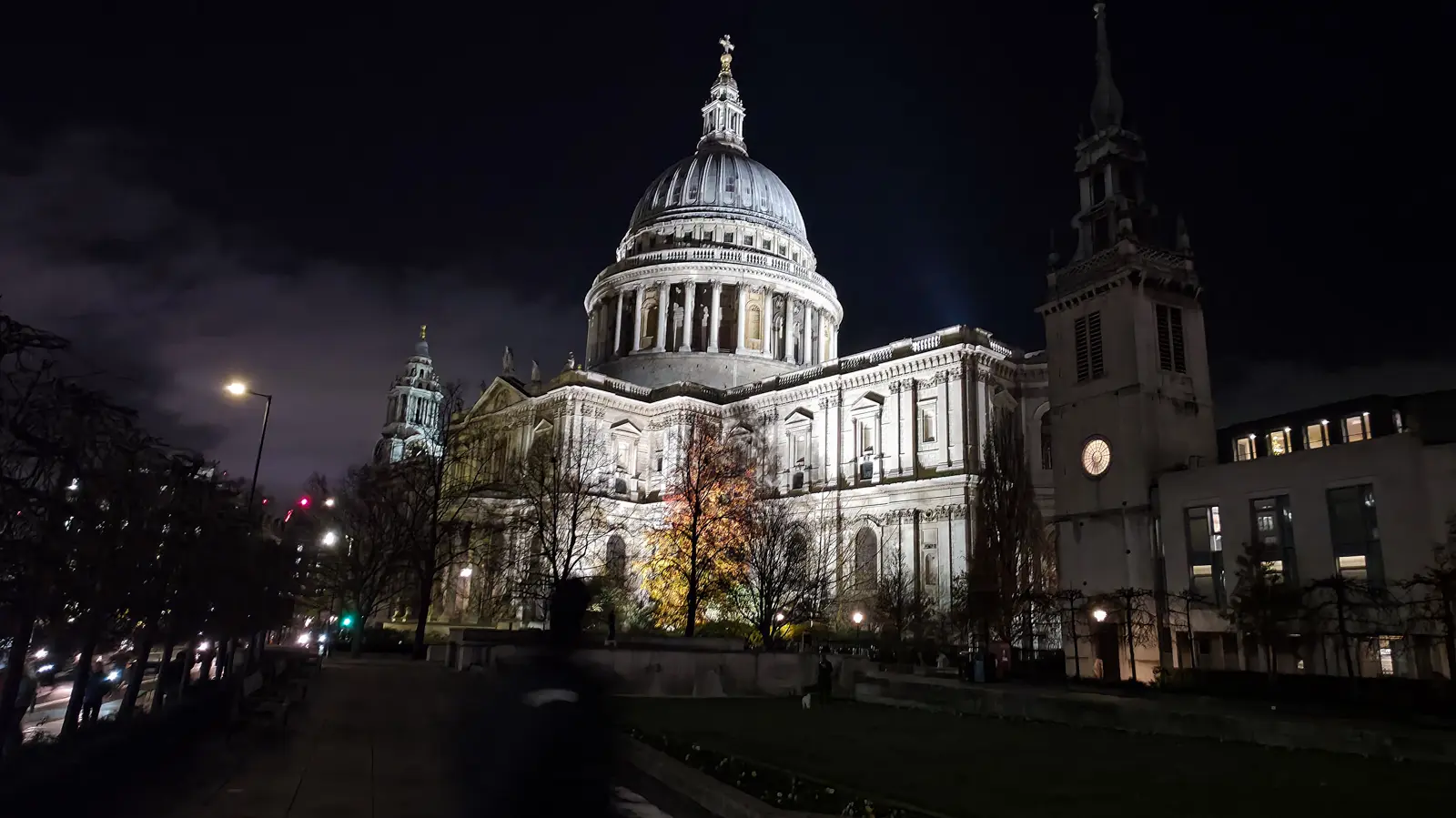
You can climb 528 steps to the top in three stages: the Whispering Gallery at 257 steps, the Stone Gallery at 376, and the Golden Gallery at 528. I didn’t this time. December is too cold for the upper galleries to be worth the climb, and the views are sharper in summer anyway. Next visit.
Walking In
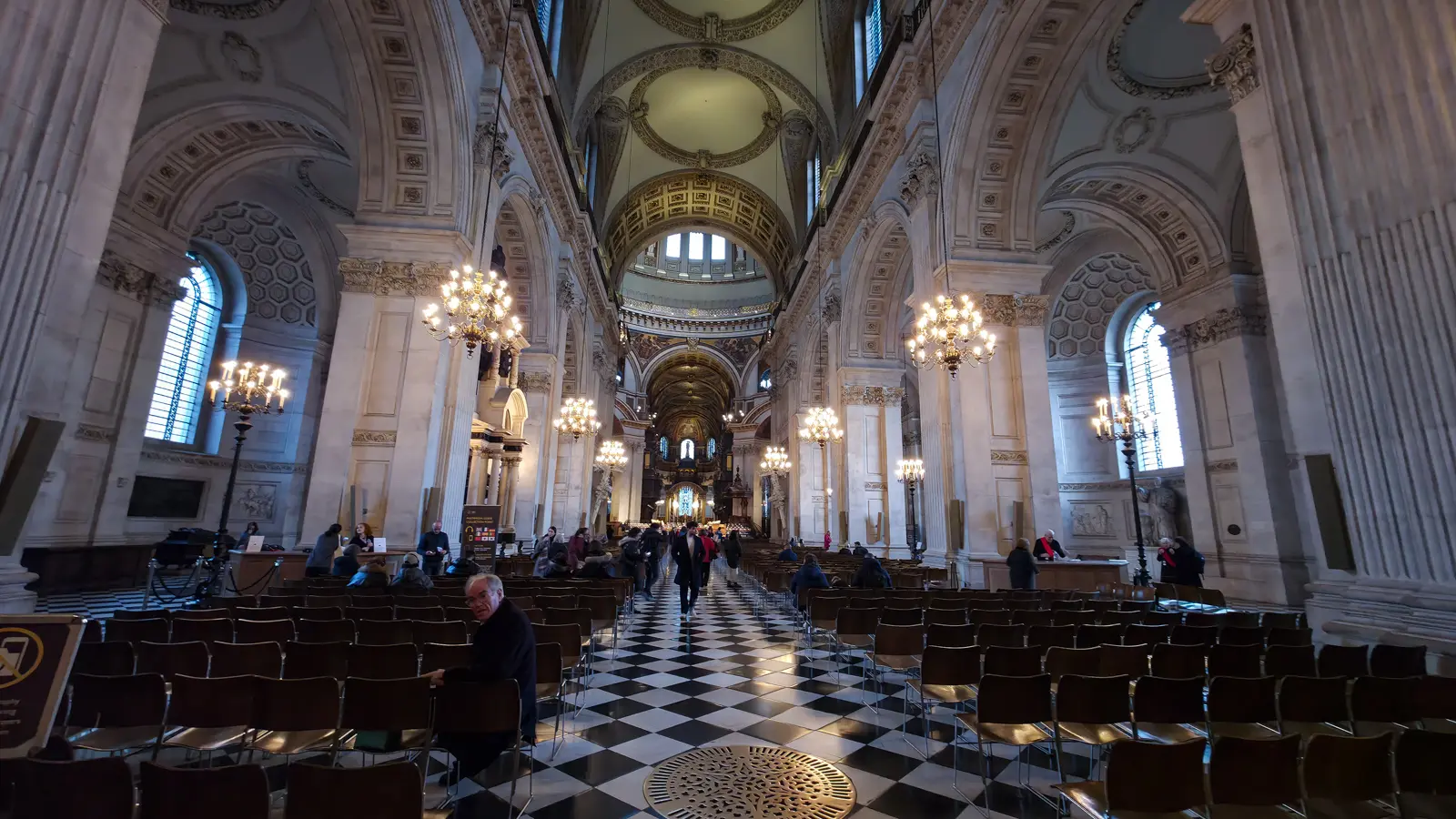
The first thing that gets you at St Paul’s, before any of the specific features, is just the scale. The nave runs 518 feet end to end. The ceiling sits 91 feet above you. The proportions are calculated to make you small without making you feel crushed. People drift in, walk a few steps, and stop. I watched several people do exactly this, pause halfway down the nave, look straight up, and just stand there for a minute.
What I liked best on this visit was watching who came in. A group of Japanese tourists with audio guides. An older British couple sitting in the back row of chairs not talking, just looking. Two women in headscarves walking the south aisle slowly. A young man on his own, in jeans and a parka, sitting in the middle of an empty row of chairs with his hands folded. A place of Christian worship, but at any given moment, full of people from every faith and none. Cathedrals do this. It’s one of the things they’re for.
The Icons That Stopped Me
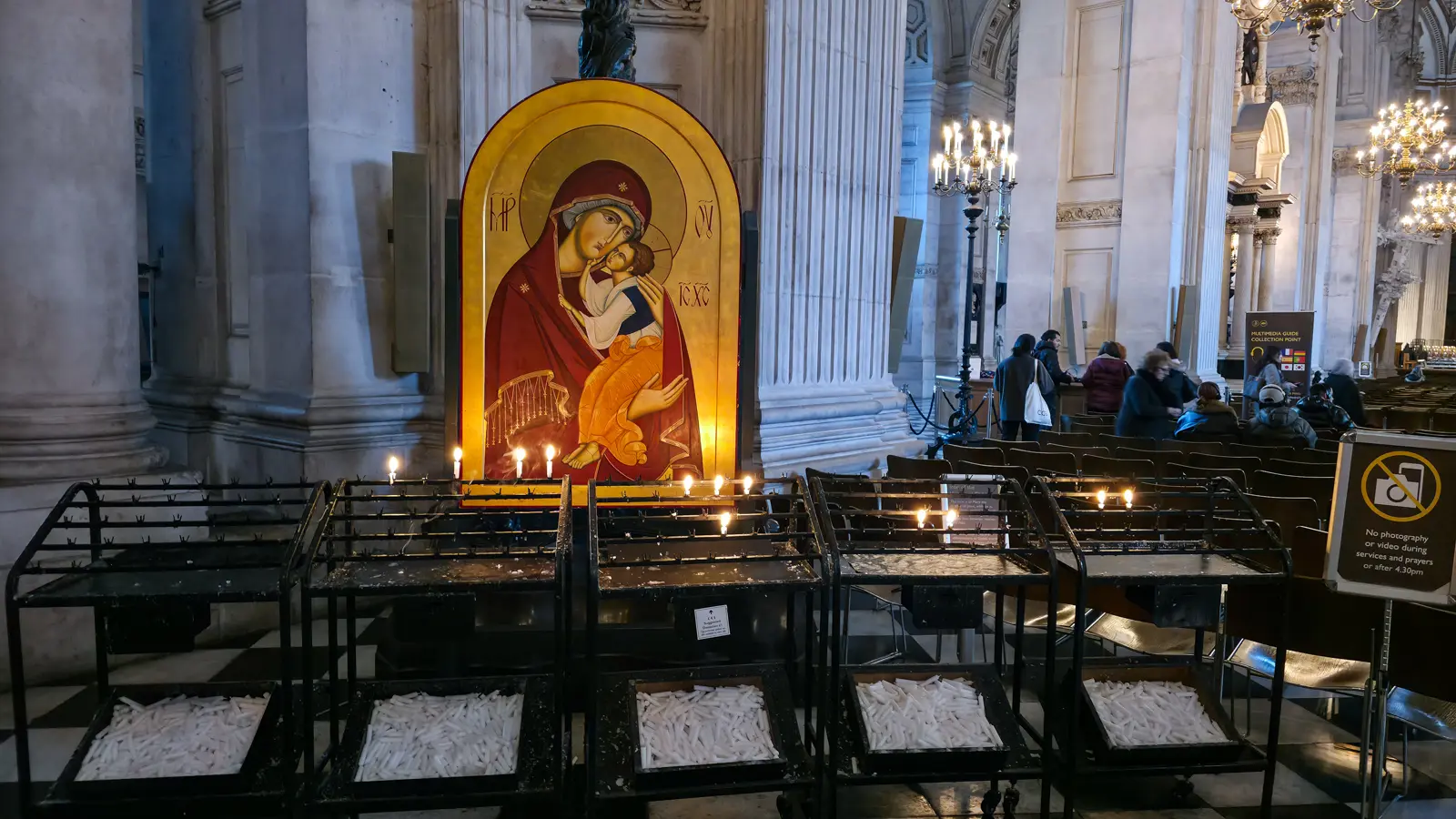
A little way past the entrance, in the nave, I came across two large icons. The first showed Christ holding the Gospel and raising his right hand in blessing, a halo of gold around his head. The second was the Virgin Mary holding the infant Christ, the two of them cheek to cheek in a way I recognised from old Russian and Greek images I’d seen in books.
The icons stopped me. They didn’t fit my expectations for an Anglican cathedral. I grew up with Catholic and Byzantine imagery, and these felt much more like the icons in the Greek and Russian churches I’ve visited than anything I associate with English Baroque architecture. There were votive candles in front of each one, the kind you can light yourself for a £1 suggested donation. People were doing so. I lit one too, at the Mary icon. The flames were small and steady against the gold ground of the panel.
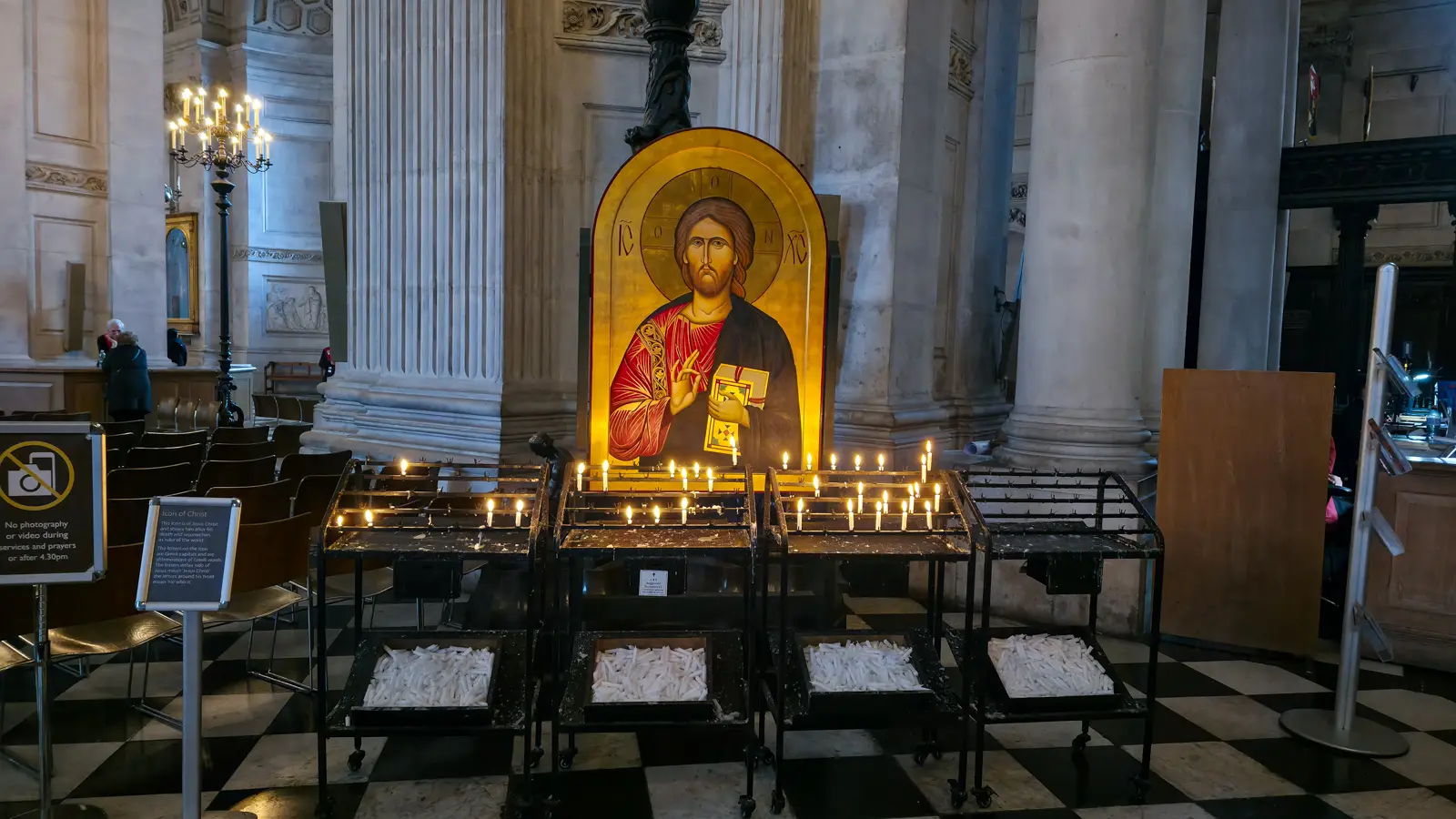
I learned afterwards that both icons are painted in the traditional Byzantine technique, egg tempera and gold leaf on wood, with the formal stylised figures and gold backgrounds that have characterised Eastern Orthodox iconography for fifteen centuries. They feel ancient because they’re built from rules that are. The icon plaque at Christ explains the Greek lettering for anyone who stops to read.
The Wellington Memorial
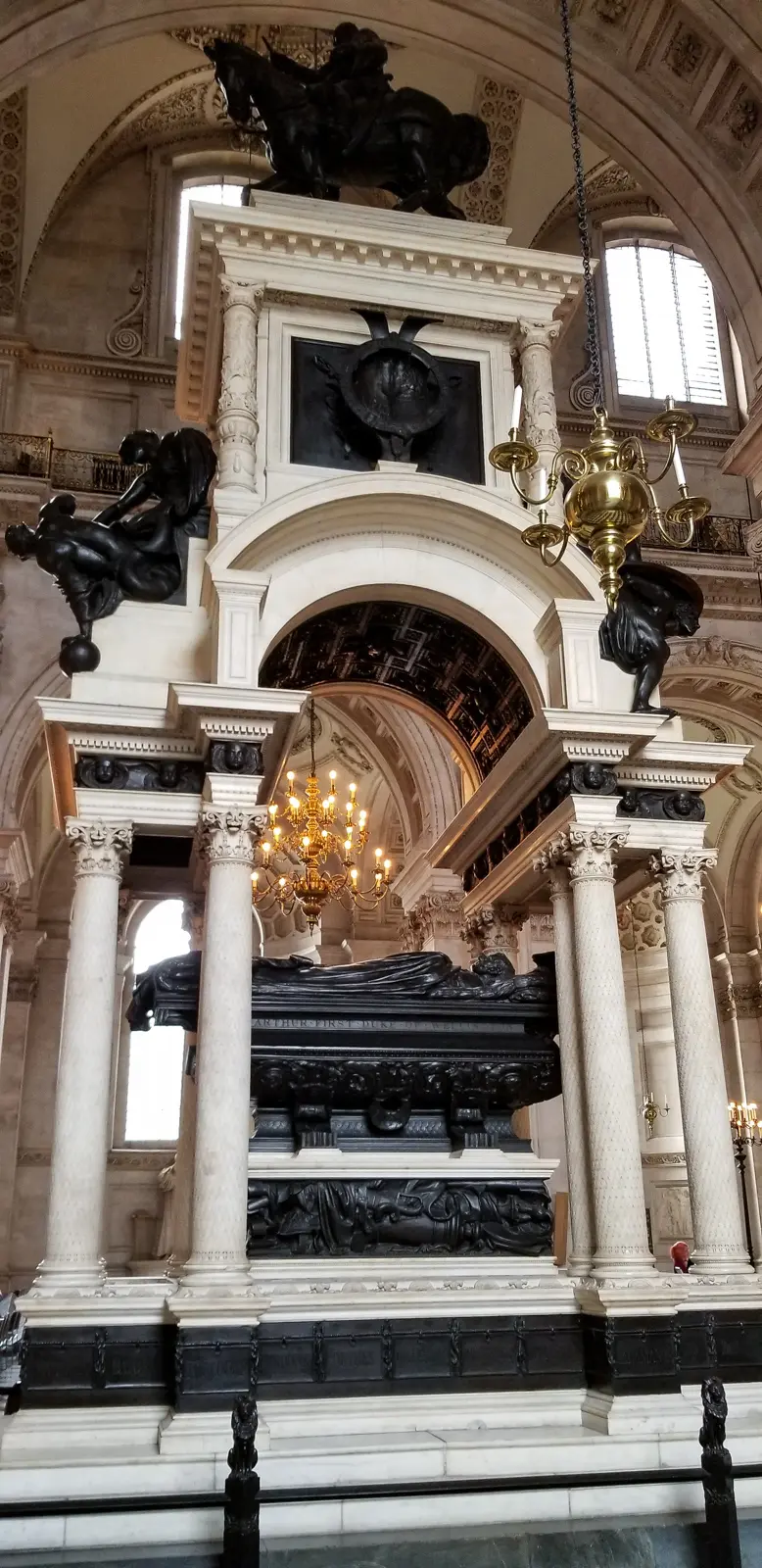
In the north nave sits one of the strangest commissions in St Paul’s: a monument that took longer to build than the cathedral itself. Alfred Stevens won the brief in 1856 and worked on it for nearly twenty years before dying in 1875. The structure stood incomplete for decades. It was finally finished in 1912 by Stevens’ studio and pupils, more than half a century after work began. Wellington is shown in two states, recumbent in death on the sarcophagus and equestrian in life on top, the whole thing surrounded by twin pairs of Corinthian columns. Wellington’s actual sarcophagus is in the crypt, in massive porphyry. This is the monument above.
The American Memorial Chapel
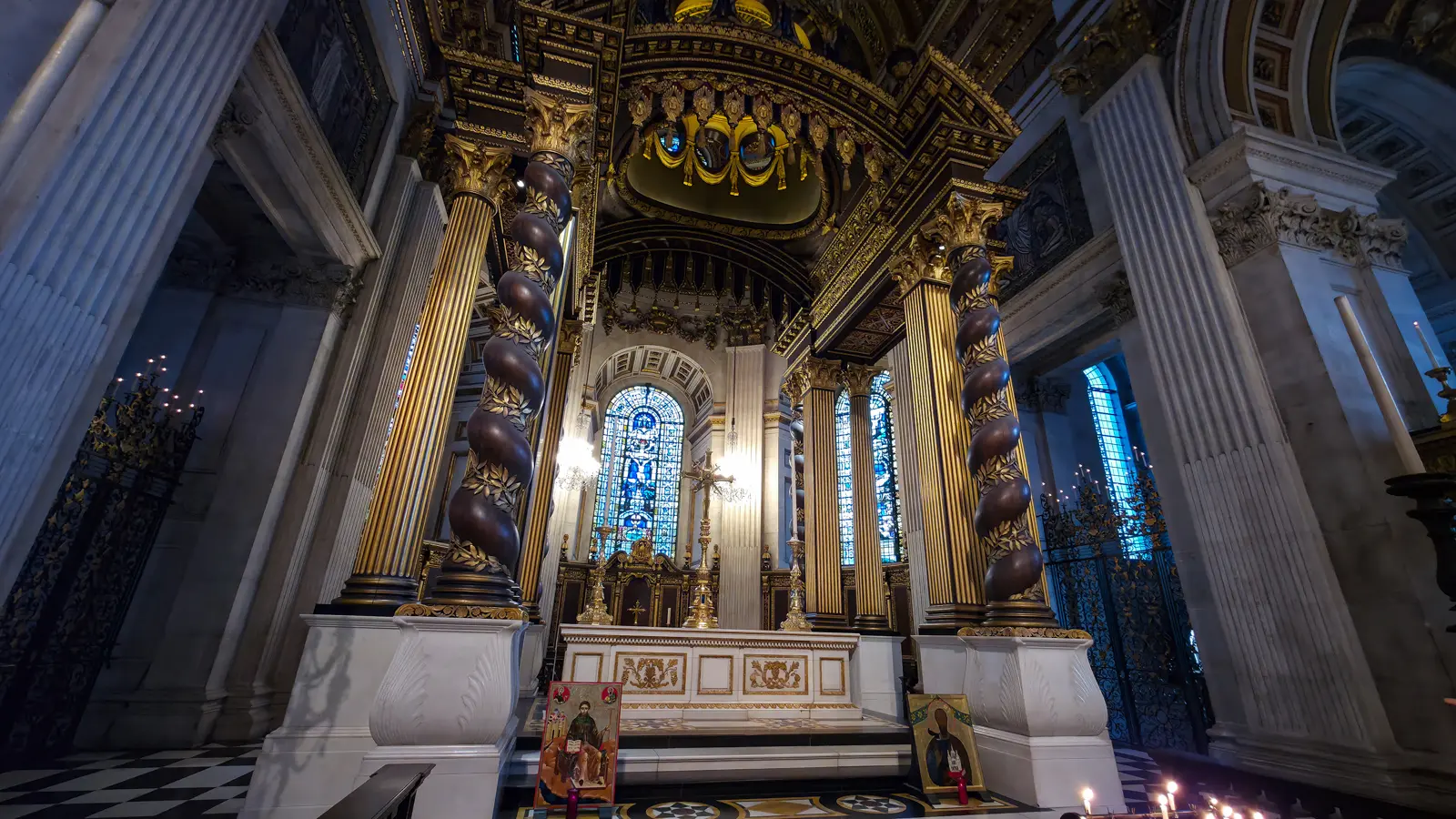
Behind the high altar, in the apse at the very east end of the cathedral, sits one of the most quietly moving spaces in any London church. The American Memorial Chapel was dedicated on 26 November 1958 by Queen Elizabeth II in the presence of Vice President Richard Nixon. It commemorates the 28,000 American servicemen who died while based in Britain during the Second World War.
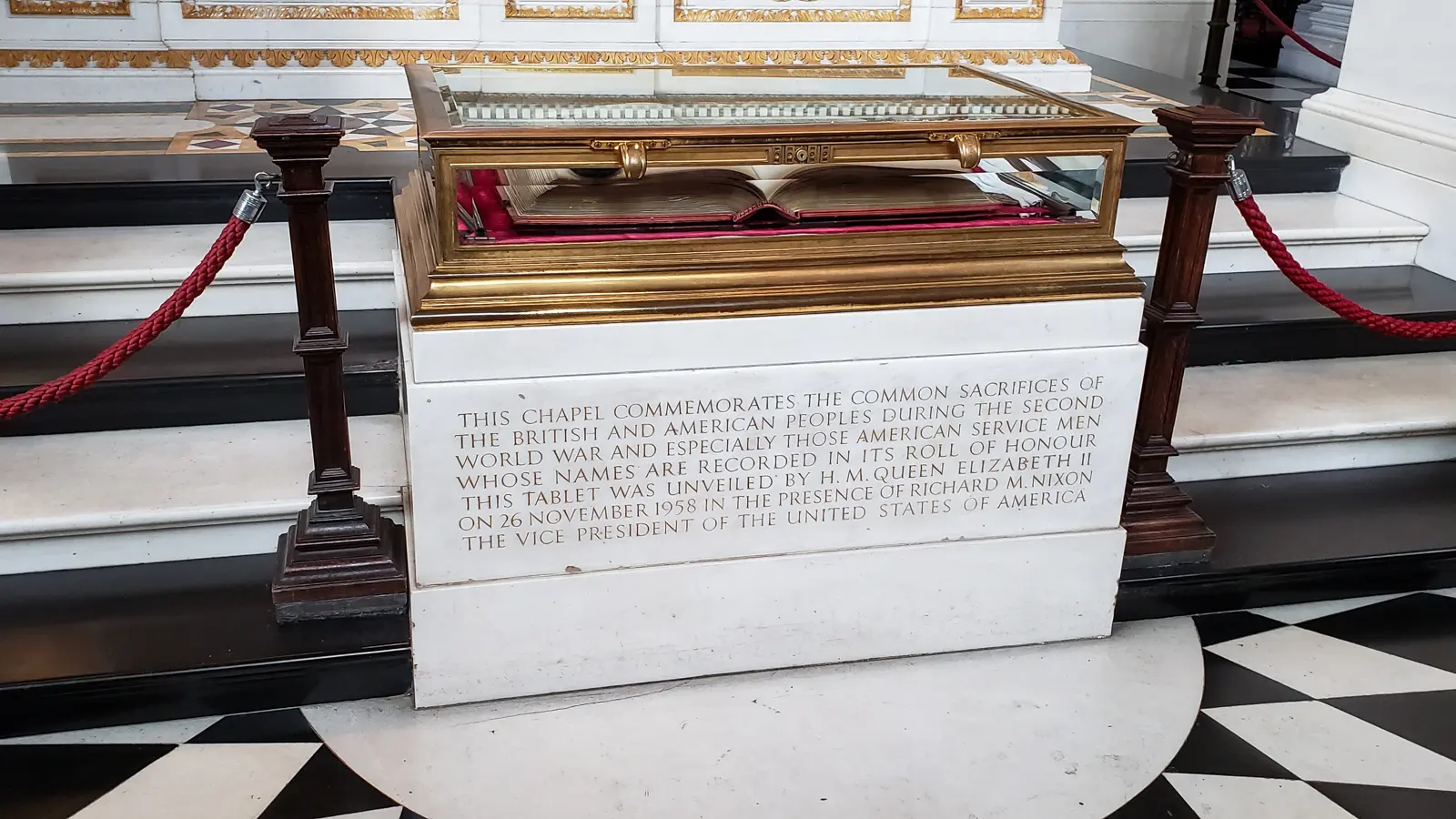
The detail I learned afterwards, and have kept thinking about since, is that the chapel was paid for entirely by donations from British people. The previous apse had been destroyed by a German bomb during the Blitz. When the cathedral was rebuilt, the British public chose to dedicate the rebuilt space to American sacrifice. A British memorial, in a British cathedral, paid for by British donations, to commemorate Americans who died defending Britain.
I went back there on my way to the crypt. There were two American men sitting in chairs near the Roll of Honour, both probably in their seventies. Both were wearing veteran caps. Neither was crying or pointing or talking. They were just sitting. I stayed there longer than I’d meant to and left them alone.
The Crypt: A Brief Visit
I expected the crypt to feel eerie. It doesn’t. It’s peaceful and unexpectedly bright: white-painted vaults, mosaic floors, light spilling from above. Nelson’s black sarcophagus sits at the centre, directly below the dome above. Wellington’s porphyry tomb is in the next chamber, massive and dark. Wren is here too, with the famous inscription on a nearby wall. So is Holman Hunt, painter of The Light of the World, hanging in the north transept above.
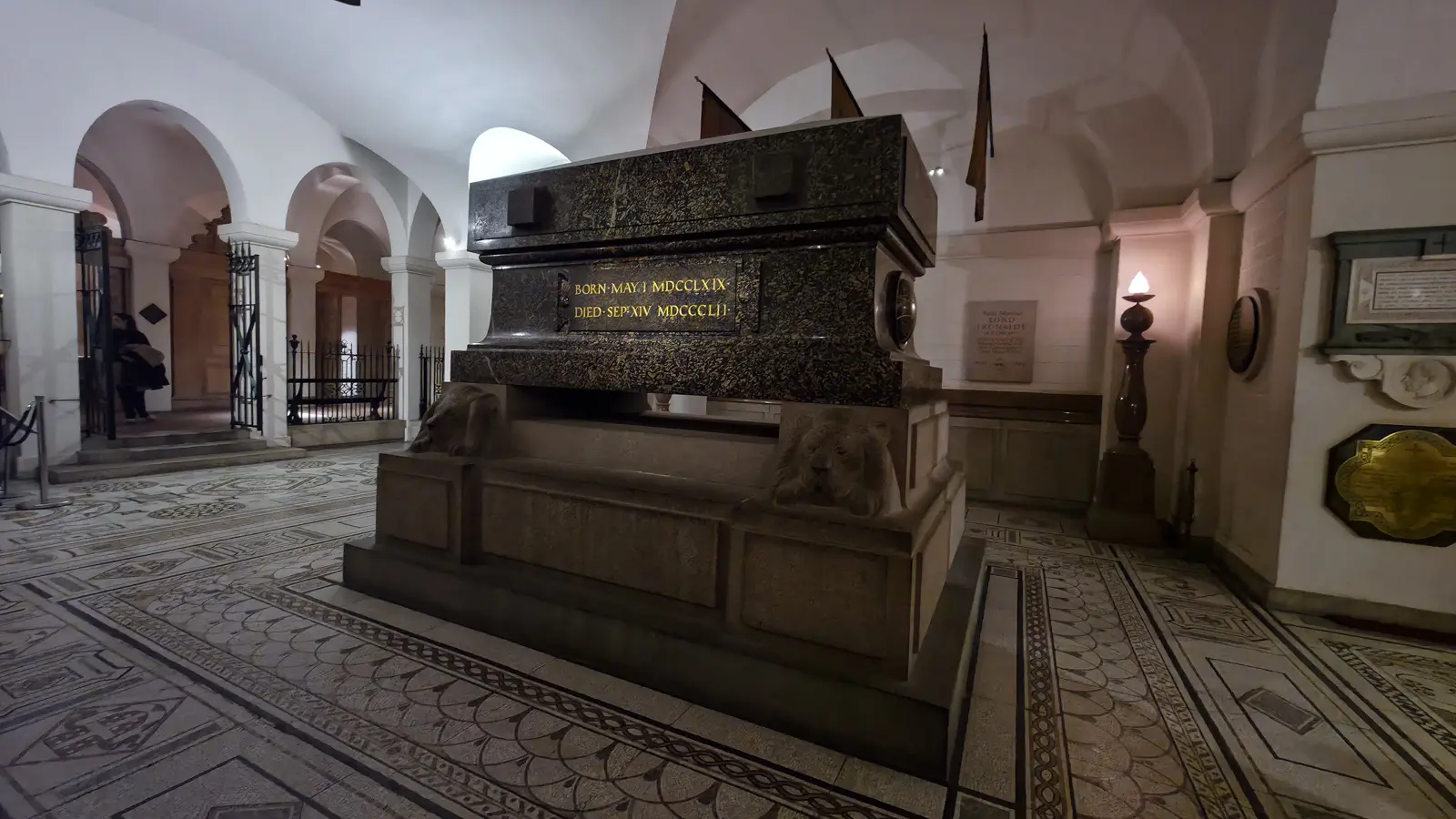
What I didn’t expect was how generous the crypt felt as a space. Visitors moved slowly between the tombs without any of the rushing or queue-pressure of the floors above. A couple stood reading the inscription on Wellington’s tomb for several minutes. A father lifted his small son up to see the gold Roman numerals on the sarcophagus. An older woman sat on the bench against the wall by Nelson and didn’t move for the ten minutes I was there. The crypt is the quietest room in St Paul’s, and the one most people don’t expect to want to linger in.
Bubbly Tips for Visiting St Paul’s Cathedral
- Photography IS allowed inside St Paul’s: the signs say “no photography during services and prayers or after 4.30pm”, but most of the day, phones and cameras are fine. This is a common misconception. Just don’t shoot during a service, and don’t use flash.
- Buy tickets online in advance. It’s cheaper than at the door and you skip the entrance queue. Adult tickets are around £25, but check stpauls.co.uk for the current rate.
- Allow at least two hours. Three if you’re climbing the dome. The cathedral floor and the crypt together take about 90 minutes at a moderate pace; the dome climb adds another 60 to 90 minutes including breaks at the Whispering Gallery and Stone Gallery.
- Combine with the Tower of London for a perfect London history day. The walk between the two is about 30 minutes along the Thames via the Millennium Bridge, with stunning views of the dome from the south bank as you approach. In bad weather, taxis are a few pounds either way.
- Light a candle at the icons. The £1 suggested donation supports cathedral upkeep, and the gesture works whether or not you’re religious. The icons themselves are worth standing in front of for a minute, even if you don’t light anything.
- Walk to the American Memorial Chapel. It’s behind the high altar, at the eastern end, and most visitors miss it. The mosaic of Christ in Glory by William Blake Richmond above the apse is worth the walk on its own. The Roll of Honour is the reason to go.
- The crypt is calmer than the floor above. If the main cathedral is busy, head down to the crypt for fifteen minutes. The temperature is cooler, the light is gentler, and the crowds thin out.
- Free worship services. Evensong is at 5pm most weekdays and is free to attend. You don’t pay the tourist ticket and you experience the cathedral the way it was actually built to be used, with music and prayer rather than audio guides.
Final Thoughts
I came to St Paul’s expecting Wren’s dome and Wren’s architecture, and those were everything I’d been told. What I didn’t expect were the smaller things. The Byzantine icons in an Anglican cathedral. The two American veterans sitting beside the Roll of Honour, paid for eighty years ago by ordinary British donations. The crypt that turned out to be the most peaceful room in the building. The Latin inscription Wren’s son wrote for his father, which I read twice and then went back and read a third time before leaving.
A cathedral on Ludgate Hill, the fifth one on this same patch of ground, with people from every faith and none drifting through it on a cold afternoon in December. London has older churches and grander palaces. It doesn’t have many places that feel quite this generous.
Until next time!

🌟 Everything You Need to Plan Your Dream Trip in 2026
- 🌟 Luxury Hotels - Find premium stays with Booking.com & Hotels.com
- 🏡 Vacation Rentals - Discover unique properties on VRBO
- 🏞️ Guided Tours - Explore with Viator or GetYourGuide
- 🎫 Attraction Tickets - Skip the lines with Tiqets
- 🚢 Ocean Cruises - Set sail with Cruise Direct
- 📱 International SIMs - Stay connected with Saily
- 🚗 Car Rentals - Budget-friendly options from Discover Cars
- 🌐 Secure VPNs - Browse safely with NordVPN
- 💶 Currency Exchange - Best rates with Wise
- 🗣️ Learn Languages - Master the local language with Babbel and Rosetta Stone