
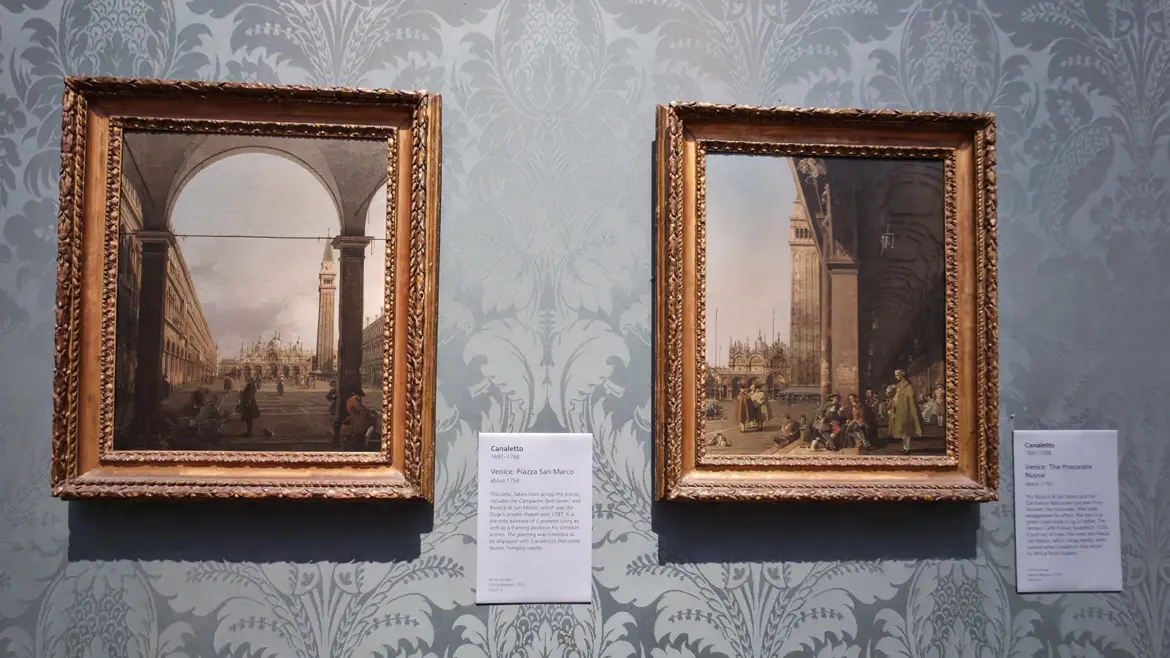
Before I had ever been anywhere, I knew Venice from paintings. Gold light on green water, gondolas tipped like commas across a canal, a city that looked too lovely to be a real place at all. A good many of those pictures, it turns out, were by one man: Giovanni Antonio Canal, known as Canaletto, the little Canal, after his father Bernardo, a painter of theatre scenery. I always wanted to see the real thing. This year I finally did, and then, a few weeks later at the National Gallery in London, I found myself standing in front of the very views that had planted the idea in my head to begin with.
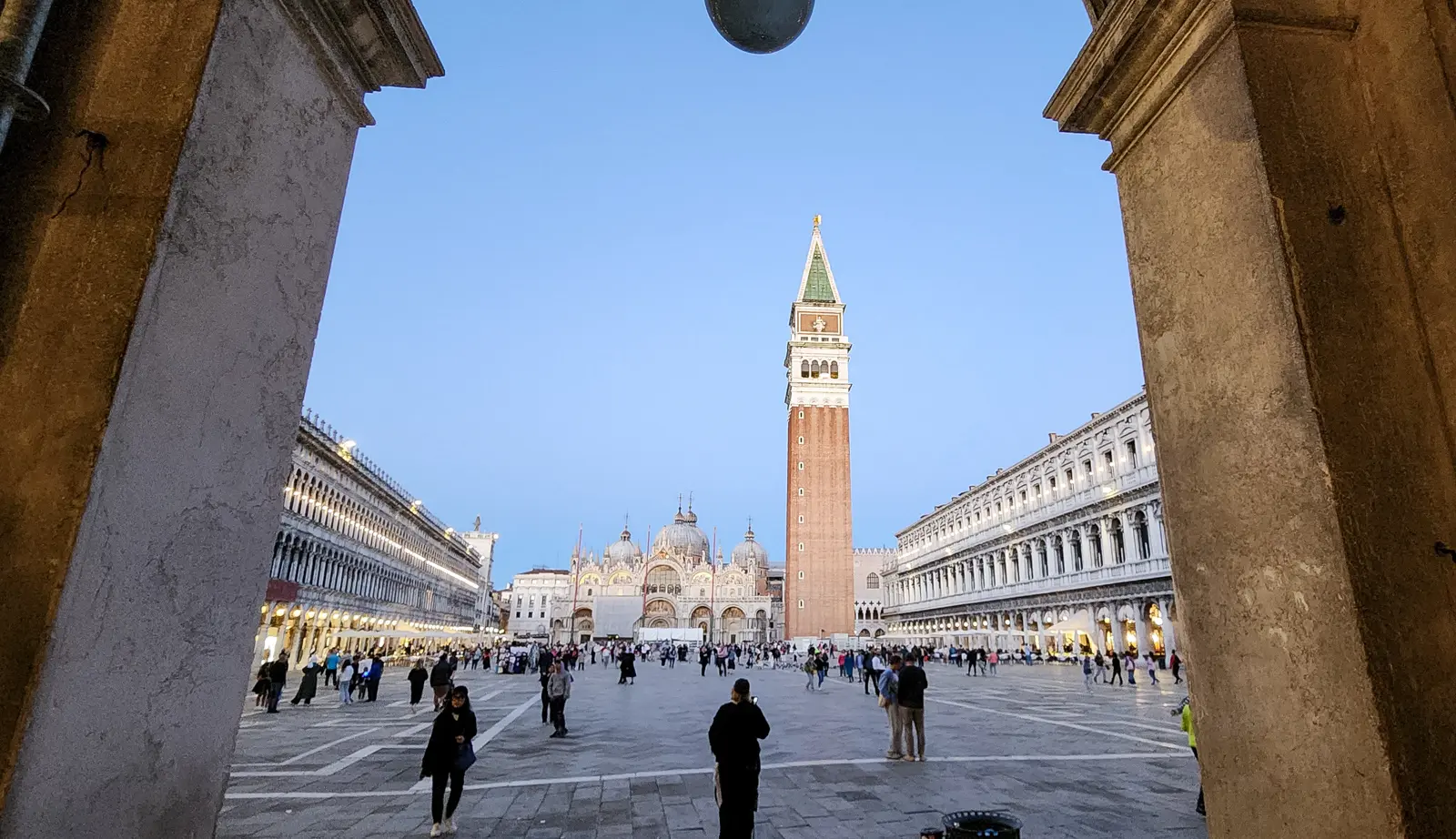
That little painting stopped me, because I had stood in almost exactly that spot a few weeks earlier, looking through an arch at the same square.
Here is the thing about Canaletto that took me a while to understand. His Venice is real and not real at the same time. He trained painting stage scenery with his father, and he never quite stopped arranging the world like a set. He owned a camera obscura, a box with a lens that projected the scene onto paper so he could trace it, and his buildings are so accurate that they can still be matched, window for window, to the city today. And yet he moved things. He widened squares, straightened facades, and tidied away the mess. His views were bought mostly by British visitors on the Grand Tour, the wealthy young men and, later, women who came to Venice once in their lives and wanted a beautiful souvenir to take home. So what he sold them, and what he sold me across two centuries, was not quite Venice. It was the Venice we dream of.
Canaletto at a Glance
🎨 Who · Giovanni Antonio Canal, “the little Canal,” son of a Venetian theatre-scenery painter, 1697–1768.
🖼️ Where in London · The National Gallery’s Venetian view paintings, free to visit, an easy hour before or after a Venice trip.
🗼 His signature edit · He nearly always painted the Campanile taller and more slender than it really is, and the tower he knew collapsed in 1902 anyway.
⛵ The showpiece · The Basin of San Marco on Ascension Day, around 1740, with the doge’s gold Bucintoro and the Marriage of the Sea.
🧱 The honest one · The Stonemason’s Yard, around 1725, a scruffy working corner of Venice thought to be painted for a Venetian rather than a tourist.
🇮🇹 The real thing · Compare his glassy Grand Canal with the number 1 vaporetto, wake and all.
The tower he stretched
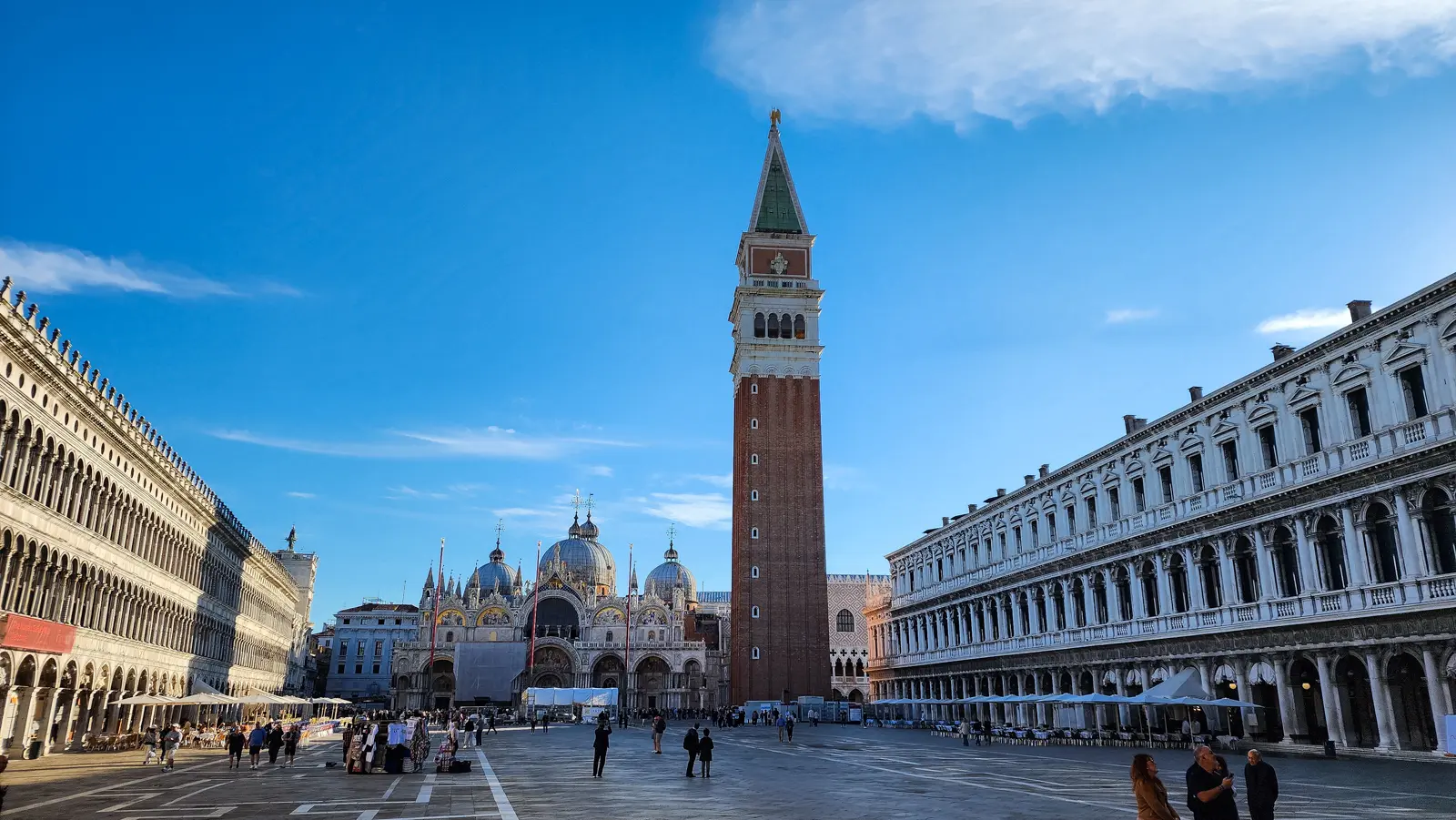
Start with the Piazza San Marco, because that is where the editing shows most. The Gallery’s own note on that little painting points it out: Canaletto nearly always painted the Campanile taller and more slender than it really is. He did it because a tapering tower draws the eye up and makes the square look grander. Stand in the real Piazza San Marco and the bell tower is a solid brick thing, wide and blunt, magnificent but not delicate.
There is a lovely irony in this. The Campanile Canaletto stretched on his canvases is not even standing any more. The original tower collapsed into the square one July morning in 1902, folding in on itself without killing anyone but the caretaker’s cat. Venice rebuilt it exactly as it had been, in the same spot, and reopened it in 1912. So when people compare his paintings to the tower today, they are comparing an idealised version of a building to a careful copy of the one he knew.
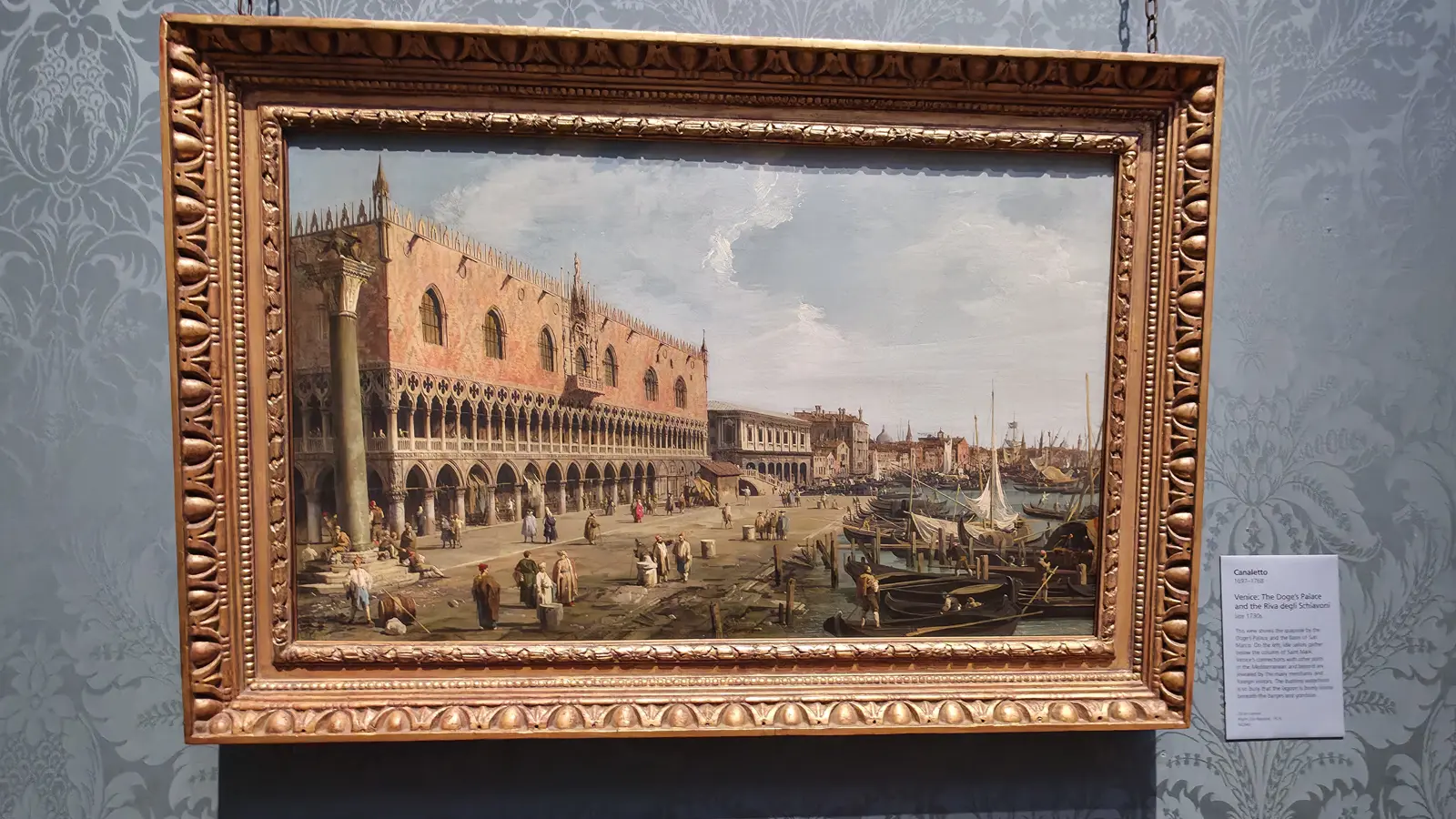
The Doge’s Palace
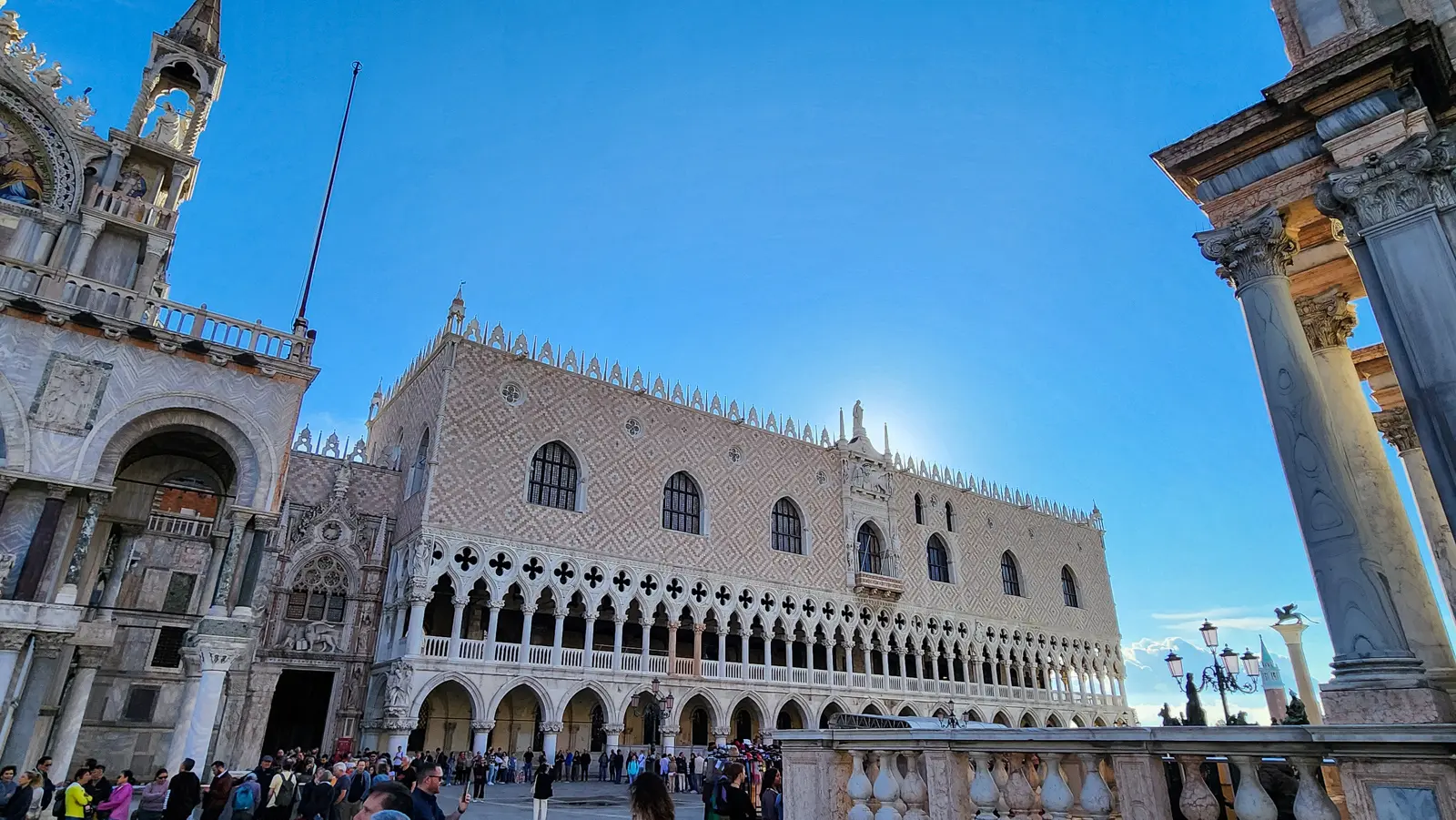
Canaletto painted the Doge’s Palace many times, usually from the water, looking along the waterfront promenade called the Riva degli Schiavoni. The palace glows pink and white, the boats sit obediently, the light is always kind.
I photographed the same palace from dry land, standing on the Piazzetta San Marco between the two great columns, and it is every bit as strange and beautiful up close, all diamond-patterned stone and pointed arches, holding up a heavy wall on a row of slender legs.
The Basin, and the Marriage of the Sea
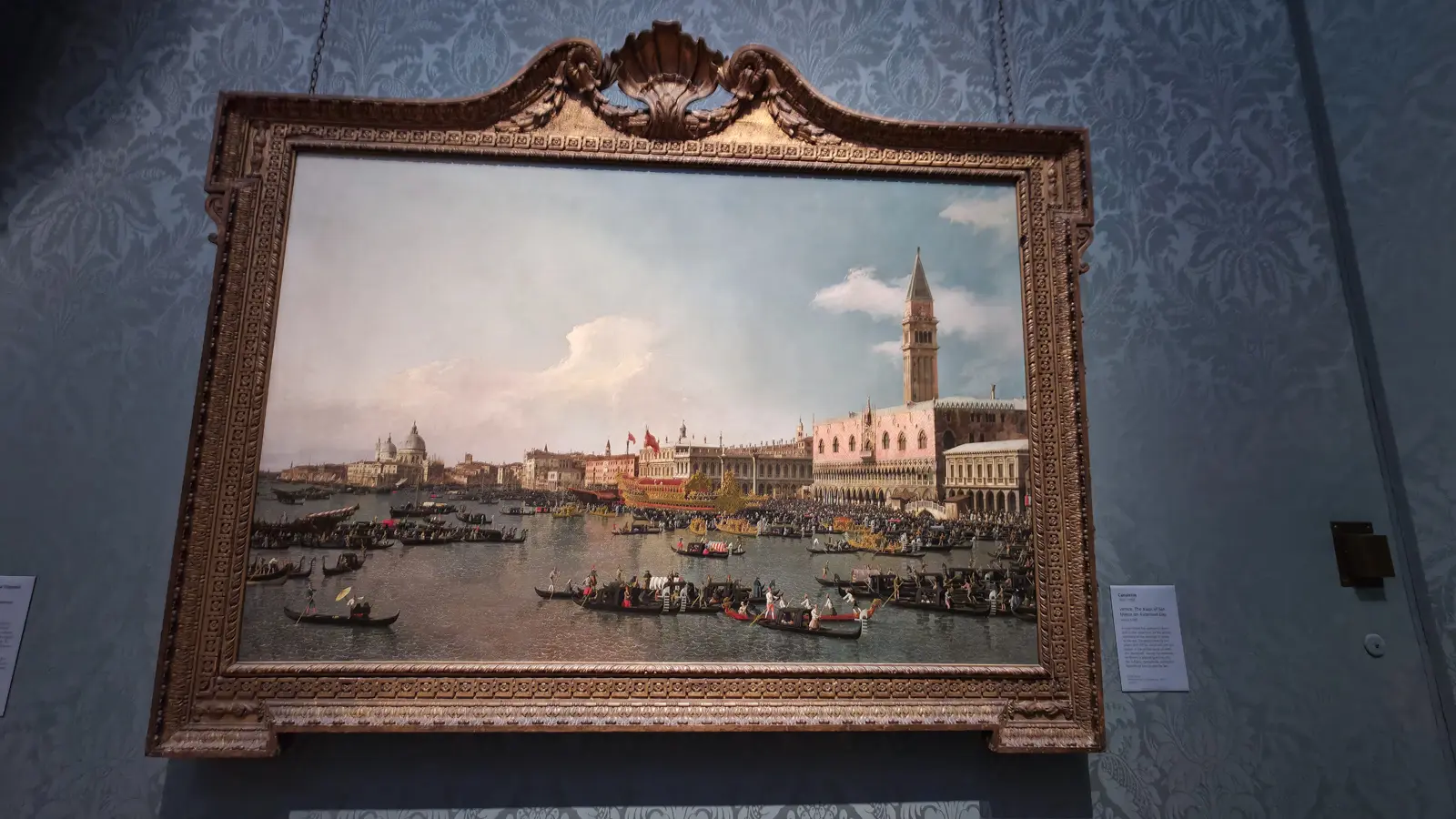
His grandest views are the festival ones. In the Basin of San Marco on Ascension Day, the whole city seems to be on the water at once, gathered around a gold and red barge called the Bucintoro. This was the doge’s state galley, rowed out onto the lagoon once a year so that he could drop a blessed ring into the sea and declare Venice married to it. The ceremony was the centrepiece of the Festa della Sensa, and Canaletto painted it around 1740 as a showpiece, meant to hang beside an equally busy scene of a regatta.
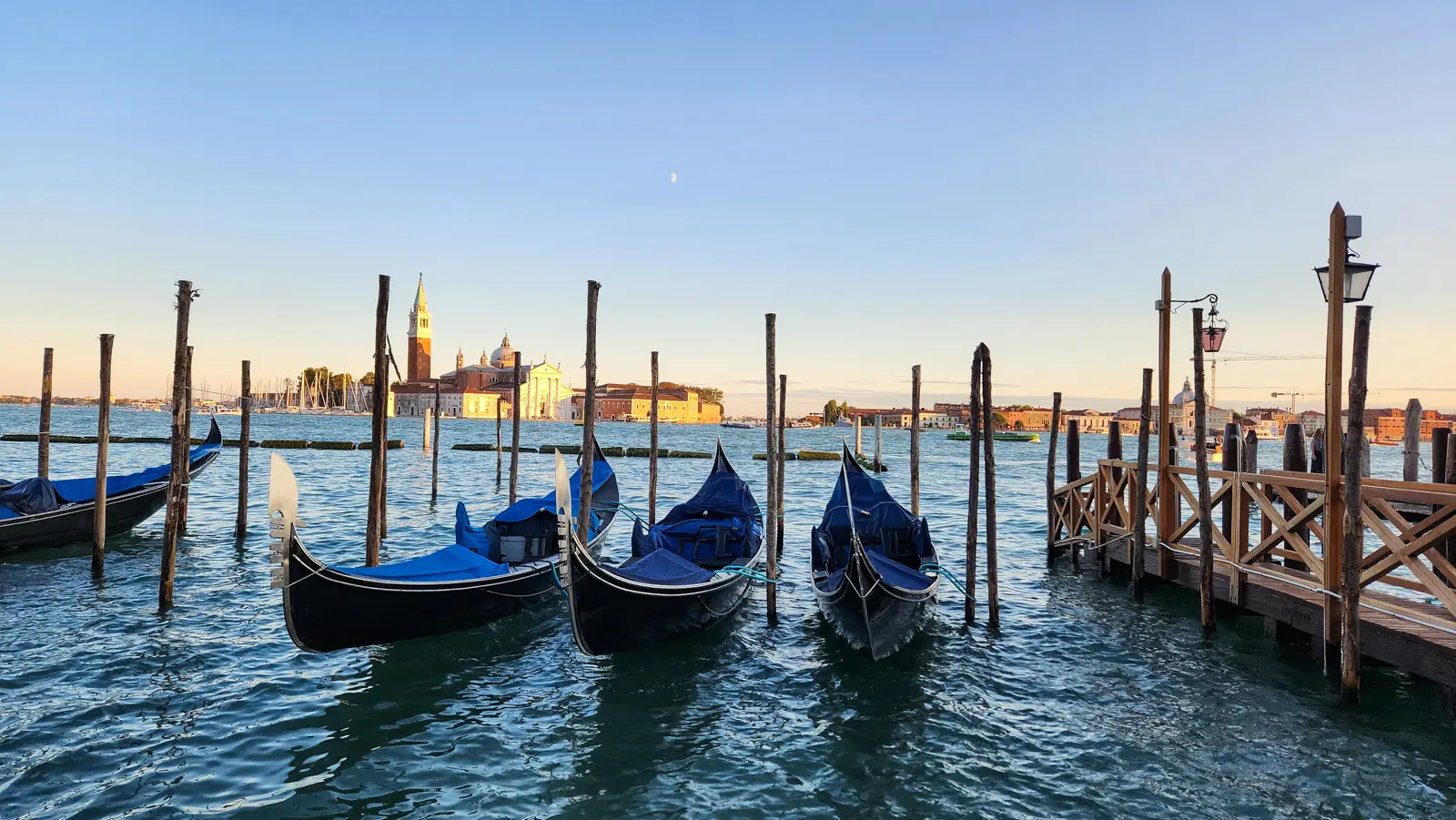
My own basin was quieter. I took this from the Molo at the edge of the square, looking the other way, out towards the island church of San Giorgio Maggiore, with the gondolas asleep under their covers and a thin moon coming up. Same water, opposite direction, no barge.
The Grand Canal
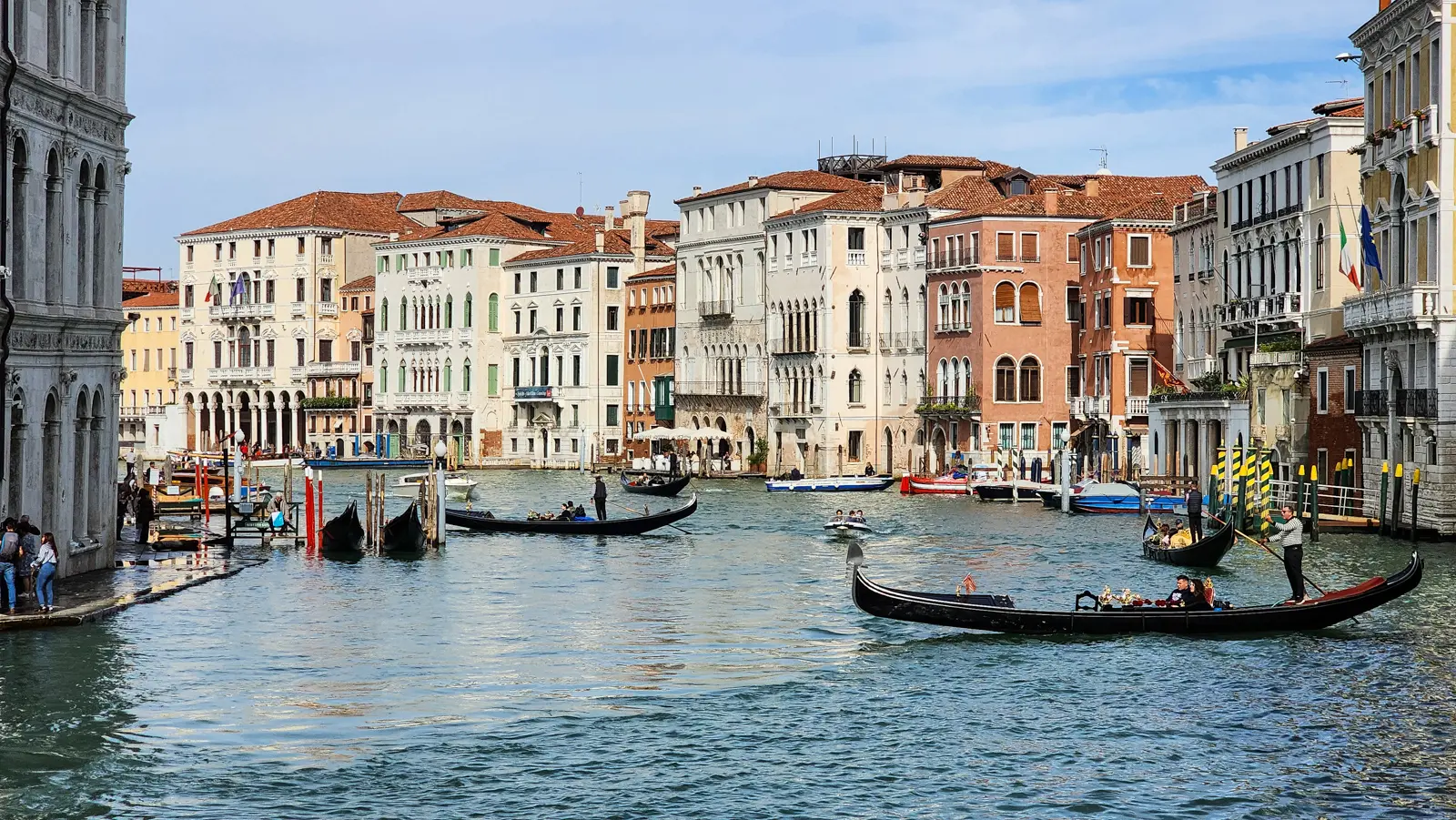
And then the Grand Canal itself, the view that says Venice to anyone anywhere. Canaletto walked it end to end in paint, and his clients hung the results in order so they could travel the canal again from an English drawing room. In his hands the water is glassy, the palaces freshly scrubbed, the traffic elegant.
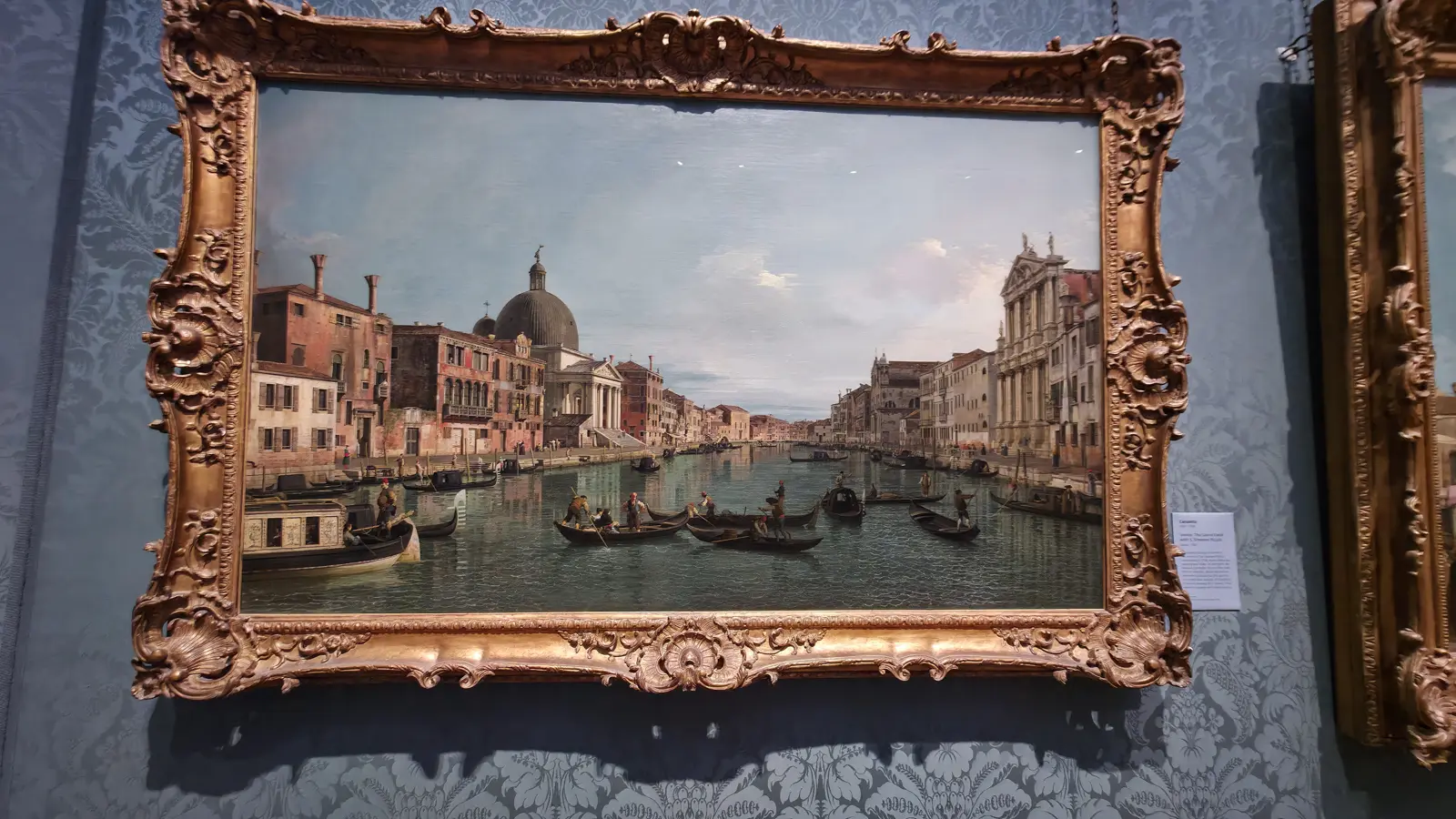
The real canal is louder, brighter and busier, full of delivery boats and water taxis throwing up wake, with gondolas that now carry tourists rather than locals. It is not tidy. It is better.
The honest one
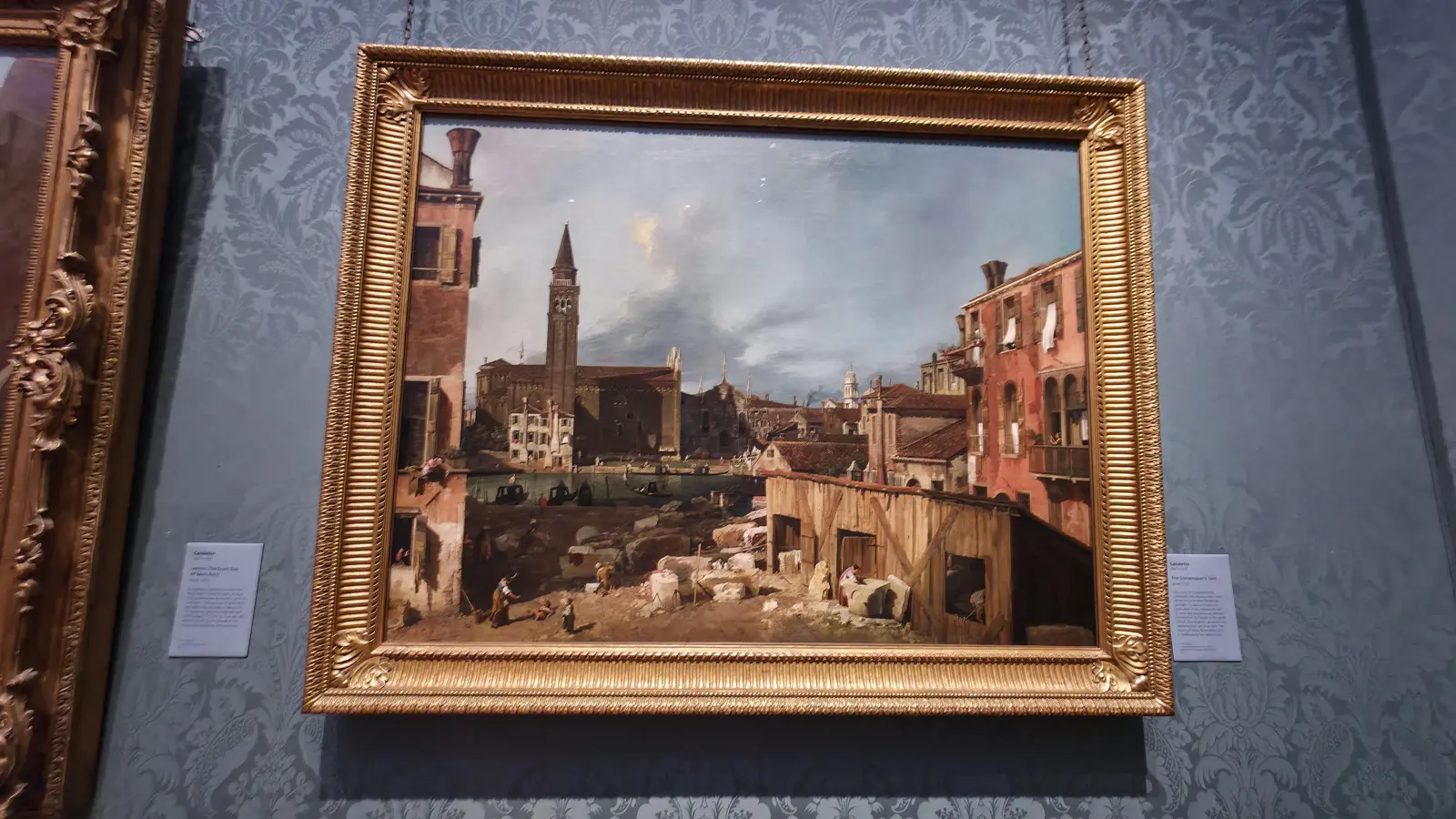
There is one painting in that room that does the opposite of all the others, and it is the one I love most. It is called The Stonemason’s Yard, and it shows a scruffy, working corner of Venice: the Campo San Vidal turned temporarily into a builder’s yard while the church next door was being repaired, around 1725. Blocks of stone lie about, a workman chisels away, a mother rushes to a child who has fallen over, a neighbour leans out of a window to watch. Nothing is tidied. The plaster is crumbling, the brick is bare. It is thought Canaletto painted this one for a Venetian, not a tourist, which may be exactly why he did not bother to prettify it. It is considered one of his finest things.
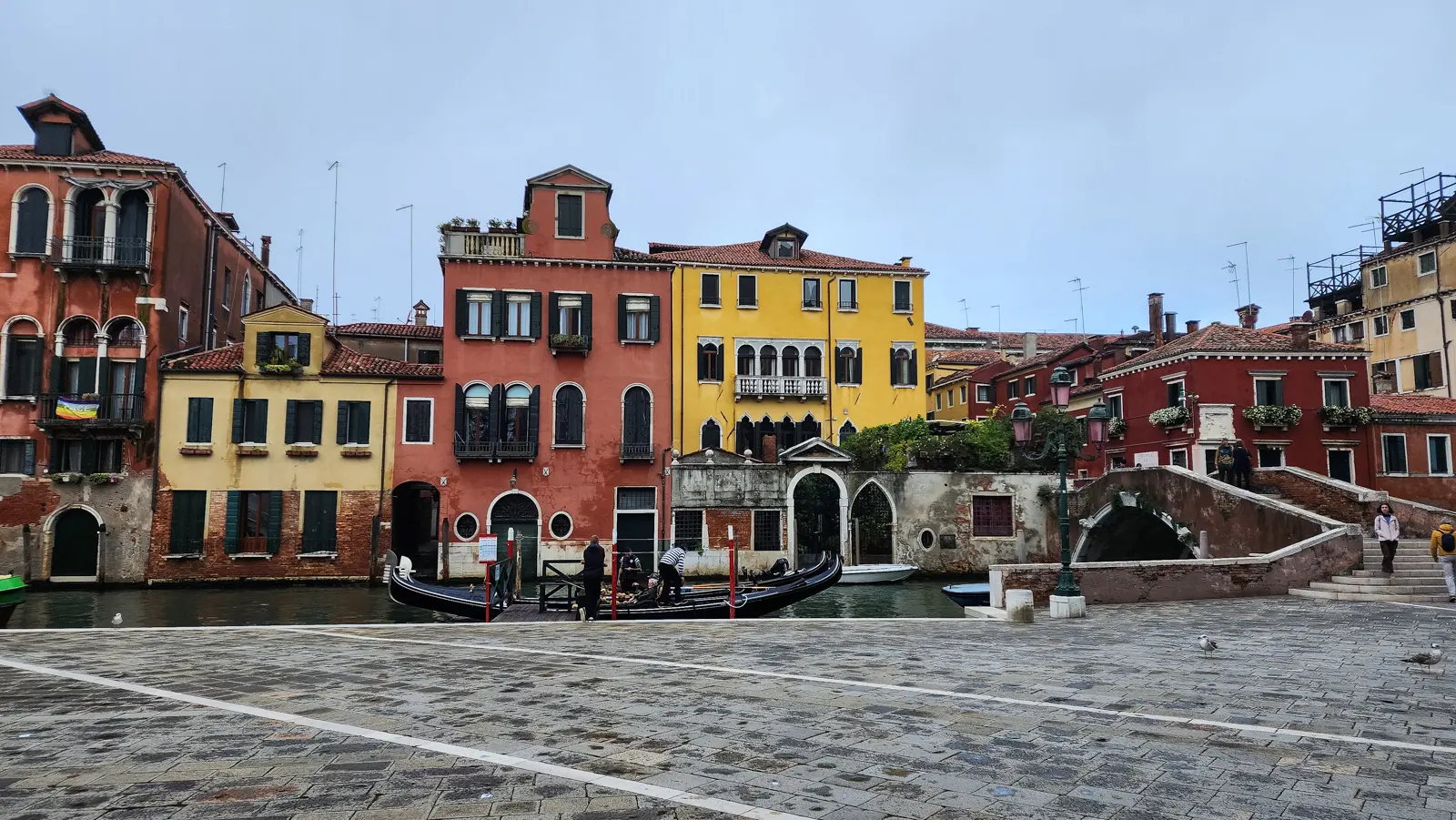
That painting looks like the Venice I actually walked through. Not the postcard, but the working city behind it. It looks like the view from the campo where I was staying, Campo Santi Giovanni e Paolo, where I stood at the little canal pier one grey morning and photographed the ordinary houses across the water while a gondolier readied his boat.
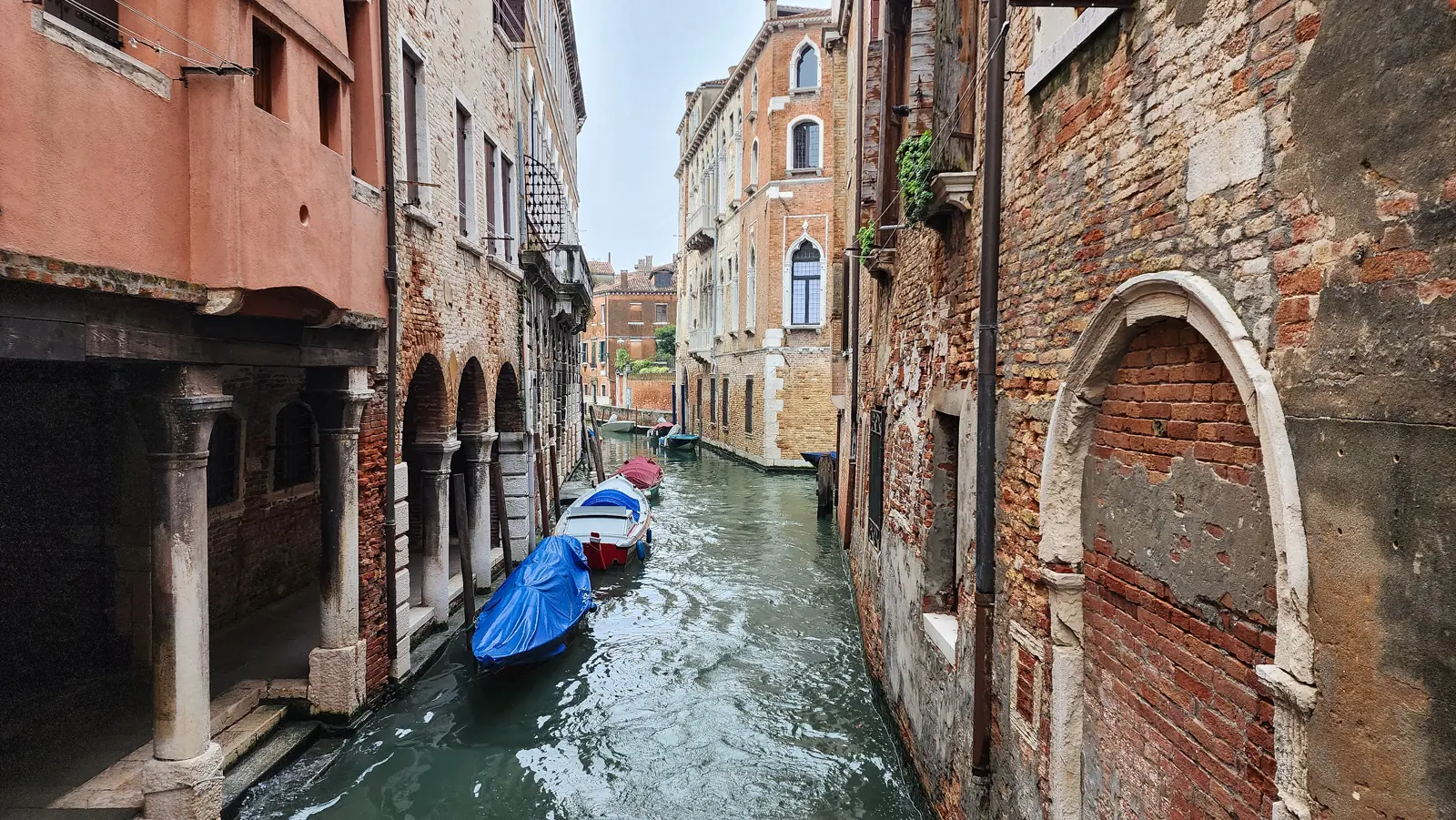
It looks, most of all, like the quiet back canals of Cannaregio, where the boats are working boats and the beauty is accidental.
Why his Venice is the one we picture
Here is what standing between the paintings and the place taught me. Canaletto was not lying, exactly. He measured his buildings carefully, sometimes with the help of that camera obscura, and then he improved on them: a wider square here, a taller tower there, a calmer sky, a tidier crowd. He was selling an impression to people who would carry it home and never come back, and he was very good at it. That edited, heightened, slightly-too-perfect Venice is the one that lodged in my head as a child, and I suspect in most of ours too.
Not everyone admired him for it. The Victorian critic John Ruskin, who worshipped Turner, thought Canaletto’s Venice was mechanical and cold. And the great exception, The Stonemason’s Yard, is the one where he stopped performing and simply painted what was there, which is why it looks so alive.
The real Venice is shabbier, wetter and more crowded than his, and I loved it more, not less, for that. But I understand now why his version is the one we all carry. He painted the Venice we hope for before we arrive. The city’s job, when we finally get there, is to be something better: real.
Bubbly Tips
- See the Canalettos for free. The National Gallery in London charges nothing for entry, and the Wolfson Room gathers the Venetian views in one place. It is an easy hour and a good thing to do before or after a trip to Venice.
- Find the arch in the Piazza. Canaletto’s favourite trick was framing St Mark’s Square through an arch of the arcade. Walk into the colonnade along the sides of the Piazza and you can line up almost the same shot yourself.
- Go early for the empty squares. The postcard Venice, with room to breathe in St Mark’s Square, only exists early in the morning and late in the evening. In the middle of the day it belongs to the crowds.
- Look for the working city. The Venice that matches The Stonemason’s Yard is a few streets back from the water, in the quiet canals of Cannaregio and Castello. Get deliberately lost and you will find it.
- Take the reverse view of the basin. From the Molo, turn your back on St Mark’s and look out to San Giorgio Maggiore. It is the calmer, less photographed side of the same water Canaletto made famous.
- Ride the number 1 vaporetto for the Grand Canal. It runs the length of the canal slowly and cheaply, and it is the nearest thing to Canaletto’s own journey along the palaces, wake and all.
- Pair it with a stay in a campo. Basing yourself on a residential square, rather than by San Marco, gives you the everyday Venice at your door. I stayed on Campo Santi Giovanni e Paolo and woke to church bells and a near-empty square.
Final Thoughts
I grew up wanting to visit a painting. What I got instead was a wetter, louder, more crowded city that I loved far more than the picture, and a new understanding of the man who painted the picture in the first place. Canaletto gave us the Venice we imagine. Venice itself gives us something harder and better: the real thing, chipped and beautiful and entirely its own.
The best of it is doing both: seeing his Venice on a gallery wall, then standing in the actual square, looking through the actual arch, and enjoying the difference.
Until next time!

🌟 Everything You Need to Plan Your Dream Trip in 2026
- 🌟 Luxury Hotels - Find premium stays with Booking.com & Hotels.com
- 🏡 Vacation Rentals - Discover unique properties on VRBO
- 🏞️ Guided Tours - Explore with Viator or GetYourGuide
- 🎫 Attraction Tickets - Skip the lines with Tiqets
- 🚢 Ocean Cruises - Set sail with Cruise Direct
- 📱 International SIMs - Stay connected with Saily
- 🚗 Car Rentals - Budget-friendly options from Discover Cars
- 🌐 Secure VPNs - Browse safely with NordVPN
- 💶 Currency Exchange - Best rates with Wise
- 🗣️ Learn Languages - Master the local language with Babbel and Rosetta Stone