
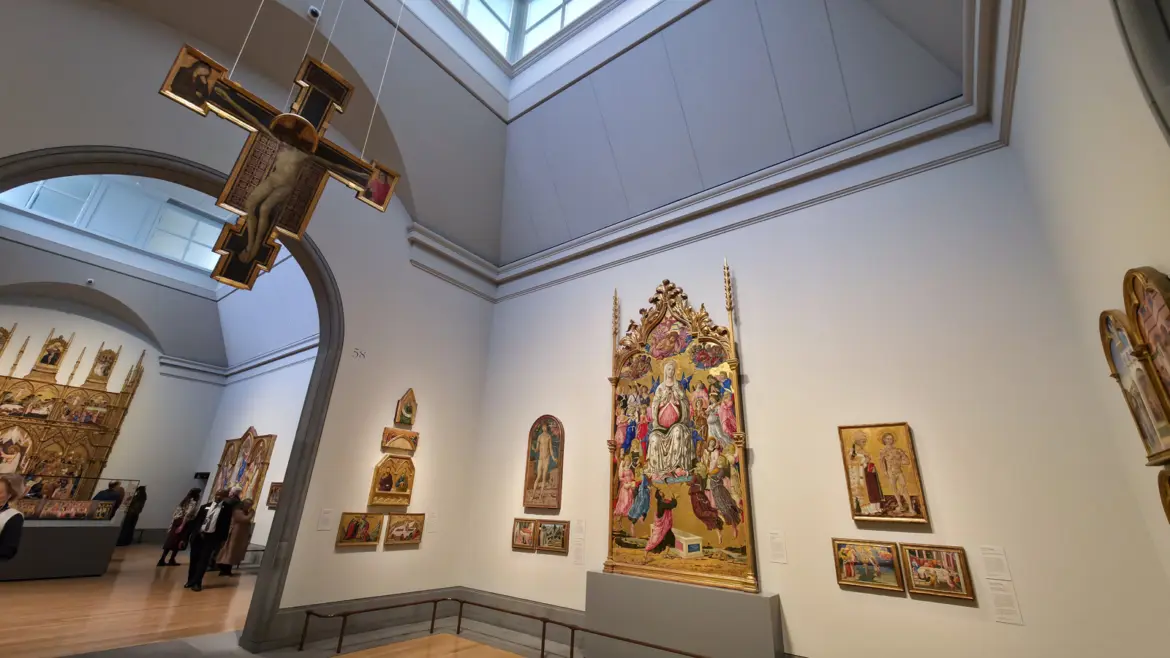
Walk into the medieval and early Renaissance rooms at the National Gallery in London and the walls turn to gold. Almost every panel is religious: a Virgin and Child, a saint, a scene from the life of Christ. To a modern visitor they can blur together into one long stretch of haloes and gilding. To the people who first stood in front of them, each one was as clear as a printed page.
That is the part worth slowing down for. Before most people could read words, they could read pictures. A saint was known by the object he held or the manner of his death. A colour told the viewer who someone was. A sleeping baby could mean something other than sleep. Religious painting was a shared language, and once its grammar becomes a little familiar, the rooms stop being a gilded blur and start to talk.
I went through these rooms on a December visit, and these are the pictures that taught me the code, oldest first.
Reading Religious Art at the National Gallery at a Glance
📍 Where · The Sainsbury Wing, in the medieval and early Renaissance rooms. The collection’s oldest works begin here, in the 1260s.
🆓 Entry · Free. Come in for twenty minutes and three paintings; this kind of slow looking suits it better than a marathon.
🔍 How to read it · Look for the attribute, not the name. Catherine has a wheel, Jerome a lion, Peter Martyr a blade in his head.
🖼️ Don’t miss · Margarito’s panel of about 1263, the oldest in the building; Duccio’s folding triptych; Piero’s Baptism; Bellini’s Madonna of the Meadow.
📖 Borrow the large-print label folders · Kept in a box by the door in several rooms, they decode a picture on the spot.
🪑 Sit with one picture · There are benches in most rooms. The Bellini and the Piero both reward five quiet minutes.
🕙 Start oldest-first · The later naturalism makes far more sense once you have seen the gold grounds it grew out of.
Saints known by their stories
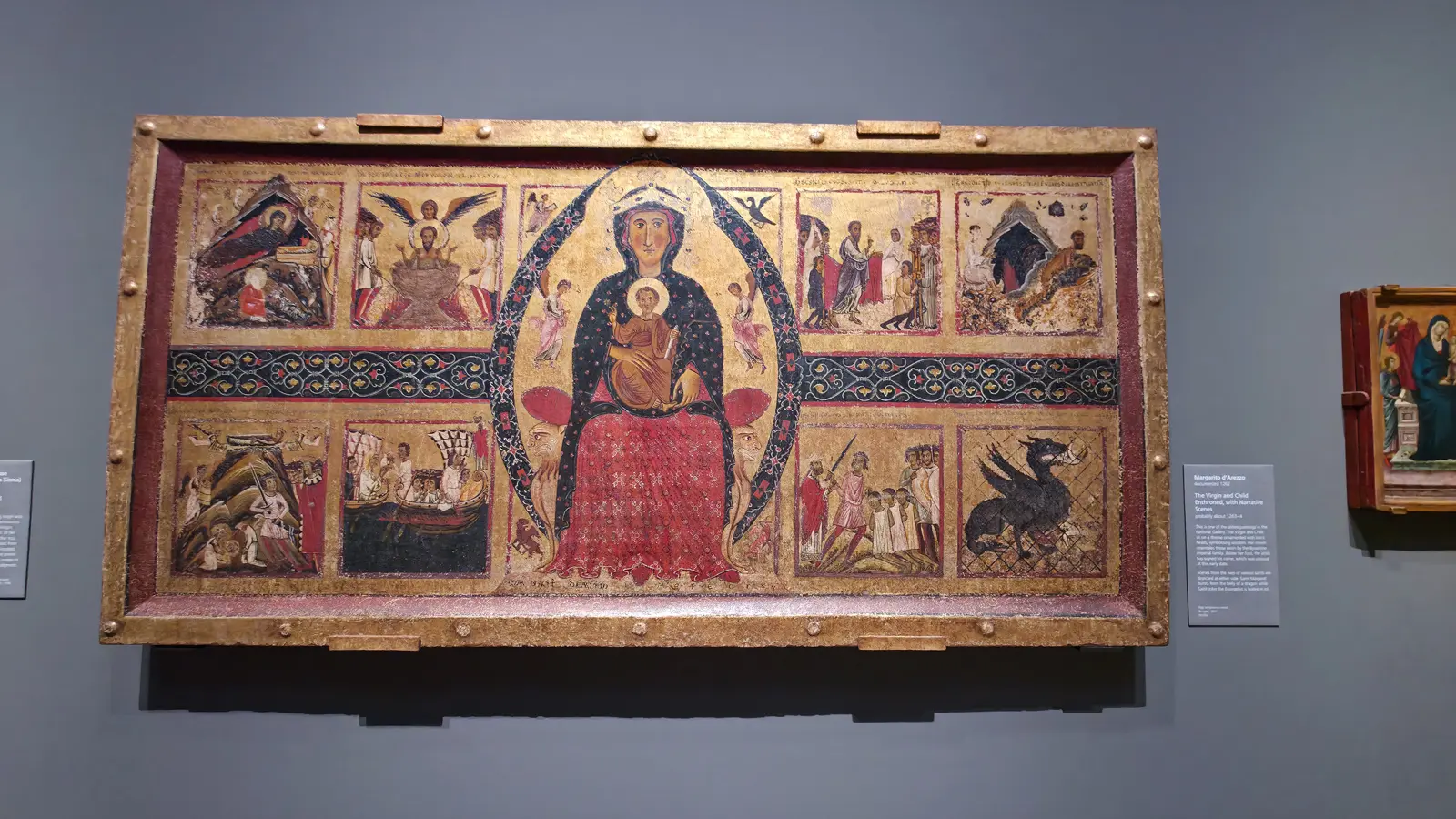
The oldest painting in the building is also one of the easiest to read. Margarito d’Arezzo painted it around 1263, and at its centre the Virgin and Child sit inside a pointed oval called a mandorla, the almond-shaped frame that marked out the heavenly realm. Around them run eight small scenes from the lives of the saints.
No labels are needed once the stories are known. Saint John the Evangelist sits in a cauldron of boiling oil and survives. Saint Catherine is beheaded. Saint Nicholas saves three men from execution. A black dragon fills one panel. Each saint is identified not by a name but by the worst or most miraculous moment of their life, which is exactly how a thirteenth-century worshipper would have known them. Margarito also signed his name beneath the Virgin’s feet, which makes this the earliest signed picture in the collection, a small sign that painters were starting to step out of anonymity.
Prophecy built into the frame
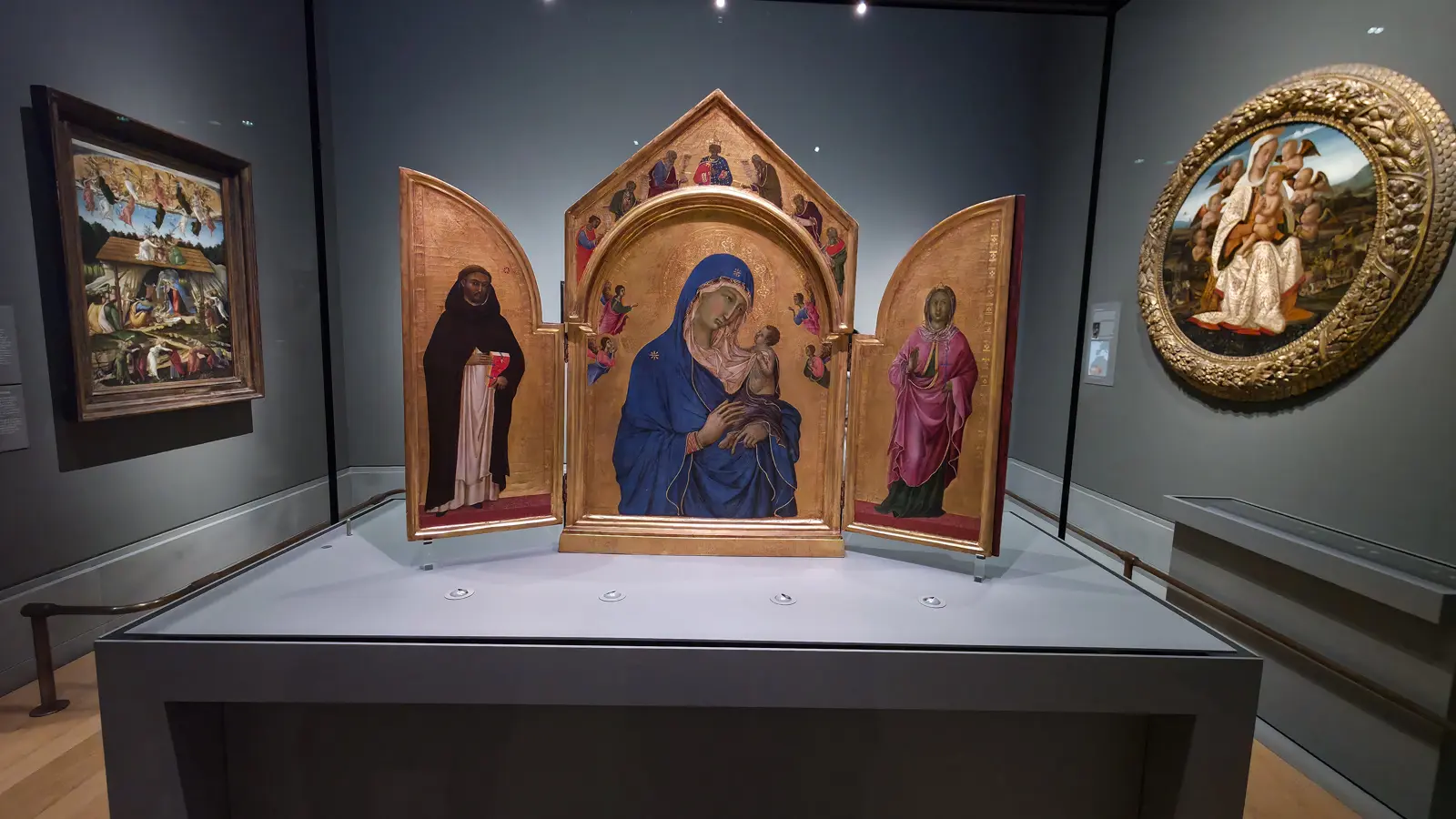
A few decades later, Duccio of Siena made this small triptych, its two wings able to fold shut over the centre like cupboard doors. Above the Virgin and Child, in the gable, sits King David surrounded by Old Testament prophets, each holding a scroll. Those scrolls are the point. The prophets foretold that a king greater than David would be born in Israel, and the scrolls carry their words. Set above the Virgin and her son, they explain the figures below: the baby on Mary’s lap is that promised king.
The two saints on the wings carry their own meaning. On the left stands Saint Dominic, founder of the Dominican order. On the right stands Saint Aurea, the patron saint of Ostia, the old port of Rome. Together they point straight to the man who ordered the picture, a cardinal who was Bishop of Ostia and a member of Dominic’s order. The saints are a kind of signature for the patron.
Pictures as fixed formulas
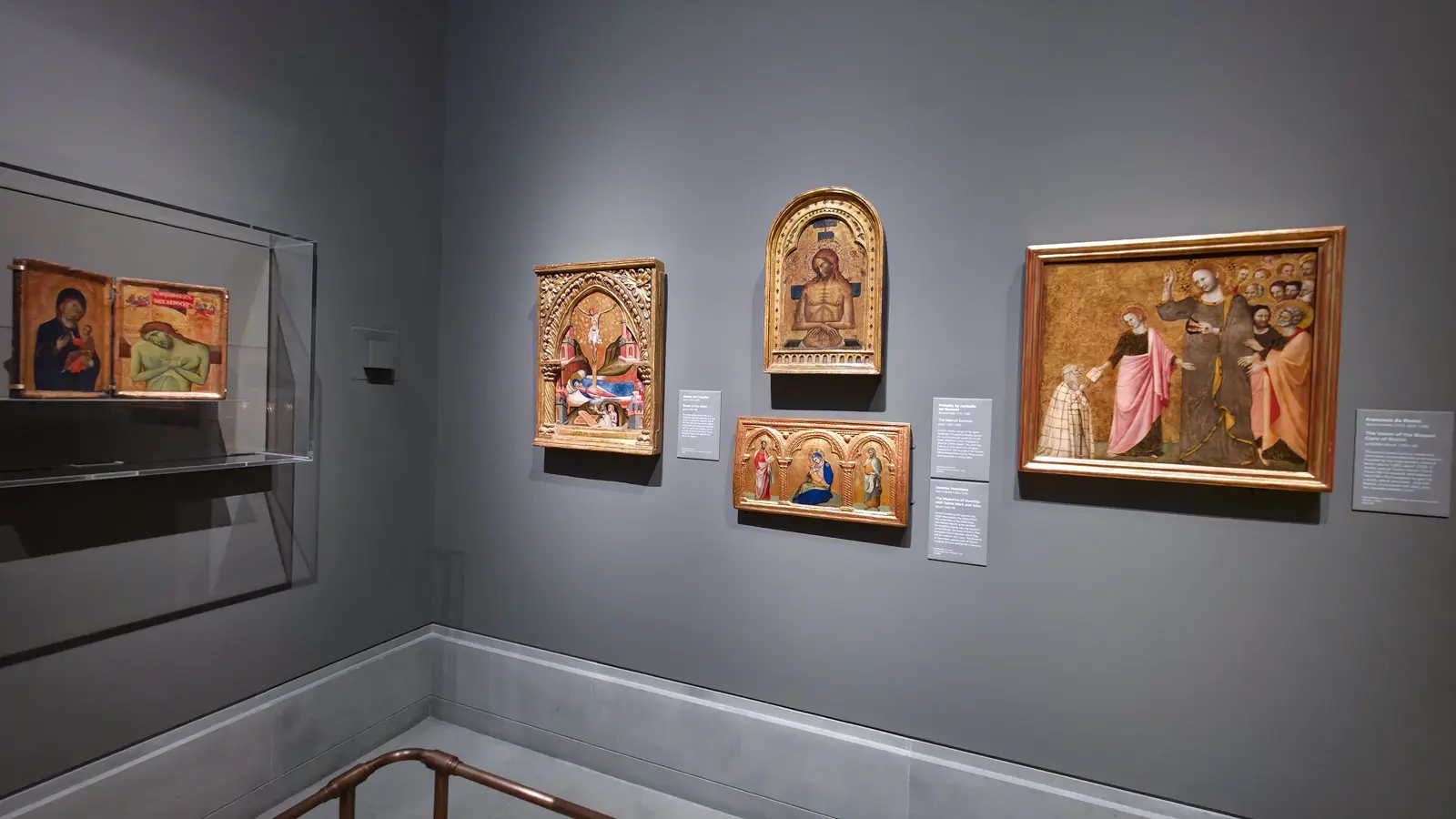
By the fourteenth century, certain religious images had settled into standard types, recognisable at a glance. Two of them hang together in this corner.
The upright panel shows Christ half-length, dead, his wounds visible and his hands crossed. This is the Man of Sorrows, or Imago Pietatis, the “image of pity”. Christ is shown dead but propped upright, outside any story, so that a worshipper could meditate on the Passion directly. The type came from Byzantium, the Eastern Christian empire, and reached Venice through its trade links and the plunder of Constantinople in 1204.
Below it is the Madonna of Humility. Instead of a throne, Mary sits low with the Child, on the ground or a cushion, and that low seat is the whole meaning of the type: her humility, spelled out in the gold inscription beside her that reads “Holy Mary of Humility”. The formula was a deliberate break from the older image of Mary as a crowned queen high on a throne. Bringing her down to the worshipper’s own level, a humble mother rather than a remote sovereign, was much of its appeal, and the type spread quickly through fourteenth-century Italy.
Humility is not the only idea woven in. A sun-shaped brooch sits at her throat, a crescent moon lies beneath her feet, and twelve stars ring her figure, the signs of the Woman of the Apocalypse from the Book of Revelation, a cosmic mother long associated with the Virgin. She sits between Saint Mark and Saint John the Baptist under three small arches, and the presence of Mark, patron saint of Venice, points to a Venetian patron, perhaps a man named after the Baptist. Like the Man of Sorrows above it, the Madonna of Humility was a fixed formula, known on sight without a word of explanation.
A crowning in heaven
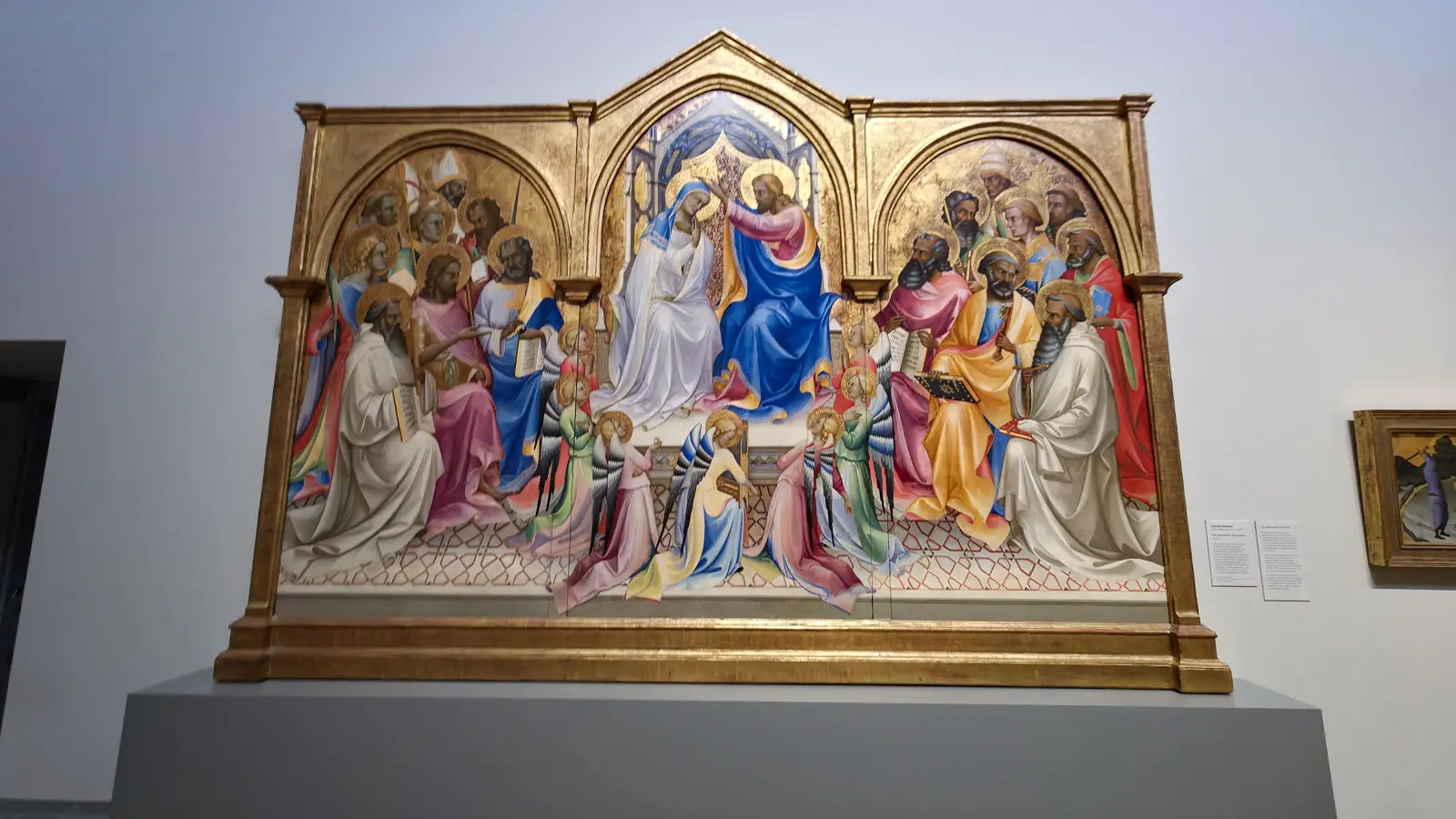
Every picture so far has happened on earth. This one happens in heaven. Christ sets a crown on his mother’s head while she crosses her hands on her chest in acceptance. The story comes from medieval legend: after Mary’s death her soul was carried up to heaven and she was crowned its queen, the closing episode of her life and a favourite subject across medieval Italy. Lorenzo Monaco, who painted it, was himself a monk, and he made it for the high altar of his own order’s monastery in Florence. The whole gold ground stands for the divine realm, and around the throne ranks of saints in glowing colours and kneeling angels with censers and instruments fill heaven with music. Like the Man of Sorrows and the Madonna of Humility, the Coronation was a fixed type, known on sight, and it makes a bold claim for Mary: not only mother, but crowned queen of heaven itself.
The dove and the Trinity
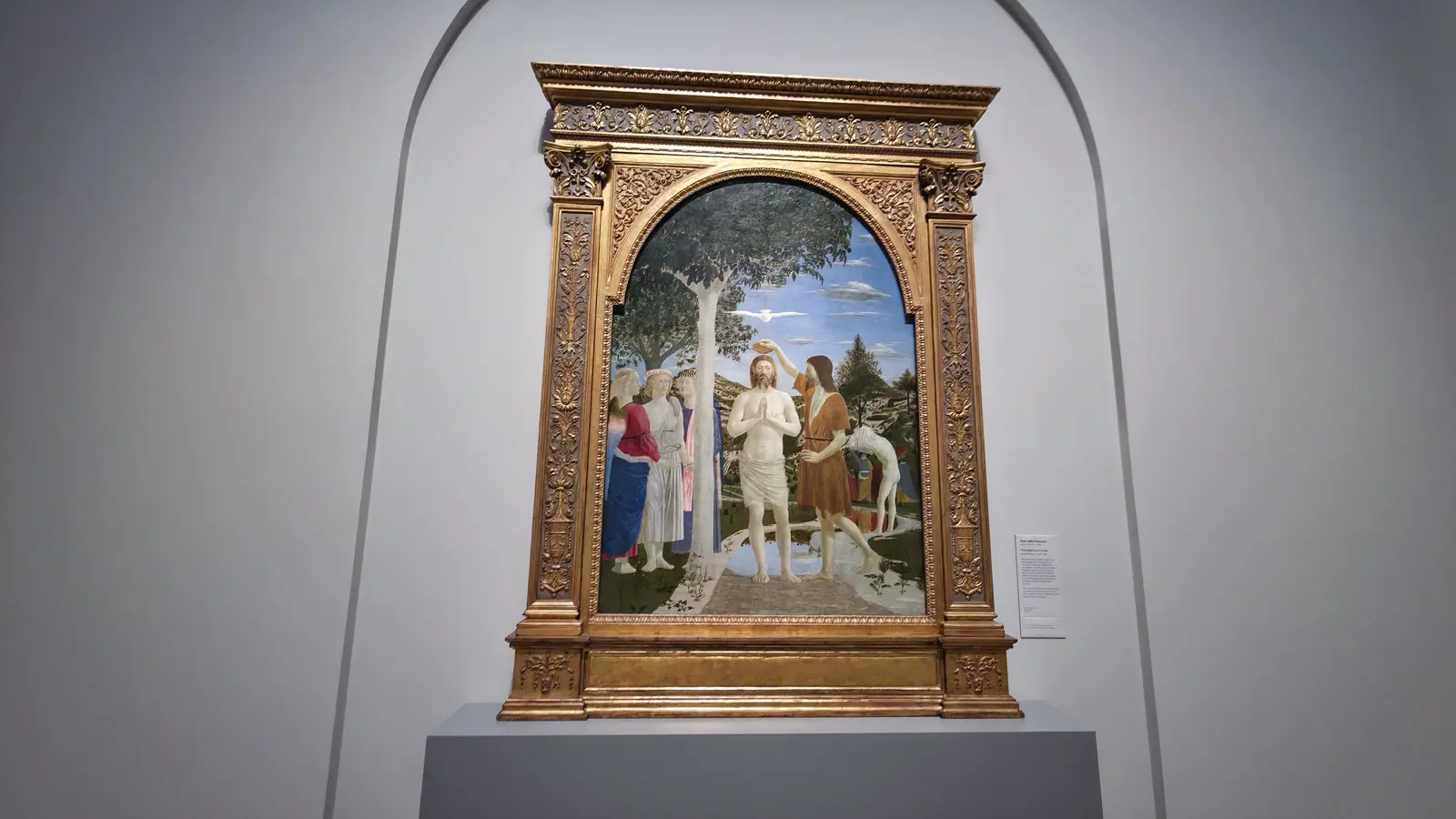
Move into the fifteenth century, and Piero della Francesca’s Baptism of Christ shows how a single object can carry an entire doctrine. John the Baptist pours water over Christ’s head, and directly above hovers a white dove. The dove is the Holy Spirit, descending at the moment God’s voice declared Christ his son.
Piero lined the dove up exactly above the bowl and Christ’s praying hands, a vertical spine running down the centre of the painting. The original frame may once have held a small roundel of God the Father directly above the dove. Father, Spirit and Son, stacked in a line: the Trinity made visible. The pale walnut tree on the left, its trunk the same colour as Christ’s skin, quietly doubles the body at the centre.
Colour as code
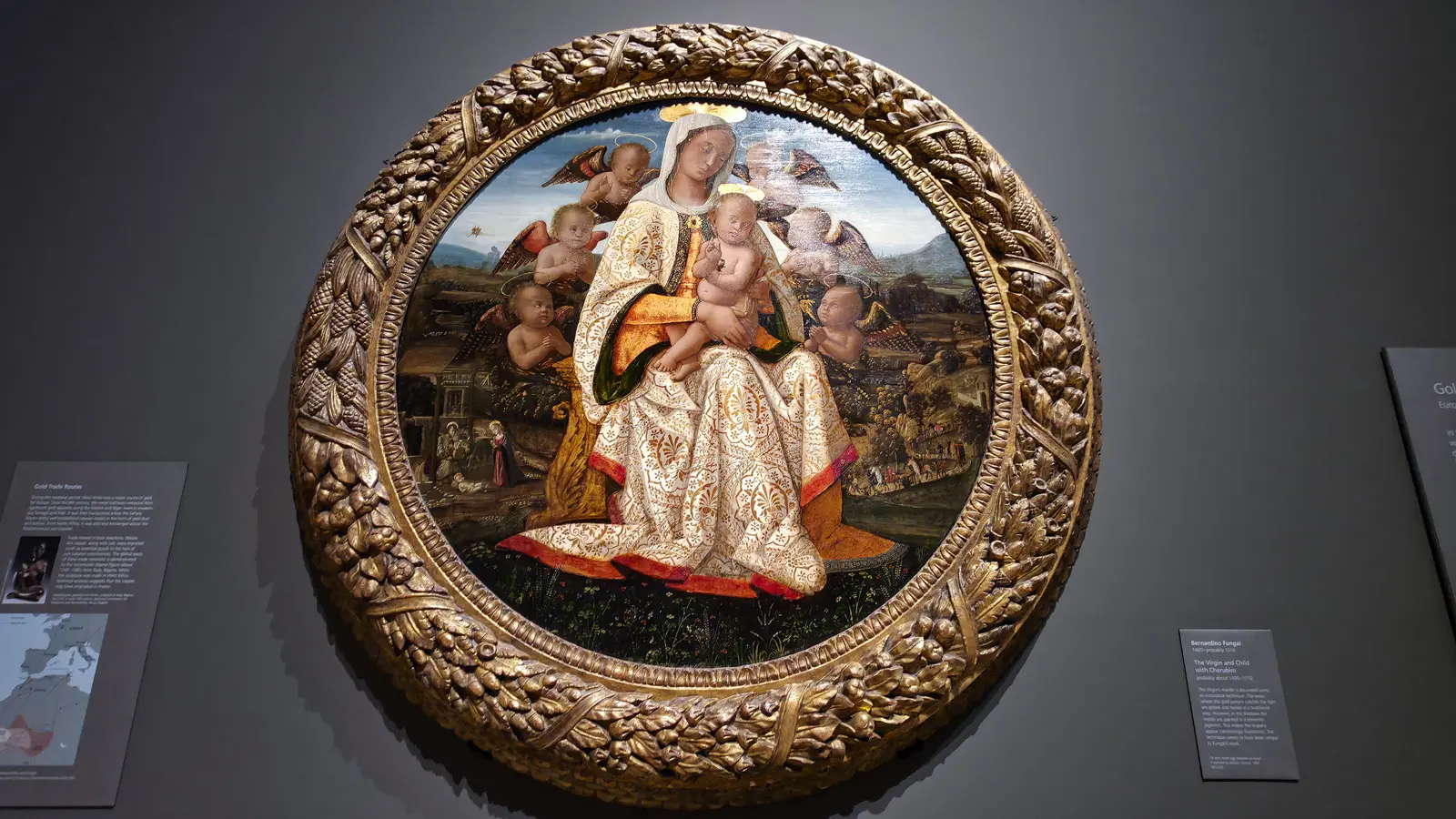
Bernardino Fungai‘s circular panel, a tondo, carries its meaning in the cloth. The Virgin wears a dazzling white and gold robe, and that colour was usually kept for the Virgin at her most glorious: her Assumption into heaven, or her coronation as Queen of Heaven. Worn here, it lends her that royal, heavenly rank even in a quiet picture of a mother and her child. The round format gave Fungai room to tuck a small Nativity into the landscape behind, with an angel bringing the news to shepherds off to one side, so a whole stretch of the story sits in the background of a single devotional image.
When the symbols go quiet
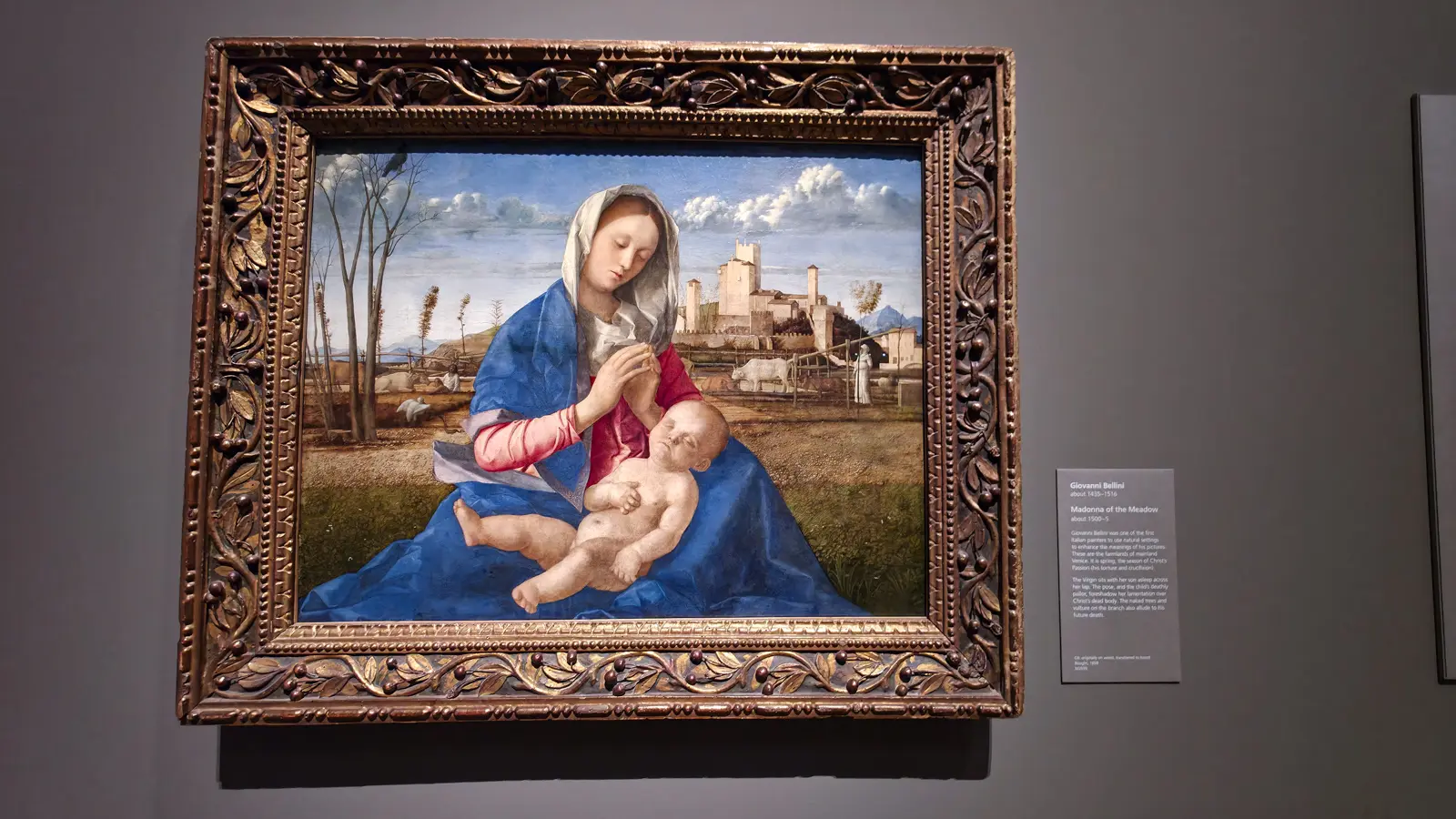
Giovanni Bellini, working in Venice around 1500, did something cleverer with the same language. He hid it in plain sight. In the Madonna of the Meadow, Mary sits in a spring field with the Christ Child asleep across her lap. The pose is the catch. A baby lying limp across his mother’s knees would have called up the Lamentation, the image of the grown Christ taken down from the cross and laid across Mary’s lap. The sleeping child carries his own death inside the picture. A bare, leafless tree stands to one side with a vulture perched in it, a bird of death. And the field is in spring, the season of Easter and of rising from the dead, so the same landscape that foretells the death also promises the resurrection.
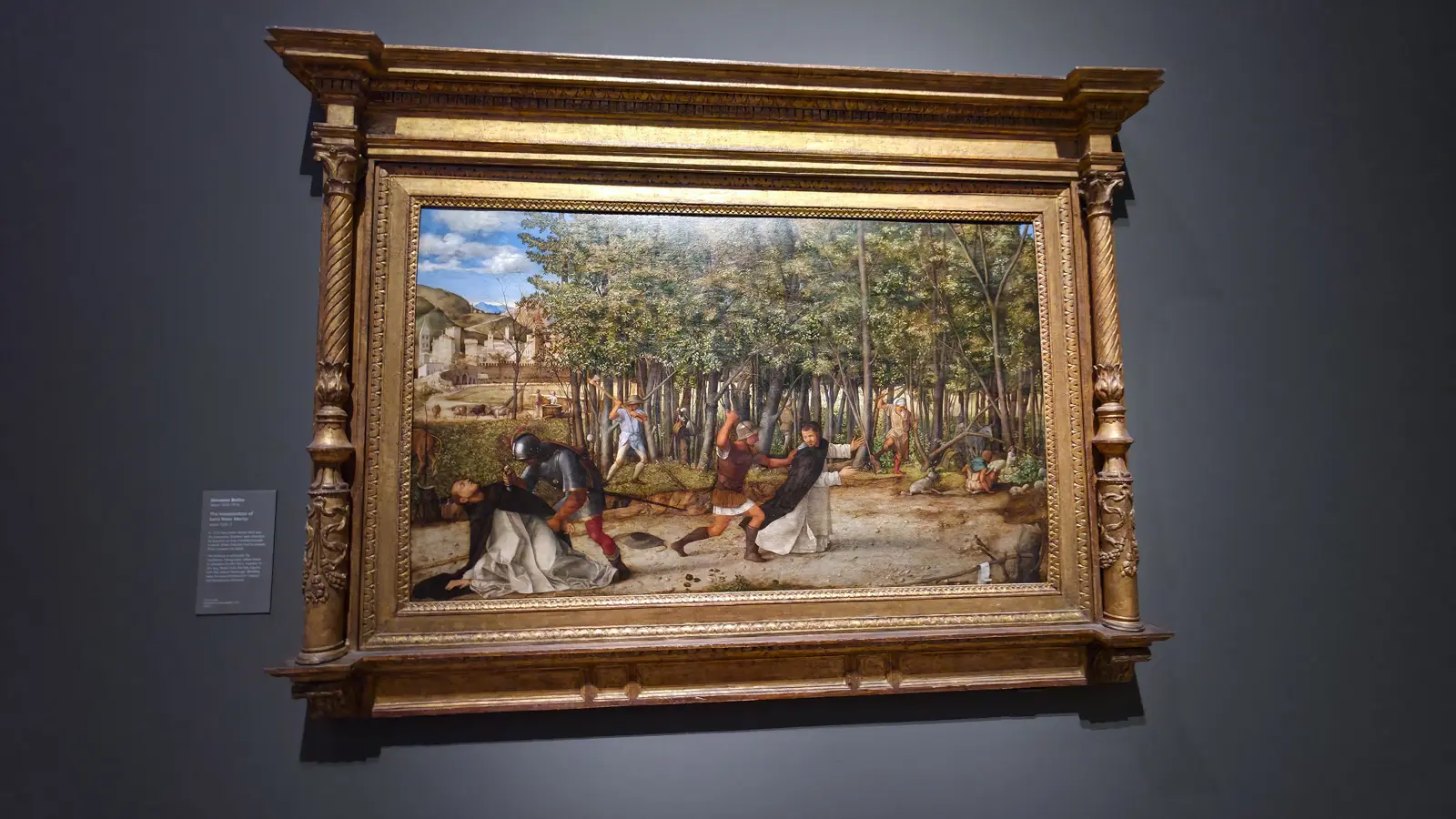
Bellini’s Assassination of Saint Peter Martyr plays the same trick with a whole forest. The saint, a Dominican friar, has been struck down by hired assassins on a woodland path, an armoured attacker driving a blade into his chest while a second friar is seized further along. Behind them, woodsmen swing their axes at the tree trunks. The felling of the trees mirrors the killing of the men, blow for blow, and in a related version of the scene the cut trees bleed in sympathy. Bellini shows almost no blood at all. He lets the woodcutters and the wounded trees carry the violence instead. Bands of bright light break between the dark trunks and lead the eye towards a sunlit city in the distance, the saint’s reward beyond his death.
Bubbly Tips
- Start in the oldest rooms. The medieval and early Renaissance galleries hold the gold-ground panels, arranged roughly by date and region. Begin here and the later naturalism makes far more sense, because you have seen what it grew out of.
- Look for the attribute, not the name. Saints come with props: Catherine with a wheel, Jerome with a lion, Peter Martyr with a blade in his head. Learn five or six and you can name half a room without reading a single label.
- Borrow the large-print label folders. Several rooms keep a box of them by the door, marked “please return after use.” They carry far more detail than the small wall labels, and they are the easiest way to decode a picture on the spot. I leaned on them all afternoon.
- Entry to the main collection is free. You can come in for twenty minutes and three paintings without guilt, which suits this kind of slow looking better than one exhausting marathon.
- Photography is fine without flash. The gold grounds are tricky in the low light, so brace your elbows or rest the camera on a railing rather than pushing the brightness later.
- Sit down with one picture. There are benches in most rooms. The Bellini Madonna of the Meadow and the Piero Baptism both reward five quiet minutes far more than a quick pass.
- Pair it with Trafalgar Square. The Gallery sits right on Trafalgar Square, so you can fold a visit into a wider central London day with Nelson’s Column, the fountains and the Christmas tree in winter just outside the door.
- Chase the Bellini twin. If the Assassination of Saint Peter Martyr catches you, its near-identical workshop version is about fifteen minutes’ walk away at the Courtauld Gallery in Somerset House. Seeing the two together is a small treat for anyone who likes spotting the differences.
Final Thoughts
What strikes me, walking out of these rooms, is how completely the Church shaped the world that made these pictures. Almost nothing here was painted for its own sake. Someone commissioned each panel, often to be remembered, to be seen as devout, or to furnish a chapel or a private room for prayer. Painters worked to please religious houses, wealthy families and, higher up, the pope. The symbols are so dense because everyone in the room could read them. This was the common visual language of the day.
The contrast is the interesting part. We stand in front of a Bellini and need a wall label to explain why the baby is asleep or why the trees are being cut down. The first viewers needed nothing of the sort. Learning even a little of the code closes that gap, and the pictures open up. The vulture, the scroll, the white robe, the bleeding tree: once they start to speak, a quiet gold-ground room turns into a room full of stories.
Until next time!

🌟 Everything You Need to Plan Your Dream Trip in 2026
- 🌟 Luxury Hotels - Find premium stays with Booking.com & Hotels.com
- 🏡 Vacation Rentals - Discover unique properties on VRBO
- 🏞️ Guided Tours - Explore with Viator or GetYourGuide
- 🎫 Attraction Tickets - Skip the lines with Tiqets
- 🚢 Ocean Cruises - Set sail with Cruise Direct
- 📱 International SIMs - Stay connected with Saily
- 🚗 Car Rentals - Budget-friendly options from Discover Cars
- 🌐 Secure VPNs - Browse safely with NordVPN
- 💶 Currency Exchange - Best rates with Wise
- 🗣️ Learn Languages - Master the local language with Babbel and Rosetta Stone