
I went to Moco Museum in Amsterdam for the Banksys. That was the whole plan. The stencils, the rats, the girl with the balloon, and then out through the shop and home.
What I had not expected was that the part of the museum I would still be turning over a week later was the part underneath it, in a set of rooms with no paintings in them at all. No frames, no labels to lean in towards, nothing hanging on a wall. In one of them there is no wall.
There is an objection to this sort of work, and it deserves stating properly rather than being waved away. Plenty of thoughtful people do not count digital and immersive installations as art at all, and their reasons are not silly ones. I will come back to that at the end, because the argument only makes sense after the rooms have been described.
What I will say now is that these rooms are worth giving the benefit of the doubt. Walking through them in four minutes on the way to the exit is a way of proving whatever a visitor already believed on the way in. Standing still in them for twenty is a different proposition entirely.
This is a post about that lower floor, plus the digital work upstairs that leads into it. Three artists, a series of rooms between them, and not a single frame.
Moco’s Immersive Rooms at a Glance
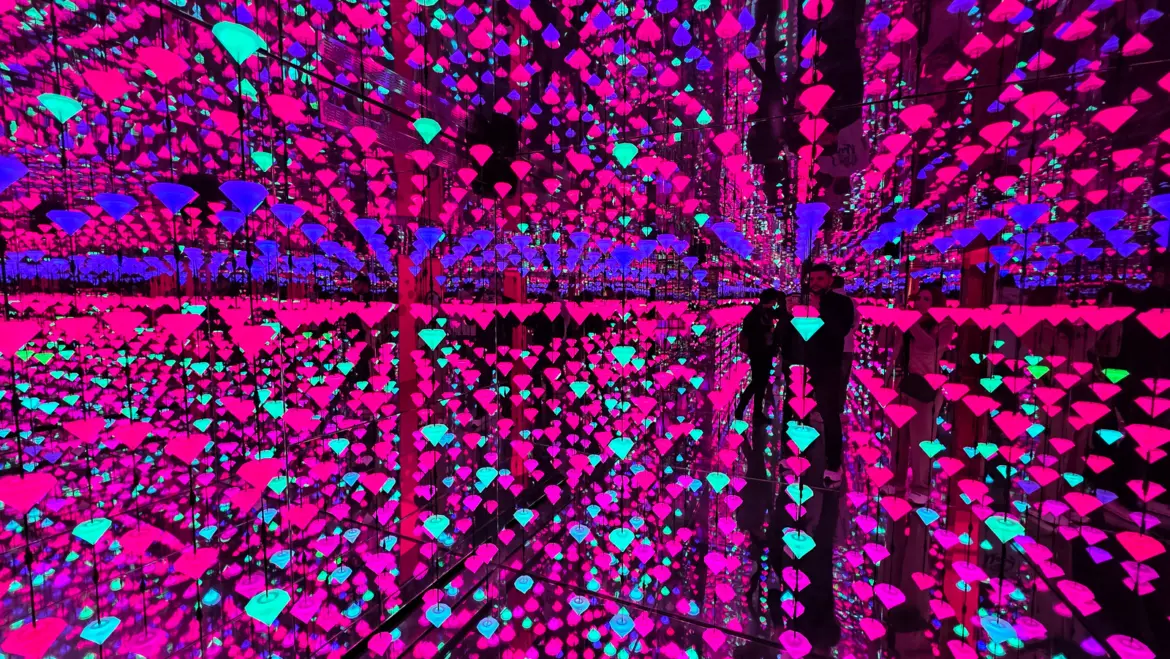
💎 The headline room · Diamond Matrix, a mirrored infinity room of ~500 light-up diamonds where the walls and floor disappear.
🌀 Whose work · Studio Irma’s Reflecting Forward downstairs, plus Six N. Five’s landscapes upstairs and Andrés Reisinger’s pink Take Over Elastic.
📍 Where · The lower ground floor, beside the shop on the way to the garden. Easy to rush; worth slowing for.
⏱️ The trick · Each room runs on a cycle. Stand still for a full colour change rather than walking through.
💡 Tip · Do these rooms with attention left, not as an afterthought. They can take half the visit if done properly.
Where It Sits
Moco occupies a villa on Museumplein, and the digital work is not the reason the building is famous. It is easy to treat these rooms as the bit at the end, because they sit downstairs beside the shop, on the route out towards the garden.
That placement does them no favours. Anyone who has already spent an hour upstairs arrives at them with a flat battery and a queue behind them.
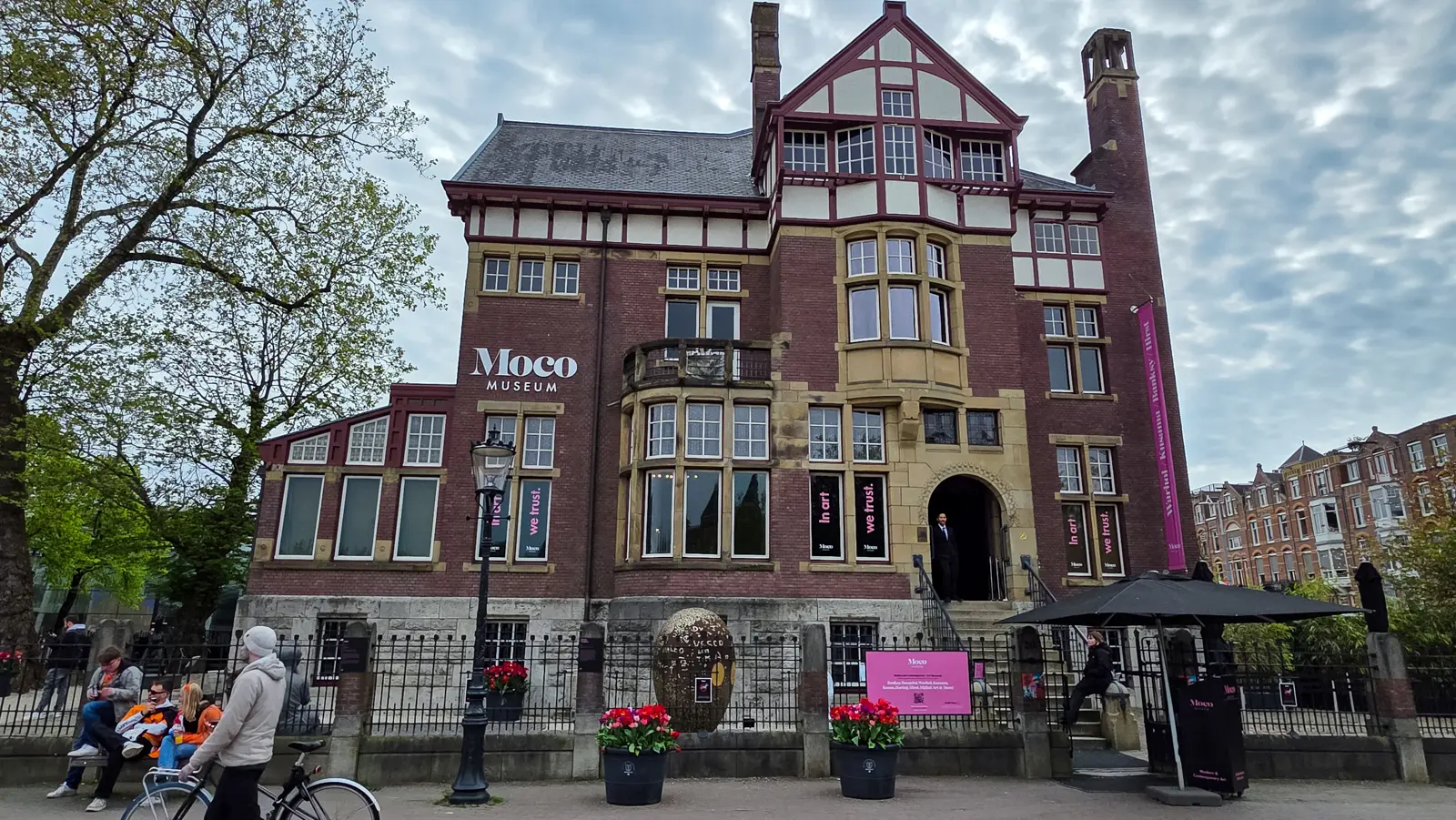
I went on King’s Day, which turned out to be the best possible accident. Amsterdam on 27 April is a flea market with a city attached. Moco stayed open, and the rooms downstairs were quieter at five in the afternoon than I have known any Amsterdam museum to be in April.
Six N. Five
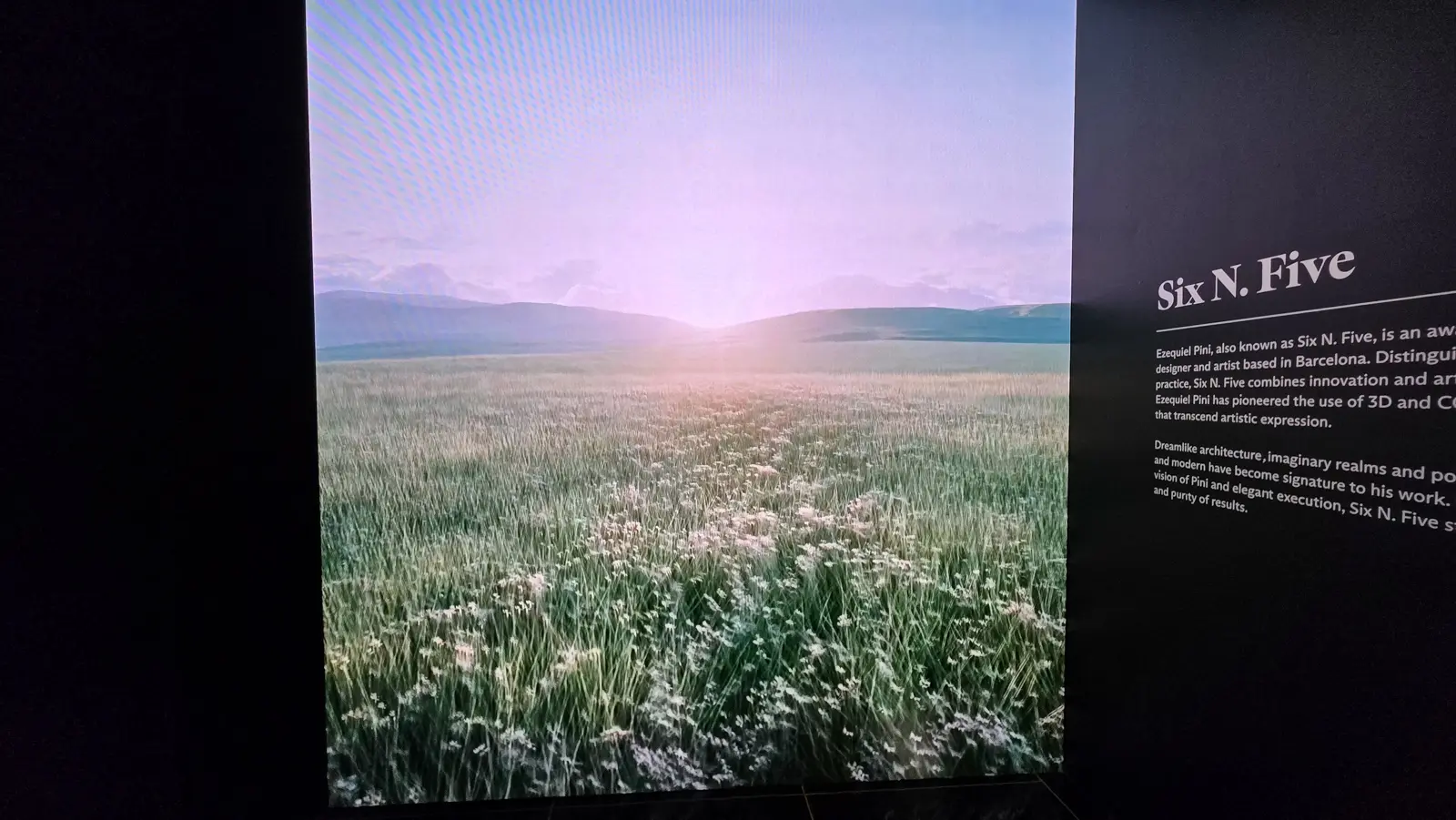
The first digital work is upstairs, in the gallery Moco keeps for shorter runs, and it is the quietest thing in the building. Two tall screens in a dark room, each carrying a slow-moving landscape that never quite settles.
One is a meadow at first light, grass and white umbellifer heads running away towards low hills, the sun sitting exactly on the horizon line. It is rendered rather than filmed, and the giveaway is that it is slightly too perfect.
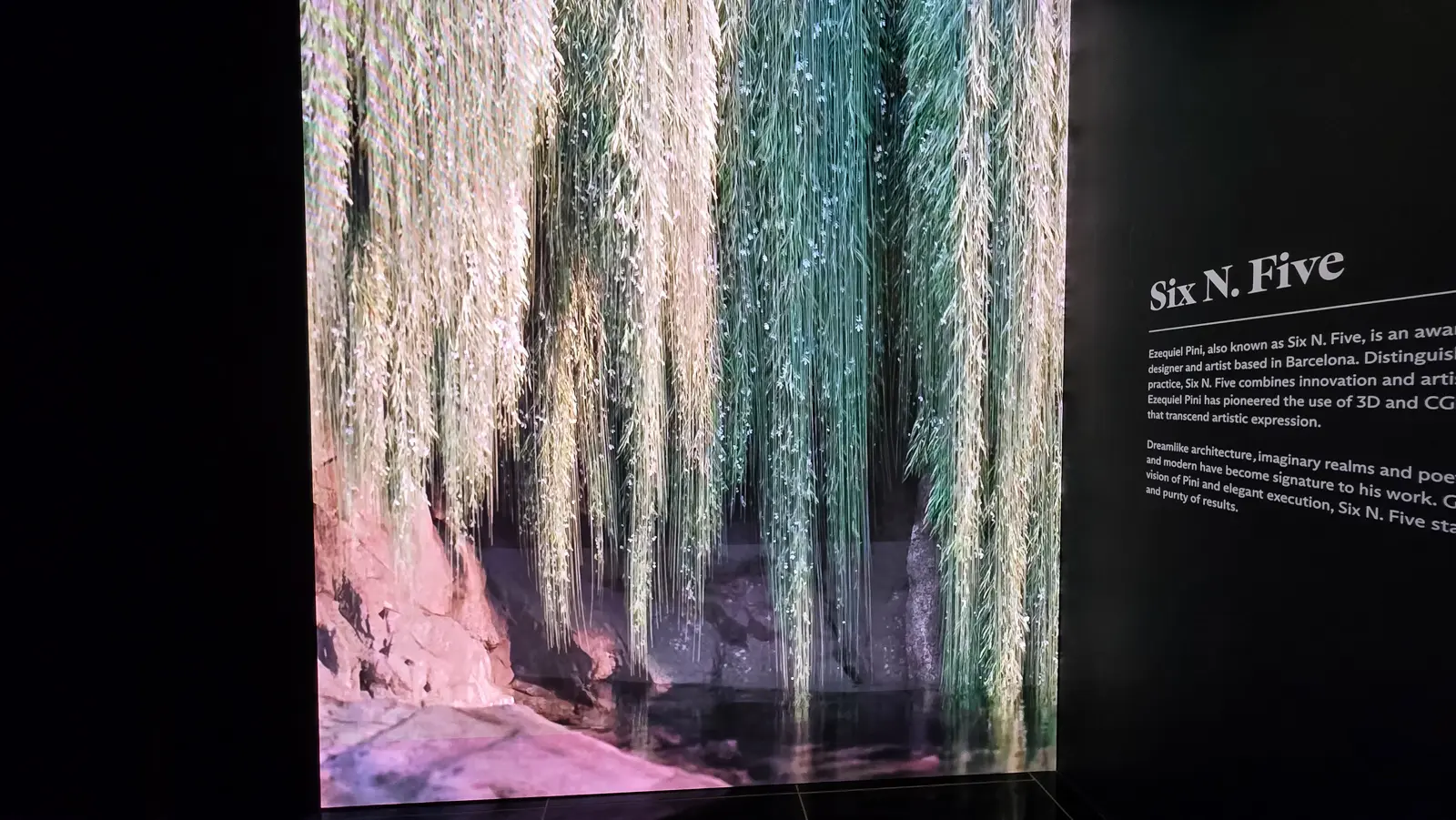
The second screen holds hanging fronds over dark water, pale green and gold, with pink rock behind them. Standing between the two, the effect is less like watching a film than like being shown two windows onto somewhere that does not exist.
Pini is Argentinian and based in Barcelona, which puts him and Andrés Reisinger downstairs in the same city, working in overlapping territory, showing in the same small Dutch villa.
Reflecting Forward
Downstairs belongs to Studio Irma, and the thing worth knowing before going down is that it is not one room. It is a set, each one named: We All Live in Bubbles, Kaleidoscope, Diamond Matrix, and Connect the Dots & Universe.
They run one into the next, and the temptation is to walk through them the way one walks through a corridor. That is the mistake, and it is an easy one to make, because there is no obvious signal that a room has finished doing what it does.
Each one is on a cycle. Standing still for ninety seconds in any of them shows something that walking through does not, and in two of the four the scheme changes so completely that a visitor who left after twenty seconds and a visitor who left after two minutes would describe different rooms.
One detail worth carrying downstairs. A particular shade of pink was developed specifically for this exhibition, and the museum has said it was chosen to prompt a dopamine response, on the basis that colour and reward have been linked in humans over evolutionary time. It recurs across the rooms rather than belonging to any one of them, which is worth knowing before wondering why so much of the basement is pink.
We All Live in Bubbles
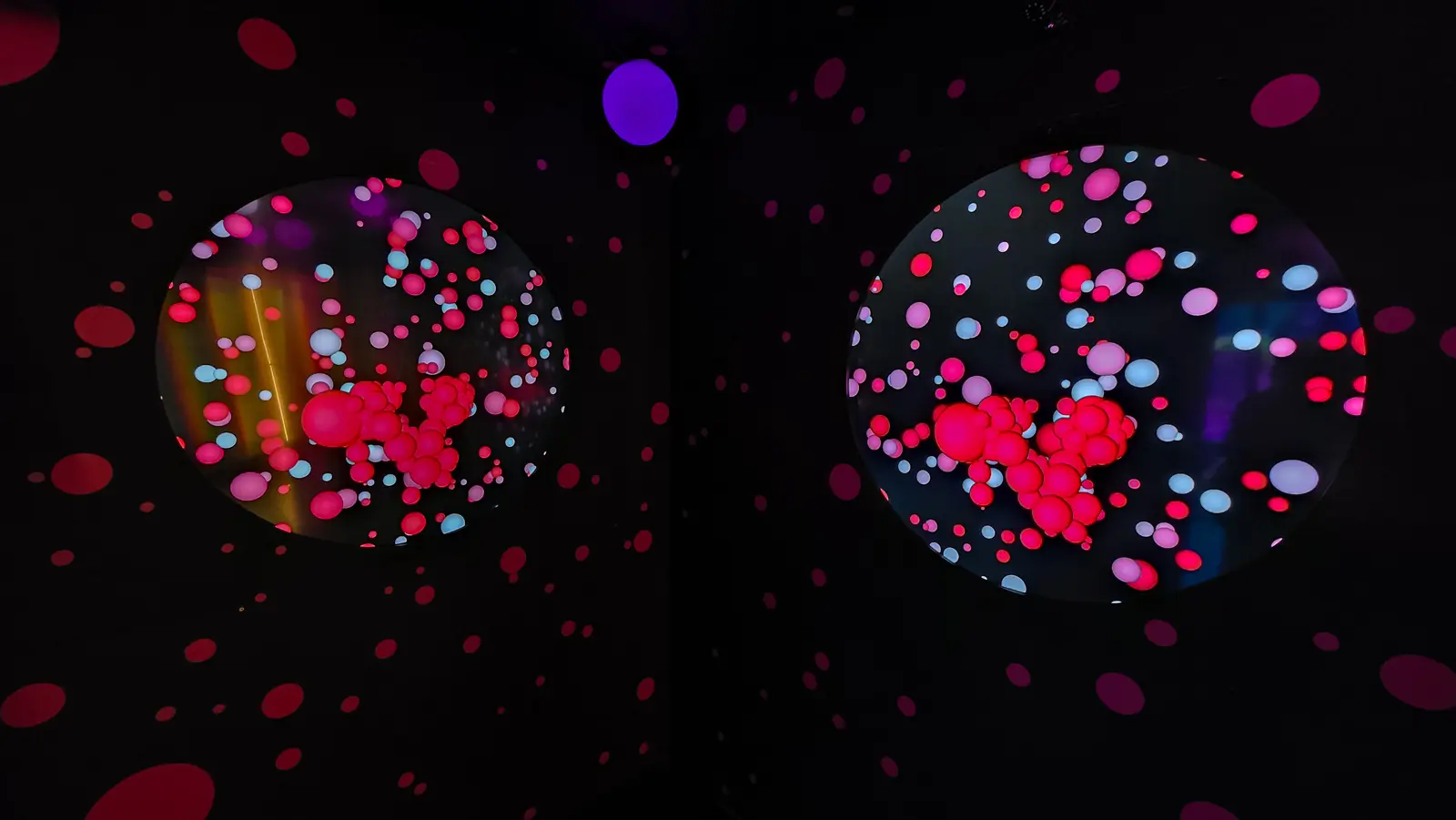
The first is the darkest, and it takes a moment for the eyes to adjust after the stairs. Black walls scattered with deep red circles, and two large round screens set into them, each carrying clusters of pink and white spheres that gather, drift apart and gather again.
The spheres never settle into a pattern. They cluster tightly, hold for a second or two, then break and reform somewhere else on the screen, and the two screens are not synchronised with each other. Watching both at once is impossible, which appears to be the point of hanging them on adjacent walls.
The title is worth sitting with. Bubbles that cluster, hold and separate is a fair description of what is on the screens. It is also, read another way, a fair description of how people sort themselves online, and the exhibition as a whole is working in that territory. Studio Irma has not said the room means that, and it does not need to.
Kaleidoscope
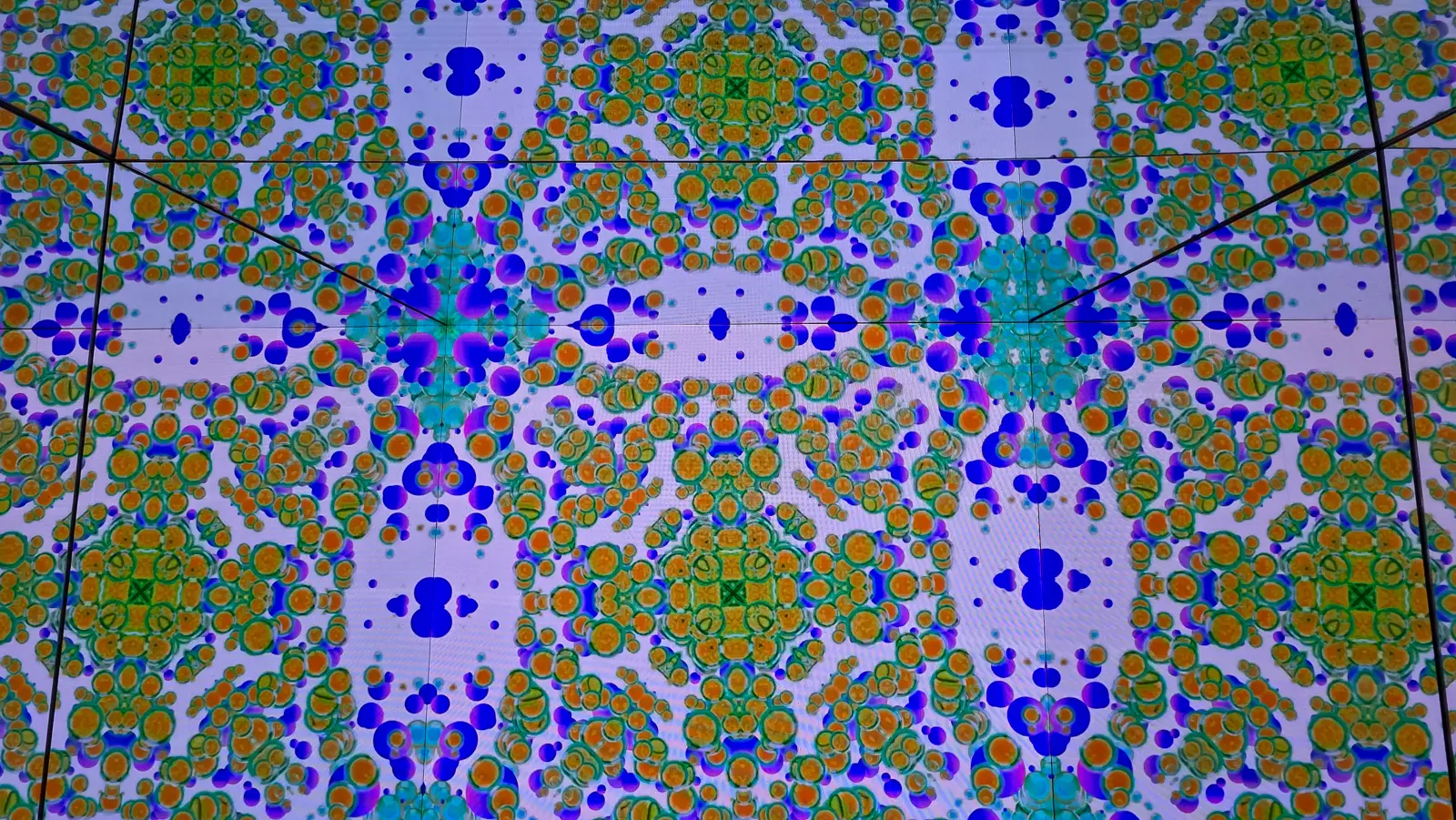
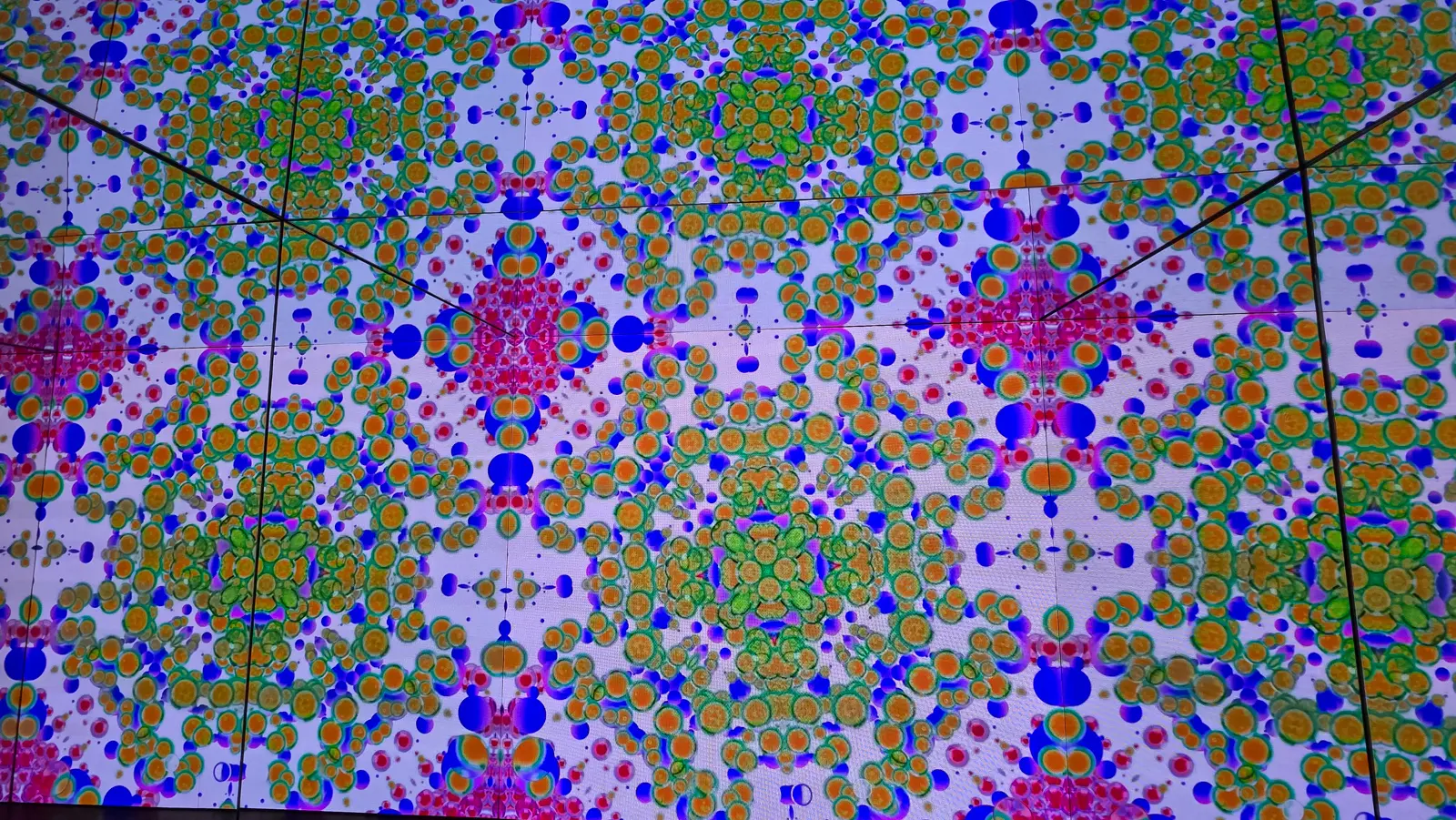
The second room is the one that surprised me. Mirrors on every surface, and projections that build into symmetrical patterns of overlapping circles: orange and green on white, then pink and blue, then something closer to gold.
Standing in the middle, the pattern resolves in every direction at once, and the corner joins between mirrors show as fine dark lines running out to the vanishing points. Those lines are the only thing in the room that gives away where the walls are.
The geometry is doing something specific. A physical kaleidoscope works by bouncing a small number of loose fragments between angled mirrors until they read as a complete symmetrical figure. This room reverses the arrangement and puts the viewer inside the tube, so the fragments are projected and the person standing there becomes part of what gets repeated.
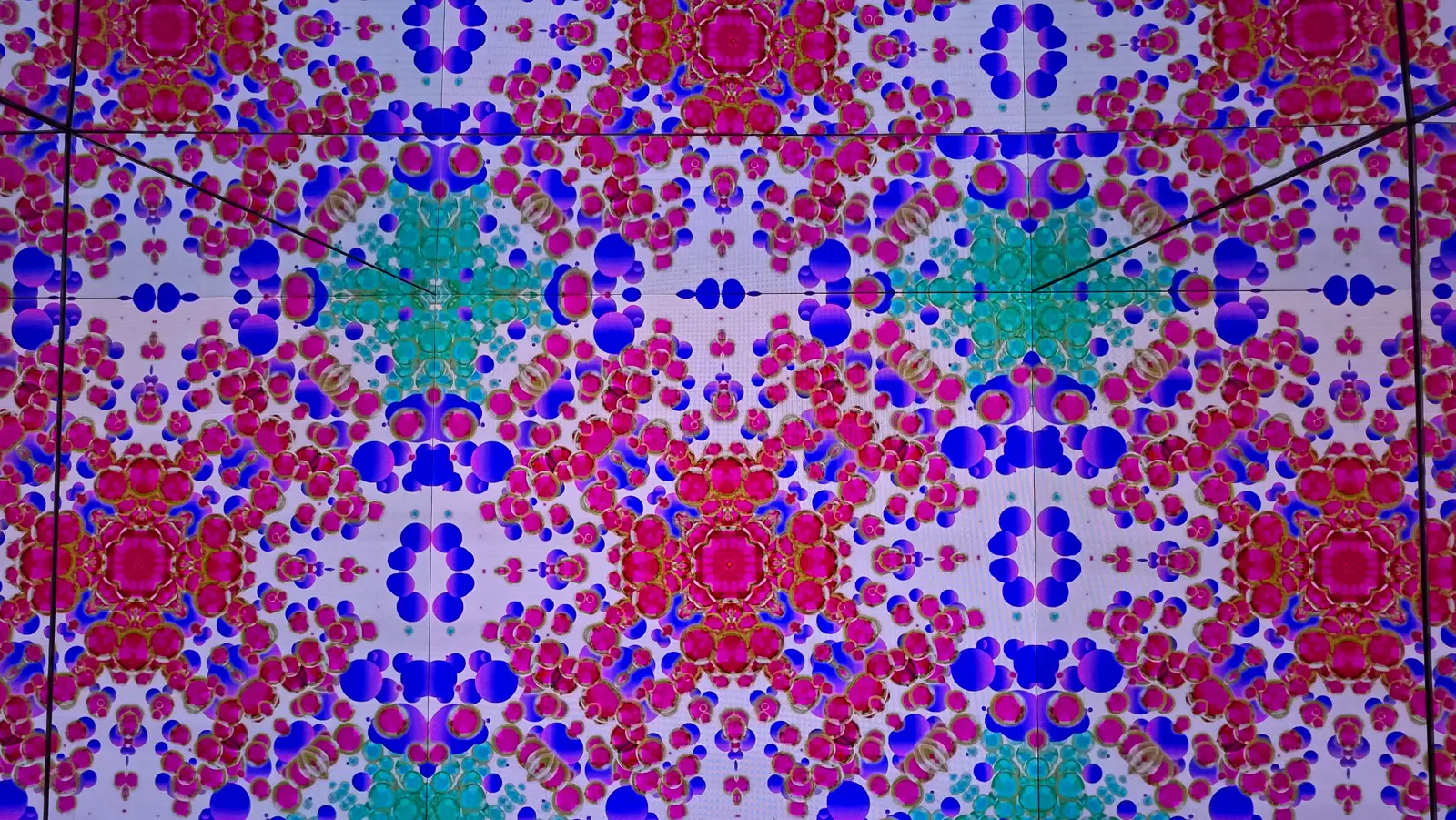
The colour scheme changes while standing there, and it changes completely rather than by degrees. There is no fade between states. One arrangement holds long enough to look settled, and then the room is a different colour and the pattern has reorganised around new centres.
Then it goes again, warmer, with red centres appearing inside the green.
Diamond Matrix
The last of Studio Irma’s rooms is the one people queue for, and the approach to it is a run of lit panels carrying enormous faceted gemstones in green, magenta and violet against cyan.
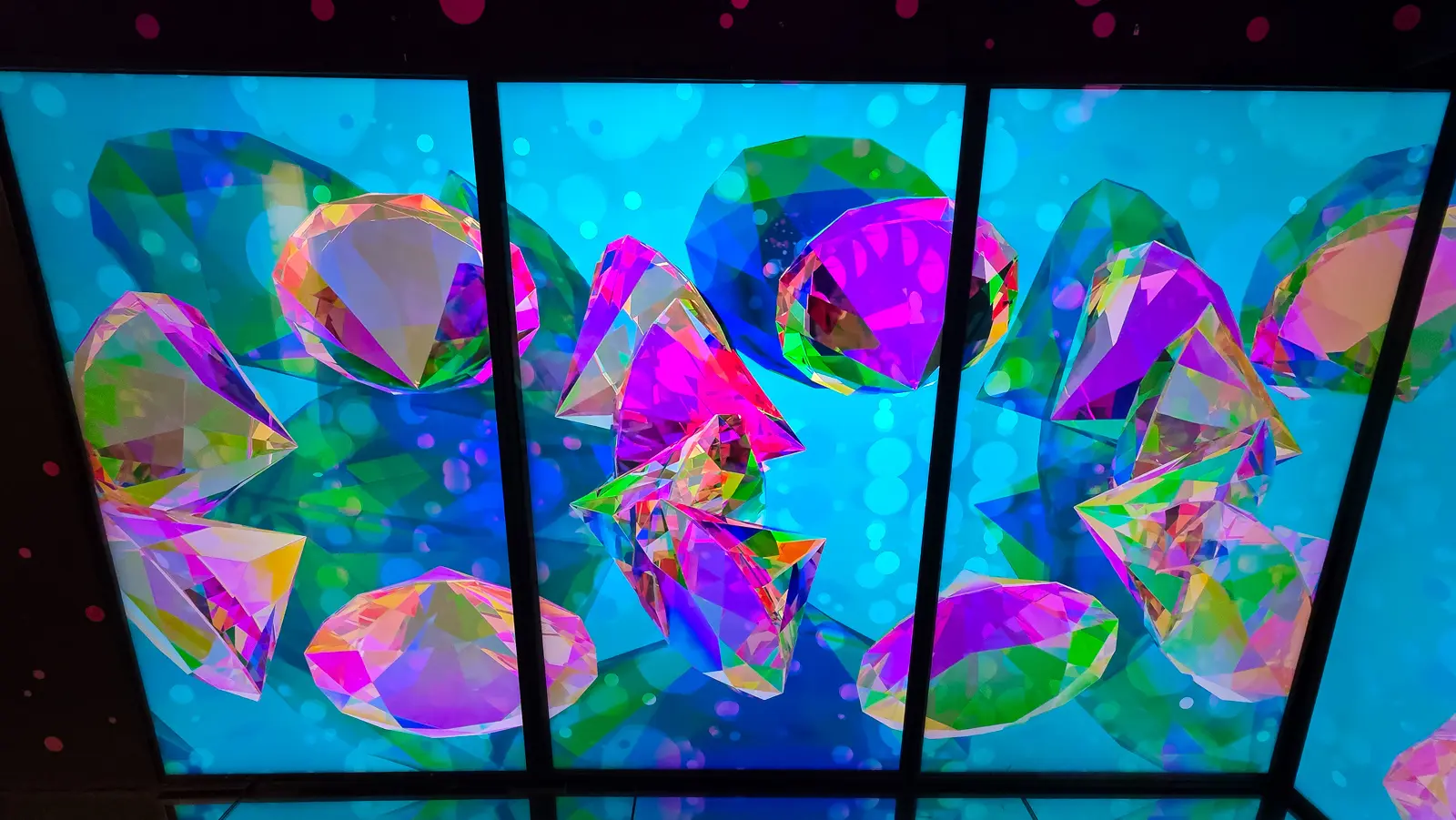
Then the room itself. The diamonds are cast in epoxy with a light ring set inside each one, and the studio that built the installation puts the number at five hundred. They are suspended from above on fine black lines, set out in a grid that stops well short of the floor at about knee height, and mirrors on the walls and underfoot carry them outwards and downwards until there is no wall anywhere and no obvious floor either. Pink, blue, green and violet, all lit from within.
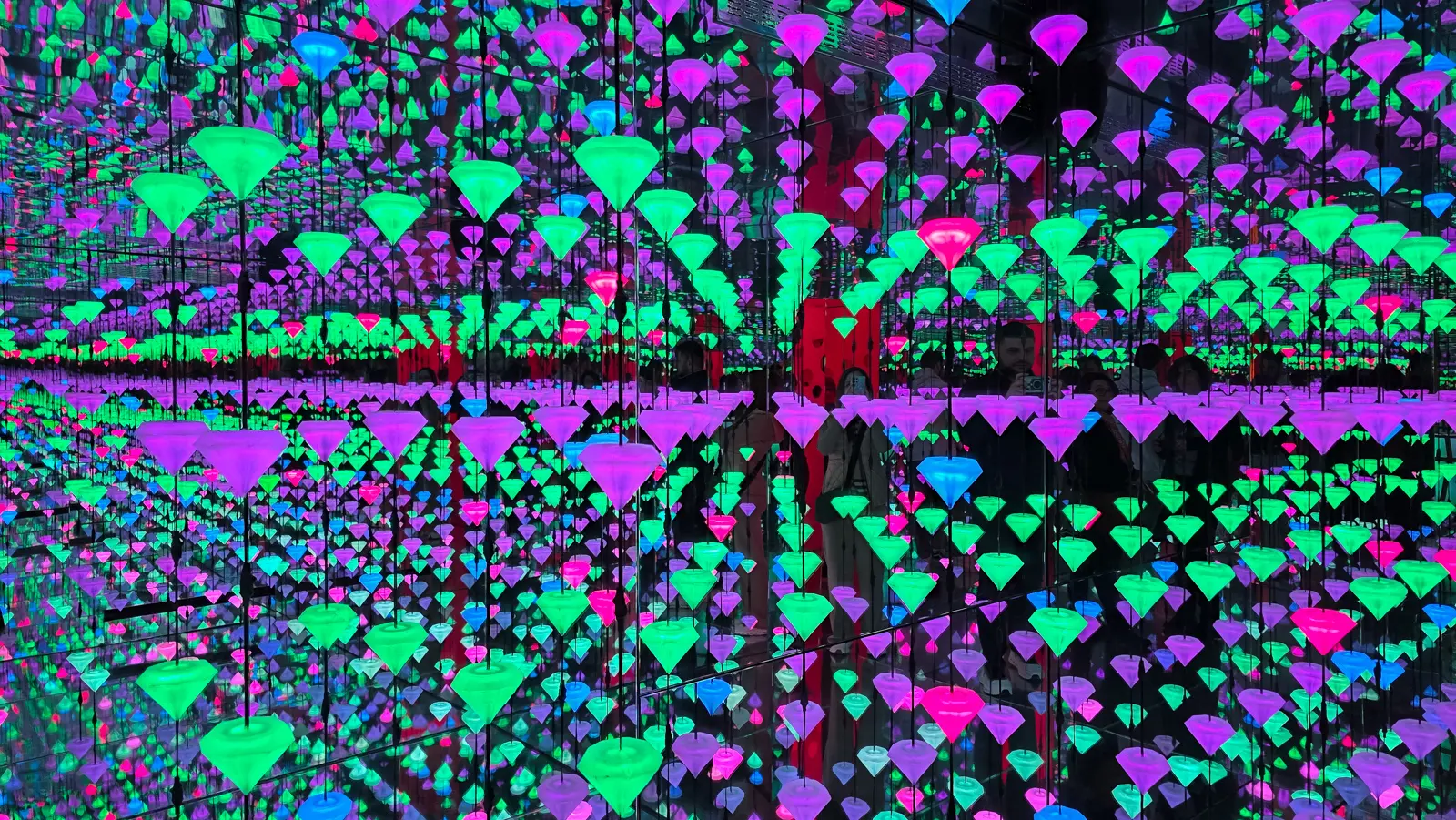
Two things are worth knowing before going in. That mirrored floor is why every photograph taken in here includes the photographer, whether or not the photographer intended it. And the room is small enough that other visitors will be in the frame as well, so it is worth waiting by the door for a gap rather than fighting for one.
Take Over Elastic
The last room is not Studio Irma’s, and it is a shock after the mirrors. Andrés Reisinger has filled a space on the lower level with monumental pink inflatable forms, stacked into walls and heaped into corners, in one flat and unbroken colour.
After forty minutes of light and reflection, walking into a room made entirely of cushions with no screen in it at all is the best joke in the building. It is also the only room down there that invites touching rather than looking, and after four mirrored spaces where the instinct is to keep both hands well out of the way, that lands as a real change of register.
The colour does most of the work. It is a single flat pink, edge to edge, over the walls and the floor and the stacked forms themselves, so there is no shadow line to tell the eye where one surface ends and the next begins. The room reads as one continuous object rather than as a space with things in it.
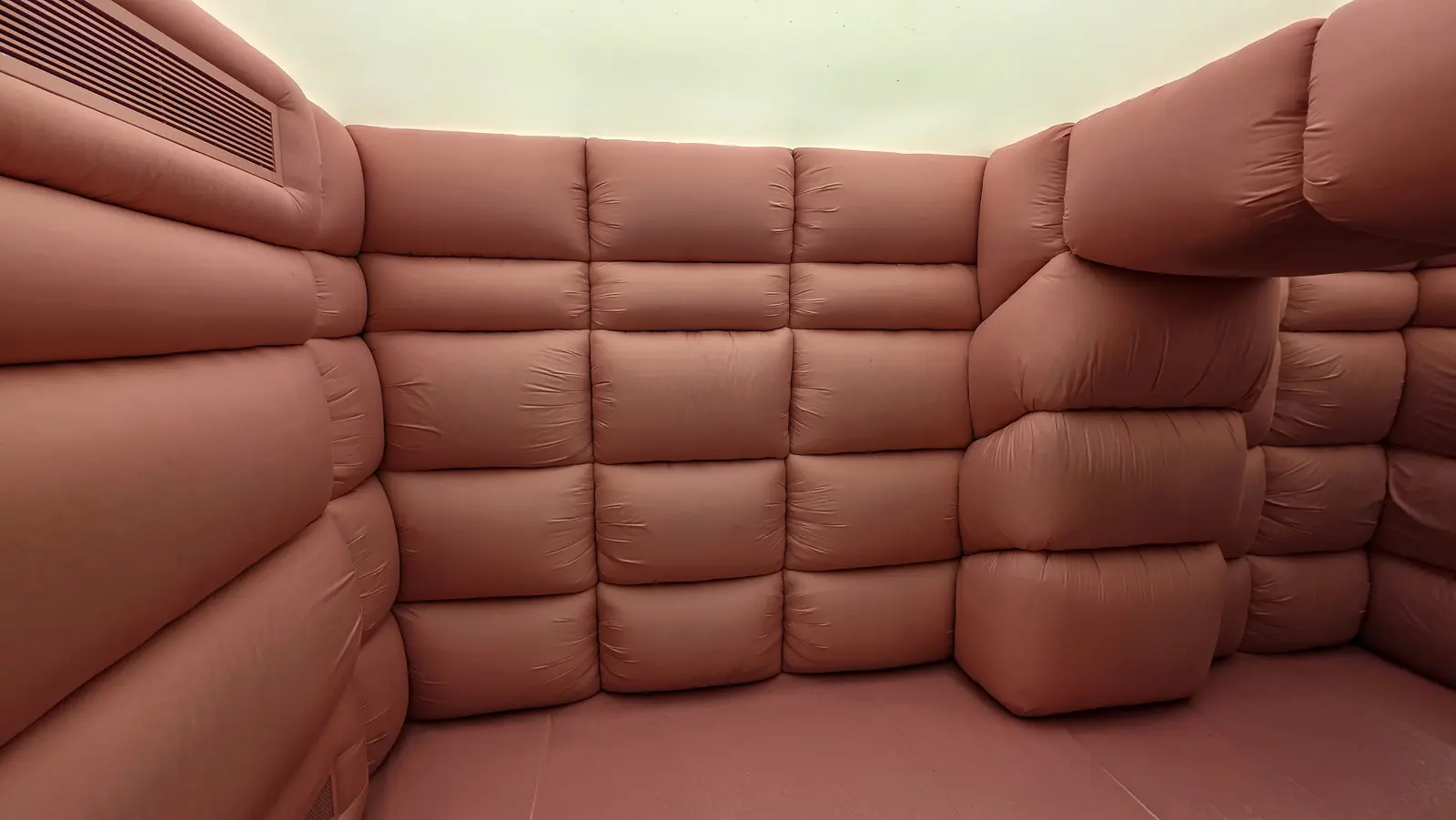
Reisinger was born in Argentina and works between Madrid and Barcelona. The room is part of Dreams, his exhibition at Moco, which opened on 8 October 2024 and comprises four separate interventions through the building, of which this is the one on the lower level.
The Objection
Here is the argument against all of this, put as well as I can put it.
Nothing in these rooms was made by hand. The works are code, which means they can be reproduced identically in Amsterdam, Barcelona or anywhere else with the right hardware, so none of it is singular in the way a painting is singular. The rooms are built to photograph well, which arguably makes the visitor’s phone the intended audience rather than the visitor. They reward a reaction rather than attention, and a reaction is cheap. And there is something uncomfortable about the language of contemplation sitting on top of timed tickets, queues and a shop at the exit.
None of that is unreasonable. I have made versions of that argument myself, in front of other work, and I would make it again.
What settled it for me was a simpler test. Art is what it stirs in the person standing in front of it, and the answer that came back in those rooms was not the one I had planned on. It brought out my inner kid. That is not a side of myself I show all that often, and I had not expected a museum basement on a public holiday to be the thing that got it out.
None of that answers the argument about reproducibility, and I am not going to pretend that it does. The code is still code. It just turned out to matter less to me than I expected it to, standing in the middle of it.
Bubbly Tips
- Go on a public holiday if the dates line up. Moco stays open on King’s Day, and the city outside is a street party that most visitors do not leave. The rooms downstairs were the quietest I saw them.
- Check for a King’s Day ticket offer before booking. Moco has promoted a two-for-one code for 27 April. Offers vary year to year, so confirm on the museum’s own site rather than through a reseller.
- Do these rooms on the way out, not as an afterthought. They sit on the lower ground floor beside the shop, on the route to the garden. Plan the visit so there is still attention left when you get there.
- It is stairs only. The villa is a listed building, the museum has stated it is not permitted to install a lift, and every immersive room is downstairs. Anyone who cannot manage stairs cannot reach any of this.
- Turn the flash off before going down. Every room down there is either mirrored or screen-lit, and a flash produces a white blot and nothing else.
- Stand still for a full colour cycle. Kaleidoscope changes its entire scheme rather than shifting shade, and anyone walking straight through will see one version of a room that has several.
- Wait by the door in Diamond Matrix. The room is small, the floor is mirrored, and the reflections mean other visitors appear in every direction at once. A thirty-second wait usually clears it.
- Bring your own headphones. The audio tour is free but the museum does not supply them.
- Allow longer than the museum suggests. Moco proposes around an hour for the whole visit. The immersive rooms alone can take half of that if they are done properly.
- Do not skip the last room because it looks empty. Take Over Elastic has no screen and no lights, which makes it easy to glance into and walk past. It is the one everyone in my group remembered.
Final Thoughts
I came out of Diamond Matrix and had to stand in the shop for a minute working out what had just happened. Not because it was profound. Because thirty seconds earlier there had been no walls, and now there were shelves of Warhol postcards.
That is the argument for these rooms, and it is not really an argument about technology. Upstairs, Moco asks visitors to look at a familiar image with one thing wrong in it: flowers instead of a petrol bomb, a smiley instead of a face. It is a museum of small deliberate errors, and it works by making people notice.
Downstairs it removes the walls and the floor and asks nothing at all. No error to spot, no joke to get, no wall text to check afterwards. The same building doing two opposite things within about four metres of vertical distance, and charging one ticket for both.
Go down with time in hand. Stand still longer than is comfortable. And do not let the shop be the last thing that registers.
Until next time!

🌟 Everything You Need to Plan Your Dream Trip in 2026
- 🌟 Luxury Hotels - Find premium stays with Booking.com & Hotels.com
- 🏡 Vacation Rentals - Discover unique properties on VRBO
- 🏞️ Guided Tours - Explore with Viator or GetYourGuide
- 🎫 Attraction Tickets - Skip the lines with Tiqets
- 🚢 Ocean Cruises - Set sail with Cruise Direct
- 📱 International SIMs - Stay connected with Saily
- 🚗 Car Rentals - Budget-friendly options from Discover Cars
- 🌐 Secure VPNs - Browse safely with NordVPN
- 💶 Currency Exchange - Best rates with Wise
- 🗣️ Learn Languages - Master the local language with Babbel and Rosetta Stone