
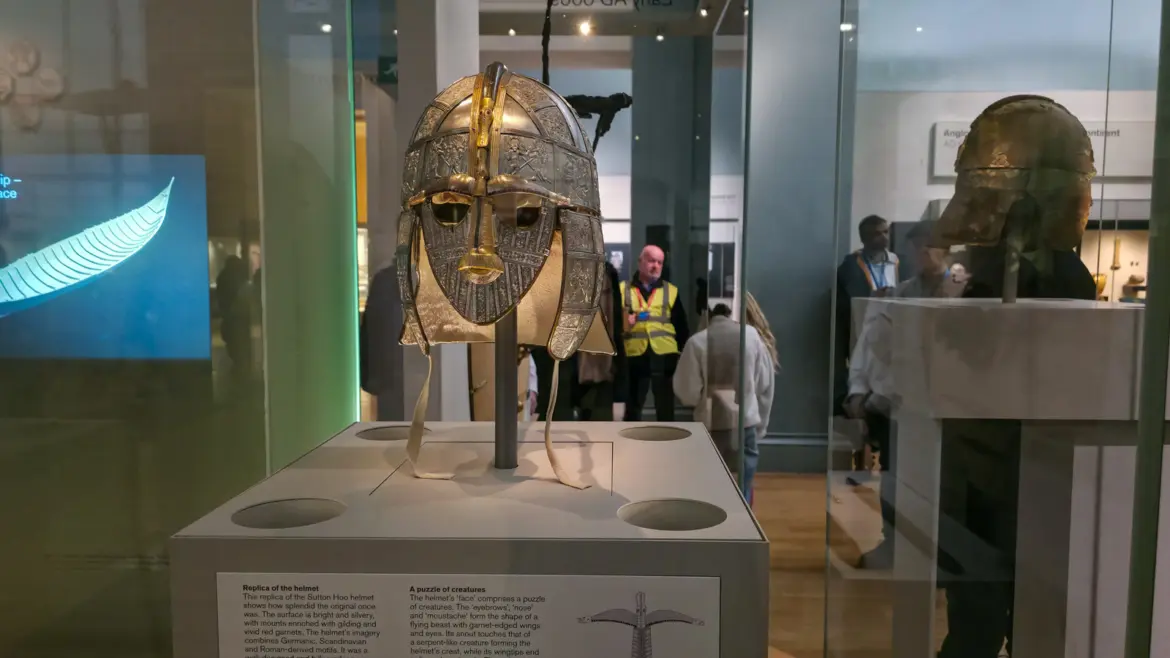
For two visits running, I walked straight past these helmets on my way to see the Lewis Chessmen. I would slow down for a minute, take a photo through the glass, and keep moving, because the little walrus-ivory chessmen in the next room were the thing I had come to find. It took a third look to admit I had it backwards. The helmet in front of me is one of only four complete Anglo-Saxon helmets ever found, pulled from the richest early medieval grave in Europe, and I had been treating it as a stop on the way to something smaller.
So this is the post I owed it. The Lewis Chessmen sit in Room 40 of the British Museum in London and they earn their fame, but the Sutton Hoo display next door in Room 41 holds a whole world: a buried ship, a lost king, and silver that travelled from Constantinople to a field in Suffolk. It deserves a visit of its own, not a glance in passing.
Sutton Hoo at the British Museum at a Glance
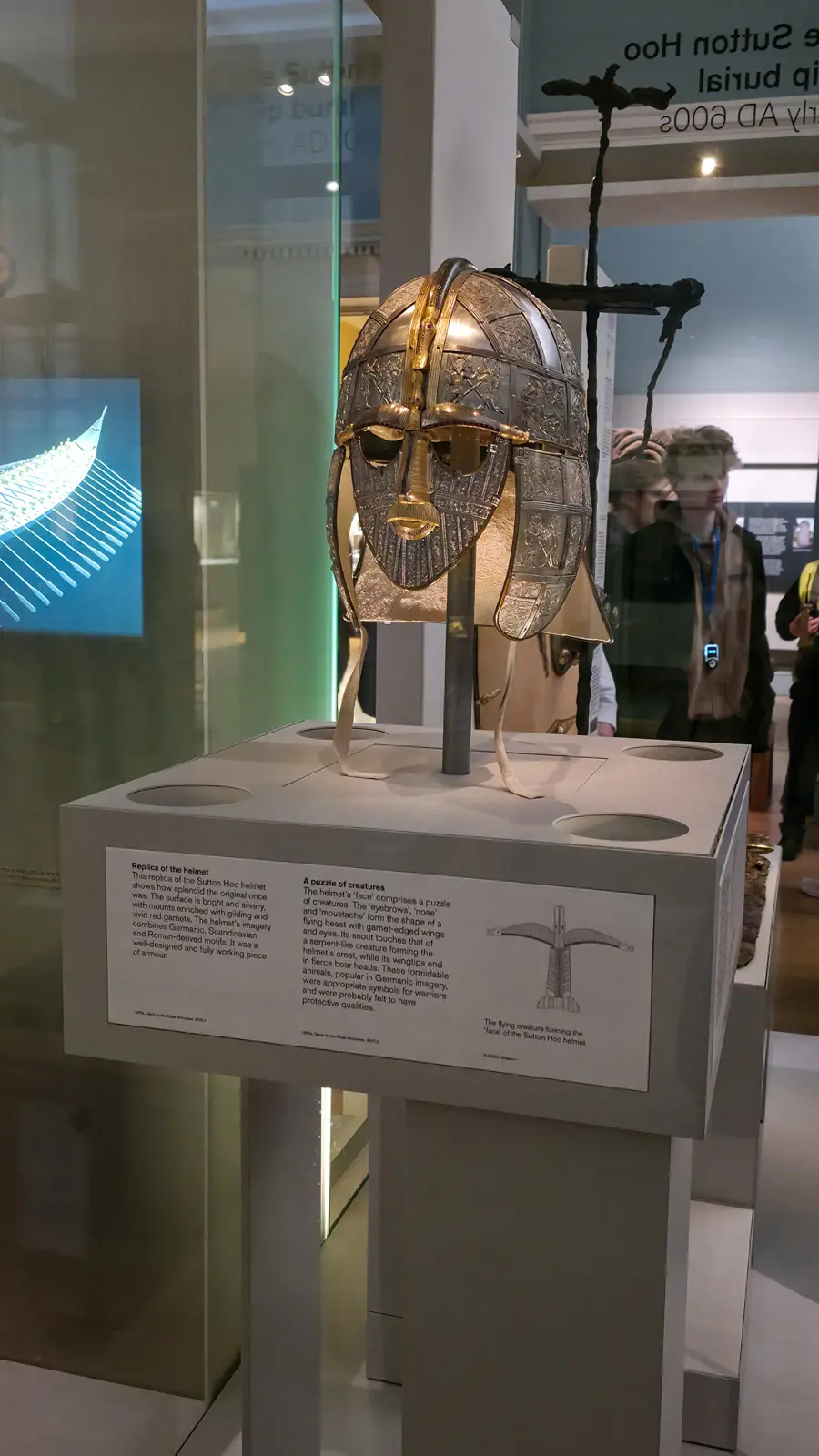
⚔️ The helmet · One of only four complete Anglo-Saxon helmets ever found. The dark original was rebuilt from hundreds of fragments; the bright replica beside it, made by the Royal Armouries, shows how it looked when new.
🚢 The ship · In 1939, Basil Brown uncovered the imprint of a 27-metre ship under a mound on Edith Pretty’s Suffolk estate, with an intact burial chamber inside. Pretty gave the whole find to the nation.
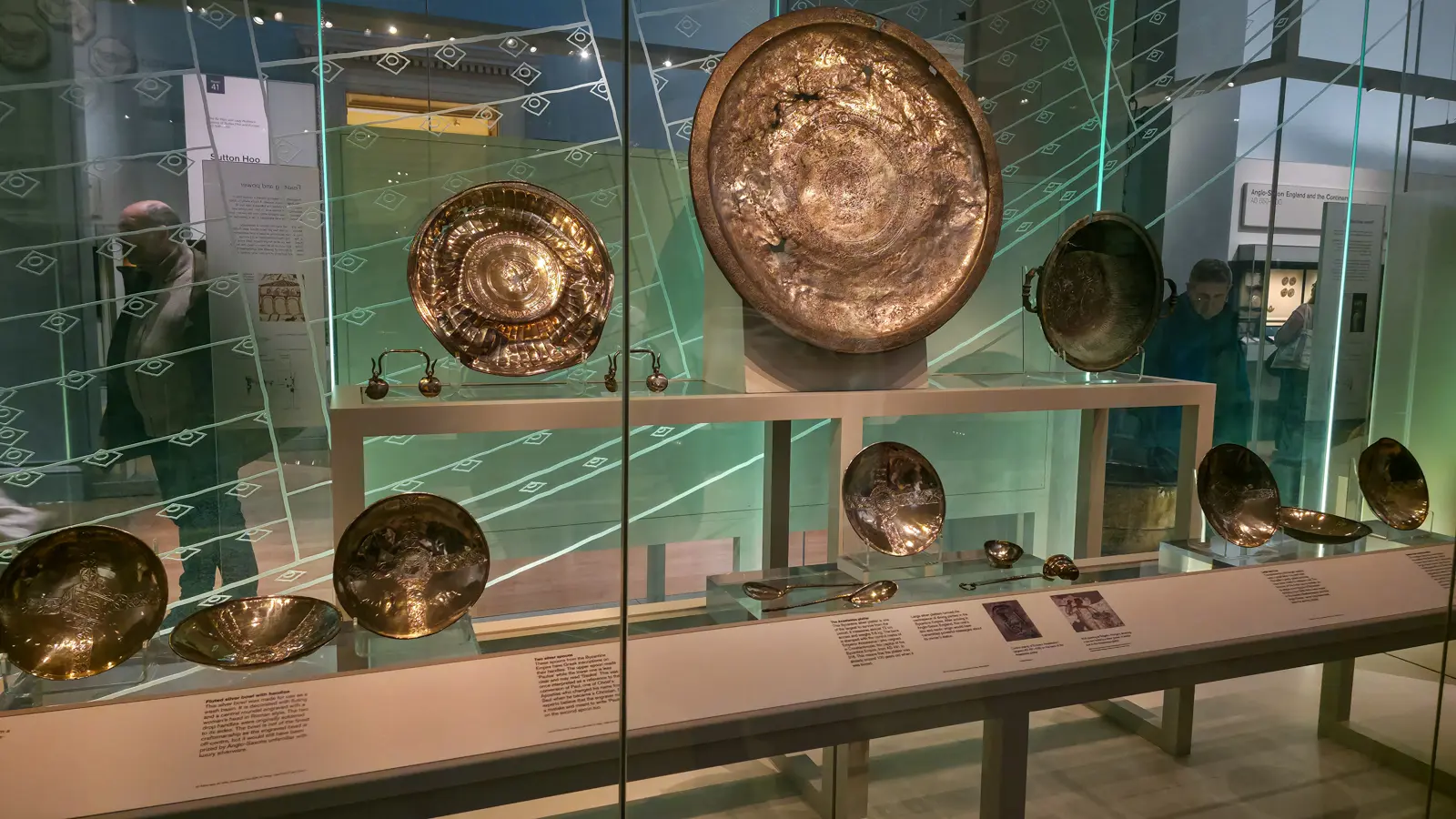
🥈 The Byzantine silver · The Anastasius Dish, almost 72 cm across, was made in Constantinople and already a century old when it was buried. Proof that early Anglo-Saxon East Anglia was not isolated.
📍 Where to find it · Room 41, the Upper Floor, next to the Lewis Chessmen in Room 40. Entry is free.
💡 Tip · See the battered original helmet first, then let the shiny replica show you what it once was.
Getting There: The Portico and the Great Court
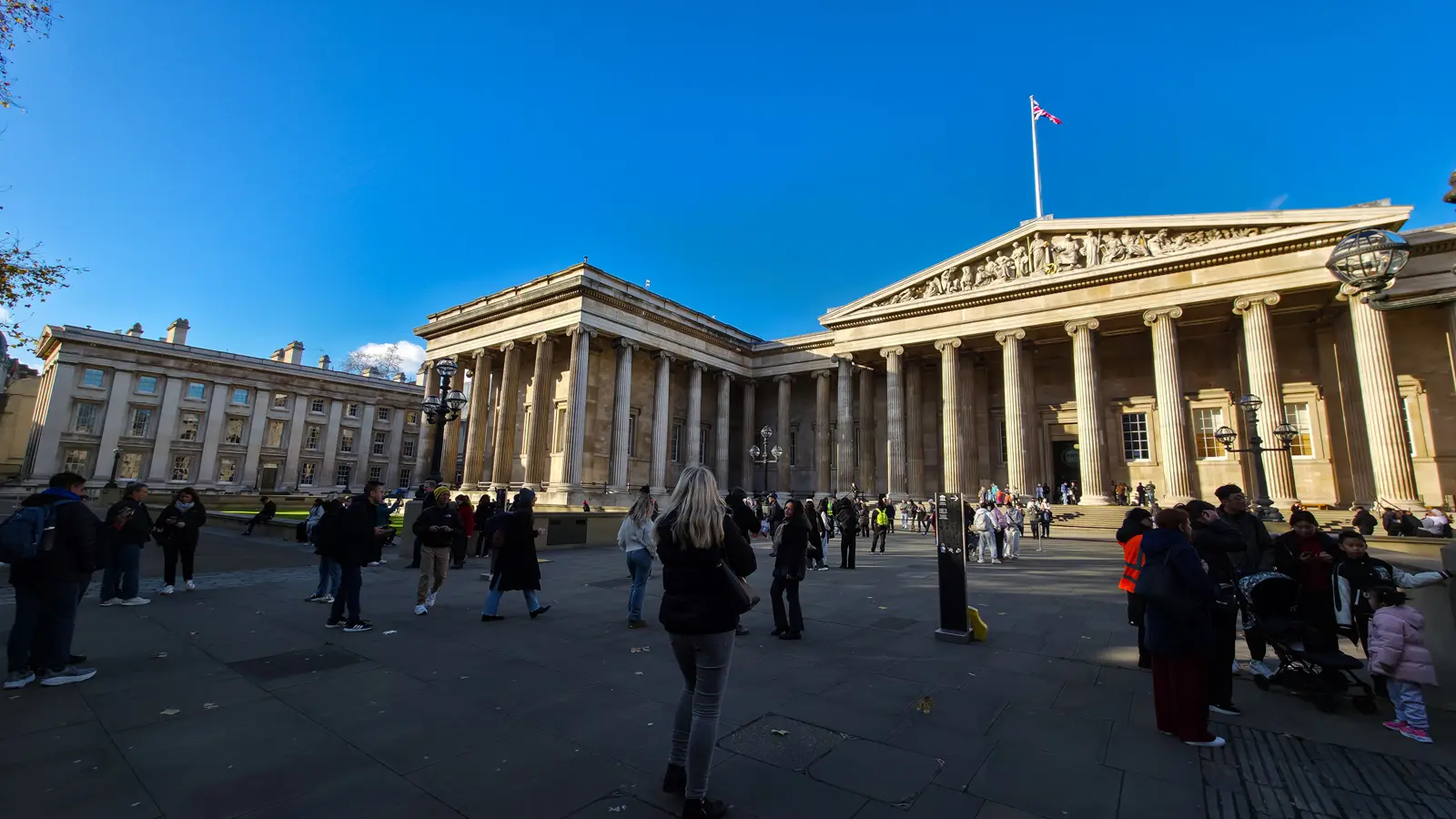
The British Museum announces itself before a visitor is through the gate. The south front is a row of 44 Ionic columns behind a triangular pediment carved with figures, the Union flag flying above it, and on a clear winter afternoon the honey-coloured stone catches the low sun. Most people stop here for a photo. I did too.
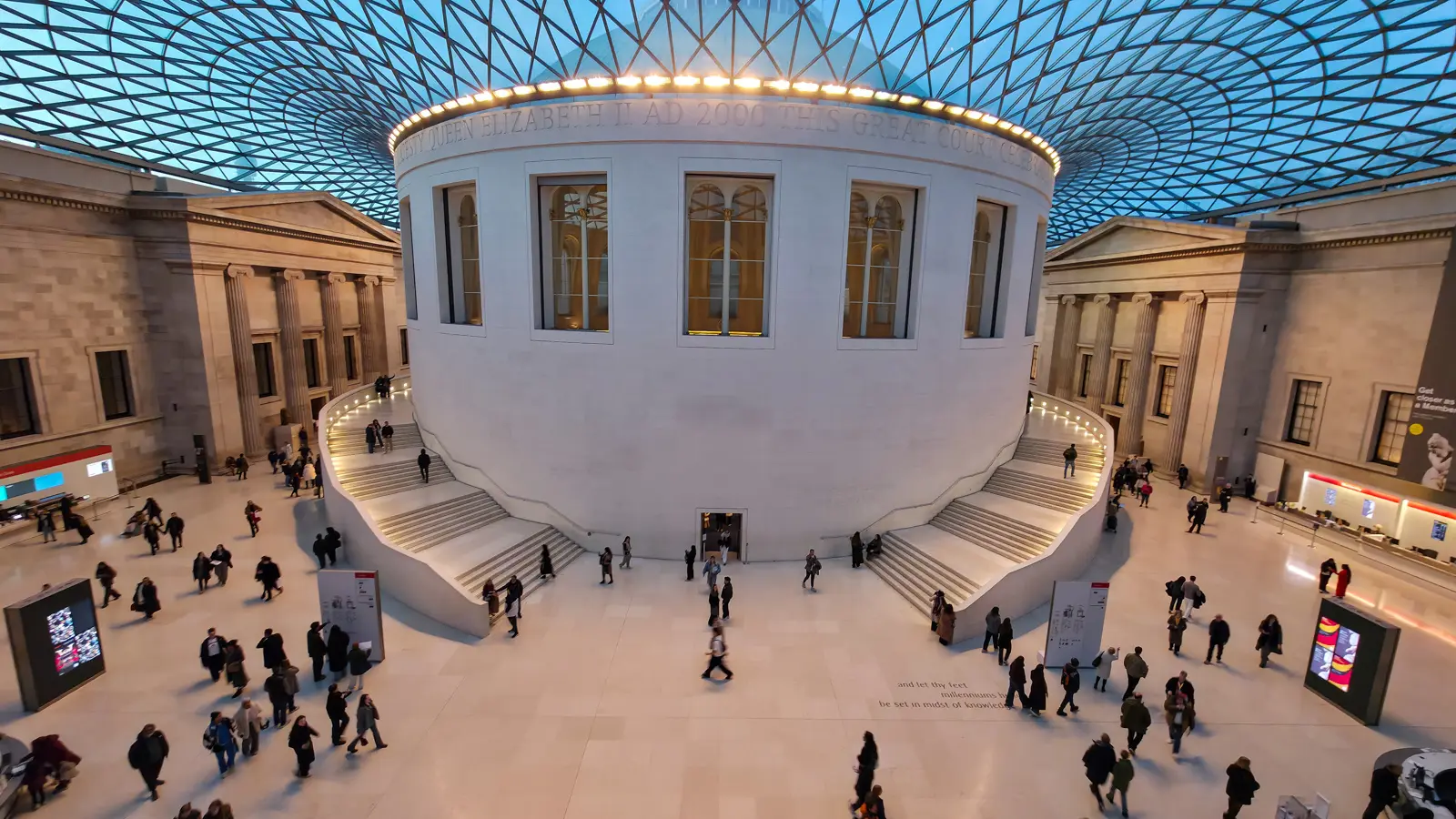
Inside, the crowd funnels into the Great Court, and this is where the museum stops reading as a single building and turns into a city under glass. The round Reading Room stands in the middle, wrapped by a pale stone drum, and above it a lattice of glass and steel curves out to the old courtyard walls. It is the largest covered public square in Europe. Around the top of the drum runs an inscription marking the opening: “…QUEEN ELIZABETH II AD 2000 THIS GREAT COURT…”. From here the galleries branch off in every direction. Room 41 is up on the Upper Floor.
1939: A Landowner, a Local Digger and a Ship
The story starts on a Suffolk estate, not in a museum. Edith Pretty owned the land at Sutton Hoo, near Woodbridge, and a cluster of grassy mounds on her property had long made her curious. In 1939 she asked Basil Brown, a self-taught local archaeologist, to dig the largest of them. Brown, who cycled to the site and worked with a couple of estate hands, began uncovering iron rivets, and then more rivets, laid out in the unmistakable shape of a ship.
What he had found was the ghost of a boat. The timber had rotted away over thirteen centuries, but it left its imprint pressed into the sand, along with the rivets that once held it together: a vessel 27 metres long. At its centre was a burial chamber that grave robbers had somehow missed, packed with gold, silver, weapons and feasting gear. It is the richest intact early medieval grave found in Europe, dated to the early AD 600s and almost certainly built for a leading figure of the Anglo-Saxon kingdom of East Anglia, perhaps a king.
Pretty could have sold the find and become very rich. Instead she gave the whole thing to the nation, and it went to the British Museum in 1939. This is the story the 2021 Netflix film “The Dig” puts on screen, with Ralph Fiennes as Basil Brown and Carey Mulligan as Edith Pretty. It is a dramatization rather than a documentary, adapted from John Preston’s novel and taking a few liberties with the personal detail, but the spine is real: a widowed landowner, a self-taught digger, and a race to reach the treasure before the Second World War closed in. The objects themselves have been in Bloomsbury ever since.
The Helmet: A Face Rebuilt from Fragments
Here is the object everyone comes for, and it comes in two versions displayed side by side. The one to see first is the real one.
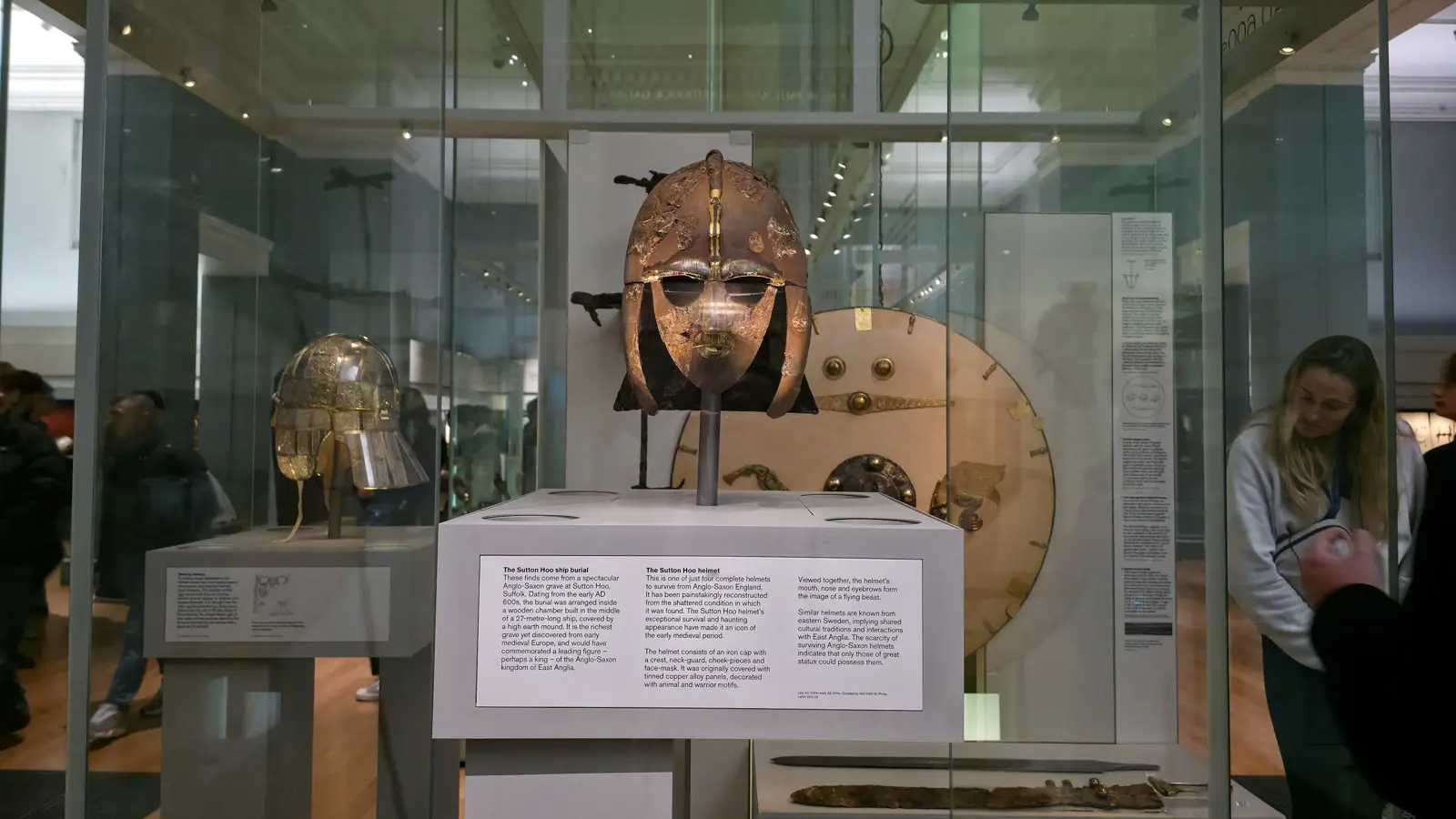
The original is dark, broken and reassembled, more gap than metal in places, and that is exactly what makes it hold the eye. This is genuine seventh-century ironwork that came out of the ground in pieces. The helmet has an iron cap, a neck-guard, hinged cheek-pieces and a full face-mask, a design that traces back to late Roman cavalry helmets. In the eyebrows, nose and moustache sits the shape the curators point out: a flying beast with outstretched wings, its body running down the nose.
That is why the bright replica in the case beside it matters. Made by the Royal Armouries, it shows what the original looked like when it was new, silvery and sharp, with gilded details and red garnets, every panel crisp. The Sutton Hoo helmet is one of only four complete Anglo-Saxon helmets known, and the museum’s own panel makes the same point the objects do: these were not the everyday kit of ordinary fighters. Only someone of high status would have owned one.
Beyond East Anglia: Celtic Bowls and Byzantine Silver
The part of the display that changed how I think about Sutton Hoo is the silver. It is easy to picture early Anglo-Saxon England as an isolated, inward-looking place. The objects in this case say the opposite, and the museum’s own wall text drives it home: the discovery proved that early Anglo-Saxons were “not isolated”.
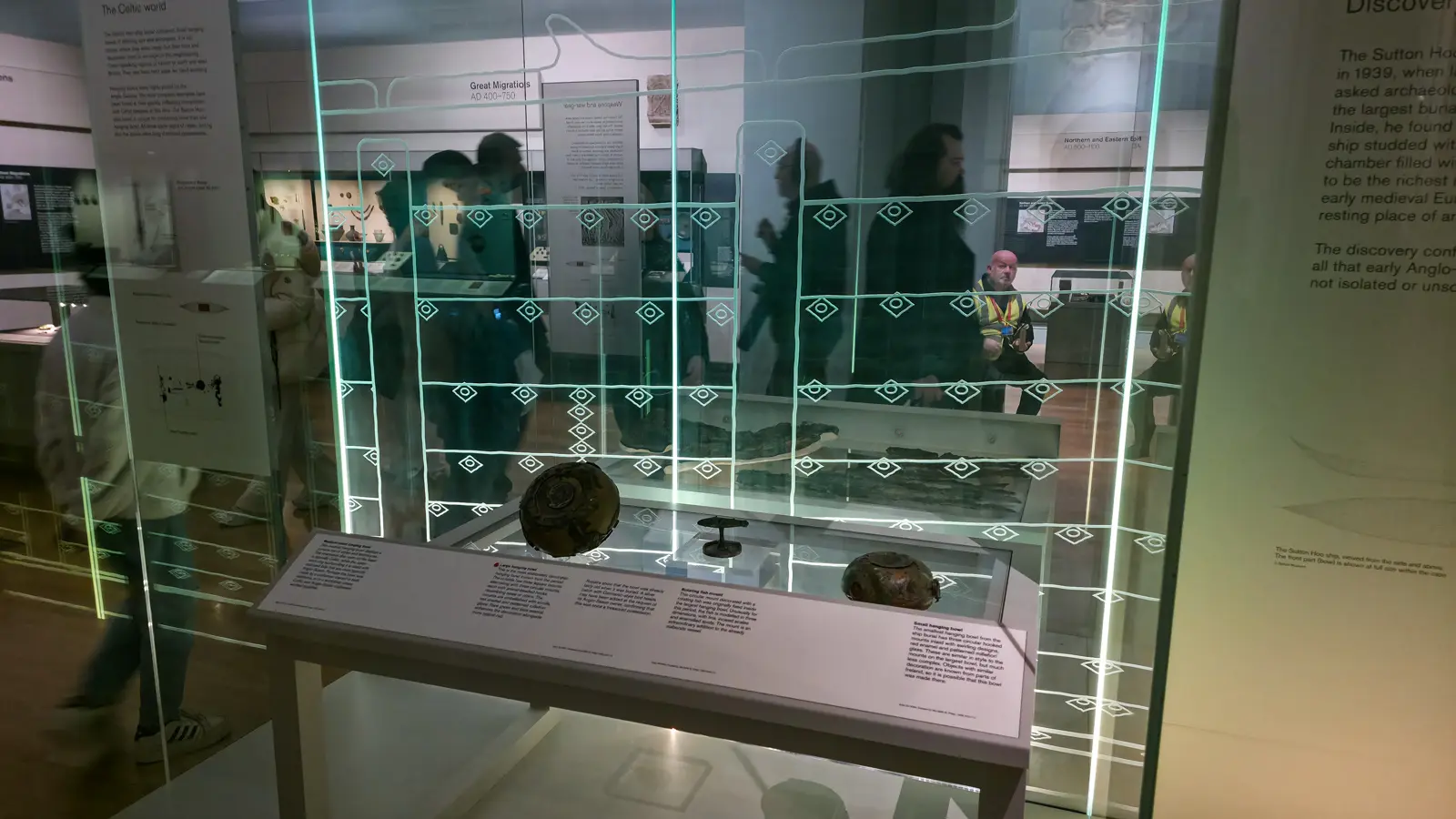
The grave held two kinds of long-distance object, and together they map a surprising reach. The hanging bowls, set out under a panel headed “The Celtic world”, show Celtic craftsmanship and were probably used for washing hands; the ones buried here had been mended more than once, a sign they were valued and kept.
Then there is the Byzantine silver, and this is the showpiece. The Anastasius Dish is almost 72 centimetres across, made in the eastern Mediterranean and carried, over decades, all the way to a Suffolk grave. Beside it sat a nested set of ten silver bowls and two silver spoons. A king in East Anglia was eating, or at least being buried, with tableware from the other end of the known world.
That is the thread that runs through the whole display, and it is why the helmet was never really a stop on the way to somewhere else. This was a kingdom plugged into Scandinavia, into Rome‘s long shadow, and into Byzantium. The chessmen can wait.
Bubbly Tips for Sutton Hoo and the British Museum
- Head straight up to Room 41. Sutton Hoo is on the Upper Floor. The Lewis Chessmen are right next door in Room 40, so you can pair the two in one loop without backtracking.
- See the original helmet before the replica. They sit side by side, and the shiny reconstruction is the one that catches your eye first. Look at the dark, rebuilt original first, then let the replica show you what it once was.
- Go on a Friday evening if you can. The museum stays open until 20:30 on Fridays while most days close at 17:00. The later hours are noticeably calmer than a weekend afternoon.
- Book a free timed ticket. General admission is free, but a timed entry slot booked online in advance saves you queueing at the busiest times.
- Give yourself the Great Court on the way in and out. It photographs best from the upper level near the café balconies, where you can get the Reading Room, the staircases and the glass roof in one frame.
- Bring patience for the glass. The Sutton Hoo cases are lit and reflective, and the silver in particular sits behind angled panes. Shooting slightly off to one side cuts the worst of the reflections.
- Look for the “flying beast” on the helmet. The eyebrows, nose and moustache form a winged creature. Once you see it on the replica, it is easier to pick out on the battered original.
- Plan around the big 2026 exhibition if you’re visiting later in the year. The Bayeux Tapestry is due at the British Museum as a special exhibition in autumn 2026, which will draw crowds, so book ahead if that is on your list.
Final Thoughts
I came to Sutton Hoo three times before I gave it the attention it asked for, and the thing that finally held me was not the gold or the famous face-mask. It was the silver platter with a Byzantine emperor’s stamp on the back, sitting a few feet from a helmet dug out of a Suffolk field. A century old before it was buried, and then thirteen more centuries underground. It travelled further than most people of its age ever could.
The Lewis Chessmen are still next door, still wonderful, and I will still go and see them. But I will not walk past Room 41 to get there again. A lost ship, a rebuilt king’s helmet, and tableware from Constantinople are not a warm-up act. Give the room an hour and it gives you back a whole connected world.
Until next time!

🌟 Everything You Need to Plan Your Dream Trip in 2026
- 🌟 Luxury Hotels - Find premium stays with Booking.com & Hotels.com
- 🏡 Vacation Rentals - Discover unique properties on VRBO
- 🏞️ Guided Tours - Explore with Viator or GetYourGuide
- 🎫 Attraction Tickets - Skip the lines with Tiqets
- 🚢 Ocean Cruises - Set sail with Cruise Direct
- 📱 International SIMs - Stay connected with Saily
- 🚗 Car Rentals - Budget-friendly options from Discover Cars
- 🌐 Secure VPNs - Browse safely with NordVPN
- 💶 Currency Exchange - Best rates with Wise
- 🗣️ Learn Languages - Master the local language with Babbel and Rosetta Stone