
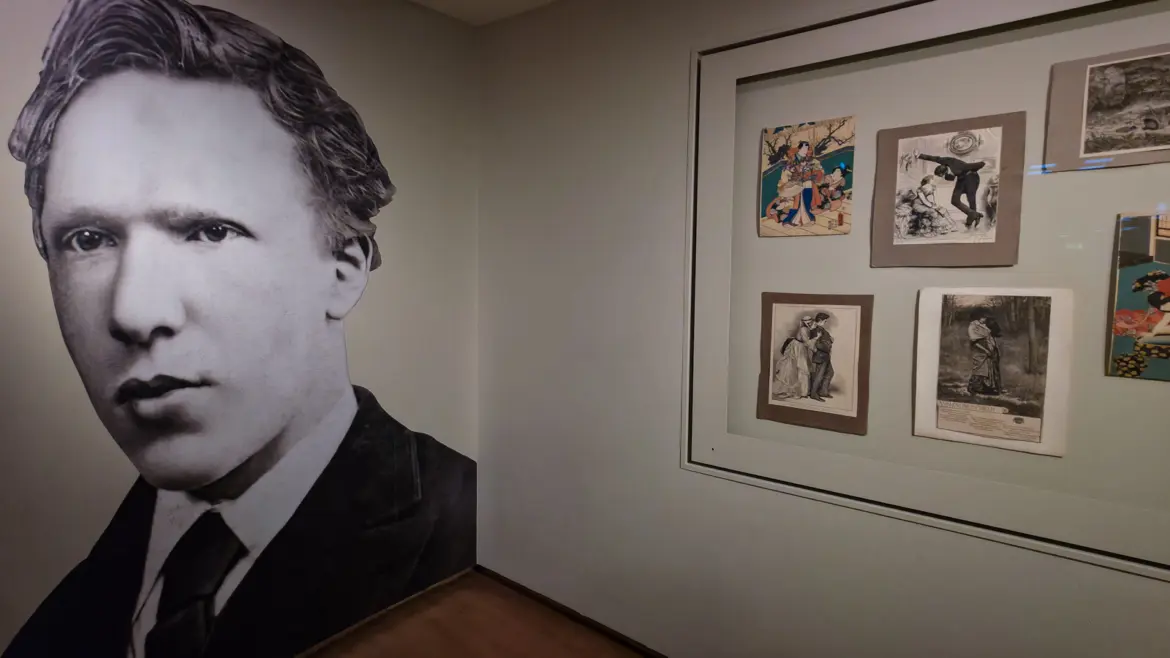
I went to the Van Gogh Museum in Amsterdam for the paintings and came out thinking about a family.
Vincent van Gogh sold very little in his lifetime and died believing he had failed at it. His name is now on tote bags in multiple languages, and the museum built around his work sells out its timed slots days ahead. Something happened between those two facts, and it was not luck.
There is a room on the way through that most people pass at walking pace. It holds photographs of two men, a case of the prints the brothers collected together, some letters in glass, a small writing desk and a woman holding a baby. It is the room that explains why any of the rest of it exists.
Three people made it happen, and only one of them ever held a brush.
Brothers and best friends
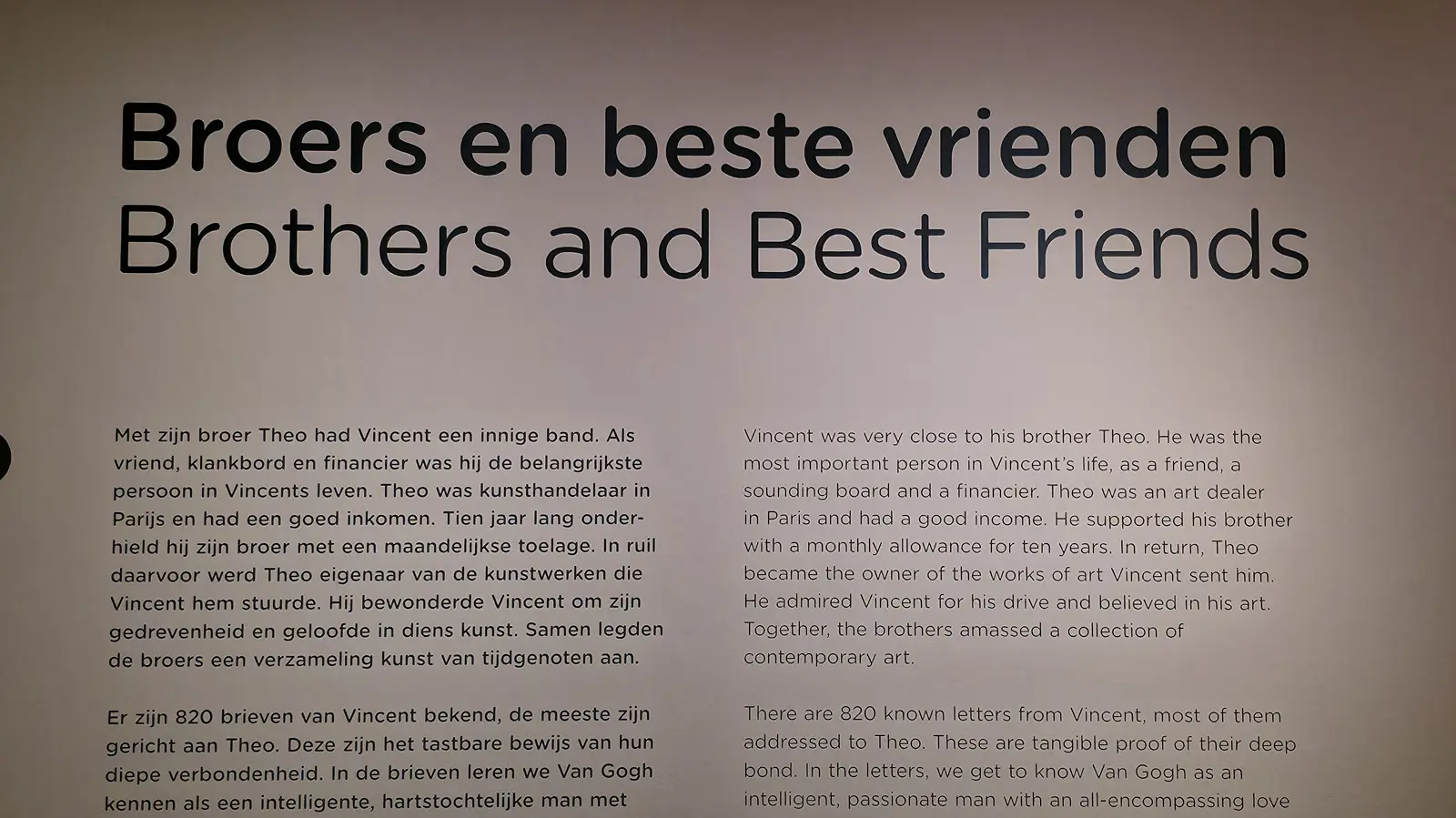
The room is called Brothers and Best Friends, and the arrangement it describes was plain and lasted a decade. Theo was an art dealer in Paris with a good income, and for ten years he sent his brother a monthly allowance. In return Theo became the owner of the work Vincent sent back. The museum’s panel puts it in one line: he was the most important person in Vincent’s life, as a friend, a sounding board and a financier.
820 letters from Vincent are known. Most of them were written to Theo.
The traffic in the other direction barely survives. Theo kept everything, down to the smallest scrap of paper. Vincent kept almost nothing that arrived. Only 84 letters written to him still exist, and 39 of those are from his brother.
Those two facts sit side by side on the wall and they are the whole relationship. One brother paid. The other wrote.
Dear brother
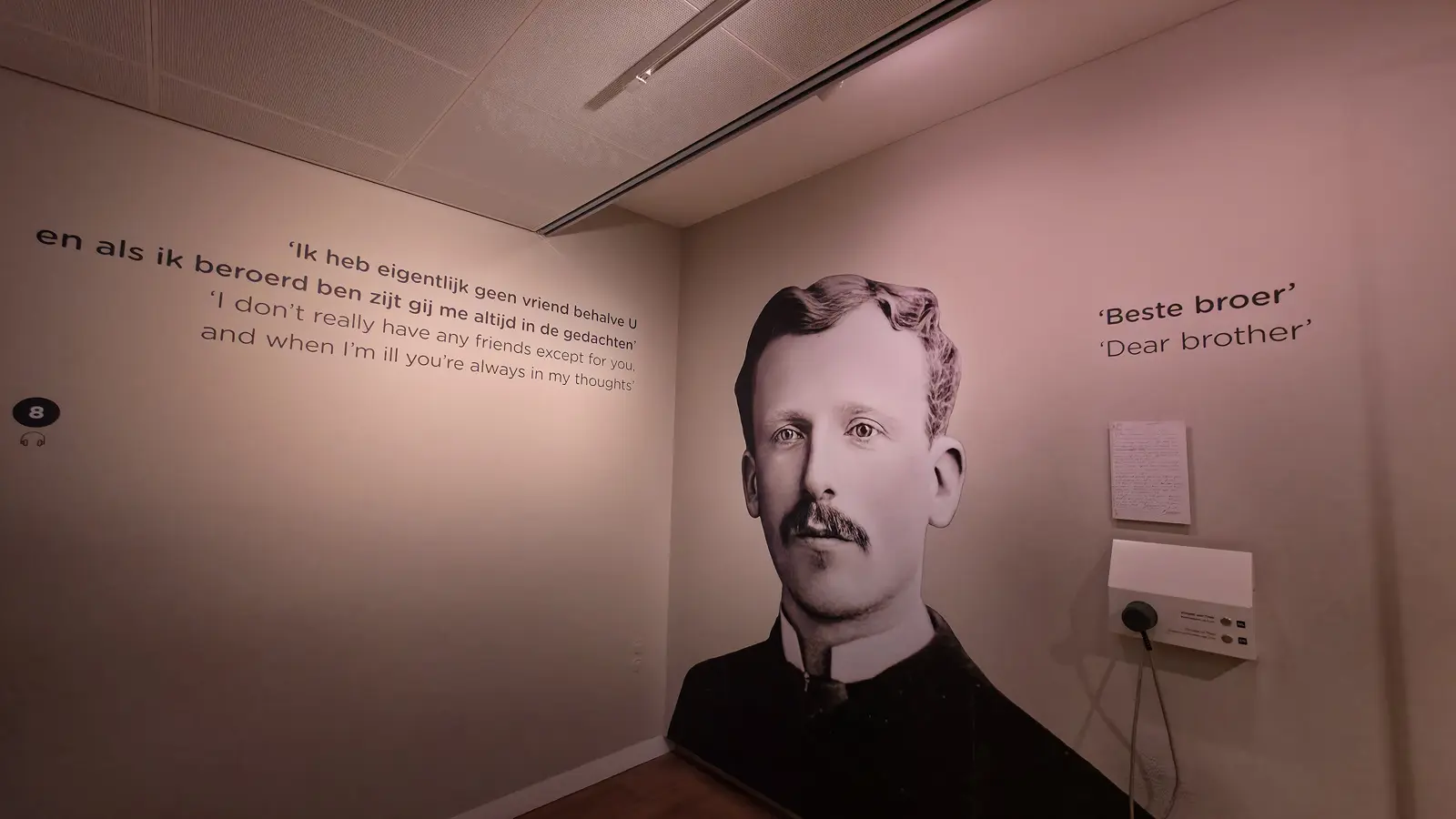
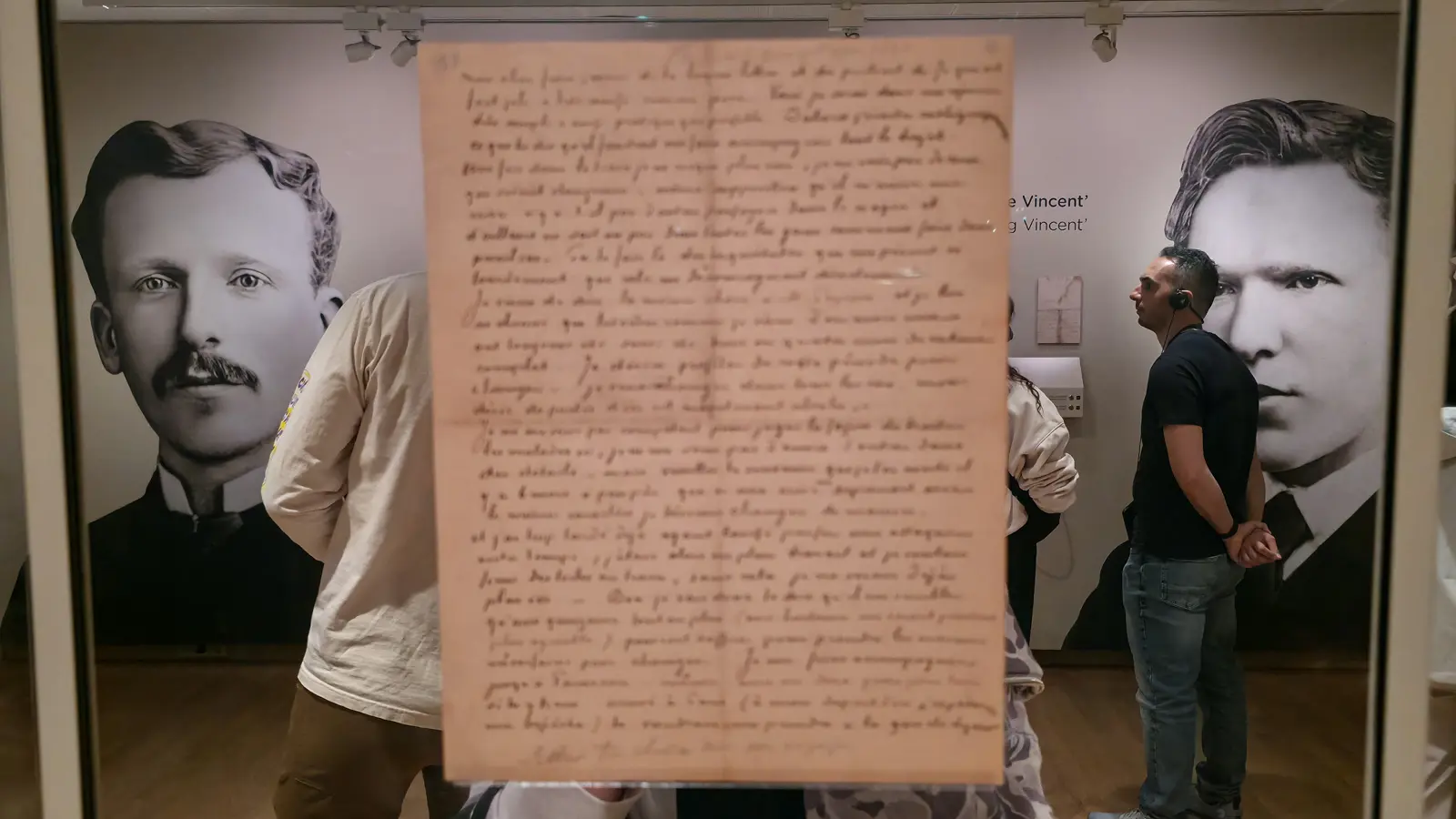
Two words are painted on the corner wall, Dear brother, and beneath them Theo’s face is printed at full height: moustache, high collar, looking straight out. Above it, in Dutch and English, is the sentence that stopped me: he had no friend except Theo, and when he was ill Theo was always in his thoughts.
He was thirty when he wrote that. He had seven years left, and he had not yet painted anything the world now recognises.
What the room does well is refuse to make Theo a minor character. He is given a wall of his own, at the same scale as his brother, which is not how the story is usually told.
What the letters look like
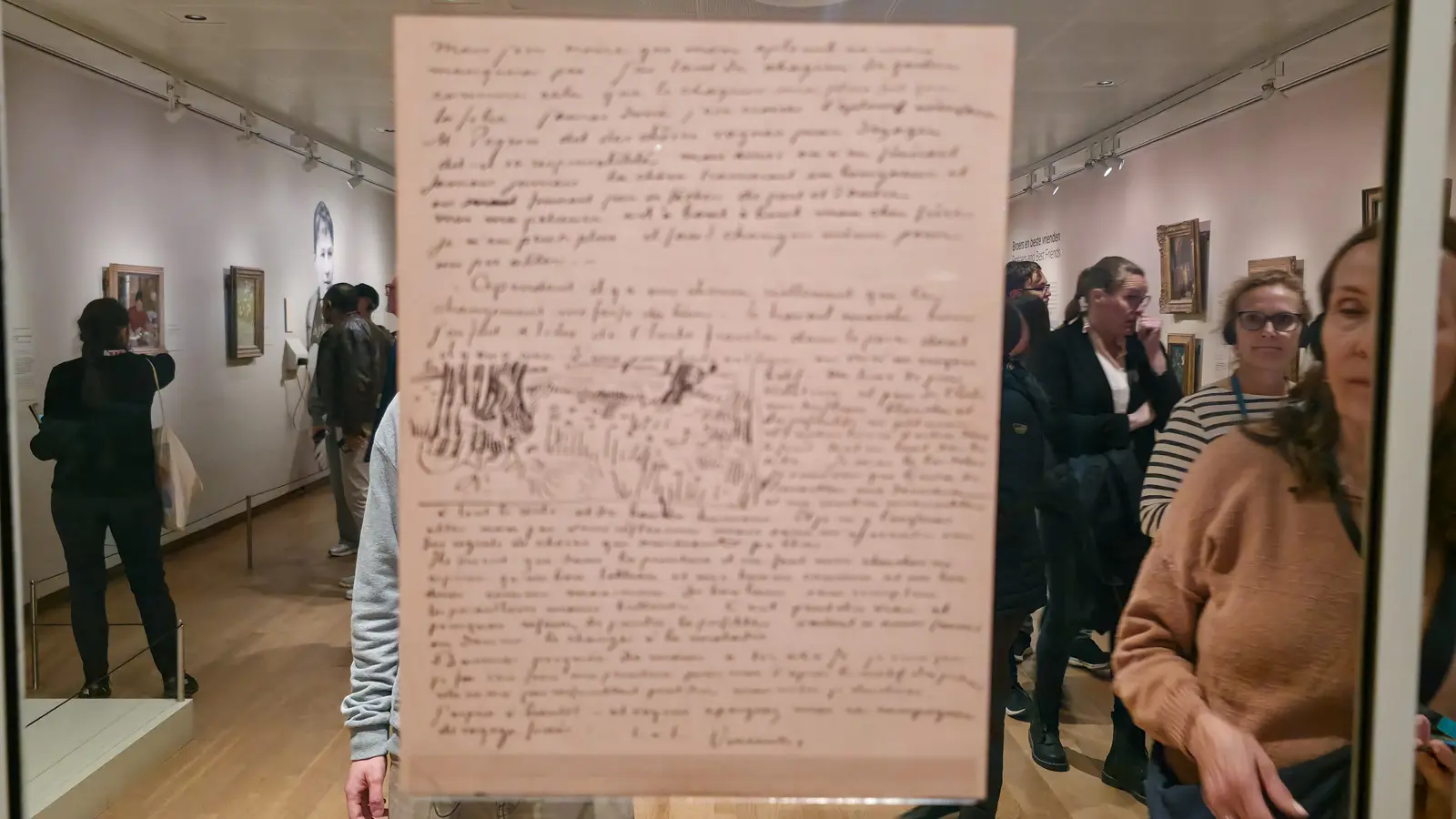
The letters hang on glass panels so both sides are visible, which means the room behind shows through them. Close, dense handwriting in brown ink, margin to margin, and then without warning a landscape drawn straight into the middle of the page: a field, a row of trees, a figure.
He did not stop to make a separate drawing. He kept writing around it, so the sentence continues under the horizon line and out the other side.
That is the thing the reproductions never convey. These were not documents. They were post, written quickly, folded, stamped and sent, by a man who expected an answer within days.
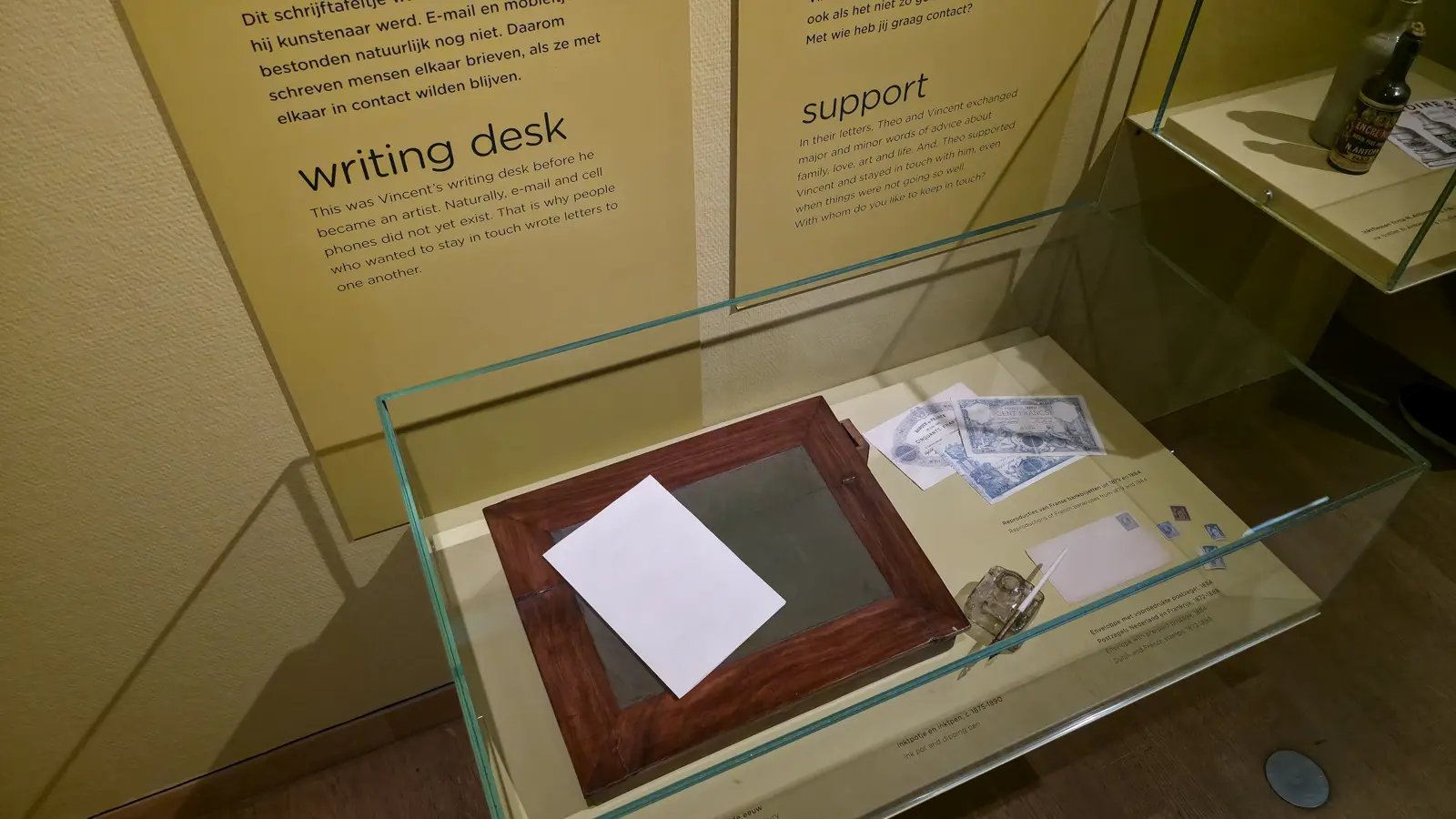
A shallow wooden board with a sloped surface, a glass ink pot, a dipping pen, an envelope with pre-paid postage, and reproduction French banknotes of fifty and a hundred francs. The banknotes are the point. That is what arrived in the post from Paris, month after month, for ten years.
The painting for the baby
On 31 January 1890 Theo and his wife Jo had a son. They named him Vincent, after his uncle.
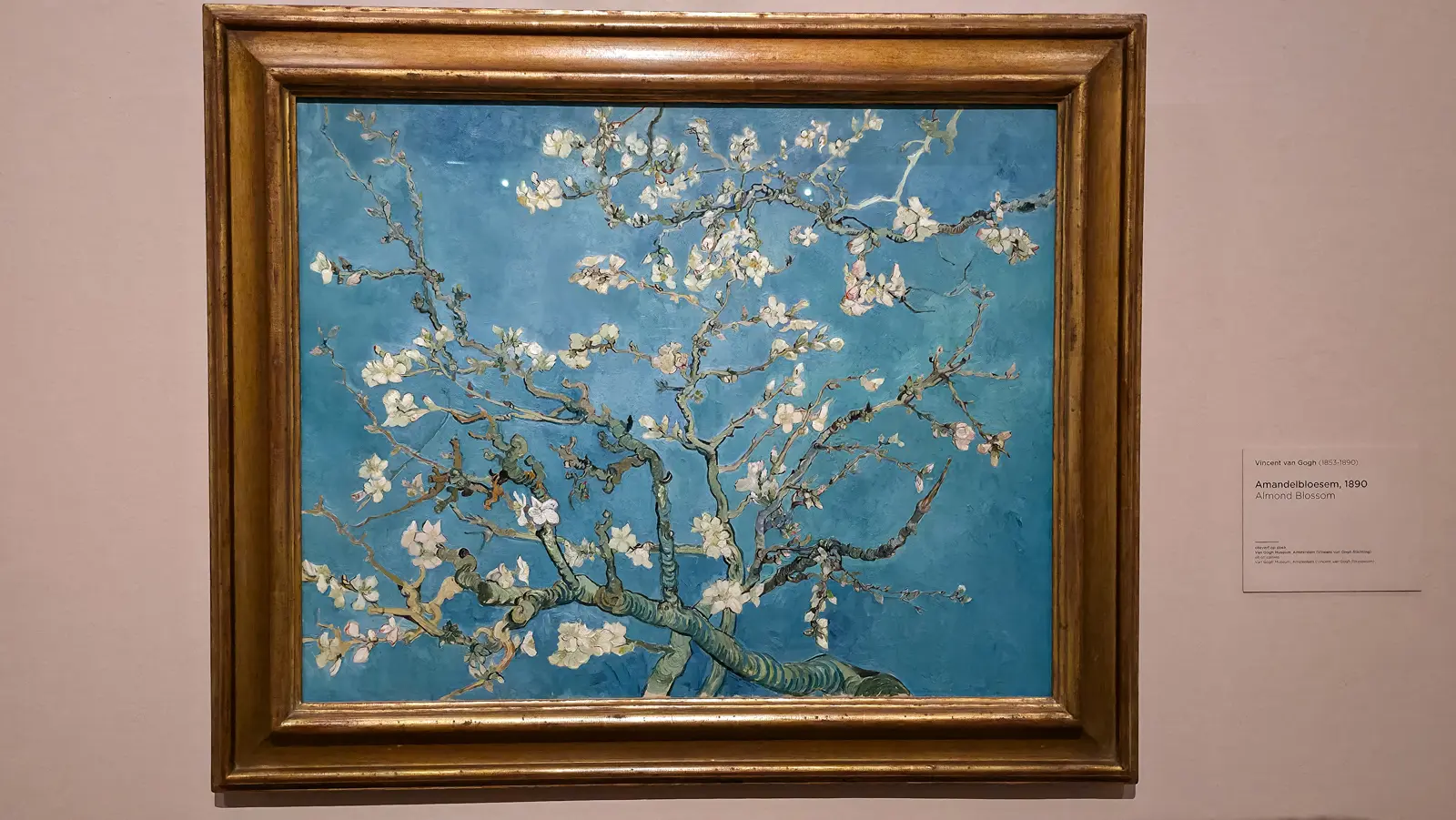
Vincent was in the asylum at Saint-Rémy and had been for nearly ten months. He heard the news and started painting immediately: almond branches in white blossom against a blue sky, painted from below, looking up into the tree.
Almond trees flower first, before everything else. He chose the one thing in Provence that announces a beginning, and he painted it for a child he had not met.
It hung above the piano in Theo and Jo’s living room. Later, after Theo died, it hung in the bedroom Jo shared with her son.
Everything for Vincent
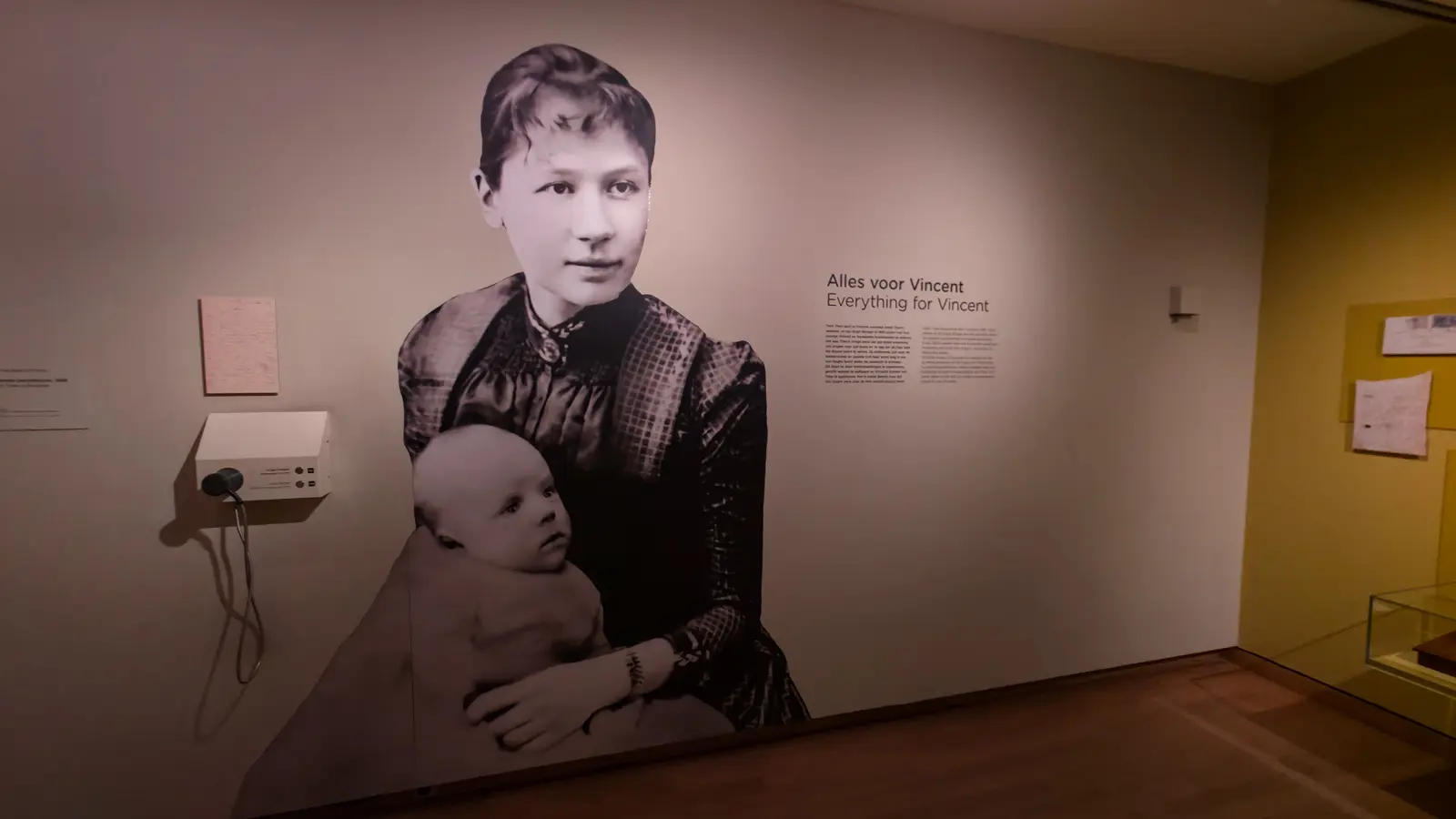
Theo died in January 1891, less than a year after Vincent. Jo van Gogh-Bonger was twenty-eight, widowed, with a baby under a year old, and in possession of several hundred paintings that nobody wanted and that the family advised her to be rid of.
She spent the next thirty-five years changing that. She lent work to exhibitions across Europe and America, found buyers, kept the correspondence in order, taught herself well enough to edit it, and published it. She was translating the letters into English when she died in 1925, and had finished about two thirds.
This is the part I had wrong before I stood in front of that wall. I had assumed the son did it. The son inherited it.
The boy the painting was for
Jo’s English translation was published four years after her death. Her son took over the work she had done for three and a half decades, lent the paintings to the Stedelijk Museum, and eventually set up the foundation that made the collection permanent.
So the chain runs: Theo paid for the work and saved the letters, Jo made the world read them, and the baby from Almond Blossom made sure the whole thing stayed together and had a building.
I am not a person who buys museum magnets. I bought a magnet and a ceramic coaster of Almond Blossom, partly because it is the most beautiful thing in the building and partly because of what it is: a painting made in an asylum, by a man having the worst year of his life, for a nephew he would never meet.
Bubbly Tips
- Do not rush the letters room. It sits between the painting galleries and most visitors treat it as a corridor. It is worth twenty minutes on its own.
- Read the panel before the letters. The ten-year allowance and the 820 letters are the two numbers that make everything else in the room legible.
- Look at the reverse of the letter panels. They are hung on glass so both sides show, and the handwriting on the back is often where the sketches are.
- Find the sketch letters specifically. Drawings dropped into the middle of a paragraph are the closest thing to watching him think.
- The audio guide has a stop in this room. Number 8 covers the brothers, and it is one of the better stops in the building.
- Almond Blossom is not in this room. It hangs separately, so do the letters first and the painting after, in that order, or the story arrives backwards.
- The shop stocks Almond Blossom on everything. If you only want one thing, the ceramic pieces hold the blue better than the printed paper does.
- Book a timed slot well ahead. The museum regularly sells out and walking up on the day is not a plan.
- Pair it with the Rijksmuseum only across two days. Both are on Museumplein and both deserve a morning to themselves.
Final Thoughts
Two brothers, eighteen years of post, and a sister-in-law who refused to let it disappear.
The painting that hangs at the end of it was a present for a week-old baby. That baby grew up, kept it, and gave it to the rest of us.
Until next time!

🌟 Everything You Need to Plan Your Dream Trip in 2026
- 🌟 Luxury Hotels - Find premium stays with Booking.com & Hotels.com
- 🏡 Vacation Rentals - Discover unique properties on VRBO
- 🏞️ Guided Tours - Explore with Viator or GetYourGuide
- 🎫 Attraction Tickets - Skip the lines with Tiqets
- 🚢 Ocean Cruises - Set sail with Cruise Direct
- 📱 International SIMs - Stay connected with Saily
- 🚗 Car Rentals - Budget-friendly options from Discover Cars
- 🌐 Secure VPNs - Browse safely with NordVPN
- 💶 Currency Exchange - Best rates with Wise
- 🗣️ Learn Languages - Master the local language with Babbel and Rosetta Stone