
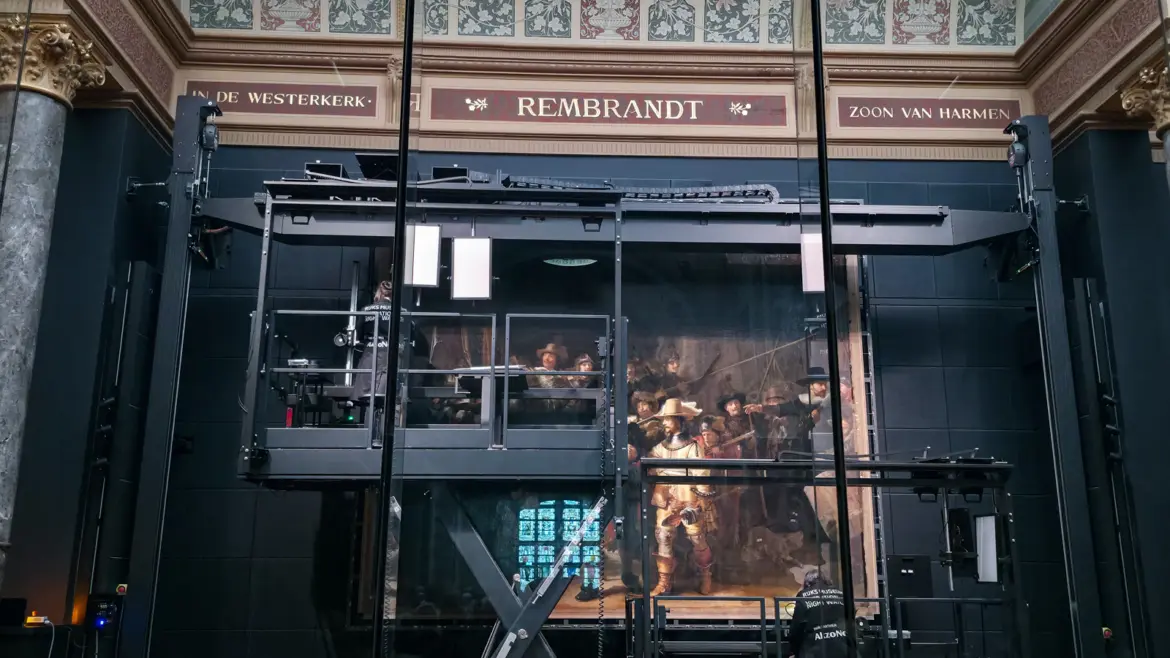
I had seen this painting perhaps four hundred times before I ever saw it. On fridge magnets, on tea towels, on postcards in every souvenir shop between Centraal and the Bloemenmarkt in Amsterdam. I knew it was a Rembrandt. I could not have told anyone what was happening in it, who any of the men were, or why this one and not another.
Compare that with Van Gogh. I could have talked at length about the sunflowers, about why he painted them and what they were for. This I had filed under famous, and left there.
Nobody had told me it was the Rijksmuseum‘s Mona Lisa. Some people make exactly that comparison, and having stood in front of it I understand why, though the reason turned out to have nothing to do with fame.
The Night Watch at a Glance
🖼️ What it is · Not a night scene and not called the Night Watch. Formally Militia Company of District II under Captain Frans Banninck Cocq (1642): a group portrait eighteen guardsmen paid to be in.
🌙 The name · A mistake from darkened varnish, first recorded in 1797. Rembrandt painted a company being ordered to march in broad daylight.
✂️ Cut down in 1715 · Trimmed on all four sides to fit a wall in the Town Hall (now the Royal Palace); two figures lost on the left. A 1650s copy in London’s National Gallery shows the whole.
🔬 Operation Night Watch · Since 2019, the biggest-ever study and restoration, done in public: a five-phase programme, currently removing varnish, some of it repair work from past attacks.
💡 Tip · Go first, look up at the gold frieze, and use a conservator on the platform as your ruler.
A Room Built for One Painting
We went straight there, before anything else, on a guided tour. The room was already full, our group and several others, everybody angling for a clear line of sight through the glass.
It is worth knowing that this is not the Gallery of Honour, which is the long corridor of alcoves everybody photographs and which we came back to at the end of the day. The Night Watch has its own room at the far end of that corridor, the Nachtwachtzaal, designed and built for this one canvas.
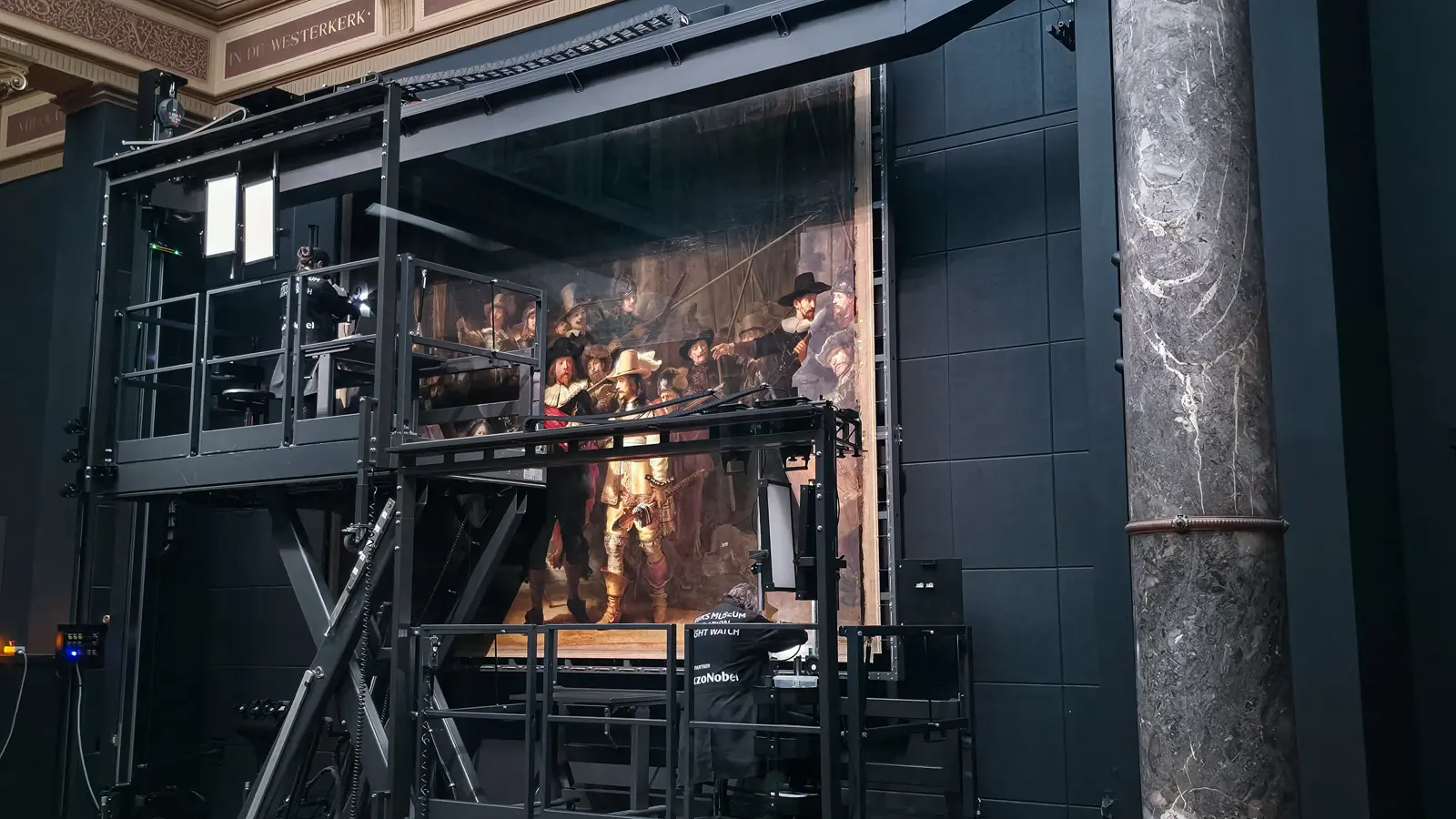
Pierre Cuypers, the architect who built the museum in the 1880s, laid the whole axis out like a church. The corridor is the nave, the alcoves along it were originally closed off with heavy curtains, and this room at the end is the high altar. The museum uses that comparison itself.
Look above the chamber and there is gold lettering running round the walls: IN DE WESTERKERK, then REMBRANDT, then ZOON VAN HARMEN. It is not ornament. The frieze is a biography. Zoon van Harmen means son of Harmen, which is where the Harmenszoon in his name comes from, and the Westerkerk is the church where he was buried in 1669. His life is written round the room in which his painting stands.
What It Actually Shows
The title is not The Night Watch. It is Militia Company of District II under the Command of Captain Frans Banninck Cocq, finished in 1642, and once that is said the picture stops being a mystery.
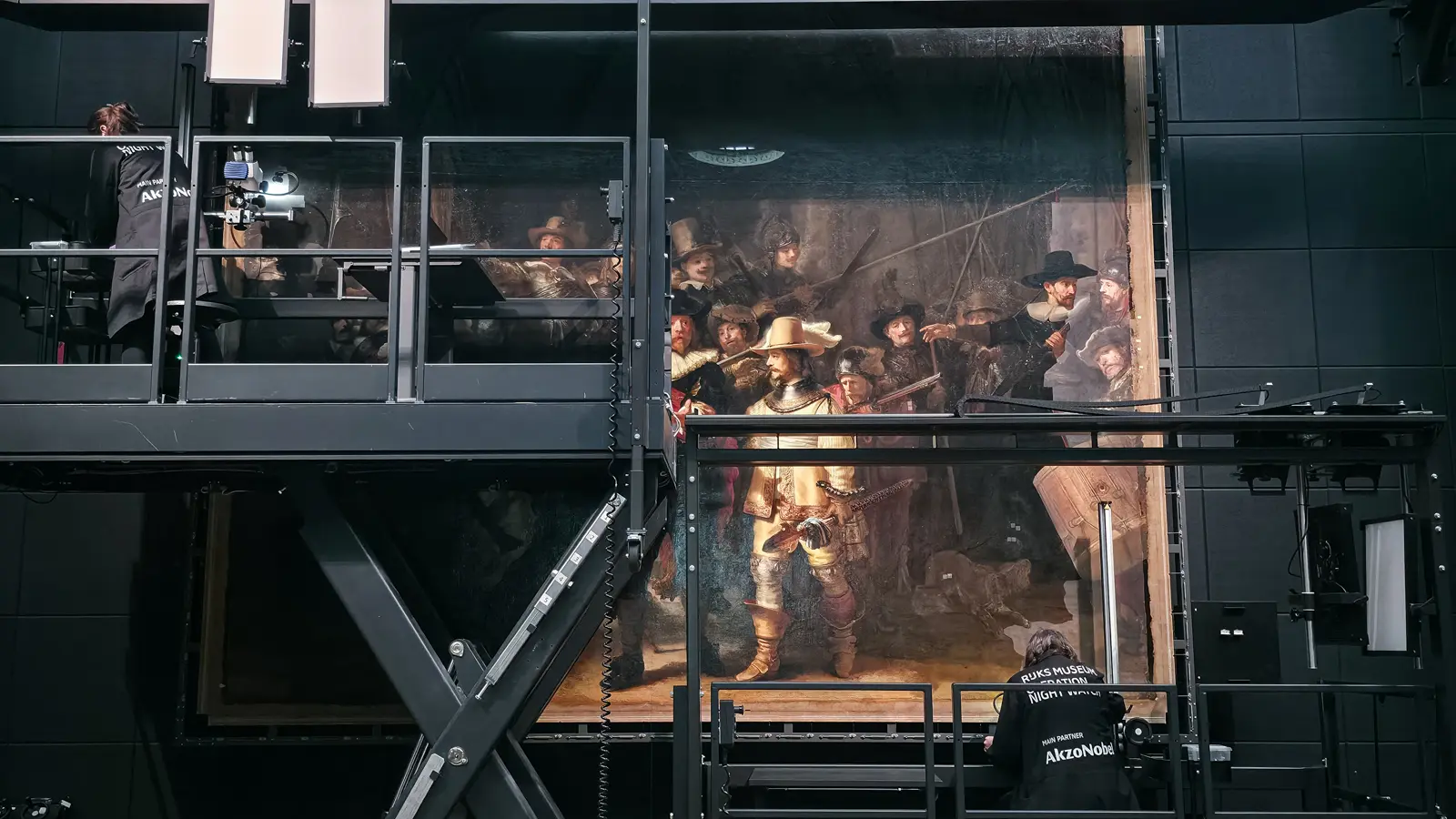
It is a group portrait that people paid to be in. Banninck Cocq and seventeen members of his civic guard commissioned it around 1639, each contributing roughly a hundred guilders depending on how prominently he appeared, sixteen hundred guilders in total. Thirty-four figures end up in the finished painting, so a good number of them are there for nothing.
The man in black with the red sash, dead centre, is the captain giving the order to move out. The man beside him in pale yellow with the white sash is his lieutenant, Willem van Ruytenburch. Everything else follows from that single gesture: a musket going off, a drummer starting up, a dog, a banner, men still forming into ranks. No battle, no patrol. What Rembrandt painted is the moment a company is told to march, and he painted it as though the paint itself were moving.
That is the part nobody puts on a magnet. What made Rembrandt’s version different from the other militia pieces hanging in that same hall was that he refused to line them up.
Why It Is Called the Night Watch
It is broad daylight. The cast shadows say so, and so does everything the conservators have found.
The name came from the varnish. Layer upon layer of it darkened and yellowed over the centuries until the scene read as nocturnal, and the nickname stuck. It appears in writing for the first time in 1797, a hundred and fifty-five years after Rembrandt finished the work. The heaviest of that varnish came off in the 1940s and the picture turned out to be a day scene, but by then the wrong name had won.
What Was Cut Off in 1715
In 1715 the painting was moved out of the militia hall to Amsterdam’s Town Hall, the building that is now the Royal Palace on Dam Square. It did not fit the new wall, so they cut it down on all four sides to sit between two columns.
Gone from the left: two figures, the top of the arch, the balustrade and the edge of a step. Those pieces were never found and presumably never kept. The painting that draws two and a half million people a year is a trimmed version of itself, and the only record of what it looked like whole is a smaller copy made in the seventeenth century by Gerrit Lundens, a contemporary of Rembrandt’s, which hangs in the National Gallery in London.
The Operation
Since 2019 the painting has been the subject of Operation Night Watch, the largest programme of research and conservation ever carried out on it, and all of it happens in public.
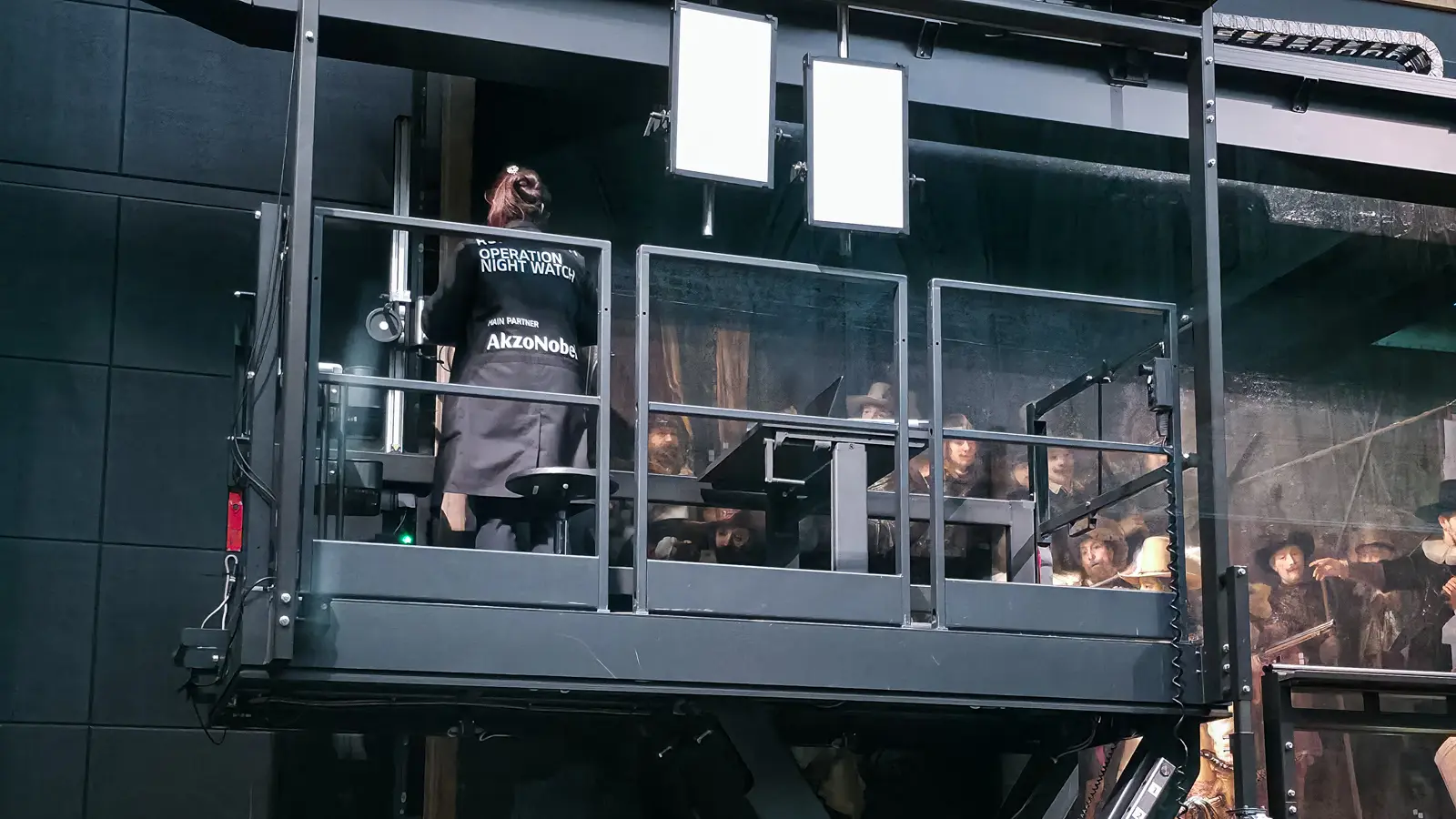
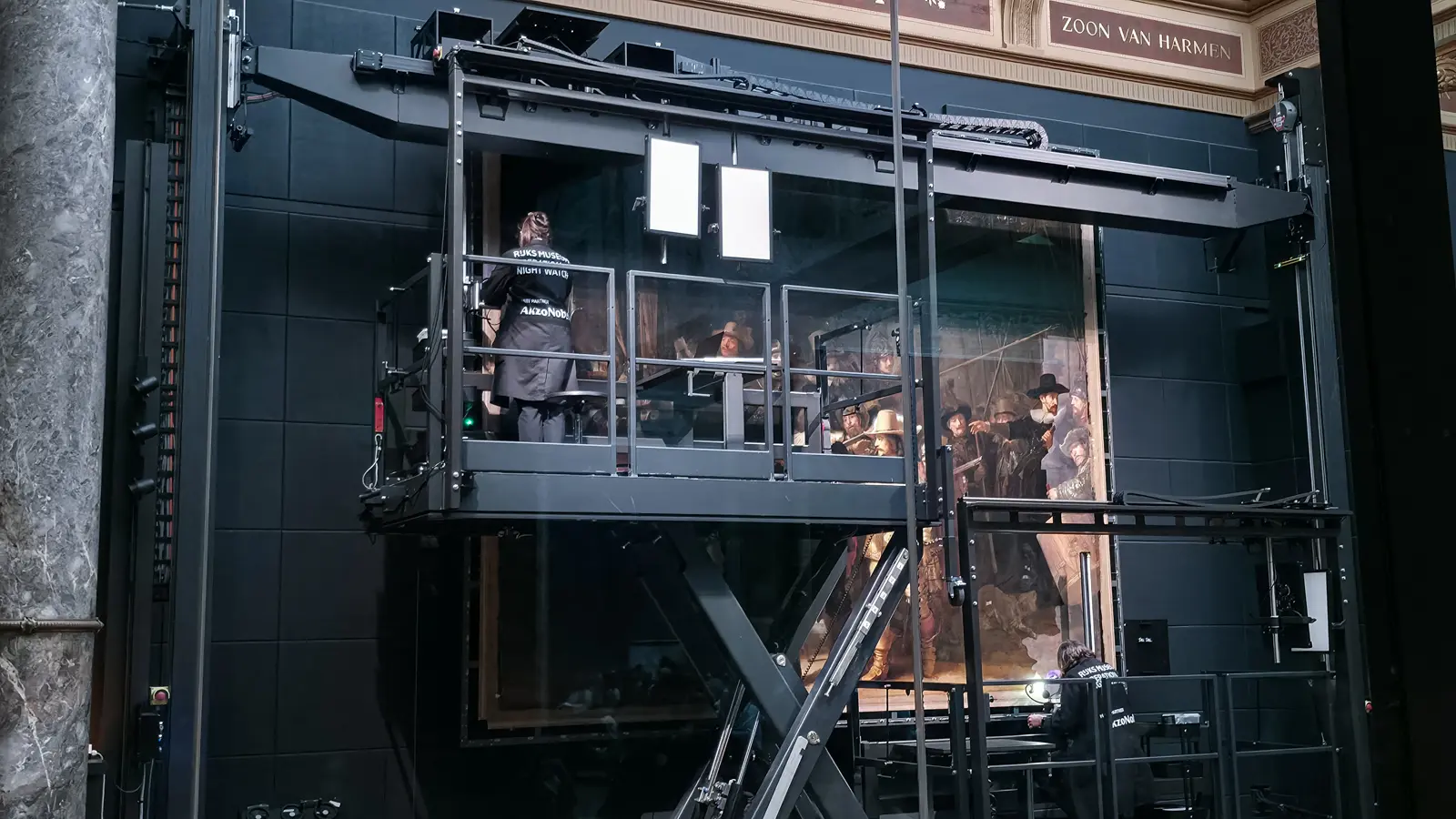
A steel gantry carries a platform that rises and slides across the face of the canvas. Lighting panels hang on rails. A digital microscope sits clamped to a stand. Two conservators were working while we were there, one high on the platform and one crouched at the bottom edge, both in black aprons lettered OPERATION NIGHT WATCH.
She is the reason the scale lands. Standing on the platform at the level of the captain’s hat, a grown woman comes up to roughly the height of the painted figures’ heads. The canvas is 363 centimetres tall and 437 wide, and no number does what that comparison does.
Five Phases, and the Current One
A panel on the side wall sets out the whole programme in Dutch and English.
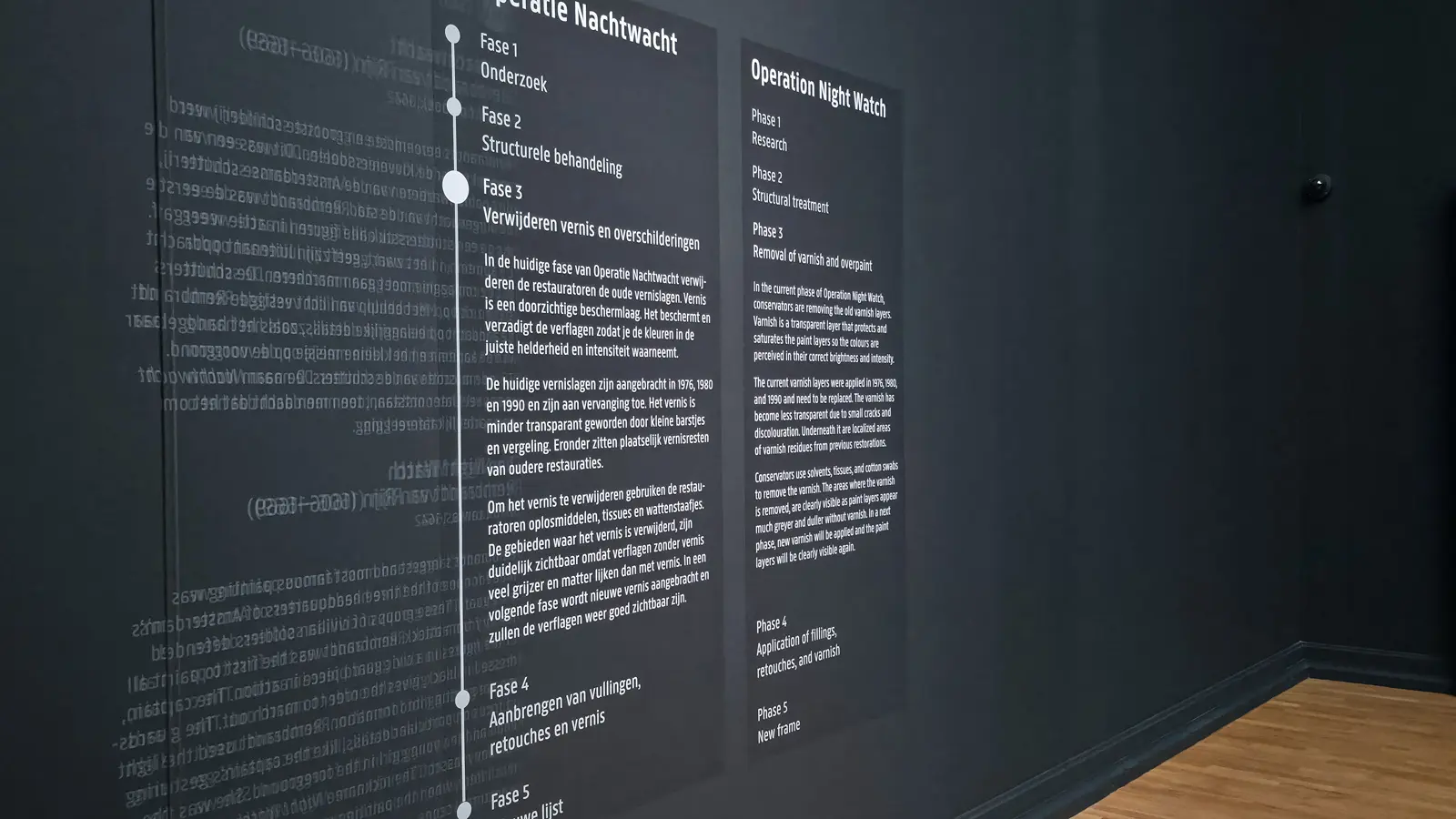
Phase one was research. Phase two was structural treatment. Phase three, the one under way when we were there, is the removal of varnish and overpaint. Phase four will be fillings, retouches and fresh varnish. Phase five is a new frame.
The panel explains what varnish is for, which is not something I had thought about. It protects the paint and it saturates it, so the colours read at their proper brightness. The layers currently on the painting have cracked and discoloured, so they scatter light instead of letting it through. Conservators lift them with solvents, tissues and cotton swabs, and the panel warns that cleaned areas look greyer and duller than the rest until the new varnish goes on.
That is exactly what the canvas looked like: patchy, unresolved, a masterpiece in the middle of being taken apart.
Three Attacks, Three Layers of Varnish
Here is the thing I did not understand until afterwards, and it is written on that panel in plain numbers.
The varnish layers being removed were applied in 1976, 1980 and 1990.
On 13 January 1911 an unemployed shoemaker went at the painting with a knife. The varnish was thick enough to take the blade and the paint underneath survived. On 14 September 1975 a Dutch schoolteacher slashed it repeatedly with a bread knife, and that one did real damage. On 6 April 1990 a man sprayed it with sulphuric acid, and a guard flooded the canvas with water fast enough that the acid got no further than the varnish.
Two of the three coatings now being lifted off went on after those attacks. The layer the conservators are dissolving with cotton swabs is, in part, the repair work from a knife and a bottle of acid. The painting is not merely old. It has been assaulted three times in a hundred and fifteen years, and what is being removed is the evidence of it surviving.
Bubbly Tips
- Go to it first. We did, before anything else, and it was the right order. The rest of the museum makes more sense once the thing at the end of the axis has been seen, and the crowd only thickens through the day.
- Know which room you want. The Gallery of Honour is the long corridor of alcoves. The Night Watch is in its own room at the end of it. Asking for one when you mean the other will cost you ten minutes.
- Expect a crowd and plan for it. Several rows deep is normal, tour groups included. Stand back and wait rather than pressing forward; people cycle through quickly and the second row clears fast.
- Look up before you look at the painting. The gold frieze running round the walls sets out Rembrandt’s life, and the gilded figures on the column capitals are there to nod at his light and shade. Almost nobody in that room raised their eyes.
- Use the conservator as your ruler. If someone is working on the platform, note where her head reaches against the painted figures. That does more for the scale than any measurement.
- Read the panel on the side wall. It explains what varnish does and why removing it makes the painting look worse before better. Two minutes, and it changes what you are looking at.
- Photograph it off-centre. It sits behind protective glass and the lighting panels reflect straight back. Standing to one side and shooting at a slight angle avoids the worst of it.
- Book a guided tour if you want the context. Ours talked us through what was happening on the platform, which is not obvious from the panel alone.
- If you are ever at the National Gallery in London, look for the Lundens copy. It shows the painting as it was before 1715, with the figures and the balustrade that Amsterdam cut off.
Final Thoughts
I came in able to recognise it and unable to say a single true thing about it. I left knowing it is a group portrait that eighteen men paid for, that it shows a company being ordered to march on a bright day, that its name is a mistake caused by dirty varnish, and that a third of a metre of it is missing on one side because a wall in 1715 was the wrong size.
What actually converted me was not the information. It was watching a woman on a hydraulic platform lean towards four hundred year old paint with a cotton swab, in a room built like a chapel, with the painter’s life lettered in gold above her head. A painting that hangs there being famous is easy to walk past. A painting that fifty people are currently keeping alive is not. I understood Rembrandt better at the end of those twenty minutes than I had in a lifetime of fridge magnets, and everything else in the museum that day was measured against it.
Until next time!

🌟 Everything You Need to Plan Your Dream Trip in 2026
- 🌟 Luxury Hotels - Find premium stays with Booking.com & Hotels.com
- 🏡 Vacation Rentals - Discover unique properties on VRBO
- 🏞️ Guided Tours - Explore with Viator or GetYourGuide
- 🎫 Attraction Tickets - Skip the lines with Tiqets
- 🚢 Ocean Cruises - Set sail with Cruise Direct
- 📱 International SIMs - Stay connected with Saily
- 🚗 Car Rentals - Budget-friendly options from Discover Cars
- 🌐 Secure VPNs - Browse safely with NordVPN
- 💶 Currency Exchange - Best rates with Wise
- 🗣️ Learn Languages - Master the local language with Babbel and Rosetta Stone