
I went in expecting a tourist trap. A restaurant inside one of the busiest museums in Europe, named after the painter, with a captive audience of two million people a year who cannot leave and come back without buying another ticket. There is no version of that sentence which sounds promising.
It was one of the better lunches I had in Amsterdam, and the thing I took away from it has almost nothing to do with the food.
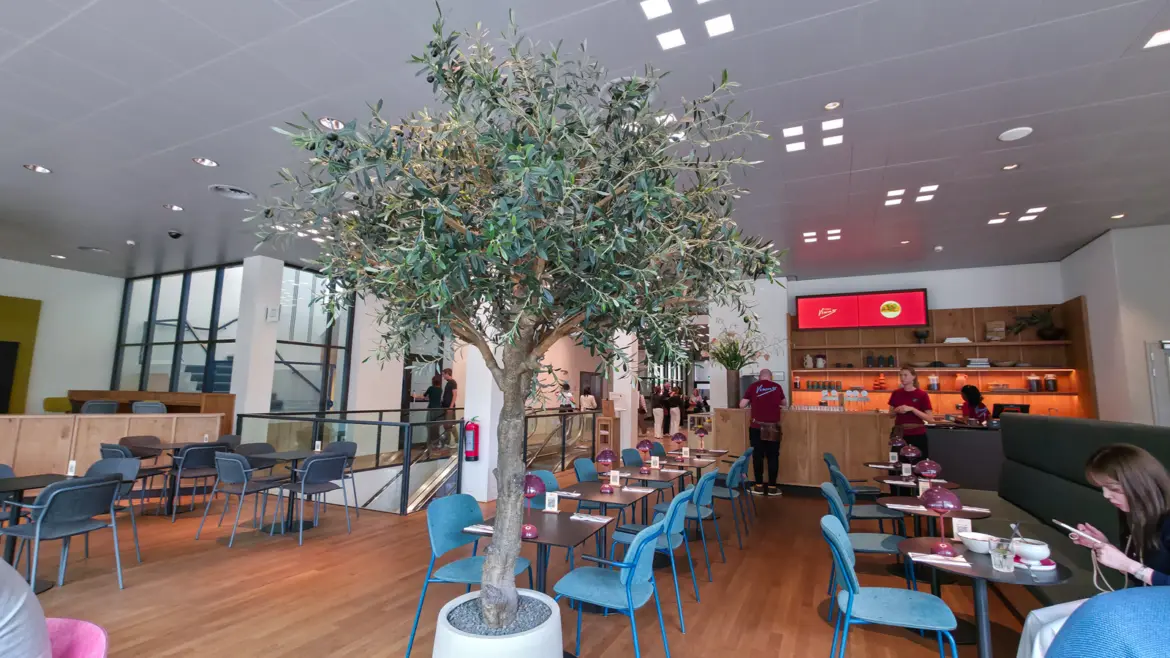
A red sign with the word Vincent in his own loose handwriting sits above a timber counter. Staff in burgundy shirts carry the same signature. Tables in dark grey with small purple lamps on them, blue-green chairs, and a bench along the far wall.
Bistro Vincent at a Glance
🍽️ What it is · The sit-down restaurant inside the Van Gogh Museum, on the first floor of the Rietveld building. Museum ticket required; no street entrance.
🌍 The menu · Built on the three countries that shaped Van Gogh: the Netherlands, France and Japan. French onion soup with Dutch soy, a katsu burger, a sunflower dessert.
🫒 The room · A full-sized olive tree in the middle, a nod to the olive groves he painted at Saint-Rémy. Blue-green chairs, purple table lamps.
🕙 Practical · Opens daily at 10am (breakfast until 11), no booking for groups of ten or under, order by QR code from the table.
💡 Tip · Stop mid-visit, not just at the end. The second half of the museum is far better on a rested head.
Up the Escalators
The bistro is inside the Rietveld building, the oldest part of the Van Gogh Museum, and the way to it starts in the entrance hall.
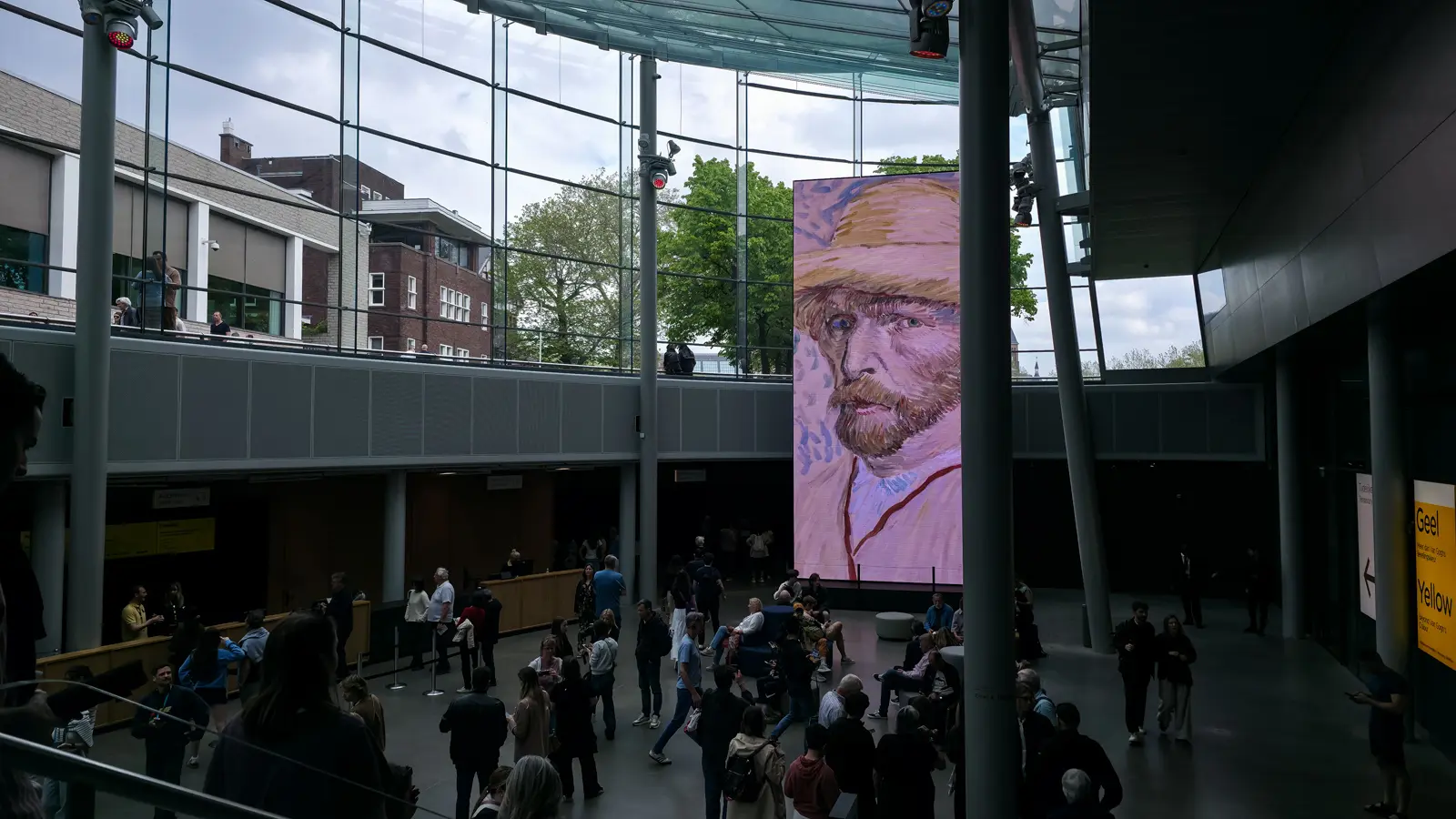
From there the route is one escalator ride, and the signage does not make much of it, so plenty of people walk straight past on their way to the galleries.
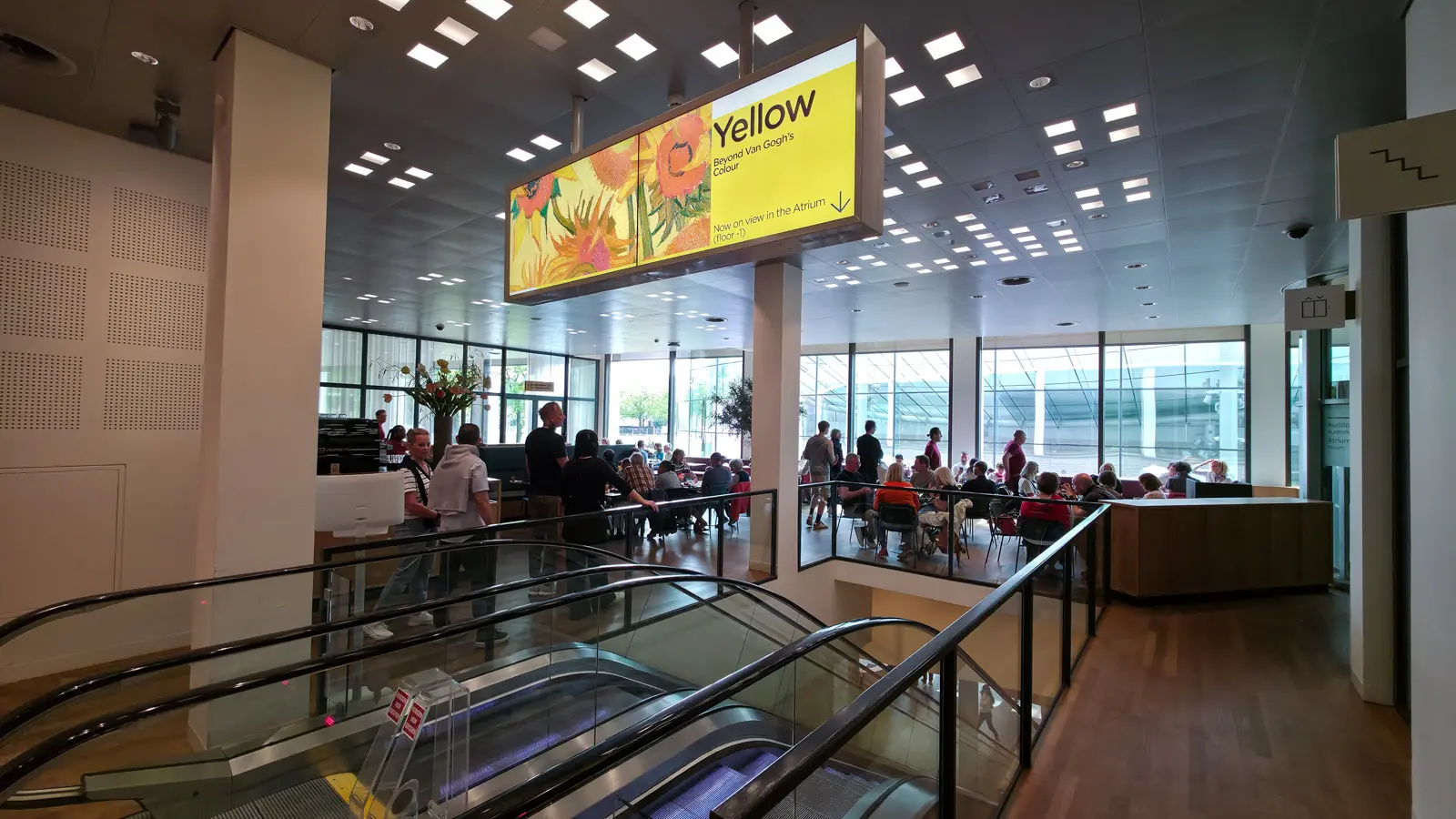
Come up from the hall and it is immediately there, on the right, open to the walkway rather than shut behind a door.
An Olive Tree in a Museum
The thing that takes the eye in that room is a full-sized olive tree standing in the middle of it, in a round white planter topped with grey gravel, about as tall as the chairs around it.
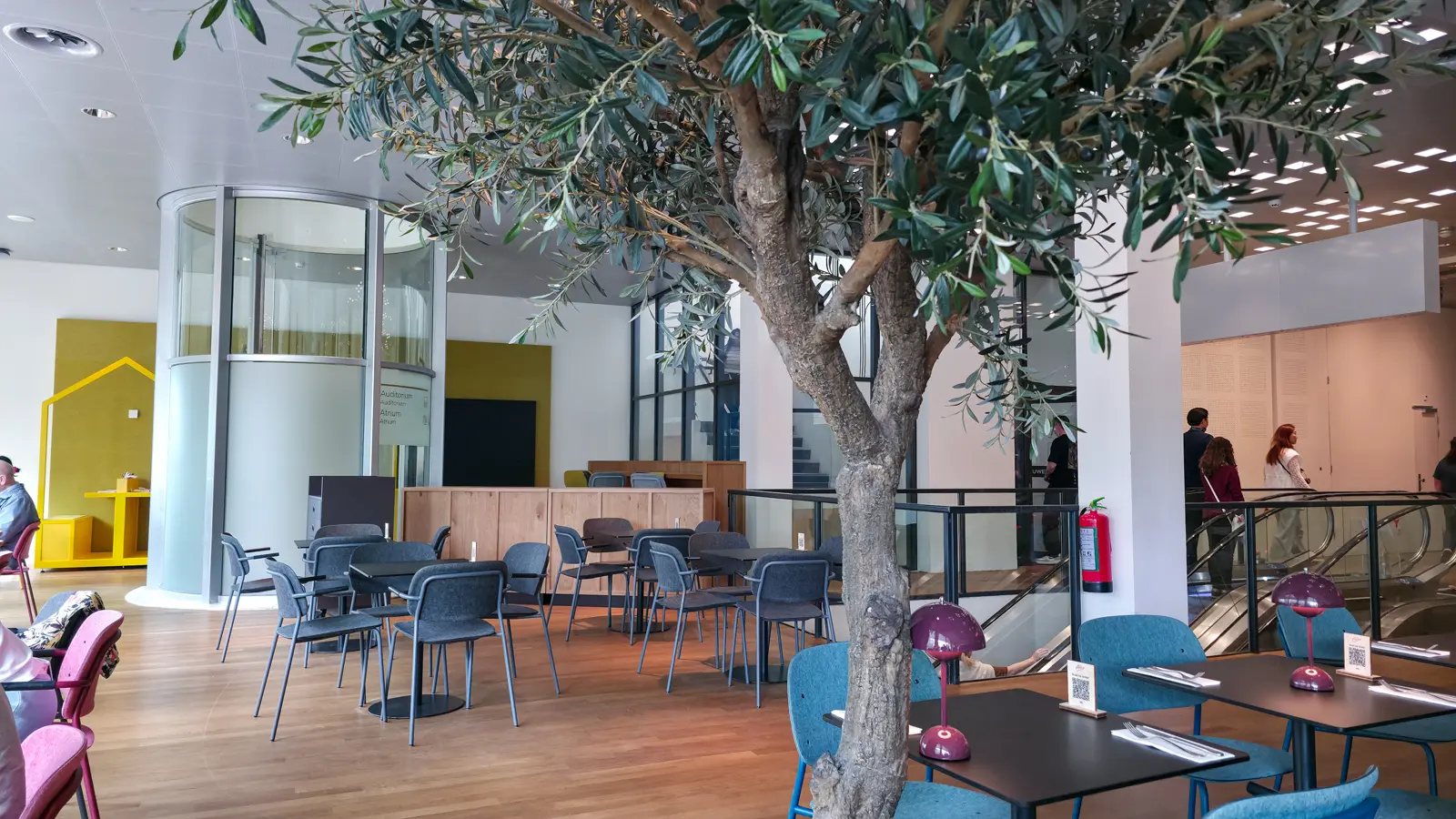
It has a thick gnarled trunk and small dark fruit on it, and it sits beside the escalator well with tables all round. My first thought was that somebody had ordered an expensive statement plant.
Then I remembered where he spent 1889. Van Gogh painted at least fifteen canvases of olive groves during his year at the asylum at Saint-Rémy, going out into the countryside whenever the doctors let him. He wrote to Theo about the leaves: old silver, turning to green against the blue. Of everything in that room, the tree is the least decorative decision anybody made.
The Netherlands, France and Japan
Here is the part that changed my mind about the place.
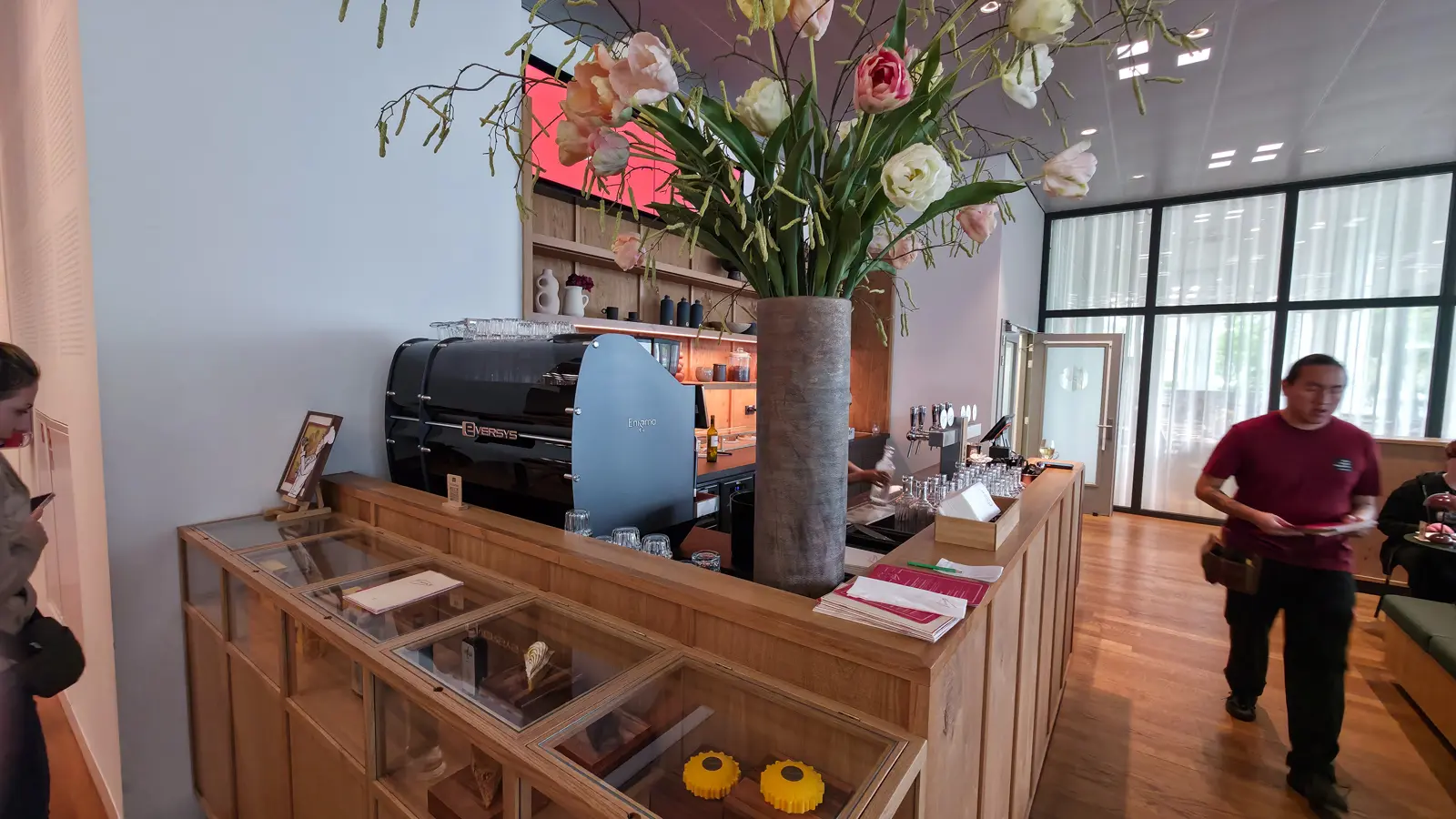
The kitchen works across three countries: the Netherlands, France and Japan. Not as a marketing line but as the actual structure of the menu, because those are the three places that made the painter. He was Dutch by birth and training, French by relocation, and Japanese by adoption, through the prints he collected and copied and the compositions he borrowed from them.
So there is French onion soup, made with soy sauce brewed in the Netherlands by a producer called Tomasu. There is a katsu burger. The mozzarella comes from buffalo kept near Haarlem, the dairy from a co-operative outside Amsterdam, and there is a sunflower-shaped dessert developed with a pastry chef as a nod to the obvious. Breakfast includes a sausage roll from a patisserie in Amsterdam that has been going for a hundred and twenty-five years.
None of that is what a captive-audience restaurant bothers to do.
One caveat on the framing, which arrived after I ate there. In early May 2026 the concept drew criticism from Seo Kyoung-duk, a professor at Sungshin Women’s University in Seoul, who posted that the bistro sells a kimchi sandwich while describing its Asian influence as Japanese, with nothing on the menu to indicate that kimchi is Korean. The Korea Herald and several other outlets reported it. I have found no response from the museum.
The bistro’s page on the museum website now says French cooking with subtle Asian influences, where the printed menu in front of me said Japanese ones. Whether that wording changed or was always different, I cannot tell.
It lands on the seam in the idea, though. Draw the map with three countries on it and anything arriving from a fourth has nowhere to go, so it gets pushed into whichever of the three sits nearest.
What We Ordered
We had two burgers, two juices and a cola between us, which came to the sort of bill a museum restaurant produces.
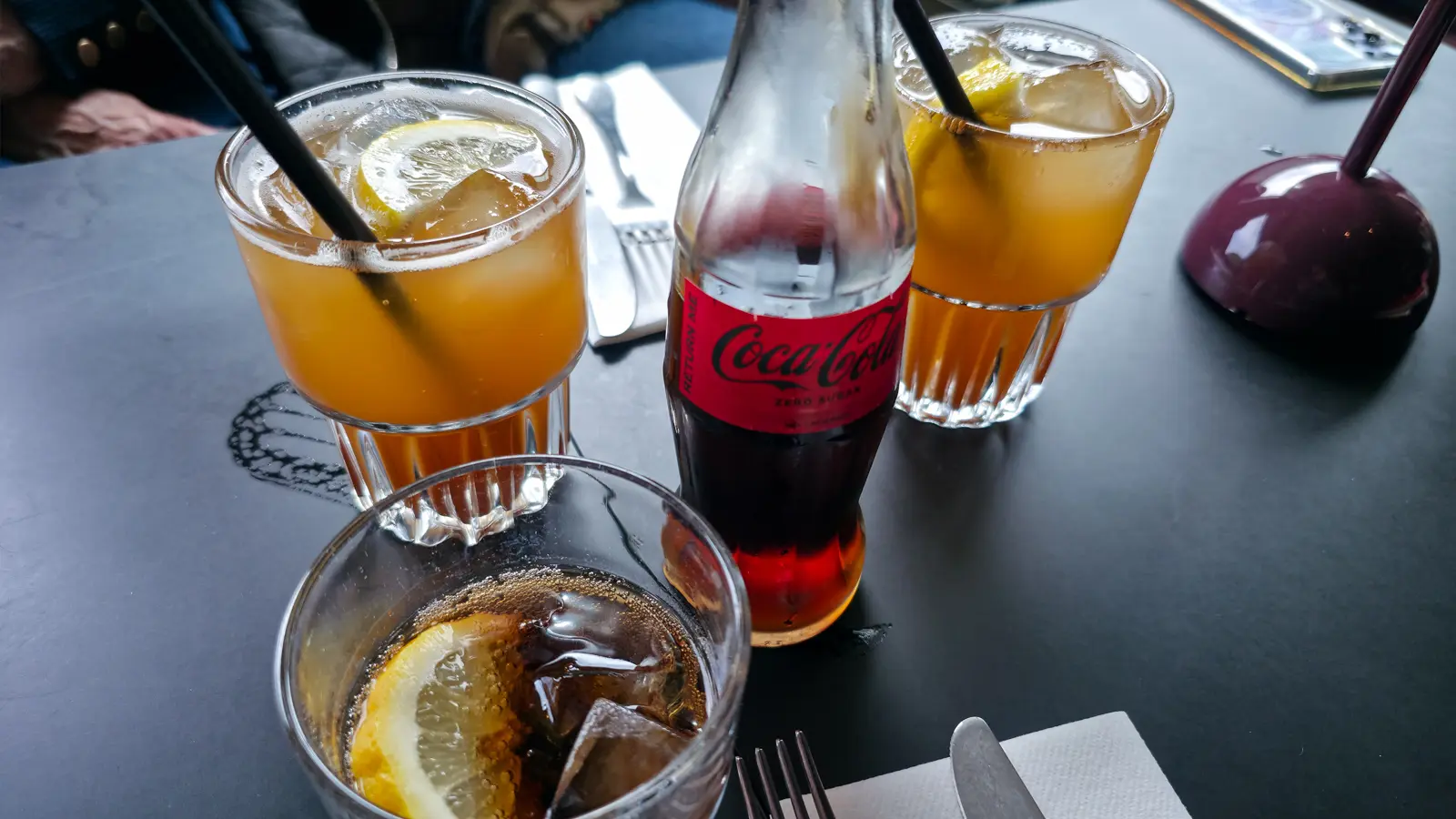
The Van Gogh Juice is the thing to order. Pineapple and carrot and apple would be unremarkable on their own, but the ginger and the mint pull the whole glass somewhere sharper, and it arrives long and cold with a slice of lemon in it. I would drink that again at home if I could work out the proportions.
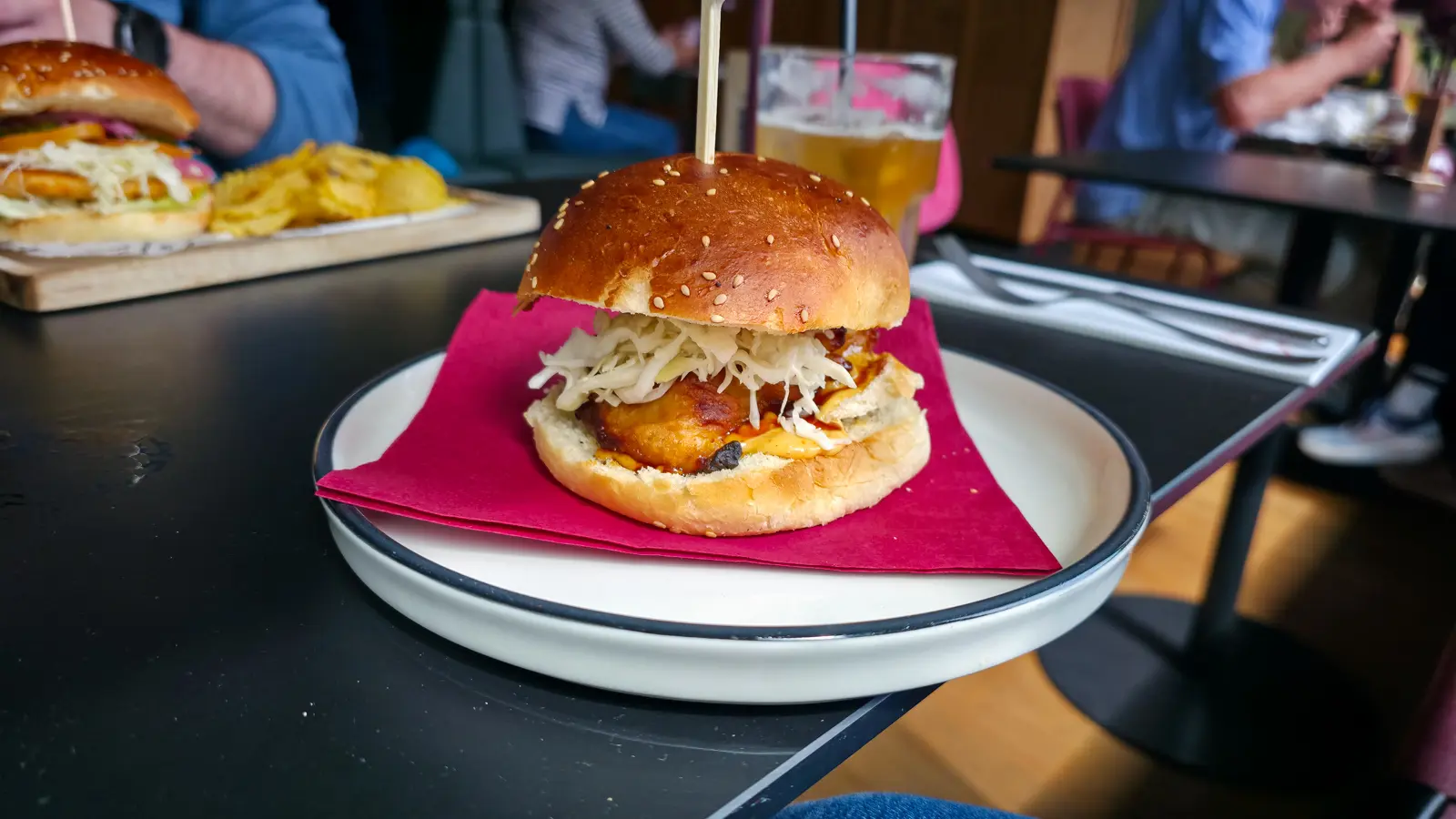
The katsu burger is the one that makes the three-country argument on a plate. Fried chicken and tonkatsu sauce from one tradition, brioche from another, and coleslaw holding the middle. It comes on a small plate with a wooden skewer through it and nothing else, and it does not need anything else.
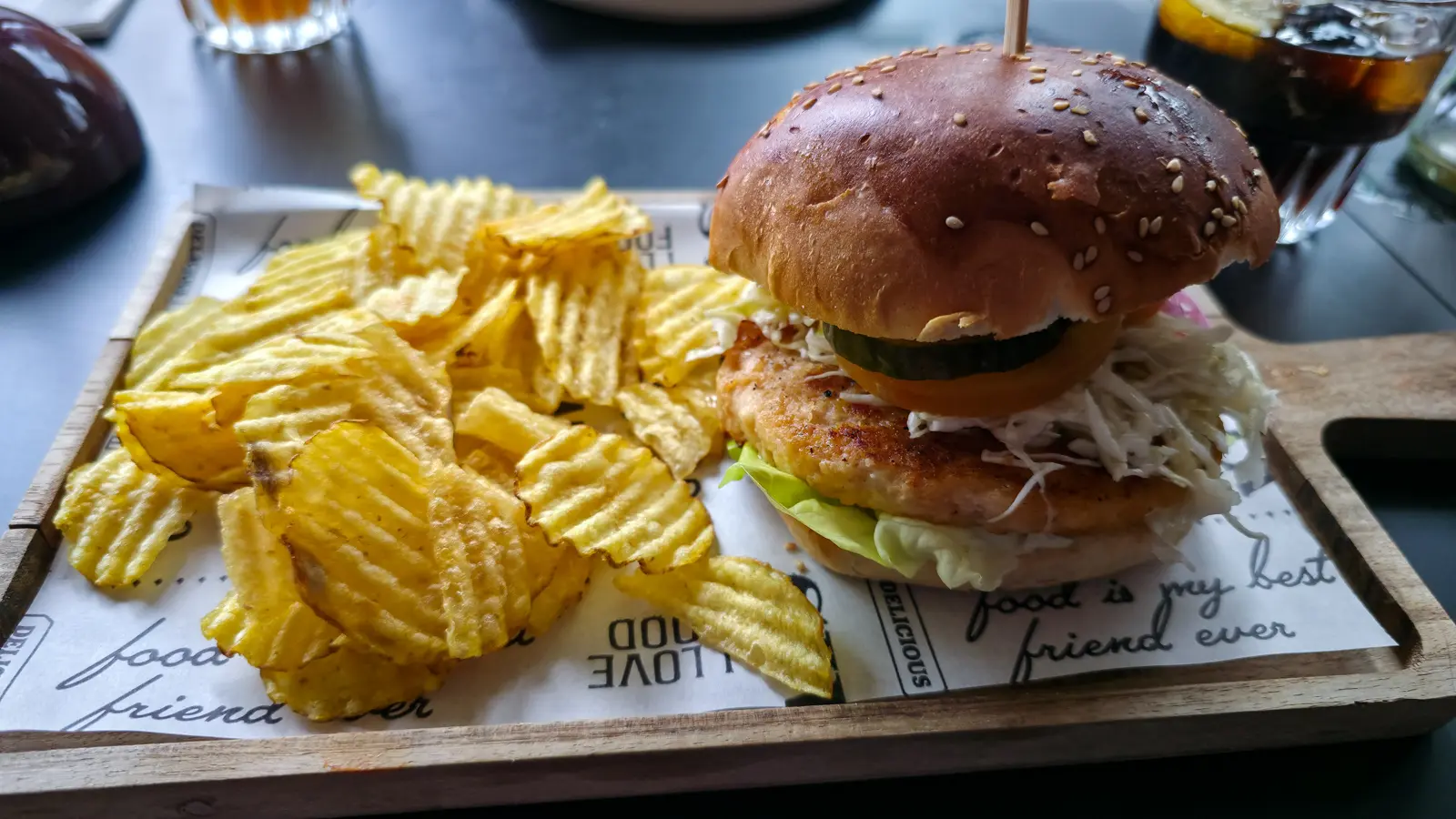
The lobster burger is the expensive one and the better looking one. A sesame brioche bun, a thick pale patty, sweet and sour cucumber, lime mayonnaise, shredded coleslaw spilling out of the side, and a heap of crinkle-cut crisps on the board next to it.
Ordering by Code
The tables carry a QR code and the menu points firmly towards it, which sounds like the usual cost-cutting and turns out to suit this particular situation rather well.
Ordering from the table means a second round can be added without catching anyone’s eye or losing a seat, which matters in a room where seats are the scarce thing. We ordered drinks, then food, then more drinks, in three goes, without standing up.
Waiting staff are on the floor throughout for anyone who would rather not, so nobody is stranded by a phone that will not scan.
Why the Stop Is the Point
We ate in the middle of the visit, went up to the galleries afterwards, and it worked. It would have worked at the end too.
What matters is doing it at all. Museums of this size are exhausting in a way that has nothing to do with walking. Two hours of concentration, standing up, in a crowd, in low light, and the last rooms stop registering. Everyone recognises the point at which the paintings stop landing and yet almost nobody plans around it.
Forty-five minutes at a table, with something cold and something to eat, resets it completely. The second half of the visit becomes as good as the first instead of a slow trudge towards the shop.
That is the argument for Bistro Vincent, and it would hold even if the food were ordinary. It happens not to be.
Bubbly Tips
- You need a museum ticket to eat here. There is no street entrance. Bistro Vincent sits inside the ticketed part of the museum, so it is not an option for anyone meeting a friend who is not visiting.
- Find it by escalator. It is in the Rietveld building, straight up from the entrance hall, on the right. It is open to the walkway rather than behind a door, which is why people walk past it.
- It opens at ten. Breakfast runs until eleven, when the main menu starts. An early slot plus breakfast here is the calmest version of this museum you will get.
- No booking for groups of ten or under. Walk in with your ticket.
- Order by QR code from the table. It genuinely suits a museum stop, because a second drink can be added without giving up a seat. Staff are there if you would rather order in person.
- The Van Gogh Juice is the pick. Pineapple, carrot, apple, lemon, ginger and mint, seven euros, and the ginger is what makes it.
- Burgers come with crisps, not chips. If you want fries they are four and a half extra, so factor that in rather than being surprised.
- Expect museum prices. Mains sit between roughly twelve and twenty-six euros and portions are moderate rather than generous. It is priced as a restaurant inside an attraction, because that is what it is.
- Stop in the middle or at the end, but stop. Either works. What does not work is pushing through two hundred paintings without sitting down and then wondering why the last rooms made no impression.
Final Thoughts
The cynical reading of a museum restaurant is that it exists because nobody can leave. That is true here as a matter of commercial fact, and it would explain a menu of cling-filmed sandwiches at eleven euros.
Instead somebody built the menu on the three countries that made the painter, sourced the soy sauce from a Dutch brewer, put a sunflower dessert on for the people who came for the sunflowers, and grew an olive tree in the middle of the room. None of that was necessary.
The real find, though, was not the katsu burger. It was realising that the museum was better after lunch than before it, and that this is true of every large museum I have ever walked out of flattened.
Until next time!

🌟 Everything You Need to Plan Your Dream Trip in 2026
- 🌟 Luxury Hotels - Find premium stays with Booking.com & Hotels.com
- 🏡 Vacation Rentals - Discover unique properties on VRBO
- 🏞️ Guided Tours - Explore with Viator or GetYourGuide
- 🎫 Attraction Tickets - Skip the lines with Tiqets
- 🚢 Ocean Cruises - Set sail with Cruise Direct
- 📱 International SIMs - Stay connected with Saily
- 🚗 Car Rentals - Budget-friendly options from Discover Cars
- 🌐 Secure VPNs - Browse safely with NordVPN
- 💶 Currency Exchange - Best rates with Wise
- 🗣️ Learn Languages - Master the local language with Babbel and Rosetta Stone