
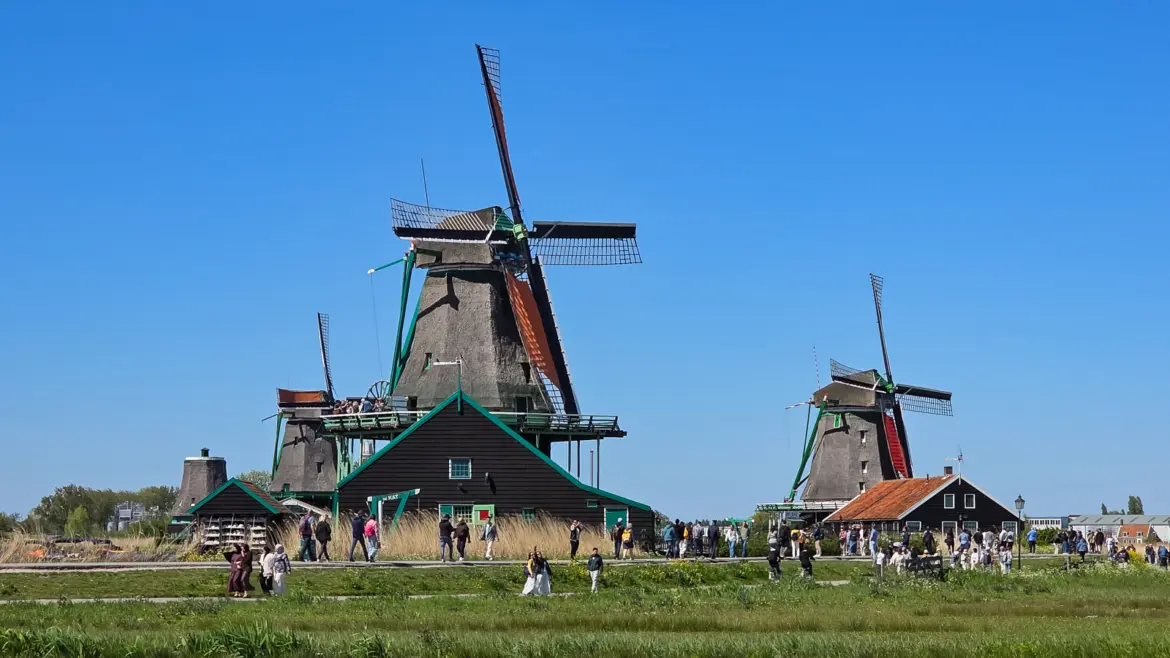
I saw Zaanse Schans because it came attached to something else.
The tour I booked bundled Keukenhof with an afternoon here, which is why I had half a day in the tulip gardens instead of the full one I would have chosen. Had I known how much there was in the pavilions alone, I would have booked the two separately and given each its own day.
That is the honest frame for this post, and it is not a complaint about Zaanse Schans. The village is lovely. It is a complaint about a bus timetable deciding how long I got to look at things.
Zaanse Schans at a Glance
🌬️ What it is · A free-to-enter riverside village of windmills and green timber houses near Zaandam, most of it relocated here between 1961 and 1974 to save it.
💶 Cost · Walking in is free; windmills and museums charge separately (a mill is roughly €7.50). The clog and cheese demonstrations are free.
🚆 Getting there · A Sprinter from Amsterdam Centraal is ~17 minutes to Zaandijk Zaanse Schans, then a 15-minute walk; bus 391 (~40 min) stops at the entrance.
🕒 Time needed · About three hours for the village, demos and a proper meal; add an hour to climb a mill.
💡 Tip · Don’t bundle it with Keukenhof in one day, and eat the apple-and-bacon pancake.
A Village That Was Carried Here
Almost nothing at Zaanse Schans was originally at Zaanse Schans.
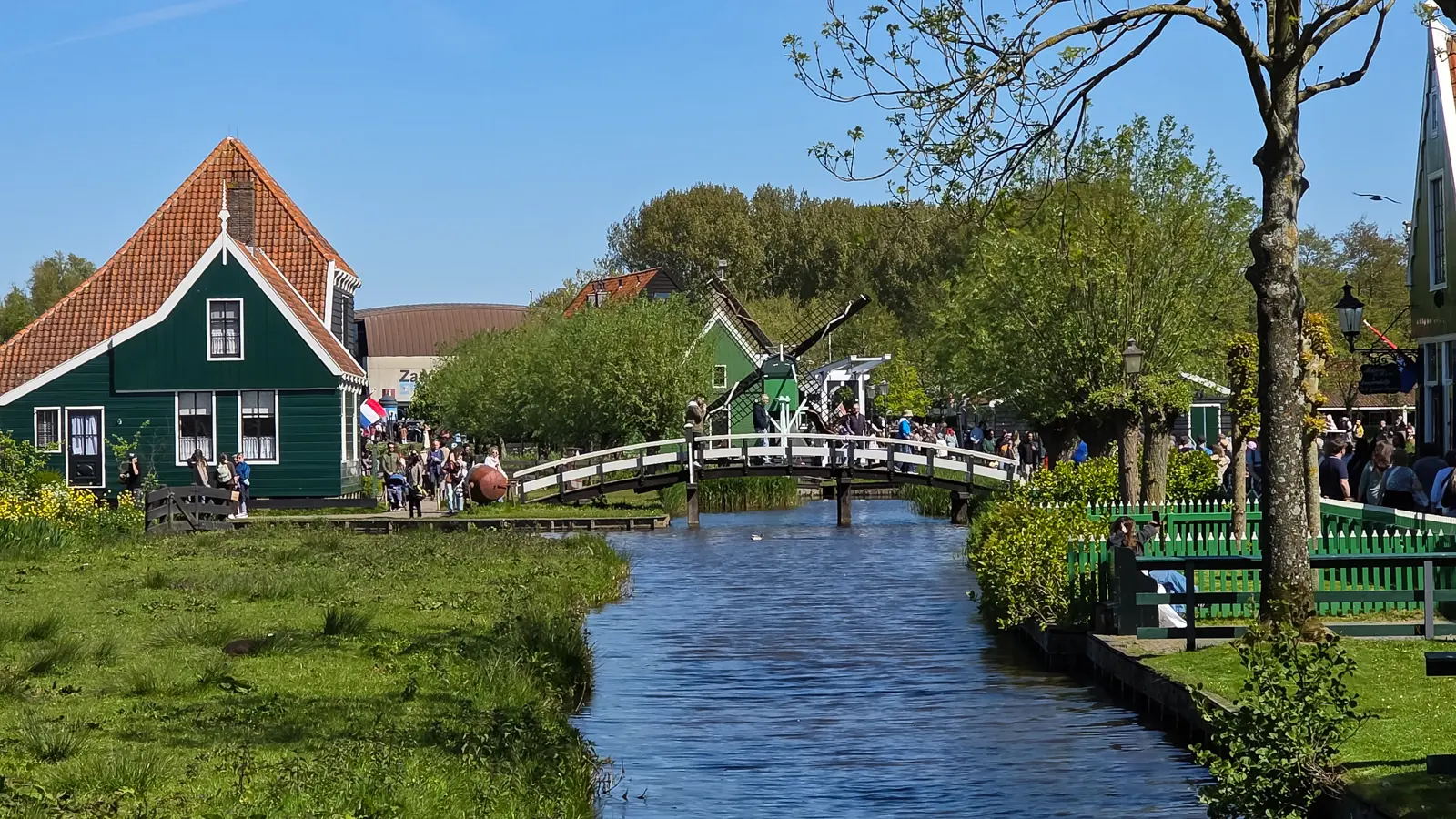
After the war, the Zaan region’s timber buildings were disappearing fast. The architect Jaap Schipper drew up a plan to save them, and between 1961 and 1974 houses, barns and windmills were dismantled across the region and moved to this stretch of riverbank on low-loader trailers and barges. The green wooden houses along the dykes, the black barns, most of the mills: all brought in. The site was formally opened in 1972 by Queen Juliana.
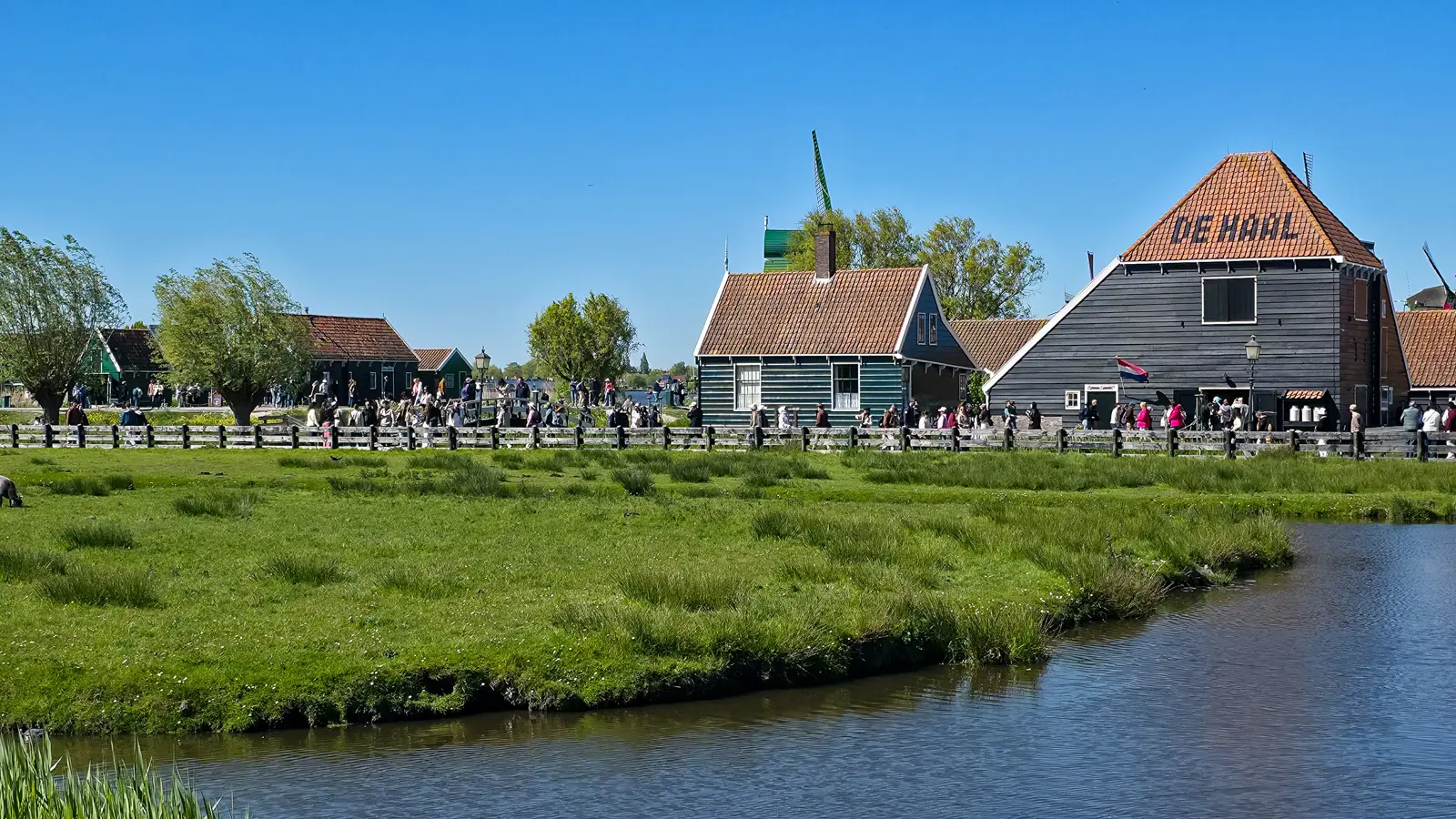
The rescue effort was older than that, though. As early as 1925 a painter and teacher named Frans Mars had founded an association to stop the mills coming down, at a point when they were being demolished faster than anyone could record them. That association still looks after thirteen of them.
There is also a reason none of these houses is older than the late sixteenth century. Spanish troops burned the Zaan villages as they withdrew from North Holland, so everything standing here dates from the late sixteenth century or after.
It is free to walk into. There is no ticket for the village itself, and no gate. The windmills and the museums charge separately, so a visitor decides how much of it to pay for.
Windmills, From the Outside
The Zaan was one of the first industrialised regions in Europe, and at its height it carried something like six hundred working windmills, grinding pigment, sawing timber, pressing oil and milling spice. What survives here is a fraction of that, standing in a row along the water.
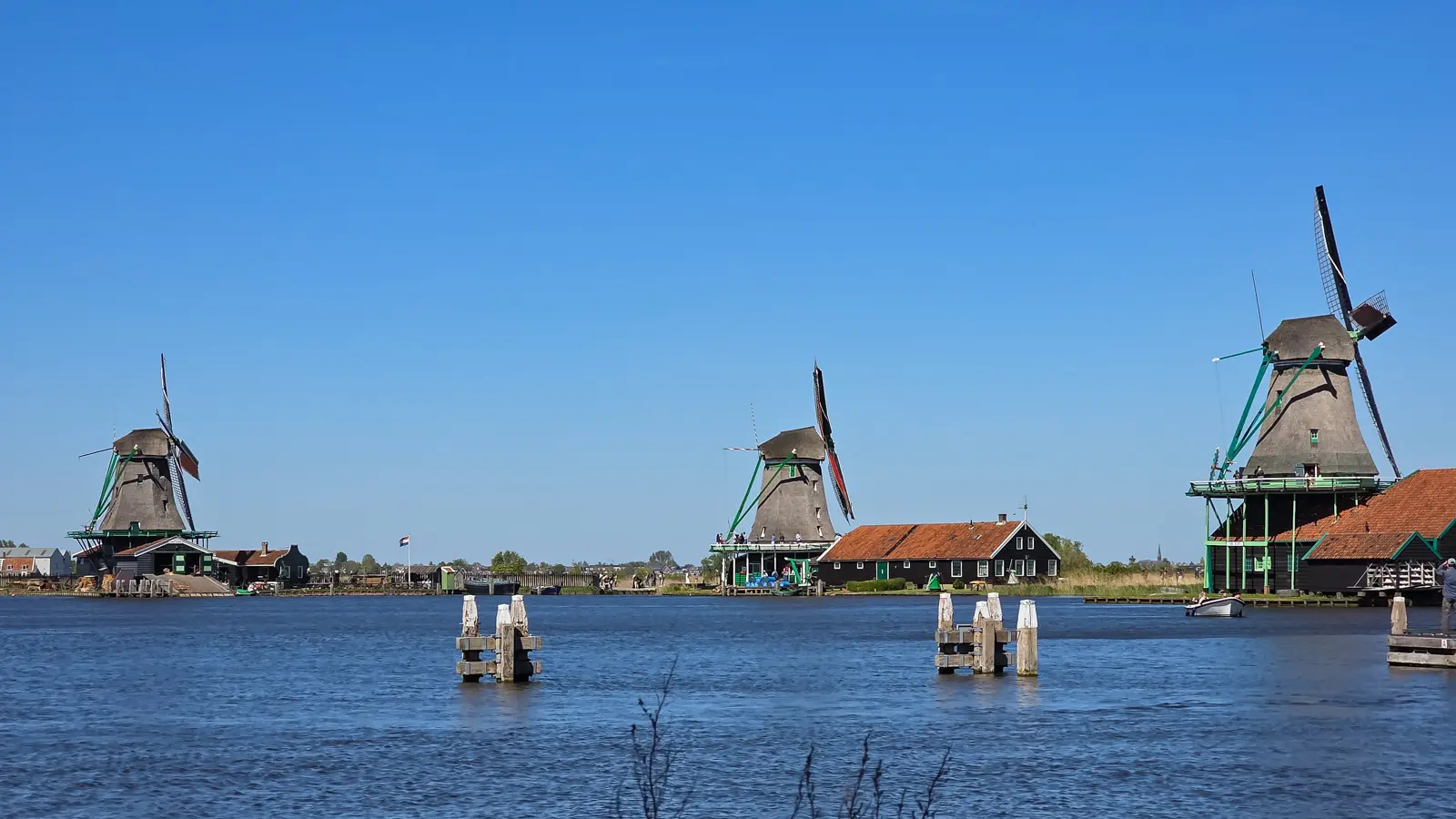
The whole thing turned on one invention. In the 1590s a mill owner from nearby Uitgeest, Cornelis Corneliszoon, fitted a crankshaft to a windmill so that the circular turn of the sails became the up and down stroke of a saw. Cutting a log into planks became something like thirty times faster than doing it by hand.
What followed was timber. The Zaan became one of the largest timber ports in the world and then the centre of commercial shipbuilding in Europe, with twenty-six yards launching somewhere between a hundred and a hundred and fifty ships a year. The planks in the hulls of the ships in the Rijksmuseum’s maritime room were very likely cut by mills standing where these ones stand. Peter the Great came here in 1697 to learn the trade himself.
Of the hundred or so wind-powered sawmills that once worked this river, exactly one survives, and it is a reconstruction. I did not go inside any of them. Several are working mills that can be entered for a fee, and if I had been given a full day I would have climbed one. With three hours I chose to walk the length of the site instead, and I would make the same choice again. From the path they hold up perfectly well: the sails turning properly, the tarred timber, the green paint, the reed beds running down to the water.
Clogs
The wooden shoe workshop is free to walk into, and it does two things at once. One half is a shop. The other is a museum case and a working demonstration.
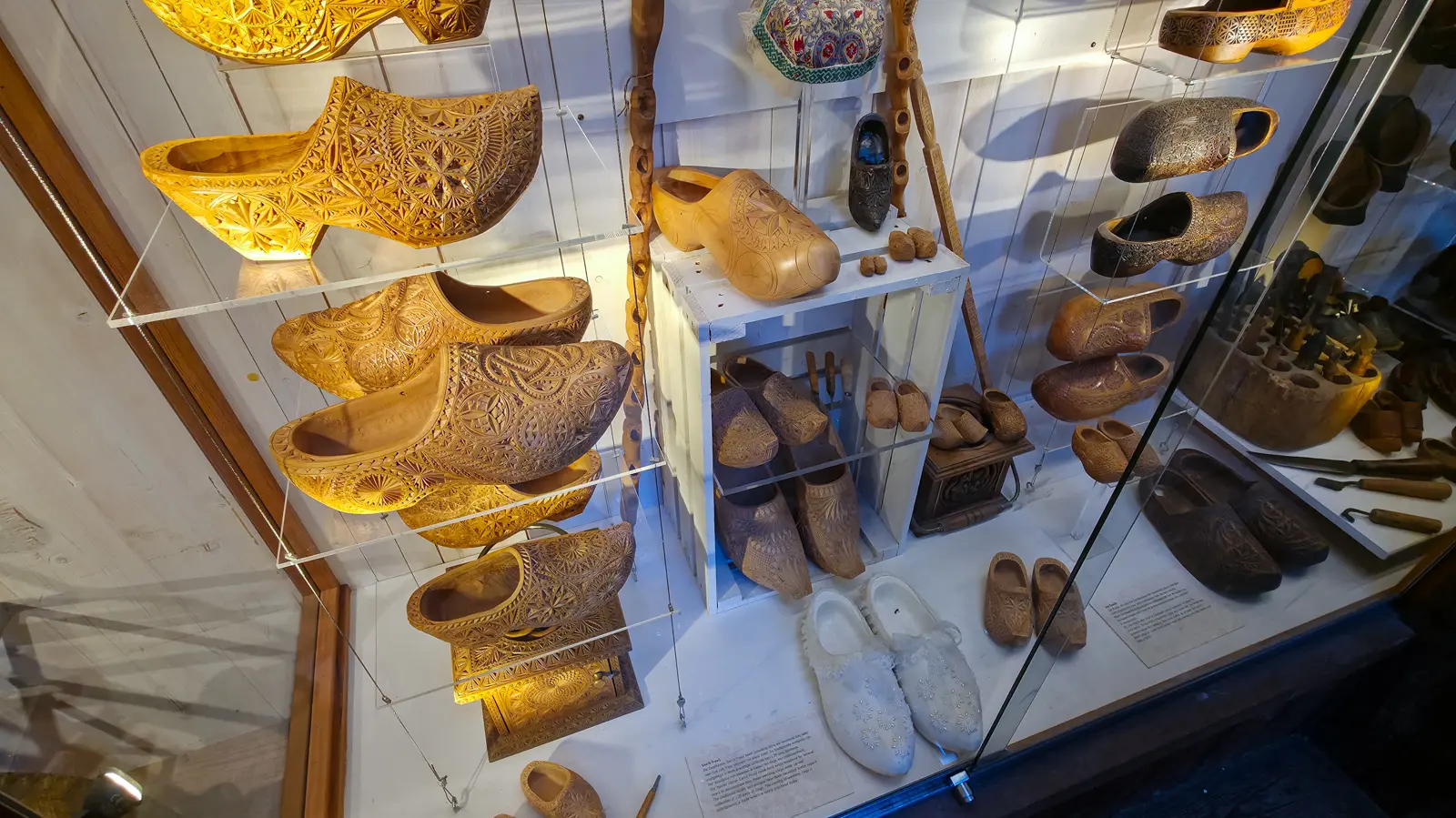
The case is the better half. Behind glass are carved clogs of a kind nobody ever put on to muck out a barn: whole uppers cut into star and rosette patterns, some pale, some almost black with age, alongside a pair of white bridal slippers embroidered with flowers.
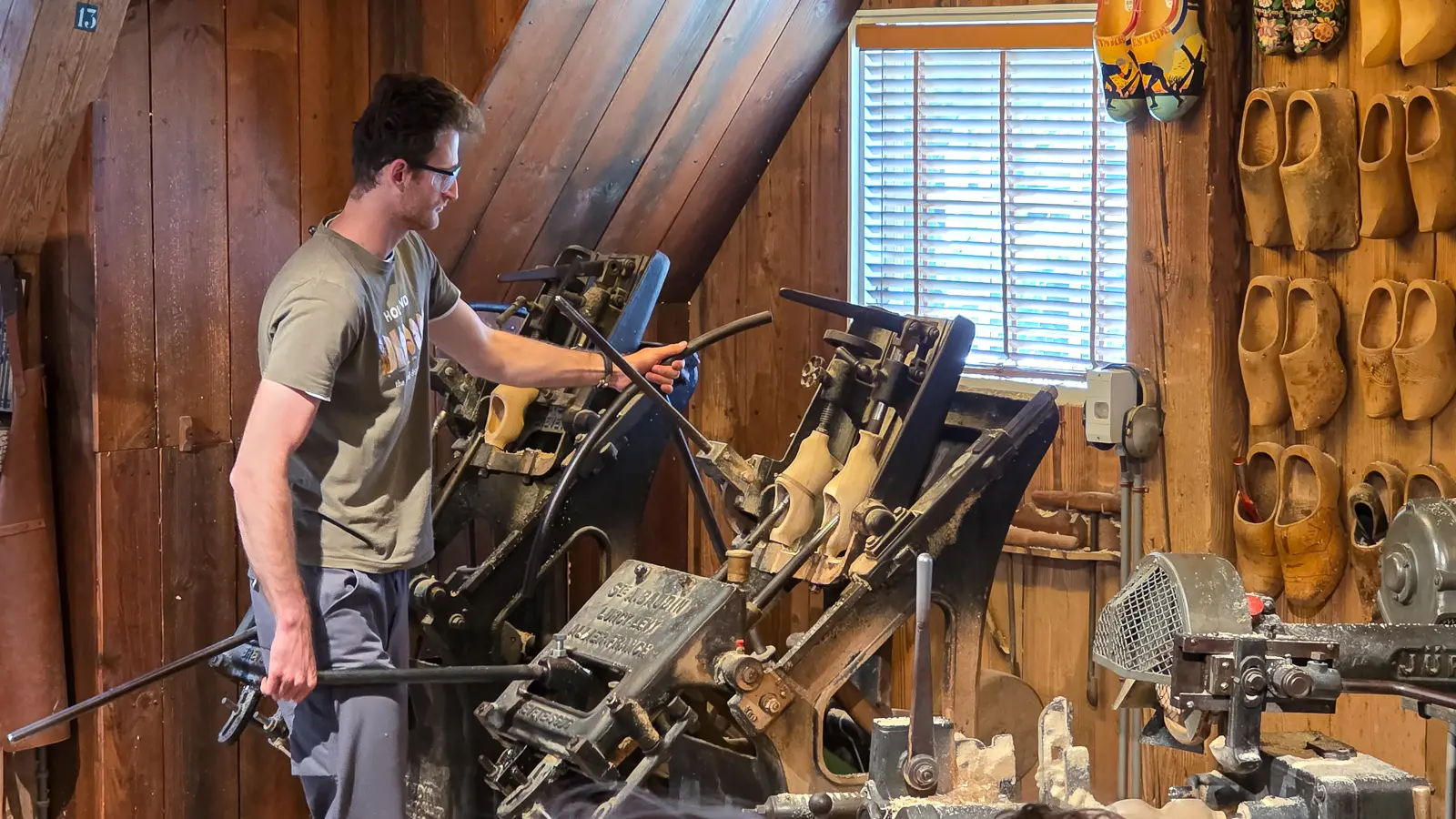
Then a man stepped up to a machine and made one. The block goes in, one arm traces a finished shoe, the other cuts, and shavings come off in handfuls. It is loud and it is fast and it is not remotely quaint.
I had seen wooden clogs plenty of times before this and always thought they looked odd. Clumsy, faintly comic, the sort of thing that exists to be sold in an airport. Half an hour in that workshop rearranged all of it.
Clogs were working footwear, cheap and waterproof and replaceable, worn by farmers and labourers who could not afford leather. They are warm in winter and cool in summer, the wood absorbs sweat, and they keep water out entirely, which matters a great deal in a country this wet. They also protect the foot. Traditional all-wooden clogs are accredited safety shoes carrying the CE mark, tested against heavy pressure and against sharp objects underfoot, and in a serious accident the wood cracks and releases the foot where a steel toecap dents and keeps pressing on it.
So the thing I had filed as a souvenir turns out to be a piece of protective equipment with about eight centuries behind it. The carved pairs in the case were the exception rather than the rule: objects made for weddings, for church, for showing off. The workshop’s own label notes that carving them by hand is now a trade rarely practised at all. They are still sold by the shelf-full to people like me, and they are also still worn in Dutch farming, which is the part I had never once considered.
Cheese
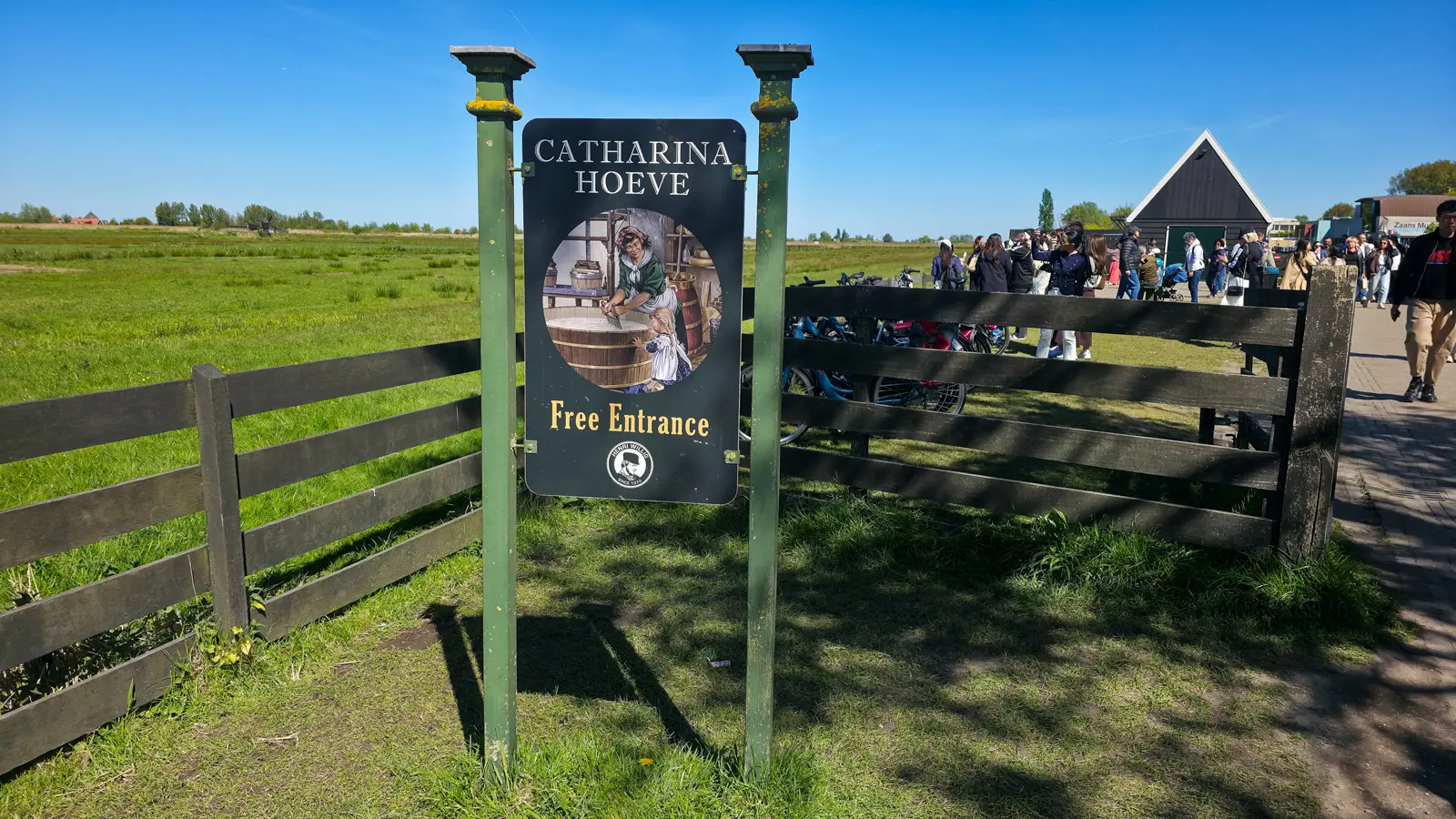
Next door is Catharina Hoeve, a working cheese farm, and the sign at the gate reads Free Entrance. Let us be honest about how that works. Nobody charges at the door, the demonstration is genuinely good, and at the end of it I was standing in a shop. The two best half-hours of my afternoon, this and the clog workshop, cost me nothing, and both of them finished in a room full of things to buy. It is smartly done. I did not mind it in the least.
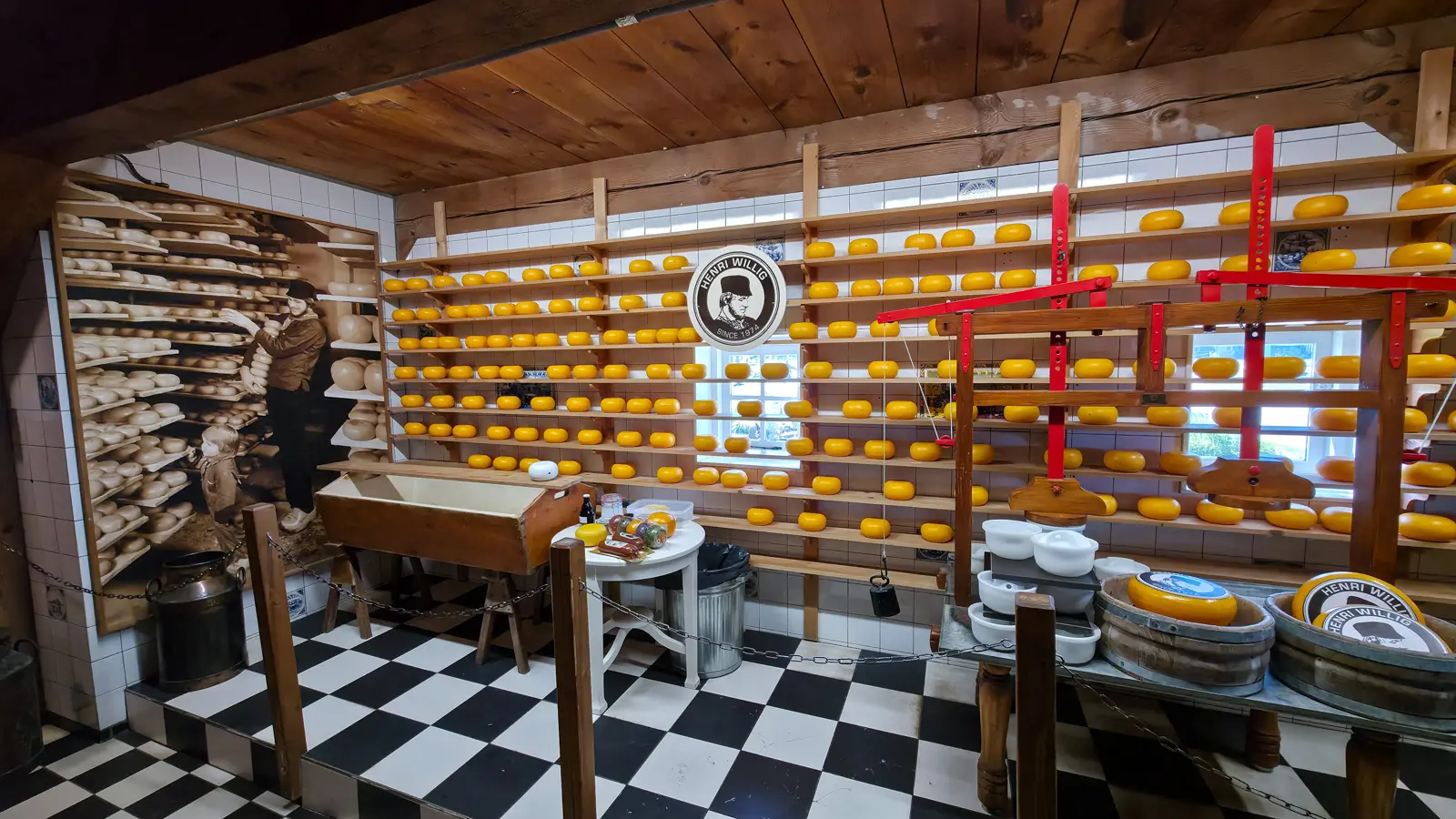
Inside is a room lined floor to ceiling with wheels of cheese on open wooden racks, a black and white tiled floor, a wooden press with red iron arms, and a large sepia photograph of a cheese loft covering one wall. There was a demonstration, there were tastings, and there was no obligation to buy anything.
I will admit something here. I did not know the Netherlands was a cheese country. Windmills, tulips, canals, painters, yes. Cheese had never once entered my picture of the place, and I had walked past Gouda and Edam on supermarket shelves my whole life without joining them to a map.
I tasted a piece. It was delicious, and I stood there mildly embarrassed about the gap in my education.
The Pancake
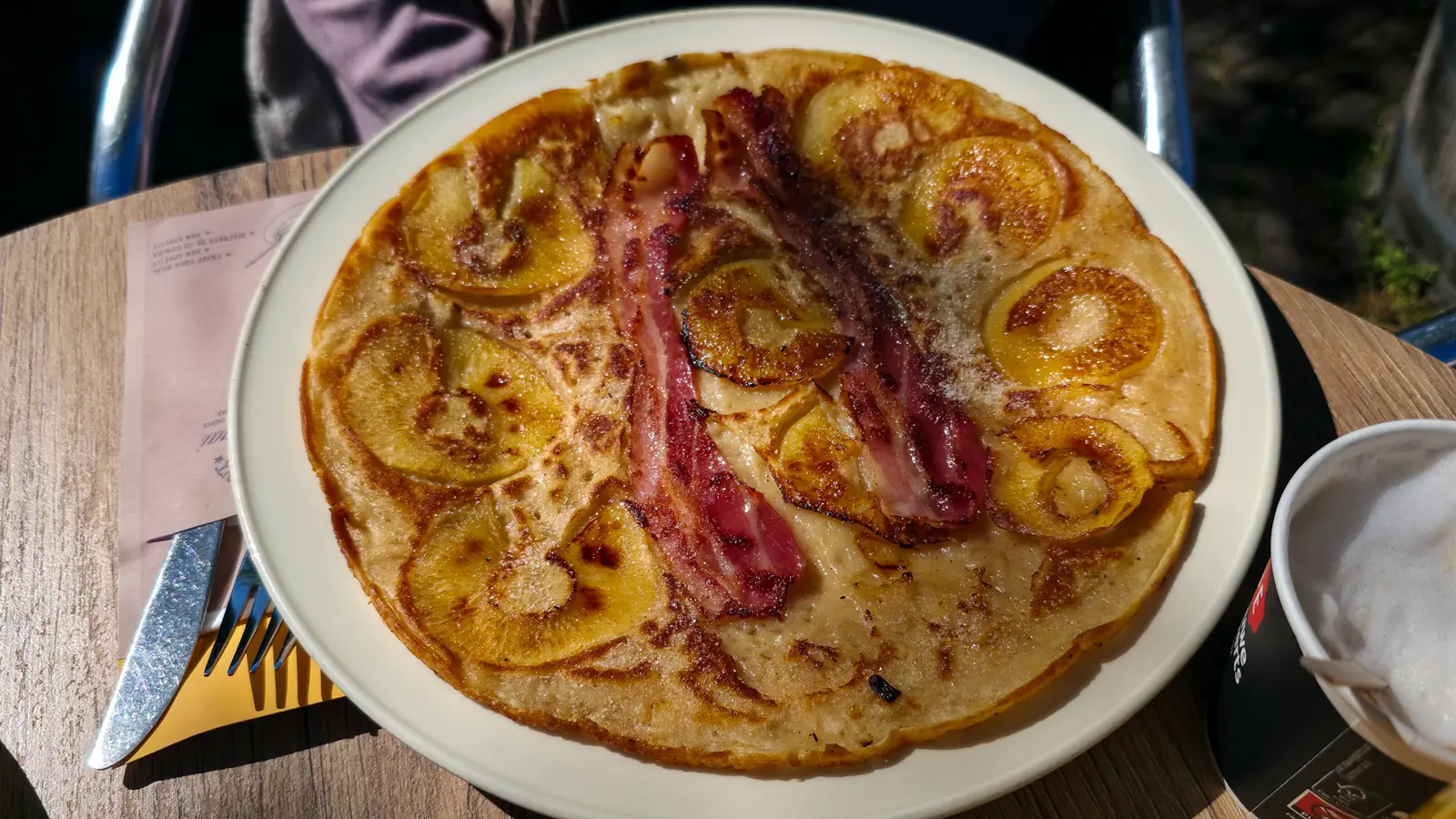
The pancakes are as good as everybody says. I ate mine at one of the village’s own restaurants rather than at a food stall, and it was worth sitting down for. Mine came thin and wide, the full width of the plate, laid with rings of apple caramelised into the batter and strips of bacon across the middle, dusted with sugar.
It is a proper meal rather than a snack, and it is the one thing I would tell somebody not to skip.
I Was Expecting Tulips
Here is the honest part, and it says more about me than about the village.
I arrived half looking for flowers. I had come straight from Keukenhof, the bus had spent the morning surrounded by bulb fields, and some part of my head had filed the whole day under tulips.
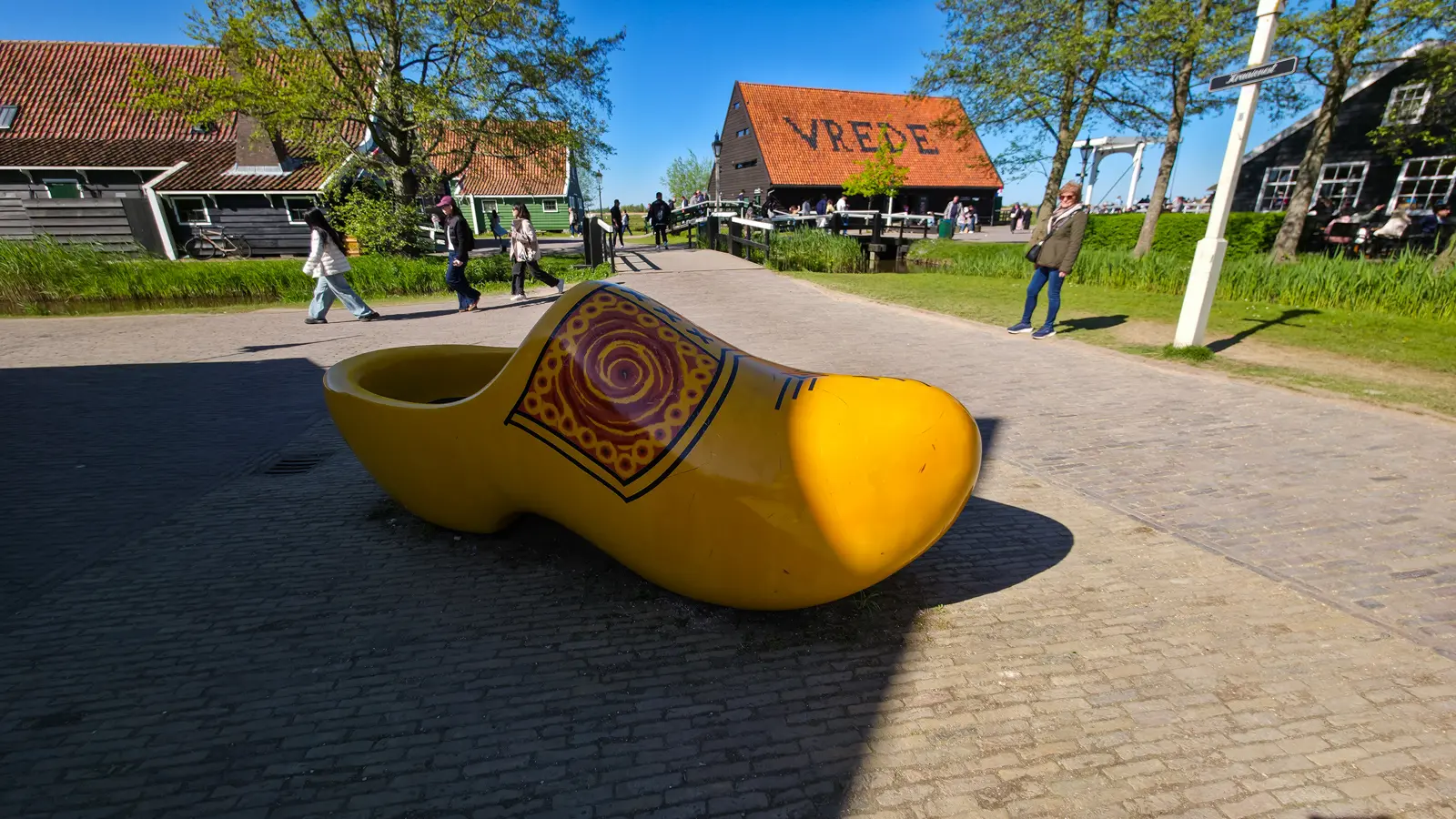
Zaanse Schans is not that. It is a village about wind, timber, pigment, oil and cheese, and the closest thing to a flower on the site is painted on the side of a giant yellow clog by the path. That is not a failing. It was an expectation I brought with me and hung on a place that had never advertised it.
People Live Here
The thing that stayed with me is on the far bank of the river.
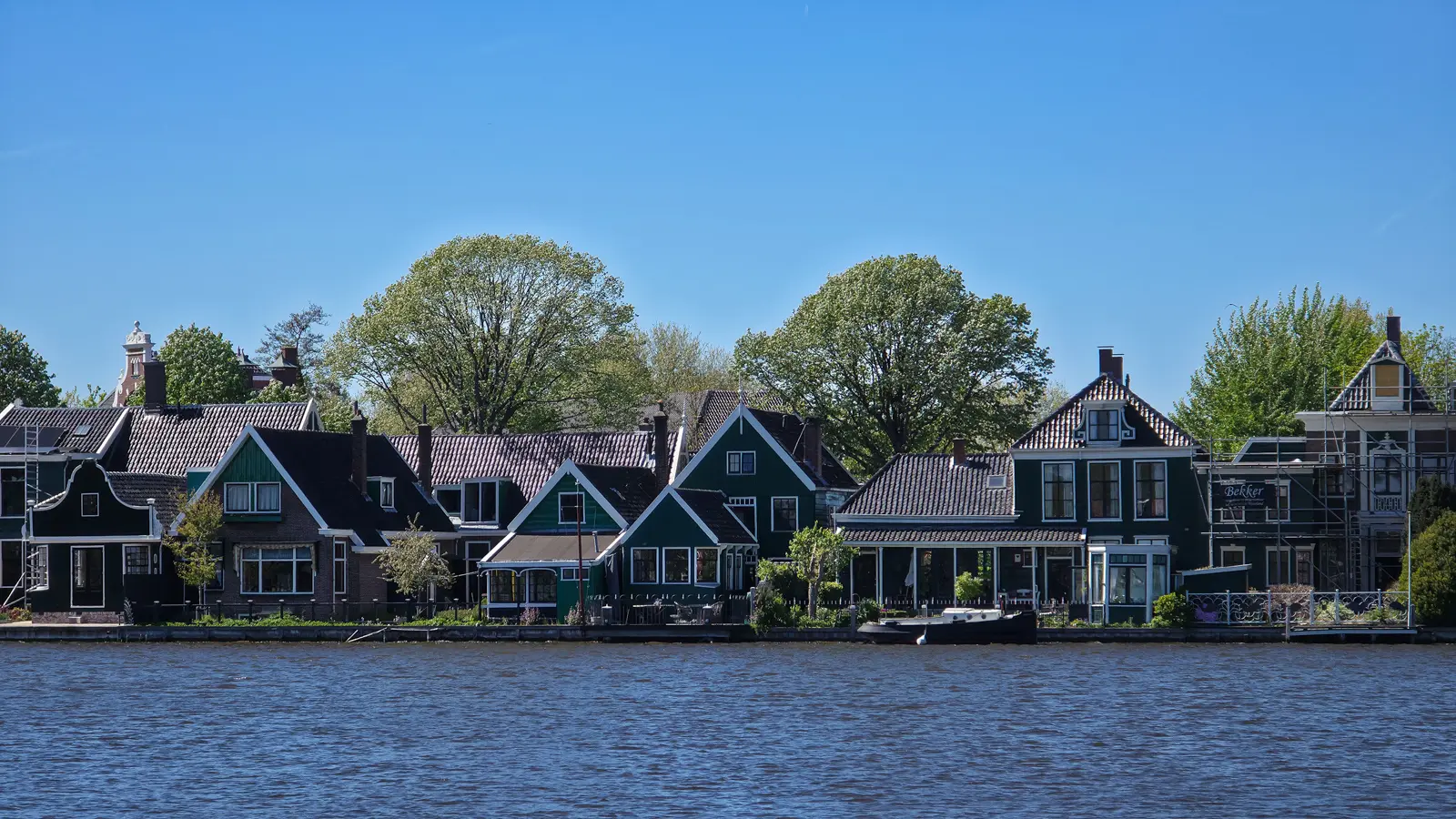
Looking across the water from the village, there is a row of green timber houses with curtains in the windows, garden furniture on the decking, a boat moored at the bottom of a garden and scaffolding up one side of a house being repaired. Ordinary life, directly opposite a site that several million people walk through every year.
Bubbly Tips
- Book Keukenhof and Zaanse Schans separately. This is the whole point of this post. Bundled as a single day they squeeze each other, and the garden is the one that loses. Give Keukenhof a full day of its own and come here on another.
- Getting there from Amsterdam is easy, and cheap. I went on a guided bus tour, but Zaanse Schans is simple to reach independently. A Sprinter from Amsterdam Centraal takes about seventeen minutes to Zaandijk Zaanse Schans, then a walk of roughly fifteen minutes along the river into the village. Bus 391 from Centraal takes about forty minutes and stops at the entrance beside the Zaans Museum, which suits anyone with a pushchair or heavy bags. Fares shift each year, so check the NS app or the 9292 planner.
- Three hours is enough for the village, but not for the mills. Walking the site, doing the clog and cheese demonstrations and eating properly took me almost exactly three hours without going inside a windmill. Add an hour if you want to climb one.
- Both demonstrations are free. The wooden shoe workshop and the cheese farm cost nothing to enter and neither pushes a sale. If you enjoy them and buy nothing, leaving something behind is a decent gesture.
- Do not come expecting tulips. Zaanse Schans is a windmill and craft village. In spring the surrounding fields may have colour, but the site itself is timber and water and grass.
- Get to the far end of the path. Most tour groups cluster around the first mills and the shops. The stretch beyond, towards the open meadow and De Haal, empties out considerably.
- Look across the river, not just along it. The far bank is where the ordinary houses are, and it is the best reminder that this is a place people actually live rather than a set.
- Bring your own lunch if you would rather. There is no gate and no ticket, so a picnic on the grass by the water is entirely allowed and considerably cheaper.
- Eat the pancake anyway. Even having said that, the pancake is worth the money and worth the queue.
- Go on a weekday if the choice is yours. The tour buses arrive in waves. A weekday afternoon at the far end of the site was noticeably calmer than the area by the entrance.
Final Thoughts
Zaanse Schans was a good afternoon. The mills are genuinely impressive, the two demonstrations are free and unhurried, the pancake was excellent and the walk along the water is exactly what people picture when they picture the Netherlands.
What I would change is not the place but the shape of the day. I gave three hours to a village I enjoyed and half a day to a garden I loved, and the split was decided by a bus timetable rather than by me. If a trip has both on the list, book them apart. Zaanse Schans is not diminished by being seen properly, and Keukenhof deserves not to be seen in a hurry.
Until next time!

🌟 Everything You Need to Plan Your Dream Trip in 2026
- 🌟 Luxury Hotels - Find premium stays with Booking.com & Hotels.com
- 🏡 Vacation Rentals - Discover unique properties on VRBO
- 🏞️ Guided Tours - Explore with Viator or GetYourGuide
- 🎫 Attraction Tickets - Skip the lines with Tiqets
- 🚢 Ocean Cruises - Set sail with Cruise Direct
- 📱 International SIMs - Stay connected with Saily
- 🚗 Car Rentals - Budget-friendly options from Discover Cars
- 🌐 Secure VPNs - Browse safely with NordVPN
- 💶 Currency Exchange - Best rates with Wise
- 🗣️ Learn Languages - Master the local language with Babbel and Rosetta Stone