
There is only one surviving portrait photograph of Vincent van Gogh. It was taken in January 1873, when he was nineteen, before he had painted anything at all. A second photograph, long published as Vincent aged thirteen, was reassigned by the museum in 2018 to his brother Theo at fifteen, after a forensic comparison of all the surviving images of both brothers. The only other known photograph from his years as a painter shows him from behind, sitting opposite Émile Bernard on the bank of the Seine at Asnières.
So every image of the adult Van Gogh’s face is one he made himself.
He made about 35 of them, most during his two years in Paris between 1886 and 1888. The reason was money. He wanted to paint people, could not pay models, and used the one face available to him at no charge.
Van Gogh’s Self-Portraits at a Glance
🖼️ How many · About 35 in total, more than 25 of them in his two Paris years (1886–1888) — the great majority of everything he ever made in the form.
💸 Why · Money. He wanted to paint people, couldn’t pay models, and used the one face available for free. Two were painted on the backs of still lifes he couldn’t afford to replace.
📷 The twist · Only one photograph of the adult Van Gogh survives (January 1873, age 19). Every image of his face as a painter is one he made himself.
🎩 The mystery · One small panel carries a double title — Self-Portrait or Portrait of Theo van Gogh — because the museum can no longer say for certain whether it shows Vincent or his brother.
💡 Tip · Walk the room in date order. The dark 1886 paintings only make sense as the “before” half of the 1887 comparison hung a couple of metres away.
1886: the dark year
The first room of them is much darker than the reproductions on tote bags and fridge magnets suggest. This is Van Gogh before Paris had done its work on him, still painting in the browns and near blacks of his Dutch years.
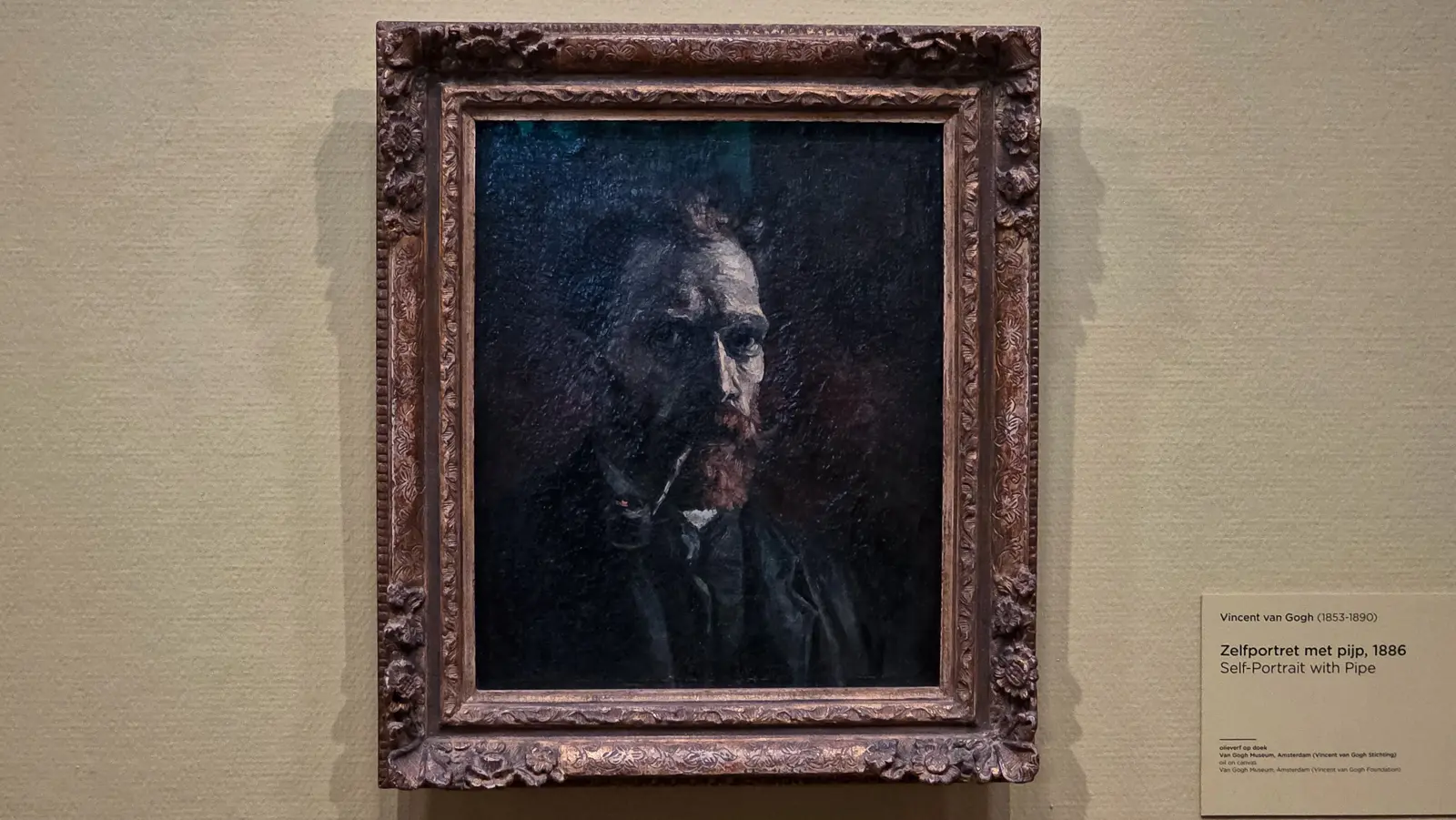
The face here is barely readable at a distance. Most of the canvas is the same brown-black, with the pipe and one cheekbone catching what light there is.
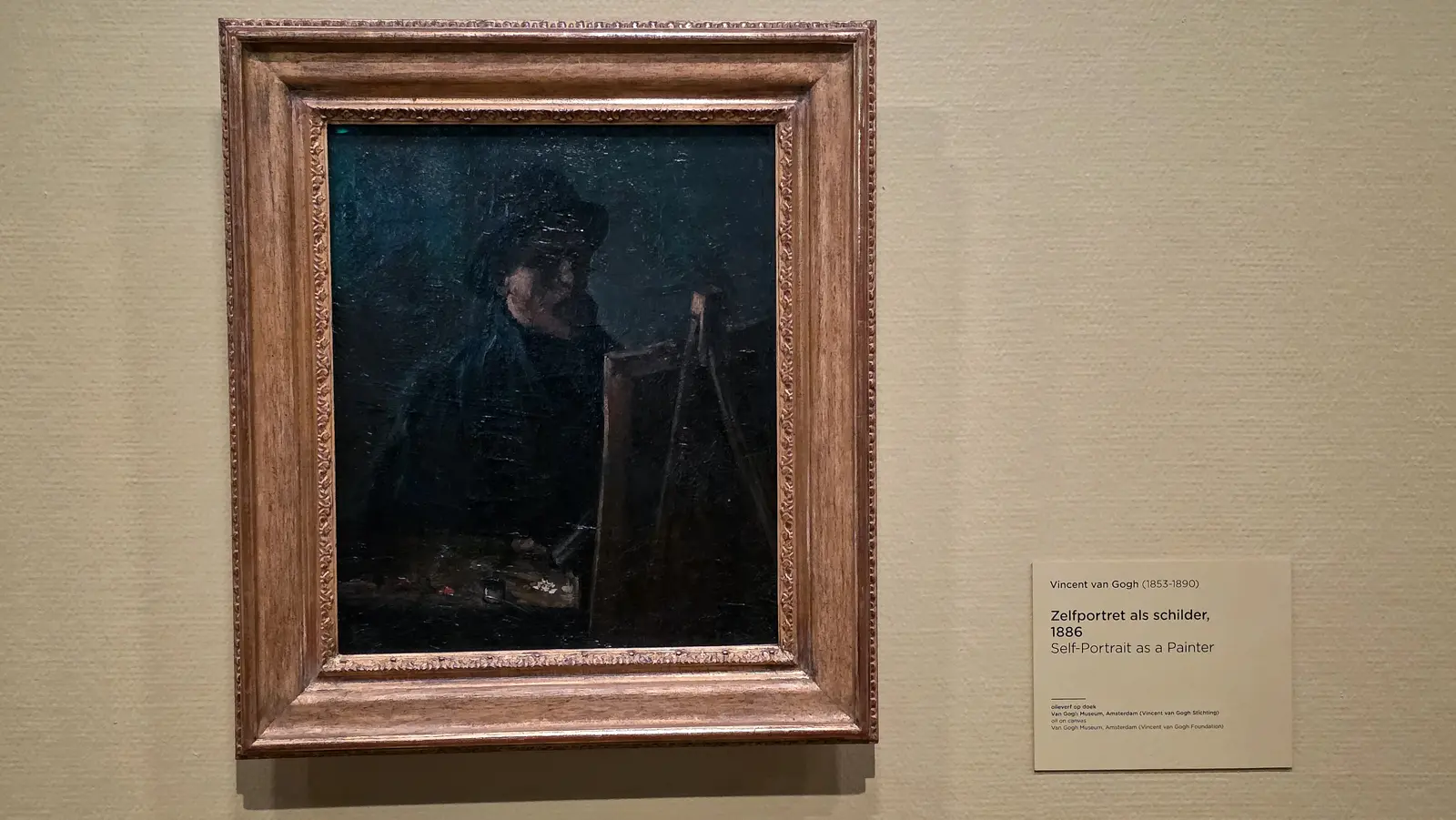
He is at the easel, palette laid out at the bottom edge, and almost everything is in shadow. Two years later he paints himself at an easel again, and the difference between the two is the whole story of Paris.
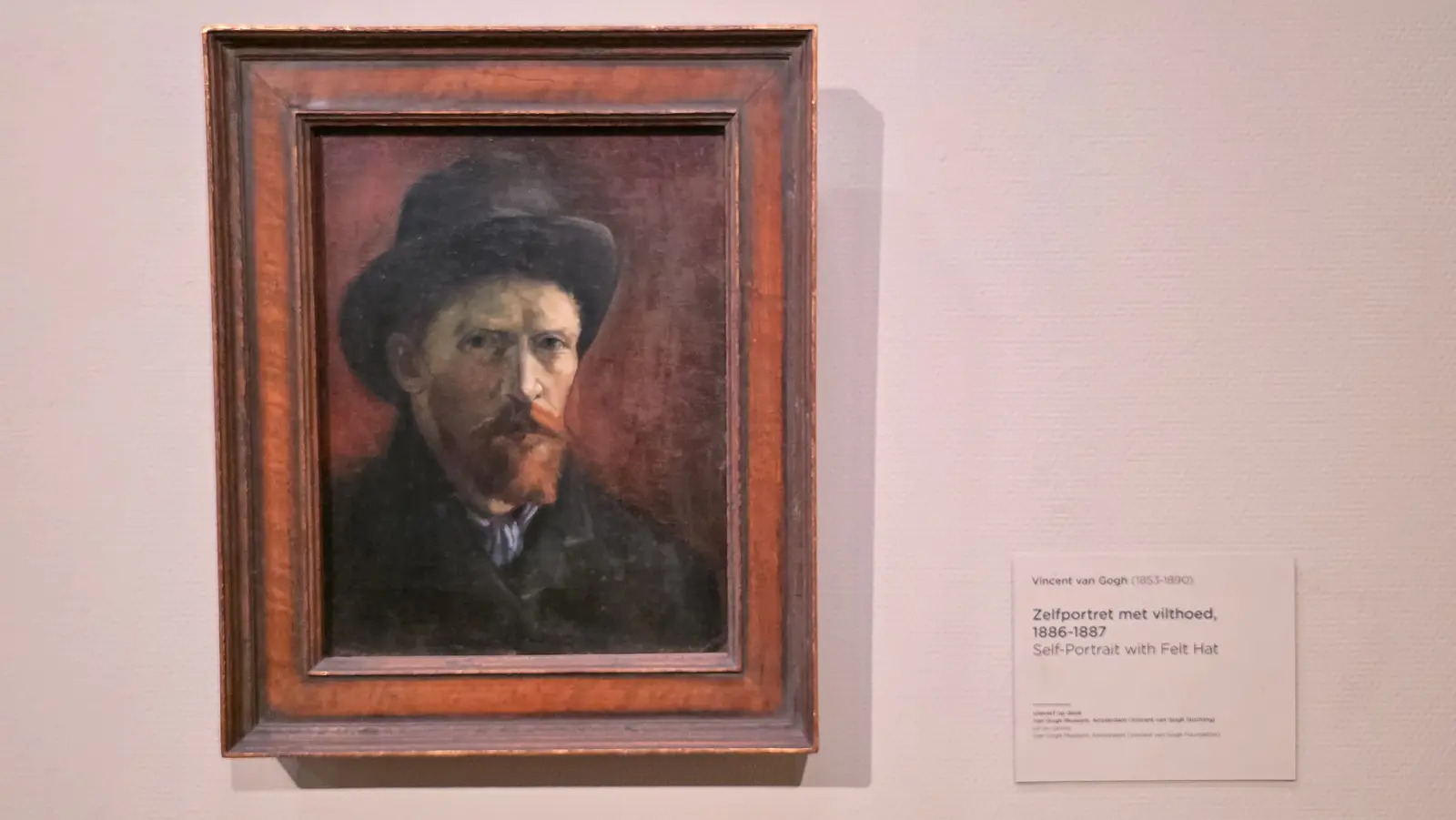
The background is a warm reddish brown and the coat is nearly black, but the face is lit differently now, greenish along the jaw, with the beard painted in separate strokes of orange rather than blended.
1887: the palette turns
The museum hangs an 1886 and an 1887 self-portrait on the same wall, a couple of metres apart. It is the most useful pairing in the building.
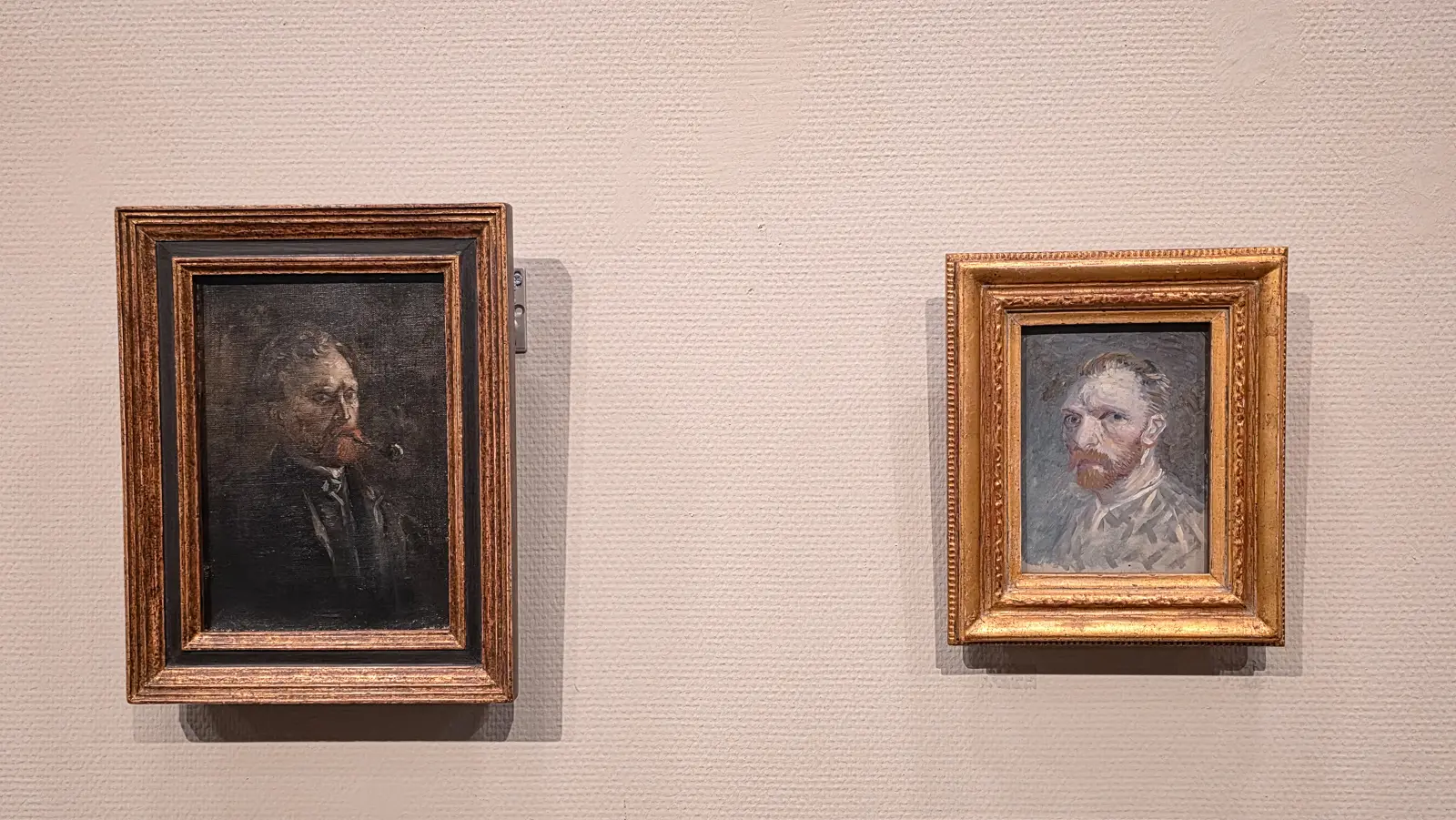
Left: brown-black, a pipe, a man dissolving into his own background. Right: a small panel of greys and pale blues, the collar built from short separate strokes, the beard bright orange. Same man, same museum wall, eighteen months apart.
Two straw hat portraits from 1887 hang in the same stretch of rooms. Self-Portrait with Straw Hat is the paler of the pair, painted on cardboard rather than canvas.
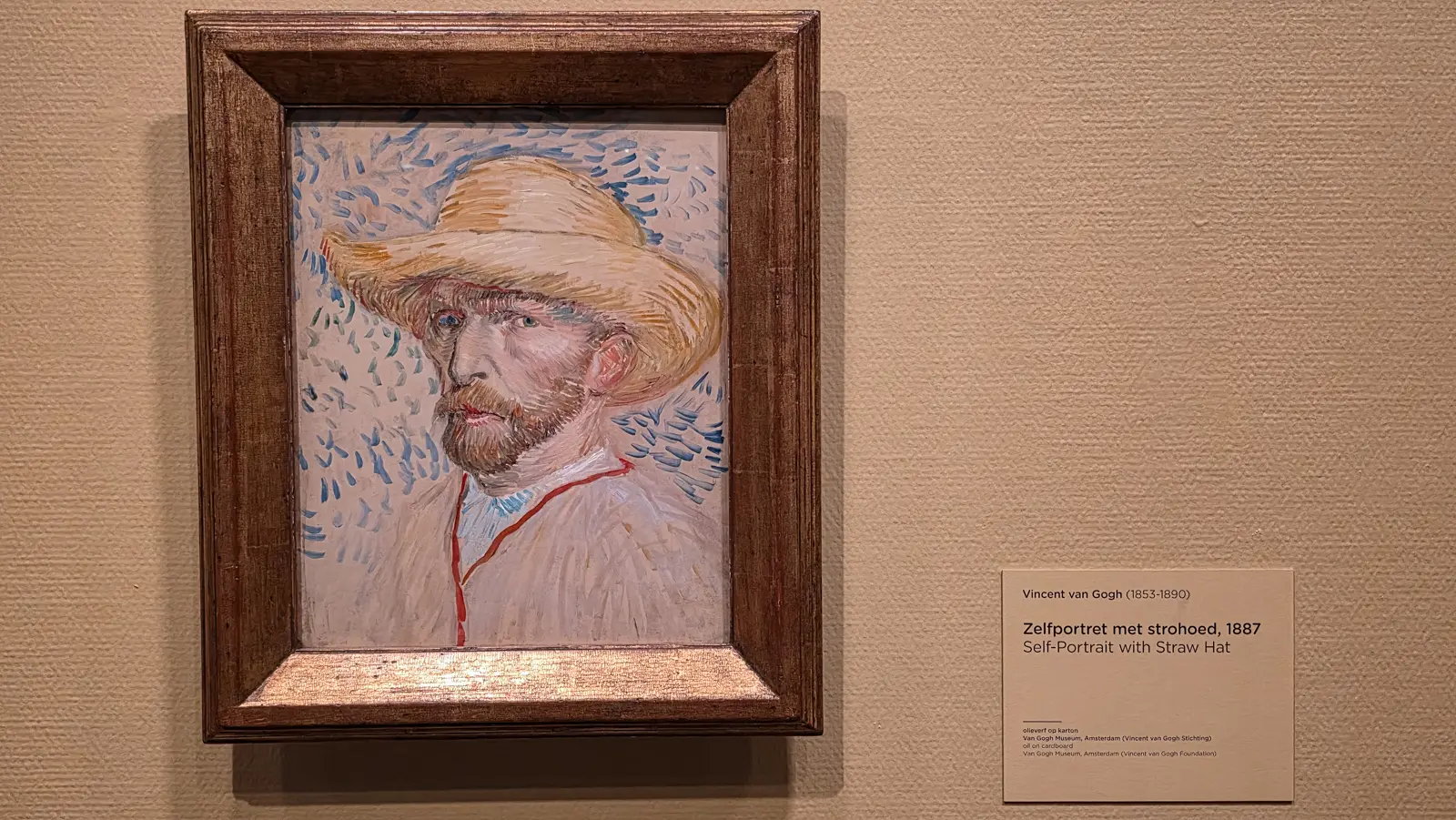
Its background is not a colour so much as a scattering of blue dashes on a pale ground, each one separate, none of them blended. A red line runs down the front of his smock.
The other is Self-Portrait with Pipe and Straw Hat, from the same summer.
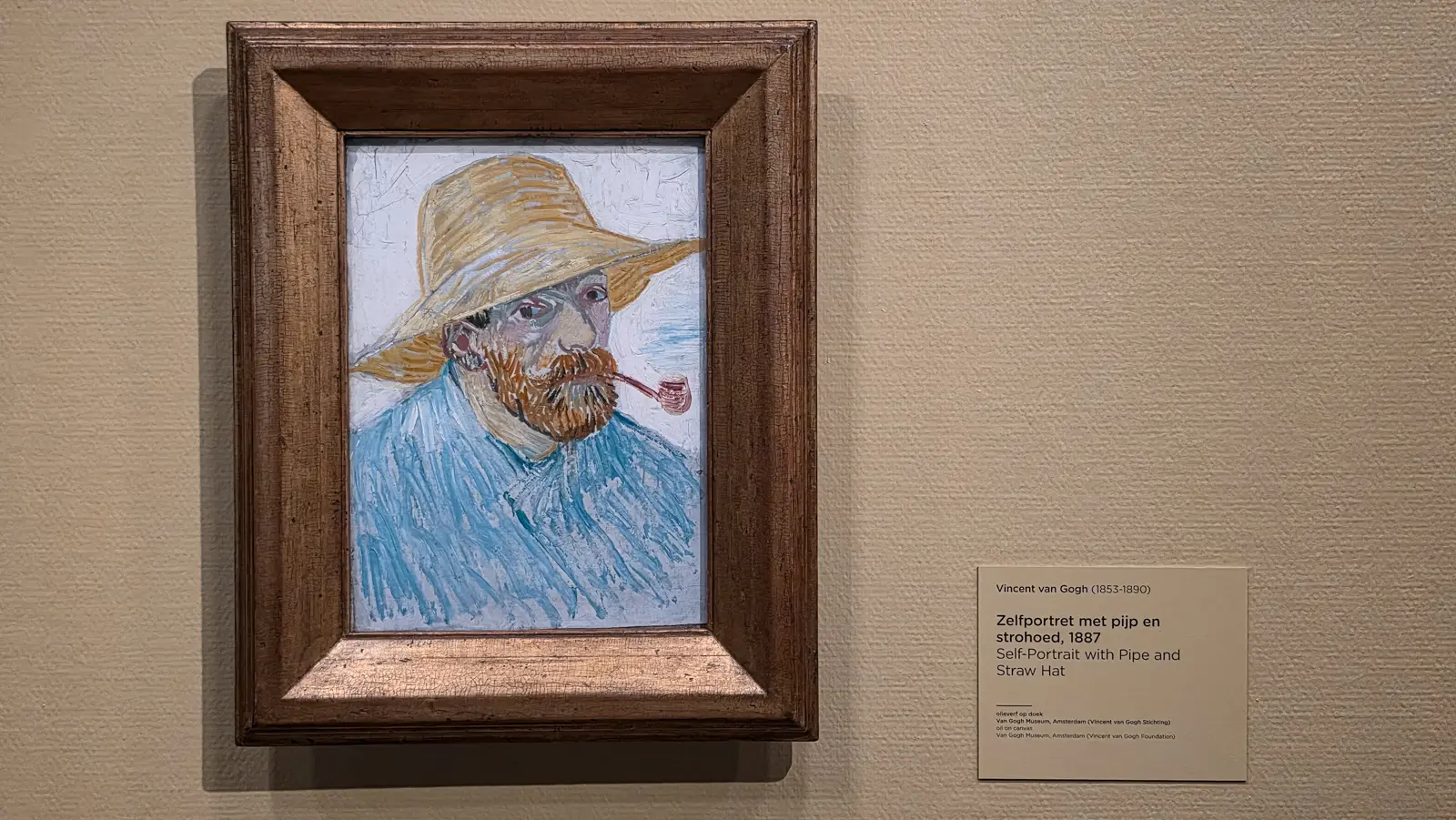
Same hat, a pipe added, and the smock laid down in long blue strokes that stop short of the edge of the board. Both of these were painted in the summer of 1887, and that summer produced a run of self-portraits made on the backs of canvases he had already used. Five of them are in the Van Gogh Museum in Amsterdam.
Painted on the back of something else
That habit is worth stopping on, because it explains two of the best paintings in the room.
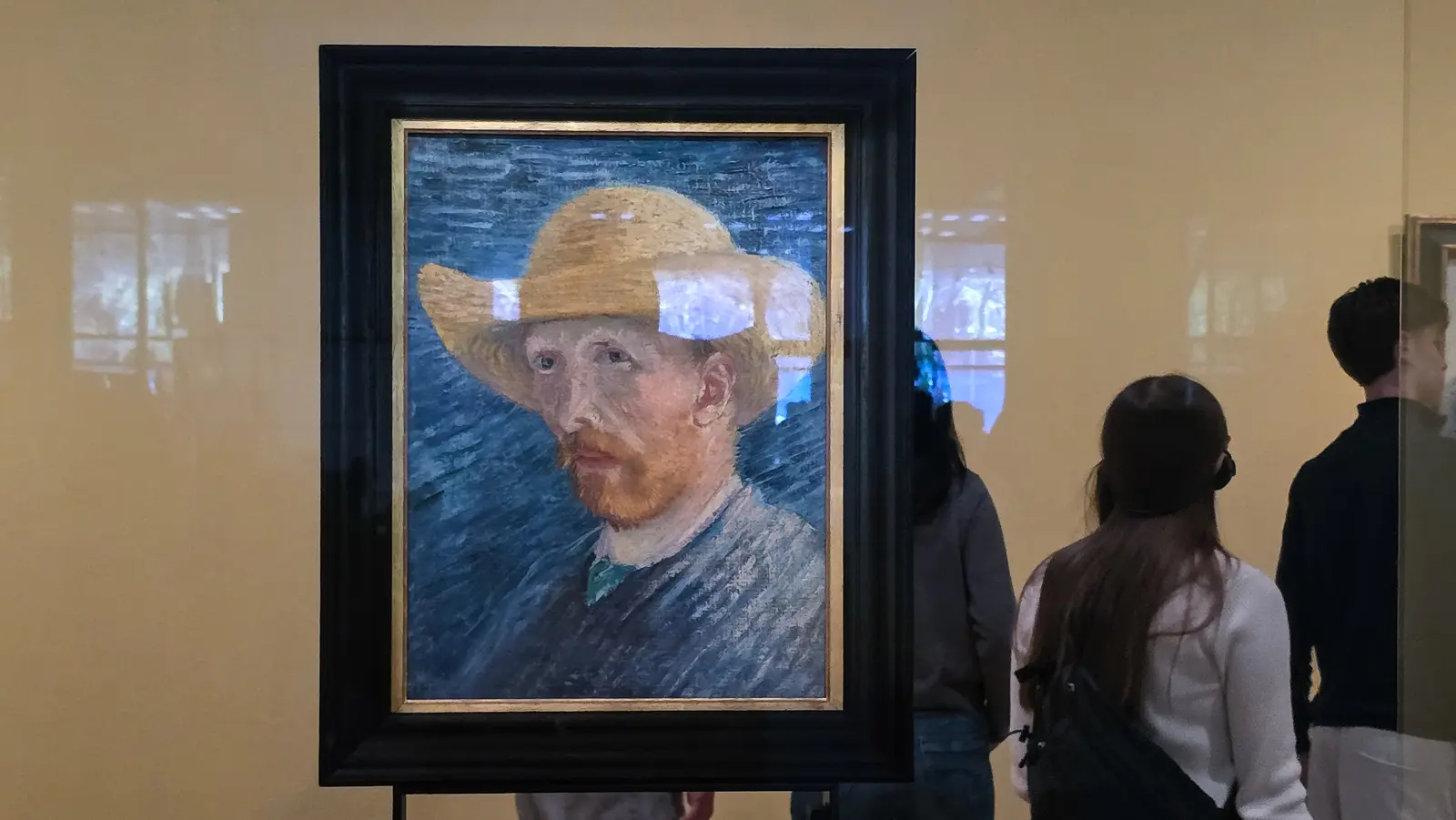
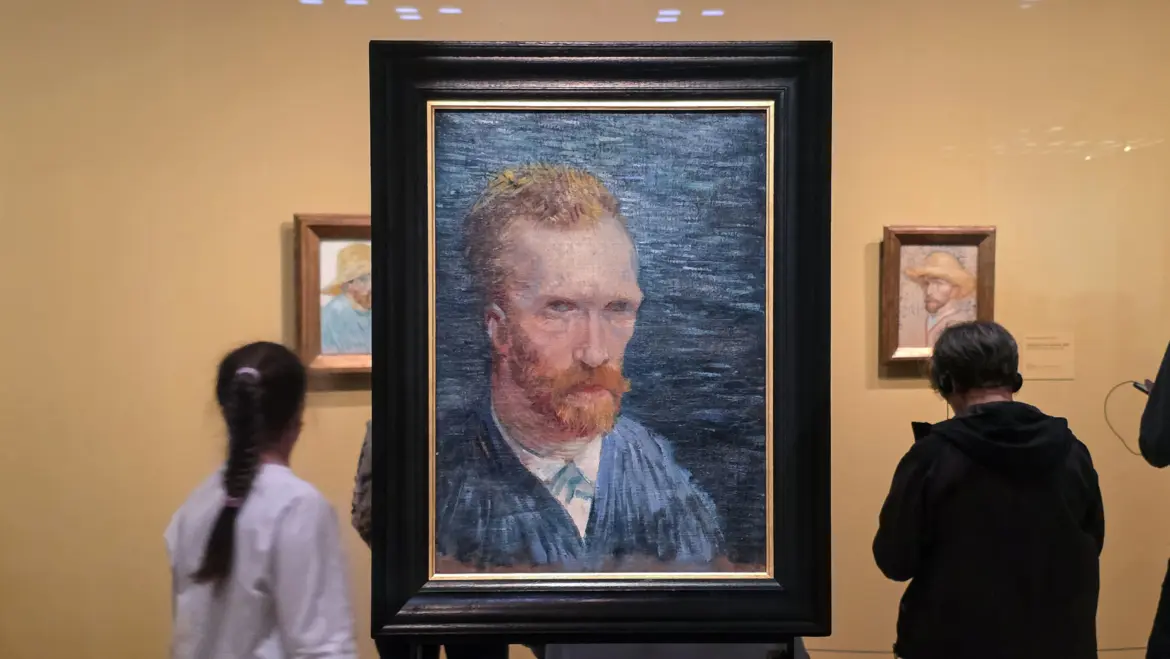
The blue self-portrait at the top of this post was made in the same two months and in the same way, on the reverse of another still life. He had been getting materials from Père Tanguy, who ran an artists’ supply shop in Paris and would take paintings in exchange or extend credit. Tanguy’s wife put a stop to it. Vincent wrote to Theo about her in terms that were not complimentary, calling her an old witch.
Two of the paintings people queue to see were made on the wrong side of canvases he could not afford to replace.
Two small panels and a question
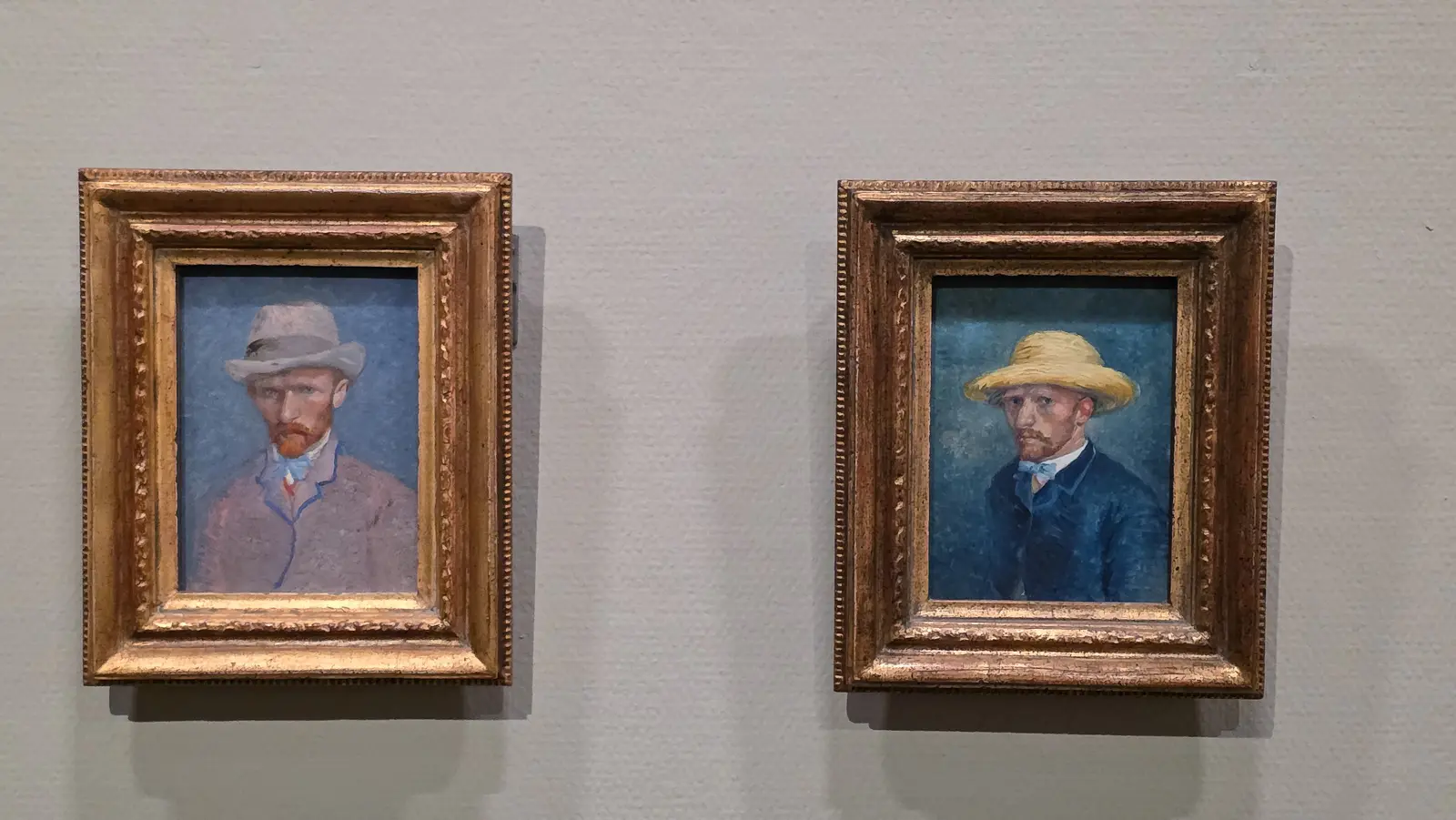
Both were called self-portraits for decades. Research published in 2011 concluded that the man in the straw hat was not Vincent but Theo, and the title was changed accordingly. The museum’s specialists then went back to it, using new work on the surviving photographs of both brothers, and concluded that neither identification could be established with certainty. The painting now carries a double title: Self-Portrait or Portrait of Theo van Gogh.
The argument has not stopped there. A former head of collections at the museum holds that the identification runs the wrong way round, since Vincent dressed carelessly and would have worn the straw hat outdoors, while Theo the art dealer would have worn the formal one.
A double title is an odd thing for a museum to print. It is the one work in these rooms where the institution says, on the wall, that it does not know.
The last painting he made in Paris
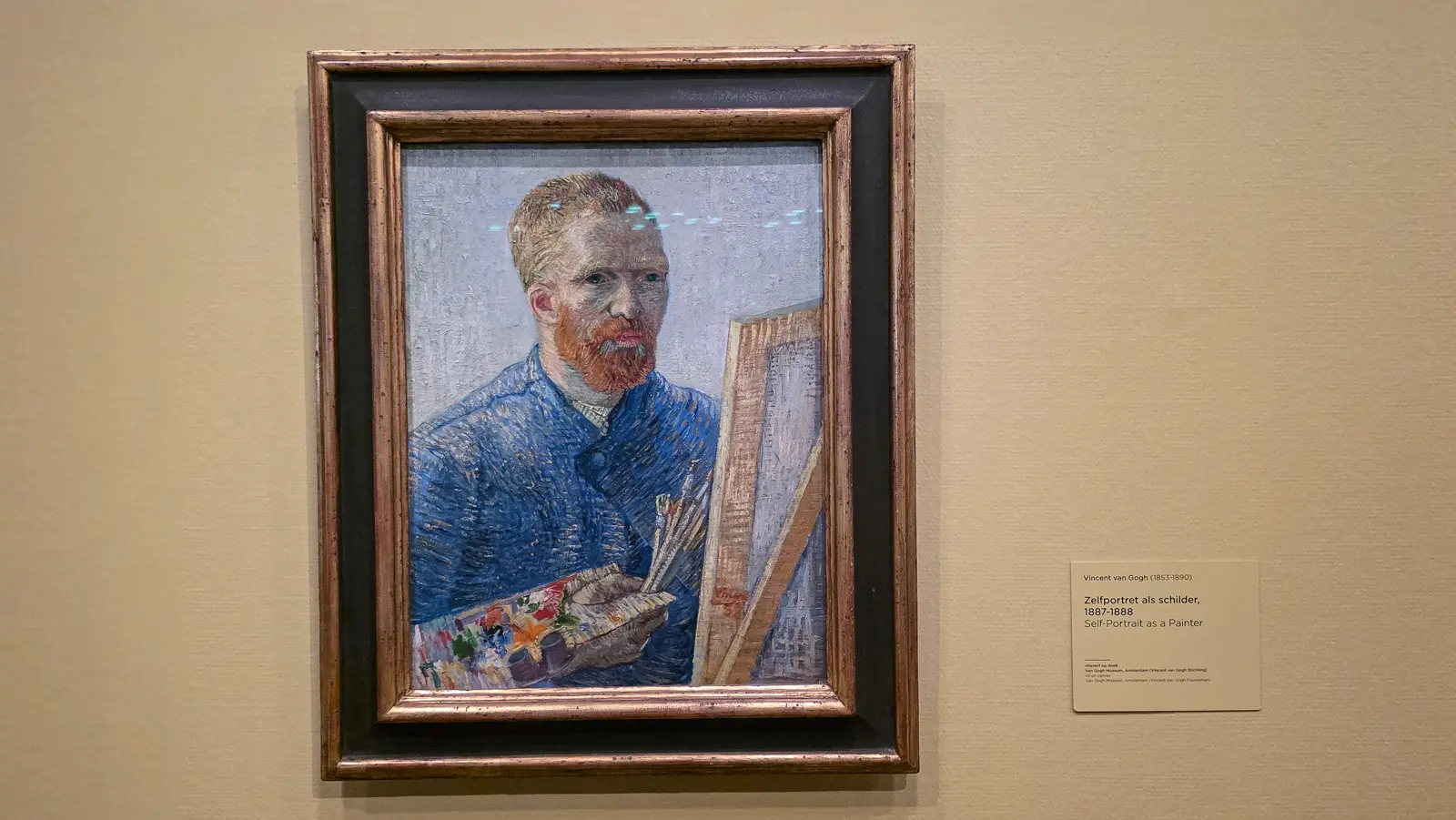
This was the last work he produced in Paris before leaving for Arles. He described himself in it to his sister Wil without flattery, noting the lines in his forehead and around his mouth, and a beard he called very red, unkempt and sad.
Set it against the 1886 easel portrait three rooms back and the two years are right there. Same pose, same props, a completely different painter.
Rembrandt did the same thing for opposite reasons
The obvious comparison is Rembrandt, who left around 80 self-portraits across a 40-year career, far more than any other painter of his time. It looks like the same instinct. It was not.
Some of Rembrandt’s earlier ones were made to practise expressions, poses and lighting effects. Others were meant to enhance his standing as an artist. Many of the early ones sold as tronies, character studies in borrowed costume, for which there was a lively market. He also used them as teaching aids, setting pupils to copy them, and the copies sold too.
Rembrandt spent most of his career as a sought-after portraitist with a studio full of students. He painted himself because it sold and because it built his name. Van Gogh sold almost nothing while he was alive and painted himself because a model cost money he did not have. Two of the greatest runs of self-portraiture in European painting, made for entirely opposite reasons.
Bubbly Tips
- Start on the second floor, not the ground floor. The self-portraits are grouped by period, and walking them in order turns a set of famous faces into an argument you can follow.
- Give the 1886 room longer than it deserves on first impression. Those paintings are genuinely dark and genuinely hard to read, and they only make sense as the before half of a comparison.
- Read the labels for dates, not names. Almost everything here is called Self-Portrait. The year is the only thing that tells one from another.
- Look for the double title. The Self-Portrait or Portrait of Theo van Gogh label is on the wall beside the small paired panels, and it is a rare case of a museum publishing its own uncertainty.
- Two paintings are in freestanding glass cases rather than on the wall, which means no label beside them and reflections in every photograph. Note the room and look them up in the online collection afterwards if you want the details.
- Photography is allowed in the permanent collection without flash, but the glass cases and the crowd around the best-known works make a clean frame difficult. Early entry helps more than any camera setting.
- Book a timed ticket in advance. Tickets are sold online with an entry slot and the museum regularly sells out, so turning up hoping for a same-day ticket is a poor plan.
- Pair it with the Rijksmuseum if you want the Rembrandt comparison, but not on the same day. Both are on Museumplein, roughly five minutes apart on foot, and both deserve a morning.
Final Thoughts
The thing that stayed with me is the arithmetic. Around 35 self-portraits, most of them made in two years, by a man who painted them because he could not pay anyone to sit for him, on the backs of canvases he could not replace, in a city that exhausted him so thoroughly that his last picture there shows a tired man in a work smock.
And no photograph of that face exists. The nineteen-year-old in the studio portrait is a stranger. Everything anyone knows about how Vincent van Gogh looked at thirty-four comes from a mirror, a cheap surface and an afternoon.
Until next time!

🌟 Everything You Need to Plan Your Dream Trip in 2026
- 🌟 Luxury Hotels - Find premium stays with Booking.com & Hotels.com
- 🏡 Vacation Rentals - Discover unique properties on VRBO
- 🏞️ Guided Tours - Explore with Viator or GetYourGuide
- 🎫 Attraction Tickets - Skip the lines with Tiqets
- 🚢 Ocean Cruises - Set sail with Cruise Direct
- 📱 International SIMs - Stay connected with Saily
- 🚗 Car Rentals - Budget-friendly options from Discover Cars
- 🌐 Secure VPNs - Browse safely with NordVPN
- 💶 Currency Exchange - Best rates with Wise
- 🗣️ Learn Languages - Master the local language with Babbel and Rosetta Stone