
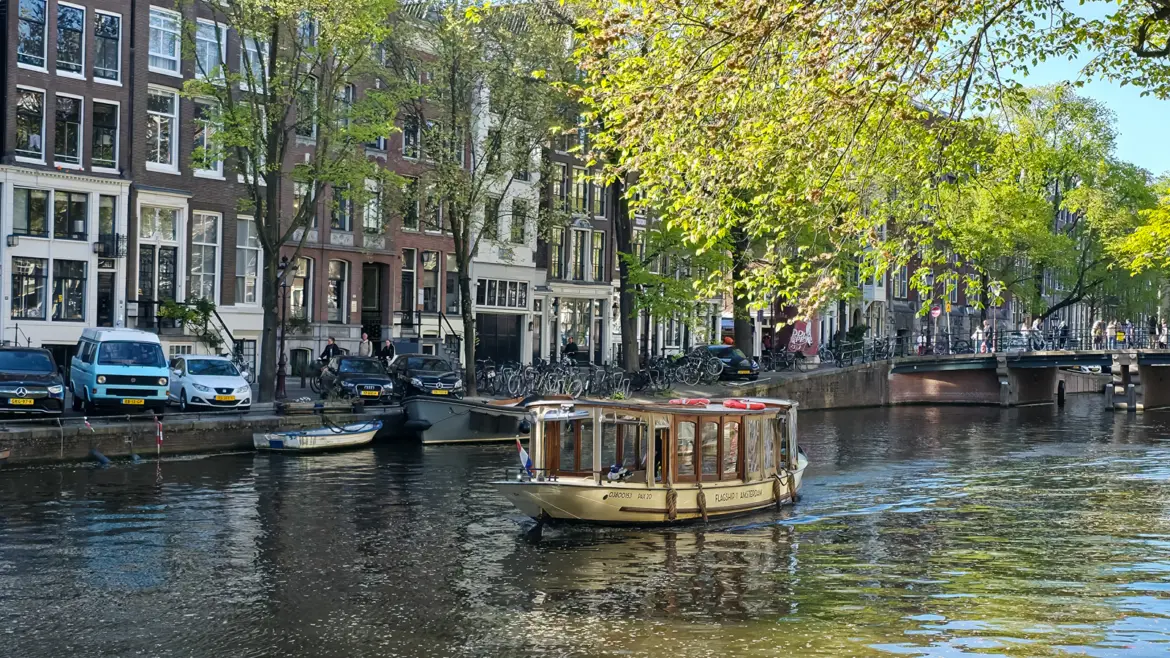
This is the boat. Cream hull, varnished timber window frames, lifebuoys strapped to the canopy, a Dutch flag at the bow, and along the side the registration and the capacity: twenty passengers.
Twenty is the whole argument for this kind of trip. The big glass-roofed boats that queue up outside Centraal carry well over a hundred and run a recorded commentary in nineteen languages. This one had a skipper who talked, answered questions, and knew which building was which.
Two hours, snacks included, drinks from the bar at our own expense. A different angle on Amsterdam I thought I had already looked at properly.
The Small-Boat Canal Cruise at a Glance
⛵ The boat · A covered saloon boat, twenty passengers, a skipper who talks and answers questions — not a hundred-seater with a recorded commentary in nineteen languages.
⏱️ The trip · Two hours, snacks included (a board of cheese, sausage, dates and stroopwafels), drinks from the bar at your own cost.
🔋 Electric by law · Since 1 January 2025, Amsterdam’s passenger boats must sail emission-free as a condition of their licence. The quiet engine isn’t a selling point any more; it’s the rule.
🐈 The stops nobody expects · The floating Catboat, the Sea Palace pagoda, NEMO’s copper prow, the VOC ship Amsterdam, a 1723 almshouse, and the Magere Brug with a leaf up.
💡 Tip · Book an evening departure and sit facing the bank. The low sun lands on the gables for the last stretch, and everything the skipper points out is at eye level on the quay.
What is actually on the boat
Cushioned bench seating around the sides, low round tables, and a bar at the back. The snacks arrived on wooden boards, one per pair.
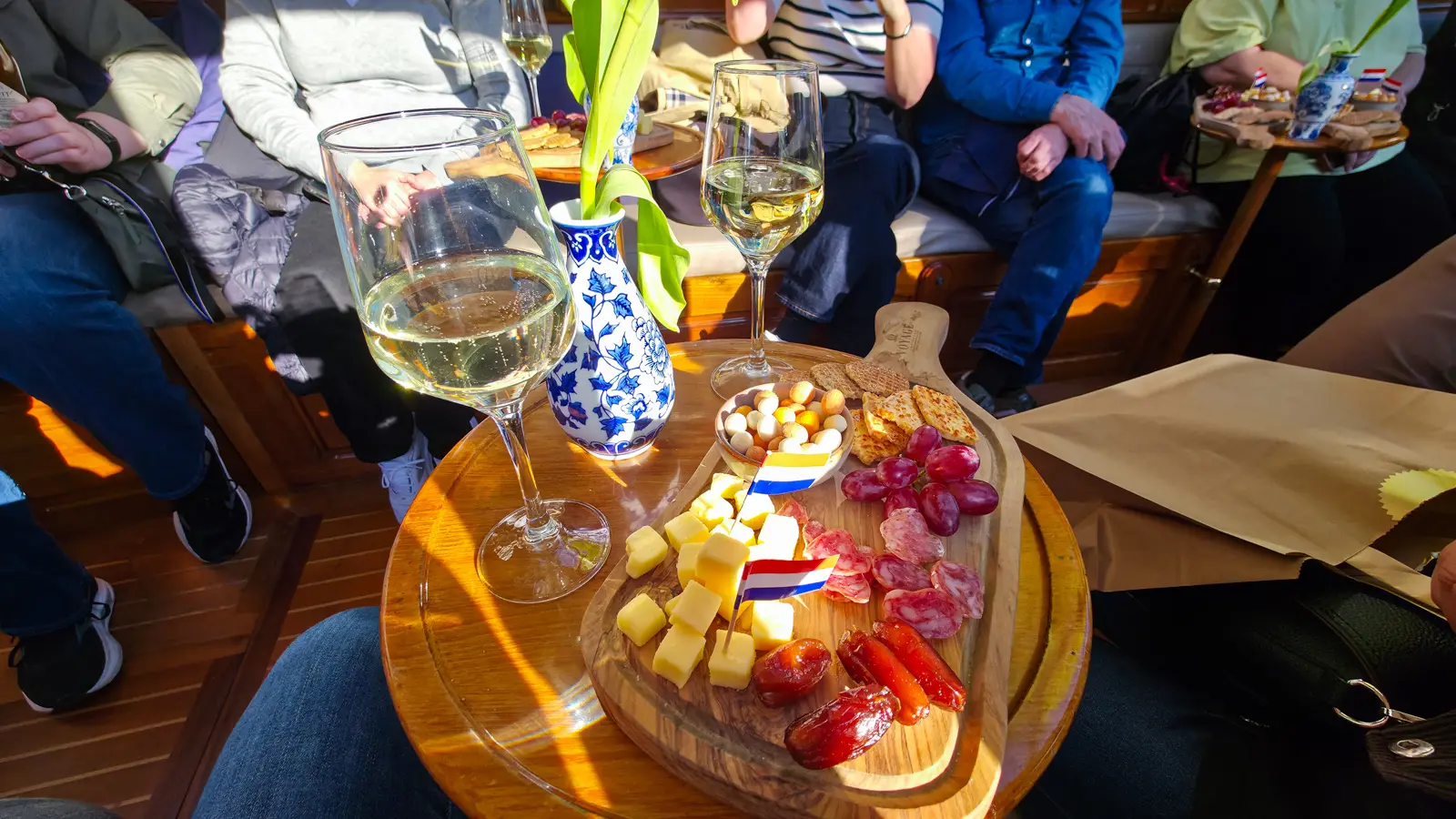
Cubes of Dutch cheese, dry sausage, dates, red grapes, crackers and two small stroopwafels, with a cocktail stick flag planted in the cheese in case anyone had forgotten which country they were in. Drinks are separate. We bought wine.
It sounds like a small thing. It changes the trip. Nobody is filing off at the end of an hour because the next group is already waiting on the quay.
The cat boat
The first thing that stopped the conversation on board was not a church. It was De Poezenboot, the Catboat, a floating cat sanctuary moored on the Singel and the only animal shelter anywhere that actually floats.
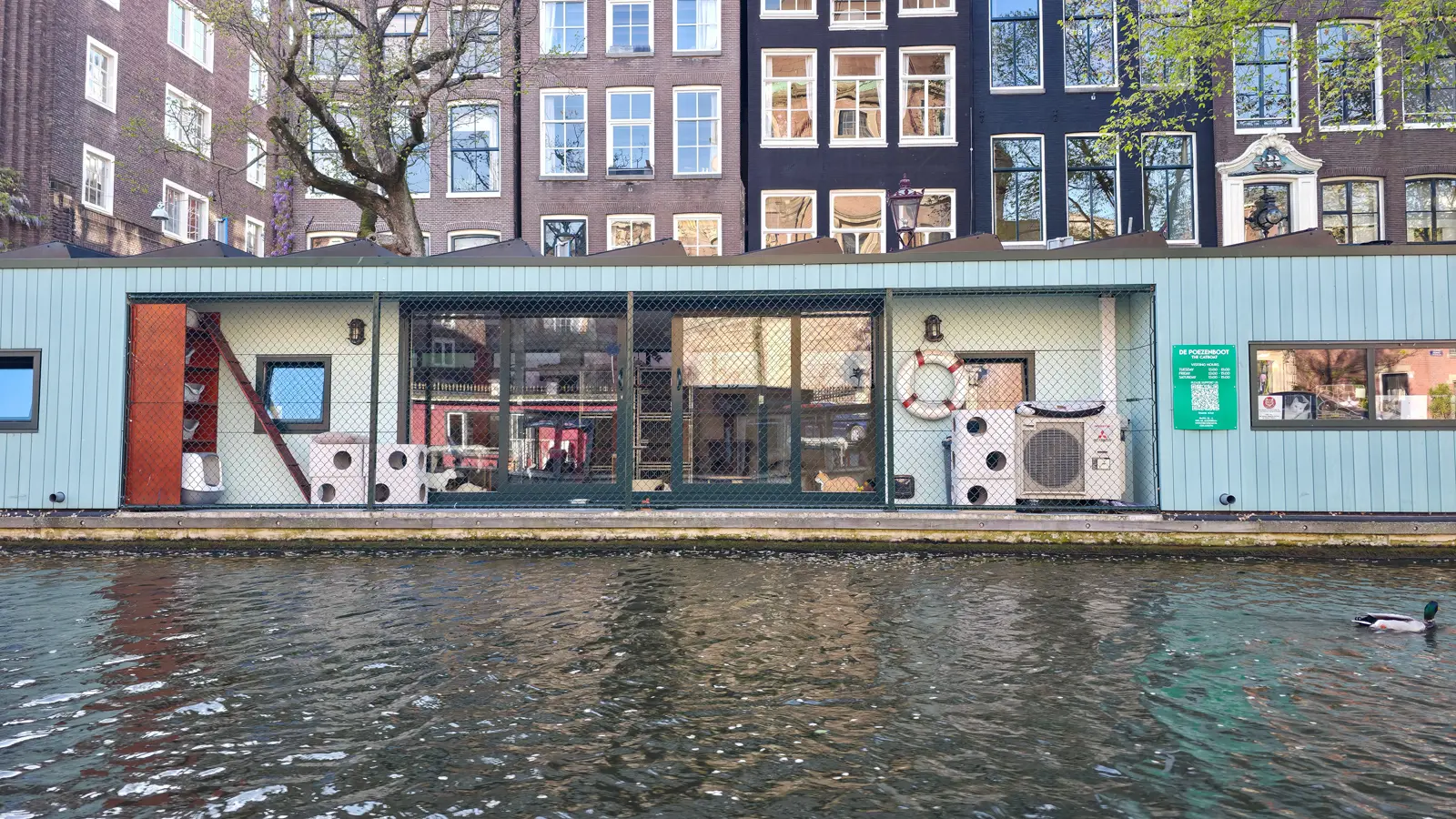
A pale green houseboat with a long wire-mesh run along the canal side, carpeted cat platforms visible through the glass, a lifebuoy on the wall and a green notice board with the visiting hours printed on it. A mallard paddled past while we looked at it.
It is free to go aboard, and the hours are short because it runs on volunteers.
Out into the harbour
The canals open out east of the centre and the scale changes completely. Amsterdam Centraal arrives first, the whole length of its front visible at once across the water, which is not how anybody sees it on foot. This is where the twenty-seat boat looks smallest, and that is the point of it.
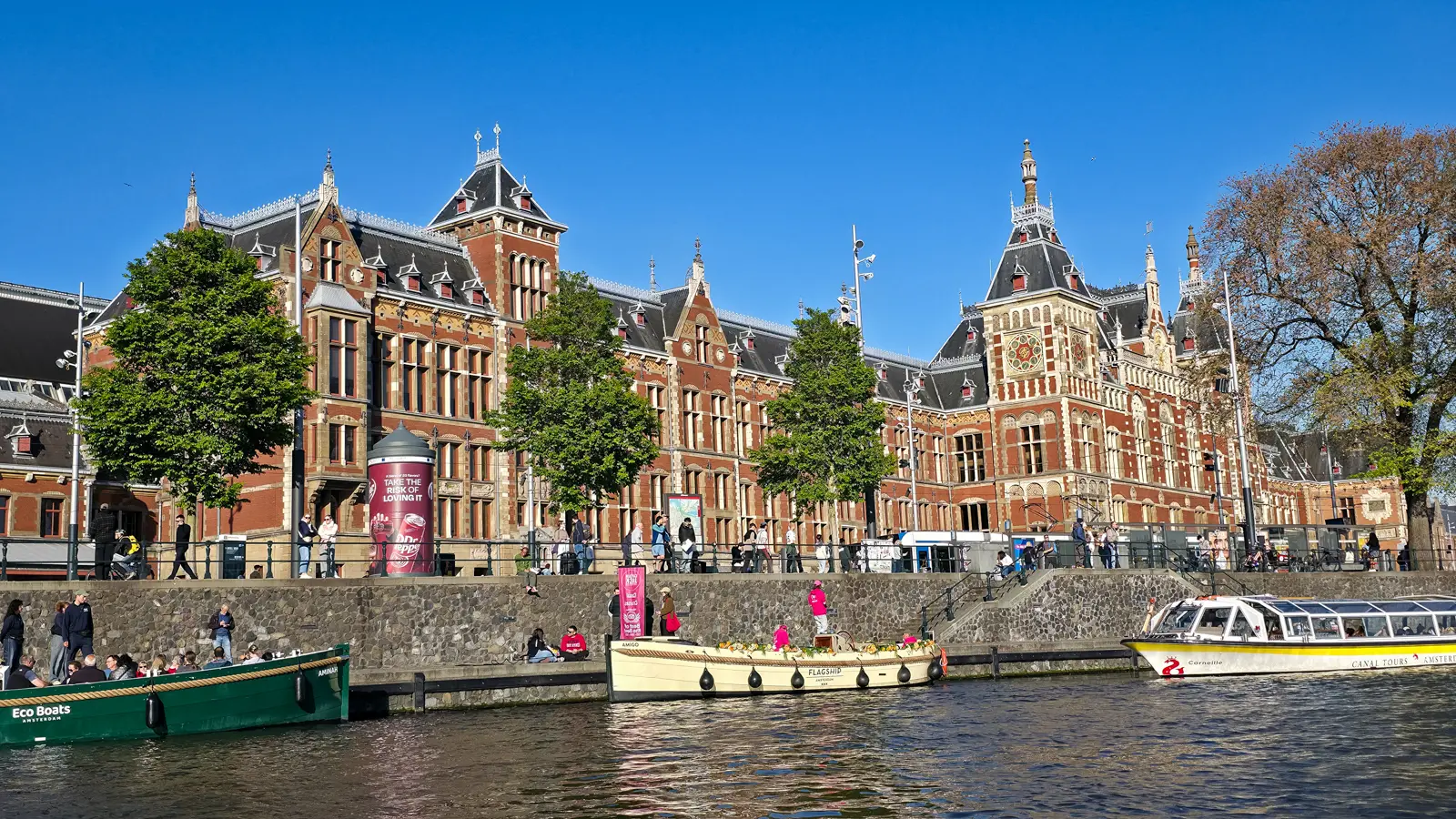
The cream boat moored in front with flowers along its gunwale is an open sloop from the same operator as ours. Same company, no roof. In late April that is a real decision rather than a preference.
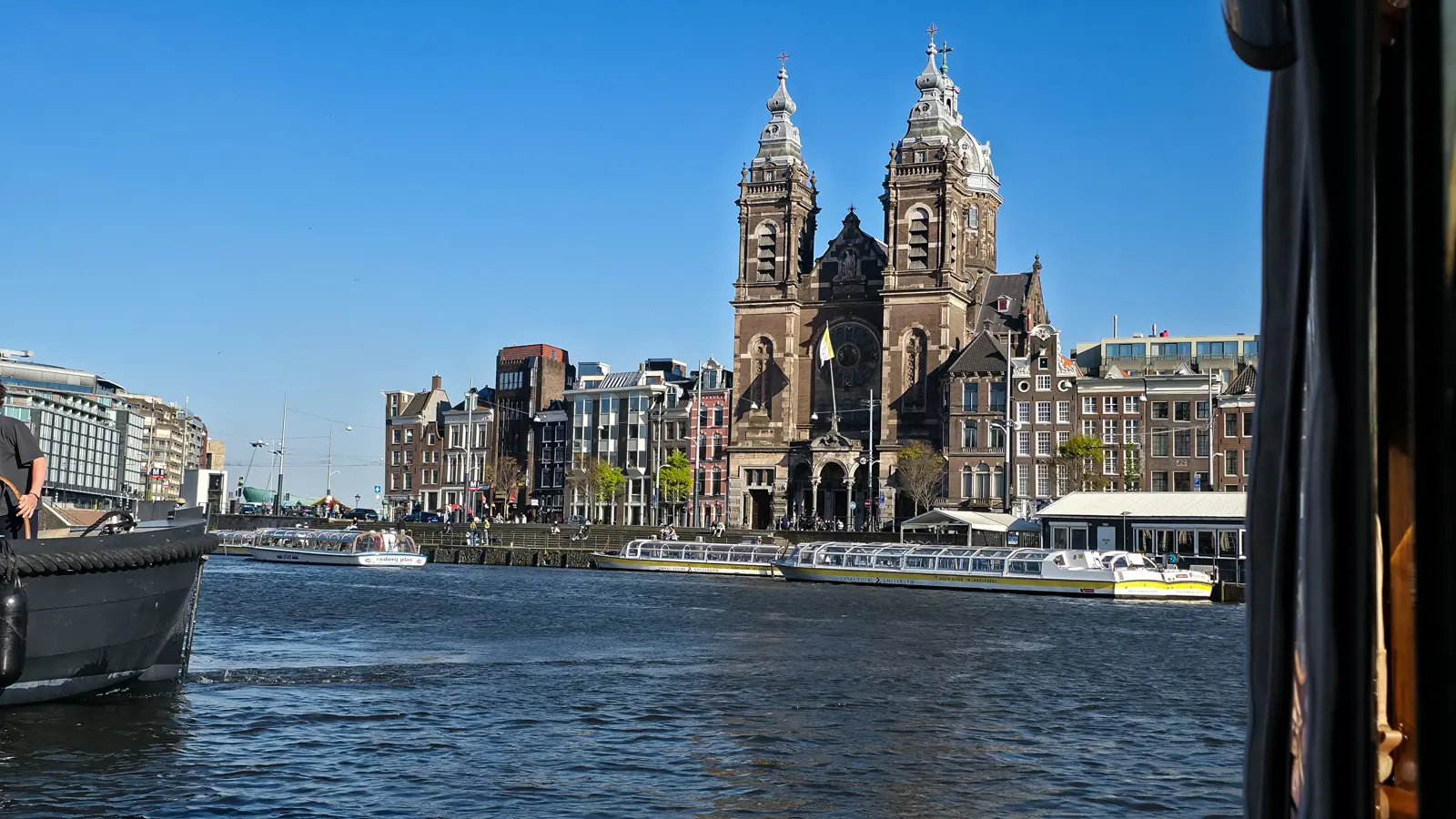
Just along from it stands the Basilica of Saint Nicholas. Two towers, a rose window between them, and a statue of the saint set into the facade above the entrance, facing the water he is supposed to look after.
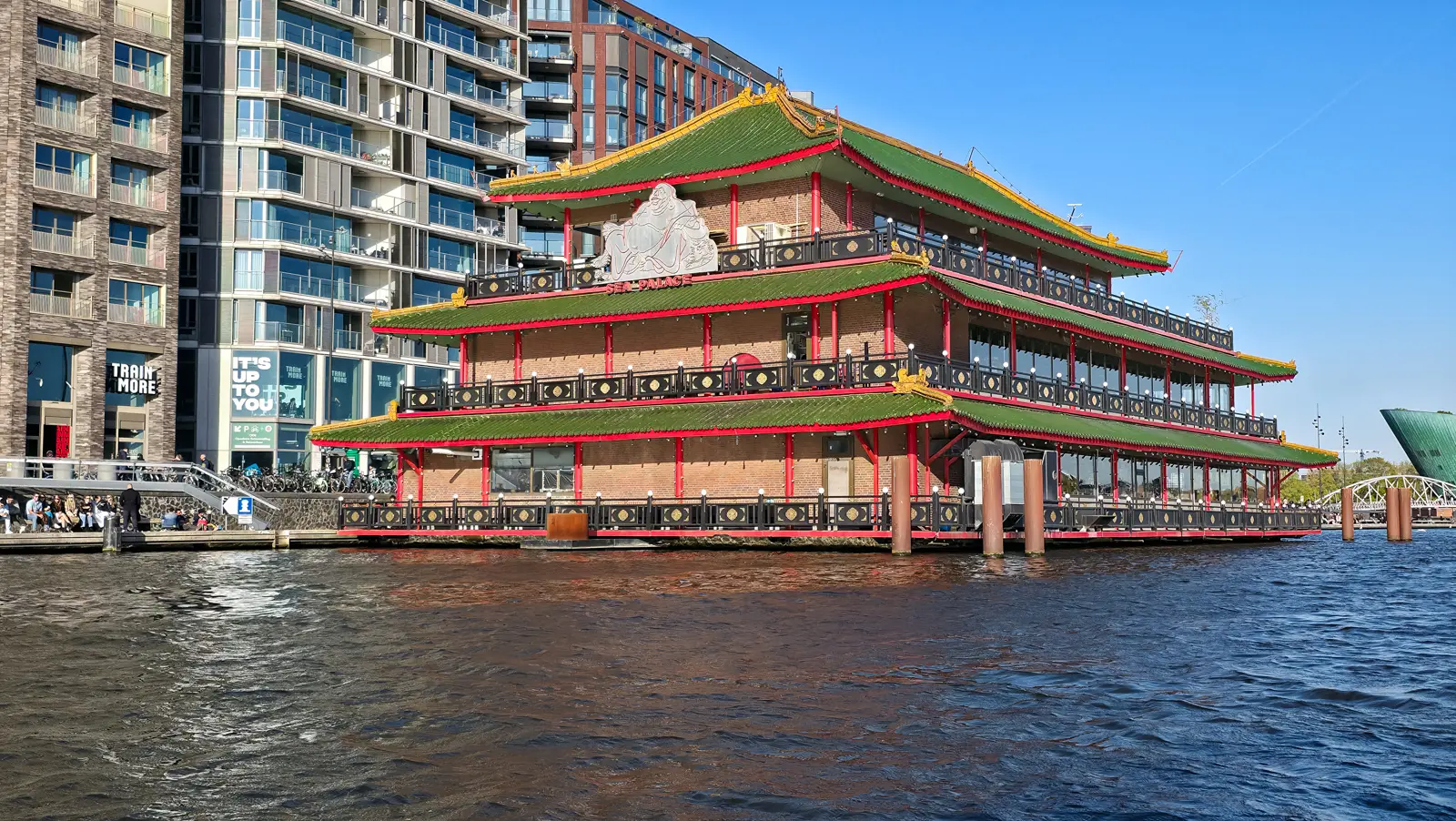
Our skipper recommended the Sea Palace, and recommended it properly rather than as a joke about the building. We ran out of trip before we ran out of appetite and never made it back.
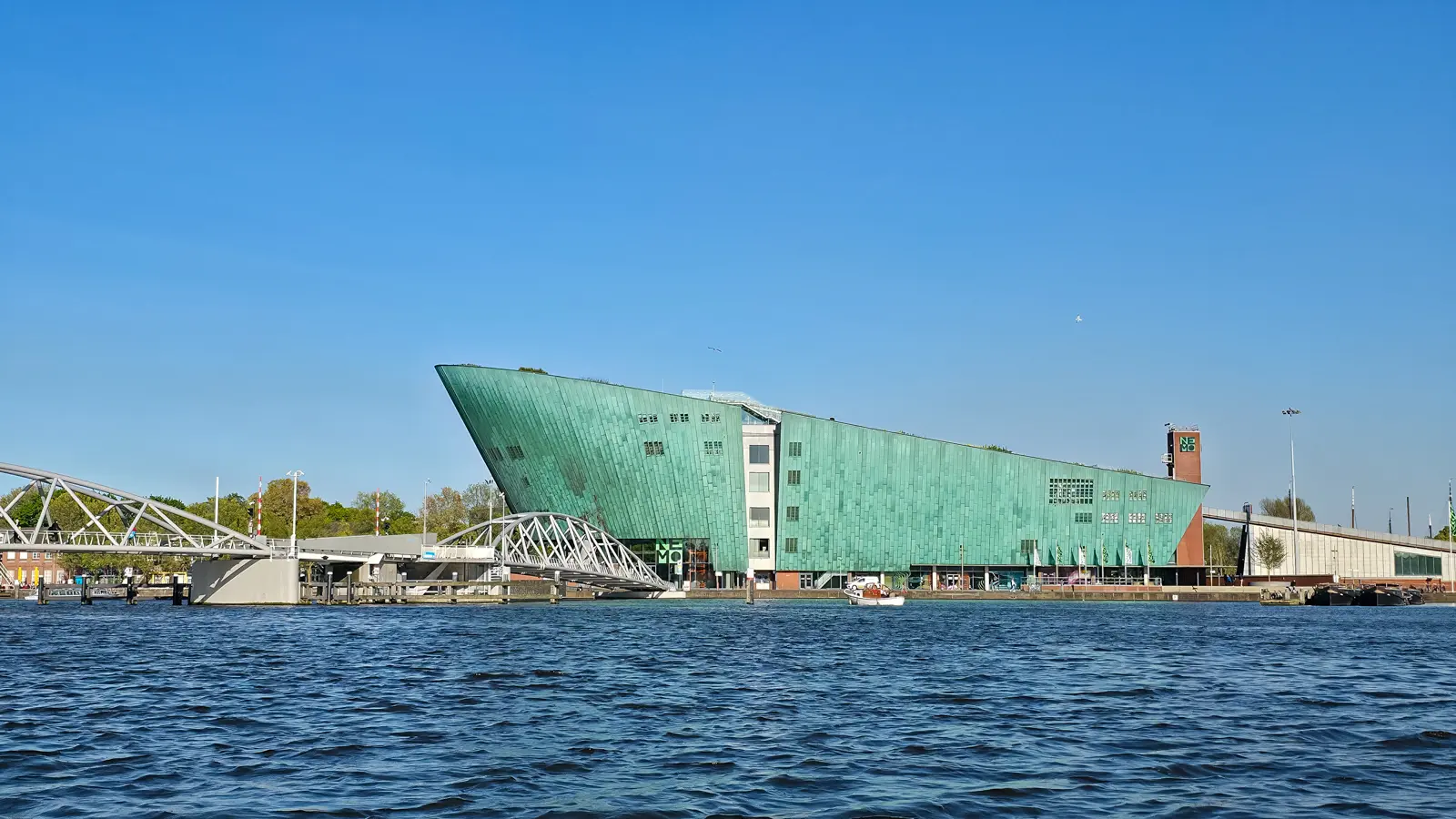
NEMO Science Museum is clad in pre-oxidised copper, so it arrived green rather than weathering into it over a century. The shape is the bow of a ship, tipped up out of the harbour, and from a low boat it has the look of something enormous bearing down on the water.
The maritime stretch
Then a proper piece of theatre, and the only moment of the two hours when everyone on board stood up at once.
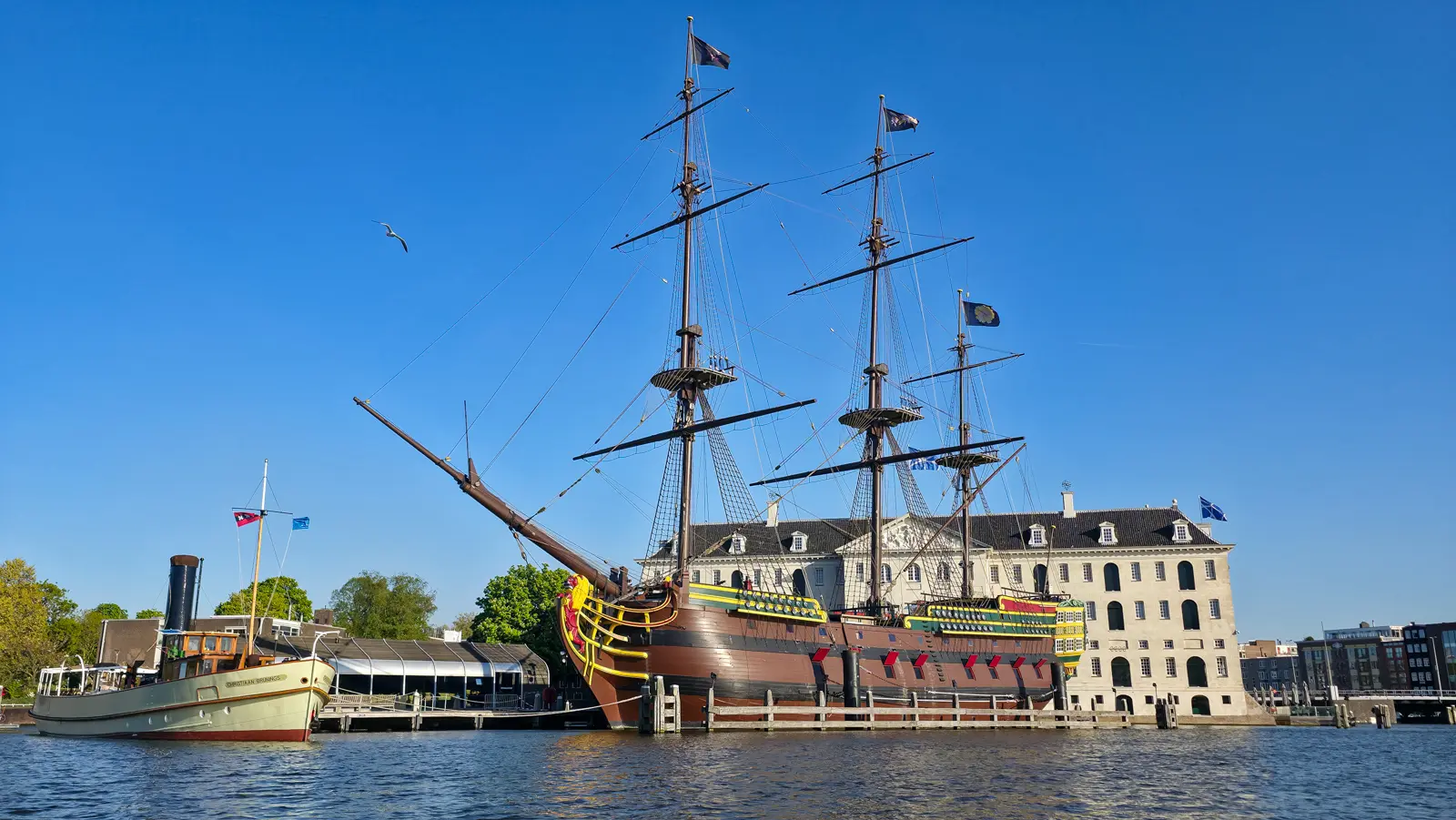
The ship is the Amsterdam, a full-size replica of an East Indiaman, built in the city between 1985 and 1990 by volunteers using period tools alongside modern ones. Behind her sits the long pale bulk of Het Scheepvaartmuseum, the national maritime museum, which is a former naval storehouse and has water on all four sides. Three masts, a painted stern in red, yellow and green, gunports down the side. The smaller green and cream steamship alongside her is the Christiaan Brunings, built in 1900 as an icebreaker.
The green stretch
After the harbour the boat turns back inland and the whole character of the trip changes. Narrower water, lower bridges, trees meeting overhead.
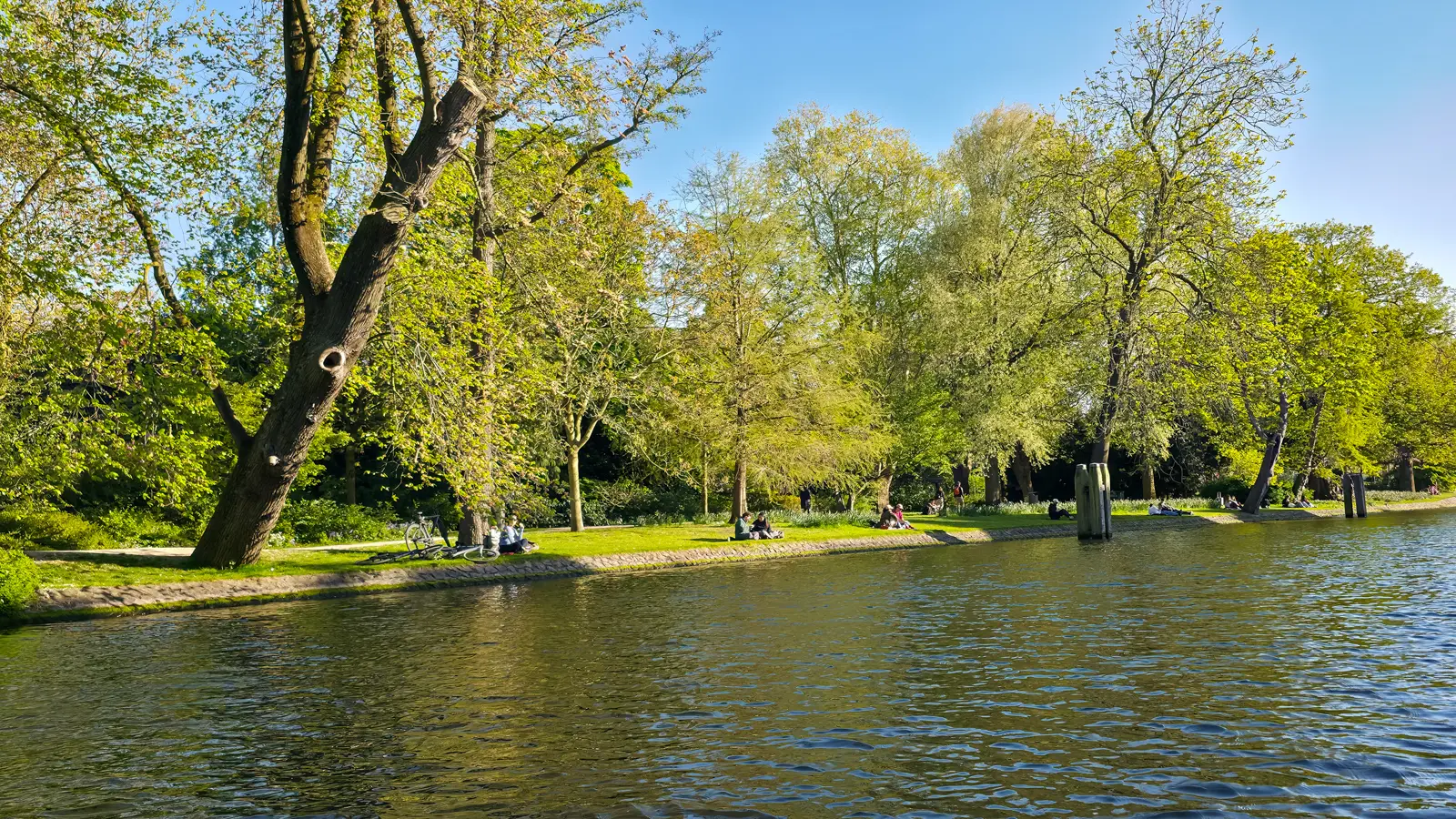
This green bank on the Nieuwe Herengracht is Wertheimpark, and the skipper slowed down for it. Low sun, bikes dropped on the grass, people sitting in twos and threes right down to the water’s edge. It was the only stretch where nobody on the boat was photographing a building.
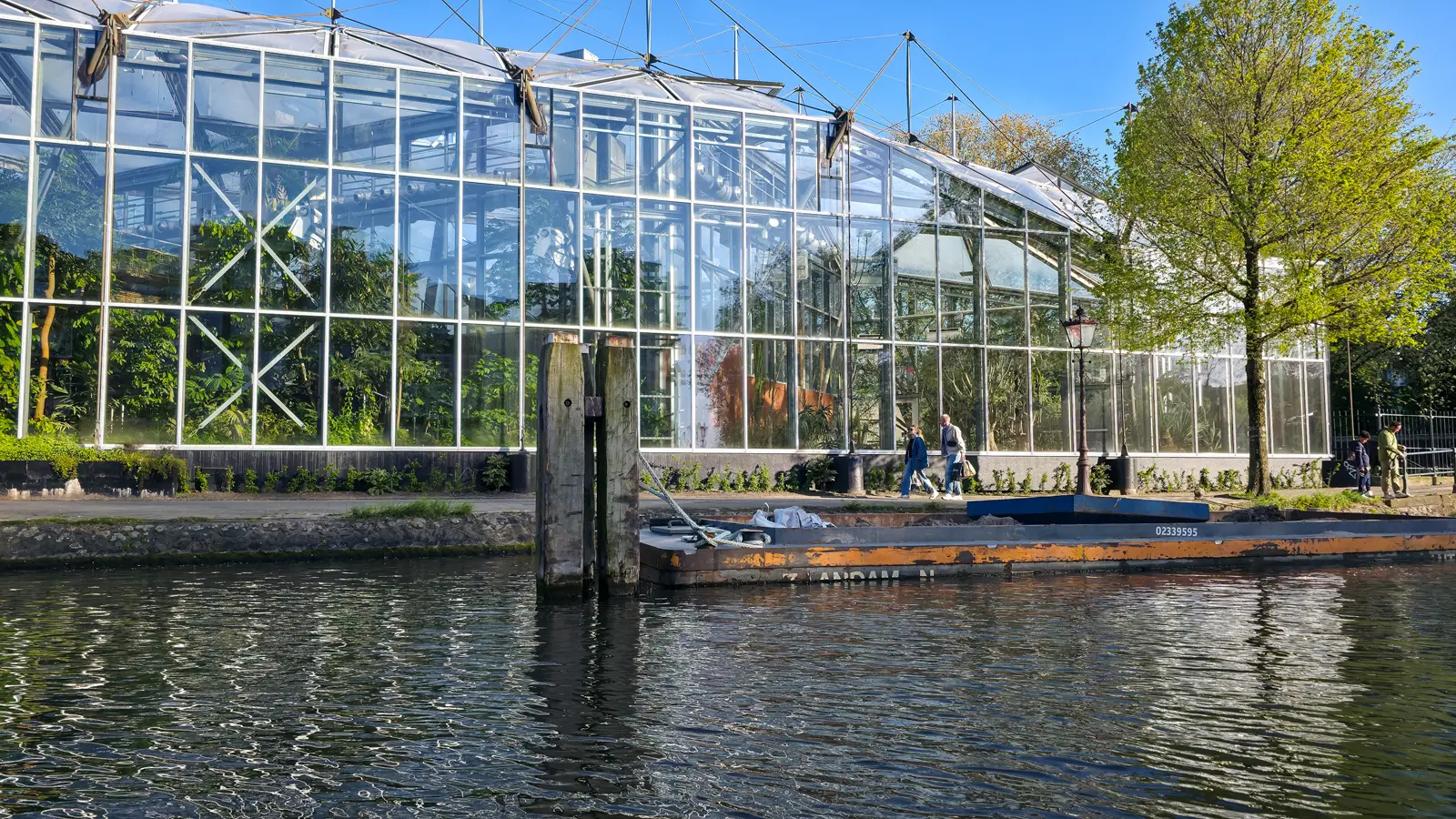
Directly opposite the park is the Hortus Botanicus. From the water it is a wall of glass with a jungle behind it, tall enough that the palms inside reach most of the way up. Two people walked past along the quay without looking at it once.
The building I would have walked straight past
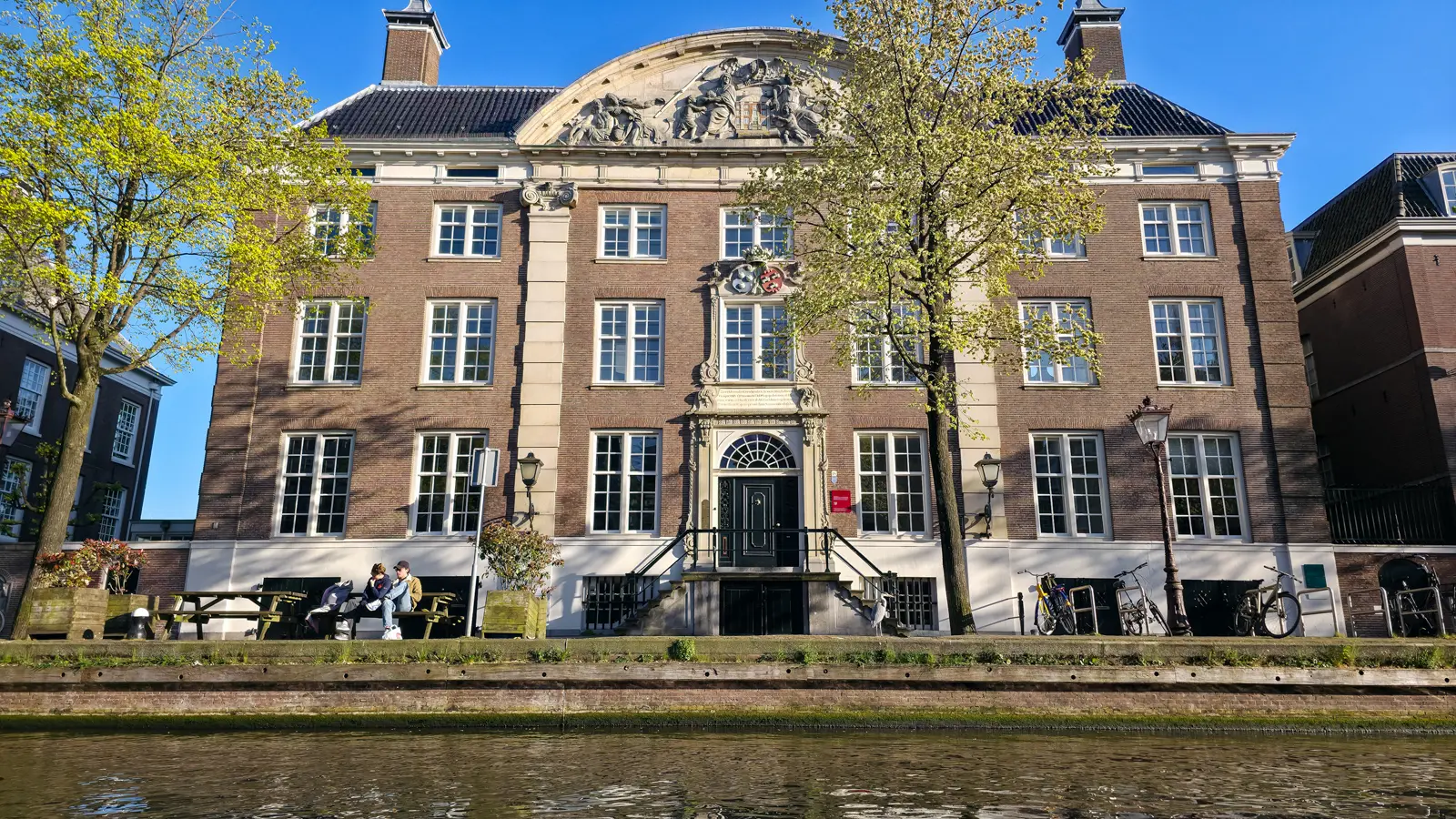
The Corvershof is a hofje, which is an almshouse: a set of small homes paid for by a wealthy founder and given over cheaply, or for nothing, to people who needed them. This one was built in 1723 by the Diaconie, the charitable arm of the Dutch Reformed church, as a home for elderly couples, and it runs as four wings around an inner courtyard. Most hofjes are modest and hidden behind a gate on a side street. This one has sandstone pilasters, an enormous curved pediment carved with figures, and a double flight of steps up to a door with a fanlight over it, which is why it looks like the townhouse of a rich merchant family rather than charity housing. A heron stood on the quay in front of it, and two people ate their lunch on a picnic bench underneath, entirely unbothered.
Living on the water
This was the part I had come for, and the part I got most confidently wrong.
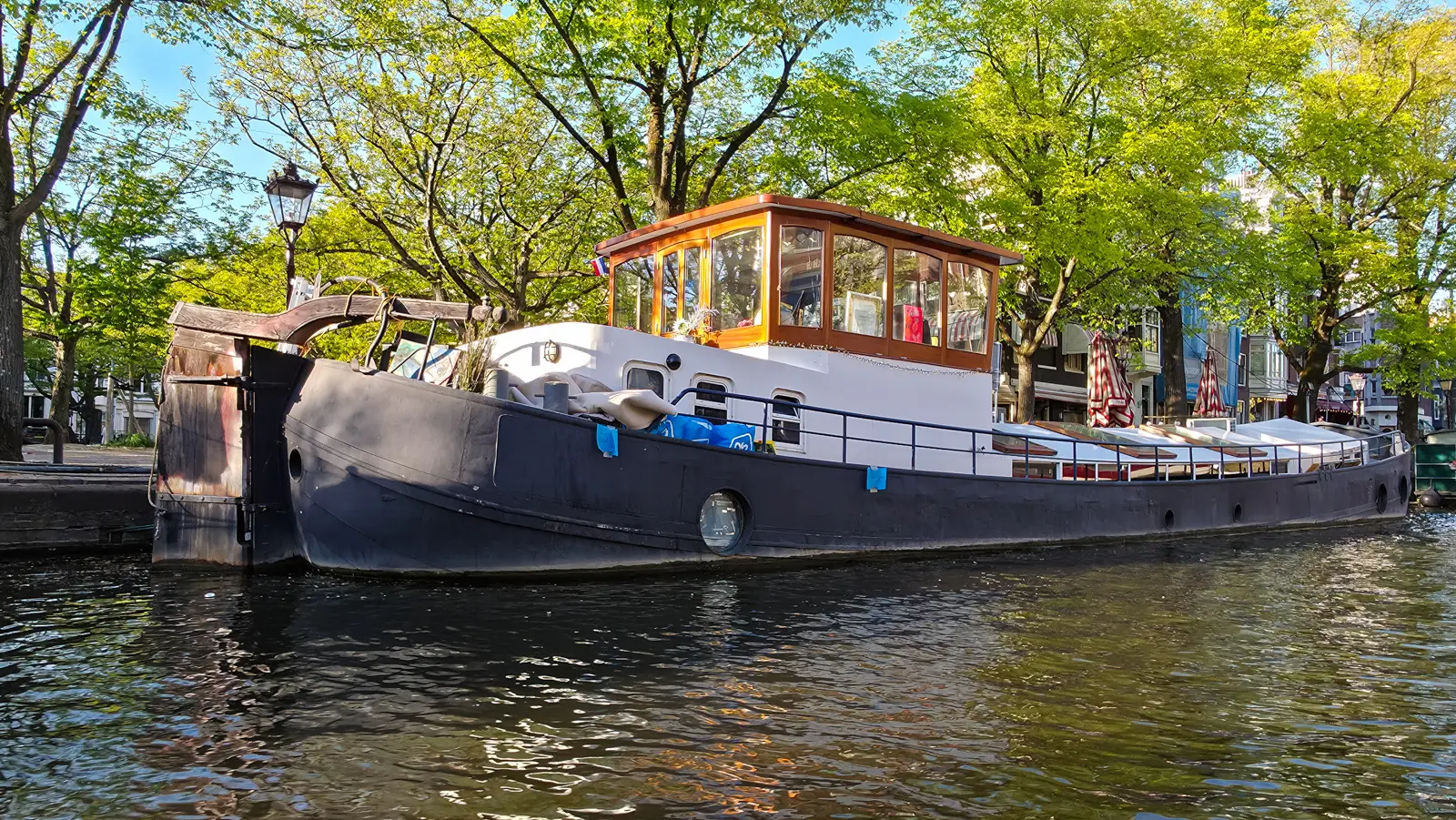
A black steel hull, a timber wheelhouse glowing in the evening sun, deck chairs, a rack of what looked like paddleboards along the side, and somebody’s shopping still in a bag on deck.
I spent a good portion of that stretch deciding one of these boats had been in the Amsterdam episode of Ted Lasso. It had not. Rebecca’s houseboat was a set built at a studio in west London. The bridge she falls off, though, is real, and it is the Raamgracht, which we had passed earlier without my noticing.
The Amstel
The last half hour runs out onto the Amstel, which is wide, busy and much less sheltered than the canals.
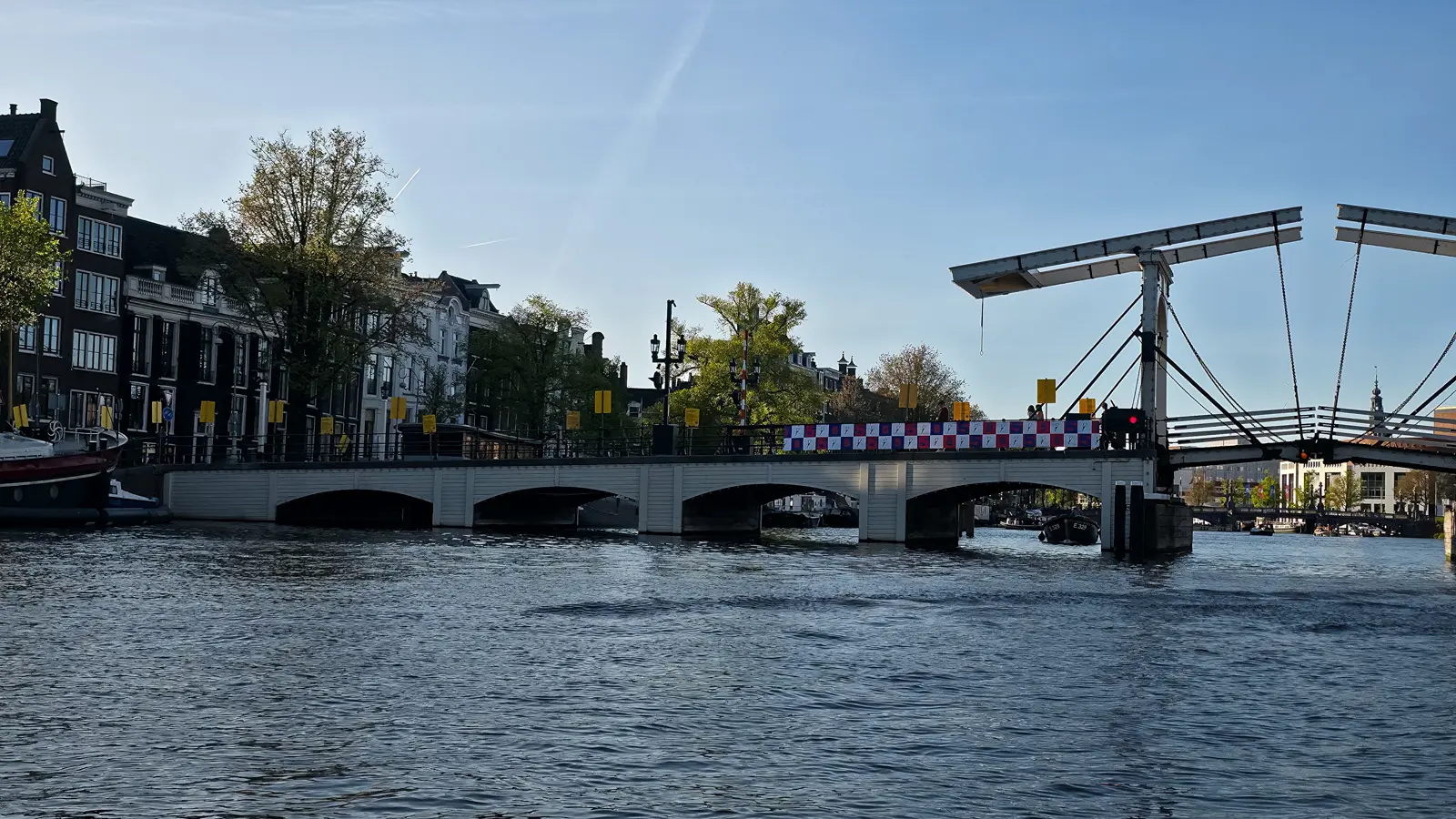
We came under the Magere Brug with one leaf up and a red light showing, which is the version worth having. From a boat the bridge sits above rather than beside.
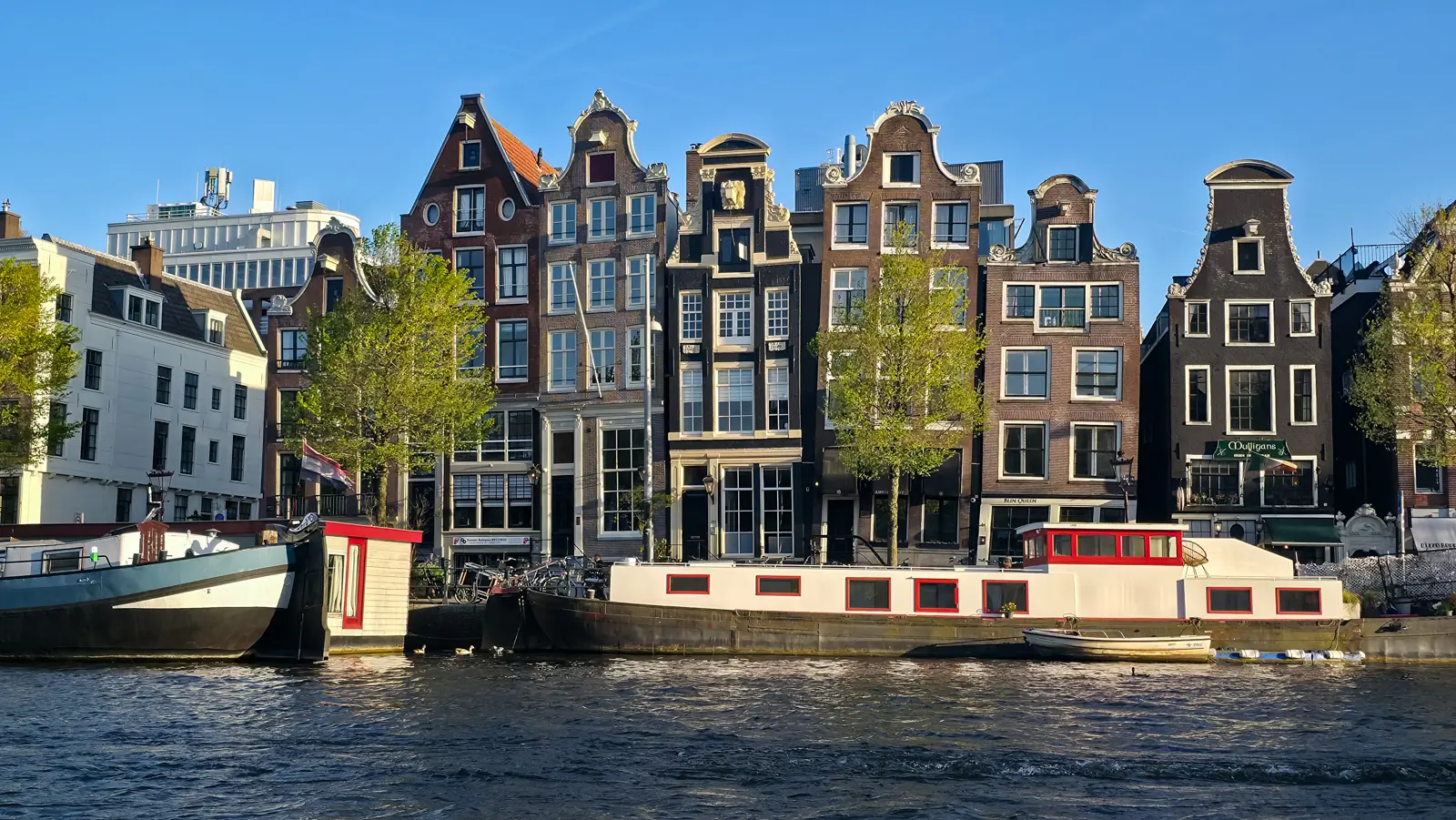
Neck gables, step gables, bell gables, a white house on the left, an Irish bar on the corner and two houseboats moored along the front. And not one of them standing straight.
Two different things cause that, and both are in this row. A house tilting forward over the street is usually doing it on purpose. Facades were built with a calculated forward slope, op vlucht in Dutch, so that furniture and goods hoisted up on the beam at the roofline swung clear of the windows instead of breaking them. A house leaning sideways, or back into its neighbour, is not deliberate. That is the wooden piles underneath settling unevenly in soft wet ground over three hundred years.
Neither is rare. Thousands of canal houses are visibly out of true, which is part of why the skyline looks hand-drawn. The sun was low enough by then to put the whole row in gold.
Bubbly Tips
- Pick the boat before you pick the price. The pontoons outside Centraal advertise a one-hour tour at €15,50 on large glass-roofed boats. A small-group two-hour trip costs considerably more and is a different experience entirely. Neither is wrong, but know which one you are buying.
- Covered or open matters in April. The same operators often run both. We were in a covered saloon boat and were glad of it by the last half hour on the Amstel, where it is windier than the canals.
- Book an evening departure. Ours ran from six to eight, which put the low sun on the gables for the final stretch. Midday gives you flat light and full boats.
- Ask the skipper things. On a twenty-seat boat you can. That is the entire advantage over a recorded commentary, and most people on board never used it.
- Check the Catboat hours before you plan around it. Visiting is free but the sanctuary is open only a few afternoons a week, because it runs on volunteers. The hours are posted on the boat and on their site.
- Sit on the side facing the bank. Most of what a skipper points out is at eye level on the quay, not in the middle of the water.
- Eat before or plan to eat after. Snacks on a snack cruise means a board of cheese and sausage, not dinner. Sea Palace is right on the route if you want to make an evening of it.
- Raamgracht for the Ted Lasso pilgrimage. The bridge is real and central. The houseboat is not; it was built on a set in London.
- Do not expect to photograph everything on the itinerary. Ours listed sixteen stops. Between bridges, moored boats and the angle of the light, I came home with clear frames of about half.
Final Thoughts
The itinerary promised the Anne Frank House, the Westerkerk, the Rijksmuseum, the Munttoren and Huis Bartolotti. I have photographs of none of them. What I have instead is a cat sanctuary, a floating Chinese pagoda, a 1723 almshouse with a pun carved above the door, and a park full of people lying on the grass at seven in the evening.
That is not a failure of the trip. It is the trip. From the water it is the backs of things, the waterlines, the roof gardens, the shopping left on a deck. Two hours at four knots with somebody who knows the city talking over my shoulder, and a glass of wine that cost too much and was worth it anyway.
I would do it again. I would just eat first.
Until next time!

🌟 Everything You Need to Plan Your Dream Trip in 2026
- 🌟 Luxury Hotels - Find premium stays with Booking.com & Hotels.com
- 🏡 Vacation Rentals - Discover unique properties on VRBO
- 🏞️ Guided Tours - Explore with Viator or GetYourGuide
- 🎫 Attraction Tickets - Skip the lines with Tiqets
- 🚢 Ocean Cruises - Set sail with Cruise Direct
- 📱 International SIMs - Stay connected with Saily
- 🚗 Car Rentals - Budget-friendly options from Discover Cars
- 🌐 Secure VPNs - Browse safely with NordVPN
- 💶 Currency Exchange - Best rates with Wise
- 🗣️ Learn Languages - Master the local language with Babbel and Rosetta Stone