
I came up from the lake still looking for the orchids.
The Wilhelmina Pavilion had turned out to be a shop, somewhere to eat and the toilets, with no floral display in it at all. So when the next building came through the trees, I made the obvious assumption. Another café. I stayed outside.
The orchid and anthurium show was in there.
What happened instead was half an hour in the grounds around it. No regrets about the half hour. Some about the door.
The Juliana Pavilion & Grounds at a Glance
🌸 What’s inside (2026) · The orchid and anthurium show, which normally lives in the Beatrix Pavilion at the far end of the park. The Juliana usually holds Keukenhof’s own history and its tulip-mania display.
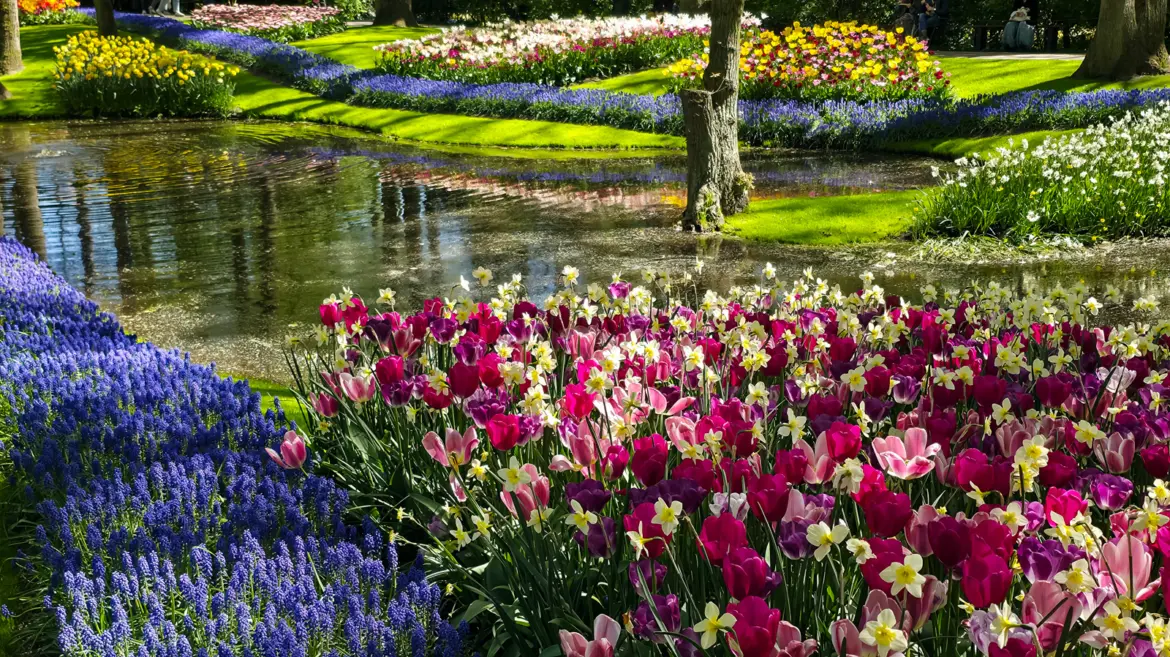
🔵 The blue river · The winding ribbon of grape hyacinth (Muscari armeniacum) that banks the stream here does most of the compositional work — the plant Keukenhof is quietly famous for.
🌷 Why a bed blooms all spring · Up to three bulbs are stacked in one hole, latest-flowering deepest, earliest nearest the surface, so one bed flowers three times across an eight-week season.
🇨🇦 The name · The pavilion honours Queen Juliana, who gave birth to Princess Margriet in wartime Ottawa in 1943 and thanked Canada with 100,000 tulip bulbs — the root of the Canadian Tulip Festival.
💡 Tip · Check the map at the gate, not last year’s blog: the pavilions swap shows between seasons, and a steady stream of people leaving a building is usually an exhibition, not the toilets.
The stream does the work
A stream runs through this part of the park. It is narrow in places and wide enough in others to hold the whole treeline upside down. The beds are set against the water rather than near it, and blue muscari runs along both banks in a continuous band. Tulips and daffodils sit behind that band, so the colour stacks from the waterline up.
Grass islands sit out in the middle with mature trees growing straight out of them. The lawn runs to the edge of the water and then stops. No border, no railing, no gravel margin.
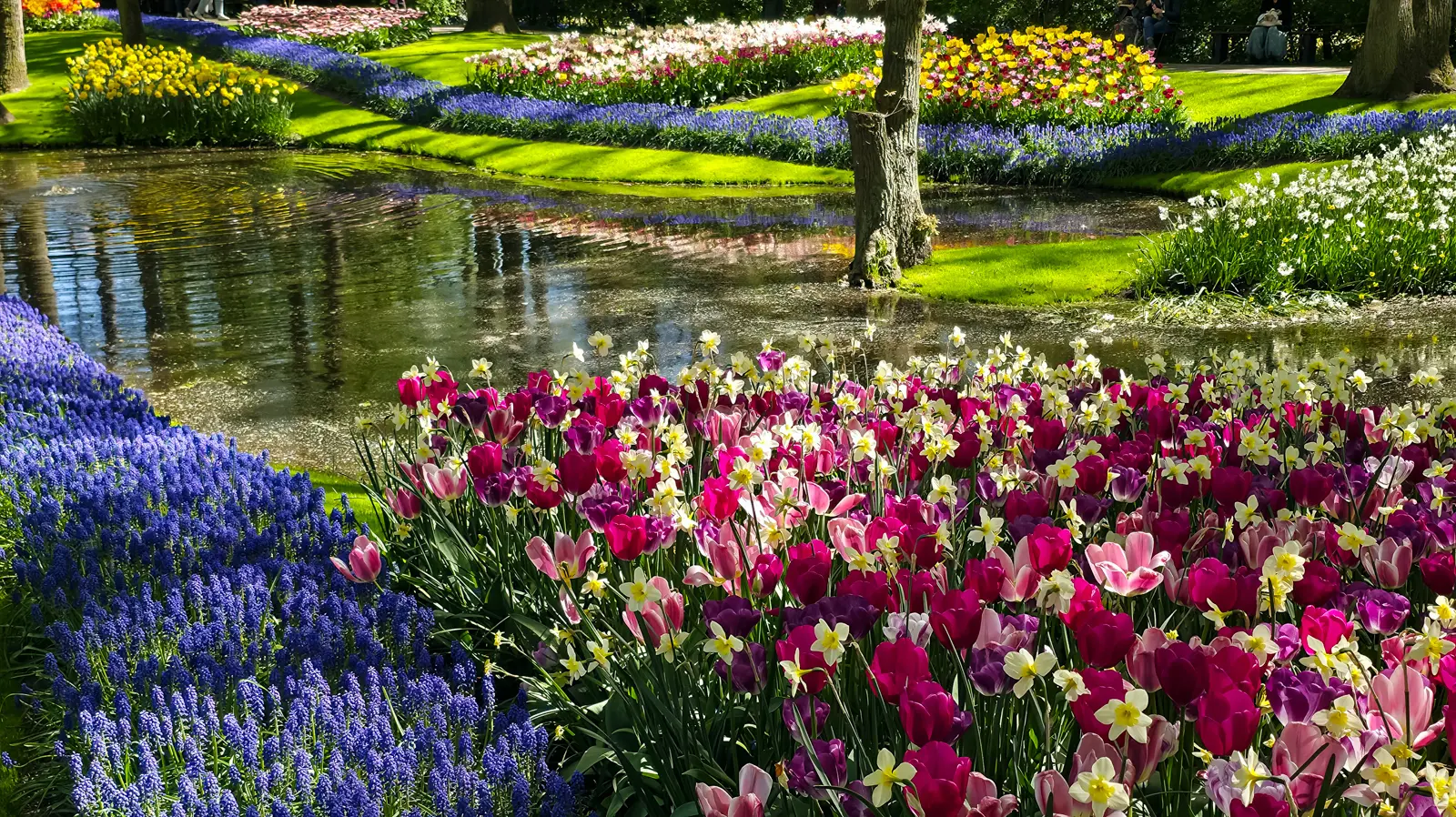
This is where people stopped. Almost everyone coming down the path lifted a camera at the water, and the cluster was thick enough that a clear frame meant waiting a moment. The beds twenty metres back had nobody in front of them at all.
At the water’s edge
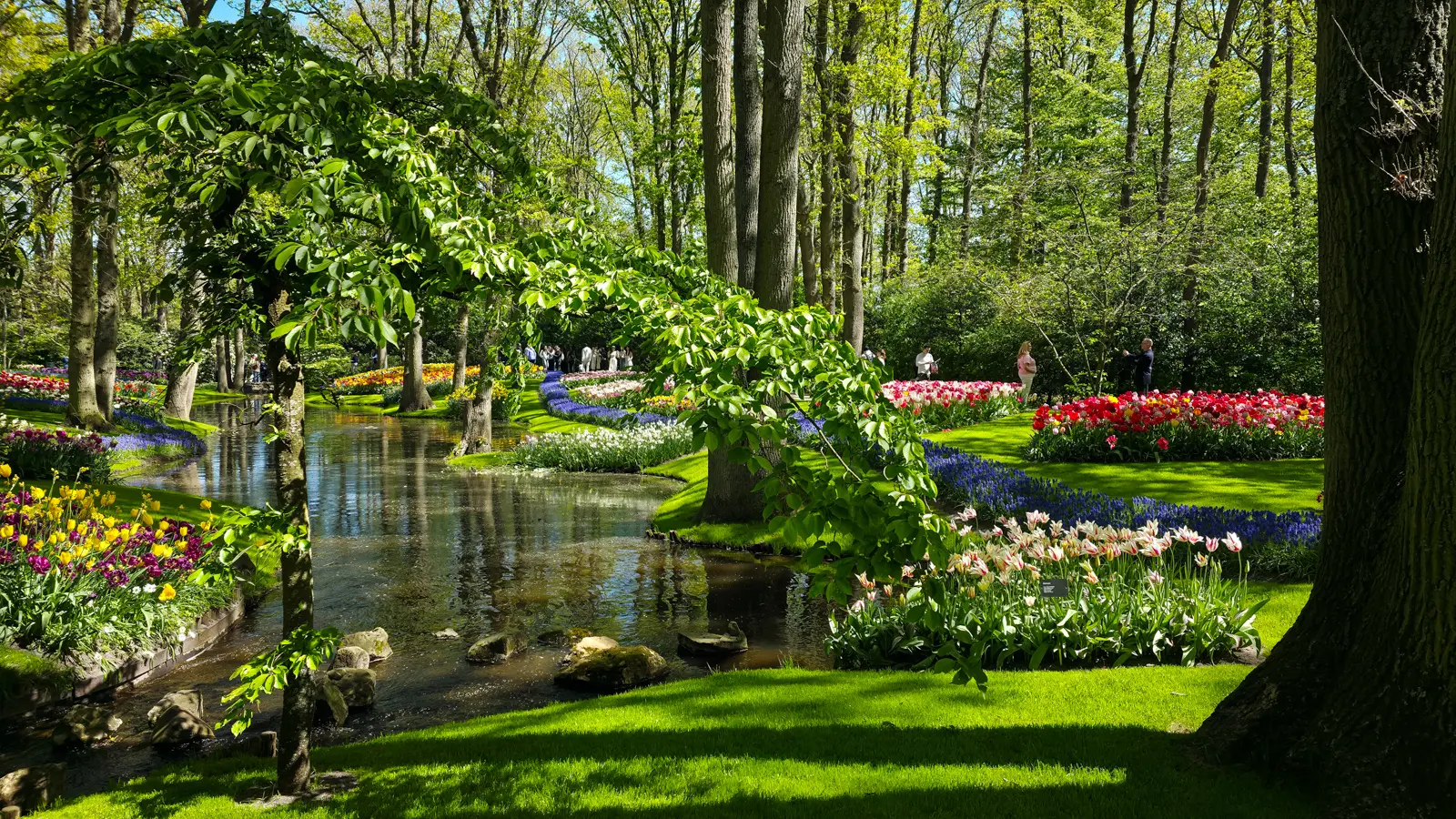
The near end of the stream is shallow. Pale rocks sit in the bed of it, breaking the surface, and the bottom is visible straight through the water. A low timber edge holds the left-hand bed back from the stream, and it is the only piece of hard landscaping anywhere in the frame.
A black plaque stands among the white and red tulips on the right bank, mounted on a stem at roughly flower height. It is headed “Mixture”, with a list of tulip names beneath it. The beds carry these throughout, planted into the display rather than set at the front edge of it, which is why most people walk past them.
How the beds are built
Forty gardeners plant Keukenhof‘s seven million bulbs every autumn. The work is done by hand, and the park is redesigned each year rather than repeated.
The part worth knowing is what happens underneath. Up to three bulbs go into a single position, stacked, with the latest-flowering variety planted deepest and the earliest nearest the surface. The shallowest layer carries the first three weeks. Then the next comes up through it, and then the last. One bed flowers three times over an eight-week season, which is why a Keukenhof photograph taken in March looks nothing like one taken in May. It is not the weather. It is the planting depth.
Late April is the back half of that sequence. This was a bed on its third act.
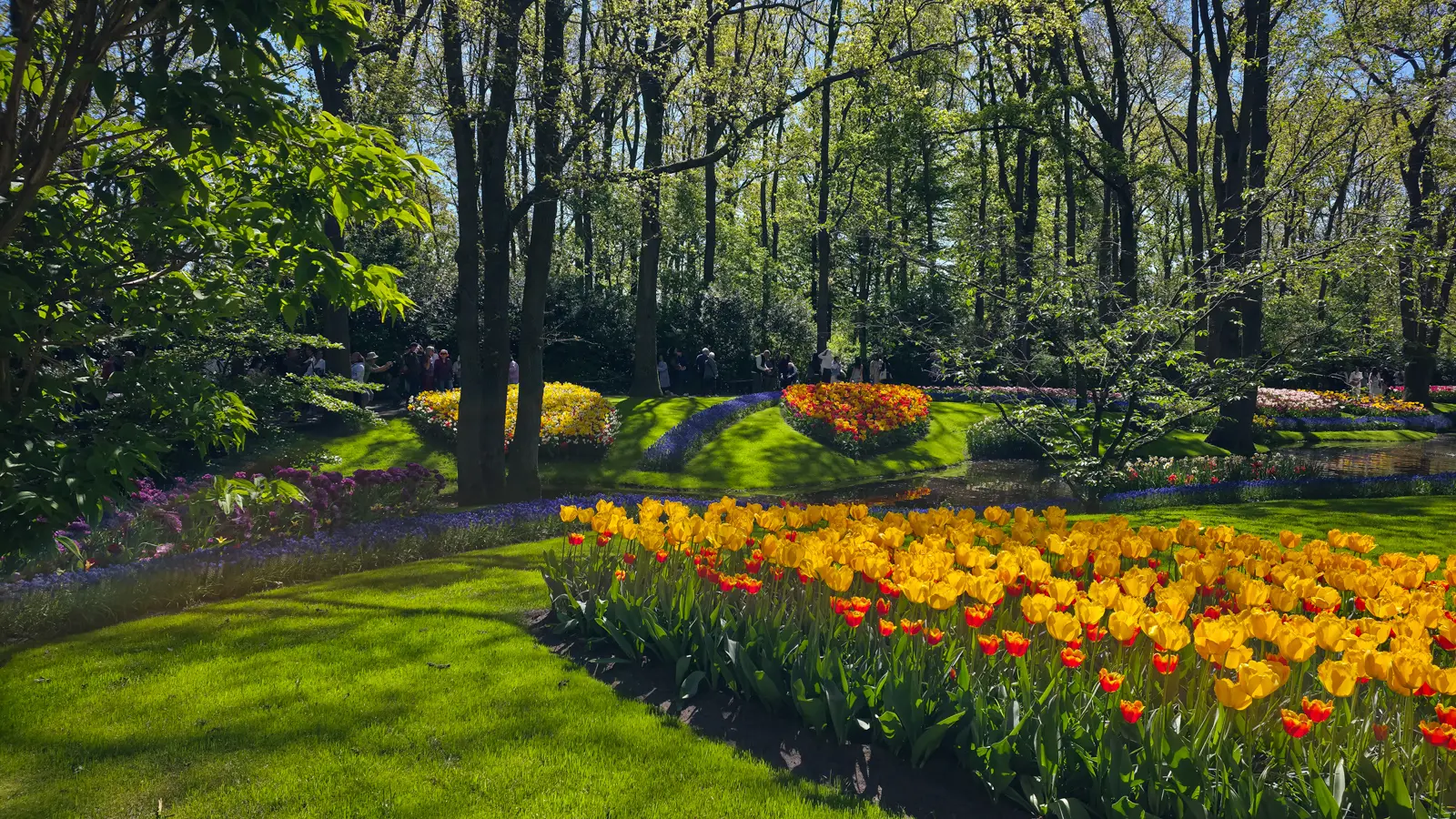
The shapes are worth watching too. Beds are cut as long curves and raised slightly at the centre, so a colour reads as a band from across the lawn instead of a patch on it. Tulips are planted straight through the daffodils rather than kept in their own block, which is why the yellow here has white running through it at ankle height.
The pavilion I walked past
Here it is, along the right-hand edge of the frame. Timber cladding, a flat roof with a deep overhang, a glazed end wall, and a second glass-walled section further along with people standing on the paving outside it.
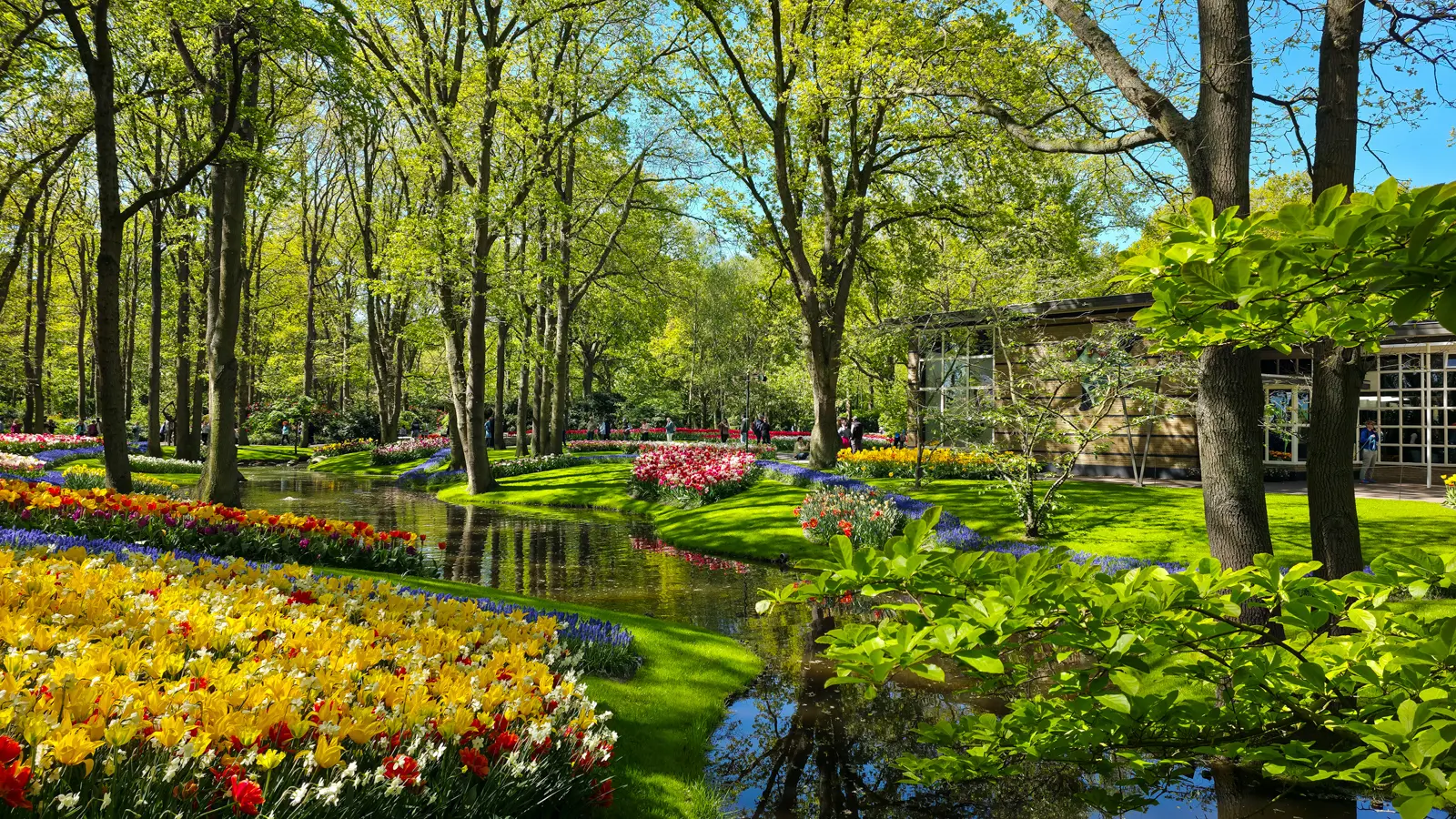
The Juliana normally holds the park’s own history and its tulip mania exhibition. In the 2026 season it held the orchid and anthurium show instead, which usually lives in the Beatrix Pavilion at the far end of the park. Shows move between buildings from one year to the next, which is exactly the sort of thing a visitor working from an assumption gets wrong.
There was a clue, too. People kept coming out of those doors, steadily, in twos and threes, the whole time I stood there. My conclusion at the time was that this was a lot of demand for a toilet block.
There is a better reason to go in than the one I missed. The pavilion is named for Queen Juliana, and Juliana has a Canadian history. She spent the war in Ottawa, and in January 1943 gave birth to Princess Margriet at the Ottawa Civic Hospital, with the maternity ward temporarily declared extraterritorial so the baby would hold Dutch nationality alone. In 1945, back in a liberated Netherlands, she sent Canada 100,000 tulip bulbs. She kept sending them every year of her reign. The tulip beds in Ottawa each May, and the festival built around them, come out of that gift.
So the building I wrote off as a café is named after the woman responsible for the tulips at home.
Up close
Two things in these grounds are better at a metre than at twenty.
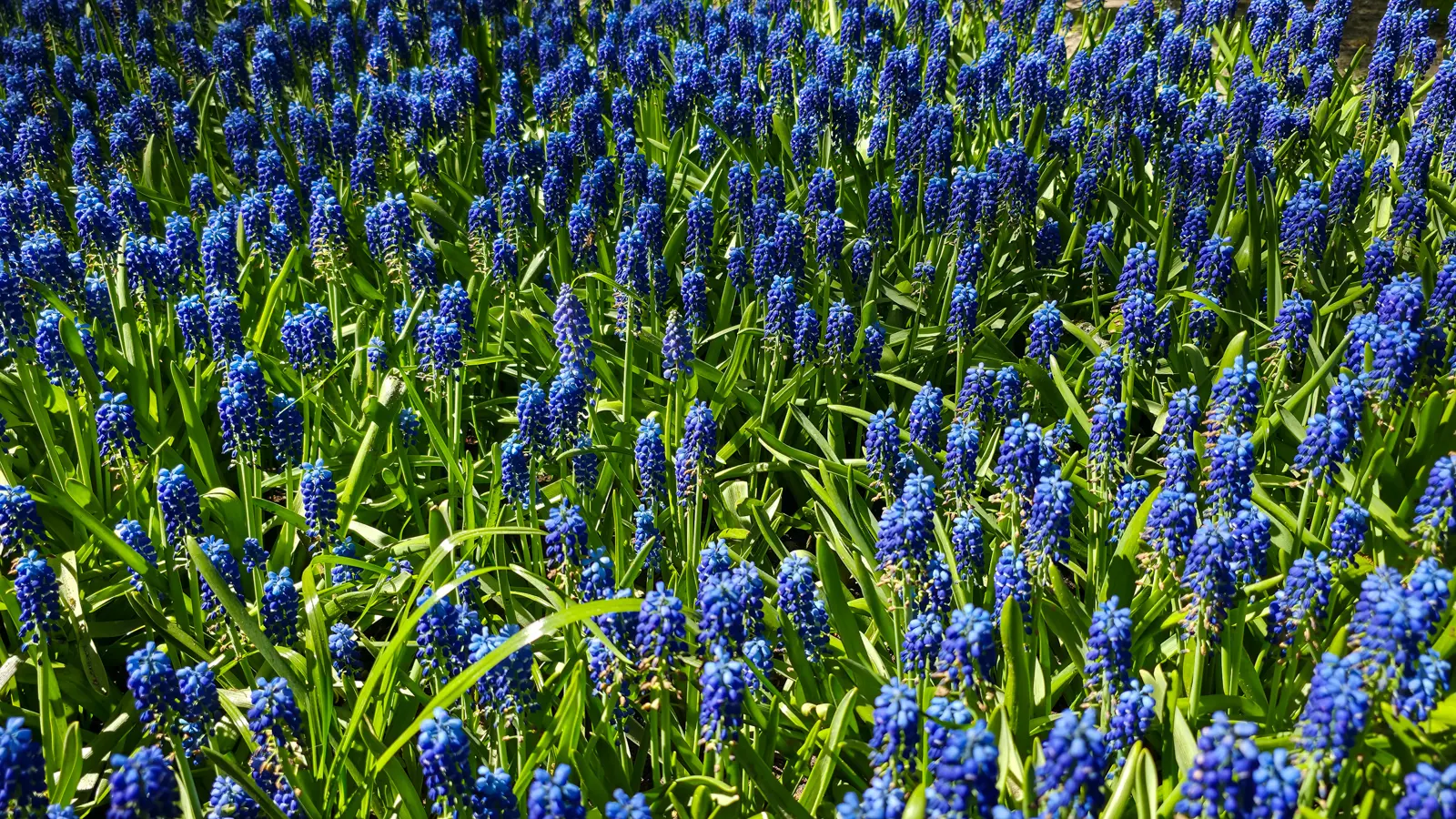
The muscari reads as a flat blue wash from across the lawn. Up close it is thousands of separate spikes, each one a tight column of small bells, packed densely enough that the leaves only show where a spike has fallen sideways.
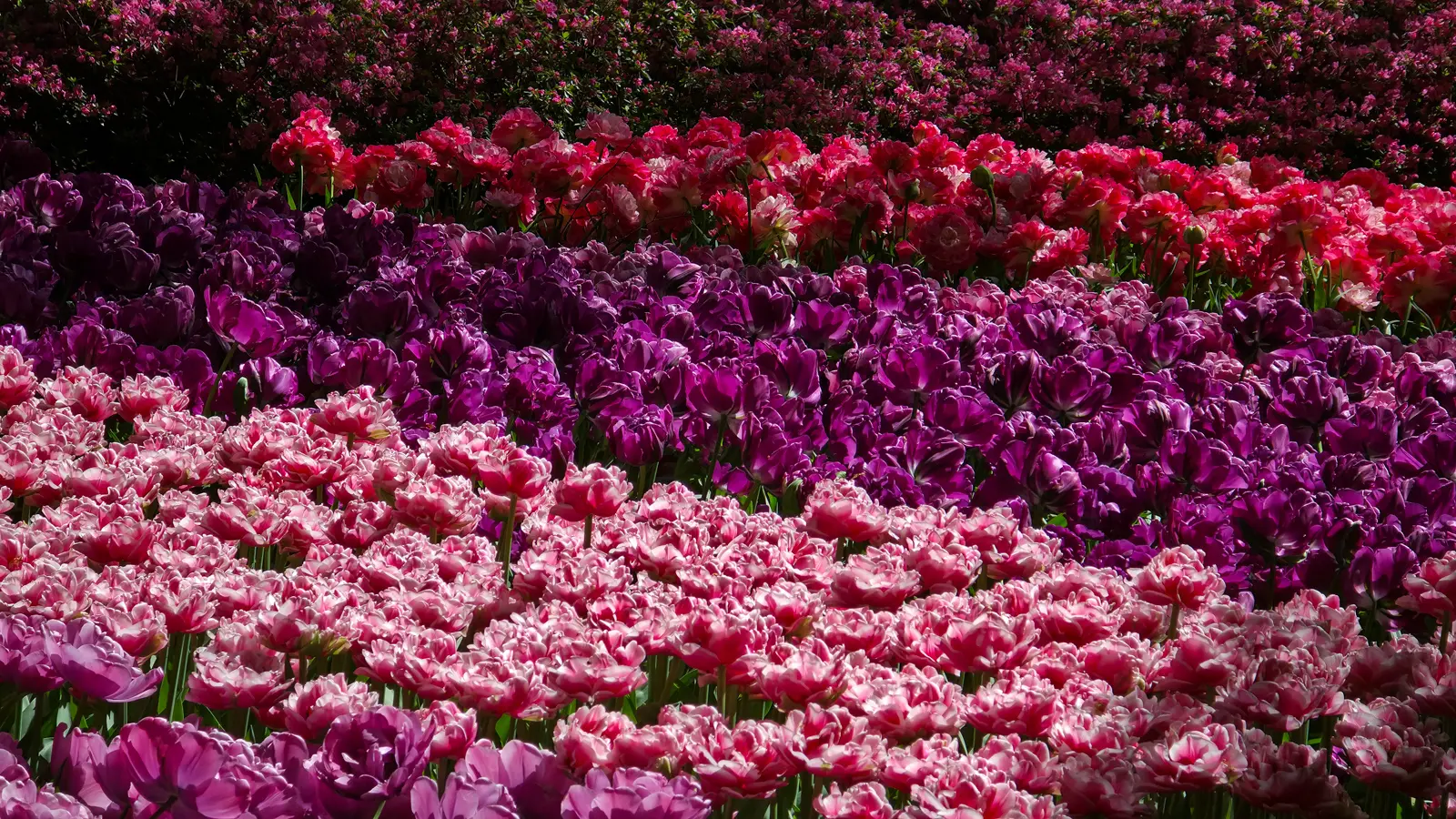
Then the doubles. These are tulips carrying so many petals they read as peonies from any distance, planted in bands of pale pink and deep purple, with coral azaleas behind them holding the composition up. It is the only stretch of this walk where the planting goes above knee height, and the only place the flowers are dense enough to hide the soil completely.
Bubbly Tips
- Do not judge a pavilion by the last one you were in. The Wilhelmina has no floral display at all. The Juliana does. I applied the first to the second and missed an orchid show.
- Check the map at the gate, not last year’s blog posts. The orchid and anthurium show normally sits in the Beatrix Pavilion and moved to the Juliana for 2026. The pavilions swap contents between seasons.
- Watch the doors. A steady stream of people leaving a building is usually an exhibition emptying out, not a queue for the toilets.
- Walk both banks of the stream. The beds are built to be read from the water, and each side gives you a different stack of colour.
- Step past the crowd. The knot of photographers forms at the widest point of the water. Twenty metres in either direction, the same planting has nobody in front of it.
- Look for the small black markers at the front of each bed if a variety stops you. They sit low, under the flower heads, and are easy to walk past.
- Time your visit to the layer you want. Early season shows you the shallowest bulbs, late April and May the deepest. A bed photographed in March is not the same bed in May.
- Allow more time than the map suggests. Fifteen kilometres of path run through the park, and the stretch between two pavilions is a walk in its own right rather than a transfer.
- Plan around the season, not the month. Keukenhof opens for roughly eight weeks a year. In 2027 that is 18 March to 9 May, daily from 08:00 to 19:00, with last entry at 18:15, and tickets going on sale from mid-October at keukenhof.nl.
- Getting there. The park is in Lisse, southwest of Amsterdam, with shuttle buses running from Schiphol and from Amsterdam RAI. Driving means a car park and a walk in; the buses set you down at the entrance.
Final Thoughts
I have been to the Canadian Tulip Festival more times than I can count, and I have stood outside a Dutch pavilion named after the woman who started it without going in. The orchid show was ten metres away, behind a door I looked at and dismissed.
Which leaves the grounds, and the grounds are the point. Seven million bulbs go into this park every autumn, three deep, planted by hand by forty people so that a stream bank in Lisse can carry three separate displays across eight weeks. Almost nobody comes to Keukenhof for the space between the pavilions. It was worth the half hour.
Until next time!

🌟 Everything You Need to Plan Your Dream Trip in 2026
- 🌟 Luxury Hotels - Find premium stays with Booking.com & Hotels.com
- 🏡 Vacation Rentals - Discover unique properties on VRBO
- 🏞️ Guided Tours - Explore with Viator or GetYourGuide
- 🎫 Attraction Tickets - Skip the lines with Tiqets
- 🚢 Ocean Cruises - Set sail with Cruise Direct
- 📱 International SIMs - Stay connected with Saily
- 🚗 Car Rentals - Budget-friendly options from Discover Cars
- 🌐 Secure VPNs - Browse safely with NordVPN
- 💶 Currency Exchange - Best rates with Wise
- 🗣️ Learn Languages - Master the local language with Babbel and Rosetta Stone