
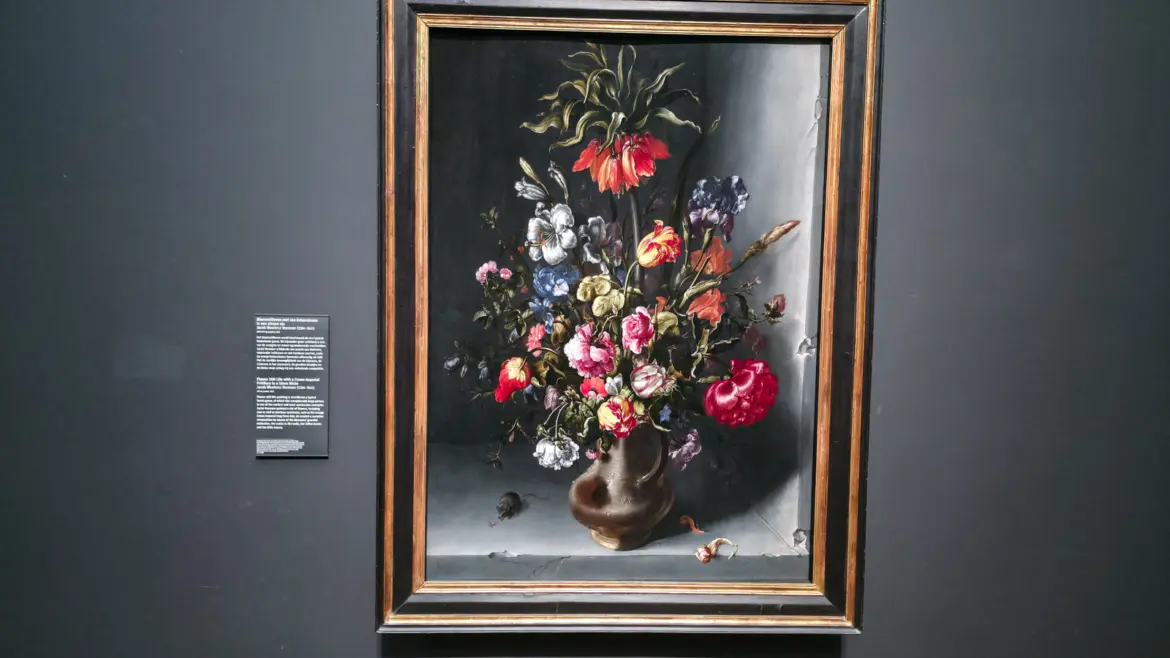
I have always been intrigued by still life paintings. I had heard they were where young artists started out, learning colour, light and texture on a bowl of fruit or a jar of flowers, and beginner art classes still start that way today. Van Gogh took a vase of sunflowers much further.
At the Rijksmuseum in late April, the still lifes from the Dutch Golden Age kept showing me things I had not expected. A mouse at the foot of a jug. A dead frog on its back. A snail on a leaf. Petals dropped on a ledge. Beetles on a tablecloth. I was sure one of the beetles was a cockroach. It was a beetle.
These painters were not amateurs, and none of these details is an accident. My first thought was that they were poking fun, refusing to dress up everyday things. The real explanation is close, but it is not mockery, and the bouquets themselves turn out to be the biggest invention on the wall.
Still Lifes at the Rijksmuseum at a Glance
🏛️ Where · The Dutch Golden Age still-life galleries on floor 2, the same level as the Gallery of Honour.
🐭 The hunt · A hidden mouse (Vosmaer), a dead frog (Marrel), a snail, beetles and a hermit crab (Van der Ast), and a cat (Maes).
🎨 The women · Clara Peeters and Rachel Ruysch — two of the genre’s leading painters, both here.
💀 Why the creatures · Vanitas — reminders that the costly, beautiful things on the table will not last.
💡 Tip · Start at the bottom edge of each painting and hunt the creature before you read the label.
A Dutch Word at the Bottom of the List
Still life as a genre of its own began in Netherlandish painting of the 1500s and 1600s. English borrowed the name from the Dutch stilleven, a term that came into use around 1650.
“Netherlandish” covers both halves of the Low Countries. Antwerp, in the Spanish-ruled south, was an early centre of still life specialists, and two of the painters in this post were Flemish by birth. Clara Peeters came from Antwerp and worked in both the south and the Dutch Republic. Pieter Claesz was born in Berchem, near Antwerp, and moved north early in the 17th century.
The academies were not impressed. In 1667 the French theorist André Félibien ranked the subjects of painting, and still life came last, below history painting, portraits, scenes of everyday life and landscape. In his view, a painter of perfect landscapes stood above one who painted only fruit, flowers or seashells. So my beginner theory had a grain of truth. In academic terms, this was the bottom rung.
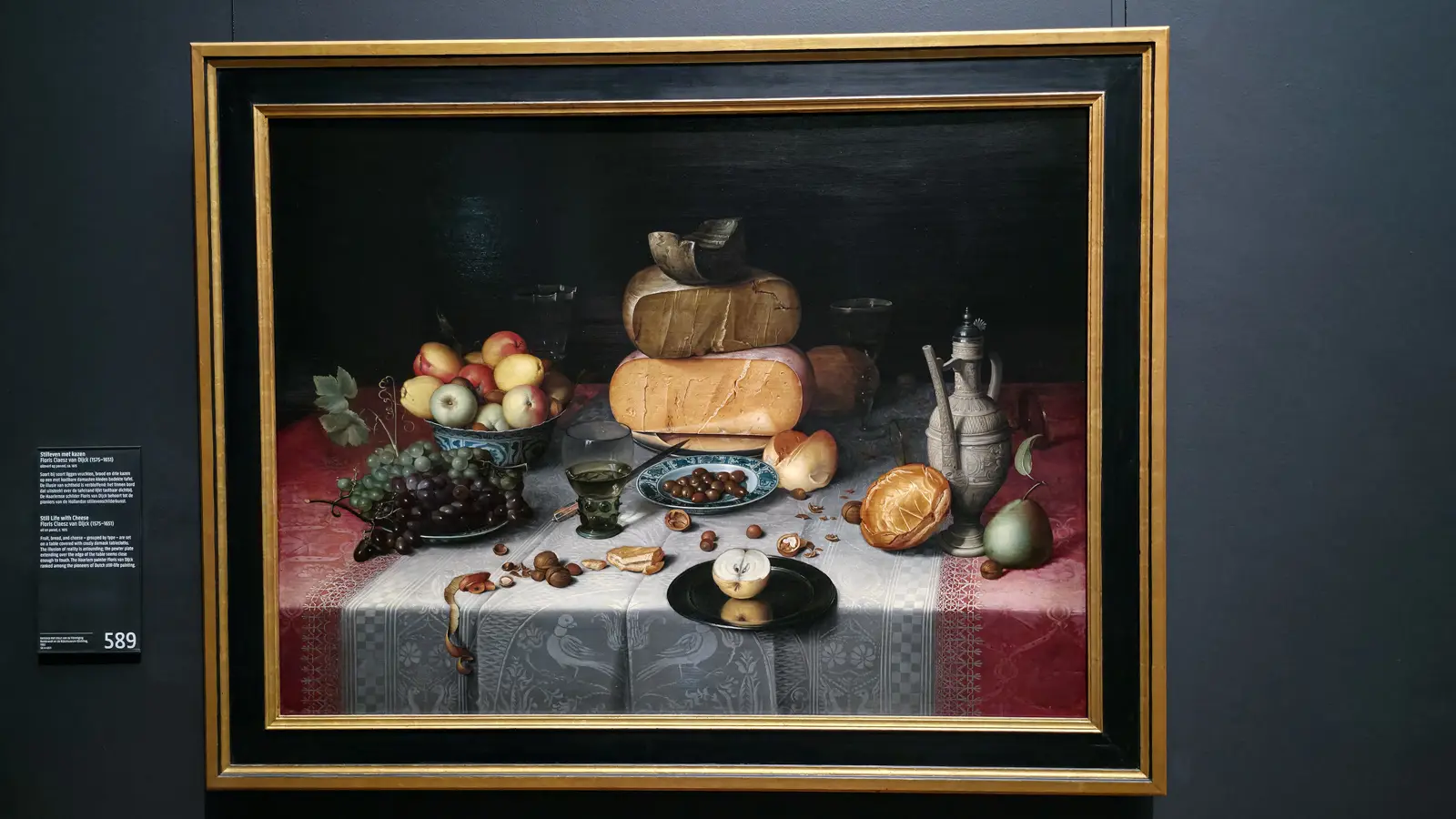
Floris van Dijck‘s Still Life with Cheese, from around 1615, shows how the early Haarlem painters worked. Fruit, bread and cheese are grouped by type on damask cloths, each item given its own space. A half apple sits on a pewter plate that juts over the edge of the table, and a curl of apple peel hangs down at the left.
The Beginner’s Genre That Wasn’t
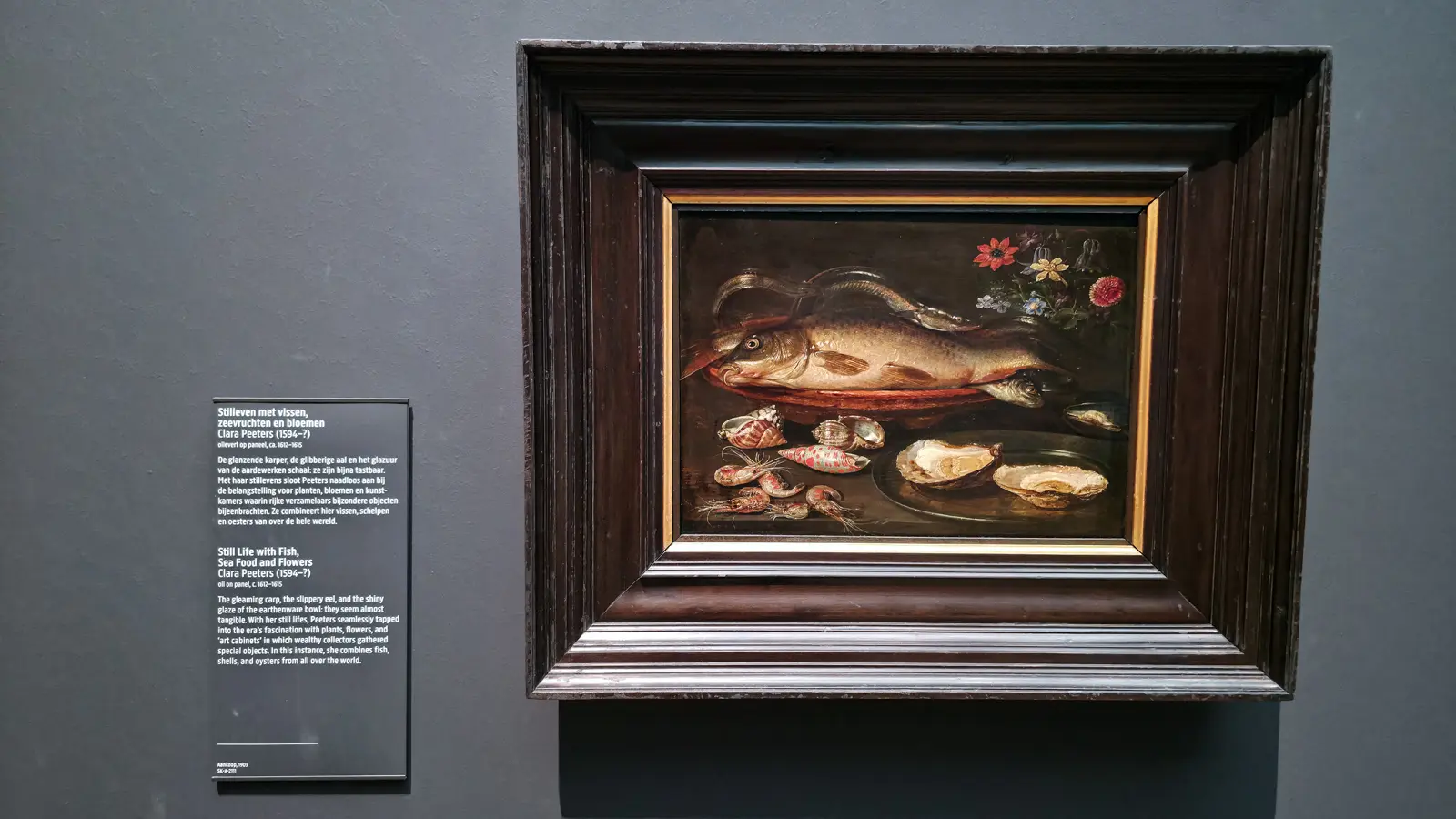
The painters themselves were nobody’s beginners. Clara Peeters signed thirty-one works with her name or “CLARA P.” and dated many of them, starting in 1607. She signed this one too. Below the prawns, along the front edge of the ledge, the faint letters CLARA are just visible. The museum label gives her birth year as 1594, with a question mark for her death, and says she brought together fish, shells and oysters from all over the world in one picture.
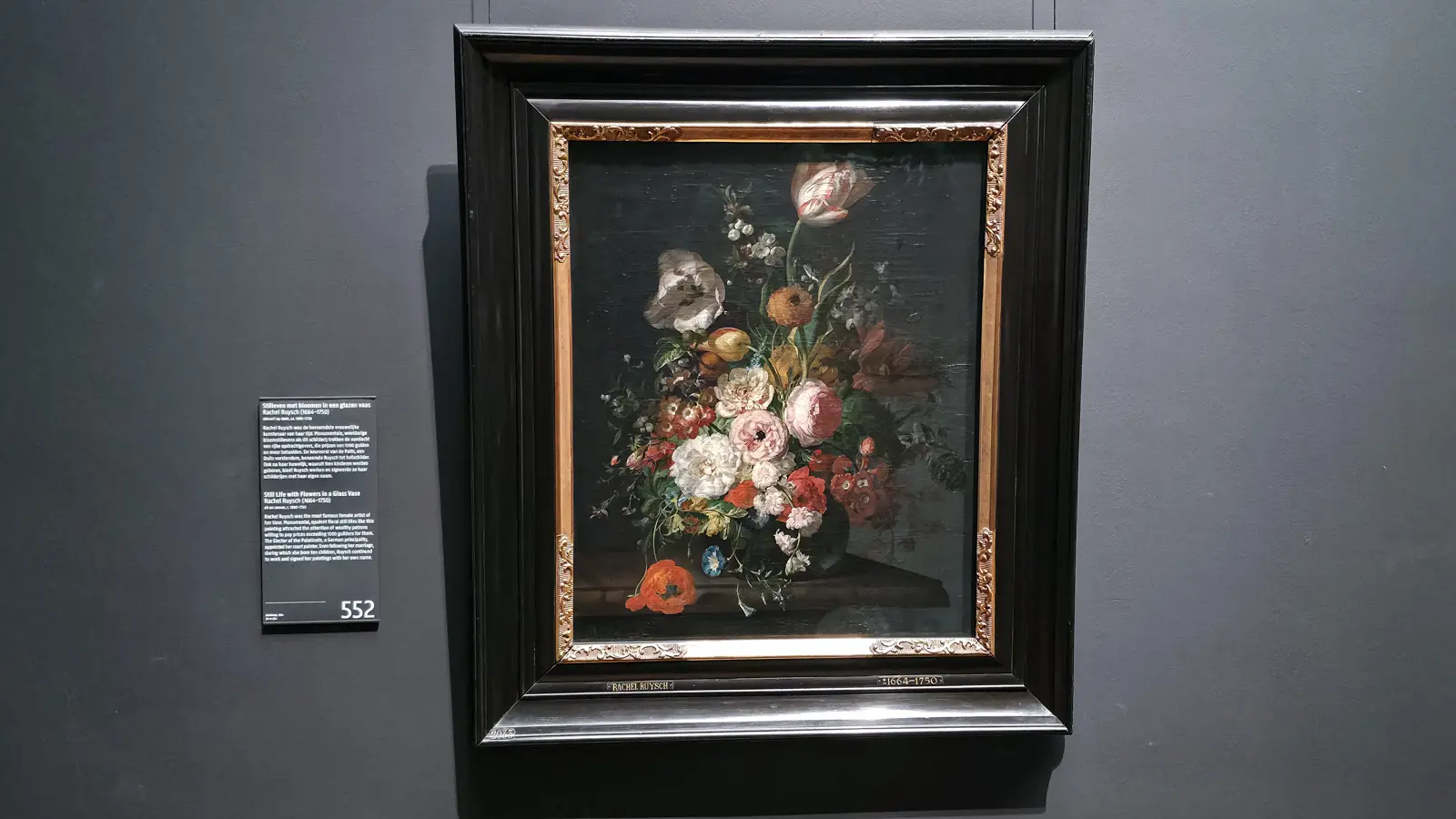
Rachel Ruysch went further. She was apprenticed at fifteen to the Amsterdam flower painter Willem van Aelst, and according to the museum label, wealthy patrons paid more than 1,000 guilders for flower pieces like this one. In 1708 the Elector Palatine, a German prince, appointed her court painter. She married the portrait painter Juriaen Pool, had ten children and kept working, and the label notes that she signed her paintings with her own name. Her name is also lettered on a plaque at the bottom of the frame.
A genre ranked last by the academy still paid its best specialists very well.
Hunting for the Hidden Creatures
The mouse at the top of this post belongs to Jacob Vosmaer, a flower painter from Delft. He added cracks to the stone niche, dropped petals and a leaf on the ledge, and put a small mouse at the lower left, its tail curling behind it. The label calls this a narrative composition but never spells the story out. The museum’s own write-up says the mouse, the cracked stonework and the fallen leaves bring the painting to life, and read as vanitas, they are a reminder that the splendid bouquet above them will not last.
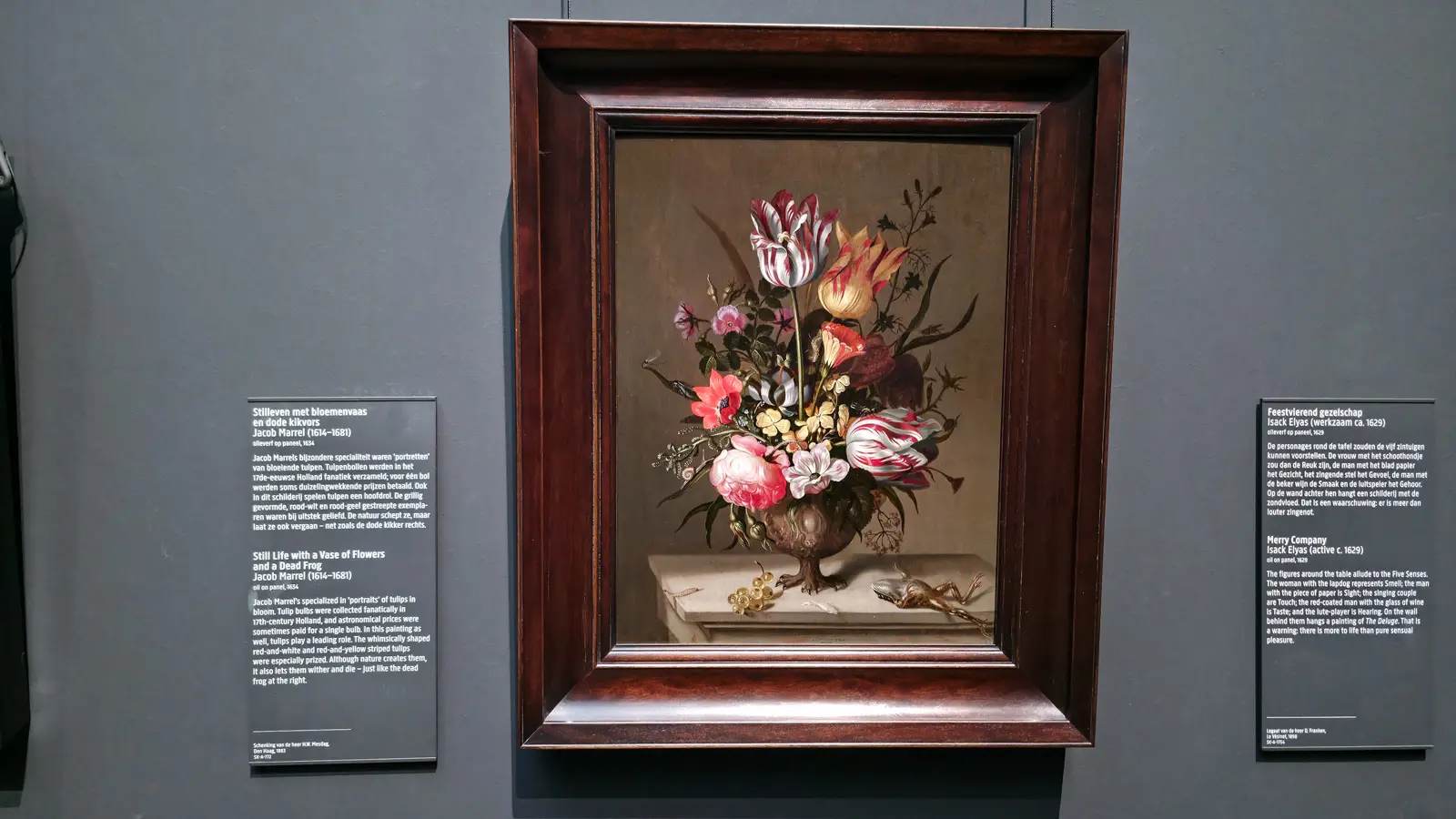
Jacob Marrel‘s vase, dated 1634, has the dead frog. It lies on its back at the right end of the ledge, legs splayed. On the left, a small snail climbs a leaf below the pink rose, and a winged insect perches on a drooping bud above it. Marrel was German-born and worked in Utrecht. The label says his speciality was “portraits” of tulips in bloom, and that red-and-white and red-and-yellow striped tulips were the most prized.
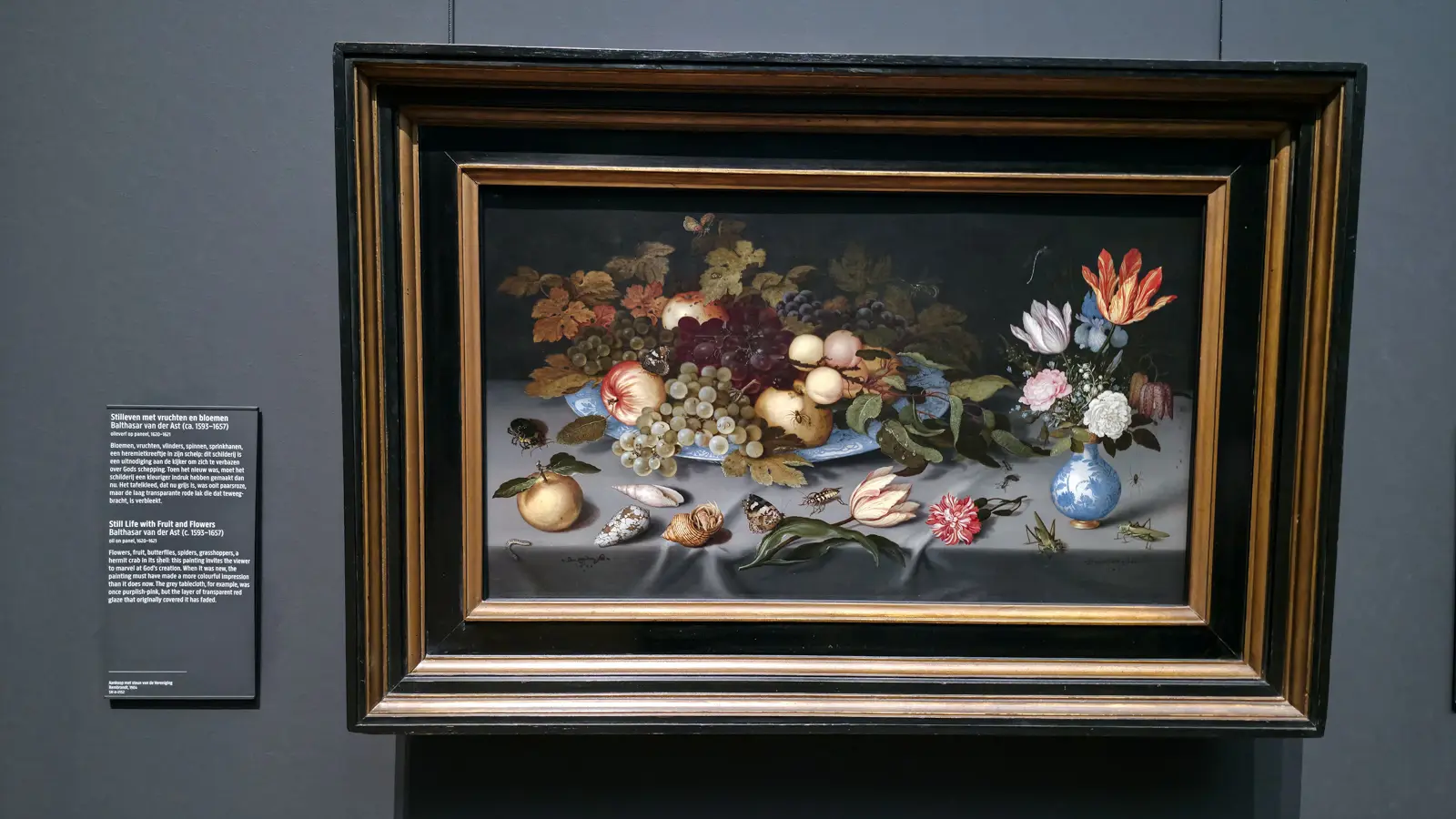
Balthasar van der Ast packed the most into a single panel. The label lists flowers, fruit, butterflies, spiders, grasshoppers and a hermit crab in its shell. Up close there is a green-gold beetle at the left edge of the cloth, a striped beetle beside the butterfly, a spider on the pear, a caterpillar at lower left and the hermit crab peering out of a spiral shell. Somewhere among them is my “cockroach”.
The label adds one more hidden detail. The grey tablecloth was once purplish-pink, but the layer of transparent red glaze that gave it that colour has faded.
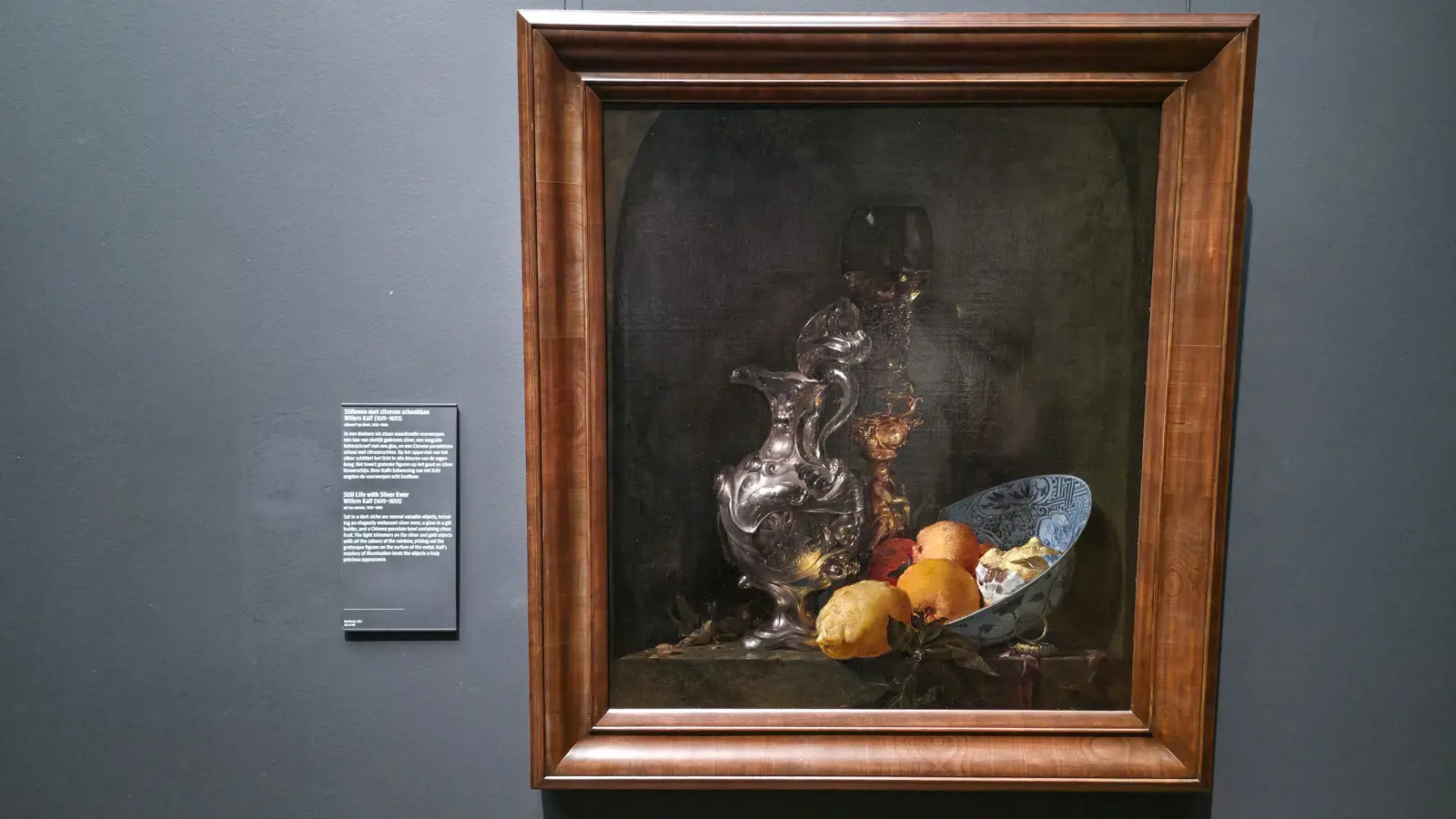
Not every hidden detail is alive. Willem Kalf‘s Still Life with Silver Ewer, painted between 1655 and 1660, sets a silver ewer, a glass in a gilt holder and a blue-and-white bowl of citrus fruit in a dark niche. At the lower right, half hidden by the bowl, a gold pocket watch lies open on a pink ribbon. A watch measures time passing, which puts this quiet table in the same company as the frog.
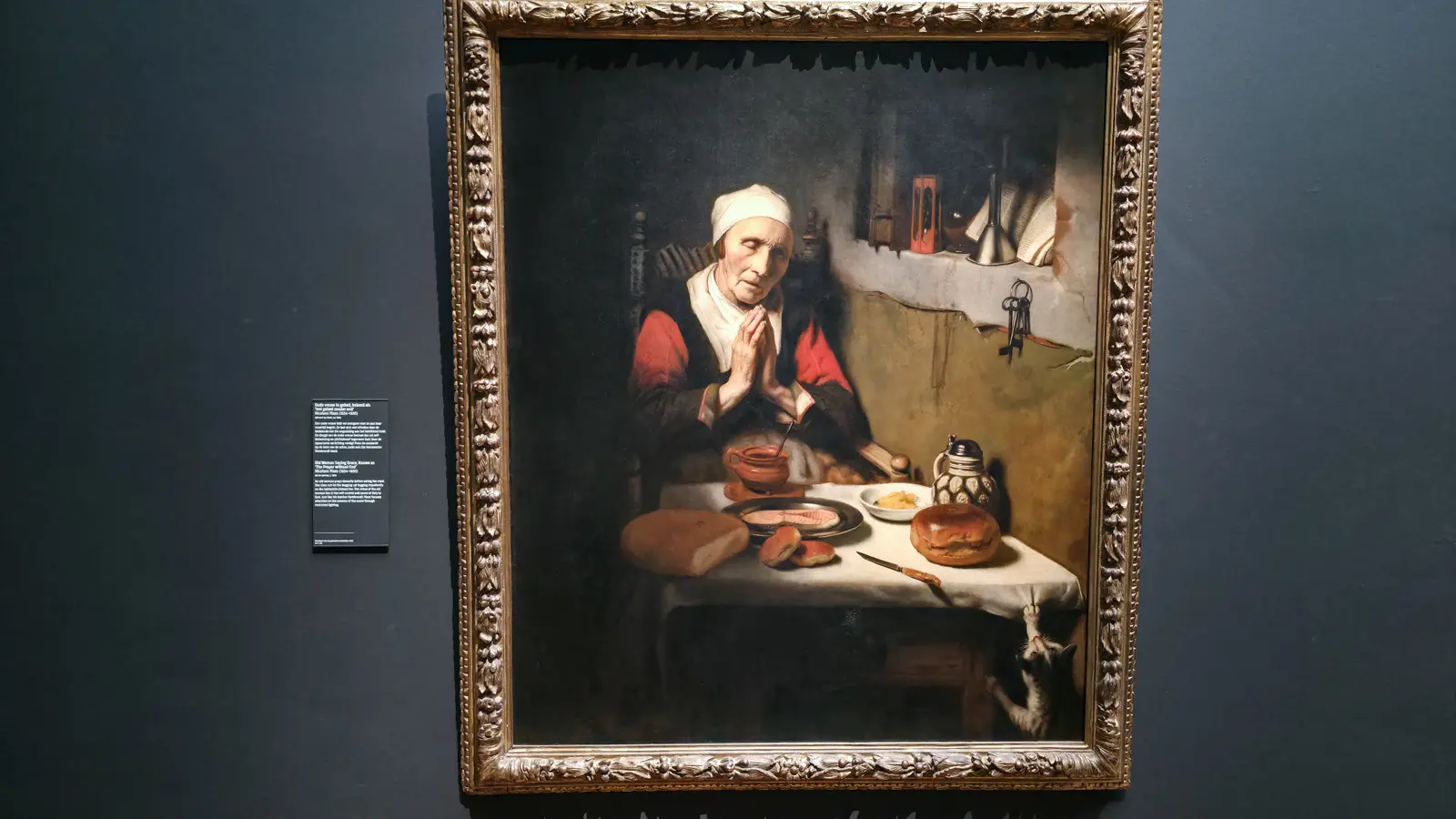
The last creature is in a painting that is not a still life at all. Nicolaes Maes, a pupil of Rembrandt, painted Old Woman Saying Grace, known as The Prayer without End, around 1656. She prays with her eyes closed over a table of bread and fish. Under the table, a cat claws at the cloth. The museum reads the scene as a lesson in self-control, since she does not let the begging cat distract her. A niche behind her holds a funnel and an hourglass, and keys hang on the wall below it.
Mockery or Memento Mori?
My mockery theory was half right. Art historians call this vanitas, from the Latin for vanity or emptiness. In the 1600s, Dutch still life was often tied to material decay and the futility of worldly life, and insects, wilted petals and spotted fruit were among the standard signals. The frog, the mouse and the fallen petals are reminders that the beautiful things on the table will not last, and neither will the people who own them.
The Marrel label says it outright. Nature creates the tulips, and nature also lets them wither and die, just like the frog on the right.
Not every insect carries a sermon, though. The National Museum of Women in the Arts describes one of Peeters’ breakfast pieces, a fish still life with a cat, as a straightforward picture of household abundance with no moral subtext. Some of these details may simply be good observation.
Bouquets That Never Bloomed Together
This is where my theory needed turning around. I had assumed the painters refused to embellish. In fact the bouquets are inventions. The flowers in many Dutch flower pieces bloom in different seasons and could never have stood in one vase together. The National Gallery of Art in Washington says this of a bouquet by Jan Davidsz de Heem, and the Rijksmuseum says the same of Vosmaer’s. Painters worked from studies of individual flowers and assembled the arrangement on the panel.
Tulips made the fantasy expensive. The Marrel label says tulip bulbs were collected fanatically in 17th-century Holland, and that some sold for astronomical sums. Marrel also painted watercolour “tulip books” that dealers used to show buyers what a bulb would look like in flower. The bulb market crashed in 1637.
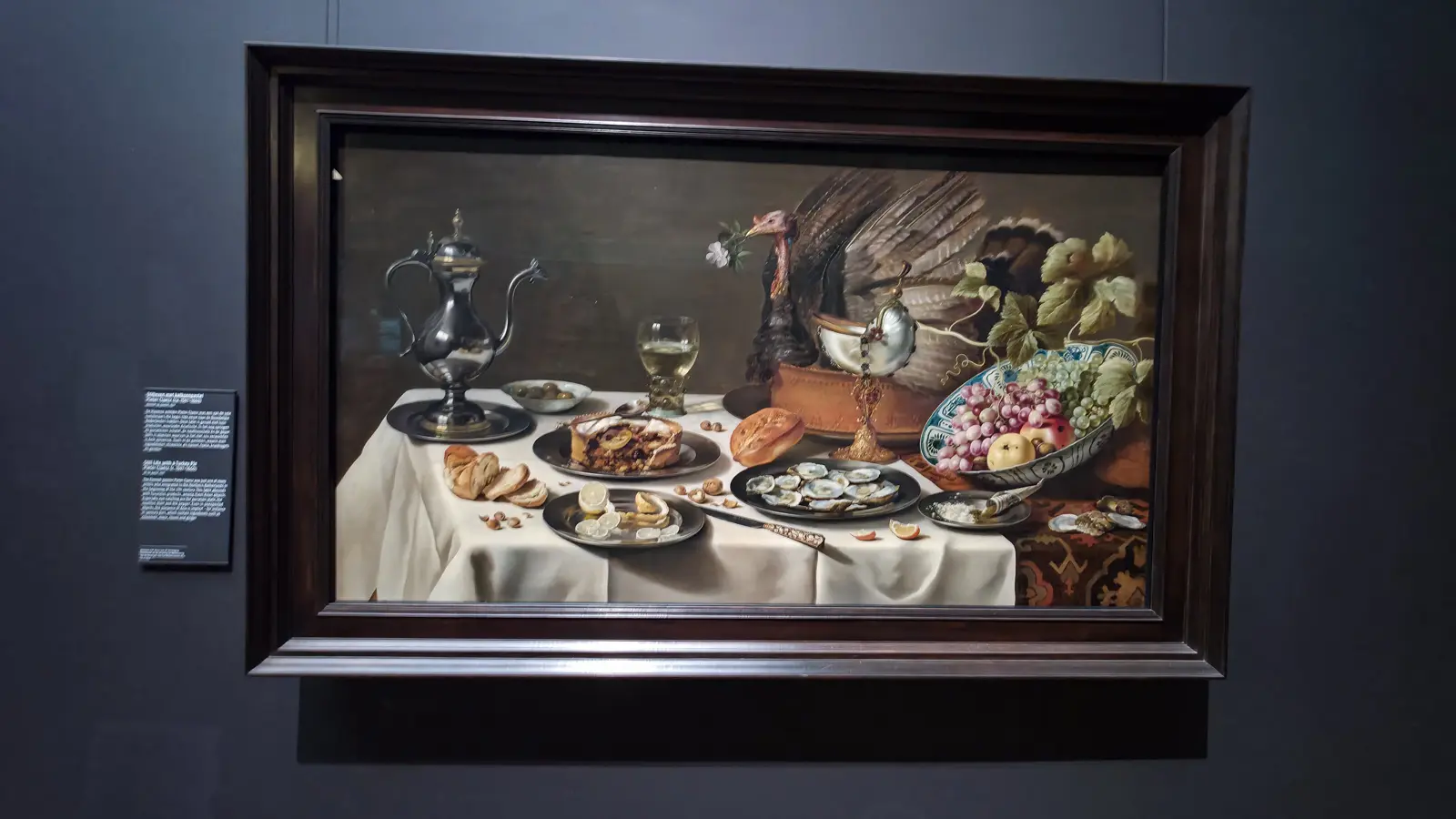
The table pieces play the same game with food. Pieter Claesz‘s Still Life with a Turkey Pie, from 1627, piles luxury onto one cloth: a silver jug, oysters, a half-peeled lemon, a nautilus cup, a blue-and-white bowl of grapes, and a pie topped with the turkey’s own head and feathers. The Rijksmuseum points out that turkey came originally from North America, and that nutmeg was among the spices in the pie. A paper cone of spice sits on a small plate at the right.
Bubbly Tips
- Photograph freely, but leave the flash off. The Rijksmuseum lets ticket holders take photos, with no tripods and no extra lighting. Photography is not allowed in the exhibition wing or the Cuypers Library.
- Start at the bottom edge. The mouse, the frog, the open watch and Maes’ cat all sit in the lower part of their pictures.
- Hunt first, read second. The Vosmaer label names the mouse and the Marrel label names the frog, so look for the creature before you read the card.
- Use your phone’s zoom. The beetles and the spider on the Van der Ast cloth are small at normal viewing distance. A zoomed photo shows the caterpillar and the hermit crab clearly.
- Look for signatures. Peeters’ CLARA runs along the front of the ledge, and Van der Ast signed in small script near the bottom left of his cloth.
- Check the reflections. In Kalf’s ewer, the silver picks up the yellow of the lemon beside it.
- Read the frames too. Ruysch’s frame carries her name and dates on small plaques along the bottom.
- Pair it with the Van Gogh Museum. Both museums sit on Museumplein, so Van Gogh’s Sunflowers make a natural next stop after the Rijksmuseum’s flower pieces.
Final Thoughts
I came in thinking still life was where painters practised. It turns out to be where they showed off. A mouse, a frog and a beetle I mistook for a cockroach turned a wall of bouquets into a scavenger hunt, and the reason those creatures are there is older and more serious than my guess at mockery.
The academy put still life at the bottom of its list in 1667, and collectors paid Rachel Ruysch more than 1,000 guilders for a vase of flowers anyway. Since the bouquets never existed in the first place, the dead frog might be the most honest thing on the panel.
Until next time!

🌟 Everything You Need to Plan Your Dream Trip in 2026
- 🌟 Luxury Hotels - Find premium stays with Booking.com & Hotels.com
- 🏡 Vacation Rentals - Discover unique properties on VRBO
- 🏞️ Guided Tours - Explore with Viator or GetYourGuide
- 🎫 Attraction Tickets - Skip the lines with Tiqets
- 🚢 Ocean Cruises - Set sail with Cruise Direct
- 📱 International SIMs - Stay connected with Saily
- 🚗 Car Rentals - Budget-friendly options from Discover Cars
- 🌐 Secure VPNs - Browse safely with NordVPN
- 💶 Currency Exchange - Best rates with Wise
- 🗣️ Learn Languages - Master the local language with Babbel and Rosetta Stone