
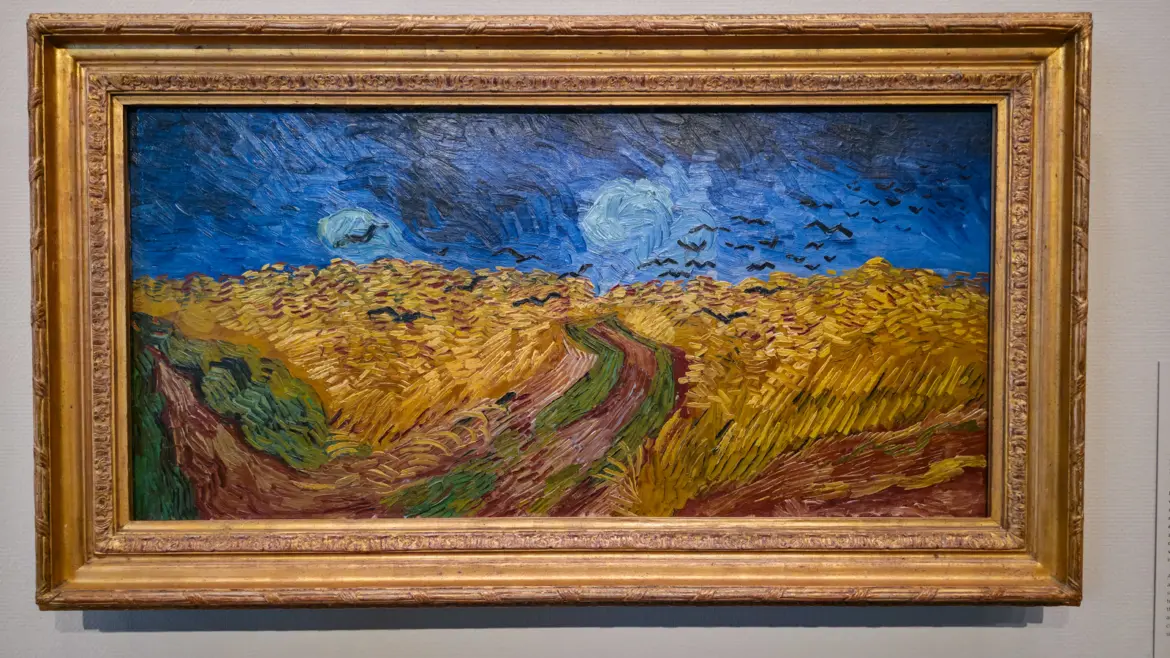
On 28 April I spent an afternoon at the Van Gogh Museum in Amsterdam, and I left with one idea I could not put down. His landscapes show how he became Van Gogh. The colour arrives first, from the Impressionists and the painters around them in Paris. The brushstroke comes later, and by the end it carries the whole painting.
The museum makes this easy to follow, because it hangs his work in the order he painted it. I photographed the landscapes as I went, and I’ve put them below in the order he made them, from Paris in 1886 to Auvers-sur-Oise in 1890.
Van Gogh’s Landscapes at a Glance
🎨 The arc · The colour arrives first, in Paris (1886–88), from the Impressionists and Seurat’s dots; the thick brushstroke comes later and, by Auvers, carries the whole painting.
🖼️ In order · The Van Gogh Museum hangs his work chronologically — so the landscapes read as a timeline from the grey 1886 Montmartre to the blazing 1890 wheatfields.
🌾 The myth · Wheatfield with Crows is often called his last painting. The museum says otherwise — he made several more cheerful works after it. The idea stuck partly from the 1956 film Lust for Life.
📐 Double-squares · In his final weeks he used a stretched canvas twice as wide as it is tall; about thirteen Auvers landscapes are on that format.
💡 Tip · Look for the small Seurat hung directly under Van Gogh’s Bank of the Seine — the clearest lesson in the building on where his Paris brushwork came from.
Where He Started
Van Gogh arrived in Paris in 1886 with a Dutch palette. His peasant paintings from Nuenen are built from browns, greys and earth colours, and The Potato Eaters, finished in April 1885, is almost entirely shades of brown. A year earlier he had written that he really was a peasant painter, at home in the countryside. Paris was the centre of modern art, and he went to catch up.
He stayed until February 1888, and those two years transformed his style. He saw the Impressionists’ bright palettes and loose brushwork for himself, along with the newest experiments of Georges Seurat and Paul Signac, who built pictures out of small dots of unmixed colour. He made friends of his own generation too, including the painter Émile Bernard. The museum’s wall text puts it plainly: face to face with the Paris avant-garde, he realised how old-fashioned his Dutch work must have looked. He tested the new ideas on self-portraits as well as landscapes, and the change shows in his own face as clearly as in his fields.
Paris, 1886: Still Dutch
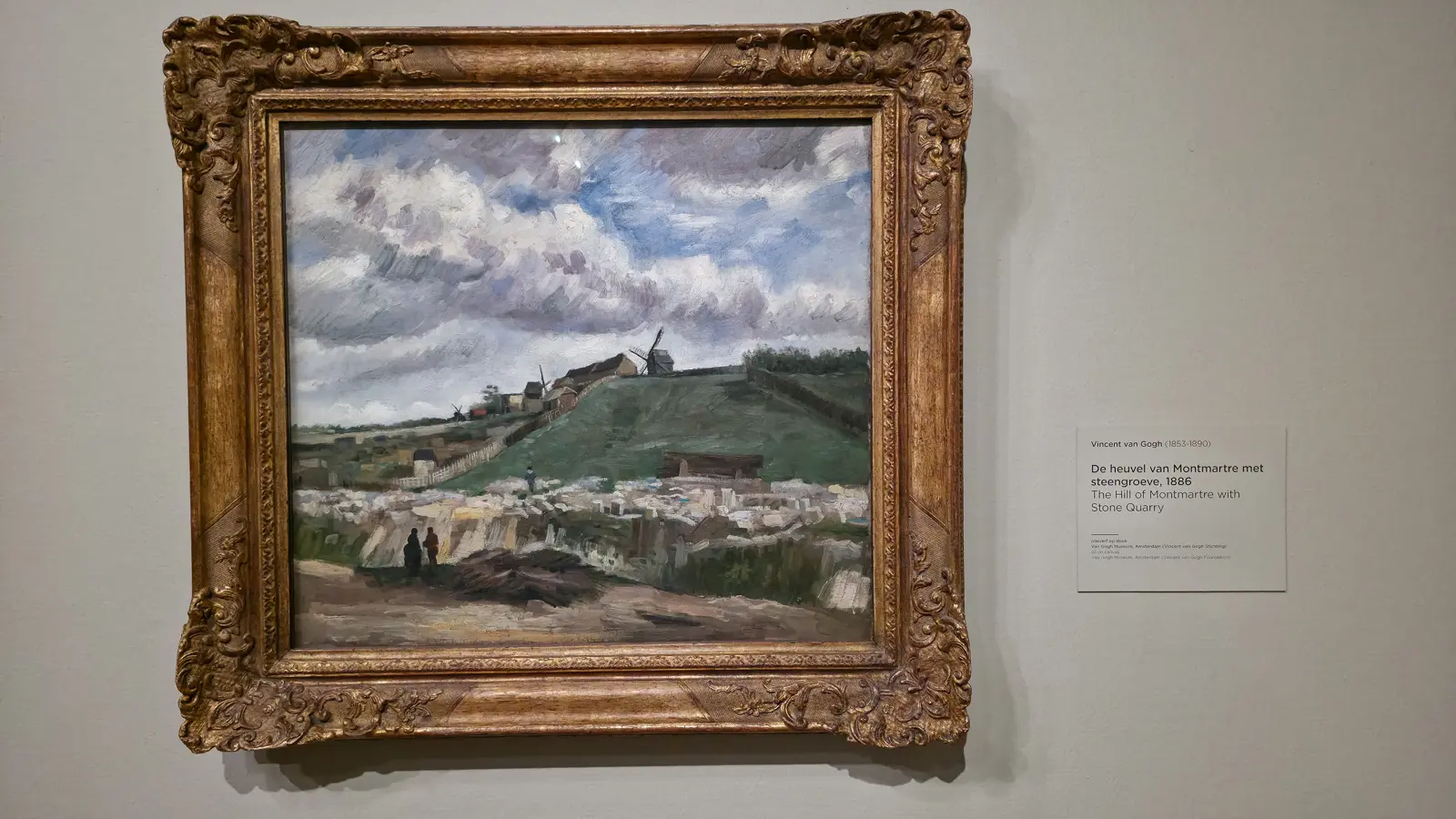
The earliest landscape I photographed is The Hill of Montmartre with Stone Quarry, from 1886. The sky is grey and white. The hill is a flat green, and the quarry in front is a spread of pale stone blocks and brown wood. Two small dark figures stand in the foreground. It is a Paris subject in the colours he brought from home.
What He Saw in Paris
The museum hangs work by other painters beside his own, and two of them sit close to his Paris landscapes.
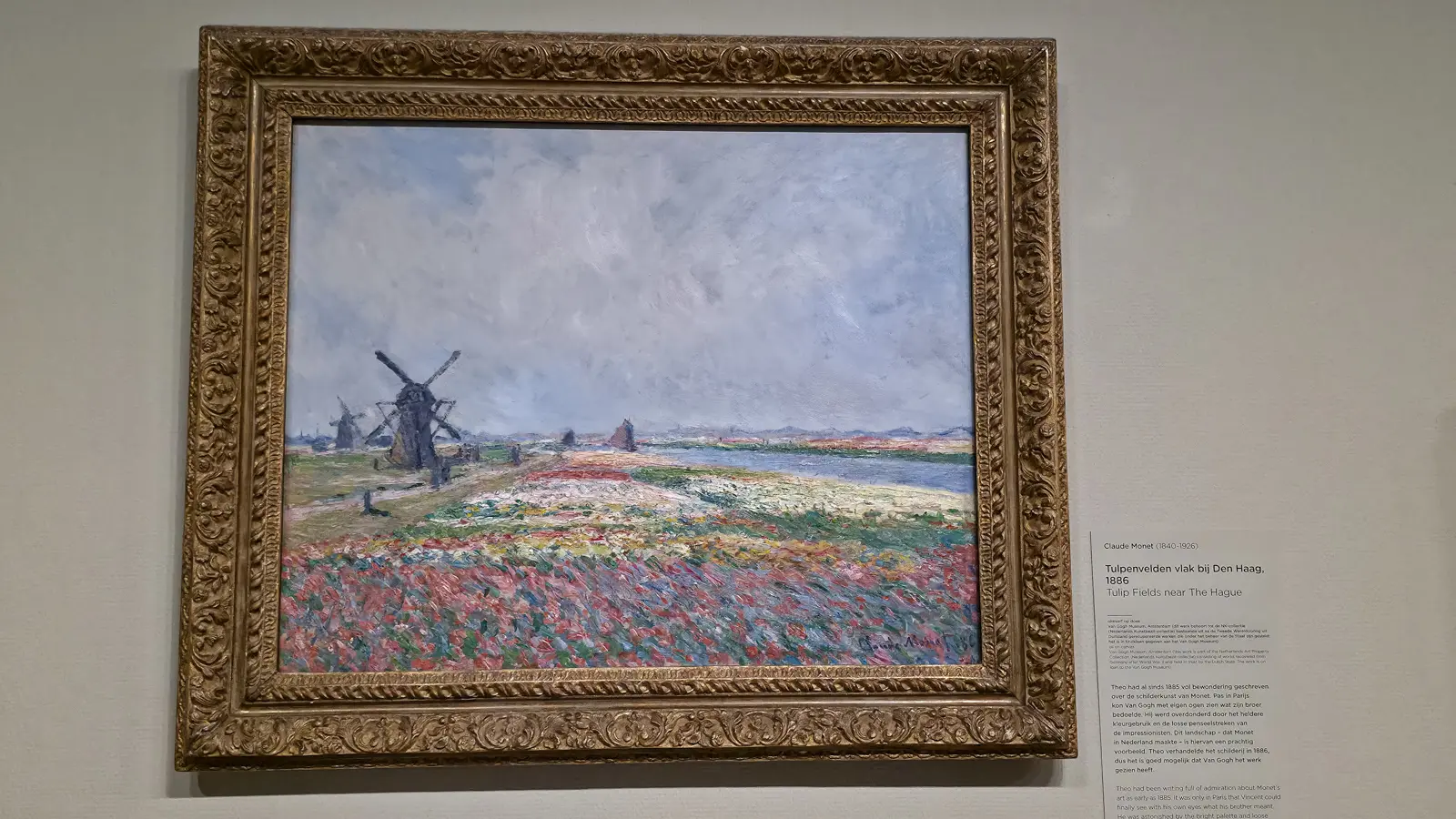
Claude Monet‘s Tulip Fields near The Hague is from 1886. Theo was an art dealer in Paris, and the museum label says he sold this painting that year, so it is possible Vincent saw it. Theo had been writing to him about Monet since 1885. In Paris, Vincent could finally see the bright palette and loose brushwork for himself.
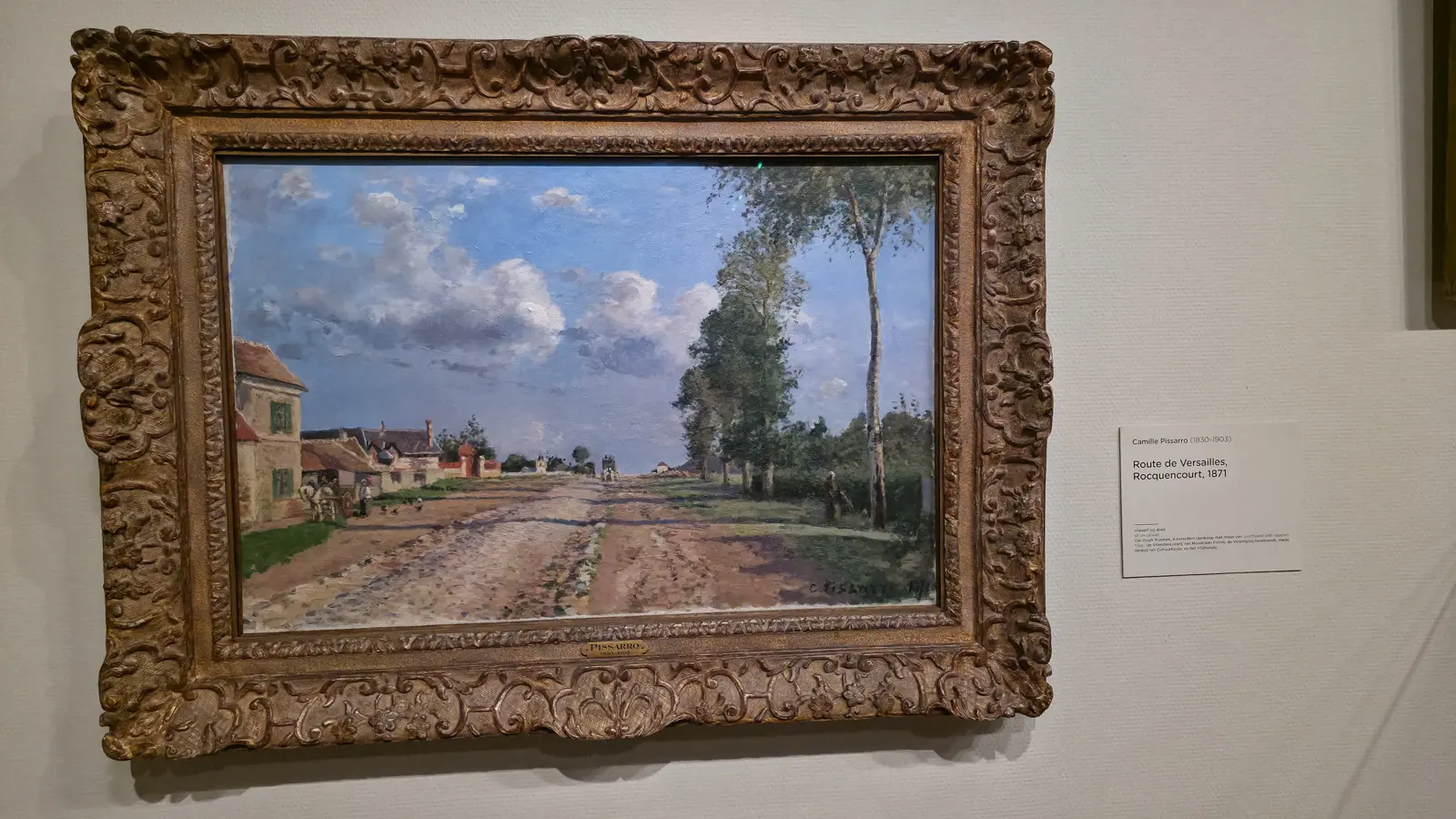
Camille Pissarro‘s Route de Versailles, Rocquencourt is older, from 1871. Nothing on the label connects Van Gogh to this particular canvas. It hangs here because Pissarro’s kind of painting is what he met in Paris: open air, broken colour, and light on an ordinary road. Pissarro’s work was among the influences he absorbed in those years.
Paris, 1887: Taking Liberties With Dots
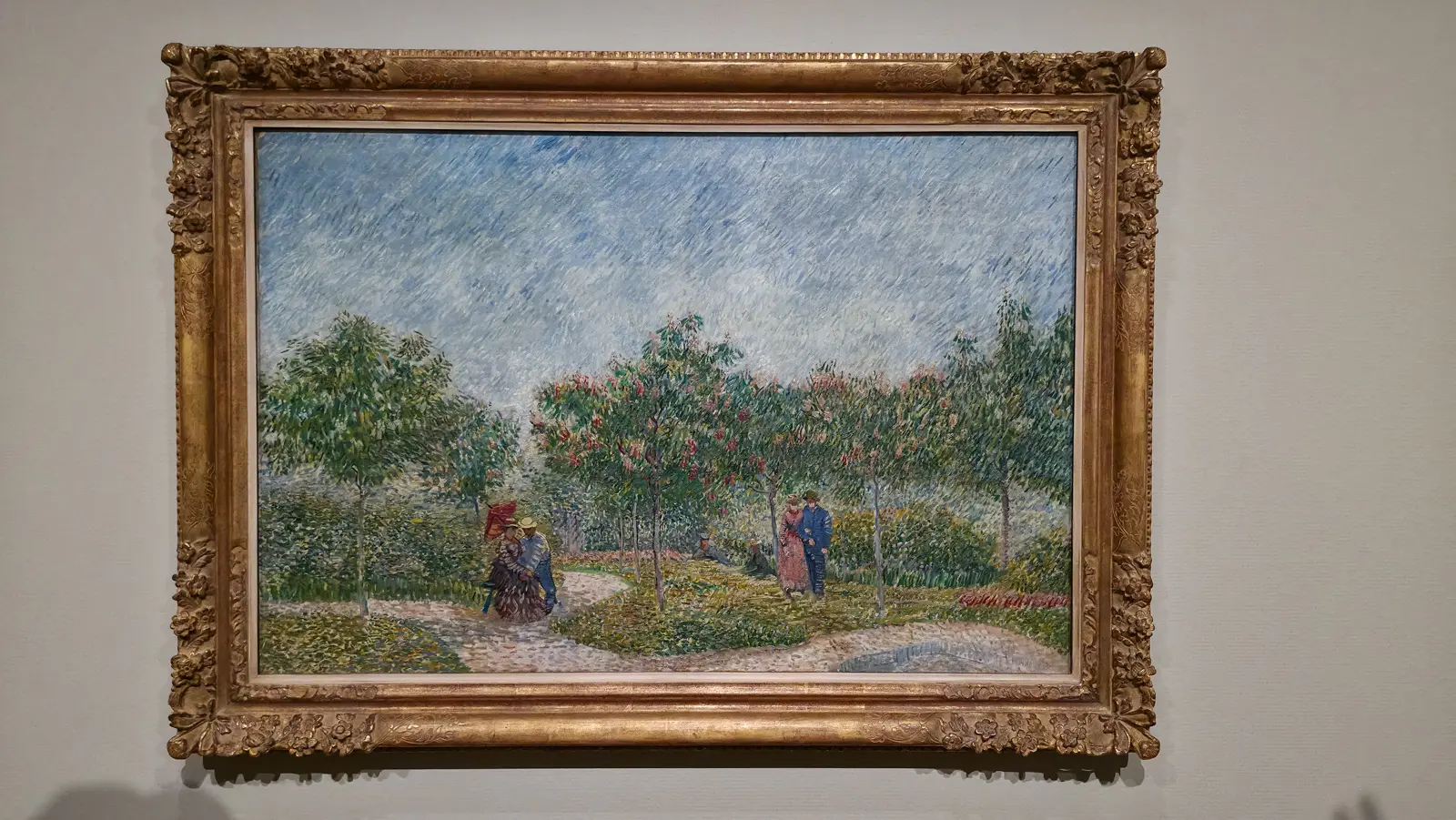
By 1887 the change is obvious. Van Gogh called Garden with Courting Couples: Square Saint-Pierre “the painting of the garden with lovers”. The sky is built from short blue and white strokes laid on a slant. The trees are dabs of green and pink. The label says he took liberties with the Pointillist technique of coloured dots, and in my photo that is exactly what it looks like: dots stretched into dashes.
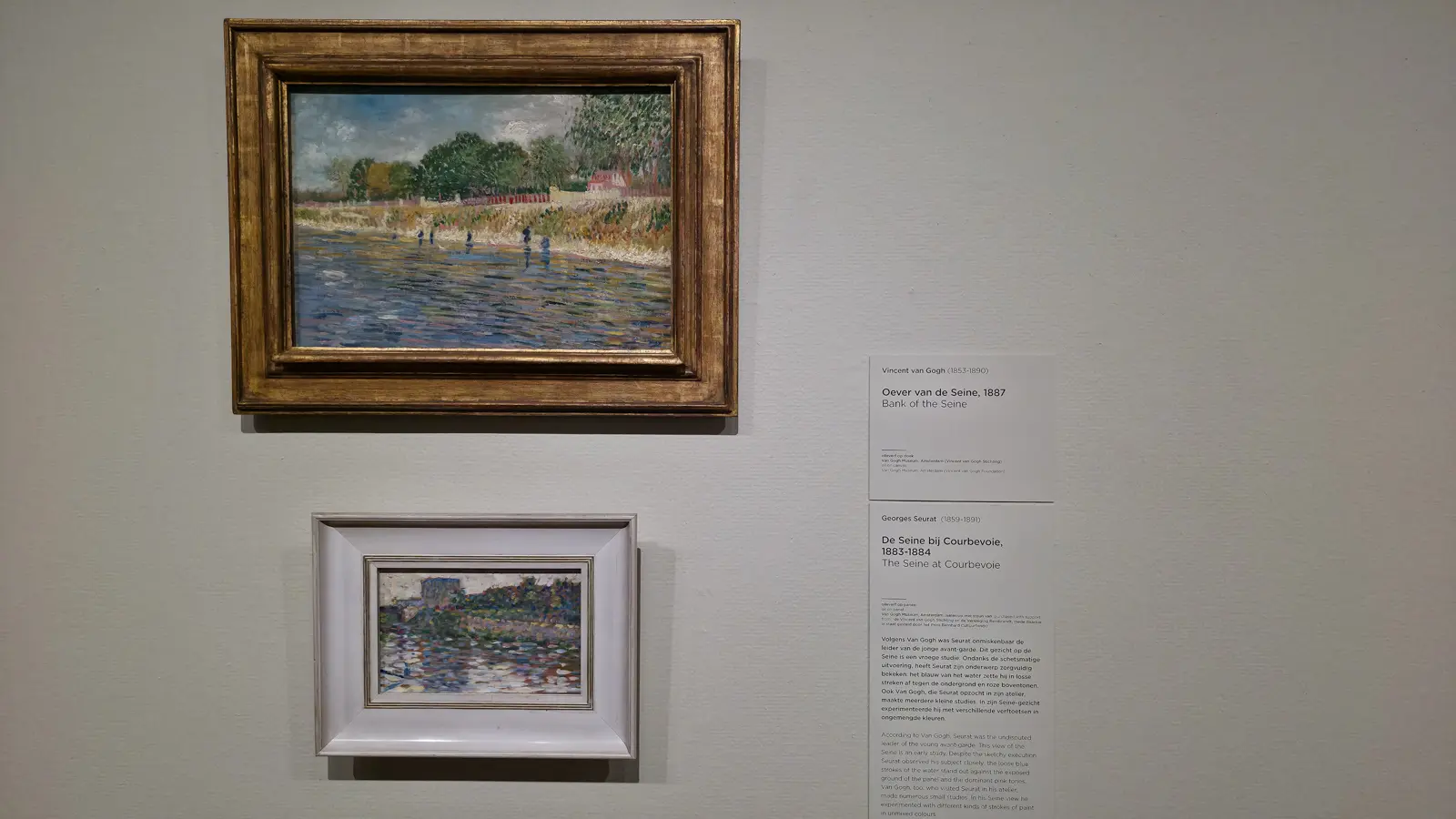
Two parts of this story hang on one wall. Van Gogh’s Bank of the Seine (1887) sits directly above Georges Seurat’s The Seine at Courbevoie (1883 to 1884). According to Van Gogh, Seurat was the leader of the young avant-garde, and the label notes that Van Gogh visited him in his studio. In his own Seine view he tried out different strokes in unmixed colours: long flat bands in the water, small dabs in the trees.
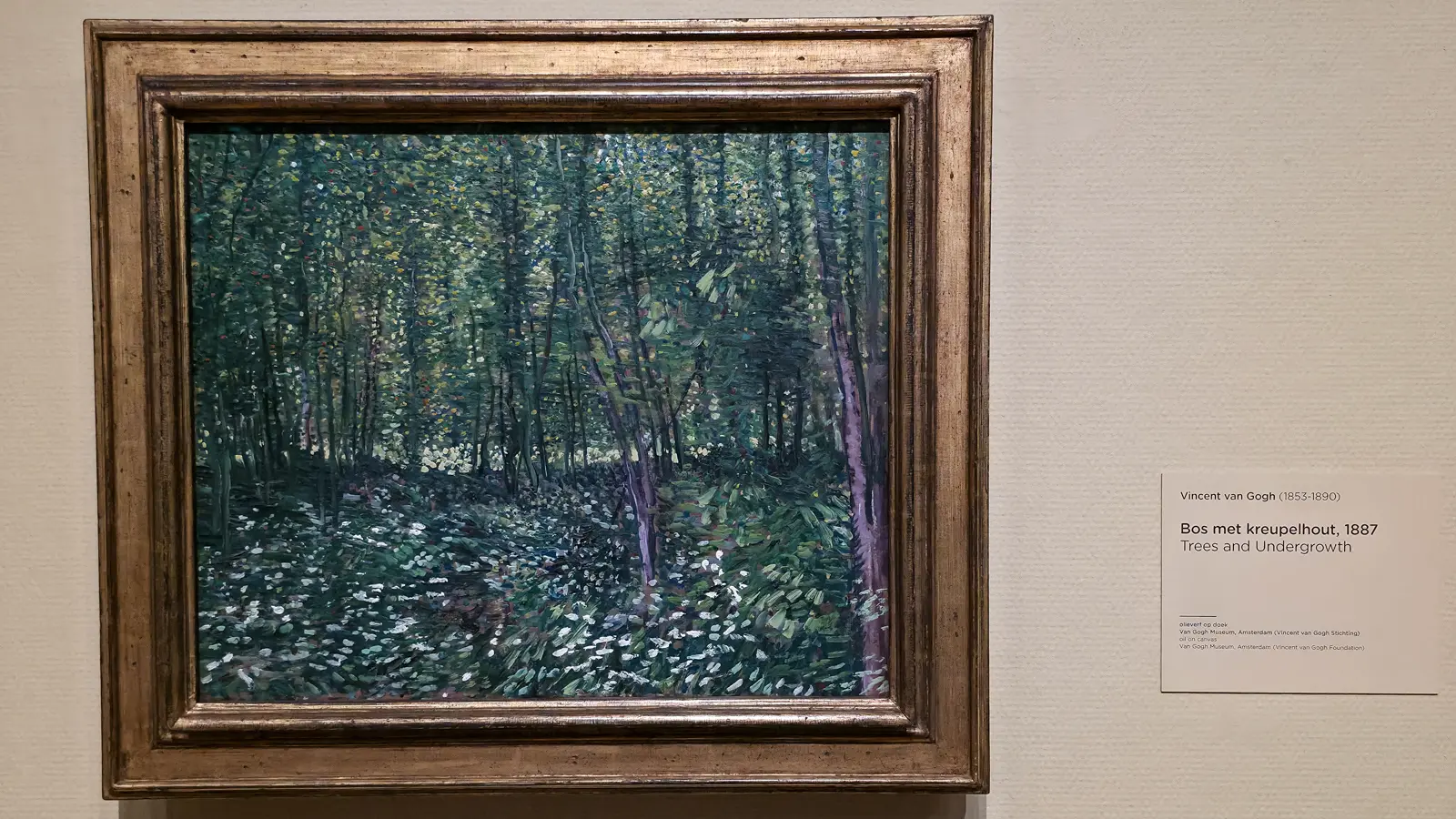
Trees and Undergrowth, from summer 1887, is the stippling at full strength. The museum describes the whole canvas as covered in small dots of paint. The floor of the wood is white and green flecks, and a pale band in the middle suggests light in a clearing.
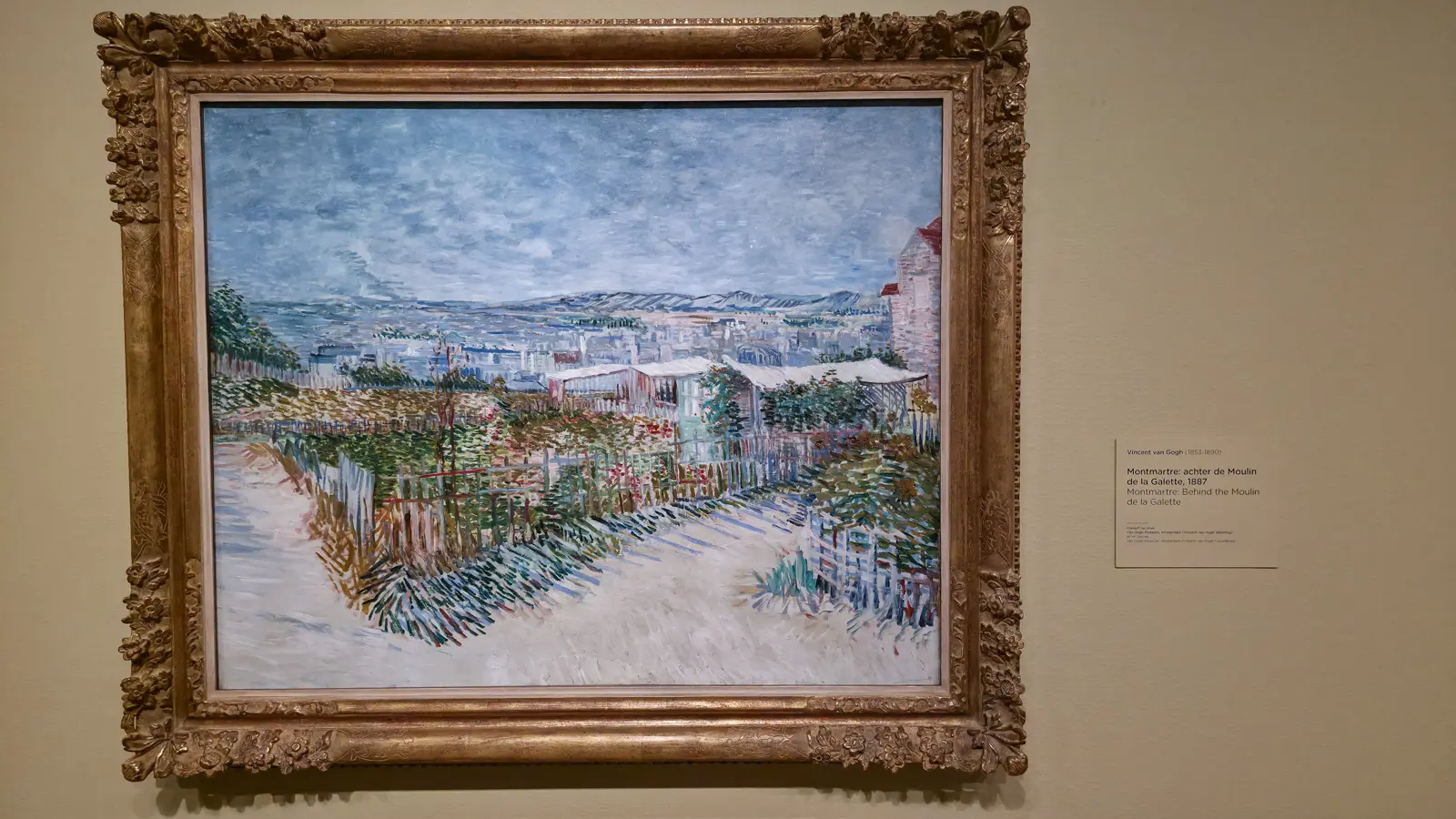
Montmartre: Behind the Moulin de la Galette, from July 1887, goes back to the hill he painted a year earlier. The quarry painting is grey and brown. This one has a white path with blue shadows cut into it, fenced gardens in green and red, and Paris spread out behind.
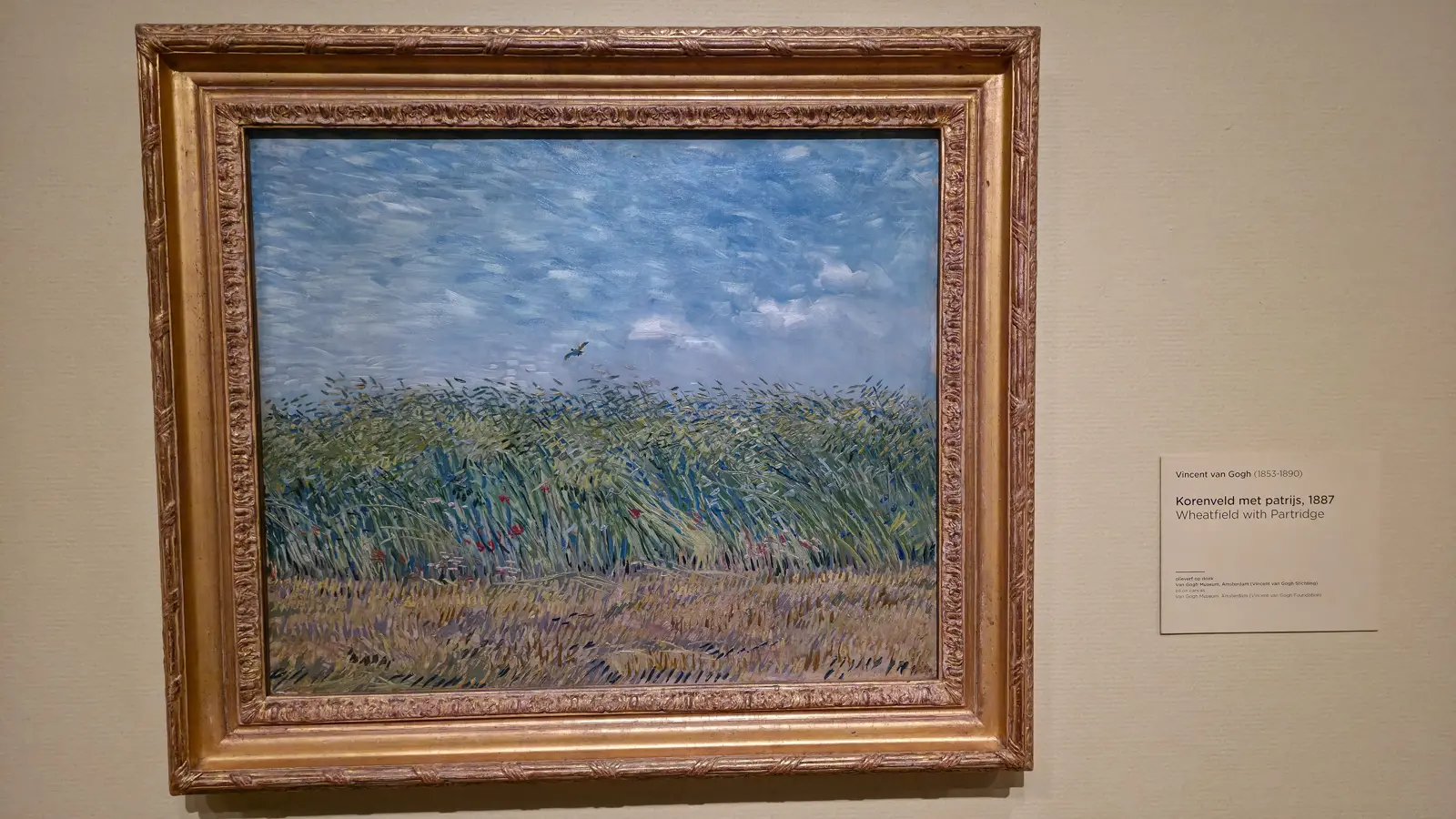
Wheatfield with Partridge, from summer 1887, points furthest ahead. The wheat bends in long strokes of green and blue, with flecks of red near the base, and a single bird flies up out of the field. Before Paris, country life had been his main subject. The museum calls this painting a brief return to it.
Five paintings from one year in Paris, and each one tries something different.
Arles, 1888
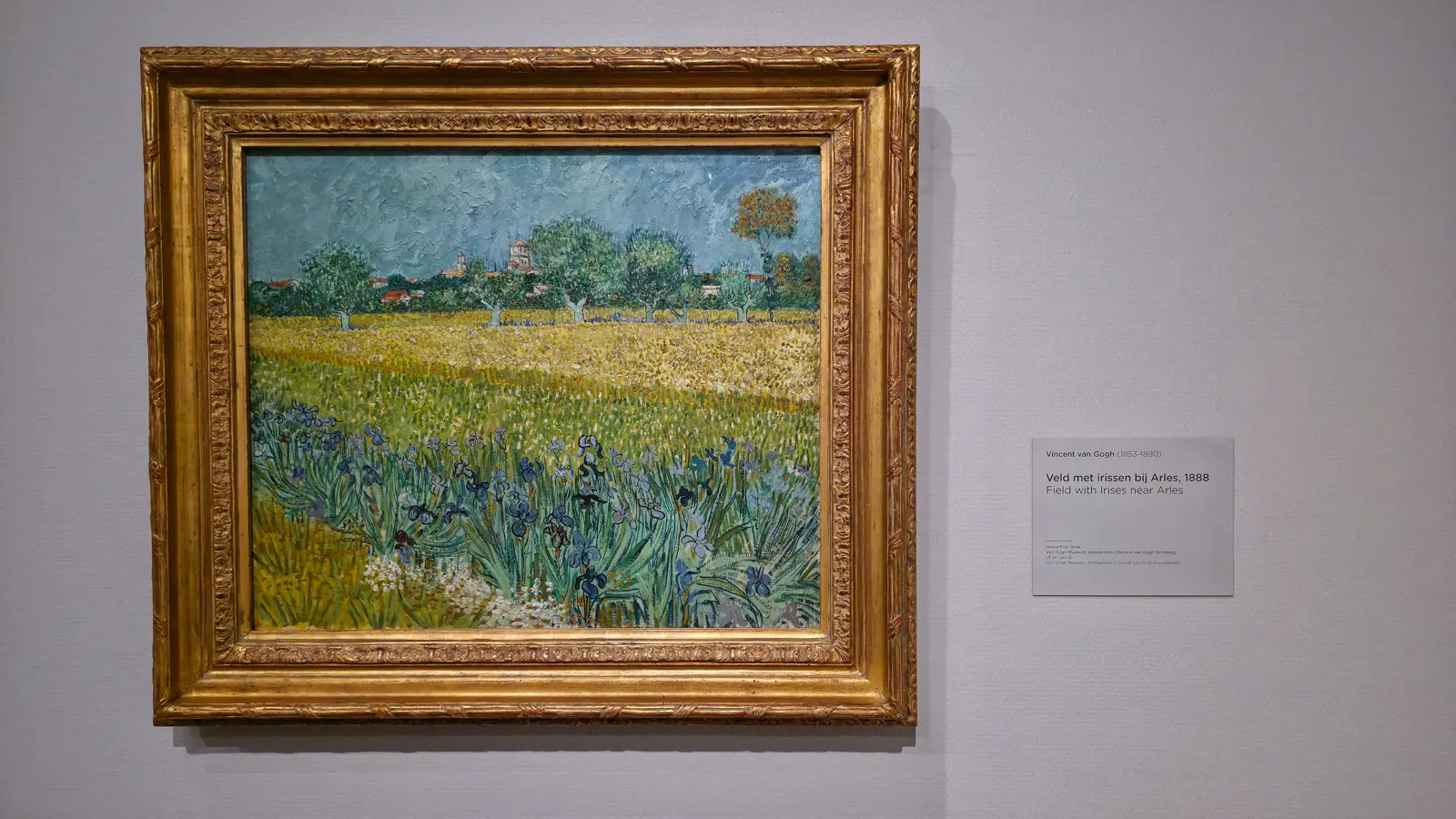
In February 1888 he left Paris for Arles in the south of France. Field with Irises near Arles is from May that year. On 12 May he described it to Theo: a meadow of very yellow buttercups, a ditch of irises, the town in the background, a strip of blue sky. The dots from Paris are gone. The paint is thicker, and the irises in front are drawn with long curving strokes. He called the flowers purple. On the wall, most of them look blue.
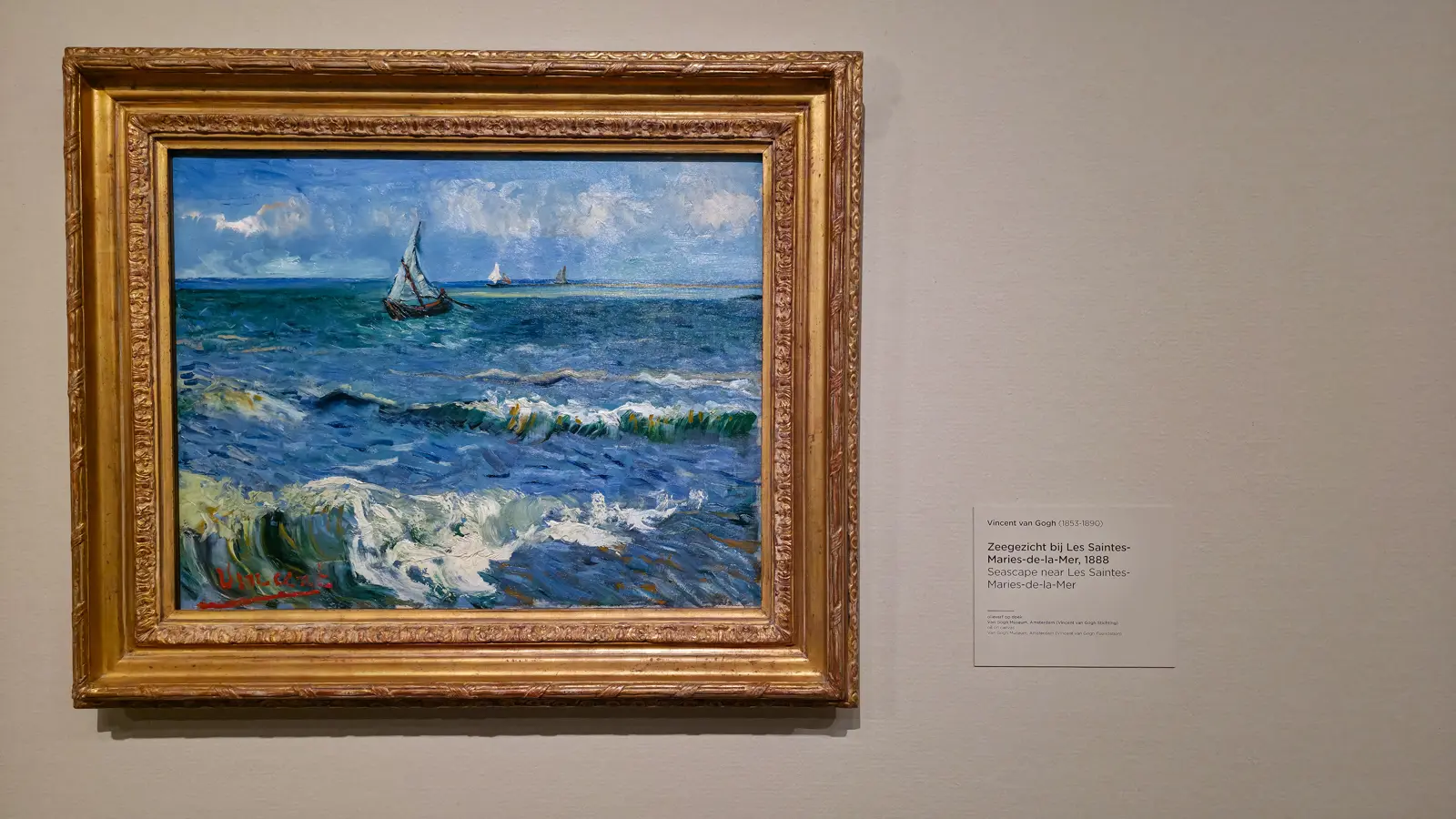
A few weeks later, in June 1888, he made a trip to Les Saintes-Maries-de-la-Mer on the Mediterranean. He wrote that the sea had a colour like mackerel, always changing between green, purple, blue, pink and grey. In Seascape near Les Saintes-Maries-de-la-Mer he laid some of the waves on with a palette knife, and he signed it “Vincent” in bright red in the lower left.
Saint-Rémy, 1889
In May 1889 Van Gogh admitted himself to the asylum at Saint-Rémy-de-Provence, where he stayed for a year. Between June and December he painted fifteen canvases of olive groves, and he counted them among his best work from the south.
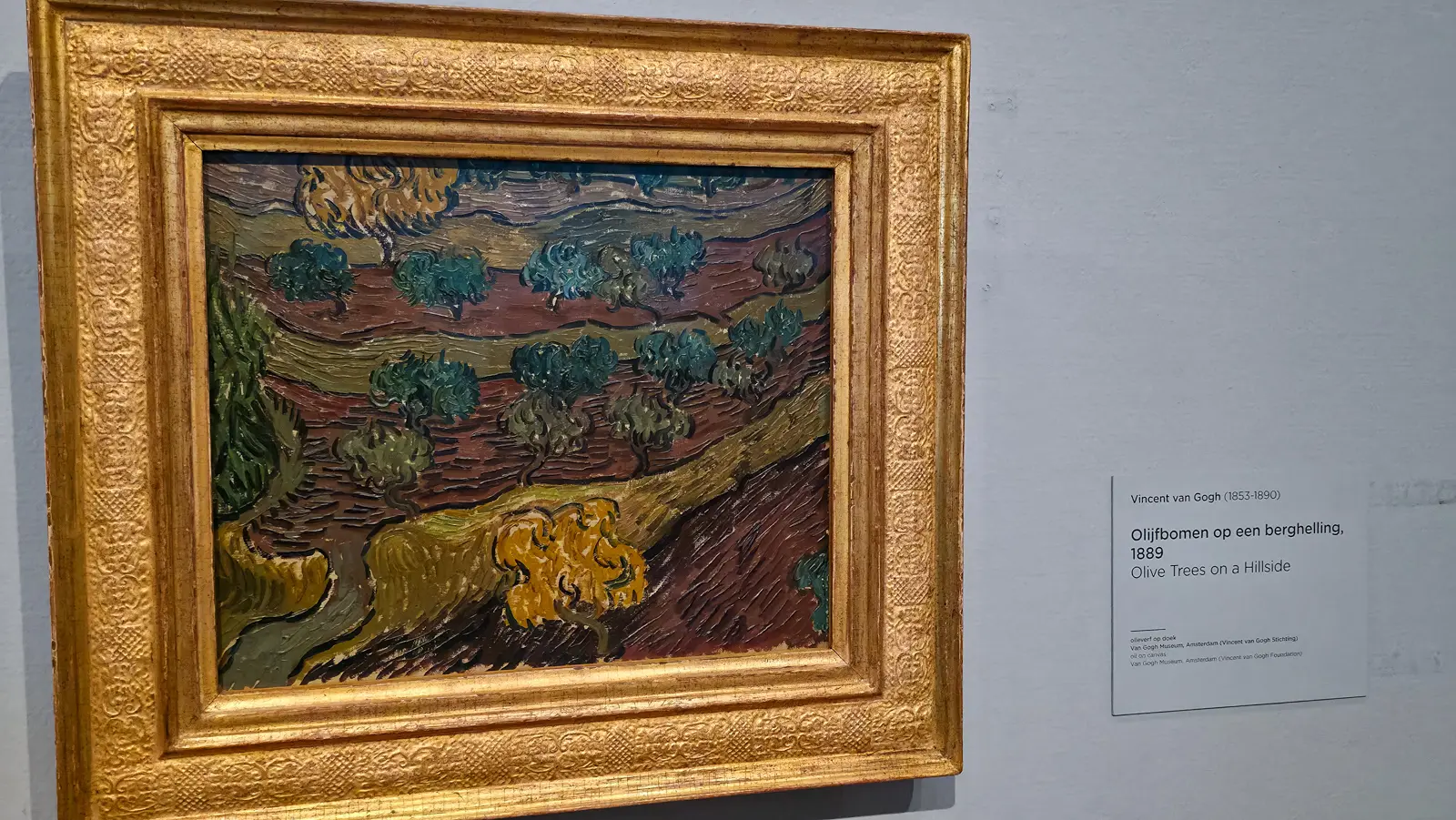
Olive Trees on a Hillside is from that year. There are no dots and no dashes here. The trees are rounded shapes with dark outlines, and the hillside is laid in long curving bands of brown, green and ochre.
Auvers, 1890
In May 1890 he left Saint-Rémy for Auvers-sur-Oise, a village outside Paris. Landscape at Twilight is from June. An orange and yellow sky is laid on in thick horizontal strokes, the château of Auvers sits between two dark trees, and a pink path runs through green fields. Compare that sky with the water in the Seine painting from three years earlier. The dabs have become heavy ridges of paint.
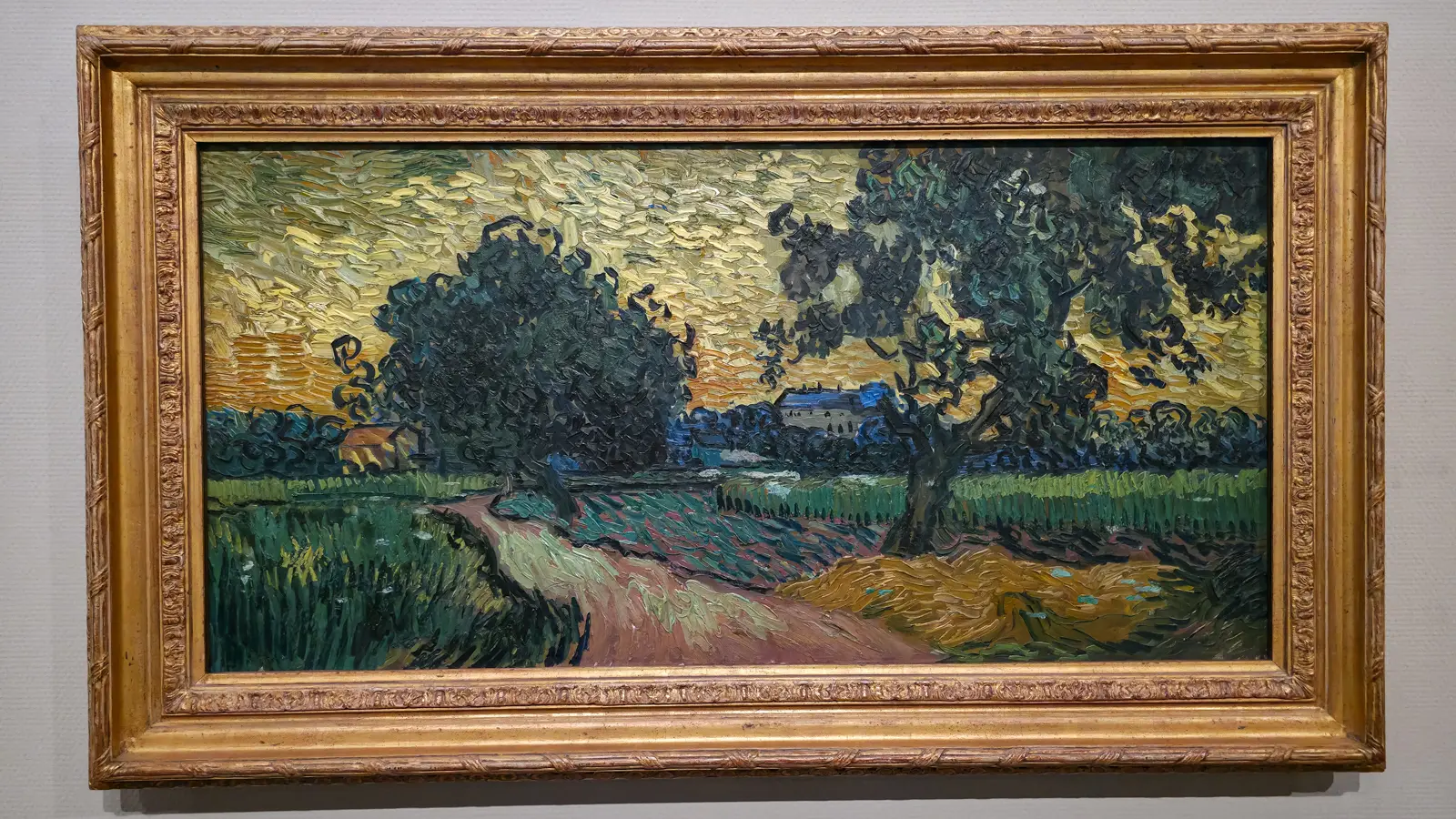
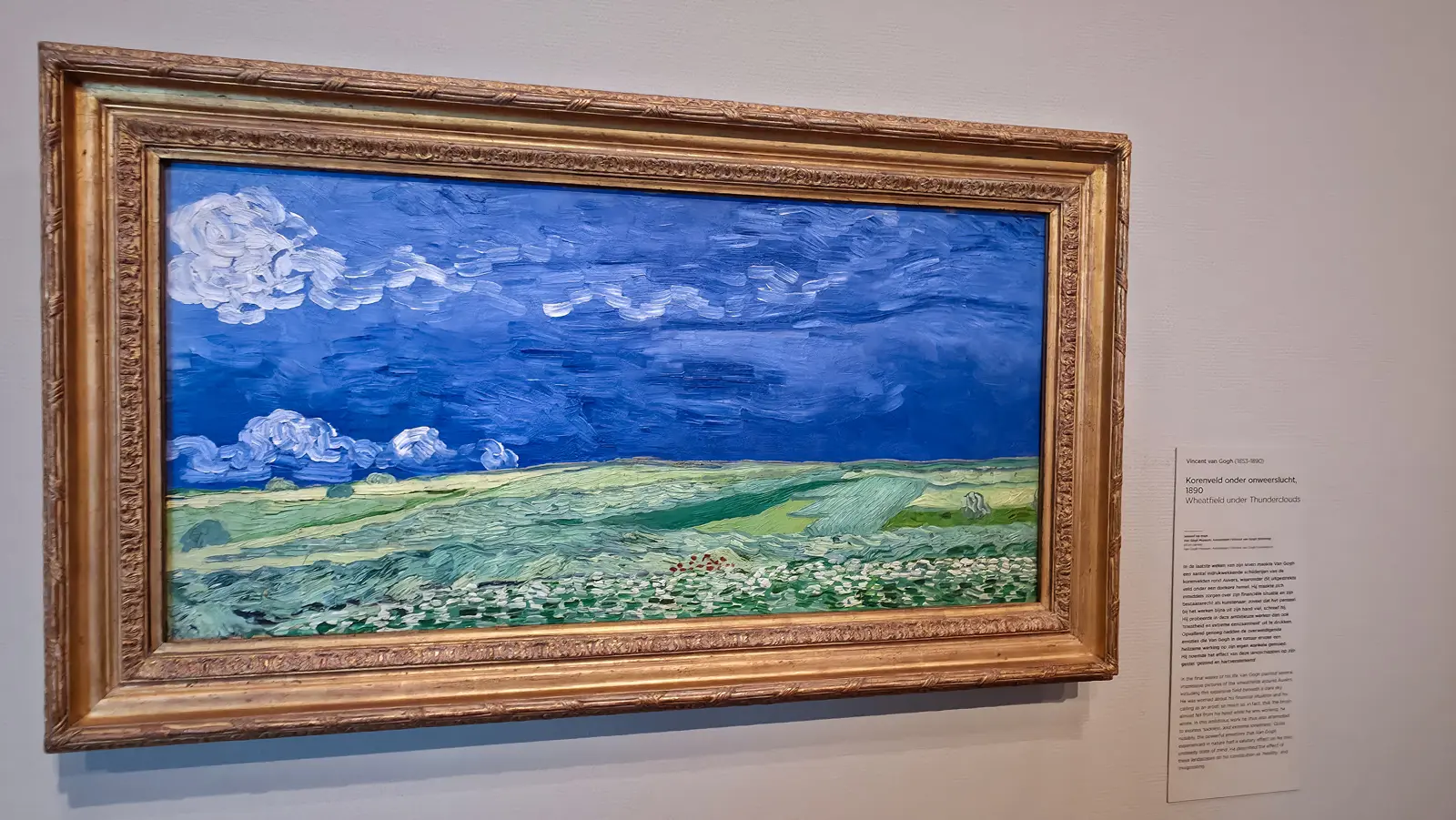
In July he painted wide views of the wheatfields above it. He described them to Theo and Jo as immense stretches of wheatfields under turbulent skies, and wrote that he had tried to express sadness and extreme loneliness. The museum label beside Wheatfield under Thunderclouds quotes the rest: he called the effect of these landscapes on him “healthy” and “invigorating”.
That line sums up what I appreciated most about these paintings. The label says he was worried about money and his calling as an artist, and he was still looking out at the fields.
Wheatfield with Crows, the painting at the top of this post, hangs nearby. A red dirt path runs into yellow wheat, the sky is dark blue and black, and crows are scattered across it in quick black strokes. It is often called his last painting. The museum’s own label says otherwise: he made several considerably more cheerful works after it. The idea took hold partly through the 1956 film Lust for Life, which shows him painting it just before his death. He died on 29 July 1890, aged 37.
Bubbly Tips
- Book a timed slot online before you go. Tickets are sold online only, with a start time, and there is no ticket counter at the door. Adult entry was €25 at the time of writing, and under-18s go free.
- Take the first slot, or a Friday evening. The museum opens at 9 AM, and midday is the busiest stretch. On most Fridays it stays open until 9 PM.
- Walk the collection in order. The museum hangs Van Gogh’s work chronologically, so following it in sequence shows the change from the dark Dutch paintings to Arles and beyond.
- Look for the Seurat under the Seine. When I visited, the small Seurat hung directly below Van Gogh’s Bank of the Seine. It is easy to walk past, and the pairing is the clearest lesson in the building on where his Paris brushwork came from.
- Photograph the labels. The wall texts are in Dutch and English, and several of the landscape labels carry Van Gogh’s own words. A quick photo saves notes.
- Photos are fine, flash is not. Personal photography is allowed, but not flash, tripods or selfie sticks. Some temporary exhibitions ban photography, and this is signposted at the entrance.
- Leave the big bag behind. Anything larger than a small handbag goes to the cloakroom, and large rucksacks and suitcases are not admitted at all.
- Bring a card, not cash. The museum is cashless throughout, including the café and the shop.
- Don’t count on the I amsterdam City Card. The museum stopped accepting it in June 2022, so you need a ticket booked through the museum.
Final Thoughts
The clearest proof that his landscapes track how he grew as a painter is two paintings of one hill. In 1886 Van Gogh painted Montmartre in grey, brown and a flat green. A year later he painted the same hill with a white path, blue shadows and red and green gardens. Same hill, same painter, twelve months apart.
He never stopped looking outward. In his last weeks, painting wheatfields under dark skies, he still called these landscapes healthy and invigorating. That is what I took home from the museum: a painter who kept going back to the fields, and painted them differently every time.
Until next time!

🌟 Everything You Need to Plan Your Dream Trip in 2026
- 🌟 Luxury Hotels - Find premium stays with Booking.com & Hotels.com
- 🏡 Vacation Rentals - Discover unique properties on VRBO
- 🏞️ Guided Tours - Explore with Viator or GetYourGuide
- 🎫 Attraction Tickets - Skip the lines with Tiqets
- 🚢 Ocean Cruises - Set sail with Cruise Direct
- 📱 International SIMs - Stay connected with Saily
- 🚗 Car Rentals - Budget-friendly options from Discover Cars
- 🌐 Secure VPNs - Browse safely with NordVPN
- 💶 Currency Exchange - Best rates with Wise
- 🗣️ Learn Languages - Master the local language with Babbel and Rosetta Stone