
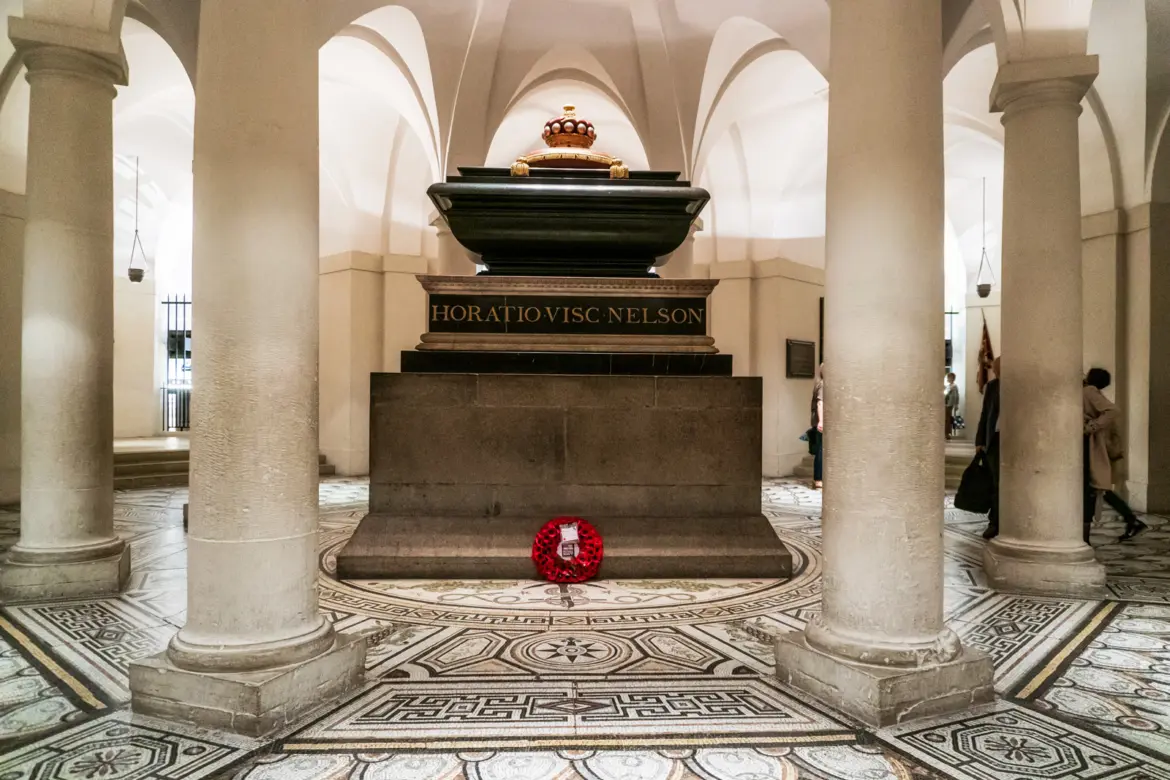
I had expected the crypt to feel eerie. It doesn’t. The first time you walk down the stairs from the cathedral floor and turn the corner into the main chamber, what strikes you is how bright it is. White-painted vaults overhead. Mosaic floors. Soft electric light that reaches into every corner. The crypt of St Paul’s Cathedral is not a dim place. It is the quietest, most generous room in the cathedral.
I came here on a December afternoon, after walking the nave and the icons and the American Memorial Chapel above. The crypt was the part I’d most looked forward to and most worried about. Looking forward to because of the names buried here: Nelson, Wellington, Wren, Florence Nightingale, J.M.W. Turner, John Everett Millais, Holman Hunt. Worried about because crypts in films are dark, and I expected this one to be the same. It isn’t. It’s where the cathedral feels most alive.
The Crypt at St Paul’s at a Glance
📍 Location · Beneath the cathedral floor, accessed by stairs in the south transept. Part of standard St Paul’s admission (around £25). Open during regular cathedral hours; allow at least 45 minutes for the crypt alone.
🏛️ What it is · The largest cathedral crypt in Europe by floor area, designed by Christopher Wren to extend the full footprint of the cathedral above. Over 200 memorials and burials in a single connected network of vaulted white-painted chambers.
⚰️ The three central tombs · Sir Christopher Wren (first burial here, 5 March 1723) · Vice-Admiral Lord Nelson, at the centre directly under the dome (buried 9 January 1806) · Arthur Wellesley, 1st Duke of Wellington (buried 18 November 1852).
🕯️ Other notable burials and memorials · Florence Nightingale (memorial only — buried at East Wellow, Hampshire) · J.M.W. Turner · Sir Joshua Reynolds · John Everett Millais · William Holman Hunt · Robert Hooke · Sir Alexander Fleming · Sir Arthur Sullivan · Captain John Cooke and dozens of other naval officers killed in the Napoleonic Wars.
⛪ The OBE Chapel · The eastern end of the crypt, originally the medieval St Faith’s chapel, was rededicated on 20 May 1960 as the spiritual home of the Order of the British Empire. The order was founded by George V in 1917 for civilian and non-combat war service.
🕊️ The strange thing about Nelson’s tomb · The black marble sarcophagus was commissioned in 1524 for Cardinal Wolsey, taken by Henry VIII, ignored by his three children, stored at Windsor for almost 300 years, and finally given to Nelson by George III in 1806. The bronze angels that were meant to flank it now live in the V&A.
💡 Tip · Don’t rush. Most visitors do the crypt in 15 minutes and miss most of it. Start at Wren’s slab, read the inscription, then walk slowly toward Nelson and Wellington at the centre, and finish in the OBE Chapel at the eastern end.
What the Crypt Actually Is
Most cathedrals have crypts at the eastern end, beneath the high altar. St Paul’s is different. Sir Christopher Wren designed the crypt to extend the full footprint of the cathedral above: nave, dome, transepts, choir. The result is the largest crypt in Europe by floor area, with white-painted barrel vaults running in every direction. It functions as the building’s structural foundation, the floor on which the rest of the cathedral stands.
It now contains more than 200 memorials and numerous burials. The first person interred here was Wren himself, on 5 March 1723. Everyone who has joined him since has, in a literal sense, been laid into the structure he designed. The crypt is the closest thing the cathedral has to a museum of who London has chosen to remember.
Nelson at the Centre
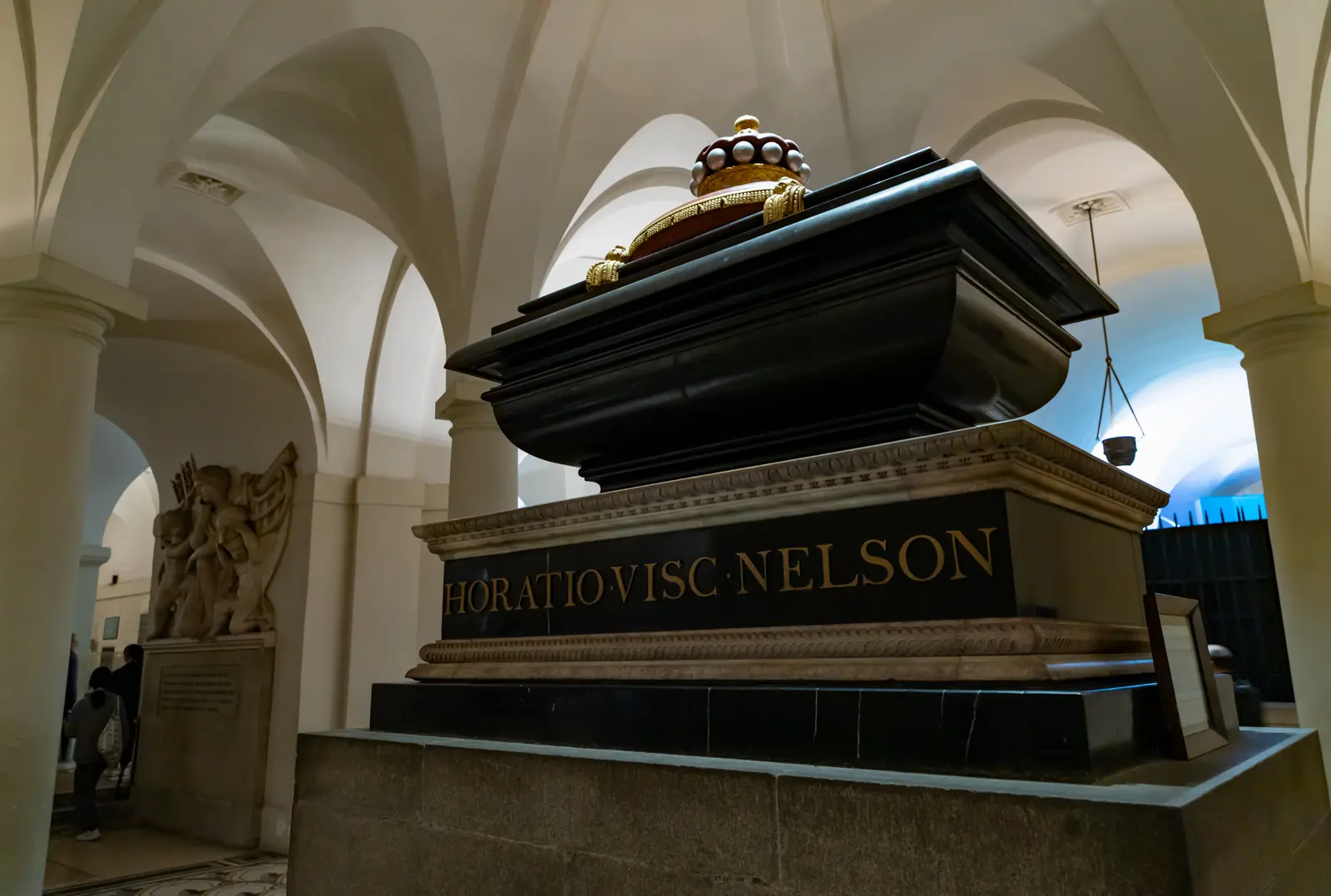
Nelson’s tomb sits at the exact centre of the crypt, directly below the centre of the dome above. The placement is deliberate. The most important burial in the cathedral takes the most important spot, structurally and symbolically. Stand under Nelson’s coronet, look up, and you are looking straight at the inside of Thornhill’s painted dome from below.
The sarcophagus itself is one of the strangest objects in any London building, and its full story is worth telling.
It was carved around 1524 by the Florentine sculptor Benedetto da Rovezzano, who had moved to England in 1519 as part of the Italian Renaissance influence on the Tudor court. Cardinal Thomas Wolsey, Lord Chancellor under Henry VIII, commissioned it for his own tomb. Wolsey was the most powerful man in England after the king, and he was preparing a memorial to match. The black marble sarcophagus was meant to sit beneath a cardinal’s hat, surrounded by four large bronze angels Benedetto had also been working on.
Then Wolsey fell. He lost Henry’s favour in 1529, was stripped of his offices, and died in disgrace at Leicester Abbey on 29 November 1530 on his way to face charges of treason. Henry VIII seized the unfinished tomb and decided to use it for himself, commissioning Benedetto to rework it. But Henry died in 1547 before the tomb was completed. His three children (Edward VI, Mary I, Elizabeth I) all said they intended to finish it for their father. None did. Elizabeth I moved the unfinished sarcophagus from Westminster to Windsor in 1565, where it sat in storage. The bronze angels were dispersed during the Commonwealth period. Two of them ended up as gate decorations at a country estate in Northamptonshire. The Victoria and Albert Museum eventually acquired them in 2015 after a national public appeal.
The sarcophagus itself stayed at Windsor, unused, for almost 300 years.
Then, on 21 October 1805, Vice-Admiral Horatio Nelson was killed at the Battle of Trafalgar, struck by a French sharpshooter at the moment of his greatest victory. His body was preserved in a keg of brandy for the journey home aboard HMS Victory. When it reached England, the country had to decide how to bury a national hero. King George III made the decision: bring out the long-forgotten Wolsey sarcophagus.
Nelson was buried inside it on 9 January 1806, after a state funeral whose procession included seven royal dukes, thirty-one admirals, more than a hundred captains, and ten thousand troops. The cortege was so long that the head of it reached St Paul’s before the tail had left the Admiralty. The service in the cathedral lasted about four hours. The wooden coffin that holds Nelson, inside the sarcophagus, was made from the mainmast of L’Orient, the French flagship Nelson had destroyed at the Battle of the Nile in 1798. Where Wolsey’s cardinal’s hat would have stood, Nelson’s viscount’s coronet now sits.
So the Wolsey sarcophagus, commissioned by a disgraced Tudor cardinal, intended for a king who never finished it, ignored by three monarchs, and stored at Windsor for centuries, finally became the resting place of the man who saved Britain from Napoleon. Object histories don’t get much stranger.
Wellington in the Adjacent Chamber
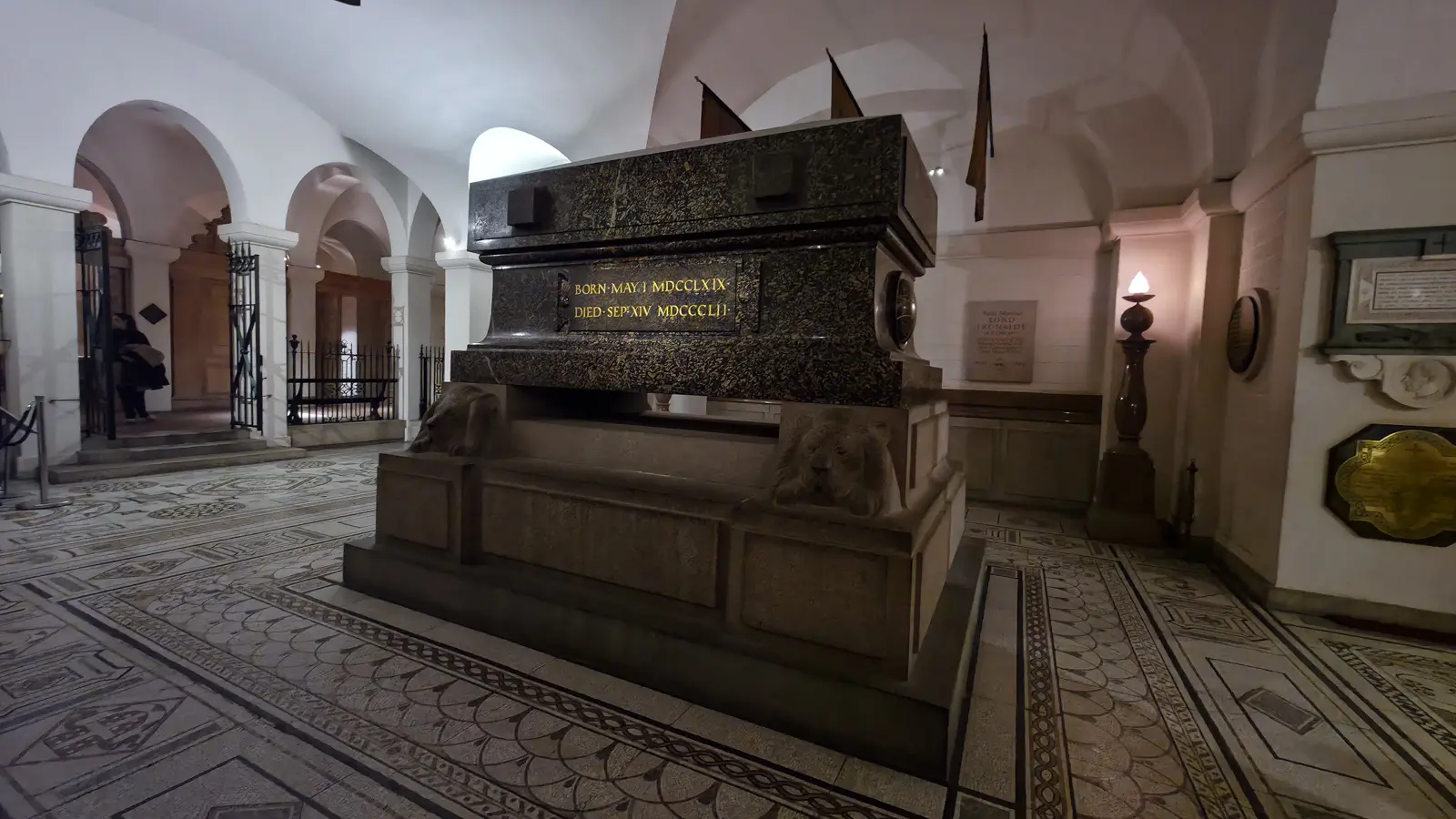
In the next chamber, just yards from Nelson, sits the Duke of Wellington’s sarcophagus. The contrast with Nelson’s is immediate. Nelson’s is polished black marble, Italian Renaissance, almost regal in its smooth carved surfaces. Wellington’s is massive, dark, speckled, and unmistakably geological — a single block of Cornish porphyry, also called luxulyanite, quarried near the village of Luxulyan in Cornwall. It rests on a block of unpolished Peterhead granite carved with four sleeping lions at the corners.
The Iron Duke died on 14 September 1852, aged 83, at Walmer Castle in Kent. His state funeral took place on 18 November. The cathedral was draped in black crepe and fitted with scaffold-borne tiered seating to hold over 13,000 mourners. The procession through London was so long it delayed the service by an hour. The Lord Mayor’s parade was cancelled, for the only time in its history, so as not to compete with the funeral cortege. An estimated 1.5 million people watched the procession along the route — the largest funeral cortege London had ever seen.
When the coffin was lowered into the crypt, it was passed through a hole specially cut in the cathedral floor, the same hole that had been cut for Nelson’s coffin forty-six years earlier. The hole is still visible from below if you know where to look. Dean Henry Milman, who presided, described the moment of the coffin sinking out of sight as “a sight which will hardly pass from the memory of those who witnessed it”.
Wellington’s sarcophagus wasn’t ready in time for the funeral. He was buried temporarily in a wooden coffin. The final porphyry sarcophagus took five more years to complete. Tomb-making was slow work in the 1850s, and luxulyanite is one of the hardest stones in the British Isles. The Roman numerals on the side of the sarcophagus read MDCCLXIX (1769, the year of his birth) and MDCCCLII (1852, the year of his death).
Wren and His Inscription
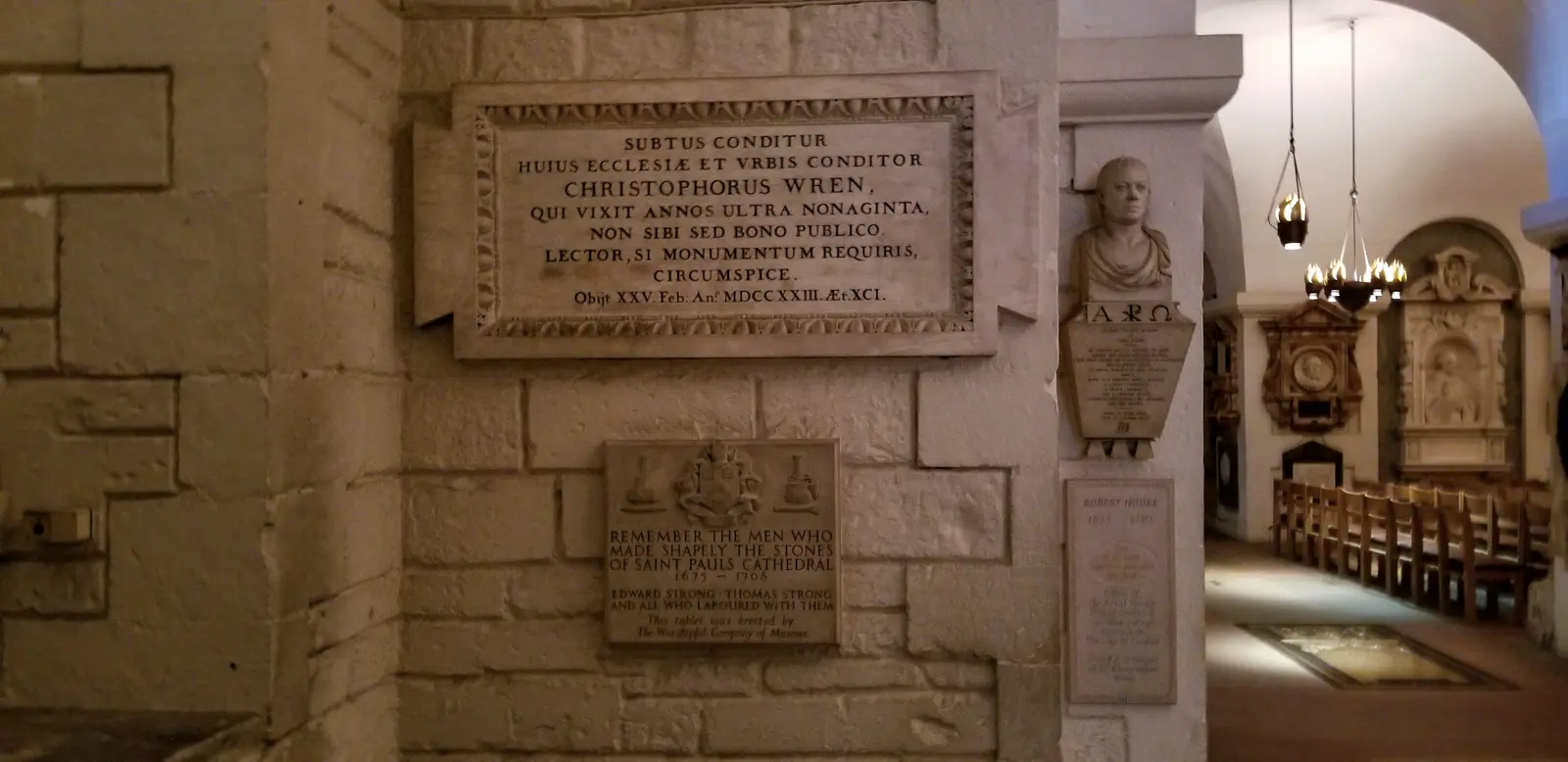
Walk through the quieter side of the crypt, away from Nelson and Wellington, and you find a modest black stone slab on the floor. There’s no sculpture, no canopy, no ornament. Just the slab and, on the wall above it, the inscription that has become one of the most-quoted in Western architectural history: Lector, si monumentum requiris, circumspice. “Reader, if you seek his monument, look around you”.
The line was written by Wren’s son, also called Christopher Wren, after his father’s death on 25 February 1723. Wren was 90, having spent thirty-five years designing and building the cathedral. He had been driven to St Paul’s the day before he died, to look at it one last time. He was buried below it five days later, the first person ever interred in the building he had spent his life creating.
The full inscription, less often quoted, includes the line that he lived “not for himself but for the public good”. The famous line that follows is the practical instruction. Don’t look for a tomb. Look around. Look up. The cathedral is the monument.
I read the inscription twice and stood there for a while. There is something quietly miraculous about an architect being buried inside the work that will outlast him by a thousand years. Most of us leave less. The same inscription is carved into the floor of the nave directly under the dome, far above the slab. So you can read it in two places in the cathedral. Below the building, beside the man. And above the building, beside the dome that is his actual memorial.
Florence Nightingale
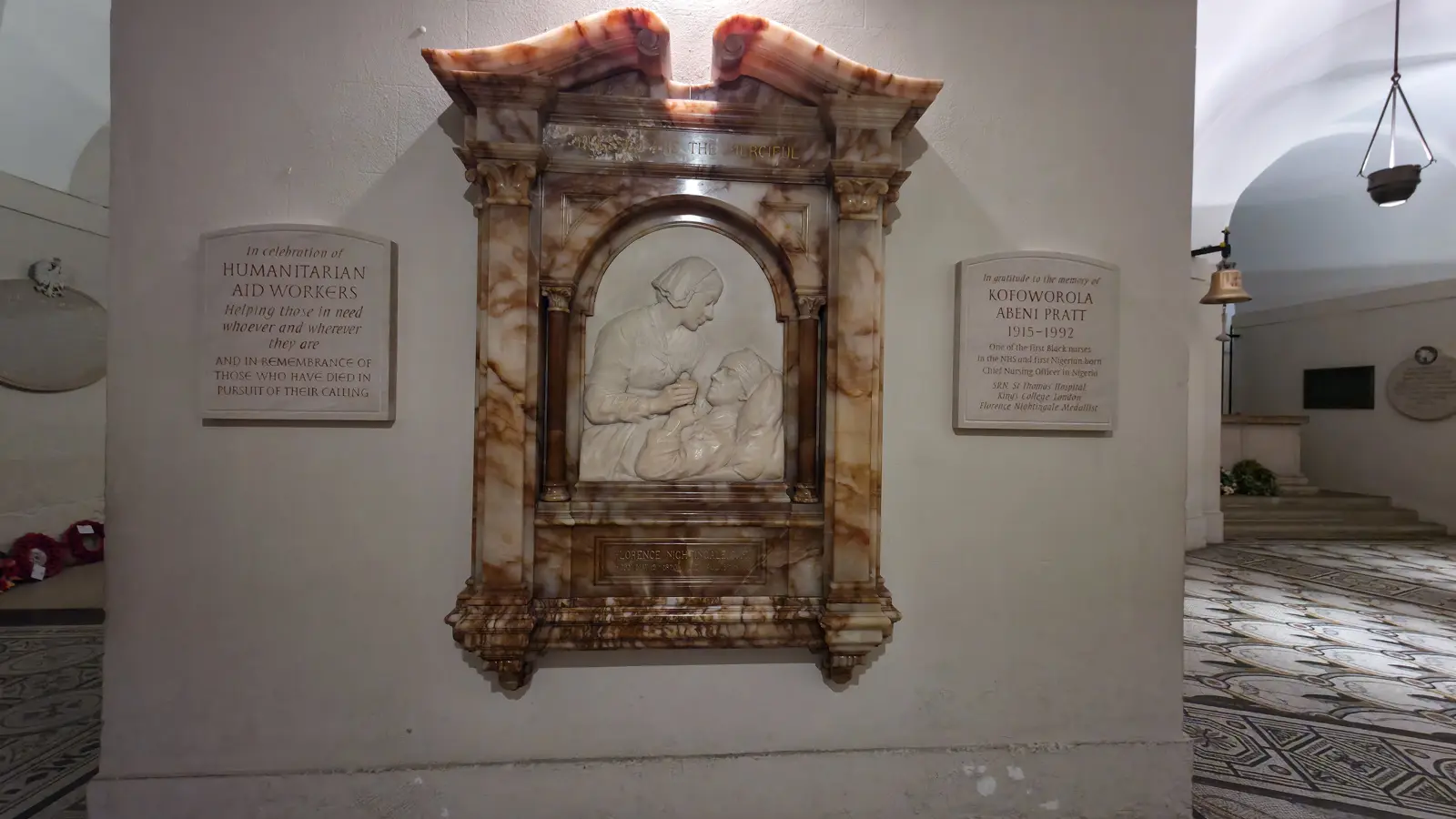
In the Nelson Chamber’s east bay sits one of the quietest and most moving memorials in the crypt. It is a marble and alabaster wall relief by Arthur George Walker RA, installed in 1916. It shows Florence Nightingale bending over a wounded soldier in his hospital bed, holding a glass of water at his right hand. Above her, in carved letters: BLESSED ARE THE MERCIFUL.
It is not her tomb. Nightingale died on 13 August 1910 at age 90 and asked to be buried quietly in her family plot at St Margaret’s Church, East Wellow, in Hampshire. The St Paul’s memorial was added six years later, and a small memorial service in the cathedral on 20 August 1910 had been attended by more than 4,000 people, with over a thousand nurses she had trained.
What stopped me at this memorial wasn’t its grandeur, there’s none. It’s smaller and quieter than Nelson’s or Wellington’s, set into the wall rather than dominating the floor. What stopped me was the act it shows. Not a hero in armour. Not a general on a horse. A woman with a glass of water, leaning over a man who is dying. The hardest of all the things humans do for each other. And on the wall of one of the grandest cathedrals in Europe, that’s the image Britain chose to remember her by.
Nightingale received the Order of Merit in 1907, the first woman ever to do so. The letters O.M. appear after her name on the memorial. It’s the only acknowledgement of rank in the entire piece. The rest is just the act itself.
Captain John Cooke and the Smaller Tombs
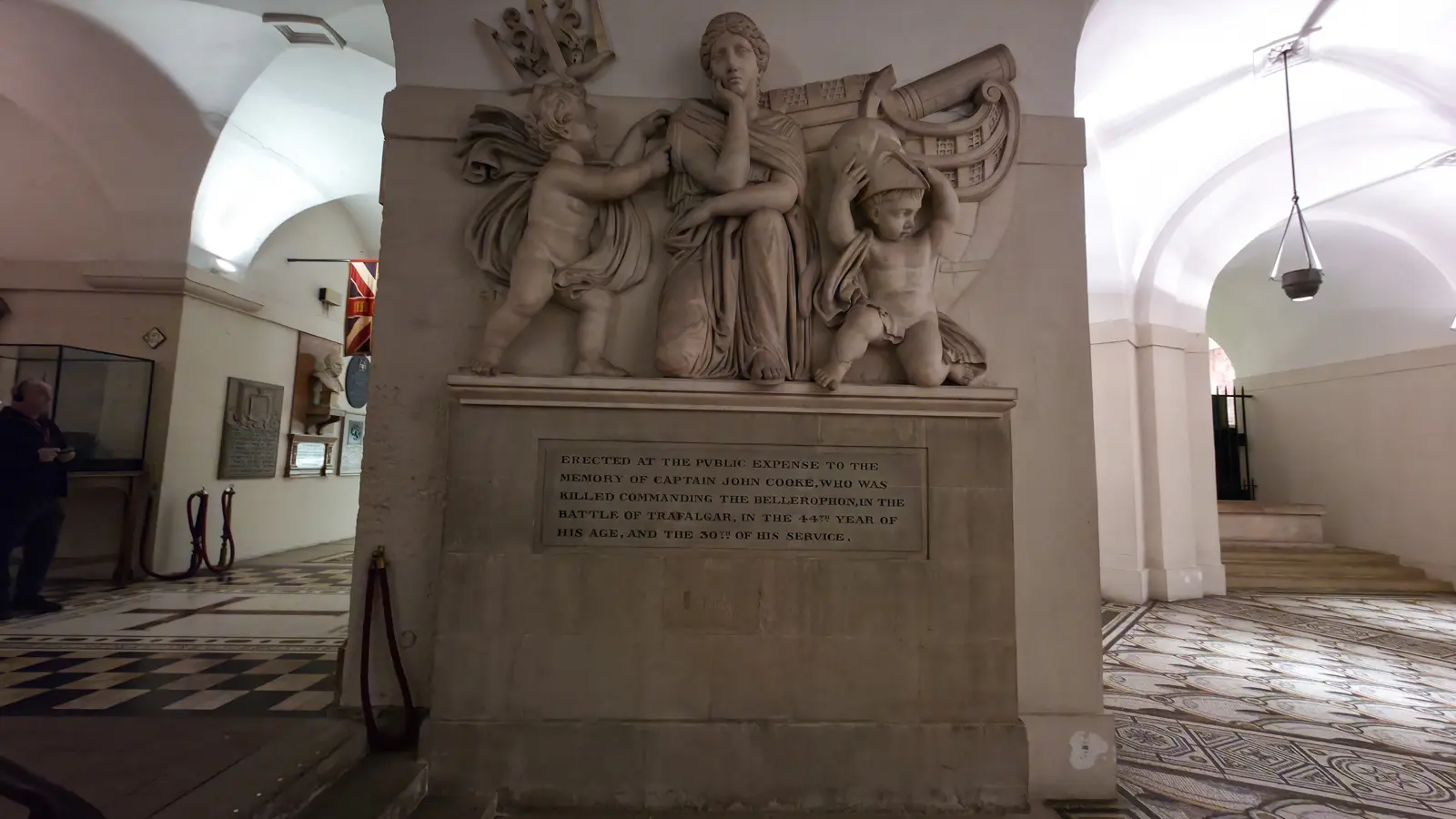
Beside the famous tombs sit dozens of smaller memorials that most visitors walk past. One of them is to Captain John Cooke, who commanded HMS Bellerophon at the Battle of Trafalgar on 21 October 1805, the same battle in which Nelson was killed. Cooke was in his 44th year, with 30 years of service in the Royal Navy. He was killed in hand-to-hand fighting when the French ship Aigle boarded his vessel; his crew drove the boarders off and ultimately forced Aigle’s surrender.
The memorial shows a seated female figure (Britannia, in this kind of neoclassical convention) flanked by two cherubs handling a flag and a piece of ship’s wreckage. The inscription reads: “Erected at the public expense to the memory of Captain John Cooke, who was killed commanding the Bellerophon, in the Battle of Trafalgar, in the 44th year of his age, and the 30th of his service”.
“At the public expense” is a phrase worth pausing on. It meant that Parliament had chosen to pay for the memorial out of national funds, an honour usually reserved for officers killed in major engagements. Captain Cooke isn’t a household name. He didn’t have streets named after him, like Nelson did. But Britain decided he had earned a memorial in its grandest cathedral, paid for by the taxpayer, the same way the country paid for the Iron Duke’s funeral. The crypt is full of these smaller stories. Each of them is a country’s choice about who to remember.
The OBE Chapel
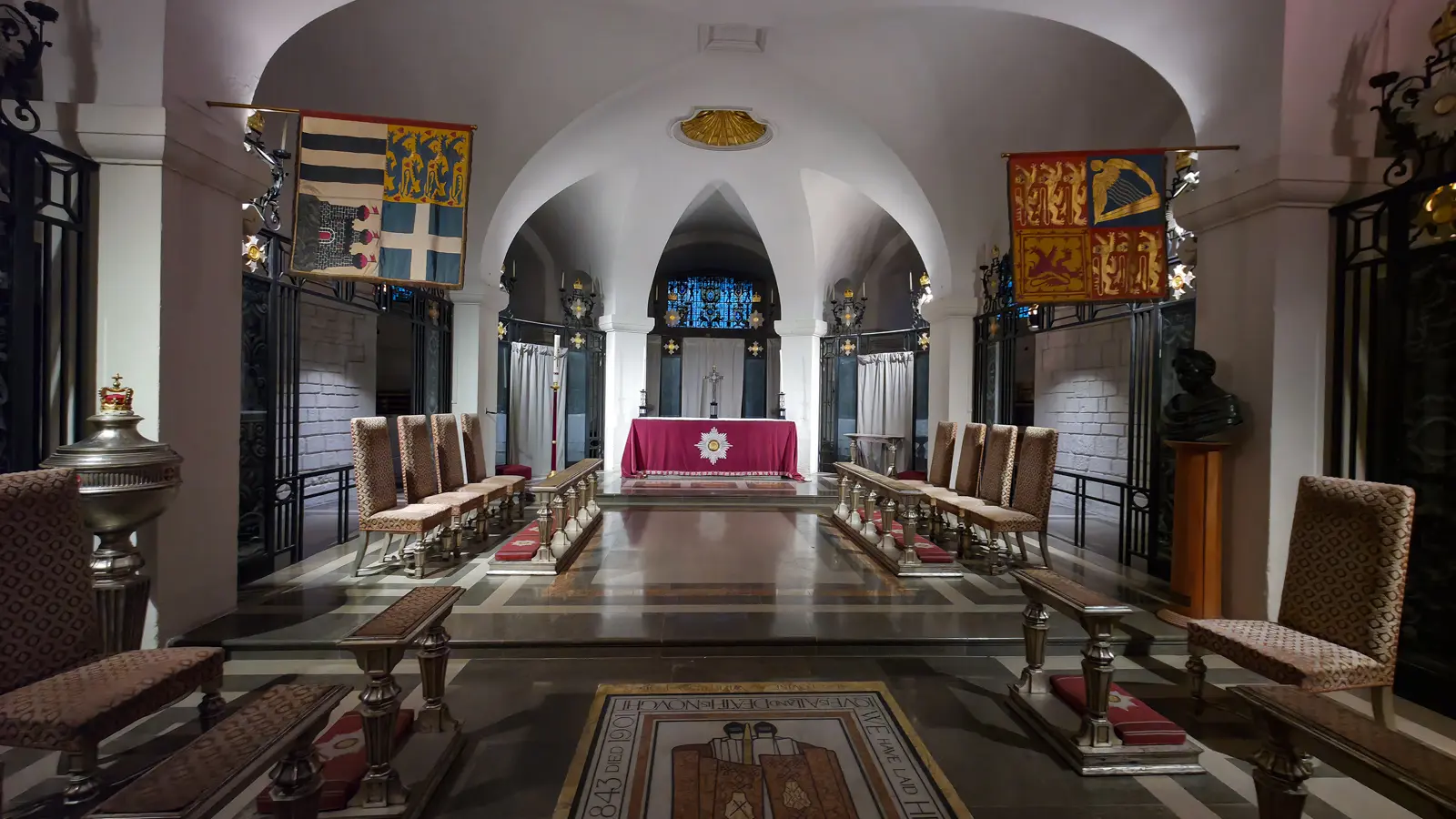
At the eastern end of the crypt, beyond the central chambers of Nelson and Wellington, sits the Order of the British Empire Chapel. It was dedicated in 1960 as the spiritual home of the order, which George V had founded in 1917 to recognise contributions to the British war effort during the First World War. The honour has since expanded to recognise distinguished service across the arts, sciences, public life, and charitable work, with members ranking from Member (MBE) up to Knight or Dame Grand Cross (GBE).
The chapel is surprisingly bright after the dimmer crypt corridors. Heraldic banners of senior members of the order hang from the rails along both sides, the altar carries the OBE star on a red cloth, and the floor inscriptions name members who have died. The chapel is still actively used. Services and ceremonies for the order are held here, including the regular installation of new members. It’s also where the small number of weddings at St Paul’s are usually conducted — the cathedral above is reserved for major state occasions and choral services, while the OBE Chapel beneath hosts the order’s marriages and baptisms on a limited number of Saturdays each year.
It’s one of the parts of the crypt most visitors walk past without entering, which is a quiet kind of loss. The chapel is small, but it sits within yards of Nelson and Wellington — military heroes on one side of the crypt, the country’s civilian honours on the other. You don’t have to be famous to stand in either.
The Café and the Practical Crypt
One thing not everyone realises about the St Paul’s crypt: it also contains the cathedral café and the gift shop. After the tombs of Nelson and Wellington, you can sit down for a sandwich and a coffee under the same Wren-designed vaults. The café is bright, busy, and full of normal life: visitors with strollers, tour groups taking a break, parents handing biscuits to children. It is not a disrespectful arrangement. The crypt has always been a working part of the cathedral, and there’s something quietly correct about ordinary life continuing alongside the great dead.
The same logic extends further than the café. The crypt is a fully booked events venue. Standing receptions for up to 350 guests, seated dinners for 250, product launches, gala fundraisers. The Nelson Chamber alone hosts drinks receptions for 250 people, meaning that on certain evenings, Londoners stand around Nelson’s actual tomb holding champagne. And weddings happen here too. Marriage ceremonies at St Paul’s take place in the OBE Chapel in the crypt, with receptions following in the main hall or the Nelson Chamber.
Toilets are in the crypt too. So is wheelchair access. The crypt is, in a structural and practical sense, the part of St Paul’s that holds everything else up.
Bubbly Tips for Visiting the Crypt
- Allow at least 45 minutes for the crypt alone. Most visitors rush through in 15. They miss most of it. The OBE Chapel is at the far east end and require walking the full length of the crypt to reach.
- Start at Wren’s tomb and read the inscription before anything else. Once you’ve read Lector si monumentum requiris, circumspice, every other thing you see in the cathedral on the way out reads differently.
- Look up at the floor above Nelson’s sarcophagus. The hole through which his coffin (and Wellington’s, forty-six years later) was lowered is still visible in the underside of the cathedral floor above the centre of the crypt.
- The Florence Nightingale memorial is in the Nelson Chamber’s east bay. It is easy to miss because most visitors are looking at the sarcophagus in the middle. Walk to the right, towards the wall, and look up.
- Don’t skip the smaller military memorials. Captain Cooke, and dozens of others like him, are worth reading. The inscriptions are short and the lives are long.
- The café is part of the experience, not a detour. Have a coffee after the tombs. The crypt is the place in St Paul’s where you can sit quietly with what you’ve seen.
- Photography is allowed. Same rules as the rest of the cathedral: not during services or after 4:30 pm. The crypt’s lighting is dimmer than the floor above, so a phone with night mode does better work than a camera in low light.
- Combine with the rest of St Paul’s. The crypt is included in general admission. If you’ve already seen the dome, the icons, and the American Memorial Chapel, the crypt is the natural close.
Final Thoughts
I had expected the crypt to feel like a cemetery. It feels like a library. The names line the walls in roughly chronological order, the way books line a shelf. Wren is in the corner because he was first. Nelson and Wellington are at the centre because they earned it. Florence Nightingale is in the east bay, the artists in the painters’ corner. Each of them is here because Britain decided, at some point, that this is where the country keeps the people it has chosen to remember.
What surprised me most was Florence Nightingale. I had come to the crypt expecting to be moved by Nelson and Wellington, by the scale, the porphyry, the polished marble, the 1.5 million mourners. I was. But the moment that stayed with me was the small relief on the wall in the Nelson Chamber. A woman with a glass of water. A wounded soldier. Blessed are the merciful. It is the smallest of the major memorials in the crypt and it is, somehow, the one that feels closest to what a cathedral is for.
I walked back up the stairs to the cathedral floor afterwards and stood under the dome again. The same dome Wren had designed, with the same inscription his son had carved both below the building and above it. Reader, if you seek his monument, look around you. Wren’s son was right. The cathedral is the monument — to its architect, but also to everyone the cathedral has kept since.
Until next time!

🌟 Everything You Need to Plan Your Dream Trip in 2026
- 🌟 Luxury Hotels - Find premium stays with Booking.com & Hotels.com
- 🏡 Vacation Rentals - Discover unique properties on VRBO
- 🏞️ Guided Tours - Explore with Viator or GetYourGuide
- 🎫 Attraction Tickets - Skip the lines with Tiqets
- 🚢 Ocean Cruises - Set sail with Cruise Direct
- 📱 International SIMs - Stay connected with Saily
- 🚗 Car Rentals - Budget-friendly options from Discover Cars
- 🌐 Secure VPNs - Browse safely with NordVPN
- 💶 Currency Exchange - Best rates with Wise
- 🗣️ Learn Languages - Master the local language with Babbel and Rosetta Stone