
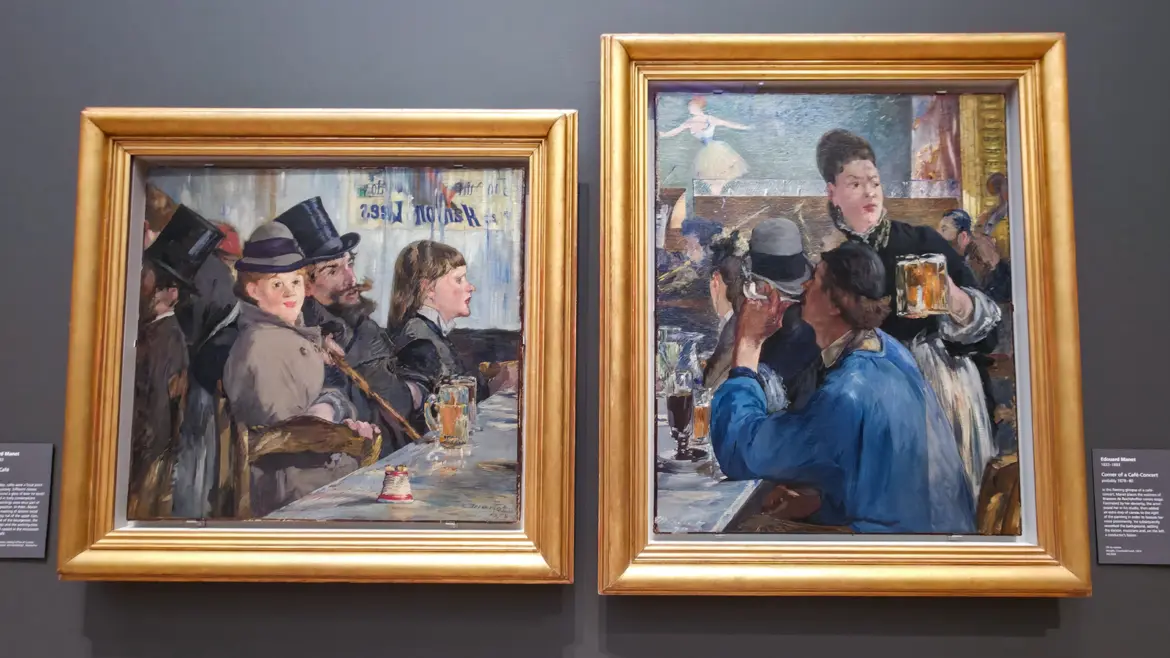
A small public service before we start: this is Manet, with an ‘a’, Édouard Manet, and not Claude Monet, with an ‘o’. The two are forever muddled, and I will come back to why. But the reason to be in this room right now is a reunion.
For its two-hundredth birthday in 2025, the National Gallery brought two paintings back together. They look like a pair of separate café scenes, and for most of the last century they have lived in separate countries. In fact they began as a single canvas. Manet painted a busy Parisian café-concert, and then cut the whole thing in two and reworked each half as its own picture. One half stayed in London. The other went to a collector in Switzerland. For the anniversary they hang side by side again, and even knowing the story, standing in front of them it took me a moment to see the join.
Manet at the National Gallery at a Glance
✂️ The reunion · For its 2025 bicentenary the Gallery hung the two halves of Manet’s cut café canvas side by side, the Swiss half on loan until December 2025.
🖼️ What stays · Corner of a Café-Concert belongs to the Gallery, along with the Execution of Maximilian and Music in the Tuileries Gardens.
🔫 The stranger story · Manet abandoned his Maximilian; after his death the canvas was cut up, and Degas hunted down the fragments and had them remounted.
🎩 The crowd scene · Music in the Tuileries, from 1862, is his first great picture of modern Paris, with Manet himself painted into the far left.
🅰️ The trick · Studio, hard edges and deep black mean Manet; outdoors, broken strokes and no black mean Monet.
🆓 The cost · The National Gallery’s collection is free, so the whole visit needs no ticket.
The painting he cut in two
The original canvas was known as Reichshoffen, after a fashionable brasserie in Paris, and by the winter of 1877 it was nearly finished. Then Manet took a knife to it. He cut it in two and treated each fragment as a new painting, adding a glass window to At the Café and, to Corner of a Café-Concert, a dancer up on a stage behind the drinkers. What looks like a snatched glimpse of a night out was in fact built up from a stack of careful drawings.
The two halves then went their separate ways. The National Gallery’s half entered the collection in 1924, the same year the Gallery bought Van Gogh‘s Sunflowers, and it cost nearly eight times as much as the Van Gogh. The other half took a Swiss collector thirty years of trying before he finally landed it in 1953. Getting the two back into one room is exactly the sort of thing a big anniversary is for.
The canvas that was cut a second time
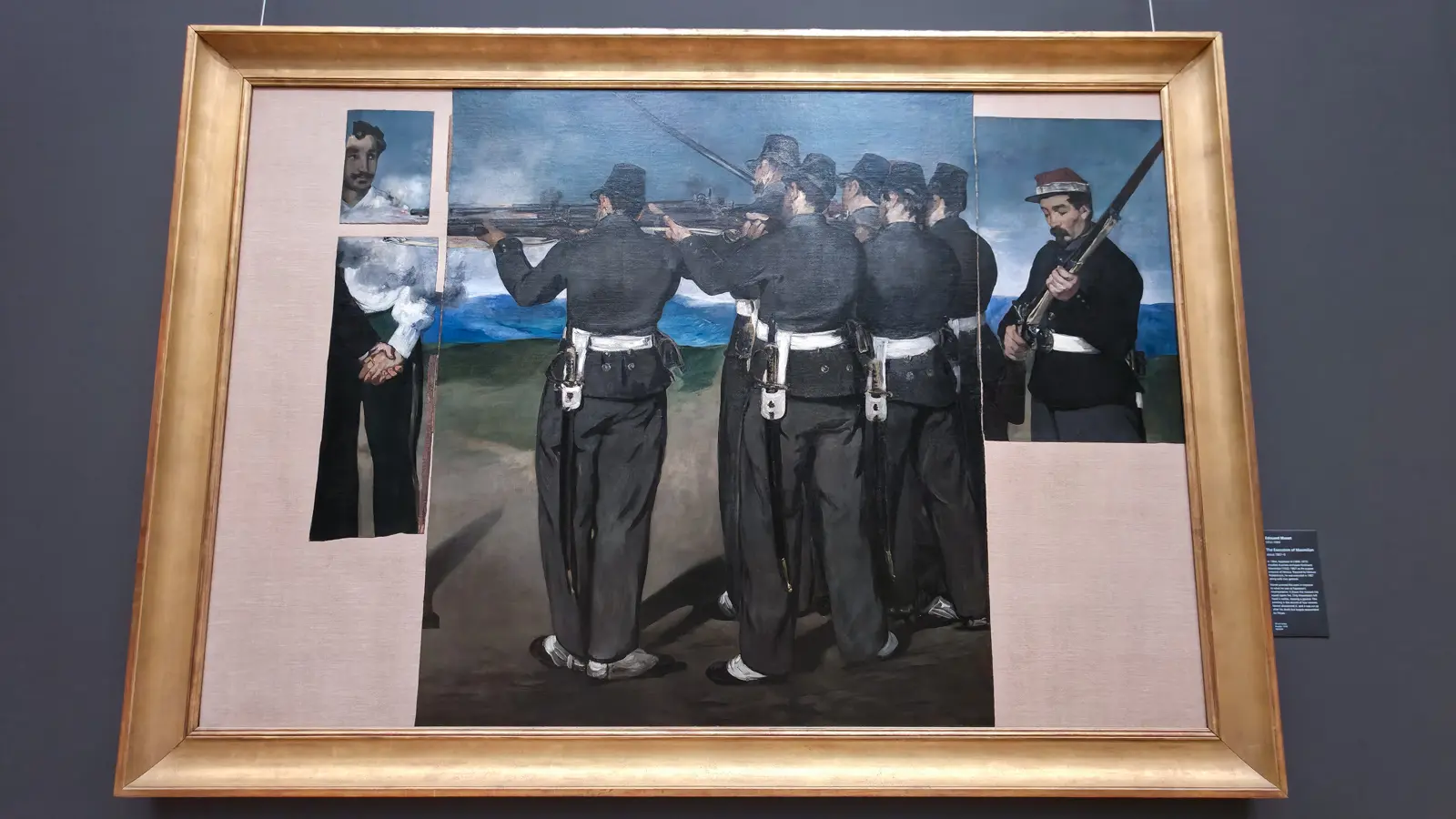
A few steps away hangs a Manet with an even stranger history of cutting. The Execution of Maximilian shows a firing squad at the instant it fires. The man being shot was real: Maximilian, an Austrian archduke whom Napoleon III installed as emperor of Mexico and then abandoned, leaving him to be captured and shot by Mexican republicans in 1867. Manet, who had no patience for Napoleon III, painted the scene as a quiet act of protest.
He never finished it, and after he died the canvas was cut into pieces. It might have disappeared for good, except that Degas, his friend and fellow painter, tracked the fragments down, bought them, and had them mounted back onto a single canvas. So this is the second painting in these rooms to have been cut apart and put together again, only this time it was history that did the cutting and Degas who did the mending.
A concert in the Tuileries
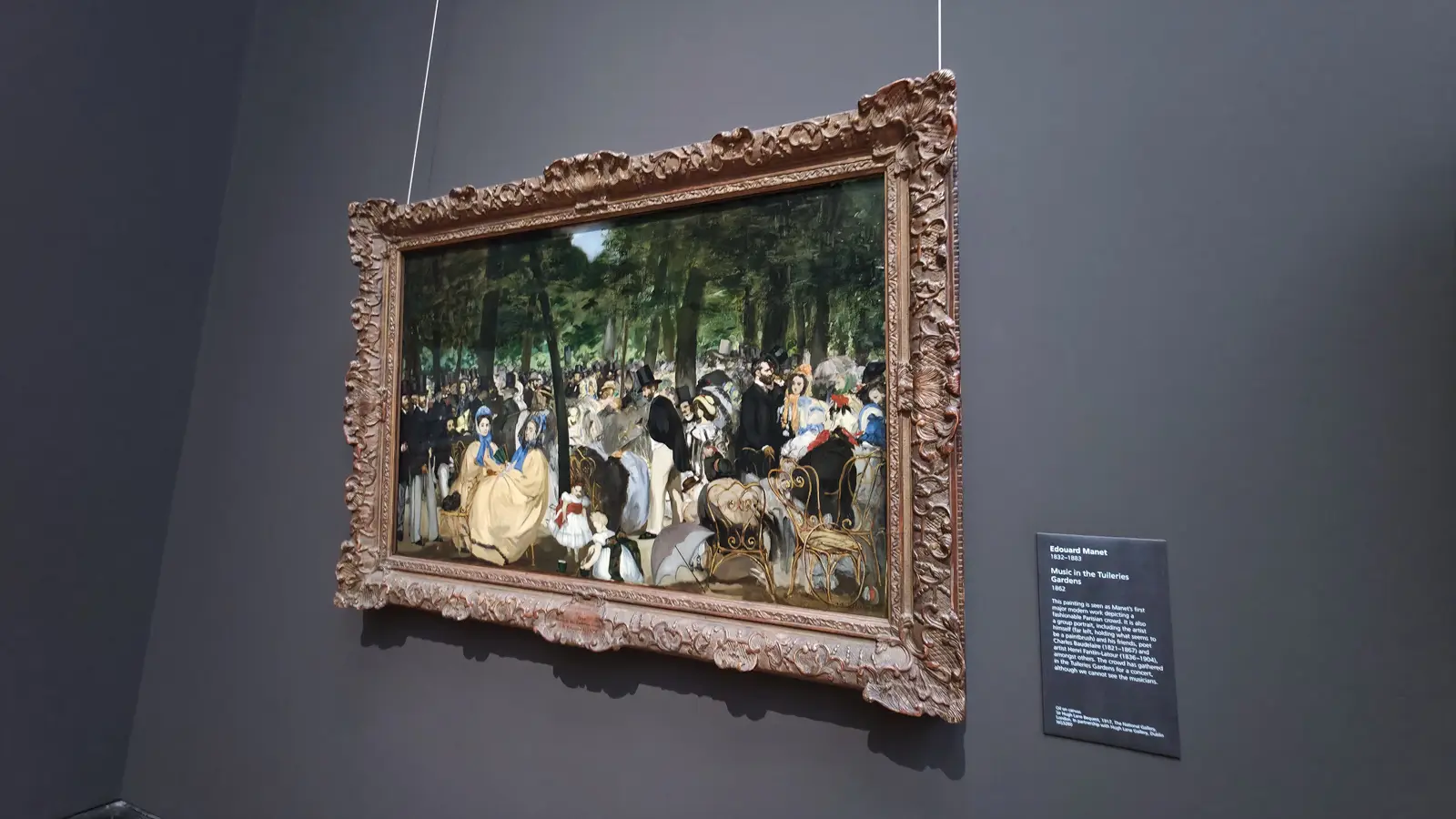
Not everything here is so grim. Music in the Tuileries Gardens, from 1862, is Manet at his most sociable: a fashionable crowd gathered under the trees for an open-air concert, all top hats and bonnets and conversation. It is often called his first real picture of modern life. He painted himself into the far left of the crowd and scattered his friends through it, the poet Charles Baudelaire among them. The one thing he left out was the band, so we never see the musicians we are told are playing.
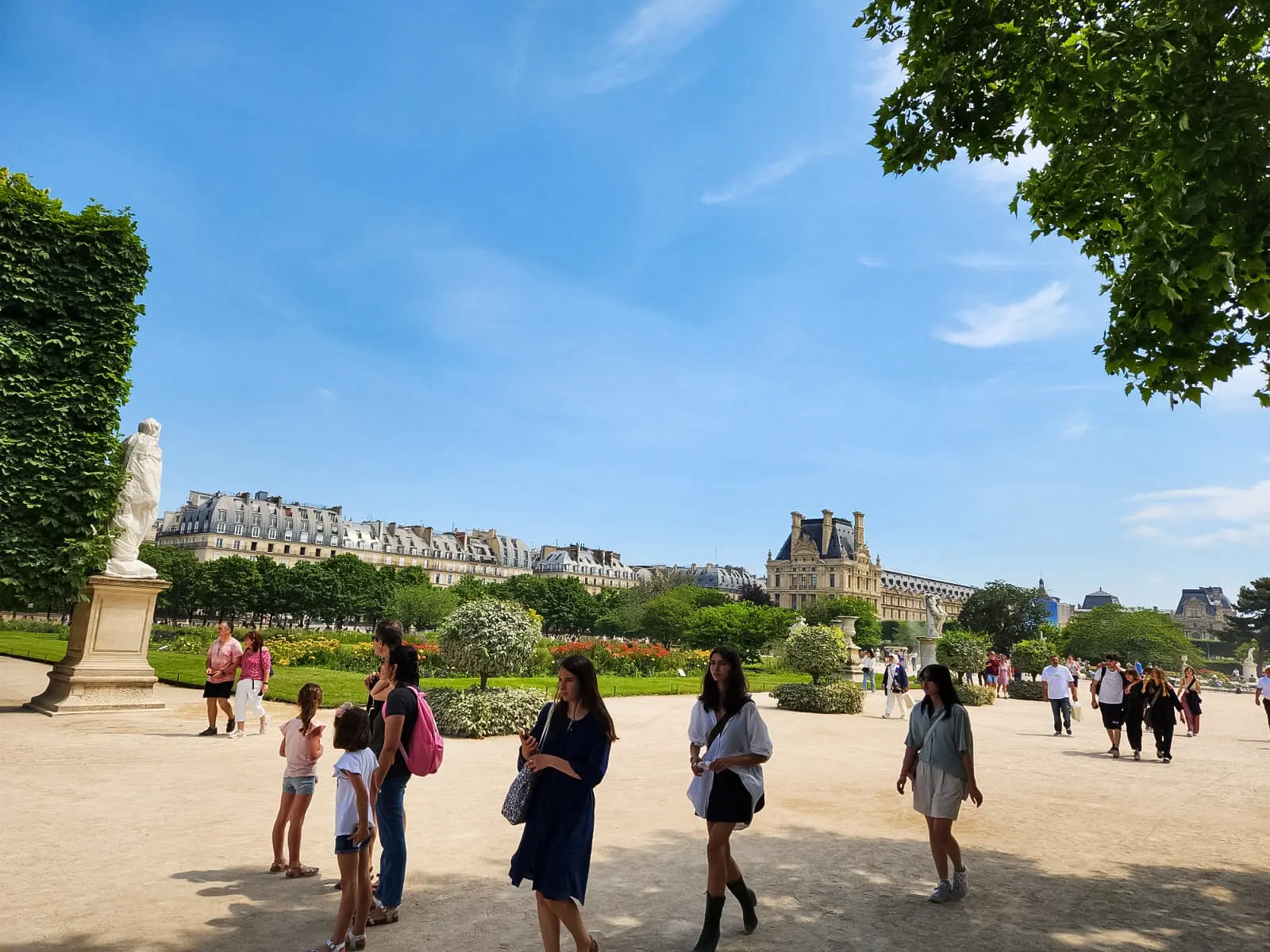
The Tuileries is still there, between the Louvre and the Seine, and still full of people on a fine day.
Manet is not Monet
Which brings us back to the spelling. Manet is endlessly confused with Claude Monet, and the mix-up is an old one. At the Paris Salon of 1865, their paintings hung almost side by side, and Manet found himself being congratulated for a group of seaside landscapes that were not his at all, but the work of a younger, then-unknown painter named Monet. He was not amused. The two men became close friends later, close enough that Manet quietly found Monet a house and paid off some of his debts, but the names have been tangling people up ever since.
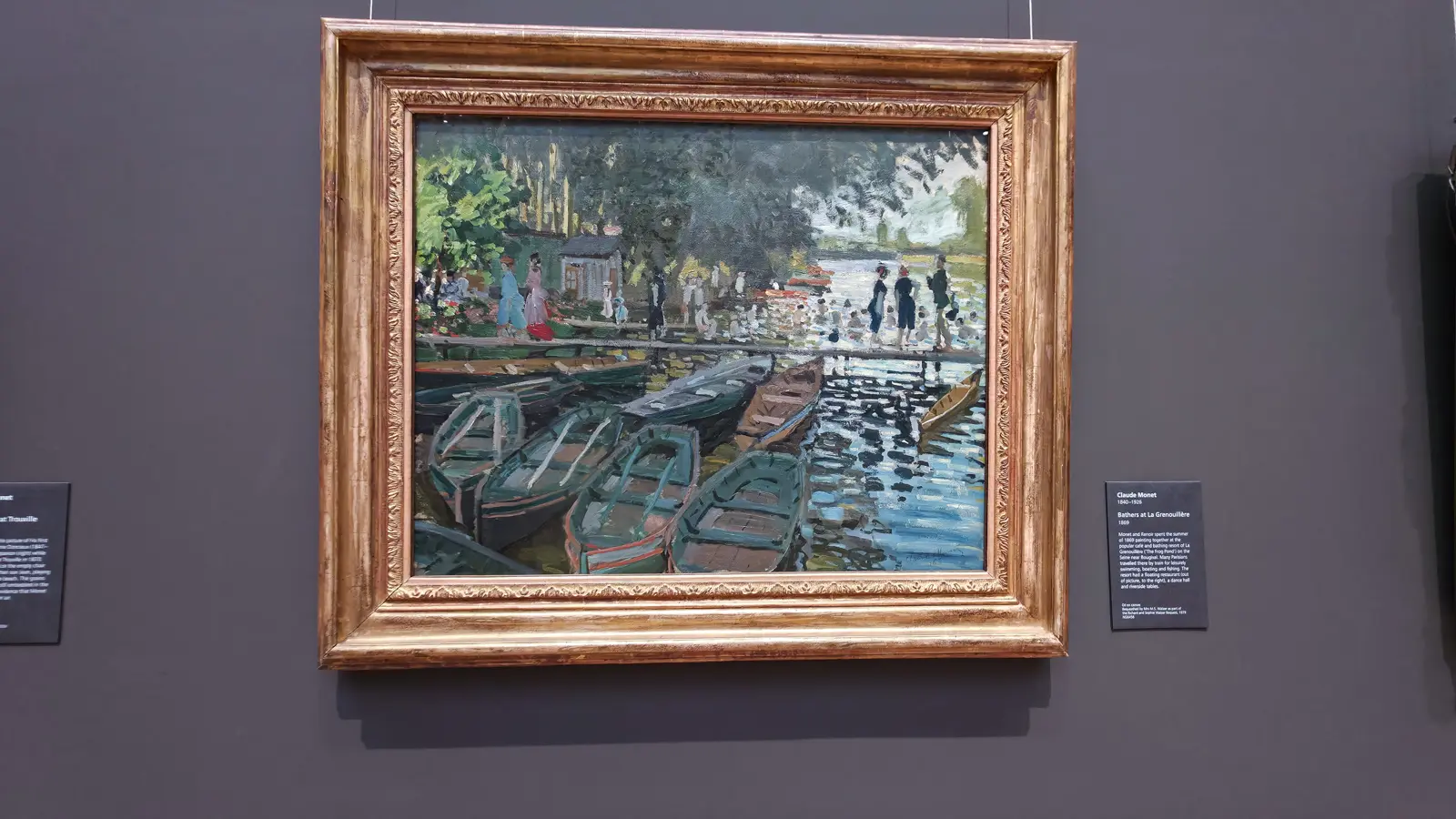
They are not actually hard to tell apart. Manet was the older man, and never really an Impressionist. He kept sending his work to the official Salon rather than joining the independent Impressionist shows, and he painted mostly indoors, building his pictures in the studio with hard edges, flat areas of colour and a deep, deliberate black. Monet did the opposite. He worked outdoors, in quick broken strokes, chasing light and weather, and he all but banished black from his palette.
Hang one of each near each other and the difference stops being a spelling problem.
Bubbly Tips
- Check the reunion is still on. The two café halves are back together for the Gallery’s anniversary, but loans go home. If the pairing is the reason for your visit, confirm it is still up before you travel.
- Look for the join. Standing in front of the two café scenes, try to work out where Manet’s knife went, and spot the window and the stage-dancer he added afterwards to tell them apart.
- Learn the Manet-or-Monet trick here. Studio, hard edges and black mean Manet; outdoors, broken strokes and no black mean Monet. The Grenouillère hung nearby is the perfect side-by-side test.
- Find the seams on the Maximilian. The reassembled fragments leave visible joins across the canvas, a strange thing to see once you know the story.
- Pair the Tuileries with the real gardens. Music in the Tuileries is set in the Paris park between the Louvre and the Seine, an easy stop on any Paris trip.
- It is all free. The National Gallery charges nothing, so this is a short, rich visit with no ticket required.
Final Thoughts
Manet spent his life just outside the movement he helped to start: too restless for the Salon that kept half-rejecting him, too proud to join the rebels who worshipped him, and forever mistaken for a man whose name was nearly his own. These few paintings hold all of it, the cut-up café, the smuggled protest, the sunny crowd, and, hanging close by, the younger friend he is still confused with a century and a half later. The reunion is the reason to go. The lasting reward is finally being able to tell Manet from Monet.
Until next time!

🌟 Everything You Need to Plan Your Dream Trip in 2026
- 🌟 Luxury Hotels - Find premium stays with Booking.com & Hotels.com
- 🏡 Vacation Rentals - Discover unique properties on VRBO
- 🏞️ Guided Tours - Explore with Viator or GetYourGuide
- 🎫 Attraction Tickets - Skip the lines with Tiqets
- 🚢 Ocean Cruises - Set sail with Cruise Direct
- 📱 International SIMs - Stay connected with Saily
- 🚗 Car Rentals - Budget-friendly options from Discover Cars
- 🌐 Secure VPNs - Browse safely with NordVPN
- 💶 Currency Exchange - Best rates with Wise
- 🗣️ Learn Languages - Master the local language with Babbel and Rosetta Stone