
Regent’s Park in London covers 410 acres of what was once a royal hunting ground. Henry VIII took the land at the dissolution of the monasteries in the 1530s and kept it for hunting and tenant farming. Nothing about it pointed to the formal park that stands there now. That came three centuries later, when the Prince Regent, later George IV, asked the architect John Nash to turn Marylebone Park into something grander. Nash drew up the plan in 1811, and it was carried out from 1818.
I have walked the park across the seasons, and it looks like a different place depending on the month. The formal gardens run from tulips in spring to red bedding in high summer, then to bare stone and fallen leaves by late October. The terraces around the edge stay the same cream colour year round. What follows is the route I keep coming back to, from the grand end near Portland Place out to the quiet water and the canal.
Regent’s Park at a Glance
🌳 The bones · 410 acres of Henry VIII’s old hunting ground, replanned by John Nash in 1811 and built out from 1818.
💷 Who paid · The developer James Burton financed it when the Crown refused; the Commissioners of Woods later called him, not Nash, the architect of Regent’s Park.
🏛️ The frame · Cream stucco terraces ring the park, most designed by Decimus Burton or Nash in the 1820s, their ground rents funding the whole scheme.
⛲ The showpiece · Nesfield’s Avenue Gardens of 1863–64, tulips in spring, blazing bedding in summer, the Griffin Tazza at the centre.
🚣 The water · A hand-dug lake with rowing boats, a heronry, and a forgotten 1867 tragedy that explains why it is only four feet deep.
🚇 Getting in · Regent’s Park and Great Portland Street tubes for the formal south end, Baker Street for the lake.
A park built for a Prince
The plan was ambitious from the start. Nash imagined a park ringed by palatial terraces and dotted with private villas, a garden suburb for the wealthy that would run down a grand new road to the Prince Regent’s home at Carlton House. Much of that vision was built, though not all of it, and not always by Nash himself.
The money is the part most people miss. When the Crown Estate refused to fund the scheme, the developer James Burton stepped in and financed it privately, which is largely why it happened at all. His son, the young architect Decimus Burton, designed many of the terraces and villas under Nash’s supervision. The two did not always agree, and Decimus went his own way often enough that the Commissioners of Woods later described James Burton, not Nash, as the architect of Regent’s Park. The park is laid out around two ring roads, the Outer Circle at 4.45 kilometres and the Inner Circle at 1 kilometre, with most of the interior kept for people on foot.
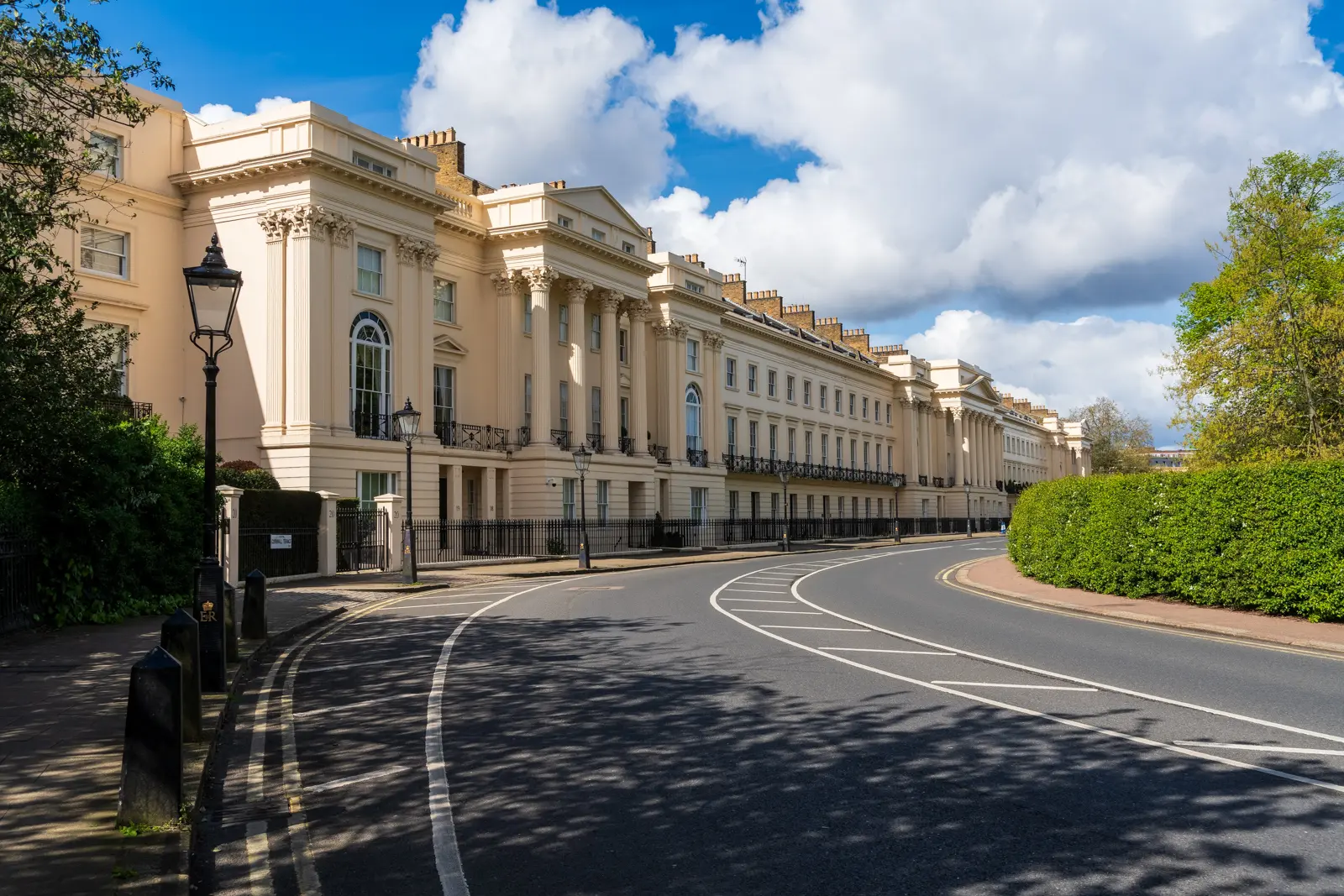
The terraces were not just decoration. They were the engine that paid for everything, since the ground rents from wealthy lessees underwrote the cost of the whole park. That is worth remembering in front of a facade like Cornwall Terrace. The black bollard on the corner carries an E II R cipher, a small royal marker that the Crown Estate still owns the land beneath these houses.
The Avenue Gardens
The showpiece gardens are not Nash’s work at all. They are Victorian, laid over his plan a generation later.
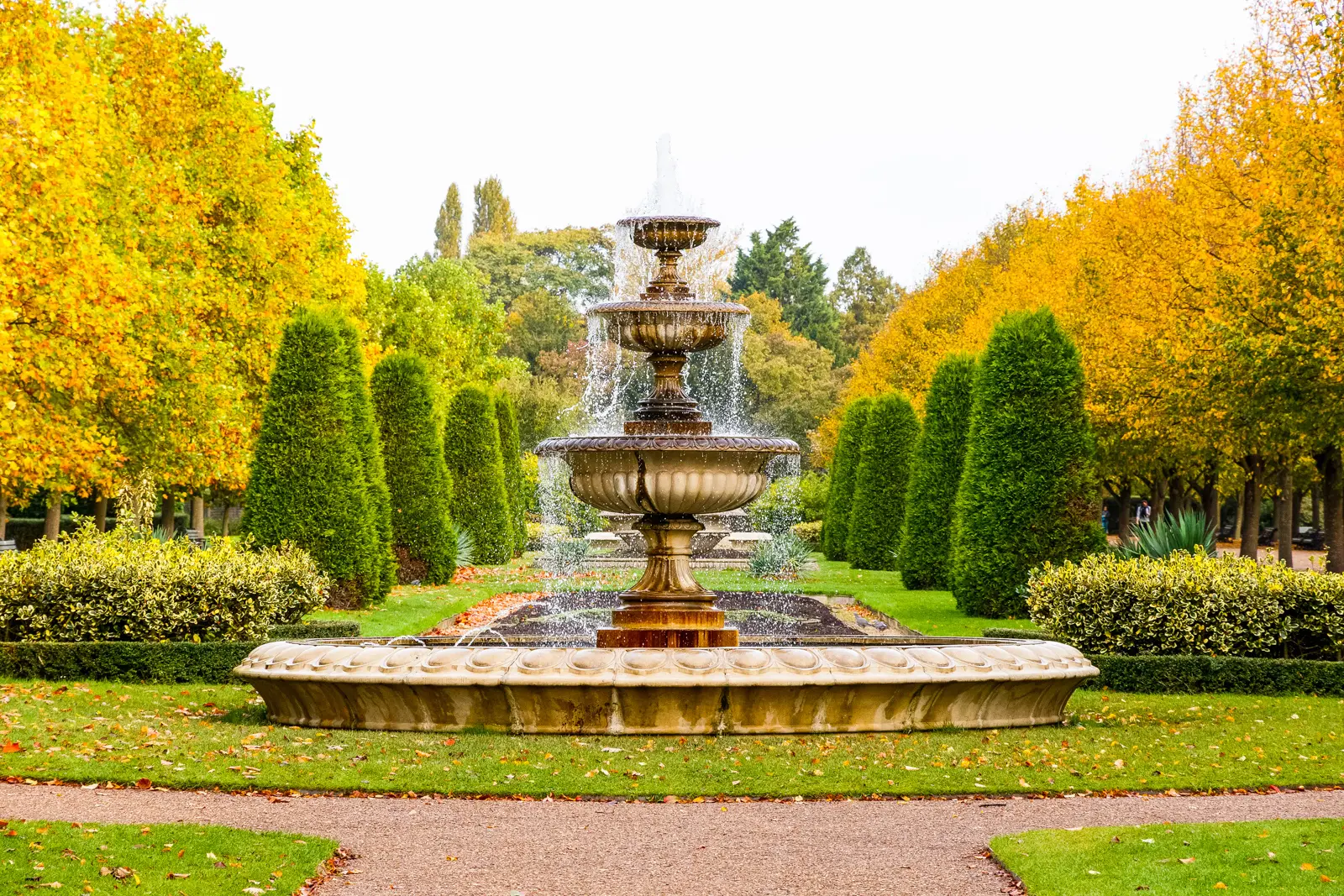
Nash had run a Broad Walk down the eastern side, planted with eight rows of trees. The trees struggled in the heavy clay and never really thrived. By the early 1860s the garden designer William Andrews Nesfield was brought in, first to advise on the failing trees and then to redesign the whole stretch. His formal gardens were approved in 1863 and completed in 1864, and they became known as the Avenue Gardens, or the Italian Gardens. Straight paths, clipped hedges, blocks of bright seasonal planting, and a run of carved stone urns and fountains down the central axis. The centrepiece is the Griffin Tazza, a wide stone bowl held up by four winged lions, made by the artificial stone firm Austin and Seeley and installed in 1863.
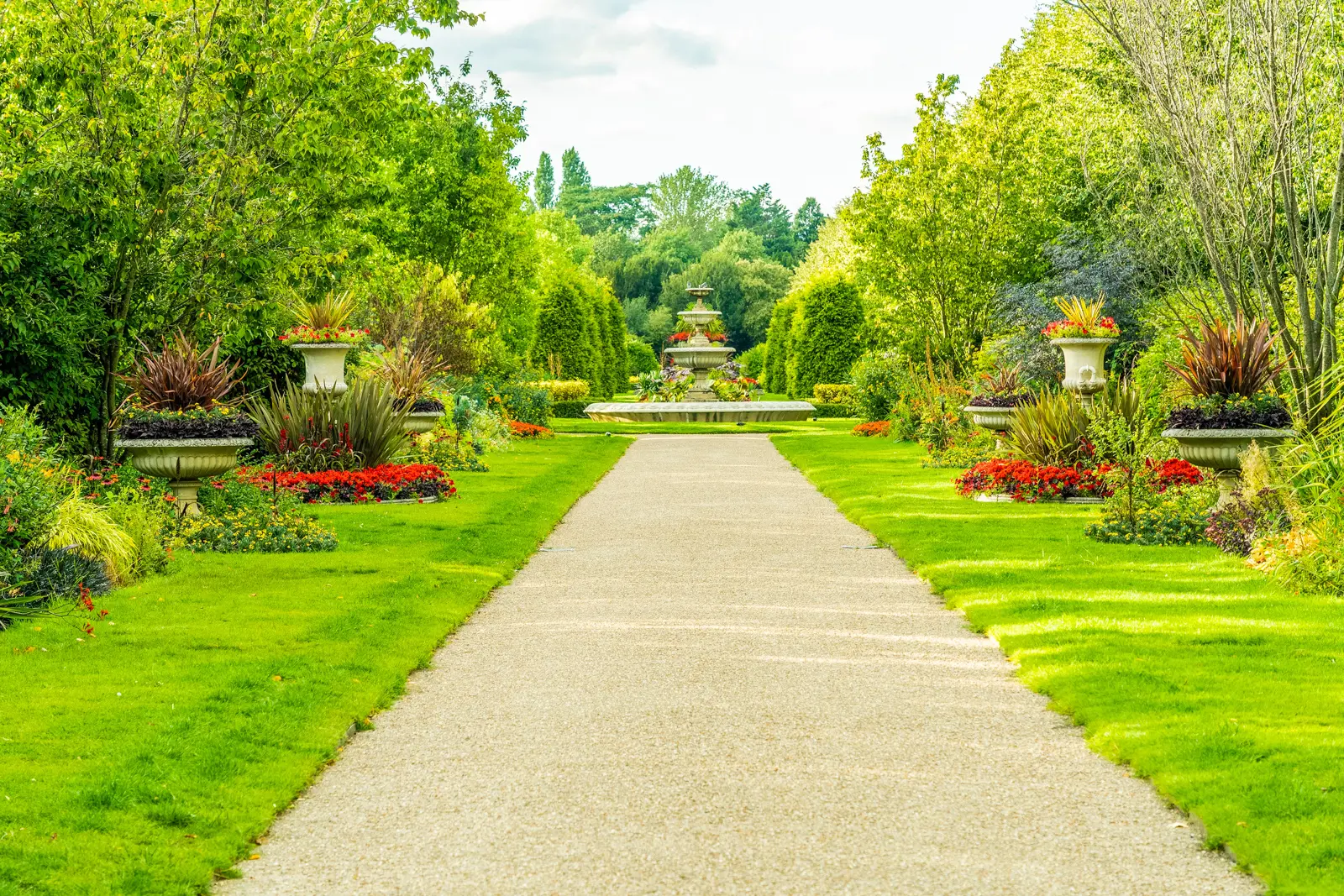
The planting is what changes through the year. In spring the beds fill with tulips and bulbs, and the cherry trees behind come into blossom.
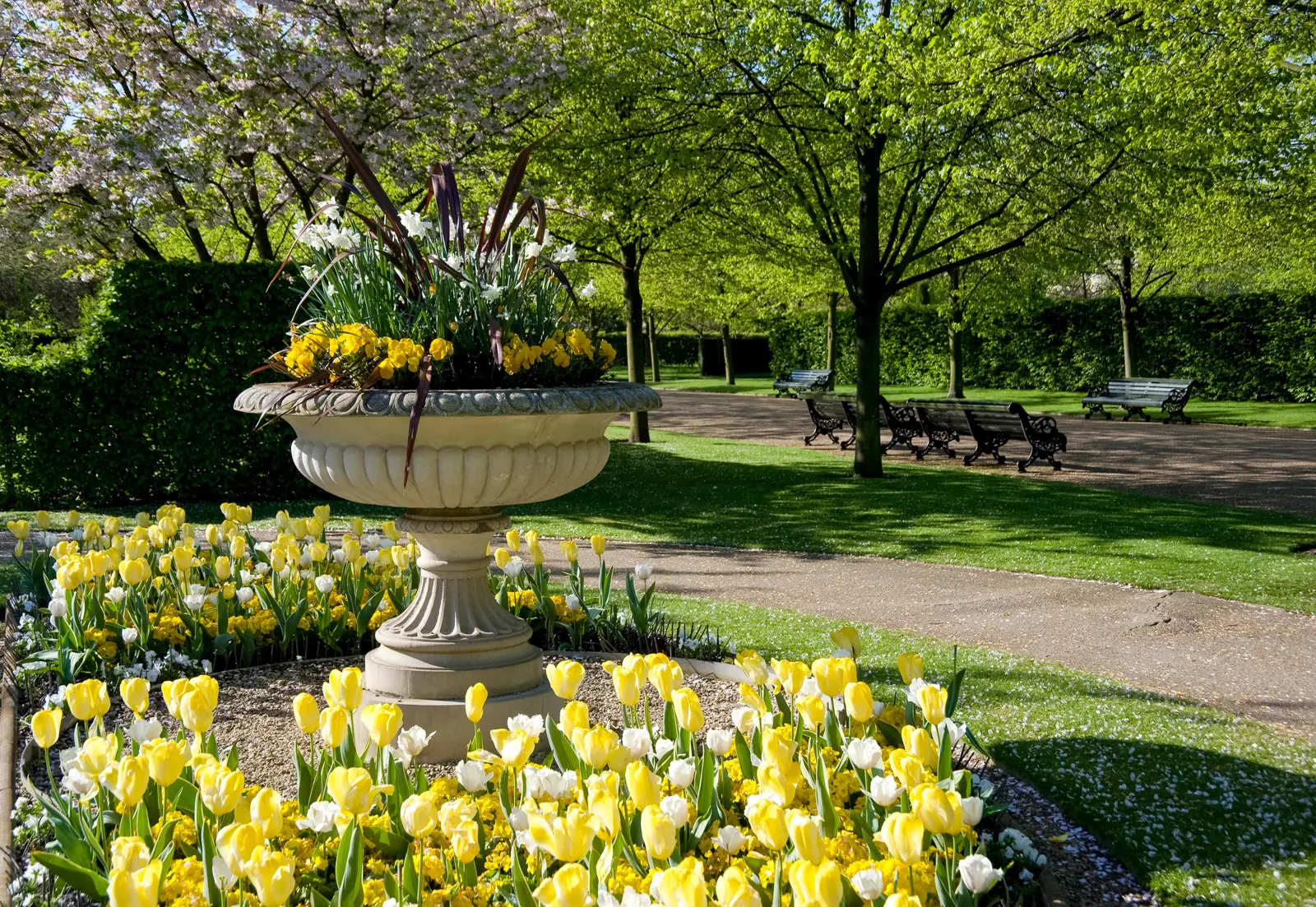
By autumn the bedding has gone over, but the stonework and the tall conifers hold the shape of the garden, and the fountains still run.
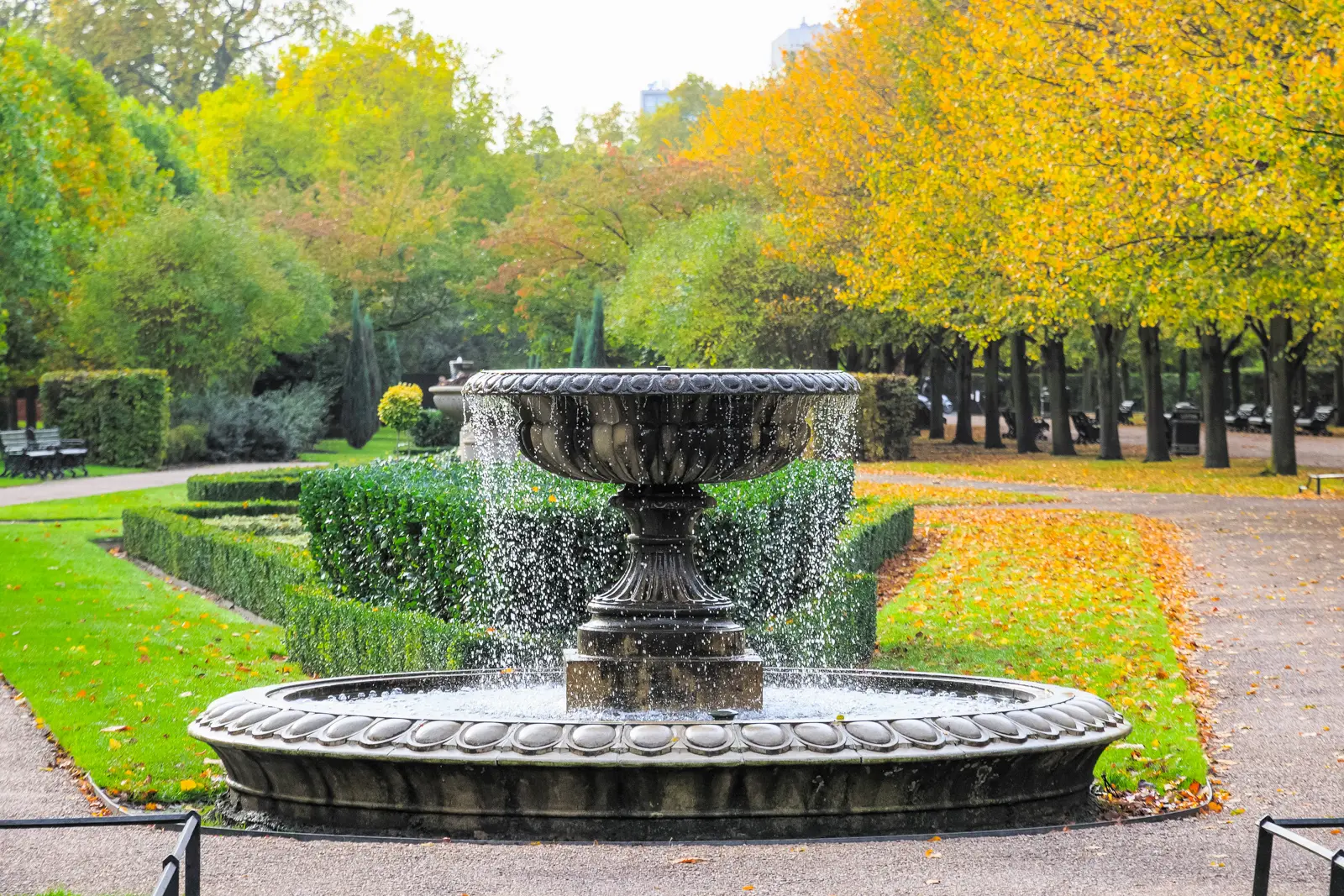
The smaller tazzas sit further along the same axis, each one raised in its own bed of low hedging.
The terraces and Park Crescent
The edge of the park runs past one white stucco terrace after another, each one a long row of houses built behind a single grand front so the whole block reads as one palatial building. Most are Nash and Burton work from the 1820s. At the southern end, where Portland Place meets Marylebone Road, is Park Crescent, a semicircle of houses behind a long curved colonnade.
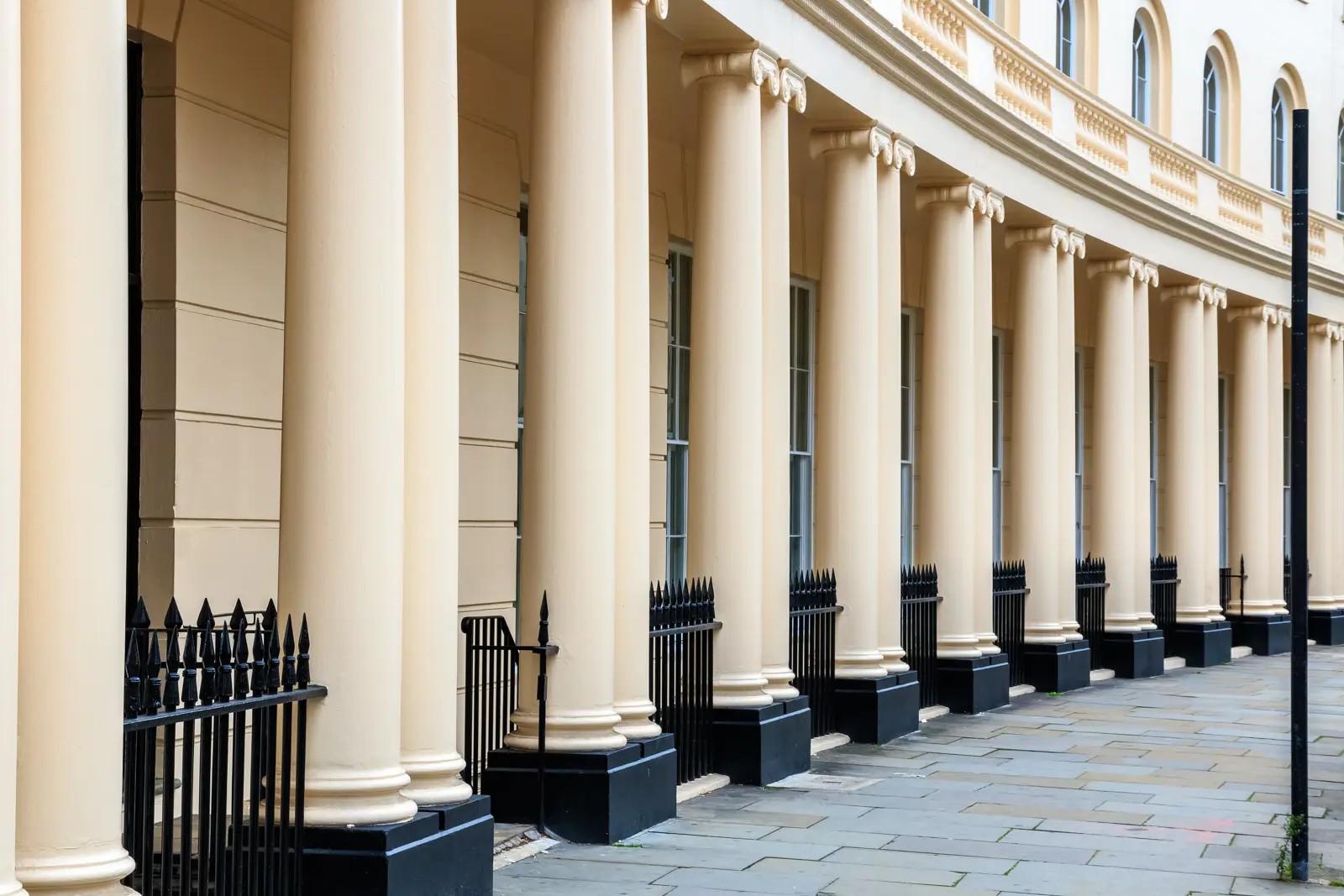
Park Crescent is where International Students House sits, in the first building on the crescent, opened in 1965 by Queen Elizabeth The Queen Mother.
The terraces around the park have had many uses over two centuries. Sussex Place, with its curved wings and pointed cupolas, was rebuilt behind its original facade in the 1960s to house the London Business School. Cornwall Terrace alone has held company headquarters, a cultural foundation and a medical royal college before returning to private homes.
The lake
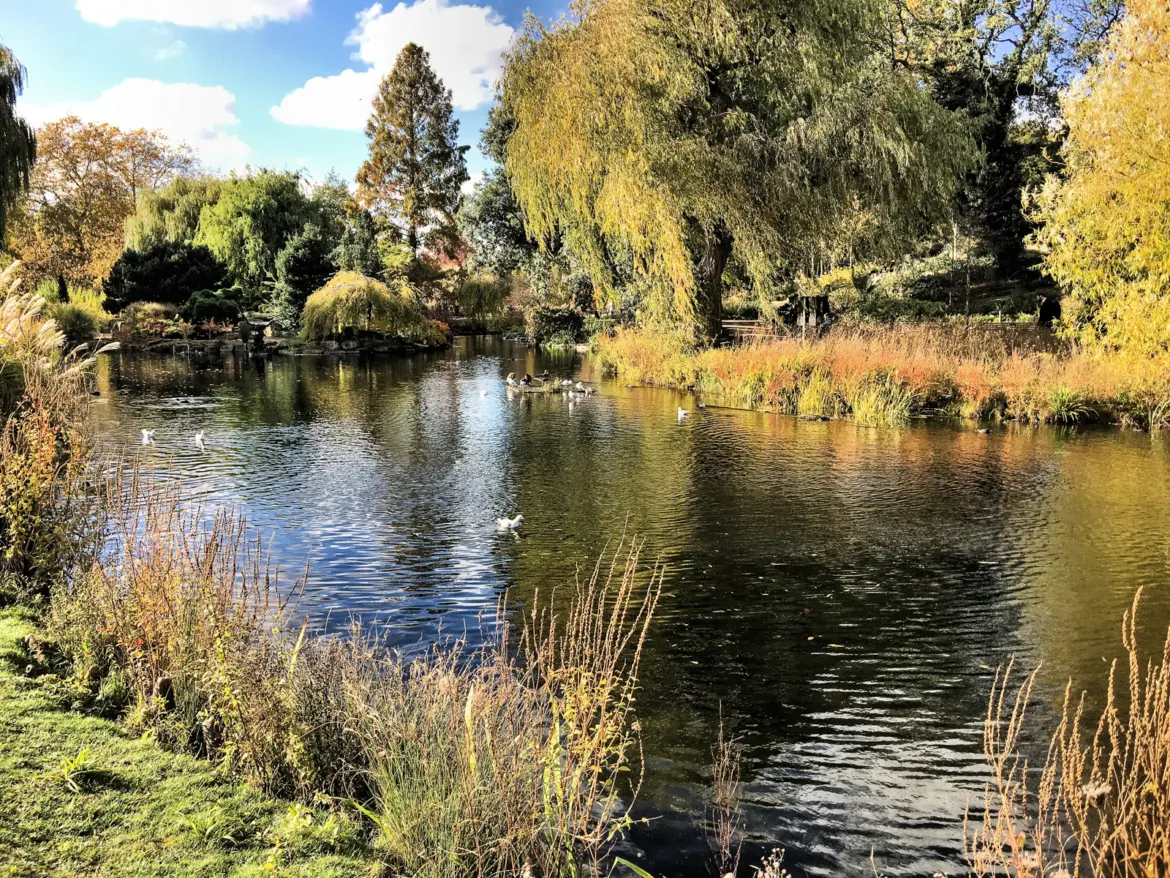
The lake looks natural, but it is not. It was dug as part of Nash’s design, a long curving stretch of water shaped with islands. The willows lean over it, the reflections double the trees, and the birds treat the islands as their own.
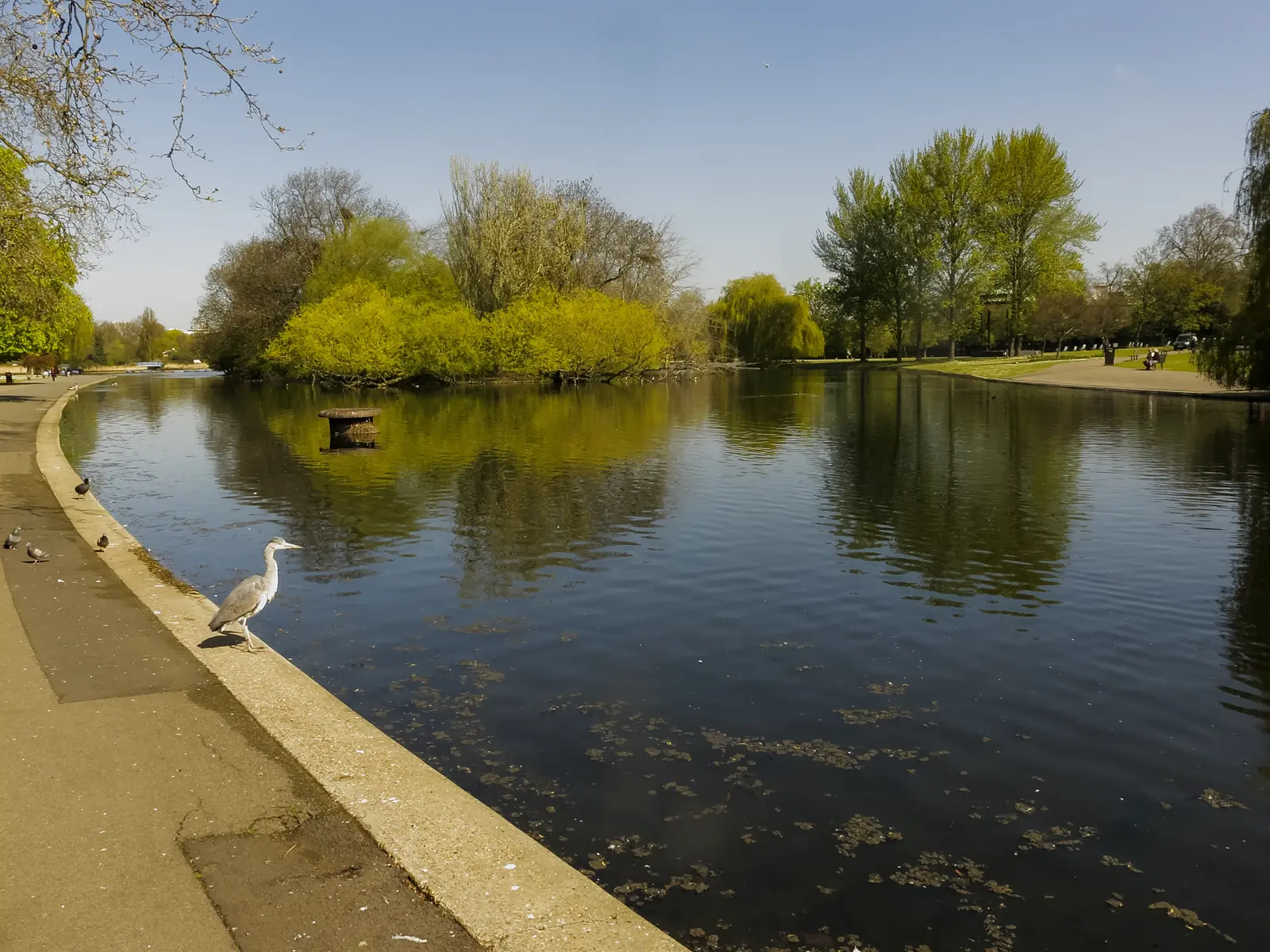
The lake also holds one of London’s grimmer stories. On 15 January 1867 the water was frozen and thronged with skaters, despite the ice having cracked and given way the day before. In the afternoon it broke apart in a hundred places at once, pitching around two hundred people into water up to twelve feet deep. Forty of them died, and at the time it was counted the worst weather-related accident in British history. After the inquest the lakebed was raised and the water shallowed to about four feet, which is roughly how it stays today. It is a quiet place to sit now, and almost nothing marks what happened, but it is worth knowing while the herons work the shallows.
The canal and the quiet corners
The northern edge of the park runs alongside Regent’s Canal, and the towpath is a good, flat walk. Narrowboats pass under the bridges, and others sit moored along the bank. The water runs east towards Camden and west towards Little Venice, with London Zoo right on the far side. It is a quieter side of the park than the formal gardens, working boats and moorings in place of clipped hedges and stone urns.
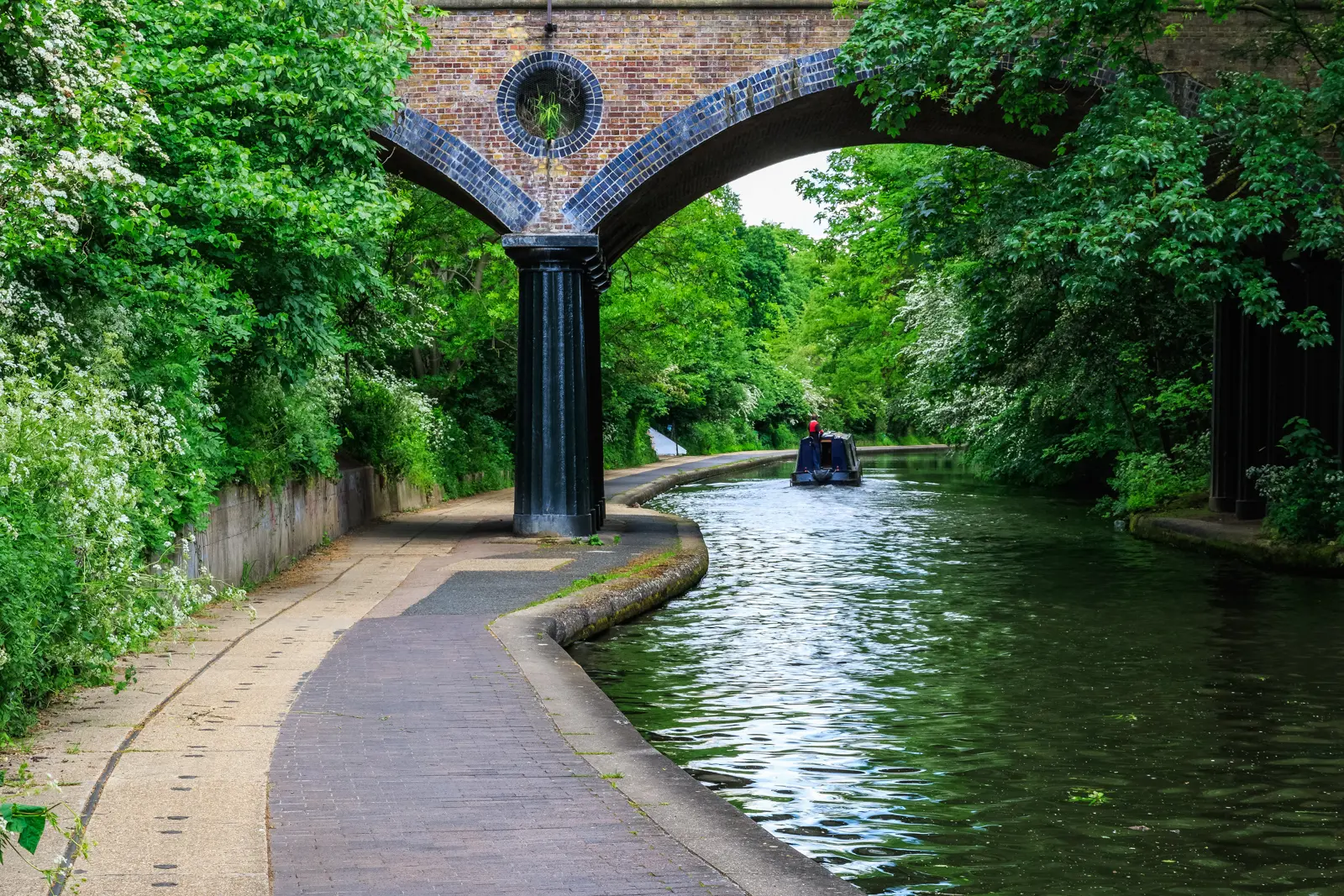
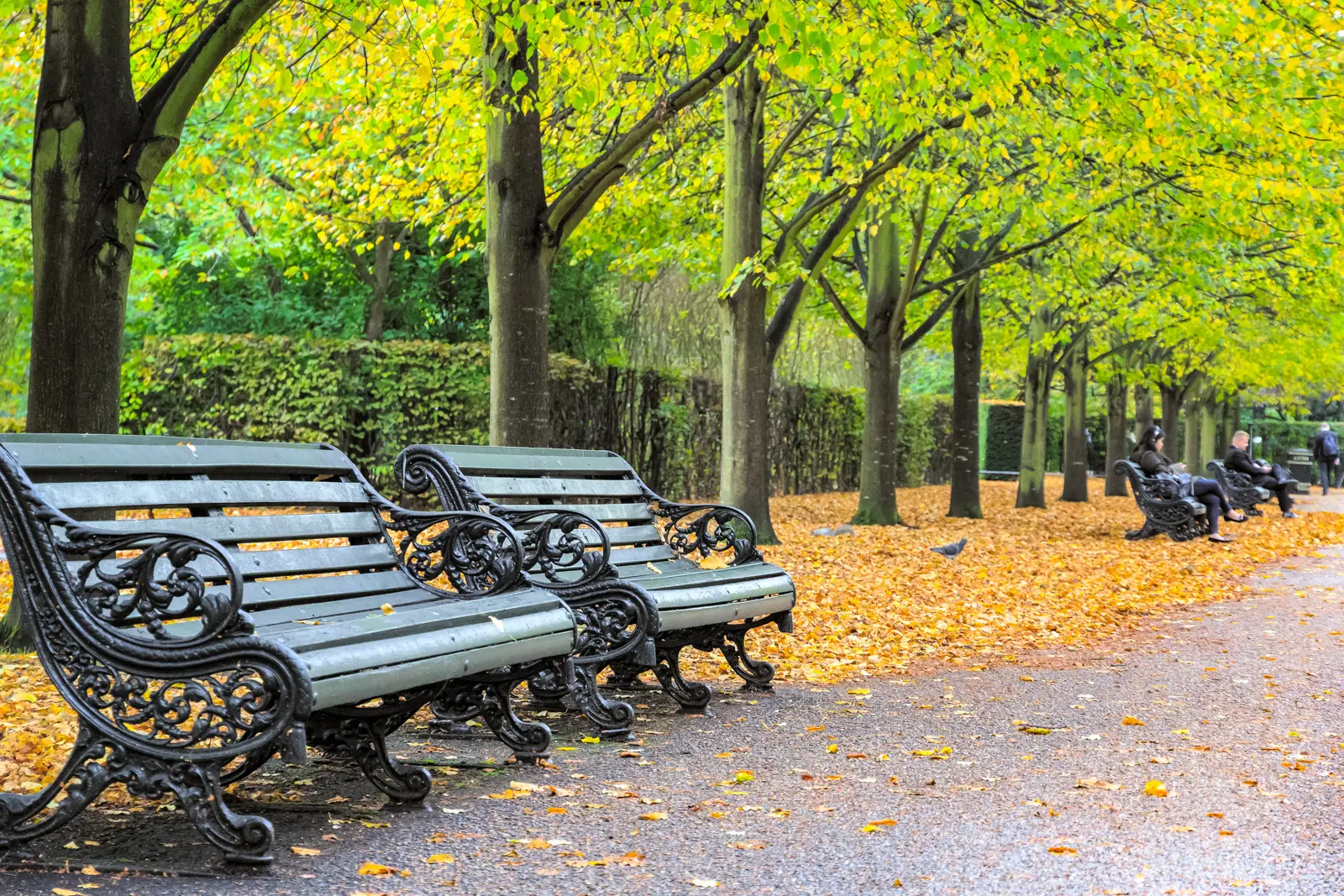
Away from the gardens and the water, the park opens into long tree-lined avenues. The Broad Walk is the spine of it, running the length of the park from the Avenue Gardens up towards Primrose Hill. In autumn the paths fill with leaves and the crowds thin out. Most visitors keep to the lake and the gardens, so these walks are left to the people who have come to wander rather than to see any one thing.
This is the corner of the park I come back to most. I like to walk it slowly, with no route in mind, and stop on one of the old green cast-iron benches, ornate at the arms. There are enough of them that one is almost always free. In autumn, with the leaves down and the paths half empty, it is calm and unhurried, which is not something central London hands out often.
The one reliable company on any bench is the squirrels. They have long since worked out that a person sitting still might be holding food, and they will come surprisingly close to check.

Bubbly Tips
- Time the Avenue Gardens to the planting. The tulips and bulbs peak in April, and the summer bedding is at its strongest through July and August. Out of those windows the gardens are about stone and structure rather than colour.
- Start at the south and walk north. Enter near Great Portland Street or Regent’s Park tube, go through the Avenue Gardens first, then work toward the lake and the canal. It puts the formal colour first and saves the quiet water for last.
- Two tube stations, two moods. Regent’s Park and Great Portland Street drop you at the formal southern end. Baker Street puts you closer to the lake and the western terraces. Pick your entrance based on what you most want to see.
- Get to the boats early on sunny weekends. The lake’s rowing boats draw a queue on warm afternoons, and going first thing is the difference between waiting and stepping straight aboard.
- Detour to Queen Mary’s Gardens for the roses. Inside the Inner Circle, the rose garden holds thousands of roses and is at its best in early June. It is a short walk from the boating lake and easy to miss if you stick to the outer paths.
- Walk the canal from the park. Join the towpath at the northern edge and head toward Camden Market or out to Little Venice. It is flat, car-free, and one of the calmer ways to cross this part of London.
- Shoot the fountains with the morning light behind them. The Avenue Gardens face roughly north to south, so a low sun early or late catches the spray and the stonework best. The autumn colour photographs strongest along the Broad Walk.
- Add Primrose Hill for the skyline. The gate at the top of the Broad Walk leads across to Primrose Hill, a short climb with one of the clearest open views back over central London. Fifteen minutes on foot from the lake.
Final Thoughts
What stays with me about Regent’s Park is how many hands shaped it. Nash drew the bones in 1811, the Burtons built and paid for it, Nesfield laid the formal gardens over the top fifty years later, and the Victorians dug and then shallowed the lake after a tragedy most people walking past have never heard of. It reads as one calm green space, but it is really a stack of decisions made across a century.
That is also why it holds up across the seasons. The tulips and the summer bedding belong to Nesfield, the terraces and the lake to Nash and the Burtons, the herons and the squirrels to nobody in particular. It works from either direction, the grand formal end or the quiet water. I have done both, more than once.
Until next time!

🌟 Everything You Need to Plan Your Dream Trip in 2026
- 🌟 Luxury Hotels - Find premium stays with Booking.com & Hotels.com
- 🏡 Vacation Rentals - Discover unique properties on VRBO
- 🏞️ Guided Tours - Explore with Viator or GetYourGuide
- 🎫 Attraction Tickets - Skip the lines with Tiqets
- 🚢 Ocean Cruises - Set sail with Cruise Direct
- 📱 International SIMs - Stay connected with Saily
- 🚗 Car Rentals - Budget-friendly options from Discover Cars
- 🌐 Secure VPNs - Browse safely with NordVPN
- 💶 Currency Exchange - Best rates with Wise
- 🗣️ Learn Languages - Master the local language with Babbel and Rosetta Stone