
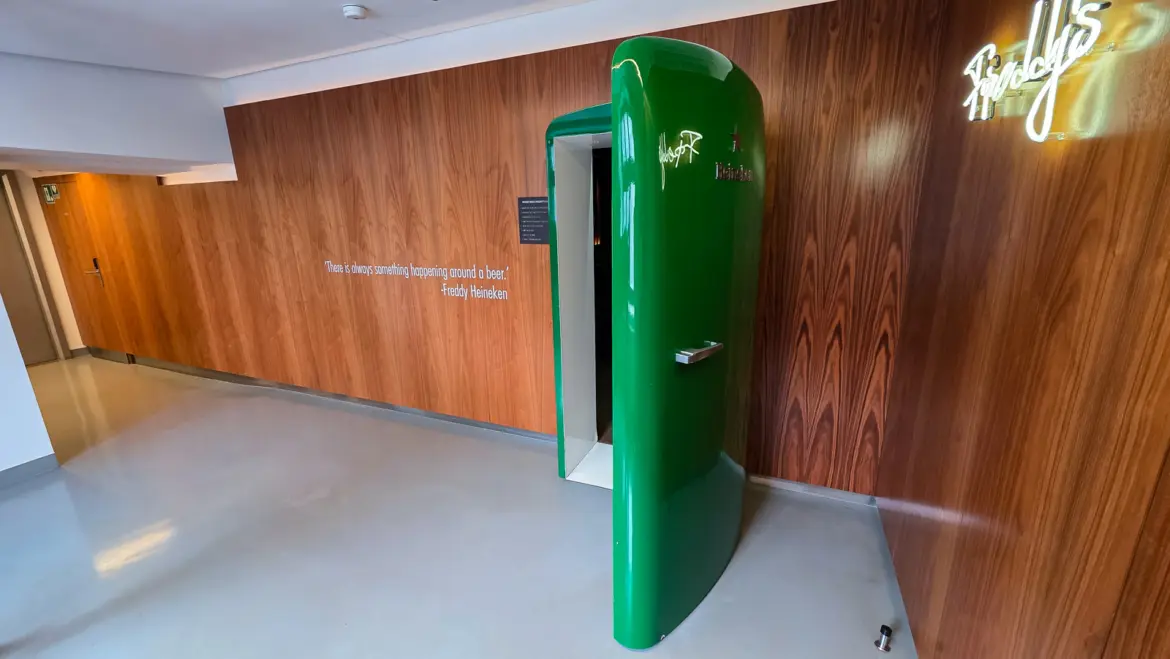
I do not drink beer. I booked a beer tour anyway, paid extra for the upgraded version of it, and spent an hour in a bar hidden behind a refrigerator door.
That is the whole review in one line, but it needs unpacking, because almost everything written about this upgrade comes from people who love beer. I am not one of them. Which means the question of whether the extra money is worth it got tested properly.
The door is real. It is a full-size green fridge set into a wood-panelled wall, and it swings open into a corridor. Beside it, in white on the panelling, is a line from the man the bar is named after: ‘There is always something happening around a beer’.
Freddy’s Bar at a Glance
🚪 What it is · A hidden bar entered through a working fridge door, reached only on the Heineken Experience VIP tour. Named after Freddy Heineken.
🎟️ The upgrade · The €65 VIP tour: ~2.5 hours, a guide, small group, behind-the-scenes rooms, a private bar, five beers with Dutch bites and a personalised bottle.
🍺 Non-drinker’s verdict · Worth it, with conditions. The upgrade buys a small group, a guide and a well-designed room, not a reason to like beer. The alcohol-free pour was the favourite.
🎭 The catch · There are two hidden bars, Freddy’s and Henry’s. The ticket guarantees a private bar, not the fridge-door one.
💡 Tip · Go on a big outdoor holiday like King’s Day (check the hours first): the city is outside and the building is calm.
The building it hides in
The Heineken Experience occupies the company’s oldest brewery, on Stadhouderskade at the edge of De Pijp, the neighbourhood immediately south of Amsterdam‘s canal ring. Brewing stopped here in 1988 when demand outgrew the building, and production moved to a larger modern site.
None of that is visible from the street, where the building reads as a handsome brick nineteenth-century block with the name on it. The theatrical parts are all inside.
Arriving on King’s Day
We arrived on 27 April, which is King’s Day. Amsterdam spends that day outdoors, in orange, on boats and in the streets.
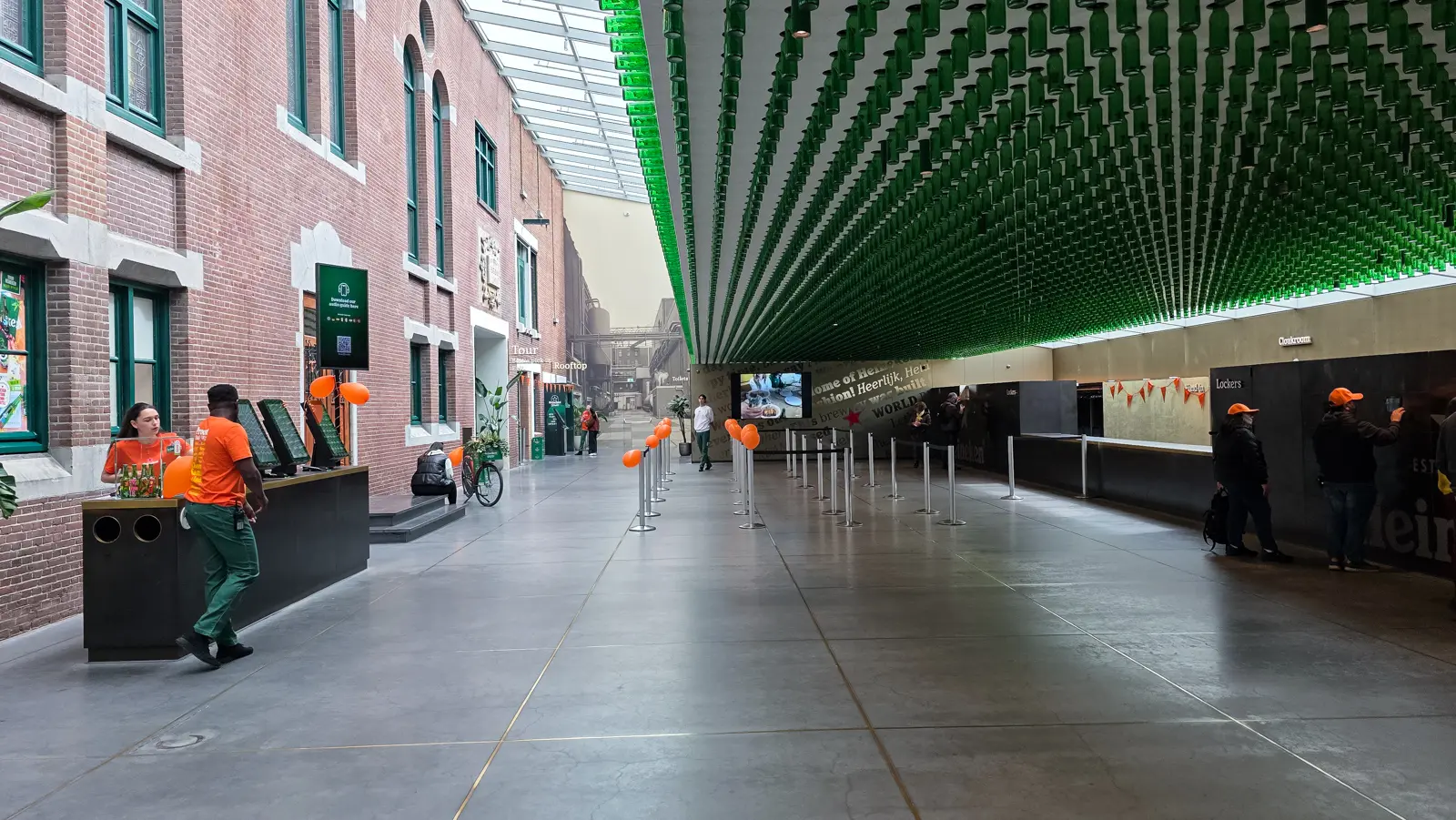
The arrival hall makes the conversion obvious in one look. The original brewery frontage still stands, brick and arched windows and green-painted frames, except that a glazed roof now runs overhead and turns what was once an outdoor yard into a covered space. Facing it, a ceiling of green bottles hangs in dense rows above the cloakroom and locker counters.
The orange was everywhere. Balloons tied to the barrier posts, bunting strung over the lockers, staff in orange shirts and caps. What was not there was a queue. The lanes were roped off and standing empty, and the floor was close to bare.
That is the single most useful thing I noticed all afternoon. A big public holiday empties the indoor attractions in a city that celebrates outdoors. Everyone else was at the party.
One caution before anyone plans around it. The Heineken Experience states that it opens every day of the year, and it also states that hours can change on public holidays. The trick works only if the hours are checked first.
What the upgrade actually buys
The standard ticket is a self-guided walk through the building, roughly an hour and a half to two hours, ending with a couple of beers at a public bar.
The VIP tour is different in kind. It runs around two and a half hours with a guide, goes into parts of the building closed to general visitors, and finishes in a private bar with five beers from the Heineken range and food chosen to go with them. It costs €65 per person at the time of writing. There was a personalised bottle at the end with my name printed on it.
Our group was eight people. That size matters more than anything else on the list, because it is small enough that the guide talks to the group rather than at it, and small enough that questions get answered properly.
The room
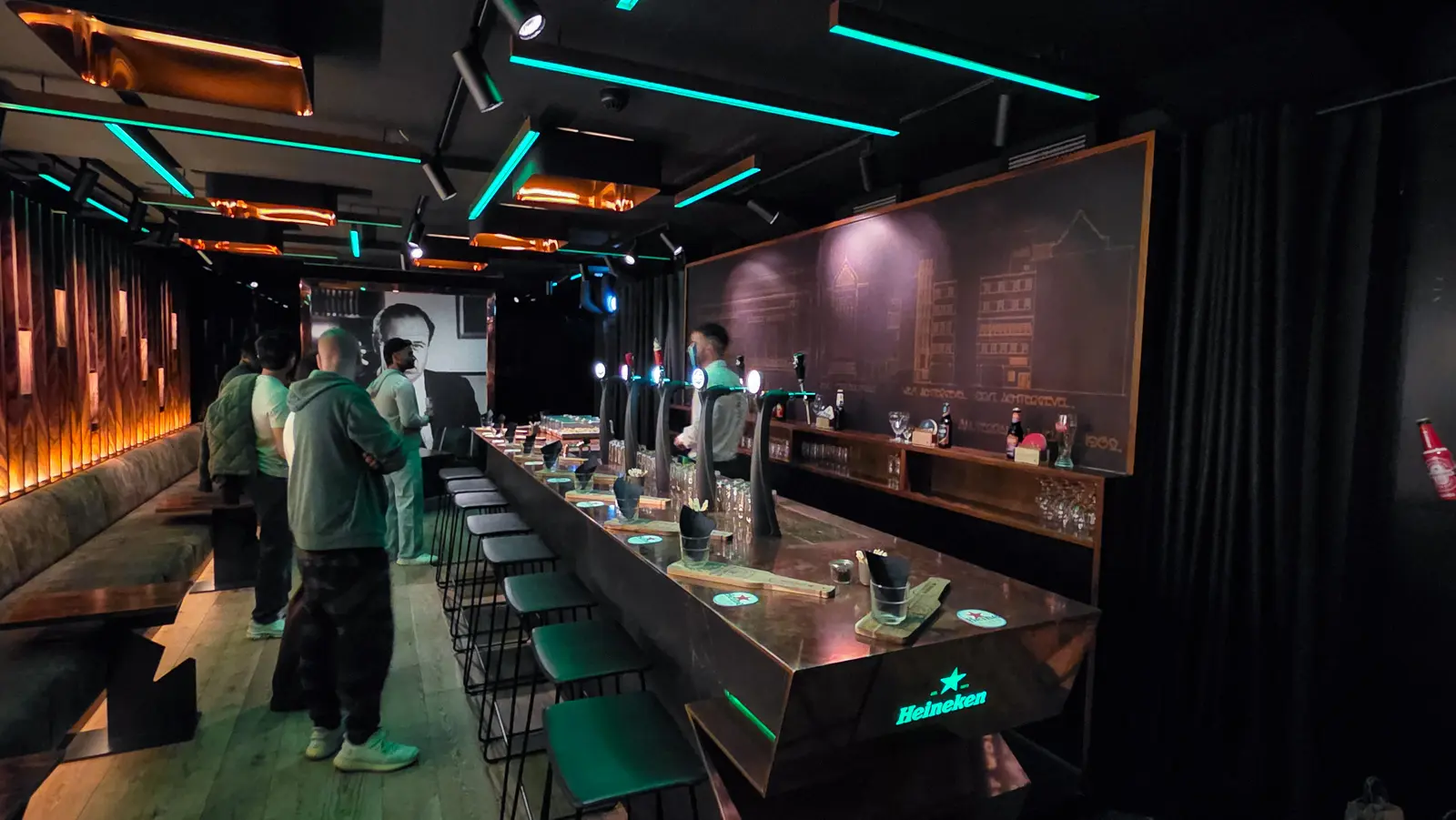
Freddy’s is a long, narrow, very dark room. Strips of teal neon run across a black ceiling, crossed by copper panels that throw the light back down in warm orange. One wall is timber, backlit in vertical slots. Down the length of it runs a copper bar with black stools, and behind the taps hangs a large panel of architectural line drawings in gold on a dark ground.
The result should be gaudy. It is not. The green and copper do most of the work and the room stays on the right side of tasteful.
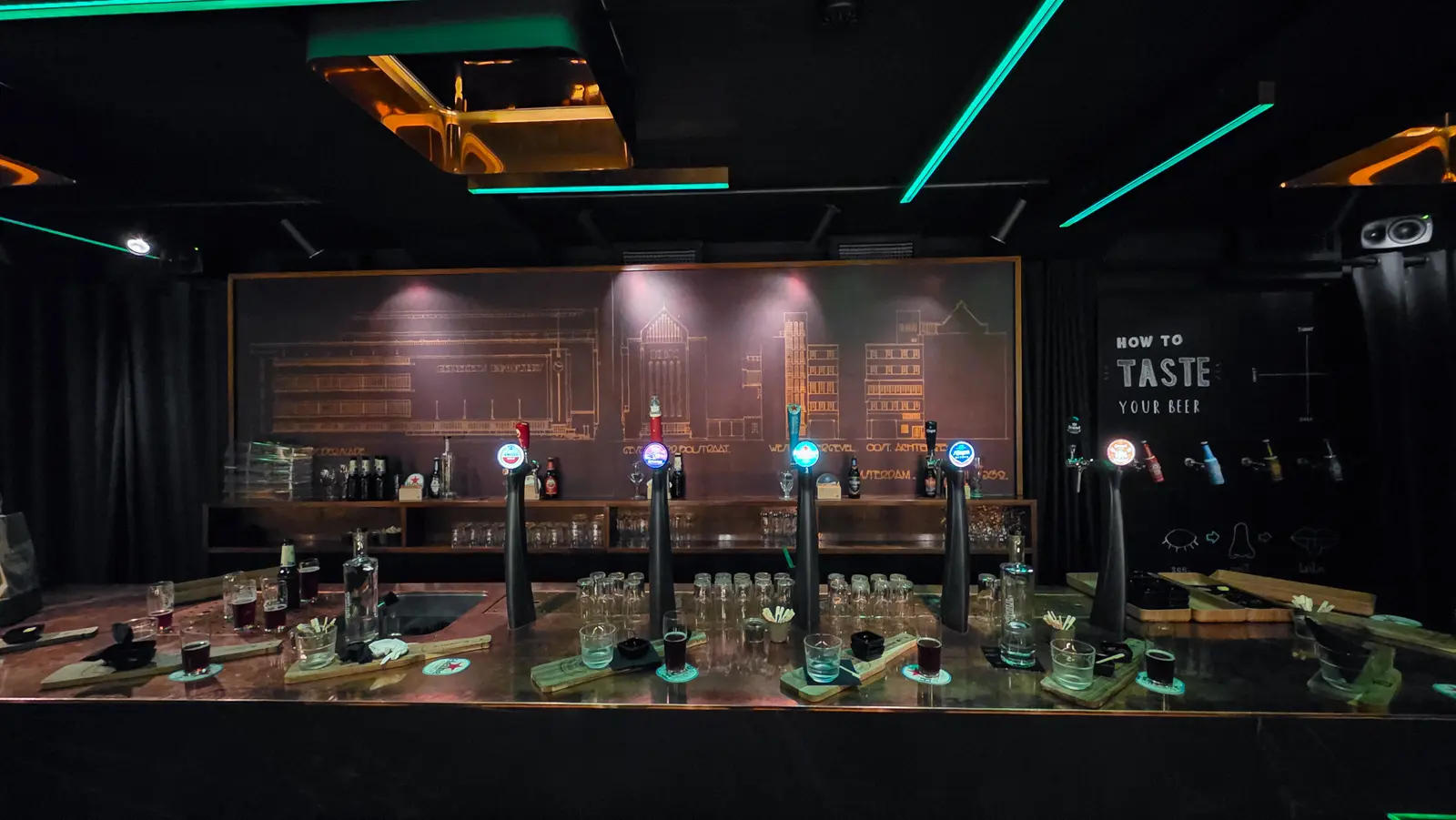
Seen straight on, the bar back is the best-composed thing in the room. Five tap towers stand in a row, each lit at the head. The drawings behind them are lit from above in three pools. Along the right-hand wall, a chalk-style board headed How to Taste Your Beer sits beside a heavy dark curtain.
Freddy
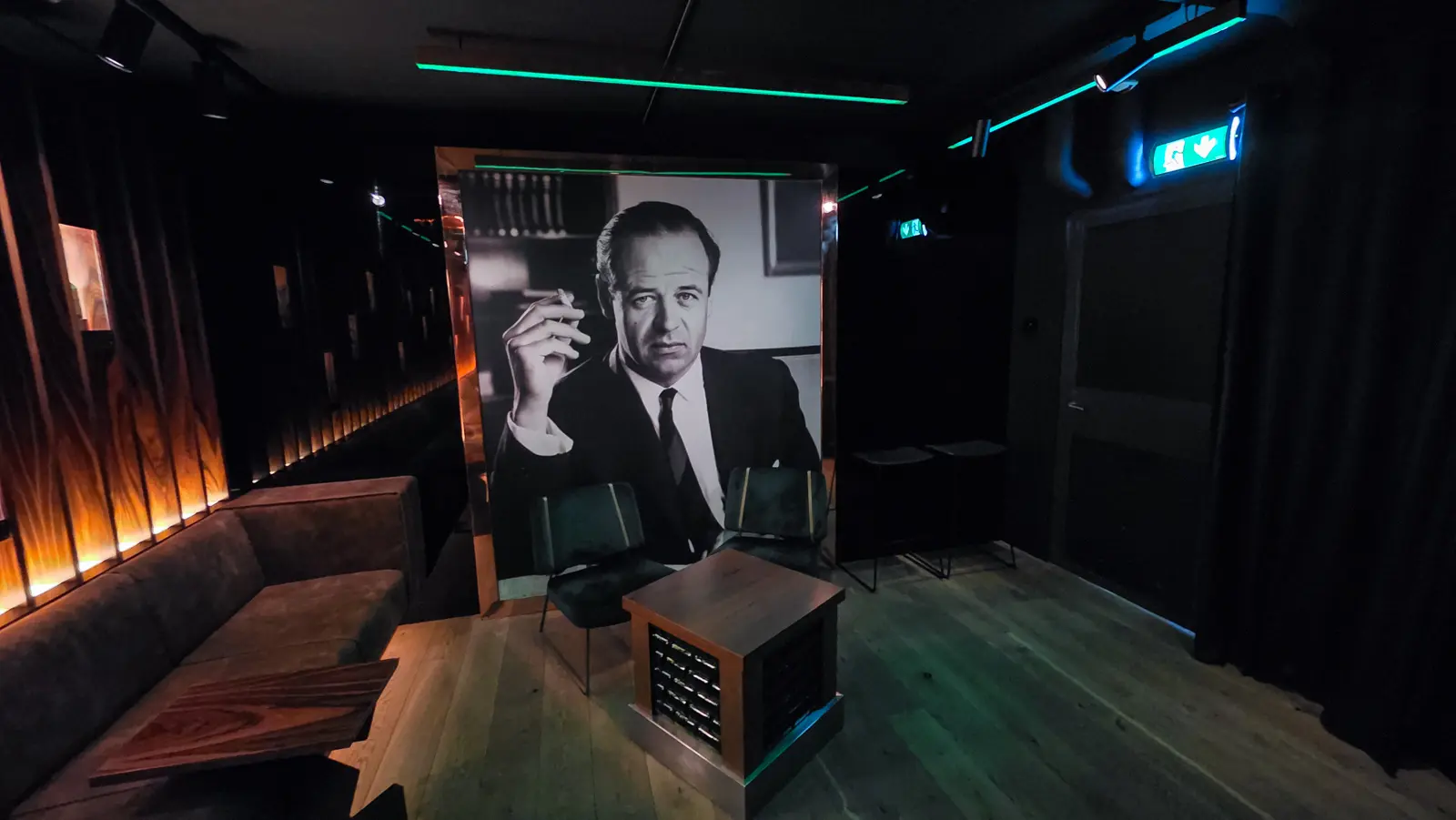
At the far end of the room, filling most of a wall, is a black-and-white photograph of a man in a dark suit and tie, holding a cigarette, looking straight down the lens. Two low chairs and a banquette sit in front of it.
He is Alfred Henry Heineken, known as Freddy, born in Amsterdam in 1923 and died in 2002. He was the grandson of Gerard Adriaan Heineken, who bought an Amsterdam brewery called De Hooiberg, the Haystack, in 1864 and built the company from it.
The part of his story that explains the room is what happened in between. By the time Freddy joined the business the family no longer owned it. He spent years buying stock back to return control to the family, then ran the company as chairman and chief executive from 1971 to 1989, turning a Dutch brewer into a global brand. The portrait is not decoration. It is the person who made the thing the building is about.
How the tasting works
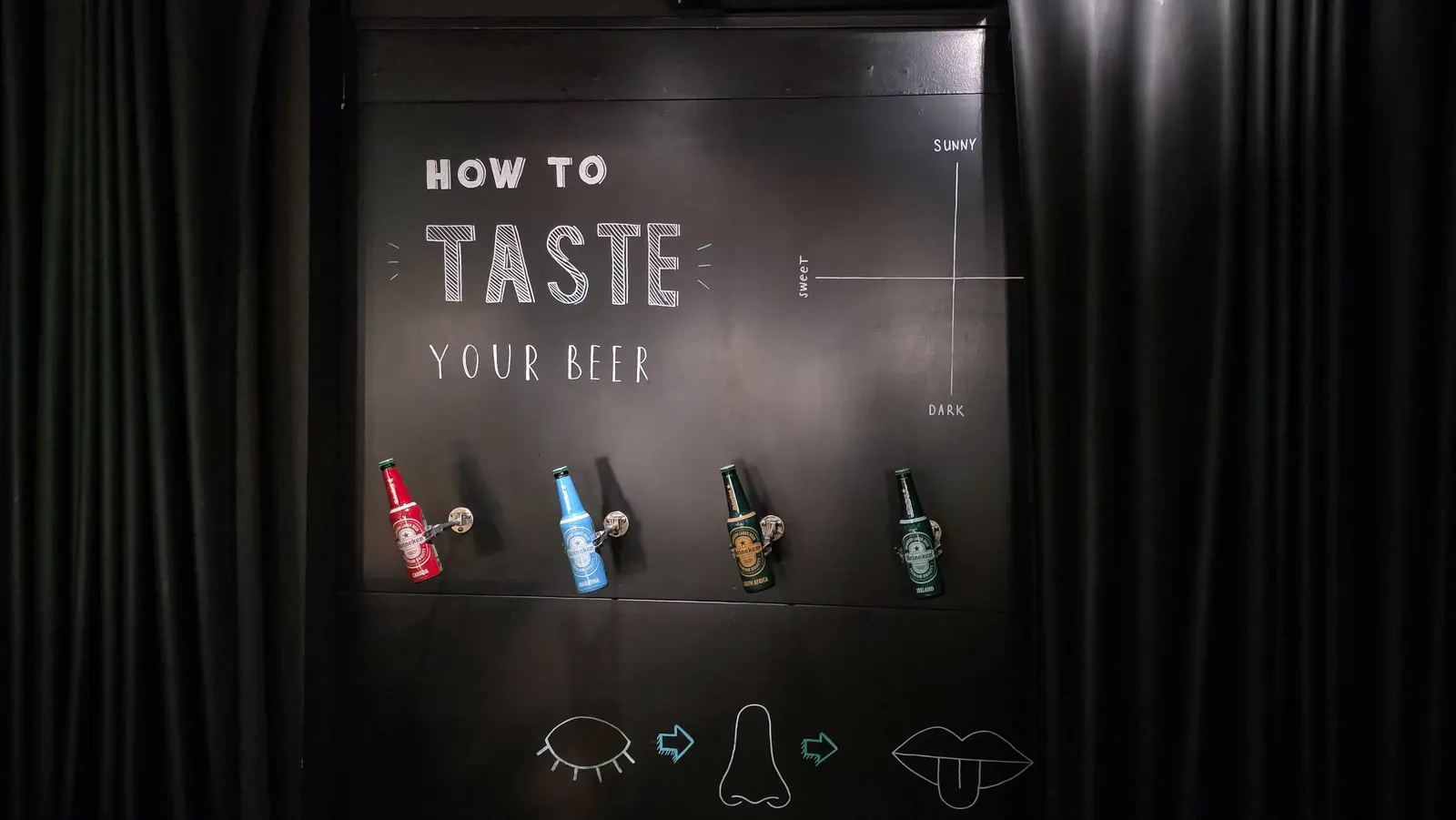
The board on the right-hand wall is the teaching aid. It carries a simple two-axis grid, sweet to dark on one line and sunny on the other, with four Heineken bottles mounted horizontally on brackets below it, each carrying a different national label. Underneath, drawn in white outline, are an eye, a nose and a mouth with an arrow running between them, in that order.
The order is the whole lesson. Look, smell, then taste. It is not complicated and it is not meant to be.
The beers, honestly
We sat at the bar for the tasting and got up afterwards, which is the right way round. Sitting keeps eight people in one conversation.
I cannot say what the five beers were. I do not drink beer, I was not taking notes, and I have forgotten. What is worth recording is what a person in that position actually gets out of the hour, which is more useful than tasting notes I would have invented.
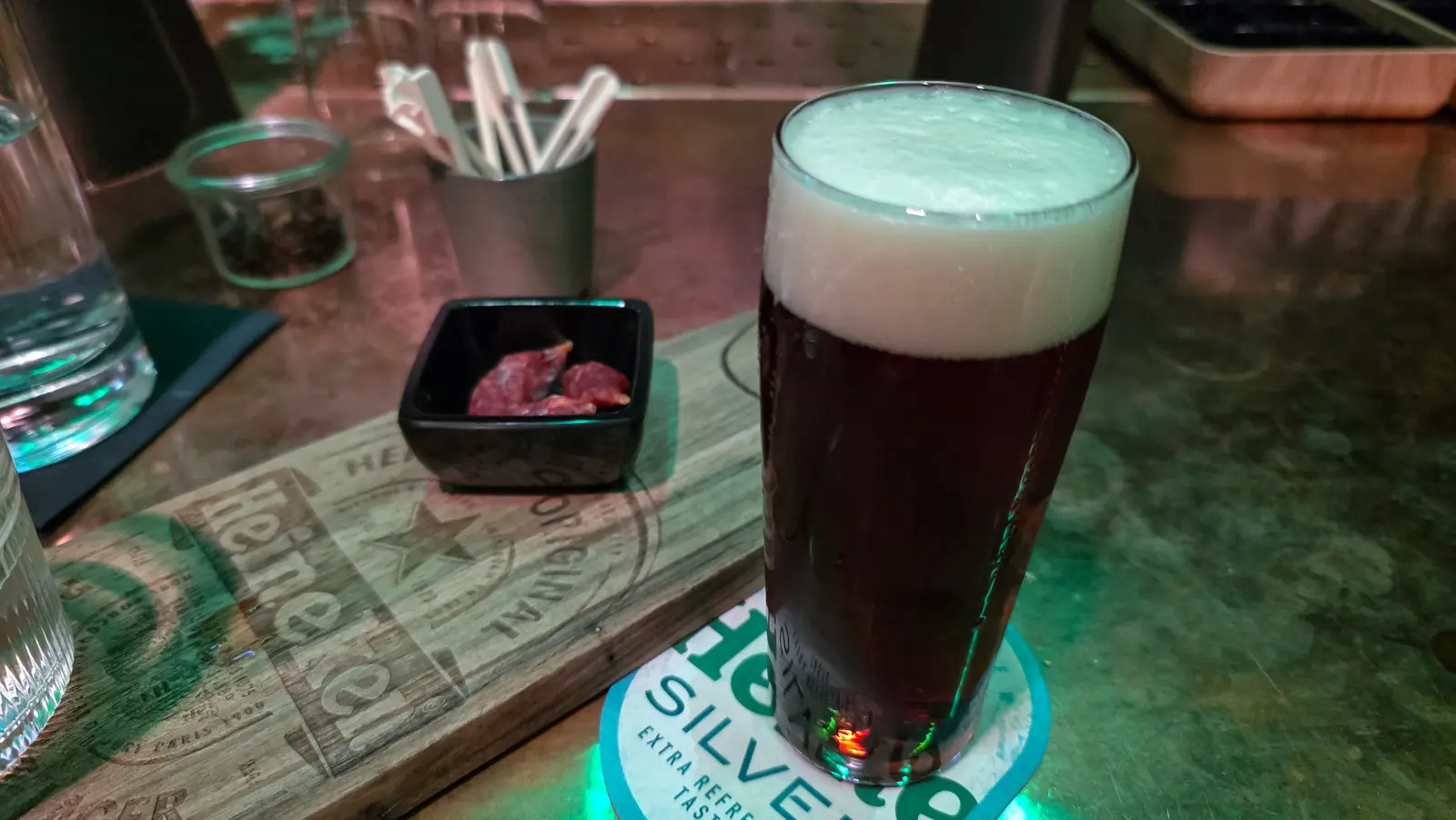
The pours are full glasses rather than thimble measures. One came out dark red-brown under a thick pale head. Another was clear gold with a fine white collar. Watching a guide explain what to look for in a glass is interesting regardless of whether the contents appeal, and having somebody talk a group through five of them removes the awkwardness of not knowing what to say.
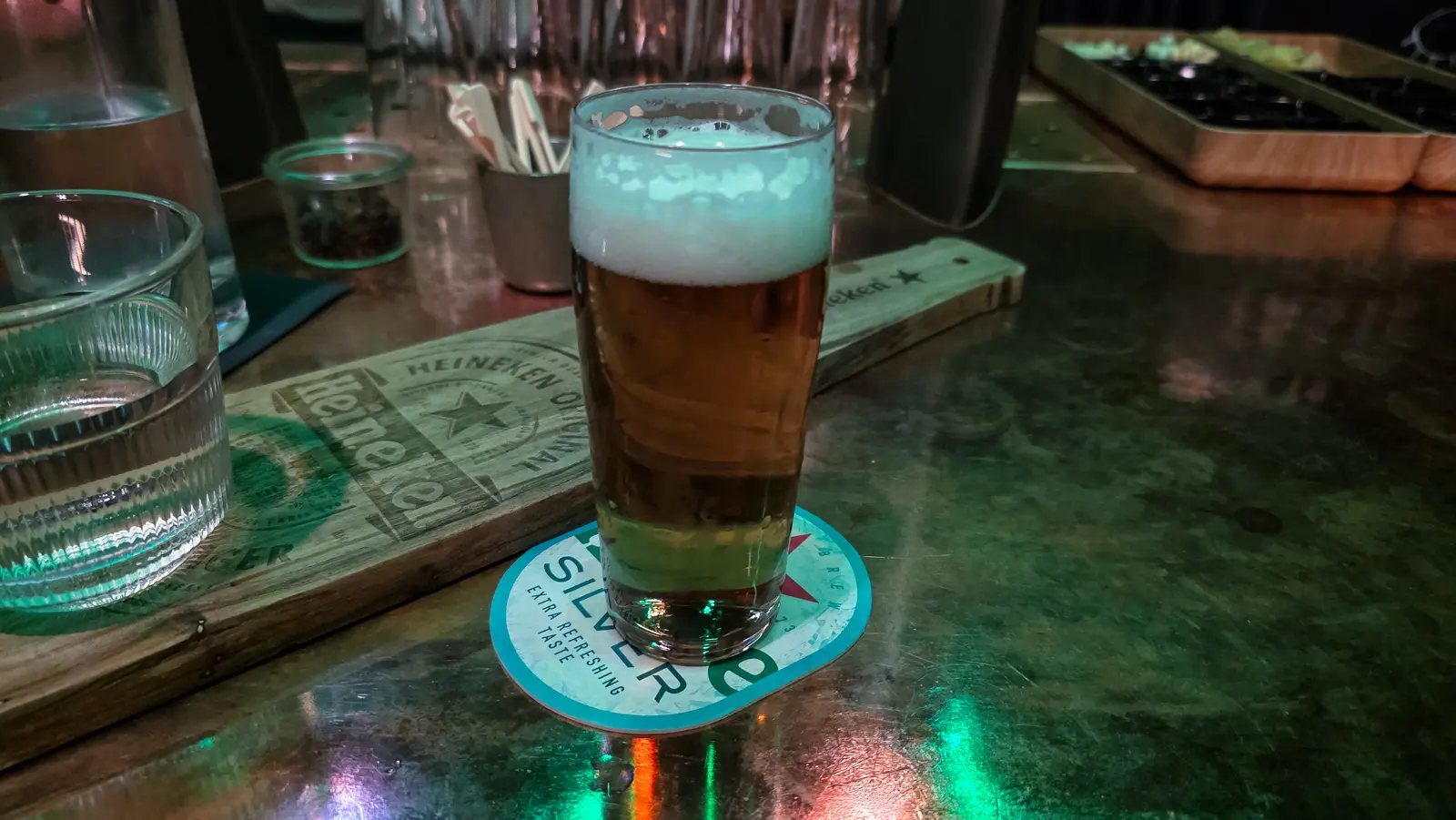
My favourite was the alcohol-free one. I am aware that this is the least impressive sentence ever written about a beer tasting. It is also the truth, and it is the sentence a non-drinker in the group would want to have read beforehand.
Each beer arrived with something to eat beside it, served in small dark dishes on the same branded boards. The pairing is deliberate rather than decorative.
There is a second hidden bar
Worth knowing before anyone books on the strength of that fridge door: Freddy’s is not the only private bar in the building. There is a second one called Henry’s, and our guide talked about both, along with a great deal of family and company history. He was good at it.
Nobody explained how a group ends up in one room rather than the other, and I did not think to ask. The ticket guarantees a private bar. It does not guarantee this one.
Was it worth it
For someone who loves beer, obviously yes, and that answer is available everywhere.
For someone who does not: also yes, with conditions. The upgrade buys a small group, a guide who can answer questions, access to rooms that are otherwise shut, and an hour in a room that has been designed properly. What it does not buy is a reason to like beer. I walked out liking beer exactly as much as I did walking in.
The fun was in the room and the company, not the contents of the glass. If that sounds like a criticism, it is not. It is the reason a non-drinker can be talked into this and come out pleased.
Bubbly Tips
- Check the opening hours before planning around a public holiday. The building lists itself as open daily, but states that holiday hours can vary.
- Go on a big outdoor holiday if the hours allow. On King’s Day the city was outside and the building was busy rather than crowded.
- Book the VIP tour for the group size, not the beer. Eight people meant a guide who could answer questions properly. That is what the money buys.
- Bring identification. Nobody under eighteen is admitted to any part of the building, and identification is checked at the door.
- Take the seat at the bar. Sitting for the tasting keeps a small group in one conversation. Standing splits it.
- Ask for the alcohol-free option without embarrassment. It is part of the range and it is poured like everything else.
- Eat beforehand. There is no restaurant inside. The tasting bites are the only food included in any ticket.
- Photograph the fridge on the way out, not on the way in. The corridor is quiet once a group has moved through, and the door photographs better open than shut.
- Do not count on getting the fridge door. There is a second private bar in the building called Henry’s. The ticket guarantees a private bar, not a specific one.
- Plan the rest of the afternoon in De Pijp. The building sits at the edge of the neighbourhood, and everything worth eating is a short walk away.
Final Thoughts
The best moment of the afternoon involved no beer at all. It was standing in a corridor at the end, looking at a green refrigerator that opens like a door, with a neon sign burning above it, and understanding that somebody had been paid to think that up and had done it well.
Freddy Heineken spent his working life turning a family brewery into a name that means something in most countries on earth. A hidden bar with his photograph on the wall is a fairly small monument to that, and it is a good one. I did not learn to like beer. I did have a better hour than I expected, which is the honest verdict on €65.
Until next time!

🌟 Everything You Need to Plan Your Dream Trip in 2026
- 🌟 Luxury Hotels - Find premium stays with Booking.com & Hotels.com
- 🏡 Vacation Rentals - Discover unique properties on VRBO
- 🏞️ Guided Tours - Explore with Viator or GetYourGuide
- 🎫 Attraction Tickets - Skip the lines with Tiqets
- 🚢 Ocean Cruises - Set sail with Cruise Direct
- 📱 International SIMs - Stay connected with Saily
- 🚗 Car Rentals - Budget-friendly options from Discover Cars
- 🌐 Secure VPNs - Browse safely with NordVPN
- 💶 Currency Exchange - Best rates with Wise
- 🗣️ Learn Languages - Master the local language with Babbel and Rosetta Stone