
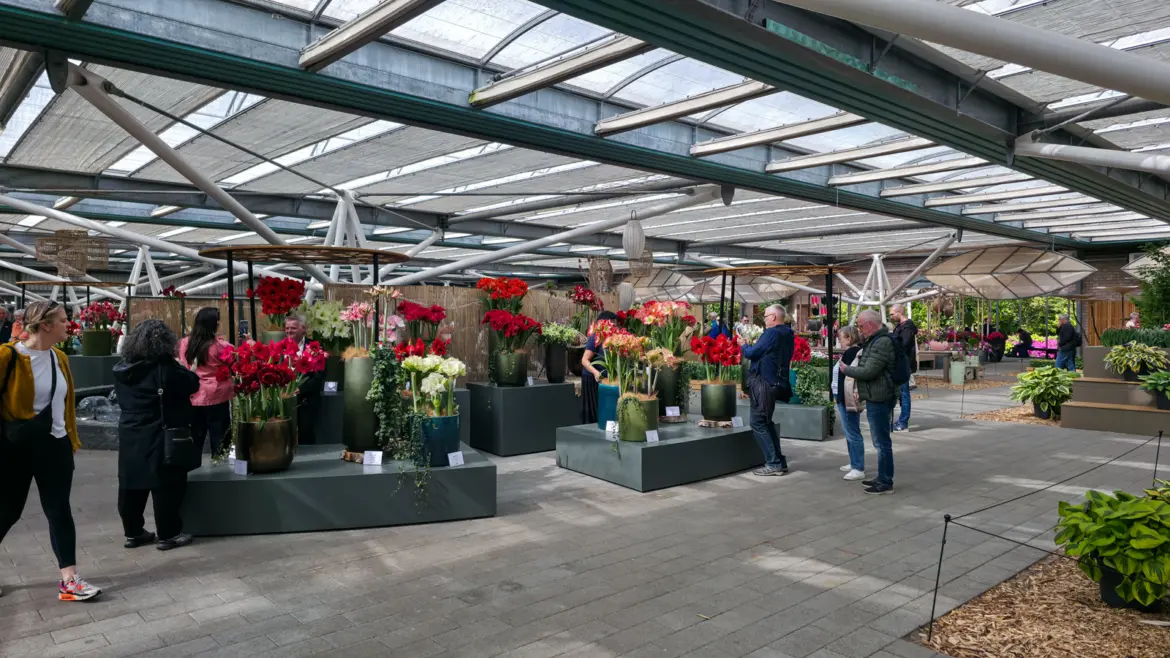
I walked into this building thinking I was looking at lilies. I walked out knowing I was not, and the correction came from a small white card on a plinth.
That is the argument for reading labels, and it is why I want to write about this pavilion separately from the gardens outside. Out there, flowers are planted in the ground in drifts and the effect is pure colour. In here they are staged one at a time on plinths, each with a card naming what it is and who grew it. It changes what a visitor does. Outside I looked. Inside I read.
The Willem-Alexander Pavilion at a Glance
🏛️ What it is · Keukenhof’s largest indoor space, built for exhibition rather than growing: plants staged one at a time on plinths, each with a naming card.
🌺 The star show · Massed “amaryllis” in colours no Christmas box contains, plus hydrangeas, hostas, gerberas and a nursery-style narcissi display.
🏷️ The twist · Those “amaryllis” are Hippeastrum, not amaryllis, and not lilies. The one true amaryllis is nicknamed a lily. A 1987 congress settled it.
🪑 The practical case · Glazed, sheltered and full of seating, it’s the sensible midday break on a long day at Keukenhof.
💡 Tip · Read the cards; check which show is running (the world’s largest lily show is only here in the final days).
A Building For Showing, Not Growing
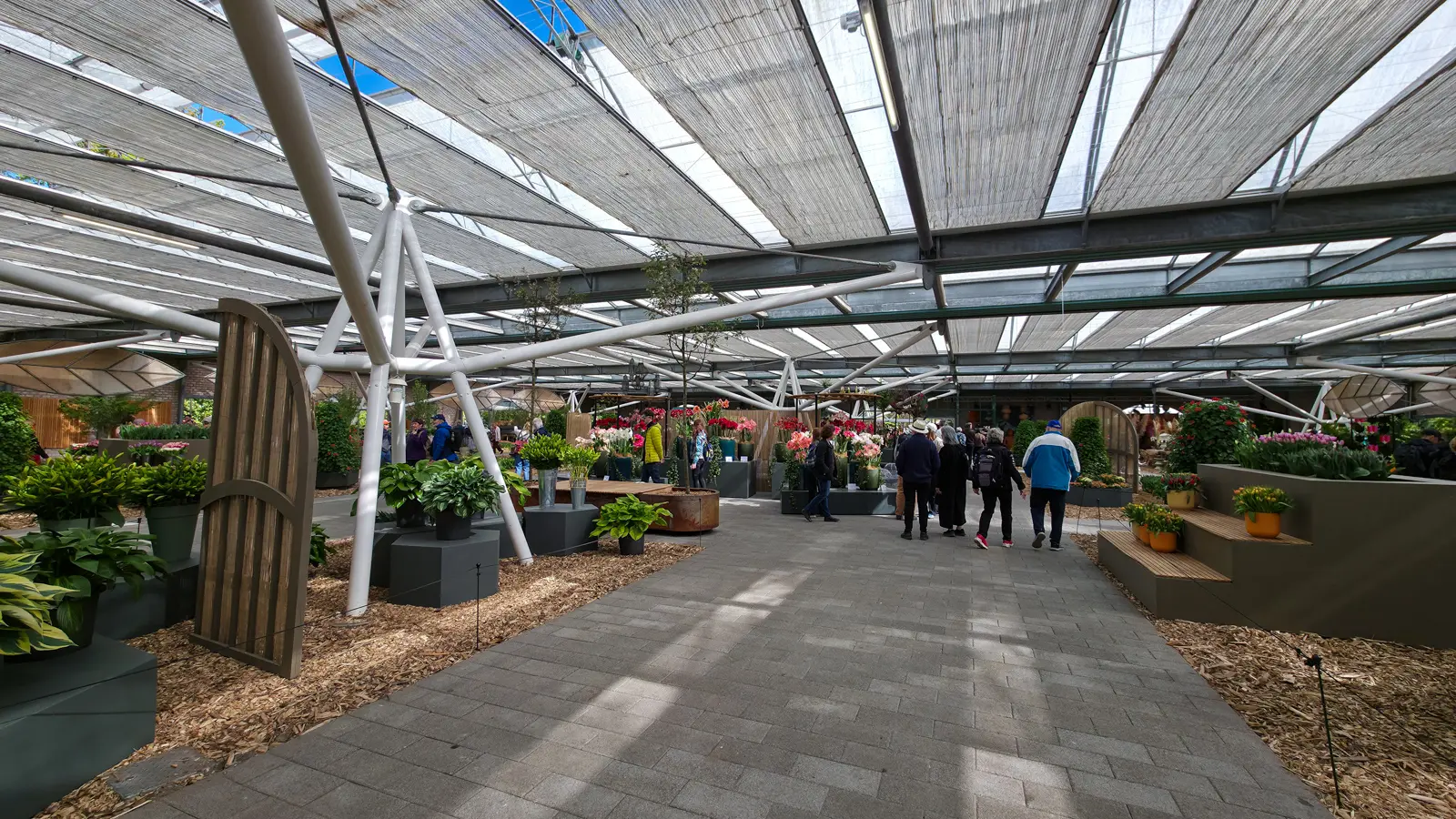
The Willem-Alexander Pavilion is the largest indoor space at Keukenhof, and it is built for exhibition rather than cultivation. A high glazed roof, white tension struts, shade blinds rolled across the glass, and timber screens dividing the floor into rooms. Some sections have curved bamboo walls. Others open onto a pool with low water jets.
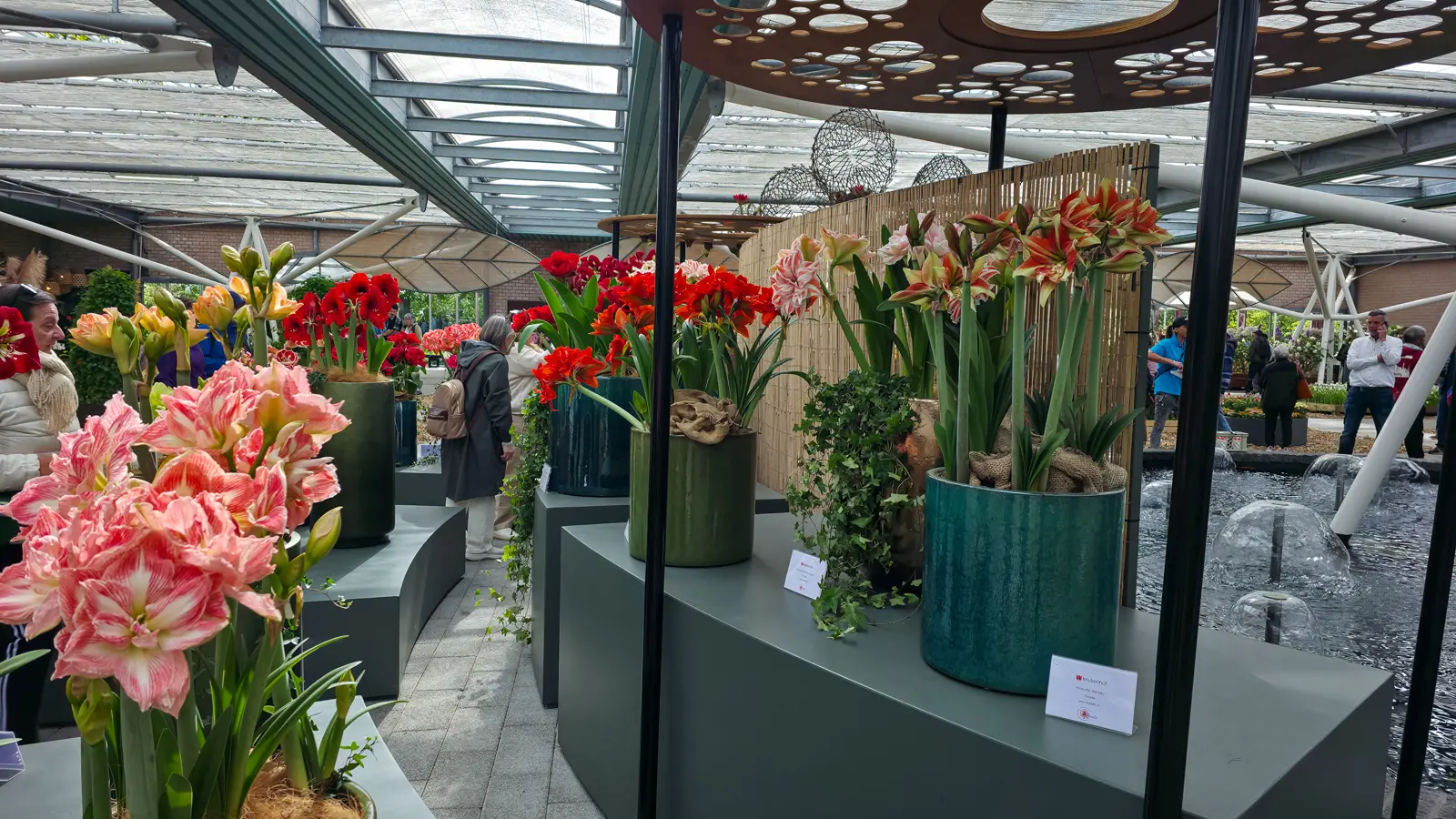
The plants sit on grey blocks at knee and waist height, staged like objects. Each one carries a card with the Keukenhof tulip logo, the cultivar name, the grower’s name and website, and a number in the corner. The one I stopped at read Amaryllis ‘Bentley’, grown by Floralia, number 114.
Across the eight weeks of the season the displays are swapped out, so the building never shows the same thing twice for long. In the final days it holds what is billed as the world’s largest lily show, which is not what I saw and is a good reason to come back at a different point in the season.
Amaryllis, Or Not
Here is what the label taught me, and it turns out to be a two-hundred-year argument.
The flowers on those plinths are not lilies. They are what everybody, including Keukenhof, calls amaryllis. But botanically they are not amaryllis either. They belong to the genus Hippeastrum.
The confusion goes back to Linnaeus, who created the name Amaryllis belladonna in 1753 at a point when South African and South American plants were being filed in the same genus. Once botanists separated them, the question became which continent Linnaeus had actually been describing. The dispute ran from the 1930s onwards, with botanists on both sides of the Atlantic, and was only settled at the fourteenth International Botanical Congress in 1987.
The ruling went one way and the shops went the other. True Amaryllis turned out to be a single South African species, Amaryllis belladonna. Everything sold at Christmas in a box, and everything on these plinths, is Hippeastrum from the Americas. The trade never changed the name.
And the joke lands properly at the end. The one plant genuinely entitled to be called Amaryllis goes by the common name belladonna lily, and is also nicknamed the naked lady. So the true amaryllis is called a lily, the false amaryllis keeps the name amaryllis, and neither of them is a lily at all.
I had called them lilies. I was wrong three ways at once, which is more than most people manage before eleven in the morning.
The Colour Range
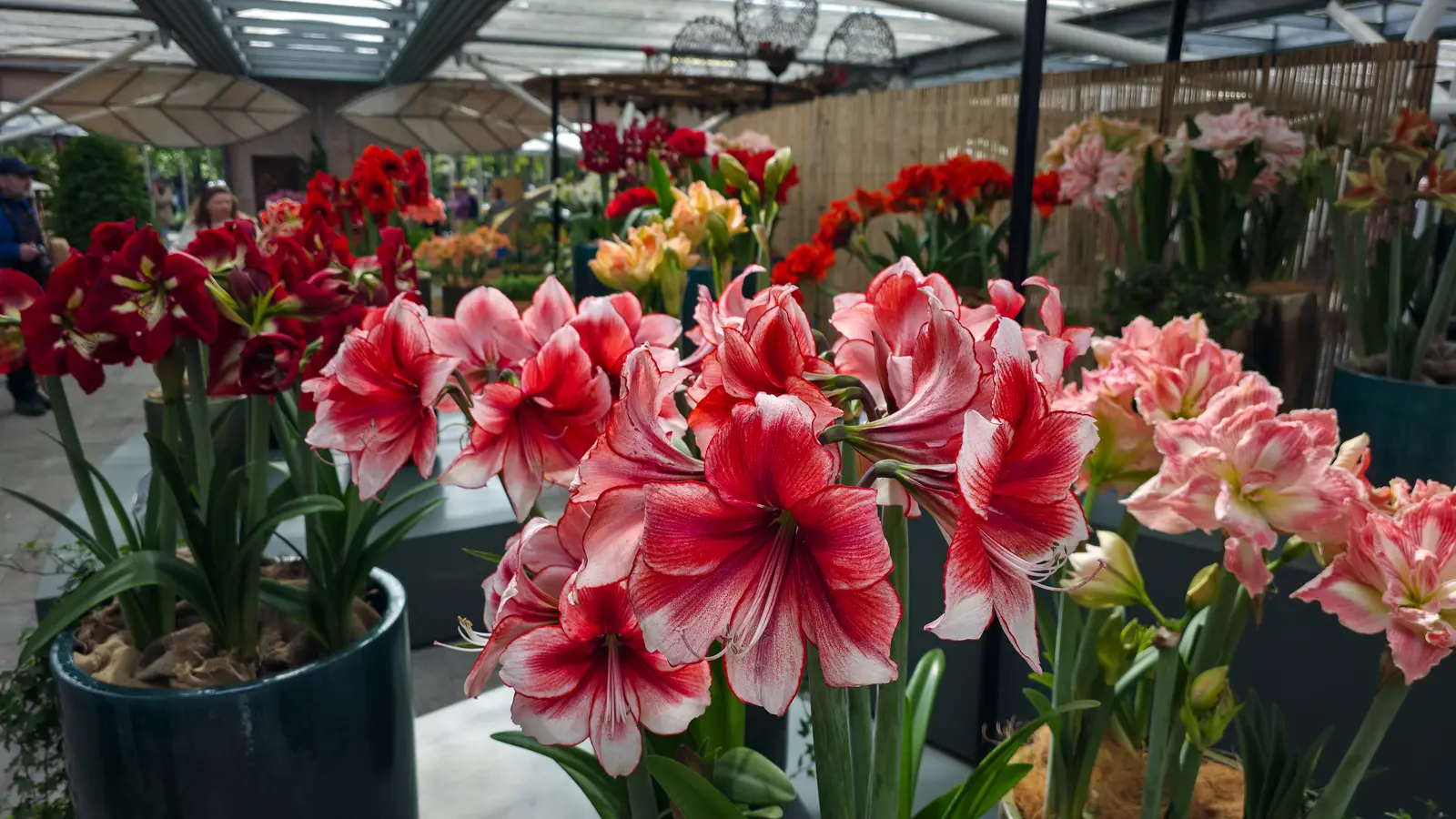
This is what I had come for without knowing it. Not one red trumpet on a windowsill in December, but forty of them at once, in colours nobody puts in a Christmas box.
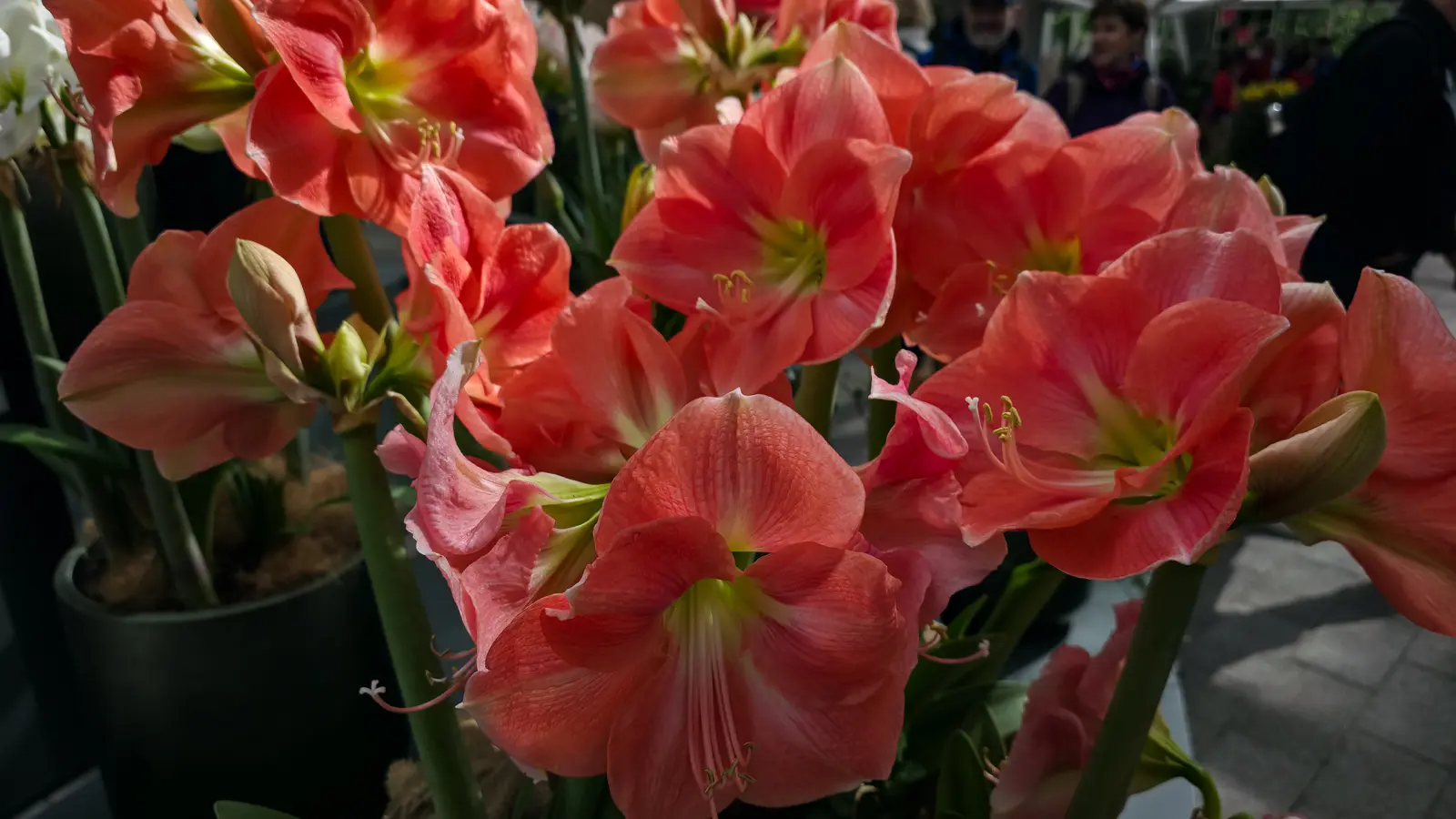
A deep red with a cream star running out from the throat and fine white feathering down the petals. A white one with a thread of dark red drawn round every edge, so precise it looks ruled. A coral that shades to salmon at the tips with a green eye at the centre. Pink and white stripes. A double form so packed with petals it stops looking like the same plant.
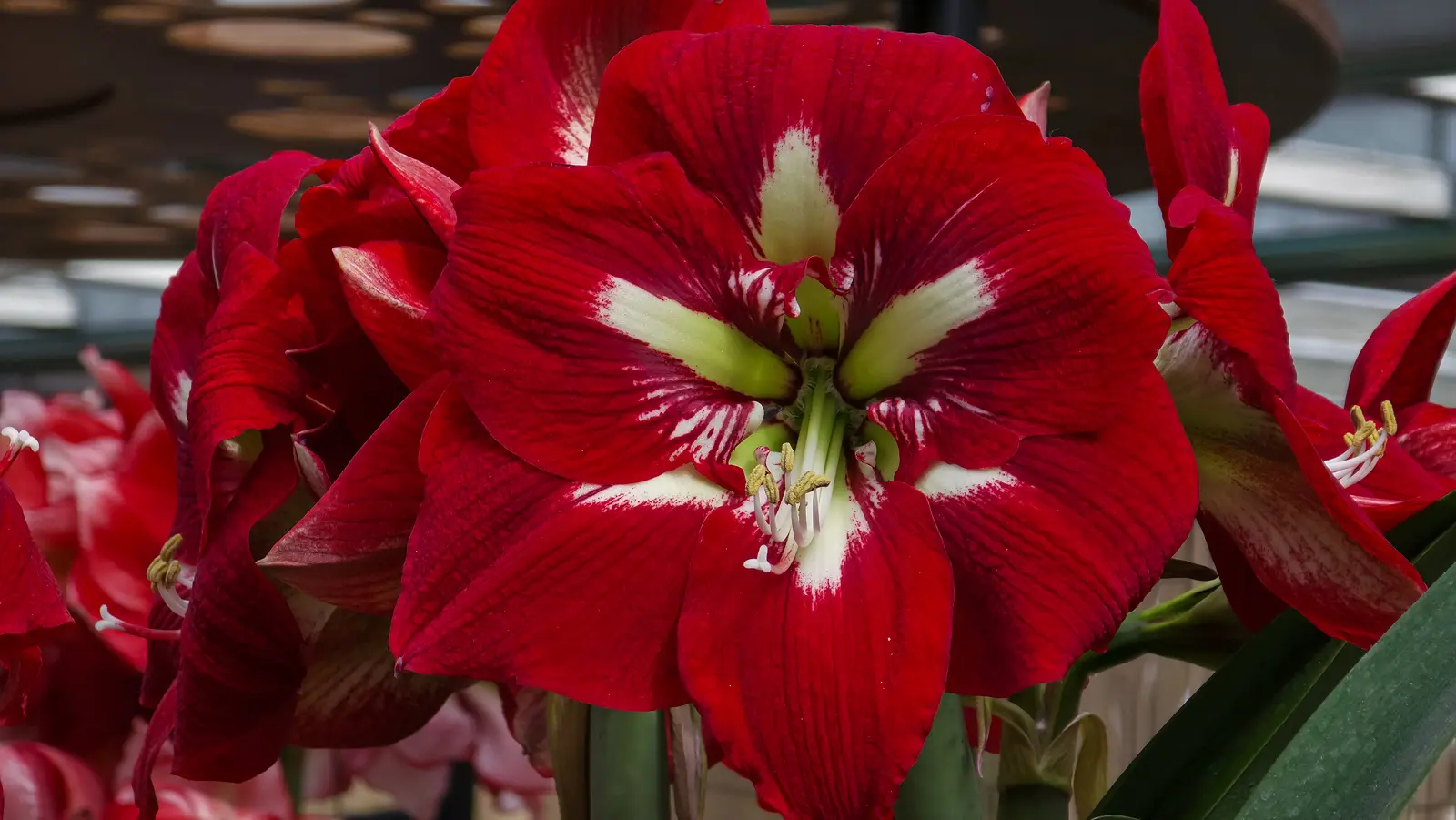
Seen close, the petals are not flat. They are ribbed and slightly crumpled, like fabric that has been folded and opened out, and the stamens curve up and out with pollen already loose on them.
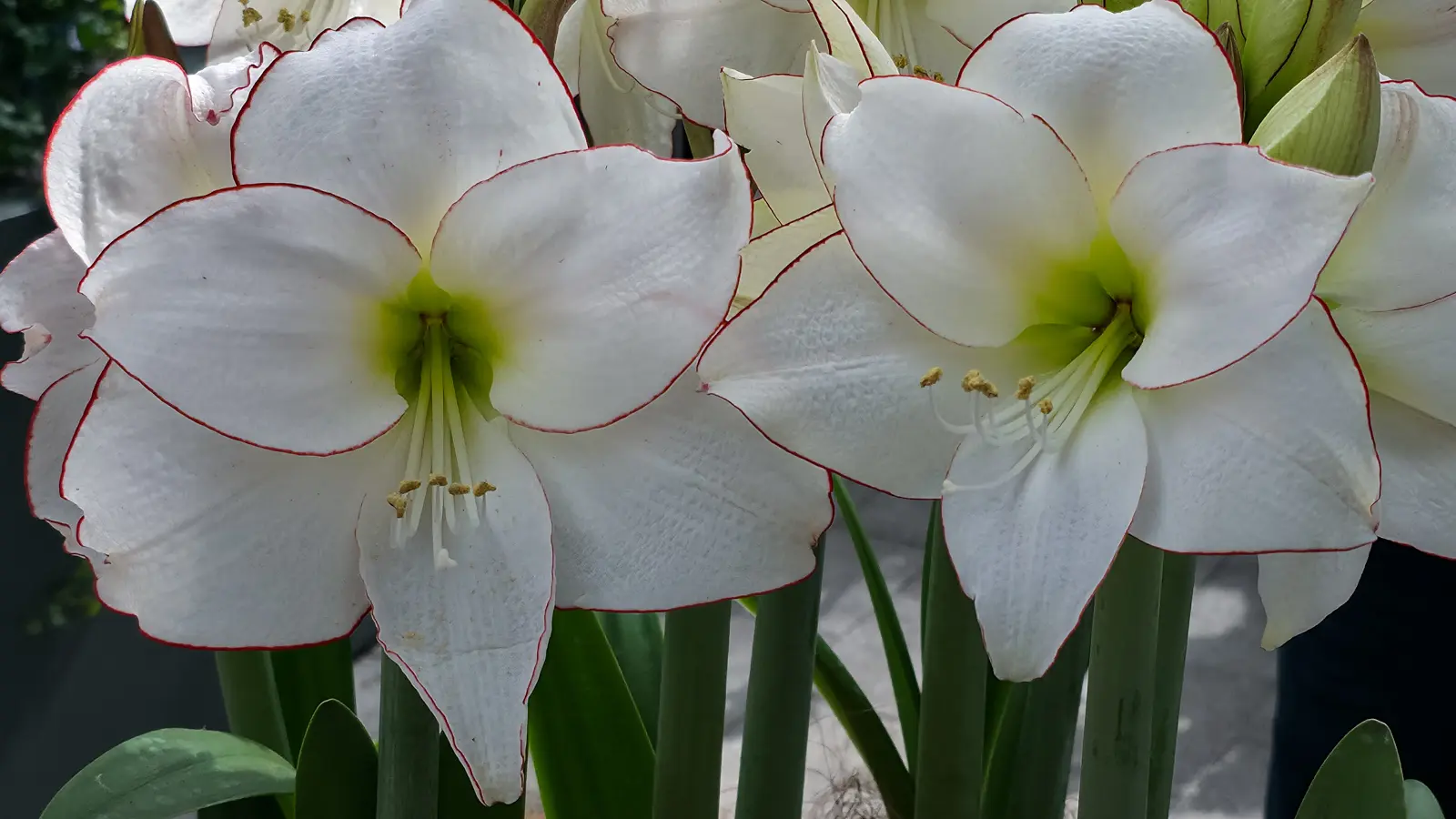
The coral one was the hardest to photograph and the one I kept returning to, because the colour shifts along each petal and no two flowers on the same stem were quite the same shade.
The Hydrangeas
Then I turned a corner and found something from home.
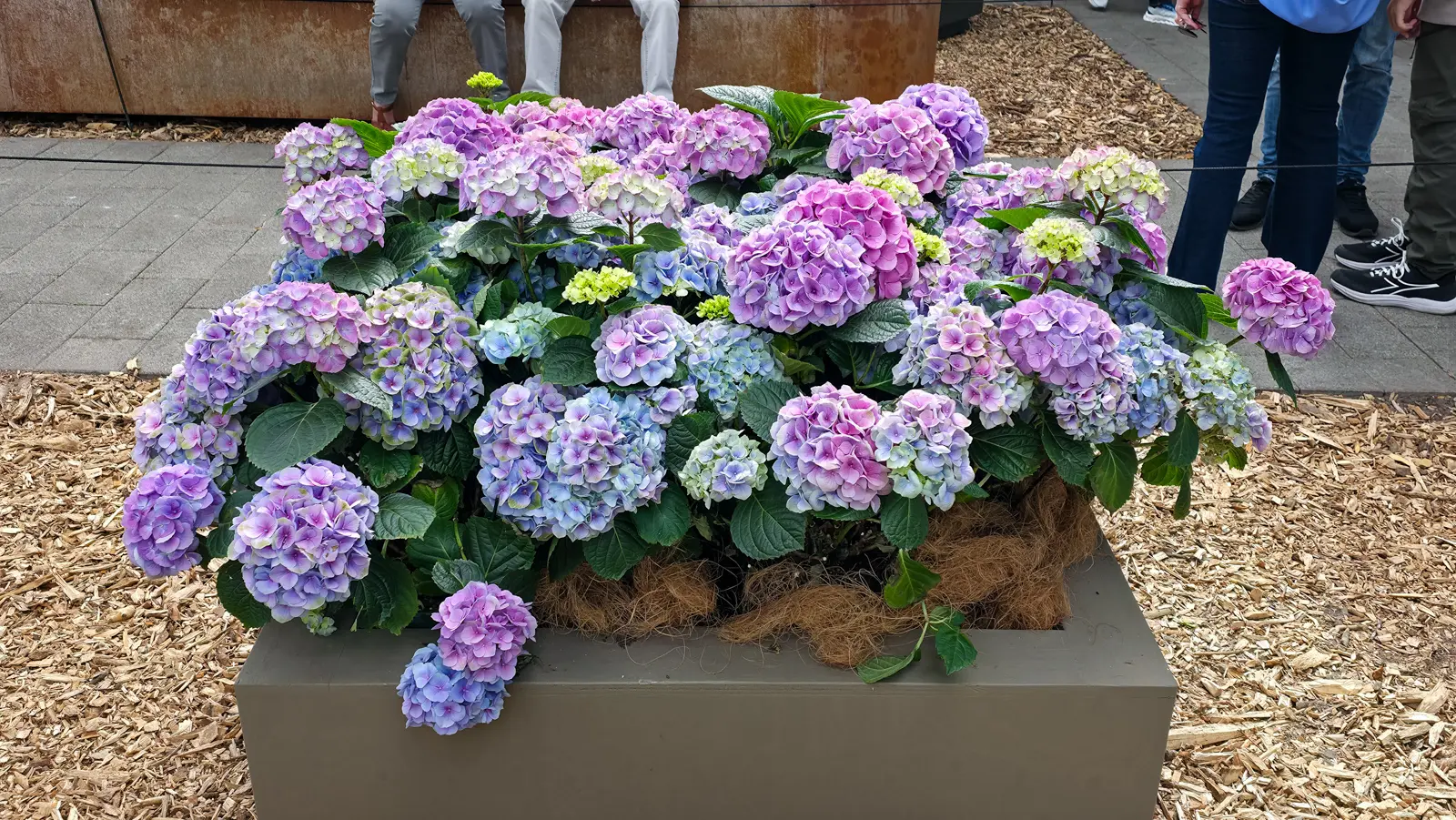
A single low planter, dressed with coir over the root balls, holding hydrangeas in pink, lilac, blue and a pale green that had not finished opening. Big mophead flowers, some heads carrying two colours at once.
We have these in Canada. Same plant, same colours, in front gardens and along driveways and in every second garden centre in spring. I had crossed an ocean and walked past seven million bulbs to be stopped by the thing that grows at home. That is not a complaint. There is something steadying about recognising a plant in a foreign country, and it is the only display in this building I could have identified without reading the card.
The Parts Nobody Photographs
Two displays in this pavilion had no crowd at all, and both were better than their audience suggested.
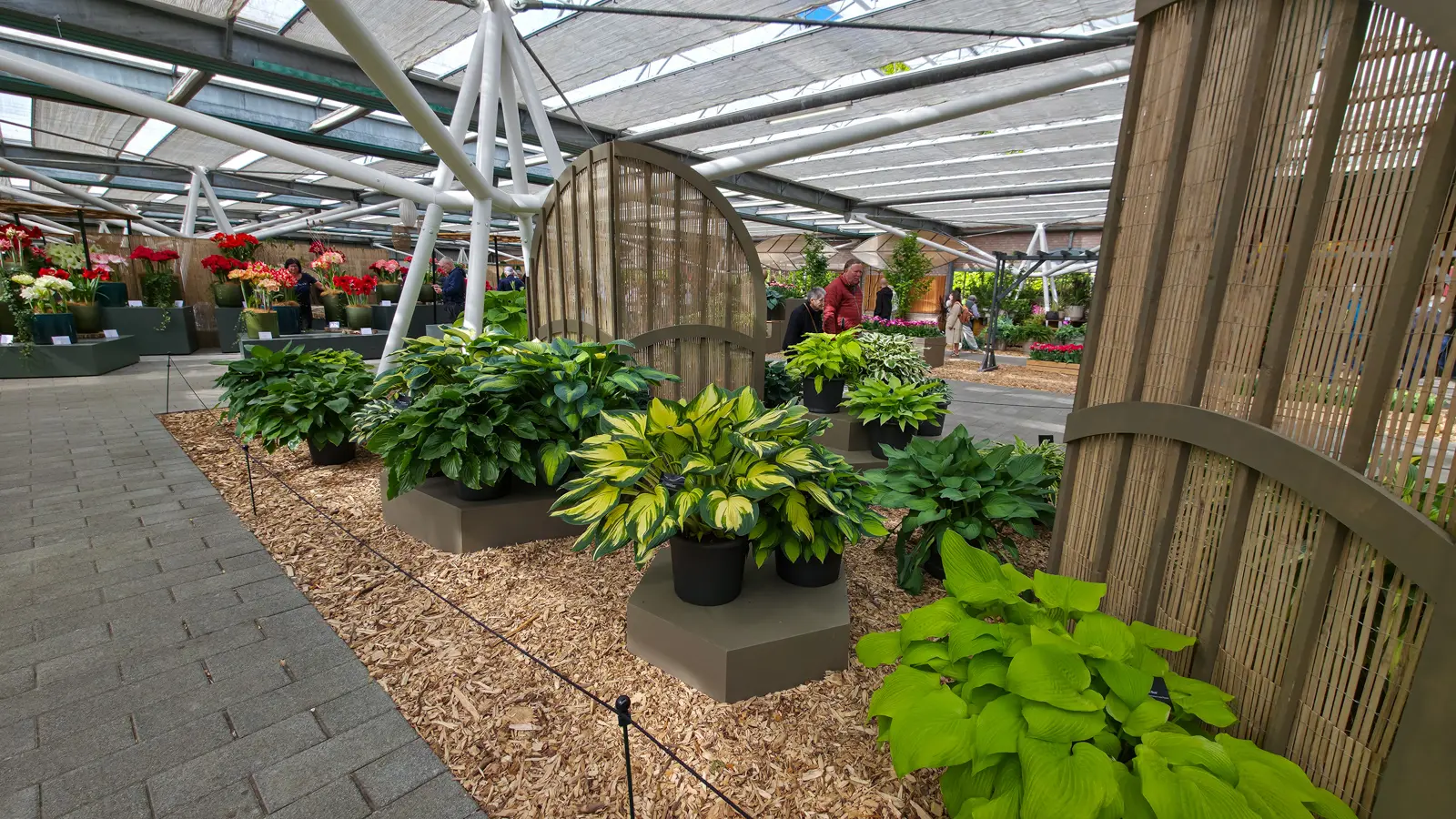
The first was foliage. Ranks of hostas in black pots on low blocks, running along a bamboo screen: broad ribbed leaves in blue green, in lime, and in cream and green variegations, arranged so the leaf shapes played against each other. No flowers involved. It was the calmest corner of the building.
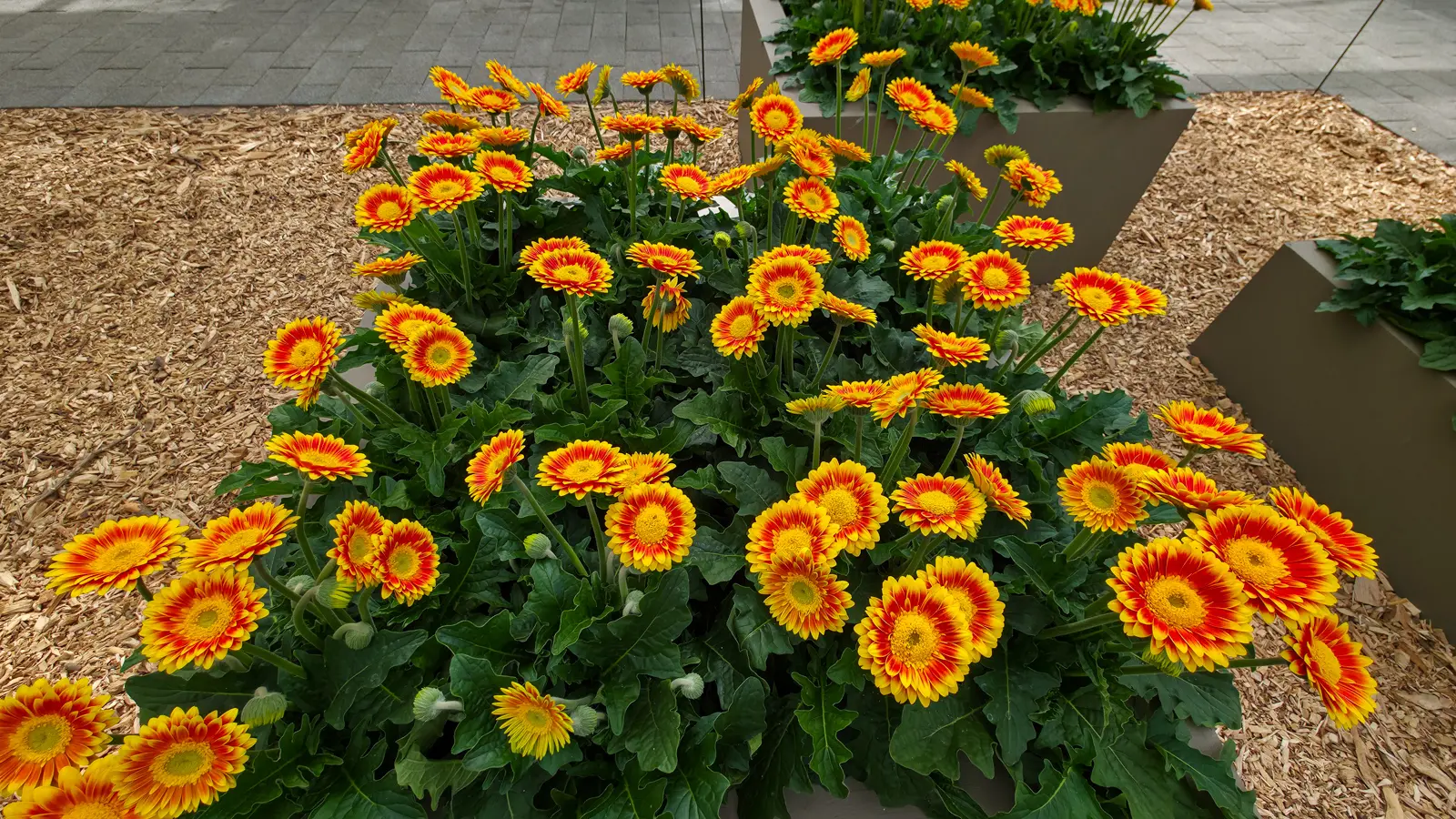
The second was a bed of gerberas in red and yellow, every flower a two-tone daisy with a yellow disc at the centre, packed so tightly the leaves barely showed. It sat in a plain planter on wood chip, and people walked straight past it towards the amaryllis.
The Other End of the Building
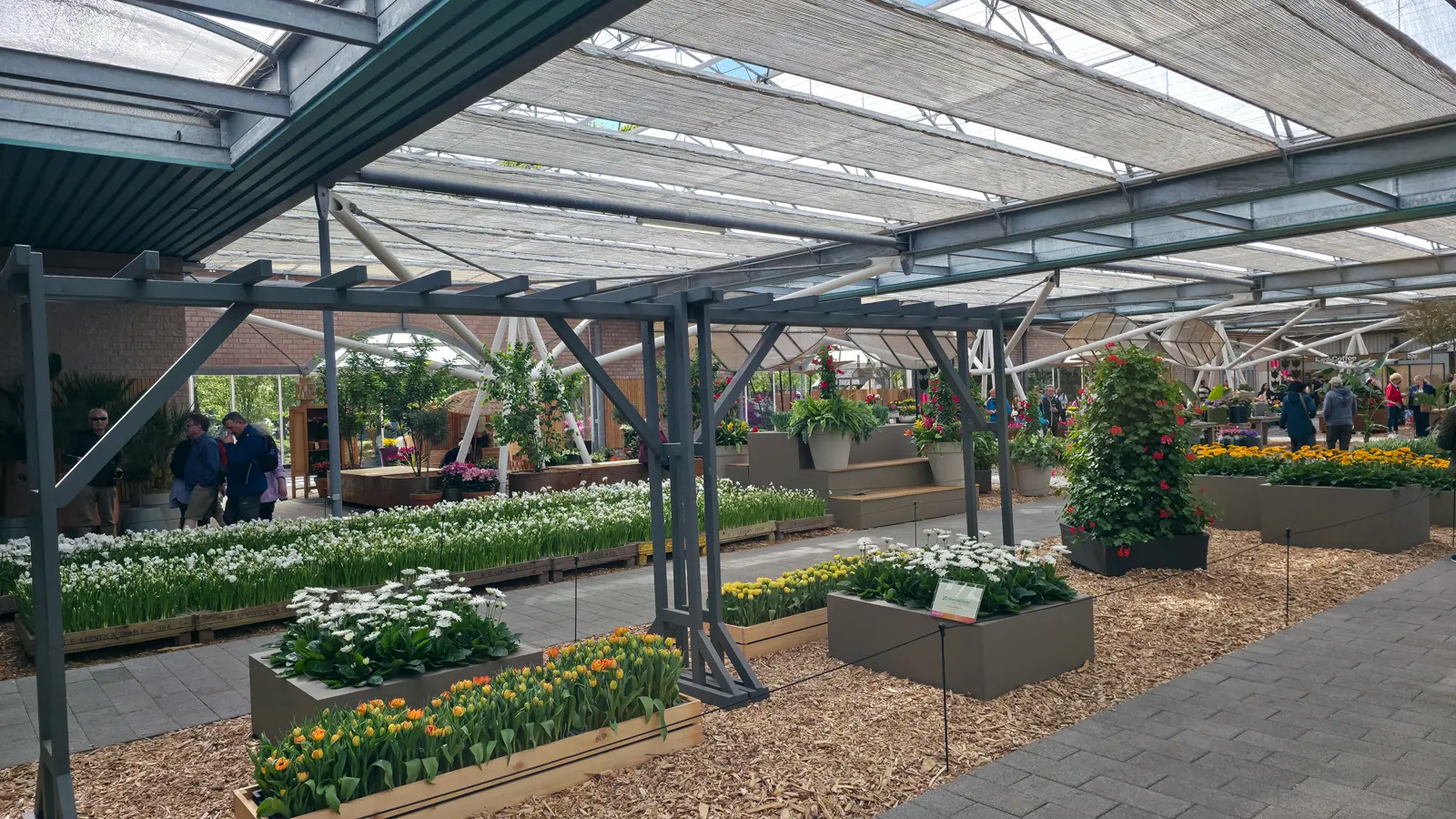
The far end of the pavilion works differently again. Timber pergolas overhead, long wooden trays of white narcissi at ground level, orange and yellow tulips in low crates, white daisies in blocks, and a climbing frame of red pelargoniums trained into a column.
This section is arranged more like a nursery than a gallery, with the trays sitting on pallets, and it is where the pavilion stops being a show and starts looking like the industry that supplies it.
Somewhere to Sit
The honest reason to come in here is that it is a building with a roof, and Keukenhof is a long day on the feet.
I had walked the gardens, and I had the Juliana Pavilion still ahead of me. This was the middle of the day and the middle of the visit, out of the wind, with somewhere to stand still and something to read. I left knowing the name of a flower I had been getting wrong for years.
Bubbly Tips
- Read the cards. Every staged plant carries one, with the cultivar name, the grower and a number. They take four seconds and they are the difference between looking at a nice red flower and knowing what it is.
- Go inside when the weather turns. The pavilion is glazed and sheltered, so it is the obvious move if it starts raining or the wind comes up off the fields.
- Check which show is running before you travel. The displays change across the eight-week season. The world’s largest lily show only occupies this pavilion in the final days, so an April visit and a May visit give you almost entirely different buildings.
- Use it as your midpoint. It sits well between the gardens and the other pavilions, and it is the sensible place to break a long day rather than pushing on to the exit.
- Photograph the close-ups indoors, not the wides. The roof blinds throw stripes across every wide shot. Move in on individual flowers and the diffused light through the glass is as good as any studio.
- Do not skip the foliage. The hosta display had no queue and no crowd, and it is the one place in the building where you can actually see what you are looking at without waiting.
- Look for the pallets at the far end. The trays on wooden pallets show how the plants actually arrive, which is a more interesting thing to notice than another perfect display.
- Bring your reading glasses if you need them. The cards are printed small and set low on the plinths, and I watched more than one person give up on them.
- Keukenhof is not in Amsterdam, and there is no station. The park sits at Lisse, roughly 35 kilometres south-west of the city, and the town has no railway station at all. The direct option is bus 852 from Europaplein, beside Amsterdam RAI, which runs non-stop and takes about 35 minutes. Metro line 52 gets you to Europaplein from Amsterdam Centraal. The Schiphol connection was reorganised for the 2026 season, so check that leg on the official site rather than relying on an older bus number.
- Allow forty minutes. Twenty gets you through. Forty lets you read, sit and go back to the ones you liked.
Final Thoughts
I came to Keukenhof for the fields and the drifts of tulips, and the thing I actually took away was a correction. The flowers I had been calling lilies for most of my adult life are amaryllis, and the flowers called amaryllis are not amaryllis either, and the only true amaryllis is a South African bulb that everyone calls a lily anyway.
None of that would have happened outside. Out in the gardens the planting is designed to overwhelm, and it does. In here the plants are set apart, one at a time, each with its name on a card at eye level, and the building quietly invites a visitor to check what they think they know. Not everything is a lily. I needed a small white label in a Dutch greenhouse to find that out.
Until next time!

🌟 Everything You Need to Plan Your Dream Trip in 2026
- 🌟 Luxury Hotels - Find premium stays with Booking.com & Hotels.com
- 🏡 Vacation Rentals - Discover unique properties on VRBO
- 🏞️ Guided Tours - Explore with Viator or GetYourGuide
- 🎫 Attraction Tickets - Skip the lines with Tiqets
- 🚢 Ocean Cruises - Set sail with Cruise Direct
- 📱 International SIMs - Stay connected with Saily
- 🚗 Car Rentals - Budget-friendly options from Discover Cars
- 🌐 Secure VPNs - Browse safely with NordVPN
- 💶 Currency Exchange - Best rates with Wise
- 🗣️ Learn Languages - Master the local language with Babbel and Rosetta Stone