
I studied history. That is most of the explanation for this blog, and it is the whole explanation for why I will happily give an hour to one room in the Rijksmuseum that other people cross in four minutes.
I also once had a Dutch boyfriend who could not stop telling me about his country’s naval conquests. Which was fine. Every seafaring nation in Europe was elbowing the others aside at the time, and I am the last person entitled to object, since I have been known to claim that the Greeks invented everything and that the Romans simply took notes. I say it as a joke. I do not entirely mean it as one. Listening to somebody talk up their own heritage is one of my favourite things, partly because I recognise the tune.
So I paid attention in this room, and what I found was better than a list of victories. The sea did not only make the Dutch Republic rich. It decided what its artists painted, who paid them, and which version of events got hung on a wall.
The Rijksmuseum Maritime Room at a Glance
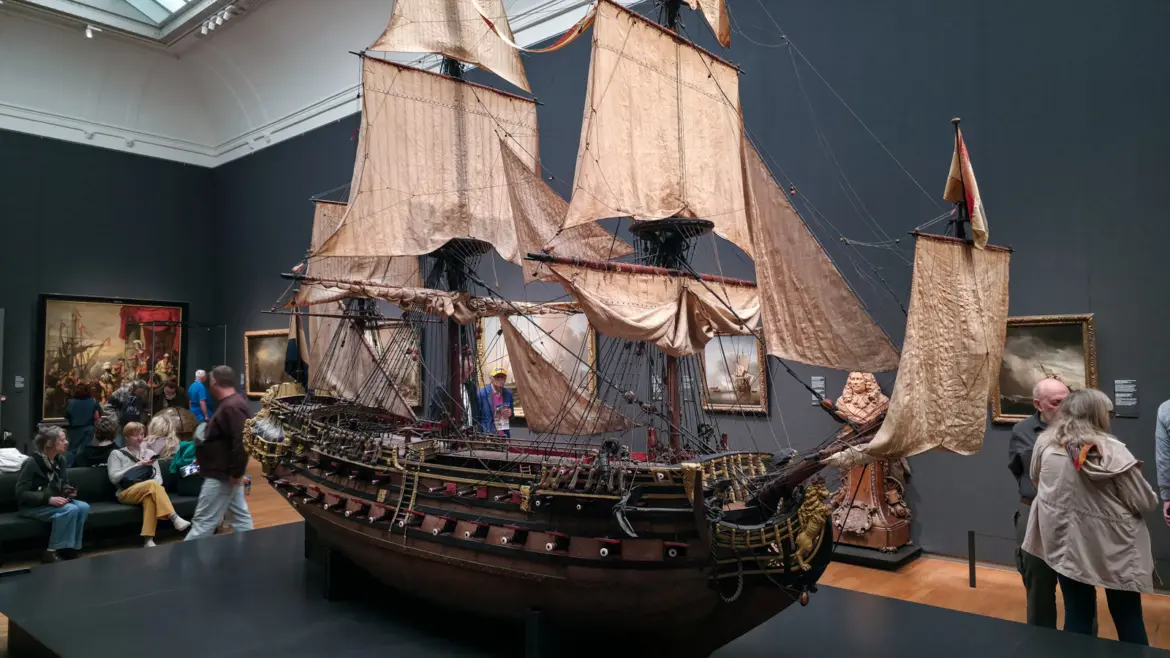
⚓ The centrepiece · The William Rex, a ~4-metre, 74-gun warship model of 1698, built at Vlissingen and fully rigged, standing for a ship that may never have existed.
🖼️ The masters · Willem van de Velde the Younger’s The Gust and The Cannon Shot, painted around 1680, in England, on Charles II’s payroll.
🗽 The twist · Schellinks’s calm golden Medway raid marks the campaign that ended with the Dutch keeping Suriname and letting the English keep New Amsterdam, now New York.
🏷️ Read the labels · Unusually candid: one admits an admiral paid for his own glory; another names the Dutch trade in enslaved Africans beneath a hero portrait.
💡 Tip · Start at the model, then read the walls; allow forty minutes if you like history.
A Ship That May Never Have Sailed
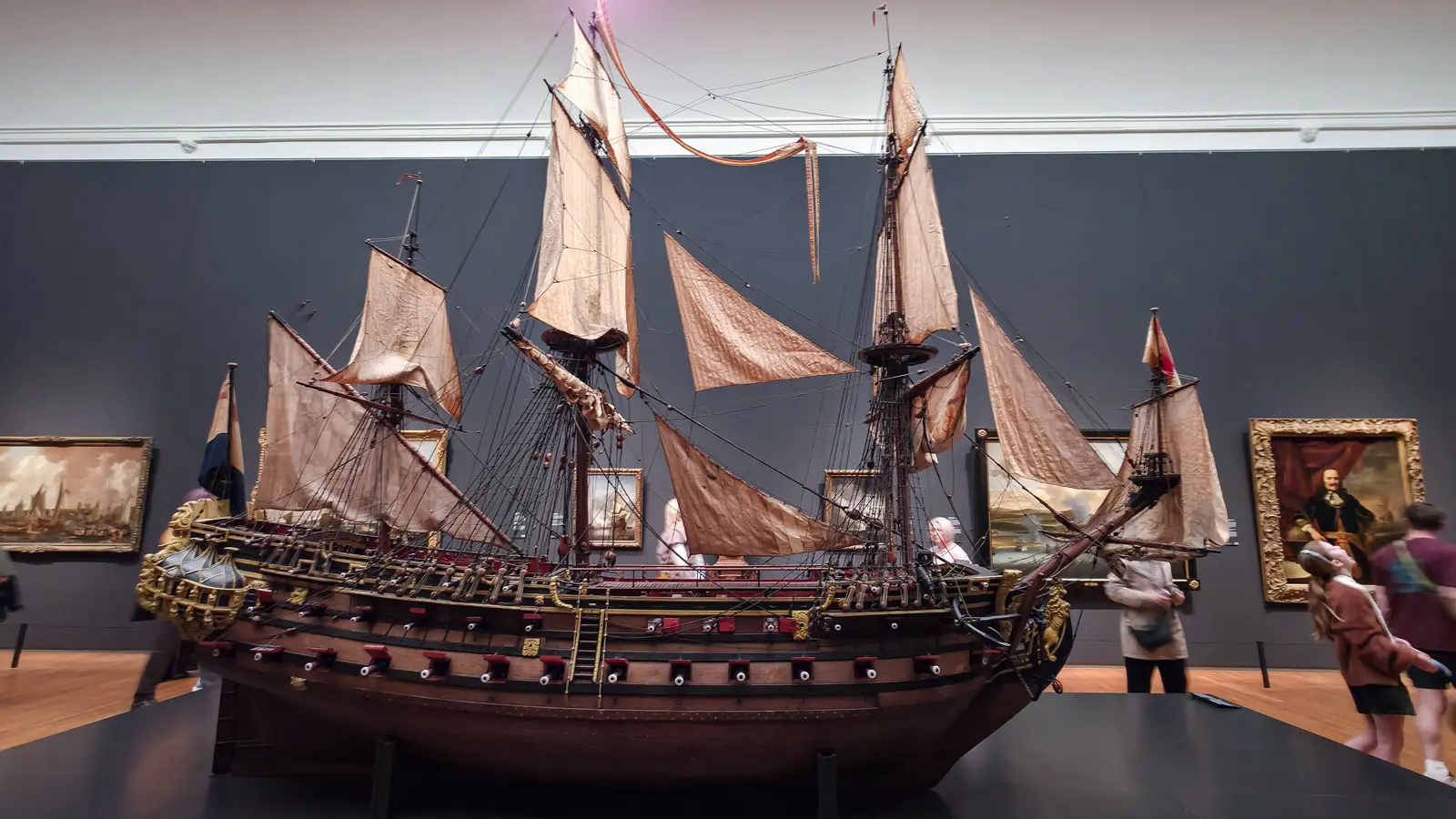
The room is built around a model. It is enormous, roughly four metres from stem to stern, a warship of seventy-four guns made in 1698 by dockyard craftsmen, with rigging and sails and rows of gun ports along two decks.
It is called the William Rex. It has only been called that since the nineteenth century, and the name comes from monograms carved into the stern, because the model cannot be convincingly matched to any ship that actually existed. One suggestion is that it was loosely based on a Zeeland vessel of ninety-four guns called the Koning William. Nobody is certain.
That is a good thing to know before looking at anything else in the room. The most commanding object here is a portrait of a ship that may never have put to sea, given a king’s name by people living a century and a half after it was built.
The Painters Who Went to Work for the Other Side
Dutch marine painting did not begin with a war. Hendrick Cornelisz Vroom, working in Haarlem from around 1590, is generally credited as the pioneer of the genre, the first Dutch painter to specialise in the sea and in portraits of particular ships. What the wars did was give his successors a subject that patrons would pay for.
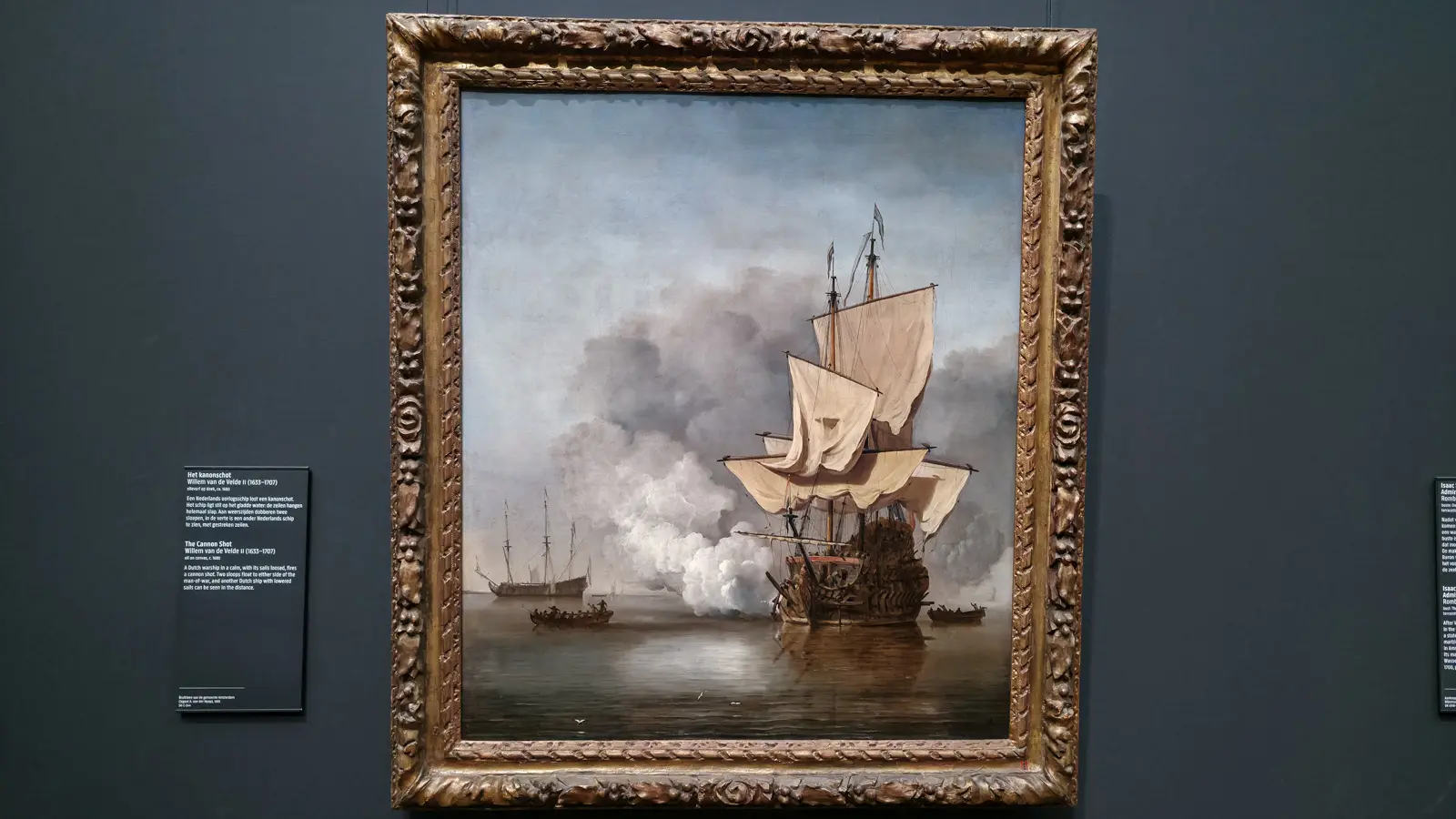
The two finest pictures in this room are by Willem van de Velde the Younger. One is catalogued as A Ship on the High Seas Caught by a Squall and known simply as The Gust, a warship heeled over under an enormous bank of cloud. The other, The Cannon Shot, shows a Dutch man-of-war on flat water firing a single gun, the smoke hanging in a slow white mass across half the canvas.
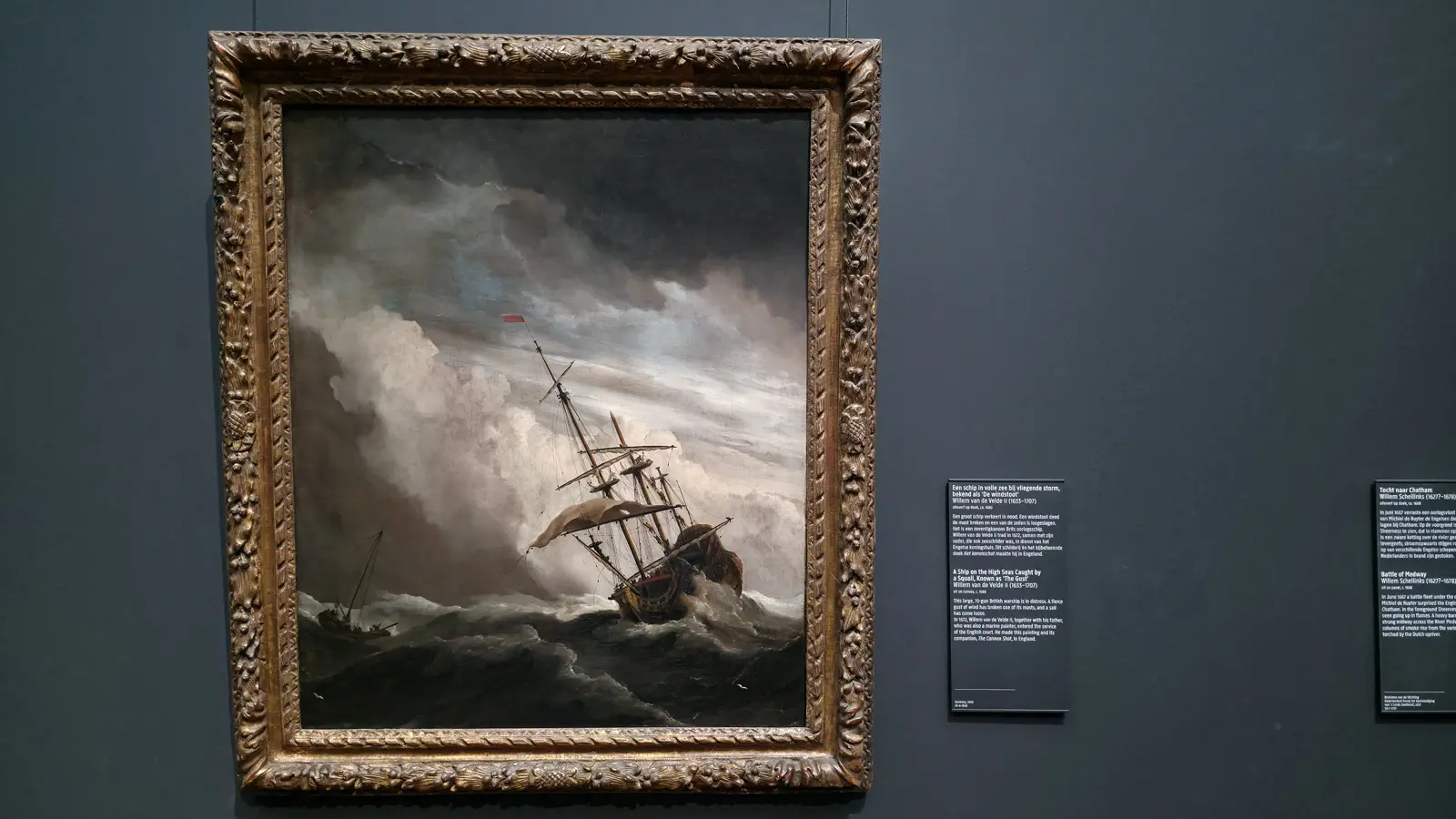
Both were painted around 1680, and both were painted in England. In the winter of 1672, the Republic’s disaster year, with the French invading and the Amsterdam art market collapsing, van de Velde and his father left for London. Charles II gave them each a salary of a hundred pounds a year and a studio in the Queen’s House at Greenwich, the father to draw sea fights and the son to put them into colour.
So the two supreme images of Dutch sea power in this gallery were made by a Dutchman on an English king’s payroll, within a decade of Dutch and English fleets shooting at each other. Reputation travelled better than loyalty did.
One Battle, Two Painters
Livorno is an Italian port, called Leghorn by English speakers at the time. A Dutch fleet beat an English one there in 1653, and that single battle hangs on these walls twice, in two completely different ways.
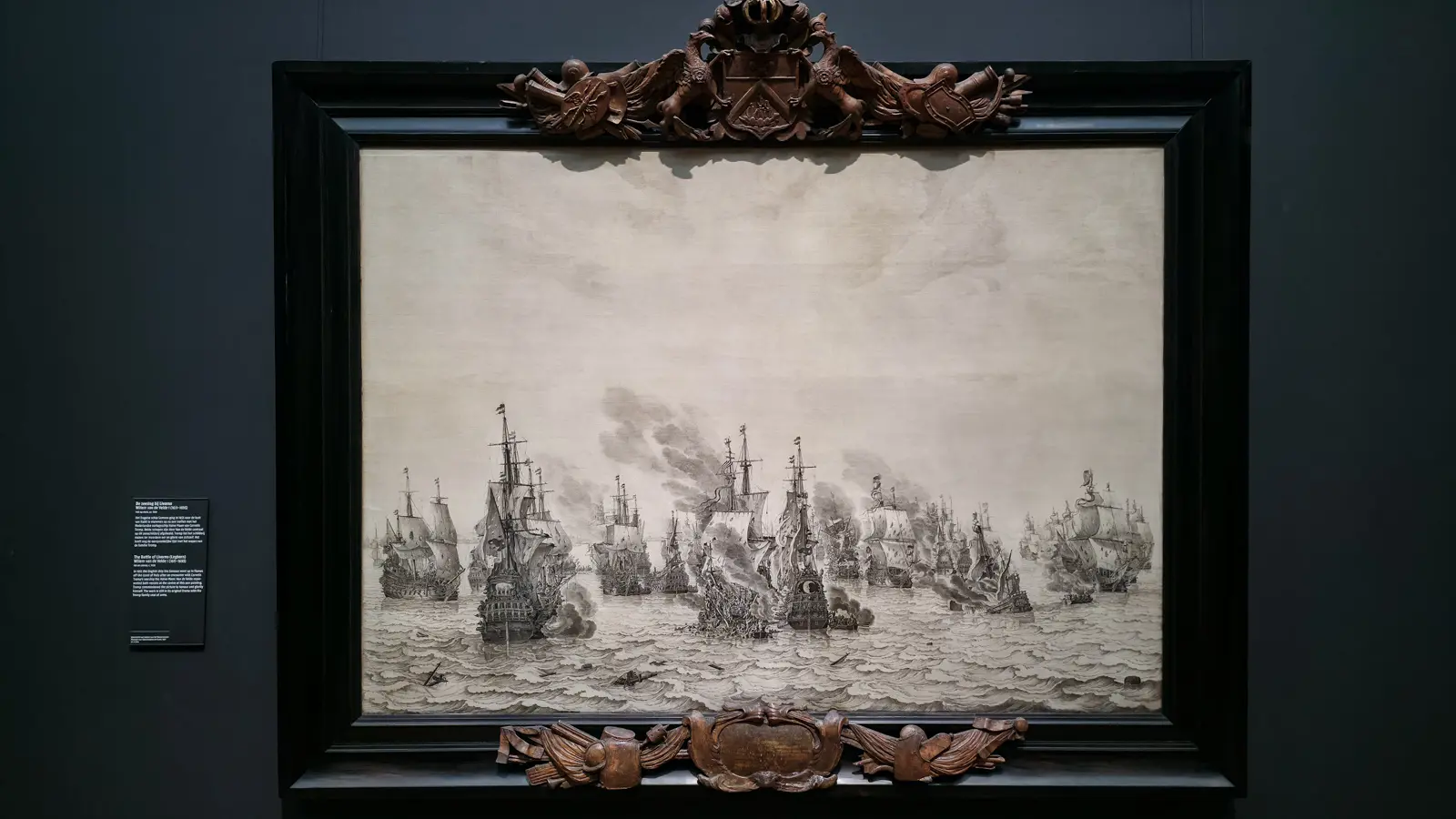
The first version is by Willem van de Velde the Elder, the father, and it is not painted in the ordinary sense at all. It is drawn in ink on canvas, in grey and white, a technique that produces something between a drawing and an engraving at wall scale. The English ship Samson burned there after an encounter with Cornelis Tromp’s warship the Halve Maan, and both vessels sit at the centre of the composition.
Then comes the line on the label that I went back and read twice. Tromp commissioned the picture to honour and glorify himself. The museum simply says so. And the work still hangs in its original frame, carved with the Tromp family coat of arms, so the family name is announced in carved wood above the battle, before anyone reaches the ships.
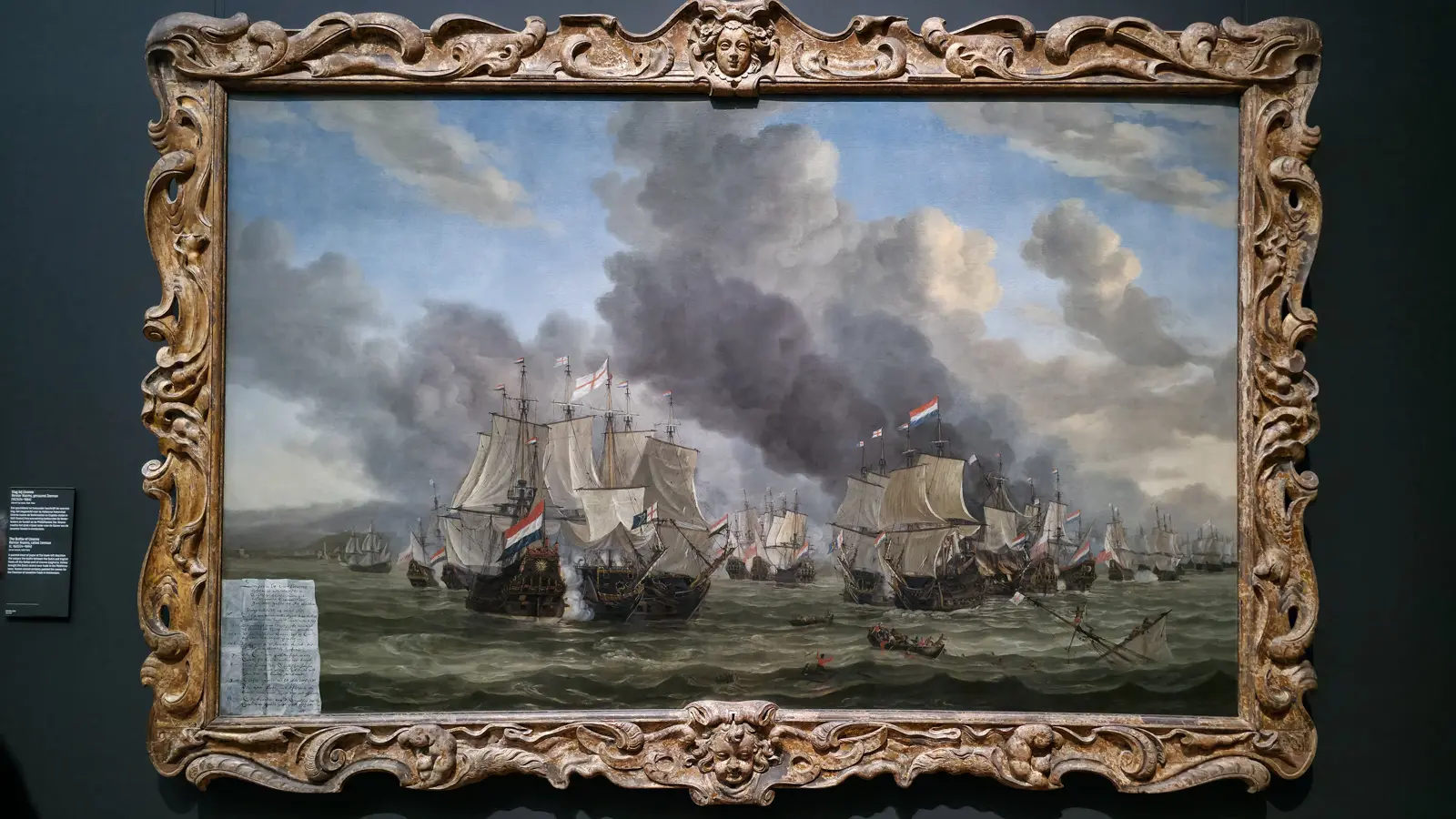
The second version is an oil by Reinier Nooms, who worked under the name Zeeman, meaning seaman. His fleets sit in a green swell under a tower of dark smoke, with men in the water in the foreground and a broken mast going under. The Dutch victory at Livorno gave them control of trade in the Mediterranean, which is the part that mattered to the people who paid for the painting.
The Raid That Cost the Dutch Manhattan
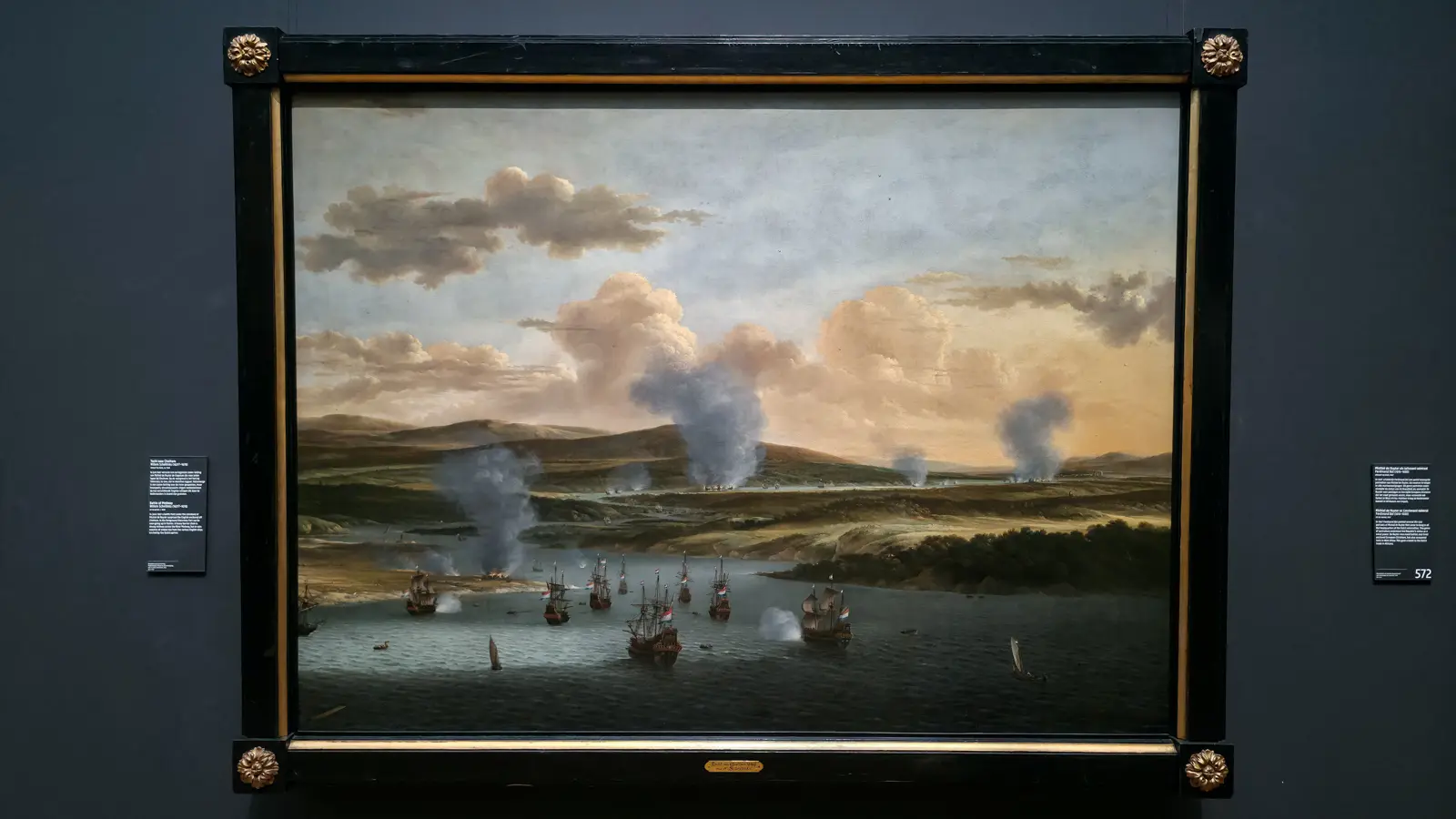
This is the painting I would send my ex-boyfriend, and it is the quietest picture in the room. A wide golden landscape at evening, hills, a river, small columns of smoke rising in the distance. It could be a view of anywhere.
It is the Medway. In June 1667 a Dutch fleet under Michiel de Ruyter sailed up the river and destroyed the English fleet at anchor off Chatham. It remains one of the worst humiliations in English naval history, and Willem Schellinks painted it as a pastoral.
Here is what my ex never mentioned. In 1664 the English had seized New Netherland, the Dutch colony stretching across parts of what are now several American states, and renamed its main town, New Amsterdam on Manhattan, as New York. The Medway raid broke English resolve three years later, and the Treaty of Breda was signed on 31 July 1667, a few weeks after it. The terms let the English keep the colony, while the Dutch kept Suriname and its sugar. Offered a choice between Manhattan and a plantation colony, the Republic took the plantations.
They did have it back briefly. In August 1673 a Dutch fleet of twenty-one ships under Cornelis Evertsen the Youngest and Jacob Binckes retook the city and renamed it New Orange. They gave it up again at the Treaty of Westminster in 1674.
He also used to tell me the Dutch discovered Manhattan. That one needs unpicking too. The 1609 voyage was made by Henry Hudson, an Englishman under contract to the Dutch East India Company, who had been sent to find a northern route to Asia and sailed west instead. The river he went up was later named after him. The Lenape had been living on the island a very long time before anybody arrived to give it a different name.
Michiel, and What the Label Admits
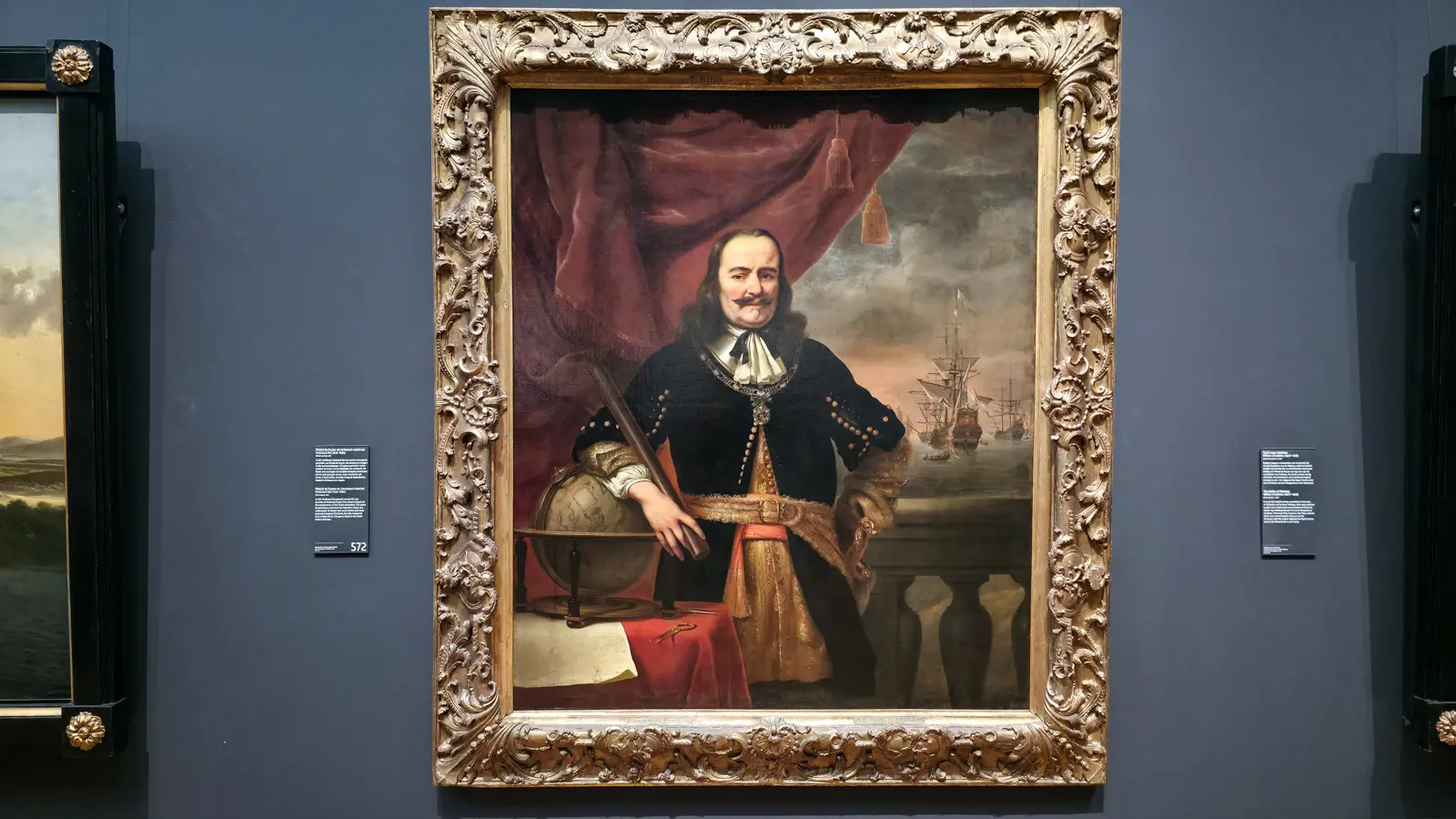
There is a portrait in this room of a man in black with a commander’s baton, a globe at his elbow and a fleet visible past a stone balustrade. His name is Michiel de Ruyter. Michiel was also my ex-boyfriend’s first name, so I arrived at this picture already rolling my eyes.
Ferdinand Bol painted it in 1667. De Ruyter is the admiral who led the Medway raid, and in 1664 he had been sent across the Atlantic with orders that included doing damage to New Netherland. He never got there. He retook the Dutch trading posts in West Africa, attacked Barbados the following April, was badly mauled, repaired at Martinique and went north to raid the Newfoundland fisheries. No territory in the Americas was recovered.
The label beside him does something I did not expect. It says he won naval battles and freed enslaved European Christians, and that he also captured forts in West Africa, and that this gave a boost to the Dutch trade in Africans. The museum puts that on the wall next to the hero, in two languages, at eye level. In a room this full of national pride, that sentence is doing more work than any of the cannon smoke.
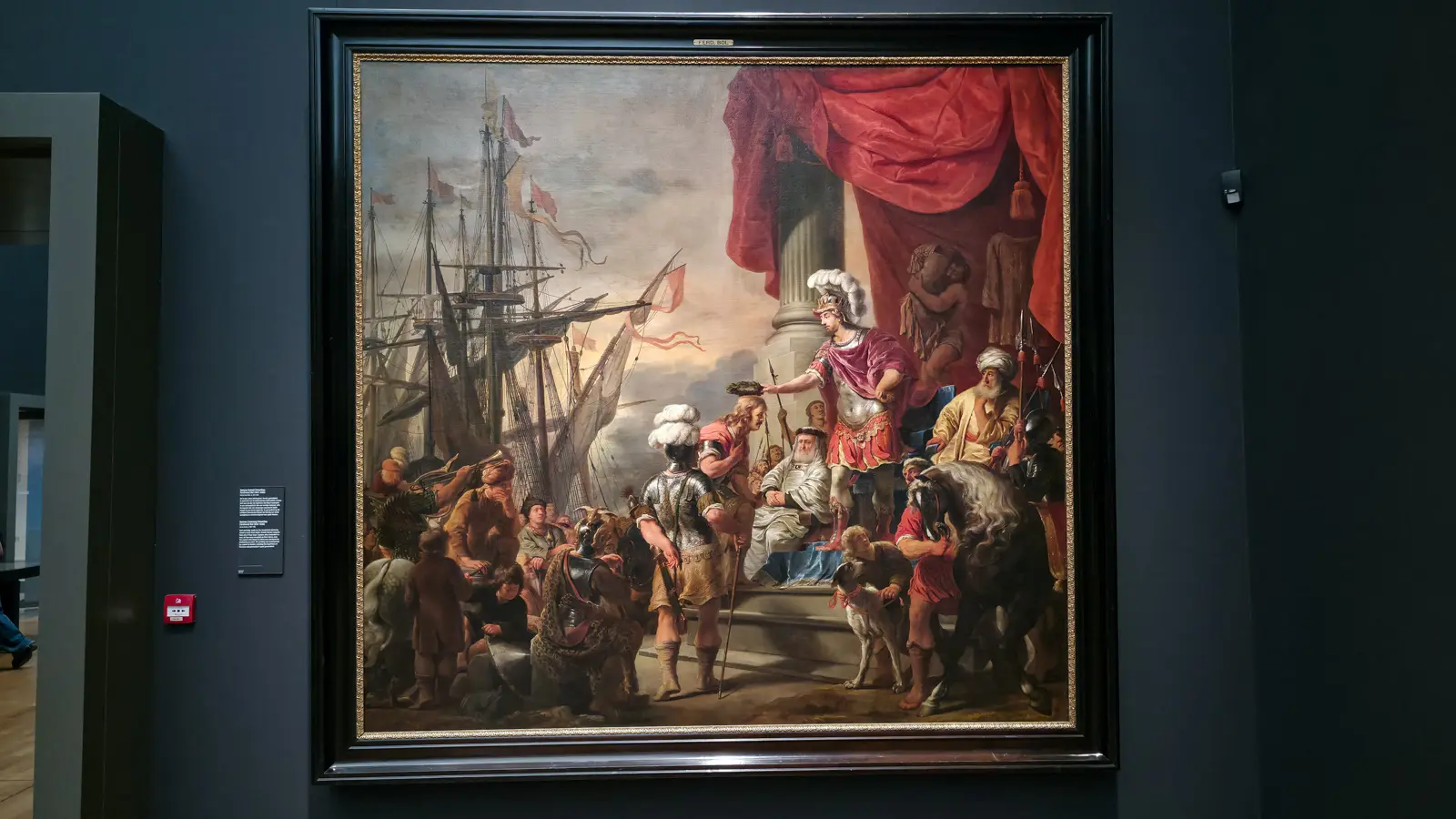
A few steps away hangs another Bol, and this one made me laugh out loud, in the muffled way a gallery permits. It shows Aeneas handing a wreath to a ship’s captain on a quayside, taken from Virgil. It was painted for the Amsterdam Admiralty.
So the men who ran the Dutch navy hung a scene from a Roman epic on their own wall, to instruct themselves in how to govern. My joke about the Greeks and the Romans turns out to have a third act I did not know about, in which seventeenth-century Amsterdam borrowed the whole apparatus to explain itself to itself.
Smoke, Wreckage and a Flagship Going Down
Two pictures in this room are almost entirely weather and gunpowder.
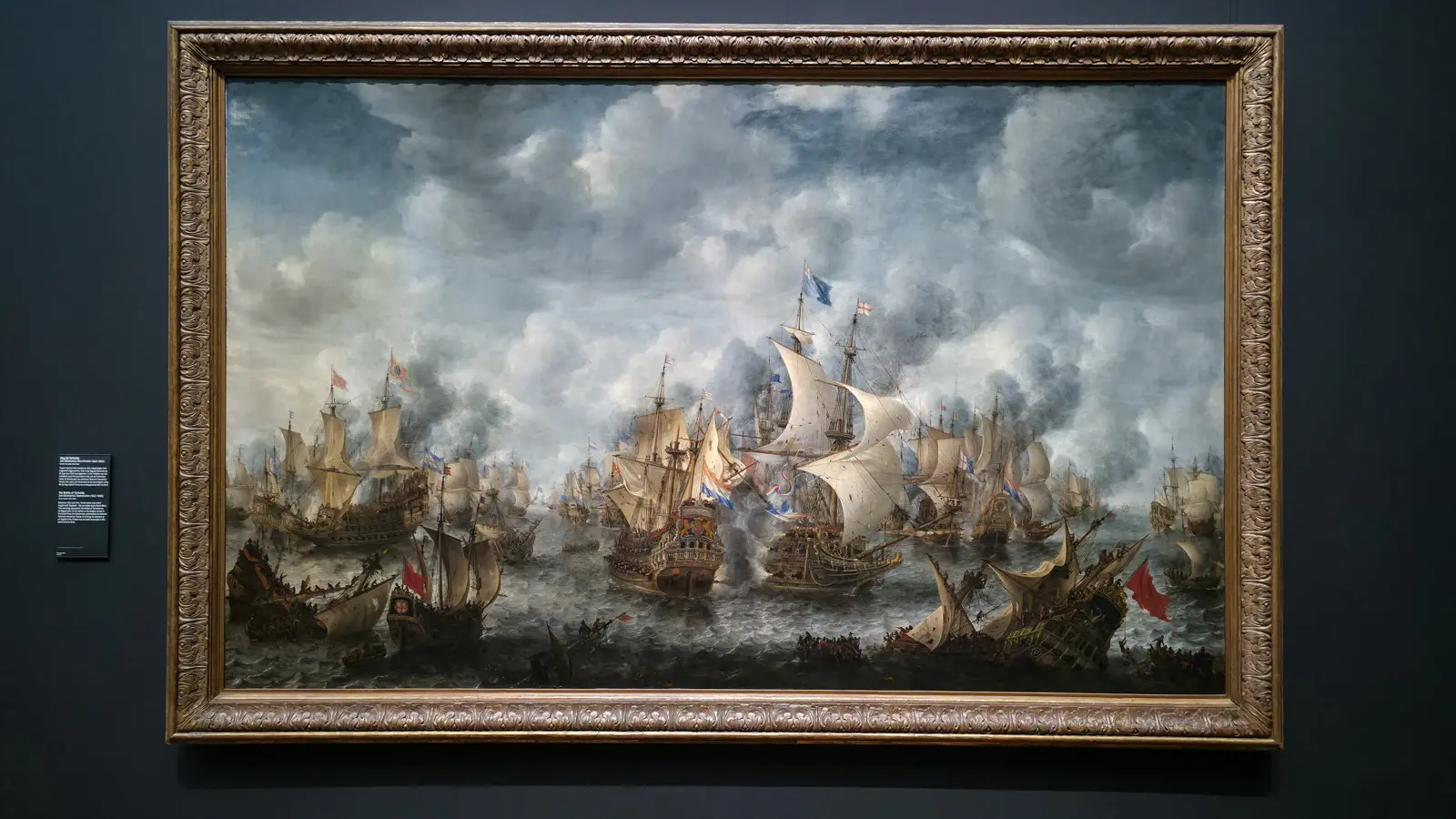
Jan Abrahamsz Beerstraten painted the Battle of Terheide, fought on 10 August 1653 during the first of the wars with England. Ships are dismasted in the foreground, men are in the water at the lower edge, a red flag hangs off a broken hull. The Dutch broke the English blockade of their coast in that battle and lost their commander in it, Maerten Harpertsz Tromp, who was fatally wounded.
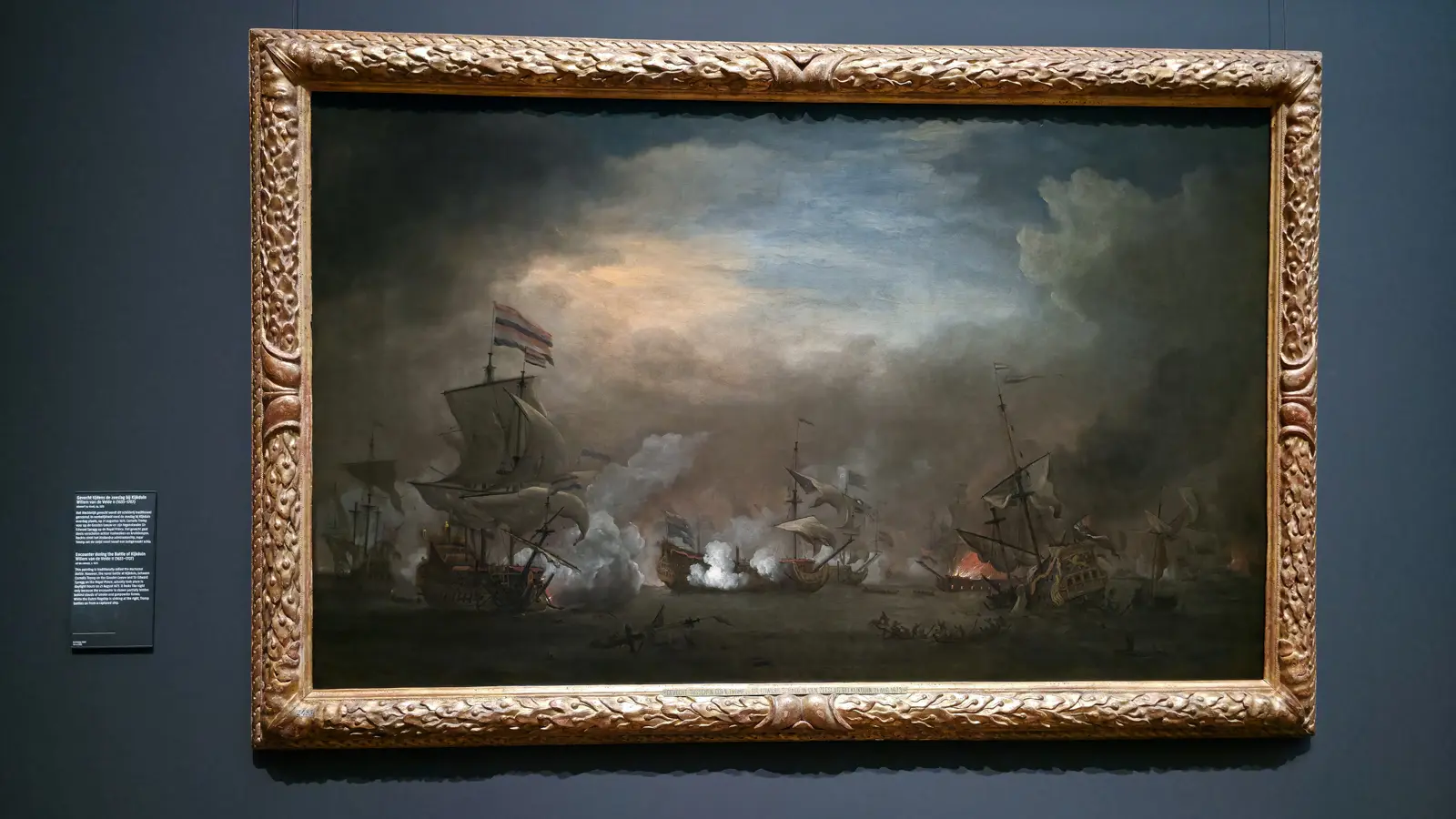
Beside it, van de Velde the Younger’s Kijkduin is so dark that for centuries people called it the Nocturnal Battle. It is not night. The action took place in daylight on 21 August 1673, and what looks like darkness is smoke and powder haze thick enough to swallow a fleet.
The detail that stopped me is at the right-hand edge. That burning, listing hull going down is the Dutch admiral’s ship. Cornelis Tromp, son of the Tromp who died at Terheide, carried on fighting the battle from a vessel he had captured. A painting made to commemorate a Dutch action puts the Dutch flagship on the seabed and expects the viewer to admire the improvisation.
The Sea as Ceremony
The last picture I want to mention has no fighting in it at all, and it is the one that puts the rest in context.
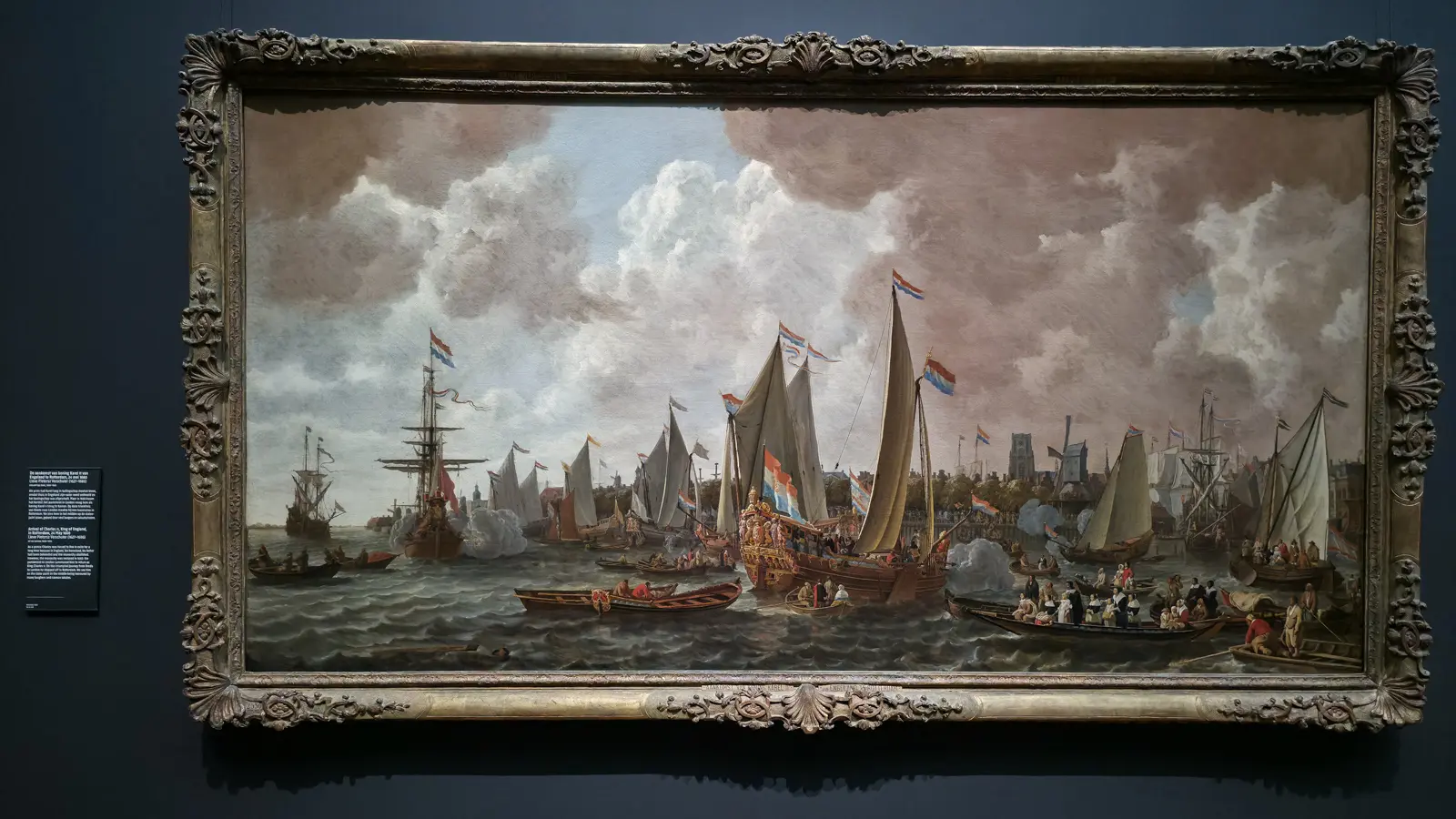
Lieve Pietersz Verschuier painted the arrival of Charles II at Rotterdam on 24 May 1660. Charles had spent years in exile, his father executed and the English monarchy abolished. Then parliament in London asked him back, and on the journey from Breda to London he stopped in Rotterdam, where the city turned out to watch.
The water is crowded with small boats. Flags fly from every mast. It is the same sea, the same ships, the same painters, doing the opposite job: not a victory but a welcome, seven years before the same king’s fleet was burning on the Medway.
Bubbly Tips
- Start at the model and work outwards. The William Rex sits in the middle of the floor and everything on the walls relates to it. Once you understand what a seventy-four-gun ship looked like, the paintings stop being brown weather and start being legible.
- Read the labels properly in this room. They are unusually candid. One tells you an admiral paid for his own glorification, another names the Dutch trade in enslaved Africans directly beneath a hero portrait. The wall texts are half the experience here.
- Look at the frames as well as the pictures. The big pen painting keeps its original frame carved with the commissioning family’s coat of arms. Several others carry title plaques along the bottom rail. The framing is part of the argument being made.
- Find the painted sheet of paper. In the lower left corner of Zeeman’s Livorno there is a trompe l’oeil document listing the ships in the battle. It is easy to walk past and it is the sort of thing that repays standing still.
- Get close to the darkest canvas. The Kijkduin painting looks like a brown rectangle from six feet away. From two feet you can pick out a burning hull, a boat full of men and a flag still flying.
- There is seating. Benches sit along one side of the gallery, which is worth knowing if you have already done several hours of museum. This is a good room to sit down in.
- Photograph the model from the short end. Side-on you get a long dark hull. From bow or stern you get the rigging, the carving and the depth of the room behind it.
- Allow forty minutes if you like history. Ten will get you round it. Forty will get you the connections between the pictures, which is where the interest actually is.
- Combine it with the Gallery of Honour, which is a short walk away and holds a van de Velde of its own, so you can see the same painter working at a different pitch.
- Finish outside in the gardens. After an hour of smoke and sinking ships, a bench among the hedges is exactly the right correction.
Final Thoughts
I came into this room expecting ships and left thinking about publicity. Almost everything here was paid for by somebody who wanted a version of events to survive: an admiral commissioning his own triumph, an admiralty hanging Virgil above its desks, a trading chamber ordering a battle scene that doubled as an advertisement for a shipping route. That is not a criticism. It is what art has usually been for.
What I keep returning to is the model in the centre of the floor, magnificent and complete down to the pumps and the anchors, carrying a king’s name it was given long after the fact, standing in for a ship that probably never existed. My ex would have loved it. I would have let him talk.
Until next time!

🌟 Everything You Need to Plan Your Dream Trip in 2026
- 🌟 Luxury Hotels - Find premium stays with Booking.com & Hotels.com
- 🏡 Vacation Rentals - Discover unique properties on VRBO
- 🏞️ Guided Tours - Explore with Viator or GetYourGuide
- 🎫 Attraction Tickets - Skip the lines with Tiqets
- 🚢 Ocean Cruises - Set sail with Cruise Direct
- 📱 International SIMs - Stay connected with Saily
- 🚗 Car Rentals - Budget-friendly options from Discover Cars
- 🌐 Secure VPNs - Browse safely with NordVPN
- 💶 Currency Exchange - Best rates with Wise
- 🗣️ Learn Languages - Master the local language with Babbel and Rosetta Stone