
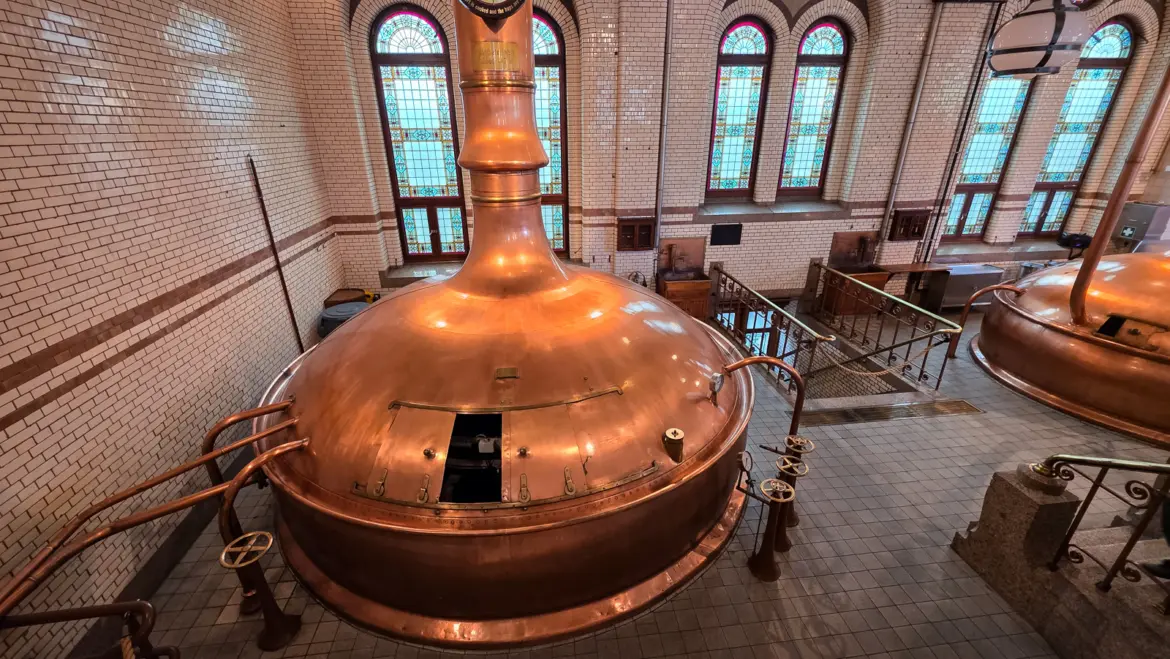
I do not drink beer. I have said so in print before now, and it is still true, so the honest place to start is that I booked the Heineken Experience in Amsterdam for the building rather than the product. What I did not expect was to spend the best part of an hour in one room, listening to a man explain how sugar becomes alcohol, and wanting him to keep going.
The room is the historic brew room, and it is the part of the tour I would go back for. Everything else in the building has been designed for visitors. This has not. It is a factory floor that stopped working and was left where it stood.
The Historic Brew Room at a Glance
🏭 What it is · A 1913 brew hall by Rotterdam architect Arie Heederik, the oldest surviving part of the Heineken complex and a national monument since 2006.
🫖 Eight copper kettles · Four originals from 1913 (red neck signs) and four added in 1956 (yellow). An oval wall plaque tells them apart.
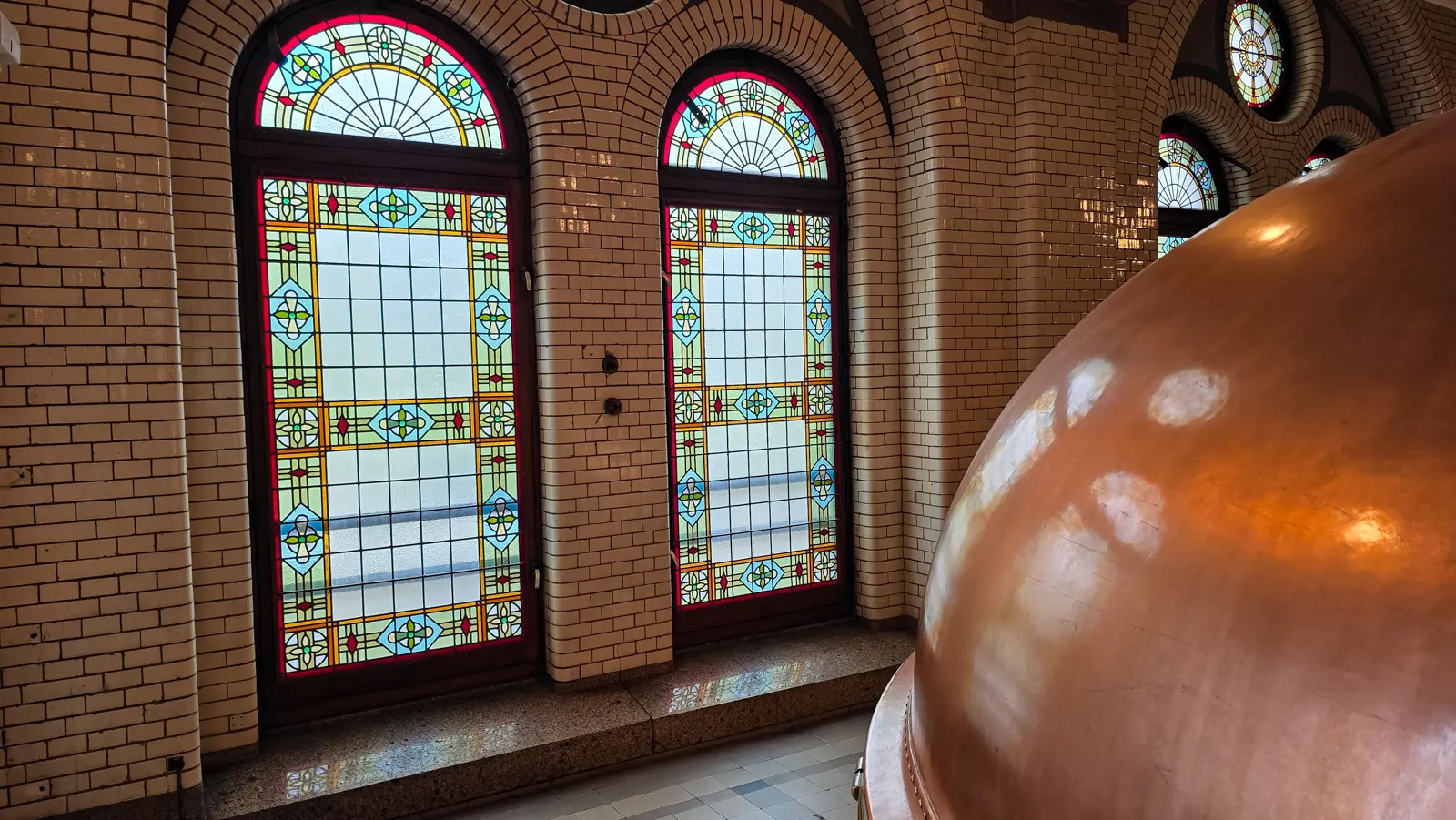
🪟 Church-window glass · Full walls of coloured leaded glass and glazed brick, in a room built to boil grain.
🔍 The best bit · An opening cut into one kettle lets you lean in: the unpolished, stained working interior, with a film playing inside.
💡 Tip · Find the oval plaque first, then look inside the kettle. The mixing is a demonstration, not a tasting; beer comes later.
A Brew House From 1913
The brew house went up between 1911 and 1913, to a design by the Rotterdam architect Arie Heederik. It rises six storeys behind a front on the Stadhouderskade, and it is the oldest part of the Heineken complex still standing. Everything around it came later or came down.
It has been a national monument since 2006. There is a detail here that pleased me more than it should have: the building is also KLM Delft Blue miniature number 95. I own three of those little houses, none of them this one, and I have been looking at the shape of Dutch buildings in that collection for years without connecting one to a brewery I would eventually walk into.
Eight Kettles and Two Dates
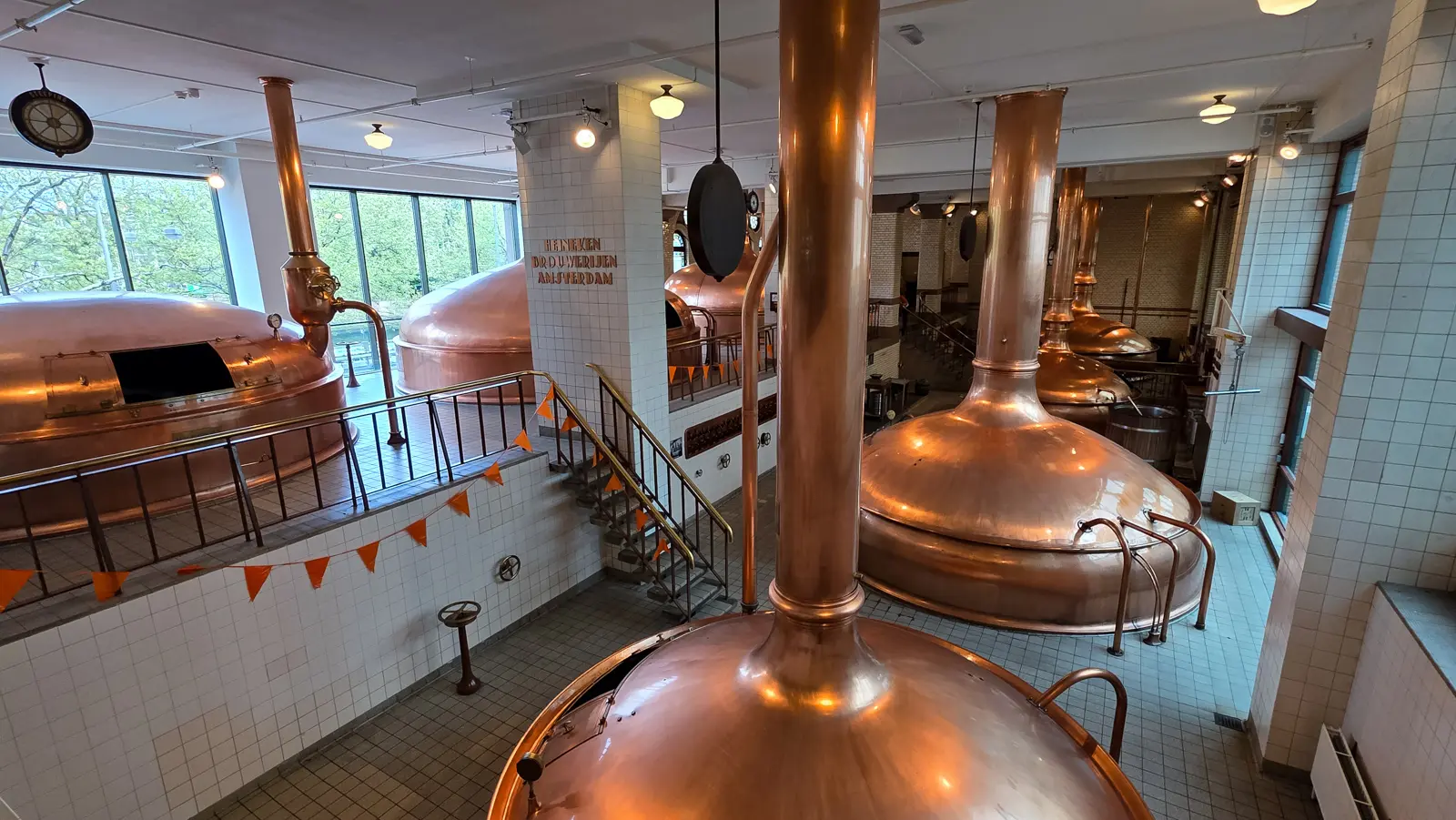
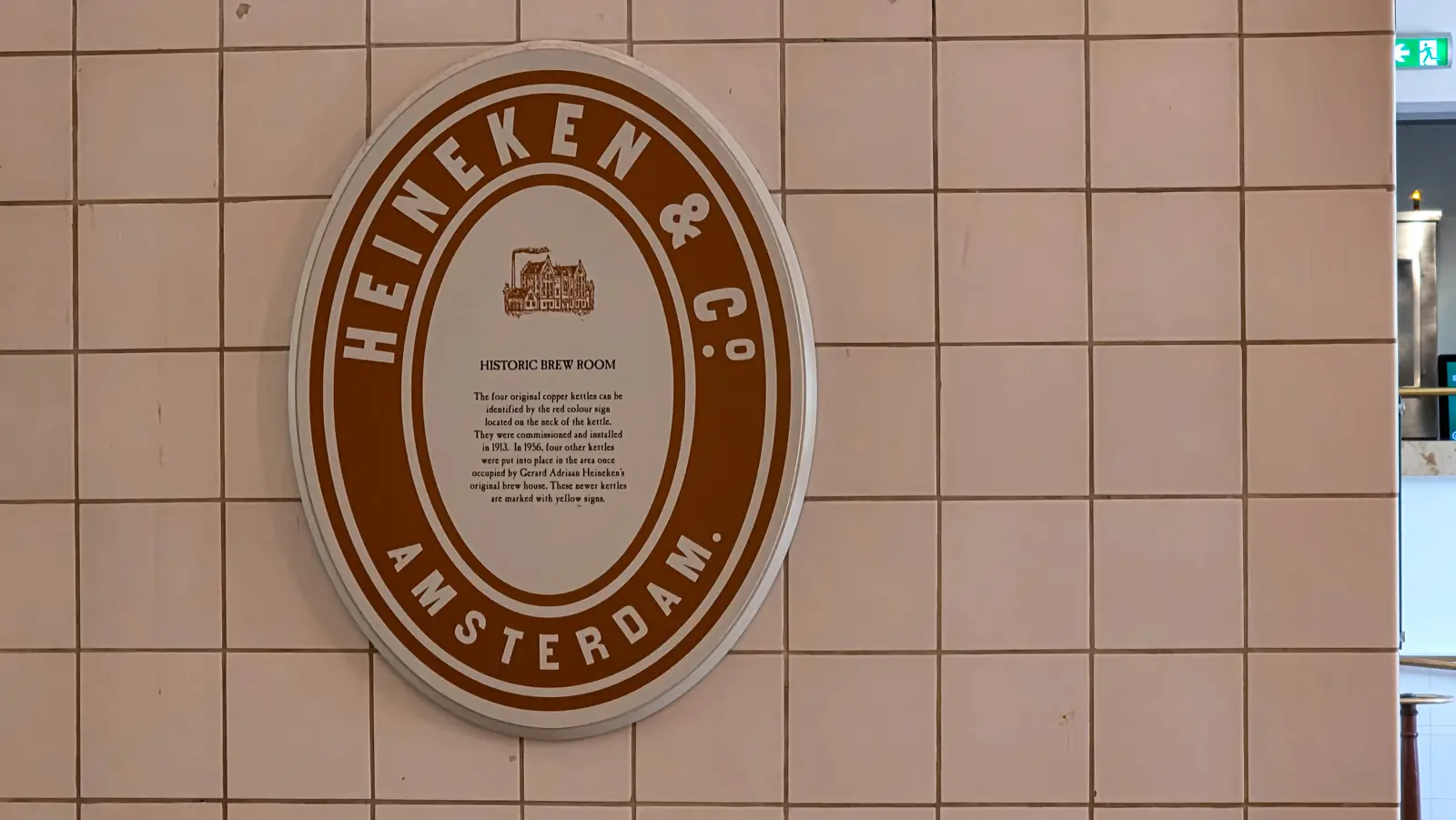
There are eight copper kettles, and they are not all the same age. A brown and white oval plaque on the tiled wall explains how to tell them apart, and it is the single most useful thing written anywhere in the room.
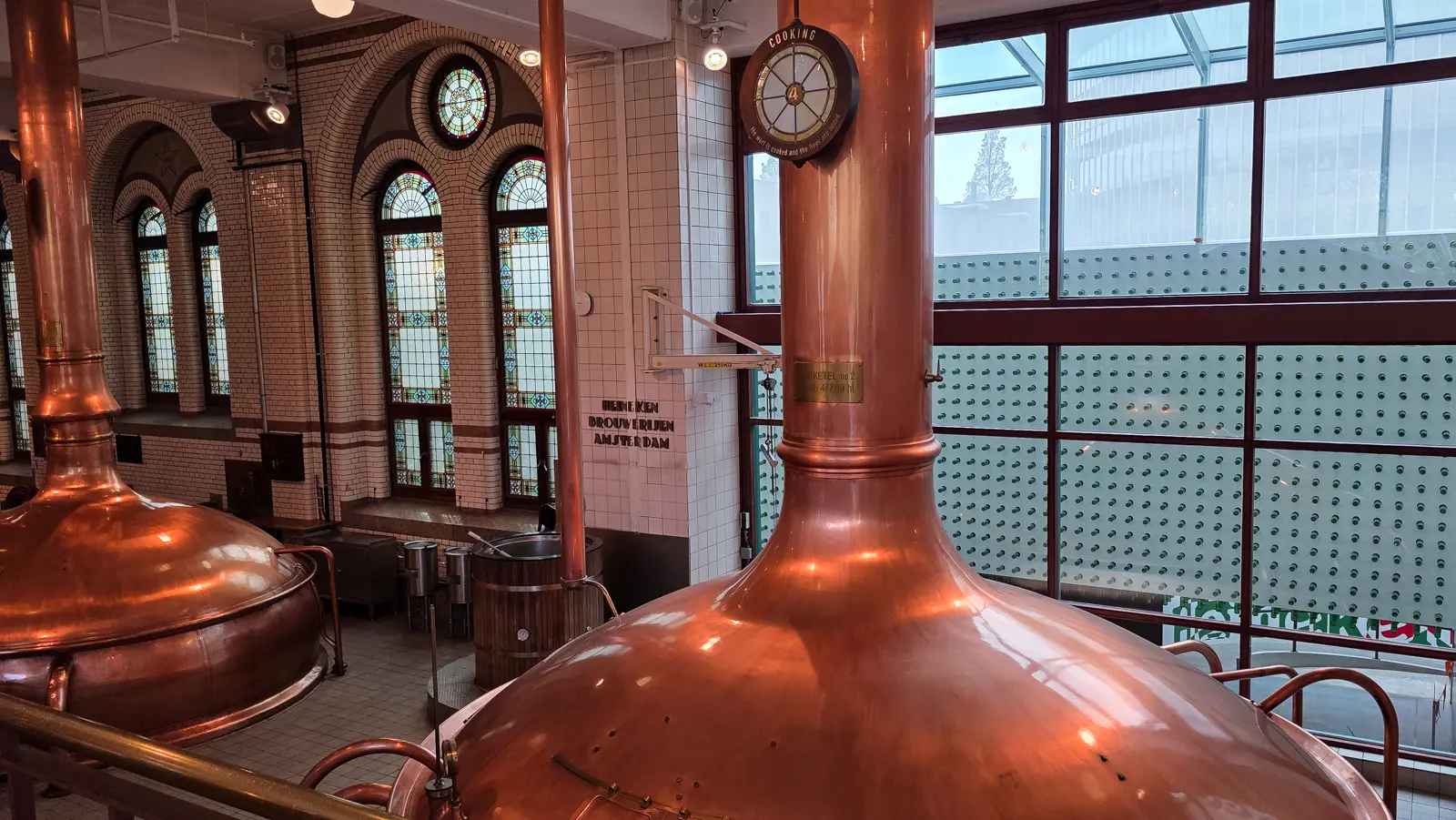
Four of the kettles are the originals, commissioned and installed in 1913, and each of those carries a red sign on its neck. In 1956 four more were added, standing on the ground once occupied by Gerard Adriaan Heineken’s own brew house, and those are marked in yellow. Nothing else distinguishes them by age. They are the same copper, polished to the same finish, and without the plaque a visitor walks past forty-three years of difference without noticing. They are not all the same size, though, and they were not all doing the same job. Small brass plates on the necks name each vessel and give its capacity, and the numbering runs separately for each type, so there is more than one vessel labelled number two.
There is a correction to make here, and it is one I would rather make than let stand. This room looks untouched, and I described it that way to myself while I was in it. It is not quite. The brew hall sits partly inside the 1911 to 1913 building and partly inside an extension added on the right-hand side between 1956 and 1958. When the complex was protected, that extension and the brewing fittings inside it were specifically left out of the listing. So half of what looks like one continuous Edwardian room is post-war, and the joint is invisible.
Glass, Tile and the Names of the Stages
The walls are glazed brick, cream and brown, laid in arches over tall windows. The windows are leaded and coloured, red and yellow and pale green in geometric patterns, with fan shapes in the arched heads and small round lights above. They belong in a church, or in the kind of bank built to advertise its own permanence. They are in a room built to boil grain.
Hanging from the pipework above each vessel is a round enamelled sign with a wheel design, and each one names the stage that happened there. One reads BREWING, and underneath, that a part of the mash is boiled. Another reads COOKING, and underneath, that the wort is cooked and the hops are added. The room labels its own process, in English, at head height. Once I had noticed the first one I went looking for the rest.
Looking Inside a Kettle
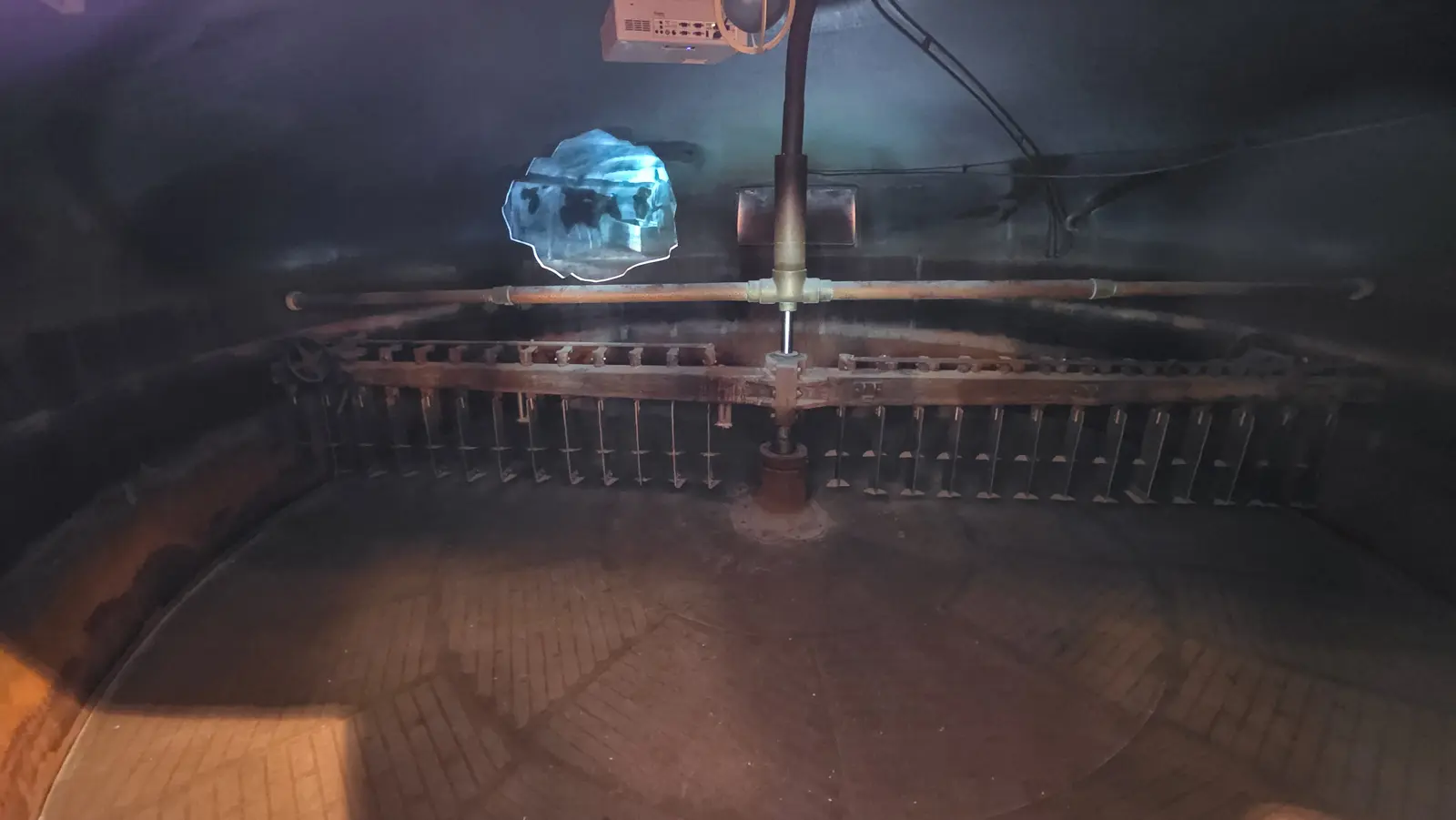
The best moment came at an opening cut into the side of one of the kettles, wide enough to lean into. Inside, the vessel is not polished at all. It is dark, stained, and crossed by a ring of iron rake arms hanging from a central shaft, the whole assembly sitting above a floor laid in a fine radiating pattern.
A short film plays on the inside wall at the same time. That combination did something no display panel had managed: the outside of these kettles is a museum object, and the inside is a piece of machinery that spent decades full of hot grain and was never meant to be looked at.
Four Ingredients
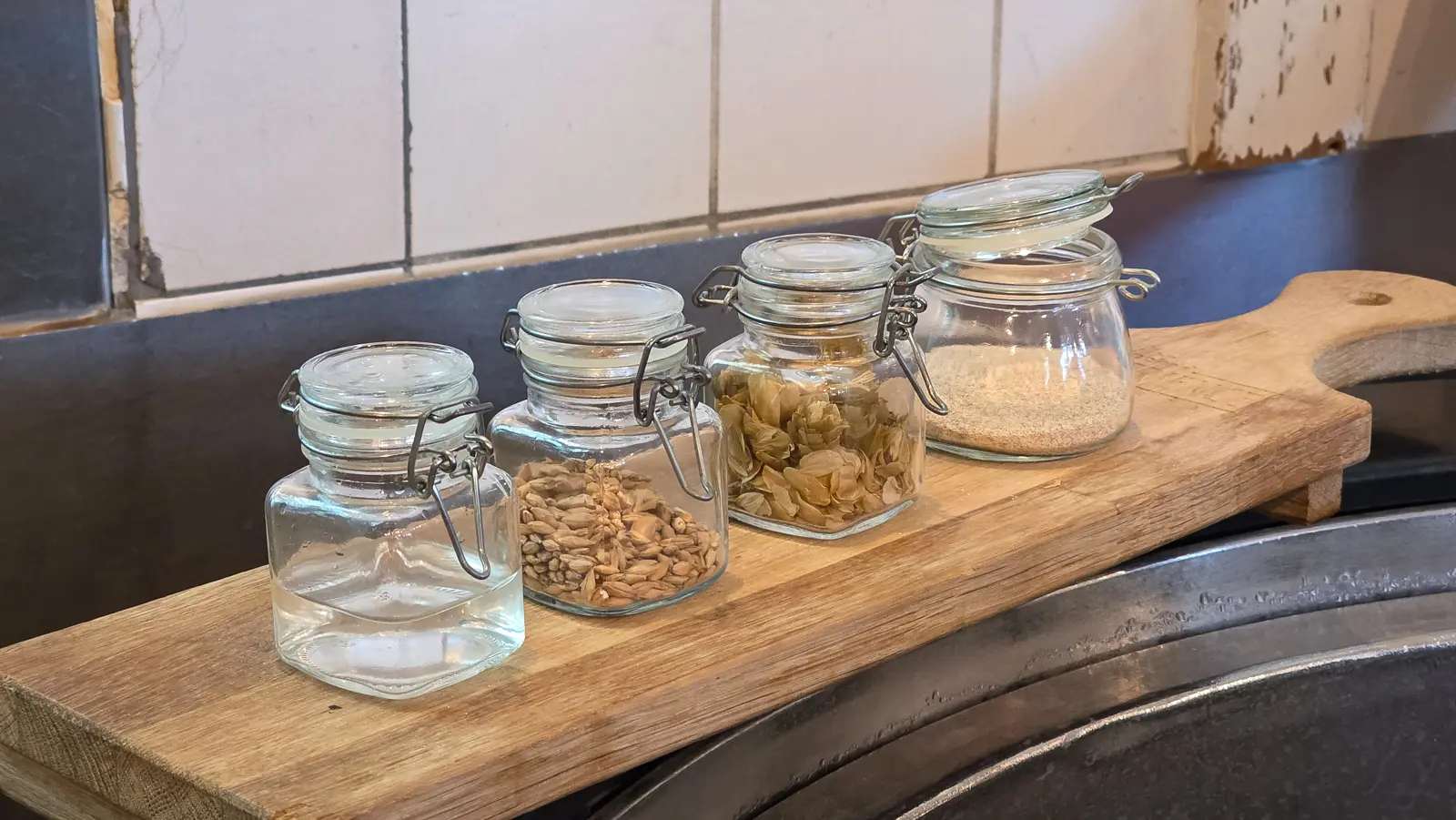
Our guide set out four glass jars on a wooden board. Water in the first, whole barley grains in the second, dried hop flowers in the third, and a fine pale powder in the fourth.
By Heineken’s own account the beer rests on four things: malted barley, water, hops and the company’s A-yeast, the strain isolated in 1886 that the main post goes into. The barley is malted before brewing, which is what turns its starch into something that will ferment. The hops go in later, for flavour and as a preservative. The water does more work than it gets credit for.
The Guide Made the Beer
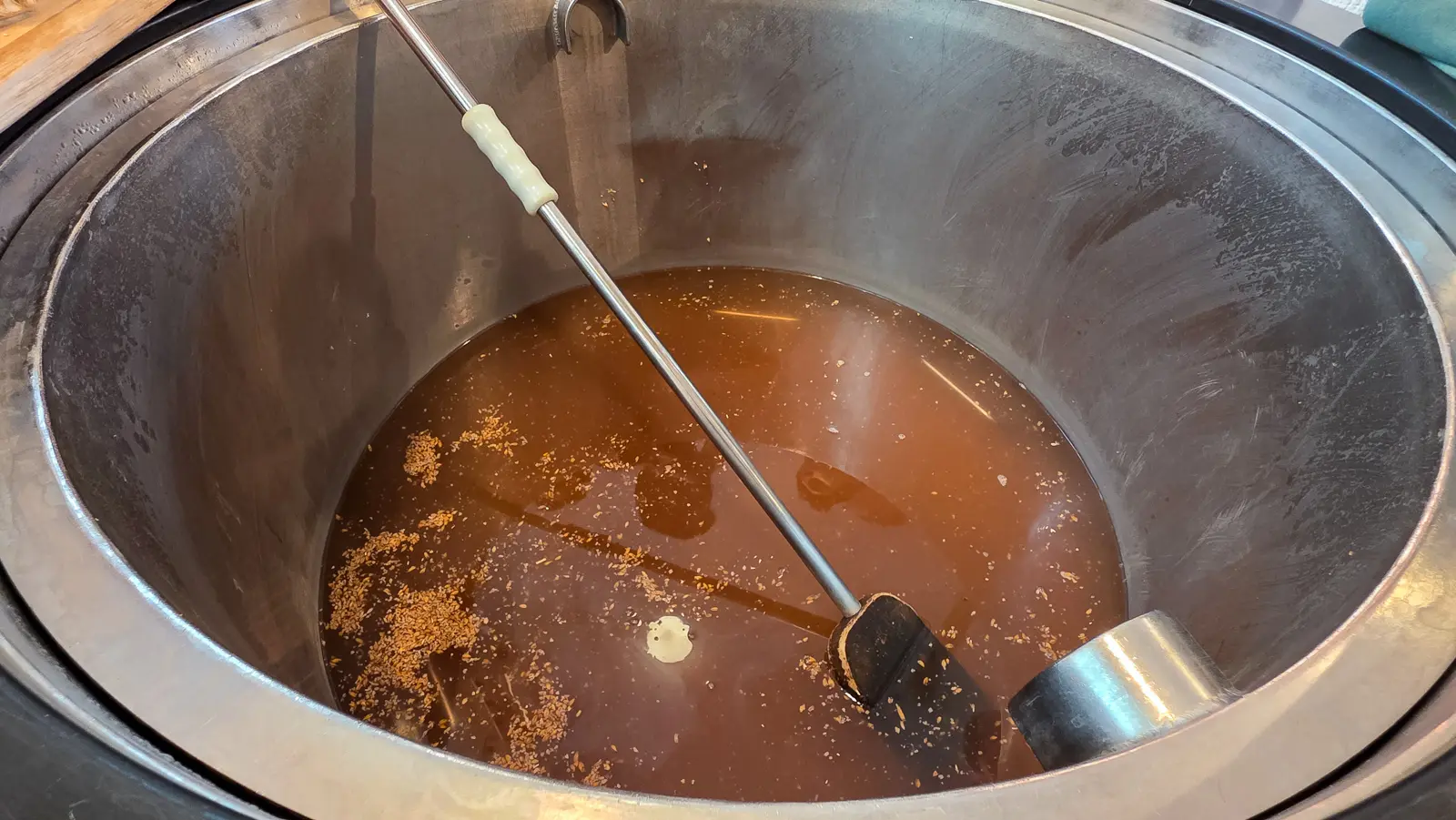
Then he mixed them. Not for us to drink, and nobody was offered a glass. He put the ingredients into a steel vessel and stirred them with a long paddle, so that we could watch the thing happen at a scale we could see rather than imagine.
What came out was cloudy and brown, with grain still floating in it and drifts of husk settled against one side. That liquid is wort, the sweet unfermented base that every one of the copper kettles in the room was built to handle. Seeing it made by hand in a steel bucket, in a room built to handle it in hundreds of hectolitres at a time, is the clearest explanation of industrial scale I have been given anywhere.
Help the Brewer
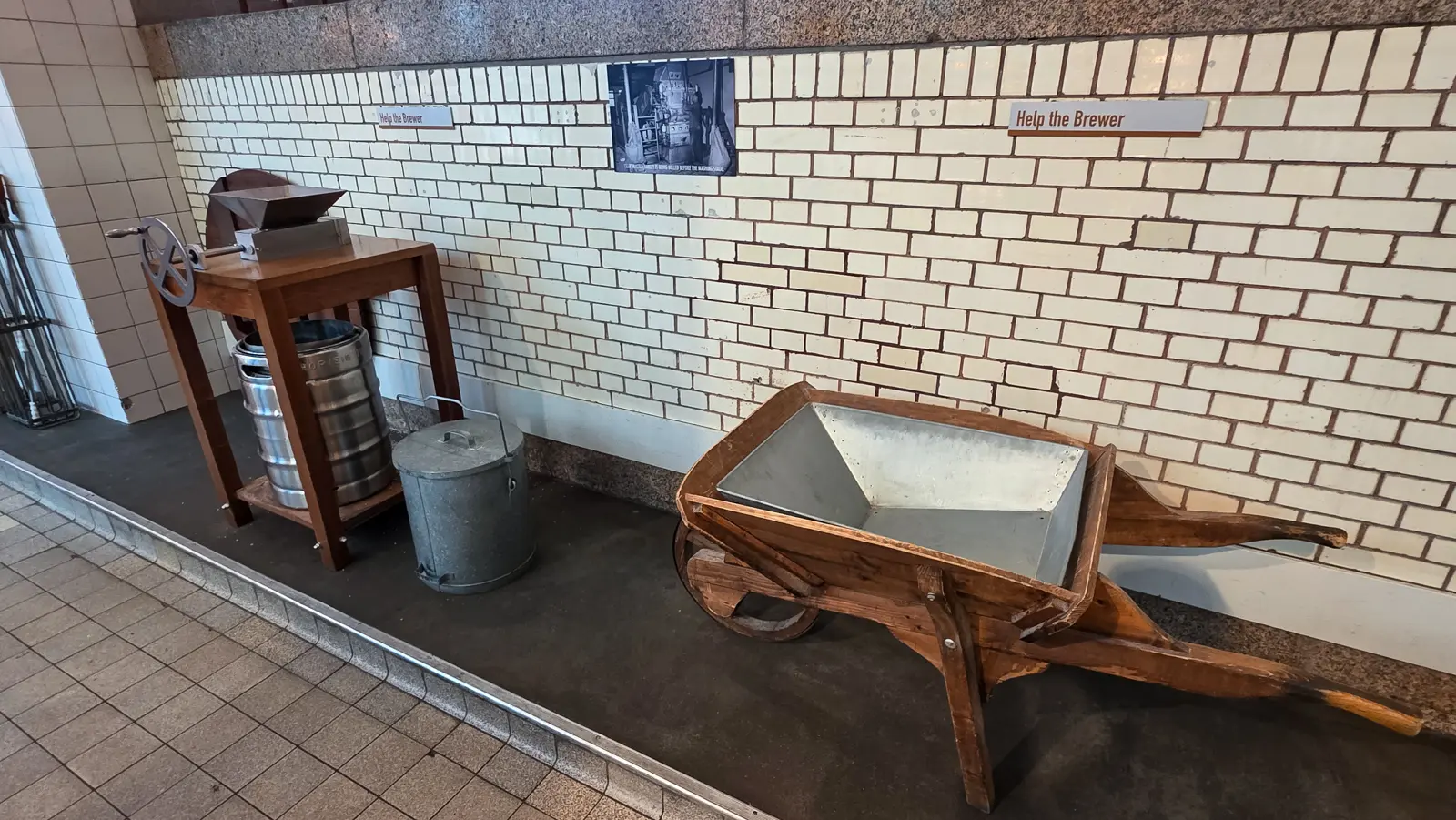
Along one wall, at floor level, there is a small display of the tools the job used to need. A wooden wheelbarrow with a metal liner, worn down at the handles. A hand-cranked mill on a wooden stand, with a hopper on top. A galvanised churn with a lid. Two signs above them read Help the Brewer.
This is the part of the room I keep thinking about. The kettles are impressive because they are enormous and made of copper. The wheelbarrow is affecting because somebody pushed it. A brewery this size ran on people carrying, lifting, grinding and hauling, in heat, for a century, and the polished vessels upstairs are the only part of that anyone photographs.
The Last Brew
Brewing stopped here in 1988 and moved to Zoeterwoude, outside Leiden. The city brewery had become impossible: too little room, too much traffic, and a modernisation bill nobody wanted to pay.
It did not end quietly. On 22 April 1988 staff and board gathered in the Koelschip, the coolship room upstairs, and drank a beer called Brouwsel 1466. It was the last batch to come out of these copper kettles. I like that it has a number rather than a name. Brew 1466, logged like all the others, and then nothing after it.
Bubbly Tips
- Find the oval plaque before you look at the kettles. It is on the tiled wall and it tells you that red signs on the neck mean 1913 and yellow signs mean 1956. Without it the eight vessels read as one set.
- Put your head into the opening in the kettle. It is easy to walk past. The interior is unpolished and there is a short film playing inside, and it is the only place in the building where you see the working side of the equipment.
- Read the round signs hanging above the vessels. Each one names a brewing stage in English and describes what happened in that vessel. They are original fittings doing the job of a modern label, and they are better written than most modern labels.
- Ask the guide to slow down on the ingredients. The four jars take two minutes if nobody asks anything and a quarter of an hour if somebody does. This is where a VIP guide earns the ticket price.
- Look up at the windows, not just the copper. The leaded glass runs the full height of one wall. Most visitors photograph the kettles with their backs to it.
- Do not expect to taste anything here. The mixing is a demonstration, not a tasting. The beer comes later in the tour, in the bar.
- Go early in your tour slot if you can. The brew room is on the standard route as well as the VIP one, so groups cycle through it. Wait a few minutes and you will get the hall without other people in the frame.
- Wear something you can move in. The route through this part of the building uses stairs, and the good angles are from the upper walkway looking down.
- Bring a wide lens or step back to the rail. The kettles are close together and tall, and from ground level you cannot get a whole vessel in without backing up to the far side of the walkway.
Final Thoughts
I went in with no interest in beer and came out able to explain, roughly, what a wort kettle does. That is not nothing for an hour. The trick the room pulls is that it does not have to reconstruct anything. The kettles are where they were, the signs above them still name the stages, and the tiles and the glass have been in place since a decade when Amsterdam still had four big breweries working inside the city.
What stayed with me was not the copper. It was the wheelbarrow, and the plaque that quietly admits half the room is younger than it looks. This is a company museum, and it is honest in places I did not expect it to be.
Until next time!

🌟 Everything You Need to Plan Your Dream Trip in 2026
- 🌟 Luxury Hotels - Find premium stays with Booking.com & Hotels.com
- 🏡 Vacation Rentals - Discover unique properties on VRBO
- 🏞️ Guided Tours - Explore with Viator or GetYourGuide
- 🎫 Attraction Tickets - Skip the lines with Tiqets
- 🚢 Ocean Cruises - Set sail with Cruise Direct
- 📱 International SIMs - Stay connected with Saily
- 🚗 Car Rentals - Budget-friendly options from Discover Cars
- 🌐 Secure VPNs - Browse safely with NordVPN
- 💶 Currency Exchange - Best rates with Wise
- 🗣️ Learn Languages - Master the local language with Babbel and Rosetta Stone