
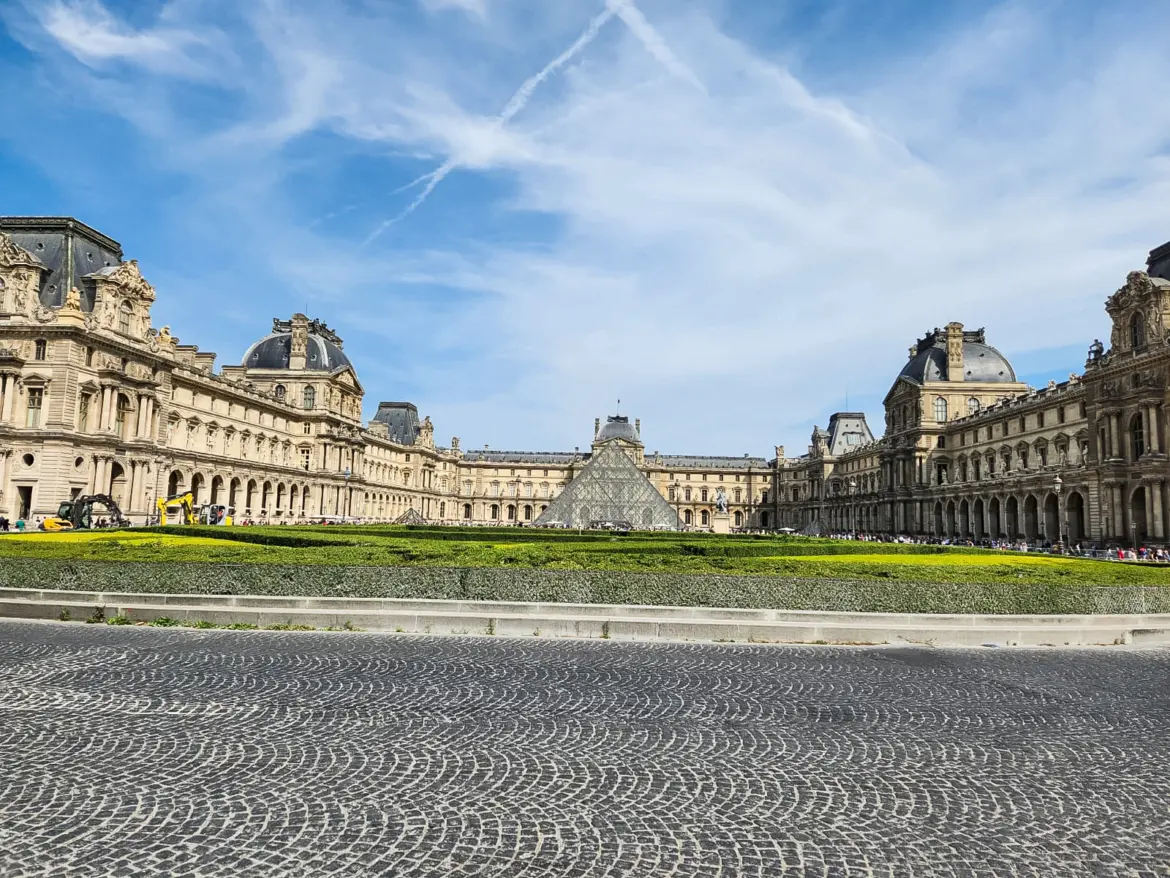
Seeing the Louvre in Paris properly takes days. I had a few hours.
That is the whole problem, and everything else in this post follows from it. With a few hours there is really only one sensible option, which is a guide who knows the route. I booked a third-party tour and I do not regret it. But a guided tour makes a trade on the visitor’s behalf, and it took me a while to work out what the trade was.
The Louvre in a Few Hours at a Glance
🎟️ Tour or not · With only a few hours, a guide is the efficient choice: it gets a first-timer to the famous works. The cost is pace, and looking only at head height.
🗺️ The route most people walk · Winged Victory, Venus de Milo, Mona Lisa, Raft of the Medusa, Great Sphinx of Tanis. Do the Greek sculpture before the Mona Lisa.
💶 2026 prices · Since 14 January 2026: €22 for EEA residents, €32 for everyone else. Under-18s free; timed slot required even for free entry.
🔒 What changed · The Apollo Gallery, robbed of the Crown Jewels in October 2025, reopened in July 2026 empty, returned to a ceremonial room.
💡 Tip · Look up in every room. The ceilings are painted and gilded throughout and no highlights tour will stop for them.
What a tour actually buys, and what it spends
A guide gets a first-timer to the famous things. Without one, the same visitor wanders, gets lost in the Denon wing, and runs out of afternoon somewhere near the Italian paintings without having seen the Greeks at all.
What a guide spends is the pace. The group moves as one body, from room to room, at the speed of the itinerary. There is no stopping to work out what a thing is. There is no doubling back. And because everyone is looking where the guide is pointing, everyone is looking at roughly head height.
That is the cost. In a building where the art is on the walls, on the floors, in the doorways and across every ceiling, a tour teaches its group to look straight ahead.
June, and the crowds
I went in June, which is the wrong month if crowds bother anybody. The courtyard was full before the doors opened, and the barriers in front of the pyramid were doing real work.
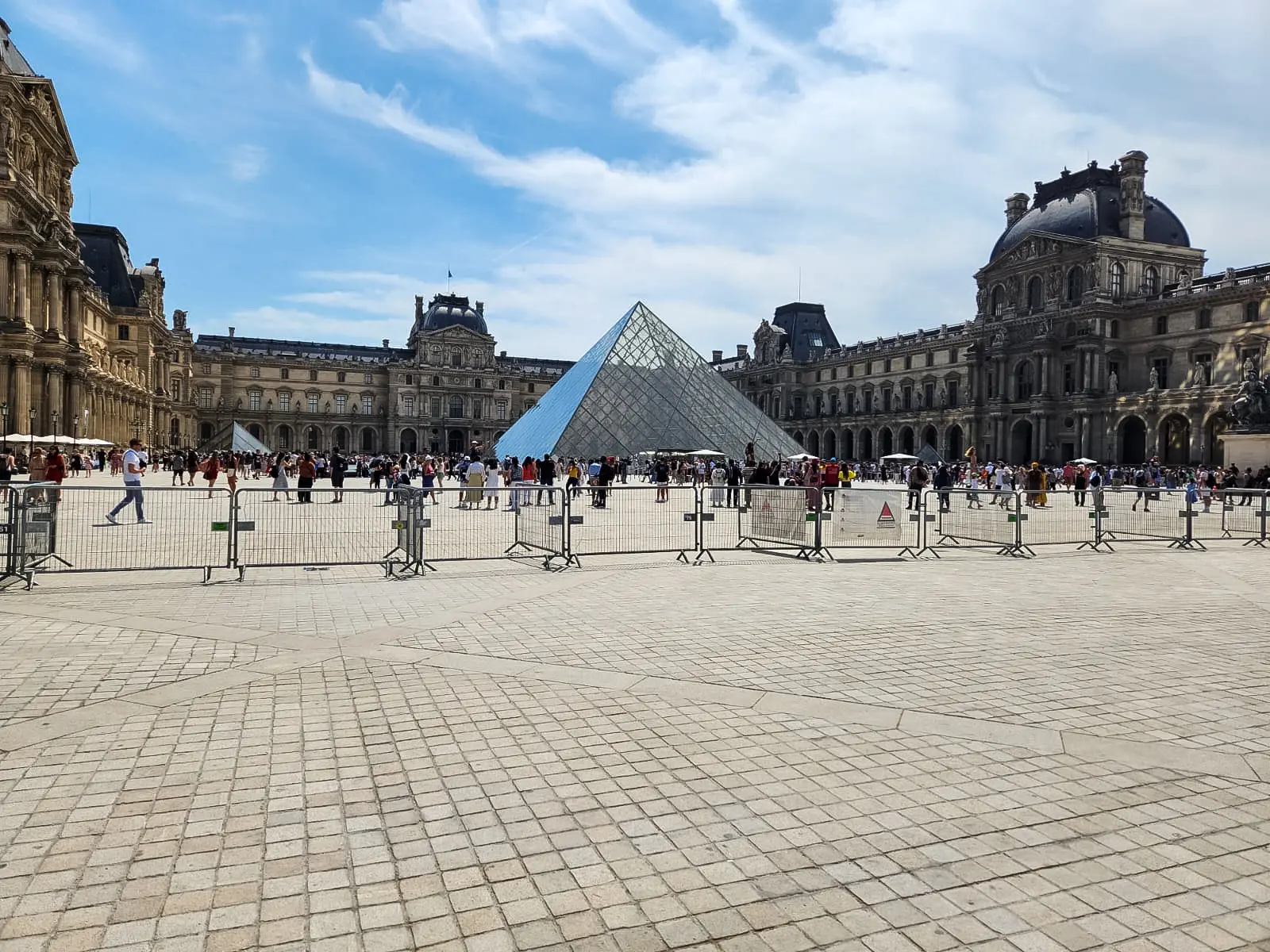
Getting a clear photograph of anything popular was not really possible. That sounds like a complaint. It is not. A packed museum is still a museum, and the point of a first visit to a place this size is not to come away with clean pictures. It is to find out what is there, so that the second visit can be spent properly.
The pyramid makes sense from underneath
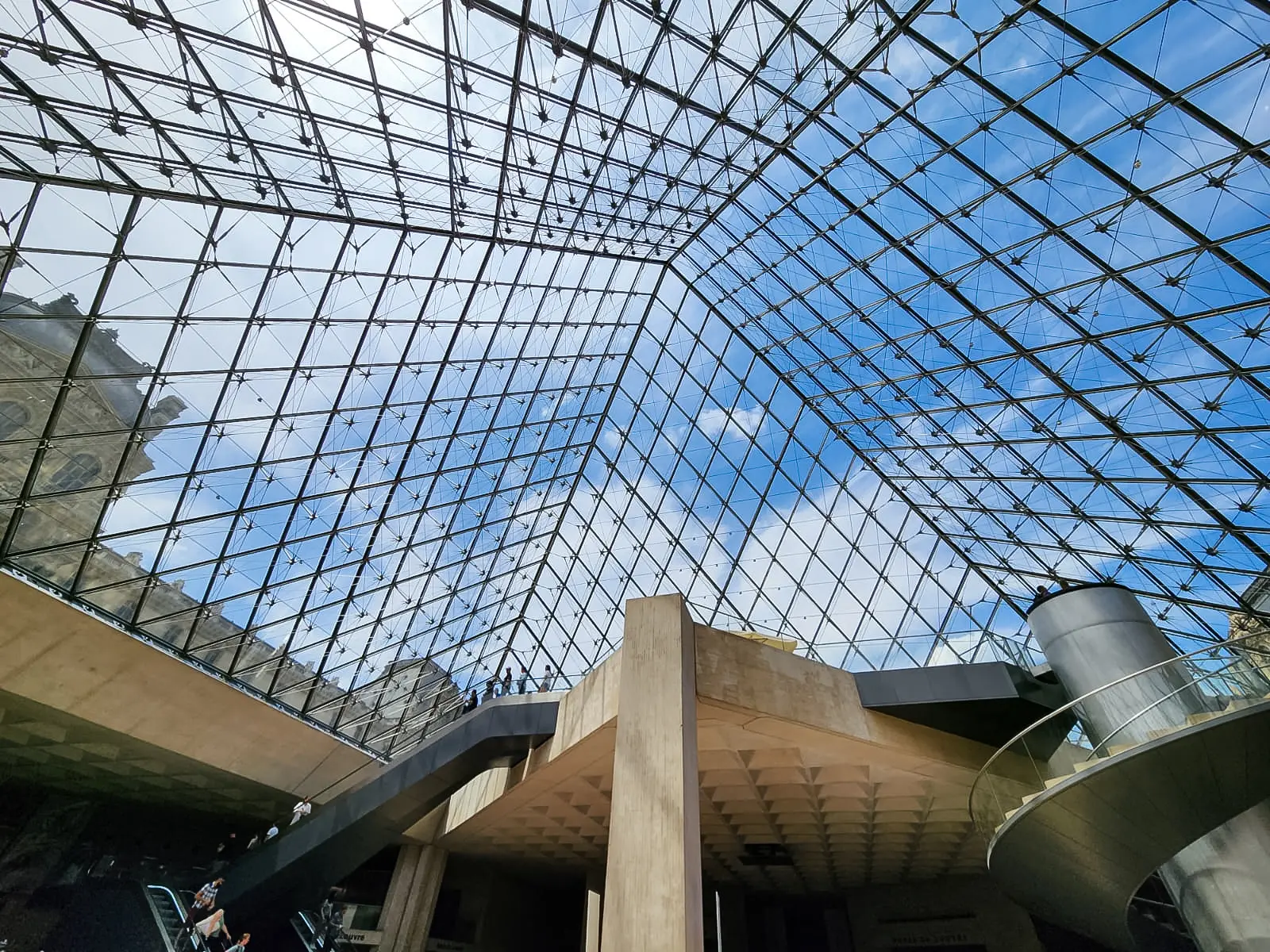
The glass pyramid is the thing everyone photographs from the courtyard, and from out there it reads as a shape dropped in front of a palace. It was designed by I. M. Pei, appointed in July 1983 to lead the Grand Louvre project that Francois Mitterrand had commissioned two years earlier, and it opened in 1989.
From inside it is a different object. Standing in the entrance hall and looking up, the structure becomes a grid of glass panels and steel rods with the sky and the old stone facades showing straight through it. Light comes down into what would otherwise be a basement. The whole design argument for the thing is only legible from underneath.
Straight to the Greeks
My family is Greek. That decided the route before the guide said a word.
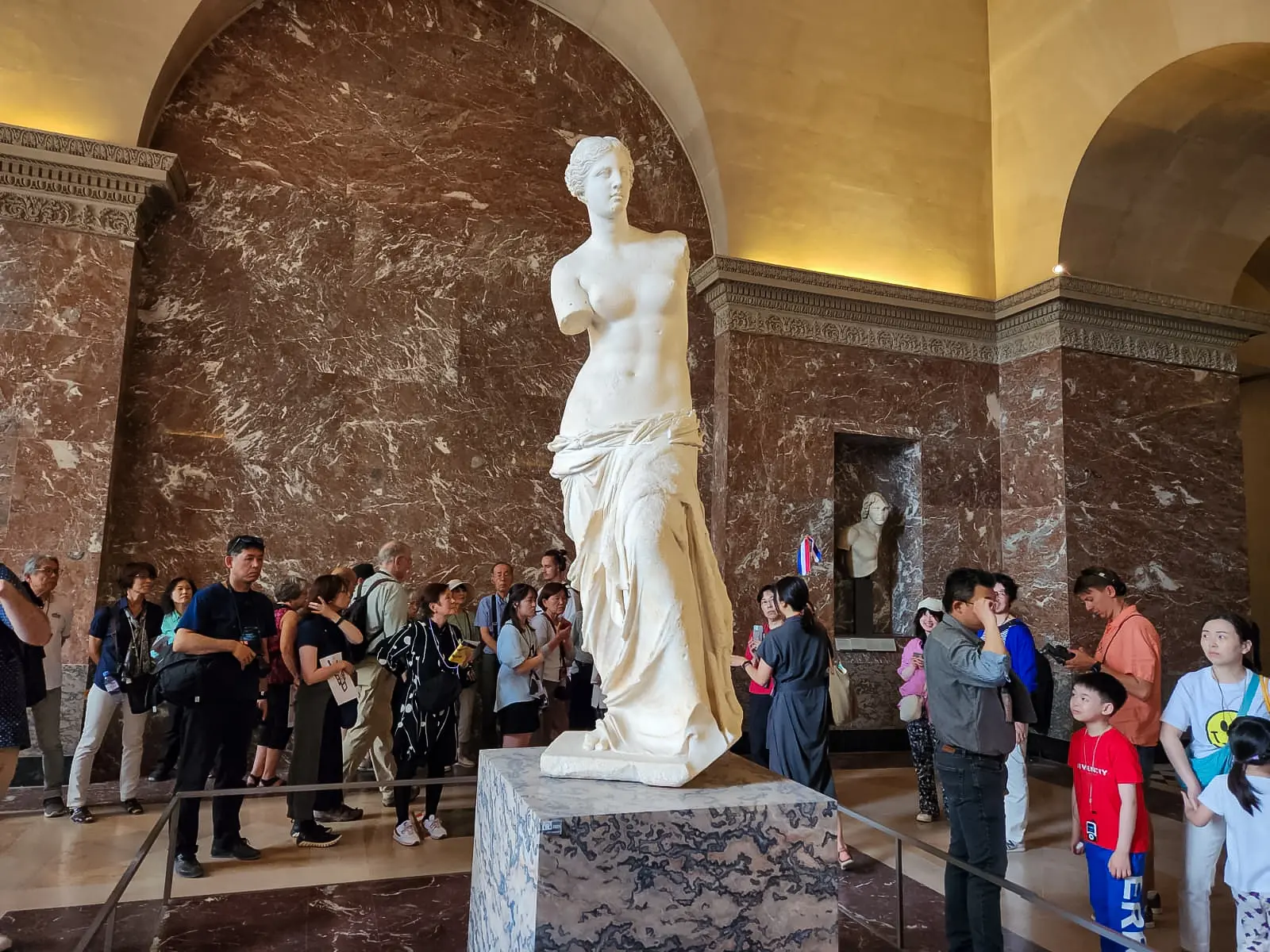
The Venus de Milo was found on the island of Milos in 1820 and reached the Louvre the following year, presented to Louis XVIII by the French ambassador and handed on to the museum. The accounts of who actually found her and how she was acquired conflict with each other, which is worth knowing before anybody repeats the tidy version. She is Hellenistic, generally placed in the second century BC, and an inscription on a now-lost part of the base points to a sculptor called Alexandros of Antioch.
She is also the single most photographed object I saw all day, surrounded at every moment.
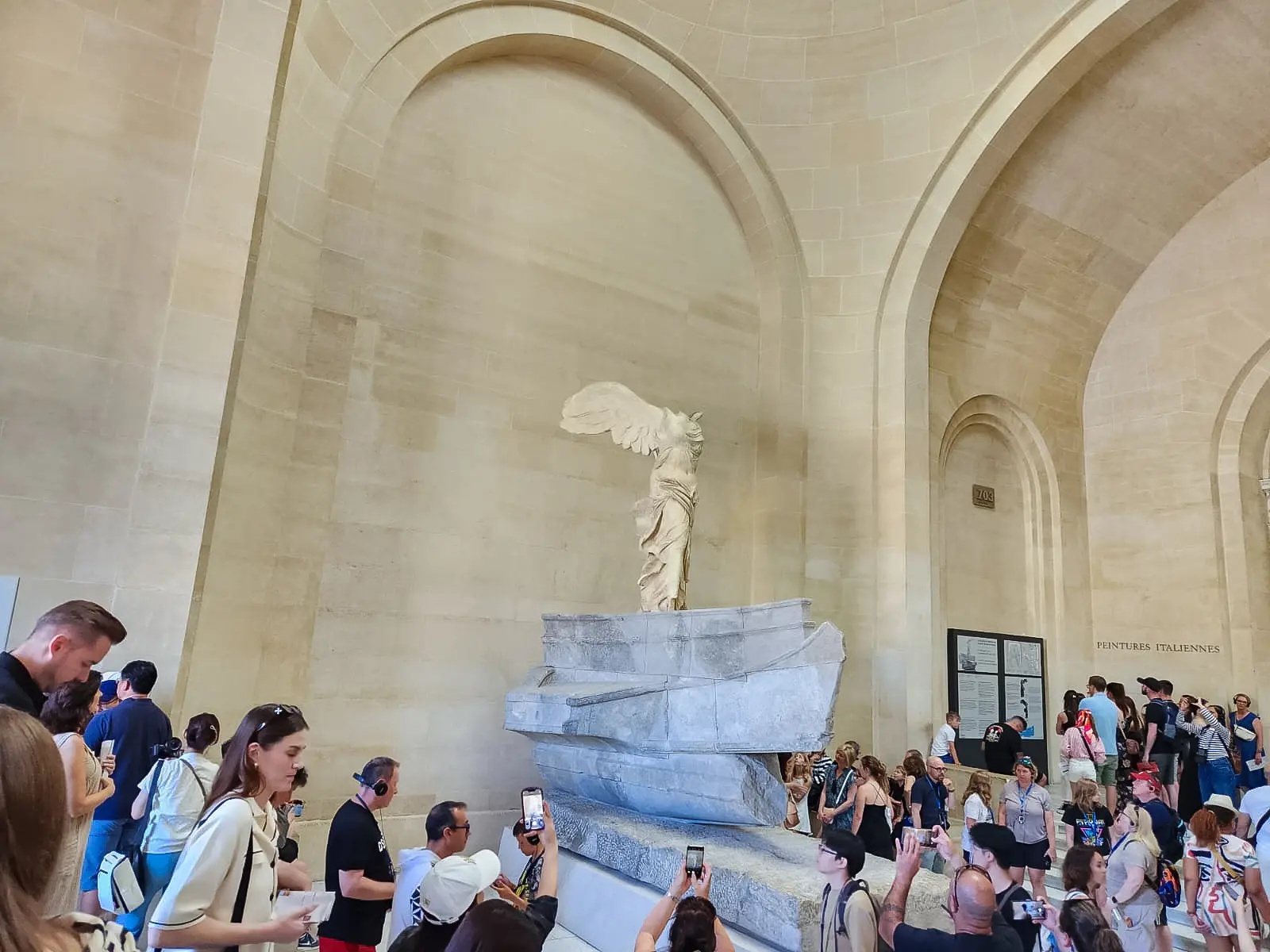
The Winged Victory of Samothrace is the other one I had come for, and she is placed better than anything else in the building, at the head of a staircase so that visitors come up towards her.
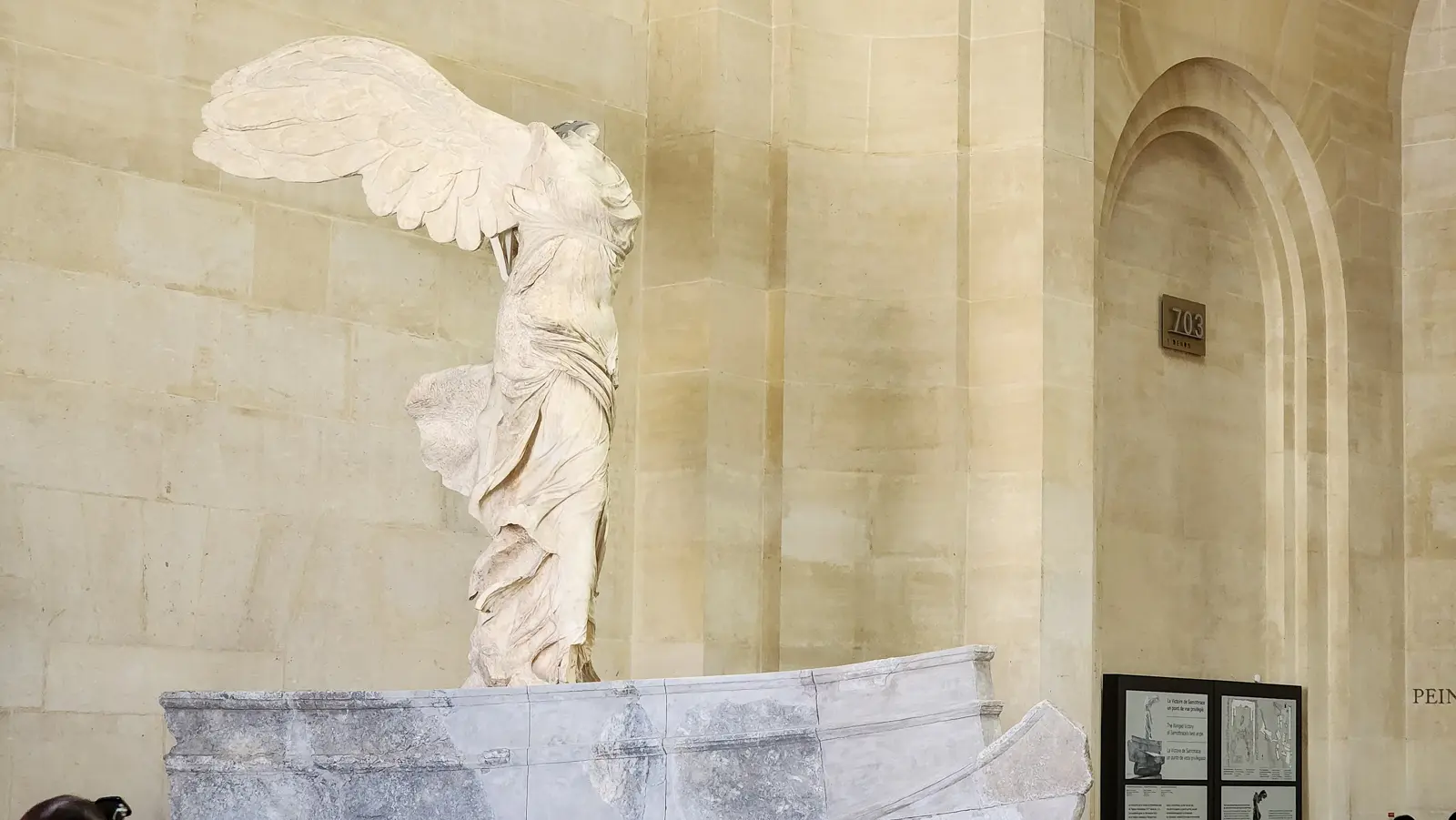
The staircase is also the pinch point of the entire building. Everything funnels through it, and the crowd arriving from below stops dead at the top, because the Victory is the first thing worth stopping for that anyone meets on the standard route. Phones go up in a wall. Groups in headsets bunch behind their guides against the flow of people trying to get past them towards the Italian paintings.
This is the point on a first visit where looking turns into queuing, and where the difference between a photograph of a sculpture and a photograph of people photographing a sculpture stops being avoidable.
The route I walked without knowing it
I knew both sculptures from the Beyoncé and Jay-Z video for Apeshit, which was filmed inside a closed Louvre and released in 2018. The museum responded by building a thematic trail around it: seventeen works, about ninety minutes, opening at the Winged Victory and closing with Marie-Guillemine Benoist’s Portrait of a Black Woman.
That trail was still being offered when I visited. I did not take it, and I regret it, because I am a fan and because it would have given the afternoon a shape.
Then I looked at my own photographs afterwards. The Winged Victory, the Venus de Milo, the Great Sphinx of Tanis, the Raft of the Medusa, the Mona Lisa. Five of the seventeen, in roughly the order the trail runs them. The video and the standard highlights tour overlap almost completely, which says something about how few objects in a collection of this size most visitors are ever steered towards.
The Mona Lisa is small
Everyone says so in advance. It is still a surprise.
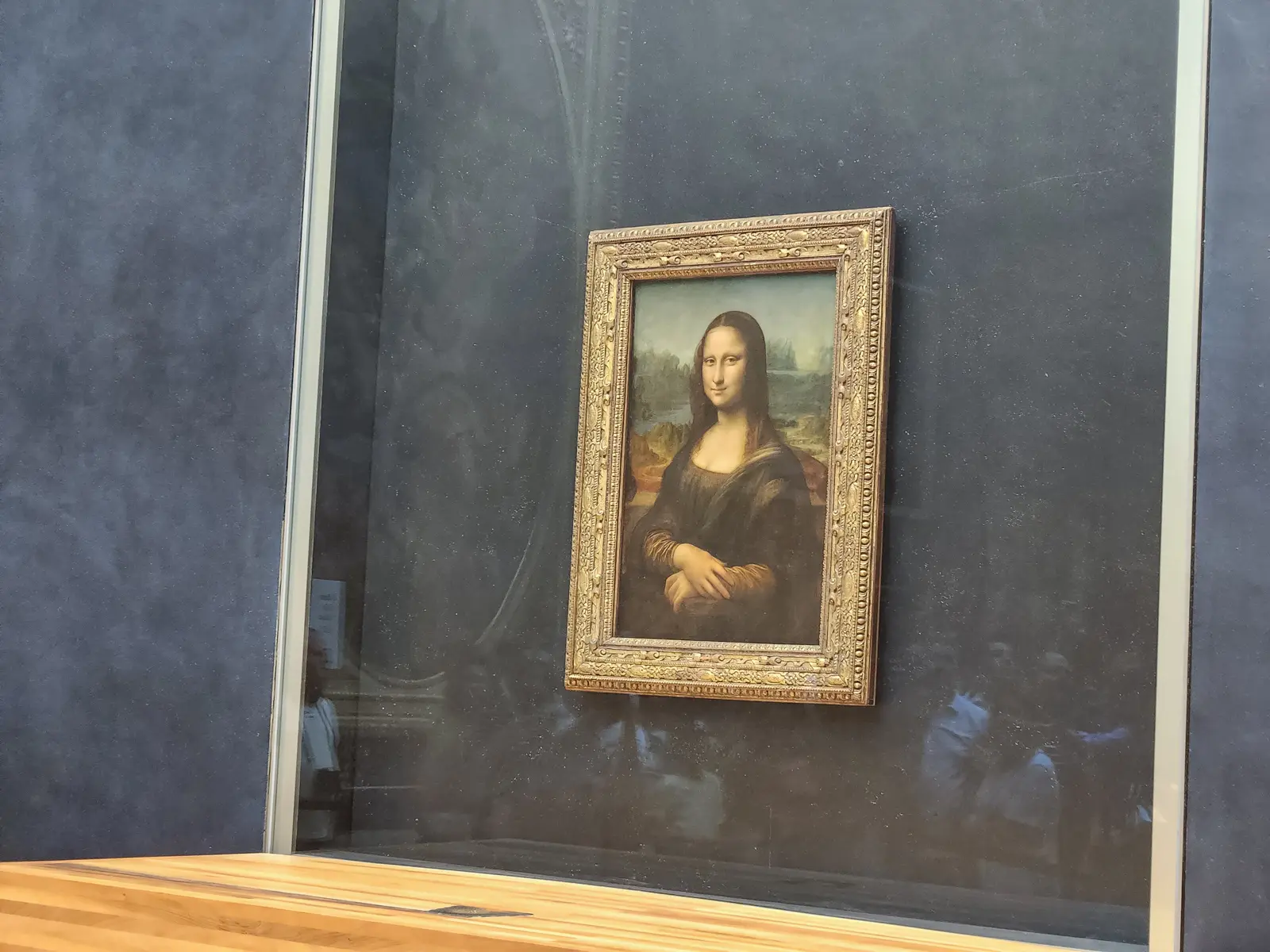
The queue moves in a slow diagonal across a very large room towards a painting that measures 77 by 53 centimetres, sealed behind glass and set well back. Oil on a poplar panel. It is roughly the size of a large cushion.
The strange part is that the size is the reason for the fame. On 21 August 1911 a former Louvre employee named Vincenzo Peruggia walked out of the building with it under his coat, on a Monday, when the museum was closed for cleaning and the guard roster was at its thinnest. He chose it partly because it was small enough to carry. It was recovered in Italy two years later, and the two years of headlines in between turned a well-regarded Leonardo into the most famous painting on earth.
So the thing that disappoints people about the Mona Lisa in person is precisely the thing that made it famous.
What happened after I left
Since my visit the building has been through something.
On 19 October 2025, half an hour after opening and with visitors already inside, thieves dressed as workmen parked a truck-mounted furniture lift against the facade, cut through a first-floor window into the Galerie d’Apollon, broke open two display cases and left on motorbikes with eight pieces of the French Crown Jewels. The whole operation ran under eight minutes, four of them inside. The valuation put on the missing pieces is around 88 million euros. The museum closed for three days. Its director resigned.
The Apollo Gallery reopened on 22 July 2026, empty. No jewels, no cases. The room has been returned to its seventeenth-century function as a ceremonial space, and the surviving precious objects have been permanently removed. Most of the stolen pieces are still missing.
I never saw the crown jewels. Some rooms were shut the day I went and that was one of them, and at the time it registered as bad luck. It reads differently now.
There is a symmetry in it that is hard to miss. The first documented theft from this building was the Mona Lisa in 1911, and it made the painting immortal. The most recent one emptied a room.
Marble I nearly walked straight past
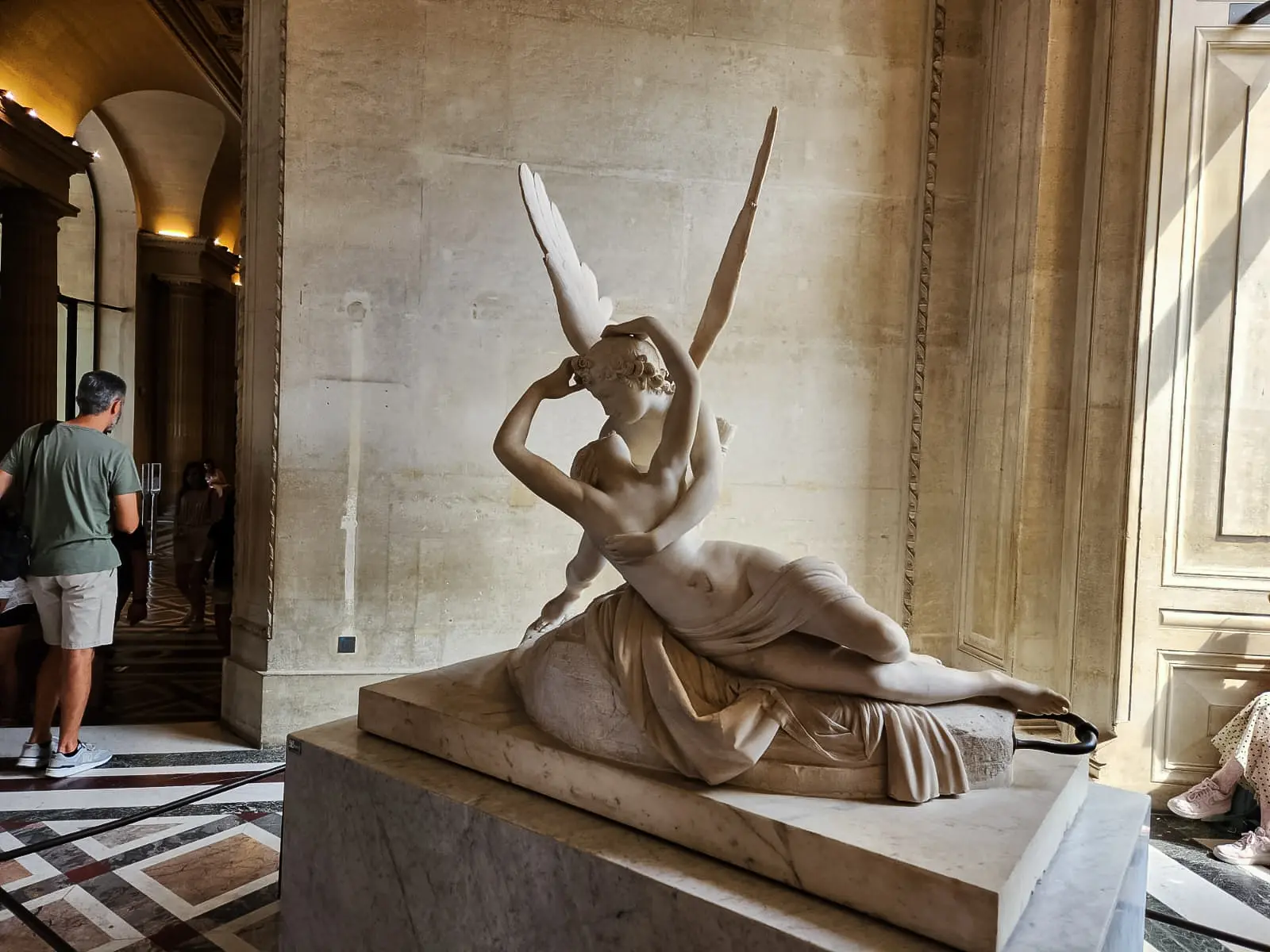
The tour route runs through the Michelangelo gallery, where Antonio Canova’s Psyche Revived by Cupid’s Kiss sits low on a plain block. Two figures, the moment before a kiss, arms making a closed loop in the air. Our group passed it in under a minute.
Further round, the route passes through the Salle des Caryatides, which was built as a ballroom when the Louvre stopped being a fortress and became a Renaissance palace. The architect was Pierre Lescot. From 1692 it was used to show the royal collection of classical sculpture, and it has held antiquities ever since.
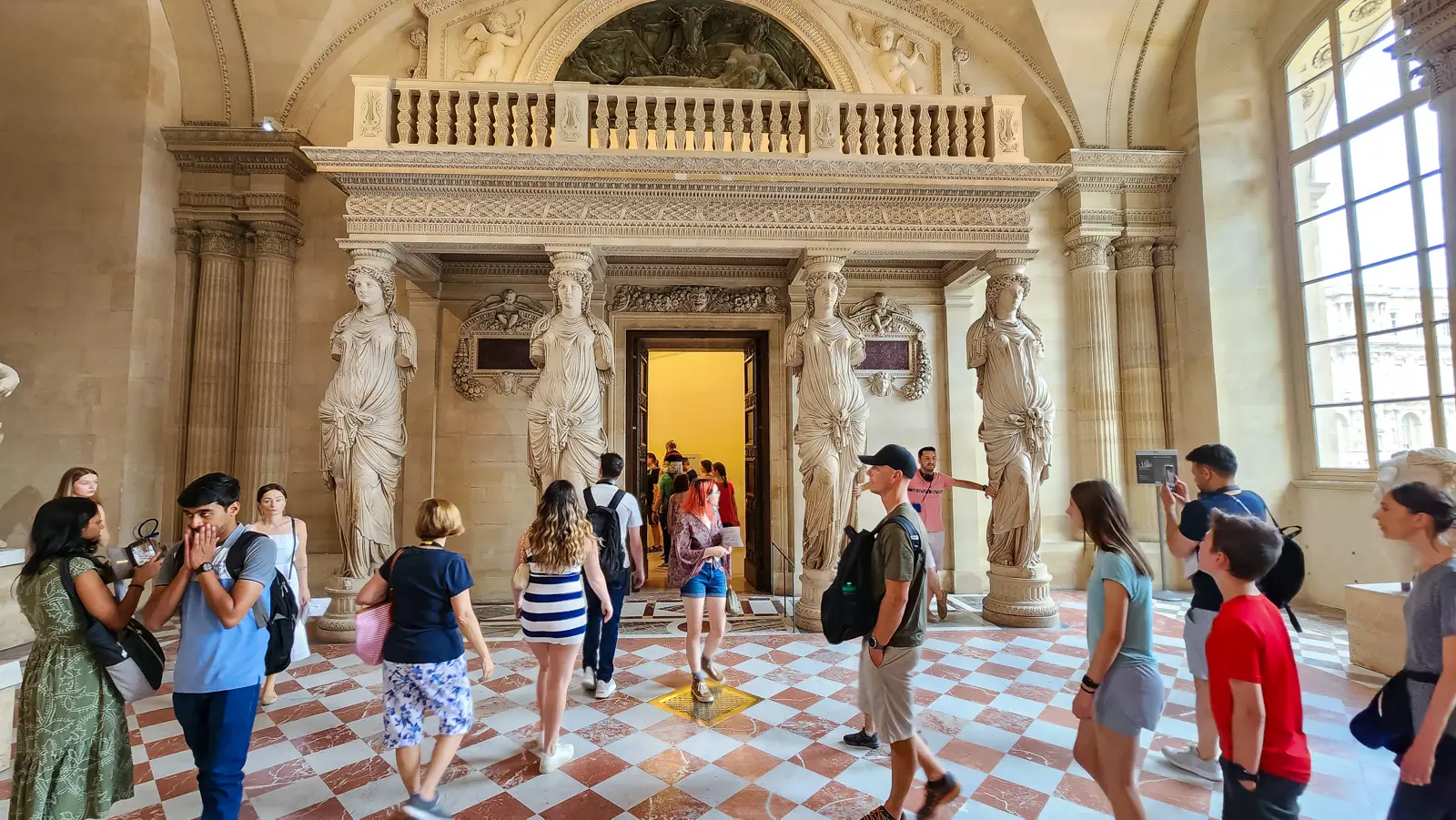
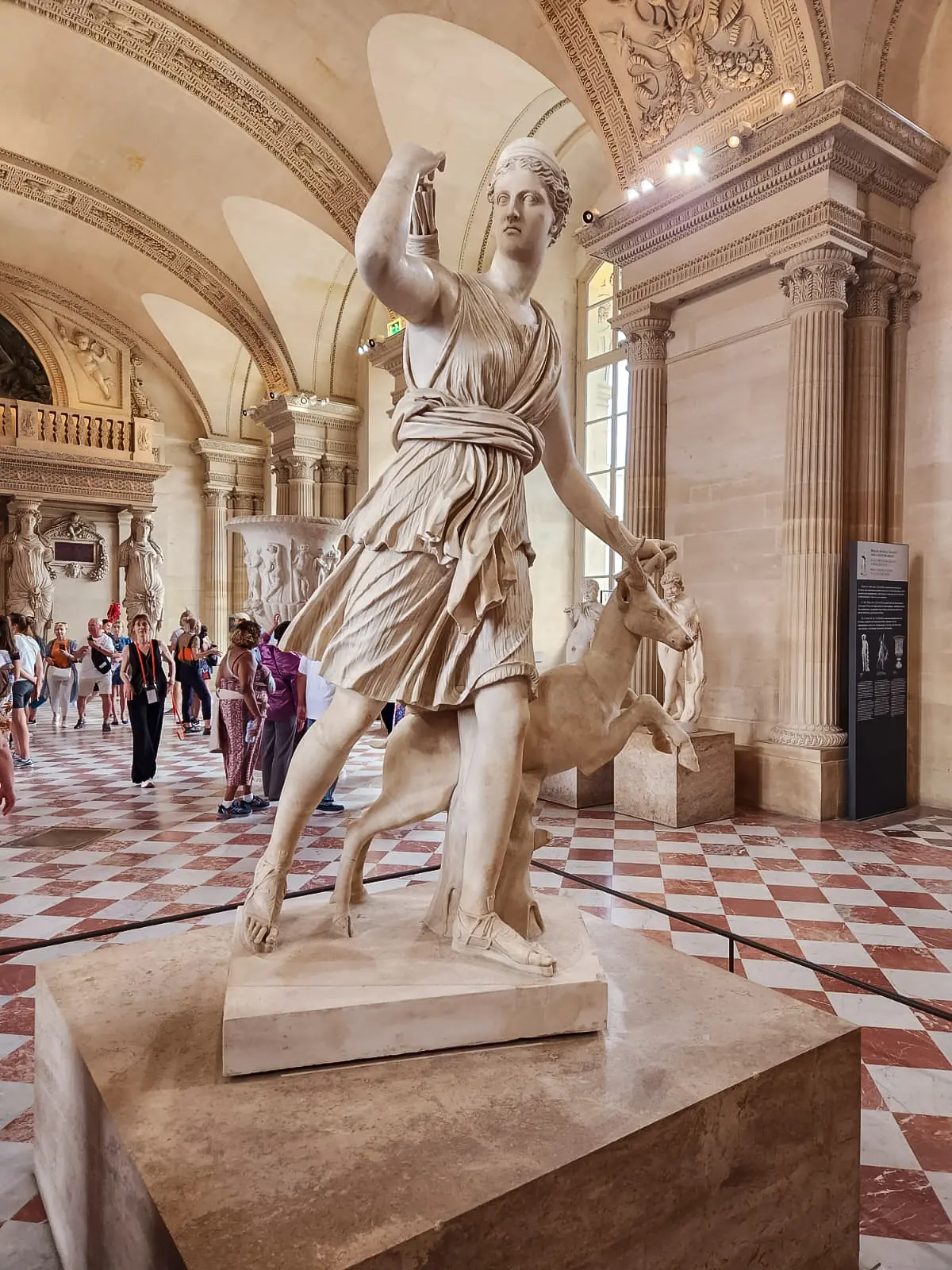
In the middle of that room stands the Diana of Versailles, shown mid-stride with a deer beside her and one arm reaching back over her shoulder for an arrow. She belongs on my list with the other two and I had not realised it. She is a Roman marble copy of a lost Greek bronze attributed to Leochares, made around 325 BC, so the thing in the room is a Roman version of a Greek original that no longer exists. She has also been standing in this particular hall, on and off, since 1602.
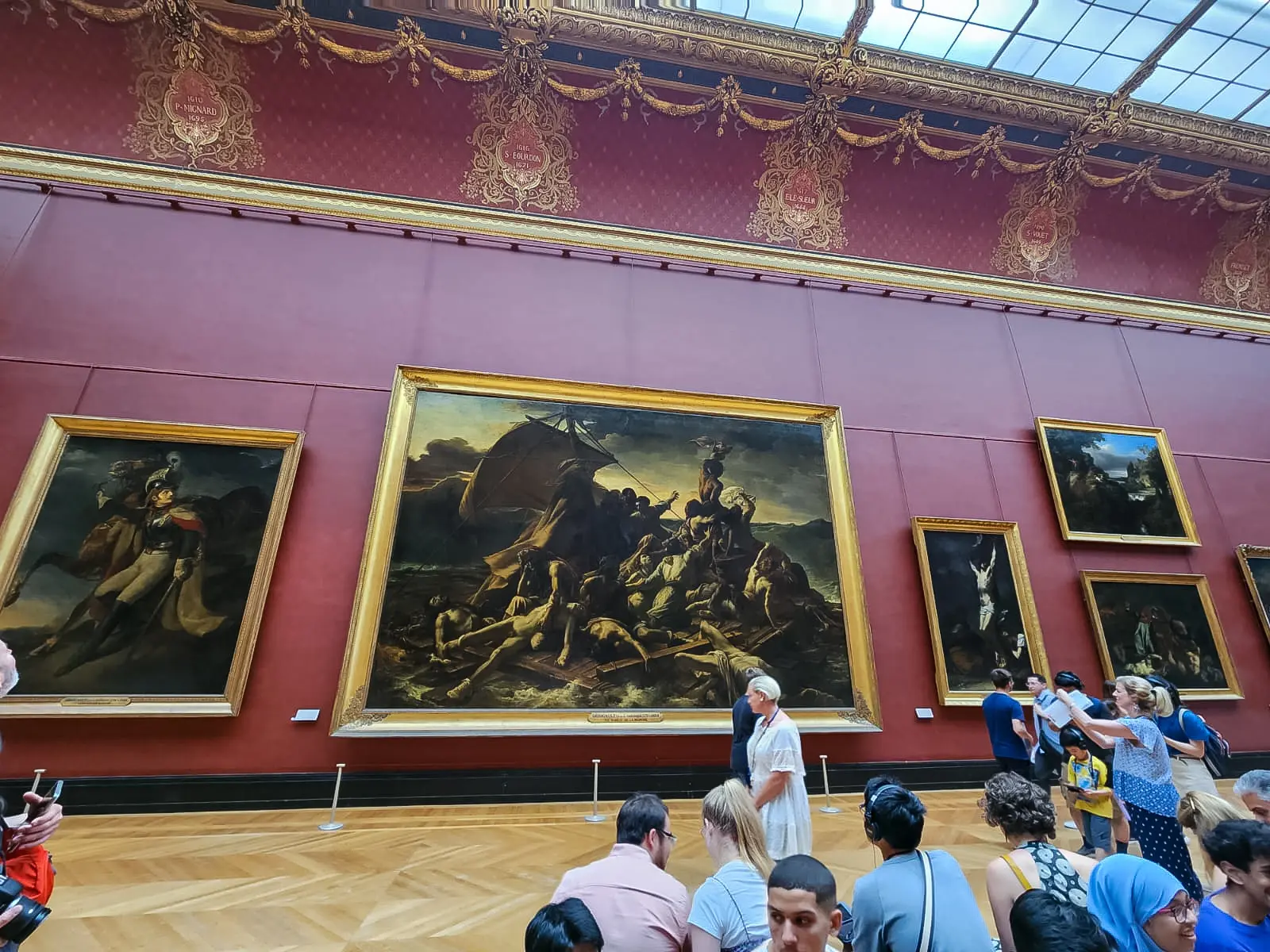
The Raft of the Medusa
In the red rooms hangs Théodore Géricault‘s painting of the wreck of the Méduse, which ran aground off West Africa in 1816. Around 150 people were put onto a raft and towed, the tow ropes were cut, and after nearly a fortnight adrift only a handful were taken off alive. What happened on the raft in between became a national scandal, and Géricault painted it while the scandal was still live.
Four days later I was at Père Lachaise, and the painting turned up again.
Géricault died in January 1824. The monument that stands over him was raised by public subscription and sculpted by Antoine Étex, and it has had more than one life. The first version, in white marble, was finished in 1840 and the statue was shown at the Salon of 1841. The soft marble did not survive the weather, and it went to the museum in Rouen, Géricault’s birthplace, where it is still held.
What stands at Père Lachaise today is Étex’s bronze of 1884, made more than forty years after his first attempt and four years before his own death.
He lies on top holding a palette and a brush. That is not a borrowed classical pose. Géricault was paralysed after a fall from a horse and spent the end of his life painting lying down, and Étex sculpted him as he actually was.
On the front of the plinth, in bronze, is the Raft of the Medusa.
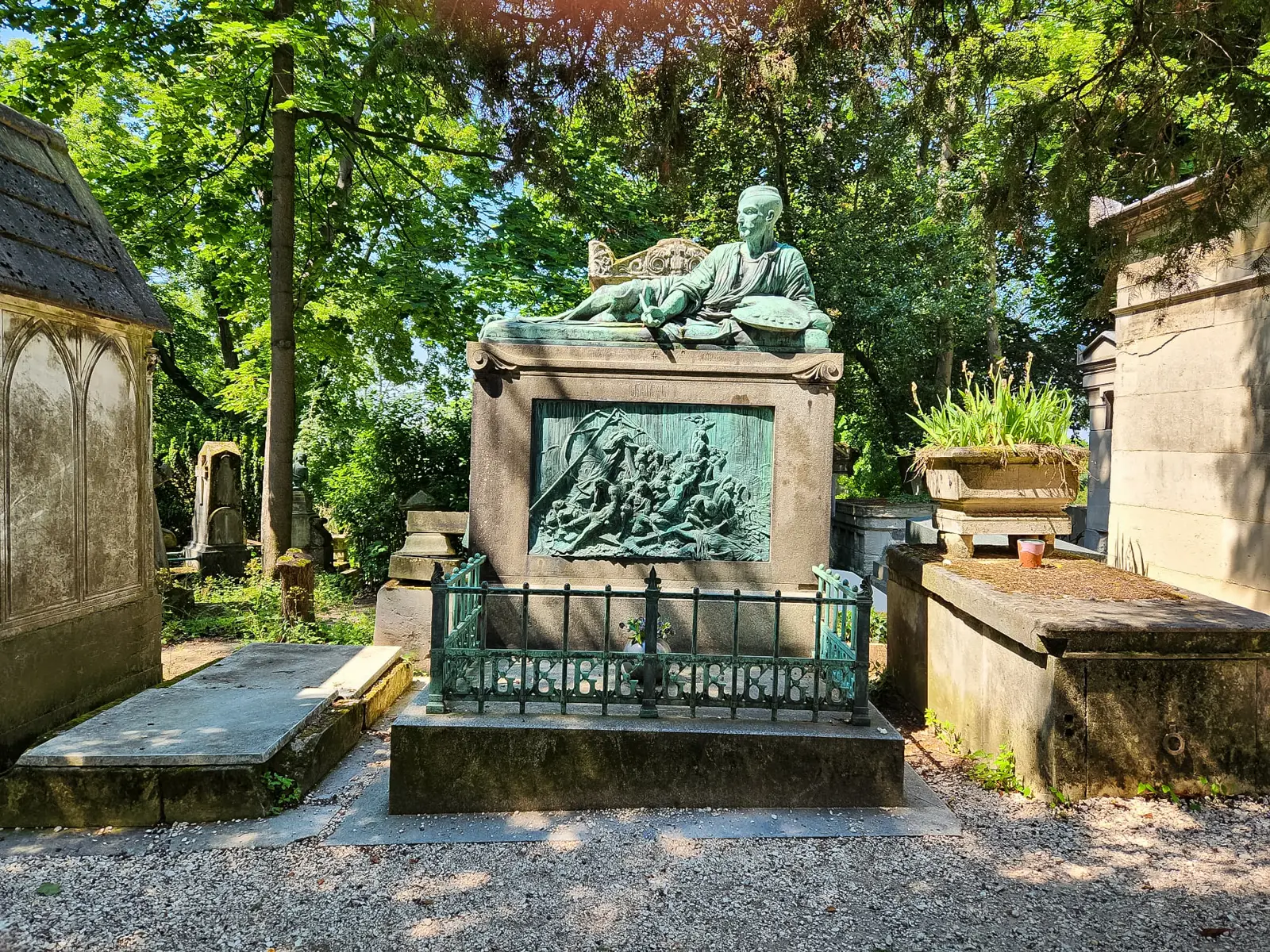
Standing in front of it, having seen the painting four days earlier, the sequence made sense in a way it would not have in the other order. The Louvre holds the work. The cemetery holds the man, with his own work bolted to the front of him.
The door I did not walk through
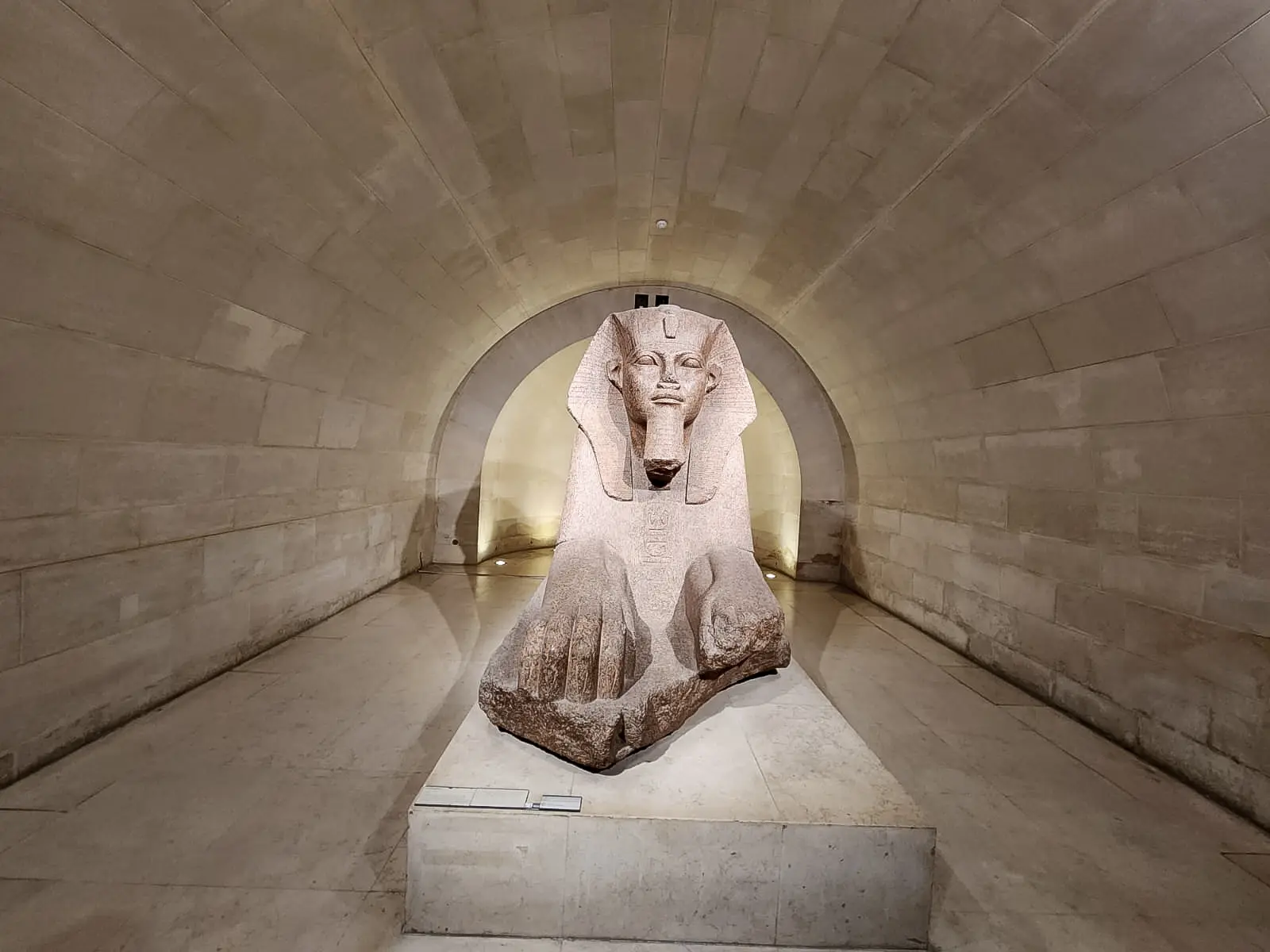
Down on the lower level, on the way through to the medieval foundations, the Great Sphinx of Tanis lies in a vaulted crypt lit from the floor. It is close to five metres long, cut from pink granite, and it was the emptiest room I stood in all day.
It also guards the entrance to the Department of Egyptian Antiquities, a collection of thousands of objects spanning several thousand years.
I got as far as the doorway. That is the sentence that will bring me back to Paris.
Look up
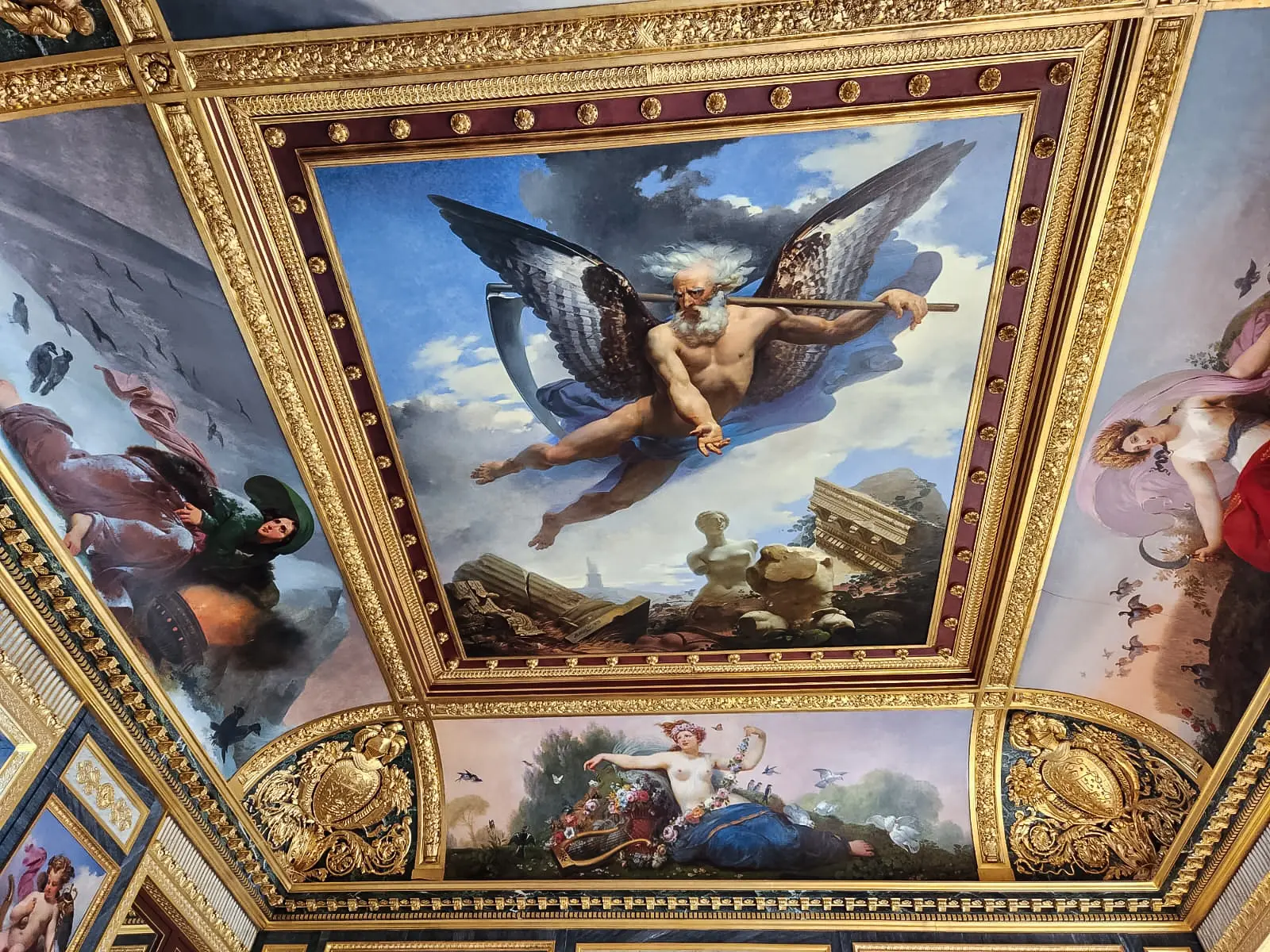
At some point in the afternoon I stopped, looked up, and took one photograph of a ceiling.
I cannot say which room it was. A winged old man with a white beard flies across a painted sky carrying a scythe, over broken columns and a toppled statue, inside a heavy gilded frame, with more painted panels running away on every side. I have no idea where I was standing. Nobody in the group stopped, the guide was already through the next door, and I took it on the move.
That photograph is the argument of this whole post. In a building where the ceilings are as worked as the walls, a guided tour moves a group underneath dozens of them and exactly one gets noticed. Art is on every surface here, and the pace decides how much of it exists for the person walking under it.
Look out, as well
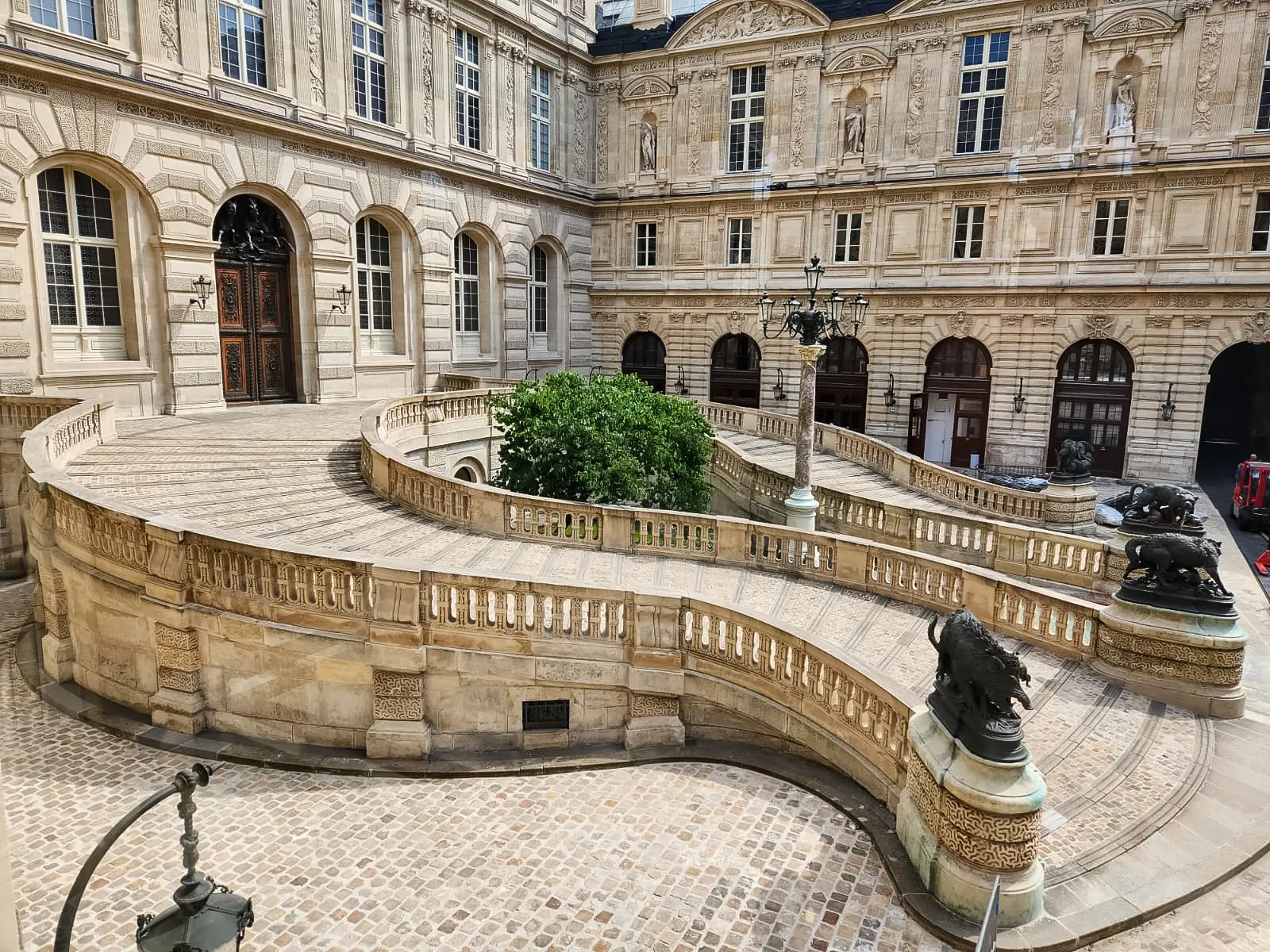
The same applies to windows. Somewhere along the route I looked through one into the Cour Lefuel and found a double ramp curving up in two horseshoe arms towards a doorway on the floor above, with bronze animals on the piers and a lamp standard on a marble column between them.
It took me a moment to work out what I was looking at, because it is far too wide and too shallow to be a staircase. It is a ramp built for horses. The buildings around that courtyard were the imperial stables, and the ramp carried horses up to the Manège, an 800 square metre riding hall on the floor above. Standing at the glass I pictured carriages coming and going through it, which turns out to be about right. The stables held close to 150 horses and 35 carriages.
None of that is on any highlights route. It is visible from a window in a sculpture gallery, to anyone who looks sideways.
My mother’s living room
Then the Richelieu wing, and the rooms that stopped me properly.
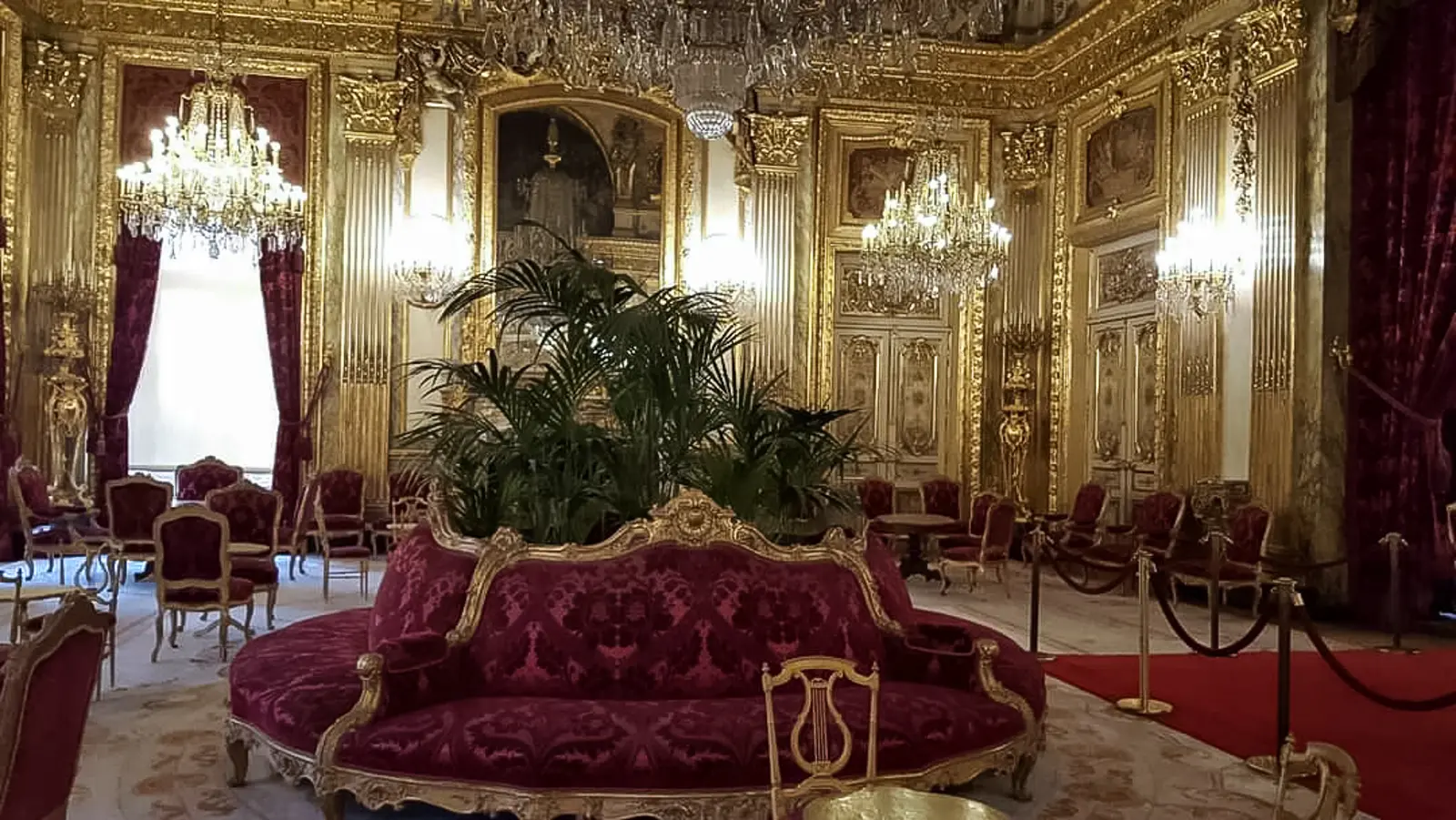
The Napoleon III Apartments were never Napoleon III’s home. He lived at the Tuileries. These were the state apartments of the Minister of State, fitted out by Hector Lefuel during the Second Empire, and the sources disagree on the exact years of the work. After the empire fell the Ministry of Finance moved in and stayed until 1989. The rooms opened to the public in 1993.
Crimson damask, gilt wood, crystal by the chandelier-load, a curved sofa in the middle of the floor and not one square centimetre of anything left plain.
I laughed out loud, because I grew up with a small version of this. My mother’s living room has the carved gilt frames and the patterned upholstery and the chairs nobody is allowed to sit on, and I have spent years failing to persuade her to part with any of it. Standing in the Grand Salon I understood that she has been right the entire time and is simply operating at a different budget.
It is the only room in the Louvre that made me think of home, which is not a sentence I expected to write about a state reception hall.
Afterwards, at Café Marly
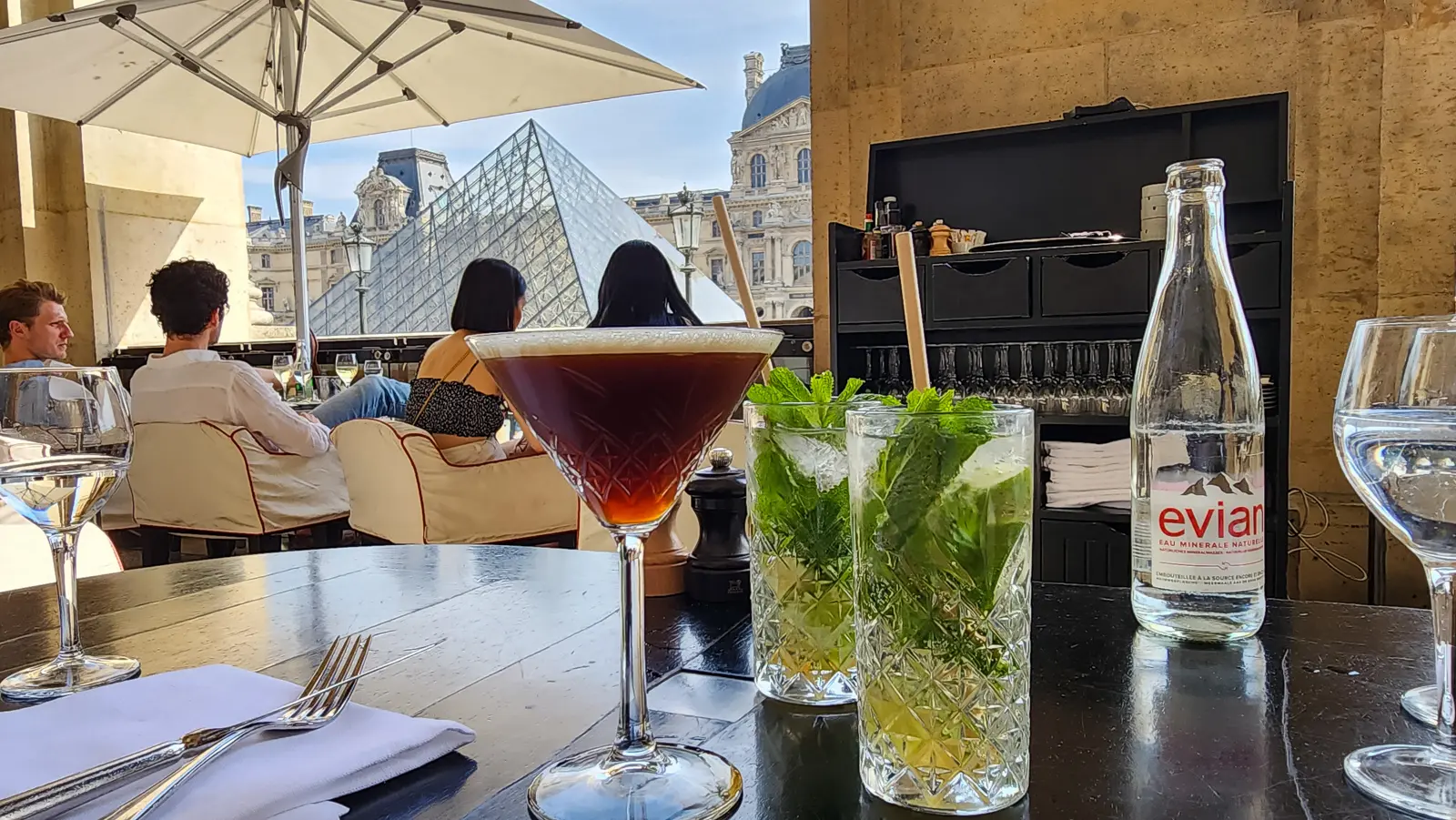
We finished with drinks at Café Marly, which sits under the arcade of the Richelieu wing looking straight out at the glass pyramid.
It is expensive. Everyone says so and everyone is right. What is being sold is the view, and the view is genuinely one of the best seats in Paris: the courtyard, the glass, the palace wings going off in both directions, and the whole thing at eye level rather than through a crowd.
Bubbly Tips
- Take a guide for a first visit, and go alone for a second. With a few hours, a guide is the only way to see the famous works. The second visit is when the building itself becomes available.
- Budget €32 if you are not an EEA resident. Since 14 January 2026 the Louvre charges €22 for European Economic Area residents and €32 for everyone else. Non-EEA visitors in accredited guided groups pay €28.
- Free admission is broader than most people expect. Under-18s go free whatever their nationality, as do EEA citizens and residents under 26 with identification. The museum is free for everyone on the first Friday of the month after 6pm, except in July and August, and on 14 July.
- Book a time slot even for free entry. Timed entry is standard, slots sell out in peak season, and free-admission visitors still need a reservation.
- Use the Carrousel entrance rather than the pyramid. It is underground and reached from the Métro, and it avoids the pyramid queue. No entrance skips the security screening.
- Closed Tuesdays, open late on Wednesdays and Fridays. Standard hours run 9am to 6pm, extended to 9pm on those two evenings, with last admission an hour before closing. Evenings are calmer than mornings.
- Go to the Greek sculpture before the Mona Lisa, not after. The Denon wing crowd builds through the morning and the sculpture halls empty out as it does.
- Look up in every room, even when the group is moving. The ceilings are painted and gilded throughout and no highlights tour will stop for them.
- The Richelieu wing is the quiet one. The Napoleon III Apartments are there, along with Northern European painting, and the crowds thin noticeably.
- Café Marly needs no ticket. The courtyard around the pyramid is public, so the terrace is available without paying admission or queueing for security.
Final Thoughts
I saw the Venus de Milo, the Winged Victory, the Mona Lisa and a Sphinx, and I have a photograph of a ceiling in a room I cannot name. Those two facts belong to the same afternoon and to the same decision.
A guided tour of the Louvre is not a compromise. It is the correct answer to the question of what to do with four hours in a building that holds tens of thousands of works. It gets a first-time visitor to the things worth crossing a city for, and hands over a map of everything there was no time for. Mine has an Egyptian collection on it that I reached the doorway of and never entered, and one gilded ceiling I intend to find again.
Until next time!

🌟 Everything You Need to Plan Your Dream Trip in 2026
- 🌟 Luxury Hotels - Find premium stays with Booking.com & Hotels.com
- 🏡 Vacation Rentals - Discover unique properties on VRBO
- 🏞️ Guided Tours - Explore with Viator or GetYourGuide
- 🎫 Attraction Tickets - Skip the lines with Tiqets
- 🚢 Ocean Cruises - Set sail with Cruise Direct
- 📱 International SIMs - Stay connected with Saily
- 🚗 Car Rentals - Budget-friendly options from Discover Cars
- 🌐 Secure VPNs - Browse safely with NordVPN
- 💶 Currency Exchange - Best rates with Wise
- 🗣️ Learn Languages - Master the local language with Babbel and Rosetta Stone