<?xml version="1.0" encoding="UTF-8"?><feed
	xmlns="http://www.w3.org/2005/Atom"
	xmlns:thr="http://purl.org/syndication/thread/1.0"
	xml:lang="en-US"
	>
	<title type="text">Bubbly Living</title>
	<subtitle type="text">Travel tips, historical insights, personal stories, and much more</subtitle>

	<updated>2026-09-16T03:25:59Z</updated>

	<link rel="alternate" type="text/html" href="https://www.bubblyliving.com/" />
	<id>https://www.bubblyliving.com/feed/atom/</id>
	<link rel="self" type="application/atom+xml" href="https://www.bubblyliving.com/feed/atom/" />

	
<icon>https://www.bubblyliving.com/wp-content/uploads/2024/09/cropped-Wordpress-150x150.webp</icon>
	<entry>
		<author>
			<name>Bubbly</name>
							<uri>https://www.bubblyliving.com</uri>
						</author>

		<title type="html"><![CDATA[The Van Gogh Museum: Two Afternoons and What I Went Back For]]></title>
		<link rel="alternate" type="text/html" href="https://www.bubblyliving.com/van-gogh-museum-amsterdam/" />

		<id>https://www.bubblyliving.com/?p=12546</id>
		<updated>2026-09-16T03:25:59Z</updated>
		<published>2026-09-16T04:00:00Z</published>
		<category scheme="https://www.bubblyliving.com/" term="Amsterdam" /><category scheme="https://www.bubblyliving.com/" term="Museums &amp; Art" />
		<summary type="html"><![CDATA[<p>A few days earlier I had stood in front of the Night Watch at the Rijksmuseum and admitted that I had never understood it. I knew it was a Rembrandt. That was&#8230;</p>
<p>The post <a href="https://www.bubblyliving.com/van-gogh-museum-amsterdam/">The Van Gogh Museum: Two Afternoons and What I Went Back For</a> appeared first on <a href="https://www.bubblyliving.com">Bubbly Living</a>.</p>
]]></summary>

					<content type="html" xml:base="https://www.bubblyliving.com/van-gogh-museum-amsterdam/"><![CDATA[
<p class="wp-block-paragraph">A few days earlier I had stood in front of the <strong>Night Watch</strong> at the <strong><a href="https://www.bubblyliving.com/rijksmuseum-amsterdam/" data-bubblylinks="2371">Rijksmuseum</a></strong> and admitted that I had never understood it. I knew it was a Rembrandt. That was the whole of it. Four hundred fridge magnets and no idea what was happening in the picture.</p>


<p class="wp-block-paragraph"><strong>Van Gogh</strong> was the opposite, and had been for years. I knew the sunflowers and I knew why they mattered. I knew the story of the ear and the asylum and the brother who paid for everything. So I came here expecting recognition rather than discovery, which is a poor frame of mind for a museum and I got caught out by it twice.</p>


<p class="wp-block-paragraph">The first time was a matter of scale: there are around two hundred paintings here and perhaps eight of them are on the tea towels. The second was that the pictures which held me longest were ones I had never heard of. An overturned crab. An empty chair.</p>


<p class="wp-block-paragraph">I went twice, four days apart. The first afternoon was with a guide, which is the right way to see it once. The second time I went in alone, walked straight past most of it and stood in front of the Arles paintings, the yellow ones, for as long as I liked.</p>


<p class="wp-block-paragraph">That is the piece of advice this whole post is built around, so it may as well come first.</p>


<p class="selector wp-block-paragraph"><strong>The Van Gogh Museum at a Glance</strong><br>🎟️ <strong>Booking</strong> · Timed slot, online, in advance, for every visitor, Museumkaart holders included. No ticket window on the day.<br>🖼️ <strong>What&#8217;s here</strong> · The world&#8217;s largest Van Gogh collection: ~200 paintings, 500 drawings and almost all his letters. Sunflowers, The Bedroom, Almond Blossom, The Potato Eaters.<br>🚫 <strong>What&#8217;s not</strong> · The Starry Night. It&#8217;s at MoMA in New York and never has been here. People ask at the desk daily.<br>📸 <strong>Photos</strong> · Allowed in the permanent collection, no flash. Older guides say otherwise and are wrong.<br>💡 <strong>Tip</strong> · Go twice if you can (guide first, alone second), start at the bottom and go up, and don&#8217;t pair it with the Rijksmuseum on the same day.</p>


<h2 id="h-nobody-just-turns-up" class="wp-block-heading"><strong>Nobody Just Turns Up</strong></h2>


<p class="wp-block-paragraph">This is the thing to understand before planning anything else in <strong><a href="https://www.bubblyliving.com/amsterdam-in-spring/" data-bubblylinks="2370">Amsterdam</a></strong>. Entry is by timed slot, booked online in advance, for every single visitor. There is no ticket window on the day. Even a Museumkaart, which gets Dutch residents into most things on a whim, still requires a reserved time here.</p>


<p class="wp-block-paragraph">In late April the museum was full at every hour I was in it. Van Gogh is one of the reasons people come to this city at all, and the building takes over two million visitors a year with roughly eighty-five per cent of them arriving from abroad.</p>


<h2 id="h-a-building-in-three-pieces" class="wp-block-heading"><strong>A Building in Three Pieces</strong></h2>


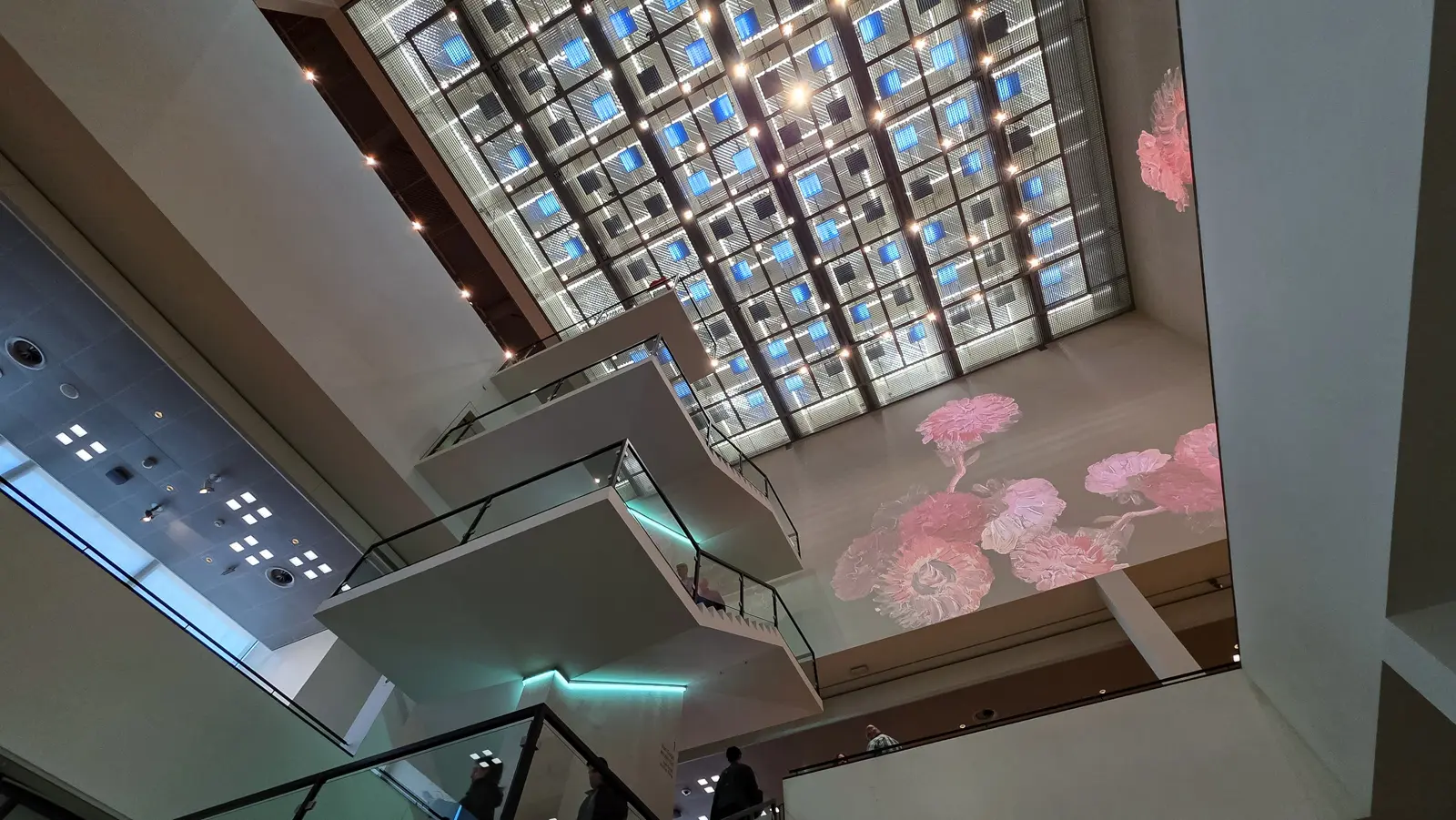
<p class="wp-block-paragraph">The museum is not one structure but three, built across forty-two years, and the seams are visible to anyone looking for them.</p>


<figure class="wp-block-image size-full"><a href="https://cdn.bubblyliving.com/wp-content/uploads/2026/09/van-gogh-museum-glass-entrance-hall.webp"><img data-dominant-color="656361" data-has-transparency="false" style="--dominant-color: #656361;" fetchpriority="high" decoding="async" width="1600" height="901" src="https://cdn.bubblyliving.com/wp-content/uploads/2026/09/van-gogh-museum-glass-entrance-hall.webp" alt="Glass entrance hall at the Van Gogh Museum, Amsterdam, looking up at the skylight grid past staircases and a floral projection" class="wp-image-12537 not-transparent" srcset="https://cdn.bubblyliving.com/wp-content/uploads/2026/09/van-gogh-museum-glass-entrance-hall.webp 1600w, https://cdn.bubblyliving.com/wp-content/uploads/2026/09/van-gogh-museum-glass-entrance-hall-300x169.webp 300w, https://cdn.bubblyliving.com/wp-content/uploads/2026/09/van-gogh-museum-glass-entrance-hall-768x432.webp 768w, https://cdn.bubblyliving.com/wp-content/uploads/2026/09/van-gogh-museum-glass-entrance-hall-1536x865.webp 1536w, https://cdn.bubblyliving.com/wp-content/uploads/2026/09/van-gogh-museum-glass-entrance-hall-1170x659.webp 1170w, https://cdn.bubblyliving.com/wp-content/uploads/2026/09/van-gogh-museum-glass-entrance-hall-585x329.webp 585w" sizes="(max-width: 1600px) 100vw, 1600px" /></a><figcaption class="wp-element-caption">The entrance hall puts visitors around five metres below street level under 650 square metres of curved structural glass carried on a steel frame weighing sixty-five tonnes, with a staircase and a panoramic lift down from Museumplein.</figcaption></figure>


<p class="wp-block-paragraph">The original block on Paulus Potterstraat is by Gerrit Rietveld, a central figure in De Stijl, and opened in 1973. The elliptical wing behind it, for temporary exhibitions, is by the Japanese architect Kisho Kurokawa and opened in 1999. The glass entrance hall that now joins them opened on 5 September 2015, built by Hans van Heeswijk from a sketch Kurokawa had prepared before his death in 2007.</p>


<p class="wp-block-paragraph">Standing under that skylight and looking up, with the projected flowers running along the far wall, is the only moment in the building where the architecture competes with the paintings.</p>


<h2 id="h-where-it-starts" class="wp-block-heading"><strong>Where It Starts</strong></h2>


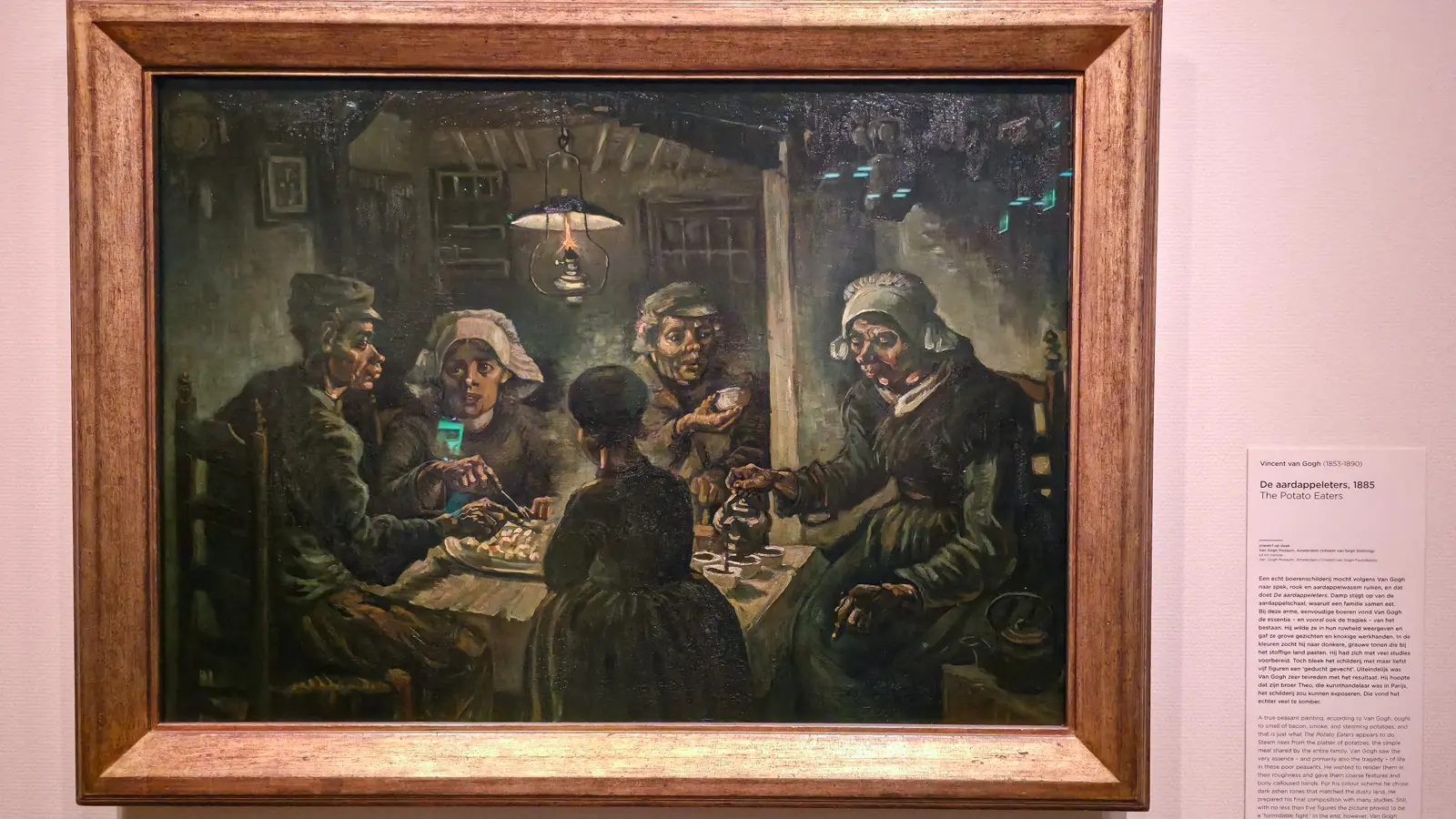
<p class="wp-block-paragraph">The route runs bottom to top and chronologically, so the first room is the darkest thing in the collection.</p>


<figure class="wp-block-image size-full"><a href="https://cdn.bubblyliving.com/wp-content/uploads/2026/09/van-gogh-potato-eaters-1885.webp"><img data-dominant-color="7c665a" data-has-transparency="false" style="--dominant-color: #7c665a;" decoding="async" width="1600" height="900" src="https://cdn.bubblyliving.com/wp-content/uploads/2026/09/van-gogh-potato-eaters-1885.webp" alt="The Potato Eaters by Vincent van Gogh, 1885, in its frame on a pale wall at the Van Gogh Museum, Amsterdam, with its wall label alongside" class="wp-image-12541 not-transparent" srcset="https://cdn.bubblyliving.com/wp-content/uploads/2026/09/van-gogh-potato-eaters-1885.webp 1600w, https://cdn.bubblyliving.com/wp-content/uploads/2026/09/van-gogh-potato-eaters-1885-300x169.webp 300w, https://cdn.bubblyliving.com/wp-content/uploads/2026/09/van-gogh-potato-eaters-1885-768x432.webp 768w, https://cdn.bubblyliving.com/wp-content/uploads/2026/09/van-gogh-potato-eaters-1885-1536x864.webp 1536w, https://cdn.bubblyliving.com/wp-content/uploads/2026/09/van-gogh-potato-eaters-1885-1170x658.webp 1170w, https://cdn.bubblyliving.com/wp-content/uploads/2026/09/van-gogh-potato-eaters-1885-585x329.webp 585w" sizes="(max-width: 1600px) 100vw, 1600px" /></a><figcaption class="wp-element-caption">Van Gogh painted this in Nuenen, in the Dutch province of North Brabant, before he had ever been to Paris or used a bright colour. It was his first serious attempt at a large multi-figure composition.</figcaption></figure>


<p class="wp-block-paragraph"><strong>The Potato Eaters, 1885</strong>. Five figures round a table under a single hanging lamp, eating potatoes with their hands, everything in browns and greys. The wall text quotes his own standard for it: a peasant painting should smell of bacon, smoke and steaming potatoes. He chose the dusty, ashen colours deliberately to match the land the family worked.</p>


<p class="wp-block-paragraph">He also said the picture, with five figures in it, had been a formidable fight. He was pleased with the result and hoped his brother Theo would show it in <strong><a href="https://www.bubblyliving.com/top-10-things-to-do-in-paris-icons-hidden-gems-and-bubbly-favorites/" data-bubblylinks="2366">Paris</a></strong>. Theo thought it far too sombre.</p>


<h2 id="h-two-self-portraits" class="wp-block-heading"><strong>Two Self-Portraits</strong></h2>


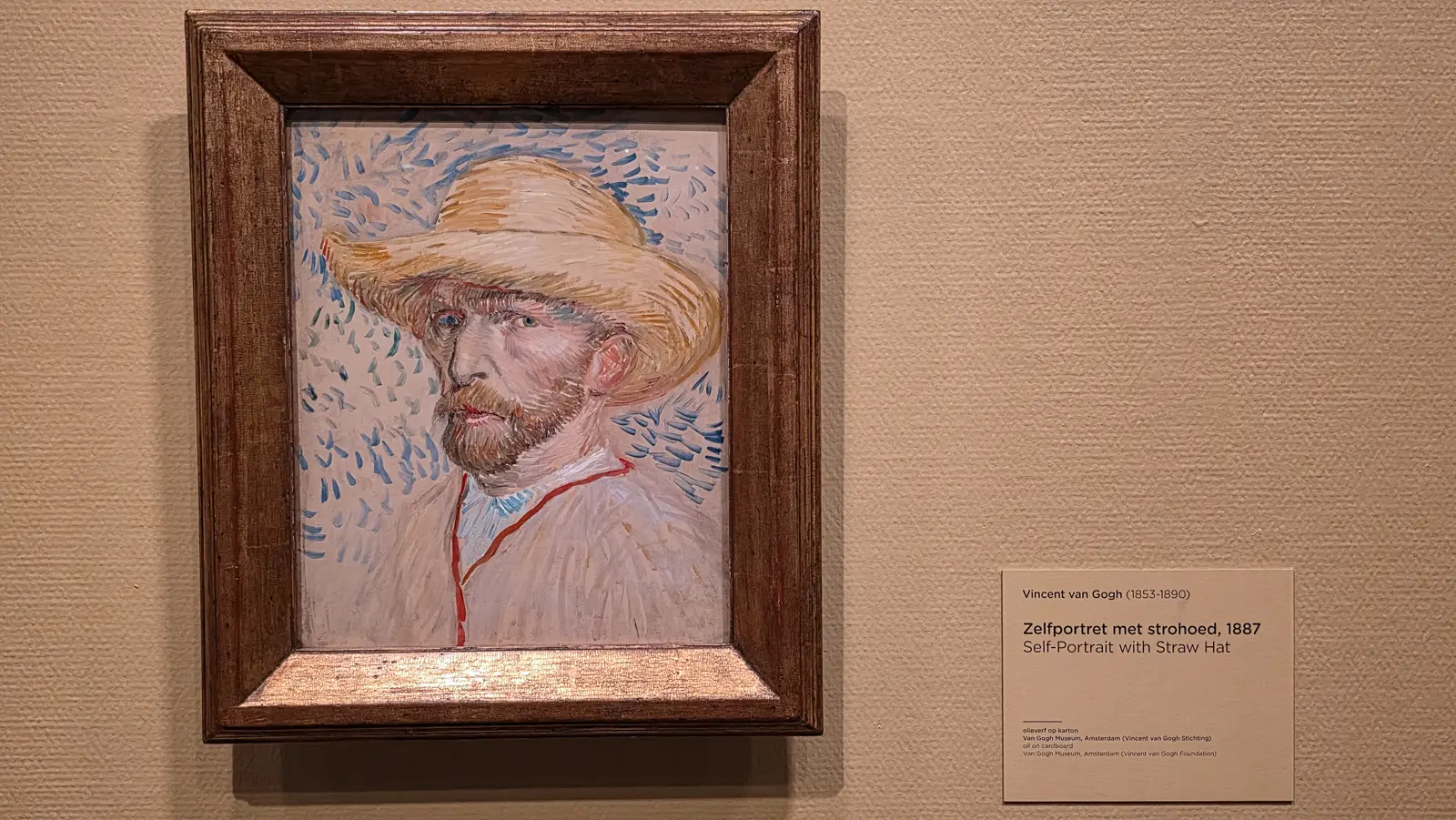
<p class="wp-block-paragraph">Upstairs the colour arrives all at once, because Paris happened in between. He moved there in 1886 to live with Theo and left for <strong>Arles</strong> in February 1888, and in those two years everything changed.</p>


<figure class="wp-block-image size-full"><a href="https://cdn.bubblyliving.com/wp-content/uploads/2026/09/van-gogh-self-portrait-straw-hat-1887.webp"><img data-dominant-color="9a7662" data-has-transparency="false" style="--dominant-color: #9a7662;" decoding="async" width="1600" height="901" src="https://cdn.bubblyliving.com/wp-content/uploads/2026/09/van-gogh-self-portrait-straw-hat-1887.webp" alt="Self-Portrait with Straw Hat, 1887, by Vincent van Gogh, in a pale wooden frame at the Van Gogh Museum, Amsterdam" class="wp-image-12543 not-transparent" srcset="https://cdn.bubblyliving.com/wp-content/uploads/2026/09/van-gogh-self-portrait-straw-hat-1887.webp 1600w, https://cdn.bubblyliving.com/wp-content/uploads/2026/09/van-gogh-self-portrait-straw-hat-1887-300x169.webp 300w, https://cdn.bubblyliving.com/wp-content/uploads/2026/09/van-gogh-self-portrait-straw-hat-1887-768x432.webp 768w, https://cdn.bubblyliving.com/wp-content/uploads/2026/09/van-gogh-self-portrait-straw-hat-1887-1536x865.webp 1536w, https://cdn.bubblyliving.com/wp-content/uploads/2026/09/van-gogh-self-portrait-straw-hat-1887-1170x659.webp 1170w, https://cdn.bubblyliving.com/wp-content/uploads/2026/09/van-gogh-self-portrait-straw-hat-1887-585x329.webp 585w" sizes="(max-width: 1600px) 100vw, 1600px" /></a><figcaption class="wp-element-caption">This one is painted on cardboard rather than canvas, which the label notes without comment. He was living on his brother’s money and used whatever surface was to hand, often painting on the backs of earlier works.</figcaption></figure>


<p class="wp-block-paragraph">In the straw hat he is all pale blue dashes on a cream ground, the strokes radiating outwards from his head like a halo of comb marks.</p>


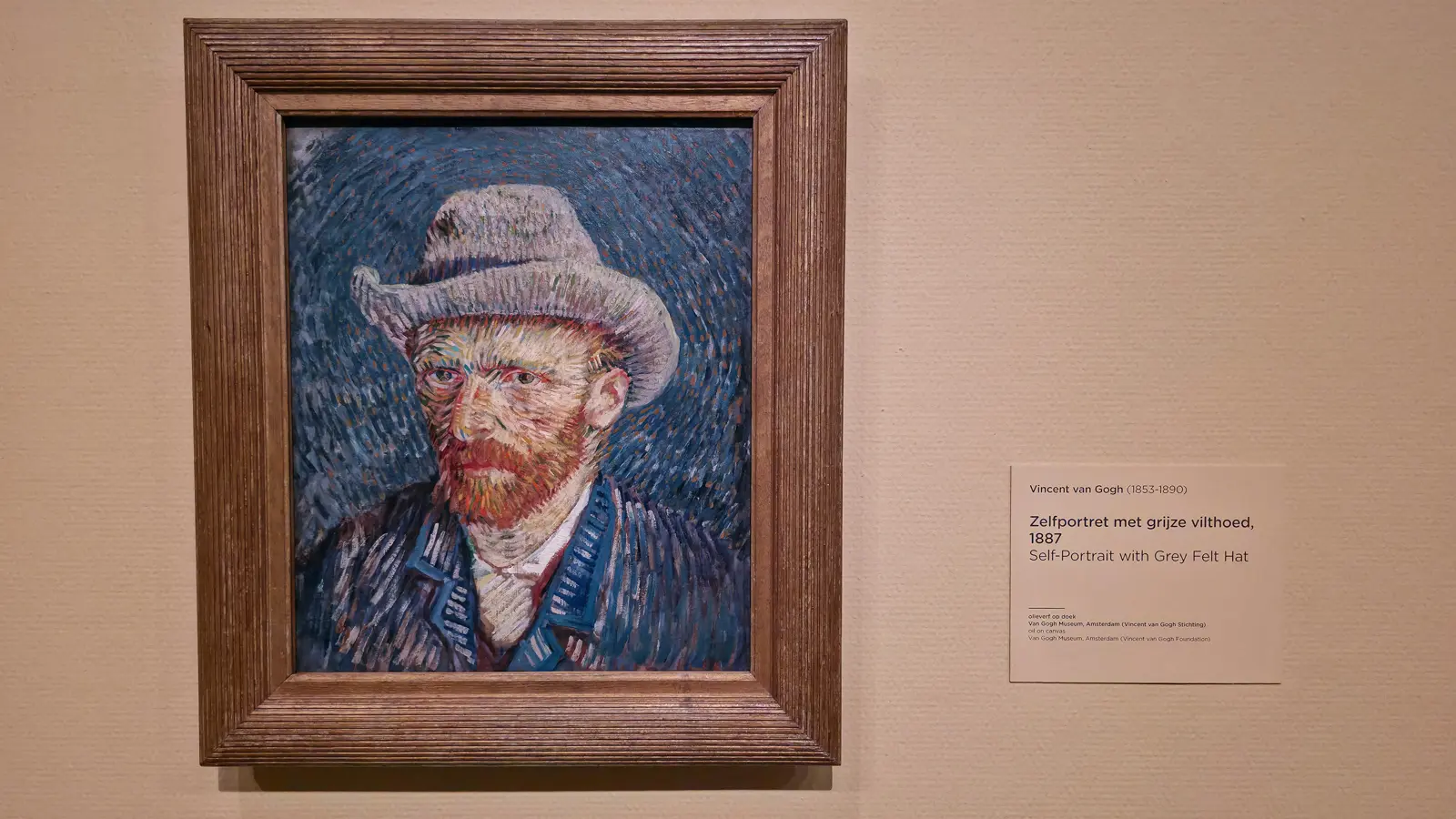
<figure class="wp-block-image size-full"><a href="https://cdn.bubblyliving.com/wp-content/uploads/2026/09/van-gogh-self-portrait-grey-felt-hat-1887.webp"><img data-dominant-color="91776c" data-has-transparency="false" style="--dominant-color: #91776c;" loading="lazy" decoding="async" width="1600" height="900" src="https://cdn.bubblyliving.com/wp-content/uploads/2026/09/van-gogh-self-portrait-grey-felt-hat-1887.webp" alt="Self-Portrait with Grey Felt Hat, 1887, by Vincent van Gogh, in a ridged wooden frame at the Van Gogh Museum, Amsterdam" class="wp-image-12542 not-transparent" srcset="https://cdn.bubblyliving.com/wp-content/uploads/2026/09/van-gogh-self-portrait-grey-felt-hat-1887.webp 1600w, https://cdn.bubblyliving.com/wp-content/uploads/2026/09/van-gogh-self-portrait-grey-felt-hat-1887-300x169.webp 300w, https://cdn.bubblyliving.com/wp-content/uploads/2026/09/van-gogh-self-portrait-grey-felt-hat-1887-768x432.webp 768w, https://cdn.bubblyliving.com/wp-content/uploads/2026/09/van-gogh-self-portrait-grey-felt-hat-1887-1536x864.webp 1536w, https://cdn.bubblyliving.com/wp-content/uploads/2026/09/van-gogh-self-portrait-grey-felt-hat-1887-1170x658.webp 1170w, https://cdn.bubblyliving.com/wp-content/uploads/2026/09/van-gogh-self-portrait-grey-felt-hat-1887-585x329.webp 585w" sizes="(max-width: 1600px) 100vw, 1600px" /></a><figcaption class="wp-element-caption">Van Gogh painted himself repeatedly during the Paris years, partly because sitters cost money he did not have. He is thought to have made more than twenty self-portraits in those two years alone.</figcaption></figure>


<p class="wp-block-paragraph">In the grey felt hat, painted the same year, the whole surface is worked in short separated strokes of orange and blue laid against each other, and the face is built out of the same marks as the background. Same man, same year, two entirely different approaches to a head.</p>


<h2 id="h-the-bedroom" class="wp-block-heading"><strong>The Bedroom</strong></h2>


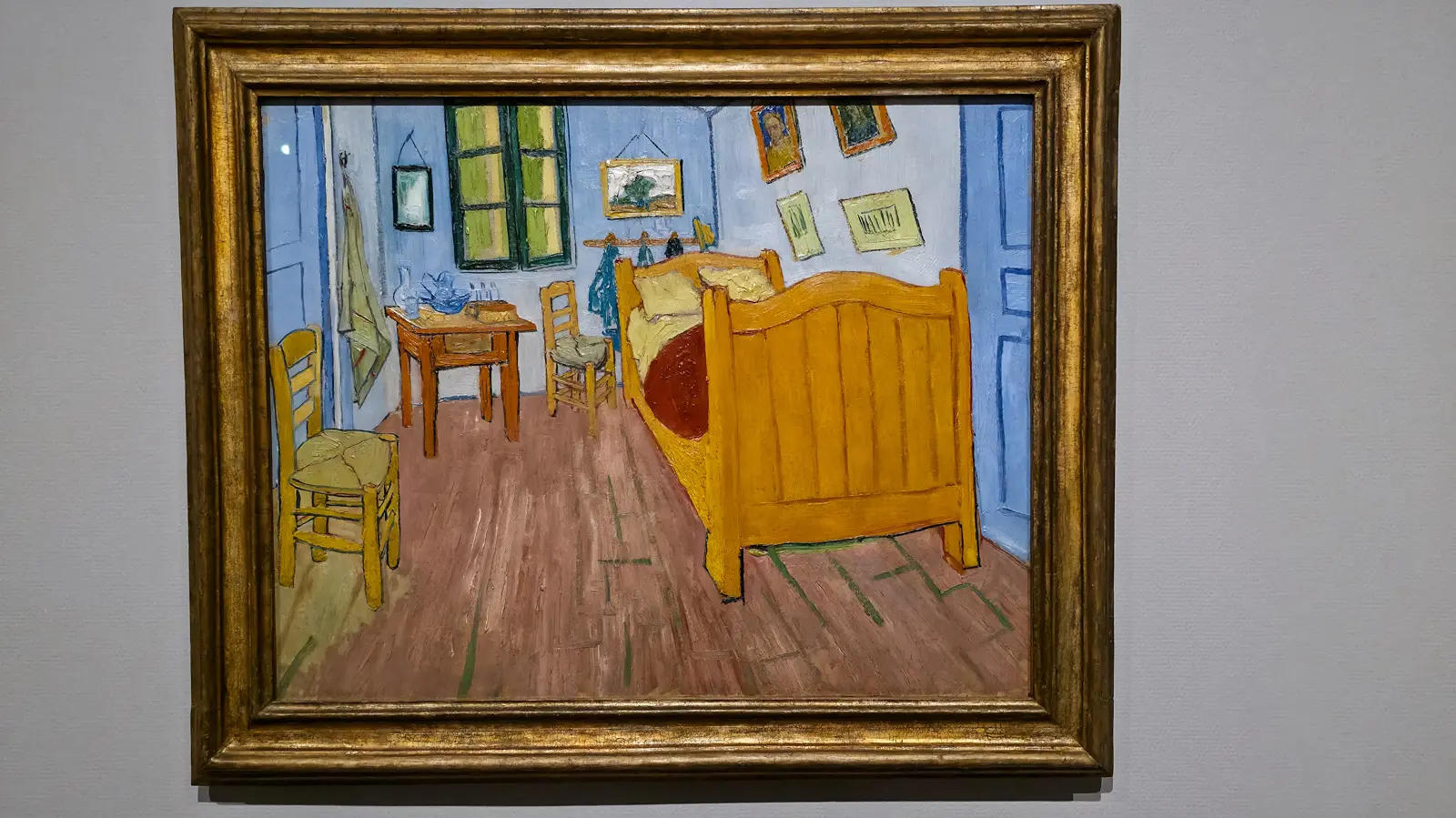
<p class="wp-block-paragraph">Then the room everyone recognises, and it is smaller than it looks in reproduction.</p>


<figure class="wp-block-image size-full"><a href="https://cdn.bubblyliving.com/wp-content/uploads/2026/09/van-gogh-the-bedroom-1888.webp"><img data-dominant-color="867661" data-has-transparency="false" style="--dominant-color: #867661;" loading="lazy" decoding="async" width="1600" height="899" src="https://cdn.bubblyliving.com/wp-content/uploads/2026/09/van-gogh-the-bedroom-1888.webp" alt="The Bedroom, 1888, by Vincent van Gogh, showing his room in the Yellow House in Arles, at the Van Gogh Museum, Amsterdam" class="wp-image-12545 not-transparent" srcset="https://cdn.bubblyliving.com/wp-content/uploads/2026/09/van-gogh-the-bedroom-1888.webp 1600w, https://cdn.bubblyliving.com/wp-content/uploads/2026/09/van-gogh-the-bedroom-1888-300x169.webp 300w, https://cdn.bubblyliving.com/wp-content/uploads/2026/09/van-gogh-the-bedroom-1888-768x432.webp 768w, https://cdn.bubblyliving.com/wp-content/uploads/2026/09/van-gogh-the-bedroom-1888-1536x863.webp 1536w, https://cdn.bubblyliving.com/wp-content/uploads/2026/09/van-gogh-the-bedroom-1888-1170x657.webp 1170w, https://cdn.bubblyliving.com/wp-content/uploads/2026/09/van-gogh-the-bedroom-1888-585x329.webp 585w" sizes="(max-width: 1600px) 100vw, 1600px" /></a><figcaption class="wp-element-caption">He painted this room three times. The first version is the one here in Amsterdam; the second is at the Art Institute of Chicago and the third, the smallest, at the Musée d’Orsay in Paris. He made the later two after the first was damaged by damp.</figcaption></figure>


<p class="wp-block-paragraph">The floor tilts, the walls lean, and two of everything sits waiting: two chairs, two pillows, two pictures over the bed.</p>


<p class="wp-block-paragraph">He left an account of what he was after, and this museum can draw on his own words more freely than any other, because it holds around eight hundred of his letters, very nearly everything that survives. He wanted the bright tones of the room to convey what he called utter repose, during a stretch when he was working so hard that he was anything but calm. He hoped his paintings would be a comfort to other people and not only to himself, and he was sure this one managed it. After a period of illness, looking again at his canvases, the bedroom seemed to him the best of them.</p>


<h2 id="h-gauguin-s-chair" class="wp-block-heading"><strong>Gauguin&#8217;s Chair</strong></h2>


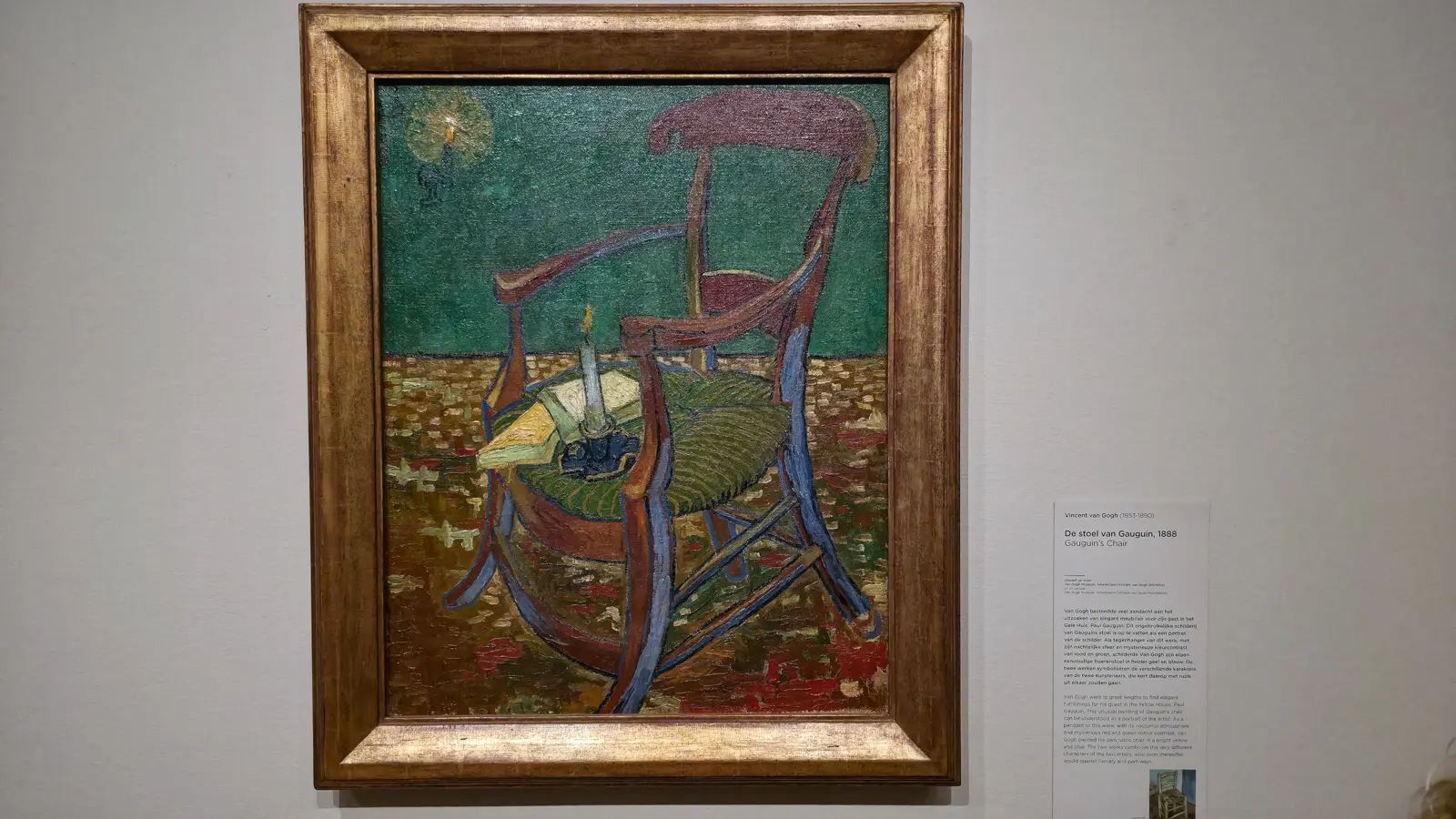
<p class="wp-block-paragraph">Around the corner is an empty chair, and it is a portrait.</p>


<figure class="wp-block-image size-full"><a href="https://cdn.bubblyliving.com/wp-content/uploads/2026/09/van-gogh-gauguins-chair-1888.webp"><img data-dominant-color="7e766b" data-has-transparency="false" style="--dominant-color: #7e766b;" loading="lazy" decoding="async" width="1600" height="900" src="https://cdn.bubblyliving.com/wp-content/uploads/2026/09/van-gogh-gauguins-chair-1888.webp" alt="Gauguin’s Chair, 1888, by Vincent van Gogh, an empty armchair with a candle and books, at the Van Gogh Museum, Amsterdam" class="wp-image-12535 not-transparent" srcset="https://cdn.bubblyliving.com/wp-content/uploads/2026/09/van-gogh-gauguins-chair-1888.webp 1600w, https://cdn.bubblyliving.com/wp-content/uploads/2026/09/van-gogh-gauguins-chair-1888-300x169.webp 300w, https://cdn.bubblyliving.com/wp-content/uploads/2026/09/van-gogh-gauguins-chair-1888-768x432.webp 768w, https://cdn.bubblyliving.com/wp-content/uploads/2026/09/van-gogh-gauguins-chair-1888-1536x864.webp 1536w, https://cdn.bubblyliving.com/wp-content/uploads/2026/09/van-gogh-gauguins-chair-1888-1170x658.webp 1170w, https://cdn.bubblyliving.com/wp-content/uploads/2026/09/van-gogh-gauguins-chair-1888-585x329.webp 585w" sizes="(max-width: 1600px) 100vw, 1600px" /></a><figcaption class="wp-element-caption">Its companion piece, Van Gogh’s own plain rush-seated chair painted in bright yellow and blue, hangs in the National Gallery in London, so the two chairs that were made as a pair now sit in different countries.</figcaption></figure>


<p class="wp-block-paragraph">Van Gogh took trouble over the furniture he bought for <strong>Paul Gauguin</strong>&#8216;s room in the Yellow House at Arles. This is the good armchair he chose for his guest: curved arms, a candle burning on the seat, two novels, the whole thing in reds and greens under a gas lamp at night. Against it he painted his own chair, plain and wooden, in daylight yellow and blue.</p>


<p class="wp-block-paragraph">Two chairs, two characters, no people.</p>


<p class="wp-block-paragraph">The two had met in Paris in 1887 and admired each other&#8217;s work. Van Gogh wanted to found what he called a Studio of the South, a house of painters in Provence with Gauguin at the head of it, and Gauguin, broke in Brittany and reluctant, came partly because Theo offered him a monthly allowance in exchange for paintings. He arrived on 23 October 1888.</p>


<p class="wp-block-paragraph">It lasted sixty-three days. They painted side by side and argued constantly, much of it about whether a picture should come from what stood in front of the easel or from memory and imagination, and Gauguin kept threatening to go. On 23 December, after a confrontation between them, Van Gogh cut off part of his left ear. Gauguin returned to Paris and the two men never saw one another again, though they wrote to each other until Van Gogh&#8217;s death eighteen months later.</p>


<h2 id="h-a-crab-on-its-back" class="wp-block-heading"><strong>A Crab on its Back</strong></h2>


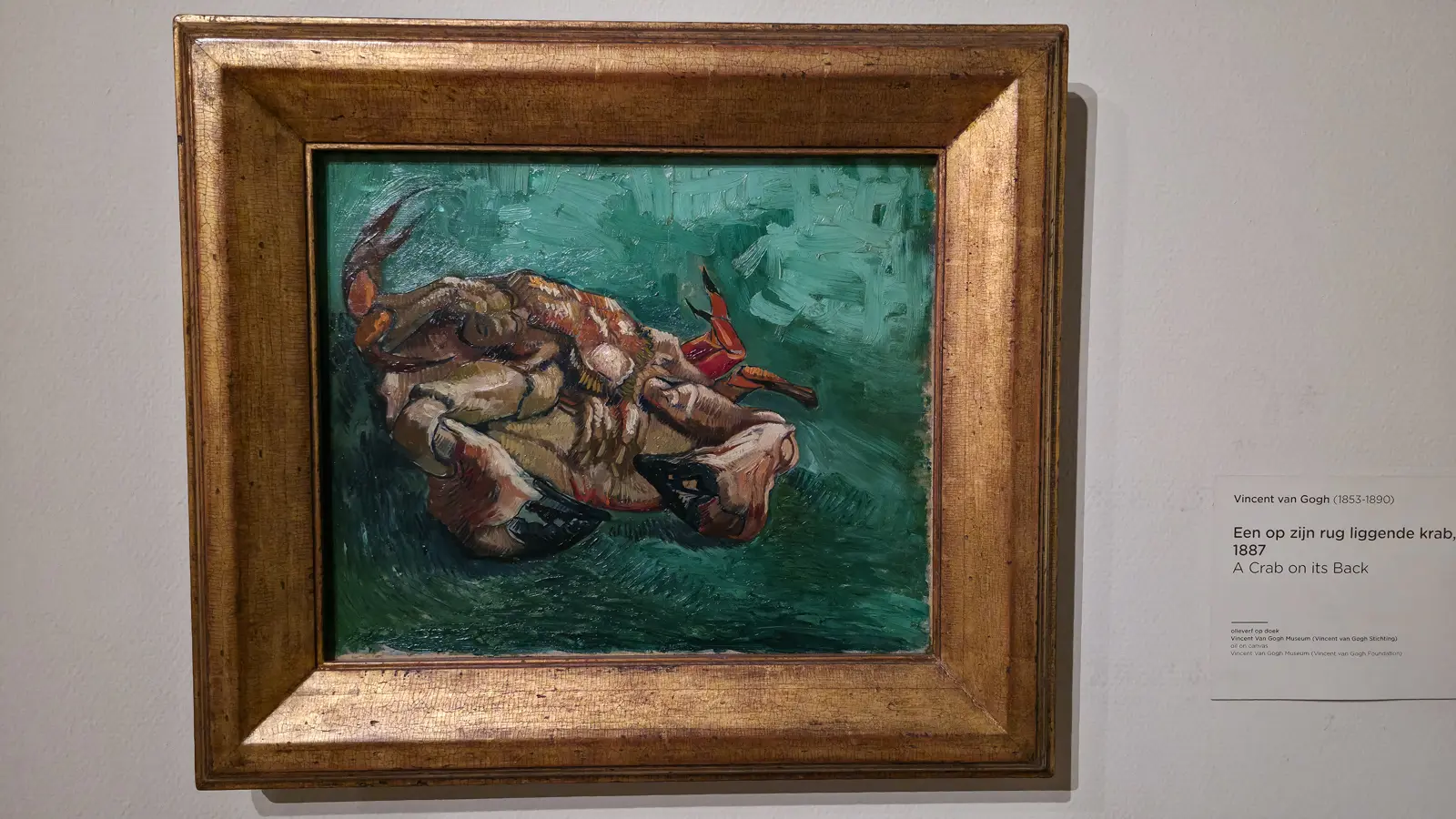
<p class="wp-block-paragraph">This one stopped me because I had seen its sibling in <a href="https://www.bubblyliving.com/london-travel-guide/" data-bubblylinks="2367">London</a>.</p>


<figure class="wp-block-image size-full"><a href="https://cdn.bubblyliving.com/wp-content/uploads/2026/09/van-gogh-crab-on-its-back-1887.webp"><img data-dominant-color="756e60" data-has-transparency="false" style="--dominant-color: #756e60;" loading="lazy" decoding="async" width="1600" height="900" src="https://cdn.bubblyliving.com/wp-content/uploads/2026/09/van-gogh-crab-on-its-back-1887.webp" alt="A Crab on its Back, 1887, by Vincent van Gogh, a single overturned crab against a green ground, at the Van Gogh Museum, Amsterdam" class="wp-image-12534 not-transparent" srcset="https://cdn.bubblyliving.com/wp-content/uploads/2026/09/van-gogh-crab-on-its-back-1887.webp 1600w, https://cdn.bubblyliving.com/wp-content/uploads/2026/09/van-gogh-crab-on-its-back-1887-300x169.webp 300w, https://cdn.bubblyliving.com/wp-content/uploads/2026/09/van-gogh-crab-on-its-back-1887-768x432.webp 768w, https://cdn.bubblyliving.com/wp-content/uploads/2026/09/van-gogh-crab-on-its-back-1887-1536x864.webp 1536w, https://cdn.bubblyliving.com/wp-content/uploads/2026/09/van-gogh-crab-on-its-back-1887-1170x658.webp 1170w, https://cdn.bubblyliving.com/wp-content/uploads/2026/09/van-gogh-crab-on-its-back-1887-585x329.webp 585w" sizes="(max-width: 1600px) 100vw, 1600px" /></a><figcaption class="wp-element-caption">The likely source is a Japanese woodcut of crabs by Hokusai, reproduced in the magazine Le Japon Artistique, which Theo sent to Vincent in September 1888. Van Gogh collected Japanese prints and borrowed their flat shapes and outlines throughout this period.</figcaption></figure>


<p class="wp-block-paragraph">The <strong><a href="https://www.bubblyliving.com/van-gogh-national-gallery-london/">National Gallery</a></strong> in London has Two Crabs, showing what is probably the same animal twice, once upright and once on its back, against the same green. Amsterdam has this one: a single crab, overturned, claws up.</p>


<p class="wp-block-paragraph">Here is the part I did not expect. The two museums disagree about when they were painted. London dates its picture to January 1889 in Arles, a fortnight after Van Gogh cut off part of his ear, and some writers have read the helpless upended crab as a self-portrait of sorts. Amsterdam dates this one to Paris, August or September 1887, and the label in front of me said 1887. Sixteen months apart, and unresolved. If Amsterdam is right, the psychological reading has nothing to stand on.</p>


<h2 id="h-irises" class="wp-block-heading"><strong>Irises</strong></h2>


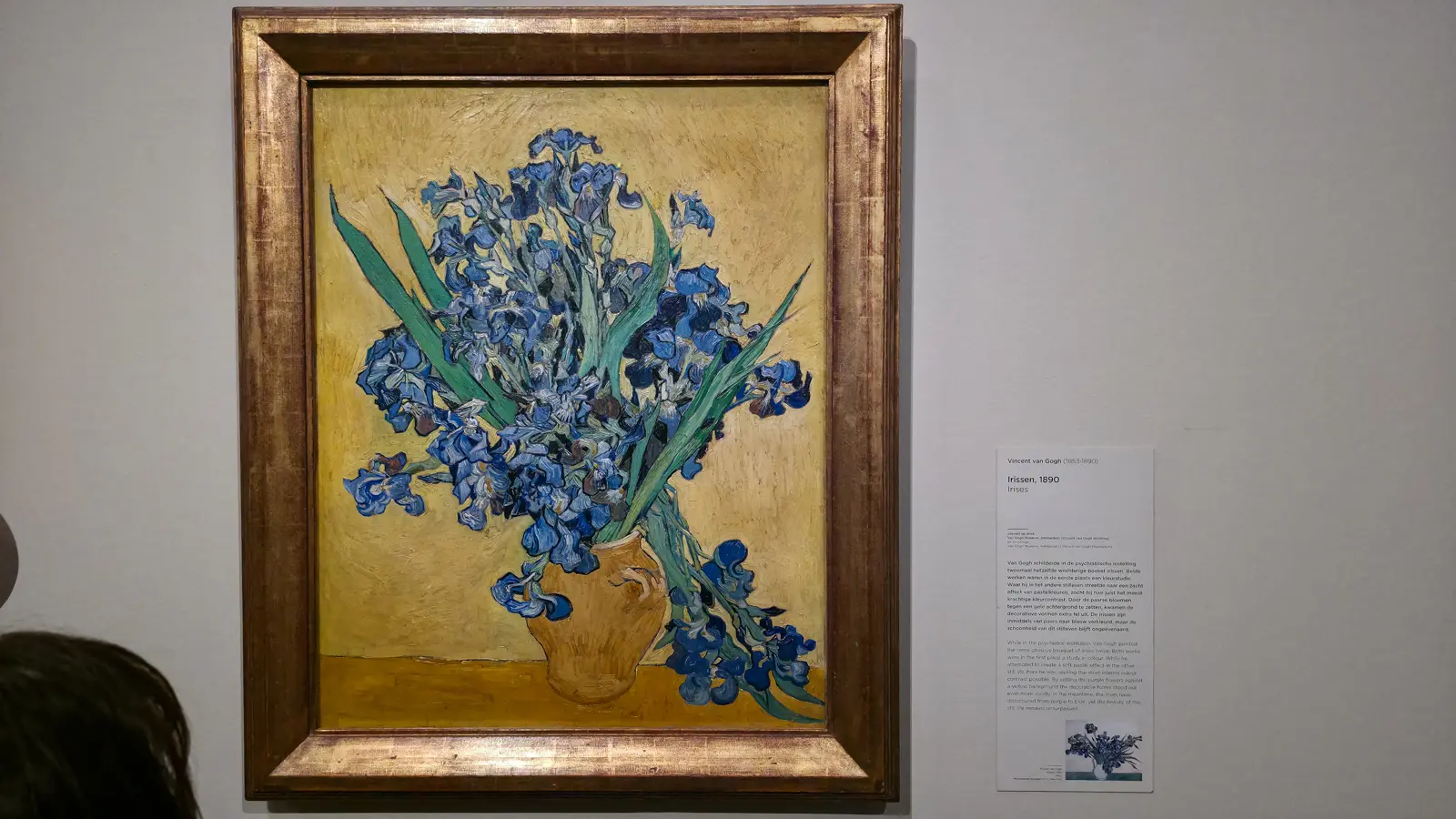
<p class="wp-block-paragraph">On the upper floor, after the asylum years begin, a jug of flowers is set against a wall of solid yellow.</p>


<figure class="wp-block-image size-full"><a href="https://cdn.bubblyliving.com/wp-content/uploads/2026/09/van-gogh-irises-1890.webp"><img data-dominant-color="847b6d" data-has-transparency="false" style="--dominant-color: #847b6d;" loading="lazy" decoding="async" width="1600" height="900" src="https://cdn.bubblyliving.com/wp-content/uploads/2026/09/van-gogh-irises-1890.webp" alt="Irises, 1890, by Vincent van Gogh, a bunch of blue irises in an earthenware jug against a yellow ground, at the Van Gogh Museum, Amsterdam" class="wp-image-12536 not-transparent" srcset="https://cdn.bubblyliving.com/wp-content/uploads/2026/09/van-gogh-irises-1890.webp 1600w, https://cdn.bubblyliving.com/wp-content/uploads/2026/09/van-gogh-irises-1890-300x169.webp 300w, https://cdn.bubblyliving.com/wp-content/uploads/2026/09/van-gogh-irises-1890-768x432.webp 768w, https://cdn.bubblyliving.com/wp-content/uploads/2026/09/van-gogh-irises-1890-1536x864.webp 1536w, https://cdn.bubblyliving.com/wp-content/uploads/2026/09/van-gogh-irises-1890-1170x658.webp 1170w, https://cdn.bubblyliving.com/wp-content/uploads/2026/09/van-gogh-irises-1890-585x329.webp 585w" sizes="(max-width: 1600px) 100vw, 1600px" /></a><figcaption class="wp-element-caption">These flowers were painted purple, not blue. The red pigment in the mixture has faded over more than a century, so the contrast with the yellow that Van Gogh actually set up was considerably stronger than the one now on the wall.</figcaption></figure>


<p class="wp-block-paragraph">He painted this bouquet twice while he was a patient at the asylum at Saint-Rémy, and both were exercises in colour before they were anything else. In the other version he went for a soft pastel effect. Here he wanted the strongest contrast he could get, so the flowers went against a flat yellow background.</p>


<p class="wp-block-paragraph">The label ends by saying the beauty of the still life remains unsurpassed, which is not the kind of sentence museums usually allow themselves.</p>


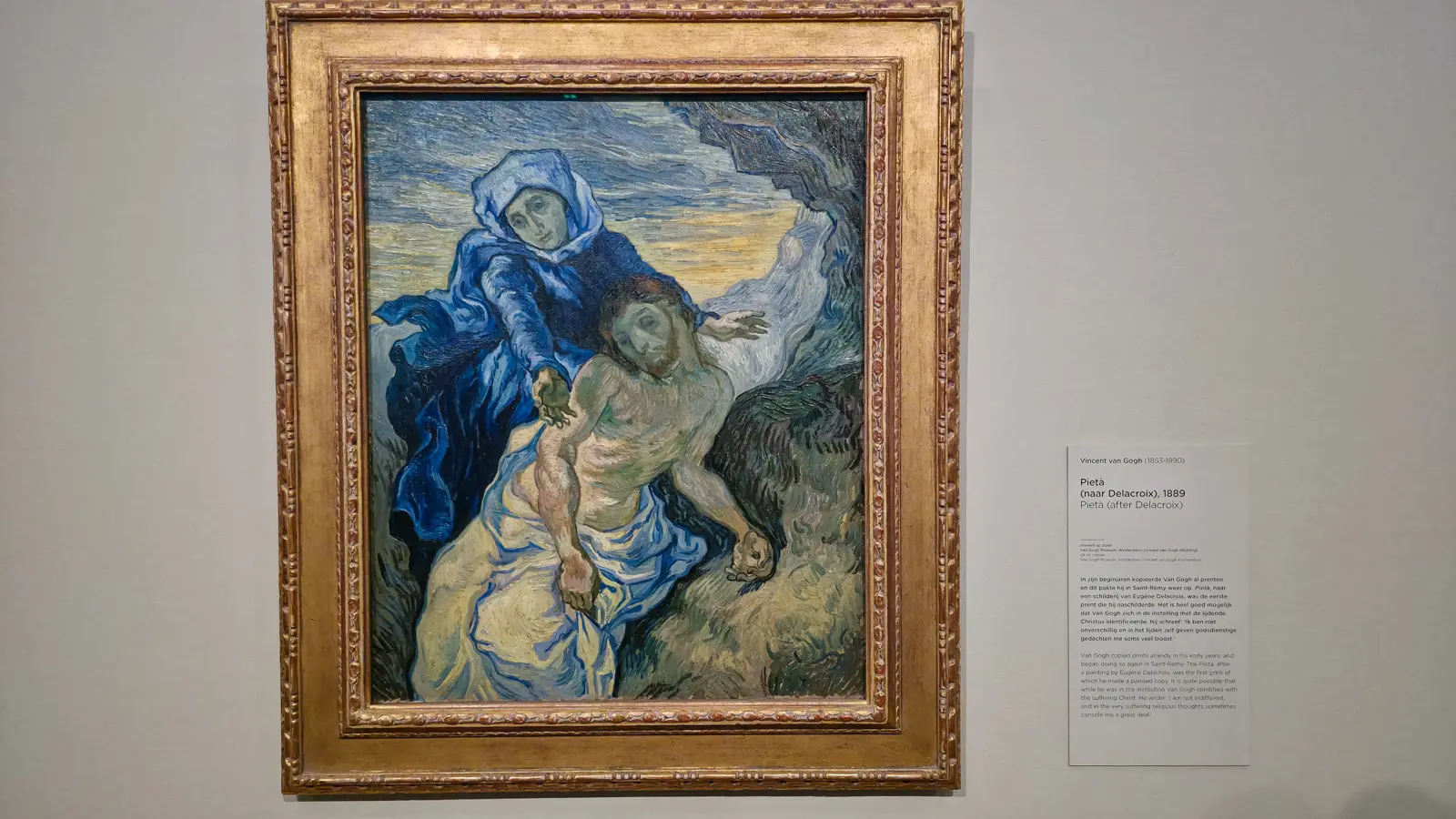
<h2 id="h-the-pieta-twice" class="wp-block-heading"><strong>The Pietà, Twice</strong></h2>


<p class="wp-block-paragraph">One painting in the collection is unlike everything around it. Van Gogh painted almost no religious subjects, and this is the exception.</p>


<figure class="wp-block-image size-full"><a href="https://cdn.bubblyliving.com/wp-content/uploads/2026/09/van-gogh-pieta-after-delacroix-1889.webp"><img data-dominant-color="8d867b" data-has-transparency="false" style="--dominant-color: #8d867b;" loading="lazy" decoding="async" width="1600" height="900" src="https://cdn.bubblyliving.com/wp-content/uploads/2026/09/van-gogh-pieta-after-delacroix-1889.webp" alt="Pieta (after Delacroix), 1889, by Vincent van Gogh, the Virgin in blue holding the dead Christ, at the Van Gogh Museum, Amsterdam" class="wp-image-12539 not-transparent" srcset="https://cdn.bubblyliving.com/wp-content/uploads/2026/09/van-gogh-pieta-after-delacroix-1889.webp 1600w, https://cdn.bubblyliving.com/wp-content/uploads/2026/09/van-gogh-pieta-after-delacroix-1889-300x169.webp 300w, https://cdn.bubblyliving.com/wp-content/uploads/2026/09/van-gogh-pieta-after-delacroix-1889-768x432.webp 768w, https://cdn.bubblyliving.com/wp-content/uploads/2026/09/van-gogh-pieta-after-delacroix-1889-1536x864.webp 1536w, https://cdn.bubblyliving.com/wp-content/uploads/2026/09/van-gogh-pieta-after-delacroix-1889-1170x658.webp 1170w, https://cdn.bubblyliving.com/wp-content/uploads/2026/09/van-gogh-pieta-after-delacroix-1889-585x329.webp 585w" sizes="(max-width: 1600px) 100vw, 1600px" /></a><figcaption class="wp-element-caption">The label beside it records that this Delacroix was the first print Van Gogh ever copied in paint, a habit begun in his early years and taken up again during his months at the asylum in Saint-Rémy.</figcaption></figure>


<p class="wp-block-paragraph">He never owned a Delacroix. What he had was a print of one: a black and white lithograph made by another artist copying Delacroix&#8217;s painting, one of a pile of such sheets he kept in his room at the asylum. In his own account to Theo, the pile fell into some oil and paint and was spoiled. He was sad about it, he wrote, and occupied himself painting it instead, this time in colour. The ruined lithograph survives in this same collection, stain and all.</p>


<p class="wp-block-paragraph">The label also gives his own explanation for why the subject held him. He was not indifferent, he wrote, and in suffering itself religious thoughts sometimes consoled him a great deal. The museum suggests, carefully, that he may have identified with the Christ he was painting.</p>


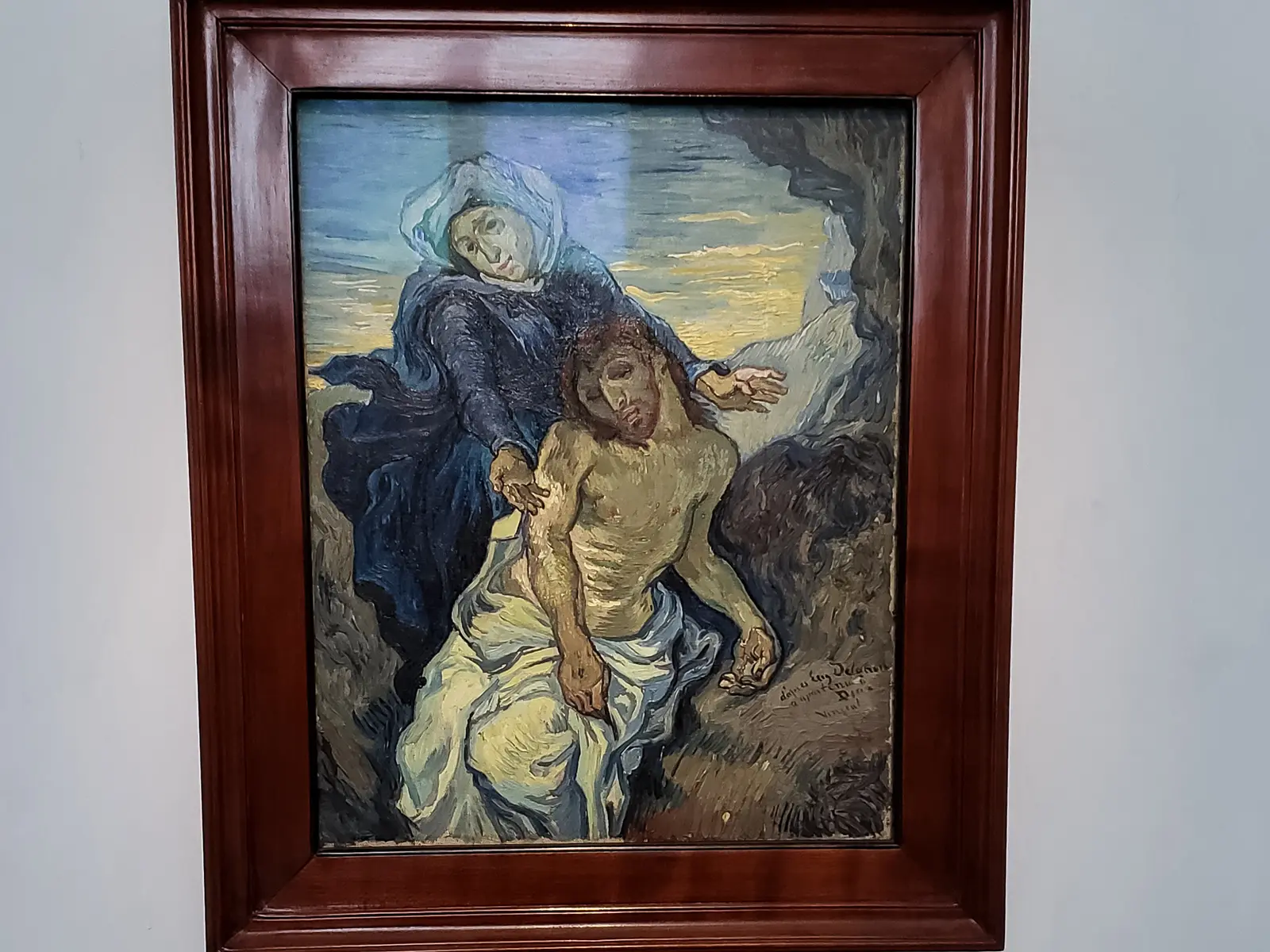
<p class="wp-block-paragraph">And then there are two of them. The larger canvas, made for Theo in September 1889, is this one. The smaller, painted for his sister Willemien, is in the <strong><a href="https://www.bubblyliving.com/wandering-through-wonder-my-visit-to-the-vatican-museums/" data-bubblylinks="2384">Vatican Museums</a></strong>, and I had already met it there in 2018.</p>


<figure class="wp-block-image size-full"><a href="https://cdn.bubblyliving.com/wp-content/uploads/2026/09/van-gogh-pieta-vatican-museums.webp"><img data-dominant-color="736b68" data-has-transparency="false" style="--dominant-color: #736b68;" loading="lazy" decoding="async" width="1600" height="1200" src="https://cdn.bubblyliving.com/wp-content/uploads/2026/09/van-gogh-pieta-vatican-museums.webp" alt="Van Gogh’s Pieta after Delacroix in the Collection of Modern Religious Art at the Vatican Museums, Vatican City, in a dark mahogany frame" class="wp-image-12540 not-transparent" srcset="https://cdn.bubblyliving.com/wp-content/uploads/2026/09/van-gogh-pieta-vatican-museums.webp 1600w, https://cdn.bubblyliving.com/wp-content/uploads/2026/09/van-gogh-pieta-vatican-museums-300x225.webp 300w, https://cdn.bubblyliving.com/wp-content/uploads/2026/09/van-gogh-pieta-vatican-museums-768x576.webp 768w, https://cdn.bubblyliving.com/wp-content/uploads/2026/09/van-gogh-pieta-vatican-museums-1536x1152.webp 1536w, https://cdn.bubblyliving.com/wp-content/uploads/2026/09/van-gogh-pieta-vatican-museums-1170x878.webp 1170w, https://cdn.bubblyliving.com/wp-content/uploads/2026/09/van-gogh-pieta-vatican-museums-585x439.webp 585w" sizes="(max-width: 1600px) 100vw, 1600px" /></a><figcaption class="wp-element-caption">This version was donated to the Vatican by the Diocese of New York in 1973. Van Gogh inscribed it at lower right, after Eugène Delacroix, and signed it simply Vincent, as he signed nearly everything.</figcaption></figure>


<p class="wp-block-paragraph">It hangs in the Collection of Modern Religious Art at the Vatican Museums, in rooms that almost nobody detours for on the way to the Sistine Chapel. Same composition, same year or thereabouts, a third of the size, in a dark mahogany frame instead of a gilt one, on a white wall instead of a cream one.</p>


<p class="wp-block-paragraph">Standing in front of the Amsterdam version seven and a half years after photographing the Roman one was a strange piece of bookkeeping.</p>


<h2 id="h-sunflowers" class="wp-block-heading"><strong>Sunflowers</strong></h2>


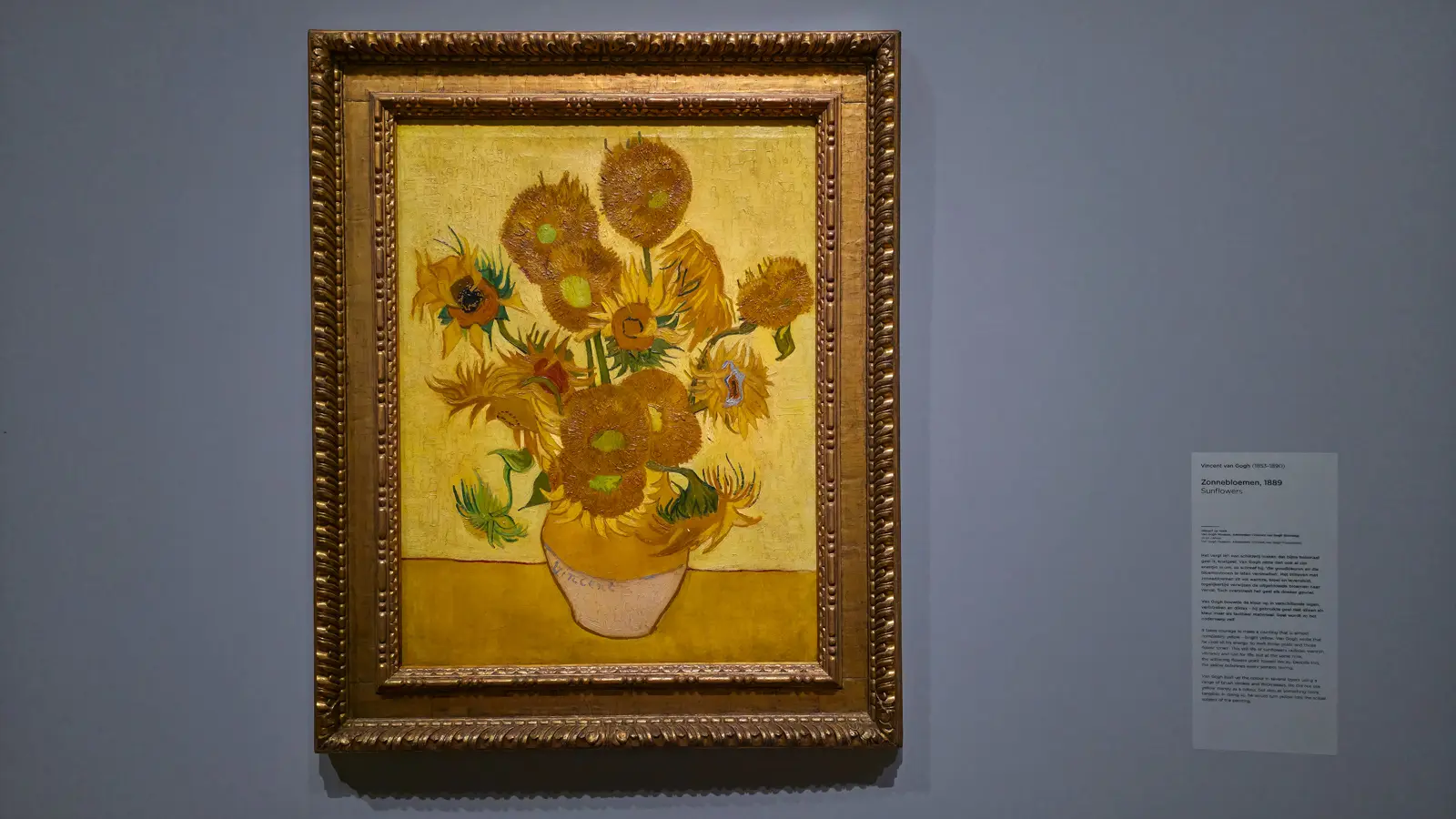
<p class="wp-block-paragraph">And then the one that everybody came for, hanging on a plain grey wall with nothing done to make an occasion of it.</p>


<figure class="wp-block-image size-full"><a href="https://cdn.bubblyliving.com/wp-content/uploads/2026/09/van-gogh-sunflowers-1889.webp"><img data-dominant-color="716550" data-has-transparency="false" style="--dominant-color: #716550;" loading="lazy" decoding="async" width="1600" height="900" src="https://cdn.bubblyliving.com/wp-content/uploads/2026/09/van-gogh-sunflowers-1889.webp" alt="Sunflowers, 1889, by Vincent van Gogh, sunflowers in an earthenware pot against a yellow ground, at the Van Gogh Museum, Amsterdam" class="wp-image-12544 not-transparent" srcset="https://cdn.bubblyliving.com/wp-content/uploads/2026/09/van-gogh-sunflowers-1889.webp 1600w, https://cdn.bubblyliving.com/wp-content/uploads/2026/09/van-gogh-sunflowers-1889-300x169.webp 300w, https://cdn.bubblyliving.com/wp-content/uploads/2026/09/van-gogh-sunflowers-1889-768x432.webp 768w, https://cdn.bubblyliving.com/wp-content/uploads/2026/09/van-gogh-sunflowers-1889-1536x864.webp 1536w, https://cdn.bubblyliving.com/wp-content/uploads/2026/09/van-gogh-sunflowers-1889-1170x658.webp 1170w, https://cdn.bubblyliving.com/wp-content/uploads/2026/09/van-gogh-sunflowers-1889-585x329.webp 585w" sizes="(max-width: 1600px) 100vw, 1600px" /></a><figcaption class="wp-element-caption">This is not the only one. Van Gogh made several versions of the sunflowers in a vase, and the others are now in London, Munich, Philadelphia and Tokyo. The Amsterdam picture is a repetition he painted in Arles in January 1889.</figcaption></figure>


<p class="wp-block-paragraph">This is what most people are here for, and on my second afternoon I went straight to it.</p>


<p class="wp-block-paragraph">The wall text is the best thing the museum has written. It takes courage, it says, to make a painting that is almost entirely yellow. He used every bit of himself, in his own words, to melt those golds and those flower tones together. The picture radiates warmth and appetite for life, and at the same time the flowers in it are going over: petals dropping, heads drying out, one of them already collapsing. The yellow outshines all of that anyway.</p>


<p class="wp-block-paragraph">What the label points out, and what a print cannot show, is that the yellow is not only a colour here. He built it up in layers, thin in places and thick in others, so the paint itself has a surface. Yellow stops being what the painting is coloured and becomes what the painting is about.</p>


<h2 id="h-almond-blossom" class="wp-block-heading"><strong>Almond Blossom</strong></h2>


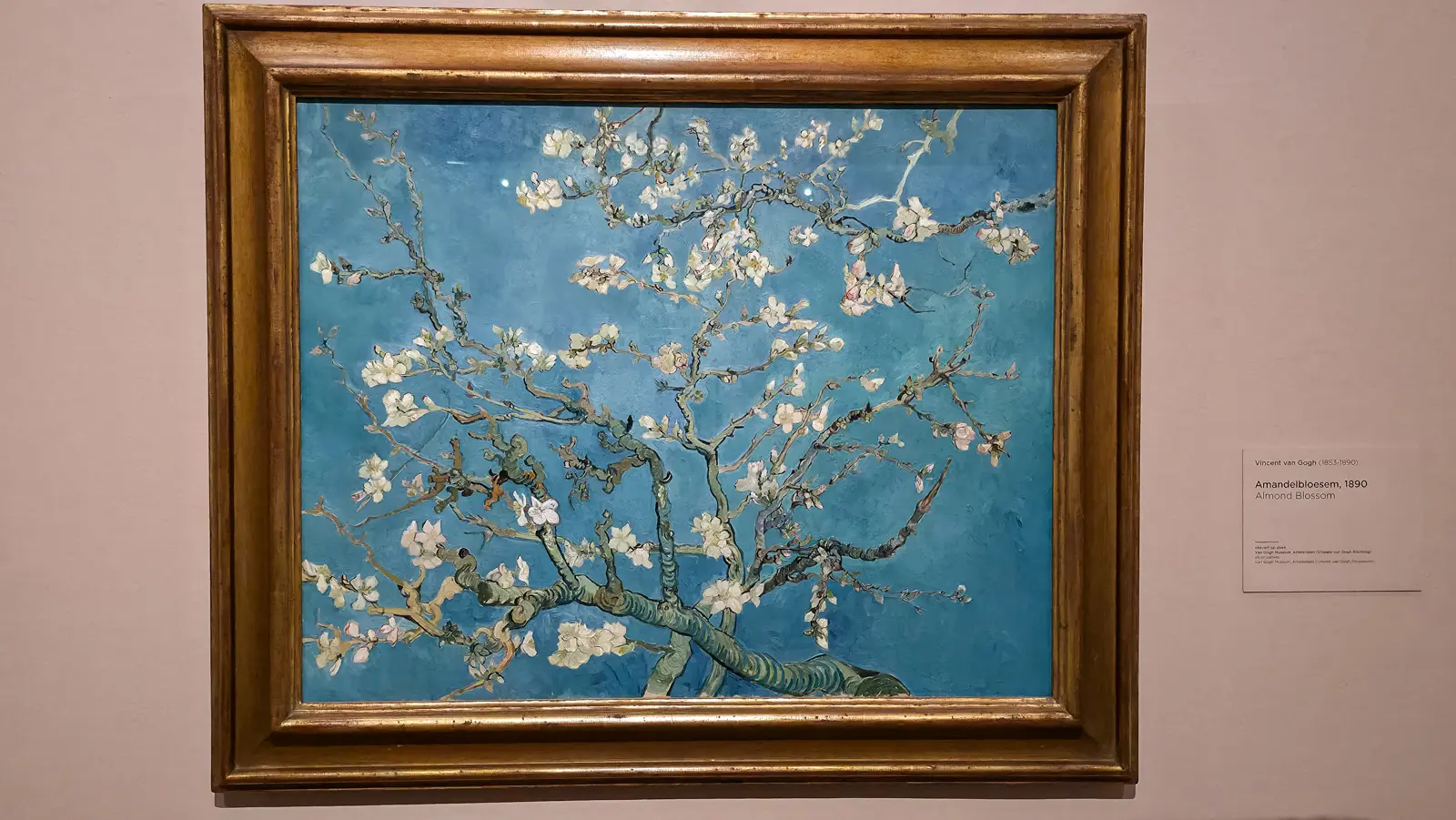
<p class="wp-block-paragraph">The last room I want to talk about holds a painting I had liked for years without knowing a single thing about it.</p>


<figure class="wp-block-image size-full"><a href="https://cdn.bubblyliving.com/wp-content/uploads/2026/09/van-gogh-almond-blossom-1890.webp"><img data-dominant-color="7d7b75" data-has-transparency="false" style="--dominant-color: #7d7b75;" loading="lazy" decoding="async" width="1600" height="901" src="https://cdn.bubblyliving.com/wp-content/uploads/2026/09/van-gogh-almond-blossom-1890.webp" alt="Almond Blossom, 1890, by Vincent van Gogh, white blossom on branches against a blue sky, in a gilt frame at the Van Gogh Museum, Amsterdam" class="wp-image-12533 not-transparent" srcset="https://cdn.bubblyliving.com/wp-content/uploads/2026/09/van-gogh-almond-blossom-1890.webp 1600w, https://cdn.bubblyliving.com/wp-content/uploads/2026/09/van-gogh-almond-blossom-1890-300x169.webp 300w, https://cdn.bubblyliving.com/wp-content/uploads/2026/09/van-gogh-almond-blossom-1890-768x432.webp 768w, https://cdn.bubblyliving.com/wp-content/uploads/2026/09/van-gogh-almond-blossom-1890-1536x865.webp 1536w, https://cdn.bubblyliving.com/wp-content/uploads/2026/09/van-gogh-almond-blossom-1890-1170x659.webp 1170w, https://cdn.bubblyliving.com/wp-content/uploads/2026/09/van-gogh-almond-blossom-1890-585x329.webp 585w" sizes="(max-width: 1600px) 100vw, 1600px" /></a><figcaption class="wp-element-caption">Days after finishing it, Van Gogh suffered a severe breakdown. The picture went to Paris, where Theo hung it in the apartment, and it stayed in the family rather than going to the gallery with the works Theo was trying to sell.</figcaption></figure>


<p class="wp-block-paragraph">My favourite in the building, and it was before I knew why.</p>


<p class="wp-block-paragraph">Theo and his wife Jo had a son on 31 January 1890 and named him Vincent Willem, after his uncle, who was also his godfather. Vincent, then a patient at Saint-Rémy, began painting immediately. He told his mother what it was for: large branches of white almond blossom against a blue sky, for the bedroom of the Paris apartment where the baby slept.</p>


<p class="wp-block-paragraph">It was a present for a newborn. The branches are cut off by the edges of the canvas in the Japanese manner he had been studying, the blue is flat, and there is no ground and no horizon, just blossom coming forward from every direction.</p>


<p class="wp-block-paragraph">Now the part that makes the room worth standing in. That baby grew up, inherited the collection, and in 1962 handed it to the Dutch state to be held in trust. The museum opened eleven years later. Almond Blossom hangs in an institution that exists because of the child it was painted for.</p>


<h2 id="h-bubbly-tips" class="wp-block-heading"><strong>Bubbly Tips</strong></h2>


<ul class="wp-block-list">
<li><strong>Book a timed slot before you book anything else.</strong> Entry is online-only with a reserved time for every visitor, Museumkaart holders included. In high season the good slots go early, and there is no queue you can join on the day.</li>


<li><strong>Go twice if your trip allows it.</strong> I did, and it was the best decision of the week. The first visit with a guide gives you the shape of his life and the argument between the rooms. The second lets you ignore all of that and stand in front of four paintings for twenty minutes each.</li>


<li><strong>Take the guide first, not second.</strong> Doing it the other way round means you spend your one unhurried visit being told things instead of looking.</li>


<li><strong>Start at the bottom and go up.</strong> The displays run chronologically by floor, so the route only makes sense in that direction. Beginning with The Potato Eaters is what makes the Paris colour land the way it should.</li>


<li><strong>Read the labels here.</strong> They quote his letters constantly, because the museum owns nearly all of them, so you are reading his own account of what he was attempting rather than a curator&#8217;s guess at it.</li>


<li><strong>Photography is allowed in the permanent collection, without flash.</strong> Older guidebooks say otherwise and are out of date.</li>


<li><strong>Do not come looking for The Starry Night.</strong> It is at the Museum of Modern Art in <a href="https://www.bubblyliving.com/christmas-magic-in-manhattan-nyc/" data-bubblylinks="2364">New York</a> and never has been here. People ask at the desk every day.</li>


<li><strong>Pair it with the Rijksmuseum, but not on the same day.</strong> They are four minutes apart across Museumplein and both need three hours and a clear head. Doing both back to back wastes one of them.</li>


<li><strong>The afternoon slots are calmer than the mornings.</strong> Both my visits were after one o&#8217;clock, and both were busy, but the crush around the famous canvases eases considerably as the day goes on.</li>
</ul>


<h2 id="h-final-thoughts" class="wp-block-heading"><strong>Final Thoughts</strong></h2>


<p class="wp-block-paragraph">The building holds about two hundred paintings, and the ones people cross continents for take up perhaps ten metres of wall. What I did not expect was how much the small, unfamous things would stay with me: an overturned crab whose date two museums cannot agree on, an empty armchair standing in for a man who was about to walk out, a bedroom he painted three times because the first one got damp.</p>


<p class="wp-block-paragraph">And Almond Blossom, which I liked immediately for the wrong reasons, on the strength of the blue. Then I learned it was a gift to a newborn from an uncle who was falling apart, and that the newborn is the reason the museum exists at all. Nothing in the collection is arranged to make that point. It just happens to be true, and it is hanging on the wall of a room that opens to anyone with a timed ticket on a Thursday afternoon.</p>


<p class="wp-block-paragraph">Until next time!</p>


<script type="application/ld+json">
{
  "@context": "https://schema.org",
  "@graph": [
    {
      "@type": "Article",
      "@id": "https://www.bubblyliving.com/van-gogh-museum-amsterdam/#article",
      "headline": "The Van Gogh Museum: Two Afternoons and What I Went Back For",
      "description": "A two-visit guide to the Van Gogh Museum, Amsterdam: how to book, why to go twice, the famous canvases and the small ones that hold you longer, from Arles to Auvers.",
      "image": "https://cdn.bubblyliving.com/wp-content/uploads/2026/09/van-gogh-museum-glass-facade-museumplein.webp",
      "datePublished": "2026-09-16T00:00:00-04:00",
      "dateModified": "2026-09-16T00:00:00-04:00",
      "author": {
        "@type": "Person",
        "name": "Bubbly",
        "url": "https://www.bubblyliving.com/about-bubbly/"
      },
      "publisher": {
        "@type": "Organization",
        "name": "BubblyLiving",
        "url": "https://www.bubblyliving.com/"
      },
      "mainEntityOfPage": {
        "@type": "WebPage",
        "@id": "https://www.bubblyliving.com/van-gogh-museum-amsterdam/"
      },
      "about": [
        { "@type": "Person", "name": "Vincent van Gogh" },
        {
          "@type": "Museum",
          "name": "Van Gogh Museum",
          "url": "https://www.vangoghmuseum.nl/en",
          "telephone": "+31 20 570 5200",
          "image": "https://cdn.bubblyliving.com/wp-content/uploads/2026/09/van-gogh-museum-glass-facade-museumplein.webp",
          "address": {
            "@type": "PostalAddress",
            "streetAddress": "Museumplein 6",
            "addressLocality": "Amsterdam",
            "postalCode": "1071 DJ",
            "addressCountry": "NL"
          },
          "geo": { "@type": "GeoCoordinates", "latitude": 52.3584, "longitude": 4.8811 }
        },
        {
          "@type": "VisualArtwork",
          "name": "Sunflowers",
          "creator": { "@type": "Person", "name": "Vincent van Gogh" },
          "dateCreated": "1889",
          "artform": "Painting",
          "artMedium": "Oil on canvas"
        },
        {
          "@type": "VisualArtwork",
          "name": "Almond Blossom",
          "creator": { "@type": "Person", "name": "Vincent van Gogh" },
          "dateCreated": "1890",
          "artform": "Painting",
          "artMedium": "Oil on canvas"
        }
      ]
    },
    {
      "@type": "FAQPage",
      "@id": "https://www.bubblyliving.com/van-gogh-museum-amsterdam/#faq",
      "mainEntity": [
        {
          "@type": "Question",
          "name": "Do you need to book the Van Gogh Museum in advance?",
          "acceptedAnswer": {
            "@type": "Answer",
            "text": "Yes, always. Entry is by a timed slot booked online in advance, and this applies to every visitor, including Dutch Museumkaart holders, who still have to reserve a time. There is no ticket window to buy at the door on the day, and in high season the best slots sell out early, so book before you plan the rest of your Amsterdam day. If a date shows as sold out online, keep checking, as slots are sometimes released."
          }
        },
        {
          "@type": "Question",
          "name": "Is The Starry Night at the Van Gogh Museum?",
          "acceptedAnswer": {
            "@type": "Answer",
            "text": "No, and this is the single most common mistake. The Starry Night, the famous swirling night sky, is at the Museum of Modern Art (MoMA) in New York and has never been in Amsterdam. The Van Gogh Museum does hold a different night scene, Starry Night Over the Rhone (owned by the Musee d'Orsay in Paris and shown on loan at times), but the painting most people picture is in Manhattan. Staff are asked about it at the desk every day."
          }
        },
        {
          "@type": "Question",
          "name": "Is the Van Gogh Museum worth it, and how long do you need?",
          "acceptedAnswer": {
            "@type": "Answer",
            "text": "Very much so, and about three hours for a proper single visit. It holds the world's largest Van Gogh collection (around 200 paintings, 500 drawings and almost all his letters), hung chronologically from the dark early Potato Eaters up through the Paris and Arles colour to Almond Blossom, with the labels quoting his own letters throughout. If your trip allows, going twice is even better: once with a guide for the arc of his life, and once alone to linger at the paintings that matter to you."
          }
        },
        {
          "@type": "Question",
          "name": "Can you take photos in the Van Gogh Museum?",
          "acceptedAnswer": {
            "@type": "Answer",
            "text": "Yes, photography is allowed in the permanent collection without flash. Some older guidebooks and blog posts still say photography is banned, but that is out of date; you can photograph the paintings, just not with flash, and rules can differ for temporary exhibitions, so check the signage for those. Tripods and selfie sticks are generally not permitted, and you should be mindful of crowds around the famous works."
          }
        },
        {
          "@type": "Question",
          "name": "Can you do the Van Gogh Museum and the Rijksmuseum on the same day?",
          "acceptedAnswer": {
            "@type": "Answer",
            "text": "You can, since they are only about four minutes apart across Museumplein, but it is not recommended. Each holds a world-class collection that deserves around three hours and a fresh, clear head, and doing both back to back means rushing one of them. If you have the time, give each its own visit; if you must combine them in a day, do one in the morning, take a proper break, and accept that the second will get less of your attention."
          }
        },
        {
          "@type": "Question",
          "name": "What are the most famous paintings at the Van Gogh Museum?",
          "acceptedAnswer": {
            "@type": "Answer",
            "text": "The headline works are Sunflowers (the Amsterdam version, a January 1889 repetition of the Arles picture), The Bedroom (the first of three versions), Almond Blossom (painted for his newborn nephew Vincent Willem), and The Potato Eaters (his dark 1885 masterpiece from Nuenen). But some of the most rewarding pictures are less famous: Gauguin's Chair, the two Paris self-portraits, the Irises, and A Crab on its Back, whose date the Van Gogh Museum and London's National Gallery still disagree on."
          }
        }
      ]
    }
  ]
}
</script>
<p>The post <a href="https://www.bubblyliving.com/van-gogh-museum-amsterdam/">The Van Gogh Museum: Two Afternoons and What I Went Back For</a> appeared first on <a href="https://www.bubblyliving.com">Bubbly Living</a>.</p>
]]></content>
		
					<link rel="replies" type="text/html" href="https://www.bubblyliving.com/van-gogh-museum-amsterdam/#comments" thr:count="0" />
			<link rel="replies" type="application/atom+xml" href="https://www.bubblyliving.com/van-gogh-museum-amsterdam/feed/atom/" thr:count="0" />
			<thr:total>0</thr:total>
			</entry>
		<entry>
		<author>
			<name>Bubbly</name>
							<uri>https://www.bubblyliving.com</uri>
						</author>

		<title type="html"><![CDATA[The Keukenhof Lake: What I Found Looking for the Orchids]]></title>
		<link rel="alternate" type="text/html" href="https://www.bubblyliving.com/keukenhof-lake-lisse/" />

		<id>https://www.bubblyliving.com/?p=12527</id>
		<updated>2026-09-15T02:40:07Z</updated>
		<published>2026-09-15T04:00:00Z</published>
		<category scheme="https://www.bubblyliving.com/" term="Lisse" />
		<summary type="html"><![CDATA[<p>I came out of the Willem-Alexander Pavilion with a vague piece of information and no map sense whatsoever. Somebody had mentioned an orchid exhibition. I had no idea where it was, so&#8230;</p>
<p>The post <a href="https://www.bubblyliving.com/keukenhof-lake-lisse/">The Keukenhof Lake: What I Found Looking for the Orchids</a> appeared first on <a href="https://www.bubblyliving.com">Bubbly Living</a>.</p>
]]></summary>

					<content type="html" xml:base="https://www.bubblyliving.com/keukenhof-lake-lisse/"><![CDATA[
<p class="wp-block-paragraph">I came out of the <strong><a href="https://www.bubblyliving.com/keukenhof-willem-alexander-pavilion-lisse/" data-bubblylinks="2363">Willem-Alexander Pavilion</a></strong> with a vague piece of information and no map sense whatsoever. Somebody had mentioned an orchid exhibition. I had no idea where it was, so I picked a direction and walked, on the theory that a park this size would eventually produce either orchids or something else worth the detour.</p>


<p class="wp-block-paragraph">It produced something else. I never found the orchids at all, and the hour I spent not finding them turned out to be the best part of my day at <strong><a href="https://www.bubblyliving.com/keukenhof-tulips-lisse/" data-bubblylinks="2362">Keukenhof</a></strong>.</p>


<p class="selector wp-block-paragraph"><strong>The Keukenhof Lake at a Glance</strong><br>🌊 <strong>What it is</strong> · The oldest part of Keukenhof: a 19th-century English landscape lake laid out by the Zochers in 1857, decades before the tulips arrived.<br>🌉 <strong>On the circuit</strong> · A low stone bridge, the Wilhelmina Pavilion (shop, food, toilets, no flowers), stepping stones across the water, and a four-jet fountain.<br>🔵 <strong>The overlooked bit</strong> · Ribbons of blue muscari, hyacinths, rhododendrons and azaleas do most of the compositional work, and almost nobody photographs them.<br>🏰 <strong>History</strong> · The estate&#8217;s manor (now Keukenhof Castle) dates to 1641; the name means &#8220;kitchen garden.&#8221; The flower show only opened in 1950.<br>💡 <strong>Tip</strong> · Walk the full lake circuit (~30–40 min), the quietest part of the park, and don&#8217;t look for the orchids in the Wilhelmina.</p>


<h2 id="h-a-park-older-than-the-flower-show" class="wp-block-heading"><strong>A Park Older Than the Flower Show</strong></h2>


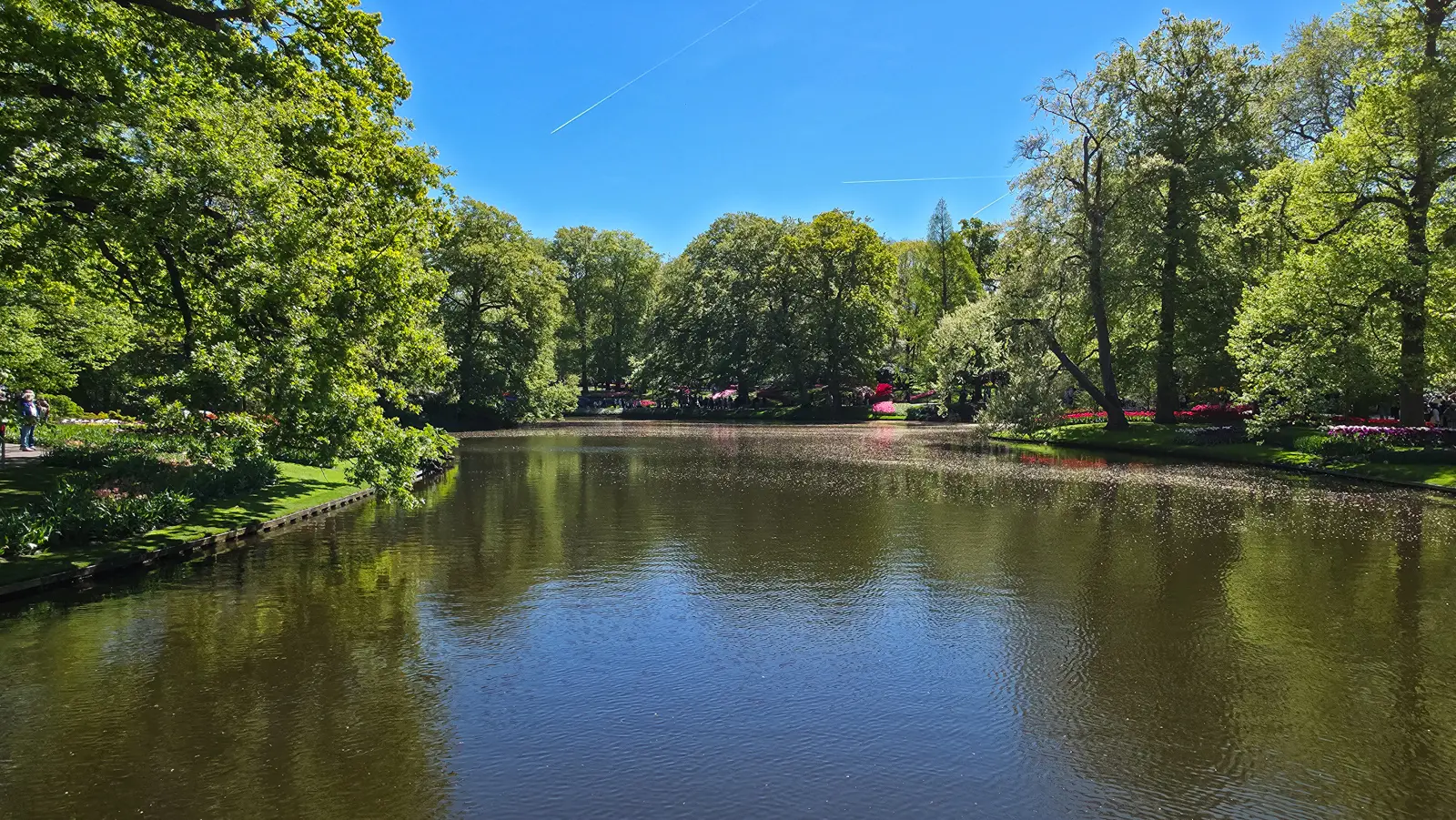
<p class="wp-block-paragraph">The first thing worth knowing is that the lake was here long before the tulips were.</p>


<figure class="wp-block-image size-full"><a href="https://cdn.bubblyliving.com/wp-content/uploads/2026/09/keukenhof-main-lake-reflections.webp"><img data-dominant-color="516559" data-has-transparency="false" style="--dominant-color: #516559;" loading="lazy" decoding="async" width="1600" height="901" src="https://cdn.bubblyliving.com/wp-content/uploads/2026/09/keukenhof-main-lake-reflections.webp" alt="The wide main lake at Keukenhof, Lisse, reflecting trees and blue sky, with flower beds along both banks in the distance" class="wp-image-12523 not-transparent" srcset="https://cdn.bubblyliving.com/wp-content/uploads/2026/09/keukenhof-main-lake-reflections.webp 1600w, https://cdn.bubblyliving.com/wp-content/uploads/2026/09/keukenhof-main-lake-reflections-300x169.webp 300w, https://cdn.bubblyliving.com/wp-content/uploads/2026/09/keukenhof-main-lake-reflections-768x432.webp 768w, https://cdn.bubblyliving.com/wp-content/uploads/2026/09/keukenhof-main-lake-reflections-1536x865.webp 1536w, https://cdn.bubblyliving.com/wp-content/uploads/2026/09/keukenhof-main-lake-reflections-1170x659.webp 1170w, https://cdn.bubblyliving.com/wp-content/uploads/2026/09/keukenhof-main-lake-reflections-585x329.webp 585w" sizes="(max-width: 1600px) 100vw, 1600px" /></a><figcaption class="wp-element-caption">The public park runs for only about eight weeks a year. Outside that window the grounds stay in use for private events and festivals, so the lawns and water in this view sit empty of visitors for ten months out of twelve.</figcaption></figure>


<p class="wp-block-paragraph">The manor house at the heart of the estate went up in <strong>1641</strong> for <strong>Adriaen Maertensz Block</strong>, a captain and governor of the Dutch East India Company. It still stands, as <strong>Keukenhof Castle</strong>, though it sits outside the flower park altogether, about five hundred metres to the south-west with its own grounds and its own gate. In 1857 the owners of the Keukenhof estate commissioned <strong>Jan David Zocher</strong> and his son <strong>Louis Paul Zocher</strong> to redesign the grounds around their castle in the English landscape style. That means curves rather than axes, long sightlines framed by trees, open lawns, and water shaped to look as though it happened on its own. The Zochers also laid out the <strong><a href="https://www.bubblyliving.com/vondelpark-amsterdam/" data-bubblylinks="2361">Vondelpark</a></strong> in <strong><a href="https://www.bubblyliving.com/amsterdam-in-spring/" data-bubblylinks="2360">Amsterdam</a></strong>, which explains why both places handle their trees the same way.</p>


<p class="wp-block-paragraph">The bulb growers only arrived in 1949, proposing an open-air exhibition to show off the Dutch trade, and the park opened to the public in <strong>1950</strong>. So the flower displays are ninety-three years younger than the ground they sit on. What looks like a garden built around tulips is actually a nineteenth-century landscape park that gets dressed each spring.</p>


<h2 id="h-the-bridge-and-the-pavilion-that-sells-sandwiches" class="wp-block-heading"><strong>The Bridge and the Pavilion That Sells Sandwiches</strong></h2>


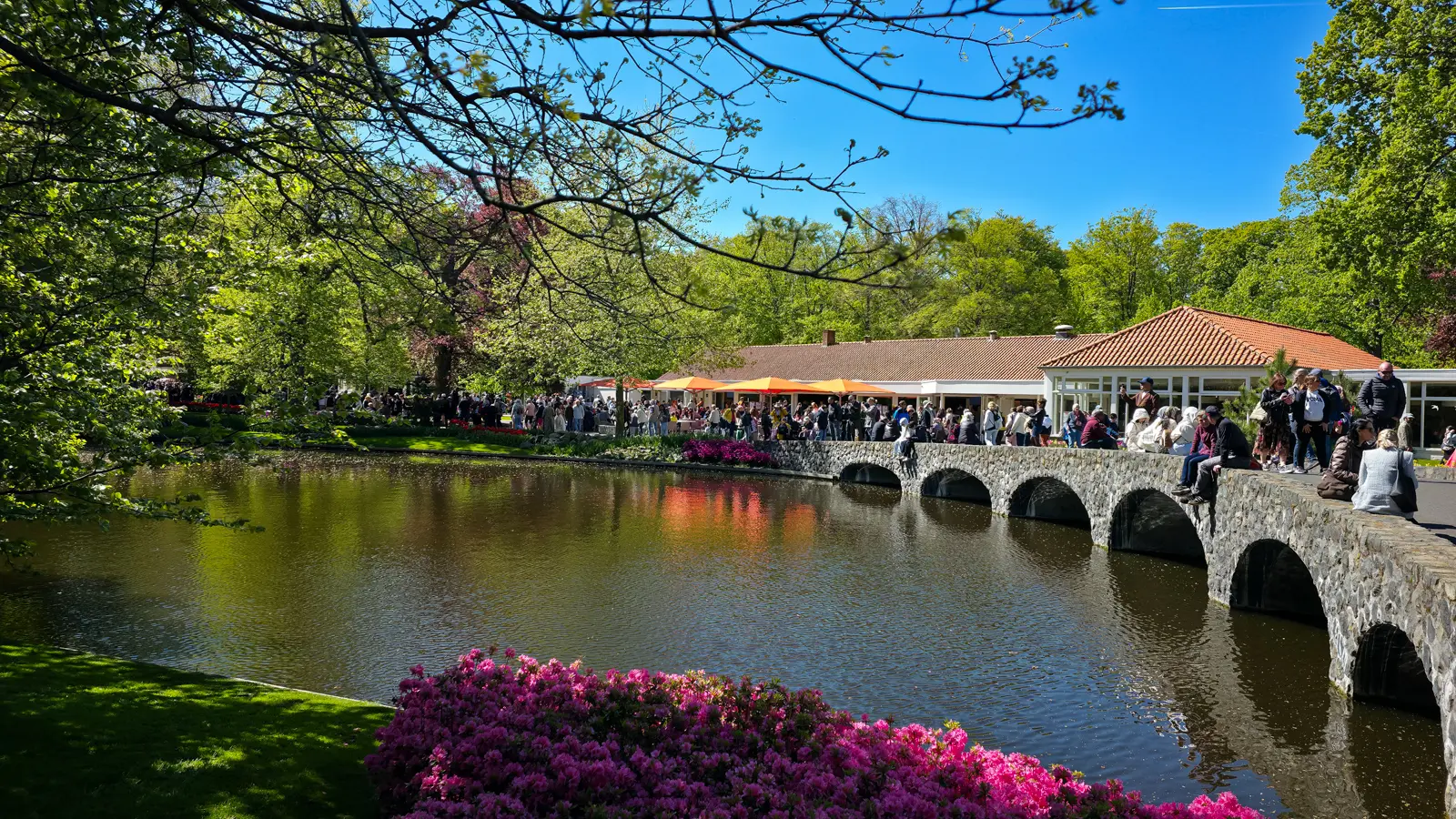
<p class="wp-block-paragraph">Walking north-west, the path arrives at a low stone bridge over the water, and on the far bank sits the <strong>Wilhelmina Pavilion</strong>, orange parasols out, a queue at the counter and a red tiled roof behind the trees.</p>


<figure class="wp-block-image size-full"><a href="https://cdn.bubblyliving.com/wp-content/uploads/2026/09/keukenhof-stone-bridge-wilhelmina-pavilion.webp"><img data-dominant-color="515f53" data-has-transparency="false" style="--dominant-color: #515f53;" loading="lazy" decoding="async" width="1600" height="900" src="https://cdn.bubblyliving.com/wp-content/uploads/2026/09/keukenhof-stone-bridge-wilhelmina-pavilion.webp" alt="Stone arched bridge over the lake at Keukenhof, Lisse, with the Wilhelmina Pavilion and orange parasols beyond, pink azaleas in front" class="wp-image-12525 not-transparent" srcset="https://cdn.bubblyliving.com/wp-content/uploads/2026/09/keukenhof-stone-bridge-wilhelmina-pavilion.webp 1600w, https://cdn.bubblyliving.com/wp-content/uploads/2026/09/keukenhof-stone-bridge-wilhelmina-pavilion-300x169.webp 300w, https://cdn.bubblyliving.com/wp-content/uploads/2026/09/keukenhof-stone-bridge-wilhelmina-pavilion-768x432.webp 768w, https://cdn.bubblyliving.com/wp-content/uploads/2026/09/keukenhof-stone-bridge-wilhelmina-pavilion-1536x864.webp 1536w, https://cdn.bubblyliving.com/wp-content/uploads/2026/09/keukenhof-stone-bridge-wilhelmina-pavilion-1170x658.webp 1170w, https://cdn.bubblyliving.com/wp-content/uploads/2026/09/keukenhof-stone-bridge-wilhelmina-pavilion-585x329.webp 585w" sizes="(max-width: 1600px) 100vw, 1600px" /></a><figcaption class="wp-element-caption">The park’s original entrance survives near this pavilion, a small hut with the Keukenhof name in bold lettering on it, left over from the decades before the current main gate was built.</figcaption></figure>


<p class="wp-block-paragraph">I did not go in, and it turns out there would have been no point looking for flowers there. The Wilhelmina is one of the only pavilions at Keukenhof with no floral displays at all. It has a shop, food and drink, and the toilets. That is the whole offer, and the building is honest about it.</p>


<p class="wp-block-paragraph">Which is worth saying plainly, because a visitor hunting for a specific exhibition can lose twenty minutes to the assumption that every pavilion holds one. For the record, the orchid and anthurium show normally lives in the <strong>Beatrix Pavilion</strong> in the far north-east corner, and in the 2026 season it moved to the <strong>Juliana Pavilion</strong>. I was looking in the one building guaranteed not to have it.</p>


<h2 id="h-stepping-stones" class="wp-block-heading"><strong>Stepping Stones</strong></h2>


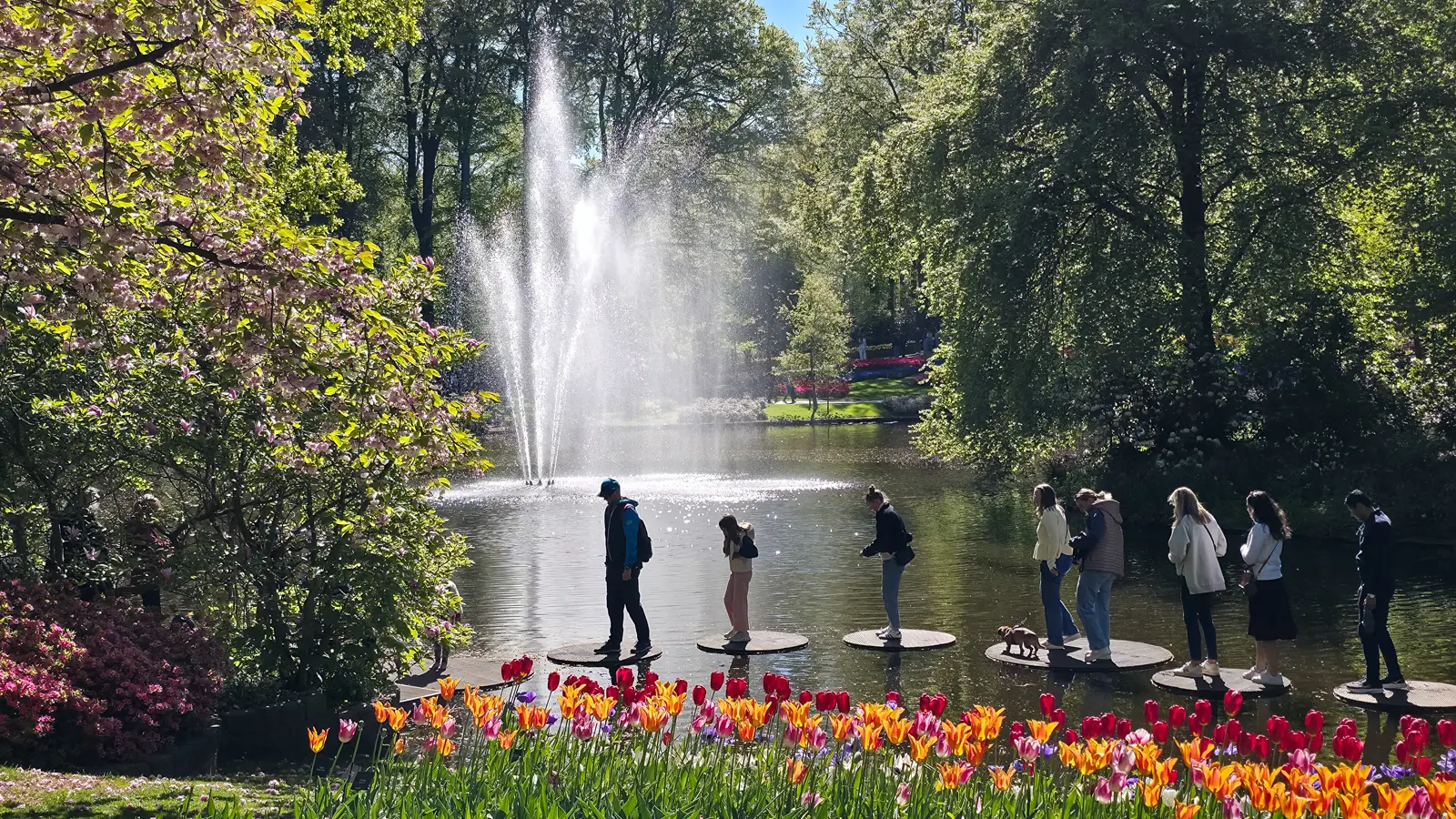
<p class="wp-block-paragraph">Just along from the bridge, a line of flat discs runs out across the water towards the fountain, and people were crossing them one at a time.</p>


<figure class="wp-block-image size-full"><a href="https://cdn.bubblyliving.com/wp-content/uploads/2026/09/keukenhof-lake-stepping-stones-fountain.webp"><img data-dominant-color="646355" data-has-transparency="false" style="--dominant-color: #646355;" loading="lazy" decoding="async" width="1600" height="900" src="https://cdn.bubblyliving.com/wp-content/uploads/2026/09/keukenhof-lake-stepping-stones-fountain.webp" alt="Visitors crossing stepping stones over the lake at Keukenhof, Lisse, with a fountain behind and a bed of orange and red tulips in front" class="wp-image-12521 not-transparent" srcset="https://cdn.bubblyliving.com/wp-content/uploads/2026/09/keukenhof-lake-stepping-stones-fountain.webp 1600w, https://cdn.bubblyliving.com/wp-content/uploads/2026/09/keukenhof-lake-stepping-stones-fountain-300x169.webp 300w, https://cdn.bubblyliving.com/wp-content/uploads/2026/09/keukenhof-lake-stepping-stones-fountain-768x432.webp 768w, https://cdn.bubblyliving.com/wp-content/uploads/2026/09/keukenhof-lake-stepping-stones-fountain-1536x864.webp 1536w, https://cdn.bubblyliving.com/wp-content/uploads/2026/09/keukenhof-lake-stepping-stones-fountain-1170x658.webp 1170w, https://cdn.bubblyliving.com/wp-content/uploads/2026/09/keukenhof-lake-stepping-stones-fountain-585x329.webp 585w" sizes="(max-width: 1600px) 100vw, 1600px" /></a><figcaption class="wp-element-caption">Keukenhof drew 1.4 million visitors in 2025 across an eight-week season, which works out at roughly 26,500 people a day. For comparison, the Rijksmuseum averages around eight thousand daily and the Efteling theme park fourteen thousand.</figcaption></figure>


<p class="wp-block-paragraph">A man in a blue cap went first, then a girl in a pink jumper stopped in the middle to look down, then a queue formed on the bank. A dachshund crossed on a lead without breaking stride. I stayed on the grass and watched, which was the right call in the shoes I had on, and the view of it was better from the bank anyway.</p>


<h2 id="h-the-fountain" class="wp-block-heading"><strong>The Fountain</strong></h2>


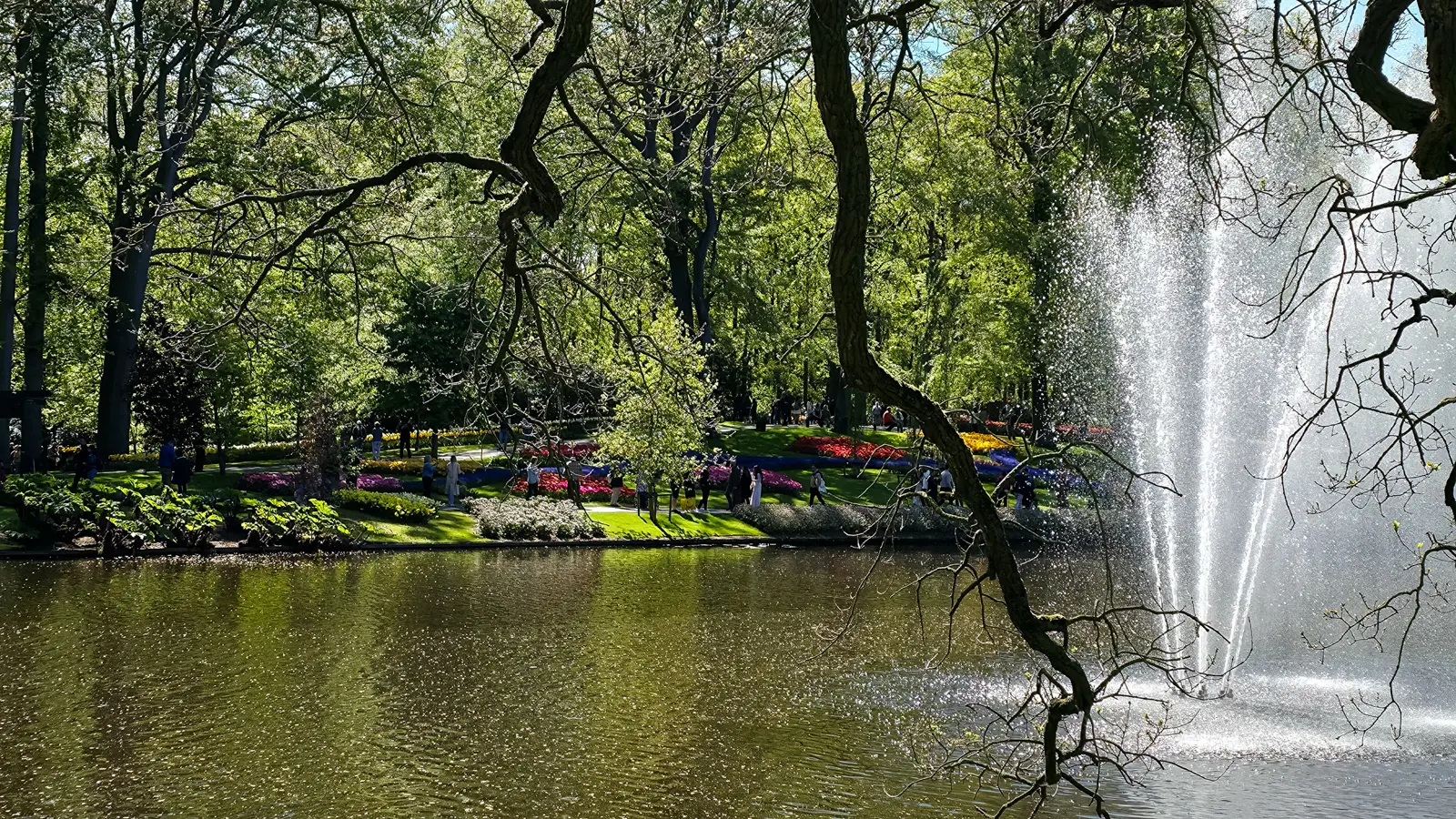
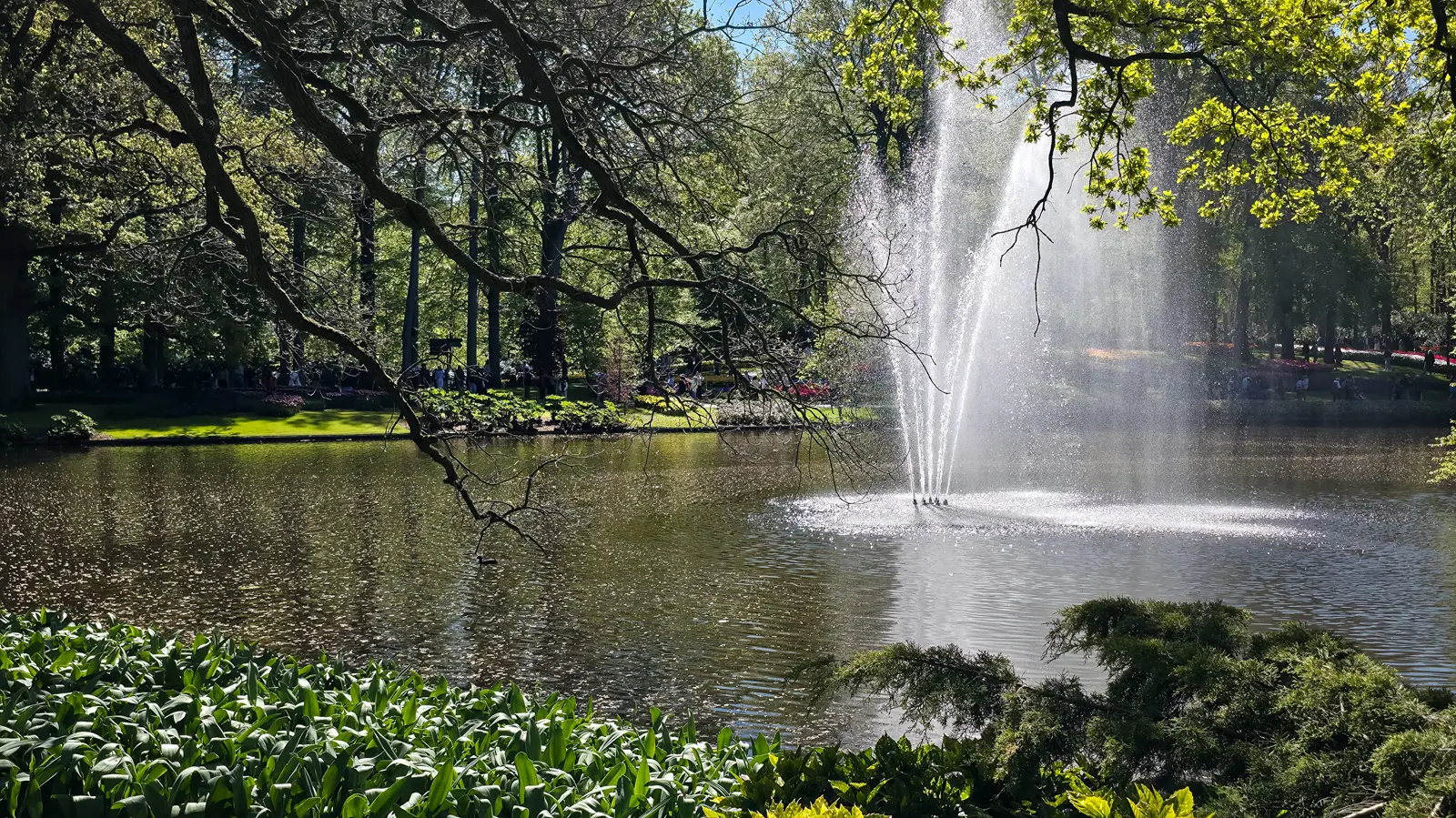
<p class="wp-block-paragraph">The fountain sits out in the middle of the lake and throws four jets, and every path along that side of the water ends up pointing at it.</p>


<figure class="wp-block-image size-full"><a href="https://cdn.bubblyliving.com/wp-content/uploads/2026/09/keukenhof-fountain-through-branches.webp"><img data-dominant-color="60654b" data-has-transparency="false" style="--dominant-color: #60654b;" loading="lazy" decoding="async" width="1600" height="900" src="https://cdn.bubblyliving.com/wp-content/uploads/2026/09/keukenhof-fountain-through-branches.webp" alt="Fountain on the Keukenhof lake, Lisse, seen through the twisted bare branches of an overhanging tree, with flower beds on the far bank" class="wp-image-12520 not-transparent" srcset="https://cdn.bubblyliving.com/wp-content/uploads/2026/09/keukenhof-fountain-through-branches.webp 1600w, https://cdn.bubblyliving.com/wp-content/uploads/2026/09/keukenhof-fountain-through-branches-300x169.webp 300w, https://cdn.bubblyliving.com/wp-content/uploads/2026/09/keukenhof-fountain-through-branches-768x432.webp 768w, https://cdn.bubblyliving.com/wp-content/uploads/2026/09/keukenhof-fountain-through-branches-1536x864.webp 1536w, https://cdn.bubblyliving.com/wp-content/uploads/2026/09/keukenhof-fountain-through-branches-1170x658.webp 1170w, https://cdn.bubblyliving.com/wp-content/uploads/2026/09/keukenhof-fountain-through-branches-585x329.webp 585w" sizes="(max-width: 1600px) 100vw, 1600px" /></a><figcaption class="wp-element-caption">The ticketed flower park is the small core of a far larger property. More than two hundred hectares of forest, meadow and castle gardens surround it, and those are open free of charge all year round.</figcaption></figure>


<p class="wp-block-paragraph">One oak on the bank has grown out almost horizontally over the water, all twisted bare limbs, and it frames the fountain from the path. The far shore reads as a long band of colour at that distance, the individual beds dissolving into stripes of red and yellow and blue.</p>


<figure class="wp-block-image size-full"><a href="https://cdn.bubblyliving.com/wp-content/uploads/2026/09/keukenhof-fountain-open-water.webp"><img data-dominant-color="5c6050" data-has-transparency="false" style="--dominant-color: #5c6050;" loading="lazy" decoding="async" width="1600" height="899" src="https://cdn.bubblyliving.com/wp-content/uploads/2026/09/keukenhof-fountain-open-water.webp" alt="Fountain and open water on the Keukenhof lake, Lisse, framed by overhanging branches, with broad tulip foliage in the foreground" class="wp-image-12519 not-transparent" srcset="https://cdn.bubblyliving.com/wp-content/uploads/2026/09/keukenhof-fountain-open-water.webp 1600w, https://cdn.bubblyliving.com/wp-content/uploads/2026/09/keukenhof-fountain-open-water-300x169.webp 300w, https://cdn.bubblyliving.com/wp-content/uploads/2026/09/keukenhof-fountain-open-water-768x432.webp 768w, https://cdn.bubblyliving.com/wp-content/uploads/2026/09/keukenhof-fountain-open-water-1536x863.webp 1536w, https://cdn.bubblyliving.com/wp-content/uploads/2026/09/keukenhof-fountain-open-water-1170x657.webp 1170w, https://cdn.bubblyliving.com/wp-content/uploads/2026/09/keukenhof-fountain-open-water-585x329.webp 585w" sizes="(max-width: 1600px) 100vw, 1600px" /></a><figcaption class="wp-element-caption">The bulbs here are lifted and replanted every year rather than left in the ground to come back, which is why the number is the same seven million every season and the colour scheme can change completely.</figcaption></figure>


<p class="wp-block-paragraph">Standing still for a minute, the water noise takes over from the crowd noise. It is the only place in the park where that happens.</p>


<h2 id="h-not-only-tulips" class="wp-block-heading"><strong>Not Only Tulips</strong></h2>


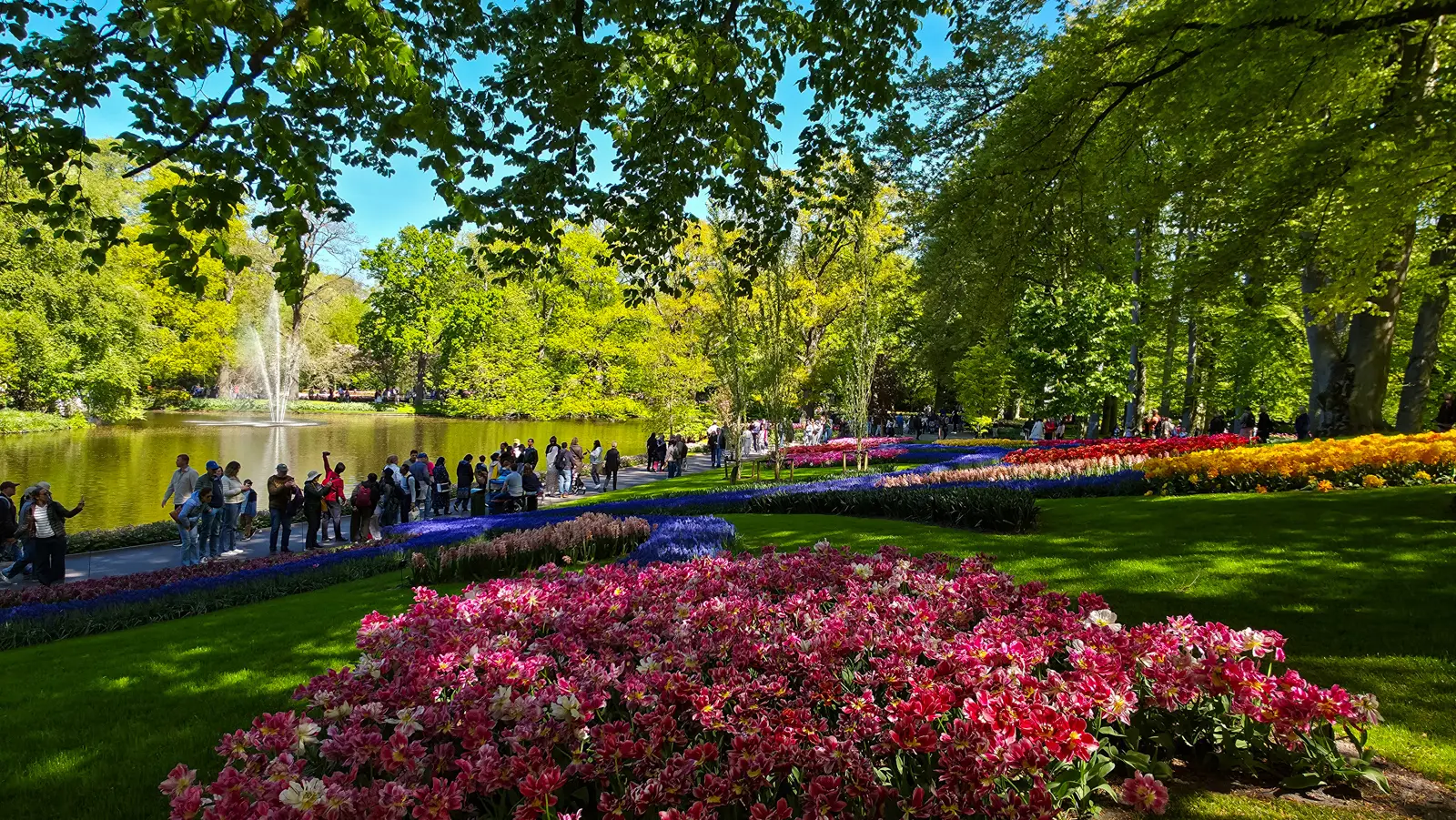
<p class="wp-block-paragraph">The other correction the lake made to my thinking is that Keukenhof is not a tulip garden. It is a bulb garden, and the tulips are simply the loudest thing in it.</p>


<figure class="wp-block-image size-full"><a href="https://cdn.bubblyliving.com/wp-content/uploads/2026/09/keukenhof-muscari-ribbons-hyacinths.webp"><img data-dominant-color="53542d" data-has-transparency="false" style="--dominant-color: #53542d;" loading="lazy" decoding="async" width="1600" height="901" src="https://cdn.bubblyliving.com/wp-content/uploads/2026/09/keukenhof-muscari-ribbons-hyacinths.webp" alt="Ribbons of blue muscari and pale hyacinths winding between lawns and tulip beds beside the lake at Keukenhof, Lisse" class="wp-image-12524 not-transparent" srcset="https://cdn.bubblyliving.com/wp-content/uploads/2026/09/keukenhof-muscari-ribbons-hyacinths.webp 1600w, https://cdn.bubblyliving.com/wp-content/uploads/2026/09/keukenhof-muscari-ribbons-hyacinths-300x169.webp 300w, https://cdn.bubblyliving.com/wp-content/uploads/2026/09/keukenhof-muscari-ribbons-hyacinths-768x432.webp 768w, https://cdn.bubblyliving.com/wp-content/uploads/2026/09/keukenhof-muscari-ribbons-hyacinths-1536x865.webp 1536w, https://cdn.bubblyliving.com/wp-content/uploads/2026/09/keukenhof-muscari-ribbons-hyacinths-1170x659.webp 1170w, https://cdn.bubblyliving.com/wp-content/uploads/2026/09/keukenhof-muscari-ribbons-hyacinths-585x329.webp 585w" sizes="(max-width: 1600px) 100vw, 1600px" /></a><figcaption class="wp-element-caption">The 2026 season ran from 19 March to 10 May, with the park open every day from eight in the morning until seven in the evening, public holidays included, and closed to the public for the remaining ten months.</figcaption></figure>


<p class="wp-block-paragraph">Ribbons of muscari, the small deep blue grape hyacinths, run in long curving bands through the grass, with paler pink and cream hyacinths beside them. Behind those come blocks of red, then orange, then a solid yellow mass. The blue is doing the work that gravel or box hedging would do in a formal garden: it draws the line the eye follows.</p>


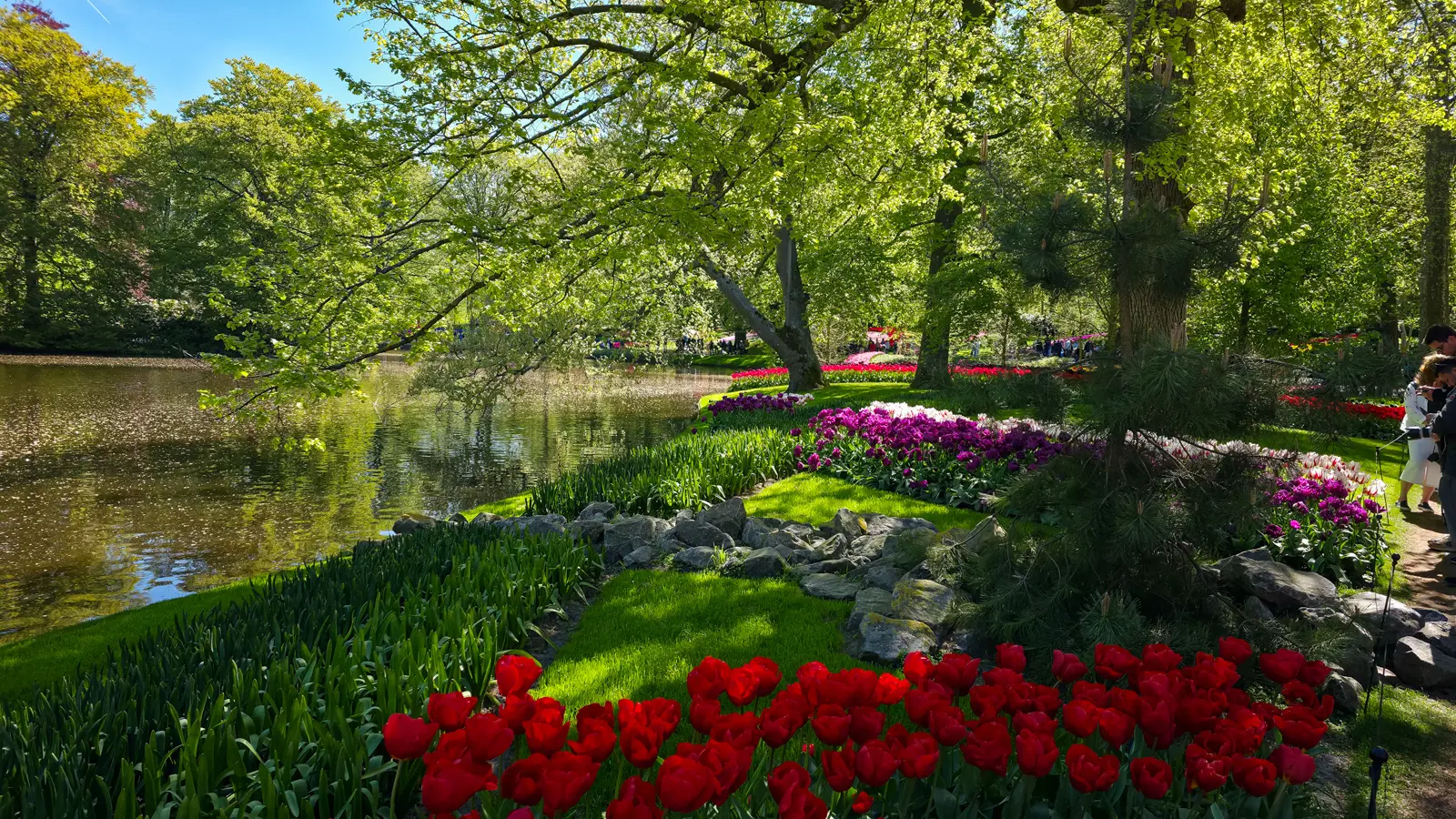
<figure class="wp-block-image size-full"><a href="https://cdn.bubblyliving.com/wp-content/uploads/2026/09/keukenhof-wooded-bank-magenta-tulips.webp"><img data-dominant-color="4f542a" data-has-transparency="false" style="--dominant-color: #4f542a;" loading="lazy" decoding="async" width="1600" height="900" src="https://cdn.bubblyliving.com/wp-content/uploads/2026/09/keukenhof-wooded-bank-magenta-tulips.webp" alt="Red, magenta and white tulip beds among rocks and lawn on the wooded bank of the lake at Keukenhof, Lisse" class="wp-image-12526 not-transparent" srcset="https://cdn.bubblyliving.com/wp-content/uploads/2026/09/keukenhof-wooded-bank-magenta-tulips.webp 1600w, https://cdn.bubblyliving.com/wp-content/uploads/2026/09/keukenhof-wooded-bank-magenta-tulips-300x169.webp 300w, https://cdn.bubblyliving.com/wp-content/uploads/2026/09/keukenhof-wooded-bank-magenta-tulips-768x432.webp 768w, https://cdn.bubblyliving.com/wp-content/uploads/2026/09/keukenhof-wooded-bank-magenta-tulips-1536x864.webp 1536w, https://cdn.bubblyliving.com/wp-content/uploads/2026/09/keukenhof-wooded-bank-magenta-tulips-1170x658.webp 1170w, https://cdn.bubblyliving.com/wp-content/uploads/2026/09/keukenhof-wooded-bank-magenta-tulips-585x329.webp 585w" sizes="(max-width: 1600px) 100vw, 1600px" /></a><figcaption class="wp-element-caption">Keukenhof opened to the public in 1950, the year after twenty bulb growers and the mayor of Lisse proposed using part of the old estate as a permanent open-air showcase for the Dutch flower trade.</figcaption></figure>


<p class="wp-block-paragraph">Along the wooded bank the planting changes again: magenta and white tulips in drifts under old trees, a low outcrop of grey rock, spears of foliage not yet in flower, and a pine hanging low over the whole arrangement. Rhododendrons and azaleas in hot pink sit at the water&#8217;s edge near the bridge. None of it is tulips, and all of it is the reason the lake looks better than the show beds.</p>


<h2 id="h-the-one-straight-line" class="wp-block-heading"><strong>The One Straight Line</strong></h2>


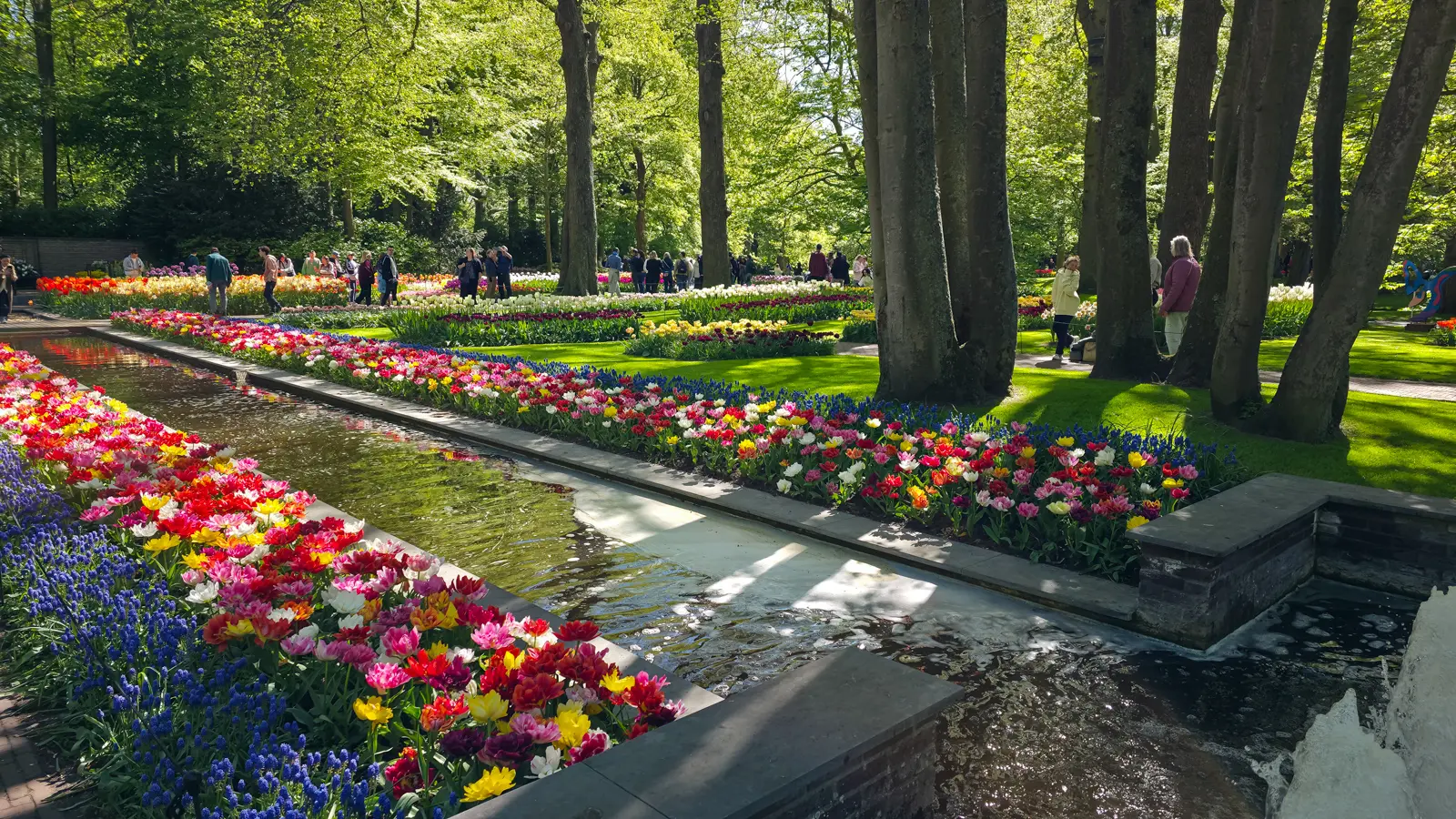
<p class="wp-block-paragraph">Further round, the park drops its curves for a moment. A narrow formal water channel runs away between paved edges, borders of mixed tulips packed tight on both sides, blue muscari at the front, and the smooth grey trunks of mature beeches standing behind.</p>


<figure class="wp-block-image size-full"><a href="https://cdn.bubblyliving.com/wp-content/uploads/2026/09/keukenhof-formal-water-channel-beeches.webp"><img data-dominant-color="585840" data-has-transparency="false" style="--dominant-color: #585840;" loading="lazy" decoding="async" width="1600" height="900" src="https://cdn.bubblyliving.com/wp-content/uploads/2026/09/keukenhof-formal-water-channel-beeches.webp" alt="Formal water channel edged with mixed tulips and blue muscari running between mature beech trunks at Keukenhof, Lisse" class="wp-image-12518 not-transparent" srcset="https://cdn.bubblyliving.com/wp-content/uploads/2026/09/keukenhof-formal-water-channel-beeches.webp 1600w, https://cdn.bubblyliving.com/wp-content/uploads/2026/09/keukenhof-formal-water-channel-beeches-300x169.webp 300w, https://cdn.bubblyliving.com/wp-content/uploads/2026/09/keukenhof-formal-water-channel-beeches-768x432.webp 768w, https://cdn.bubblyliving.com/wp-content/uploads/2026/09/keukenhof-formal-water-channel-beeches-1536x864.webp 1536w, https://cdn.bubblyliving.com/wp-content/uploads/2026/09/keukenhof-formal-water-channel-beeches-1170x658.webp 1170w, https://cdn.bubblyliving.com/wp-content/uploads/2026/09/keukenhof-formal-water-channel-beeches-585x329.webp 585w" sizes="(max-width: 1600px) 100vw, 1600px" /></a><figcaption class="wp-element-caption">The name Keukenhof means kitchen garden. In the fifteenth century this land supplied herbs, fruit and game to the kitchen of Teylingen Castle, where Countess Jacoba van Beieren lived until her death in 1436.</figcaption></figure>


<p class="wp-block-paragraph">It is the one piece of straight-line geometry in a park built on the principle of not having any, and the contrast is what makes it work. The beeches do most of it. Their trunks are pale and branchless for the first several metres, so the eye reads them as columns, and the tulips at their feet look planted in a nave.</p>


<h2 id="h-watching-people" class="wp-block-heading"><strong>Watching People</strong></h2>


<p class="wp-block-paragraph">What I actually did for the last stretch was stop walking.</p>


<p class="wp-block-paragraph">There were families on the grass, children hanging over the edge of the water, dogs on leads, several couples taking the same photograph in turn, and a steady traffic of people going nowhere in particular. Nobody was queuing for anything. The paths are wide enough on that side that a park taking twenty-six thousand people a day stops pressing in on anybody.</p>


<p class="wp-block-paragraph">I had come out of an exhibition hall looking for another exhibition hall, and the best hour of the visit turned out to be the bit between them.</p>


<h2 id="h-bubbly-tips" class="wp-block-heading"><strong>Bubbly Tips</strong></h2>


<ul class="wp-block-list">
<li><strong>Do not look for the orchids in the Wilhelmina Pavilion.</strong> It is one of the only pavilions with no floral display at all: shop, food, drinks and toilets. The orchid and anthurium show is normally in the Beatrix Pavilion in the north-east corner, but in 2026 it moved to the Juliana. Check the map at the gate rather than assuming, because the pavilions do swap shows between seasons.</li>


<li><strong>Use the Wilhelmina anyway.</strong> It is the natural stop on the lake circuit if you need a coffee, a toilet or twenty minutes off your feet, and the terrace outside has the best outlook of any food stop in the park.</li>


<li><strong>Walk the whole lake, not half of it.</strong> The circuit takes around thirty to forty minutes at a wandering pace and it is the quietest part of Keukenhof. Most visitors cut between pavilions and miss it entirely.</li>


<li><strong>The stone bridge is the reflection shot.</strong> Stand on the south bank looking across at the pavilion and the water does the rest. Earlier in the day gives you stiller water and fewer people sitting on the parapet.</li>


<li><strong>The stepping stones are more solid than they look.</strong> They are broad, flat and stable, and children and dogs were crossing without trouble. A queue builds at busy times, so either commit or watch from the bank.</li>


<li><strong>Look for the things that are not tulips.</strong> The muscari ribbons, the hyacinths, the daffodils, the rhododendrons and the azaleas around the lake are doing most of the compositional work, and almost nobody photographs them.</li>


<li><strong>Season and hours matter more here than at most attractions.</strong> The 2026 season ran 19 March to 10 May, daily from eight until seven. Outside those eight weeks the park is closed to the public entirely.</li>


<li><strong>Arrive early if you want the water calm.</strong> The classic still-reflection photographs happen in the first hour after opening, before the wind picks up and before the paths fill.</li>


<li><strong>Getting there without a car is straightforward.</strong> Buses run to Keukenhof from Haarlem, Leiden and Schiphol, and a combined bus and entry ticket is usually the cheaper option.</li>
</ul>


<h2 id="h-final-thoughts" class="wp-block-heading"><strong>Final Thoughts</strong></h2>


<p class="wp-block-paragraph">The lake is the oldest thing at Keukenhof and the least advertised. Everything in the brochures is a display: a pavilion, a show, a themed garden, seven million bulbs arranged by people who do this for a living. The lake is just a nineteenth-century landscape park doing what the Zochers designed it to do, with a spring&#8217;s worth of colour laid along its banks as a seasonal extra.</p>


<p class="wp-block-paragraph">I went looking for a room full of orchids and did not find it. What I got instead was a stone bridge, a fountain, a line of people crossing water on stepping stones and a dachshund, and a bed of blue muscari running through grass like a river. If the orchids had been where I thought they were, I would have walked past all of it.</p>


<p class="wp-block-paragraph">Until next time!</p>


<script type="application/ld+json">
{
  "@context": "https://schema.org",
  "@graph": [
    {
      "@type": "Article",
      "@id": "https://www.bubblyliving.com/keukenhof-lake-lisse/#article",
      "headline": "The Keukenhof Lake: What I Found Looking for the Orchids",
      "description": "The quietest, oldest part of Keukenhof: a 19th-century landscape lake with a stone bridge, stepping stones, a fountain, and the muscari nobody photographs.",
      "image": "https://cdn.bubblyliving.com/wp-content/uploads/2026/09/keukenhof-lake-tulip-beds-shoreline.webp",
      "datePublished": "2026-09-15T00:00:00-04:00",
      "dateModified": "2026-09-15T00:00:00-04:00",
      "author": {
        "@type": "Person",
        "name": "Bubbly",
        "url": "https://www.bubblyliving.com/about-bubbly/"
      },
      "publisher": {
        "@type": "Organization",
        "name": "BubblyLiving",
        "url": "https://www.bubblyliving.com/"
      },
      "mainEntityOfPage": {
        "@type": "WebPage",
        "@id": "https://www.bubblyliving.com/keukenhof-lake-lisse/"
      },
      "about": [
        {
          "@type": "TouristAttraction",
          "name": "Keukenhof",
          "url": "https://keukenhof.nl/en/",
          "image": "https://cdn.bubblyliving.com/wp-content/uploads/2026/09/keukenhof-lake-tulip-beds-shoreline.webp",
          "address": {
            "@type": "PostalAddress",
            "streetAddress": "Stationsweg 166A",
            "addressLocality": "Lisse",
            "postalCode": "2161 AM",
            "addressCountry": "NL"
          },
          "geo": { "@type": "GeoCoordinates", "latitude": 52.2703, "longitude": 4.5468 }
        },
        { "@type": "Person", "name": "Jan David Zocher" }
      ]
    },
    {
      "@type": "FAQPage",
      "@id": "https://www.bubblyliving.com/keukenhof-lake-lisse/#faq",
      "mainEntity": [
        {
          "@type": "Question",
          "name": "Is there a lake at Keukenhof?",
          "acceptedAnswer": {
            "@type": "Answer",
            "text": "Yes. A large lake sits at the heart of Keukenhof, part of the 19th-century English landscape park that the flower displays are laid over. It has a stone bridge, a four-jet fountain, a line of stepping stones across the water, and flower beds along both banks. It is the oldest and quietest part of the park: most visitors move between the pavilions and miss the lake circuit, which takes about 30 to 40 minutes to walk."
          }
        },
        {
          "@type": "Question",
          "name": "How old is Keukenhof, and what was it before the flower garden?",
          "acceptedAnswer": {
            "@type": "Answer",
            "text": "Much older than the flower show. The estate's manor house (now Keukenhof Castle) was built in 1641 for Adriaen Maertensz Block, a captain and governor of the Dutch East India Company, and the land had been a kitchen garden and hunting ground for Teylingen Castle since the 15th century (hence the name, which means kitchen garden). The grounds were laid out as an English landscape park in 1857 by Jan David Zocher and his son Louis Paul Zocher. The public flower exhibition only opened in 1950."
          }
        },
        {
          "@type": "Question",
          "name": "Who designed Keukenhof, and did they design anything else famous?",
          "acceptedAnswer": {
            "@type": "Answer",
            "text": "The landscape park was designed in 1857 by the landscape architects Jan David Zocher and his son Louis Paul Zocher, in the English landscape style (winding paths, framed sightlines, naturalistic water). The same father-and-son practice also designed Amsterdam's Vondelpark, which is why the two places handle their trees, lawns and water in a strikingly similar way. The Zocher layout still forms the underlying structure of Keukenhof today; the flower beds are dressed onto it each spring."
          }
        },
        {
          "@type": "Question",
          "name": "Is Keukenhof only tulips?",
          "acceptedAnswer": {
            "@type": "Answer",
            "text": "No. Keukenhof is a bulb garden, and tulips are simply the most prominent flower; around 7 million bulbs are planted each year, including large quantities of daffodils, hyacinths and muscari (grape hyacinths), plus flowering shrubs like rhododendrons and azaleas. Around the lake especially, the ribbons of blue muscari and the hyacinths do much of the compositional work, drawing the lines the eye follows. The bulbs are lifted and replanted every year, so the colour scheme changes between seasons."
          }
        },
        {
          "@type": "Question",
          "name": "What is the quietest part of Keukenhof?",
          "acceptedAnswer": {
            "@type": "Answer",
            "text": "The lake circuit. While the pavilions and the main show beds draw the crowds, the paths around the water are wide and comparatively empty, and it is the one place in the park where the sound of the fountain replaces the sound of the crowd. Walking the full lake (about 30 to 40 minutes) is the easiest way to escape the busiest areas, especially in the first hour after opening or later in the afternoon."
          }
        },
        {
          "@type": "Question",
          "name": "How do you get to Keukenhof, and when is it open?",
          "acceptedAnswer": {
            "@type": "Answer",
            "text": "Keukenhof is in Lisse, between Amsterdam and The Hague, and has no train station of its own; buses run from Haarlem, Leiden and Schiphol, and a combined bus-and-entry ticket is usually the cheapest option. The park is open only in spring: the 2026 season ran from 19 March to 10 May, daily from 8am to 7pm, including public holidays, and it is closed to the public for the rest of the year (the surrounding castle grounds stay open year-round)."
          }
        }
      ]
    }
  ]
}
</script>
<p>The post <a href="https://www.bubblyliving.com/keukenhof-lake-lisse/">The Keukenhof Lake: What I Found Looking for the Orchids</a> appeared first on <a href="https://www.bubblyliving.com">Bubbly Living</a>.</p>
]]></content>
		
					<link rel="replies" type="text/html" href="https://www.bubblyliving.com/keukenhof-lake-lisse/#comments" thr:count="0" />
			<link rel="replies" type="application/atom+xml" href="https://www.bubblyliving.com/keukenhof-lake-lisse/feed/atom/" thr:count="0" />
			<thr:total>0</thr:total>
			</entry>
		<entry>
		<author>
			<name>Bubbly</name>
							<uri>https://www.bubblyliving.com</uri>
						</author>

		<title type="html"><![CDATA[The Night Watch Under Repair at the Rijksmuseum]]></title>
		<link rel="alternate" type="text/html" href="https://www.bubblyliving.com/night-watch-rijksmuseum-restoration/" />

		<id>https://www.bubblyliving.com/?p=12512</id>
		<updated>2026-09-14T03:04:44Z</updated>
		<published>2026-09-14T04:00:00Z</published>
		<category scheme="https://www.bubblyliving.com/" term="Amsterdam" /><category scheme="https://www.bubblyliving.com/" term="Museums &amp; Art" />
		<summary type="html"><![CDATA[<p>I had seen this painting perhaps four hundred times before I ever saw it. On fridge magnets, on tea towels, on postcards in every souvenir shop between Centraal and the Bloemenmarkt in&#8230;</p>
<p>The post <a href="https://www.bubblyliving.com/night-watch-rijksmuseum-restoration/">The Night Watch Under Repair at the Rijksmuseum</a> appeared first on <a href="https://www.bubblyliving.com">Bubbly Living</a>.</p>
]]></summary>

					<content type="html" xml:base="https://www.bubblyliving.com/night-watch-rijksmuseum-restoration/"><![CDATA[
<p class="wp-block-paragraph">I had seen this painting perhaps four hundred times before I ever saw it. On fridge magnets, on tea towels, on postcards in every souvenir shop between Centraal and the Bloemenmarkt in <strong><a href="https://www.bubblyliving.com/amsterdam-in-spring/" data-bubblylinks="2351">Amsterdam</a></strong>. I knew it was a <strong><a href="https://www.bubblyliving.com/rembrandt-national-gallery-london/" data-bubblylinks="2350">Rembrandt</a></strong>. I could not have told anyone what was happening in it, who any of the men were, or why this one and not another.</p>


<p class="wp-block-paragraph">Compare that with Van Gogh. I could have talked at length about the sunflowers, about why he painted them and what they were for. This I had filed under famous, and left there.</p>


<p class="wp-block-paragraph">Nobody had told me it was the <strong><a href="https://www.bubblyliving.com/rijksmuseum-amsterdam/" data-bubblylinks="2354">Rijksmuseum</a></strong>&#8216;s <a href="https://www.bubblyliving.com/my-encounter-with-the-mona-lisa-a-timeless-icon/" data-bubblylinks="2348">Mona Lisa</a>. Some people make exactly that comparison, and having stood in front of it I understand why, though the reason turned out to have nothing to do with fame.</p>


<p class="selector wp-block-paragraph"><strong>The Night Watch at a Glance</strong><br>🖼️ <strong>What it is</strong> · Not a night scene and not called the Night Watch. Formally Militia Company of District II under Captain Frans Banninck Cocq (1642): a group portrait eighteen guardsmen paid to be in.<br>🌙 <strong>The name</strong> · A mistake from darkened varnish, first recorded in 1797. Rembrandt painted a company being ordered to march in broad daylight.<br>✂️ <strong>Cut down in 1715</strong> · Trimmed on all four sides to fit a wall in the Town Hall (now the Royal Palace); two figures lost on the left. A 1650s copy in London&#8217;s National Gallery shows the whole.<br>🔬 <strong>Operation Night Watch</strong> · Since 2019, the biggest-ever study and restoration, done in public: a five-phase programme, currently removing varnish, some of it repair work from past attacks.<br>💡 <strong>Tip</strong> · Go first, look up at the gold frieze, and use a conservator on the platform as your ruler.</p>


<h2 id="h-a-room-built-for-one-painting" class="wp-block-heading"><strong>A Room Built for One Painting</strong></h2>


<p class="wp-block-paragraph">We went straight there, before anything else, on a guided tour. The room was already full, our group and several others, everybody angling for a clear line of sight through the glass.</p>


<p class="wp-block-paragraph">It is worth knowing that this is not the Gallery of Honour, which is the long corridor of alcoves everybody photographs and which we came back to at the end of the day. The Night Watch has its own room at the far end of that corridor, the <strong>Nachtwachtzaal</strong>, designed and built for this one canvas.</p>


<figure class="wp-block-image size-full"><a href="https://cdn.bubblyliving.com/wp-content/uploads/2026/09/night-watch-gallery-restoration-rig-caryatids.webp"><img data-dominant-color="383b40" data-has-transparency="false" style="--dominant-color: #383b40;" loading="lazy" decoding="async" width="1600" height="900" src="https://cdn.bubblyliving.com/wp-content/uploads/2026/09/night-watch-gallery-restoration-rig-caryatids.webp" alt="The Night Watch Gallery, Rijksmuseum, Amsterdam, with the restoration rig beside a marble column and gilded frieze lettering above" class="wp-image-12507 not-transparent" srcset="https://cdn.bubblyliving.com/wp-content/uploads/2026/09/night-watch-gallery-restoration-rig-caryatids.webp 1600w, https://cdn.bubblyliving.com/wp-content/uploads/2026/09/night-watch-gallery-restoration-rig-caryatids-300x169.webp 300w, https://cdn.bubblyliving.com/wp-content/uploads/2026/09/night-watch-gallery-restoration-rig-caryatids-768x432.webp 768w, https://cdn.bubblyliving.com/wp-content/uploads/2026/09/night-watch-gallery-restoration-rig-caryatids-1536x864.webp 1536w, https://cdn.bubblyliving.com/wp-content/uploads/2026/09/night-watch-gallery-restoration-rig-caryatids-1170x658.webp 1170w, https://cdn.bubblyliving.com/wp-content/uploads/2026/09/night-watch-gallery-restoration-rig-caryatids-585x329.webp 585w" sizes="(max-width: 1600px) 100vw, 1600px" /></a><figcaption class="wp-element-caption">The gilded female figures crowning the columns in this room are caryatids, and the museum’s own account of the architecture says they were put there to allude to Rembrandt’s handling of light and shade.</figcaption></figure>


<p class="wp-block-paragraph"><strong>Pierre Cuypers</strong>, the architect who built the museum in the 1880s, laid the whole axis out like a church. The corridor is the nave, the alcoves along it were originally closed off with heavy curtains, and this room at the end is the high altar. The museum uses that comparison itself.</p>


<p class="wp-block-paragraph">Look above the chamber and there is gold lettering running round the walls: <strong>IN DE WESTERKERK</strong>, then <strong>REMBRANDT</strong>, then <strong>ZOON VAN HARMEN</strong>. It is not ornament. The frieze is a biography. Zoon van Harmen means son of Harmen, which is where the Harmenszoon in his name comes from, and the Westerkerk is the church where he was buried in 1669. His life is written round the room in which his painting stands.</p>


<h2 id="h-what-it-actually-shows" class="wp-block-heading"><strong>What It Actually Shows</strong></h2>


<p class="wp-block-paragraph">The title is not The Night Watch. It is <strong>Militia Company of District II under the Command of Captain Frans Banninck Cocq</strong>, finished in <strong>1642</strong>, and once that is said the picture stops being a mystery.</p>


<figure class="wp-block-image size-full"><a href="https://cdn.bubblyliving.com/wp-content/uploads/2026/09/night-watch-varnish-removal-conservators.webp"><img data-dominant-color="373a39" data-has-transparency="false" style="--dominant-color: #373a39;" loading="lazy" decoding="async" width="1600" height="900" src="https://cdn.bubblyliving.com/wp-content/uploads/2026/09/night-watch-varnish-removal-conservators.webp" alt="The Night Watch during varnish removal at the Rijksmuseum, Amsterdam, with conservators working at the lower right and upper left of the canvas" class="wp-image-12509 not-transparent" srcset="https://cdn.bubblyliving.com/wp-content/uploads/2026/09/night-watch-varnish-removal-conservators.webp 1600w, https://cdn.bubblyliving.com/wp-content/uploads/2026/09/night-watch-varnish-removal-conservators-300x169.webp 300w, https://cdn.bubblyliving.com/wp-content/uploads/2026/09/night-watch-varnish-removal-conservators-768x432.webp 768w, https://cdn.bubblyliving.com/wp-content/uploads/2026/09/night-watch-varnish-removal-conservators-1536x864.webp 1536w, https://cdn.bubblyliving.com/wp-content/uploads/2026/09/night-watch-varnish-removal-conservators-1170x658.webp 1170w, https://cdn.bubblyliving.com/wp-content/uploads/2026/09/night-watch-varnish-removal-conservators-585x329.webp 585w" sizes="(max-width: 1600px) 100vw, 1600px" /></a><figcaption class="wp-element-caption">The canvas hung in the Kloveniersdoelen, the headquarters of the Amsterdam arquebusiers, for more than seventy years before anyone moved it. It was made for a specific wall in a specific building, as one of a set.</figcaption></figure>


<p class="wp-block-paragraph">It is a group portrait that people paid to be in. Banninck Cocq and seventeen members of his civic guard commissioned it around 1639, each contributing roughly a hundred guilders depending on how prominently he appeared, sixteen hundred guilders in total. Thirty-four figures end up in the finished painting, so a good number of them are there for nothing.</p>


<p class="wp-block-paragraph">The man in black with the red sash, dead centre, is the captain giving the order to move out. The man beside him in pale yellow with the white sash is his lieutenant, Willem van Ruytenburch. Everything else follows from that single gesture: a musket going off, a drummer starting up, a dog, a banner, men still forming into ranks. No battle, no patrol. What Rembrandt painted is the moment a company is told to march, and he painted it as though the paint itself were moving.</p>


<p class="wp-block-paragraph">That is the part nobody puts on a magnet. What made Rembrandt&#8217;s version different from the other militia pieces hanging in that same hall was that he refused to line them up.</p>


<h2 id="h-why-it-is-called-the-night-watch" class="wp-block-heading"><strong>Why It Is Called the Night Watch</strong></h2>


<p class="wp-block-paragraph">It is broad daylight. The cast shadows say so, and so does everything the conservators have found.</p>


<p class="wp-block-paragraph">The name came from the varnish. Layer upon layer of it darkened and yellowed over the centuries until the scene read as nocturnal, and the nickname stuck. It appears in writing for the first time in 1797, a hundred and fifty-five years after Rembrandt finished the work. The heaviest of that varnish came off in the 1940s and the picture turned out to be a day scene, but by then the wrong name had won.</p>


<h2 id="h-what-was-cut-off-in-1715" class="wp-block-heading"><strong>What Was Cut Off in 1715</strong></h2>


<p class="wp-block-paragraph">In 1715 the painting was moved out of the militia hall to <strong>Amsterdam&#8217;s Town Hall</strong>, the building that is now the <a href="https://www.bubblyliving.com/royal-palace-amsterdam/" data-bubblylinks="2352">Royal Palace</a> on <a href="https://www.bubblyliving.com/dam-square-amsterdam/" data-bubblylinks="2353">Dam Square</a>. It did not fit the new wall, so they cut it down on all four sides to sit between two columns.</p>


<p class="wp-block-paragraph">Gone from the left: two figures, the top of the arch, the balustrade and the edge of a step. Those pieces were never found and presumably never kept. The painting that draws two and a half million people a year is a trimmed version of itself, and the only record of what it looked like whole is a smaller copy made in the seventeenth century by <strong>Gerrit Lundens</strong>, a contemporary of Rembrandt&#8217;s, which hangs in the <strong><a href="https://www.bubblyliving.com/national-gallery-london/" data-bubblylinks="2358">National Gallery</a></strong> in <strong><a href="https://www.bubblyliving.com/london-travel-guide/" data-bubblylinks="2349">London</a></strong>.</p>


<h2 id="h-the-operation" class="wp-block-heading"><strong>The Operation</strong></h2>


<p class="wp-block-paragraph">Since 2019 the painting has been the subject of <strong>Operation Night Watch</strong>, the largest programme of research and conservation ever carried out on it, and all of it happens in public.</p>


<figure class="wp-block-image size-full"><a href="https://cdn.bubblyliving.com/wp-content/uploads/2026/09/night-watch-conservator-platform-akzonobel-apron.webp"><img data-dominant-color="404a50" data-has-transparency="false" style="--dominant-color: #404a50;" loading="lazy" decoding="async" width="1600" height="900" src="https://cdn.bubblyliving.com/wp-content/uploads/2026/09/night-watch-conservator-platform-akzonobel-apron.webp" alt="Conservator on the raised platform beside the Night Watch at the Rijksmuseum, Amsterdam, wearing an Operation Night Watch apron" class="wp-image-12506 not-transparent" srcset="https://cdn.bubblyliving.com/wp-content/uploads/2026/09/night-watch-conservator-platform-akzonobel-apron.webp 1600w, https://cdn.bubblyliving.com/wp-content/uploads/2026/09/night-watch-conservator-platform-akzonobel-apron-300x169.webp 300w, https://cdn.bubblyliving.com/wp-content/uploads/2026/09/night-watch-conservator-platform-akzonobel-apron-768x432.webp 768w, https://cdn.bubblyliving.com/wp-content/uploads/2026/09/night-watch-conservator-platform-akzonobel-apron-1536x864.webp 1536w, https://cdn.bubblyliving.com/wp-content/uploads/2026/09/night-watch-conservator-platform-akzonobel-apron-1170x658.webp 1170w, https://cdn.bubblyliving.com/wp-content/uploads/2026/09/night-watch-conservator-platform-akzonobel-apron-585x329.webp 585w" sizes="(max-width: 1600px) 100vw, 1600px" /></a><figcaption class="wp-element-caption">The main partner named across the back of every apron in this room is AkzoNobel, a Dutch company whose principal business today is manufacturing paint, which makes the sponsorship a good deal less arbitrary than most museum branding.</figcaption></figure>


<p class="wp-block-paragraph">A steel gantry carries a platform that rises and slides across the face of the canvas. Lighting panels hang on rails. A digital microscope sits clamped to a stand. Two conservators were working while we were there, one high on the platform and one crouched at the bottom edge, both in black aprons lettered OPERATION NIGHT WATCH.</p>


<p class="wp-block-paragraph">She is the reason the scale lands. Standing on the platform at the level of the captain&#8217;s hat, a grown woman comes up to roughly the height of the painted figures&#8217; heads. The canvas is 363 centimetres tall and 437 wide, and no number does what that comparison does.</p>


<h2 id="h-five-phases-and-the-current-one" class="wp-block-heading"><strong>Five Phases, and the Current One</strong></h2>


<p class="wp-block-paragraph">A panel on the side wall sets out the whole programme in Dutch and English.</p>


<figure class="wp-block-image size-full"><a href="https://cdn.bubblyliving.com/wp-content/uploads/2026/09/operation-night-watch-five-phases-panel.webp"><img data-dominant-color="383e43" data-has-transparency="false" style="--dominant-color: #383e43;" loading="lazy" decoding="async" width="1600" height="900" src="https://cdn.bubblyliving.com/wp-content/uploads/2026/09/operation-night-watch-five-phases-panel.webp" alt="Wall panel in the Night Watch Gallery, Rijksmuseum, Amsterdam, listing the five phases of Operation Night Watch in Dutch and English" class="wp-image-12510 not-transparent" srcset="https://cdn.bubblyliving.com/wp-content/uploads/2026/09/operation-night-watch-five-phases-panel.webp 1600w, https://cdn.bubblyliving.com/wp-content/uploads/2026/09/operation-night-watch-five-phases-panel-300x169.webp 300w, https://cdn.bubblyliving.com/wp-content/uploads/2026/09/operation-night-watch-five-phases-panel-768x432.webp 768w, https://cdn.bubblyliving.com/wp-content/uploads/2026/09/operation-night-watch-five-phases-panel-1536x864.webp 1536w, https://cdn.bubblyliving.com/wp-content/uploads/2026/09/operation-night-watch-five-phases-panel-1170x658.webp 1170w, https://cdn.bubblyliving.com/wp-content/uploads/2026/09/operation-night-watch-five-phases-panel-585x329.webp 585w" sizes="(max-width: 1600px) 100vw, 1600px" /></a><figcaption class="wp-element-caption">The museum has never announced a finishing date. The conservators have said publicly that the work is difficult enough that they do not know when it will end, which is an unusual admission for a project this visible.</figcaption></figure>


<p class="wp-block-paragraph">Phase one was research. Phase two was structural treatment. Phase three, the one under way when we were there, is the removal of varnish and overpaint. Phase four will be fillings, retouches and fresh varnish. Phase five is a new frame.</p>


<p class="wp-block-paragraph">The panel explains what varnish is for, which is not something I had thought about. It protects the paint and it saturates it, so the colours read at their proper brightness. The layers currently on the painting have cracked and discoloured, so they scatter light instead of letting it through. Conservators lift them with solvents, tissues and cotton swabs, and the panel warns that cleaned areas look greyer and duller than the rest until the new varnish goes on.</p>


<p class="wp-block-paragraph">That is exactly what the canvas looked like: patchy, unresolved, a masterpiece in the middle of being taken apart.</p>


<h2 id="h-three-attacks-three-layers-of-varnish" class="wp-block-heading"><strong>Three Attacks, Three Layers of Varnish</strong></h2>


<p class="wp-block-paragraph">Here is the thing I did not understand until afterwards, and it is written on that panel in plain numbers.</p>


<p class="wp-block-paragraph">The varnish layers being removed were applied in 1976, 1980 and 1990.</p>


<figure class="wp-block-image size-full"><a href="https://cdn.bubblyliving.com/wp-content/uploads/2026/09/night-watch-mid-restoration-platform-frieze.webp"><img data-dominant-color="363d43" data-has-transparency="false" style="--dominant-color: #363d43;" loading="lazy" decoding="async" width="1600" height="900" src="https://cdn.bubblyliving.com/wp-content/uploads/2026/09/night-watch-mid-restoration-platform-frieze.webp" alt="The Night Watch mid-restoration at the Rijksmuseum, Amsterdam, a conservator on the raised platform and gilded lettering above" class="wp-image-12508 not-transparent" srcset="https://cdn.bubblyliving.com/wp-content/uploads/2026/09/night-watch-mid-restoration-platform-frieze.webp 1600w, https://cdn.bubblyliving.com/wp-content/uploads/2026/09/night-watch-mid-restoration-platform-frieze-300x169.webp 300w, https://cdn.bubblyliving.com/wp-content/uploads/2026/09/night-watch-mid-restoration-platform-frieze-768x432.webp 768w, https://cdn.bubblyliving.com/wp-content/uploads/2026/09/night-watch-mid-restoration-platform-frieze-1536x864.webp 1536w, https://cdn.bubblyliving.com/wp-content/uploads/2026/09/night-watch-mid-restoration-platform-frieze-1170x658.webp 1170w, https://cdn.bubblyliving.com/wp-content/uploads/2026/09/night-watch-mid-restoration-platform-frieze-585x329.webp 585w" sizes="(max-width: 1600px) 100vw, 1600px" /></a><figcaption class="wp-element-caption">The restoration that followed the 1975 knife attack took the museum’s conservators around eight months of continuous work. The scars it left can still be traced on the canvas at close range, which is part of what the current team is reassessing.</figcaption></figure>


<p class="wp-block-paragraph">On 13 January <strong>1911</strong> an unemployed shoemaker went at the painting with a knife. The varnish was thick enough to take the blade and the paint underneath survived. On 14 September <strong>1975</strong> a Dutch schoolteacher slashed it repeatedly with a bread knife, and that one did real damage. On 6 April <strong>1990</strong> a man sprayed it with sulphuric acid, and a guard flooded the canvas with water fast enough that the acid got no further than the varnish.</p>


<p class="wp-block-paragraph">Two of the three coatings now being lifted off went on after those attacks. The layer the conservators are dissolving with cotton swabs is, in part, the repair work from a knife and a bottle of acid. The painting is not merely old. It has been assaulted three times in a hundred and fifteen years, and what is being removed is the evidence of it surviving.</p>


<h2 id="h-bubbly-tips" class="wp-block-heading"><strong>Bubbly Tips</strong></h2>


<ul class="wp-block-list">
<li><strong>Go to it first.</strong> We did, before anything else, and it was the right order. The rest of the museum makes more sense once the thing at the end of the axis has been seen, and the crowd only thickens through the day.</li>


<li><strong>Know which room you want.</strong> The Gallery of Honour is the long corridor of alcoves. The Night Watch is in its own room at the end of it. Asking for one when you mean the other will cost you ten minutes.</li>


<li><strong>Expect a crowd and plan for it.</strong> Several rows deep is normal, tour groups included. Stand back and wait rather than pressing forward; people cycle through quickly and the second row clears fast.</li>


<li><strong>Look up before you look at the painting.</strong> The gold frieze running round the walls sets out Rembrandt&#8217;s life, and the gilded figures on the column capitals are there to nod at his light and shade. Almost nobody in that room raised their eyes.</li>


<li><strong>Use the conservator as your ruler.</strong> If someone is working on the platform, note where her head reaches against the painted figures. That does more for the scale than any measurement.</li>


<li><strong>Read the panel on the side wall.</strong> It explains what varnish does and why removing it makes the painting look worse before better. Two minutes, and it changes what you are looking at.</li>


<li><strong>Photograph it off-centre.</strong> It sits behind protective glass and the lighting panels reflect straight back. Standing to one side and shooting at a slight angle avoids the worst of it.</li>


<li><strong>Book a guided tour if you want the context.</strong> Ours talked us through what was happening on the platform, which is not obvious from the panel alone.</li>


<li><strong>If you are ever at the National Gallery in London, look for the Lundens copy</strong>. It shows the painting as it was before 1715, with the figures and the balustrade that Amsterdam cut off.</li>
</ul>


<h2 id="h-final-thoughts" class="wp-block-heading"><strong>Final Thoughts</strong></h2>


<p class="wp-block-paragraph">I came in able to recognise it and unable to say a single true thing about it. I left knowing it is a group portrait that eighteen men paid for, that it shows a company being ordered to march on a bright day, that its name is a mistake caused by dirty varnish, and that a third of a metre of it is missing on one side because a wall in 1715 was the wrong size.</p>


<p class="wp-block-paragraph">What actually converted me was not the information. It was watching a woman on a hydraulic platform lean towards four hundred year old paint with a cotton swab, in a room built like a chapel, with the painter&#8217;s life lettered in gold above her head. A painting that hangs there being famous is easy to walk past. A painting that fifty people are currently keeping alive is not. I understood Rembrandt better at the end of those twenty minutes than I had in a lifetime of fridge magnets, and everything else in the museum that day was measured against it.</p>


<p class="wp-block-paragraph">Until next time!</p>


<script type="application/ld+json">
{
  "@context": "https://schema.org",
  "@graph": [
    {
      "@type": "Article",
      "@id": "https://www.bubblyliving.com/night-watch-rijksmuseum-restoration/#article",
      "headline": "The Night Watch Under Repair at the Rijksmuseum",
      "description": "Rembrandt's Night Watch under live restoration: what it actually shows, why the name is wrong, what was cut off in 1715, and the three attacks it has survived.",
      "image": "https://cdn.bubblyliving.com/wp-content/uploads/2026/09/rembrandt-night-watch-restoration-chamber-rijksmuseum.webp",
      "datePublished": "2026-09-14T00:00:00-04:00",
      "dateModified": "2026-09-14T00:00:00-04:00",
      "author": {
        "@type": "Person",
        "name": "Bubbly",
        "url": "https://www.bubblyliving.com/about-bubbly/"
      },
      "publisher": {
        "@type": "Organization",
        "name": "BubblyLiving",
        "url": "https://www.bubblyliving.com/"
      },
      "mainEntityOfPage": {
        "@type": "WebPage",
        "@id": "https://www.bubblyliving.com/night-watch-rijksmuseum-restoration/"
      },
      "about": [
        { "@type": "Person", "name": "Rembrandt van Rijn" },
        {
          "@type": "VisualArtwork",
          "name": "The Night Watch (Militia Company of District II under the Command of Captain Frans Banninck Cocq)",
          "creator": { "@type": "Person", "name": "Rembrandt van Rijn" },
          "dateCreated": "1642",
          "artform": "Painting",
          "artMedium": "Oil on canvas",
          "width": "437 cm",
          "height": "363 cm"
        },
        {
          "@type": "Museum",
          "name": "Rijksmuseum",
          "url": "https://www.rijksmuseum.nl/en",
          "telephone": "+31 20 674 7000",
          "image": "https://cdn.bubblyliving.com/wp-content/uploads/2026/09/rembrandt-night-watch-restoration-chamber-rijksmuseum.webp",
          "address": {
            "@type": "PostalAddress",
            "streetAddress": "Museumstraat 1",
            "addressLocality": "Amsterdam",
            "postalCode": "1071 XX",
            "addressCountry": "NL"
          },
          "geo": { "@type": "GeoCoordinates", "latitude": 52.3600, "longitude": 4.8852 }
        }
      ]
    },
    {
      "@type": "FAQPage",
      "@id": "https://www.bubblyliving.com/night-watch-rijksmuseum-restoration/#faq",
      "mainEntity": [
        {
          "@type": "Question",
          "name": "What does Rembrandt's Night Watch actually show?",
          "acceptedAnswer": {
            "@type": "Answer",
            "text": "It is a group portrait of an Amsterdam civic militia company, formally titled Militia Company of District II under the Command of Captain Frans Banninck Cocq (1642). It shows the moment the captain (in black with a red sash, centre) gives the order to march, and his lieutenant Willem van Ruytenburch (pale yellow, white sash) beside him, with the company forming up around them: a musket firing, a drummer, a dog, a banner. It is not a battle or a night patrol, but a company being called into action in broad daylight, painted with a sense of movement that broke the conventions of the static group portrait."
          }
        },
        {
          "@type": "Question",
          "name": "Why is it called the Night Watch if it's set in daytime?",
          "acceptedAnswer": {
            "@type": "Answer",
            "text": "Because of darkened varnish, not Rembrandt. Over the centuries, layers of varnish yellowed and darkened until the daylight scene looked nocturnal, and the nickname Night Watch stuck. It was first recorded in writing in 1797, 155 years after the painting was finished in 1642. The heaviest varnish was removed in the 1940s, revealing a day scene, but by then the wrong name was too well established to shift. The real, formal title has nothing to do with night."
          }
        },
        {
          "@type": "Question",
          "name": "Why was the Night Watch cut down, and how much is missing?",
          "acceptedAnswer": {
            "@type": "Answer",
            "text": "In 1715 the painting was moved from the militia headquarters (the Kloveniersdoelen) to Amsterdam's Town Hall (now the Royal Palace on Dam Square), and it was trimmed on all four sides to fit a wall between two columns. The largest loss was on the left: two figures, the top of an arch, a balustrade and the edge of a step, roughly a third of a metre. The cut pieces were never recovered. A 17th-century copy by Gerrit Lundens in London's National Gallery preserves the original, fuller composition."
          }
        },
        {
          "@type": "Question",
          "name": "What is Operation Night Watch?",
          "acceptedAnswer": {
            "@type": "Answer",
            "text": "Operation Night Watch is the largest research and conservation programme ever undertaken on the painting, running since 2019 and carried out in public inside a glass chamber in the Rijksmuseum, with the paint firm AkzoNobel as principal partner. It has five phases: research, structural treatment, removal of varnish and overpaint (the current phase), application of fillings, retouches and fresh varnish, and finally a new frame. The museum has not announced a completion date, as the work is genuinely difficult to predict."
          }
        },
        {
          "@type": "Question",
          "name": "Can you still see the Night Watch during the restoration?",
          "acceptedAnswer": {
            "@type": "Answer",
            "text": "Yes. The whole point of Operation Night Watch is that it happens in public: the painting stays on display throughout, inside a transparent chamber, with conservators visibly at work on a moving platform. What you see changes over time (during the varnish-removal phase, cleaned areas look greyer than the rest until new varnish is applied), so it looks like a masterpiece mid-treatment rather than a finished, glossy picture. Many visitors find the live conservation more compelling than the untouched painting would be."
          }
        },
        {
          "@type": "Question",
          "name": "Has the Night Watch been attacked or damaged?",
          "acceptedAnswer": {
            "@type": "Answer",
            "text": "Yes, three times in just over a century, and it survived all three. On 13 January 1911 an unemployed shoemaker attacked it with a knife, but the thick varnish protected the paint. On 14 September 1975 an unemployed schoolteacher slashed it repeatedly with a bread knife, causing serious damage that took about eight months to repair. On 6 April 1990 a man sprayed it with sulphuric acid, but a guard flooded the canvas with water quickly enough that the acid got no further than the varnish. Some of the varnish now being removed is repair work from those incidents."
          }
        }
      ]
    }
  ]
}
</script>
<p>The post <a href="https://www.bubblyliving.com/night-watch-rijksmuseum-restoration/">The Night Watch Under Repair at the Rijksmuseum</a> appeared first on <a href="https://www.bubblyliving.com">Bubbly Living</a>.</p>
]]></content>
		
					<link rel="replies" type="text/html" href="https://www.bubblyliving.com/night-watch-rijksmuseum-restoration/#comments" thr:count="0" />
			<link rel="replies" type="application/atom+xml" href="https://www.bubblyliving.com/night-watch-rijksmuseum-restoration/feed/atom/" thr:count="0" />
			<thr:total>0</thr:total>
			</entry>
		<entry>
		<author>
			<name>Bubbly</name>
							<uri>https://www.bubblyliving.com</uri>
						</author>

		<title type="html"><![CDATA[The Heineken Rooftop Bar: Amsterdam From Above]]></title>
		<link rel="alternate" type="text/html" href="https://www.bubblyliving.com/heineken-experience-rooftop-amsterdam/" />

		<id>https://www.bubblyliving.com/?p=12499</id>
		<updated>2026-09-12T03:41:29Z</updated>
		<published>2026-09-13T04:00:00Z</published>
		<category scheme="https://www.bubblyliving.com/" term="Amsterdam" />
		<summary type="html"><![CDATA[<p>I went up on King&#8217;s Day. That is the twenty-seventh of April, the loudest day of the Dutch year, and by early afternoon the canal below the brewery was full of boats&#8230;</p>
<p>The post <a href="https://www.bubblyliving.com/heineken-experience-rooftop-amsterdam/">The Heineken Rooftop Bar: Amsterdam From Above</a> appeared first on <a href="https://www.bubblyliving.com">Bubbly Living</a>.</p>
]]></summary>

					<content type="html" xml:base="https://www.bubblyliving.com/heineken-experience-rooftop-amsterdam/"><![CDATA[
<p class="wp-block-paragraph">I went up on <strong><a href="https://www.bubblyliving.com/kings-day-amsterdam/" data-bubblylinks="2345">King&#8217;s Day</a></strong>. That is the twenty-seventh of April, the loudest day of the Dutch year, and by early afternoon the canal below the brewery was full of boats and the bridges were full of people in orange.</p>


<p class="wp-block-paragraph">The roof was not quiet, exactly. But the noise arrived thinned out, the way a party sounds from the street outside, and it turned out to be the most restful twenty minutes of the whole day.</p>


<p class="selector wp-block-paragraph"><strong>The Heineken Rooftop at a Glance</strong><br>🏙️ <strong>What it is</strong> · A bar and open terrace on the sixth floor of the old brewery, in the former malt attic (Moutzolder), with a view north-west over the canal to the Rijksmuseum.<br>🎟️ <strong>How to reach it</strong> · Not on the standard tour. Add &#8220;Tour + Rooftop&#8221; (with two drinks) or book a rooftop-only ticket. Adults only, ID at the door.<br>🍺 <strong>The beer</strong> · Home of Heineken Studio, the small-batch experimental brews, led by Mokum750, the wheat pilsner brewed for Amsterdam&#8217;s 750th birthday. Not sold in shops.<br>🕛 <strong>Hours</strong> · The roof opens at noon (not with the attraction at 10.30) and closes at 7pm, or 8.30 Fri/Sat.<br>💡 <strong>Tip</strong> · Take the stairs through Silo 10, face north-west for the view, and try what Studio has on that day.</p>


<h2 id="h-six-floors-up" class="wp-block-heading"><strong>Six Floors Up</strong></h2>


<p class="wp-block-paragraph">The bar occupies the sixth floor of the old brewery, and the terrace opens off it onto the roof. Most people reach it by lift, which runs up the inside of one of the brewery&#8217;s grain silos from the entrance hall. We walked part of the way, including the stretch that goes through the silo itself.</p>


<figure class="wp-block-image size-full"><a href="https://cdn.bubblyliving.com/wp-content/uploads/2026/09/heineken-rooftop-silo-10-stairwell.webp"><img data-dominant-color="705e5a" data-has-transparency="false" style="--dominant-color: #705e5a;" loading="lazy" decoding="async" width="1600" height="901" src="https://cdn.bubblyliving.com/wp-content/uploads/2026/09/heineken-rooftop-silo-10-stairwell.webp" alt="Stairwell curving down through a former grain silo stencilled SILO 10 in red, Heineken Experience, Amsterdam" class="wp-image-12495 not-transparent" srcset="https://cdn.bubblyliving.com/wp-content/uploads/2026/09/heineken-rooftop-silo-10-stairwell.webp 1600w, https://cdn.bubblyliving.com/wp-content/uploads/2026/09/heineken-rooftop-silo-10-stairwell-300x169.webp 300w, https://cdn.bubblyliving.com/wp-content/uploads/2026/09/heineken-rooftop-silo-10-stairwell-768x432.webp 768w, https://cdn.bubblyliving.com/wp-content/uploads/2026/09/heineken-rooftop-silo-10-stairwell-1536x865.webp 1536w, https://cdn.bubblyliving.com/wp-content/uploads/2026/09/heineken-rooftop-silo-10-stairwell-1170x659.webp 1170w, https://cdn.bubblyliving.com/wp-content/uploads/2026/09/heineken-rooftop-silo-10-stairwell-585x329.webp 585w" sizes="(max-width: 1600px) 100vw, 1600px" /></a><figcaption class="wp-element-caption">The lift most visitors use runs inside one of these silos and rises directly from the entrance hall to the sixth floor. The stair is the alternative, and it goes down through the silo wall rather than past it.</figcaption></figure>


<p class="wp-block-paragraph">That stretch is worth doing on foot. It passes through the structure rather than around it, and it is beautifully lit, which I had not expected of the inside of a grain silo. The stencil on the concrete says SILO 10 in red capitals. Above it the timber floor and glass balustrade of the modern bar, below it a curved grey wall that used to hold grain.</p>


<h2 id="h-the-malt-attic" class="wp-block-heading"><strong>The Malt Attic</strong></h2>


<p class="wp-block-paragraph">The room is called the Moutzolder, the malt attic. Barley arrived by water, went up to the top of the building, and worked its way down through the floors as it was processed, which is why the grain store is the highest room and the kettles are far below it.</p>


<figure class="wp-block-image size-full"><a href="https://cdn.bubblyliving.com/wp-content/uploads/2026/09/heineken-rooftop-moutzolder-malt-attic.webp"><img data-dominant-color="715c4e" data-has-transparency="false" style="--dominant-color: #715c4e;" loading="lazy" decoding="async" width="1600" height="901" src="https://cdn.bubblyliving.com/wp-content/uploads/2026/09/heineken-rooftop-moutzolder-malt-attic.webp" alt="Malt attic seating at the Heineken Experience, Amsterdam, with orange-lit alcoves, green benches and red lettering on the wall" class="wp-image-12493 not-transparent" srcset="https://cdn.bubblyliving.com/wp-content/uploads/2026/09/heineken-rooftop-moutzolder-malt-attic.webp 1600w, https://cdn.bubblyliving.com/wp-content/uploads/2026/09/heineken-rooftop-moutzolder-malt-attic-300x169.webp 300w, https://cdn.bubblyliving.com/wp-content/uploads/2026/09/heineken-rooftop-moutzolder-malt-attic-768x432.webp 768w, https://cdn.bubblyliving.com/wp-content/uploads/2026/09/heineken-rooftop-moutzolder-malt-attic-1536x865.webp 1536w, https://cdn.bubblyliving.com/wp-content/uploads/2026/09/heineken-rooftop-moutzolder-malt-attic-1170x659.webp 1170w, https://cdn.bubblyliving.com/wp-content/uploads/2026/09/heineken-rooftop-moutzolder-malt-attic-585x329.webp 585w" sizes="(max-width: 1600px) 100vw, 1600px" /></a><figcaption class="wp-element-caption">Gerstemout, lettered on the wall here, is barley malt. Storing grain at the very top of a brewery was not decoration but engineering: gravity carried the ingredients down through each stage without machinery to lift them again.</figcaption></figure>


<p class="wp-block-paragraph">Almost none of that has been hidden. Arched concrete ribs run up into the roof. Recessed alcoves are lit orange and lettered in red with the old words: MOUTZOLDER, GERSTEMOUT, HEINEKEN BROUWERIJ MAATSCHAPPIJ. Green benches sit in the alcoves, and most of them were empty. It was late in the day on King&#8217;s Day and the whole city was outdoors and down at water level, which meant one of the busiest attractions in <a href="https://www.bubblyliving.com/amsterdam-in-spring/" data-bubblylinks="2344">Amsterdam</a> had room to spare. A neon lightbulb over the stairs reads TEST + TASTE + TELL, and dried barley stands in a planter along the balustrade.</p>


<h2 id="h-a-bar-made-of-bottles" class="wp-block-heading"><strong>A Bar Made of Bottles</strong></h2>


<p class="wp-block-paragraph">The bar itself runs most of the length of the room, and its entire front is built from green Heineken bottles stacked on their sides and lit from within.</p>


<figure class="wp-block-image size-full"><a href="https://cdn.bubblyliving.com/wp-content/uploads/2026/09/heineken-rooftop-bottle-bar.webp"><img data-dominant-color="635b4b" data-has-transparency="false" style="--dominant-color: #635b4b;" loading="lazy" decoding="async" width="1600" height="901" src="https://cdn.bubblyliving.com/wp-content/uploads/2026/09/heineken-rooftop-bottle-bar.webp" alt="Top-floor bar at the Heineken Experience, Amsterdam, its front built from stacked green bottles, under a ceiling of suspended light tubes" class="wp-image-12488 not-transparent" srcset="https://cdn.bubblyliving.com/wp-content/uploads/2026/09/heineken-rooftop-bottle-bar.webp 1600w, https://cdn.bubblyliving.com/wp-content/uploads/2026/09/heineken-rooftop-bottle-bar-300x169.webp 300w, https://cdn.bubblyliving.com/wp-content/uploads/2026/09/heineken-rooftop-bottle-bar-768x432.webp 768w, https://cdn.bubblyliving.com/wp-content/uploads/2026/09/heineken-rooftop-bottle-bar-1536x865.webp 1536w, https://cdn.bubblyliving.com/wp-content/uploads/2026/09/heineken-rooftop-bottle-bar-1170x659.webp 1170w, https://cdn.bubblyliving.com/wp-content/uploads/2026/09/heineken-rooftop-bottle-bar-585x329.webp 585w" sizes="(max-width: 1600px) 100vw, 1600px" /></a><figcaption class="wp-element-caption">Nobody under eighteen gets up here. The Heineken Experience admits adults only and asks for photo identification at the door, which is unusual among Amsterdam’s major paid attractions and worth knowing before booking a family day.</figcaption></figure>


<p class="wp-block-paragraph">Above it hangs a cluster of long light tubes at angles, and a neon sign on the far column reads PILOT BREWS. Behind the counter the shelves carry more green bottles, the taps run in a row, and two screens above the back bar cycle through what is on.</p>


<h2 id="h-heineken-studio" class="wp-block-heading"><strong>Heineken Studio</strong></h2>


<p class="wp-block-paragraph">That column sign is the clue to what this floor actually is. The rooftop bar houses Heineken Studio, the company&#8217;s innovation operation, and the beers made there are small batches that are not sold anywhere else.</p>


<figure class="wp-block-image size-full"><a href="https://cdn.bubblyliving.com/wp-content/uploads/2026/09/heineken-rooftop-studio-tap-list.webp"><img data-dominant-color="5c544a" data-has-transparency="false" style="--dominant-color: #5c544a;" loading="lazy" decoding="async" width="1600" height="901" src="https://cdn.bubblyliving.com/wp-content/uploads/2026/09/heineken-rooftop-studio-tap-list.webp" alt="Heineken Studio bar at the Heineken Experience rooftop in Amsterdam, its tap listing eight options above a counter wrapped in branded tape" class="wp-image-12497 not-transparent" srcset="https://cdn.bubblyliving.com/wp-content/uploads/2026/09/heineken-rooftop-studio-tap-list.webp 1600w, https://cdn.bubblyliving.com/wp-content/uploads/2026/09/heineken-rooftop-studio-tap-list-300x169.webp 300w, https://cdn.bubblyliving.com/wp-content/uploads/2026/09/heineken-rooftop-studio-tap-list-768x432.webp 768w, https://cdn.bubblyliving.com/wp-content/uploads/2026/09/heineken-rooftop-studio-tap-list-1536x865.webp 1536w, https://cdn.bubblyliving.com/wp-content/uploads/2026/09/heineken-rooftop-studio-tap-list-1170x659.webp 1170w, https://cdn.bubblyliving.com/wp-content/uploads/2026/09/heineken-rooftop-studio-tap-list-585x329.webp 585w" sizes="(max-width: 1600px) 100vw, 1600px" /></a><figcaption class="wp-element-caption">Studio is where Heineken runs its brewing experiments, and its output stays here rather than reaching shops. That is the argument for the rooftop ticket: the view is free to look at from a bridge, the beer is not available anywhere but this floor.</figcaption></figure>


<p class="wp-block-paragraph">The tap on the mobile counter lists eight things to choose between: extra dry, double hopped, witte, amber, Heineken Studio, floral, zest fusion and spritz. Our guide went through them one at a time. It was pouring, not standing there for show. The counter is wrapped in tape printed with the Studio logo and the words WORK IN PROGRESS, which is branding rather than building work, though it takes a second look to be sure. The screens over the main bar were pushing flavoured foam tops as well, in bitter blood orange and espresso.</p>


<h2 id="h-mokum750" class="wp-block-heading"><strong>Mokum750</strong></h2>


<p class="wp-block-paragraph">I did not choose mine. The guide recommended the Mokum750, and it turns out to have a better story than anything else on the board.</p>


<figure class="wp-block-image size-full"><a href="https://cdn.bubblyliving.com/wp-content/uploads/2026/09/heineken-rooftop-mokum750-screens.webp"><img data-dominant-color="525b4f" data-has-transparency="false" style="--dominant-color: #525b4f;" loading="lazy" decoding="async" width="1600" height="901" src="https://cdn.bubblyliving.com/wp-content/uploads/2026/09/heineken-rooftop-mokum750-screens.webp" alt="Screens above the bar at the Heineken Experience, Amsterdam, advertising Mokum750 and flavoured foam tops in blood orange and espresso" class="wp-image-12492 not-transparent" srcset="https://cdn.bubblyliving.com/wp-content/uploads/2026/09/heineken-rooftop-mokum750-screens.webp 1600w, https://cdn.bubblyliving.com/wp-content/uploads/2026/09/heineken-rooftop-mokum750-screens-300x169.webp 300w, https://cdn.bubblyliving.com/wp-content/uploads/2026/09/heineken-rooftop-mokum750-screens-768x432.webp 768w, https://cdn.bubblyliving.com/wp-content/uploads/2026/09/heineken-rooftop-mokum750-screens-1536x865.webp 1536w, https://cdn.bubblyliving.com/wp-content/uploads/2026/09/heineken-rooftop-mokum750-screens-1170x659.webp 1170w, https://cdn.bubblyliving.com/wp-content/uploads/2026/09/heineken-rooftop-mokum750-screens-585x329.webp 585w" sizes="(max-width: 1600px) 100vw, 1600px" /></a><figcaption class="wp-element-caption">Mokum750 was developed by master brewer Willem van Waesberghe with five Amsterdam café owners. Heineken brewed eight hundred hectolitres and spread it across two hundred cafés, and the first keg reached Café De Eland by beer barge.</figcaption></figure>


<p class="wp-block-paragraph">Mokum is the city&#8217;s own nickname for itself. The 750 is <strong>Amsterdam</strong>&#8216;s age: the city marked its seven hundred and fiftieth birthday on the twenty-seventh of October 2025, after a festival year leading up to it. Heineken brewed this for the occasion, and it was the first beer Studio released. It is an unfiltered wheat pilsner at 5.5 per cent, made with coriander seed and lemon peel, hopped with Citra and fermented with Heineken&#8217;s own A-yeast.</p>


<p class="wp-block-paragraph">I do not drink beer, as anyone who has read the last three of these will know. I tried it anyway, because a beer brewed for a city&#8217;s birthday is not the moment to order a soft drink, and because standing on a roof above that city on its national holiday made the arithmetic hard to argue with. It is light and citrusy and does not taste much like Heineken. I had a few mouthfuls, took the glass outside with me, and left it at that.</p>


<h2 id="h-out-on-the-roof" class="wp-block-heading"><strong>Out on the Roof</strong></h2>


<p class="wp-block-paragraph">The terrace runs along the southern side of the building in timber decking, with a broad red stripe painted across it in the shape of the star.</p>


<figure class="wp-block-image size-full"><a href="https://cdn.bubblyliving.com/wp-content/uploads/2026/09/heineken-rooftop-ivy-wall-sign.webp"><img data-dominant-color="756f6b" data-has-transparency="false" style="--dominant-color: #756f6b;" loading="lazy" decoding="async" width="1600" height="901" src="https://cdn.bubblyliving.com/wp-content/uploads/2026/09/heineken-rooftop-ivy-wall-sign.webp" alt="Heineken sign mounted on an ivy-covered wall on the rooftop terrace in Amsterdam, with a cornhole board on the decking in front of it" class="wp-image-12490 not-transparent" srcset="https://cdn.bubblyliving.com/wp-content/uploads/2026/09/heineken-rooftop-ivy-wall-sign.webp 1600w, https://cdn.bubblyliving.com/wp-content/uploads/2026/09/heineken-rooftop-ivy-wall-sign-300x169.webp 300w, https://cdn.bubblyliving.com/wp-content/uploads/2026/09/heineken-rooftop-ivy-wall-sign-768x432.webp 768w, https://cdn.bubblyliving.com/wp-content/uploads/2026/09/heineken-rooftop-ivy-wall-sign-1536x865.webp 1536w, https://cdn.bubblyliving.com/wp-content/uploads/2026/09/heineken-rooftop-ivy-wall-sign-1170x659.webp 1170w, https://cdn.bubblyliving.com/wp-content/uploads/2026/09/heineken-rooftop-ivy-wall-sign-585x329.webp 585w" sizes="(max-width: 1600px) 100vw, 1600px" /></a><figcaption class="wp-element-caption">The roof keeps shorter hours than the attraction below it. It opens at midday and closes at seven in the evening from Sunday to Thursday, and at half past eight on Friday and Saturday, so an early ticket does not reach it.</figcaption></figure>


<p class="wp-block-paragraph">Vines climb a grey wall at the back, with the Heineken wordmark and red star mounted in the middle of them. A cornhole board sat on the boards in front of it, unused the whole time I was there. Long green benches curve round in circles in the middle of the deck, and there are high tables and stools along the glass.</p>


<figure class="wp-block-image size-full"><a href="https://cdn.bubblyliving.com/wp-content/uploads/2026/09/heineken-rooftop-circular-benches.webp"><img data-dominant-color="818c96" data-has-transparency="false" style="--dominant-color: #818c96;" loading="lazy" decoding="async" width="1600" height="901" src="https://cdn.bubblyliving.com/wp-content/uploads/2026/09/heineken-rooftop-circular-benches.webp" alt="Circular green benches and high tables on the rooftop terrace of the Heineken Experience, Amsterdam, with visitors seated around them" class="wp-image-12489 not-transparent" srcset="https://cdn.bubblyliving.com/wp-content/uploads/2026/09/heineken-rooftop-circular-benches.webp 1600w, https://cdn.bubblyliving.com/wp-content/uploads/2026/09/heineken-rooftop-circular-benches-300x169.webp 300w, https://cdn.bubblyliving.com/wp-content/uploads/2026/09/heineken-rooftop-circular-benches-768x432.webp 768w, https://cdn.bubblyliving.com/wp-content/uploads/2026/09/heineken-rooftop-circular-benches-1536x865.webp 1536w, https://cdn.bubblyliving.com/wp-content/uploads/2026/09/heineken-rooftop-circular-benches-1170x659.webp 1170w, https://cdn.bubblyliving.com/wp-content/uploads/2026/09/heineken-rooftop-circular-benches-585x329.webp 585w" sizes="(max-width: 1600px) 100vw, 1600px" /></a><figcaption class="wp-element-caption">Terrace numbers are capped and entry runs on timed slots, with arrival more than fifteen minutes late not guaranteed. Tripods and drones are both prohibited up here, so the view has to be taken handheld.</figcaption></figure>


<p class="wp-block-paragraph">Nobody was hurrying anybody along. People sat with a glass, looked out, took a photograph, sat back down.</p>


<h2 id="h-the-view" class="wp-block-heading"><strong>The View</strong></h2>


<p class="wp-block-paragraph">The view runs north and west across the rooftops, and the height is not the reason it works. The <strong><a href="https://www.bubblyliving.com/rijksmuseum-amsterdam/" data-bubblylinks="2346">Rijksmuseum</a></strong> is close enough to read the clock on it.</p>


<figure class="wp-block-image size-full"><a href="https://cdn.bubblyliving.com/wp-content/uploads/2026/09/heineken-rooftop-walkway-rijksmuseum.webp"><img data-dominant-color="72828c" data-has-transparency="false" style="--dominant-color: #72828c;" loading="lazy" decoding="async" width="1600" height="901" src="https://cdn.bubblyliving.com/wp-content/uploads/2026/09/heineken-rooftop-walkway-rijksmuseum.webp" alt="Timber decking beside a gabled glass-fronted structure on the Heineken Experience roof, Amsterdam, with the Rijksmuseum beyond" class="wp-image-12498 not-transparent" srcset="https://cdn.bubblyliving.com/wp-content/uploads/2026/09/heineken-rooftop-walkway-rijksmuseum.webp 1600w, https://cdn.bubblyliving.com/wp-content/uploads/2026/09/heineken-rooftop-walkway-rijksmuseum-300x169.webp 300w, https://cdn.bubblyliving.com/wp-content/uploads/2026/09/heineken-rooftop-walkway-rijksmuseum-768x432.webp 768w, https://cdn.bubblyliving.com/wp-content/uploads/2026/09/heineken-rooftop-walkway-rijksmuseum-1536x865.webp 1536w, https://cdn.bubblyliving.com/wp-content/uploads/2026/09/heineken-rooftop-walkway-rijksmuseum-1170x659.webp 1170w, https://cdn.bubblyliving.com/wp-content/uploads/2026/09/heineken-rooftop-walkway-rijksmuseum-585x329.webp 585w" sizes="(max-width: 1600px) 100vw, 1600px" /></a><figcaption class="wp-element-caption">The last brew was made in this building on 30 December 1987 and the last bottles came off the line on 20 April 1988. Production moved to Zoeterwoude and Den Bosch, where Heineken still brews today.</figcaption></figure>


<p class="wp-block-paragraph">A walkway runs the length of the roof beside a long gabled structure with a glazed end wall. From the railing the Singelgracht lies directly below, with a houseboat moored along it and cars parked under the plane trees.</p>


<figure class="wp-block-image size-full"><a href="https://cdn.bubblyliving.com/wp-content/uploads/2026/09/heineken-rooftop-singelgracht-view.webp"><img data-dominant-color="767c6f" data-has-transparency="false" style="--dominant-color: #767c6f;" loading="lazy" decoding="async" width="1600" height="901" src="https://cdn.bubblyliving.com/wp-content/uploads/2026/09/heineken-rooftop-singelgracht-view.webp" alt="View over Amsterdam rooftops and the Singelgracht from the Heineken rooftop terrace, towards a modern block carrying the Heineken name" class="wp-image-12496 not-transparent" srcset="https://cdn.bubblyliving.com/wp-content/uploads/2026/09/heineken-rooftop-singelgracht-view.webp 1600w, https://cdn.bubblyliving.com/wp-content/uploads/2026/09/heineken-rooftop-singelgracht-view-300x169.webp 300w, https://cdn.bubblyliving.com/wp-content/uploads/2026/09/heineken-rooftop-singelgracht-view-768x432.webp 768w, https://cdn.bubblyliving.com/wp-content/uploads/2026/09/heineken-rooftop-singelgracht-view-1536x865.webp 1536w, https://cdn.bubblyliving.com/wp-content/uploads/2026/09/heineken-rooftop-singelgracht-view-1170x659.webp 1170w, https://cdn.bubblyliving.com/wp-content/uploads/2026/09/heineken-rooftop-singelgracht-view-585x329.webp 585w" sizes="(max-width: 1600px) 100vw, 1600px" /></a><figcaption class="wp-element-caption">Amsterdam turned seven hundred and fifty on the twenty-seventh of October 2025. The festival year ran from the same date in 2024, and the city treated the whole twelve months as the celebration rather than the single day.</figcaption></figure>


<p class="wp-block-paragraph">Away to the east, a long modern block carries the Heineken name in green along its top floor. Beyond that the roofline runs out towards the towers of the centre.</p>


<figure class="wp-block-image size-full"><a href="https://cdn.bubblyliving.com/wp-content/uploads/2026/09/heineken-rooftop-railing-telescope-view.webp"><img data-dominant-color="8c9ca8" data-has-transparency="false" style="--dominant-color: #8c9ca8;" loading="lazy" decoding="async" width="1600" height="901" src="https://cdn.bubblyliving.com/wp-content/uploads/2026/09/heineken-rooftop-railing-telescope-view.webp" alt="Visitors at the rooftop railing of the Heineken Experience, Amsterdam, with a telescope and the city skyline beyond" class="wp-image-12494 not-transparent" srcset="https://cdn.bubblyliving.com/wp-content/uploads/2026/09/heineken-rooftop-railing-telescope-view.webp 1600w, https://cdn.bubblyliving.com/wp-content/uploads/2026/09/heineken-rooftop-railing-telescope-view-300x169.webp 300w, https://cdn.bubblyliving.com/wp-content/uploads/2026/09/heineken-rooftop-railing-telescope-view-768x432.webp 768w, https://cdn.bubblyliving.com/wp-content/uploads/2026/09/heineken-rooftop-railing-telescope-view-1536x865.webp 1536w, https://cdn.bubblyliving.com/wp-content/uploads/2026/09/heineken-rooftop-railing-telescope-view-1170x659.webp 1170w, https://cdn.bubblyliving.com/wp-content/uploads/2026/09/heineken-rooftop-railing-telescope-view-585x329.webp 585w" sizes="(max-width: 1600px) 100vw, 1600px" /></a><figcaption class="wp-element-caption">UNESCO inscribed the canal ring in 2010 under the name Seventeenth-Century Canal Ring Area of Amsterdam inside the Singelgracht. The Singelgracht is the outer boundary, which puts this roof directly on the edge of the World Heritage area.</figcaption></figure>


<p class="wp-block-paragraph">A telescope stands at the rail and costs nothing to use. Around it on the afternoon I was there stood a row of people in orange scarves and orange hats, taking turns.</p>


<h2 id="h-king-s-day-from-the-rooftop" class="wp-block-heading"><strong>King&#8217;s Day From The Rooftop</strong></h2>


<p class="wp-block-paragraph">The best of it is to the north-west, where the Rijksmuseum&#8217;s towers rise over the trees.</p>


<figure class="wp-block-image size-full"><a href="https://cdn.bubblyliving.com/wp-content/uploads/2026/09/heineken-rooftop-kings-day-rijksmuseum-view.webp"><img data-dominant-color="71785f" data-has-transparency="false" style="--dominant-color: #71785f;" loading="lazy" decoding="async" width="1600" height="901" src="https://cdn.bubblyliving.com/wp-content/uploads/2026/09/heineken-rooftop-kings-day-rijksmuseum-view.webp" alt="View from the Heineken rooftop in Amsterdam towards the Rijksmuseum, with boats of people in orange on the canal below on King’s Day" class="wp-image-12491 not-transparent" srcset="https://cdn.bubblyliving.com/wp-content/uploads/2026/09/heineken-rooftop-kings-day-rijksmuseum-view.webp 1600w, https://cdn.bubblyliving.com/wp-content/uploads/2026/09/heineken-rooftop-kings-day-rijksmuseum-view-300x169.webp 300w, https://cdn.bubblyliving.com/wp-content/uploads/2026/09/heineken-rooftop-kings-day-rijksmuseum-view-768x432.webp 768w, https://cdn.bubblyliving.com/wp-content/uploads/2026/09/heineken-rooftop-kings-day-rijksmuseum-view-1536x865.webp 1536w, https://cdn.bubblyliving.com/wp-content/uploads/2026/09/heineken-rooftop-kings-day-rijksmuseum-view-1170x659.webp 1170w, https://cdn.bubblyliving.com/wp-content/uploads/2026/09/heineken-rooftop-kings-day-rijksmuseum-view-585x329.webp 585w" sizes="(max-width: 1600px) 100vw, 1600px" /></a><figcaption class="wp-element-caption">Pierre Cuypers’ Rijksmuseum opened on the thirteenth of July 1885 after nine years of building. The design drew heavy criticism for looking too Gothic and too Catholic, and William III declined to attend the opening.</figcaption></figure>


<p class="wp-block-paragraph">Below it, on the water, the boats were going past three and four at a time, every one of them loaded with people in orange. On the bridge at the bottom right of the frame, a market stall and a crowd. It was the same day I had spent down at street level, and from up here it played out as something I could watch rather than something I was standing in.</p>


<p class="wp-block-paragraph">That is what the rooftop is actually for, and it has nothing to do with beer. Twenty minutes of altitude in the middle of a day with none.</p>


<h2 id="h-bubbly-tips" class="wp-block-heading"><strong>Bubbly Tips</strong></h2>


<ul class="wp-block-list">
<li><strong>Work out which ticket gets you up there.</strong> The standard Heineken Tour at €24.95 does not include the roof. Tour plus Rooftop is €29.95 with two drinks. There is a rooftop-only ticket with two drinks and no tour at all, which is the one to book if the brewery exhibits do not appeal. If you have already bought a standard ticket, ask staff in the entrance hall about adding the roof. Rooftop access came with my <a href="https://www.bubblyliving.com/heineken-experience-vip-tour-amsterdam/" data-bubblylinks="2347">VIP tour</a>, but the published VIP description does not list it, so confirm that at booking rather than assuming.</li>


<li><strong>Twenty minutes is enough, thirty is plenty.</strong> Official guidance suggests allowing thirty to forty-five extra minutes. I lingered for twenty and had seen everything, though nobody was rushing anyone out.</li>


<li><strong>Take the stairs.</strong> They run through the wall of Silo 10 with the stencil still on the concrete, which is a better piece of the building than the lift shaft. The Moutzolder is on the sixth floor, so check how many flights that means from wherever the tour leaves you before committing.</li>


<li><strong>Bring photo identification.</strong> The whole attraction is strictly eighteen and over and they check at the door.</li>


<li><strong>Do not plan lunch around it.</strong> The rooftop bar sells snacks alongside the drinks, but there is no full dining anywhere on site. The restaurants of De Pijp are a few minutes away at street level.</li>


<li><strong>The roof does not open until midday.</strong> The attraction below opens at half past ten, but the rooftop bar runs noon to seven, or noon to half past eight on Fridays and Saturdays. The terrace is also open to the sky with nothing overhead, so dress for whatever the day is doing.</li>


<li><strong>Ask what Studio has on that day.</strong> The experimental beers are small batches and they rotate. Mokum750 was still on draught in late April 2026, but do not travel for a specific one.</li>


<li><strong>Face north-west.</strong> The Rijksmuseum and the canal are the view worth standing at, over on the far side of the deck. The telescope there is free, and tripods and drones are not permitted.</li>
</ul>


<h2 id="h-final-thoughts" class="wp-block-heading"><strong>Final Thoughts</strong></h2>


<p class="wp-block-paragraph">The rooftop bar is a commercial space at the top of a commercial attraction, and I am not going to pretend the glass of Mokum750 in my hand was anything other than a product with a marketing story attached. But the story happened to be true, and it happened to line up. A beer brewed for Amsterdam&#8217;s seven hundred and fiftieth birthday, tasted on a roof above the city on the King&#8217;s birthday, by someone who does not drink beer.</p>


<p class="wp-block-paragraph">The thing I would go back for is not on the menu. It is the gap between the noise down on the water and the noise up on the deck: same city, same afternoon, two entirely different volumes. On the loudest day of the Dutch calendar, six floors of brewery turned out to be exactly the right amount of distance.</p>


<p class="wp-block-paragraph">Until next time!</p>


<script type="application/ld+json">
{
  "@context": "https://schema.org",
  "@graph": [
    {
      "@type": "Article",
      "@id": "https://www.bubblyliving.com/heineken-experience-rooftop-amsterdam/#article",
      "headline": "The Heineken Rooftop Bar: Amsterdam From Above",
      "description": "The rooftop bar at the Heineken Experience: a malt-attic terrace six floors up, a birthday beer brewed for Amsterdam 750, and the best view of the Rijksmuseum.",
      "image": "https://cdn.bubblyliving.com/wp-content/uploads/2026/09/heineken-experience-amsterdam-rooftop-terrace.webp",
      "datePublished": "2026-09-13T00:00:00-04:00",
      "dateModified": "2026-09-13T00:00:00-04:00",
      "author": {
        "@type": "Person",
        "name": "Bubbly",
        "url": "https://www.bubblyliving.com/about-bubbly/"
      },
      "publisher": {
        "@type": "Organization",
        "name": "BubblyLiving",
        "url": "https://www.bubblyliving.com/"
      },
      "mainEntityOfPage": {
        "@type": "WebPage",
        "@id": "https://www.bubblyliving.com/heineken-experience-rooftop-amsterdam/"
      },
      "about": [
        { "@type": "Person", "name": "Willem van Waesberghe" },
        {
          "@type": "TouristAttraction",
          "name": "Heineken Experience",
          "url": "https://www.heineken.com/experience/",
          "telephone": "+31 20 523 9222",
          "image": "https://cdn.bubblyliving.com/wp-content/uploads/2026/09/heineken-experience-amsterdam-rooftop-terrace.webp",
          "address": {
            "@type": "PostalAddress",
            "streetAddress": "Stadhouderskade 78",
            "addressLocality": "Amsterdam",
            "postalCode": "1072 AE",
            "addressCountry": "NL"
          },
          "geo": { "@type": "GeoCoordinates", "latitude": 52.3577, "longitude": 4.8912 }
        }
      ]
    },
    {
      "@type": "FAQPage",
      "@id": "https://www.bubblyliving.com/heineken-experience-rooftop-amsterdam/#faq",
      "mainEntity": [
        {
          "@type": "Question",
          "name": "Is the Heineken Experience rooftop worth it?",
          "acceptedAnswer": {
            "@type": "Answer",
            "text": "If you want a view and a drink you can't get elsewhere, yes. The rooftop bar sits six floors up in the brewery's former malt attic, with an open terrace looking north-west over the canal to the Rijksmuseum, and it houses Heineken Studio, whose small-batch experimental beers (led by the Amsterdam-750 birthday brew, Mokum750) are not sold in shops. It is a commercial space, but the setting and the Studio beers are genuine reasons to go up. Note the roof is a separate add-on to the standard tour."
          }
        },
        {
          "@type": "Question",
          "name": "How do you get to the Heineken rooftop bar?",
          "acceptedAnswer": {
            "@type": "Answer",
            "text": "It is not included in the standard Heineken Tour (24.95 euros as of early 2026). You need the Tour plus Rooftop ticket (29.95 euros, with two drinks) or a rooftop-only ticket (two drinks, no tour). If you've already bought a standard ticket, ask staff in the entrance hall about adding the roof. Some VIP tours include it, but check at booking, as the published description may not list it. The whole venue is adults-only, with ID checked at the door."
          }
        },
        {
          "@type": "Question",
          "name": "What is Heineken Studio and Mokum750?",
          "acceptedAnswer": {
            "@type": "Answer",
            "text": "Heineken Studio is Heineken's experimental brewing operation, housed in the rooftop bar, producing small-batch pilot brews not sold in shops. Its first release was Mokum750, an unfiltered wheat pilsner (5.5%) brewed to mark Amsterdam's 750th birthday (27 October 2025). Developed by master brewer Willem van Waesberghe with five Amsterdam café owners, made with coriander seed, lemon peel and Citra hops, 800 hectolitres were brewed and spread across 200 city cafés, with the first keg delivered to Café De Eland by beer barge."
          }
        },
        {
          "@type": "Question",
          "name": "What can you see from the Heineken rooftop?",
          "acceptedAnswer": {
            "@type": "Answer",
            "text": "The view runs north and west across the rooftops of Oud-Zuid and De Pijp. The Rijksmuseum's towers rise close by over the trees to the north-west, and the Singelgracht canal lies directly below, busy with boats (especially on King's Day). A free telescope stands at the rail. The roof sits right on the edge of Amsterdam's UNESCO World Heritage canal ring, whose outer boundary is the Singelgracht. Tripods and drones are not permitted, so photograph handheld."
          }
        },
        {
          "@type": "Question",
          "name": "What are the Heineken rooftop opening hours?",
          "acceptedAnswer": {
            "@type": "Answer",
            "text": "The rooftop bar keeps shorter hours than the attraction below it. It opens at noon, later than the 10.30am opening of the main experience, and closes at 7pm Sunday to Thursday, or 8.30pm on Friday and Saturday. This means an early tour slot won't reach the roof if you don't linger, so time your visit for after midday. The terrace is open to the sky, so dress for the weather."
          }
        },
        {
          "@type": "Question",
          "name": "Is the Heineken Experience suitable for children?",
          "acceptedAnswer": {
            "@type": "Answer",
            "text": "No. The entire Heineken Experience, including the rooftop bar, is strictly for adults aged 18 and over, and photo identification is checked at the door. This is unusual among Amsterdam's major paid attractions, so it's worth knowing before planning a family day. Families with under-18s should choose a different activity; the nearby Rijksmuseum and Vondelpark are both suitable alternatives."
          }
        }
      ]
    }
  ]
}
</script>
<p>The post <a href="https://www.bubblyliving.com/heineken-experience-rooftop-amsterdam/">The Heineken Rooftop Bar: Amsterdam From Above</a> appeared first on <a href="https://www.bubblyliving.com">Bubbly Living</a>.</p>
]]></content>
		
					<link rel="replies" type="text/html" href="https://www.bubblyliving.com/heineken-experience-rooftop-amsterdam/#comments" thr:count="0" />
			<link rel="replies" type="application/atom+xml" href="https://www.bubblyliving.com/heineken-experience-rooftop-amsterdam/feed/atom/" thr:count="0" />
			<thr:total>0</thr:total>
			</entry>
		<entry>
		<author>
			<name>Bubbly</name>
							<uri>https://www.bubblyliving.com</uri>
						</author>

		<title type="html"><![CDATA[De Kraai, Zaanse Schans: Dutch Pancakes in an Old Warehouse]]></title>
		<link rel="alternate" type="text/html" href="https://www.bubblyliving.com/de-kraai-pancakes-zaanse-schans/" />

		<id>https://www.bubblyliving.com/?p=12482</id>
		<updated>2026-09-12T02:56:01Z</updated>
		<published>2026-09-12T04:00:00Z</published>
		<category scheme="https://www.bubblyliving.com/" term="Zaandam" />
		<summary type="html"><![CDATA[<p>In Amsterdam I went looking for stroopwafels and found them, at Hans Egstorf on the Singel. What I had never done, on that trip or any other, was eat a Dutch pancake.&#8230;</p>
<p>The post <a href="https://www.bubblyliving.com/de-kraai-pancakes-zaanse-schans/">De Kraai, Zaanse Schans: Dutch Pancakes in an Old Warehouse</a> appeared first on <a href="https://www.bubblyliving.com">Bubbly Living</a>.</p>
]]></summary>

					<content type="html" xml:base="https://www.bubblyliving.com/de-kraai-pancakes-zaanse-schans/"><![CDATA[
<p class="wp-block-paragraph">In <strong><a href="https://www.bubblyliving.com/amsterdam-in-spring/" data-bubblylinks="2336">Amsterdam</a></strong> I went looking for stroopwafels and found them, at <strong><a href="https://www.bubblyliving.com/hans-egstorf-stroopwafels-amsterdam/" data-bubblylinks="2337">Hans Egstorf</a></strong> on the Singel. What I had never done, on that trip or any other, was eat a <strong>Dutch pancake</strong>. Somebody told me at the start of the day that the pancakes were the thing to eat at <strong><a href="https://www.bubblyliving.com/zaanse-schans-day-trip/" data-bubblylinks="2338">Zaanse Schans</a></strong>, ahead of the <a href="https://www.bubblyliving.com/catharina-hoeve-cheese-zaanse-schans/" data-bubblylinks="2343">cheese</a> and the <a href="https://www.bubblyliving.com/wooden-shoe-workshop-zaanse-schans/" data-bubblylinks="2341">clogs</a>. For a place built on cheese and clogs, that seemed like a strong claim.</p>


<p class="wp-block-paragraph">They were right.</p>


<p class="selector wp-block-paragraph"><strong>De Kraai at a Glance</strong><br>🥞 <strong>What it is</strong> · A pancake restaurant on the main path at Zaanse Schans, in an 18th-century granary floated here from Wormerveer in 1976. Free to enter, opens 9am.<br>📏 <strong>The pancake</strong> · A pannenkoek, 29cm across, thin, dense and unleavened, eaten as a full meal, not a breakfast stack. One is lunch.<br>🍳 <strong>Watch the griddle</strong> · A rotating carousel of cast-iron pans cooks a dozen at once; fillings are laid onto the wet batter so they cook in, not on top.<br>🔵 <strong>Don&#8217;t miss the smuiger</strong> · A floor-to-ceiling Delft-blue tiled Zaan fireplace, with a tile picture of the building&#8217;s 1976 barge journey beside it.<br>💡 <strong>Tip</strong> · Order one, go savoury (bacon and cheese), eat at half past three to dodge the coach crowds, and use the Zaanse Schans ticket discount.</p>


<h2 id="h-a-warehouse-that-arrived-by-barge" class="wp-block-heading"><strong>A Warehouse That Arrived by Barge</strong></h2>


<p class="wp-block-paragraph"><strong>Restaurant De Kraai</strong> stands at Kraaienpad 1, close to the car park and the village entrance, which makes it either the first building at Zaanse Schans or the last depending on which way round the day goes. It is a long green timber warehouse with white window frames, oak barrels of daffodils and pansies at the door, and a crow on every sign.</p>


<figure class="wp-block-image size-full"><a href="https://cdn.bubblyliving.com/wp-content/uploads/2026/09/de-kraai-zaanse-schans-a-board.webp"><img data-dominant-color="6e6362" data-has-transparency="false" style="--dominant-color: #6e6362;" loading="lazy" decoding="async" width="1600" height="900" src="https://cdn.bubblyliving.com/wp-content/uploads/2026/09/de-kraai-zaanse-schans-a-board.webp" alt="A-board outside Restaurant De Kraai at Zaanse Schans, printed with a crow and listing pancakes, sandwiches, soups, pies and ice cream" class="wp-image-12474 not-transparent" srcset="https://cdn.bubblyliving.com/wp-content/uploads/2026/09/de-kraai-zaanse-schans-a-board.webp 1600w, https://cdn.bubblyliving.com/wp-content/uploads/2026/09/de-kraai-zaanse-schans-a-board-300x169.webp 300w, https://cdn.bubblyliving.com/wp-content/uploads/2026/09/de-kraai-zaanse-schans-a-board-768x432.webp 768w, https://cdn.bubblyliving.com/wp-content/uploads/2026/09/de-kraai-zaanse-schans-a-board-1536x864.webp 1536w, https://cdn.bubblyliving.com/wp-content/uploads/2026/09/de-kraai-zaanse-schans-a-board-1170x658.webp 1170w, https://cdn.bubblyliving.com/wp-content/uploads/2026/09/de-kraai-zaanse-schans-a-board-585x329.webp 585w" sizes="(max-width: 1600px) 100vw, 1600px" /></a><figcaption class="wp-element-caption">The crow is not decoration. The restaurant borrowed its name from De Bonte Kraai, the hooded crow, an oil mill that once stood at Wormerveer a few kilometres up the river from here.</figcaption></figure>


<p class="wp-block-paragraph">The building has had several working lives before this one. It ground oil, then flour, then stored grain, and it was picked up and moved more than once along the way. The last move was the spectacular one.</p>


<p class="wp-block-paragraph">In 1976 the entire warehouse came to Zaanse Schans by water. It was cut into seven sections, each roughly five metres long, eight metres high and fourteen metres wide, and floated here on fourteen deck barges. It has stood on this spot ever since, which means De Kraai turned fifty in April 2026, six days before I walked through the doors.</p>


<figure class="wp-block-image size-full"><a href="https://cdn.bubblyliving.com/wp-content/uploads/2026/09/de-kraai-zaanse-schans-courtyard-umbrellas.webp"><img data-dominant-color="495f6b" data-has-transparency="false" style="--dominant-color: #495f6b;" loading="lazy" decoding="async" width="1600" height="900" src="https://cdn.bubblyliving.com/wp-content/uploads/2026/09/de-kraai-zaanse-schans-courtyard-umbrellas.webp" alt="Sunny brick courtyard at Zaanse Schans with green umbrellas and full tables, the green De Kraai building to the right" class="wp-image-12476 not-transparent" srcset="https://cdn.bubblyliving.com/wp-content/uploads/2026/09/de-kraai-zaanse-schans-courtyard-umbrellas.webp 1600w, https://cdn.bubblyliving.com/wp-content/uploads/2026/09/de-kraai-zaanse-schans-courtyard-umbrellas-300x169.webp 300w, https://cdn.bubblyliving.com/wp-content/uploads/2026/09/de-kraai-zaanse-schans-courtyard-umbrellas-768x432.webp 768w, https://cdn.bubblyliving.com/wp-content/uploads/2026/09/de-kraai-zaanse-schans-courtyard-umbrellas-1536x864.webp 1536w, https://cdn.bubblyliving.com/wp-content/uploads/2026/09/de-kraai-zaanse-schans-courtyard-umbrellas-1170x658.webp 1170w, https://cdn.bubblyliving.com/wp-content/uploads/2026/09/de-kraai-zaanse-schans-courtyard-umbrellas-585x329.webp 585w" sizes="(max-width: 1600px) 100vw, 1600px" /></a><figcaption class="wp-element-caption">The courtyard is shared. The black building opposite houses De Tweekoppige Phoenix, a distillery and tasting room, which is why two sets of signage compete for attention across the same set of tables.</figcaption></figure>


<h2 id="h-ordering-at-the-counter" class="wp-block-heading"><strong>Ordering at the Counter</strong></h2>


<p class="wp-block-paragraph">The system inside is self-service and signposted for people who do not read Dutch. A stack of trays sits by the door, the counter runs past soup and sandwiches and cakes, and a round yellow sign hanging over the middle of it sends pancake orders to the checkout counter. We ordered, waited, and carried ours outside.</p>


<figure class="wp-block-image size-full"><a href="https://cdn.bubblyliving.com/wp-content/uploads/2026/09/de-kraai-zaanse-schans-interior-handcart.webp"><img data-dominant-color="5d5a54" data-has-transparency="false" style="--dominant-color: #5d5a54;" loading="lazy" decoding="async" width="1600" height="900" src="https://cdn.bubblyliving.com/wp-content/uploads/2026/09/de-kraai-zaanse-schans-interior-handcart.webp" alt="Interior of Restaurant De Kraai at Zaanse Schans, with an old green handcart of packed lunches in front of the service counter" class="wp-image-12478 not-transparent" srcset="https://cdn.bubblyliving.com/wp-content/uploads/2026/09/de-kraai-zaanse-schans-interior-handcart.webp 1600w, https://cdn.bubblyliving.com/wp-content/uploads/2026/09/de-kraai-zaanse-schans-interior-handcart-300x169.webp 300w, https://cdn.bubblyliving.com/wp-content/uploads/2026/09/de-kraai-zaanse-schans-interior-handcart-768x432.webp 768w, https://cdn.bubblyliving.com/wp-content/uploads/2026/09/de-kraai-zaanse-schans-interior-handcart-1536x864.webp 1536w, https://cdn.bubblyliving.com/wp-content/uploads/2026/09/de-kraai-zaanse-schans-interior-handcart-1170x658.webp 1170w, https://cdn.bubblyliving.com/wp-content/uploads/2026/09/de-kraai-zaanse-schans-interior-handcart-585x329.webp 585w" sizes="(max-width: 1600px) 100vw, 1600px" /></a><figcaption class="wp-element-caption">The restaurant seats roughly two hundred people across its rooms, and the whole building can be hired outside normal opening hours for receptions and weddings, which is a fair amount of pancake capacity for a converted granary.</figcaption></figure>


<p class="wp-block-paragraph">An old green handcart stands in the middle of the room with the restaurant&#8217;s name painted on the side panel, loaded with children&#8217;s lunch boxes and packets, a hessian sack propped under the axle. Behind it the counter runs the length of the wall under hanging signs for soup and sandwiches.</p>


<h2 id="h-the-carousel" class="wp-block-heading"><strong>The Carousel</strong></h2>


<p class="wp-block-paragraph">The cooking happens in the open, on a machine worth standing still for. A ring of cast-iron pans sits in a rotating steel carousel, so a dozen pancakes cook at once and travel slowly round the circuit while they do.</p>


<figure class="wp-block-image size-full"><a href="https://cdn.bubblyliving.com/wp-content/uploads/2026/09/de-kraai-pancake-carousel-griddle.webp"><img data-dominant-color="76706c" data-has-transparency="false" style="--dominant-color: #76706c;" loading="lazy" decoding="async" width="1600" height="900" src="https://cdn.bubblyliving.com/wp-content/uploads/2026/09/de-kraai-pancake-carousel-griddle.webp" alt="Two staff cooking pancakes on a rotating carousel griddle at Restaurant De Kraai, Zaanse Schans, with the dining room behind" class="wp-image-12471 not-transparent" srcset="https://cdn.bubblyliving.com/wp-content/uploads/2026/09/de-kraai-pancake-carousel-griddle.webp 1600w, https://cdn.bubblyliving.com/wp-content/uploads/2026/09/de-kraai-pancake-carousel-griddle-300x169.webp 300w, https://cdn.bubblyliving.com/wp-content/uploads/2026/09/de-kraai-pancake-carousel-griddle-768x432.webp 768w, https://cdn.bubblyliving.com/wp-content/uploads/2026/09/de-kraai-pancake-carousel-griddle-1536x864.webp 1536w, https://cdn.bubblyliving.com/wp-content/uploads/2026/09/de-kraai-pancake-carousel-griddle-1170x658.webp 1170w, https://cdn.bubblyliving.com/wp-content/uploads/2026/09/de-kraai-pancake-carousel-griddle-585x329.webp 585w" sizes="(max-width: 1600px) 100vw, 1600px" /></a><figcaption class="wp-element-caption">Before it served anybody lunch, this building worked as an oil mill, then a flour mill, then a granary, and was relocated more than once. The beams overhead are the ones that came with it.</figcaption></figure>


<p class="wp-block-paragraph">Two of the staff worked it while I watched. One ladled batter onto a pan and swept it flat with a single pass, the other laid fillings straight onto the wet surface so they cook into the pancake instead of sitting on top of it. Nobody hurried. Nothing was fussed over.</p>


<figure class="wp-block-image size-full"><a href="https://cdn.bubblyliving.com/wp-content/uploads/2026/09/de-kraai-pancake-griddle-closeup.webp"><img data-dominant-color="706564" data-has-transparency="false" style="--dominant-color: #706564;" loading="lazy" decoding="async" width="1600" height="902" src="https://cdn.bubblyliving.com/wp-content/uploads/2026/09/de-kraai-pancake-griddle-closeup.webp" alt="Close view of the rotating pancake griddle at De Kraai, Zaanse Schans, with trays of sliced fruit and bacon waiting alongside" class="wp-image-12472 not-transparent" srcset="https://cdn.bubblyliving.com/wp-content/uploads/2026/09/de-kraai-pancake-griddle-closeup.webp 1600w, https://cdn.bubblyliving.com/wp-content/uploads/2026/09/de-kraai-pancake-griddle-closeup-300x169.webp 300w, https://cdn.bubblyliving.com/wp-content/uploads/2026/09/de-kraai-pancake-griddle-closeup-768x433.webp 768w, https://cdn.bubblyliving.com/wp-content/uploads/2026/09/de-kraai-pancake-griddle-closeup-1536x866.webp 1536w, https://cdn.bubblyliving.com/wp-content/uploads/2026/09/de-kraai-pancake-griddle-closeup-1170x660.webp 1170w, https://cdn.bubblyliving.com/wp-content/uploads/2026/09/de-kraai-pancake-griddle-closeup-585x330.webp 585w" sizes="(max-width: 1600px) 100vw, 1600px" /></a><figcaption class="wp-element-caption">A pancake here comes out twenty-nine centimetres across, wider than the plate it is served on, which is why one of them counts as lunch rather than as a starter and why the kitchen cooks a dozen at a time on a rotating ring rather than to order.</figcaption></figure>


<p class="wp-block-paragraph">Trays of prepared toppings wait at the end of the run in a steel counter: sliced fruit, bacon, chopped strawberries. The pans are seasoned black and the whole carousel sits under a broad steel hood.</p>


<h2 id="h-twenty-numbered-pancakes" class="wp-block-heading"><strong>Twenty Numbered Pancakes</strong></h2>


<p class="wp-block-paragraph">The menu hangs above the till on a long board, Dutch down the left side and English down the right, numbered one to twenty.</p>


<figure class="wp-block-image size-full"><a href="https://cdn.bubblyliving.com/wp-content/uploads/2026/09/de-kraai-dining-room-menu-board.webp"><img data-dominant-color="756061" data-has-transparency="false" style="--dominant-color: #756061;" loading="lazy" decoding="async" width="1600" height="900" src="https://cdn.bubblyliving.com/wp-content/uploads/2026/09/de-kraai-dining-room-menu-board.webp" alt="Dining room at Restaurant De Kraai, Zaanse Schans, with pink gingham curtains, timber beams and the numbered pancake board above the till" class="wp-image-12469 not-transparent" srcset="https://cdn.bubblyliving.com/wp-content/uploads/2026/09/de-kraai-dining-room-menu-board.webp 1600w, https://cdn.bubblyliving.com/wp-content/uploads/2026/09/de-kraai-dining-room-menu-board-300x169.webp 300w, https://cdn.bubblyliving.com/wp-content/uploads/2026/09/de-kraai-dining-room-menu-board-768x432.webp 768w, https://cdn.bubblyliving.com/wp-content/uploads/2026/09/de-kraai-dining-room-menu-board-1536x864.webp 1536w, https://cdn.bubblyliving.com/wp-content/uploads/2026/09/de-kraai-dining-room-menu-board-1170x658.webp 1170w, https://cdn.bubblyliving.com/wp-content/uploads/2026/09/de-kraai-dining-room-menu-board-585x329.webp 585w" sizes="(max-width: 1600px) 100vw, 1600px" /></a><figcaption class="wp-element-caption">Boerenjongens, number seven on the board, translates literally as farmer’s boys. Steeping fruit in brandy began as a way of preserving it and became a holiday treat; the apricot version of the same thing is boerenmeisjes, farmer’s girls.</figcaption></figure>


<p class="wp-block-paragraph">The first nine are sweet and run from plain through Nutella, honey, cherry jam and apricot jam to stroopwafel with caramel sauce and banana with chocolate. Number seven is boerenjongens, raisins soaked in brandy, served with whipped cream. The savoury half is longer than I expected: apple with cinnamon sugar, apple and bacon, pineapple and cheese, bacon and cheese, ham and cheese, salami and cheese, then bacon, ham and cheese on their own, then bacon with onion and cheese, then chicken with cheese, rocket and pesto mayonnaise. Prices sat between twelve and fifteen and a half euros. A children&#8217;s box was ten, vanilla ice cream three fifty extra, and the day&#8217;s special, printed on the doors and on a banner over the till, was strawberries with cream.</p>


<p class="wp-block-paragraph">The room it hangs in is long and low under dark beams, with rush-seated ladder-back chairs, pink gingham curtains and green enamel pendant lamps.</p>


<h2 id="h-what-a-dutch-pancake-actually-is" class="wp-block-heading"><strong>What a Dutch Pancake Actually Is</strong></h2>


<p class="wp-block-paragraph">I grew up on Canadian pancakes. Small, thick, stacked three high, maple syrup over the top, eaten at breakfast. A pannenkoek is a different object wearing the same word. The batter is flour, eggs, milk and salt, and that list is missing the ingredient that makes a North American pancake rise. No baking powder, no baking soda. What arrives is thin and dense and as wide as the plate, and it is eaten as a meal rather than as breakfast.</p>


<figure class="wp-block-image size-full"><a href="https://cdn.bubblyliving.com/wp-content/uploads/2026/09/zaanse-schans-dutch-pancake-apple-bacon-1.webp"><img data-dominant-color="876748" data-has-transparency="false" style="--dominant-color: #876748;" loading="lazy" decoding="async" width="1600" height="900" src="https://cdn.bubblyliving.com/wp-content/uploads/2026/09/zaanse-schans-dutch-pancake-apple-bacon-1.webp" alt="Dutch pancake with caramelised apple rings and two rashers of bacon, on a white plate at De Kraai, Zaanse Schans" class="wp-image-12479 not-transparent" srcset="https://cdn.bubblyliving.com/wp-content/uploads/2026/09/zaanse-schans-dutch-pancake-apple-bacon-1.webp 1600w, https://cdn.bubblyliving.com/wp-content/uploads/2026/09/zaanse-schans-dutch-pancake-apple-bacon-1-300x169.webp 300w, https://cdn.bubblyliving.com/wp-content/uploads/2026/09/zaanse-schans-dutch-pancake-apple-bacon-1-768x432.webp 768w, https://cdn.bubblyliving.com/wp-content/uploads/2026/09/zaanse-schans-dutch-pancake-apple-bacon-1-1536x864.webp 1536w, https://cdn.bubblyliving.com/wp-content/uploads/2026/09/zaanse-schans-dutch-pancake-apple-bacon-1-1170x658.webp 1170w, https://cdn.bubblyliving.com/wp-content/uploads/2026/09/zaanse-schans-dutch-pancake-apple-bacon-1-585x329.webp 585w" sizes="(max-width: 1600px) 100vw, 1600px" /></a><figcaption class="wp-element-caption">Bacon, apple, cheese and raisins are the classic pannenkoek fillings and have been for generations, which is why a menu that looks inventive is mostly running through a very old list.</figcaption></figure>


<p class="wp-block-paragraph">We ordered two. Mine was number eleven, appel en spek. Rings of apple caramelised into the surface, two rashers of bacon laid across the middle, sugar dusted over the lot. Sweet and salt in the same mouthful, and the apple had gone soft and jammy where it met the pan.</p>


<figure class="wp-block-image size-full"><a href="https://cdn.bubblyliving.com/wp-content/uploads/2026/09/de-kraai-pancake-bacon-cheese.webp"><img data-dominant-color="8e7559" data-has-transparency="false" style="--dominant-color: #8e7559;" loading="lazy" decoding="async" width="1600" height="900" src="https://cdn.bubblyliving.com/wp-content/uploads/2026/09/de-kraai-pancake-bacon-cheese.webp" alt="Dutch pancake topped with bacon and three slices of melted cheese, on a white plate at De Kraai, Zaanse Schans" class="wp-image-12470 not-transparent" srcset="https://cdn.bubblyliving.com/wp-content/uploads/2026/09/de-kraai-pancake-bacon-cheese.webp 1600w, https://cdn.bubblyliving.com/wp-content/uploads/2026/09/de-kraai-pancake-bacon-cheese-300x169.webp 300w, https://cdn.bubblyliving.com/wp-content/uploads/2026/09/de-kraai-pancake-bacon-cheese-768x432.webp 768w, https://cdn.bubblyliving.com/wp-content/uploads/2026/09/de-kraai-pancake-bacon-cheese-1536x864.webp 1536w, https://cdn.bubblyliving.com/wp-content/uploads/2026/09/de-kraai-pancake-bacon-cheese-1170x658.webp 1170w, https://cdn.bubblyliving.com/wp-content/uploads/2026/09/de-kraai-pancake-bacon-cheese-585x329.webp 585w" sizes="(max-width: 1600px) 100vw, 1600px" /></a><figcaption class="wp-element-caption">Maple syrup has no part in this. A Dutch pancake is finished with icing sugar, or with stroop, a dark syrup boiled from sugar beet, and plain ones are often rolled up and eaten by hand.</figcaption></figure>


<p class="wp-block-paragraph">The other was number thirteen, spek en kaas. Bacon cooked into the batter, three slices of cheese melted over the top, nothing else at all. It is a plain thing and it was the better of the two.</p>


<h2 id="h-the-smuiger" class="wp-block-heading"><strong>The Smuiger</strong></h2>


<p class="wp-block-paragraph">Late in the afternoon I went back inside to look at the fireplace properly, because it is the best thing in the building.</p>


<p class="wp-block-paragraph">The Zaan region had its own kind of chimney piece, called a <strong>smuiger</strong>. It is tiled from floor to ceiling, and the hood curves forward into the room at the top to throw as much heat as possible back at the people sitting in front of it. An iron plate set into the floor warmed their feet. A single smuiger took something in the region of three hundred hand-painted tiles, and most of them carried biblical scenes copied from engravings sold in Amsterdam.</p>


<figure class="wp-block-image size-full"><a href="https://cdn.bubblyliving.com/wp-content/uploads/2026/09/de-kraai-smuiger-tiled-fireplace.webp"><img data-dominant-color="676465" data-has-transparency="false" style="--dominant-color: #676465;" loading="lazy" decoding="async" width="1600" height="900" src="https://cdn.bubblyliving.com/wp-content/uploads/2026/09/de-kraai-smuiger-tiled-fireplace.webp" alt="Blue and white tiled smuiger fireplace with a cast-iron stove at Restaurant De Kraai, Zaanse Schans, flanked by two tile pictures" class="wp-image-12473 not-transparent" srcset="https://cdn.bubblyliving.com/wp-content/uploads/2026/09/de-kraai-smuiger-tiled-fireplace.webp 1600w, https://cdn.bubblyliving.com/wp-content/uploads/2026/09/de-kraai-smuiger-tiled-fireplace-300x169.webp 300w, https://cdn.bubblyliving.com/wp-content/uploads/2026/09/de-kraai-smuiger-tiled-fireplace-768x432.webp 768w, https://cdn.bubblyliving.com/wp-content/uploads/2026/09/de-kraai-smuiger-tiled-fireplace-1536x864.webp 1536w, https://cdn.bubblyliving.com/wp-content/uploads/2026/09/de-kraai-smuiger-tiled-fireplace-1170x658.webp 1170w, https://cdn.bubblyliving.com/wp-content/uploads/2026/09/de-kraai-smuiger-tiled-fireplace-585x329.webp 585w" sizes="(max-width: 1600px) 100vw, 1600px" /></a><figcaption class="wp-element-caption">The tile picture to the right of the hood was made by the architect Cornelis de Jong and records the 1976 relocation, so the building carries a portrait of its own journey on the wall of its dining room.</figcaption></figure>


<p class="wp-block-paragraph">De Kraai&#8217;s runs the full height of the room, hundreds of small scenes in blue on white, with a cast-iron column stove standing in front of it and a black crow perched on the lid. A painted milk churn sits to one side and a coal scuttle to the other.</p>


<p class="wp-block-paragraph">The two larger tile pictures flanking it are the reason to cross the room. The left one shows a windmill. The right one shows something else entirely: sections of a large building out on the water, barges beneath them, a mill in the background. It is the move.</p>


<h2 id="h-outside-and-a-visitor" class="wp-block-heading"><strong>Outside, and a Visitor</strong></h2>


<p class="wp-block-paragraph">The courtyard was full when we came back out. Every table taken, green umbrellas up, a queue at the neighbouring counter, people eating with coats still on because the sun was warm and the air was not.</p>


<figure class="wp-block-image size-full"><a href="https://cdn.bubblyliving.com/wp-content/uploads/2026/09/de-kraai-zaanse-schans-busy-terrace.webp"><img data-dominant-color="5e6467" data-has-transparency="false" style="--dominant-color: #5e6467;" loading="lazy" decoding="async" width="1600" height="900" src="https://cdn.bubblyliving.com/wp-content/uploads/2026/09/de-kraai-zaanse-schans-busy-terrace.webp" alt="Busy terrace at Zaanse Schans on a spring afternoon, green umbrellas open and every table occupied under a clear blue sky" class="wp-image-12475 not-transparent" srcset="https://cdn.bubblyliving.com/wp-content/uploads/2026/09/de-kraai-zaanse-schans-busy-terrace.webp 1600w, https://cdn.bubblyliving.com/wp-content/uploads/2026/09/de-kraai-zaanse-schans-busy-terrace-300x169.webp 300w, https://cdn.bubblyliving.com/wp-content/uploads/2026/09/de-kraai-zaanse-schans-busy-terrace-768x432.webp 768w, https://cdn.bubblyliving.com/wp-content/uploads/2026/09/de-kraai-zaanse-schans-busy-terrace-1536x864.webp 1536w, https://cdn.bubblyliving.com/wp-content/uploads/2026/09/de-kraai-zaanse-schans-busy-terrace-1170x658.webp 1170w, https://cdn.bubblyliving.com/wp-content/uploads/2026/09/de-kraai-zaanse-schans-busy-terrace-585x329.webp 585w" sizes="(max-width: 1600px) 100vw, 1600px" /></a><figcaption class="wp-element-caption">Zaanse Schans took around 2.6 million visitors in 2024, and a clear Thursday in late April puts a good share of them in this courtyard at the same hour, which is worth knowing before deciding when to eat.</figcaption></figure>


<p class="wp-block-paragraph">Halfway through the pancakes we had company.</p>


<figure class="wp-block-image size-full"><a href="https://cdn.bubblyliving.com/wp-content/uploads/2026/09/zaanse-schans-female-mallard-terrace.webp"><img data-dominant-color="706a61" data-has-transparency="false" style="--dominant-color: #706a61;" loading="lazy" decoding="async" width="1600" height="900" src="https://cdn.bubblyliving.com/wp-content/uploads/2026/09/zaanse-schans-female-mallard-terrace.webp" alt="Female mallard standing on brick paving beside a table leg on the terrace at Zaanse Schans, in bright afternoon sun" class="wp-image-12480 not-transparent" srcset="https://cdn.bubblyliving.com/wp-content/uploads/2026/09/zaanse-schans-female-mallard-terrace.webp 1600w, https://cdn.bubblyliving.com/wp-content/uploads/2026/09/zaanse-schans-female-mallard-terrace-300x169.webp 300w, https://cdn.bubblyliving.com/wp-content/uploads/2026/09/zaanse-schans-female-mallard-terrace-768x432.webp 768w, https://cdn.bubblyliving.com/wp-content/uploads/2026/09/zaanse-schans-female-mallard-terrace-1536x864.webp 1536w, https://cdn.bubblyliving.com/wp-content/uploads/2026/09/zaanse-schans-female-mallard-terrace-1170x658.webp 1170w, https://cdn.bubblyliving.com/wp-content/uploads/2026/09/zaanse-schans-female-mallard-terrace-585x329.webp 585w" sizes="(max-width: 1600px) 100vw, 1600px" /></a><figcaption class="wp-element-caption">This is a female mallard. Only the drake carries the green head and white collar; the hen is mottled brown for camouflage while sitting on a nest. Both sexes carry a blue patch on the wing, edged in white.</figcaption></figure>


<p class="wp-block-paragraph">A duck walked out from among the table legs, stopped about a metre away and looked at us. Not nervous, not begging, simply present and entirely aware of what was on the plates.</p>


<figure class="wp-block-image size-full"><a href="https://cdn.bubblyliving.com/wp-content/uploads/2026/09/zaanse-schans-mallard-brick-paving.webp"><img data-dominant-color="7c7875" data-has-transparency="false" style="--dominant-color: #7c7875;" loading="lazy" decoding="async" width="1600" height="901" src="https://cdn.bubblyliving.com/wp-content/uploads/2026/09/zaanse-schans-mallard-brick-paving.webp" alt="Mallard standing among chair and table legs on herringbone brick paving at Zaanse Schans, casting a long shadow" class="wp-image-12481 not-transparent" srcset="https://cdn.bubblyliving.com/wp-content/uploads/2026/09/zaanse-schans-mallard-brick-paving.webp 1600w, https://cdn.bubblyliving.com/wp-content/uploads/2026/09/zaanse-schans-mallard-brick-paving-300x169.webp 300w, https://cdn.bubblyliving.com/wp-content/uploads/2026/09/zaanse-schans-mallard-brick-paving-768x432.webp 768w, https://cdn.bubblyliving.com/wp-content/uploads/2026/09/zaanse-schans-mallard-brick-paving-1536x865.webp 1536w, https://cdn.bubblyliving.com/wp-content/uploads/2026/09/zaanse-schans-mallard-brick-paving-1170x659.webp 1170w, https://cdn.bubblyliving.com/wp-content/uploads/2026/09/zaanse-schans-mallard-brick-paving-585x329.webp 585w" sizes="(max-width: 1600px) 100vw, 1600px" /></a><figcaption class="wp-element-caption">Mallards are dabbling ducks. They feed by tipping forward at the surface to graze on underwater plants and almost never dive, and they forage on land as readily as on water.</figcaption></figure>


<p class="wp-block-paragraph">She waited. She walked a slow half circle and waited again. Pancake is no good for a duck, so she got nothing from us, and after a while she went to try a different table with the same patient expression.</p>


<h2 id="h-bubbly-tips" class="wp-block-heading"><strong>Bubbly Tips</strong></h2>


<ul class="wp-block-list">
<li><strong>Getting there from Amsterdam.</strong> Zaanse Schans is about sixteen kilometres north-west of the city centre. The Sprinter from Amsterdam Centraal to Zaandijk Zaanse Schans takes around seventeen minutes, then it is a walk of ten to twenty minutes along the river. Bus 391 from the IJ side behind Centraal takes about forty minutes and stops at the village entrance. De Kraai sits by the car park, so it is the first thing you reach on foot from the bus and the last thing you pass on the way out.</li>


<li><strong>Know which service you want.</strong> Inside is self-service: trays by the door, and pancakes ordered separately at the checkout counter. The terrace runs table service from its own boards. Picking the wrong one is the easiest way to end up waiting for something that is not coming.</li>


<li><strong>Order one pancake, not two.</strong> They are twenty-nine centimetres across and dense rather than airy. One is a full lunch for an adult. If you are feeding a child, the children&#8217;s box at ten euros includes a small pancake.</li>


<li><strong>Go savoury at least once.</strong> Sweet pancakes are the safe order and the menu&#8217;s savoury half is where the tradition actually lives. Bacon and cheese is the plainest thing on the board and the one worth travelling for.</li>


<li><strong>Check your birth year before you order.</strong> De Kraai turned fifty in April 2026 and is giving a free pancake of choice to anyone born in 1975, 1976 or 1977, with ten per cent off for whoever is eating with them. Worth confirming it is still running when you go.</li>


<li><strong>The Zaanse Schans ticket includes a discount here.</strong> Ten per cent off, which is easy to forget about once you are standing at the till with a tray.</li>


<li><strong>Eat early or eat late.</strong> The kitchen opens at nine, earlier than most attractions on the site, and the courtyard fills hard between roughly noon and two when the tour buses are in. Coming at half past three means an empty table and better light.</li>


<li><strong>Go inside even if you eat outside.</strong> The smuiger is in the dining room and costs nothing to look at. Walk the length of the room, then come back and stand in front of the right-hand tile picture.</li>


<li><strong>Do not feed the ducks.</strong> They will come to your table and they are very good at it. Pancake, bread and anything sugary are bad for them, and the paving is not their habitat. Admire and decline.</li>
</ul>


<h2 id="h-final-thoughts" class="wp-block-heading"><strong>Final Thoughts</strong></h2>


<p class="wp-block-paragraph">The claim I was handed in the morning was that the pancakes are the best thing at Zaanse Schans. Having spent the day on clogs, cheese and windmills, I would put it slightly differently. The pancake is the best meal on the site, and the building it arrives in is worth as much as the meal. A warehouse cut into seven pieces and floated here on fourteen barges, with a picture of the crossing set into the fireplace in blue and white tile.</p>


<p class="wp-block-paragraph">What I will actually remember is smaller than any of that. Number eleven, apple gone soft and jammy where it met the pan, bacon across the middle, eaten outside in late April sun with a duck standing a metre away, waiting with great dignity for something she was never going to get.</p>


<p class="wp-block-paragraph">Until next time!</p>


<script type="application/ld+json">
{
  "@context": "https://schema.org",
  "@graph": [
    {
      "@type": "Article",
      "@id": "https://www.bubblyliving.com/de-kraai-pancakes-zaanse-schans/#article",
      "headline": "De Kraai, Zaanse Schans: Dutch Pancakes in an Old Warehouse",
      "description": "Dutch pancakes at De Kraai, Zaanse Schans: a 29cm pannenkoek in a granary floated here on 14 barges, a rotating griddle, a tiled smuiger, and one hungry duck.",
      "image": "https://cdn.bubblyliving.com/wp-content/uploads/2026/09/de-kraai-zaanse-schans-entrance-doors.webp",
      "datePublished": "2026-09-12T00:00:00-04:00",
      "dateModified": "2026-09-12T00:00:00-04:00",
      "author": {
        "@type": "Person",
        "name": "Bubbly",
        "url": "https://www.bubblyliving.com/about-bubbly/"
      },
      "publisher": {
        "@type": "Organization",
        "name": "BubblyLiving",
        "url": "https://www.bubblyliving.com/"
      },
      "mainEntityOfPage": {
        "@type": "WebPage",
        "@id": "https://www.bubblyliving.com/de-kraai-pancakes-zaanse-schans/"
      },
      "about": [
        { "@type": "Thing", "name": "Pannenkoek" },
        { "@type": "Thing", "name": "Zaanse Schans" }
      ]
    },
    {
      "@type": "Review",
      "@id": "https://www.bubblyliving.com/de-kraai-pancakes-zaanse-schans/#review",
      "itemReviewed": {
        "@type": "Restaurant",
        "name": "Restaurant De Kraai",
        "servesCuisine": ["Dutch", "Pancakes", "Pannenkoeken"],
        "url": "https://www.restaurantdekraai.nl/",
        "priceRange": "€€",
        "image": "https://cdn.bubblyliving.com/wp-content/uploads/2026/09/de-kraai-zaanse-schans-entrance-doors.webp",
        "address": {
          "@type": "PostalAddress",
          "streetAddress": "Kraaienpad 1",
          "addressLocality": "Zaandam",
          "postalCode": "1509 BX",
          "addressCountry": "NL"
        }
      },
      "reviewRating": {
        "@type": "Rating",
        "ratingValue": "4.5",
        "bestRating": "5",
        "worstRating": "1"
      },
      "author": { "@type": "Person", "name": "Bubbly", "url": "https://www.bubblyliving.com/about-bubbly/" },
      "publisher": { "@type": "Organization", "name": "BubblyLiving", "url": "https://www.bubblyliving.com/" },
      "reviewBody": "De Kraai serves the best meal at Zaanse Schans: large 29cm traditional Dutch pancakes in an 18th-century granary floated to the site in 1976. The savoury bacon-and-cheese pancake is a standout, the rotating carousel griddle is worth watching, and the floor-to-ceiling Delft-blue smuiger fireplace, with a tiled picture of the building's own barge journey beside it, makes the setting as good as the food. Free to enter, terrace and self-service, ticket discount; come off-peak."
    },
    {
      "@type": "FAQPage",
      "@id": "https://www.bubblyliving.com/de-kraai-pancakes-zaanse-schans/#faq",
      "mainEntity": [
        {
          "@type": "Question",
          "name": "Where should you eat at Zaanse Schans?",
          "acceptedAnswer": {
            "@type": "Answer",
            "text": "For a proper meal, Restaurant De Kraai, the pancake restaurant near the car park and village entrance. It serves large traditional Dutch pancakes (pannenkoeken) in an 18th-century granary that was floated to the site in 1976, and it is widely considered the best meal on the site. It is free to enter, opens at 9am (earlier than most attractions), and has both a self-service counter and a table-service terrace. There are also cafés and food stalls elsewhere in the village for lighter bites."
          }
        },
        {
          "@type": "Question",
          "name": "What is a Dutch pancake (pannenkoek)?",
          "acceptedAnswer": {
            "@type": "Answer",
            "text": "A pannenkoek is thin, dense and as wide as the plate, closer to a large crepe than to a fluffy North American pancake. The batter is flour, eggs, milk and salt, with no baking powder or baking soda, so it does not rise. It is eaten as a full meal rather than a breakfast, with sweet or savoury fillings cooked into the batter, and finished with icing sugar or stroop (a dark sugar-beet syrup) rather than maple syrup. At De Kraai they measure 29 cm across."
          }
        },
        {
          "@type": "Question",
          "name": "How big are the pancakes at De Kraai?",
          "acceptedAnswer": {
            "@type": "Answer",
            "text": "29 centimetres in diameter, wider than the plate they are served on. They are dense rather than airy, so one is a full lunch for an adult, not a starter. The kitchen cooks a dozen at a time on a rotating carousel of cast-iron pans, laying the fillings onto the wet batter so they cook into the pancake. A children's box with a smaller pancake is available."
          }
        },
        {
          "@type": "Question",
          "name": "Is Restaurant De Kraai worth it?",
          "acceptedAnswer": {
            "@type": "Answer",
            "text": "Yes. The pancakes are genuinely good (the plain savoury bacon-and-cheese is a standout), and the setting adds real value: an 18th-century Zaan granary, relocated to Zaanse Schans in 1976 in seven sections floated on barges, with a floor-to-ceiling Delft-blue smuiger fireplace and a tiled picture of the building's own journey. It is free to enter, has a large terrace, and offers a discount with the Zaanse Schans ticket. Come off-peak (around 3.30pm) for a table and better light."
          }
        },
        {
          "@type": "Question",
          "name": "What is a smuiger?",
          "acceptedAnswer": {
            "@type": "Answer",
            "text": "A smuiger is the traditional chimney piece of the Zaan region: a fireplace tiled from floor to ceiling, usually in Delft blue and white, with a hood that curves forward into the room to throw heat back at the people sitting in front of it, and often an iron plate in the floor to warm their feet. A single smuiger used around 300 hand-painted tiles, frequently biblical scenes. De Kraai's is a highlight, with a tile picture beside it showing the restaurant's 1976 relocation, made by the architect Cornelis de Jong."
          }
        },
        {
          "@type": "Question",
          "name": "How do you get to De Kraai and Zaanse Schans from Amsterdam?",
          "acceptedAnswer": {
            "@type": "Answer",
            "text": "Zaanse Schans is about 16 km northwest of central Amsterdam. Take a Sprinter train from Amsterdam Centraal to Zaandijk Zaanse Schans (about 17 minutes), then walk 10 to 20 minutes along the river into the village. Alternatively, bus 391 from behind Centraal takes about 40 minutes and stops at the village entrance. De Kraai is right by the car park and entrance, so it is the first restaurant you reach on foot and the last you pass leaving."
          }
        }
      ]
    }
  ]
}
</script>
<p>The post <a href="https://www.bubblyliving.com/de-kraai-pancakes-zaanse-schans/">De Kraai, Zaanse Schans: Dutch Pancakes in an Old Warehouse</a> appeared first on <a href="https://www.bubblyliving.com">Bubbly Living</a>.</p>
]]></content>
		
					<link rel="replies" type="text/html" href="https://www.bubblyliving.com/de-kraai-pancakes-zaanse-schans/#comments" thr:count="0" />
			<link rel="replies" type="application/atom+xml" href="https://www.bubblyliving.com/de-kraai-pancakes-zaanse-schans/feed/atom/" thr:count="0" />
			<thr:total>0</thr:total>
			</entry>
		<entry>
		<author>
			<name>Bubbly</name>
							<uri>https://www.bubblyliving.com</uri>
						</author>

		<title type="html"><![CDATA[Wooden Shoe Workshop, Zaanse Schans: Inside the Clog Museum]]></title>
		<link rel="alternate" type="text/html" href="https://www.bubblyliving.com/wooden-shoe-workshop-zaanse-schans/" />

		<id>https://www.bubblyliving.com/?p=12463</id>
		<updated>2026-09-11T02:36:40Z</updated>
		<published>2026-09-11T04:00:00Z</published>
		<category scheme="https://www.bubblyliving.com/" term="Zaandam" />
		<summary type="html"><![CDATA[<p>I had clogs filed under souvenir. Blue and white, palm-sized, sold in every shop between Dam Square and Centraal in Amsterdam. That was the whole of my thinking on the subject until&#8230;</p>
<p>The post <a href="https://www.bubblyliving.com/wooden-shoe-workshop-zaanse-schans/">Wooden Shoe Workshop, Zaanse Schans: Inside the Clog Museum</a> appeared first on <a href="https://www.bubblyliving.com">Bubbly Living</a>.</p>
]]></summary>

					<content type="html" xml:base="https://www.bubblyliving.com/wooden-shoe-workshop-zaanse-schans/"><![CDATA[
<p class="wp-block-paragraph">I had clogs filed under souvenir. Blue and white, palm-sized, sold in every shop between <a href="https://www.bubblyliving.com/dam-square-amsterdam/" data-bubblylinks="2330">Dam Square</a> and Centraal in <strong><a href="https://www.bubblyliving.com/amsterdam-in-spring/" data-bubblylinks="2329">Amsterdam</a></strong>. That was the whole of my thinking on the subject until the end of April, when I walked into a timber warehouse at <strong><a href="https://www.bubblyliving.com/zaanse-schans-day-trip/" data-bubblylinks="2331">Zaanse Schans</a></strong> and came out with a different opinion entirely.</p>


<p class="wp-block-paragraph">The <strong>Wooden Shoe Workshop</strong> at Kraaienest 4 runs on the same principle as the <strong><a href="https://www.bubblyliving.com/catharina-hoeve-cheese-zaanse-schans/" data-bubblylinks="2334">Catharina Hoeve cheese farm</a></strong> a few minutes along the path. Museum first, demonstration second, shop third. It is a commercial building and it makes no secret of that. It is also free to enter, and the collection inside holds one of the largest gatherings of wooden shoes in the Netherlands.</p>


<p class="selector wp-block-paragraph"><strong>The Wooden Shoe Workshop at a Glance</strong><br>🥾 <strong>What it is</strong> · A free clog museum, workshop and shop at Zaanse Schans, opened 1974, holding one of the largest wooden-shoe collections in the Netherlands.<br>💍 <strong>The collection</strong> · Chip-carved wedding clogs, 1675 church clogs from Hindeloopen, a world case (roller-skate clogs and all), art clogs and a Swarovski-covered Diamond Clog.<br>🪓 <strong>The craft</strong> · Antique cast-iron machines cut a clog from a fresh poplar block on the principle of a key cutter; mastering it by hand took about seven years.<br>🛡️ <strong>The surprise</strong> · A traditional wooden clog is CE-certified safety footwear, an accepted alternative to steel-toed boots.<br>💡 <strong>Tip</strong> · Turn left and do the museum before the shop; pair it with the cheese farm along the same path.</p>


<h2 id="h-into-the-warehouse" class="wp-block-heading"><strong>Into the Warehouse</strong></h2>


<p class="wp-block-paragraph">Jaap and Ineke Kooijman opened the workshop on 1 April 1974, in a timber warehouse called De Vrede. Theirs was the first business to set up at Zaanse Schans, and the family still runs it, now into a third generation. The museum occupies the front of the building, which means the collection comes before the machines and the machines come before the till.</p>


<p class="wp-block-paragraph">The first thing on the wall is a set of black and white photographs, mounted on dark timber boards.</p>


<figure class="wp-block-image size-full"><a href="https://cdn.bubblyliving.com/wp-content/uploads/2026/09/wooden-shoe-workshop-historic-photographs.webp"><img data-dominant-color="73665e" data-has-transparency="false" style="--dominant-color: #73665e;" loading="lazy" decoding="async" width="1600" height="899" src="https://cdn.bubblyliving.com/wp-content/uploads/2026/09/wooden-shoe-workshop-historic-photographs.webp" alt="Four historic black and white photographs on a dark timber plank wall, showing Dutch families, workers and schoolchildren in wooden clogs" class="wp-image-12454 not-transparent" srcset="https://cdn.bubblyliving.com/wp-content/uploads/2026/09/wooden-shoe-workshop-historic-photographs.webp 1600w, https://cdn.bubblyliving.com/wp-content/uploads/2026/09/wooden-shoe-workshop-historic-photographs-300x169.webp 300w, https://cdn.bubblyliving.com/wp-content/uploads/2026/09/wooden-shoe-workshop-historic-photographs-768x432.webp 768w, https://cdn.bubblyliving.com/wp-content/uploads/2026/09/wooden-shoe-workshop-historic-photographs-1536x863.webp 1536w, https://cdn.bubblyliving.com/wp-content/uploads/2026/09/wooden-shoe-workshop-historic-photographs-1170x657.webp 1170w, https://cdn.bubblyliving.com/wp-content/uploads/2026/09/wooden-shoe-workshop-historic-photographs-585x329.webp 585w" sizes="(max-width: 1600px) 100vw, 1600px" /></a><figcaption class="wp-element-caption">Almost no worn-out wooden shoes survive from this period. Once a pair split they went on the fire, which is why photographs like these are often better evidence of everyday clog wearing than the objects themselves.</figcaption></figure>


<p class="wp-block-paragraph">Every person in them has wooden shoes on. A woman stands in a doorway with children gathered at the step. A yard full of men and boys line up for a works photograph. A row of schoolchildren watch someone crouched over a patch of soil. A group stands among bare trees, some sitting on the ground. Nobody is dressed up for the camera. The clogs are simply what they had on their feet that day.</p>


<p class="wp-block-paragraph">Below the photographs sit objects from the same working world. A large stone wheel is set in a heavy timber frame, and a wooden sack barrow leans against the boards beside it, its handles worn pale.</p>


<figure class="wp-block-image size-full"><a href="https://cdn.bubblyliving.com/wp-content/uploads/2026/09/wooden-shoe-workshop-stone-wheel-sack-barrow.webp"><img data-dominant-color="79685c" data-has-transparency="false" style="--dominant-color: #79685c;" loading="lazy" decoding="async" width="1600" height="899" src="https://cdn.bubblyliving.com/wp-content/uploads/2026/09/wooden-shoe-workshop-stone-wheel-sack-barrow.webp" alt="Large stone wheel set in a heavy timber frame beside a wooden sack barrow, on the plank floor of the clog museum, Zaanse Schans" class="wp-image-12457 not-transparent" srcset="https://cdn.bubblyliving.com/wp-content/uploads/2026/09/wooden-shoe-workshop-stone-wheel-sack-barrow.webp 1600w, https://cdn.bubblyliving.com/wp-content/uploads/2026/09/wooden-shoe-workshop-stone-wheel-sack-barrow-300x169.webp 300w, https://cdn.bubblyliving.com/wp-content/uploads/2026/09/wooden-shoe-workshop-stone-wheel-sack-barrow-768x432.webp 768w, https://cdn.bubblyliving.com/wp-content/uploads/2026/09/wooden-shoe-workshop-stone-wheel-sack-barrow-1536x863.webp 1536w, https://cdn.bubblyliving.com/wp-content/uploads/2026/09/wooden-shoe-workshop-stone-wheel-sack-barrow-1170x657.webp 1170w, https://cdn.bubblyliving.com/wp-content/uploads/2026/09/wooden-shoe-workshop-stone-wheel-sack-barrow-585x329.webp 585w" sizes="(max-width: 1600px) 100vw, 1600px" /></a><figcaption class="wp-element-caption">The Zaan region ran on timber and wind for centuries. Zaanse Schans itself was assembled from 1961 onwards by moving threatened wooden houses, barns and mills here from across the district, often by boat along the river.</figcaption></figure>


<p class="wp-block-paragraph">The oldest wooden shoe found anywhere in the Netherlands has been dated to around 1250, which puts the habit comfortably past its thousandth year. Until industrial shoemaking took over, nearly everyone wore them. Every district had its own maker working to his own outline, and a glance at somebody&#8217;s feet gave away where they came from.</p>


<h2 id="h-the-wedding-clogs-of-gerrit-fraaij" class="wp-block-heading"><strong>The Wedding Clogs of Gerrit Fraaij</strong></h2>


<p class="wp-block-paragraph">A few steps further in, the tone changes completely. One case holds clogs carved so densely that the wood looks embroidered. Rosettes, chip-carved borders, six-pointed stars worked across the toe and up over the instep, and on one pair a band of interlocking teardrops running the length of the shoe. They are the work of Gerrit Fraaij, a carver from the Zaan region who spent years of weekends here demonstrating how it was done. They are also wedding clogs.</p>


<figure class="wp-block-image size-full"><a href="https://cdn.bubblyliving.com/wp-content/uploads/2026/09/zaanse-schans-carved-clogs-display-case.webp"><img data-dominant-color="7a6d5f" data-has-transparency="false" style="--dominant-color: #7a6d5f;" loading="lazy" decoding="async" width="1600" height="899" src="https://cdn.bubblyliving.com/wp-content/uploads/2026/09/zaanse-schans-carved-clogs-display-case.webp" alt="Display case of elaborately carved wooden clogs in pale and dark wood, with white bridal clogs below, Zaanse Schans" class="wp-image-12415 not-transparent" srcset="https://cdn.bubblyliving.com/wp-content/uploads/2026/09/zaanse-schans-carved-clogs-display-case.webp 1600w, https://cdn.bubblyliving.com/wp-content/uploads/2026/09/zaanse-schans-carved-clogs-display-case-300x169.webp 300w, https://cdn.bubblyliving.com/wp-content/uploads/2026/09/zaanse-schans-carved-clogs-display-case-768x432.webp 768w, https://cdn.bubblyliving.com/wp-content/uploads/2026/09/zaanse-schans-carved-clogs-display-case-1536x863.webp 1536w, https://cdn.bubblyliving.com/wp-content/uploads/2026/09/zaanse-schans-carved-clogs-display-case-1170x657.webp 1170w, https://cdn.bubblyliving.com/wp-content/uploads/2026/09/zaanse-schans-carved-clogs-display-case-585x329.webp 585w" sizes="(max-width: 1600px) 100vw, 1600px" /></a><figcaption class="wp-element-caption">The workshop’s collection includes bridal clogs, work clogs, church clogs from Hindeloopen dating back to 1675, and clogs fitted with blades so they could be worn out onto the ice.</figcaption></figure>


<p class="wp-block-paragraph">A bridegroom would commission bridal clogs for the wedding day, cut with patterns standing for trust, hope, love and fertility. Afterwards the pair generally went on display in the best room of the house rather than back on anyone&#8217;s feet. That is why so many have come through in this condition, while the plain working pairs from the same villages have vanished almost entirely.</p>


<p class="wp-block-paragraph">Sunday church clogs formed a class of their own again. The oldest in the collection come from Hindeloopen in Friesland and are dated to 1675.</p>


<h2 id="h-clogs-from-everywhere-else" class="wp-block-heading"><strong>Clogs from Everywhere Else</strong></h2>


<p class="wp-block-paragraph">The full wooden shoe with a closed wooden toe is a Dutch speciality, but wooden footwear is not. One long case sets the Dutch versions against the rest of the world, shelf by shelf, each with a small country label.</p>


<figure class="wp-block-image size-full"><a href="https://cdn.bubblyliving.com/wp-content/uploads/2026/09/wooden-shoe-workshop-world-clogs-case.webp"><img data-dominant-color="71655f" data-has-transparency="false" style="--dominant-color: #71655f;" loading="lazy" decoding="async" width="1600" height="899" src="https://cdn.bubblyliving.com/wp-content/uploads/2026/09/wooden-shoe-workshop-world-clogs-case.webp" alt="Glass case of wooden shoes from different countries, labelled by nation, including a pair of clogs fitted with roller-skate wheels, at the clog museum" class="wp-image-12459 not-transparent" srcset="https://cdn.bubblyliving.com/wp-content/uploads/2026/09/wooden-shoe-workshop-world-clogs-case.webp 1600w, https://cdn.bubblyliving.com/wp-content/uploads/2026/09/wooden-shoe-workshop-world-clogs-case-300x169.webp 300w, https://cdn.bubblyliving.com/wp-content/uploads/2026/09/wooden-shoe-workshop-world-clogs-case-768x432.webp 768w, https://cdn.bubblyliving.com/wp-content/uploads/2026/09/wooden-shoe-workshop-world-clogs-case-1536x863.webp 1536w, https://cdn.bubblyliving.com/wp-content/uploads/2026/09/wooden-shoe-workshop-world-clogs-case-1170x657.webp 1170w, https://cdn.bubblyliving.com/wp-content/uploads/2026/09/wooden-shoe-workshop-world-clogs-case-585x329.webp 585w" sizes="(max-width: 1600px) 100vw, 1600px" /></a><figcaption class="wp-element-caption">The international display runs from the Pyrenees to Japan. Its oddest entries are the sporting ones: clogs mounted on roller-skate plates, clog skates fitted with blades, and studded ice clogs made for crossing frozen ground.</figcaption></figure>


<p class="wp-block-paragraph">The French shelf holds a broad, blunt-nosed pair in dark wood. The Portuguese one holds a slender pair in pale orange with a raised heel, carved as if the leather were still there. Elsewhere in the case sit woven and strapped forms, leather uppers tacked onto wooden soles, and a lacquered black pair that would not look out of place in a shoe shop today. Then, on a middle shelf, a pair of clogs with yellow roller-skate wheels bolted underneath.</p>


<h2 id="h-a-poster-and-two-watercolours" class="wp-block-heading"><strong>A Poster and Two Watercolours</strong></h2>


<p class="wp-block-paragraph">Above the cases hangs a large framed poster with a <a href="https://www.bubblyliving.com/top-10-things-to-do-in-paris-icons-hidden-gems-and-bubbly-favorites/" data-bubblylinks="2328">Paris</a> printer&#8217;s line down the right-hand edge. <em>Les Moulins qui Chantent</em>, an operetta in three acts, libretto by Fonson and Wicheler, music by Arthur Van Oost. Two young women sit facing one another on the grass, a windmill behind each of them and a village between. Both are wearing painted clogs, one yellow and one red, and those clogs are the brightest thing in the picture.</p>


<figure class="wp-block-image size-full"><a href="https://cdn.bubblyliving.com/wp-content/uploads/2026/09/wooden-shoe-workshop-moulins-qui-chantent-poster.webp"><img data-dominant-color="7b6f5f" data-has-transparency="false" style="--dominant-color: #7b6f5f;" loading="lazy" decoding="async" width="1600" height="899" src="https://cdn.bubblyliving.com/wp-content/uploads/2026/09/wooden-shoe-workshop-moulins-qui-chantent-poster.webp" alt="Framed poster for the operetta Les Moulins qui Chantent, two young women in Dutch dress seated on grass between two windmills, at the clog museum" class="wp-image-12456 not-transparent" srcset="https://cdn.bubblyliving.com/wp-content/uploads/2026/09/wooden-shoe-workshop-moulins-qui-chantent-poster.webp 1600w, https://cdn.bubblyliving.com/wp-content/uploads/2026/09/wooden-shoe-workshop-moulins-qui-chantent-poster-300x169.webp 300w, https://cdn.bubblyliving.com/wp-content/uploads/2026/09/wooden-shoe-workshop-moulins-qui-chantent-poster-768x432.webp 768w, https://cdn.bubblyliving.com/wp-content/uploads/2026/09/wooden-shoe-workshop-moulins-qui-chantent-poster-1536x863.webp 1536w, https://cdn.bubblyliving.com/wp-content/uploads/2026/09/wooden-shoe-workshop-moulins-qui-chantent-poster-1170x657.webp 1170w, https://cdn.bubblyliving.com/wp-content/uploads/2026/09/wooden-shoe-workshop-moulins-qui-chantent-poster-585x329.webp 585w" sizes="(max-width: 1600px) 100vw, 1600px" /></a><figcaption class="wp-element-caption">The Belgian artist Henri Cassiers designed this poster in 1912. The operetta had opened in Brussels before transferring to the Theatre Rejane in Paris that spring, where the run was capped at a month by contract.</figcaption></figure>


<p class="wp-block-paragraph">Two smaller watercolours hang beside it. In the first, three men in traditional dress stand on brick paving, one holding a small bottle while the others hold glasses, all three in white clogs. In the second, two boys stand in a field, one leaning across to light something the other is holding to his mouth. Both pictures are signed at the lower edge.</p>


<figure class="wp-block-image size-full"><a href="https://cdn.bubblyliving.com/wp-content/uploads/2026/09/wooden-shoe-workshop-clog-watercolours.webp"><img data-dominant-color="6f6a61" data-has-transparency="false" style="--dominant-color: #6f6a61;" loading="lazy" decoding="async" width="1600" height="899" src="https://cdn.bubblyliving.com/wp-content/uploads/2026/09/wooden-shoe-workshop-clog-watercolours.webp" alt="Two framed watercolours on a pale timber wall, one of three men in traditional dress, one of two boys standing in a field, at the clog museum" class="wp-image-12452 not-transparent" srcset="https://cdn.bubblyliving.com/wp-content/uploads/2026/09/wooden-shoe-workshop-clog-watercolours.webp 1600w, https://cdn.bubblyliving.com/wp-content/uploads/2026/09/wooden-shoe-workshop-clog-watercolours-300x169.webp 300w, https://cdn.bubblyliving.com/wp-content/uploads/2026/09/wooden-shoe-workshop-clog-watercolours-768x432.webp 768w, https://cdn.bubblyliving.com/wp-content/uploads/2026/09/wooden-shoe-workshop-clog-watercolours-1536x863.webp 1536w, https://cdn.bubblyliving.com/wp-content/uploads/2026/09/wooden-shoe-workshop-clog-watercolours-1170x657.webp 1170w, https://cdn.bubblyliving.com/wp-content/uploads/2026/09/wooden-shoe-workshop-clog-watercolours-585x329.webp 585w" sizes="(max-width: 1600px) 100vw, 1600px" /></a><figcaption class="wp-element-caption">Every figure in both pictures is wearing plain, undecorated wooden shoes. That was the working standard. Carving, colour and painted panels were kept for Sundays, weddings and, much later, the souvenir counter.</figcaption></figure>


<h2 id="h-the-clog-as-art-object" class="wp-block-heading"><strong>The Clog as Art Object</strong></h2>


<p class="wp-block-paragraph">Bas van Buuren studied audiovisual design at the Gerrit Rietveld Academie in Amsterdam and specialised in film animation. Since 1992 he has painted and built work from ordinary factory-made clogs, which he calls klompjekten, or clogjects. His reasoning is set out on the wall in his own words. A clog is a wooden casing for a human foot, so it carries a person, and anyone looking at one imagines the person inside it.</p>


<figure class="wp-block-image size-full"><a href="https://cdn.bubblyliving.com/wp-content/uploads/2026/09/wooden-shoe-workshop-van-buuren-mondrian-clogs.webp"><img data-dominant-color="756b64" data-has-transparency="false" style="--dominant-color: #756b64;" loading="lazy" decoding="async" width="1600" height="899" src="https://cdn.bubblyliving.com/wp-content/uploads/2026/09/wooden-shoe-workshop-van-buuren-mondrian-clogs.webp" alt="Case of painted art clogs beside a wall text on artist Bas van Buuren, with a pair in Mondrian blocks inside a gilt frame, at the clog museum" class="wp-image-12458 not-transparent" srcset="https://cdn.bubblyliving.com/wp-content/uploads/2026/09/wooden-shoe-workshop-van-buuren-mondrian-clogs.webp 1600w, https://cdn.bubblyliving.com/wp-content/uploads/2026/09/wooden-shoe-workshop-van-buuren-mondrian-clogs-300x169.webp 300w, https://cdn.bubblyliving.com/wp-content/uploads/2026/09/wooden-shoe-workshop-van-buuren-mondrian-clogs-768x432.webp 768w, https://cdn.bubblyliving.com/wp-content/uploads/2026/09/wooden-shoe-workshop-van-buuren-mondrian-clogs-1536x863.webp 1536w, https://cdn.bubblyliving.com/wp-content/uploads/2026/09/wooden-shoe-workshop-van-buuren-mondrian-clogs-1170x657.webp 1170w, https://cdn.bubblyliving.com/wp-content/uploads/2026/09/wooden-shoe-workshop-van-buuren-mondrian-clogs-585x329.webp 585w" sizes="(max-width: 1600px) 100vw, 1600px" /></a><figcaption class="wp-element-caption">Van Buuren’s Mondrian-patterned clogs have travelled: he lent a pair to the Internationaal Klompenmuseum at Eelde for its 2017 exhibition marking a century of De Stijl, the movement Mondrian founded with Theo van Doesburg and Bart van der Leck.</figcaption></figure>


<p class="wp-block-paragraph">One pair sits inside a gilt picture frame, painted in blocks of white, black, red, blue and yellow. It is an ode to <strong>Mondrian</strong>, and it works precisely because a clog has no straight edge anywhere on it, so the grid has to bend over the toe and break at the heel. Around it are others: a white pair with a blue tulip painted in Delft style, a pair patterned like fishnet, and a pair painted as bare feet, toes and all.</p>


<h2 id="h-the-diamond-clog" class="wp-block-heading"><strong>The Diamond Clog</strong></h2>


<p class="wp-block-paragraph">The last case is lit differently from the rest. Inside it, raised on a black plinth and backed by a mirror, sits a single clog covered from toe to heel in crystals set so close together that no wood shows through at all.</p>


<figure class="wp-block-image size-full"><a href="https://cdn.bubblyliving.com/wp-content/uploads/2026/09/wooden-shoe-workshop-diamond-clog.webp"><img data-dominant-color="565454" data-has-transparency="false" style="--dominant-color: #565454;" loading="lazy" decoding="async" width="1600" height="902" src="https://cdn.bubblyliving.com/wp-content/uploads/2026/09/wooden-shoe-workshop-diamond-clog.webp" alt="Single wooden clog entirely encrusted with clear crystals, displayed on a black plinth inside a mirrored glass case at the clog museum, Zaanse Schans" class="wp-image-12453 not-transparent" srcset="https://cdn.bubblyliving.com/wp-content/uploads/2026/09/wooden-shoe-workshop-diamond-clog.webp 1600w, https://cdn.bubblyliving.com/wp-content/uploads/2026/09/wooden-shoe-workshop-diamond-clog-300x169.webp 300w, https://cdn.bubblyliving.com/wp-content/uploads/2026/09/wooden-shoe-workshop-diamond-clog-768x433.webp 768w, https://cdn.bubblyliving.com/wp-content/uploads/2026/09/wooden-shoe-workshop-diamond-clog-1536x866.webp 1536w, https://cdn.bubblyliving.com/wp-content/uploads/2026/09/wooden-shoe-workshop-diamond-clog-1170x660.webp 1170w, https://cdn.bubblyliving.com/wp-content/uploads/2026/09/wooden-shoe-workshop-diamond-clog-585x330.webp 585w" sizes="(max-width: 1600px) 100vw, 1600px" /></a><figcaption class="wp-element-caption">The workshop treats the Diamond Clog as the crowning piece of its collection, and it is on permanent display. The wider collection is not fixed: pieces are added every year, and the museum asks visitors who own unusual clogs to get in touch.</figcaption></figure>


<p class="wp-block-paragraph">It is called the <strong>Diamond Clog</strong>, and no, they are not diamonds. The stones are Swarovski crystals, in the thousands. The design came from Jan Roedema, an Amsterdam artist and worker in precious metals, who took his cue from <strong>Damien Hirst</strong> and from the shape of the clog itself. Standing in front of it, the mirror doubles the whole thing, which is either the point or a happy accident.</p>


<h2 id="h-from-log-to-clog" class="wp-block-heading"><strong>From Log to Clog</strong></h2>


<p class="wp-block-paragraph">Through a doorway at the end of the museum, the building becomes a workshop. The floor is ankle-deep in pale shavings. Cast-iron machines stand in the middle of the room, a stove sits in one corner, and the walls are hung with rows and rows of clog blanks. Small hand-lettered signs above them name the timber: populier, poplar, pappel.</p>


<figure class="wp-block-image size-full"><a href="https://cdn.bubblyliving.com/wp-content/uploads/2026/09/wooden-shoe-workshop-clog-making-workshop.webp"><img data-dominant-color="73604c" data-has-transparency="false" style="--dominant-color: #73604c;" loading="lazy" decoding="async" width="1600" height="900" src="https://cdn.bubblyliving.com/wp-content/uploads/2026/09/wooden-shoe-workshop-clog-making-workshop.webp" alt="Clog-making workshop, cast-iron machines on a floor deep in wood shavings, walls hung with rows of unfinished clog blanks, Zaanse Schans" class="wp-image-12450 not-transparent" srcset="https://cdn.bubblyliving.com/wp-content/uploads/2026/09/wooden-shoe-workshop-clog-making-workshop.webp 1600w, https://cdn.bubblyliving.com/wp-content/uploads/2026/09/wooden-shoe-workshop-clog-making-workshop-300x169.webp 300w, https://cdn.bubblyliving.com/wp-content/uploads/2026/09/wooden-shoe-workshop-clog-making-workshop-768x432.webp 768w, https://cdn.bubblyliving.com/wp-content/uploads/2026/09/wooden-shoe-workshop-clog-making-workshop-1536x864.webp 1536w, https://cdn.bubblyliving.com/wp-content/uploads/2026/09/wooden-shoe-workshop-clog-making-workshop-1170x658.webp 1170w, https://cdn.bubblyliving.com/wp-content/uploads/2026/09/wooden-shoe-workshop-clog-making-workshop-585x329.webp 585w" sizes="(max-width: 1600px) 100vw, 1600px" /></a><figcaption class="wp-element-caption">Machines like these were developed at the end of the nineteenth century, when demand outstripped what hand carvers could supply. The workshop still runs the antiques rather than modern equipment, which is why the demonstration looks the way it does.</figcaption></figure>


<p class="wp-block-paragraph">The demonstrator worked two machines in turn. The first traces a finished model shoe with a stylus while revolving knives cut the same shape into a fresh block, on exactly the principle of a key cutter. The second machine repeats the trick on the inside, hollowing the block with a rotating drill, and the frame tilts partway through so the drill can reach up into the nose.</p>


<figure class="wp-block-image size-full"><a href="https://cdn.bubblyliving.com/wp-content/uploads/2026/09/wooden-shoe-workshop-clog-hollowing-machine.webp"><img data-dominant-color="775e4b" data-has-transparency="false" style="--dominant-color: #775e4b;" loading="lazy" decoding="async" width="1600" height="900" src="https://cdn.bubblyliving.com/wp-content/uploads/2026/09/wooden-shoe-workshop-clog-hollowing-machine.webp" alt="Clog maker working an antique cast-iron hollowing machine at Zaanse Schans, rows of clog blanks hanging on the wall behind him" class="wp-image-12449 not-transparent" srcset="https://cdn.bubblyliving.com/wp-content/uploads/2026/09/wooden-shoe-workshop-clog-hollowing-machine.webp 1600w, https://cdn.bubblyliving.com/wp-content/uploads/2026/09/wooden-shoe-workshop-clog-hollowing-machine-300x169.webp 300w, https://cdn.bubblyliving.com/wp-content/uploads/2026/09/wooden-shoe-workshop-clog-hollowing-machine-768x432.webp 768w, https://cdn.bubblyliving.com/wp-content/uploads/2026/09/wooden-shoe-workshop-clog-hollowing-machine-1536x864.webp 1536w, https://cdn.bubblyliving.com/wp-content/uploads/2026/09/wooden-shoe-workshop-clog-hollowing-machine-1170x658.webp 1170w, https://cdn.bubblyliving.com/wp-content/uploads/2026/09/wooden-shoe-workshop-clog-hollowing-machine-585x329.webp 585w" sizes="(max-width: 1600px) 100vw, 1600px" /></a><figcaption class="wp-element-caption">Learning to turn out a faultless pair by hand took roughly seven years. The trade survives here as a demonstration rather than as production, run daily in front of visitors who mostly arrive knowing nothing about it.</figcaption></figure>


<p class="wp-block-paragraph">The wood has to be around 60 per cent water to cut cleanly, so only fresh poplar or willow goes on the machines. Heel and toe are finished by hand afterwards with a paalmes, a long-handled knife pivoted at one end, and the whole shoe is smoothed on a sanding belt. A skilled maker working entirely by hand needed at least two hours for a pair. The demonstration I watched took about ten minutes.</p>


<figure class="wp-block-image size-full"><a href="https://cdn.bubblyliving.com/wp-content/uploads/2026/09/wooden-shoe-workshop-jurgens-clog-lathe.webp"><img data-dominant-color="796657" data-has-transparency="false" style="--dominant-color: #796657;" loading="lazy" decoding="async" width="1600" height="900" src="https://cdn.bubblyliving.com/wp-content/uploads/2026/09/wooden-shoe-workshop-jurgens-clog-lathe.webp" alt="Close view of an antique clog-copying lathe cast with the name Jurgens, coated in wood dust, with a clog blank clamped in the carriage" class="wp-image-12455 not-transparent" srcset="https://cdn.bubblyliving.com/wp-content/uploads/2026/09/wooden-shoe-workshop-jurgens-clog-lathe.webp 1600w, https://cdn.bubblyliving.com/wp-content/uploads/2026/09/wooden-shoe-workshop-jurgens-clog-lathe-300x169.webp 300w, https://cdn.bubblyliving.com/wp-content/uploads/2026/09/wooden-shoe-workshop-jurgens-clog-lathe-768x432.webp 768w, https://cdn.bubblyliving.com/wp-content/uploads/2026/09/wooden-shoe-workshop-jurgens-clog-lathe-1536x864.webp 1536w, https://cdn.bubblyliving.com/wp-content/uploads/2026/09/wooden-shoe-workshop-jurgens-clog-lathe-1170x658.webp 1170w, https://cdn.bubblyliving.com/wp-content/uploads/2026/09/wooden-shoe-workshop-jurgens-clog-lathe-585x329.webp 585w" sizes="(max-width: 1600px) 100vw, 1600px" /></a><figcaption class="wp-element-caption">The casting reads Jurgens, and a brass plate on the bed names Albert Jurgens, Maschinenfabrik, of Emsdetten in Westphalia. Dutch clogs carry a European CE safety certification, awarded in the early 2000s, and are used as an alternative to steel-toed boots.</figcaption></figure>


<h2 id="h-the-shop" class="wp-block-heading"><strong>The Shop</strong></h2>


<p class="wp-block-paragraph">Then the doors open onto the shop, which is the largest of its kind in the country and makes no apology for it. Wooden shoes in every size hang floor to ceiling. So do slippers, keyrings, money boxes and miniatures. One wall is given over to plain unpainted clogs mounted on old timber boards, each holding a bunch of painted wooden tulips, with a small white card in the middle showing the price.</p>


<figure class="wp-block-image size-full"><a href="https://cdn.bubblyliving.com/wp-content/uploads/2026/09/wooden-shoe-workshop-clogs-tulips-shop-wall.webp"><img data-dominant-color="89643e" data-has-transparency="false" style="--dominant-color: #89643e;" loading="lazy" decoding="async" width="1600" height="901" src="https://cdn.bubblyliving.com/wp-content/uploads/2026/09/wooden-shoe-workshop-clogs-tulips-shop-wall.webp" alt="Wall of plain wooden clogs on timber boards, each holding a bunch of painted wooden tulips, with a price card reading 10,00, Zaanse Schans" class="wp-image-12451 not-transparent" srcset="https://cdn.bubblyliving.com/wp-content/uploads/2026/09/wooden-shoe-workshop-clogs-tulips-shop-wall.webp 1600w, https://cdn.bubblyliving.com/wp-content/uploads/2026/09/wooden-shoe-workshop-clogs-tulips-shop-wall-300x169.webp 300w, https://cdn.bubblyliving.com/wp-content/uploads/2026/09/wooden-shoe-workshop-clogs-tulips-shop-wall-768x432.webp 768w, https://cdn.bubblyliving.com/wp-content/uploads/2026/09/wooden-shoe-workshop-clogs-tulips-shop-wall-1536x865.webp 1536w, https://cdn.bubblyliving.com/wp-content/uploads/2026/09/wooden-shoe-workshop-clogs-tulips-shop-wall-1170x659.webp 1170w, https://cdn.bubblyliving.com/wp-content/uploads/2026/09/wooden-shoe-workshop-clogs-tulips-shop-wall-585x329.webp 585w" sizes="(max-width: 1600px) 100vw, 1600px" /></a><figcaption class="wp-element-caption">The card offers a clog at ten euros, or with nine tulips for twenty-five. Alongside the wearable stock, this shop carries miniature clogs, clog slippers, keyrings and money boxes, which is what most of the two and a half million annual visitors leave with.</figcaption></figure>


<p class="wp-block-paragraph">Which brings me back to where I started. Having spent an hour learning that the clog is a certified safety shoe, a wedding gift, a regional identifier and an art object, I went to the counter and bought a small blue and white ceramic one.</p>


<figure class="wp-block-image size-full"><a href="https://cdn.bubblyliving.com/wp-content/uploads/2026/09/delft-blue-ceramic-souvenir-clog.webp"><img data-dominant-color="9e5915" data-has-transparency="false" style="--dominant-color: #9e5915;" loading="lazy" decoding="async" width="1600" height="900" src="https://cdn.bubblyliving.com/wp-content/uploads/2026/09/delft-blue-ceramic-souvenir-clog.webp" alt="Small ceramic souvenir clog in Delft blue and white, decorated with a windmill in a heart-shaped cartouche and the word Holland in script" class="wp-image-12448 not-transparent" srcset="https://cdn.bubblyliving.com/wp-content/uploads/2026/09/delft-blue-ceramic-souvenir-clog.webp 1600w, https://cdn.bubblyliving.com/wp-content/uploads/2026/09/delft-blue-ceramic-souvenir-clog-300x169.webp 300w, https://cdn.bubblyliving.com/wp-content/uploads/2026/09/delft-blue-ceramic-souvenir-clog-768x432.webp 768w, https://cdn.bubblyliving.com/wp-content/uploads/2026/09/delft-blue-ceramic-souvenir-clog-1536x864.webp 1536w, https://cdn.bubblyliving.com/wp-content/uploads/2026/09/delft-blue-ceramic-souvenir-clog-1170x658.webp 1170w, https://cdn.bubblyliving.com/wp-content/uploads/2026/09/delft-blue-ceramic-souvenir-clog-585x329.webp 585w" sizes="(max-width: 1600px) 100vw, 1600px" /></a><figcaption class="wp-element-caption">The blue-on-white palette copied here goes back to seventeenth-century Delft potters imitating Chinese porcelain, which reached Amsterdam by the shipload and which Dutch workshops learned to answer in tin-glazed earthenware.</figcaption></figure>


<p class="wp-block-paragraph">I am not going to defend it. The windmill sits inside a little heart, the flowers are transfer-printed, and Holland runs across the side in script. It cost very little and it does exactly what that kind of object is meant to do, which is sit on a shelf at home and bring back an afternoon.</p>


<h2 id="h-bubbly-tips" class="wp-block-heading"><strong>Bubbly Tips</strong></h2>


<ul class="wp-block-list">
<li><strong>Getting there from Amsterdam.</strong> Zaanse Schans sits roughly sixteen kilometres north-west of the city centre. The Sprinter from Amsterdam Centraal to Zaandijk Zaanse Schans takes about seventeen minutes, and the village is a walk of ten to twenty minutes from the platform along the river. Bus 391 leaves from the IJ side behind Centraal, takes about forty minutes, and stops at the village entrance, which is the better option with a pushchair or a bad knee.</li>


<li><strong>Entry is free, for now.</strong> The village and the Wooden Shoe Workshop both cost nothing to enter. Zaanstad council approved a €17.50 visitor charge in 2025, then postponed it twice; spring 2027 is the current target and it remains in dispute. Check before you travel rather than assuming either way. Individual windmill interiors and the Zaans Museum charge separately regardless.</li>


<li><strong>There is no demonstration timetable.</strong> Staff start when enough people have gathered, so plan to linger rather than arrive at a set time. If you want to see it properly, stand by the machines rather than drifting into the shop, and give it fifteen minutes of patience.</li>


<li><strong>Do the museum first, deliberately.</strong> The collection runs along the front of the building and plenty of visitors walk straight through it to the till. Turn left when you come in and work the cases slowly. The carved wedding clogs and the world display are the two worth the most time.</li>


<li><strong>The opening hours are better than the rest of the site.</strong> From March to October the workshop runs 08:00 to 18:00, which is wider at both ends than the nine-to-five most Zaanse Schans locations keep. An early start here is the single easiest way to dodge the coach groups.</li>


<li><strong>Photographing the Diamond Clog.</strong> The case is dark, mirrored and glazed, so a flash will bounce straight back at you and a phone will hunt for focus. Get the lens close to the glass, turn the flash off, and let the case lighting do the work.</li>


<li><strong>Try a pair on before you buy one.</strong> The shop keeps sizes out for exactly this. Wooden shoes take thick socks and a slightly shuffling walk, and ten seconds of standing in a pair will tell you more than any amount of admiring them on a shelf.</li>


<li><strong>Pair it with the cheese farm.</strong> Catharina Hoeve is a few minutes along the same path and follows an identical rhythm of display, demonstration and shop. Doing both back to back takes well under two hours and gives you the whole Zaanse Schans formula in one go.</li>


<li><strong>Look for the giant clog on the path.</strong> It sits a short walk beyond the workshop itself, out where the paths meet near the drawbridge. Mornings put the sun behind it, so late afternoon gives you the better light and the emptier frame.</li>
</ul>


<h2 id="h-final-thoughts" class="wp-block-heading"><strong>Final Thoughts</strong></h2>


<p class="wp-block-paragraph">What changed my mind was not the crystal one. It was the wall of photographs at the entrance, where nobody is posing and everybody, down to the smallest child on the step, is standing in wooden shoes on wet ground. After that, the wedding pairs cut with symbols for trust and hope stop looking like folk craft and start looking like something people spent real money on, once, for a day that mattered.</p>


<p class="wp-block-paragraph">The rest of it follows from there. A shoe that every village made slightly differently, that a bridegroom commissioned, that still passes European safety certification, and that an artist can grid up in Mondrian&#8217;s colours and put in a gilt frame. I went in thinking of a fridge magnet and came out with an argument. And, admittedly, with a small ceramic clog that has a windmill in a heart on the side of it.</p>


<p class="wp-block-paragraph">Until next time!</p>


<script type="application/ld+json">
{
  "@context": "https://schema.org",
  "@graph": [
    {
      "@type": "Article",
      "@id": "https://www.bubblyliving.com/wooden-shoe-workshop-zaanse-schans/#article",
      "headline": "Wooden Shoe Workshop, Zaanse Schans: Inside the Clog Museum",
      "description": "Inside the free clog museum at Zaanse Schans: carved wedding clogs, a Swarovski-covered Diamond Clog, log-to-clog machines, and why a clog isn't a souvenir.",
      "image": "https://cdn.bubblyliving.com/wp-content/uploads/2026/09/zaanse-schans-giant-yellow-clog-path.webp",
      "datePublished": "2026-09-11T00:00:00-04:00",
      "dateModified": "2026-09-11T00:00:00-04:00",
      "author": {
        "@type": "Person",
        "name": "Bubbly",
        "url": "https://www.bubblyliving.com/about-bubbly/"
      },
      "publisher": {
        "@type": "Organization",
        "name": "BubblyLiving",
        "url": "https://www.bubblyliving.com/"
      },
      "mainEntityOfPage": {
        "@type": "WebPage",
        "@id": "https://www.bubblyliving.com/wooden-shoe-workshop-zaanse-schans/"
      },
      "about": [
        {
          "@type": "TouristAttraction",
          "name": "Wooden Shoe Workshop De Zaanse Schans",
          "alternateName": "Clog Museum, Zaanse Schans",
          "url": "https://www.woodenshoes.nl/",
          "image": "https://cdn.bubblyliving.com/wp-content/uploads/2026/09/zaanse-schans-giant-yellow-clog-path.webp",
          "isAccessibleForFree": true,
          "address": {
            "@type": "PostalAddress",
            "streetAddress": "Kraaienest 4",
            "addressLocality": "Zaandam",
            "postalCode": "1509 AZ",
            "addressCountry": "NL"
          },
          "geo": { "@type": "GeoCoordinates", "latitude": 52.4739, "longitude": 4.8175 }
        },
        { "@type": "Thing", "name": "Clog" }
      ]
    },
    {
      "@type": "FAQPage",
      "@id": "https://www.bubblyliving.com/wooden-shoe-workshop-zaanse-schans/#faq",
      "mainEntity": [
        {
          "@type": "Question",
          "name": "Is the clog museum at Zaanse Schans free?",
          "acceptedAnswer": {
            "@type": "Answer",
            "text": "Yes. The Wooden Shoe Workshop (also called the Clog Museum), run by Kooijman at Kraaienest 4, is free to enter, with a free clog-making demonstration and one of the largest wooden-shoe collections in the Netherlands. It ends in a large shop, but there is no charge and no obligation to buy. Note that Zaanstad council has approved a general 17.50-euro visitor charge for the site, repeatedly postponed; check the current status before you travel, as the village and workshop are free for now."
          }
        },
        {
          "@type": "Question",
          "name": "How are Dutch clogs made?",
          "acceptedAnswer": {
            "@type": "Answer",
            "text": "From a single block of fresh poplar or willow, cut when the wood is around 60% water so it shapes cleanly. On antique cast-iron machines, one traces a model clog with a stylus while revolving knives cut the same outline into the block (like a key cutter), and a second machine hollows the inside with a rotating drill, tilting to reach into the toe. The heel and toe are finished by hand with a long knife called a paalmes and smoothed on a sanding belt. A skilled maker working entirely by hand needed at least two hours per pair; mastering the craft took about seven years."
          }
        },
        {
          "@type": "Question",
          "name": "Are wooden clogs actually safe to wear?",
          "acceptedAnswer": {
            "@type": "Answer",
            "text": "Yes, genuinely. A traditional all-wooden Dutch clog carries a European CE safety certification (awarded in the early 2000s) and is accepted as an alternative to steel-toed work boots. The wood protects against heavy pressure and sharp objects underfoot, and in a serious accident it tends to crack and release the foot, where a steel toecap can dent and keep pressing. Clogs are still worn in Dutch farming and gardening for exactly this reason, not only sold as souvenirs."
          }
        },
        {
          "@type": "Question",
          "name": "What is the Diamond Clog at Zaanse Schans?",
          "acceptedAnswer": {
            "@type": "Answer",
            "text": "It is the showpiece of the Wooden Shoe Workshop's collection: a single wooden clog covered from toe to heel in thousands of Swarovski crystals, so densely set that no wood shows. Despite the name, the stones are crystals, not diamonds. It was designed by Jan Roedema, an Amsterdam artist and precious-metal worker, as a tribute to the British artist Damien Hirst and to the shape of the clog itself, and it sits on a black plinth backed by a mirror in its own darkened, lit case."
          }
        },
        {
          "@type": "Question",
          "name": "What is there to see at the Wooden Shoe Workshop besides the shop?",
          "acceptedAnswer": {
            "@type": "Answer",
            "text": "A substantial museum. It holds historic photographs of everyday clog-wearing, densely chip-carved wedding clogs by Zaan carver Gerrit Fraaij, Sunday church clogs from Hindeloopen dated to 1675, a world case comparing wooden footwear from France to Japan (including roller-skate clogs and ice clogs), a 1912 operetta poster and watercolours, contemporary art clogs by Bas van Buuren (including a Mondrian pair in a gilt frame), the crystal Diamond Clog, and a working demonstration on antique machines. The collection runs along the front of the building, before the shop."
          }
        },
        {
          "@type": "Question",
          "name": "How do you get to the Wooden Shoe Workshop at Zaanse Schans from Amsterdam?",
          "acceptedAnswer": {
            "@type": "Answer",
            "text": "Zaanse Schans is about 16 km northwest of central Amsterdam. Take a Sprinter train from Amsterdam Centraal to Zaandijk Zaanse Schans (about 17 minutes), then walk 10 to 20 minutes along the river into the village. Alternatively, bus 391 from behind Centraal takes about 40 minutes and stops at the village entrance, which is easier with a pushchair. The workshop is on the main path through the village, a few minutes from the cheese farm, and is open daily 08:00 to 18:00 from March to October."
          }
        }
      ]
    }
  ]
}
</script>
<p>The post <a href="https://www.bubblyliving.com/wooden-shoe-workshop-zaanse-schans/">Wooden Shoe Workshop, Zaanse Schans: Inside the Clog Museum</a> appeared first on <a href="https://www.bubblyliving.com">Bubbly Living</a>.</p>
]]></content>
		
					<link rel="replies" type="text/html" href="https://www.bubblyliving.com/wooden-shoe-workshop-zaanse-schans/#comments" thr:count="0" />
			<link rel="replies" type="application/atom+xml" href="https://www.bubblyliving.com/wooden-shoe-workshop-zaanse-schans/feed/atom/" thr:count="0" />
			<thr:total>0</thr:total>
			</entry>
		<entry>
		<author>
			<name>Bubbly</name>
							<uri>https://www.bubblyliving.com</uri>
						</author>

		<title type="html"><![CDATA[Cheese That Was Built to Travel: Catharina Hoeve at Zaanse Schans]]></title>
		<link rel="alternate" type="text/html" href="https://www.bubblyliving.com/catharina-hoeve-cheese-zaanse-schans/" />

		<id>https://www.bubblyliving.com/?p=12442</id>
		<updated>2026-09-10T03:40:23Z</updated>
		<published>2026-09-10T04:00:00Z</published>
		<category scheme="https://www.bubblyliving.com/" term="Zaandam" />
		<summary type="html"><![CDATA[<p>I did not know the Netherlands was a cheese country. That is an embarrassing sentence to write. I had walked past Gouda and Edam in supermarkets my entire adult life without once&#8230;</p>
<p>The post <a href="https://www.bubblyliving.com/catharina-hoeve-cheese-zaanse-schans/">Cheese That Was Built to Travel: Catharina Hoeve at Zaanse Schans</a> appeared first on <a href="https://www.bubblyliving.com">Bubbly Living</a>.</p>
]]></summary>

					<content type="html" xml:base="https://www.bubblyliving.com/catharina-hoeve-cheese-zaanse-schans/"><![CDATA[
<p class="wp-block-paragraph">I did not know the Netherlands was a cheese country.</p>


<p class="wp-block-paragraph">That is an embarrassing sentence to write. I had walked past <strong>Gouda</strong> and <strong>Edam</strong> in supermarkets my entire adult life without once joining those words to a map, and I had built a picture of this country out of windmills, tulips, canals and painters with no dairy in it anywhere. Then I spent forty minutes in a black timber shed at <strong><a href="https://www.bubblyliving.com/zaanse-schans-day-trip/" data-bubblylinks="2326">Zaanse Schans</a></strong> and had to rearrange the whole thing.</p>


<p class="selector wp-block-paragraph"><strong>Catharina Hoeve at a Glance</strong><br>🧀 <strong>What it is</strong> · A free, working cheese farm on the main path at Zaanse Schans, with a ten-minute Gouda-making demonstration, a tasting, and a large shop.<br>🔬 <strong>What you learn</strong> · Milk to wheel: rennet sets it, the harp cuts curds from whey, and washing the curds with warm water is what makes Gouda mild, where Cheddar stays sharp.<br>🏷️ <strong>The surprise</strong> · Gouda is named after the town where it was <em>traded</em>, not made. First market 1395; first written mention 1184.<br>🚢 <strong>The point</strong> · The brine, rind, wax and ageing are all preservation. Edam&#8217;s wax coat ruled the world cheese trade from the 14th to 18th centuries.<br>💡 <strong>Tip</strong> · Catch the demo before you shop, and buy the cheese even if you&#8217;re travelling: waxed and vacuum-packed, it keeps a month unrefrigerated.</p>


<h2 id="h-a-farm-with-a-shop-attached" class="wp-block-heading"><strong>A Farm With a Shop Attached</strong></h2>


<p class="wp-block-paragraph"><strong>Catharina Hoeve</strong> sits on the path between the windmills and the village entrance, behind a wooden cart loaded with old milk churns. The building is black timber with a red tiled roof, a Dutch flag on a pole and a white stable door standing open.</p>


<p class="wp-block-paragraph">The sign at the gate says Free Entrance. I have written elsewhere about what that actually buys, which is a demonstration, a taste and then a room full of things to purchase. It is smartly done and I did not mind it.</p>


<figure class="wp-block-image size-full"><a href="https://cdn.bubblyliving.com/wp-content/uploads/2026/09/catharina-hoeve-farmhouse-exterior.webp"><img data-dominant-color="646d6c" data-has-transparency="false" style="--dominant-color: #646d6c;" loading="lazy" decoding="async" width="1600" height="900" src="https://cdn.bubblyliving.com/wp-content/uploads/2026/09/catharina-hoeve-farmhouse-exterior.webp" alt="The black timber farmhouse of Catharina Hoeve with a Dutch flag and open stable door, Zaanse Schans" class="wp-image-12438 not-transparent" srcset="https://cdn.bubblyliving.com/wp-content/uploads/2026/09/catharina-hoeve-farmhouse-exterior.webp 1600w, https://cdn.bubblyliving.com/wp-content/uploads/2026/09/catharina-hoeve-farmhouse-exterior-300x169.webp 300w, https://cdn.bubblyliving.com/wp-content/uploads/2026/09/catharina-hoeve-farmhouse-exterior-768x432.webp 768w, https://cdn.bubblyliving.com/wp-content/uploads/2026/09/catharina-hoeve-farmhouse-exterior-1536x864.webp 1536w, https://cdn.bubblyliving.com/wp-content/uploads/2026/09/catharina-hoeve-farmhouse-exterior-1170x658.webp 1170w, https://cdn.bubblyliving.com/wp-content/uploads/2026/09/catharina-hoeve-farmhouse-exterior-585x329.webp 585w" sizes="(max-width: 1600px) 100vw, 1600px" /></a><figcaption class="wp-element-caption">Cheese has been made in this part of Europe for a very long time. Roman writers mention cheese from the Low Countries, centuries before the towns that eventually gave the cheeses their names had grown up around their markets.</figcaption></figure>


<h2 id="h-the-demonstration" class="wp-block-heading"><strong>The Demonstration</strong></h2>


<p class="wp-block-paragraph">Our tour guide brought us to the farm and left us to it. The demonstration is run by the farm itself, and afterwards there was time to shop or wander at our own pace. That order matters, and it is the reason I would tell anybody to catch the talk before doing anything else.</p>


<p class="wp-block-paragraph">The man presenting it stood in front of a wall of yellow wheels racked on pale wooden shelves, with a red iron press beside him and a table of samples at his elbow, and took the room through the sequence from milk to wheel. Ten minutes, no charge, in plain English.</p>


<p class="wp-block-paragraph">I had eaten cheese my whole life without any idea how it was made. I could not have said what curds were. Standing in that room, watching somebody name each step in order, turned a supermarket product into a process with reasons behind it.</p>


<figure class="wp-block-image size-full"><a href="https://cdn.bubblyliving.com/wp-content/uploads/2026/09/catharina-hoeve-cheese-demonstration.webp"><img data-dominant-color="5c4e3c" data-has-transparency="false" style="--dominant-color: #5c4e3c;" loading="lazy" decoding="async" width="1600" height="900" src="https://cdn.bubblyliving.com/wp-content/uploads/2026/09/catharina-hoeve-cheese-demonstration.webp" alt="A man presenting the cheese demonstration in front of a wall of yellow wheels and a red press, Catharina Hoeve, Zaanse Schans" class="wp-image-12433 not-transparent" srcset="https://cdn.bubblyliving.com/wp-content/uploads/2026/09/catharina-hoeve-cheese-demonstration.webp 1600w, https://cdn.bubblyliving.com/wp-content/uploads/2026/09/catharina-hoeve-cheese-demonstration-300x169.webp 300w, https://cdn.bubblyliving.com/wp-content/uploads/2026/09/catharina-hoeve-cheese-demonstration-768x432.webp 768w, https://cdn.bubblyliving.com/wp-content/uploads/2026/09/catharina-hoeve-cheese-demonstration-1536x864.webp 1536w, https://cdn.bubblyliving.com/wp-content/uploads/2026/09/catharina-hoeve-cheese-demonstration-1170x658.webp 1170w, https://cdn.bubblyliving.com/wp-content/uploads/2026/09/catharina-hoeve-cheese-demonstration-585x329.webp 585w" sizes="(max-width: 1600px) 100vw, 1600px" /></a><figcaption class="wp-element-caption">Gouda accounts for more than half of all Dutch cheese production, and Edam for close to a third. The wheels stacked on the racks behind the guide are display pieces, but the shape and size are those of the real thing.</figcaption></figure>


<h2 id="h-what-is-happening-in-the-vat" class="wp-block-heading"><strong>What Is Happening in the Vat</strong></h2>


<p class="wp-block-paragraph">Next door stands the vat, and once the demonstration has explained it, it stops being a big tub and becomes the whole point.</p>


<p class="wp-block-paragraph">It is a wooden barrel bound in steel, with a stainless rim and a rotating arm carrying a wire harp. Inside, the surface is not milk. It is set: a pale, slightly grainy solid with a faint sheen, which is milk that has been persuaded to stop being liquid.</p>


<p class="wp-block-paragraph">Rennet does that. Added to warmed and cultured milk, its enzymes link the milk proteins together and the whole vat turns to a soft gel in something like thirty to forty-five minutes. Then the wire harp comes down and cuts the mass into pieces so the liquid can drain away from the solids. Those two things are the whole vocabulary of cheese: the solids are the curds, the liquid running off them is the whey.</p>


<figure class="wp-block-image size-full"><a href="https://cdn.bubblyliving.com/wp-content/uploads/2026/09/catharina-hoeve-cheese-vat-curd-harp.webp"><img data-dominant-color="756f66" data-has-transparency="false" style="--dominant-color: #756f66;" loading="lazy" decoding="async" width="1600" height="900" src="https://cdn.bubblyliving.com/wp-content/uploads/2026/09/catharina-hoeve-cheese-vat-curd-harp.webp" alt="Wooden cheese vat bound in steel, holding set curd with a wire cutting harp resting in it, Catharina Hoeve" class="wp-image-12435 not-transparent" srcset="https://cdn.bubblyliving.com/wp-content/uploads/2026/09/catharina-hoeve-cheese-vat-curd-harp.webp 1600w, https://cdn.bubblyliving.com/wp-content/uploads/2026/09/catharina-hoeve-cheese-vat-curd-harp-300x169.webp 300w, https://cdn.bubblyliving.com/wp-content/uploads/2026/09/catharina-hoeve-cheese-vat-curd-harp-768x432.webp 768w, https://cdn.bubblyliving.com/wp-content/uploads/2026/09/catharina-hoeve-cheese-vat-curd-harp-1536x864.webp 1536w, https://cdn.bubblyliving.com/wp-content/uploads/2026/09/catharina-hoeve-cheese-vat-curd-harp-1170x658.webp 1170w, https://cdn.bubblyliving.com/wp-content/uploads/2026/09/catharina-hoeve-cheese-vat-curd-harp-585x329.webp 585w" sizes="(max-width: 1600px) 100vw, 1600px" /></a><figcaption class="wp-element-caption">The cutting is what decides the texture. Gouda is a semi-hard cheese, so the curds are cut relatively small, which releases more whey and leaves less moisture in the finished wheel than a softer cheese would keep.</figcaption></figure>


<h2 id="h-the-step-that-makes-gouda-taste-like-gouda" class="wp-block-heading"><strong>The Step That Makes Gouda Taste Like Gouda</strong></h2>


<p class="wp-block-paragraph">Here is the thing I have thought about most since.</p>


<p class="wp-block-paragraph">After the curds are cut, part of the whey is drained off and replaced with warm water. The step is called washing the curds, and it is not a cleaning operation. It dilutes the lactic acid the bacteria have been producing, which is precisely why Gouda is mild and faintly sweet rather than sharp.</p>


<p class="wp-block-paragraph">Cheddar skips that step. That is the whole difference. Two cheeses that look broadly similar on a shelf taste nothing alike because of one decision made in a vat about whether to pour some liquid off and top it up with water.</p>


<p class="wp-block-paragraph">After that the curds go into round moulds lined with cloth and are pressed, then the wheels go into a saturated salt brine for the better part of a day. The brine does three jobs at once. It seasons the cheese all the way through, draws out more moisture, and forms the rind that holds the wheel&#8217;s shape while it ages.</p>


<figure class="wp-block-image size-full"><a href="https://cdn.bubblyliving.com/wp-content/uploads/2026/09/catharina-hoeve-demonstration-room.webp"><img data-dominant-color="786148" data-has-transparency="false" style="--dominant-color: #786148;" loading="lazy" decoding="async" width="1600" height="900" src="https://cdn.bubblyliving.com/wp-content/uploads/2026/09/catharina-hoeve-demonstration-room.webp" alt="Demonstration room at Catharina Hoeve with chequerboard floor, a wooden trough and racked cheese wheels, Zaanse Schans" class="wp-image-12436 not-transparent" srcset="https://cdn.bubblyliving.com/wp-content/uploads/2026/09/catharina-hoeve-demonstration-room.webp 1600w, https://cdn.bubblyliving.com/wp-content/uploads/2026/09/catharina-hoeve-demonstration-room-300x169.webp 300w, https://cdn.bubblyliving.com/wp-content/uploads/2026/09/catharina-hoeve-demonstration-room-768x432.webp 768w, https://cdn.bubblyliving.com/wp-content/uploads/2026/09/catharina-hoeve-demonstration-room-1536x864.webp 1536w, https://cdn.bubblyliving.com/wp-content/uploads/2026/09/catharina-hoeve-demonstration-room-1170x658.webp 1170w, https://cdn.bubblyliving.com/wp-content/uploads/2026/09/catharina-hoeve-demonstration-room-585x329.webp 585w" sizes="(max-width: 1600px) 100vw, 1600px" /></a><figcaption class="wp-element-caption">After brining, most wheels are coated in wax before they go into the ageing room, traditionally in yellow or red. Gouda then ripens anywhere from three months to five years or more, growing harder and stronger as it goes.</figcaption></figure>


<h2 id="h-the-wall-of-photographs" class="wp-block-heading"><strong>The Wall of Photographs</strong></h2>


<p class="wp-block-paragraph">Along one wall are framed photographs, and they are worth more than a passing look.</p>


<p class="wp-block-paragraph">One shows a cheese loft, rack after rack of pale wheels running back into the dark, with two people moving among them and a low brick salting trough in the foreground. The other shows a woman in an apron at a frame of moulds, with two small children in work clothes standing at the table beside her, hands on the equipment.</p>


<p class="wp-block-paragraph">For centuries this was family work. Farmers made cheese from the milk of their own cows and carried it to local markets, and the method passed down a household rather than through a school. The children in that photograph are not visiting. They are helping.</p>


<figure class="wp-block-image size-full"><a href="https://cdn.bubblyliving.com/wp-content/uploads/2026/09/catharina-hoeve-historic-cheese-photographs.webp"><img data-dominant-color="715944" data-has-transparency="false" style="--dominant-color: #715944;" loading="lazy" decoding="async" width="1600" height="900" src="https://cdn.bubblyliving.com/wp-content/uploads/2026/09/catharina-hoeve-historic-cheese-photographs.webp" alt="Two framed historic photographs on pale wood panelling, one of a cheese loft and one of a woman and two children at cheese moulds" class="wp-image-12441 not-transparent" srcset="https://cdn.bubblyliving.com/wp-content/uploads/2026/09/catharina-hoeve-historic-cheese-photographs.webp 1600w, https://cdn.bubblyliving.com/wp-content/uploads/2026/09/catharina-hoeve-historic-cheese-photographs-300x169.webp 300w, https://cdn.bubblyliving.com/wp-content/uploads/2026/09/catharina-hoeve-historic-cheese-photographs-768x432.webp 768w, https://cdn.bubblyliving.com/wp-content/uploads/2026/09/catharina-hoeve-historic-cheese-photographs-1536x864.webp 1536w, https://cdn.bubblyliving.com/wp-content/uploads/2026/09/catharina-hoeve-historic-cheese-photographs-1170x658.webp 1170w, https://cdn.bubblyliving.com/wp-content/uploads/2026/09/catharina-hoeve-historic-cheese-photographs-585x329.webp 585w" sizes="(max-width: 1600px) 100vw, 1600px" /></a><figcaption class="wp-element-caption">Milk is highly perishable and, before refrigeration, extremely difficult to keep. Cheese was the solution to that problem long before it was a delicacy: a way of turning a few hours of usable milk into something that would last months.</figcaption></figure>


<h2 id="h-why-the-netherlands" class="wp-block-heading"><strong>Why the Netherlands</strong></h2>


<p class="wp-block-paragraph">The part that genuinely surprised me is that Dutch cheese is named after trade rather than production.</p>


<p class="wp-block-paragraph">Gouda is not called Gouda because it was made in Gouda. It is called Gouda because it was sold there. The first cheese market in the town was held in 1395, and the first written mention of the cheese goes back to 1184, which makes it one of the oldest cheeses still in production anywhere. Edam takes its name from a town in North Holland in the same way.</p>


<p class="wp-block-paragraph">The trade grew a whole apparatus around itself. Towns granted weighing rights built weigh houses, and the square in front became the Waagplein, the weighing square. Guild porters carried the wheels on wooden barrows between two men. Alkmaar has been trading cheese on its Waagplein since 1593.</p>


<p class="wp-block-paragraph">None of that is about flavour. It is about a country with wet grass, a lot of cows, a serious surplus of milk and an unusually good instinct for selling things.</p>


<figure class="wp-block-image size-full"><a href="https://cdn.bubblyliving.com/wp-content/uploads/2026/09/catharina-hoeve-farmers-cheese-shop.webp"><img data-dominant-color="6d5121" data-has-transparency="false" style="--dominant-color: #6d5121;" loading="lazy" decoding="async" width="1600" height="900" src="https://cdn.bubblyliving.com/wp-content/uploads/2026/09/catharina-hoeve-farmers-cheese-shop.webp" alt="Stacked wheels of Farmers Cheese at 24.95 euros beside racks of yellow cheese, Catharina Hoeve shop, Zaanse Schans" class="wp-image-12437 not-transparent" srcset="https://cdn.bubblyliving.com/wp-content/uploads/2026/09/catharina-hoeve-farmers-cheese-shop.webp 1600w, https://cdn.bubblyliving.com/wp-content/uploads/2026/09/catharina-hoeve-farmers-cheese-shop-300x169.webp 300w, https://cdn.bubblyliving.com/wp-content/uploads/2026/09/catharina-hoeve-farmers-cheese-shop-768x432.webp 768w, https://cdn.bubblyliving.com/wp-content/uploads/2026/09/catharina-hoeve-farmers-cheese-shop-1536x864.webp 1536w, https://cdn.bubblyliving.com/wp-content/uploads/2026/09/catharina-hoeve-farmers-cheese-shop-1170x658.webp 1170w, https://cdn.bubblyliving.com/wp-content/uploads/2026/09/catharina-hoeve-farmers-cheese-shop-585x329.webp 585w" sizes="(max-width: 1600px) 100vw, 1600px" /></a><figcaption class="wp-element-caption">Boerenkaas, farmhouse cheese, is a distinct category rather than a marketing term. It is made on the farm itself, usually from raw milk, as opposed to the factory production that accounts for most Dutch cheese today.</figcaption></figure>


<h2 id="h-the-shop" class="wp-block-heading"><strong>The Shop</strong></h2>


<p class="wp-block-paragraph">The retail half is considerable, and it is arranged by category rather than piled up.</p>


<p class="wp-block-paragraph">One chilled case holds goat&#8217;s cheese: truffle at €17.95, lavender at €16.95, cow cheese with red pesto, and a bank of small orange-waxed rounds behind. Another holds the aged end of the range, extra old cow, goat and sheep, with a Trio Old Cheese offer at €43.95 against a normal price of €52.85, and a shelf of wine above it at €8.95 a bottle. A table near the door carries gift sets, wax-sealed rounds paired with wooden boards and Delft-handled slicers, and a wooden box branded A Gift from Holland.</p>


<p class="wp-block-paragraph">All of those were April 2026 prices and will have moved since.</p>


<figure class="wp-block-image size-full"><a href="https://cdn.bubblyliving.com/wp-content/uploads/2026/09/catharina-hoeve-goat-cheese-case.webp"><img data-dominant-color="605041" data-has-transparency="false" style="--dominant-color: #605041;" loading="lazy" decoding="async" width="1600" height="900" src="https://cdn.bubblyliving.com/wp-content/uploads/2026/09/catharina-hoeve-goat-cheese-case.webp" alt="Chilled case of goat cheese with truffle and lavender varieties and orange-waxed rounds, Catharina Hoeve shop, Zaanse Schans" class="wp-image-12440 not-transparent" srcset="https://cdn.bubblyliving.com/wp-content/uploads/2026/09/catharina-hoeve-goat-cheese-case.webp 1600w, https://cdn.bubblyliving.com/wp-content/uploads/2026/09/catharina-hoeve-goat-cheese-case-300x169.webp 300w, https://cdn.bubblyliving.com/wp-content/uploads/2026/09/catharina-hoeve-goat-cheese-case-768x432.webp 768w, https://cdn.bubblyliving.com/wp-content/uploads/2026/09/catharina-hoeve-goat-cheese-case-1536x864.webp 1536w, https://cdn.bubblyliving.com/wp-content/uploads/2026/09/catharina-hoeve-goat-cheese-case-1170x658.webp 1170w, https://cdn.bubblyliving.com/wp-content/uploads/2026/09/catharina-hoeve-goat-cheese-case-585x329.webp 585w" sizes="(max-width: 1600px) 100vw, 1600px" /></a><figcaption class="wp-element-caption">Dutch cheese exports run to more than 200 million kilos a year. Goat’s milk cheeses like these are a relatively recent addition to a trade that was built almost entirely on cow’s milk.</figcaption></figure>


<p class="wp-block-paragraph">I tasted a piece of Gouda. I could not now say whether it was young or aged, which is the honest answer, and it was delicious.</p>


<figure class="wp-block-image size-full"><a href="https://cdn.bubblyliving.com/wp-content/uploads/2026/09/catharina-hoeve-aged-cheese-wine-case.webp"><img data-dominant-color="5e5042" data-has-transparency="false" style="--dominant-color: #5e5042;" loading="lazy" decoding="async" width="1600" height="900" src="https://cdn.bubblyliving.com/wp-content/uploads/2026/09/catharina-hoeve-aged-cheese-wine-case.webp" alt="Case of extra old cheeses with a Trio Old Cheese offer sign and a shelf of wine bottles above, Catharina Hoeve, Zaanse Schans" class="wp-image-12432 not-transparent" srcset="https://cdn.bubblyliving.com/wp-content/uploads/2026/09/catharina-hoeve-aged-cheese-wine-case.webp 1600w, https://cdn.bubblyliving.com/wp-content/uploads/2026/09/catharina-hoeve-aged-cheese-wine-case-300x169.webp 300w, https://cdn.bubblyliving.com/wp-content/uploads/2026/09/catharina-hoeve-aged-cheese-wine-case-768x432.webp 768w, https://cdn.bubblyliving.com/wp-content/uploads/2026/09/catharina-hoeve-aged-cheese-wine-case-1536x864.webp 1536w, https://cdn.bubblyliving.com/wp-content/uploads/2026/09/catharina-hoeve-aged-cheese-wine-case-1170x658.webp 1170w, https://cdn.bubblyliving.com/wp-content/uploads/2026/09/catharina-hoeve-aged-cheese-wine-case-585x329.webp 585w" sizes="(max-width: 1600px) 100vw, 1600px" /></a><figcaption class="wp-element-caption">The wine on the shelf above the aged cheese is not an accident of stocking. Old Gouda is a dessert and table cheese as much as a sandwich one, and the pairing is what the case is arranged to suggest.</figcaption></figure>


<p class="wp-block-paragraph">I did not buy any, and I want to explain why, because the reason turns out to be the joke of the whole visit.</p>


<h2 id="h-our-cheese-likes-to-travel" class="wp-block-heading"><strong>Our Cheese Likes to Travel</strong></h2>


<p class="wp-block-paragraph">I was travelling. I had days of trains and a flight ahead of me and no way of keeping anything cold, so I looked at a wall of cheese I had just learned to appreciate and decided it was impractical.</p>


<p class="wp-block-paragraph">Printed along the shelf edge of the chilled case, twice, in white capitals, is this: our cheese likes to travel, it keeps well without refrigeration, max 1 month.</p>


<p class="wp-block-paragraph">I photographed that line without reading it.</p>


<p class="wp-block-paragraph">And the shop is not making it up. Keeping is the entire reason this cheese exists in the form it does. The brine, the rind, the wax, the months of ageing are all preservation, invented for a world without refrigeration. Edam&#8217;s wax coat made it so durable that it went into ships&#8217; holds as a matter of course and dominated the world cheese trade from the fourteenth century to the eighteenth. Dutch cheese conquered the planet precisely because it survived the journey.</p>


<p class="wp-block-paragraph">So the one objection I raised was the one objection six hundred years of Dutch engineering had already answered, on a sign, at eye level, in English.</p>


<figure class="wp-block-image size-full"><a href="https://cdn.bubblyliving.com/wp-content/uploads/2026/09/catharina-hoeve-gift-table-cheese.webp"><img data-dominant-color="6d5b4b" data-has-transparency="false" style="--dominant-color: #6d5b4b;" loading="lazy" decoding="async" width="1600" height="900" src="https://cdn.bubblyliving.com/wp-content/uploads/2026/09/catharina-hoeve-gift-table-cheese.webp" alt="Gift table in the Catharina Hoeve shop with wax-sealed cheeses, wooden boards, Delft-handled slicers and a Gift from Holland box" class="wp-image-12439 not-transparent" srcset="https://cdn.bubblyliving.com/wp-content/uploads/2026/09/catharina-hoeve-gift-table-cheese.webp 1600w, https://cdn.bubblyliving.com/wp-content/uploads/2026/09/catharina-hoeve-gift-table-cheese-300x169.webp 300w, https://cdn.bubblyliving.com/wp-content/uploads/2026/09/catharina-hoeve-gift-table-cheese-768x432.webp 768w, https://cdn.bubblyliving.com/wp-content/uploads/2026/09/catharina-hoeve-gift-table-cheese-1536x864.webp 1536w, https://cdn.bubblyliving.com/wp-content/uploads/2026/09/catharina-hoeve-gift-table-cheese-1170x658.webp 1170w, https://cdn.bubblyliving.com/wp-content/uploads/2026/09/catharina-hoeve-gift-table-cheese-585x329.webp 585w" sizes="(max-width: 1600px) 100vw, 1600px" /></a><figcaption class="wp-element-caption">Gouda takes its name from the town where the cheese was traded rather than made. The first cheese market there was held in 1395, and the wheels came in by horse and cart to be weighed in front of the town’s weigh house.</figcaption></figure>


<h2 id="h-bubbly-tips" class="wp-block-heading"><strong>Bubbly Tips</strong></h2>


<ul class="wp-block-list">
<li><strong>Catch the demonstration before you shop.</strong> It is free, it takes about ten minutes and it runs through the day. Doing it first turns the shop from a wall of packaging into a wall of things you understand.</li>


<li><strong>Buy the cheese even if you are travelling.</strong> This is the tip I wish somebody had given me. Vacuum-packed and waxed Dutch cheese keeps without refrigeration for around a month, which is longer than most trips.</li>


<li><strong>Getting there from <a href="https://www.bubblyliving.com/amsterdam-in-spring/" data-bubblylinks="2325">Amsterdam</a>.</strong> Catharina Hoeve stands at Zaanse Schans, about seventeen kilometres by road north of the city and roughly half an hour door to door. The Sprinter from Amsterdam Centraal reaches Zaandijk Zaanse Schans in about seventeen minutes, followed by a fifteen-minute walk along the river. Bus 391 from Centraal takes around forty minutes and stops at the village entrance, which is closer. The farm is a few minutes on foot once you are in the village.</li>


<li><strong>Ask for young and old side by side.</strong> The same cheese at three months and at three years is barely the same food. Tasting them together is the fastest way to work out what you actually like.</li>


<li><strong>Look at the two framed photographs.</strong> They are on the wall near the demonstration area and almost nobody stops at them. The one with the children says more about Dutch cheese than any label in the shop.</li>


<li><strong>The vat is worth a proper look.</strong> Once you know what rennet does, the set surface in that barrel is genuinely interesting rather than just a big tub of something white.</li>


<li><strong>Prices are per piece, not per kilo, on the small packs.</strong> Check the shelf label before assuming, since the cases mix formats and the wedges and the whole rounds are priced differently.</li>


<li><strong>Free entrance means free.</strong> Nobody follows you round, nobody pushes, and leaving without buying is entirely normal. The tasting is not a transaction.</li>


<li><strong>Combine it with the clog workshop next door.</strong> Both are free, both run demonstrations, and together they take about an hour, which is a sensible chunk of a Zaanse Schans visit.</li>


<li><strong>Go early if you want to hear anything.</strong> By mid-afternoon the demonstration room fills to the beams and the back of the crowd catches roughly half of it.</li>
</ul>


<h2 id="h-final-thoughts" class="wp-block-heading"><strong>Final Thoughts</strong></h2>


<p class="wp-block-paragraph">I came to Zaanse Schans for windmills and left thinking about preservation.</p>


<p class="wp-block-paragraph">Everything that makes Dutch cheese what it is, the washing of the curds, the salt bath, the wax, the patient months on a wooden rack, exists because milk goes off and a farm with cows has more of it than a family can drink. Solve that problem well enough and a farm does not merely feed itself through the winter. It ends up naming a cheese after its market town, building a weigh house on the square, and selling to the world for six centuries.</p>


<p class="wp-block-paragraph">I still think about that sign on the fridge. I had spent forty minutes being told, in detail, that this is food designed to survive a journey, and then declined to buy any on the grounds that I had a journey ahead of me.</p>


<p class="wp-block-paragraph">Until next time!</p>


<script type="application/ld+json">
{
  "@context": "https://schema.org",
  "@graph": [
    {
      "@type": "Article",
      "@id": "https://www.bubblyliving.com/catharina-hoeve-cheese-zaanse-schans/#article",
      "headline": "Cheese That Was Built to Travel: Catharina Hoeve at Zaanse Schans",
      "description": "Inside the Catharina Hoeve cheese farm at Zaanse Schans: how Gouda is made, why it differs from Cheddar, why it's named after a market, and the sign I ignored.",
      "image": "https://cdn.bubblyliving.com/wp-content/uploads/2026/09/catharina-hoeve-cheese-farm-sign-churns.webp",
      "datePublished": "2026-09-10T00:00:00-04:00",
      "dateModified": "2026-09-10T00:00:00-04:00",
      "author": {
        "@type": "Person",
        "name": "Bubbly",
        "url": "https://www.bubblyliving.com/about-bubbly/"
      },
      "publisher": {
        "@type": "Organization",
        "name": "BubblyLiving",
        "url": "https://www.bubblyliving.com/"
      },
      "mainEntityOfPage": {
        "@type": "WebPage",
        "@id": "https://www.bubblyliving.com/catharina-hoeve-cheese-zaanse-schans/"
      },
      "about": [
        { "@type": "Thing", "name": "Gouda cheese" },
        {
          "@type": "TouristAttraction",
          "name": "Catharina Hoeve Cheese Farm",
          "alternateName": "Catharina Hoeve, Zaanse Schans",
          "url": "https://www.henriwillig.com/en/locations/catharina-hoeve/",
          "image": "https://cdn.bubblyliving.com/wp-content/uploads/2026/09/catharina-hoeve-cheese-farm-sign-churns.webp",
          "isAccessibleForFree": true,
          "address": {
            "@type": "PostalAddress",
            "streetAddress": "Zeilenmakerspad 5",
            "addressLocality": "Zaandam",
            "postalCode": "1509 BX",
            "addressCountry": "NL"
          },
          "geo": { "@type": "GeoCoordinates", "latitude": 52.4745, "longitude": 4.8175 }
        }
      ]
    },
    {
      "@type": "FAQPage",
      "@id": "https://www.bubblyliving.com/catharina-hoeve-cheese-zaanse-schans/#faq",
      "mainEntity": [
        {
          "@type": "Question",
          "name": "How is Gouda cheese made?",
          "acceptedAnswer": {
            "@type": "Answer",
            "text": "Warmed cow's milk is cultured and set with rennet, whose enzymes turn the vat into a soft gel in 30 to 45 minutes. A wire harp cuts the gel into pieces, separating solid curds from liquid whey. For Gouda, some whey is then drained and replaced with warm water (washing the curds), which dilutes the acidity and gives the mild, faintly sweet flavour. The curds are pressed in cloth-lined moulds, bathed in salt brine for most of a day to season them and form a rind, then waxed and aged from three months to five years or more."
          }
        },
        {
          "@type": "Question",
          "name": "What is the difference between Gouda and Cheddar?",
          "acceptedAnswer": {
            "@type": "Answer",
            "text": "The key difference is one step. Gouda is a washed-curd cheese: after cutting the curds, some whey is replaced with warm water, which dilutes the lactic acid and leaves Gouda mild and slightly sweet. Cheddar skips the washing and instead uses cheddaring (stacking and milling the curds), keeping more acidity and giving Cheddar its sharper, tangier taste. Two cheeses that look similar on a shelf taste different because of what happens to the curds in the vat."
          }
        },
        {
          "@type": "Question",
          "name": "Why is Gouda cheese named after Gouda if it isn't made there?",
          "acceptedAnswer": {
            "@type": "Answer",
            "text": "Because it was traded there, not produced there. In the Middle Ages, certain Dutch towns held market and weighing rights, and Gouda held the right to the region's cheese market, so farmers brought their wheels to Gouda to be weighed and sold. The cheese took the name of its marketplace. The Gouda cheese market dates to 1395, and the first written mention of the cheese goes back to 1184, making it one of the oldest cheeses still made today. Edam is named the same way."
          }
        },
        {
          "@type": "Question",
          "name": "Is the cheese farm at Zaanse Schans free?",
          "acceptedAnswer": {
            "@type": "Answer",
            "text": "Yes. Catharina Hoeve, the cheese farm on the main path at Zaanse Schans, is free to enter, with a free ten-minute cheese-making demonstration and a tasting. It does end in a large shop, and the whole thing is designed to encourage a purchase, but there is no charge and no obligation to buy. It pairs well with the neighbouring clog workshop, which is also a free demonstration; together they take about an hour."
          }
        },
        {
          "@type": "Question",
          "name": "Does Dutch cheese need to be refrigerated?",
          "acceptedAnswer": {
            "@type": "Answer",
            "text": "Not for the short term. Vacuum-packed and waxed Dutch cheese such as Gouda and Edam keeps well without refrigeration for around a month, which is longer than most trips, so it travels well as a souvenir. This is not a modern trick: the brine bath, the rind, the wax coating and the months of ageing were all developed as preservation for a world before refrigeration, which is exactly why Dutch cheese could be shipped worldwide and dominated the cheese trade for centuries."
          }
        },
        {
          "@type": "Question",
          "name": "How do you get to Catharina Hoeve at Zaanse Schans from Amsterdam?",
          "acceptedAnswer": {
            "@type": "Answer",
            "text": "The farm is at Zaanse Schans, about 17 km north of Amsterdam and roughly half an hour door to door. Take a Sprinter train from Amsterdam Centraal to Zaandijk Zaanse Schans (about 17 minutes), then walk about 15 minutes along the river into the village; the farm is a few minutes further on foot. Alternatively, bus 391 from Centraal takes around 40 minutes and stops at the village entrance, which is closer. Entry to the village and to the cheese farm is free."
          }
        }
      ]
    }
  ]
}
</script>
<p>The post <a href="https://www.bubblyliving.com/catharina-hoeve-cheese-zaanse-schans/">Cheese That Was Built to Travel: Catharina Hoeve at Zaanse Schans</a> appeared first on <a href="https://www.bubblyliving.com">Bubbly Living</a>.</p>
]]></content>
		
					<link rel="replies" type="text/html" href="https://www.bubblyliving.com/catharina-hoeve-cheese-zaanse-schans/#comments" thr:count="0" />
			<link rel="replies" type="application/atom+xml" href="https://www.bubblyliving.com/catharina-hoeve-cheese-zaanse-schans/feed/atom/" thr:count="0" />
			<thr:total>0</thr:total>
			</entry>
		<entry>
		<author>
			<name>Bubbly</name>
							<uri>https://www.bubblyliving.com</uri>
						</author>

		<title type="html"><![CDATA[Zaanse Schans, and the Trouble With Bundled Day Trips]]></title>
		<link rel="alternate" type="text/html" href="https://www.bubblyliving.com/zaanse-schans-day-trip/" />

		<id>https://www.bubblyliving.com/?p=12426</id>
		<updated>2026-09-09T03:46:03Z</updated>
		<published>2026-09-09T04:00:00Z</published>
		<category scheme="https://www.bubblyliving.com/" term="Zaandam" />
		<summary type="html"><![CDATA[<p>I saw Zaanse Schans because it came attached to something else. The tour I booked bundled Keukenhof with an afternoon here, which is why I had half a day in the tulip&#8230;</p>
<p>The post <a href="https://www.bubblyliving.com/zaanse-schans-day-trip/">Zaanse Schans, and the Trouble With Bundled Day Trips</a> appeared first on <a href="https://www.bubblyliving.com">Bubbly Living</a>.</p>
]]></summary>

					<content type="html" xml:base="https://www.bubblyliving.com/zaanse-schans-day-trip/"><![CDATA[
<p class="wp-block-paragraph">I saw <strong>Zaanse Schans</strong> because it came attached to something else.</p>


<p class="wp-block-paragraph">The tour I booked bundled <strong><a href="https://www.bubblyliving.com/keukenhof-tulips-lisse/" data-bubblylinks="2320">Keukenhof</a></strong> with an afternoon here, which is why I had half a day in the tulip gardens instead of the full one I would have chosen. Had I known how much there was in the <a href="https://www.bubblyliving.com/keukenhof-willem-alexander-pavilion-lisse/" data-bubblylinks="2324">pavilions</a> alone, I would have booked the two separately and given each its own day.</p>


<p class="wp-block-paragraph">That is the honest frame for this post, and it is not a complaint about Zaanse Schans. The village is lovely. It is a complaint about a bus timetable deciding how long I got to look at things.</p>


<p class="selector wp-block-paragraph"><strong>Zaanse Schans at a Glance</strong><br>🌬️ <strong>What it is</strong> · A free-to-enter riverside village of windmills and green timber houses near Zaandam, most of it relocated here between 1961 and 1974 to save it.<br>💶 <strong>Cost</strong> · Walking in is free; windmills and museums charge separately (a mill is roughly €7.50). The clog and cheese demonstrations are free.<br>🚆 <strong>Getting there</strong> · A Sprinter from Amsterdam Centraal is ~17 minutes to Zaandijk Zaanse Schans, then a 15-minute walk; bus 391 (~40 min) stops at the entrance.<br>🕒 <strong>Time needed</strong> · About three hours for the village, demos and a proper meal; add an hour to climb a mill.<br>💡 <strong>Tip</strong> · Don&#8217;t bundle it with Keukenhof in one day, and eat the apple-and-bacon pancake.</p>


<h2 id="h-a-village-that-was-carried-here" class="wp-block-heading"><strong>A Village That Was Carried Here</strong></h2>


<p class="wp-block-paragraph">Almost nothing at Zaanse Schans was originally at Zaanse Schans.</p>


<p class="wp-block-paragraph">After the war, the Zaan region&#8217;s timber buildings were disappearing fast. The architect Jaap Schipper drew up a plan to save them, and between 1961 and 1974 houses, barns and windmills were dismantled across the region and moved to this stretch of riverbank on low-loader trailers and barges. The green wooden houses along the dykes, the black barns, most of the mills: all brought in. The site was formally opened in 1972 by Queen Juliana.</p>


<figure class="wp-block-image size-full"><a href="https://cdn.bubblyliving.com/wp-content/uploads/2026/09/zaanse-schans-de-haal-barn-houses.webp"><img data-dominant-color="5a7978" data-has-transparency="false" style="--dominant-color: #5a7978;" loading="lazy" decoding="async" width="1600" height="900" src="https://cdn.bubblyliving.com/wp-content/uploads/2026/09/zaanse-schans-de-haal-barn-houses.webp" alt="De Haal barn and green timber houses behind a fenced meadow at Zaanse Schans, with visitors on the path, Zaandam" class="wp-image-12419 not-transparent" srcset="https://cdn.bubblyliving.com/wp-content/uploads/2026/09/zaanse-schans-de-haal-barn-houses.webp 1600w, https://cdn.bubblyliving.com/wp-content/uploads/2026/09/zaanse-schans-de-haal-barn-houses-300x169.webp 300w, https://cdn.bubblyliving.com/wp-content/uploads/2026/09/zaanse-schans-de-haal-barn-houses-768x432.webp 768w, https://cdn.bubblyliving.com/wp-content/uploads/2026/09/zaanse-schans-de-haal-barn-houses-1536x864.webp 1536w, https://cdn.bubblyliving.com/wp-content/uploads/2026/09/zaanse-schans-de-haal-barn-houses-1170x658.webp 1170w, https://cdn.bubblyliving.com/wp-content/uploads/2026/09/zaanse-schans-de-haal-barn-houses-585x329.webp 585w" sizes="(max-width: 1600px) 100vw, 1600px" /></a><figcaption class="wp-element-caption">The site received about 2.6 million visitors in 2024. On a warm afternoon at the end of April the paths along the dyke carry a steady line of people from one end of the village to the other.</figcaption></figure>


<p class="wp-block-paragraph">The rescue effort was older than that, though. As early as 1925 a painter and teacher named Frans Mars had founded an association to stop the mills coming down, at a point when they were being demolished faster than anyone could record them. That association still looks after thirteen of them.</p>


<p class="wp-block-paragraph">There is also a reason none of these houses is older than the late sixteenth century. Spanish troops burned the Zaan villages as they withdrew from North Holland, so everything standing here dates from the late sixteenth century or after.</p>


<p class="wp-block-paragraph">It is free to walk into. There is no ticket for the village itself, and no gate. The windmills and the museums charge separately, so a visitor decides how much of it to pay for.</p>


<figure class="wp-block-image size-full"><a href="https://cdn.bubblyliving.com/wp-content/uploads/2026/09/zaanse-schans-canal-house-bridge-windmill.webp"><img data-dominant-color="5b6d66" data-has-transparency="false" style="--dominant-color: #5b6d66;" loading="lazy" decoding="async" width="1600" height="900" src="https://cdn.bubblyliving.com/wp-content/uploads/2026/09/zaanse-schans-canal-house-bridge-windmill.webp" alt="Canal at Zaanse Schans with a green timber house, a white bridge and a windmill beyond, Zaandam" class="wp-image-12414 not-transparent" srcset="https://cdn.bubblyliving.com/wp-content/uploads/2026/09/zaanse-schans-canal-house-bridge-windmill.webp 1600w, https://cdn.bubblyliving.com/wp-content/uploads/2026/09/zaanse-schans-canal-house-bridge-windmill-300x169.webp 300w, https://cdn.bubblyliving.com/wp-content/uploads/2026/09/zaanse-schans-canal-house-bridge-windmill-768x432.webp 768w, https://cdn.bubblyliving.com/wp-content/uploads/2026/09/zaanse-schans-canal-house-bridge-windmill-1536x864.webp 1536w, https://cdn.bubblyliving.com/wp-content/uploads/2026/09/zaanse-schans-canal-house-bridge-windmill-1170x658.webp 1170w, https://cdn.bubblyliving.com/wp-content/uploads/2026/09/zaanse-schans-canal-house-bridge-windmill-585x329.webp 585w" sizes="(max-width: 1600px) 100vw, 1600px" /></a><figcaption class="wp-element-caption">The Zaans Museum sits at the southern edge of the site and was established in 1994. It holds the regional collection and sits next to the first of the windmills a visitor reaches on the way in from the car park.</figcaption></figure>


<h2 id="h-windmills-from-the-outside" class="wp-block-heading"><strong>Windmills, From the Outside</strong></h2>


<p class="wp-block-paragraph">The Zaan was one of the first industrialised regions in Europe, and at its height it carried something like six hundred working windmills, grinding pigment, sawing timber, pressing oil and milling spice. What survives here is a fraction of that, standing in a row along the water.</p>


<figure class="wp-block-image size-full"><a href="https://cdn.bubblyliving.com/wp-content/uploads/2026/09/zaanse-schans-three-windmills-river.webp"><img data-dominant-color="5d8cba" data-has-transparency="false" style="--dominant-color: #5d8cba;" loading="lazy" decoding="async" width="1600" height="900" src="https://cdn.bubblyliving.com/wp-content/uploads/2026/09/zaanse-schans-three-windmills-river.webp" alt="Three windmills along the river Zaan seen across open water, with mooring posts in the foreground, Zaandam" class="wp-image-12424 not-transparent" srcset="https://cdn.bubblyliving.com/wp-content/uploads/2026/09/zaanse-schans-three-windmills-river.webp 1600w, https://cdn.bubblyliving.com/wp-content/uploads/2026/09/zaanse-schans-three-windmills-river-300x169.webp 300w, https://cdn.bubblyliving.com/wp-content/uploads/2026/09/zaanse-schans-three-windmills-river-768x432.webp 768w, https://cdn.bubblyliving.com/wp-content/uploads/2026/09/zaanse-schans-three-windmills-river-1536x864.webp 1536w, https://cdn.bubblyliving.com/wp-content/uploads/2026/09/zaanse-schans-three-windmills-river-1170x658.webp 1170w, https://cdn.bubblyliving.com/wp-content/uploads/2026/09/zaanse-schans-three-windmills-river-585x329.webp 585w" sizes="(max-width: 1600px) 100vw, 1600px" /></a><figcaption class="wp-element-caption">Two of the windmills at Zaanse Schans stand where they were originally built and were never moved. Everything around them was brought in and reassembled, which makes those two the only things on the site still in their own place.</figcaption></figure>


<p class="wp-block-paragraph">The whole thing turned on one invention. In the 1590s a mill owner from nearby Uitgeest, Cornelis Corneliszoon, fitted a crankshaft to a windmill so that the circular turn of the sails became the up and down stroke of a saw. Cutting a log into planks became something like thirty times faster than doing it by hand.</p>


<p class="wp-block-paragraph">What followed was timber. The Zaan became one of the largest timber ports in the world and then the centre of commercial shipbuilding in Europe, with twenty-six yards launching somewhere between a hundred and a hundred and fifty ships a year. The planks in the hulls of the ships in the <strong><a href="https://www.bubblyliving.com/rijksmuseum-maritime-room-amsterdam/" data-bubblylinks="2322">Rijksmuseum&#8217;s maritime room</a></strong> were very likely cut by mills standing where these ones stand. Peter the Great came here in 1697 to learn the trade himself.</p>


<p class="wp-block-paragraph">Of the hundred or so wind-powered sawmills that once worked this river, exactly one survives, and it is a reconstruction. I did not go inside any of them. Several are working mills that can be entered for a fee, and if I had been given a full day I would have climbed one. With three hours I chose to walk the length of the site instead, and I would make the same choice again. From the path they hold up perfectly well: the sails turning properly, the tarred timber, the green paint, the reed beds running down to the water.</p>


<h2 id="h-clogs" class="wp-block-heading"><strong>Clogs</strong></h2>


<p class="wp-block-paragraph">The <a href="https://www.bubblyliving.com/wooden-shoe-workshop-zaanse-schans/" data-bubblylinks="2333">wooden shoe workshop</a> is free to walk into, and it does two things at once. One half is a shop. The other is a museum case and a working demonstration.</p>


<p class="wp-block-paragraph">The case is the better half. Behind glass are carved clogs of a kind nobody ever put on to muck out a barn: whole uppers cut into star and rosette patterns, some pale, some almost black with age, alongside a pair of white bridal slippers embroidered with flowers.</p>


<figure class="wp-block-image size-full"><a href="https://cdn.bubblyliving.com/wp-content/uploads/2026/09/zaanse-schans-carved-clogs-display-case.webp"><img data-dominant-color="7a6d5f" data-has-transparency="false" style="--dominant-color: #7a6d5f;" loading="lazy" decoding="async" width="1600" height="899" src="https://cdn.bubblyliving.com/wp-content/uploads/2026/09/zaanse-schans-carved-clogs-display-case.webp" alt="Display case of elaborately carved wooden clogs in pale and dark wood, with white bridal clogs below, Zaanse Schans" class="wp-image-12415 not-transparent" srcset="https://cdn.bubblyliving.com/wp-content/uploads/2026/09/zaanse-schans-carved-clogs-display-case.webp 1600w, https://cdn.bubblyliving.com/wp-content/uploads/2026/09/zaanse-schans-carved-clogs-display-case-300x169.webp 300w, https://cdn.bubblyliving.com/wp-content/uploads/2026/09/zaanse-schans-carved-clogs-display-case-768x432.webp 768w, https://cdn.bubblyliving.com/wp-content/uploads/2026/09/zaanse-schans-carved-clogs-display-case-1536x863.webp 1536w, https://cdn.bubblyliving.com/wp-content/uploads/2026/09/zaanse-schans-carved-clogs-display-case-1170x657.webp 1170w, https://cdn.bubblyliving.com/wp-content/uploads/2026/09/zaanse-schans-carved-clogs-display-case-585x329.webp 585w" sizes="(max-width: 1600px) 100vw, 1600px" /></a><figcaption class="wp-element-caption">The workshop’s collection includes bridal clogs, work clogs, church clogs from Hindeloopen dating back to 1675, and clogs fitted with blades so they could be worn out onto the ice.</figcaption></figure>


<p class="wp-block-paragraph">Then a man stepped up to a machine and made one. The block goes in, one arm traces a finished shoe, the other cuts, and shavings come off in handfuls. It is loud and it is fast and it is not remotely quaint.</p>


<p class="wp-block-paragraph">I had seen wooden clogs plenty of times before this and always thought they looked odd. Clumsy, faintly comic, the sort of thing that exists to be sold in an airport. Half an hour in that workshop rearranged all of it.</p>


<p class="wp-block-paragraph">Clogs were working footwear, cheap and waterproof and replaceable, worn by farmers and labourers who could not afford leather. They are warm in winter and cool in summer, the wood absorbs sweat, and they keep water out entirely, which matters a great deal in a country this wet. They also protect the foot. Traditional all-wooden clogs are accredited safety shoes carrying the CE mark, tested against heavy pressure and against sharp objects underfoot, and in a serious accident the wood cracks and releases the foot where a steel toecap dents and keeps pressing on it.</p>


<p class="wp-block-paragraph">So the thing I had filed as a souvenir turns out to be a piece of protective equipment with about eight centuries behind it. The carved pairs in the case were the exception rather than the rule: objects made for weddings, for church, for showing off. The workshop&#8217;s own label notes that carving them by hand is now a trade rarely practised at all. They are still sold by the shelf-full to people like me, and they are also still worn in Dutch farming, which is the part I had never once considered.</p>


<figure class="wp-block-image size-full"><a href="https://cdn.bubblyliving.com/wp-content/uploads/2026/09/zaanse-schans-clog-carving-workshop.webp"><img data-dominant-color="79604f" data-has-transparency="false" style="--dominant-color: #79604f;" loading="lazy" decoding="async" width="1600" height="900" src="https://cdn.bubblyliving.com/wp-content/uploads/2026/09/zaanse-schans-clog-carving-workshop.webp" alt="A craftsman working a clog-carving machine in the wooden shoe workshop, with clogs hung on the timber wall, Zaanse Schans" class="wp-image-12418 not-transparent" srcset="https://cdn.bubblyliving.com/wp-content/uploads/2026/09/zaanse-schans-clog-carving-workshop.webp 1600w, https://cdn.bubblyliving.com/wp-content/uploads/2026/09/zaanse-schans-clog-carving-workshop-300x169.webp 300w, https://cdn.bubblyliving.com/wp-content/uploads/2026/09/zaanse-schans-clog-carving-workshop-768x432.webp 768w, https://cdn.bubblyliving.com/wp-content/uploads/2026/09/zaanse-schans-clog-carving-workshop-1536x864.webp 1536w, https://cdn.bubblyliving.com/wp-content/uploads/2026/09/zaanse-schans-clog-carving-workshop-1170x658.webp 1170w, https://cdn.bubblyliving.com/wp-content/uploads/2026/09/zaanse-schans-clog-carving-workshop-585x329.webp 585w" sizes="(max-width: 1600px) 100vw, 1600px" /></a><figcaption class="wp-element-caption">Each clog is cut from a single block of poplar or willow rather than assembled from parts, and a practised carver can turn out a finished pair in a matter of minutes on a machine of this kind.</figcaption></figure>


<h2 id="h-cheese" class="wp-block-heading"><strong>Cheese</strong></h2>


<p class="wp-block-paragraph">Next door is <strong><a href="https://www.bubblyliving.com/catharina-hoeve-cheese-zaanse-schans/" data-bubblylinks="2327">Catharina Hoeve</a></strong>, a working cheese farm, and the sign at the gate reads Free Entrance. Let us be honest about how that works. Nobody charges at the door, the demonstration is genuinely good, and at the end of it I was standing in a shop. The two best half-hours of my afternoon, this and the clog workshop, cost me nothing, and both of them finished in a room full of things to buy. It is smartly done. I did not mind it in the least.</p>


<figure class="wp-block-image size-full"><a href="https://cdn.bubblyliving.com/wp-content/uploads/2026/09/zaanse-schans-catharina-hoeve-cheese-gate.webp"><img data-dominant-color="53695e" data-has-transparency="false" style="--dominant-color: #53695e;" loading="lazy" decoding="async" width="1600" height="900" src="https://cdn.bubblyliving.com/wp-content/uploads/2026/09/zaanse-schans-catharina-hoeve-cheese-gate.webp" alt="Sign at the gate of Catharina Hoeve cheese farm reading Free Entrance, with meadow and visitors beyond, Zaanse Schans" class="wp-image-12416 not-transparent" srcset="https://cdn.bubblyliving.com/wp-content/uploads/2026/09/zaanse-schans-catharina-hoeve-cheese-gate.webp 1600w, https://cdn.bubblyliving.com/wp-content/uploads/2026/09/zaanse-schans-catharina-hoeve-cheese-gate-300x169.webp 300w, https://cdn.bubblyliving.com/wp-content/uploads/2026/09/zaanse-schans-catharina-hoeve-cheese-gate-768x432.webp 768w, https://cdn.bubblyliving.com/wp-content/uploads/2026/09/zaanse-schans-catharina-hoeve-cheese-gate-1536x864.webp 1536w, https://cdn.bubblyliving.com/wp-content/uploads/2026/09/zaanse-schans-catharina-hoeve-cheese-gate-1170x658.webp 1170w, https://cdn.bubblyliving.com/wp-content/uploads/2026/09/zaanse-schans-catharina-hoeve-cheese-gate-585x329.webp 585w" sizes="(max-width: 1600px) 100vw, 1600px" /></a><figcaption class="wp-element-caption">The farm makes Gouda and Edam in the traditional way, and shows the process from curdling the milk to pressing the rounds into moulds. Tastings are included and there is a farm shop attached.</figcaption></figure>


<p class="wp-block-paragraph">Inside is a room lined floor to ceiling with wheels of cheese on open wooden racks, a black and white tiled floor, a wooden press with red iron arms, and a large sepia photograph of a cheese loft covering one wall. There was a demonstration, there were tastings, and there was no obligation to buy anything.</p>


<figure class="wp-block-image size-full"><a href="https://cdn.bubblyliving.com/wp-content/uploads/2026/09/zaanse-schans-catharina-hoeve-cheese-interior.webp"><img data-dominant-color="6b5647" data-has-transparency="false" style="--dominant-color: #6b5647;" loading="lazy" decoding="async" width="1600" height="900" src="https://cdn.bubblyliving.com/wp-content/uploads/2026/09/zaanse-schans-catharina-hoeve-cheese-interior.webp" alt="Interior of the Catharina Hoeve cheese farm with wheels of cheese on wooden racks and a chequerboard tiled floor, Zaanse Schans" class="wp-image-12417 not-transparent" srcset="https://cdn.bubblyliving.com/wp-content/uploads/2026/09/zaanse-schans-catharina-hoeve-cheese-interior.webp 1600w, https://cdn.bubblyliving.com/wp-content/uploads/2026/09/zaanse-schans-catharina-hoeve-cheese-interior-300x169.webp 300w, https://cdn.bubblyliving.com/wp-content/uploads/2026/09/zaanse-schans-catharina-hoeve-cheese-interior-768x432.webp 768w, https://cdn.bubblyliving.com/wp-content/uploads/2026/09/zaanse-schans-catharina-hoeve-cheese-interior-1536x864.webp 1536w, https://cdn.bubblyliving.com/wp-content/uploads/2026/09/zaanse-schans-catharina-hoeve-cheese-interior-1170x658.webp 1170w, https://cdn.bubblyliving.com/wp-content/uploads/2026/09/zaanse-schans-catharina-hoeve-cheese-interior-585x329.webp 585w" sizes="(max-width: 1600px) 100vw, 1600px" /></a><figcaption class="wp-element-caption">The roundel on the wall carries the name Henri Willig and the date 1974, the year the family dairy business behind this farm was founded. The company now runs cheese farms and shops at several sites across the Netherlands.</figcaption></figure>


<p class="wp-block-paragraph">I will admit something here. I did not know the Netherlands was a cheese country. Windmills, tulips, canals, painters, yes. Cheese had never once entered my picture of the place, and I had walked past Gouda and Edam on supermarket shelves my whole life without joining them to a map.</p>


<p class="wp-block-paragraph">I tasted a piece. It was delicious, and I stood there mildly embarrassed about the gap in my education.</p>


<h2 id="h-the-pancake" class="wp-block-heading"><strong>The Pancake</strong></h2>


<p class="wp-block-paragraph">The pancakes are as good as everybody says. I ate mine at one of the village&#8217;s own restaurants rather than at a food stall, and it was worth sitting down for. Mine came thin and wide, the full width of the plate, laid with rings of apple caramelised into the batter and strips of bacon across the middle, dusted with sugar.</p>


<p class="wp-block-paragraph">It is a proper meal rather than a snack, and it is the one thing I would tell somebody not to skip.</p>


<figure class="wp-block-image size-full"><a href="https://cdn.bubblyliving.com/wp-content/uploads/2026/09/zaanse-schans-dutch-pancake-apple-bacon.webp"><img data-dominant-color="876748" data-has-transparency="false" style="--dominant-color: #876748;" loading="lazy" decoding="async" width="1600" height="900" src="https://cdn.bubblyliving.com/wp-content/uploads/2026/09/zaanse-schans-dutch-pancake-apple-bacon.webp" alt="Dutch pancake the width of the plate, topped with caramelised apple rings and bacon, at Zaanse Schans" class="wp-image-12421 not-transparent" srcset="https://cdn.bubblyliving.com/wp-content/uploads/2026/09/zaanse-schans-dutch-pancake-apple-bacon.webp 1600w, https://cdn.bubblyliving.com/wp-content/uploads/2026/09/zaanse-schans-dutch-pancake-apple-bacon-300x169.webp 300w, https://cdn.bubblyliving.com/wp-content/uploads/2026/09/zaanse-schans-dutch-pancake-apple-bacon-768x432.webp 768w, https://cdn.bubblyliving.com/wp-content/uploads/2026/09/zaanse-schans-dutch-pancake-apple-bacon-1536x864.webp 1536w, https://cdn.bubblyliving.com/wp-content/uploads/2026/09/zaanse-schans-dutch-pancake-apple-bacon-1170x658.webp 1170w, https://cdn.bubblyliving.com/wp-content/uploads/2026/09/zaanse-schans-dutch-pancake-apple-bacon-585x329.webp 585w" sizes="(max-width: 1600px) 100vw, 1600px" /></a><figcaption class="wp-element-caption">Because the village has no entrance gate, visitors are free to bring their own food and eat it on the grass. The pancake restaurant and the food stalls are a choice rather than the only option.</figcaption></figure>


<h2 id="h-i-was-expecting-tulips" class="wp-block-heading"><strong>I Was Expecting Tulips</strong></h2>


<p class="wp-block-paragraph">Here is the honest part, and it says more about me than about the village.</p>


<p class="wp-block-paragraph">I arrived half looking for flowers. I had come straight from Keukenhof, the bus had spent the morning surrounded by bulb fields, and some part of my head had filed the whole day under tulips.</p>


<p class="wp-block-paragraph">Zaanse Schans is not that. It is a village about wind, timber, pigment, oil and cheese, and the closest thing to a flower on the site is painted on the side of a giant yellow clog by the path. That is not a failing. It was an expectation I brought with me and hung on a place that had never advertised it.</p>


<figure class="wp-block-image size-full"><a href="https://cdn.bubblyliving.com/wp-content/uploads/2026/09/zaanse-schans-giant-yellow-clog.webp"><img data-dominant-color="6a6653" data-has-transparency="false" style="--dominant-color: #6a6653;" loading="lazy" decoding="async" width="1600" height="900" src="https://cdn.bubblyliving.com/wp-content/uploads/2026/09/zaanse-schans-giant-yellow-clog.webp" alt="Giant yellow clog beside the path at Zaanse Schans, with the Vrede barn and a white bridge behind, Zaandam" class="wp-image-12423 not-transparent" srcset="https://cdn.bubblyliving.com/wp-content/uploads/2026/09/zaanse-schans-giant-yellow-clog.webp 1600w, https://cdn.bubblyliving.com/wp-content/uploads/2026/09/zaanse-schans-giant-yellow-clog-300x169.webp 300w, https://cdn.bubblyliving.com/wp-content/uploads/2026/09/zaanse-schans-giant-yellow-clog-768x432.webp 768w, https://cdn.bubblyliving.com/wp-content/uploads/2026/09/zaanse-schans-giant-yellow-clog-1536x864.webp 1536w, https://cdn.bubblyliving.com/wp-content/uploads/2026/09/zaanse-schans-giant-yellow-clog-1170x658.webp 1170w, https://cdn.bubblyliving.com/wp-content/uploads/2026/09/zaanse-schans-giant-yellow-clog-585x329.webp 585w" sizes="(max-width: 1600px) 100vw, 1600px" /></a><figcaption class="wp-element-caption">Entry to the village costs nothing, while going inside an individual windmill runs to roughly seven and a half euros for an adult, which is worth checking before a visit since prices change.</figcaption></figure>


<h2 id="h-people-live-here" class="wp-block-heading"><strong>People Live Here</strong></h2>


<p class="wp-block-paragraph">The thing that stayed with me is on the far bank of the river.</p>


<p class="wp-block-paragraph">Looking across the water from the village, there is a row of green timber houses with curtains in the windows, garden furniture on the decking, a boat moored at the bottom of a garden and scaffolding up one side of a house being repaired. Ordinary life, directly opposite a site that several million people walk through every year.</p>


<figure class="wp-block-image size-full"><a href="https://cdn.bubblyliving.com/wp-content/uploads/2026/09/zaanse-schans-far-bank-timber-houses-river.webp"><img data-dominant-color="52728f" data-has-transparency="false" style="--dominant-color: #52728f;" loading="lazy" decoding="async" width="1600" height="900" src="https://cdn.bubblyliving.com/wp-content/uploads/2026/09/zaanse-schans-far-bank-timber-houses-river.webp" alt="Row of green timber houses with gardens and a moored boat on the far bank of the river Zaan, seen from Zaanse Schans" class="wp-image-12422 not-transparent" srcset="https://cdn.bubblyliving.com/wp-content/uploads/2026/09/zaanse-schans-far-bank-timber-houses-river.webp 1600w, https://cdn.bubblyliving.com/wp-content/uploads/2026/09/zaanse-schans-far-bank-timber-houses-river-300x169.webp 300w, https://cdn.bubblyliving.com/wp-content/uploads/2026/09/zaanse-schans-far-bank-timber-houses-river-768x432.webp 768w, https://cdn.bubblyliving.com/wp-content/uploads/2026/09/zaanse-schans-far-bank-timber-houses-river-1536x864.webp 1536w, https://cdn.bubblyliving.com/wp-content/uploads/2026/09/zaanse-schans-far-bank-timber-houses-river-1170x658.webp 1170w, https://cdn.bubblyliving.com/wp-content/uploads/2026/09/zaanse-schans-far-bank-timber-houses-river-585x329.webp 585w" sizes="(max-width: 1600px) 100vw, 1600px" /></a><figcaption class="wp-element-caption">The site’s own operators are explicit that Zaanse Schans is not an open-air museum but a regular residential neighbourhood within the municipality of Zaanstad, which is why the houses are not exhibits and not all of them are open.</figcaption></figure>


<h2 id="h-bubbly-tips" class="wp-block-heading"><strong>Bubbly Tips</strong></h2>


<ul class="wp-block-list">
<li><strong>Book Keukenhof and Zaanse Schans separately.</strong> This is the whole point of this post. Bundled as a single day they squeeze each other, and the garden is the one that loses. Give Keukenhof a full day of its own and come here on another.</li>


<li><strong>Getting there from <a href="https://www.bubblyliving.com/amsterdam-in-spring/" data-bubblylinks="2319">Amsterdam</a> is easy, and cheap.</strong> I went on a guided bus tour, but Zaanse Schans is simple to reach independently. A Sprinter from Amsterdam Centraal takes about seventeen minutes to Zaandijk Zaanse Schans, then a walk of roughly fifteen minutes along the river into the village. Bus 391 from Centraal takes about forty minutes and stops at the entrance beside the Zaans Museum, which suits anyone with a pushchair or heavy bags. Fares shift each year, so check the NS app or the 9292 planner.</li>


<li><strong>Three hours is enough for the village, but not for the mills.</strong> Walking the site, doing the clog and cheese demonstrations and eating properly took me almost exactly three hours without going inside a windmill. Add an hour if you want to climb one.</li>


<li><strong>Both demonstrations are free.</strong> The wooden shoe workshop and the cheese farm cost nothing to enter and neither pushes a sale. If you enjoy them and buy nothing, leaving something behind is a decent gesture.</li>


<li><strong>Do not come expecting tulips.</strong> Zaanse Schans is a windmill and craft village. In spring the surrounding fields may have colour, but the site itself is timber and water and grass.</li>


<li><strong>Get to the far end of the path.</strong> Most tour groups cluster around the first mills and the shops. The stretch beyond, towards the open meadow and De Haal, empties out considerably.</li>


<li><strong>Look across the river, not just along it.</strong> The far bank is where the ordinary houses are, and it is the best reminder that this is a place people actually live rather than a set.</li>


<li><strong>Bring your own lunch if you would rather.</strong> There is no gate and no ticket, so a picnic on the grass by the water is entirely allowed and considerably cheaper.</li>


<li><strong>Eat the pancake anyway.</strong> Even having said that, the pancake is worth the money and worth the queue.</li>


<li><strong>Go on a weekday if the choice is yours.</strong> The tour buses arrive in waves. A weekday afternoon at the far end of the site was noticeably calmer than the area by the entrance.</li>
</ul>


<h2 id="h-final-thoughts" class="wp-block-heading"><strong>Final Thoughts</strong></h2>


<p class="wp-block-paragraph">Zaanse Schans was a good afternoon. The mills are genuinely impressive, the two demonstrations are free and unhurried, the pancake was excellent and the walk along the water is exactly what people picture when they picture the Netherlands.</p>


<p class="wp-block-paragraph">What I would change is not the place but the shape of the day. I gave three hours to a village I enjoyed and half a day to a garden I loved, and the split was decided by a bus timetable rather than by me. If a trip has both on the list, book them apart. Zaanse Schans is not diminished by being seen properly, and Keukenhof deserves not to be seen in a hurry.</p>


<p class="wp-block-paragraph">Until next time!</p>


<script type="application/ld+json">
{
  "@context": "https://schema.org",
  "@graph": [
    {
      "@type": "Article",
      "@id": "https://www.bubblyliving.com/zaanse-schans-day-trip/#article",
      "headline": "Zaanse Schans, and the Trouble With Bundled Day Trips",
      "description": "A visit to Zaanse Schans: a village of windmills carried here piece by piece, free clog and cheese demos, the best pancake, and why not to bundle it with Keukenhof.",
      "image": "https://cdn.bubblyliving.com/wp-content/uploads/2026/09/zaanse-schans-de-kat-windmills.webp",
      "datePublished": "2026-09-09T00:00:00-04:00",
      "dateModified": "2026-09-09T00:00:00-04:00",
      "author": {
        "@type": "Person",
        "name": "Bubbly",
        "url": "https://www.bubblyliving.com/about-bubbly/"
      },
      "publisher": {
        "@type": "Organization",
        "name": "BubblyLiving",
        "url": "https://www.bubblyliving.com/"
      },
      "mainEntityOfPage": {
        "@type": "WebPage",
        "@id": "https://www.bubblyliving.com/zaanse-schans-day-trip/"
      },
      "about": [
        {
          "@type": "TouristAttraction",
          "name": "Zaanse Schans",
          "url": "https://www.dezaanseschans.nl/en/",
          "image": "https://cdn.bubblyliving.com/wp-content/uploads/2026/09/zaanse-schans-de-kat-windmills.webp",
          "isAccessibleForFree": true,
          "address": {
            "@type": "PostalAddress",
            "streetAddress": "Schansend 7",
            "addressLocality": "Zaandam",
            "postalCode": "1509 AW",
            "addressCountry": "NL"
          },
          "geo": { "@type": "GeoCoordinates", "latitude": 52.4739, "longitude": 4.8164 }
        },
        { "@type": "Thing", "name": "Windmill" }
      ]
    },
    {
      "@type": "FAQPage",
      "@id": "https://www.bubblyliving.com/zaanse-schans-day-trip/#faq",
      "mainEntity": [
        {
          "@type": "Question",
          "name": "Is Zaanse Schans worth visiting?",
          "acceptedAnswer": {
            "@type": "Answer",
            "text": "Yes. It is a genuinely lovely riverside village of working windmills and historic green timber houses, most of them relocated here to be saved, with free clog-carving and cheese-making demonstrations, good pancakes and an easy walk along the water. Allow about three hours. The one caveat is expectations: it is a windmill-and-craft village, not a tulip site, and it is best not rushed, so avoid bundling it into a half-day tacked onto Keukenhof."
          }
        },
        {
          "@type": "Question",
          "name": "How do you get to Zaanse Schans from Amsterdam?",
          "acceptedAnswer": {
            "@type": "Answer",
            "text": "It is easy and cheap. A Sprinter train from Amsterdam Centraal reaches Zaandijk Zaanse Schans in about 17 minutes, followed by a walk of roughly 15 minutes along the river into the village. Alternatively, bus 391 from Centraal takes about 40 minutes and stops right at the entrance beside the Zaans Museum, which is handy with a pushchair or heavy bags. Fares change each year, so check the NS app or the 9292 journey planner before you go."
          }
        },
        {
          "@type": "Question",
          "name": "Is Zaanse Schans free?",
          "acceptedAnswer": {
            "@type": "Answer",
            "text": "The village itself is free to walk into; there is no gate and no admission ticket. You pay only for the things you choose to go inside: individual windmills (roughly 7.50 euros for an adult, though prices vary and rise) and the museums. The two most popular demonstrations, clog carving at the wooden shoe workshop and cheese making at Catharina Hoeve, are free to enter, though both end in a shop."
          }
        },
        {
          "@type": "Question",
          "name": "How long do you need at Zaanse Schans?",
          "acceptedAnswer": {
            "@type": "Answer",
            "text": "About three hours covers walking the whole site, watching the free clog and cheese demonstrations and sitting down for a proper meal, without going inside a windmill. Add an hour if you want to climb one of the working mills. If you are combining it with anything else in a single day, budget generously; the site rewards an unhurried afternoon rather than a quick photo stop."
          }
        },
        {
          "@type": "Question",
          "name": "Can you do Keukenhof and Zaanse Schans in the same day?",
          "acceptedAnswer": {
            "@type": "Answer",
            "text": "You can, and many bundled tours do, but this post argues against it. Doing both in one day means a half-day at Keukenhof, which is not enough for a garden that size, and a rushed afternoon at Zaanse Schans. Each deserves its own visit: give Keukenhof a full day and come to Zaanse Schans separately. If you must combine them, accept that the garden is the one that suffers from the compressed schedule."
          }
        },
        {
          "@type": "Question",
          "name": "Is there anything to see at Zaanse Schans besides windmills?",
          "acceptedAnswer": {
            "@type": "Answer",
            "text": "Yes. Alongside the windmills there is a free wooden shoe (clog) workshop with a carving demonstration and a display of elaborately carved and bridal clogs; the Catharina Hoeve cheese farm with free Gouda and Edam demonstrations and tastings; the Zaans Museum; pancake restaurants and food stalls; and simply the walk along the river past the green timber houses. The far bank is a real residential neighbourhood, a reminder that people still live here."
          }
        }
      ]
    }
  ]
}
</script>
<p>The post <a href="https://www.bubblyliving.com/zaanse-schans-day-trip/">Zaanse Schans, and the Trouble With Bundled Day Trips</a> appeared first on <a href="https://www.bubblyliving.com">Bubbly Living</a>.</p>
]]></content>
		
					<link rel="replies" type="text/html" href="https://www.bubblyliving.com/zaanse-schans-day-trip/#comments" thr:count="0" />
			<link rel="replies" type="application/atom+xml" href="https://www.bubblyliving.com/zaanse-schans-day-trip/feed/atom/" thr:count="0" />
			<thr:total>0</thr:total>
			</entry>
		<entry>
		<author>
			<name>Bubbly</name>
							<uri>https://www.bubblyliving.com</uri>
						</author>

		<title type="html"><![CDATA[Café Vertigo, Amsterdam: Go for the Terrace, Not the Food]]></title>
		<link rel="alternate" type="text/html" href="https://www.bubblyliving.com/cafe-vertigo-vondelpark-amsterdam/" />

		<id>https://www.bubblyliving.com/?p=12410</id>
		<updated>2026-09-08T03:09:06Z</updated>
		<published>2026-09-08T04:00:00Z</published>
		<category scheme="https://www.bubblyliving.com/" term="Amsterdam" />
		<summary type="html"><![CDATA[<p>I had walked through Vondelpark in Amsterdam several times before I ever ate there. In April the pond carries floating beds of tulips, planted on black rafts and set out across the&#8230;</p>
<p>The post <a href="https://www.bubblyliving.com/cafe-vertigo-vondelpark-amsterdam/">Café Vertigo, Amsterdam: Go for the Terrace, Not the Food</a> appeared first on <a href="https://www.bubblyliving.com">Bubbly Living</a>.</p>
]]></summary>

					<content type="html" xml:base="https://www.bubblyliving.com/cafe-vertigo-vondelpark-amsterdam/"><![CDATA[
<p class="wp-block-paragraph">I had walked through <strong><a href="https://www.bubblyliving.com/vondelpark-amsterdam/" data-bubblylinks="2317">Vondelpark</a></strong> in <strong><a href="https://www.bubblyliving.com/amsterdam-in-spring/" data-bubblylinks="2316">Amsterdam</a></strong> several times before I ever ate there. In April the pond carries floating beds of tulips, planted on black rafts and set out across the water, and I had stood on the bank looking at them more than once thinking how good it would be to sit at a table with that in front of me.</p>


<p class="wp-block-paragraph">So on the last evening of April we went to <strong>Café Vertigo</strong>. This is not the post I expected to write about it.</p>


<p class="selector wp-block-paragraph"><strong>Café Vertigo at a Glance</strong><br>🏛️ <strong>The setting</strong> · A terrace beneath the 1881 Vondelpark Pavilion, looking over the pond where the Tulp Festival floats tulip beds each April. Genuinely lovely.<br>☕ <strong>What works</strong> · The bar. Coffee, beer and fried snacks (order the spring rolls) arrive fast and are perfectly good.<br>🍽️ <strong>What doesn&#8217;t</strong> · The kitchen. A burger never arrived after an hour-plus; the shrimp &#8220;dish&#8221; was a mayo salad in an ice-cream glass. No apology.<br>🪧 <strong>The tell</strong> · A &#8220;we&#8217;re hiring, apply now&#8221; board stands on the terrace, three metres from tables being told the waitress is too busy.<br>💡 <strong>Tip</strong> · Go for a drink in the evening light, eat elsewhere, and see the tulip rafts free from the pond bank.</p>


<figure class="wp-block-image size-full"><a href="https://cdn.bubblyliving.com/wp-content/uploads/2026/09/vondelpark-floating-tulips-pond-golden-hour.webp"><img data-dominant-color="556050" data-has-transparency="false" style="--dominant-color: #556050;" loading="lazy" decoding="async" width="1600" height="901" src="https://cdn.bubblyliving.com/wp-content/uploads/2026/09/vondelpark-floating-tulips-pond-golden-hour.webp" alt="Floating beds of pink, red and yellow tulips on the Vondelpark pond at golden hour, Amsterdam" class="wp-image-12409 not-transparent" srcset="https://cdn.bubblyliving.com/wp-content/uploads/2026/09/vondelpark-floating-tulips-pond-golden-hour.webp 1600w, https://cdn.bubblyliving.com/wp-content/uploads/2026/09/vondelpark-floating-tulips-pond-golden-hour-300x169.webp 300w, https://cdn.bubblyliving.com/wp-content/uploads/2026/09/vondelpark-floating-tulips-pond-golden-hour-768x432.webp 768w, https://cdn.bubblyliving.com/wp-content/uploads/2026/09/vondelpark-floating-tulips-pond-golden-hour-1536x865.webp 1536w, https://cdn.bubblyliving.com/wp-content/uploads/2026/09/vondelpark-floating-tulips-pond-golden-hour-1170x659.webp 1170w, https://cdn.bubblyliving.com/wp-content/uploads/2026/09/vondelpark-floating-tulips-pond-golden-hour-585x329.webp 585w" sizes="(max-width: 1600px) 100vw, 1600px" /></a><figcaption class="wp-element-caption">The rafts are part of the Tulp Festival, a free city-wide event that places tulips in public spaces across Amsterdam through April. The pond beds are among the most photographed installations of the whole festival.</figcaption></figure>


<h2 id="h-the-building-is-not-the-problem" class="wp-block-heading"><strong>The Building Is Not the Problem</strong></h2>


<p class="wp-block-paragraph">Let me be fair about the setting, because the setting is genuinely lovely and it is the reason people keep coming.</p>


<p class="wp-block-paragraph">The <strong>Vondelpark Pavilion</strong> went up between 1879 and 1881 to a design by the architect Willem Hamer, in an <a href="https://www.bubblyliving.com/the-italian-renaissance-florences-timeless-gift-to-the-world/" data-bubblylinks="2315">Italian Renaissance</a> style that looks imported from a spa town: domed turrets, arched windows, fluted half columns, a broad terrace above the water. Hamer also designed the restaurant hall added on the east side in 1890. <strong>Café Vertigo</strong> takes its name from the Hitchcock film and has been part of the pavilion since the late 1980s. It was redesigned in 2025 by the studio Modijefsky, working with the building&#8217;s past lives as a film museum and, before that, a nightclub.</p>


<p class="wp-block-paragraph">On a clear evening in late April the terrace is full, the parasols are out, the string lights are up and the bicycles are stacked six deep along the path. It looks exactly like the place to spend an evening. That is the trap.</p>


<figure class="wp-block-image size-full"><a href="https://cdn.bubblyliving.com/wp-content/uploads/2026/09/cafe-vertigo-terrace-recruitment-board.webp"><img data-dominant-color="41525d" data-has-transparency="false" style="--dominant-color: #41525d;" loading="lazy" decoding="async" width="1600" height="900" src="https://cdn.bubblyliving.com/wp-content/uploads/2026/09/cafe-vertigo-terrace-recruitment-board.webp" alt="Café Vertigo’s terrace beneath the Vondelpark Pavilion, with orange parasols, string lights and stacked bicycles, Amsterdam" class="wp-image-12407 not-transparent" srcset="https://cdn.bubblyliving.com/wp-content/uploads/2026/09/cafe-vertigo-terrace-recruitment-board.webp 1600w, https://cdn.bubblyliving.com/wp-content/uploads/2026/09/cafe-vertigo-terrace-recruitment-board-300x169.webp 300w, https://cdn.bubblyliving.com/wp-content/uploads/2026/09/cafe-vertigo-terrace-recruitment-board-768x432.webp 768w, https://cdn.bubblyliving.com/wp-content/uploads/2026/09/cafe-vertigo-terrace-recruitment-board-1536x864.webp 1536w, https://cdn.bubblyliving.com/wp-content/uploads/2026/09/cafe-vertigo-terrace-recruitment-board-1170x658.webp 1170w, https://cdn.bubblyliving.com/wp-content/uploads/2026/09/cafe-vertigo-terrace-recruitment-board-585x329.webp 585w" sizes="(max-width: 1600px) 100vw, 1600px" /></a><figcaption class="wp-element-caption">Pupils of the Quellinus school carved the crowning group on the central section of the facade. The school was founded in 1877 by Pierre Cuypers and Eduard Colinet, in the Rijksmuseum’s own workshops while that building was going up.</figcaption></figure>


<h2 id="h-what-arrived" class="wp-block-heading"><strong>What Arrived</strong></h2>


<p class="wp-block-paragraph">A hostess seated us and the order was taken. Then the small things came out steadily, one after another: a flat white, then nuts and crisps and olives, then spring rolls, then a dish described to us as shrimp cocktail, which arrived as a small shrimp salad in a stemmed glass with two triangles of toast.</p>


<p class="wp-block-paragraph">All of that reached the table inside about half an hour. Hold on to that, because it matters later.</p>


<figure class="wp-block-image size-full"><a href="https://cdn.bubblyliving.com/wp-content/uploads/2026/09/cafe-vertigo-flat-white.webp"><img data-dominant-color="646b74" data-has-transparency="false" style="--dominant-color: #646b74;" loading="lazy" decoding="async" width="1600" height="900" src="https://cdn.bubblyliving.com/wp-content/uploads/2026/09/cafe-vertigo-flat-white.webp" alt="Flat white in a glass on a silver tray with a paper doily and a wrapped sugar stick, Café Vertigo, Amsterdam" class="wp-image-12403 not-transparent" srcset="https://cdn.bubblyliving.com/wp-content/uploads/2026/09/cafe-vertigo-flat-white.webp 1600w, https://cdn.bubblyliving.com/wp-content/uploads/2026/09/cafe-vertigo-flat-white-300x169.webp 300w, https://cdn.bubblyliving.com/wp-content/uploads/2026/09/cafe-vertigo-flat-white-768x432.webp 768w, https://cdn.bubblyliving.com/wp-content/uploads/2026/09/cafe-vertigo-flat-white-1536x864.webp 1536w, https://cdn.bubblyliving.com/wp-content/uploads/2026/09/cafe-vertigo-flat-white-1170x658.webp 1170w, https://cdn.bubblyliving.com/wp-content/uploads/2026/09/cafe-vertigo-flat-white-585x329.webp 585w" sizes="(max-width: 1600px) 100vw, 1600px" /></a><figcaption class="wp-element-caption">The coffee arrives in a glass rather than a cup, set on a paper doily on a small silver tray, with a long spoon and a striped paper sugar stick laid beside it. It was the first thing to reach the table.</figcaption></figure>


<p class="wp-block-paragraph">None of that was bad. The coffee was fine.</p>


<figure class="wp-block-image size-full"><a href="https://cdn.bubblyliving.com/wp-content/uploads/2026/09/cafe-vertigo-nuts-crisps-olives.webp"><img data-dominant-color="757467" data-has-transparency="false" style="--dominant-color: #757467;" loading="lazy" decoding="async" width="1600" height="900" src="https://cdn.bubblyliving.com/wp-content/uploads/2026/09/cafe-vertigo-nuts-crisps-olives.webp" alt="Bowl of mixed nuts, basket of crisps and dish of green olives beside a glass of beer, Café Vertigo terrace, Amsterdam" class="wp-image-12404 not-transparent" srcset="https://cdn.bubblyliving.com/wp-content/uploads/2026/09/cafe-vertigo-nuts-crisps-olives.webp 1600w, https://cdn.bubblyliving.com/wp-content/uploads/2026/09/cafe-vertigo-nuts-crisps-olives-300x169.webp 300w, https://cdn.bubblyliving.com/wp-content/uploads/2026/09/cafe-vertigo-nuts-crisps-olives-768x432.webp 768w, https://cdn.bubblyliving.com/wp-content/uploads/2026/09/cafe-vertigo-nuts-crisps-olives-1536x864.webp 1536w, https://cdn.bubblyliving.com/wp-content/uploads/2026/09/cafe-vertigo-nuts-crisps-olives-1170x658.webp 1170w, https://cdn.bubblyliving.com/wp-content/uploads/2026/09/cafe-vertigo-nuts-crisps-olives-585x329.webp 585w" sizes="(max-width: 1600px) 100vw, 1600px" /></a><figcaption class="wp-element-caption">The nuts come in a small footed metal dish, set on a doily on a saucer. The crisps are in a lined wicker basket and the olives, green and pitted, in a second steel cup.</figcaption></figure>


<p class="wp-block-paragraph">The nuts and crisps were nuts and crisps. Nothing to complain about and nothing much to remember either.</p>


<figure class="wp-block-image size-full"><a href="https://cdn.bubblyliving.com/wp-content/uploads/2026/09/cafe-vertigo-spring-rolls.webp"><img data-dominant-color="777576" data-has-transparency="false" style="--dominant-color: #777576;" loading="lazy" decoding="async" width="1600" height="900" src="https://cdn.bubblyliving.com/wp-content/uploads/2026/09/cafe-vertigo-spring-rolls.webp" alt="Plate of eight fried spring rolls arranged around a paper cup of sweet chilli sauce, Café Vertigo, Amsterdam" class="wp-image-12406 not-transparent" srcset="https://cdn.bubblyliving.com/wp-content/uploads/2026/09/cafe-vertigo-spring-rolls.webp 1600w, https://cdn.bubblyliving.com/wp-content/uploads/2026/09/cafe-vertigo-spring-rolls-300x169.webp 300w, https://cdn.bubblyliving.com/wp-content/uploads/2026/09/cafe-vertigo-spring-rolls-768x432.webp 768w, https://cdn.bubblyliving.com/wp-content/uploads/2026/09/cafe-vertigo-spring-rolls-1536x864.webp 1536w, https://cdn.bubblyliving.com/wp-content/uploads/2026/09/cafe-vertigo-spring-rolls-1170x658.webp 1170w, https://cdn.bubblyliving.com/wp-content/uploads/2026/09/cafe-vertigo-spring-rolls-585x329.webp 585w" sizes="(max-width: 1600px) 100vw, 1600px" /></a><figcaption class="wp-element-caption">Eight rolls, browned unevenly across the batch, are arranged in a ring around a small pleated paper cup of dipping sauce on a plain white plate, with a knife and fork set on a folded napkin alongside.</figcaption></figure>


<p class="wp-block-paragraph">The spring rolls came out hot and crisp with a cup of sweet chilli sauce, and were the best thing that reached the table all evening.</p>


<figure class="wp-block-image size-full"><a href="https://cdn.bubblyliving.com/wp-content/uploads/2026/09/cafe-vertigo-shrimp-salad.webp"><img data-dominant-color="777c7d" data-has-transparency="false" style="--dominant-color: #777c7d;" loading="lazy" decoding="async" width="1600" height="900" src="https://cdn.bubblyliving.com/wp-content/uploads/2026/09/cafe-vertigo-shrimp-salad.webp" alt="Shrimp salad in a stemmed glass coupe topped with chopped chives, served with toast triangles, Café Vertigo, Amsterdam" class="wp-image-12405 not-transparent" srcset="https://cdn.bubblyliving.com/wp-content/uploads/2026/09/cafe-vertigo-shrimp-salad.webp 1600w, https://cdn.bubblyliving.com/wp-content/uploads/2026/09/cafe-vertigo-shrimp-salad-300x169.webp 300w, https://cdn.bubblyliving.com/wp-content/uploads/2026/09/cafe-vertigo-shrimp-salad-768x432.webp 768w, https://cdn.bubblyliving.com/wp-content/uploads/2026/09/cafe-vertigo-shrimp-salad-1536x864.webp 1536w, https://cdn.bubblyliving.com/wp-content/uploads/2026/09/cafe-vertigo-shrimp-salad-1170x658.webp 1170w, https://cdn.bubblyliving.com/wp-content/uploads/2026/09/cafe-vertigo-shrimp-salad-585x329.webp 585w" sizes="(max-width: 1600px) 100vw, 1600px" /></a><figcaption class="wp-element-caption">The salad is bound in a pale dressing and finished with a heavy layer of chopped chives and cracked pepper. It is served in a footed glass on a doily, with two triangles of toasted white bread propped beside it.</figcaption></figure>


<p class="wp-block-paragraph">The shrimp cocktail was the first real disappointment, and a mild one. It was delivered as a mayonnaise-bound salad under a thick layer of chives, in a glass more usually used for ice cream. It was not unpleasant. It was not what I had pictured, and I did not want to finish it.</p>


<h2 id="h-what-did-not" class="wp-block-heading"><strong>What Did Not</strong></h2>


<p class="wp-block-paragraph">We had also ordered a burger. It never came.</p>


<p class="wp-block-paragraph">We waited more than an hour for it. When we asked, the waitress told us she was too busy. She came back about fifteen minutes later and we told her again that we had ordered a burger. There was no apology and no explanation. So I cancelled it, we paid for what had actually been delivered, and we left.</p>


<p class="wp-block-paragraph">I want to be precise about why that ended the evening rather than merely annoying me. Kitchens get behind. Tickets get lost. A busy terrace on a warm evening at the end of April is a hard shift and I have no interest in pretending otherwise. What decided it was that nobody treated it as a problem. Not the waitress, not anyone else. We cancelled a main course after more than an hour and it landed as though we had asked for the bill.</p>


<h2 id="h-the-sign-on-the-terrace" class="wp-block-heading"><strong>The Sign On The Terrace</strong></h2>


<p class="wp-block-paragraph">Here is the detail I keep returning to, and it is in my own photograph of the terrace.</p>


<p class="wp-block-paragraph">Propped at the edge of the seating, in the house colours, is a recruitment board. Bij ons werken, soliciteer direct. Work with us, apply now, with a QR code.</p>


<p class="wp-block-paragraph">So the restaurant knows. Somebody put that board out because there are not enough staff, and it is standing three metres from tables where people are being told the waitress is too busy. I do not blame the woman who served us for a staffing level she did not set. I do blame an operation that keeps seating a full terrace it cannot serve, and advertises the fact while doing it.</p>


<h2 id="h-i-had-been-warned" class="wp-block-heading"><strong>I Had Been Warned</strong></h2>


<p class="wp-block-paragraph">The irritating part is that I knew. Before we went, more than one person had told me the same thing about Vertigo: lovely spot, go for a drink, do not eat there.</p>


<p class="wp-block-paragraph">I went anyway, because the pavilion is beautiful and the park in tulip season is beautiful and I wanted the version of the evening I had imagined from the bank of the pond. A view is a powerful argument. It is not, as it turns out, an argument about food.</p>


<h2 id="h-bubbly-tips" class="wp-block-heading"><strong>Bubbly Tips</strong></h2>


<ul class="wp-block-list">
<li><strong>Go for a drink, not a meal.</strong> This is the advice I was given and ignored, and it is the advice I would now pass on. The coffee and the beer arrived quickly and were perfectly good. The kitchen is where it fell apart.</li>


<li><strong>Ask how long the kitchen is running before you order a main.</strong> On a full terrace this is a fair question and the answer tells you whether to stay or move on.</li>


<li><strong>Order snacks rather than plates.</strong> Everything that came out of the bar or needed only a fryer arrived within twenty minutes. The one item that needed cooking to order never appeared at all.</li>


<li><strong>Ask about the upper balcony when you book, not when you arrive.</strong> I asked to sit up there and was told it was closed for a private event, so we were put outside instead. The terrace is lovely, but it is worth knowing which parts of the building are actually available before you turn up hoping for one of them.</li>


<li><strong>Do not pay for what did not arrive.</strong> Cancelling an item that never came is entirely reasonable, and paying only for what was delivered is the correct outcome, not a favour.</li>


<li><strong>See the tulip rafts from the bank, not the table.</strong> The floating beds sit out on the pond through April and the best views are from the paths around the water, which cost nothing and require no reservation.</li>


<li><strong>Eat elsewhere and come back for the terrace.</strong> There are better kitchens within a short walk in the museum quarter. Come here afterwards for a drink in the last of the light, which is what the place is actually good at.</li>


<li><strong>Go earlier than we did if you want a table at all.</strong> By seven on a warm evening the terrace was full and the queue at the steps was building.</li>


<li><strong>Look up at the facade before you sit down.</strong> The group crowning the centre of the building is the Amsterdam city shield held between Pomona, goddess of orchard fruit, and Flora, goddess of spring and flowers. It takes ten seconds from the path, and almost everyone photographs the parasols instead.</li>
</ul>


<h2 id="h-final-thoughts" class="wp-block-heading"><strong>Final Thoughts</strong></h2>


<p class="wp-block-paragraph">I do not enjoy writing this. Most of what appears on this blog is enthusiasm, because most of what I do on a trip is worth being enthusiastic about, and a restaurant having a bad night is not usually a story.</p>


<p class="wp-block-paragraph">This was not a bad night. This was an evening in which a beautiful building, a famous park and a full terrace were all working exactly as intended, and the only thing that failed was the part where somebody brings the food that was ordered, and speaks to the table when they cannot. A view cannot carry that. Nothing can.</p>


<p class="wp-block-paragraph">Go and stand by the pond in April and look at the tulips on the water. Have a drink on the terrace afterwards if the light is good. Then eat somewhere else.</p>


<p class="wp-block-paragraph">Until next time!</p>


<script type="application/ld+json">
{
  "@context": "https://schema.org",
  "@graph": [
    {
      "@type": "Article",
      "@id": "https://www.bubblyliving.com/cafe-vertigo-vondelpark-amsterdam/#article",
      "headline": "Café Vertigo, Amsterdam: Go for the Terrace, Not the Food",
      "description": "An honest review of Café Vertigo in Vondelpark: a beautiful pavilion terrace over the tulip pond, quick drinks, and a kitchen that never delivered the burger.",
      "image": "https://cdn.bubblyliving.com/wp-content/uploads/2026/09/cafe-vertigo-vondelpark-pavilion-terrace.webp",
      "datePublished": "2026-09-08T00:00:00-04:00",
      "dateModified": "2026-09-08T00:00:00-04:00",
      "author": {
        "@type": "Person",
        "name": "Bubbly",
        "url": "https://www.bubblyliving.com/about-bubbly/"
      },
      "publisher": {
        "@type": "Organization",
        "name": "BubblyLiving",
        "url": "https://www.bubblyliving.com/"
      },
      "mainEntityOfPage": {
        "@type": "WebPage",
        "@id": "https://www.bubblyliving.com/cafe-vertigo-vondelpark-amsterdam/"
      },
      "about": [
        { "@type": "Thing", "name": "Vondelpark" },
        { "@type": "Thing", "name": "Terrace dining" }
      ]
    },
    {
      "@type": "Review",
      "@id": "https://www.bubblyliving.com/cafe-vertigo-vondelpark-amsterdam/#review",
      "itemReviewed": {
        "@type": "Restaurant",
        "name": "Café Vertigo",
        "servesCuisine": ["Cafe", "Terrace", "European"],
        "url": "https://www.vertigo.nl/",
        "priceRange": "€€",
        "image": "https://cdn.bubblyliving.com/wp-content/uploads/2026/09/cafe-vertigo-vondelpark-pavilion-terrace.webp",
        "address": {
          "@type": "PostalAddress",
          "streetAddress": "Vondelpark 3",
          "addressLocality": "Amsterdam",
          "postalCode": "1071 AA",
          "addressCountry": "NL"
        }
      },
      "reviewRating": {
        "@type": "Rating",
        "ratingValue": "2.5",
        "bestRating": "5",
        "worstRating": "1"
      },
      "author": { "@type": "Person", "name": "Bubbly", "url": "https://www.bubblyliving.com/about-bubbly/" },
      "publisher": { "@type": "Organization", "name": "BubblyLiving", "url": "https://www.bubblyliving.com/" },
      "reviewBody": "Café Vertigo occupies the beautiful 1881 Vondelpark Pavilion, with a terrace overlooking the tulip pond. The bar side is good: coffee, beer and fried snacks, especially the spring rolls, arrived quickly. The kitchen let it down badly on our visit: a burger never arrived after more than an hour, the shrimp dish was a mayonnaise salad in an ice-cream glass, and the service did not treat the failure as a problem, with a now-hiring board standing on the terrace. Go for the setting and a drink; eat elsewhere."
    },
    {
      "@type": "FAQPage",
      "@id": "https://www.bubblyliving.com/cafe-vertigo-vondelpark-amsterdam/#faq",
      "mainEntity": [
        {
          "@type": "Question",
          "name": "Is Café Vertigo in Amsterdam worth visiting?",
          "acceptedAnswer": {
            "@type": "Answer",
            "text": "For a drink and the view, yes; for a meal, be cautious. Café Vertigo sits beneath the historic Vondelpark Pavilion with one of the loveliest terraces in the city, looking over the pond that carries floating tulip beds in April. Drinks and bar snacks (the coffee, beer and spring rolls) arrive quickly and are good. On our visit the kitchen was the weak point: a burger never arrived after more than an hour, and there was no apology. Go for the terrace, and consider eating elsewhere."
          }
        },
        {
          "@type": "Question",
          "name": "What is the Vondelpark Pavilion?",
          "acceptedAnswer": {
            "@type": "Answer",
            "text": "It is an ornate café-restaurant building in the northwest corner of Amsterdam's Vondelpark, built between 1879 and 1881 to an Italian Renaissance design by the architect Willem Hamer, with domed turrets, arched windows and a broad terrace over the water (a restaurant hall was added in 1890). It housed the Nederlands Filmmuseum for about four decades until the collection moved to the IJ waterfront and reopened as EYE. Today it holds Café Vertigo and its terrace."
          }
        },
        {
          "@type": "Question",
          "name": "Why is it called Café Vertigo?",
          "acceptedAnswer": {
            "@type": "Answer",
            "text": "The café is named after Alfred Hitchcock's 1958 film Vertigo, a nod to the building's decades as home to the Nederlands Filmmuseum. It has been part of the Vondelpark Pavilion since the late 1980s and was redesigned in 2025 by the Amsterdam studio Modijefsky, whose scheme deliberately plays on the building's layered past as a film museum and, before that, a nightclub, using perspective lines and mirrored, cinematic detailing."
          }
        },
        {
          "@type": "Question",
          "name": "Can you see the floating tulips from Café Vertigo?",
          "acceptedAnswer": {
            "@type": "Answer",
            "text": "The floating tulip beds of the Tulp Festival sit out on the Vondelpark pond through April, and the pavilion terrace overlooks the water. However, the best and closest views are from the free paths around the pond, which need no reservation and let you get right to the bank. You do not need to book a table at Café Vertigo to see them; stand by the pond, then have a drink on the terrace afterwards if you like."
          }
        },
        {
          "@type": "Question",
          "name": "Should you eat at Café Vertigo or just have a drink?",
          "acceptedAnswer": {
            "@type": "Answer",
            "text": "Based on our visit, have a drink. The bar side works well: coffee, beer and fried snacks came quickly and were good, with the spring rolls the standout. The kitchen was the problem: a cooked-to-order main (a burger) never arrived after over an hour, the service didn't treat it as an issue, and a now hiring board on the terrace suggested the place was knowingly understaffed. If you want a proper meal, eat elsewhere nearby and return for a drink in the evening light."
          }
        },
        {
          "@type": "Question",
          "name": "When is the best time to go to Café Vertigo?",
          "acceptedAnswer": {
            "@type": "Answer",
            "text": "Late afternoon into early evening on a clear day, for the light over the pond, is when the terrace is at its best, especially in April when the tulip rafts are on the water. Arrive earlier rather than later, though: by around seven on a warm evening the terrace was full and a queue was building at the steps. If you specifically want the upper balcony, ask about its availability when you book, as it can be closed for private events."
          }
        }
      ]
    }
  ]
}
</script>
<p>The post <a href="https://www.bubblyliving.com/cafe-vertigo-vondelpark-amsterdam/">Café Vertigo, Amsterdam: Go for the Terrace, Not the Food</a> appeared first on <a href="https://www.bubblyliving.com">Bubbly Living</a>.</p>
]]></content>
		
					<link rel="replies" type="text/html" href="https://www.bubblyliving.com/cafe-vertigo-vondelpark-amsterdam/#comments" thr:count="0" />
			<link rel="replies" type="application/atom+xml" href="https://www.bubblyliving.com/cafe-vertigo-vondelpark-amsterdam/feed/atom/" thr:count="0" />
			<thr:total>0</thr:total>
			</entry>
		<entry>
		<author>
			<name>Bubbly</name>
							<uri>https://www.bubblyliving.com</uri>
						</author>

		<title type="html"><![CDATA[Blue and White: What Lisbon and Amsterdam Have in Common]]></title>
		<link rel="alternate" type="text/html" href="https://www.bubblyliving.com/blue-and-white-lisbon-amsterdam/" />

		<id>https://www.bubblyliving.com/?p=12395</id>
		<updated>2026-09-06T03:21:27Z</updated>
		<published>2026-09-07T04:00:00Z</published>
		<category scheme="https://www.bubblyliving.com/" term="Amsterdam" /><category scheme="https://www.bubblyliving.com/" term="Lisbon" />
		<summary type="html"><![CDATA[<p>I have three of these on a shelf at home. They came from KLM flights, they are filled with Dutch gin, and each one is a scale model of a real building&#8230;</p>
<p>The post <a href="https://www.bubblyliving.com/blue-and-white-lisbon-amsterdam/">Blue and White: What Lisbon and Amsterdam Have in Common</a> appeared first on <a href="https://www.bubblyliving.com">Bubbly Living</a>.</p>
]]></summary>

					<content type="html" xml:base="https://www.bubblyliving.com/blue-and-white-lisbon-amsterdam/"><![CDATA[
<p class="wp-block-paragraph">I have three of these on a shelf at home. They came from <strong>KLM flights</strong>, they are filled with Dutch gin, and each one is a scale model of a real building somewhere in the Netherlands. A new one is released every year on 7 October, the anniversary of the airline&#8217;s founding.</p>


<p class="wp-block-paragraph">For years they were just a nice thing that arrived with a drink. Then I went to <strong><a href="https://www.bubblyliving.com/top-10-things-to-do-in-lisbon/" data-bubblylinks="2293">Lisbon</a></strong> and fell for the <a href="https://www.bubblyliving.com/azulejos-lisbon/" data-bubblylinks="2292">azulejos</a>, and then I went to <strong><a href="https://www.bubblyliving.com/amsterdam-in-spring/" data-bubblylinks="2295">Amsterdam</a></strong> and found a museum case full of Chinese porcelain, and somewhere in between I realised that all three were the same story. This post is that story, and it starts in the wrong country.</p>


<p class="selector wp-block-paragraph"><strong>Blue and White at a Glance</strong><br>🔵 <strong>One pattern, many hands</strong> · Blue-on-white began in 9th-century Iraq (Basra), imitating Chinese white ware, and travelled for 900 years before a Dutch ship carried any of it.<br>🇨🇳 <strong>Chinese and Islamic at once</strong> · Mass-produced blue-and-white porcelain is Chinese (Jingdezhen), but only because cobalt came from Persia; the Chinese name for it means &#8220;Islamic blue.&#8221;<br>🇳🇱 <strong>Delft is an imitation</strong> · When Chinese imports stopped after the Ming fell, Delft potters faked porcelain in tin-glazed earthenware. It never was porcelain.<br>🇵🇹 <strong>Lisbon copied Delft</strong> · Portugal&#8217;s azulejos turned blue-and-white under Dutch influence, and &#8220;azulejo&#8221; comes from Arabic for &#8220;polished stone,&#8221; not from azul.<br>💡 <strong>Tip</strong> · Read the &#8220;medium&#8221; line on museum labels: porcelain and tin-glazed earthenware look identical and are the whole story.</p>


<h2 id="h-it-started-in-lisbon" class="wp-block-heading"><strong>It Started in Lisbon</strong></h2>


<p class="wp-block-paragraph">In <strong><a href="https://www.bubblyliving.com/getting-lost-in-time-exploring-alfama-lisbons-old-soul/" data-bubblylinks="2297">Alfama</a></strong>, on the terrace at the <strong><a href="https://www.bubblyliving.com/lisbon-from-above-a-tale-of-two-magical-miradouros/" data-bubblylinks="2302">Miradouro de Santa Luzia</a></strong>, the side wall of the church carries two panels of blue and white tiles. The one I stood in front of shows the Terreiro do Paço, the great riverside square now called the <strong><a href="https://www.bubblyliving.com/praca-do-comercio-lisbons-grand-waterfront-square/" data-bubblylinks="2304">Praça do Comércio</a></strong>, as it looked before the <strong><a href="https://www.bubblyliving.com/the-day-lisbon-shook-the-world-remembering-the-1755-earthquake/" data-bubblylinks="2306">earthquake of 1755</a></strong> flattened it. Carriages, market stalls, a bullfight in progress, and a city that no longer exists.</p>


<p class="wp-block-paragraph">I assumed, as most people do, that azulejo must come from azul, the Portuguese word for blue. It does not. The word comes from Arabic, al-zulayj, meaning a small polished stone, and it arrived in Iberia with the Moors centuries before anyone painted a picture on a tile. The first azulejos were cut geometric mosaic, in green and yellow and white as much as blue.</p>


<p class="wp-block-paragraph">So the name is Arabic, the technique is North African, and the blue came later from somewhere else entirely. That was the first thing I got wrong.</p>


<figure class="wp-block-image size-full"><a href="https://cdn.bubblyliving.com/wp-content/uploads/2026/09/santa-luzia-azulejo-panel-terreiro-do-paco-lisbon.webp"><img data-dominant-color="93999d" data-has-transparency="false" style="--dominant-color: #93999d;" loading="lazy" decoding="async" width="1600" height="901" src="https://cdn.bubblyliving.com/wp-content/uploads/2026/09/santa-luzia-azulejo-panel-terreiro-do-paco-lisbon.webp" alt="Blue and white azulejo panels on the wall of the Santa Luzia church, Miradouro de Santa Luzia, Alfama, Lisbon" class="wp-image-12393 not-transparent" srcset="https://cdn.bubblyliving.com/wp-content/uploads/2026/09/santa-luzia-azulejo-panel-terreiro-do-paco-lisbon.webp 1600w, https://cdn.bubblyliving.com/wp-content/uploads/2026/09/santa-luzia-azulejo-panel-terreiro-do-paco-lisbon-300x169.webp 300w, https://cdn.bubblyliving.com/wp-content/uploads/2026/09/santa-luzia-azulejo-panel-terreiro-do-paco-lisbon-768x432.webp 768w, https://cdn.bubblyliving.com/wp-content/uploads/2026/09/santa-luzia-azulejo-panel-terreiro-do-paco-lisbon-1536x865.webp 1536w, https://cdn.bubblyliving.com/wp-content/uploads/2026/09/santa-luzia-azulejo-panel-terreiro-do-paco-lisbon-1170x659.webp 1170w, https://cdn.bubblyliving.com/wp-content/uploads/2026/09/santa-luzia-azulejo-panel-terreiro-do-paco-lisbon-585x329.webp 585w" sizes="(max-width: 1600px) 100vw, 1600px" /></a><figcaption class="wp-element-caption">The church of Santa Luzia belongs to the Order of Malta and was rebuilt after the 1755 earthquake. Its second panel, out of frame here, shows the Christian siege of the castle above Alfama during the taking of Lisbon in 1147.</figcaption></figure>


<h2 id="h-a-case-full-of-china" class="wp-block-heading"><strong>A Case Full of China</strong></h2>


<p class="wp-block-paragraph">Months later I was standing in front of a display case at the <strong><a href="https://www.bubblyliving.com/rijksmuseum-amsterdam/" data-bubblylinks="2296">Rijksmuseum</a></strong> holding several hundred pieces of blue and white, and none of it was Dutch.</p>


<p class="wp-block-paragraph">Tall cylindrical vases on the top shelf. Bowls, cups, dishes and plates below, some whole and some broken clean in half. The pieces are Chinese, made mostly between 1600 and 1650, and they came to Amsterdam in the holds of ships belonging to the <strong>Dutch East India Company</strong>, known by its Dutch initials as the <strong>VOC</strong>.</p>


<p class="wp-block-paragraph">This is where the assumption I had carried since Lisbon started to come apart. The Dutch did not invent this. They imported it by the shipload.</p>


<figure class="wp-block-image size-full"><a href="https://cdn.bubblyliving.com/wp-content/uploads/2026/09/rijksmuseum-blue-white-porcelain-shipwreck.webp"><img data-dominant-color="545051" data-has-transparency="false" style="--dominant-color: #545051;" loading="lazy" decoding="async" width="1600" height="901" src="https://cdn.bubblyliving.com/wp-content/uploads/2026/09/rijksmuseum-blue-white-porcelain-shipwreck.webp" alt="Museum case of Chinese blue and white porcelain, with tall cylindrical vases above and bowls and broken plates below, Rijksmuseum" class="wp-image-12388 not-transparent" srcset="https://cdn.bubblyliving.com/wp-content/uploads/2026/09/rijksmuseum-blue-white-porcelain-shipwreck.webp 1600w, https://cdn.bubblyliving.com/wp-content/uploads/2026/09/rijksmuseum-blue-white-porcelain-shipwreck-300x169.webp 300w, https://cdn.bubblyliving.com/wp-content/uploads/2026/09/rijksmuseum-blue-white-porcelain-shipwreck-768x432.webp 768w, https://cdn.bubblyliving.com/wp-content/uploads/2026/09/rijksmuseum-blue-white-porcelain-shipwreck-1536x865.webp 1536w, https://cdn.bubblyliving.com/wp-content/uploads/2026/09/rijksmuseum-blue-white-porcelain-shipwreck-1170x659.webp 1170w, https://cdn.bubblyliving.com/wp-content/uploads/2026/09/rijksmuseum-blue-white-porcelain-shipwreck-585x329.webp 585w" sizes="(max-width: 1600px) 100vw, 1600px" /></a><figcaption class="wp-element-caption">The tall vases on the upper shelf are known as rolwagens, literally rolling wagons, a name that may come from a kind of wheelchair occasionally shown painted on them. Their decoration was copied from woodcut illustrations in printed books.</figcaption></figure>


<h2 id="h-pepper-from-a-wreck" class="wp-block-heading"><strong>Pepper From a Wreck</strong></h2>


<p class="wp-block-paragraph">The strangest object in the case is a lump of encrusted iron with a small white cup fused to it, lying beside a neat square of what looks like gravel.</p>


<p class="wp-block-paragraph">The gravel is peppercorns. They came off the <strong>Witte Leeuw</strong>, a Dutch East India Company ship that sank in 1613 carrying porcelain and pepper. The wreck was found and salvaged in 1976, and the material in this case was given to the museum the following year.</p>


<p class="wp-block-paragraph">Pepper does not normally survive a shipwreck. It floats free and rots. Only occasionally does a load get buried in the seabed fast enough to be preserved, and then it comes up looking, as the label puts it, as though it had come from the market yesterday. The white wine cup did not fare as well. It fused itself to a piece of iron among the shells and had to be lifted with it.</p>


<figure class="wp-block-image size-full"><a href="https://cdn.bubblyliving.com/wp-content/uploads/2026/09/witte-leeuw-peppercorns-porcelain-shards-rijksmuseum.webp"><img data-dominant-color="4e4f4d" data-has-transparency="false" style="--dominant-color: #4e4f4d;" loading="lazy" decoding="async" width="1600" height="900" src="https://cdn.bubblyliving.com/wp-content/uploads/2026/09/witte-leeuw-peppercorns-porcelain-shards-rijksmuseum.webp" alt="Peppercorns and encrusted iron from the wreck of the Witte Leeuw, with porcelain shards, Rijksmuseum, Amsterdam" class="wp-image-12394 not-transparent" srcset="https://cdn.bubblyliving.com/wp-content/uploads/2026/09/witte-leeuw-peppercorns-porcelain-shards-rijksmuseum.webp 1600w, https://cdn.bubblyliving.com/wp-content/uploads/2026/09/witte-leeuw-peppercorns-porcelain-shards-rijksmuseum-300x169.webp 300w, https://cdn.bubblyliving.com/wp-content/uploads/2026/09/witte-leeuw-peppercorns-porcelain-shards-rijksmuseum-768x432.webp 768w, https://cdn.bubblyliving.com/wp-content/uploads/2026/09/witte-leeuw-peppercorns-porcelain-shards-rijksmuseum-1536x864.webp 1536w, https://cdn.bubblyliving.com/wp-content/uploads/2026/09/witte-leeuw-peppercorns-porcelain-shards-rijksmuseum-1170x658.webp 1170w, https://cdn.bubblyliving.com/wp-content/uploads/2026/09/witte-leeuw-peppercorns-porcelain-shards-rijksmuseum-585x329.webp 585w" sizes="(max-width: 1600px) 100vw, 1600px" /></a><figcaption class="wp-element-caption">When a ship sank, most of a pepper cargo floated away and rotted. In rare cases the grains sank into the seabed and were covered, and marine archaeologists recover them clumped together or waterlogged but otherwise intact.</figcaption></figure>


<p class="wp-block-paragraph">The two dishes further down stopped me for a different reason. They show a bare-bellied monk surrounded by swirling leaves, and the label explains that they were made for Japanese buyers, not Dutch ones. The smaller plates in the same case, with a horse and a grasshopper, were intended for European customers.</p>


<p class="wp-block-paragraph">The same kilns, the same blue, the same year, painted differently depending on who was expected to buy. That is not an artistic tradition. That is a business with a catalogue.</p>


<h2 id="h-where-the-blue-actually-came-from" class="wp-block-heading"><strong>Where the Blue Actually Came From</strong></h2>


<p class="wp-block-paragraph">Here is the part I had entirely wrong, and it answers the question I had been carrying around since Lisbon.</p>


<p class="wp-block-paragraph">Blue and white porcelain as a mass-produced object is Chinese. It comes from the kilns at Jingdezhen and became widespread in the fourteenth century, under the Yuan dynasty. So far, so expected.</p>


<p class="wp-block-paragraph">But the Chinese could only make it because cobalt was being imported from Persia. The pigment was so associated with its source that the Chinese name for it translates as Islamic blue. And the decorative idea of painting in blue on a white ground is older still. In the ninth century, potters in Basra, in what is now Iraq, were trying to imitate white Chinese stoneware arriving by sea. They could not make porcelain, so they covered their earthenware in an opaque white tin glaze and painted it in blue.</p>


<p class="wp-block-paragraph">Which means the answer to my question is all three of the things I had heard. It is Chinese. It is also, in its origins, Islamic. And it travelled by trade route in both directions for six hundred years before a Dutch ship ever carried any of it.</p>


<figure class="wp-block-image size-full"><a href="https://cdn.bubblyliving.com/wp-content/uploads/2026/09/rijksmuseum-voc-porcelain-case-wide.webp"><img data-dominant-color="4d4f4a" data-has-transparency="false" style="--dominant-color: #4d4f4a;" loading="lazy" decoding="async" width="1600" height="900" src="https://cdn.bubblyliving.com/wp-content/uploads/2026/09/rijksmuseum-voc-porcelain-case-wide.webp" alt="Wide museum case of Dutch East India Company porcelain with vases, bowls, plates and tiles, Rijksmuseum, Amsterdam" class="wp-image-12392 not-transparent" srcset="https://cdn.bubblyliving.com/wp-content/uploads/2026/09/rijksmuseum-voc-porcelain-case-wide.webp 1600w, https://cdn.bubblyliving.com/wp-content/uploads/2026/09/rijksmuseum-voc-porcelain-case-wide-300x169.webp 300w, https://cdn.bubblyliving.com/wp-content/uploads/2026/09/rijksmuseum-voc-porcelain-case-wide-768x432.webp 768w, https://cdn.bubblyliving.com/wp-content/uploads/2026/09/rijksmuseum-voc-porcelain-case-wide-1536x864.webp 1536w, https://cdn.bubblyliving.com/wp-content/uploads/2026/09/rijksmuseum-voc-porcelain-case-wide-1170x658.webp 1170w, https://cdn.bubblyliving.com/wp-content/uploads/2026/09/rijksmuseum-voc-porcelain-case-wide-585x329.webp 585w" sizes="(max-width: 1600px) 100vw, 1600px" /></a><figcaption class="wp-element-caption">The lower shelf holds three tiles made in Batavia, now Jakarta, which was the Dutch East India Company’s Asian headquarters. Tiles were shipped out from the Netherlands, but some were also made locally, closely following Dutch models.</figcaption></figure>


<h2 id="h-when-the-supply-failed" class="wp-block-heading"><strong>When the Supply Failed</strong></h2>


<p class="wp-block-paragraph">Now the Dutch part, and it is not a story about taste. It is a story about a broken supply chain.</p>


<p class="wp-block-paragraph">The Dutch East India Company imported Chinese porcelain steadily until the middle of the seventeenth century. Then the Ming dynasty fell, China went into a long civil war, and after about 1647 the shipments stopped. European households still wanted blue and white. Nobody in Europe could make porcelain, because nobody had worked out that it needed kaolin.</p>


<p class="wp-block-paragraph">So the potters of <strong>Delft</strong> did exactly what Basra had done eight centuries earlier. They took ordinary clay, coated it in opaque white tin glaze, and painted it in blue. Seventeen new factories opened in Delft between 1653 and 1662.</p>


<p class="wp-block-paragraph">This is why the labels in this room say tin-glazed earthenware rather than porcelain. <strong>Delftware</strong> is not porcelain and never was. It is a very good imitation of something the people making it could not reproduce.</p>


<figure class="wp-block-image size-full"><a href="https://cdn.bubblyliving.com/wp-content/uploads/2026/09/rijksmuseum-delft-lidded-jar-vases.webp"><img data-dominant-color="6f6461" data-has-transparency="false" style="--dominant-color: #6f6461;" loading="lazy" decoding="async" width="1600" height="900" src="https://cdn.bubblyliving.com/wp-content/uploads/2026/09/rijksmuseum-delft-lidded-jar-vases.webp" alt="Large Delft lidded jar and pairs of blue and white vases on a museum plinth, Rijksmuseum, Amsterdam" class="wp-image-12389 not-transparent" srcset="https://cdn.bubblyliving.com/wp-content/uploads/2026/09/rijksmuseum-delft-lidded-jar-vases.webp 1600w, https://cdn.bubblyliving.com/wp-content/uploads/2026/09/rijksmuseum-delft-lidded-jar-vases-300x169.webp 300w, https://cdn.bubblyliving.com/wp-content/uploads/2026/09/rijksmuseum-delft-lidded-jar-vases-768x432.webp 768w, https://cdn.bubblyliving.com/wp-content/uploads/2026/09/rijksmuseum-delft-lidded-jar-vases-1536x864.webp 1536w, https://cdn.bubblyliving.com/wp-content/uploads/2026/09/rijksmuseum-delft-lidded-jar-vases-1170x658.webp 1170w, https://cdn.bubblyliving.com/wp-content/uploads/2026/09/rijksmuseum-delft-lidded-jar-vases-585x329.webp 585w" sizes="(max-width: 1600px) 100vw, 1600px" /></a><figcaption class="wp-element-caption">The faceted jar third along the plinth was a technical showpiece. Its eight sides were made by cutting slabs of clay away from a thick-walled round pot, an operation that risked collapsing the whole thing before firing.</figcaption></figure>


<h2 id="h-copies-of-copies" class="wp-block-heading"><strong>Copies of Copies</strong></h2>


<p class="wp-block-paragraph">What happened next is the part I find genuinely funny.</p>


<p class="wp-block-paragraph">Having learned to imitate Chinese decoration, Delft painters started applying the same blue to entirely Dutch subjects. On one wall hangs a group of tin-glazed plaques painted like framed pictures: wooded landscapes, a cavalry encampment with tents and flags, a river with a bridge, two portraits of bearded men in dark robes, a <a href="https://www.bubblyliving.com/experiencing-leonardo-da-vincis-the-last-supper-in-milan/" data-bubblylinks="2291">Last Supper</a>. They are copied from Dutch and Flemish prints, in a colour scheme borrowed from China, using a technique borrowed from the Islamic world.</p>


<p class="wp-block-paragraph">The museum&#8217;s own label for one of the jars calls this <strong>chinoiserie</strong>, and defines it as a free European interpretation of Chinese motifs. It is an interpretation of an interpretation.</p>


<figure class="wp-block-image size-full"><a href="https://cdn.bubblyliving.com/wp-content/uploads/2026/09/rijksmuseum-delft-plaques-wall.webp"><img data-dominant-color="62696f" data-has-transparency="false" style="--dominant-color: #62696f;" loading="lazy" decoding="async" width="1600" height="900" src="https://cdn.bubblyliving.com/wp-content/uploads/2026/09/rijksmuseum-delft-plaques-wall.webp" alt="Wall of blue and white Delft earthenware plaques painted with landscapes, portraits and a Last Supper, Rijksmuseum" class="wp-image-12390 not-transparent" srcset="https://cdn.bubblyliving.com/wp-content/uploads/2026/09/rijksmuseum-delft-plaques-wall.webp 1600w, https://cdn.bubblyliving.com/wp-content/uploads/2026/09/rijksmuseum-delft-plaques-wall-300x169.webp 300w, https://cdn.bubblyliving.com/wp-content/uploads/2026/09/rijksmuseum-delft-plaques-wall-768x432.webp 768w, https://cdn.bubblyliving.com/wp-content/uploads/2026/09/rijksmuseum-delft-plaques-wall-1536x864.webp 1536w, https://cdn.bubblyliving.com/wp-content/uploads/2026/09/rijksmuseum-delft-plaques-wall-1170x658.webp 1170w, https://cdn.bubblyliving.com/wp-content/uploads/2026/09/rijksmuseum-delft-plaques-wall-585x329.webp 585w" sizes="(max-width: 1600px) 100vw, 1600px" /></a><figcaption class="wp-element-caption">The Last Supper plaque of 1663 was copied from a print by Hieronymus Cock after a painting by Frans Floris. The two portrait plaques beside it are dated 1660, and their painted decoration is attributed to Isaac Junius.</figcaption></figure>


<p class="wp-block-paragraph">By the table of Delft tableware at the far end, the Chinese source has almost disappeared. A jug, plates painted with horsemen and hunting scenes, a teapot, a lidded jar, and one large dish still carrying the panelled border that came straight off a Chinese original. Dutch subjects, Dutch shapes, Chinese layout, Persian pigment.</p>


<figure class="wp-block-image size-full"><a href="https://cdn.bubblyliving.com/wp-content/uploads/2026/09/rijksmuseum-delft-tableware-table.webp"><img data-dominant-color="696663" data-has-transparency="false" style="--dominant-color: #696663;" loading="lazy" decoding="async" width="1600" height="900" src="https://cdn.bubblyliving.com/wp-content/uploads/2026/09/rijksmuseum-delft-tableware-table.webp" alt="Delft blue and white jug, plates and teapot arranged on a museum table, Rijksmuseum, Amsterdam" class="wp-image-12391 not-transparent" srcset="https://cdn.bubblyliving.com/wp-content/uploads/2026/09/rijksmuseum-delft-tableware-table.webp 1600w, https://cdn.bubblyliving.com/wp-content/uploads/2026/09/rijksmuseum-delft-tableware-table-300x169.webp 300w, https://cdn.bubblyliving.com/wp-content/uploads/2026/09/rijksmuseum-delft-tableware-table-768x432.webp 768w, https://cdn.bubblyliving.com/wp-content/uploads/2026/09/rijksmuseum-delft-tableware-table-1536x864.webp 1536w, https://cdn.bubblyliving.com/wp-content/uploads/2026/09/rijksmuseum-delft-tableware-table-1170x658.webp 1170w, https://cdn.bubblyliving.com/wp-content/uploads/2026/09/rijksmuseum-delft-tableware-table-585x329.webp 585w" sizes="(max-width: 1600px) 100vw, 1600px" /></a><figcaption class="wp-element-caption">The scale of the Delft response was considerable. Seventeen new pottery factories were established in the town between 1653 and 1662, out of the thirty-four known to have operated there in total.</figcaption></figure>


<h2 id="h-back-to-lisbon" class="wp-block-heading"><strong>Back to Lisbon</strong></h2>


<p class="wp-block-paragraph">Which brings the whole thing round, because Portugal did the same, and slightly later.</p>


<p class="wp-block-paragraph">Portuguese azulejos were polychrome until the 1620s or thereabouts. The shift to blue and white followed the arrival of Chinese porcelain and then, decisively, of Dutch tiles. Portugal imported Delft blue and white in such quantity that the government eventually banned the imports to protect its own workshops.</p>


<p class="wp-block-paragraph">So the tiles I fell in love with in Alfama are blue because of Delft, and Delft is blue because of China, and China is blue because of Persia, and the idea of blue on white tin glaze started in Iraq. The wall at Santa Luzia and the case at the Rijksmuseum are two points on the same line.</p>


<figure class="wp-block-image size-full"><a href="https://cdn.bubblyliving.com/wp-content/uploads/2026/09/principe-real-blue-white-shop-window-lisbon.webp"><img data-dominant-color="928d8c" data-has-transparency="false" style="--dominant-color: #928d8c;" loading="lazy" decoding="async" width="1600" height="901" src="https://cdn.bubblyliving.com/wp-content/uploads/2026/09/principe-real-blue-white-shop-window-lisbon.webp" alt="Shop window in Príncipe Real, Lisbon, with blue and white patterned soap and candle packaging on a wooden crate" class="wp-image-12387 not-transparent" srcset="https://cdn.bubblyliving.com/wp-content/uploads/2026/09/principe-real-blue-white-shop-window-lisbon.webp 1600w, https://cdn.bubblyliving.com/wp-content/uploads/2026/09/principe-real-blue-white-shop-window-lisbon-300x169.webp 300w, https://cdn.bubblyliving.com/wp-content/uploads/2026/09/principe-real-blue-white-shop-window-lisbon-768x432.webp 768w, https://cdn.bubblyliving.com/wp-content/uploads/2026/09/principe-real-blue-white-shop-window-lisbon-1536x865.webp 1536w, https://cdn.bubblyliving.com/wp-content/uploads/2026/09/principe-real-blue-white-shop-window-lisbon-1170x659.webp 1170w, https://cdn.bubblyliving.com/wp-content/uploads/2026/09/principe-real-blue-white-shop-window-lisbon-585x329.webp 585w" sizes="(max-width: 1600px) 100vw, 1600px" /></a><figcaption class="wp-element-caption">Despite appearances the word azulejo is not related to azul, the Portuguese for blue. The resemblance is a coincidence of sound, and the tiles carried the name for centuries while they were still being made in green, yellow and white.</figcaption></figure>


<p class="wp-block-paragraph">And the pattern has not stopped working. In a shop window in <strong><a href="https://www.bubblyliving.com/wandering-through-principe-real-lisbons-chic-leafy-and-soulful-escape/" data-bubblylinks="2308">Príncipe Real</a></strong> I found soap boxes, hand cream and candle tins in the same blue on the same white, sold as something recognisably Portuguese. In <strong><a href="https://www.bubblyliving.com/belem-a-golden-chapter-of-lisbons-story/" data-bubblylinks="2310">Belém</a></strong>’s famous <a href="https://www.bubblyliving.com/pasteis-de-belem-where-lisbons-sweetest-story-begins/" data-bubblylinks="2314">pastry shop</a> there is a framed eighteenth-century panel on the wall showing the monastery and the riverfront, with people arriving by boat.</p>


<p class="wp-block-paragraph">Nobody buying a candle in that window is thinking about Basra. That is rather the point. The pattern outlived every trade route that carried it.</p>


<figure class="wp-block-image size-full"><a href="https://cdn.bubblyliving.com/wp-content/uploads/2026/09/belem-azulejo-panel-pastry-shop-lisbon.webp"><img data-dominant-color="a99380" data-has-transparency="false" style="--dominant-color: #a99380;" loading="lazy" decoding="async" width="1600" height="901" src="https://cdn.bubblyliving.com/wp-content/uploads/2026/09/belem-azulejo-panel-pastry-shop-lisbon.webp" alt="Framed eighteenth-century azulejo panel showing Belém and its monastery, hanging in a pastry shop in Belém, Portugal" class="wp-image-12385 not-transparent" srcset="https://cdn.bubblyliving.com/wp-content/uploads/2026/09/belem-azulejo-panel-pastry-shop-lisbon.webp 1600w, https://cdn.bubblyliving.com/wp-content/uploads/2026/09/belem-azulejo-panel-pastry-shop-lisbon-300x169.webp 300w, https://cdn.bubblyliving.com/wp-content/uploads/2026/09/belem-azulejo-panel-pastry-shop-lisbon-768x432.webp 768w, https://cdn.bubblyliving.com/wp-content/uploads/2026/09/belem-azulejo-panel-pastry-shop-lisbon-1536x865.webp 1536w, https://cdn.bubblyliving.com/wp-content/uploads/2026/09/belem-azulejo-panel-pastry-shop-lisbon-1170x659.webp 1170w, https://cdn.bubblyliving.com/wp-content/uploads/2026/09/belem-azulejo-panel-pastry-shop-lisbon-585x329.webp 585w" sizes="(max-width: 1600px) 100vw, 1600px" /></a><figcaption class="wp-element-caption">Portuguese tiles were polychrome for most of their history. Blue and white only became the dominant scheme from the 1620s onwards, after imported Chinese porcelain and then Dutch tiles set the fashion.</figcaption></figure>


<h2 id="h-bubbly-tips" class="wp-block-heading"><strong>Bubbly Tips</strong></h2>


<ul class="wp-block-list">
<li><strong>Read the medium line on every label.</strong> Porcelain and tin-glazed earthenware look almost identical behind glass and are completely different things. The label tells you which you are looking at, and the difference is the whole history.</li>


<li><strong>Look for the broken pieces, not the perfect ones.</strong> The half plates and shards in the Chinese case came off a wreck. They carry more information than the intact vases beside them.</li>


<li><strong>Find the peppercorns.</strong> They are easy to walk past because they look like gravel on a white card. They are a cargo from 1613.</li>


<li><strong>Check who a piece was made for.</strong> Several labels in this room specify Japanese buyers or European ones. Once you start looking for it, the export catalogue becomes visible.</li>


<li><strong>Give yourself two rooms, not one.</strong> The Chinese porcelain and the Delft earthenware sit in different parts of the museum. Seeing them in that order is what makes the argument land.</li>


<li><strong>In Lisbon, go to Santa Luzia early.</strong> The terrace is small and gets crowded, and the panels are in a shaded alcove beside the church wall that most people walk straight past on the way to the railing.</li>


<li><strong>Photograph tiles on an overcast day.</strong> Direct sun blows out the white glaze and kills the blue. The flat light I had in Alfama in December was better for it than a bright afternoon would have been.</li>


<li><strong>Look at packaging as well as monuments.</strong> Some of the best blue and white in Lisbon is in shop windows, and it tells you the pattern is still alive rather than preserved.</li>
</ul>


<p class="wp-block-paragraph"><strong>If you fly KLM in <a href="https://www.bubblyliving.com/business-class-klm-vs-air-france-vs-air-canada/" data-bubblylinks="2294">Business Class</a>, keep the house.</strong> It is a scale model of a real Dutch building, there is a new one every 7 October, and it is the cheapest piece of this entire story you will ever</p>


<h2 id="h-final-thoughts" class="wp-block-heading"><strong>Final Thoughts</strong></h2>


<p class="wp-block-paragraph">I started this thinking blue and white was Dutch, then decided it was Chinese, then heard it might be Moorish, and assumed one of those had to be right. All three are, and the order matters: Iraqi potters imitating Chinese white ware, Persian cobalt reaching Chinese kilns, Chinese porcelain reaching Amsterdam, Dutch potters imitating it when the ships stopped coming, and Portuguese workshops imitating the Dutch.</p>


<p class="wp-block-paragraph">Every stage of that is somebody copying something they admired and could not quite make. The Basra potters could not make porcelain. The Delft potters could not make porcelain. Neither failure produced anything less beautiful, and the thing I keep on a shelf at home is the end of that line: a Dutch house, in a Chinese colour scheme, mixed from a Persian pigment, handed to me on an airplane.</p>


<p class="wp-block-paragraph">Until next time!</p>


<script type="application/ld+json">
{
  "@context": "https://schema.org",
  "@graph": [
    {
      "@type": "Article",
      "@id": "https://www.bubblyliving.com/blue-and-white-lisbon-amsterdam/#article",
      "headline": "Blue and White: What Lisbon and Amsterdam Have in Common",
      "description": "Portuguese azulejos, Delft pottery and Chinese porcelain are one story. It runs from 9th-century Iraq through Persia, China and Delft to a tile wall in Lisbon.",
      "image": "https://cdn.bubblyliving.com/wp-content/uploads/2026/09/klm-delft-blue-houses-collection.webp",
      "datePublished": "2026-09-07T00:00:00-04:00",
      "dateModified": "2026-09-07T00:00:00-04:00",
      "author": {
        "@type": "Person",
        "name": "Bubbly",
        "url": "https://www.bubblyliving.com/about-bubbly/"
      },
      "publisher": {
        "@type": "Organization",
        "name": "BubblyLiving",
        "url": "https://www.bubblyliving.com/"
      },
      "mainEntityOfPage": {
        "@type": "WebPage",
        "@id": "https://www.bubblyliving.com/blue-and-white-lisbon-amsterdam/"
      },
      "about": [
        { "@type": "Thing", "name": "Blue and white pottery" },
        {
          "@type": "Museum",
          "name": "Rijksmuseum",
          "url": "https://www.rijksmuseum.nl/en",
          "telephone": "+31 20 674 7000",
          "image": "https://cdn.bubblyliving.com/wp-content/uploads/2026/09/rijksmuseum-blue-white-porcelain-shipwreck.webp",
          "address": {
            "@type": "PostalAddress",
            "streetAddress": "Museumstraat 1",
            "addressLocality": "Amsterdam",
            "postalCode": "1071 XX",
            "addressCountry": "NL"
          },
          "geo": { "@type": "GeoCoordinates", "latitude": 52.3600, "longitude": 4.8852 }
        },
        { "@type": "Thing", "name": "Azulejo" }
      ]
    },
    {
      "@type": "FAQPage",
      "@id": "https://www.bubblyliving.com/blue-and-white-lisbon-amsterdam/#faq",
      "mainEntity": [
        {
          "@type": "Question",
          "name": "Does the word azulejo come from azul (blue)?",
          "acceptedAnswer": {
            "@type": "Answer",
            "text": "No, despite the resemblance. Azulejo comes from the Arabic al-zulayj (or az-zulayj), meaning small polished stone, and it entered Iberian languages with the Moors. The earliest azulejos were cut geometric mosaics in several colours, not blue pictures. The similarity to azul, the Spanish and Portuguese word for blue, is a coincidence of sound; the tiles carried the name for centuries while they were still being made in green, yellow and white."
          }
        },
        {
          "@type": "Question",
          "name": "Is Delftware real porcelain?",
          "acceptedAnswer": {
            "@type": "Answer",
            "text": "No. Delftware is tin-glazed earthenware, not porcelain. When Chinese porcelain imports to Europe collapsed in the mid-17th century, Delft potters imitated it by coating ordinary clay in an opaque white tin glaze and painting it in blue, because no one in Europe yet knew porcelain required kaolin. It is a very convincing imitation, which is why museum labels carefully say tin-glazed earthenware rather than porcelain, but it is a different material from the Chinese pieces it copies."
          }
        },
        {
          "@type": "Question",
          "name": "Where did blue and white porcelain originally come from?",
          "acceptedAnswer": {
            "@type": "Answer",
            "text": "Mass-produced blue-and-white porcelain is Chinese, from the kilns at Jingdezhen, becoming widespread in the 14th century under the Yuan dynasty. But it depended on cobalt imported from Persia (the Chinese term for the pigment translates as Islamic blue), and the idea of painting blue on a white ground is older still: 9th-century potters in Basra, in modern Iraq, tin-glazed their earthenware white and painted it blue to imitate Chinese white ware. So blue-and-white is Chinese, Persian and Islamic at once."
          }
        },
        {
          "@type": "Question",
          "name": "Why is Delft pottery blue and white?",
          "acceptedAnswer": {
            "@type": "Answer",
            "text": "Because it was copying Chinese blue-and-white porcelain. The Dutch East India Company imported huge quantities of Chinese porcelain until the Ming dynasty fell and shipments stopped around 1647. With European demand unmet and no one able to make true porcelain, Delft potters produced blue-and-white tin-glazed earthenware instead. Seventeen new factories opened in Delft between 1653 and 1662. The blue came, ultimately, from Persian cobalt by way of Chinese kilns."
          }
        },
        {
          "@type": "Question",
          "name": "What is the Witte Leeuw at the Rijksmuseum?",
          "acceptedAnswer": {
            "@type": "Answer",
            "text": "The Witte Leeuw (White Lion) was a Dutch East India Company ship that sank in 1613, off St Helena, carrying Chinese porcelain and pepper. The wreck was discovered and salvaged in 1976, and the Rijksmuseum acquired material from it the following year. Its display is notable for surviving peppercorns (pepper rarely survives a wreck, but a buried load can be preserved) and for a delicate white wine cup that fused to a lump of iron on the seabed and had to be lifted with it."
          }
        },
        {
          "@type": "Question",
          "name": "How are Portuguese azulejos connected to Dutch Delftware?",
          "acceptedAnswer": {
            "@type": "Answer",
            "text": "Directly. Portuguese azulejos were mostly polychrome until the 1620s, then shifted to blue-and-white under the influence of imported Chinese porcelain and, decisively, Dutch tiles. Portugal imported so much Delft blue-and-white that the government eventually banned the imports to protect its own workshops. So the blue-and-white tiles now seen as quintessentially Portuguese trace their colour scheme through Delft to China and, ultimately, to Persian cobalt and Iraqi tin glaze."
          }
        }
      ]
    }
  ]
}
</script>
<p>The post <a href="https://www.bubblyliving.com/blue-and-white-lisbon-amsterdam/">Blue and White: What Lisbon and Amsterdam Have in Common</a> appeared first on <a href="https://www.bubblyliving.com">Bubbly Living</a>.</p>
]]></content>
		
					<link rel="replies" type="text/html" href="https://www.bubblyliving.com/blue-and-white-lisbon-amsterdam/#comments" thr:count="0" />
			<link rel="replies" type="application/atom+xml" href="https://www.bubblyliving.com/blue-and-white-lisbon-amsterdam/feed/atom/" thr:count="0" />
			<thr:total>0</thr:total>
			</entry>
	</feed>