

I had clogs filed under souvenir. Blue and white, palm-sized, sold in every shop between Dam Square and Centraal in Amsterdam. That was the whole of my thinking on the subject until the end of April, when I walked into a timber warehouse at Zaanse Schans and came out with a different opinion entirely.
The Wooden Shoe Workshop at Kraaienest 4 runs on the same principle as the Catharina Hoeve cheese farm a few minutes along the path. Museum first, demonstration second, shop third. It is a commercial building and it makes no secret of that. It is also free to enter, and the collection inside holds one of the largest gatherings of wooden shoes in the Netherlands.
The Wooden Shoe Workshop at a Glance
🥾 What it is · A free clog museum, workshop and shop at Zaanse Schans, opened 1974, holding one of the largest wooden-shoe collections in the Netherlands.
💍 The collection · Chip-carved wedding clogs, 1675 church clogs from Hindeloopen, a world case (roller-skate clogs and all), art clogs and a Swarovski-covered Diamond Clog.
🪓 The craft · Antique cast-iron machines cut a clog from a fresh poplar block on the principle of a key cutter; mastering it by hand took about seven years.
🛡️ The surprise · A traditional wooden clog is CE-certified safety footwear, an accepted alternative to steel-toed boots.
💡 Tip · Turn left and do the museum before the shop; pair it with the cheese farm along the same path.
Into the Warehouse
Jaap and Ineke Kooijman opened the workshop on 1 April 1974, in a timber warehouse called De Vrede. Theirs was the first business to set up at Zaanse Schans, and the family still runs it, now into a third generation. The museum occupies the front of the building, which means the collection comes before the machines and the machines come before the till.
The first thing on the wall is a set of black and white photographs, mounted on dark timber boards.

Every person in them has wooden shoes on. A woman stands in a doorway with children gathered at the step. A yard full of men and boys line up for a works photograph. A row of schoolchildren watch someone crouched over a patch of soil. A group stands among bare trees, some sitting on the ground. Nobody is dressed up for the camera. The clogs are simply what they had on their feet that day.
Below the photographs sit objects from the same working world. A large stone wheel is set in a heavy timber frame, and a wooden sack barrow leans against the boards beside it, its handles worn pale.

The oldest wooden shoe found anywhere in the Netherlands has been dated to around 1250, which puts the habit comfortably past its thousandth year. Until industrial shoemaking took over, nearly everyone wore them. Every district had its own maker working to his own outline, and a glance at somebody’s feet gave away where they came from.
The Wedding Clogs of Gerrit Fraaij
A few steps further in, the tone changes completely. One case holds clogs carved so densely that the wood looks embroidered. Rosettes, chip-carved borders, six-pointed stars worked across the toe and up over the instep, and on one pair a band of interlocking teardrops running the length of the shoe. They are the work of Gerrit Fraaij, a carver from the Zaan region who spent years of weekends here demonstrating how it was done. They are also wedding clogs.
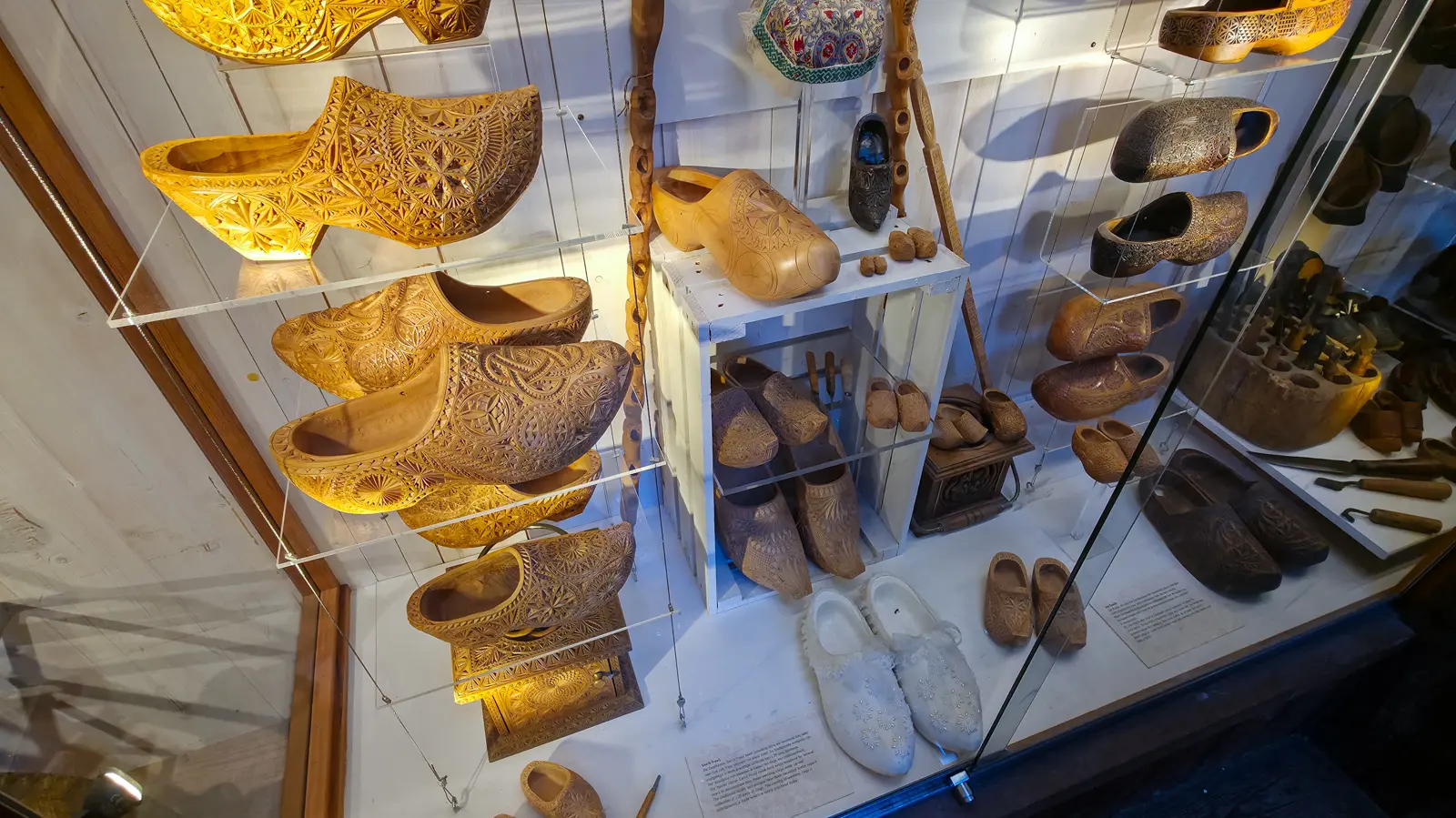
A bridegroom would commission bridal clogs for the wedding day, cut with patterns standing for trust, hope, love and fertility. Afterwards the pair generally went on display in the best room of the house rather than back on anyone’s feet. That is why so many have come through in this condition, while the plain working pairs from the same villages have vanished almost entirely.
Sunday church clogs formed a class of their own again. The oldest in the collection come from Hindeloopen in Friesland and are dated to 1675.
Clogs from Everywhere Else
The full wooden shoe with a closed wooden toe is a Dutch speciality, but wooden footwear is not. One long case sets the Dutch versions against the rest of the world, shelf by shelf, each with a small country label.

The French shelf holds a broad, blunt-nosed pair in dark wood. The Portuguese one holds a slender pair in pale orange with a raised heel, carved as if the leather were still there. Elsewhere in the case sit woven and strapped forms, leather uppers tacked onto wooden soles, and a lacquered black pair that would not look out of place in a shoe shop today. Then, on a middle shelf, a pair of clogs with yellow roller-skate wheels bolted underneath.
A Poster and Two Watercolours
Above the cases hangs a large framed poster with a Paris printer’s line down the right-hand edge. Les Moulins qui Chantent, an operetta in three acts, libretto by Fonson and Wicheler, music by Arthur Van Oost. Two young women sit facing one another on the grass, a windmill behind each of them and a village between. Both are wearing painted clogs, one yellow and one red, and those clogs are the brightest thing in the picture.

Two smaller watercolours hang beside it. In the first, three men in traditional dress stand on brick paving, one holding a small bottle while the others hold glasses, all three in white clogs. In the second, two boys stand in a field, one leaning across to light something the other is holding to his mouth. Both pictures are signed at the lower edge.

The Clog as Art Object
Bas van Buuren studied audiovisual design at the Gerrit Rietveld Academie in Amsterdam and specialised in film animation. Since 1992 he has painted and built work from ordinary factory-made clogs, which he calls klompjekten, or clogjects. His reasoning is set out on the wall in his own words. A clog is a wooden casing for a human foot, so it carries a person, and anyone looking at one imagines the person inside it.

One pair sits inside a gilt picture frame, painted in blocks of white, black, red, blue and yellow. It is an ode to Mondrian, and it works precisely because a clog has no straight edge anywhere on it, so the grid has to bend over the toe and break at the heel. Around it are others: a white pair with a blue tulip painted in Delft style, a pair patterned like fishnet, and a pair painted as bare feet, toes and all.
The Diamond Clog
The last case is lit differently from the rest. Inside it, raised on a black plinth and backed by a mirror, sits a single clog covered from toe to heel in crystals set so close together that no wood shows through at all.

It is called the Diamond Clog, and no, they are not diamonds. The stones are Swarovski crystals, in the thousands. The design came from Jan Roedema, an Amsterdam artist and worker in precious metals, who took his cue from Damien Hirst and from the shape of the clog itself. Standing in front of it, the mirror doubles the whole thing, which is either the point or a happy accident.
From Log to Clog
Through a doorway at the end of the museum, the building becomes a workshop. The floor is ankle-deep in pale shavings. Cast-iron machines stand in the middle of the room, a stove sits in one corner, and the walls are hung with rows and rows of clog blanks. Small hand-lettered signs above them name the timber: populier, poplar, pappel.

The demonstrator worked two machines in turn. The first traces a finished model shoe with a stylus while revolving knives cut the same shape into a fresh block, on exactly the principle of a key cutter. The second machine repeats the trick on the inside, hollowing the block with a rotating drill, and the frame tilts partway through so the drill can reach up into the nose.

The wood has to be around 60 per cent water to cut cleanly, so only fresh poplar or willow goes on the machines. Heel and toe are finished by hand afterwards with a paalmes, a long-handled knife pivoted at one end, and the whole shoe is smoothed on a sanding belt. A skilled maker working entirely by hand needed at least two hours for a pair. The demonstration I watched took about ten minutes.

The Shop
Then the doors open onto the shop, which is the largest of its kind in the country and makes no apology for it. Wooden shoes in every size hang floor to ceiling. So do slippers, keyrings, money boxes and miniatures. One wall is given over to plain unpainted clogs mounted on old timber boards, each holding a bunch of painted wooden tulips, with a small white card in the middle showing the price.

Which brings me back to where I started. Having spent an hour learning that the clog is a certified safety shoe, a wedding gift, a regional identifier and an art object, I went to the counter and bought a small blue and white ceramic one.

I am not going to defend it. The windmill sits inside a little heart, the flowers are transfer-printed, and Holland runs across the side in script. It cost very little and it does exactly what that kind of object is meant to do, which is sit on a shelf at home and bring back an afternoon.
Bubbly Tips
- Getting there from Amsterdam. Zaanse Schans sits roughly sixteen kilometres north-west of the city centre. The Sprinter from Amsterdam Centraal to Zaandijk Zaanse Schans takes about seventeen minutes, and the village is a walk of ten to twenty minutes from the platform along the river. Bus 391 leaves from the IJ side behind Centraal, takes about forty minutes, and stops at the village entrance, which is the better option with a pushchair or a bad knee.
- Entry is free, for now. The village and the Wooden Shoe Workshop both cost nothing to enter. Zaanstad council approved a €17.50 visitor charge in 2025, then postponed it twice; spring 2027 is the current target and it remains in dispute. Check before you travel rather than assuming either way. Individual windmill interiors and the Zaans Museum charge separately regardless.
- There is no demonstration timetable. Staff start when enough people have gathered, so plan to linger rather than arrive at a set time. If you want to see it properly, stand by the machines rather than drifting into the shop, and give it fifteen minutes of patience.
- Do the museum first, deliberately. The collection runs along the front of the building and plenty of visitors walk straight through it to the till. Turn left when you come in and work the cases slowly. The carved wedding clogs and the world display are the two worth the most time.
- The opening hours are better than the rest of the site. From March to October the workshop runs 08:00 to 18:00, which is wider at both ends than the nine-to-five most Zaanse Schans locations keep. An early start here is the single easiest way to dodge the coach groups.
- Photographing the Diamond Clog. The case is dark, mirrored and glazed, so a flash will bounce straight back at you and a phone will hunt for focus. Get the lens close to the glass, turn the flash off, and let the case lighting do the work.
- Try a pair on before you buy one. The shop keeps sizes out for exactly this. Wooden shoes take thick socks and a slightly shuffling walk, and ten seconds of standing in a pair will tell you more than any amount of admiring them on a shelf.
- Pair it with the cheese farm. Catharina Hoeve is a few minutes along the same path and follows an identical rhythm of display, demonstration and shop. Doing both back to back takes well under two hours and gives you the whole Zaanse Schans formula in one go.
- Look for the giant clog on the path. It sits a short walk beyond the workshop itself, out where the paths meet near the drawbridge. Mornings put the sun behind it, so late afternoon gives you the better light and the emptier frame.
Final Thoughts
What changed my mind was not the crystal one. It was the wall of photographs at the entrance, where nobody is posing and everybody, down to the smallest child on the step, is standing in wooden shoes on wet ground. After that, the wedding pairs cut with symbols for trust and hope stop looking like folk craft and start looking like something people spent real money on, once, for a day that mattered.
The rest of it follows from there. A shoe that every village made slightly differently, that a bridegroom commissioned, that still passes European safety certification, and that an artist can grid up in Mondrian’s colours and put in a gilt frame. I went in thinking of a fridge magnet and came out with an argument. And, admittedly, with a small ceramic clog that has a windmill in a heart on the side of it.
Until next time!

🌟 Everything You Need to Plan Your Dream Trip in 2026
- 🌟 Luxury Hotels - Find premium stays with Booking.com & Hotels.com
- 🏡 Vacation Rentals - Discover unique properties on VRBO
- 🏞️ Guided Tours - Explore with Viator or GetYourGuide
- 🎫 Attraction Tickets - Skip the lines with Tiqets
- 🚢 Ocean Cruises - Set sail with Cruise Direct
- 📱 International SIMs - Stay connected with Saily
- 🚗 Car Rentals - Budget-friendly options from Discover Cars
- 🌐 Secure VPNs - Browse safely with NordVPN
- 💶 Currency Exchange - Best rates with Wise
- 🗣️ Learn Languages - Master the local language with Babbel and Rosetta Stone