
I did not know the Netherlands was a cheese country.
That is an embarrassing sentence to write. I had walked past Gouda and Edam in supermarkets my entire adult life without once joining those words to a map, and I had built a picture of this country out of windmills, tulips, canals and painters with no dairy in it anywhere. Then I spent forty minutes in a black timber shed at Zaanse Schans and had to rearrange the whole thing.
Catharina Hoeve at a Glance
🧀 What it is · A free, working cheese farm on the main path at Zaanse Schans, with a ten-minute Gouda-making demonstration, a tasting, and a large shop.
🔬 What you learn · Milk to wheel: rennet sets it, the harp cuts curds from whey, and washing the curds with warm water is what makes Gouda mild, where Cheddar stays sharp.
🏷️ The surprise · Gouda is named after the town where it was traded, not made. First market 1395; first written mention 1184.
🚢 The point · The brine, rind, wax and ageing are all preservation. Edam’s wax coat ruled the world cheese trade from the 14th to 18th centuries.
💡 Tip · Catch the demo before you shop, and buy the cheese even if you’re travelling: waxed and vacuum-packed, it keeps a month unrefrigerated.
A Farm With a Shop Attached
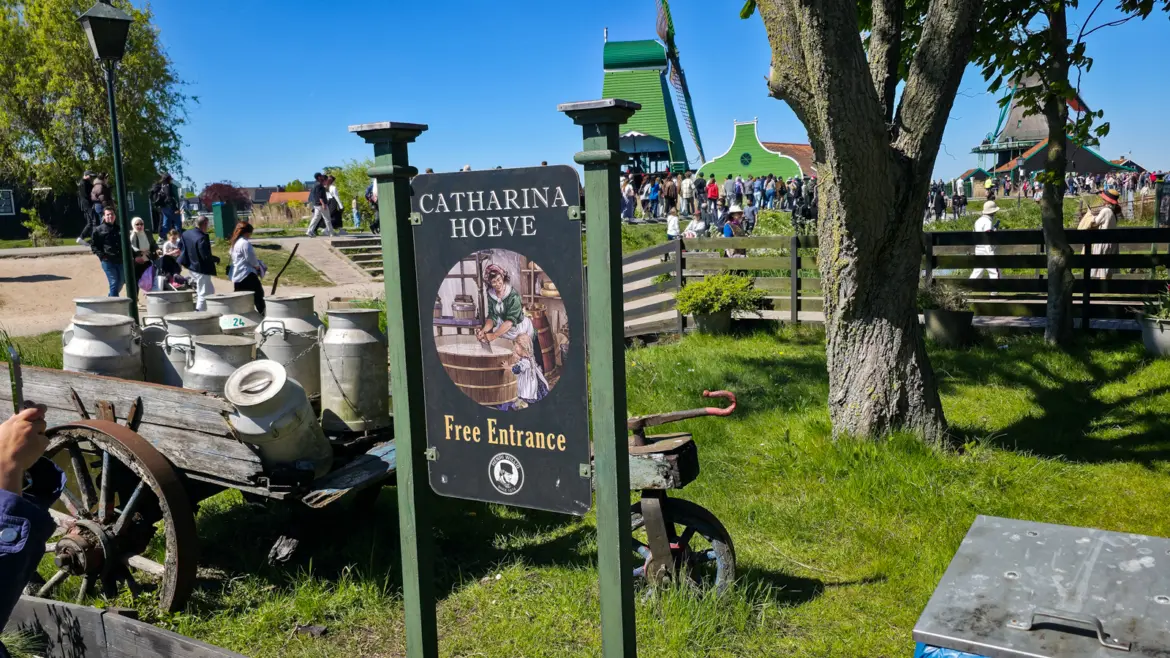
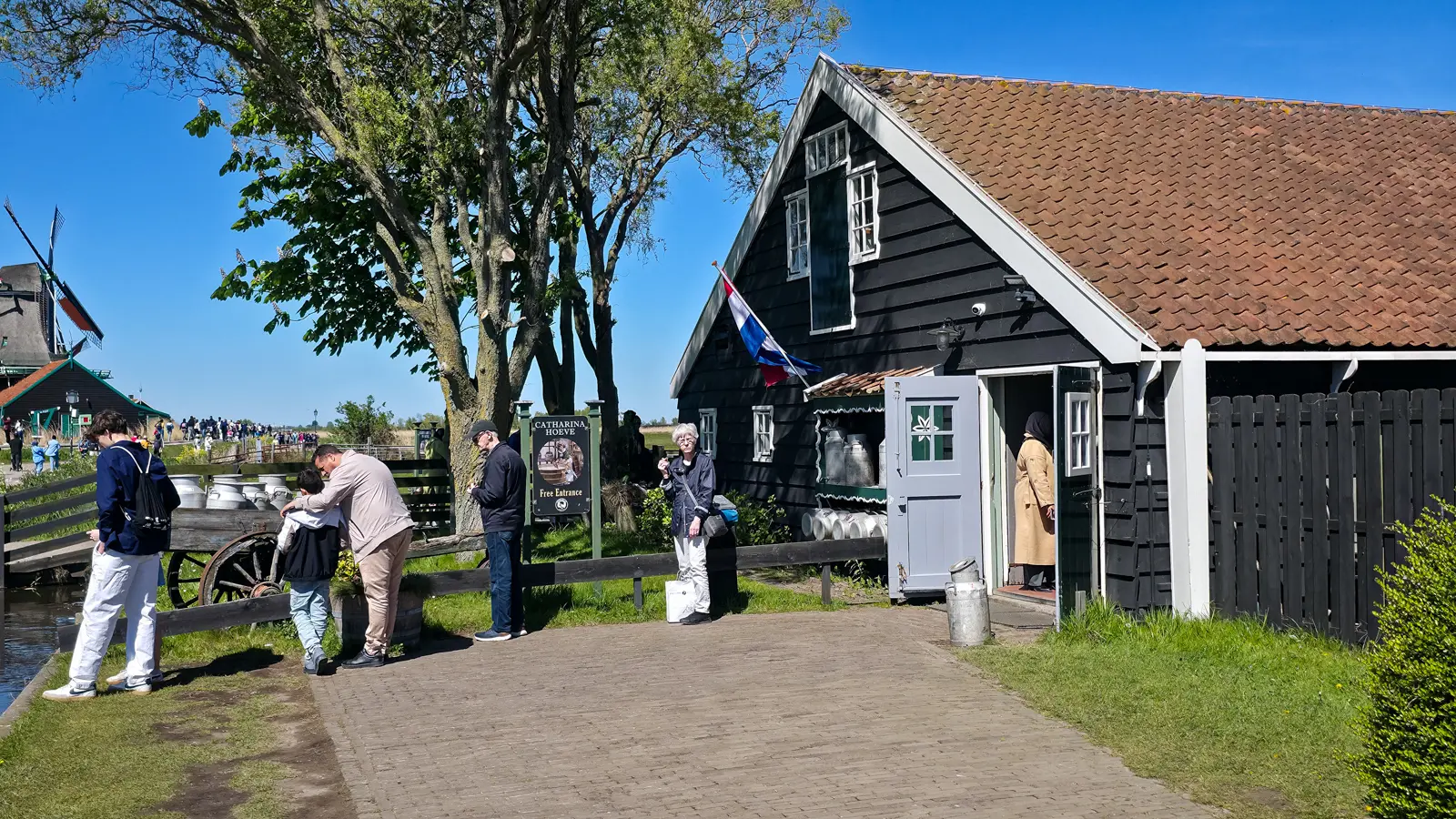
Catharina Hoeve sits on the path between the windmills and the village entrance, behind a wooden cart loaded with old milk churns. The building is black timber with a red tiled roof, a Dutch flag on a pole and a white stable door standing open.
The sign at the gate says Free Entrance. I have written elsewhere about what that actually buys, which is a demonstration, a taste and then a room full of things to purchase. It is smartly done and I did not mind it.
The Demonstration
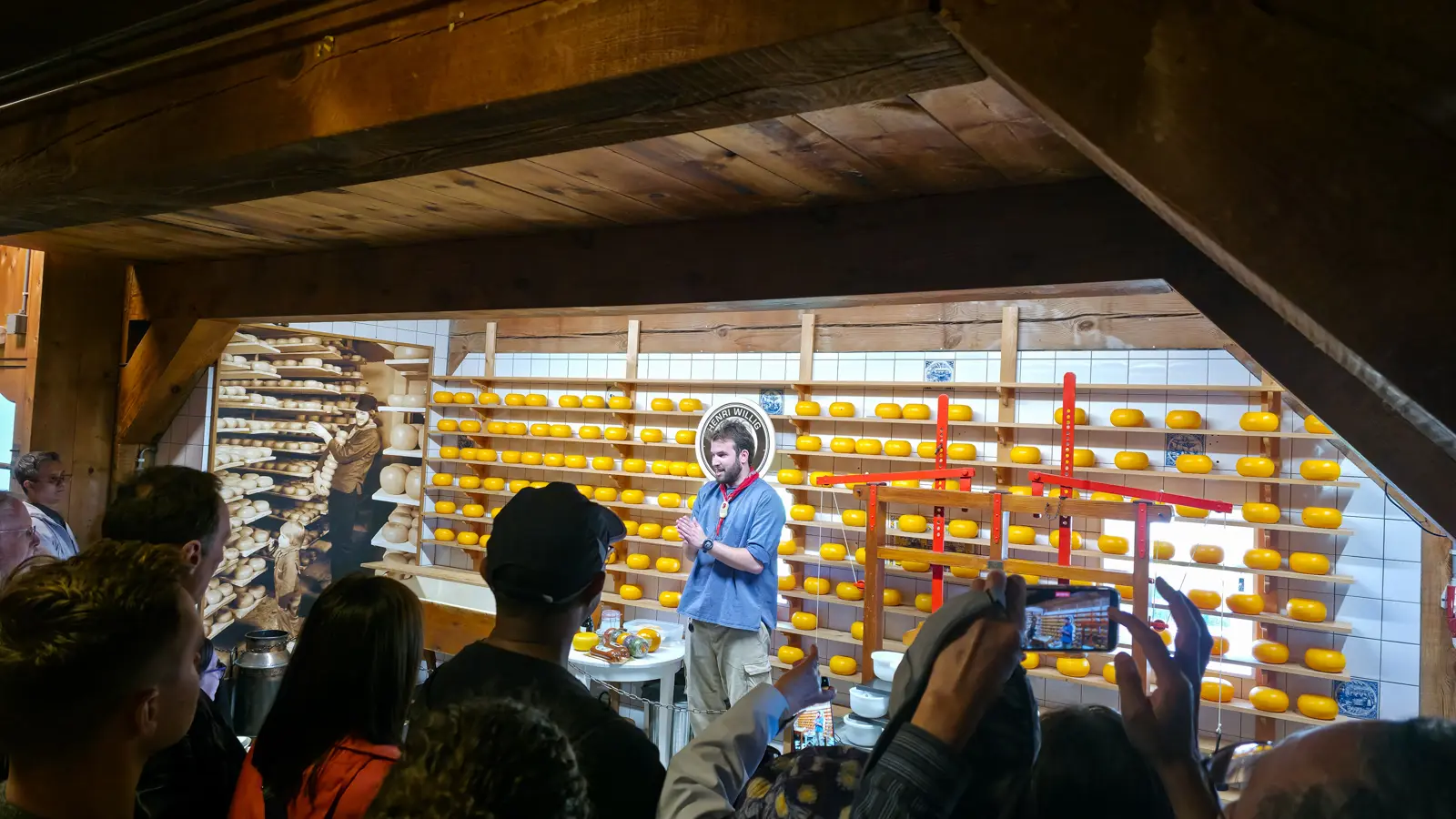
Our tour guide brought us to the farm and left us to it. The demonstration is run by the farm itself, and afterwards there was time to shop or wander at our own pace. That order matters, and it is the reason I would tell anybody to catch the talk before doing anything else.
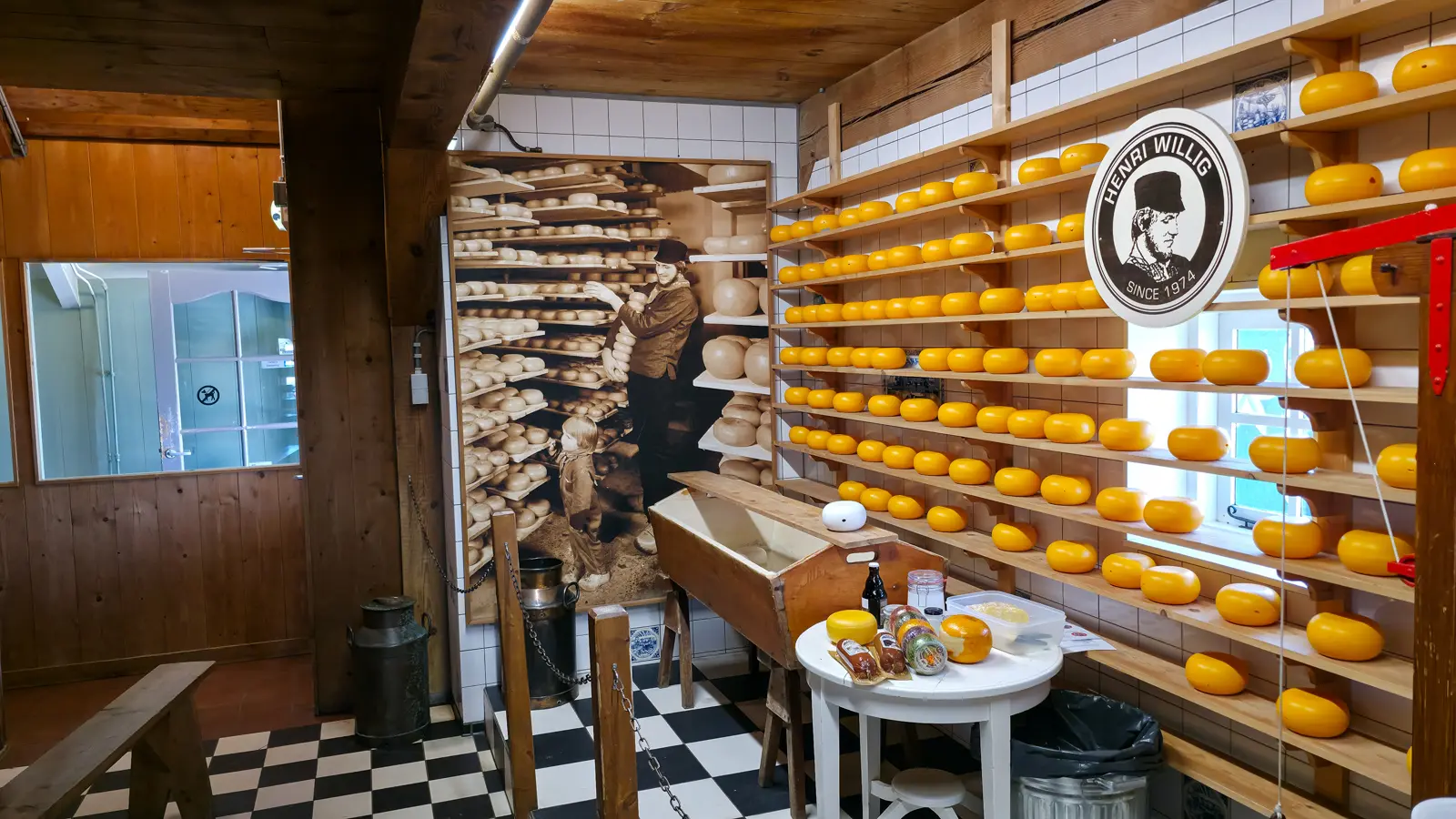
The man presenting it stood in front of a wall of yellow wheels racked on pale wooden shelves, with a red iron press beside him and a table of samples at his elbow, and took the room through the sequence from milk to wheel. Ten minutes, no charge, in plain English.
I had eaten cheese my whole life without any idea how it was made. I could not have said what curds were. Standing in that room, watching somebody name each step in order, turned a supermarket product into a process with reasons behind it.
What Is Happening in the Vat
Next door stands the vat, and once the demonstration has explained it, it stops being a big tub and becomes the whole point.
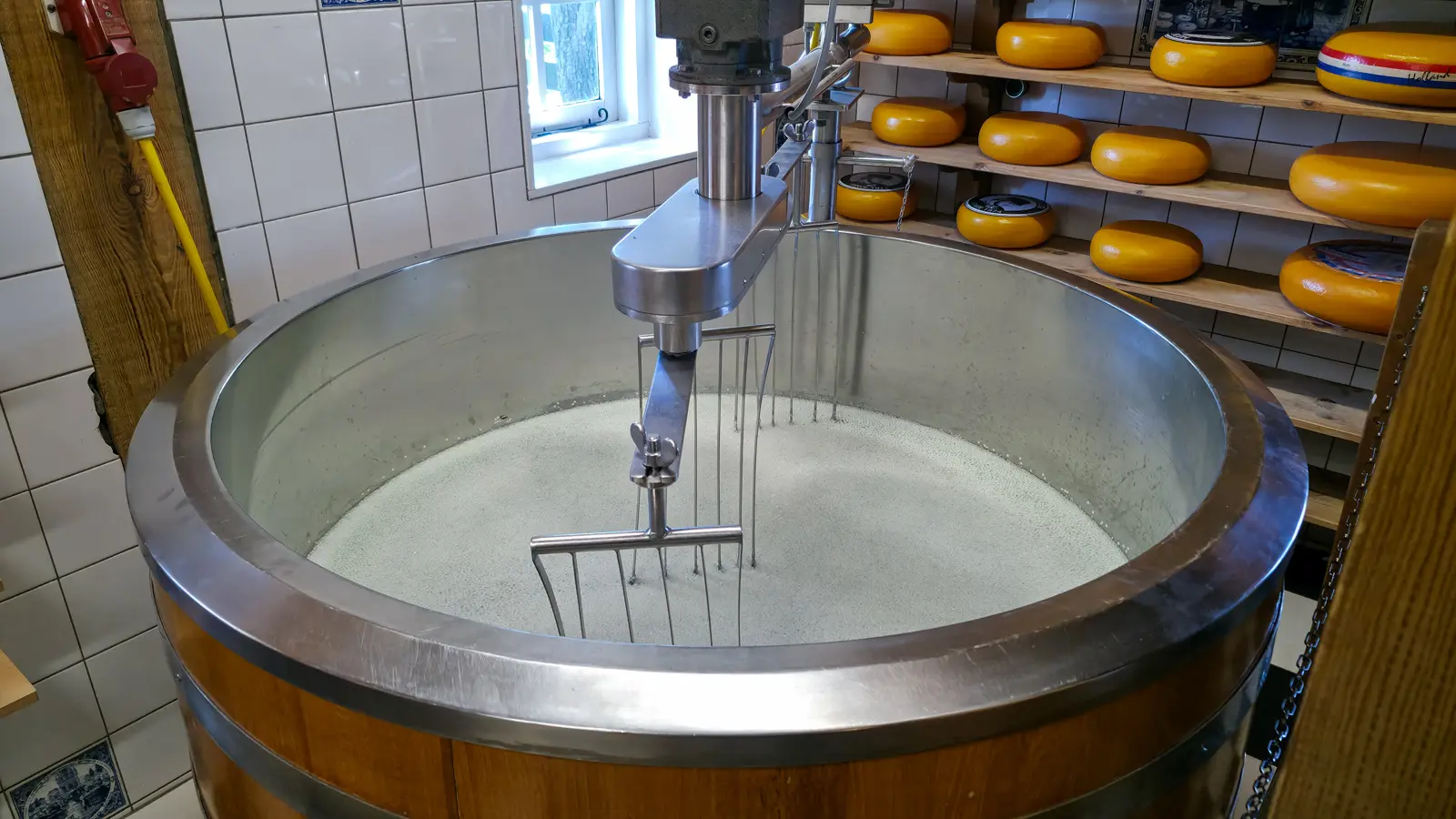
It is a wooden barrel bound in steel, with a stainless rim and a rotating arm carrying a wire harp. Inside, the surface is not milk. It is set: a pale, slightly grainy solid with a faint sheen, which is milk that has been persuaded to stop being liquid.
Rennet does that. Added to warmed and cultured milk, its enzymes link the milk proteins together and the whole vat turns to a soft gel in something like thirty to forty-five minutes. Then the wire harp comes down and cuts the mass into pieces so the liquid can drain away from the solids. Those two things are the whole vocabulary of cheese: the solids are the curds, the liquid running off them is the whey.
The Step That Makes Gouda Taste Like Gouda
Here is the thing I have thought about most since.
After the curds are cut, part of the whey is drained off and replaced with warm water. The step is called washing the curds, and it is not a cleaning operation. It dilutes the lactic acid the bacteria have been producing, which is precisely why Gouda is mild and faintly sweet rather than sharp.
Cheddar skips that step. That is the whole difference. Two cheeses that look broadly similar on a shelf taste nothing alike because of one decision made in a vat about whether to pour some liquid off and top it up with water.
After that the curds go into round moulds lined with cloth and are pressed, then the wheels go into a saturated salt brine for the better part of a day. The brine does three jobs at once. It seasons the cheese all the way through, draws out more moisture, and forms the rind that holds the wheel’s shape while it ages.
The Wall of Photographs
Along one wall are framed photographs, and they are worth more than a passing look.
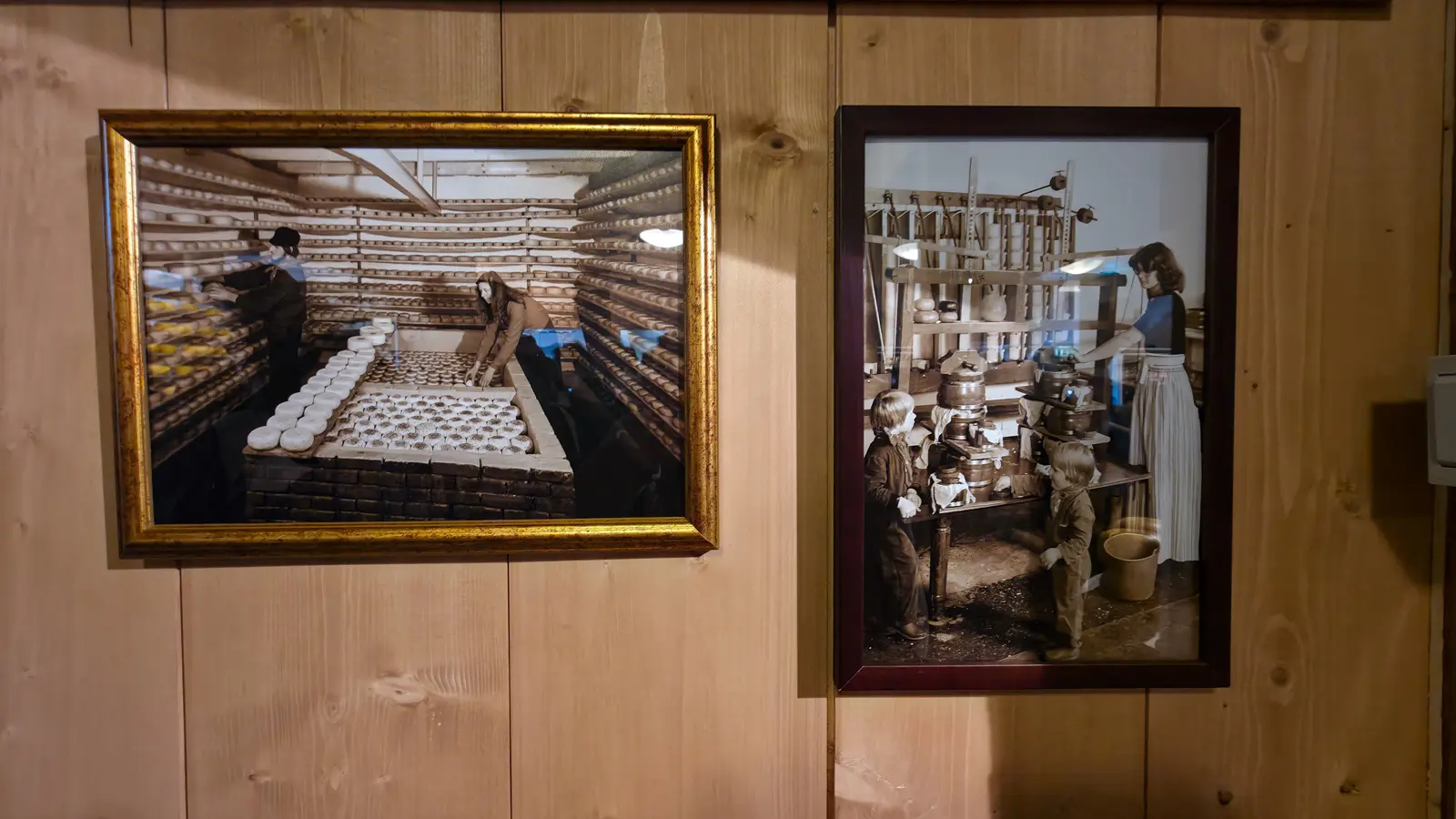
One shows a cheese loft, rack after rack of pale wheels running back into the dark, with two people moving among them and a low brick salting trough in the foreground. The other shows a woman in an apron at a frame of moulds, with two small children in work clothes standing at the table beside her, hands on the equipment.
For centuries this was family work. Farmers made cheese from the milk of their own cows and carried it to local markets, and the method passed down a household rather than through a school. The children in that photograph are not visiting. They are helping.
Why the Netherlands
The part that genuinely surprised me is that Dutch cheese is named after trade rather than production.
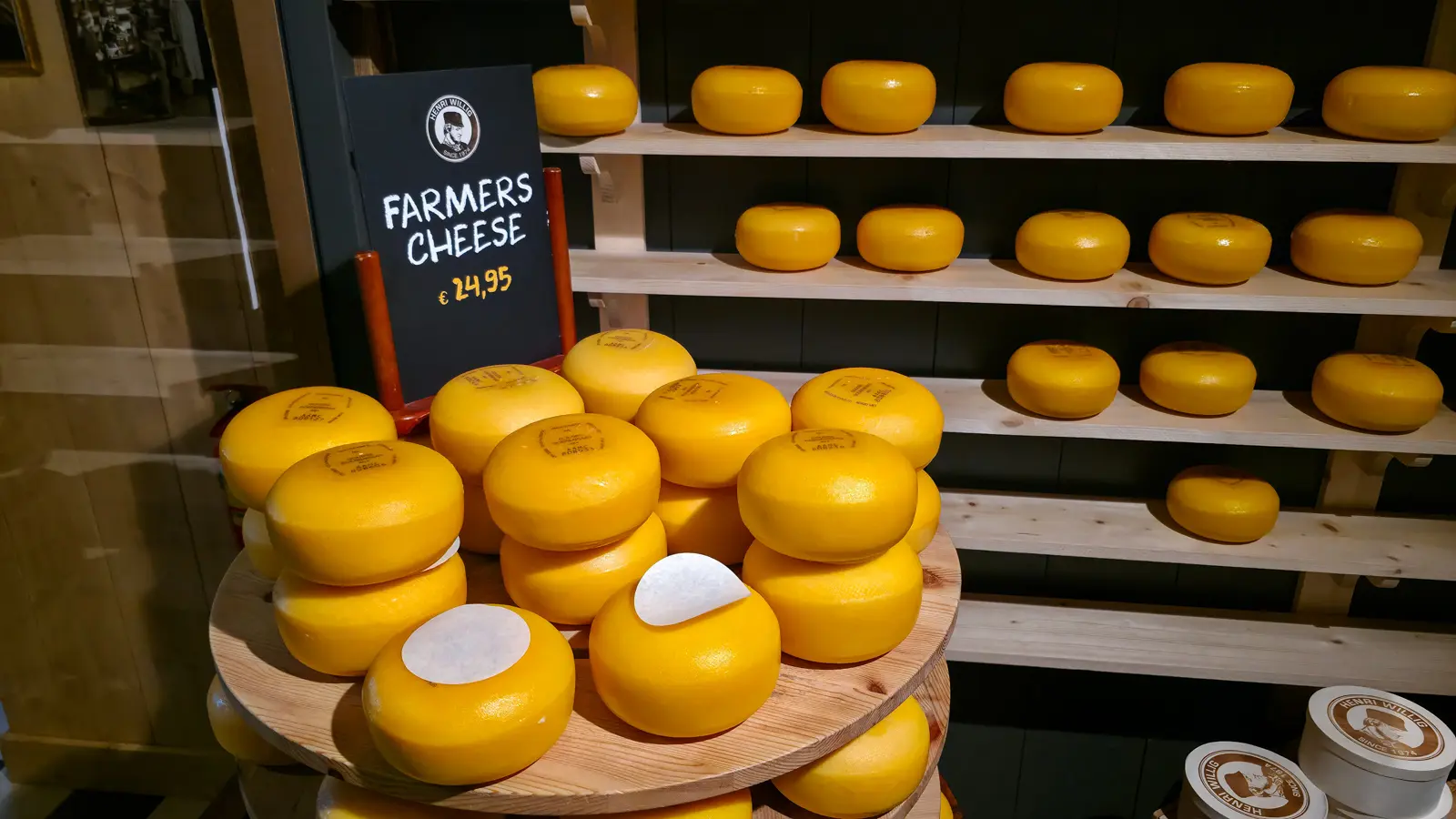
Gouda is not called Gouda because it was made in Gouda. It is called Gouda because it was sold there. The first cheese market in the town was held in 1395, and the first written mention of the cheese goes back to 1184, which makes it one of the oldest cheeses still in production anywhere. Edam takes its name from a town in North Holland in the same way.
The trade grew a whole apparatus around itself. Towns granted weighing rights built weigh houses, and the square in front became the Waagplein, the weighing square. Guild porters carried the wheels on wooden barrows between two men. Alkmaar has been trading cheese on its Waagplein since 1593.
None of that is about flavour. It is about a country with wet grass, a lot of cows, a serious surplus of milk and an unusually good instinct for selling things.
The Shop
The retail half is considerable, and it is arranged by category rather than piled up.
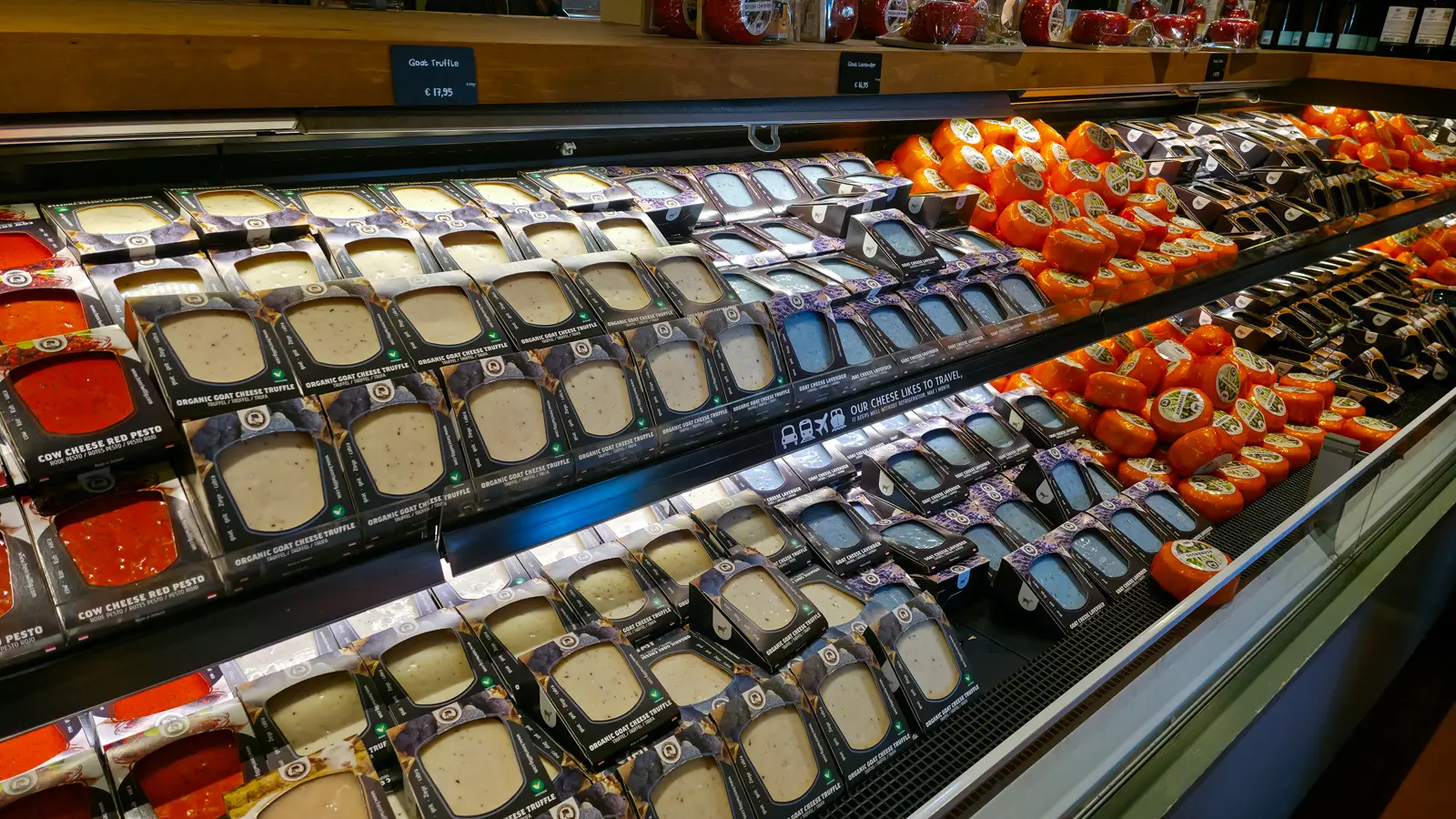
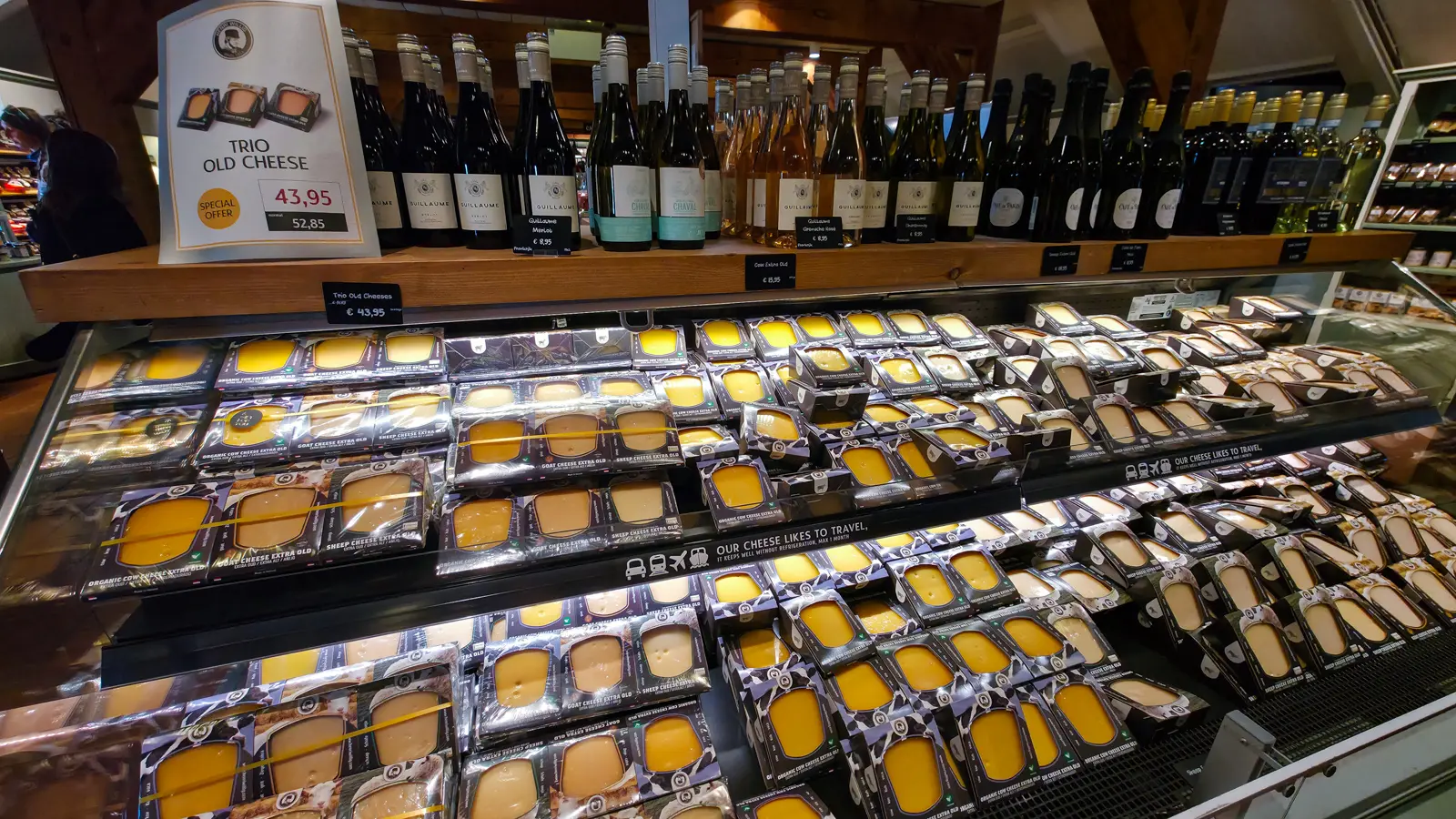
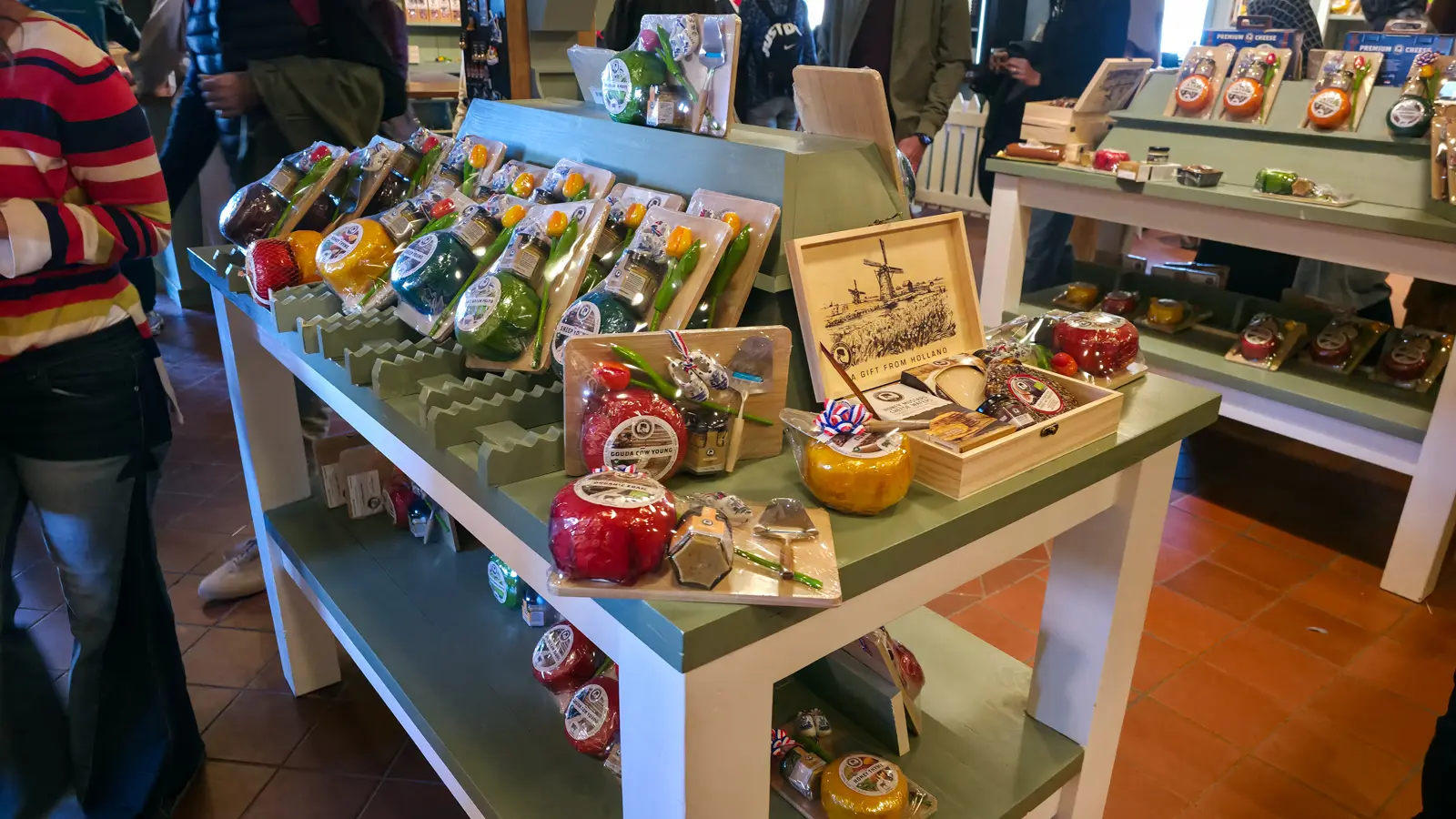
One chilled case holds goat’s cheese: truffle at €17.95, lavender at €16.95, cow cheese with red pesto, and a bank of small orange-waxed rounds behind. Another holds the aged end of the range, extra old cow, goat and sheep, with a Trio Old Cheese offer at €43.95 against a normal price of €52.85, and a shelf of wine above it at €8.95 a bottle. A table near the door carries gift sets, wax-sealed rounds paired with wooden boards and Delft-handled slicers, and a wooden box branded A Gift from Holland.
All of those were April 2026 prices and will have moved since.
I tasted a piece of Gouda. I could not now say whether it was young or aged, which is the honest answer, and it was delicious.
I did not buy any, and I want to explain why, because the reason turns out to be the joke of the whole visit.
Our Cheese Likes to Travel
I was travelling. I had days of trains and a flight ahead of me and no way of keeping anything cold, so I looked at a wall of cheese I had just learned to appreciate and decided it was impractical.
Printed along the shelf edge of the chilled case, twice, in white capitals, is this: our cheese likes to travel, it keeps well without refrigeration, max 1 month.
I photographed that line without reading it.
And the shop is not making it up. Keeping is the entire reason this cheese exists in the form it does. The brine, the rind, the wax, the months of ageing are all preservation, invented for a world without refrigeration. Edam’s wax coat made it so durable that it went into ships’ holds as a matter of course and dominated the world cheese trade from the fourteenth century to the eighteenth. Dutch cheese conquered the planet precisely because it survived the journey.
So the one objection I raised was the one objection six hundred years of Dutch engineering had already answered, on a sign, at eye level, in English.
Bubbly Tips
- Catch the demonstration before you shop. It is free, it takes about ten minutes and it runs through the day. Doing it first turns the shop from a wall of packaging into a wall of things you understand.
- Buy the cheese even if you are travelling. This is the tip I wish somebody had given me. Vacuum-packed and waxed Dutch cheese keeps without refrigeration for around a month, which is longer than most trips.
- Getting there from Amsterdam. Catharina Hoeve stands at Zaanse Schans, about seventeen kilometres by road north of the city and roughly half an hour door to door. The Sprinter from Amsterdam Centraal reaches Zaandijk Zaanse Schans in about seventeen minutes, followed by a fifteen-minute walk along the river. Bus 391 from Centraal takes around forty minutes and stops at the village entrance, which is closer. The farm is a few minutes on foot once you are in the village.
- Ask for young and old side by side. The same cheese at three months and at three years is barely the same food. Tasting them together is the fastest way to work out what you actually like.
- Look at the two framed photographs. They are on the wall near the demonstration area and almost nobody stops at them. The one with the children says more about Dutch cheese than any label in the shop.
- The vat is worth a proper look. Once you know what rennet does, the set surface in that barrel is genuinely interesting rather than just a big tub of something white.
- Prices are per piece, not per kilo, on the small packs. Check the shelf label before assuming, since the cases mix formats and the wedges and the whole rounds are priced differently.
- Free entrance means free. Nobody follows you round, nobody pushes, and leaving without buying is entirely normal. The tasting is not a transaction.
- Combine it with the clog workshop next door. Both are free, both run demonstrations, and together they take about an hour, which is a sensible chunk of a Zaanse Schans visit.
- Go early if you want to hear anything. By mid-afternoon the demonstration room fills to the beams and the back of the crowd catches roughly half of it.
Final Thoughts
I came to Zaanse Schans for windmills and left thinking about preservation.
Everything that makes Dutch cheese what it is, the washing of the curds, the salt bath, the wax, the patient months on a wooden rack, exists because milk goes off and a farm with cows has more of it than a family can drink. Solve that problem well enough and a farm does not merely feed itself through the winter. It ends up naming a cheese after its market town, building a weigh house on the square, and selling to the world for six centuries.
I still think about that sign on the fridge. I had spent forty minutes being told, in detail, that this is food designed to survive a journey, and then declined to buy any on the grounds that I had a journey ahead of me.
Until next time!

🌟 Everything You Need to Plan Your Dream Trip in 2026
- 🌟 Luxury Hotels - Find premium stays with Booking.com & Hotels.com
- 🏡 Vacation Rentals - Discover unique properties on VRBO
- 🏞️ Guided Tours - Explore with Viator or GetYourGuide
- 🎫 Attraction Tickets - Skip the lines with Tiqets
- 🚢 Ocean Cruises - Set sail with Cruise Direct
- 📱 International SIMs - Stay connected with Saily
- 🚗 Car Rentals - Budget-friendly options from Discover Cars
- 🌐 Secure VPNs - Browse safely with NordVPN
- 💶 Currency Exchange - Best rates with Wise
- 🗣️ Learn Languages - Master the local language with Babbel and Rosetta Stone