
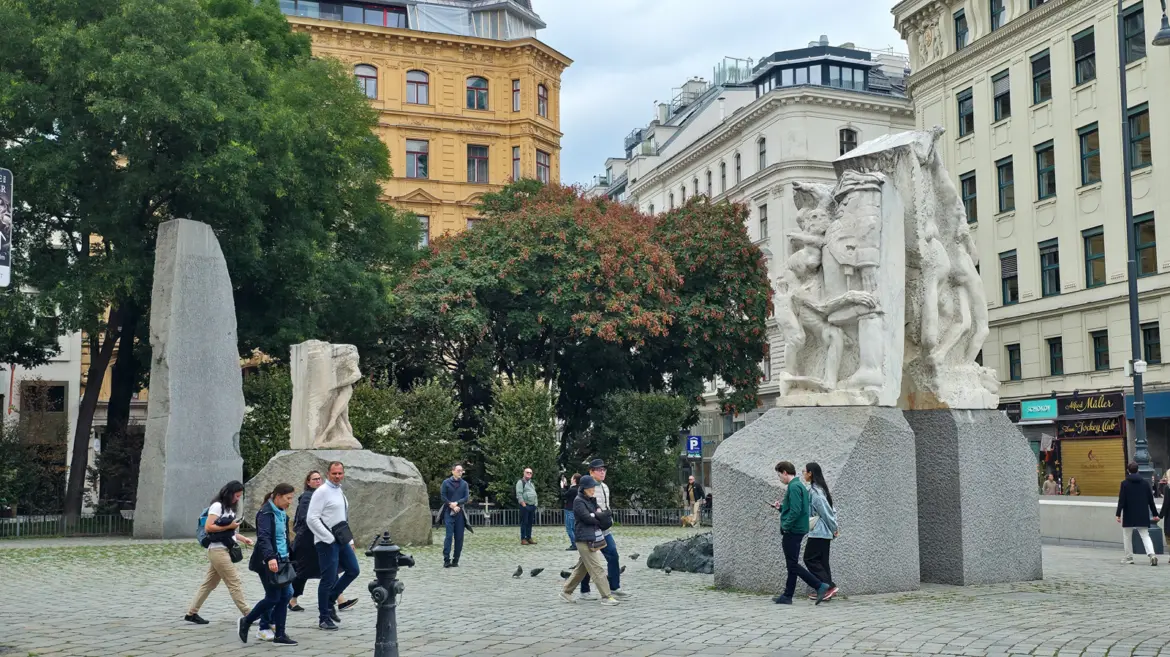
There are places in a city that invite admiration, and then there are places that invite reflection. The Memorial Against War and Fascism is unmistakably the latter. It is not a place that draws you in with beauty alone, but one that reveals its meaning gradually, asking for your attention in a quieter, more deliberate way. What begins as a simple encounter becomes something more layered – a moment that lingers, not because it is explained, but because it is felt.
Set within the elegance of Albertinaplatz – surrounded by historic architecture, cultural landmarks, and the steady rhythm of daily life – the memorial does not immediately announce itself. You may arrive expecting beauty, symmetry, and refinement, as Vienna so often offers. And then, almost unexpectedly, the atmosphere shifts. What stands before you is not ornamental, but confronting – a space that asks you not just to look, but to pause, to feel, and to remember.
Monument Against War and Fascism at a Glance
🕊️ What it is: A multi-part memorial by sculptor Alfred Hrdlicka at Albertinaplatz — inaugurated 1988, completed 1991
📍 The site: Built on the ground where the Philipphof once stood — a residential building destroyed in a 1945 air raid, killing hundreds sheltering in its cellars
⛏️ Gate of Violence: Constructed from Mauthausen granite — the same stone quarried by concentration camp prisoners. The material is the memory.
🗿 Orpheus Enters Hades: A figure descending into darkness, carved from stone that once served a camp — mythology becoming a metaphor for historical horror
📜 Stone of the Republic: Bears the text of Austria’s 1945 Declaration of Independence — the moment the country began to reclaim itself
🧎 Street-Washing Jew: A kneeling figure scrubbing the pavement, wrapped in barbed wire — recreating the public humiliations of 1938. The most confrontational element.
🆓 Entry: Free, open at all times, placed in the middle of everyday life — not behind a fence, not in a museum
💡 Tip: Approach slowly. Read each element individually. This monument was designed to make you uncomfortable — and that discomfort is the point.
Albertinaplatz: Beauty and Contrast
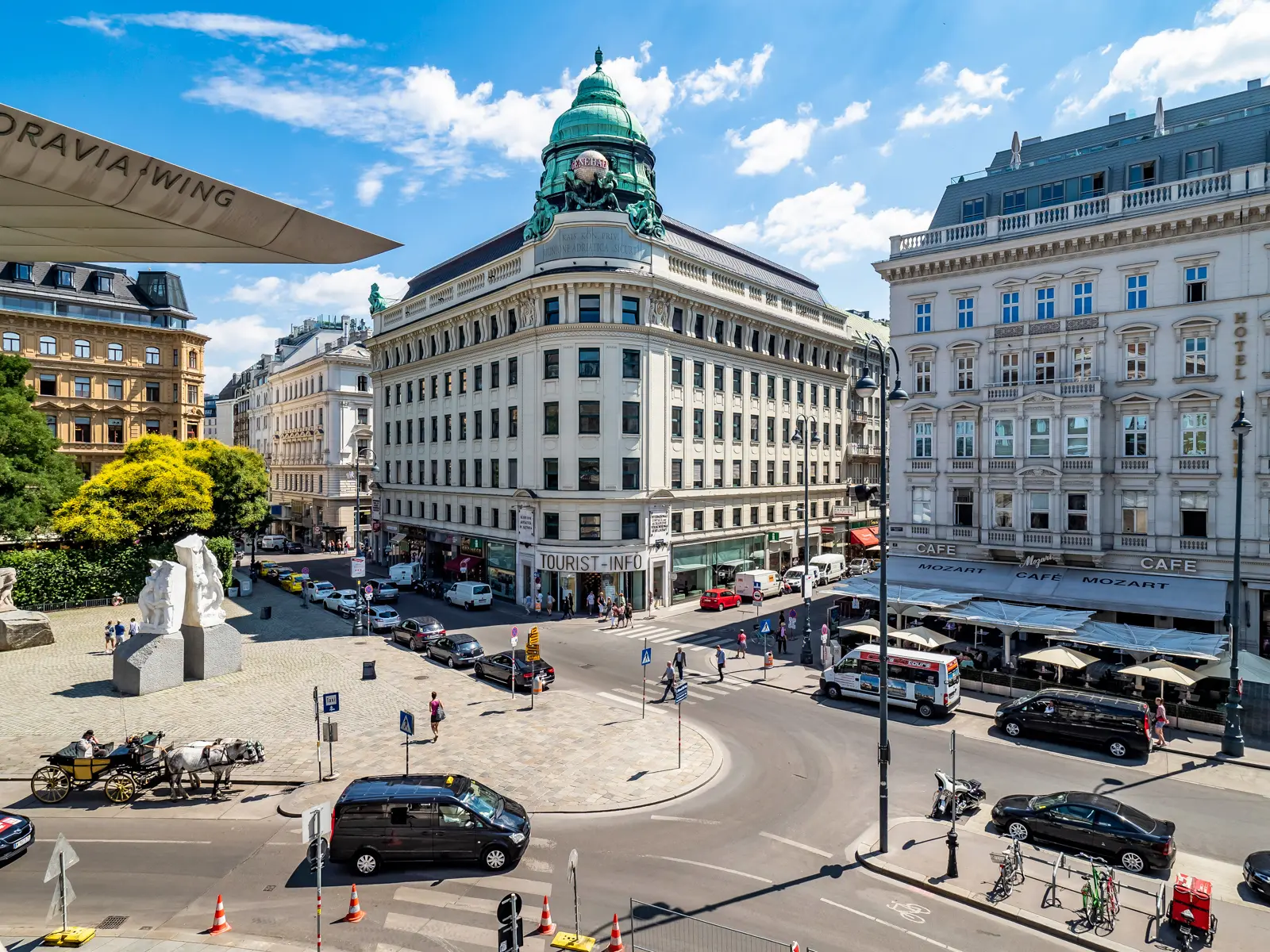
At first glance, Albertinaplatz reflects the Vienna many imagine: elegant, composed, and layered with history. The Albertina rises above the square, the Vienna State Opera stands just steps away, and the surrounding streets carry a steady flow of movement that feels both timeless and alive. It is a space defined by balance and refinement, where architecture, culture, and daily life coexist in a way that feels effortless. Everything appears carefully ordered, inviting admiration without demanding attention.
It is within this refined setting that the memorial takes on its full meaning. The contrast is immediate and intentional. Where the surrounding architecture speaks of empire, culture, and continuity, the Memorial Against War and Fascism speaks of rupture – of moments in history that cannot be smoothed over or forgotten. It does not attempt to blend in. Instead, it exists in quiet tension with its surroundings, creating a dialogue between beauty and memory that defines the space. And it is precisely this contrast, between what is celebrated and what is remembered, that gives Albertinaplatz its depth.
A History Grounded in Reality
The Memorial Against War and Fascism stands on the site of the former Philipphof, a residential building destroyed during an air raid on March 12, 1945. In its cellars, hundreds of people had taken shelter – most of whom were never recovered. The ruins were eventually cleared but the history beneath remained largely unacknowledged in the public space for decades, a silence that itself speaks volumes about Austria’s complicated relationship with its wartime past.
For years after World War II, Austria emphasized its status as the “first victim” of Nazi aggression, a narrative that discouraged deeper reflection on shared responsibility. It was not until 1988, the 50th anniversary of the Anschluss and a date chosen with clear symbolic intent, that the memorial was unveiled, with Austrian sculptor Alfred Hrdlicka’s work completed in 1991. The choice of that anniversary was itself a statement: an acknowledgment that remembrance had been delayed too long, and that the silence needed to be broken.
Rather than offering a traditional monument, Hrdlicka designed a series of sculptural elements that confront, question, and resist simplification. This is not a space that tells a single story, it is one that reflects the complexity, pain, and responsibility of remembering.
The Monument: Fragments of Memory
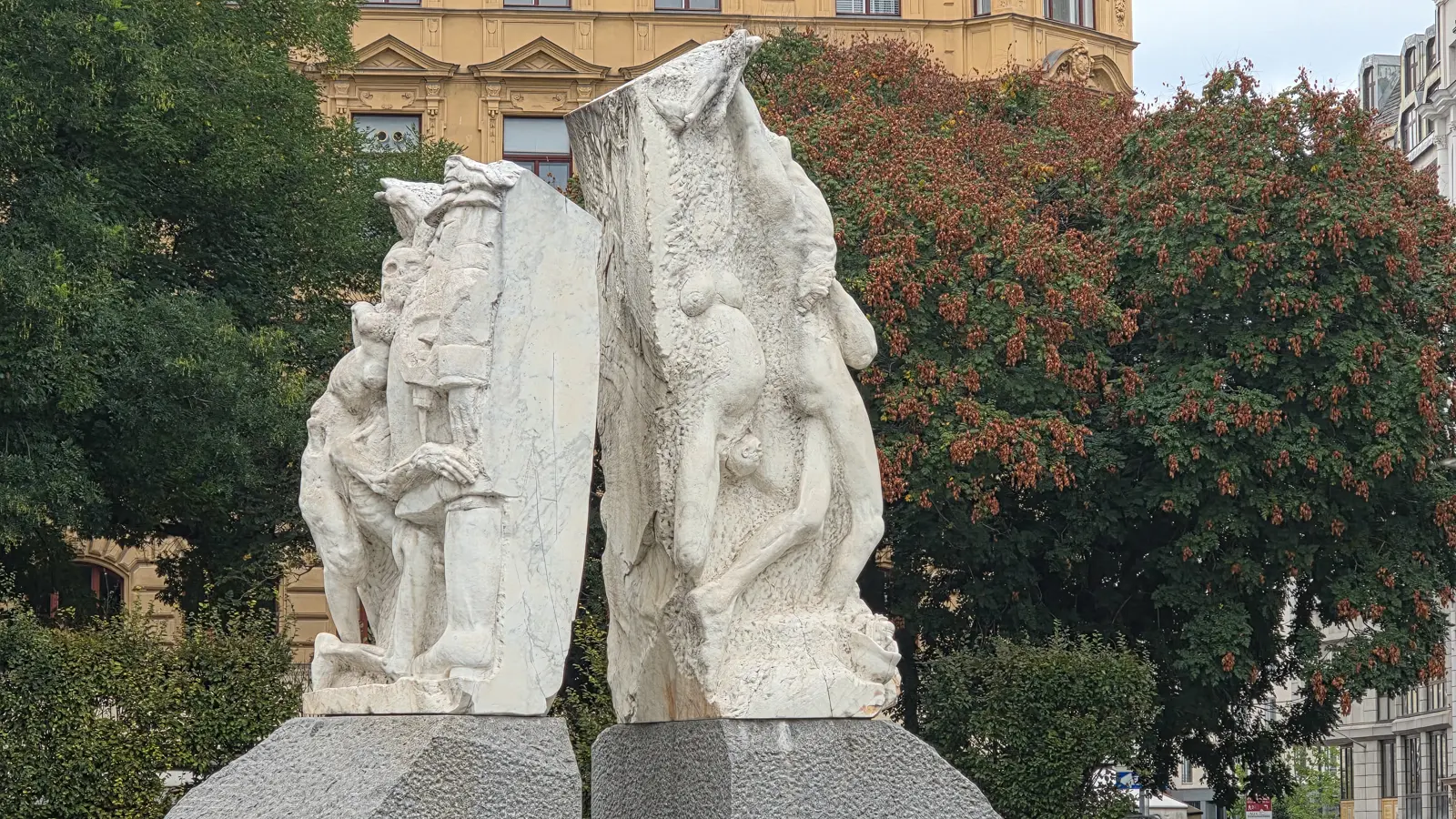
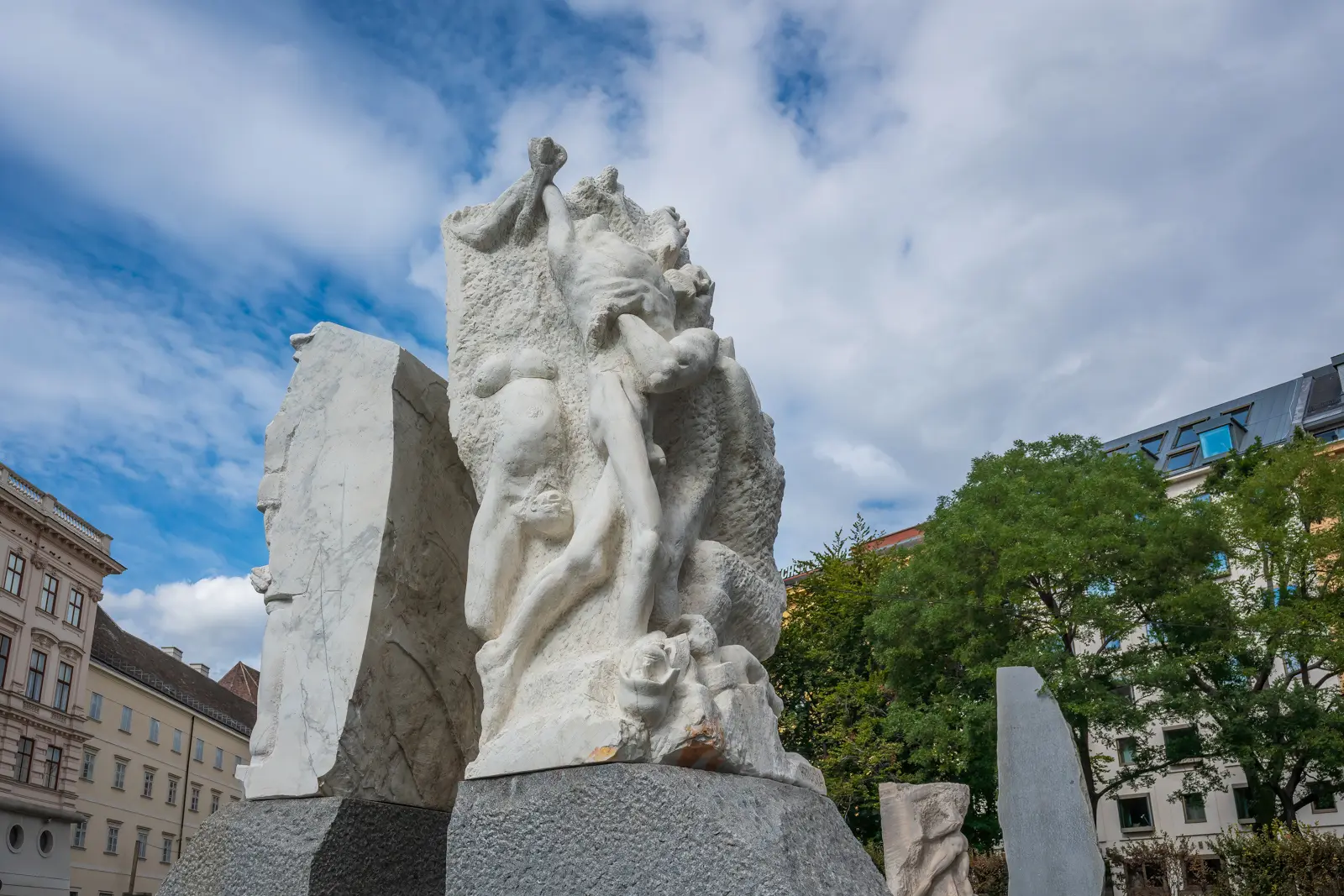
The memorial is composed of several distinct elements, each contributing to a larger narrative. In Orpheus Enters Hades, the legendary musician’s body appears to dissolve into a block of stone – the realm of the underworld – his arm reaching downward in a gesture that suggests both descent and loss. The work is widely understood to commemorate the bomb victims of the Philipphof, as well as those who died resisting National Socialism, linking myth with memory in a way that feels both symbolic and deeply human.
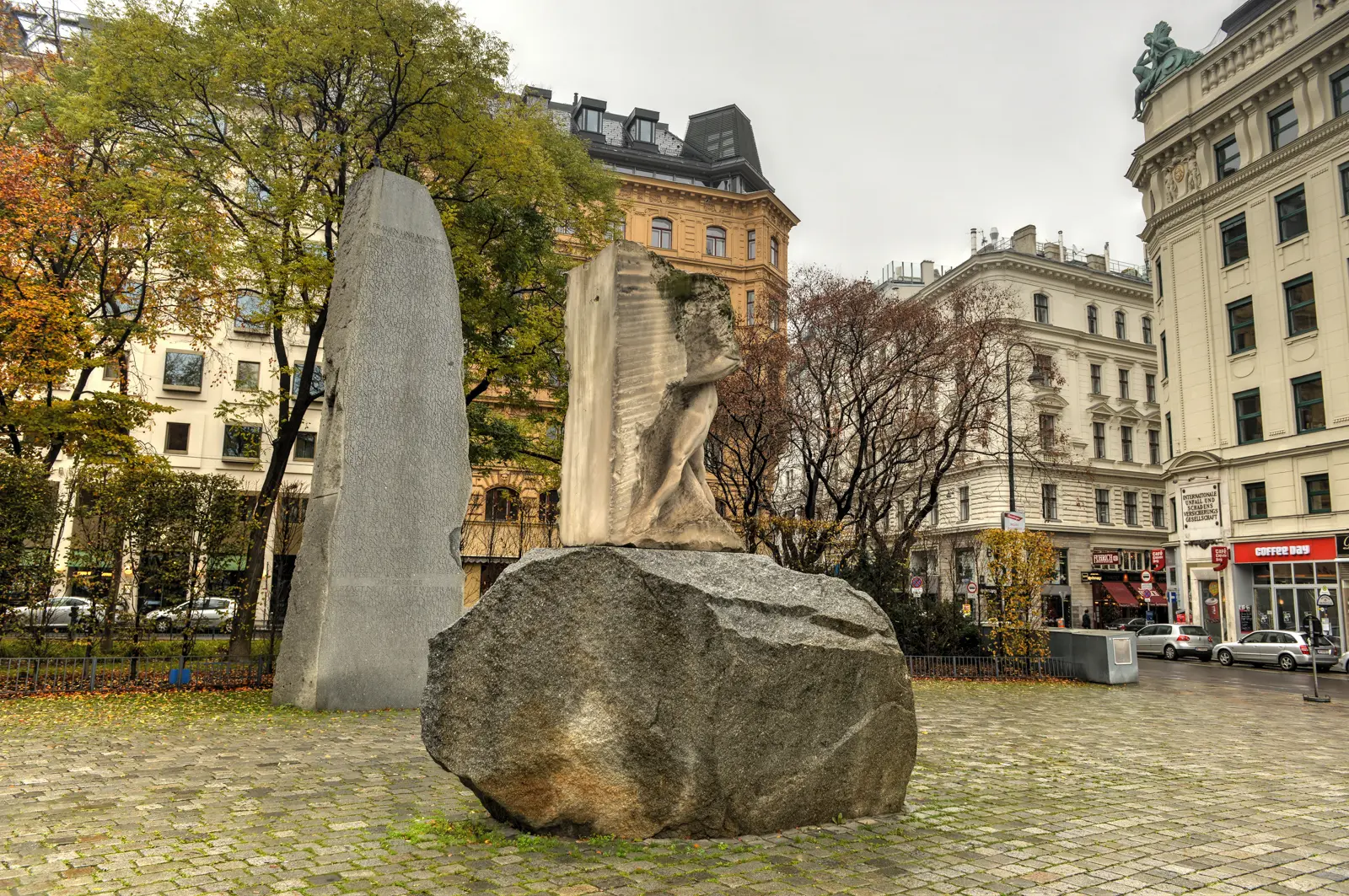
The Gate of Violence is itself divided into two parts: on the left, Hinterland Front commemorates victims of Nazi persecution in concentration camps and prisons; on the right, Heroic Death (Heldentod) is dedicated to the memory of all victims of war. Significantly, the gate is constructed from Mauthausen granite, the same stone that thousands of concentration camp prisoners were forced to carry up the infamous “Steps of Death” in the camp quarry. The material itself is part of the message, embedding the weight of history directly into the monument.
The Stone of the Republic bears the text of Austria’s Declaration of Independence from April 27, 1945, grounding the memorial not only in grief, but in the moment of national rebirth that followed. Nearby, the figure known as the “Street-Washing Jew” depicts a Jewish man forced to scrub the pavement, a direct reference to the humiliating public acts imposed after the Anschluss. After visitors repeatedly sat on the sculpture, Alfred Hrdlicka added iron barbed wire to its back, a stark and telling detail that reflects how difficult genuine confrontation with history can be.
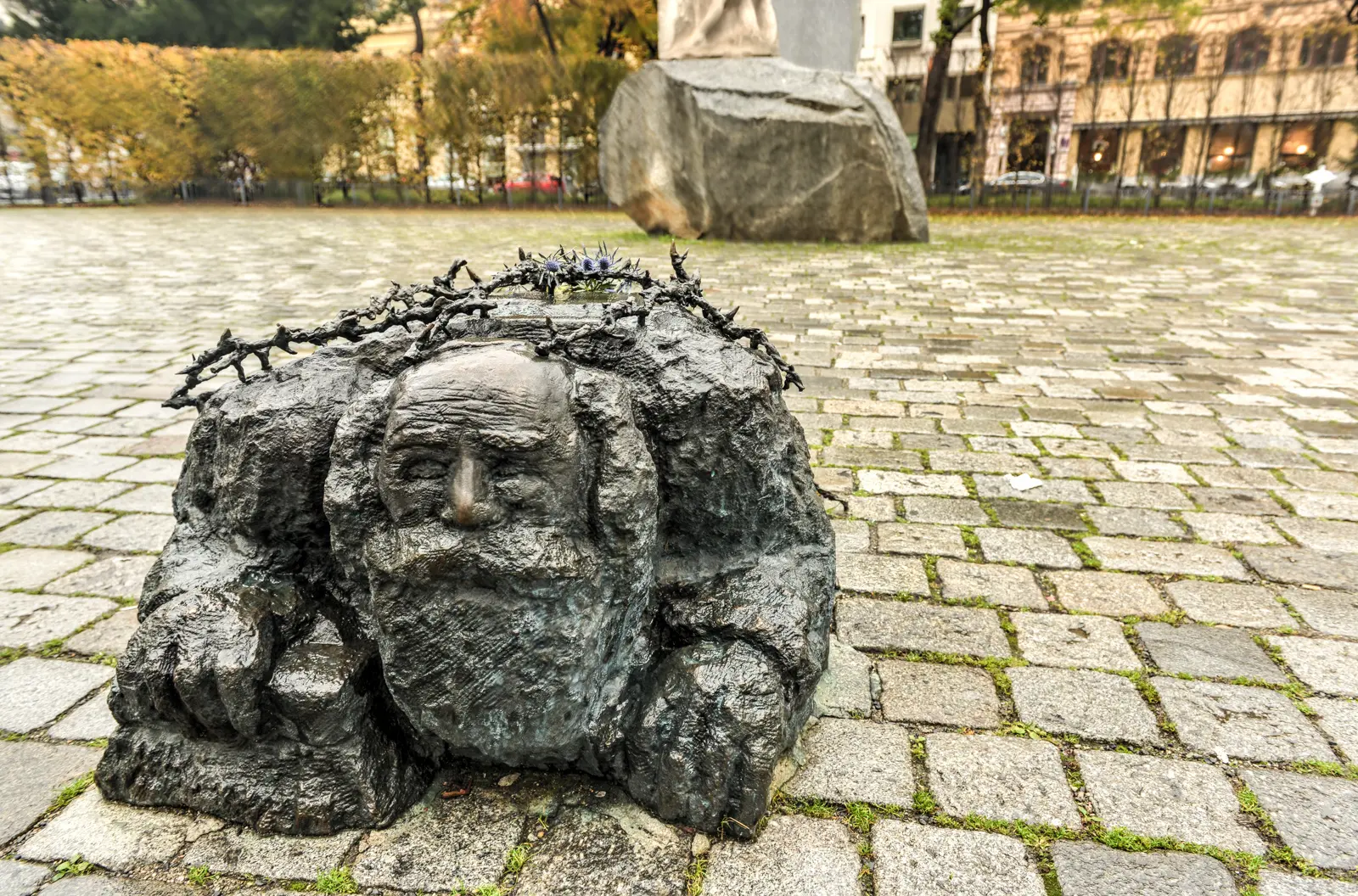
Taken together, these elements do not form a single unified image. Instead, they feel intentionally disjointed, fragments rather than a whole. This fragmentation is part of the message. History here is not presented as resolved or distant, but as something that remains present, layered, and at times deeply difficult to confront.
The Experience: Confrontation, Reflection, and Meaning
Experiencing the Memorial Against War and Fascism is unlike visiting most landmarks in Vienna. There is no clear path, no single focal point, no prescribed way to engage. People move through the space differently – some pause, others pass by, some linger longer than they expected. It unfolds gradually, not as something you observe from a distance, but as something you move through, piece by piece, moment by moment.
What is striking is how the memorial alters the atmosphere around it. The sounds of the city remain – footsteps, conversations, distant traffic – but they seem to soften, as if the space itself asks for a different kind of attention. It is not overwhelming, but it is present. A quiet weight that stays with you as you move through it, subtly shifting the way you perceive everything around you.
There is no single emotion that defines the experience. It may be discomfort, curiosity, reflection, or something less easily named. And perhaps that is the point. The memorial does not tell you what to feel, it creates space for you to consider, to question, and to remember in your own way. In a city known for its beauty and cultural legacy, it serves as an essential counterpoint, a reminder that history is not only composed of moments of achievement and elegance, but also of suffering, conflict, and responsibility.
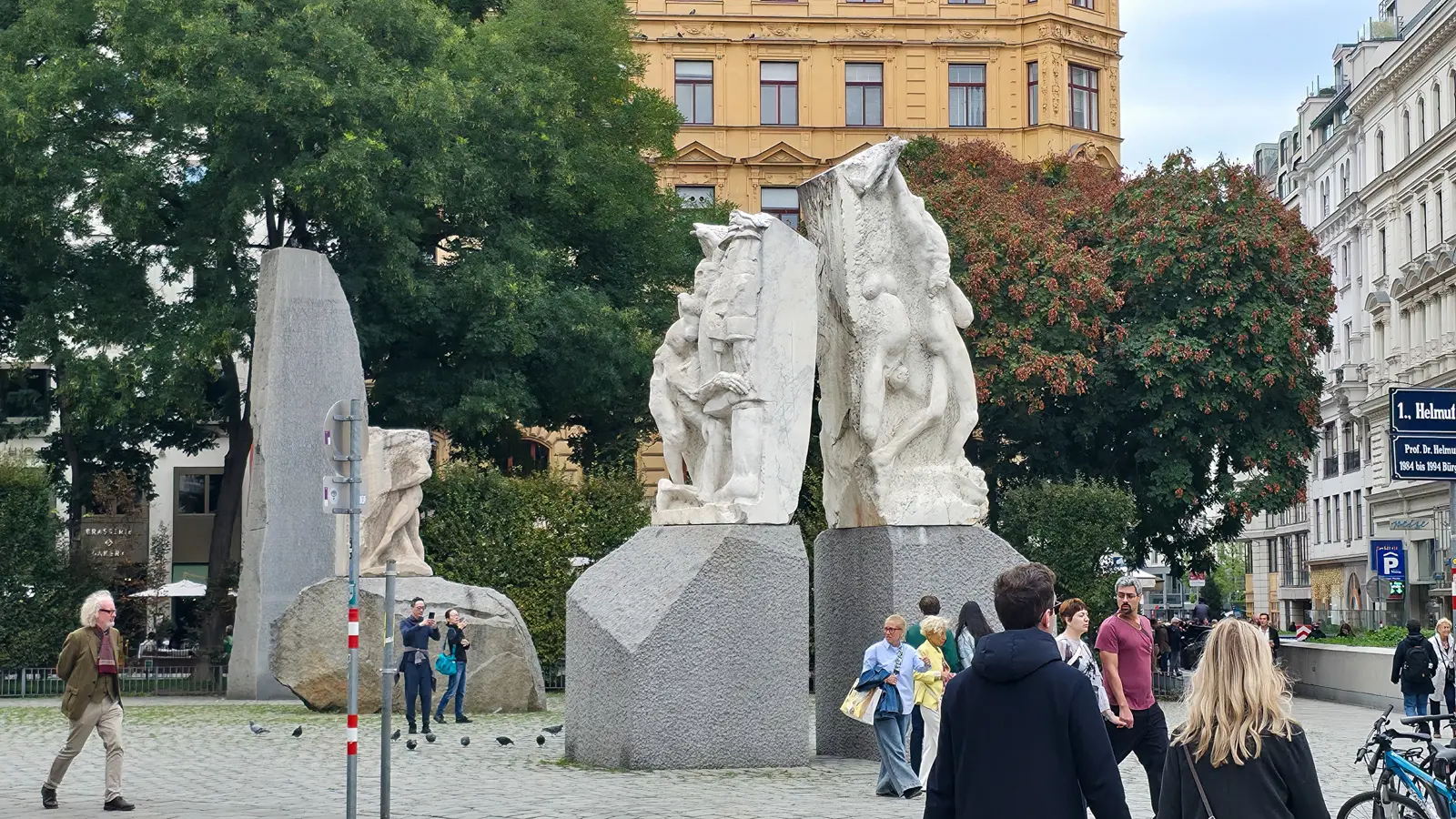
Its presence in such a central and visible location is significant. It ensures that remembrance is not confined to museums or distant sites, but remains part of the everyday landscape. It asks those who pass through to acknowledge what came before – not as something separate from the present, but as something that continues to shape it. And in doing so, it transforms a public square into something more than a place of passage, into a place of awareness.
Bubbly Tips: Visiting the Memorial Against War and Fascism
To fully experience the Memorial Against War and Fascism:
- Take your time – this is not a place to rush through
- Approach with openness – the meaning is not immediate, and that is intentional
- Walk through the entire space – each element contributes to the overall experience
- Read the context if available – understanding the history adds depth
- Visit at different times of day – quieter moments allow for deeper reflection
- Combine with nearby landmarks like the Albertina and Vienna State Opera to experience the contrast
- Allow space for reflection afterward – this is a place that stays with you
Final Thoughts
The Memorial Against War and Fascism is not a place you visit in the traditional sense. It is a place you encounter.
It does not seek admiration, but awareness. It does not offer easy answers, but invites reflection. And in doing so, it adds a depth to Vienna that goes beyond its beauty, a reminder that the most meaningful places are often the ones that ask us to pause, to look more closely, and to remember.
I’d love to hear your thoughts. Have you visited this memorial, or is it something you would include in your Vienna journey?
Happy travels!

🌟 Everything You Need to Plan Your Dream Trip in 2026
- 🌟 Luxury Hotels - Find premium stays with Booking.com & Hotels.com
- 🏡 Vacation Rentals - Discover unique properties on VRBO
- 🏞️ Guided Tours - Explore with Viator or GetYourGuide
- 🎫 Attraction Tickets - Skip the lines with Tiqets
- 🚢 Ocean Cruises - Set sail with Cruise Direct
- 📱 International SIMs - Stay connected with Saily
- 🚗 Car Rentals - Budget-friendly options from Discover Cars
- 🌐 Secure VPNs - Browse safely with NordVPN
- 💶 Currency Exchange - Best rates with Wise
- 🗣️ Learn Languages - Master the local language with Babbel and Rosetta Stone