
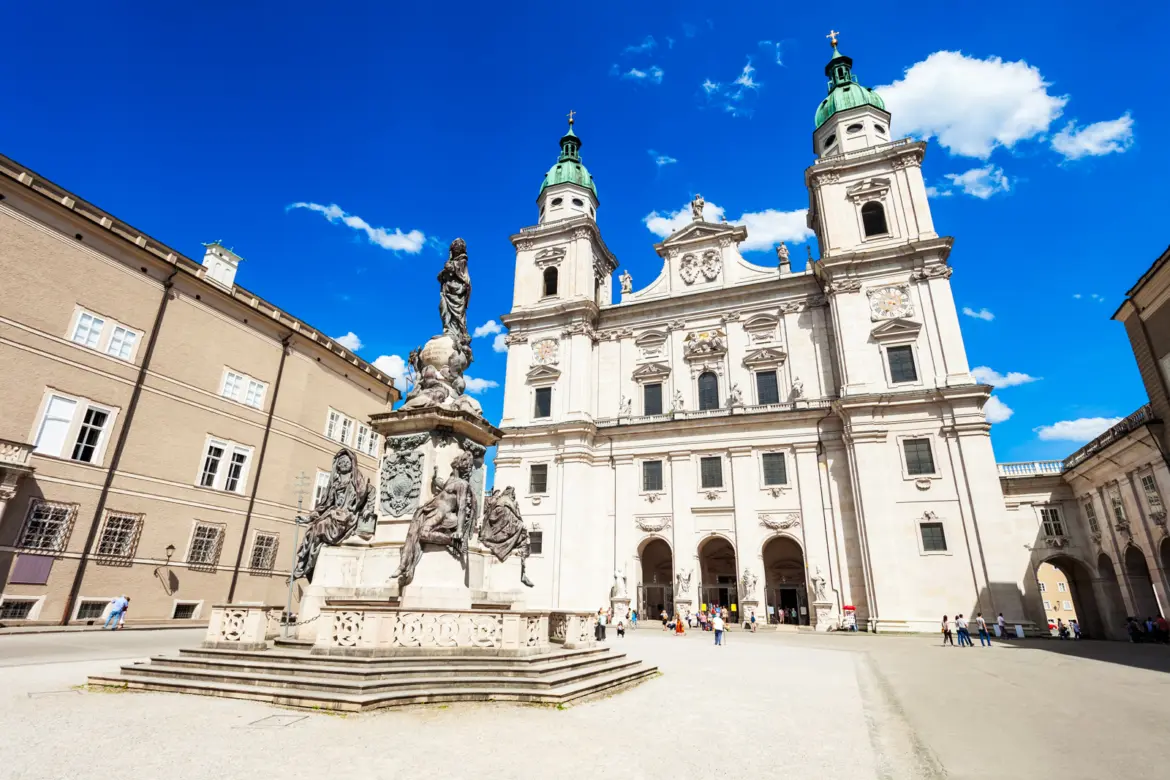
There are spaces in a city where movement slows almost instinctively, not because you are told to pause, but because the space itself asks it of you. In Salzburg, that moment unfolds in Domplatz. After moving through the rhythm of the Old Town – the narrow streets, the hidden passages, the sudden openness of nearby squares – arriving here feels different. The space does not expand in the same way as Residenzplatz. Instead, it settles. It gathers itself around a single presence, creating a square that feels both open and contained, structured yet quiet.
Here, the experience shifts from movement to awareness, from walking through the city to standing within it. There is a sense of arrival, but also of pause – as if the city, for a moment, invites you to slow down and take it in more fully.
Domplatz at a glance
🏛️ The square · An enclosed rectangular Baroque square directly in front of Salzburg Cathedral, with arcades (the Dombögen) connecting it to Residenzplatz and Kapitelplatz. The architectural enclosure was completed under Archbishop Guidobald von Thun in the 1660s.
🗿 Mariensäule (Immaculate Column) · Created between 1766 and 1771 by brothers Wolfgang and Johann Baptist Hagenauer, commissioned by Archbishop Sigismund von Schrattenbach. The Virgin Mary stands atop the column, surrounded by four allegorical figures: an angel, the devil, wisdom (or truth), and the Church.
👁️ The optical alignment · From under the western arcade of Franziskanergasse, the column aligns with the cathedral’s central axis, and the Virgin appears to be crowned by the angels carved into the façade behind her — a deliberate Baroque visual effect.
🎭 Jedermann at the Salzburg Festival · Hugo von Hofmannsthal’s morality play has been performed annually here since 1920, with the cathedral façade as backdrop.
🎄 Christkindlmarkt · Domplatz hosts the Salzburg Christmas market alongside neighbouring Residenzplatz, with origins traceable to a Tandlmarkt first recorded in 1491.
🚶 Practical tip · Free, open 24/7. Best in early morning before crowds, or late afternoon when the Cathedral façade catches the western sun.
The Setting: A Square Defined by the Cathedral
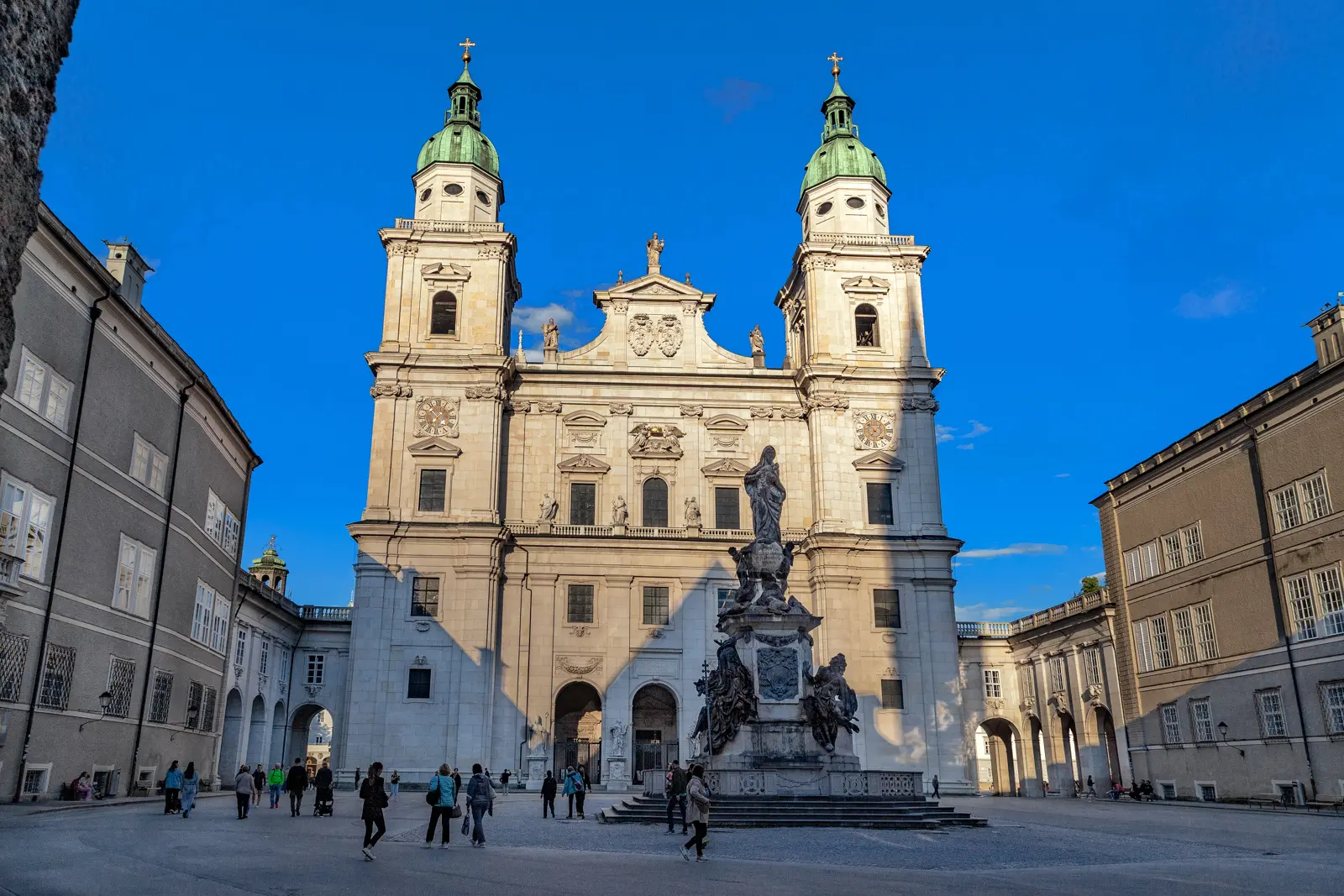
Domplatz is inseparable from the Salzburg Cathedral, whose monumental Baroque façade forms the visual and symbolic anchor of the space. Built between 1614 and 1628 to designs by Santino Solari – commissioned by Wolf Dietrich’s successor Markus Sittikus von Hohenems and consecrated under Archbishop Paris Lodron – the cathedral introduced a new architectural language to Salzburg, one defined by symmetry, proportion, and clarity, inspired by Italian Baroque models, particularly those of Rome. Its façade does more than face the square; it shapes it, establishing a strong central axis and a sense of orientation that immediately draws the eye forward and upward. The scale of the structure creates a powerful presence, yet its refinement ensures that it remains visually legible rather than overwhelming.
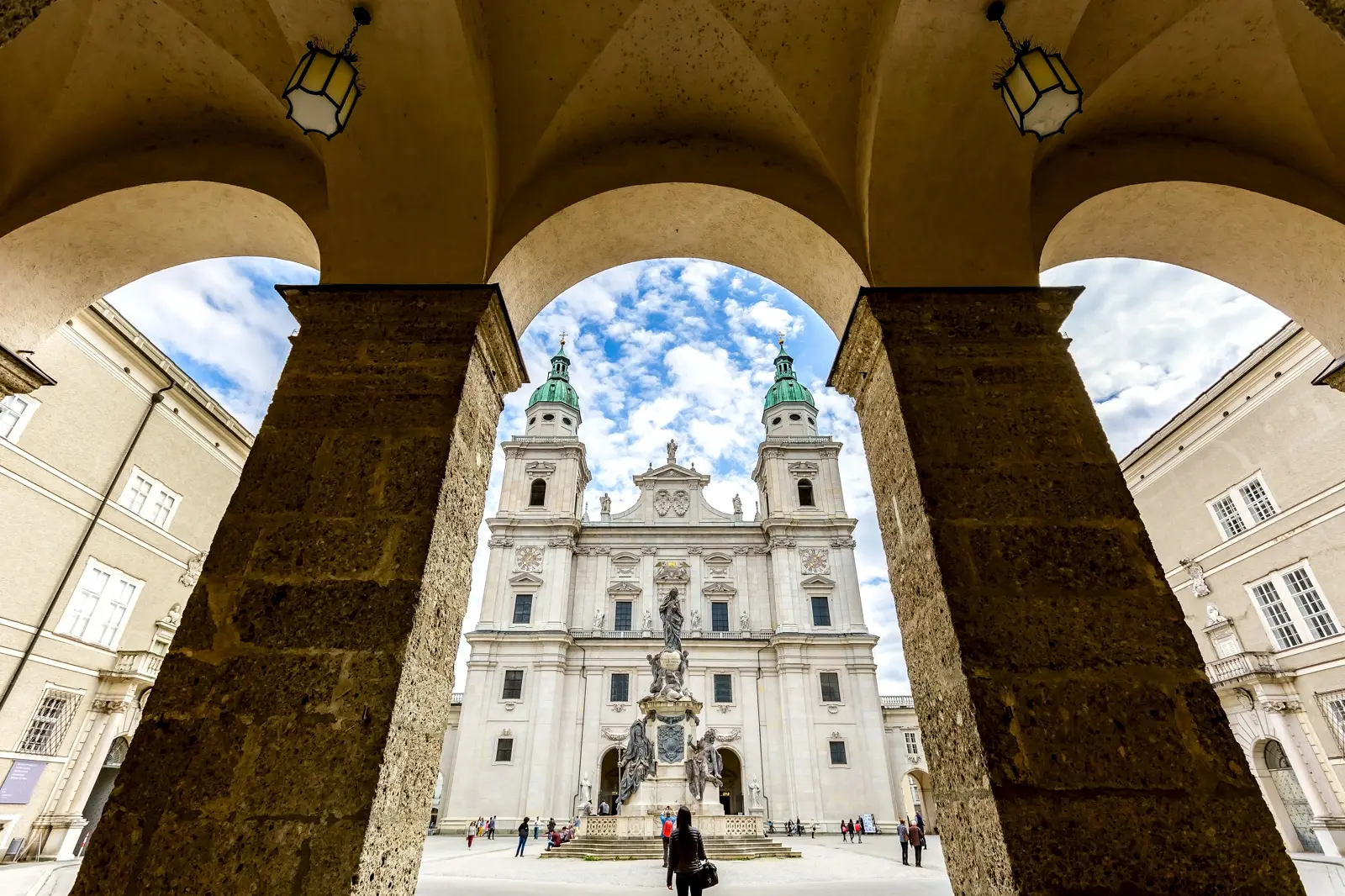
The square itself was shaped in tandem with this vision. Rather than existing independently, Domplatz was conceived as part of a larger spatial composition, linking the cathedral to surrounding ecclesiastical and civic buildings. The Dombögen – the arcades that frame the square and connect it to Residenzplatz in the north, Kapitelplatz in the south, and Franziskanergasse in the west – were built between 1658 and 1663 by the Italian architect Giovanni Antonio Dario, commissioned by Archbishop Guidobald von Thun as part of his project to give Domplatz its enclosed character. At the centre of the square stands the Immaculate Column (Mariensäule), commissioned by Archbishop Sigismund von Schrattenbach and created between 1766 and 1771 by brothers Wolfgang and Johann Baptist Hagenauer in a combination of Untersberg marble (for the pedestal and balustrade) and cast lead (for the figures). The Virgin Mary stands atop the column, surrounded by four allegorical figures – an angel, the devil, wisdom (or truth), and the Church – together depicting the four reactions to the mystery of the Immaculate Conception. Its placement carries an additional layer of intention: when viewed from the arcades of Franziskanergasse, the column carefully aligns with the cathedral’s central axis, and the Virgin appears to be crowned by the angels carved into the façade behind her, a composed Baroque visual effect that rewards those who seek it out.
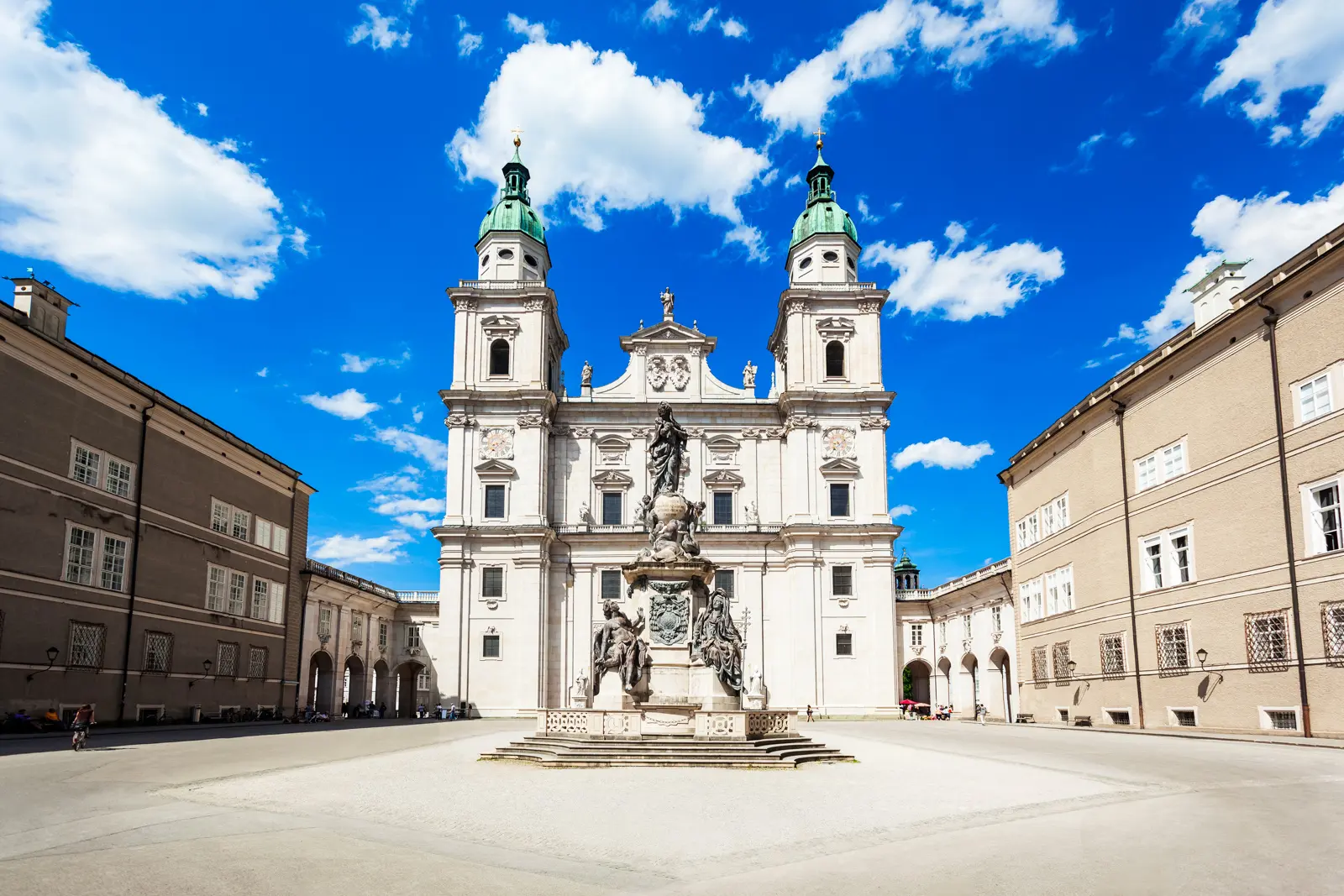
What makes the setting particularly striking is its balance. The cathedral dominates, yet the square does not feel overwhelmed. The proportions are carefully measured, allowing the façade to be fully perceived while still leaving room for movement and gathering. The interplay between the monumental architecture and the finer details – the column, the arcades, and the open paving – creates a layered experience that reveals itself gradually. The result is a space that feels intentional, designed not only to be seen, but to host presence, ceremony, and quiet observation.
Architecture and Perspective
Standing in Domplatz, perspective becomes part of the experience. The cathedral’s façade rises with clarity, its twin towers framing the sky, while the three bronze portals create a rhythm across the lower level. Sculptural details, inscriptions, and layered architectural elements draw the eye upward, reinforcing the verticality that defines Baroque design. The surrounding buildings contribute quietly to this composition. Their façades are restrained, allowing the cathedral to remain the focal point while still creating a cohesive architectural enclosure. The paving of the square itself – broad, open, and unobstructed – enhances this clarity, offering uninterrupted sightlines and reinforcing the sense of order.
From certain angles, glimpses of Hohensalzburg Fortress appear above the surrounding structures, adding a vertical layer that connects the square to the broader topography of Salzburg. This layering – square, façade, fortress – creates a composition that feels both grounded in the city and connected to the landscape beyond.
A Stage for Performance
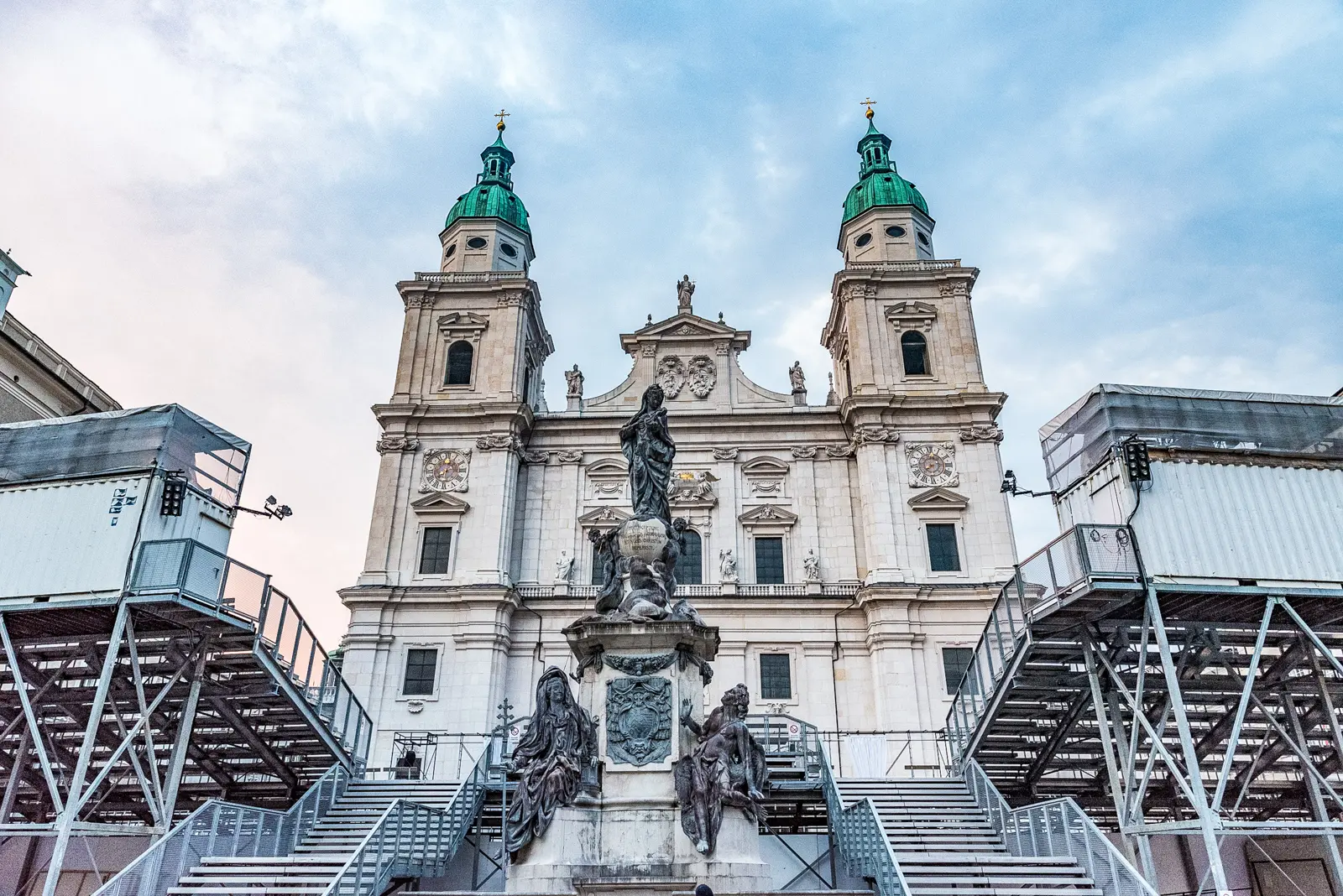
Beyond its architectural presence, Domplatz functions as a stage, quite literally. Each summer, it becomes the setting for performances during the Salzburg Festival, one of the world’s most renowned cultural events. At the centre of this tradition is Jedermann, the iconic morality play by Hugo von Hofmannsthal, performed annually here since 1920 (with only a brief Nazi-era interruption) against the backdrop of the cathedral façade. That continuity makes it one of the longest-running annual theatrical productions in Europe. The scale and composition of the square lend themselves naturally to this use. The façade becomes a dramatic backdrop, the open space a gathering ground, and the audience an integral part of the experience.
This transformation highlights the original intention behind the square’s design. Domplatz was never meant to be static, it was conceived as a place of assembly, ceremony, and shared experience. The continuation of this tradition gives the square a living cultural dimension, where architecture and performance interact in a way that feels both historic and immediate.
Seasonal Transformation
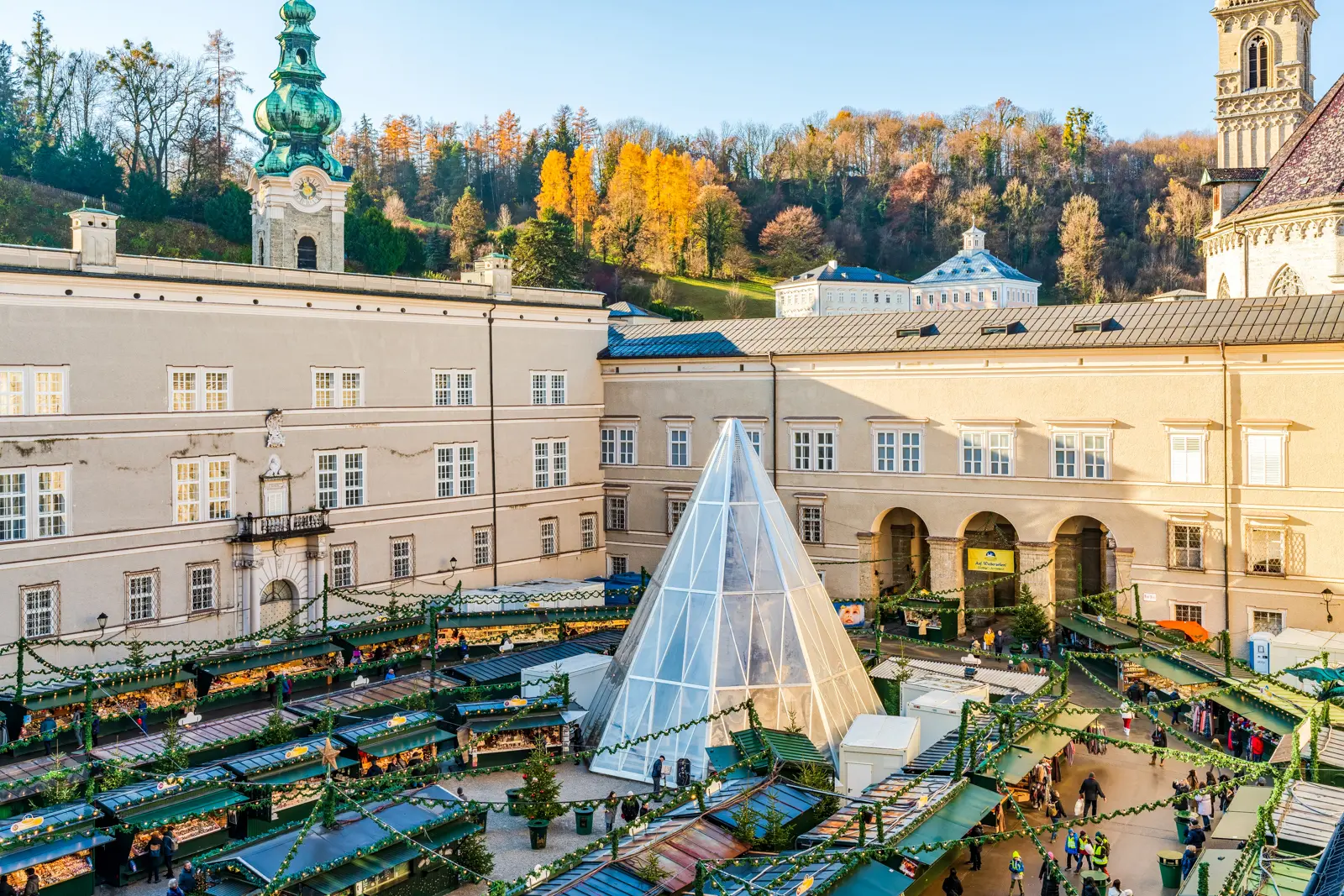
Like much of Salzburg’s Old Town, Domplatz transforms with the seasons. During Advent, it becomes part of the Salzburger Christkindlmarkt, extending the festive atmosphere from nearby Residenzplatz into a space that feels more intimate and enclosed. Wooden stalls line the square, their lights reflecting softly against the cathedral’s pale stone façade. The openness of the space remains, but its character shifts – becoming warmer, more atmospheric, more immersive. The scent of mulled wine (Glühwein), roasted chestnuts, and traditional pastries fills the air, while music, often choral or classical, drifts across the square, reinforcing Salzburg’s deep musical identity.
What is striking is how naturally this transformation occurs. The square does not lose its identity; it adapts, revealing a softer, more intimate version of itself without losing its architectural clarity.
The Experience: Presence and Pause
What makes Domplatz unique is not simply what it contains, but how it is experienced. Unlike other spaces in the Old Town, which encourage movement, this is a place that invites stillness. I remember standing here toward the end of the day, just as the light began to soften against the cathedral’s façade. The square wasn’t empty. People moved quietly along its edges, some pausing, others passing through, but there was a noticeable calm. I found myself lingering without intention, drawn not to a specific detail, but to the overall presence of the space.
There’s something about the scale and balance here that shifts your awareness. You begin to notice the way sound carries: footsteps echoing lightly across the stone, voices softening as they disperse across the square, the occasional bell marking the passage of time. The longer you stay, the more subtle the experience becomes. Time feels slightly extended here. It’s not dramatic, there’s no single moment that defines it, but rather a gradual deepening of awareness. And in that quiet shift, the square reveals itself not just as a place to see, but as a place to feel.
Bubbly Tips for Visiting
- Take a moment to pause: Stand at the centre of Domplatz and take in the full façade of the Salzburg Cathedral.
- Look for alignment: Notice how the architecture frames your perspective from different angles across Domplatz in Salzburg.
- Visit during the Salzburg Festival (July–August): If timing allows, experiencing a performance in Domplatz is unforgettable.
- Explore nearby spaces: Move between Domplatz, Kapitelplatz, and Residenzplatz to feel the contrast in scale and atmosphere.
- Experience the Christmas market: During Advent, Domplatz becomes part of the Salzburg Christmas market, adding lights, music, and a warm seasonal atmosphere to the square.
- Come at different times: Morning light, evening shadows, and the Christmas market season each transform Domplatz in Salzburg in distinct ways.
Final Thoughts
Domplatz is not the largest square in Salzburg, nor the most dynamic, but it may be the most composed. It is a space where architecture, history, and presence come into balance, creating an experience that feels both structured and deeply human.
In a city defined by movement and discovery, this is where everything briefly pauses. And in that pause, you begin to see not just the city, but your place within it.
I’d love to hear your thoughts: do you find yourself drawn to spaces that invite stillness, or do you prefer those filled with constant movement?
Happy travels!

🌟 Everything You Need to Plan Your Dream Trip in 2026
- 🌟 Luxury Hotels - Find premium stays with Booking.com & Hotels.com
- 🏡 Vacation Rentals - Discover unique properties on VRBO
- 🏞️ Guided Tours - Explore with Viator or GetYourGuide
- 🎫 Attraction Tickets - Skip the lines with Tiqets
- 🚢 Ocean Cruises - Set sail with Cruise Direct
- 📱 International SIMs - Stay connected with Saily
- 🚗 Car Rentals - Budget-friendly options from Discover Cars
- 🌐 Secure VPNs - Browse safely with NordVPN
- 💶 Currency Exchange - Best rates with Wise
- 🗣️ Learn Languages - Master the local language with Babbel and Rosetta Stone