
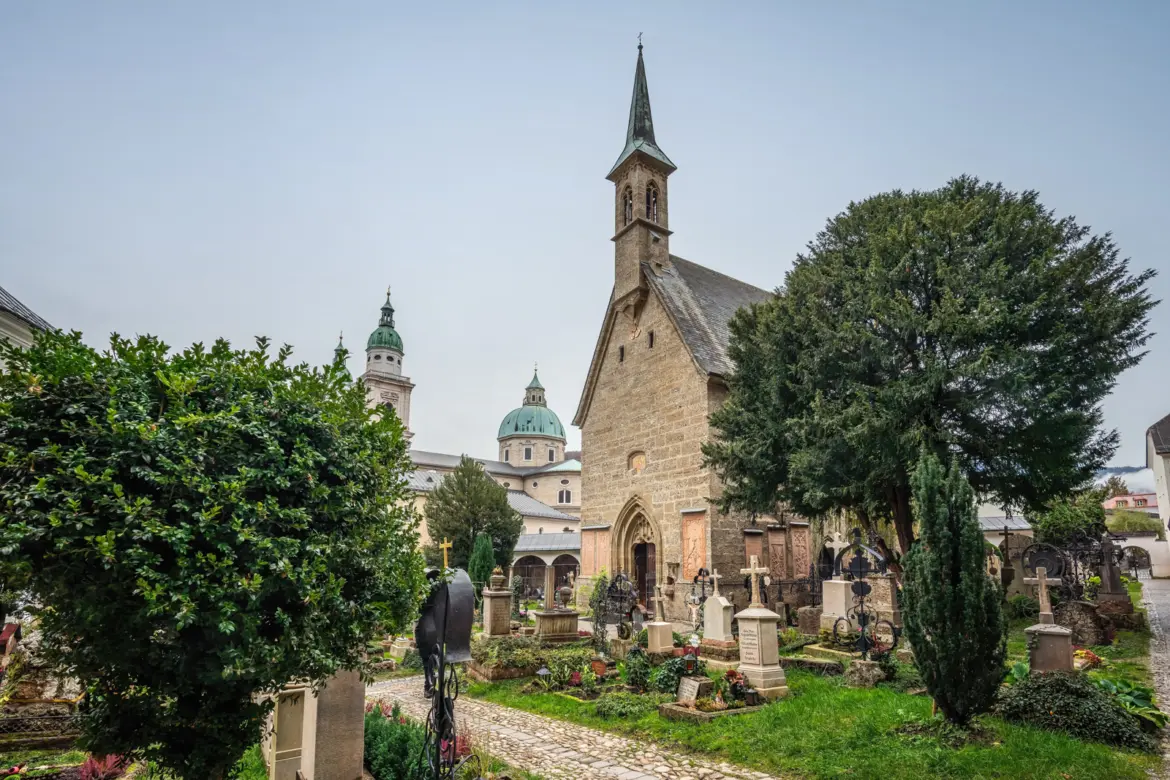
There are places in a city that reveal themselves slowly, not through scale or spectacle, but through quiet presence. In Salzburg, St. Peter’s Cemetery is one of those spaces. Tucked within the Old Town, it feels both connected to the city and gently removed from it, as though time operates at a slightly different pace once you cross its threshold.
Despite being one of Salzburg’s most popular attractions, the cemetery retains a remarkable sense of calm. The transition is subtle but immediate: the movement of nearby streets softens, sound becomes more diffuse, and attention naturally shifts inward. Rather than presenting itself all at once, the space unfolds gradually – through pathways, textures, and small details that invite observation. It is not simply a place to pass through, but one that encourages pause, reflection, and a more attentive way of experiencing the city.
St. Peter’s Cemetery at a glance
⛪ Origins · One of the oldest cemeteries in the German-speaking world. Laid out around 700 AD, alongside the founding of St. Peter’s Abbey by Saint Rupert in 696. First mentioned in a 1139 deed; the oldest preserved tombstone dates to 1288.
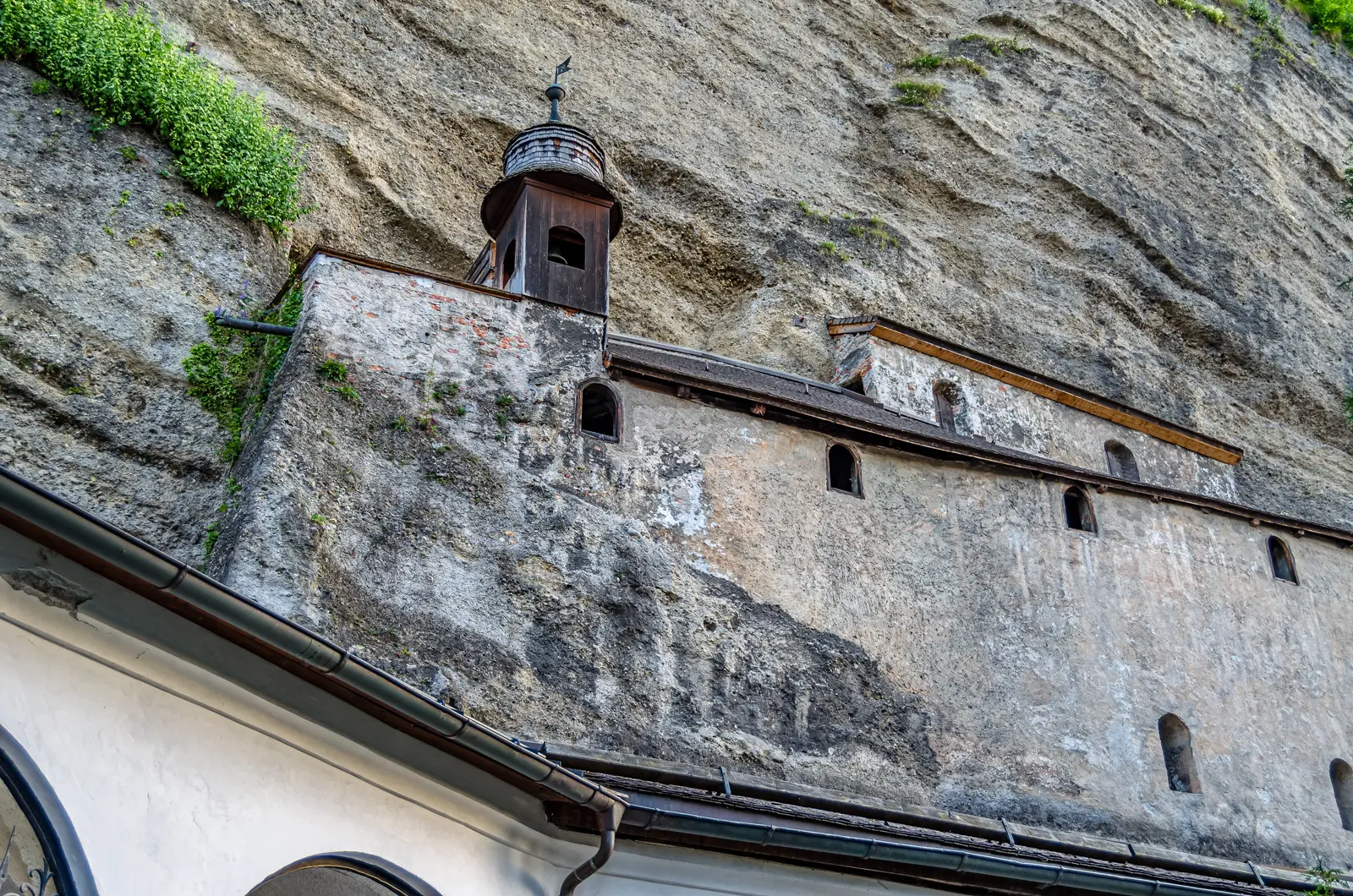
🪨 The catacombs · Two rock-cut chapels — the Maximus and the Gertrauden — carved into Festungsberg’s conglomerate cliff. The Gertrauden was consecrated in 1178 by Archbishop Conrad of Wittelsbach and dedicated to Thomas Becket of Canterbury, recently martyred at the time.
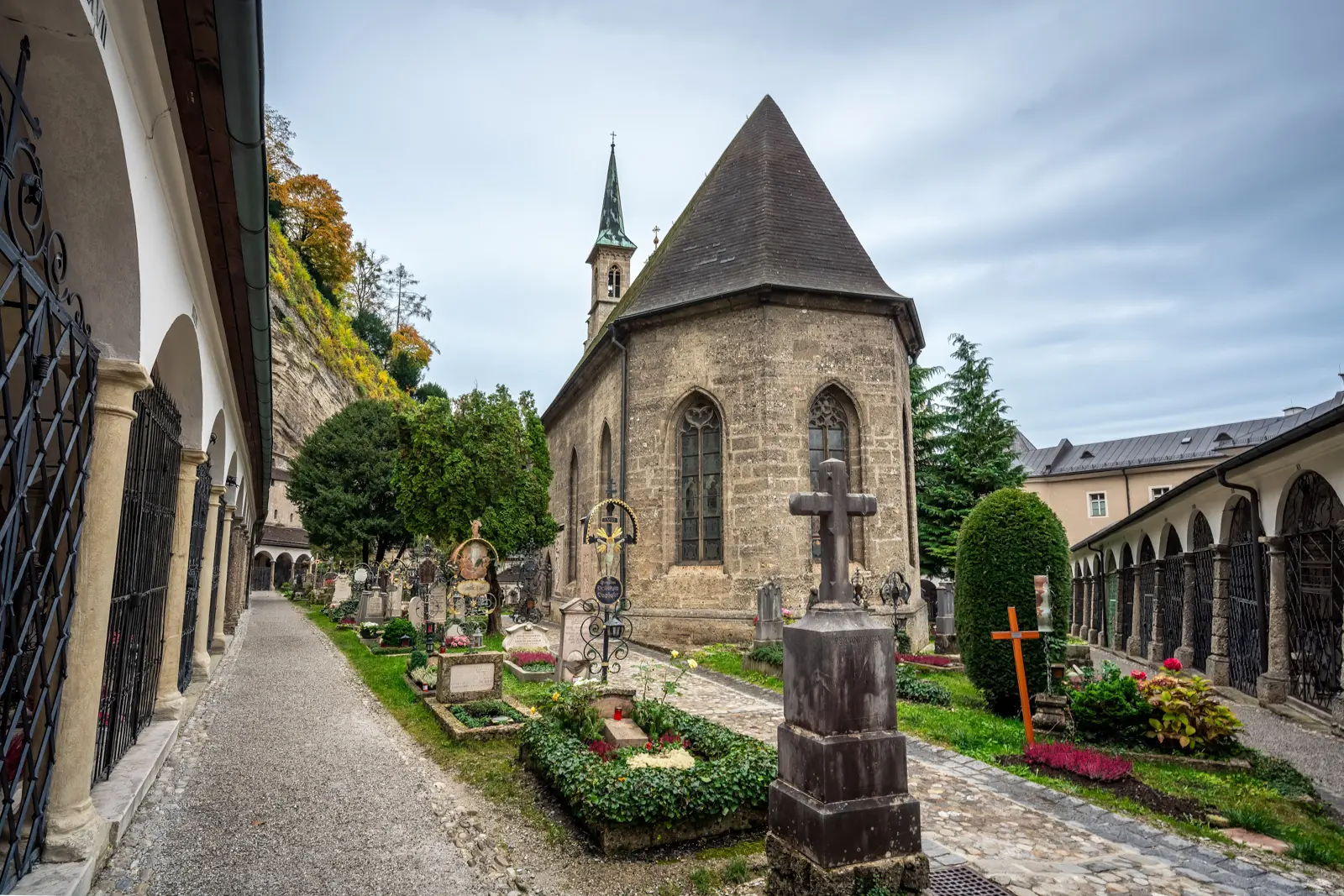
⛪ St. Margaret’s Chapel · The Late Gothic chapel at the cemetery’s heart was completed in 1491 on Romanesque foundations.
💐 The graves · Wrought iron crosses are the cemetery’s defining feature. Crypt LIV, near the catacombs entrance, contains Mozart’s older sister Maria Anna ‘Nannerl’ and the composer Michael Haydn (brother of Joseph). Crypt XXXI holds Santino Solari, architect of Salzburg Cathedral.
🎬 Sound of Music · The von Trapp escape scene was inspired by — but not filmed in — this cemetery; a replica was built on a Hollywood soundstage at 20th Century Fox.
🎟️ Visiting · The cemetery is free. The catacombs cost €2 (under-18s €1.50). Cemetery hours: 6:30–20:00 April–September; 6:30–18:00 October–March.
The Setting: At the Foot of the Mountain
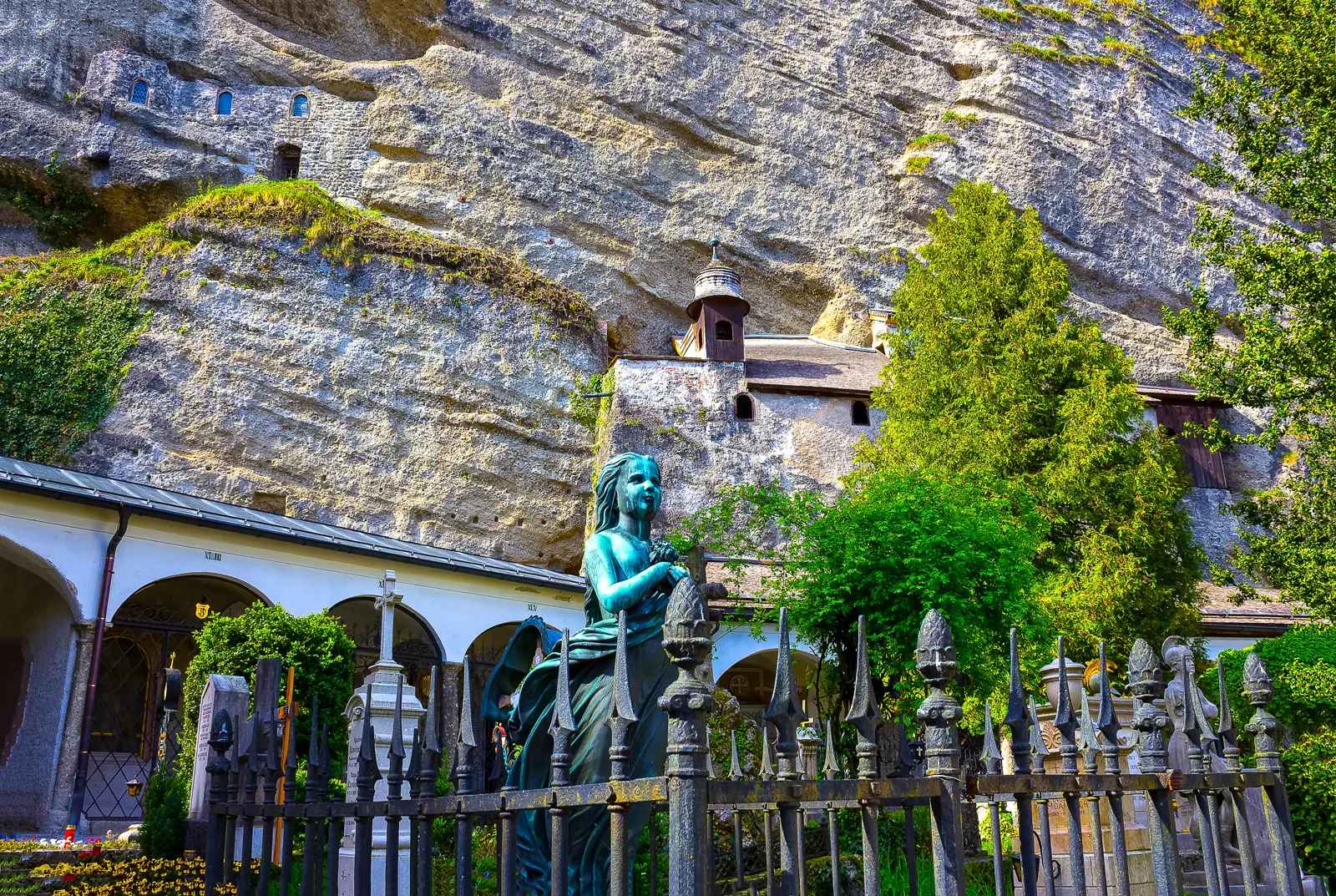
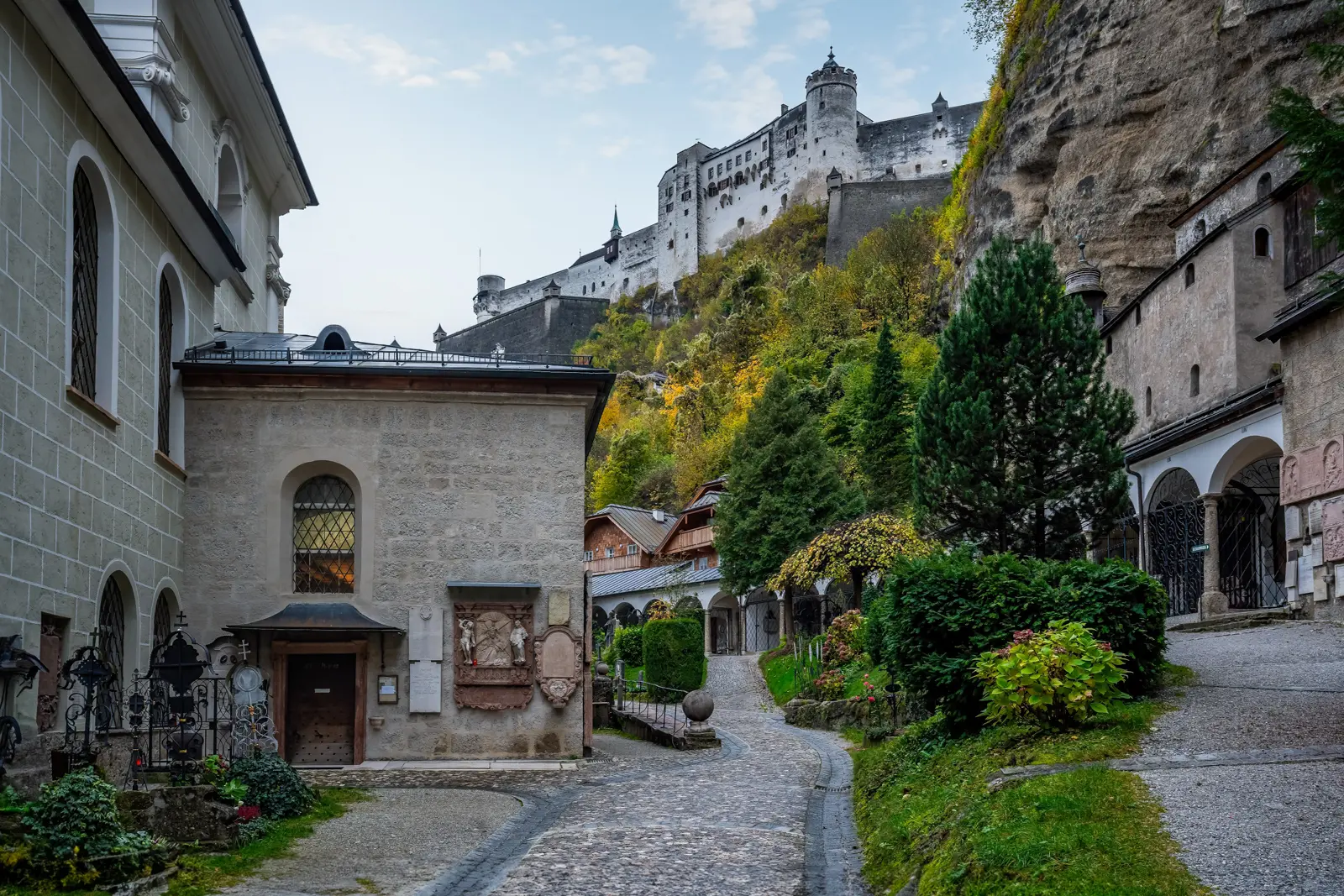
What gives St. Peter’s Cemetery its distinctive presence is its setting. It lies at the base of Festungsberg, the steep, rocky hill that rises sharply above the Old Town and is crowned by Hohensalzburg Fortress. This vertical relationship defines the experience of the cemetery as much as its layout does. The rising cliff creates a natural enclosure, giving the space a sense of protection and quiet separation from the surrounding city.
The cemetery’s origins date back to the early 700 AD, making it among the oldest Christian burial sites in the German-speaking world. It developed alongside St. Peter’s Abbey, founded by Saint Rupert as part of his broader Christianisation of the region, a connection that anchors the site within the earliest chapter of Salzburg’s history. This depth of continuity is part of what makes the space feel so distinctive. It is not simply old; it is foundational.
Behind the orderly rows of graves, the exposed rock face forms both a boundary and a backdrop. Over centuries, this cliff has been shaped and adapted, not through large-scale alteration, but through careful integration. Chapels and catacombs are integrated into and carved from the stone, blending architecture with the natural landscape in a way that feels entirely organic. The result is a space where built and natural elements are inseparable, reinforcing a sense of continuity between human presence and the passage of time.
The Cemetery: Order and Detail
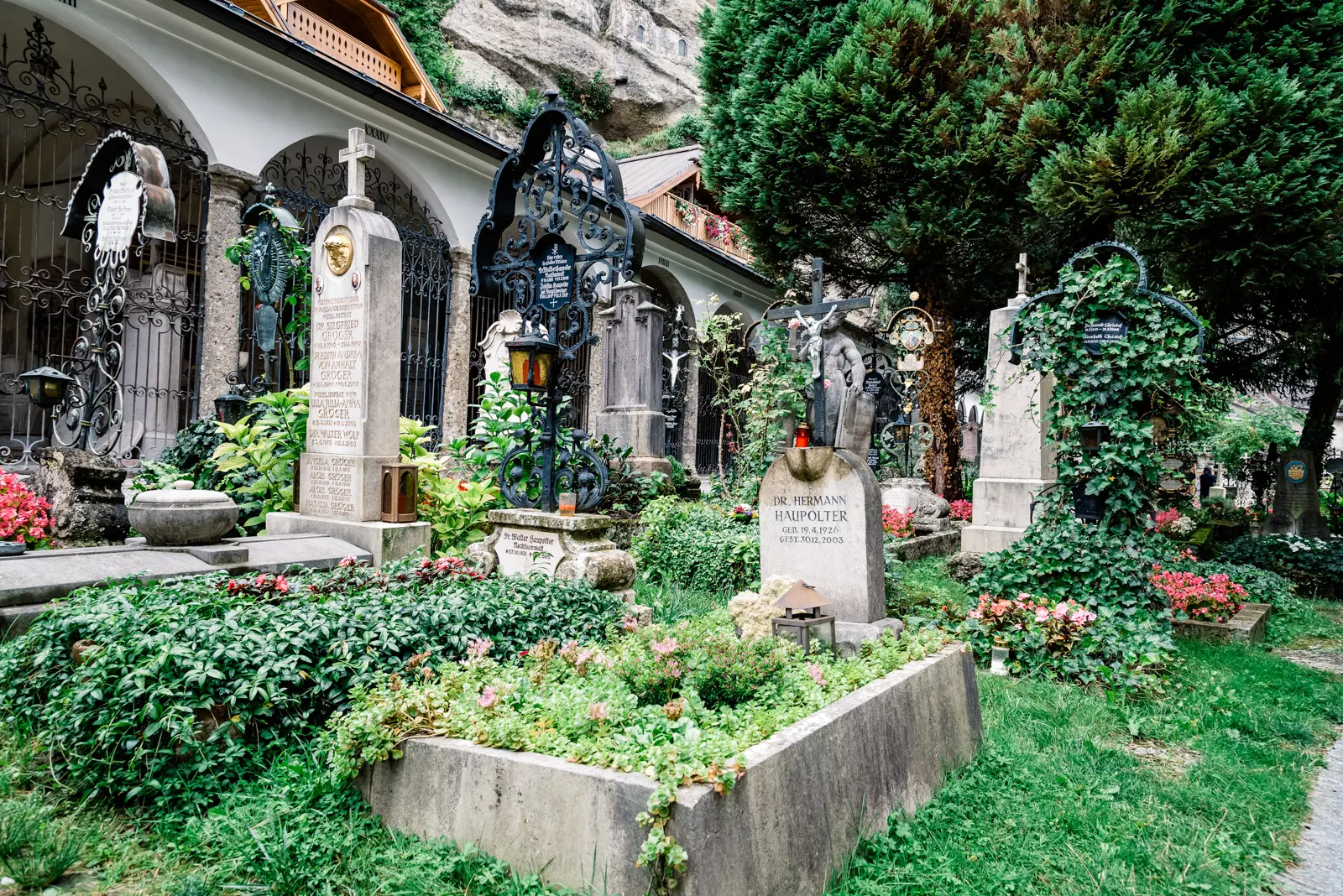
At first glance, the layout of St. Peter’s Cemetery appears orderly and composed. Straight pathways divide the grounds into defined sections, creating a structure that guides movement while still allowing for quiet exploration. This sense of order reflects centuries of continuity, where the spatial organisation has been preserved even as individual graves have evolved over time. The repetition of paths and plots introduces a rhythm to the space, one that feels stable and enduring rather than rigid.
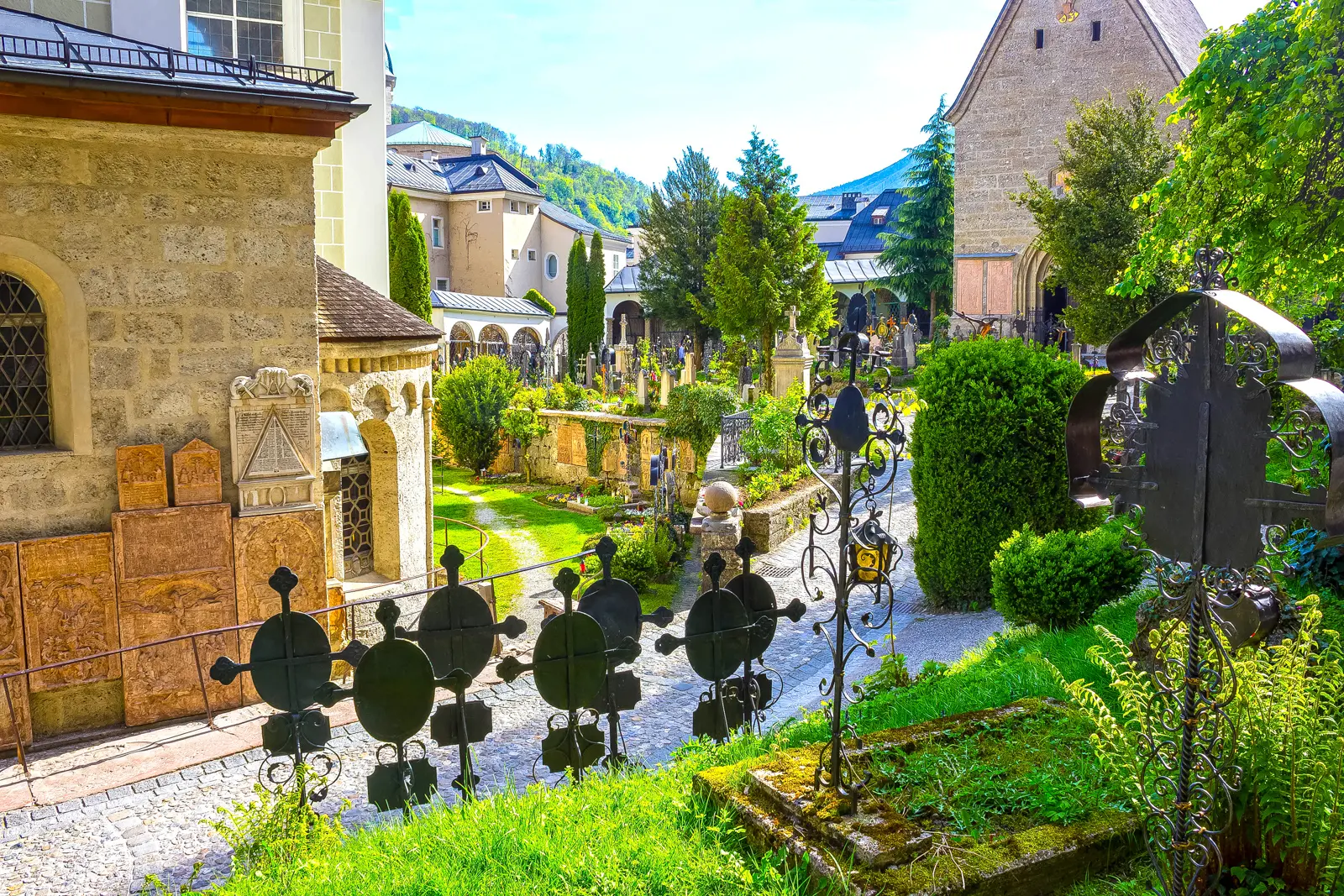
Within this framework, it is the detail that becomes most compelling. Each grave is distinct, marked by intricately crafted wrought iron crosses, many gilded, some painted, all uniquely designed. These crosses, often dating back generations, are a defining feature of the cemetery and reflect a long-standing regional tradition of metalwork. Beneath them, carefully arranged flowers introduce colour and softness, changing with the seasons and adding a living element to the space. Pansies are particularly prevalent, in German their name carries the meaning of “thoughts”, giving their presence a quiet symbolic resonance. The interplay between iron, stone, and greenery creates a layered visual texture that rewards close attention. Crypt XXXI holds Santino Solari, the Italian architect of Salzburg Cathedral — buried here in 1646, just eighteen years after his masterpiece was consecrated.
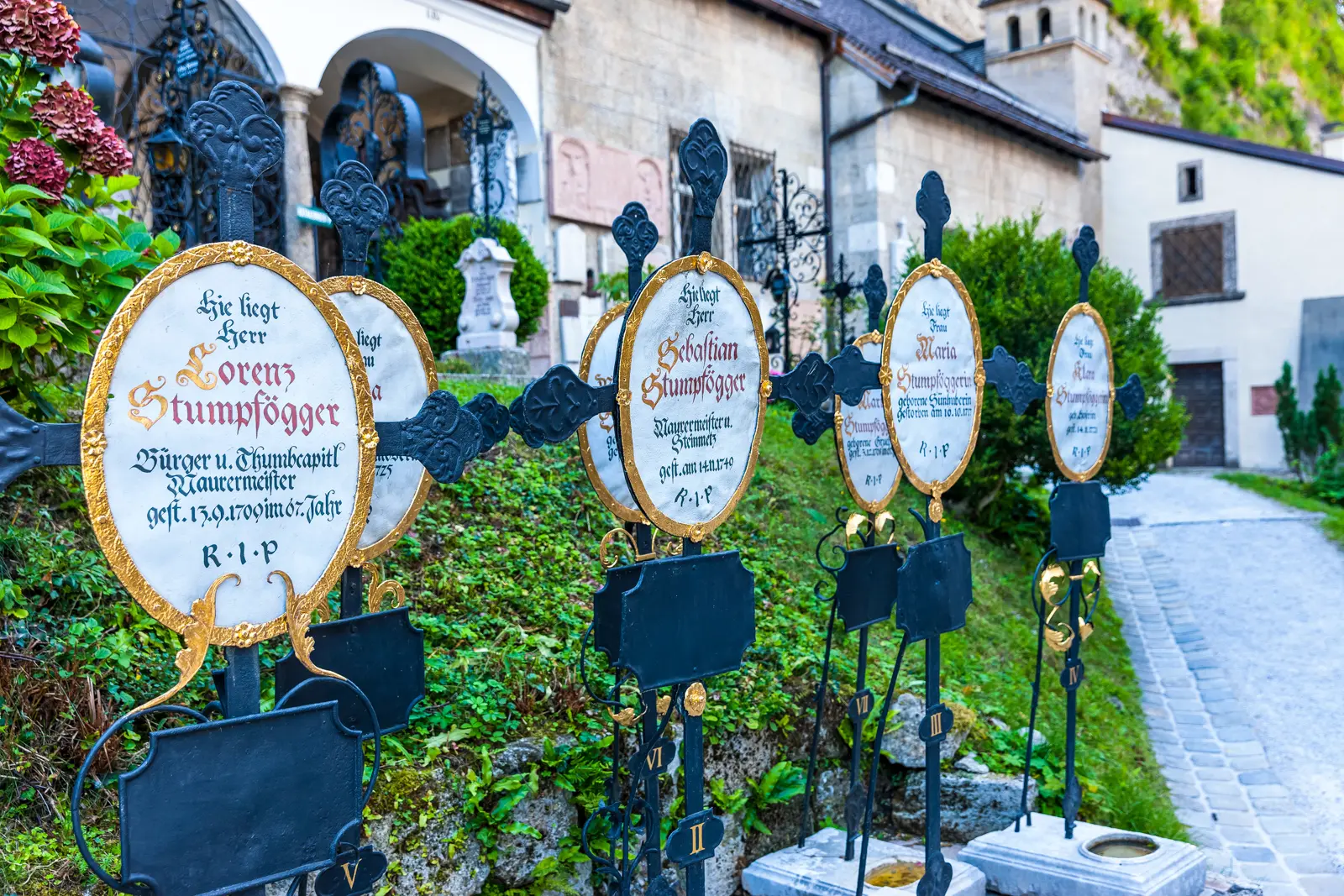
Among the graves, certain sites draw particular interest. The Stumpfögger family grave is often noted for its distinctive ironwork and decorative detail — seven gilded iron crosses commemorating Sebastian Stumpfögger, his parents, and four of his five wives. Sebastian was no ordinary citizen: as Hofsteinmetz (court stonemason) to the Prince-Archbishops, he worked alongside Johann Bernhard Fischer von Erlach on landmarks across the city, including the Kollegienkirche, Hellbrunn, and Schloss Klessheim. More historically grounded is the grave of Michael Haydn, brother of the more famous Joseph and a composer in his own right, whose presence connects the site directly to Salzburg’s musical heritage. He is buried in Crypt LIV near the catacombs entrance, alongside Mozart‘s older sister Maria Anna ‘Nannerl’, also an accomplished musician. Rather than standing apart from one another, these graves contribute to a collective yet deeply personal landscape, where each site adds its own layer to the space’s long and varied history.
St. Margaret’s Chapel: A Presence in Stone
Set against the rock face at the rear of St. Peter’s Cemetery, St. Margaret’s Chapel introduces a distinct architectural presence within the grounds. A late Gothic structure rebuilt in 1491, it stands in quiet contrast to the darker cliff behind it, its pale stone façade and refined proportions aligning with the restrained character of the surrounding space.
Rather than dominating the landscape, the chapel integrates into it. Its position at the base of the rock reinforces the vertical composition of the cemetery, where graves, pathways, and arcades gradually give way to the rising stone above. Historically, it also reflects the close relationship between the cemetery and the adjacent St. Peter’s Abbey, one of the oldest monasteries in the German-speaking world, reinforcing the sense that this space has been shaped and sustained within a continuous tradition of care, faith, and presence.
The Catacombs: Carved into the Rock
Beyond the graves, a series of narrow stairways leads upward into the rock face of Festungsberg, where the catacombs are carved directly into the mountain. Dating back to early Christian times, these spaces are not burial chambers in the traditional sense, but rather small chapels and hermitage-like rooms used for contemplation and worship.
Inside, the atmosphere shifts noticeably. The open air of the cemetery gives way to enclosed, stone-carved interiors where light is more limited and sound is muted. Openings in the rock provide framed views back toward the cemetery and the city beyond, creating a contrast between interior stillness and exterior openness. This vertical movement, from ground level into the cliff, adds another dimension to the experience, reinforcing the layered relationship between space, history, and landscape.
The Experience: Stillness and Reflection
Experiencing St. Peter’s Cemetery is defined less by movement and more by stillness. Visitors tend to slow naturally, drawn not by a single focal point but by a series of small observations: a detail in an iron cross, the arrangement of flowers, the texture of stone against light. Sound behaves differently here. Conversations are softer, footsteps more deliberate, and the surrounding city feels distant despite its proximity. Light filters through trees and reflects off metal and stone, shifting throughout the day and subtly altering the atmosphere. The cemetery feels neither static nor staged, but quietly active in its own way, shaped by time, care, and continuity.
What is most striking is the balance the space achieves. It is undeniably a place of memory, yet it does not feel heavy or somber. Instead, it carries a sense of calm presence – where history, nature, and human attention coexist without tension.
A Cultural Note
St. Peter’s Cemetery is often linked to The Sound of Music, having inspired the cemetery scene in which the Von Trapp family hides from the Nazis. While the actual filming took place on a reconstructed Hollywood set, the visual inspiration is unmistakable, from the arrangement of graves to the intricate wrought iron gates of the family crypts, which were carefully echoed in the film’s design. The cemetery’s enclosed arcades and quiet, atmospheric layout made it a natural visual reference, capturing a sense of intimacy and tension that translated seamlessly to the screen. Even removed from its cinematic context, the space retains that same layered quality, where stillness, structure, and narrative seem to converge.
Bubbly Tips for Visiting
- Take your time: St. Peter’s Cemetery is best experienced slowly, allow yourself to pause and observe.
- Look closely: Notice the craftsmanship of the wrought iron crosses and the seasonal flowers throughout the cemetery in Salzburg.
- Visit the catacombs: The rock-cut catacombs above St. Peter’s Cemetery offer elevated views over Salzburg’s Old Town.
- Choose your timing: Early morning or late afternoon enhances the sense of stillness in one of Salzburg’s most peaceful historic sites.
- Combine nearby sites: Pair your visit with Salzburg Cathedral, Kapitelplatz, or a walk through Salzburg’s Old Town.
Final Thoughts
St. Peter’s Cemetery is not defined by a single element, but by the way everything comes together: stone, light, nature, and time. It is a space that does not demand attention, yet holds it effortlessly. What lingers is not a specific image, but a feeling – of calm, continuity, and quiet beauty. In a city known for its grand architecture and layered history, this is where everything slows, offering a more intimate and reflective way of experiencing Salzburg.
Would you include this peaceful place in your Salzburg itinerary? I’d love to hear your thoughts.
Happy travels!

🌟 Everything You Need to Plan Your Dream Trip in 2026
- 🌟 Luxury Hotels - Find premium stays with Booking.com & Hotels.com
- 🏡 Vacation Rentals - Discover unique properties on VRBO
- 🏞️ Guided Tours - Explore with Viator or GetYourGuide
- 🎫 Attraction Tickets - Skip the lines with Tiqets
- 🚢 Ocean Cruises - Set sail with Cruise Direct
- 📱 International SIMs - Stay connected with Saily
- 🚗 Car Rentals - Budget-friendly options from Discover Cars
- 🌐 Secure VPNs - Browse safely with NordVPN
- 💶 Currency Exchange - Best rates with Wise
- 🗣️ Learn Languages - Master the local language with Babbel and Rosetta Stone