
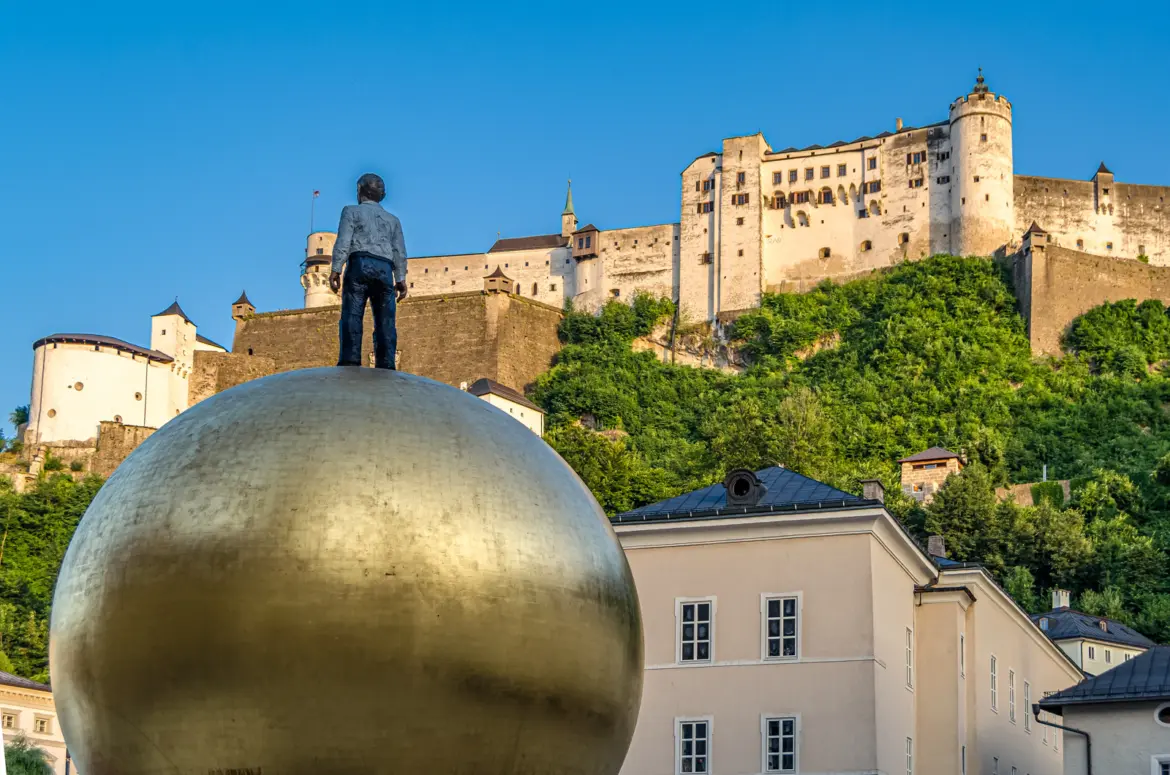
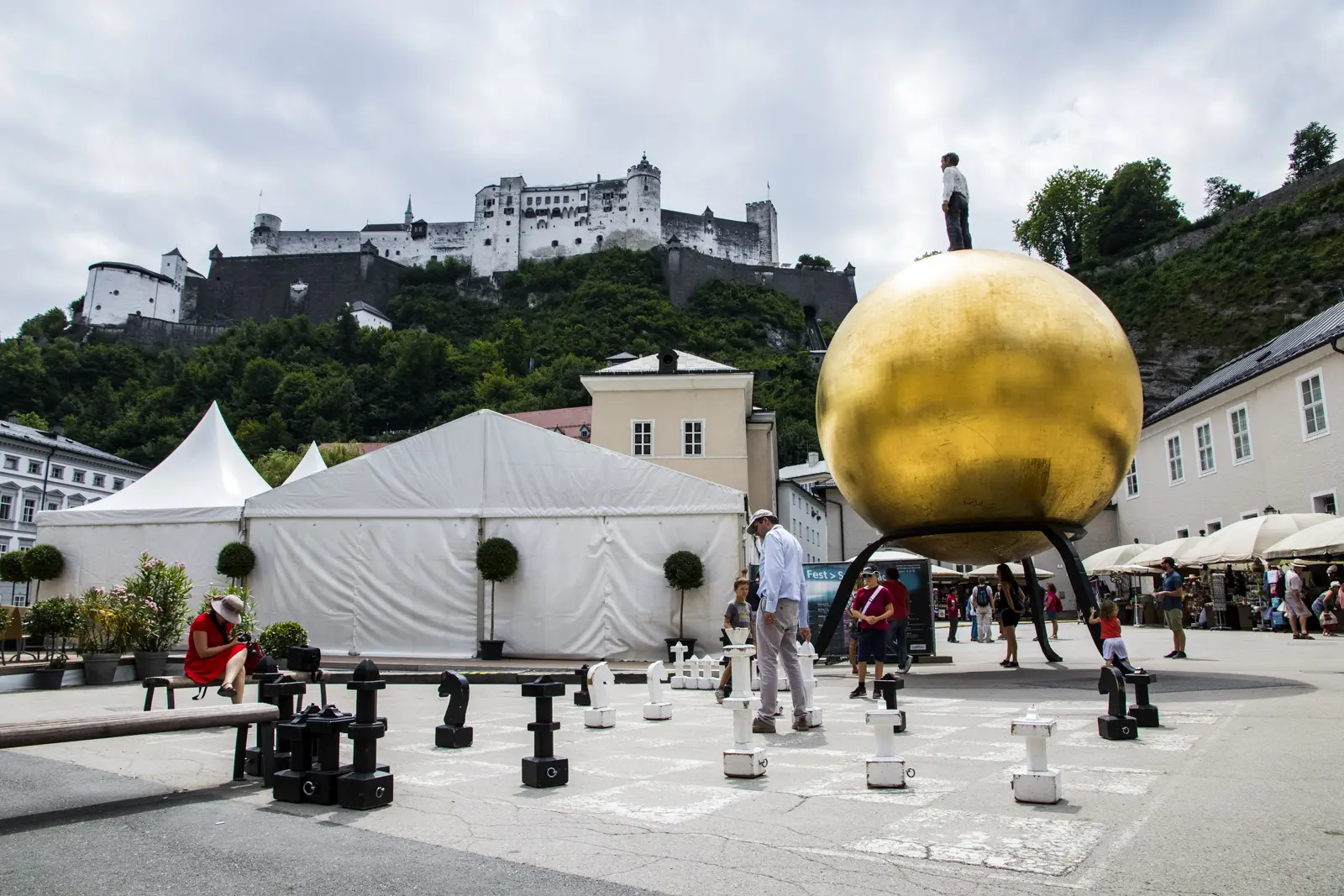
There are moments in travel when something stops you, not because it is grand or historic, but because it feels entirely unexpected within its surroundings. In Salzburg, a city defined by Baroque elegance, fortress silhouettes, and centuries of continuity, Sphaera is one of those moments. At first glance, it seems almost out of place. A golden sphere, perfectly smooth and reflective, rises from the open space of Kapitelplatz. Atop it stands a solitary human figure – still, upright, and unadorned. Unveiled in July 2007 as part of the 5th Salzburg Art Project, it has stood here for nearly two decades, long enough for locals to have given it an affectionate nickname, and yet it still feels new each time you encounter it. There is no immediate explanation, no narrative imposed. And yet, it is precisely this ambiguity that gives the work its presence.
Sphaera at a glance
🎨 The artwork · Created by German sculptor Stephan Balkenhol for the 5th Salzburg Art Project and handed over to the public on July 26, 2007. Roughly 8.8 metres tall with a 5-metre-diameter gilded sphere, weighing about 3.5 tonnes.
👤 The figure · Carved from wawa wood and bronzed, depicting an everyman in black trousers and a white shirt. Often read as the protagonist of “Jedermann” (Everyman), the morality play performed annually at the Salzburg Festival since 1920.
🥮 Local nickname · Salzburgers often call it the “Mozartkugel” — after the city’s famous pistachio-marzipan-and-dark-chocolate sphere.
🏰 The setting · Kapitelplatz, directly below the Hohensalzburg Fortress and beside Salzburg Cathedral. The fortress-and-sphere alignment is one of the city’s most photographed contemporary compositions.
👭 Partner piece · Balkenhol made a companion work the same year — “Frau im Fels” (Woman in the Rock) — a smaller female figure half-embedded in the rock face at Toscaninihof, a few minutes’ walk away.
🎟️ Visiting · Free, outdoors, 24/7. Best for photos in late afternoon or at blue hour, when the gold leaf picks up directional light.
The Sculpture: Form and Simplicity
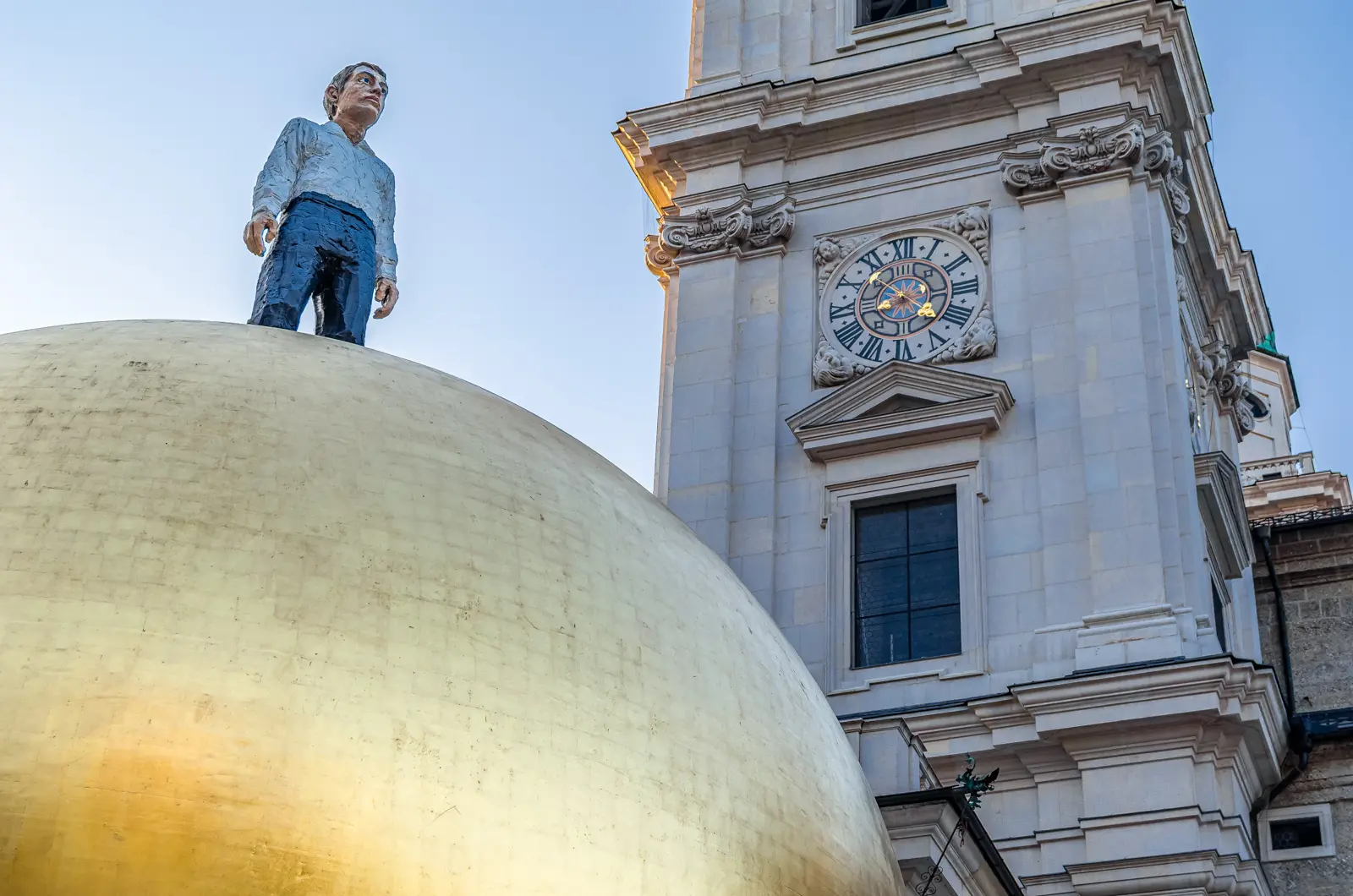
Created by Stephan Balkenhol, Sphaera stands approximately nine metres high and depicts a male figure in black trousers and a white shirt, standing in a relaxed pose with a neutral expression atop a large golden sphere. The figure itself is carved from African wawa wood and then bronzed – Balkenhol’s signature medium for the everyman figures that recur throughout his work – while the sphere beneath it is a steel and plastic structure finished in gold leaf. The sphere itself, with a diameter of roughly five metres, is monumental in scale yet geometrically simple, its gold-leafed surface catching the changing tones of the day and appearing luminous in sunlight and more subdued under softer skies.
The human figure introduces a striking contrast to the abstraction of the sphere beneath it. Dressed without symbolic markers or dramatic gesture, it resists easy interpretation. It does not command attention through action, but through stillness, an ordinary person elevated to an extraordinary position, neither heroic nor troubled, simply present. This deliberate ordinariness is central to Balkenhol’s practice, which consistently elevates the anonymous and the everyday. The figure is often associated with the protagonist of Jedermann, the Austrian morality play performed annually at the Salzburg Festival, though the sculpture’s open neutrality allows every viewer to bring their own reading to it. The relationship between the perfect sphere and the ordinary figure creates a visual tension that is both subtle and compelling, grounded and abstract, familiar and strange, all at once.
The Setting: Between Square and Fortress
What makes Sphaera particularly powerful is its placement. Situated in Kapitelplatz, the sculpture exists within one of Salzburg’s most historically charged spaces, where centuries of architectural continuity define the surrounding environment. The square itself is framed by Baroque façades that establish a sense of order and cohesion, while its openness introduces scale and distance, allowing the artwork to be experienced from multiple vantage points. As you move through the space, the perception of the sculpture shifts continuously, shaped not only by its form but by its relationship to the surrounding architecture.
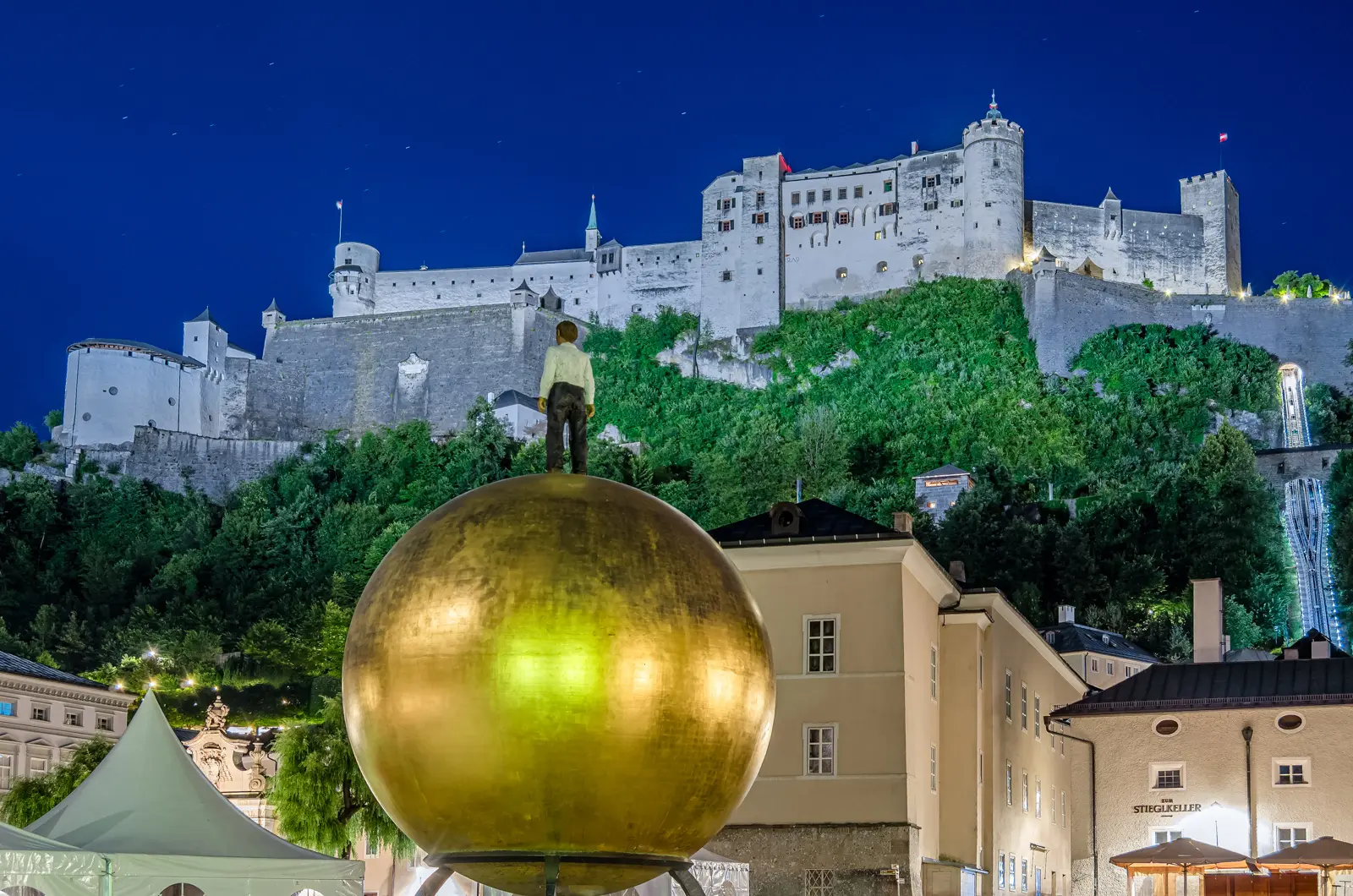
Above it rises Hohensalzburg Fortress – massive, immovable, and centuries old. This vertical relationship creates one of the most striking juxtapositions in the city. The fortress represents permanence, authority, and historical continuity; Sphaera, by contrast, introduces a contemporary presence that feels light, abstract, and open to interpretation. Together, they form a layered composition: medieval above, modern below; stone against gold; monumentality contrasted with minimalism. It is not a clash, but a dialogue, one that expands Salzburg’s identity beyond a single era, allowing past and present to coexist within the same visual and spatial frame.
Contrast and Interpretation
In a city where architecture often carries clear historical meaning, Sphaera stands apart in its openness to interpretation. The figure atop the sphere can be seen in many ways: as an observer, an individual elevated above the world, or as a subtle expression of balance and isolation. Its stillness is striking, not because it demands attention, but because it resists definition. The absence of explicit symbolism allows the figure to remain deliberately open, inviting viewers to project their own perspectives onto it. What appears simple at first glance gradually reveals itself as more complex, shaped as much by interpretation as by form.
The sphere itself extends this ambiguity. Its geometric perfection suggests completeness, while its reflective, gold-leafed surface connects it continuously to its surroundings, subtly incorporating the city into the artwork. As light shifts, so does its presence, never entirely fixed, always slightly changing. This interplay between constancy and transformation is central to the experience. Rather than directing the viewer toward a single meaning, the sculpture creates space for reflection, asking questions without answering them and allowing each encounter to unfold differently.
The Experience: Movement and Perspective
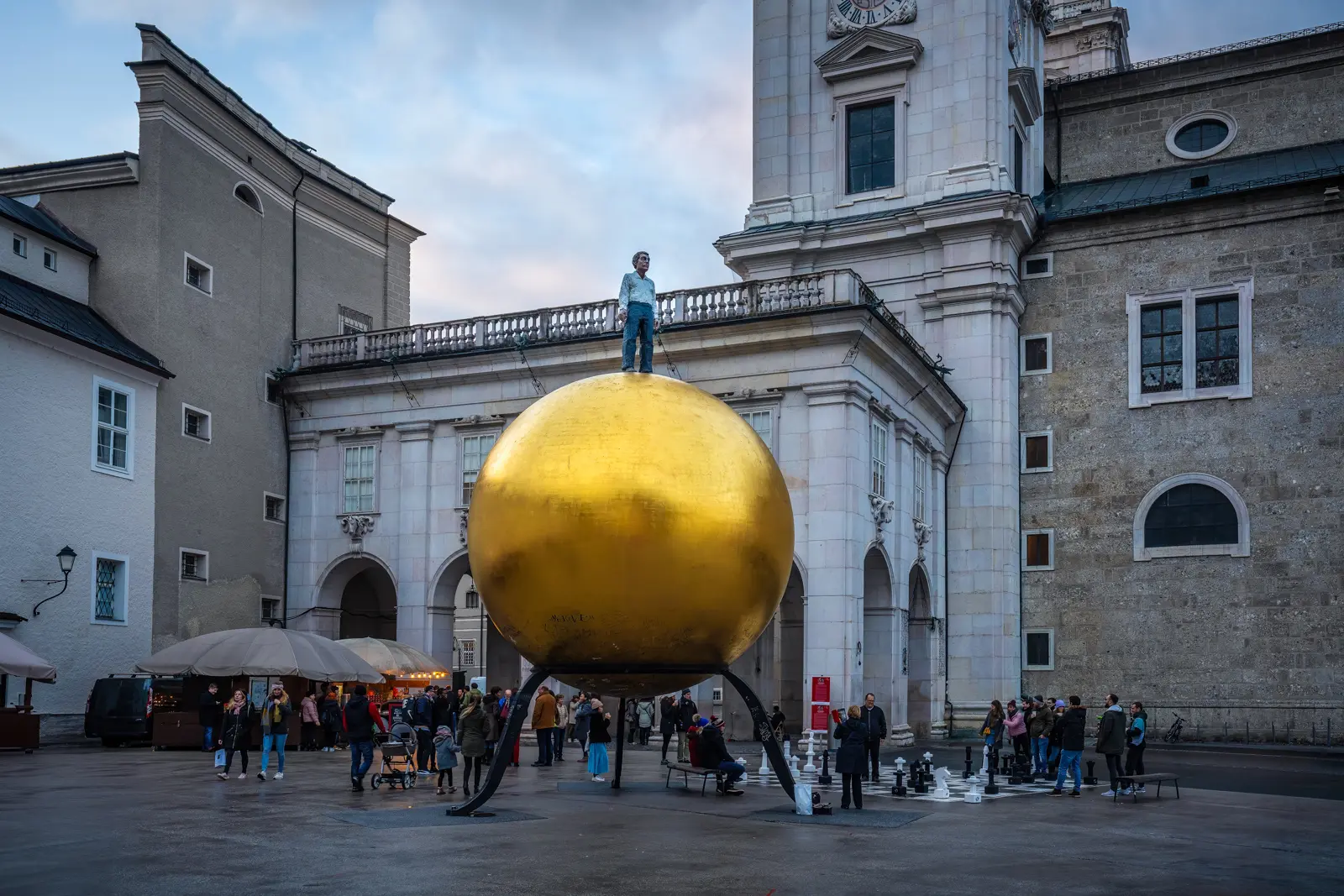
Experiencing Sphaera is not about a single viewpoint. The sculpture reveals itself gradually as you move through Kapitelplatz. From one angle, the sphere dominates; from another, the figure becomes the focus. At times, the fortress aligns directly behind it, creating a layered composition that feels almost intentional. The openness of the square allows for distance, and with it, perspective. Unlike enclosed spaces, where viewing is directed, Kapitelplatz invites movement – approaching, circling, pausing. The experience becomes less about observing the sculpture as an object and more about understanding its relationship to the surrounding environment.
There is also a quiet playfulness to the space. Visitors often interact with the sculpture visually, aligning themselves within its frame and capturing moments where scale and perspective shift unexpectedly. At times, this sense of interaction extends beyond the sculpture itself, with elements like the outdoor chess set occasionally appearing in the square, reinforcing the idea of Kapitelplatz as a place not only of observation, but of participation. This interplay adds a human dimension that complements the stillness of the figure above.
Bubbly Tips for Experiencing Sphaera
- Best time to visit: Late afternoon or early evening, when the golden surface reflects softer light.
- Take your time: Walk around the square to experience how the sculpture changes from different angles.
- Photography tip: Capture the alignment between Sphaera and Hohensalzburg Fortress for a striking composition.
- Look closely: Notice how the sphere reflects its surroundings, subtle details appear within its surface.
- Combine your visit: Pair with nearby landmarks like the Salzburg Cathedral and Domplatz for a contrast between historical and contemporary spaces.
Final Thoughts
Sphaera is not defined by scale alone, nor by historical significance, but by its ability to introduce a different kind of presence into Salzburg. It does not replace the city’s past – it exists alongside it, offering a new way of engaging with space, form, and meaning.
What lingers is not a fixed interpretation, but a sense of possibility. The sculpture invites you to pause, to look, and to consider how something so simple can hold so many perspectives. In a city shaped by centuries, it reminds you that experience is not only about what has been preserved, but also about what continues to be created.
How do you interpret Sphaera when you see it? I’d love to hear your thoughts.
Happy travels!

🌟 Everything You Need to Plan Your Dream Trip in 2026
- 🌟 Luxury Hotels - Find premium stays with Booking.com & Hotels.com
- 🏡 Vacation Rentals - Discover unique properties on VRBO
- 🏞️ Guided Tours - Explore with Viator or GetYourGuide
- 🎫 Attraction Tickets - Skip the lines with Tiqets
- 🚢 Ocean Cruises - Set sail with Cruise Direct
- 📱 International SIMs - Stay connected with Saily
- 🚗 Car Rentals - Budget-friendly options from Discover Cars
- 🌐 Secure VPNs - Browse safely with NordVPN
- 💶 Currency Exchange - Best rates with Wise
- 🗣️ Learn Languages - Master the local language with Babbel and Rosetta Stone