
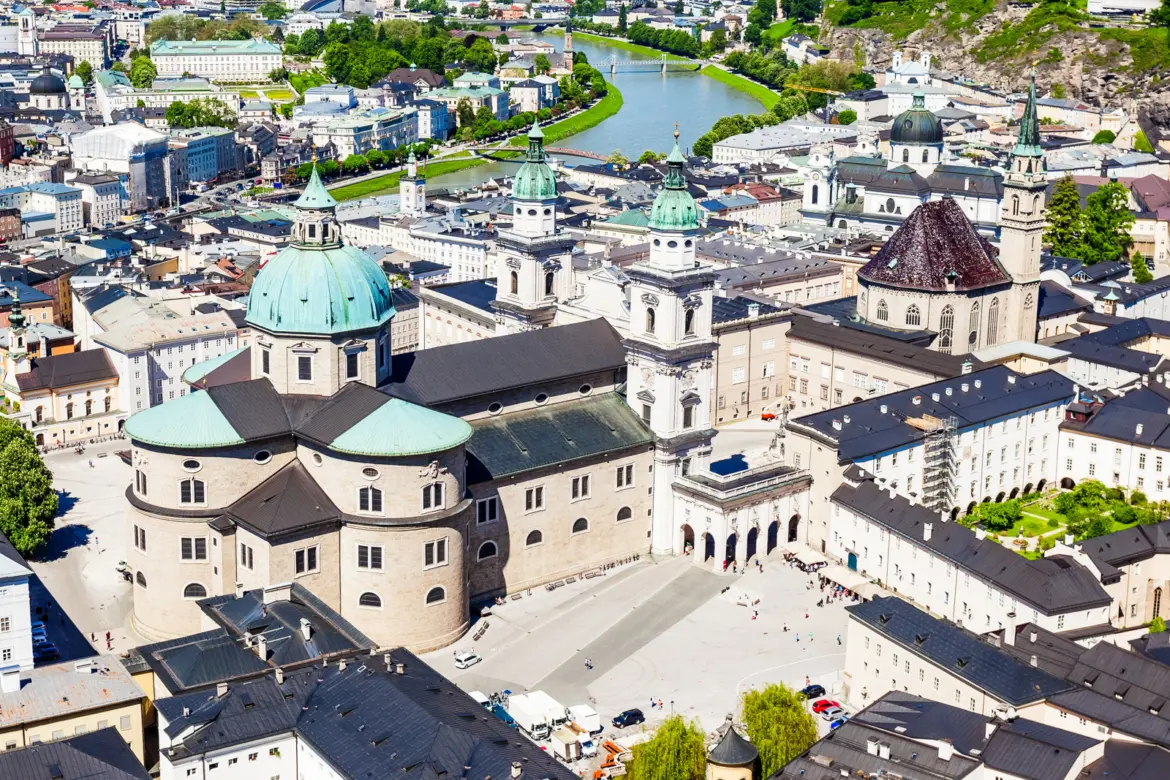
There are places that define a city not only through their presence, but through the way they shape everything around them. In Salzburg, the Salzburg Cathedral is one of those places. It does not simply occupy space, it organizes it, anchors it, and gives it meaning.
Set within the openness of Domplatz and framed by surrounding Baroque architecture, the cathedral stands as both a focal point and a point of transition. It is where movement gathers, where perspectives align, and where the rhythm of the Old Town feels most clearly defined. From a distance, it establishes orientation; up close, it reveals detail. Its presence is both immediate and gradual, unfolding differently depending on how you approach it.
Salzburg Cathedral at a glance
⛪ The cathedral · 142 metres long, 33 metres to the crossing, with a 71-metre central dome. Designed by Italian architect Santino Solari and consecrated on September 24, 1628 — the first major early-Baroque cathedral north of the Alps.
📜 Three consecrations · The dates 774, 1628, and 1959 are inscribed in gold above the bronze doors. 1959 marks the restoration after a US bomb destroyed the dome on October 16, 1944.
🎼 Mozart’s church · Wolfgang Amadeus Mozart was baptised here on January 28, 1756, in the 14th-century bronze font. He later served as court organist from 1779 to 1781 and composed the Coronation Mass (K. 317) during this period.
🎨 Art inside · Frescoes by Donato Mascagni and Ignazio Solari across the nave and dome, white-and-black stucco by Giuseppe Bassarino (c. 1628), and the 14,256 kg Salvator bell — the second-largest in Austria after St. Stephen’s “Pummerin” in Vienna.
🎟️ Visiting · A €5 preservation fee applies; under-18s free. Daily tours available. The cathedral is active, so silent observation is expected during Mass.
🎭 On the square · Domplatz hosts the annual “Jedermann” (Everyman) performance of the Salzburg Festival each summer, and the Christkindlmarkt in Advent.
A Cathedral Through Time
The history of Salzburg Cathedral reflects both continuity and transformation. The site has been central to Salzburg’s religious life since the early foundations established under Saint Rupert in the late 7th century, with the first cathedral formally consecrated in 774 by Bishop Virgil. Dedicated to both Saint Rupert and Saint Virgil, the cathedral embodies the city’s early Christian identity and its development as a spiritual and cultural centre. Over time, these early structures evolved in response to changing architectural styles and growing regional importance, including a major Romanesque rebuilding following a fire in 1167.
The structure seen today, however, dates primarily to the early 17th century. After a devastating fire in 1598 destroyed much of the previous cathedral, Prince-Archbishop Wolf Dietrich von Raitenau ordered its demolition and commissioned Italian architect Vincenzo Scamozzi to design an ambitious new building. Political upheaval, however, halted these plans before construction could begin. His successor, Markus Sittikus, instead entrusted Santino Solari with the project, who significantly reworked Scamozzi’s vision, producing a design of greater clarity, balance, and architectural refinement.
Consecrated in 1628, the cathedral stands as one of the earliest Baroque cathedrals north of the Alps, a distinction that marked a turning point not only in Salzburg’s architectural identity but in the broader evolution of ecclesiastical design in Central Europe. Its composition emphasizes openness, axial alignment, and visual coherence, principles that would come to define the city’s Baroque character. Despite the destruction of the dome during a bombing in 1944 and the extensive restoration completed by 1959, the cathedral retains its essential form. What exists today is not a reconstruction of a single moment, but a continuity of design, where restoration has preserved intention as much as structure.
The Exterior: Symmetry and Presence
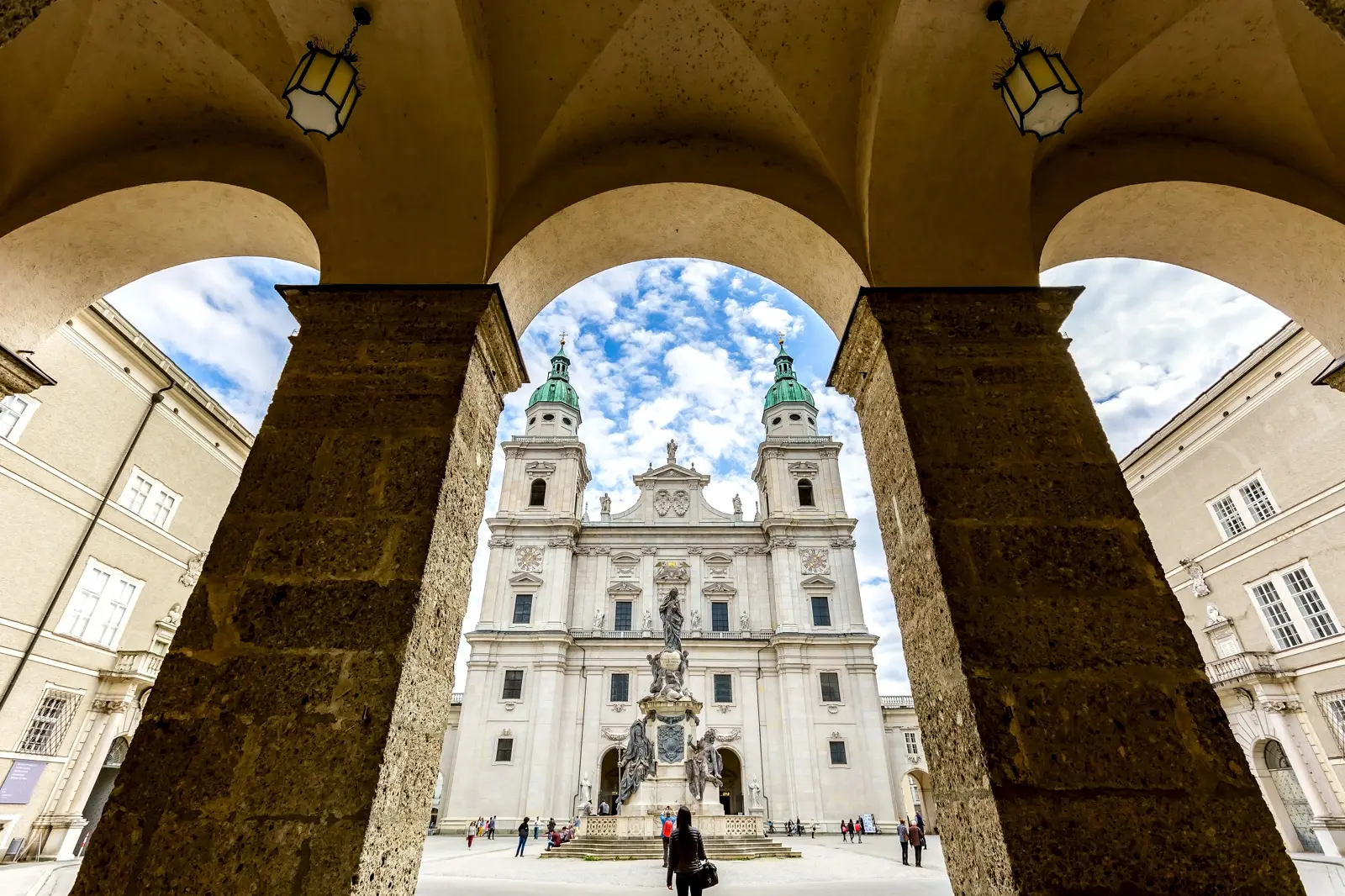
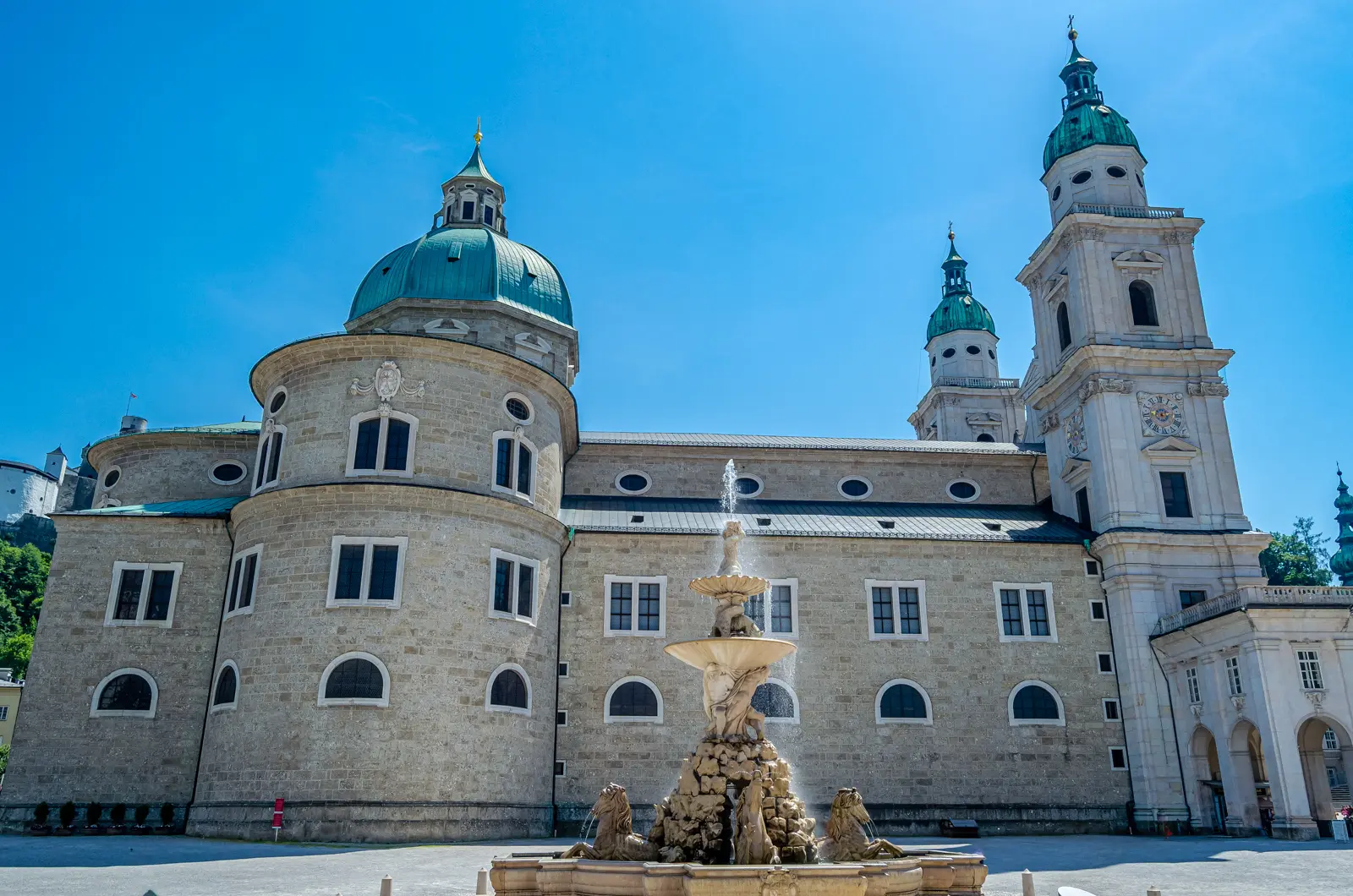
Approaching the Salzburg Cathedral from Domplatz, the façade presents itself with striking clarity. The main body of the cathedral, constructed in darker stone, contrasts with the façade, which is faced in bright Untersberg marble, a distinction that gives the exterior its characteristic luminosity. The pale surface shifts subtly in tone depending on the light, at times appearing almost radiant against the surrounding architecture.
Two towers rise symmetrically on either side, framing the central entrance and guiding the eye upward. The façade is organized across distinct horizontal levels, with pilasters dividing the surface into vertical registers, arched openings introducing depth, and the sculptural programme adding richness without disrupting the overall order. Four monumental figures flank the three portals: Saint Rupert holding a salt barrel and Saint Virgil holding a model of a church, representing the local patron saints, alongside the apostles Saint Peter with his keys and Saint Paul with his sword, representing the universal Church. Above the portals, the dates 774, 1628, and 1959 are inscribed in gold, commemorating the cathedral’s three consecrations, a quiet but powerful detail that layers the façade with historical meaning. The three bronze doors themselves bear the themes of Faith, Love, and Hope.
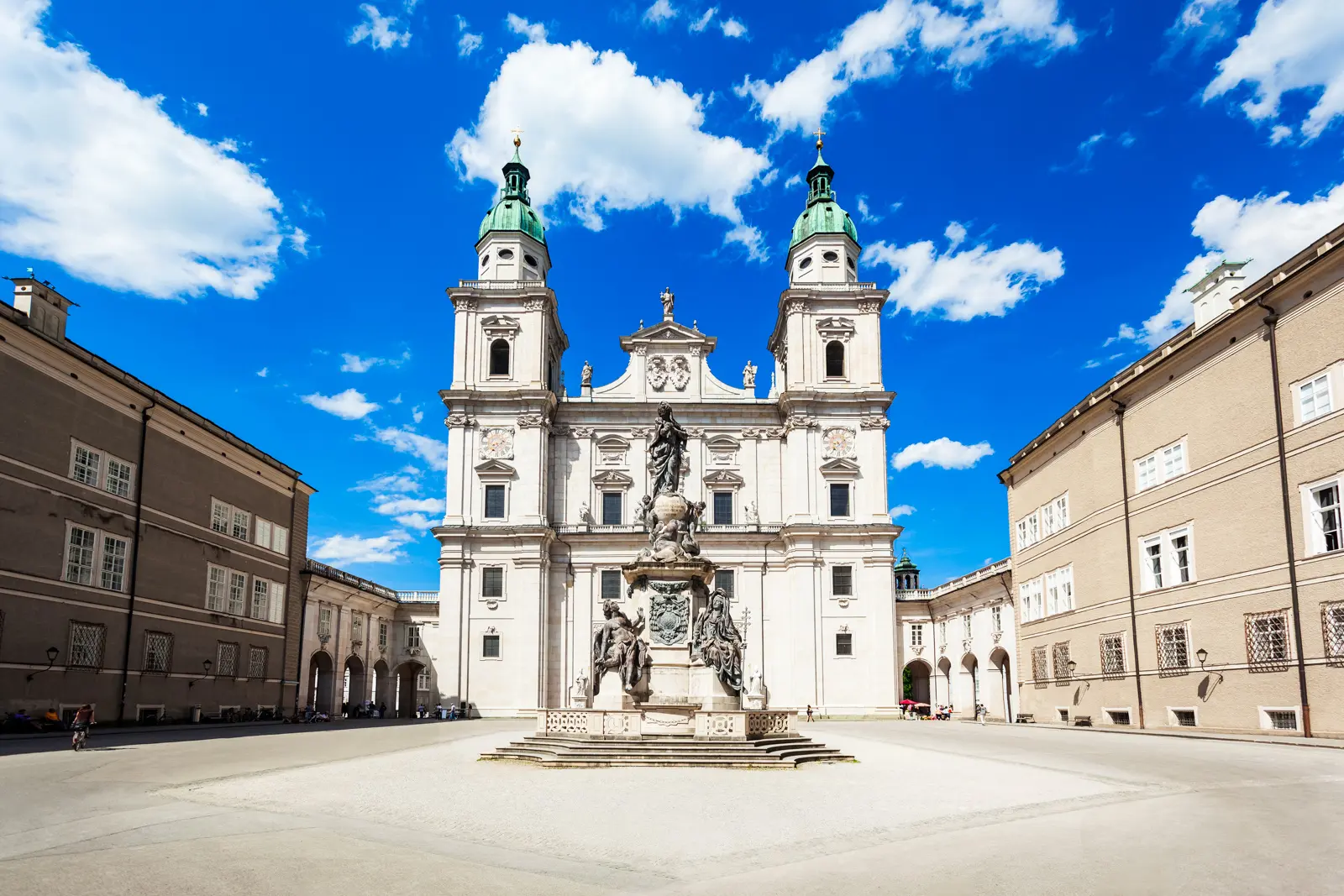
What makes the exterior particularly compelling is its relationship with the surrounding space. Domplatz opens outward in front of the cathedral, creating a sense of distance that allows the full geometry of the façade to be perceived. This spatial relationship transforms the act of approach into an experience, one that unfolds gradually, revealing proportion, alignment, and detail with each step forward.
Entering the Space: Transition and Scale
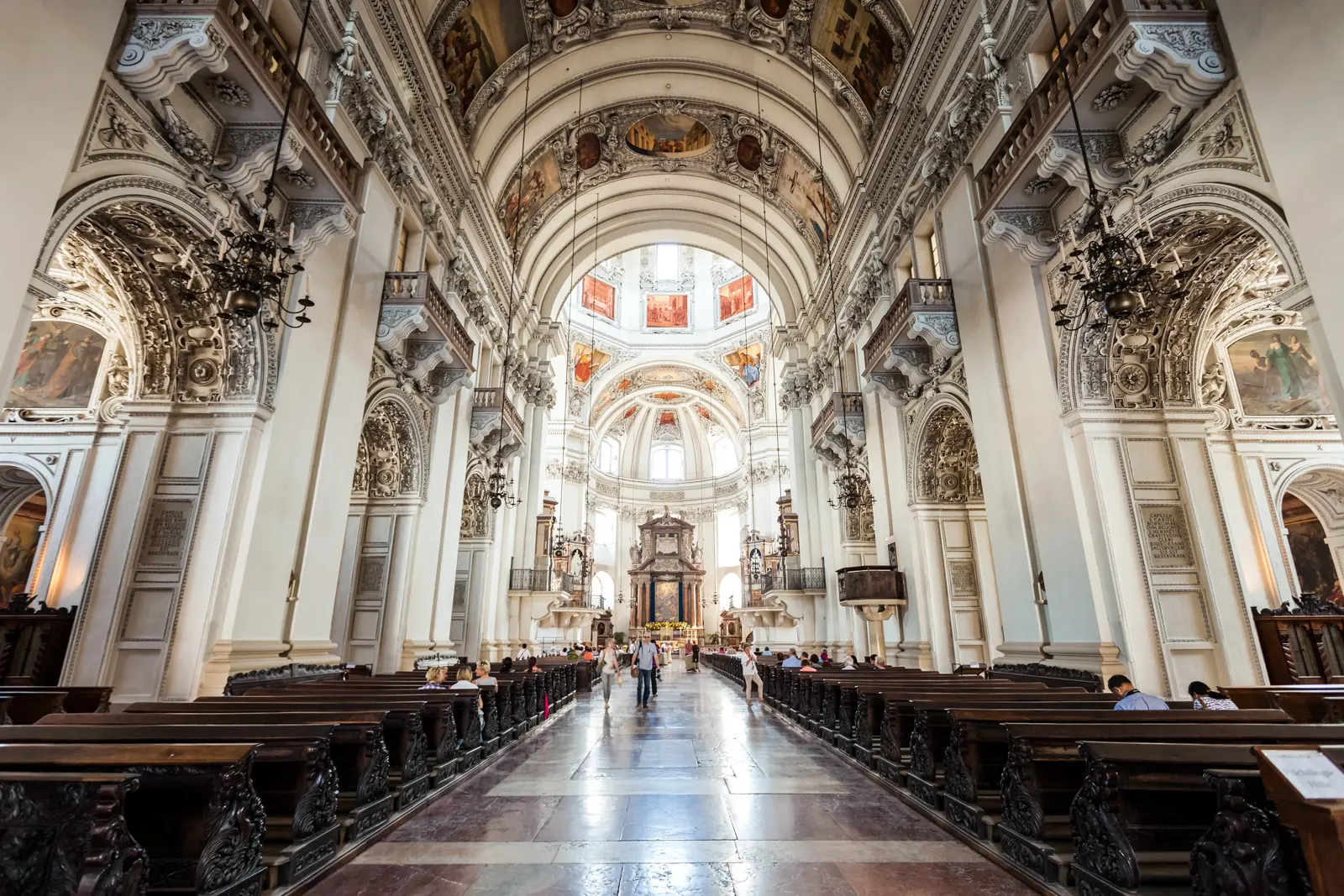
Crossing the threshold into the Salzburg Cathedral introduces a clear shift in atmosphere. The brightness and openness of the square give way to a more controlled and contemplative environment, where sound softens and the pace of movement slows. The interior reveals itself progressively. The central nave extends forward with remarkable clarity, framed by massive pillars that create both structure and openness. These pillars support a series of arches that guide the eye along the central axis, reinforcing the sense of direction without constraining movement. The proportions of the space are carefully calibrated: wide enough to feel expansive, yet ordered enough to maintain coherence.
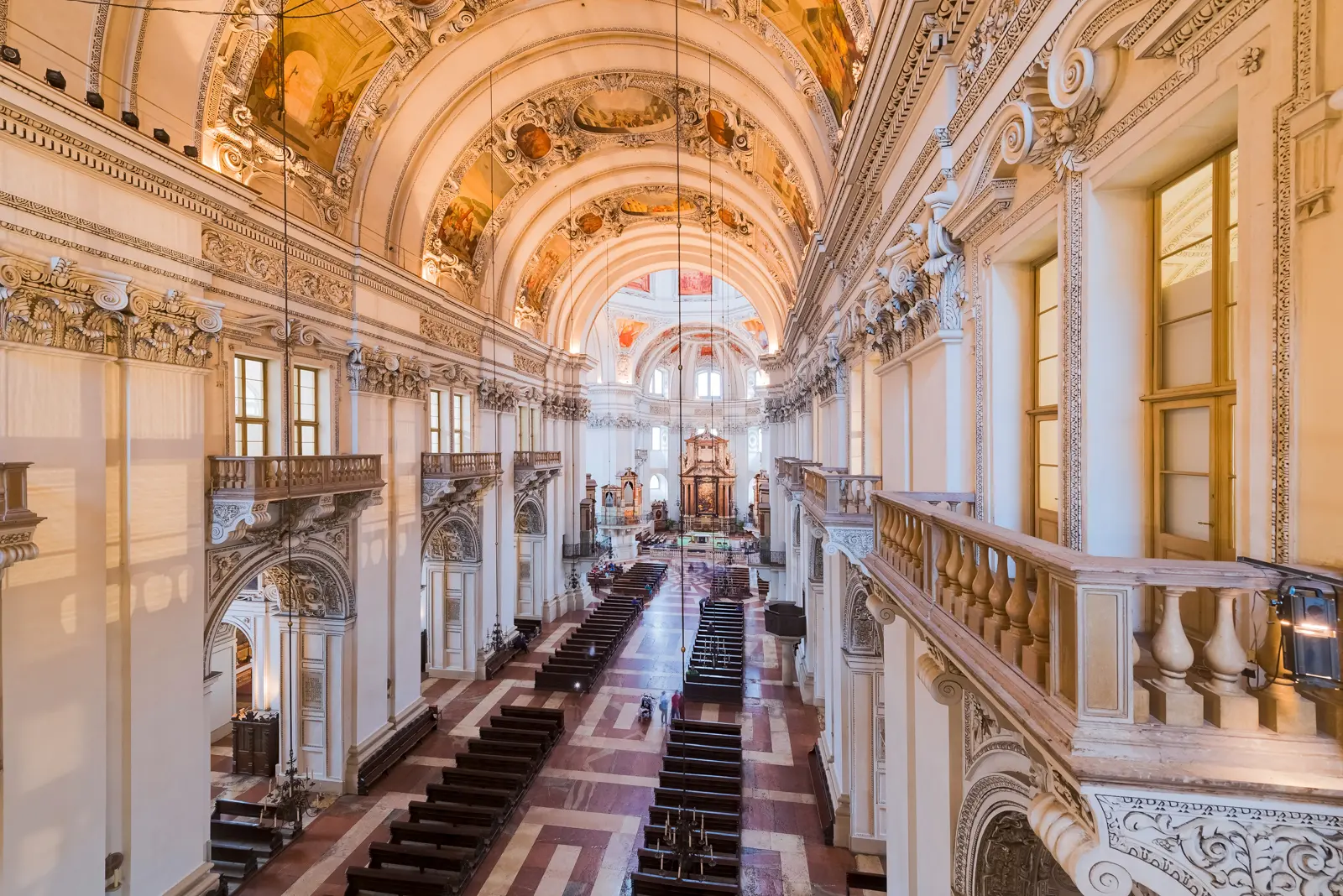
The floor, patterned in marble, subtly reinforces this sense of alignment, drawing movement inward while echoing the architectural rhythm above. This continuity between floor, columns, and ceiling creates a unified spatial experience, where each element contributes to the overall composition.
The Dome: Light and Verticality
At the centre of Salzburg Cathedral rises its most defining feature: the dome. Positioned at the crossing of the nave and transept and soaring to approximately 71 metres, it introduces a powerful vertical emphasis into the otherwise horizontal flow of the space, creating a focal point that anchors the entire interior. Natural light enters through windows encircling the base of the dome, filtering downward in a soft, diffused manner. This light illuminates a cycle of frescoes attributed to Donato Mascagni and his workshop, depicting themes of salvation and divine presence that connect symbolically to the Passion and life of Christ represented throughout the cathedral, forming a unified narrative across the interior. The curvature of the dome enhances this effect, allowing light to move across the painted surfaces throughout the day, subtly altering their appearance. At the very apex, a depiction of the Holy Spirit in the form of a dove hovers above the space, a delicate detail that is easily overlooked, yet becomes all the more striking once noticed.
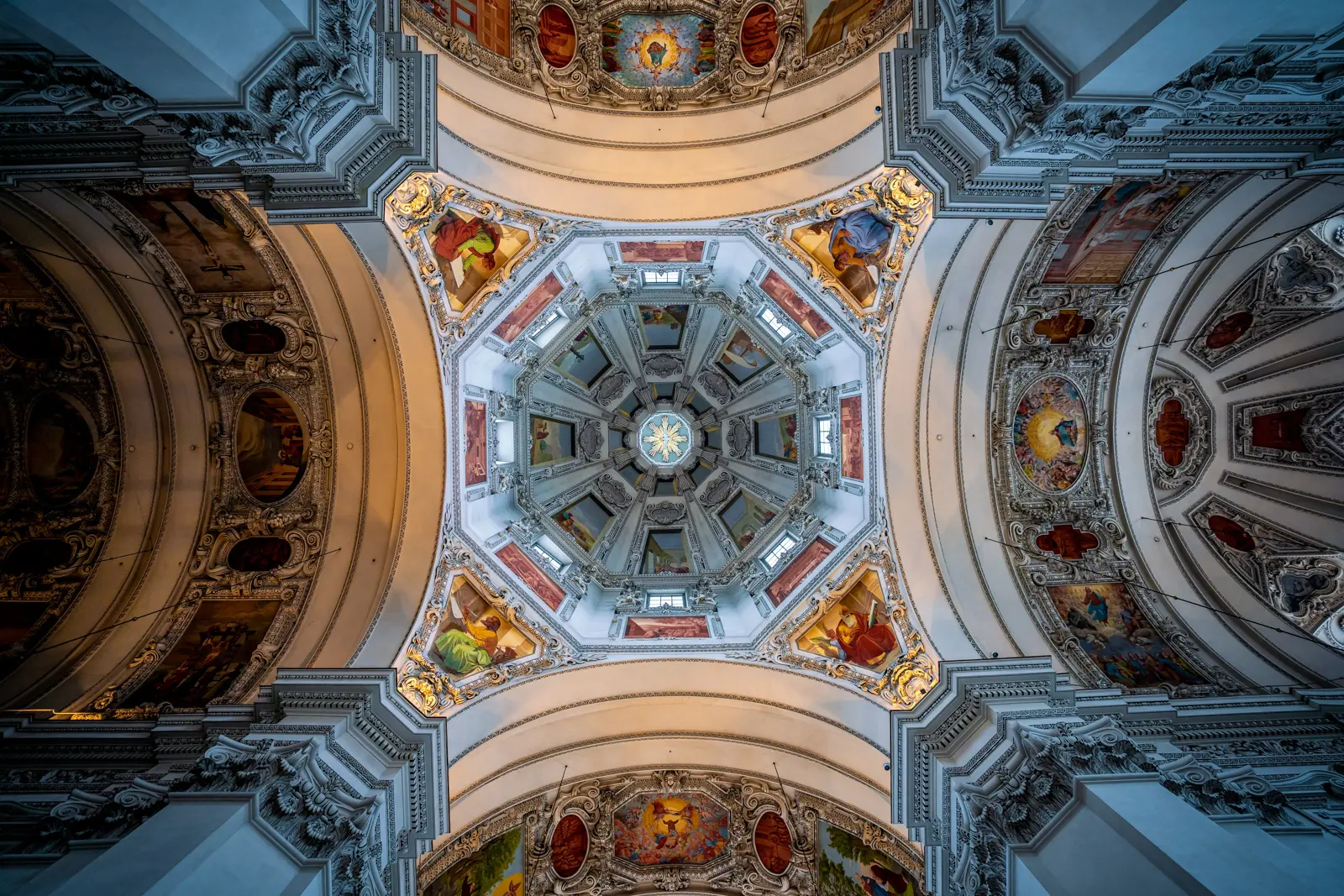
Architecturally, the dome serves both a structural and symbolic function. It marks the intersection of the cathedral’s main axes while also creating a sense of elevation that extends beyond the physical limits of the building. The experience of looking upward is not merely visual, but spatial, a moment where the scale of the interior becomes fully apparent.
The Altar and Interior Details
Moving toward the eastern end of Salzburg Cathedral, the high altar becomes a focal point of both visual and symbolic importance. Constructed in marble and framed by columns, it reflects the Baroque emphasis on clarity and centrality. The painting above the altar depicts the Resurrection of Christ, executed by the Florentine artist Donato Mascagni. Above the painting stand statues of Saint Rupert and Saint Virgil, alongside allegorical figures often interpreted as Religio and Caritas, while an inscription between them reads “Notas mihi fecisti vias vitae” – “You showed me the way of life” – linking the visual programme to a single, unifying spiritual message.
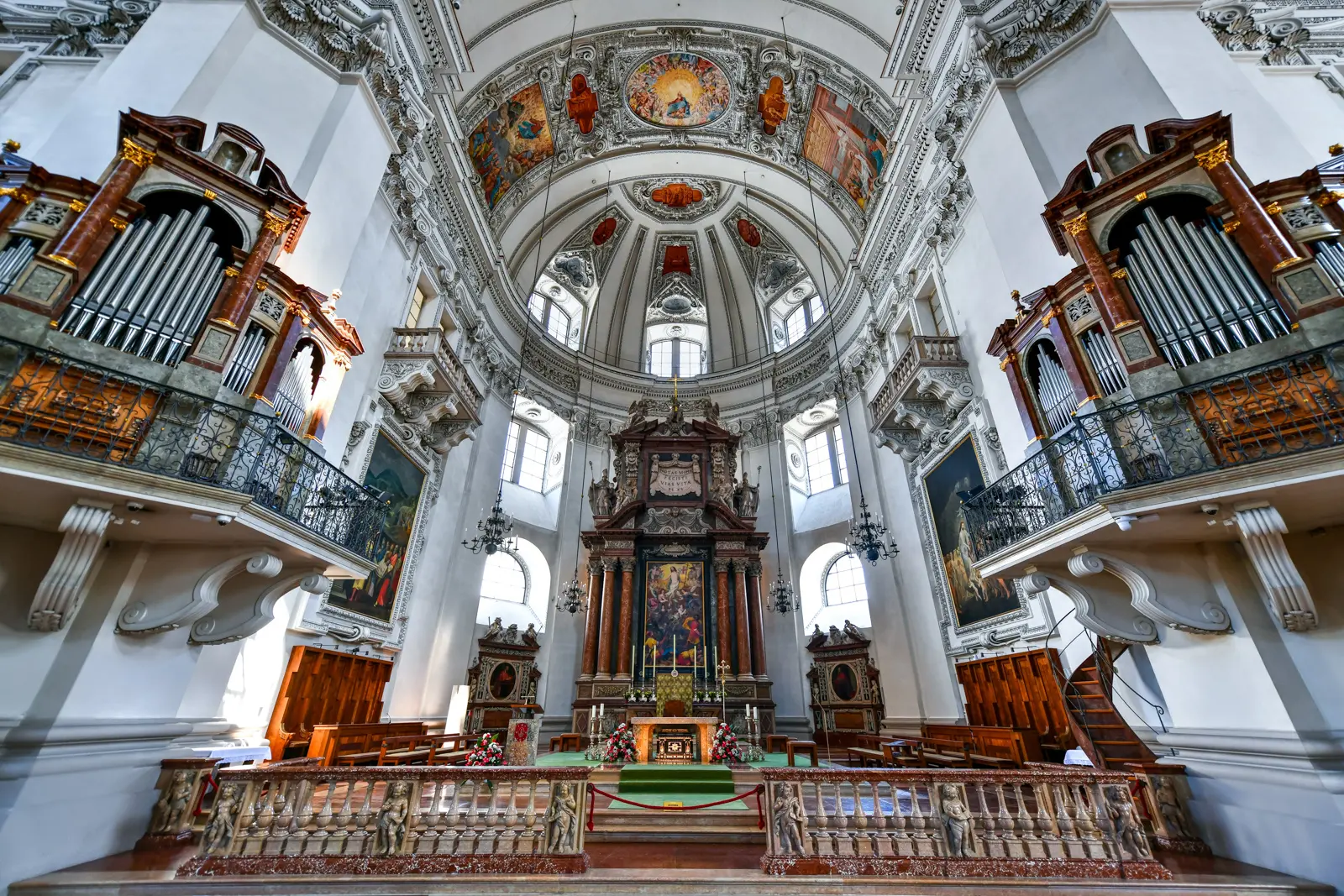
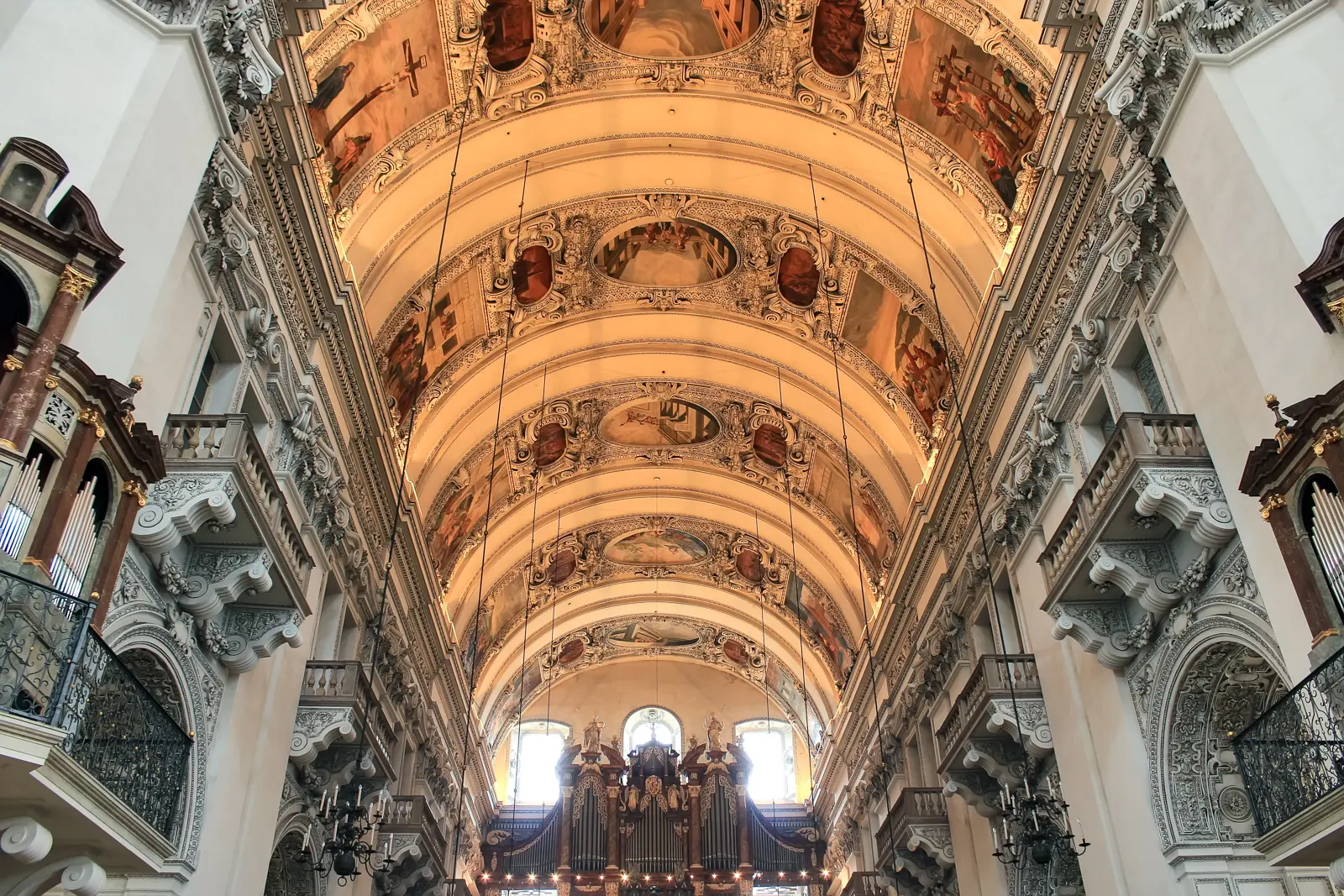
The nave ceiling extends this narrative upward. Paintings attributed to Donato Mascagni and his workshop depict scenes from the life and Passion of Christ across the ceiling, accompanied by elaborate white and black stucco work by Giuseppe Bassarino dating to 1628. The overall effect is one of coherence – art, architecture, and ornament working together toward a single expressive end, where each element reinforces the cathedral’s visual and thematic unity. Surrounding the nave, a series of side chapels introduce variation within the overall composition. Each contains its own altar, artwork, and decorative elements, offering more intimate spaces within the larger structure – where gilded details, sculptural forms, and frescoes reveal themselves at a closer scale, encouraging a more focused and contemplative form of observation.
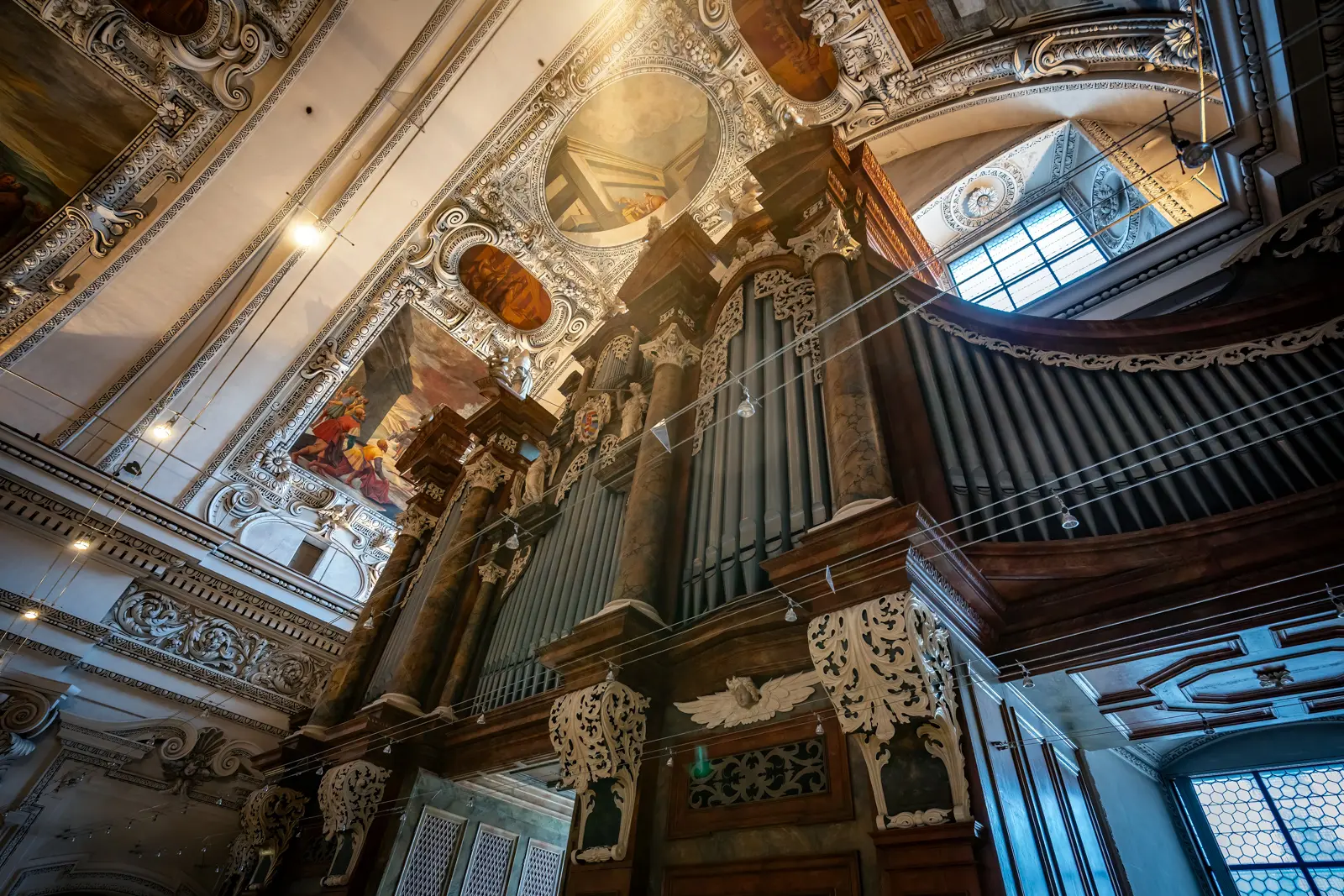
Among the cathedral’s historical details, its connection to Wolfgang Amadeus Mozart is particularly layered. Baptized here on 28 January 1756 in the cathedral’s medieval bronze baptismal font, Mozart later returned as court organist from 1779 to 1781. During this period, he composed several works associated with Salzburg’s liturgical life, including the Coronation Mass, which was performed within the cathedral. His connection to the space is therefore not merely biographical but musical, making the cathedral central to his creative as well as personal history.
The Experience: Space, Sound, and Stillness
Experiencing the Salzburg Cathedral is less about movement and more about presence. Unlike the dynamic flow of the surrounding Old Town, the cathedral introduces a different rhythm, one defined by stillness, observation, and subtle shifts in perception. Sound behaves differently within the space. Voices echo gently, footsteps soften, and the overall acoustic quality creates a sense of distance even within proximity. Light continues to change throughout the day, revealing different aspects of the architecture and decoration depending on where you stand.
There is a noticeable shift in how time is perceived. Moments feel slightly extended, allowing for a deeper engagement with the space. The cathedral does not direct your experience; it allows it to unfold gradually, shaped by attention rather than movement.
Bubbly Tips for Visiting the Salzburg Cathedral
- Best time to visit: Early morning or late afternoon for softer light and fewer visitors.
- Don’t miss: The dome frescoes, the high altar, and the symmetry of the nave from the central axis.
- Take your time: Pause at multiple points to observe how light and perspective shift across the space.
- Combine your visit: Pair with Domplatz and Residenzplatz for a full spatial experience.
- Look for details: Notice how smaller elements – chapels, sculptures, and materials – complement the larger architectural composition.
Final Thoughts
The Salzburg Cathedral is more than a landmark, it is a space that defines how Salzburg is experienced. It brings together history, architecture, and atmosphere in a way that feels both structured and fluid, monumental yet accessible.
What lingers is not a single detail, but the overall impression of balance – between light and structure, movement and stillness, past and present. It is this balance that gives the cathedral its enduring presence, allowing it to remain central not only in the physical landscape of Salzburg, but in the way the city is understood and remembered.
Did the cathedral’s interior or its presence in Domplatz leave the stronger impression on you? I’d love to hear your thoughts.
Happy travels!

🌟 Everything You Need to Plan Your Dream Trip in 2026
- 🌟 Luxury Hotels - Find premium stays with Booking.com & Hotels.com
- 🏡 Vacation Rentals - Discover unique properties on VRBO
- 🏞️ Guided Tours - Explore with Viator or GetYourGuide
- 🎫 Attraction Tickets - Skip the lines with Tiqets
- 🚢 Ocean Cruises - Set sail with Cruise Direct
- 📱 International SIMs - Stay connected with Saily
- 🚗 Car Rentals - Budget-friendly options from Discover Cars
- 🌐 Secure VPNs - Browse safely with NordVPN
- 💶 Currency Exchange - Best rates with Wise
- 🗣️ Learn Languages - Master the local language with Babbel and Rosetta Stone