
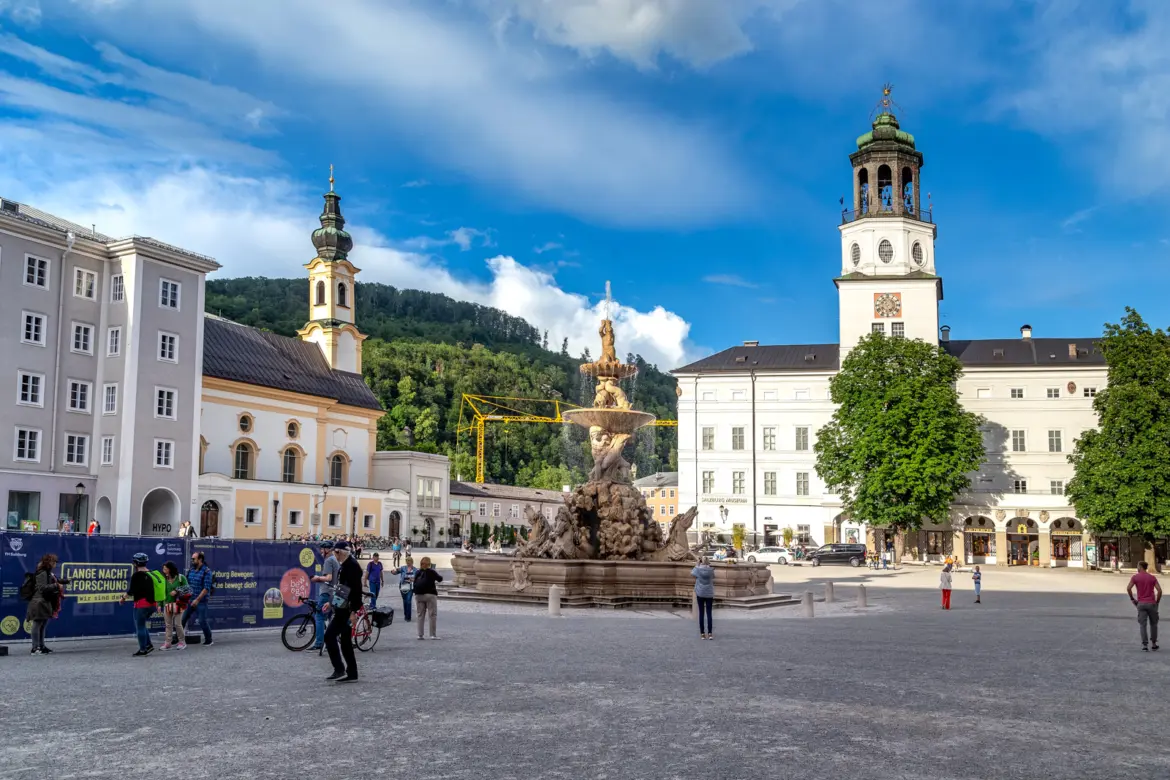
There are moments in a city when space itself becomes the experience. In Salzburg, that moment unfolds in Residenzplatz, a square where the rhythm of narrow medieval streets gives way to openness, light, and movement.
After moving through the intimate passageways of the Old Town, arriving here feels almost like a release. The space expands, the sky opens, and the architecture arranges itself with remarkable clarity. This sense of openness is not accidental, it is the result of deliberate Baroque urban planning, where space was designed to create visual harmony and ceremonial presence. The square, as it exists today, largely took shape in the late 16th century under Prince-Archbishop Wolf Dietrich von Raitenau, who sought to transform Salzburg into an Italianate Baroque city. Laid out from 1587 onwards according to the mannerist plans of the Italian architect Vincenzo Scamozzi, its creation required the demolition of fifty-five medieval buildings — a measure of Wolf Dietrich’s ambition to remake Salzburg as the “Rome of the North.
What emerges is not simply a square, but a carefully composed environment, one that reflects both power and refinement, and that continues to function as a central stage for the city’s daily life.
Residenzplatz at a glance
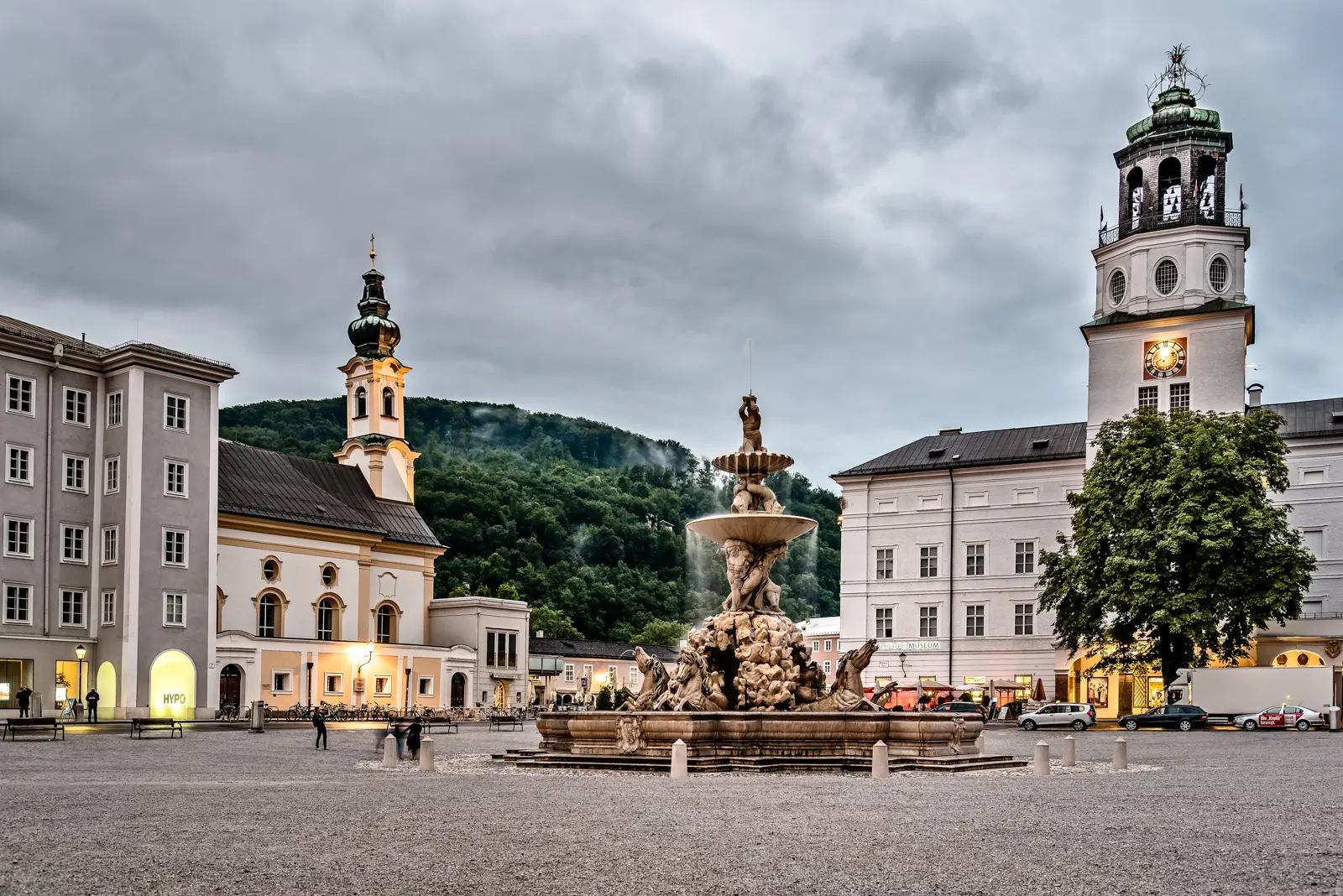
🏛️ The square · Laid out from 1587 onwards under Prince-Archbishop Wolf Dietrich von Raitenau as part of his “Rome of the North” project, designed to mannerist plans by the Italian architect Vincenzo Scamozzi. Fifty-five medieval buildings were demolished to create the open space.
⛲ Residenzbrunnen · The 15-metre Baroque fountain at the centre — the largest of its kind in Central Europe — was built between 1656 and 1661 under Archbishop Guidobald von Thun. Carved from Untersberg “marble” (a fossil-rich limestone) and attributed to Italian sculptor Tommaso di Garona, with Antonio Dario as chief engineer.
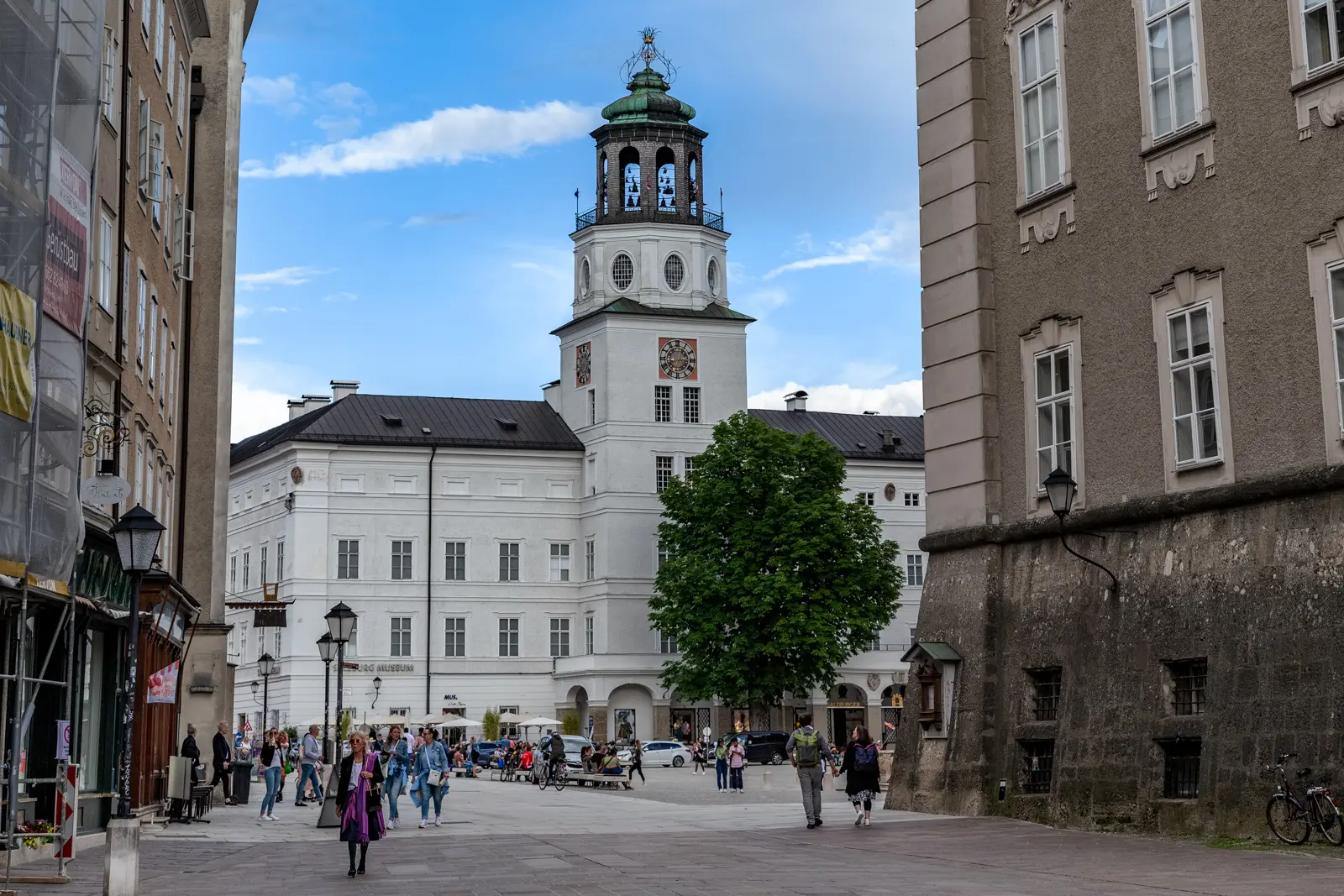
🛎️ Glockenspiel · The carillon in the Neue Residenz tower has 35 bells across three octaves, cast in Antwerp by Melchior de Haze and installed in 1704. It plays daily at 7am, 11am, and 6pm.
🎬 Sound of Music · Maria sings “I Have Confidence” while crossing this square, splashing water at the fountain horses on her way to the von Trapp villa.
🎄 Christmas market · The Christkindlmarkt only expanded onto Residenzplatz in 2003, supplementing its long-standing presence on Domplatz which traces back to 1491.
🚶 Practical tip · Free, open 24/7. Best in the late afternoon when the western sun catches the fountain and the cathedral façade.
The Setting: Space and Structure
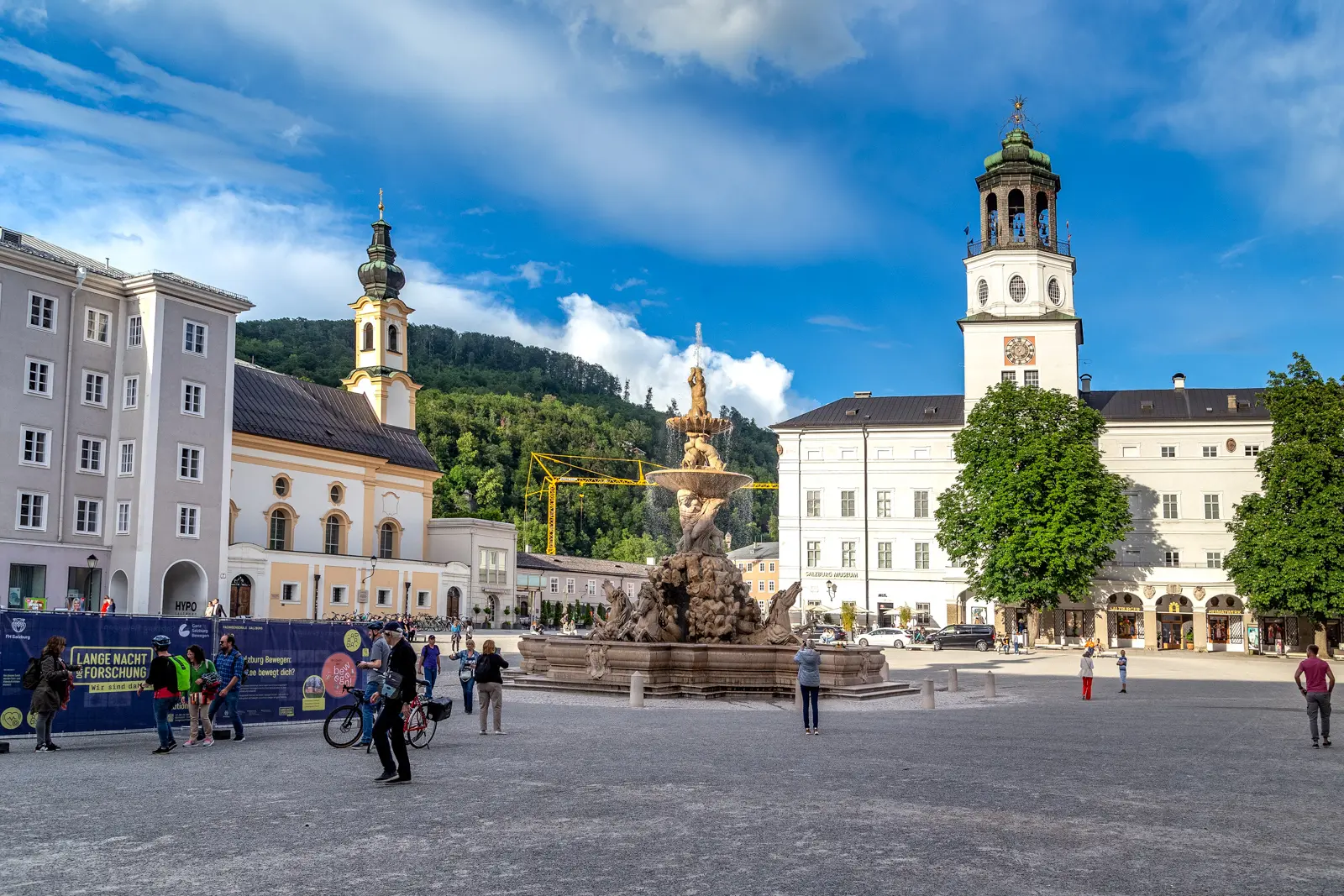
Residenzplatz is one of the largest and most historically significant squares in Salzburg’s Old Town, and its scale defines the experience immediately. Unlike the surrounding streets, which guide movement in a linear and enclosed way, the square invites a more open and multidirectional experience. It allows the eye to travel – across façades, upward toward towers, and across the sky – creating a sense of spatial awareness that is rare within the dense medieval fabric of the city.
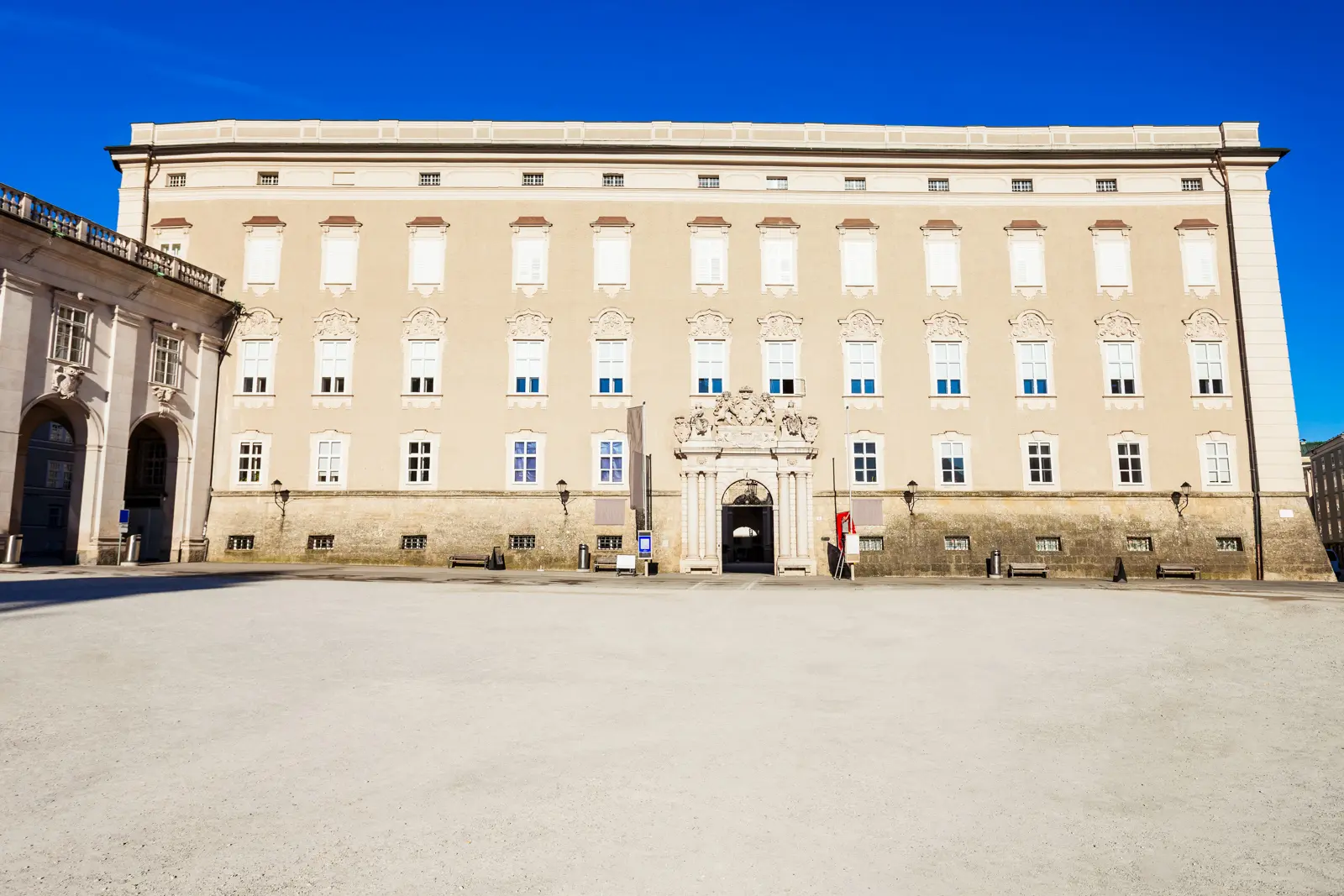
The square is framed by some of Salzburg’s most important architectural landmarks. The imposing façade of Salzburg Cathedral anchors one side, its early Baroque design reflecting the influence of Italian architects and reinforcing the city’s transformation during the 17th century. Adjacent to the square stands the Salzburg Residenz, once the official residence of the prince-archbishops who ruled Salzburg as both spiritual and temporal leaders. Its presence introduces a sense of authority and political history, linking the square to centuries of governance and ceremonial life.
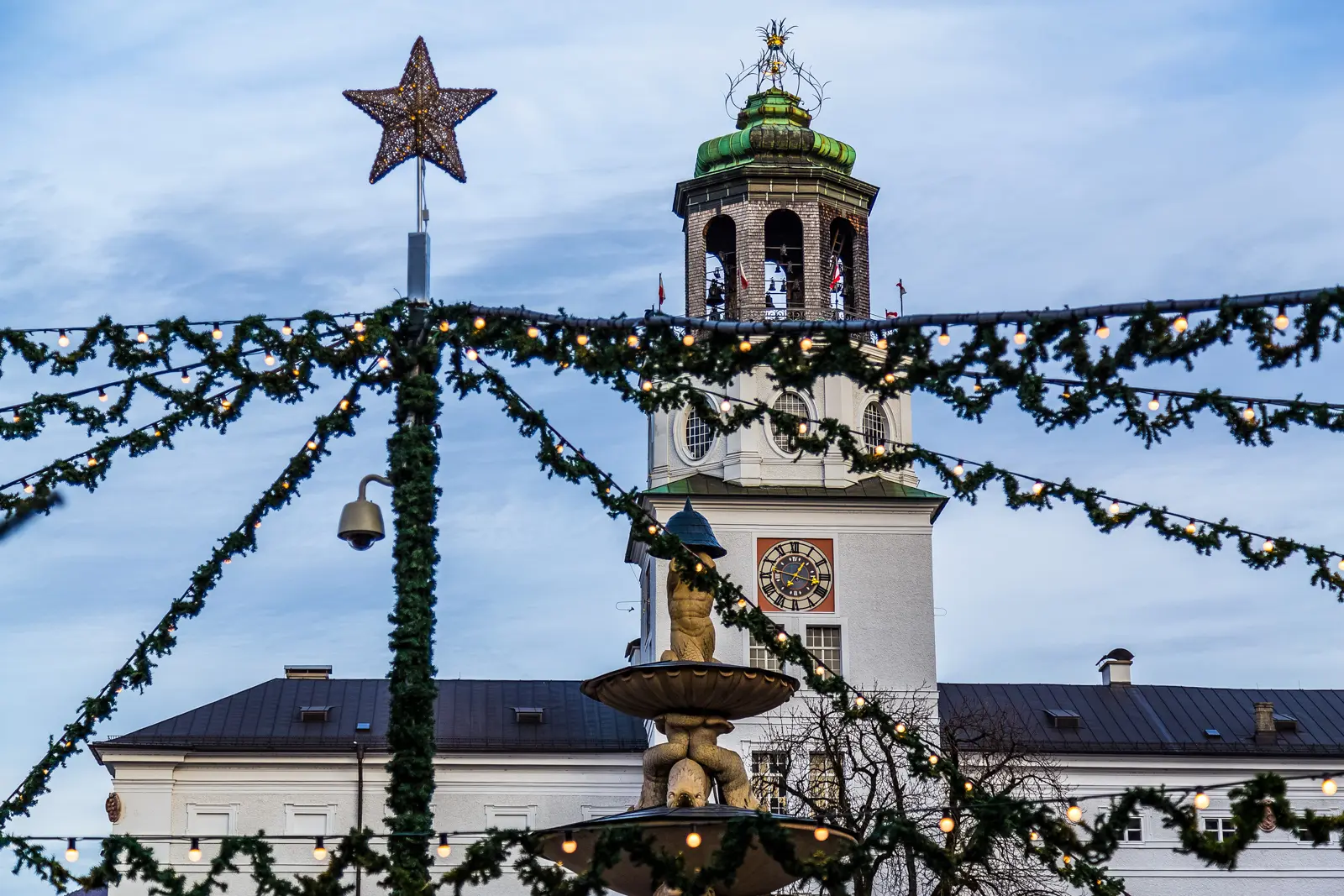
Opposite, the Neue Residenz, with its distinctive bell tower, adds another architectural layer. The tower houses the famous Glockenspiel, a carillon of 35 bells spanning three octaves, installed in the early 18th century (1704) after the bells were commissioned from Antwerp bell founder Melchior de Haze. The carillon plays three times daily, at 7am, 11am, and 6pm, its repertoire reflecting Salzburg’s rich musical heritage and adding a subtle auditory dimension to the square that has continued for over three centuries. Together, these structures create a cohesive architectural ensemble, where proportions, materials, and alignments work in harmony, and where the space between them becomes just as significant as the buildings themselves.
The Fountain: Movement at the Centre
At the heart of Residenzplatz stands the Residenz Fountain (Residenzbrunnen), one of the largest Baroque fountains north of the Alps. Built between 1656 and 1661 under Archbishop Guidobald von Thun and attributed to the Italian sculptor Tommaso di Garona, with Antonio Dario as chief engineer, the fountain is carved from Untersberg marble — technically a fossil-rich limestone — the same local stone used throughout much of Salzburg’s Baroque architecture, reflecting the deep artistic and cultural exchange between the city and Italy during this period.
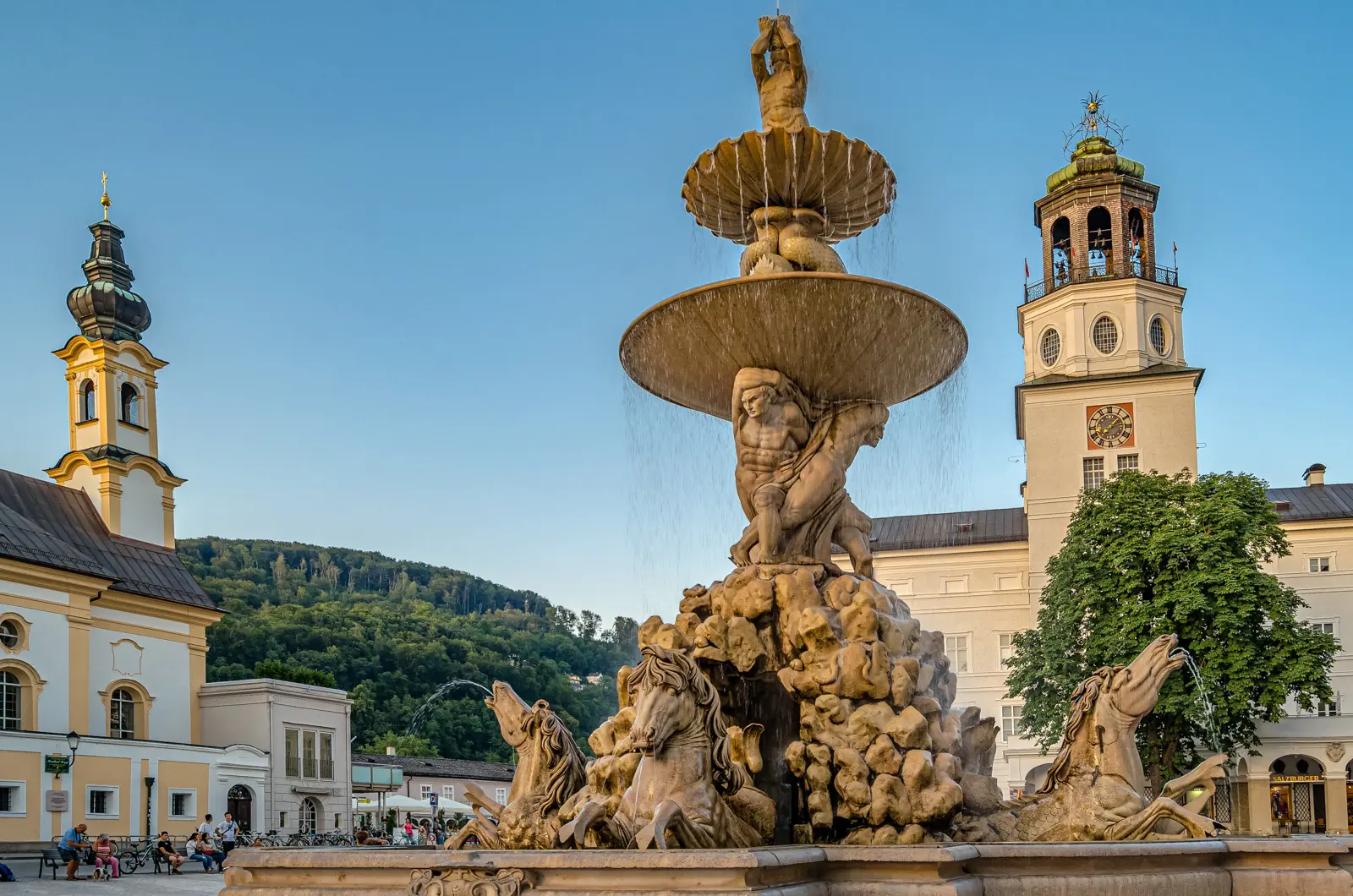
Its composition is dynamic and layered, unfolding in tiers from base to summit. Four sea horses rear around a central rock covered in marine creatures, above which four Atlases carry a shallow water bowl. Three dolphins then support the upper basin, and at the very top, a figure of Triton blows water into the air from a conch shell. Water flows continuously over these forms, softening the stone and introducing a sense of life and movement into the otherwise composed architectural setting. The sound of water becomes part of the experience – a constant, gentle presence that contrasts with the openness of the square. Like much of Salzburg’s Baroque ambition, the fountain looked to Rome — its tiered composition was directly inspired by Bernini’s Fontana dei Quattro Fiumi in Piazza Navona, completed just five years earlier.
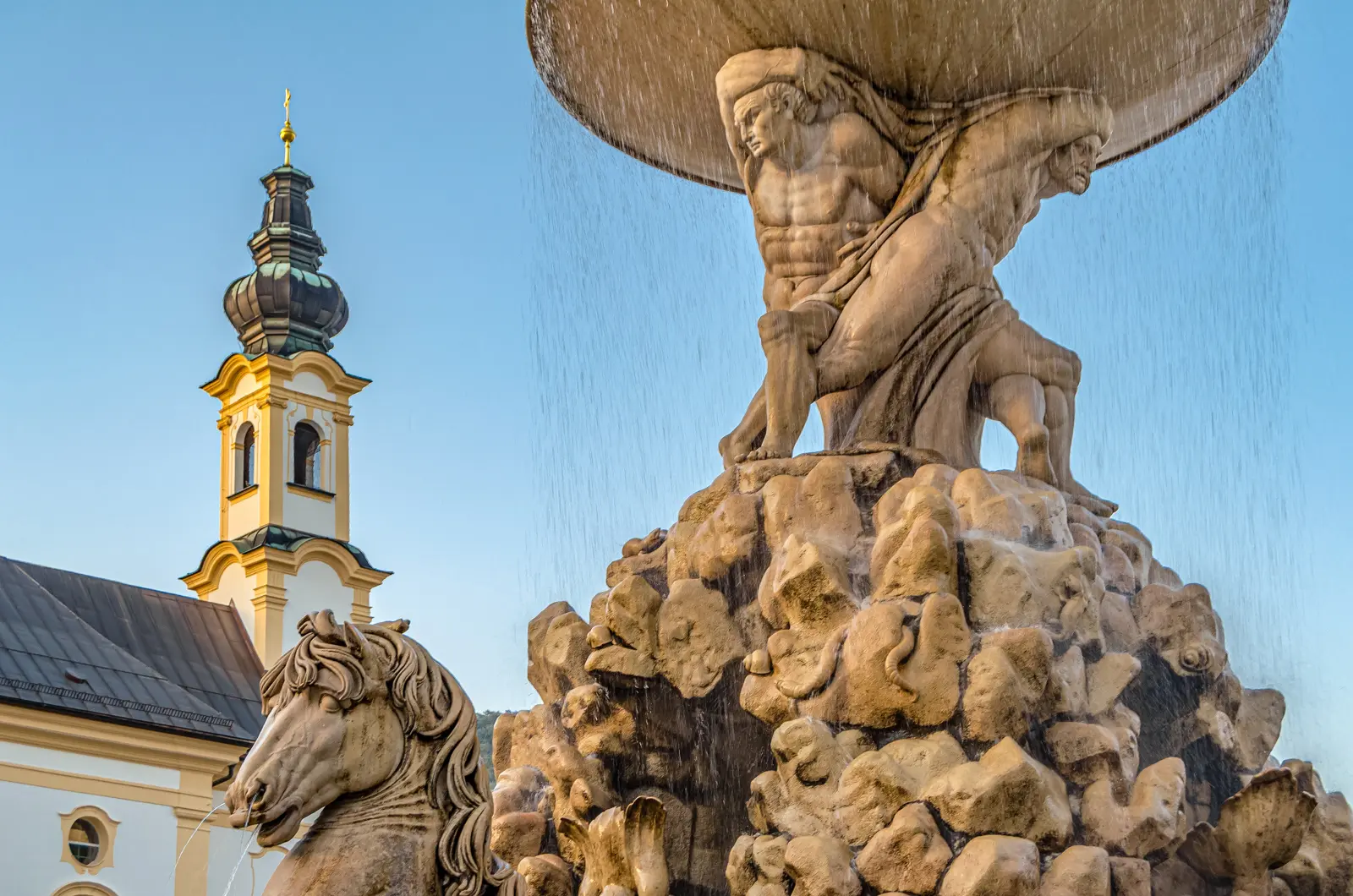
The fountain does more than decorate the space, it structures it. It creates a natural centre, a point of orientation, and a place where people gather, pause, and engage with their surroundings. Its presence ensures that the square is never empty, even in its quietest moments.
A Living Square: Movement and Gathering
What defines Residenzplatz is not only its architectural coherence, but its role as a living, evolving space. Historically, the square served as a site for public gatherings, ceremonies, and markets, functions that continue in different forms today. Throughout the day, the square shifts in character. Early mornings bring a quieter atmosphere, where light defines the façades and the space feels almost contemplative. As the day progresses, movement increases – visitors cross the square, pause at the fountain, or gather along its edges, while locals move through it as part of their daily routines. This layering of activity creates a dynamic environment where observation and participation coexist.
Unlike enclosed landmarks, where attention is directed toward a single focal point, Residenzplatz invites a more fluid experience. It is shaped not only by its architecture, but by the movement of people within it, a space that is continuously redefined through use.
A Cinematic Connection
Residenzplatz holds a place in cinematic history through its appearance in The Sound of Music. It is here that Maria sings “I Have Confidence”, moving across the square with a sense of purpose and transformation. What makes this scene particularly effective is how naturally the square lends itself to movement. Its openness, symmetry, and visual clarity create a sense of progression that translates seamlessly to film. The camera captures not only the architecture, but the experience of crossing the space — a journey that feels both physical and emotional.
Even today, standing in the square, the connection is immediate. The space has not been altered to reflect the film; rather, the film drew from the inherent qualities of the space. This continuity reinforces the idea that Residenzplatz is not simply a backdrop, but an active participant in the narratives associated with it.
The Christmas Market: Light and Atmosphere
During the Advent season, Residenzplatz, together with the adjacent Domplatz, transforms into one of Austria’s most atmospheric Christmas markets. The Salzburger Christkindlmarkt traces its origins to the late 15th century, when a market known as the Tandlmarkt was first recorded on Cathedral Square in 1491. The modern market has taken its current form since 1974, with Residenzplatz becoming part of the setting in 2003. Wooden stalls line the squares, their lights, strung in a canopy of thousands of fairy lights across the market, casting a warm glow against the Baroque façades. The scale of the space allows the market to unfold without feeling crowded, while still maintaining a sense of intimacy. The scent of mulled wine (Glühwein), roasted chestnuts, and traditional pastries fills the air, adding a sensory layer that complements the visual richness.
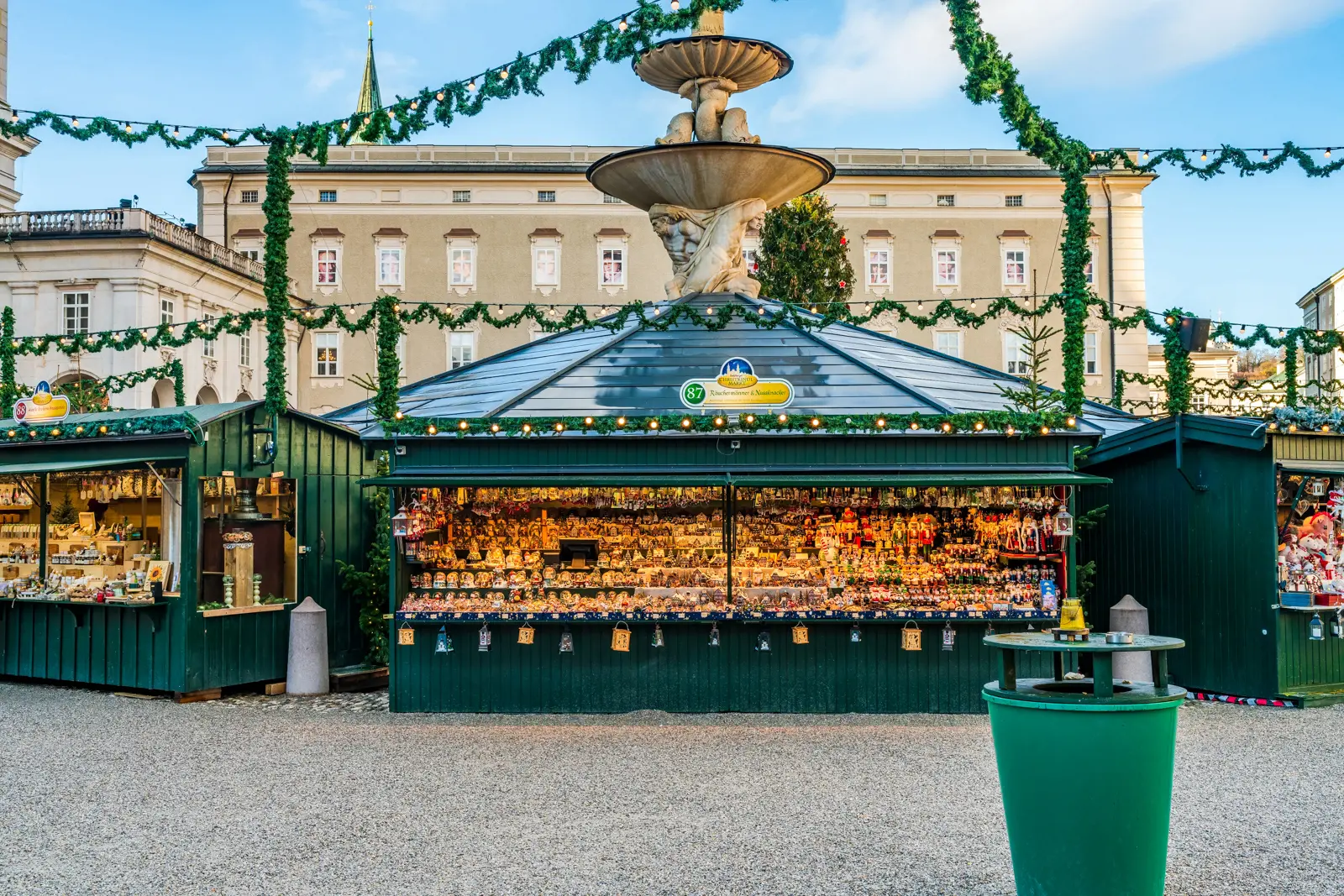
The Residenz Fountain remains at the centre, now framed by festive decoration, while the surrounding architecture takes on a softer, more luminous quality. Music is woven throughout, daily choral singing in front of the cathedral, and the tradition of Turmblasen, where wind musicians play from the towers above the square, their sound drifting down across the market below. The transformation is complete: what is open and structured in the daytime becomes warm, atmospheric, and immersive in winter.
The Experience: Space in Motion
Experiencing Residenzplatz is not about a single viewpoint, but about movement through space. The square reveals itself differently depending on where you stand: at the centre near the fountain, along the edges beneath the façades, or at the entrances where narrow streets open suddenly into light. Light plays a defining role. During the day, it reflects off pale stone surfaces, emphasising symmetry and proportion. As evening approaches, shadows lengthen and artificial light begins to shape the space, creating a more intimate atmosphere within the openness. At night, the square feels quieter, almost contemplative, as the architectural lines soften and the rhythm of movement slows.
What emerges is a balance between permanence and change. The architecture provides structure and continuity, while the movement of people, water, and light ensures that the space is never static. It is a square that is experienced differently each time, familiar, yet always evolving.
Bubbly Tips for Visiting
- Pause at the centre: Stand near the fountain to fully appreciate the scale and symmetry of the square.
- Look upward: Notice the architectural details of the surrounding buildings, including the cathedral façade and the Residenz tower.
- Listen for the Glockenspiel: The carillon at the Neue Residenz adds a unique auditory element to your visit.
- Visit at different times: The atmosphere shifts beautifully from day to evening.
- Experience the market: If visiting in winter, don’t miss the Christmas market, it transforms the square entirely.
Final Thoughts
Residenzplatz is not defined by a single landmark, but by the way space itself is shaped and experienced. It is where Salzburg opens outward – where architecture, movement, and atmosphere come together in a way that feels both deliberate and alive.
In a city known for its detail and intimacy, this is where everything expands. And in that openness, you begin to see not just the buildings, but the relationships between them, and your own place within the scene.
Do you prefer grand open squares like this, or quieter hidden corners when exploring a city? I’d love to hear your thoughts.
Happy travels!

🌟 Everything You Need to Plan Your Dream Trip in 2026
- 🌟 Luxury Hotels - Find premium stays with Booking.com & Hotels.com
- 🏡 Vacation Rentals - Discover unique properties on VRBO
- 🏞️ Guided Tours - Explore with Viator or GetYourGuide
- 🎫 Attraction Tickets - Skip the lines with Tiqets
- 🚢 Ocean Cruises - Set sail with Cruise Direct
- 📱 International SIMs - Stay connected with Saily
- 🚗 Car Rentals - Budget-friendly options from Discover Cars
- 🌐 Secure VPNs - Browse safely with NordVPN
- 💶 Currency Exchange - Best rates with Wise
- 🗣️ Learn Languages - Master the local language with Babbel and Rosetta Stone