
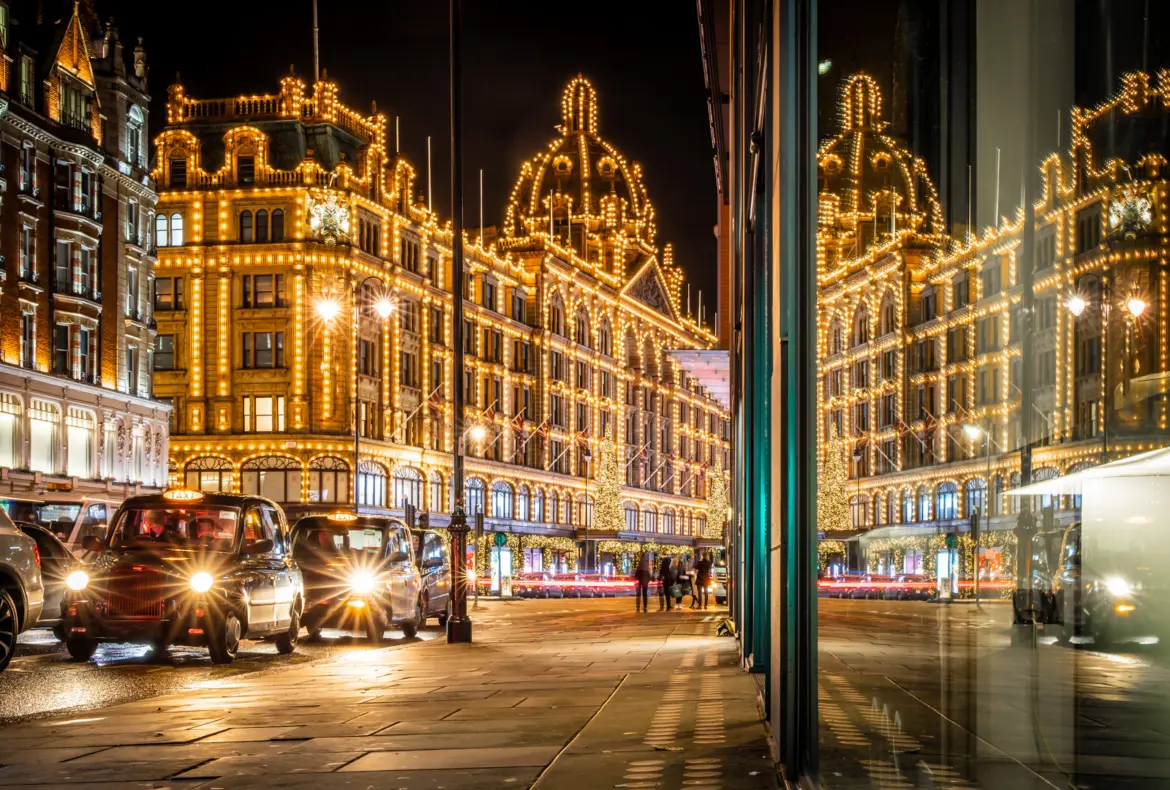
Harrods in December is a different kind of crowded. Not the steady busy of a Saturday afternoon at a busy department store, where people are moving through with purpose. This is slow crowded. People standing still in the cosmetics hall taking photographs. Groups gathered at the chocolate counters not to order but to be seen ordering. The escalators backed up. A queue outside the entrance, in the cold, just to come in.
I liked it, but I want to be honest about what visiting Harrods is in 2025. It is not the calm luxury department store the guidebooks describe. It is one of London‘s busiest tourist attractions, especially in the weeks before Christmas, and a meaningful portion of the people inside on a December afternoon are not there to shop at all. They are there to be there. To photograph it. To post about it. To say they have been.
This is the thing about London, though. You have to have patience. You have to take it all in and go with the flow. If you don’t, the city will overwhelm you at times, especially during the holidays. So I went with the flow. I noticed I had dressed wrong, in flat shoes and a coat suitable for a shopping day, while many of the women around me were dressed for an evening out. I laughed about it and kept walking. My motto: walk with confidence, you make the clothes, not the other way around. I was there to shop. I cannot do that in heels.
The post that follows is my honest take on Harrods after two visits across six years: the building, the food halls, the luxury floors, the service quality (which varied wildly between brands), and the question I want to address head-on of whether the December crowding makes the place worth visiting at all.
Harrods at a Glance
📍 Location · 87–135 Brompton Road, Knightsbridge, London SW1X 7XL. The store occupies an entire city block. Nearest Tube: Knightsbridge (Piccadilly Line) directly across Hans Crescent; South Kensington (Piccadilly, District, Circle) a 10-minute walk south-west.
🏛️ The building · Grade II* listed since 1969. Designed by Charles William Stephens and built in phases between 1894 and 1905. The famous Doulton terracotta façade fills five acres of Knightsbridge. At night the building is outlined by more than 11,500 lights — switched on at dusk, off around 2 am.
🛍️ Scale · 1.1 million square feet of retail across seven floors, 330 departments, 22 restaurants and bars, around 15 million visitors a year. The largest department store in Europe.
🍞 The Food Halls · The 1902 Edwardian Food Halls were designed by William James Neatby, Royal Doulton’s chief ceramic designer. Twenty medallions of farming and hunting scenes line the Dining Hall ceiling; the Floral Hall (now Chocolate Hall) was tiled by Malkin Tile Works of Burslem. A multi-year restoration by David Collins Studio with Craven Dunnill Jackfield completed in 2021.
🎁 The Christmas tins · An annual collectible release. Designs change every year. The shortbread tins (green with the terracotta façade depicted in coral pink) and the seasonal biscuit tins (reds, oranges, purples, greens) are some of the most photogenic souvenirs in London. The tins reliably outlive the biscuits.
💡 Tip · December afternoons are the busiest hours of the busiest month. Weekday mornings before 11 am are noticeably calmer. The Food Halls and the Coffee Bar are worth visiting even if you have no plans to buy anything — the Edwardian tile work is museum-grade and free to walk through.
A Quick History of Harrods
Charles Henry Harrod founded what would become Harrods in 1834, as a wholesale grocery in Stepney in East London. He had a particular interest in tea. In 1849 he moved the business to a small shop on Brompton Road in Knightsbridge, partly to escape what he called the vice of the inner city and partly to catch the increased foot traffic expected from the 1851 Great Exhibition at the Crystal Palace in nearby Hyde Park. The original Knightsbridge shop had a turnover of about £20 a week. That was the entire business.
His son Charles Digby Harrod took over in 1861 and began expanding the store significantly. By 1868 it had sixteen staff and was turning over £1,000 a week. Then on 6 December 1883, a fire broke out and gutted the building.
This is where the most famous Harrods legend comes from. Despite the fire destroying the shop, the family still managed to deliver every customer’s Christmas order on time that year, working out of temporary premises and with borrowed equipment. The store sent out a letter to its customers apologising for any inconvenience and assuring them that their orders would arrive. They all did. The legend of Harrods customer service was made in those three weeks between the fire and Christmas Day 1883.
The rebuild that followed was the start of the building you see today. The new shop opened on the same site, larger and grander. By 1898, Harrods had installed the first escalator in London, made of 224 leather pieces, with an attendant at the top offering brandy or smelling salts to anyone unnerved by the experience. The current building, designed by architect Charles William Stephens, was built in phases between 1894 and 1905. The famous terracotta façade dates from this period and was designed to advertise the store from a distance. At night, the building is now illuminated by over 11,500 lights, making it one of the most photographed buildings in London.
A small bit of literary history. In 1921, the writer A. A. Milne came into Harrods to buy a stuffed bear as a first-birthday present for his one-year-old son. The boy was named Christopher Robin. He named the bear Winnie-the-Pooh. The bear in question was a Harrods bear, bought on the toy floor. There is a small commemorative display about this somewhere in the children’s department.
The Building and the Façade
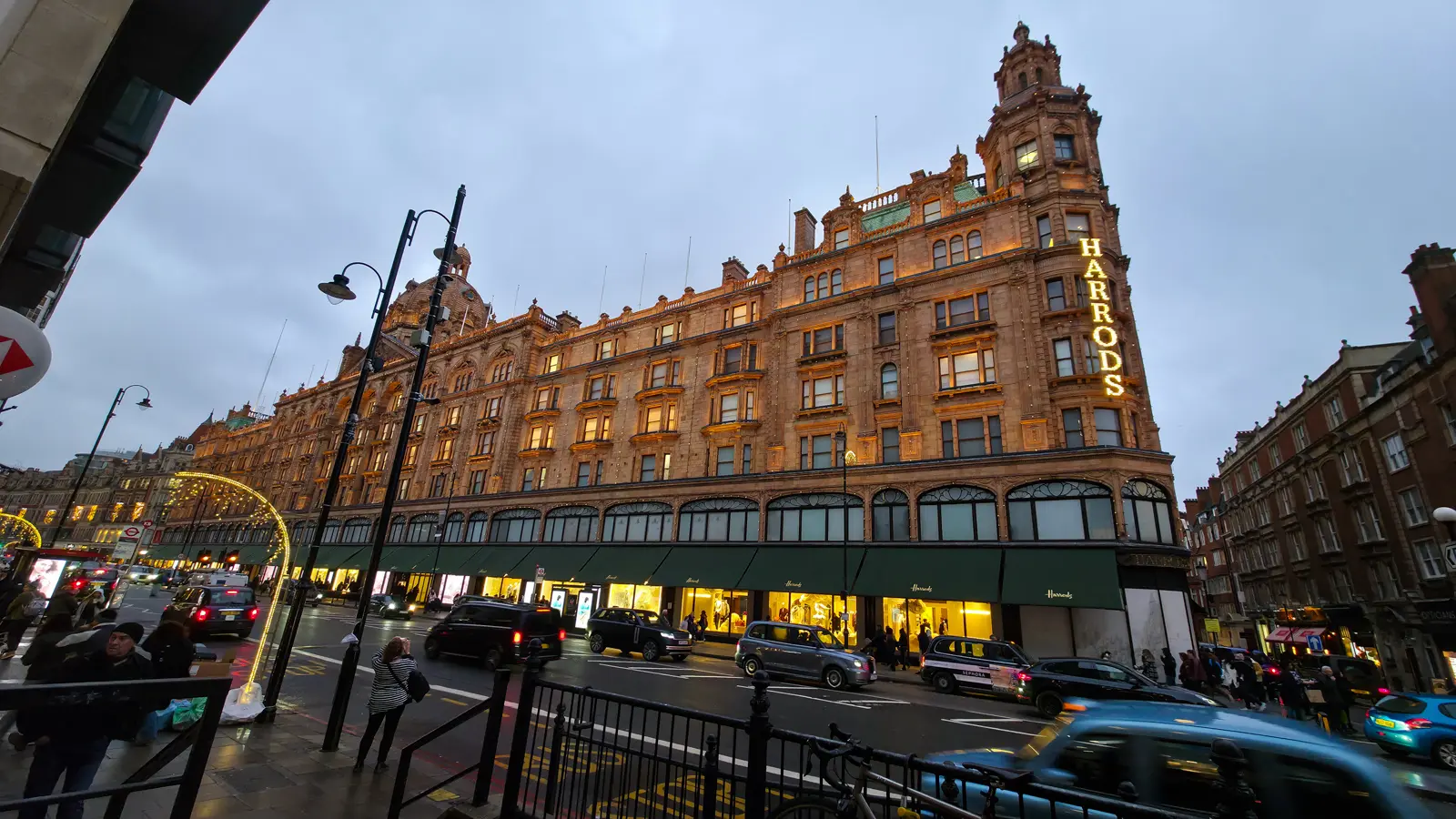
The Harrods building is a Grade II* listed structure. It was Grade II* listed in 1969, the higher of the two Grade II tiers, reserved for buildings of more than special interest. The façade is Doulton terracotta, a kind of unglazed ceramic that gives the building its distinctive warm orange colour. The Brompton Road frontage is the most photographed face, but the building actually fills an entire city block, with the east face on Basil Street (rebuilt in 1929-1930 by Louis D. Blanc in matching terracotta) and the north face on Hans Crescent (rebuilt in 1939 by John L. Harvey).
The building covers a five-acre site. It contains 1.1 million square feet of retail space across seven floors. It has 330 separate departments. It receives around 15 million visitors per year, with a noticeable peak in December. There are 22 restaurants and bars inside, not counting the takeaway food counters. The illumination at night uses over 11,500 lights, all of which are switched on every evening at dusk and switched off at around 2 in the morning. The electricity bill alone is reported to be around half a million pounds a year. None of this is normal for a department store. Harrods is its own scale.
The Food Halls
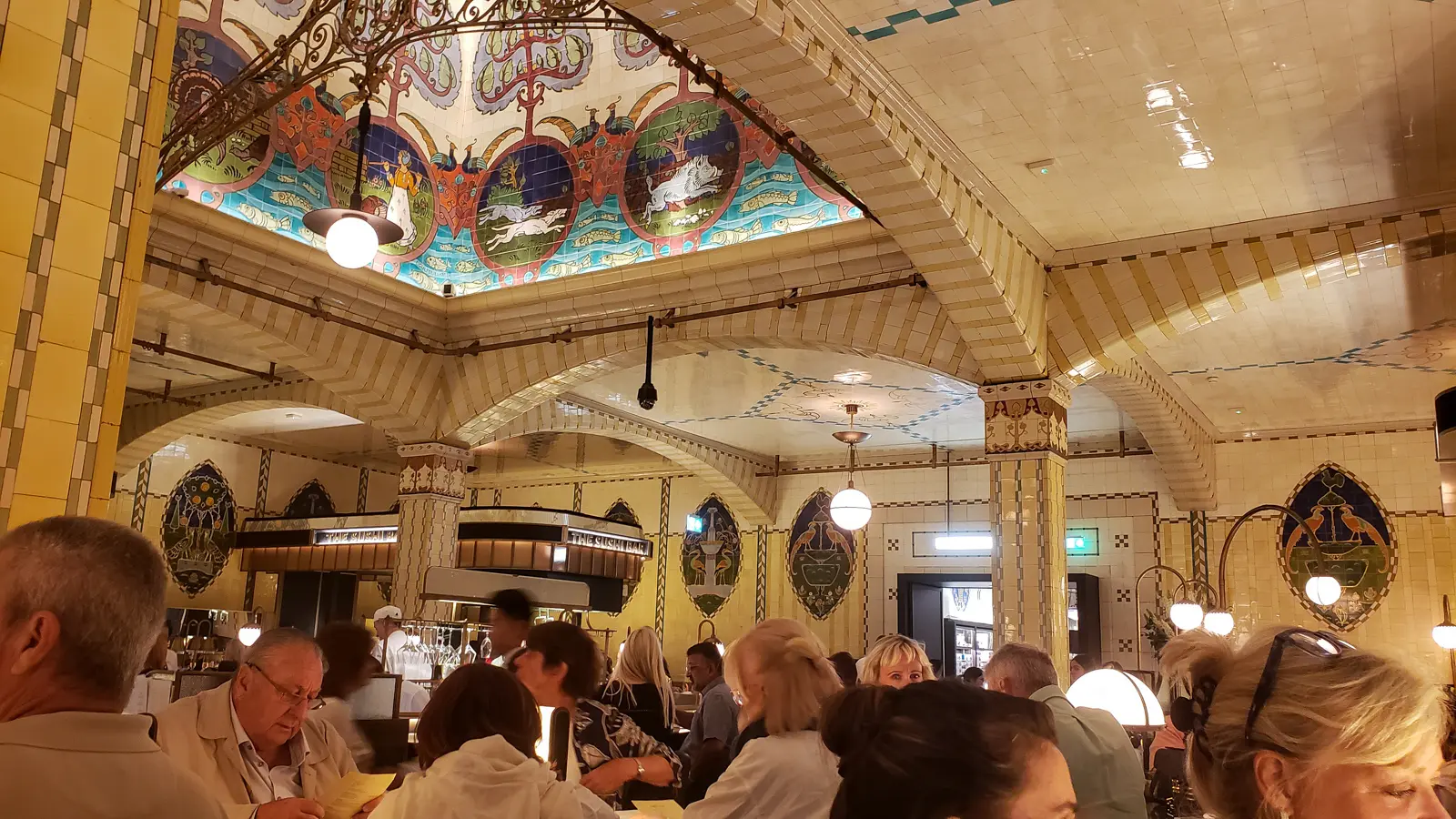
The Food Halls are the most architecturally significant part of Harrods, and they are worth knowing about even if you have no plans to buy anything. They were designed between 1902 and 1903 by William James Neatby, a Barnsley-born architect and designer who was Doulton and Co.‘s chief ceramic designer at the time. The Meat Hall (now part of what is called the Dining Hall) is decorated with twenty medallions of farming and hunting scenes made from Doulton’s Parian ware and Carrara ware tiles. The Floral Hall, where the chocolate counters now sit, was tiled by Malkin Tile Works of Burslem in Staffordshire rather than Doulton, though both halls share the same Art Nouveau aesthetic.
The tile work is genuinely museum-grade. The hall was even featured in a Viennese arts magazine when it first opened in 1903, with critics comparing it to a church with side aisles and a nave. The art-nouveau-meets-arts-and-crafts interior took just nine weeks to complete originally and survived more or less intact through the next 120 years, although photographs from the 1970s suggest the food halls were not at their best during that decade.
Between 2019 and 2021, the David Collins Studio led a major restoration of the Food Halls, working with the specialist Victorian-tile-restoration firm Craven Dunnill Jackfield. The Dining Hall was unveiled in October 2019 and the Chocolate Hall in May 2021. The restoration repaired and replicated damaged tiles, restored the gilded cartouches featuring pheasants in the Meat Hall, and rebuilt the lighting to show the tile work properly. Looking at the food halls today, what you are seeing is essentially what Neatby designed in 1902, brought back to its original colour and finish.
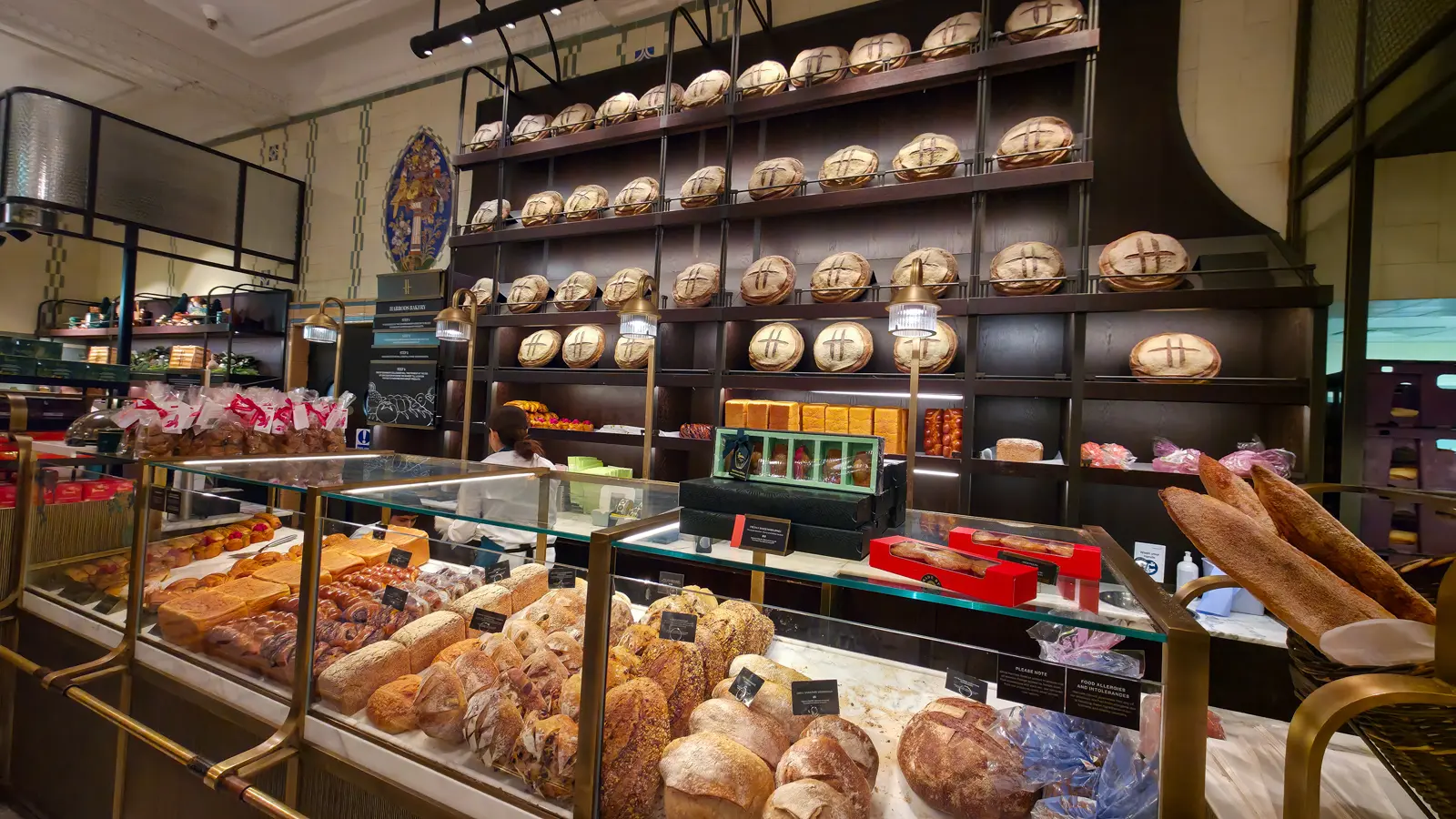
The Bake Hall is one of the post-restoration additions to the Food Halls and is now one of its most photographed corners. Bread is baked in-house each day, with the signature Harrods loaves stamped with an H insignia stacked on tall wooden shelving behind the counter. The display includes pain de campagne sourdough, baguettes resting in upright wicker baskets, and a glass case of pastries, croissants, brioche, and seasonal breads. The brass-and-wood detailing of the counter continues the David Collins Studio aesthetic from the surrounding halls. The bread is genuinely good. A loaf brought back from Harrods is a more interesting London souvenir than most.
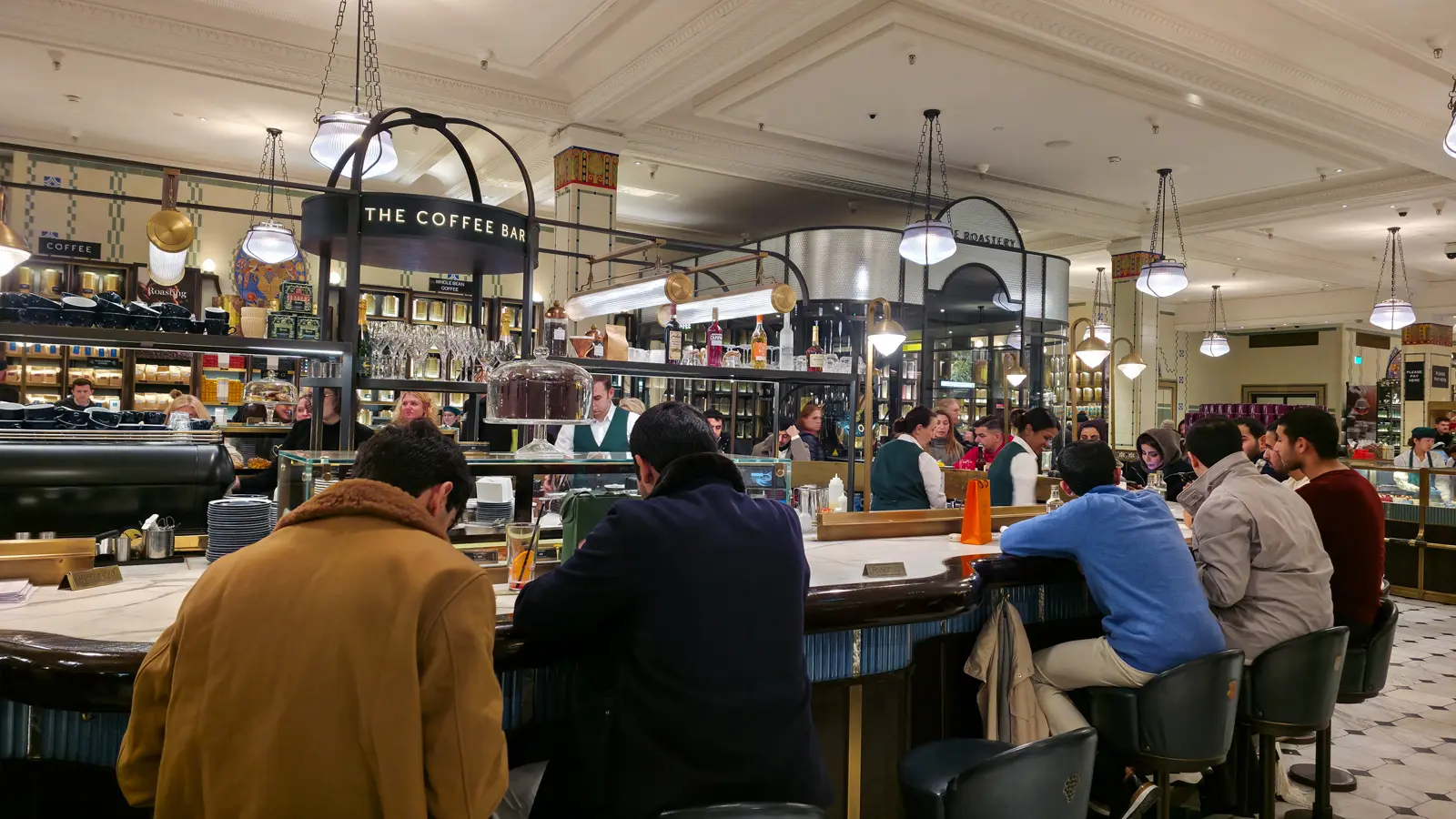
The Coffee Bar sits adjacent to the chocolate halls and is one of the calmer spots inside the entire building. The curved marble counter seats around twenty people on stools, with the bar staff working in full view at the centre. Coffee beans are roasted in-house at the adjacent Harrods Roastery, with whole bean coffee available to take home alongside the in-cafe service. The Coffee Bar serves espresso, cappuccinos, lattes, and small plates throughout the day, and it stays open late into the evening. If you need a break from the rest of the store during a busy December afternoon, a counter seat at the Coffee Bar with a cappuccino and a slice of cake is one of the most pleasant pauses you can take inside Harrods. The architecture around you is the Edwardian original.
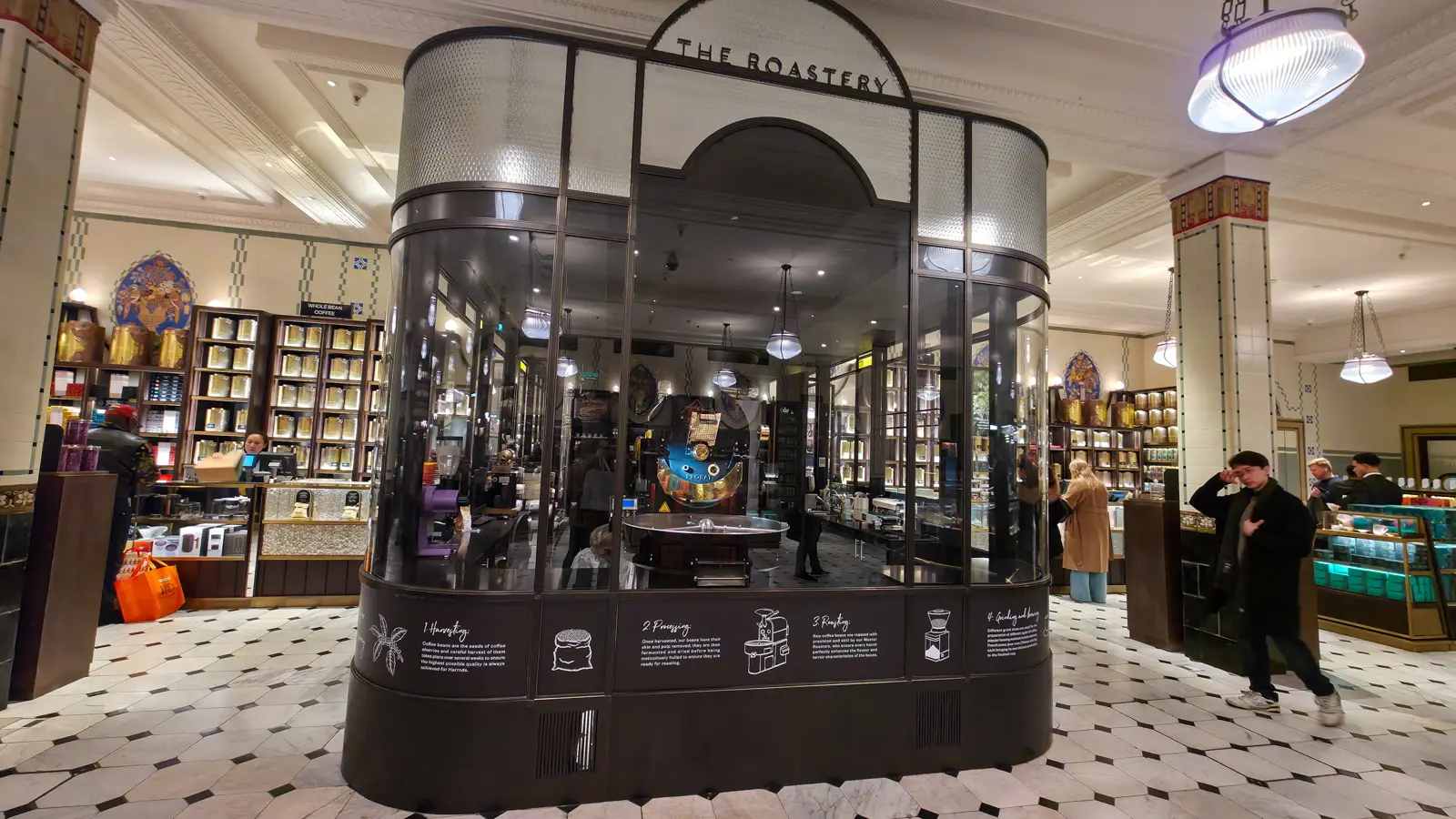
The Roastery itself is worth a look. It is a glass pavilion set in the middle of the hall, with the roaster running in full view, so you can usually watch a batch of beans turning while you wait for a coffee at the bar.
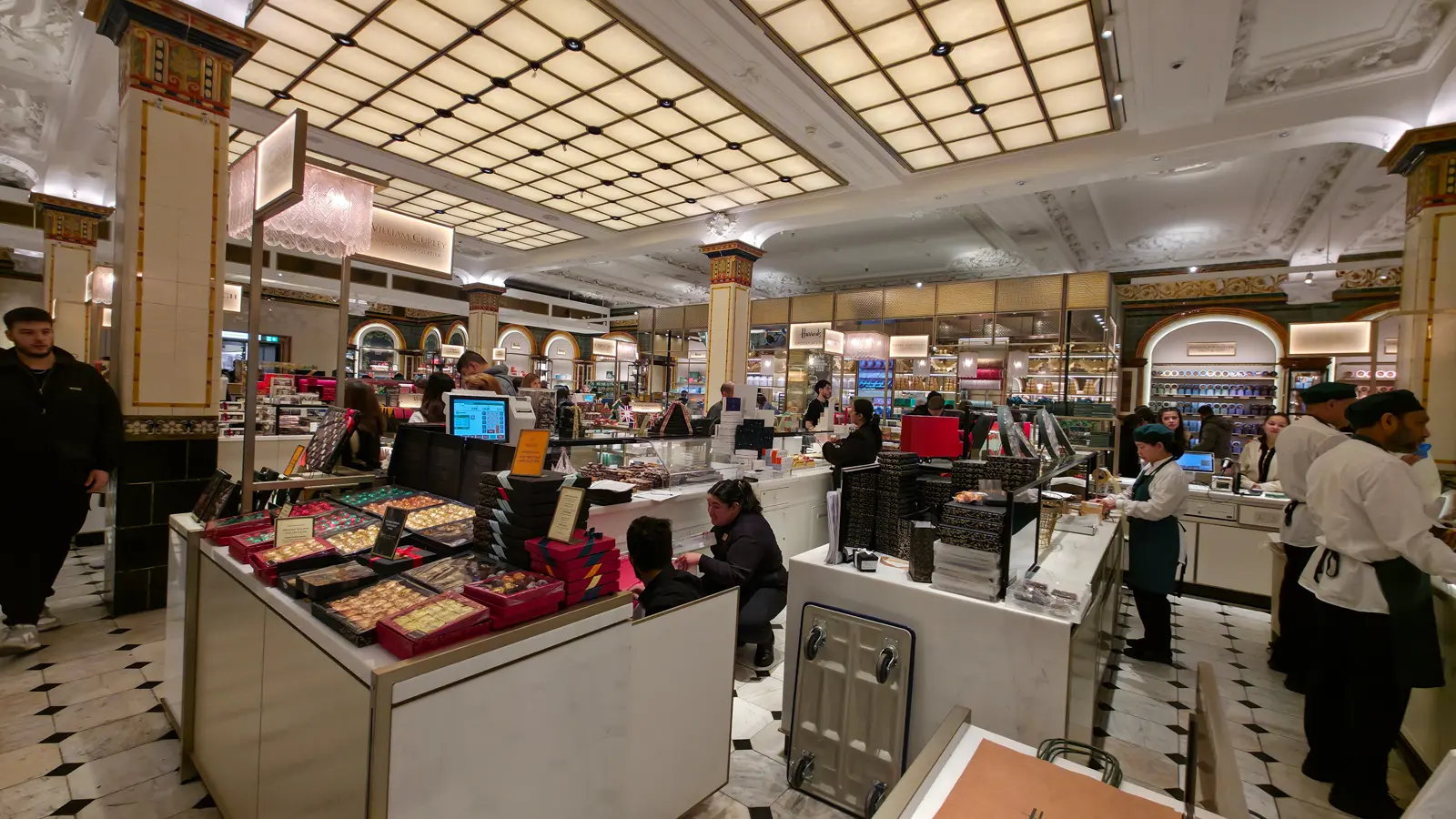
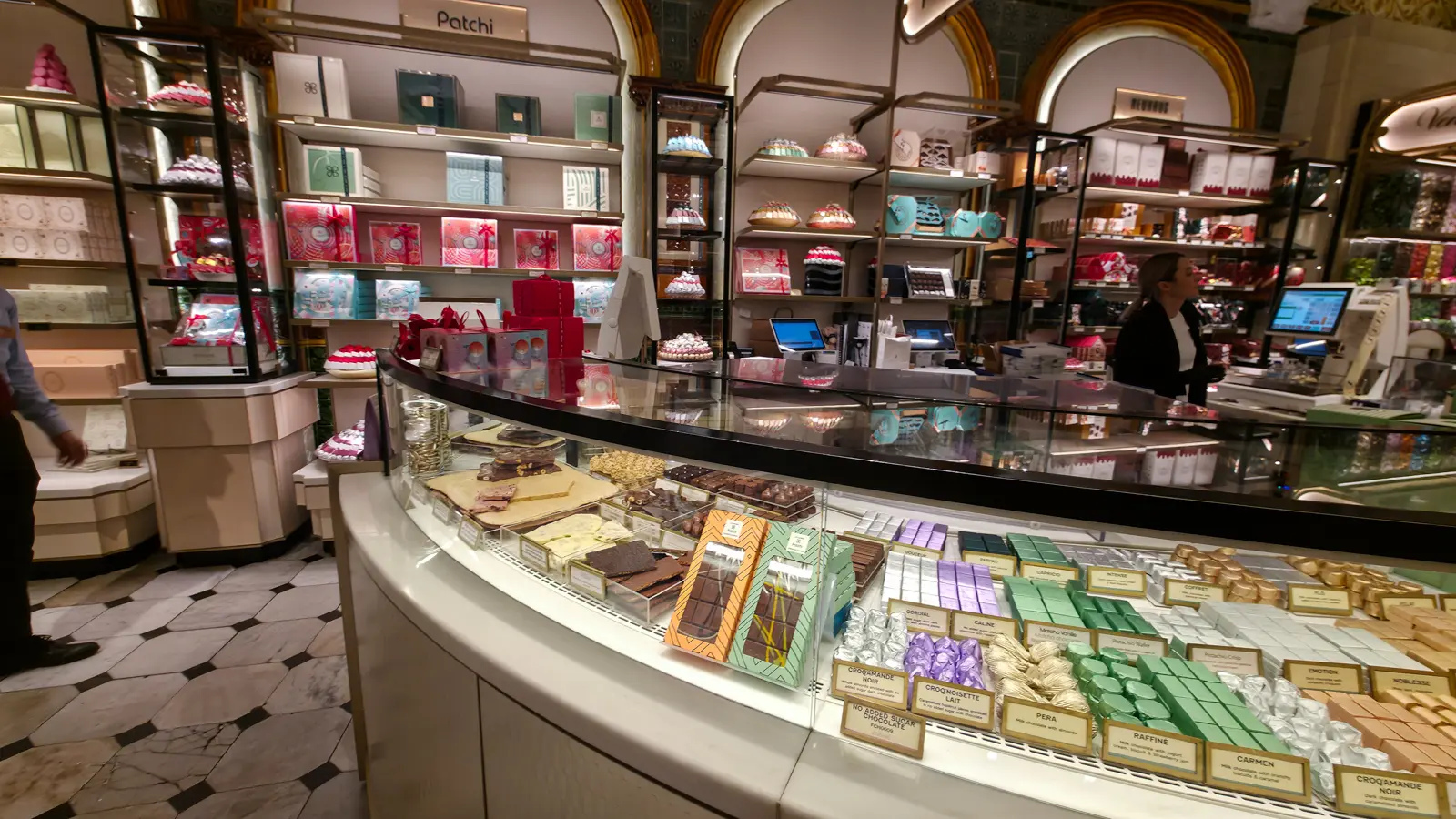
The Chocolate Hall itself houses some of the most significant chocolatiers operating in the UK. Harrods’s own-brand chocolate counter sits alongside concessions from William Curley, Pierre Marcolini, Patchi, Neuhaus, and several others. Each chocolatier has its own display case and its own counter staff. The William Curley counter (four times named Britain’s Best Chocolatier by the Academy of Chocolate) is in the Floral Hall directly under the Malkin Tile Works ceiling. The Pierre Marcolini Belgian chocolates are nearby. The Patchi Lebanese chocolates take up a substantial counter at the far end. Each has its own boxed gift range, with the Harrods festive boxes especially worth knowing about during the December season.
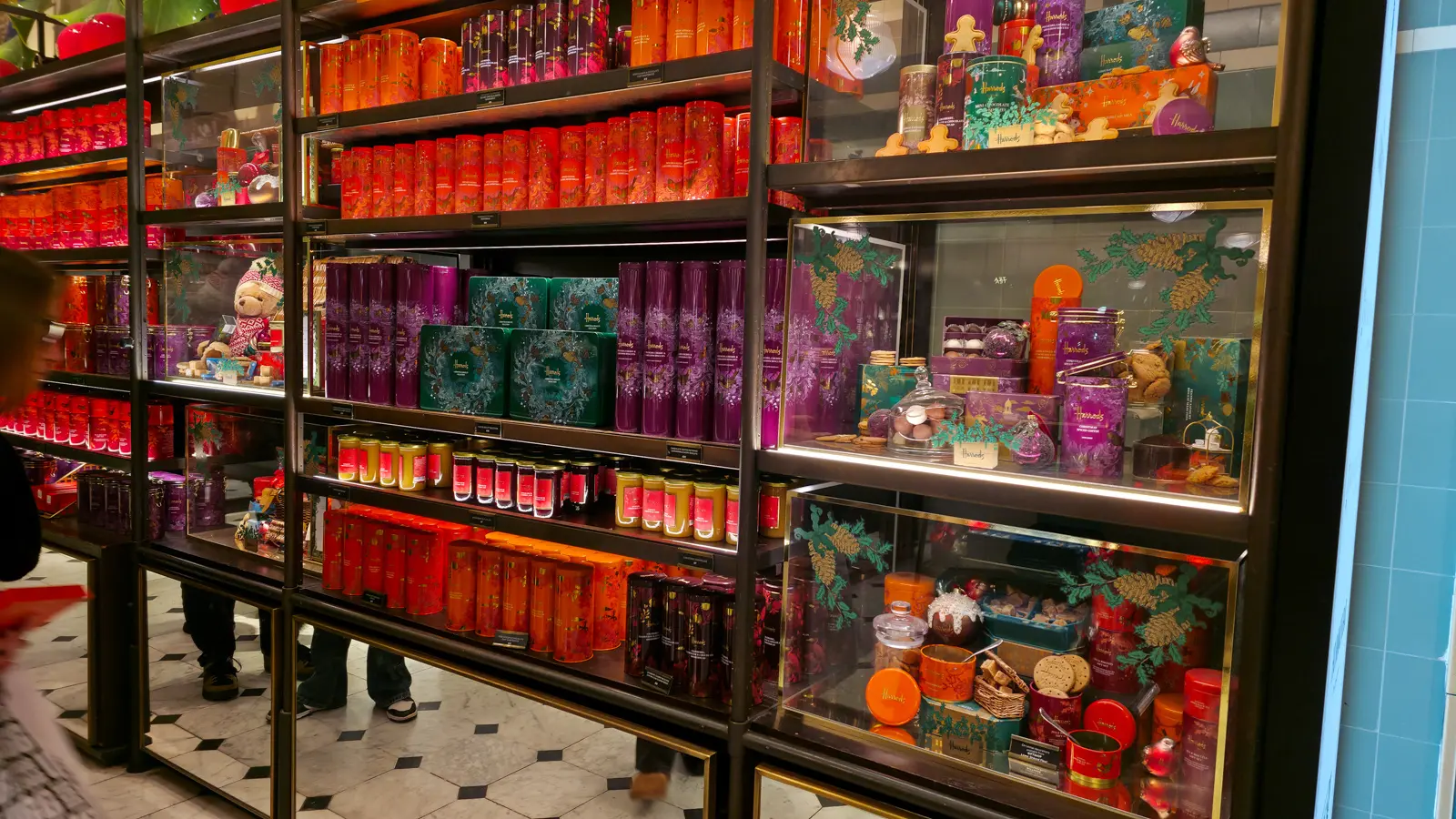
The Christmas tin display is a Harrods December tradition that is worth seeing whether or not you intend to buy anything. Harrods releases a new line of seasonal biscuit tins each year, with designs that change annually and become genuinely collectible. The tins themselves are illustrated in rich colours: deep reds, golden oranges, royal purples, and forest greens, all with gold lettering and ornate Edwardian-inspired typography. Inside are the actual biscuits: spiced shortbread, mocha cherry, cranberry and chocolate, Christmas spiced coffee. The tin display in early December is at its most complete, before the most popular designs start selling out closer to Christmas. A new tin every year, kept in a cupboard at home, becomes a small piece of family Christmas tradition over time. The tin from 2025 will be different from the tin from 2024 which was different from the tin from 2019.
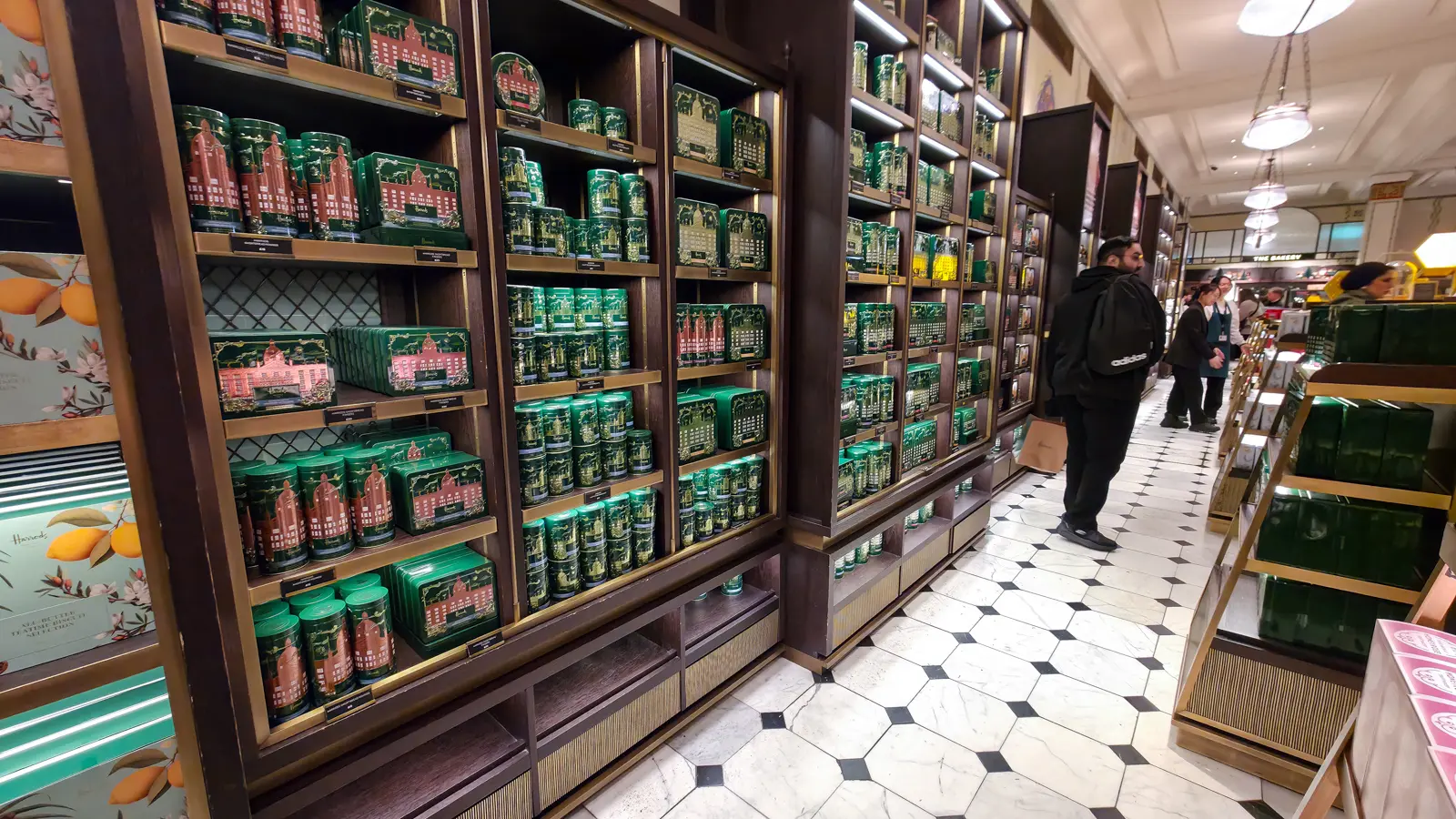
The Harrods shortbread tin is its own institution. These are the tins decorated with detailed lithographic images of the building’s terracotta façade, with the green roof and the corner tower clearly visible on the front. They have been part of the Harrods Food Halls offering for decades and are one of the most reliable gift items the store sells. The traditional version is filled with all-butter shortbread fingers. Variants over the years have included shortbread rounds, chocolate-dipped shortbread, and seasonal cranberry or lemon shortbread. The tins themselves are the real gift. People bring them home, eat the shortbread, then keep the tin to hold tea bags or pens or as a piece of London memorabilia on a shelf. A friend of mine in Toronto still has the tin she brought back from a Harrods visit in 2003. The shortbread is long gone. The tin is on a shelf in her kitchen.
A Note on Recent History
I want to be honest about a significant story that any current Harrods post should acknowledge, even briefly.
Mohamed Al-Fayed and his brother Ali bought Harrods through the House of Fraser group in 1985 and ran the store for the next 25 years. In 2010, Mohamed Al-Fayed sold the store to Qatar Holding (now the Qatar Investment Authority) for around £1.5 billion. He died in 2023 aged 94. In September 2024, a BBC documentary called Al Fayed: Predator at Harrods aired, in which multiple women alleged they had been sexually abused by Al-Fayed during his time as the store’s owner. Since then, the Metropolitan Police have reported that 146 to 154 victims have come forward to report crimes, and Harrods has established a compensation scheme called the Harrods Redress Scheme, which had over 180 survivors engaged at the time of writing and closed to new submissions on 31 March 2026.
Harrods, under its current Qatari ownership, has set aside £62.3 million for the scheme and has acknowledged the systemic failures during Al-Fayed’s ownership. Some survivor groups have argued that the redress scheme is inadequate. The story is ongoing. I am mentioning it here because any honest writing about Harrods in 2025 or 2026 has to acknowledge that the institution carries this history. The current staff at Harrods are not the staff who worked there in the Al-Fayed era. The current owners are not the Al-Fayed family. The building, the food halls, the brand experiences are real and worth describing. But the institution did harm to people during a long period of its history, and that harm is being addressed slowly and incompletely. Worth knowing before you walk in.
2019 vs 2025: A Tale of Two Visits
My 2019 visit was busy but normal. I could walk through the food halls without being shoulder-to-shoulder. I could browse without being jostled. The brand floors had a steady but manageable flow of shoppers. I bought what I came for, looked around, took my time, left.
My December 2025 visit was different. The store was packed in a way that felt like a tourist attraction rather than a department store. The crowds on the cosmetics floor were three or four people deep at every counter. The chocolate halls were so busy that ordering required patience. The Bakery had a queue. The escalators backed up at peak times. I noticed something I had not seen in 2019: many of the people in the store were not really shopping. They were there to be in the building. To take photographs. To say they had been. The food halls in particular had the energy of a luxury attraction rather than a place to buy groceries.
This is not a criticism of the store, exactly. Harrods has always been a tourist destination as much as a shopping destination. But the balance has tilted. In 2025, December at Harrods feels like visiting a famous landmark on a busy day rather than going to a department store. The luxury halls on the upper floors had a date-night meet-and-greet quality, with couples and groups dressed up for an evening out, taking photographs in front of the Christmas displays, lingering rather than shopping.
A specific thing I noticed this time and not in 2019: how dressed up many of the women shopping were. Many were in heels and full evening makeup, with elaborate handbags, dressed as if they had come from somewhere or were going somewhere later. I had come from a long day of walking around London and was wearing flat shoes and a coat. I felt slightly underdressed and laughed about it. I am a strong believer in walking with confidence and letting the clothes follow the wearer rather than the other way around. But I noticed.
This is, again, the London thing. You have to have patience, you have to take it all in, you have to go with the flow. The crowds and the people-watching are part of the experience now whether you signed up for them or not.
The Brand Floors and Service
Here is the part of the post I really wanted to write.
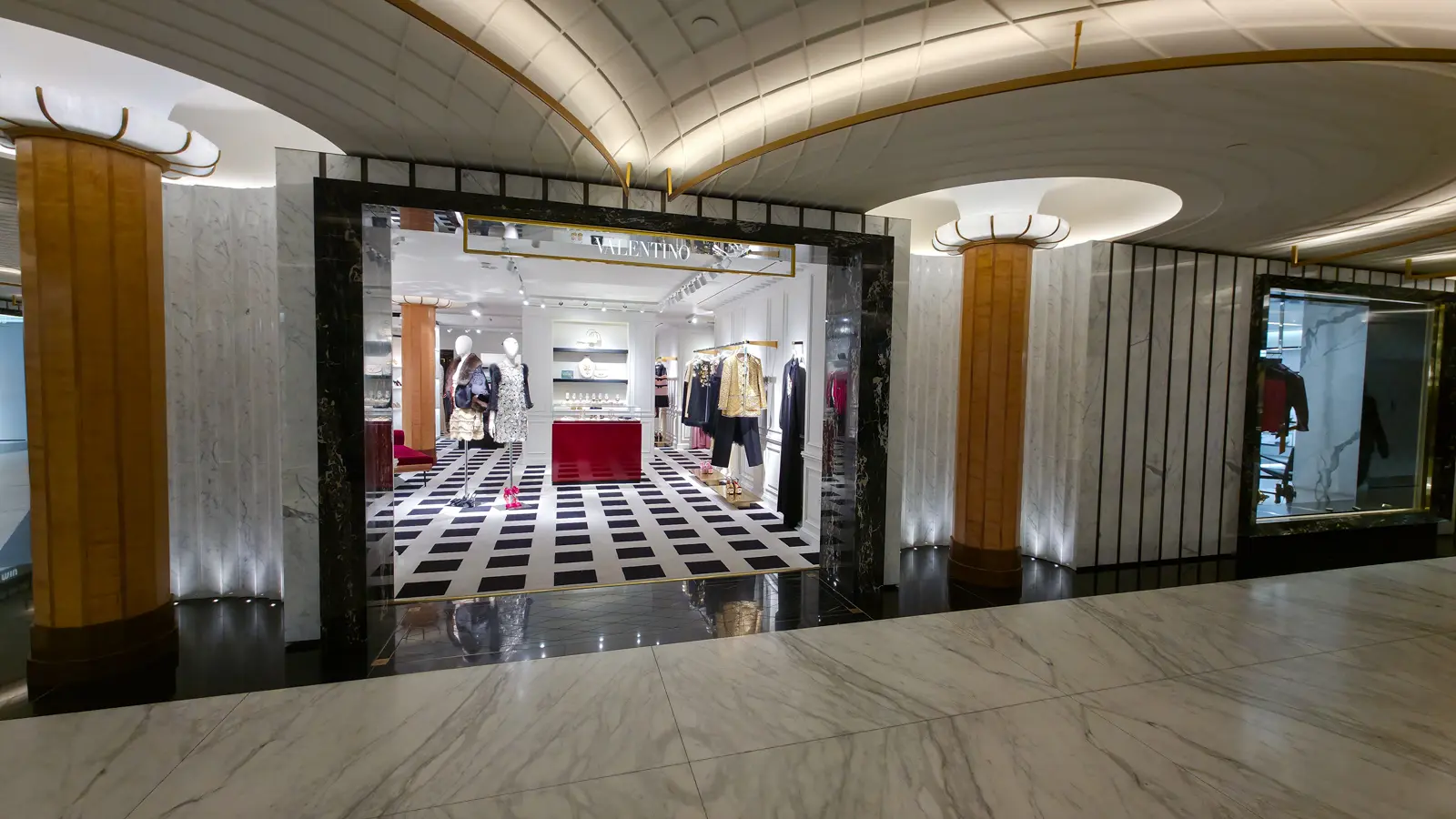
Harrods houses concessions for every major luxury brand you can name: Chanel, Dior, Louis Vuitton, Hermès, Gucci, Valentino, Burberry, Saint Laurent, Prada, Fendi, Bottega Veneta, Tiffany, Cartier, the lot. Each operates as a semi-independent retail space within the building. Some are individual shops with their own staff, their own walls, their own checkout. Others are open counters or open-floor concessions. The quality of the shopping experience at Harrods is therefore not really about Harrods. It is about the individual brand staff you happen to encounter on that particular day.
My experience this December was stark. At the Gucci concession, I went in with a clear purchase in mind. I had researched the item, I knew the price, I had brought the budget, I was visibly there as a buyer rather than as a browser. The rep I spoke with did not take me seriously. Whether it was the flat shoes, the lack of an obvious designer handbag, or something else I cannot identify, the interaction was dismissive enough that I left without making the purchase. I am not interested in giving my money to a salesperson who has decided in advance that I am not the customer.
At Burberry, the experience could not have been more different. The staff member who greeted me asked what I was looking for, listened to the answer, walked me through the relevant options, was patient when I asked questions, brought multiple variations for me to look at, and treated me like the customer I was. The interaction was warm without being performative, and helpful without being pushy. I made my purchase at Burberry that afternoon. I would walk into a Burberry store again on the strength of that one interaction alone.
This is the secret of shopping at Harrods that no one really writes about. The store itself is the architecture, the food halls, the spectacle. The shopping is the brand staff. The reputation of the store is not the same as the reputation of the people standing behind the counters of the individual concessions. A friend of mine in London told me once that she has favourite specific salespeople across the Harrods brands and that she shops their schedules. I now understand why.
If you are going to Harrods to actually buy something, and not just to look, my advice is to approach each brand concession with no assumptions and walk out if the staff member you encounter does not treat you with the same respect they would treat anyone else. The store has enough good staff that you do not have to tolerate the bad ones.
The Festive Season Specifically
December at Harrods is genuinely beautiful in some ways and genuinely difficult in others.
The beautiful side: the building lit up at night with over 11,500 lights is one of the iconic London scenes of the festive season. The food halls are decorated to a standard that puts most other London Christmas displays to shame. The Christmas tin displays in the bakery and chocolate sections are worth seeing in their own right. The luxury floors are dressed for the occasion. The cosmetics floor is at its busiest but also at its most spectacular. There is a reason December is the most photographed month at Harrods.
The difficult side: the crowds. December at Harrods is genuinely the busiest month, with the two weeks before Christmas reaching levels of foot traffic that make actual shopping difficult. If you are visiting to actually buy something, December afternoons are not the best time. Mornings on weekdays are much calmer. Avoiding the cosmetics ground floor, particularly the perfume counters, makes navigation significantly easier. The food halls are also calmer in the morning, and the chocolate counters are easier to approach before lunch.
I left both visits glad I had gone. The 2019 visit was the better shopping experience. The 2025 visit was the better visual experience. Both visits gave me something different.
Bubbly Tips for Visiting Harrods
- Go in the morning, ideally on a weekday. December afternoons are the peak crowd. Tuesday or Wednesday mornings before 11 AM are noticeably calmer in every department.
- Approach the brand concessions with no assumptions. The staff are the experience. If you encounter a salesperson who is dismissive, leave. The next brand over may be excellent. Do not let one bad interaction ruin a shopping visit.
- The Food Halls are worth visiting even if you are not buying anything. The Edwardian tile work by William James Neatby in the Dining Hall and the Floral Hall is genuinely museum-grade. Look up at the ceilings. Notice the medallions of farming scenes. The Halls are Grade II* listed for a reason.
- The Harrods biscuit tins are real gifts. If you want a souvenir that looks like a souvenir but is actually a genuinely lovely thing, the Christmas tin range and the shortbread tins are both worth bringing home. The tins outlive the biscuits.
- The Coffee Bar is one of the calmer spots inside the store. If you need a break from the crowds, a counter seat at the Coffee Bar in the Food Halls is one of the most pleasant pauses you can take during a Harrods visit. The coffee is excellent and the architecture around you is the Edwardian original.
- Don’t try to do all seven floors in one visit. Pick the floors you actually care about and skip the rest. Most of the second and third floors are designer fashion brands you could see anywhere. The Food Halls (ground floor) and the Toy Department (fourth floor) and the Halls dedicated to home and gifts (third floor) are the more Harrods-specific experiences.
- The famous toy bear story is real. A. A. Milne bought a stuffed bear from the Harrods toy department in 1921 for his son Christopher Robin, who named it Winnie-the-Pooh. The Toy Department still sells stuffed bears in a similar style.
- The illuminated façade is best photographed from across Brompton Road. Stand on the opposite side of the street at the corner of Hans Crescent for the best photograph of the full façade lit at night. The lights come on at dusk.
- Nearest tube station is Knightsbridge (Piccadilly Line), with the station entrance on the Hans Crescent side of the Harrods building. The walk from South Kensington (also on the Piccadilly, District, and Circle Lines) is about ten minutes and takes you through some lovely Knightsbridge architecture.
- Combine with a Knightsbridge walk. Harrods sits in one of the most architecturally beautiful neighbourhoods in London. After your visit, walking up Brompton Road toward the Brompton Oratory, or down toward Knightsbridge proper and into Hyde Park, is one of the great London afternoon walks.
Final Thoughts
I have stopped recommending Harrods to friends who are visiting London for the first time, and that is a recent change. The store is still extraordinary. The building is still one of the great Edwardian commercial structures in Britain. The Food Halls are still a piece of working art-nouveau architecture you can walk through without paying admission. The brand concessions are still some of the densest concentrations of luxury retail anywhere in the world. None of that has changed.
What has changed is the experience of actually being there. In 2025, going to Harrods means going to a tourist attraction that happens to sell things. The crowd density, the people-watching, the date-night dressing, the photographs being taken of everything, the slow processional shuffle through the cosmetics floor: all of this has shifted Harrods from being a department store into being a London experience that you go through. That is not bad, exactly. But it is different from what the guidebooks describe.
If you are going for the architecture, the food halls, and the spectacle, December is the best time and you should go. If you are going to actually shop, pick a Tuesday morning in January or February instead. The store is the same. The crowds are not.
I am genuinely glad I went both times, even with the Gucci moment and the underdressed laughing and the queue at the entrance. London asks for patience. Harrods asks for it slightly more than usual. If you bring patience and you walk with confidence (and you are willing to walk away from a dismissive salesperson), the place will give you what you came for.
Until next time!

🌟 Everything You Need to Plan Your Dream Trip in 2026
- 🌟 Luxury Hotels - Find premium stays with Booking.com & Hotels.com
- 🏡 Vacation Rentals - Discover unique properties on VRBO
- 🏞️ Guided Tours - Explore with Viator or GetYourGuide
- 🎫 Attraction Tickets - Skip the lines with Tiqets
- 🚢 Ocean Cruises - Set sail with Cruise Direct
- 📱 International SIMs - Stay connected with Saily
- 🚗 Car Rentals - Budget-friendly options from Discover Cars
- 🌐 Secure VPNs - Browse safely with NordVPN
- 💶 Currency Exchange - Best rates with Wise
- 🗣️ Learn Languages - Master the local language with Babbel and Rosetta Stone