
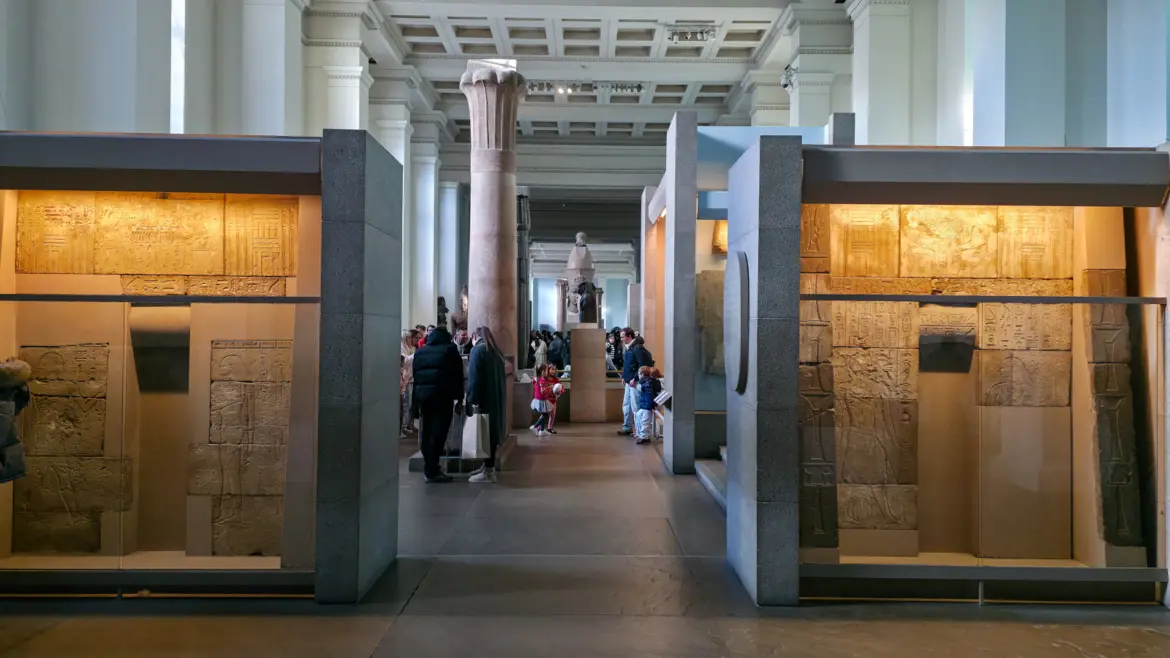
The British Museum in London holds one of the largest collections of Egyptian material anywhere outside Cairo, and you meet it on two floors. The monumental stone sits downstairs in the long sculpture gallery, Room 4. The mummies, coffins and painted walls are upstairs in the death and afterlife rooms. I have now walked it twice, in 2019 and again last November, and I still left things unseen both times. With Egypt at this museum, that is simply the deal. Here are the pieces that stopped me, with the facts checked and the stories straight.
Entry is free, as it is across the whole museum. You only pay for the temporary exhibitions.
British Museum Egypt at a Glance
📍 Location · Great Russell Street, Bloomsbury, WC1B 3DG. Nearest tube: Tottenham Court Road or Holborn, both about a five-minute walk.
🏺 The galleries · Monumental sculpture in Room 4 on the ground floor, west of the Great Court. Mummies, coffins and the Nebamun paintings upstairs in Rooms 61 to 64.
🗿 Star piece · The Rosetta Stone, a priestly decree of 196 BC carved in three scripts. Found in 1799, in the Museum since 1802, and the key Champollion used to crack hieroglyphs in 1822.
👑 The colossi · The Younger Memnon, a seven-tonne bust of Ramesses II hauled out of Thebes by a former circus strongman in 1816. News of its arrival inspired Shelley to write “Ozymandias”.
🦴 Don’t miss · Gebelein Man, a naturally preserved body from about 3500 BC. A 2012 CT scan revealed he was stabbed in the back, aged just 18 to 21.
💰 Cost · Free, like the rest of the museum. Only temporary exhibitions are ticketed.
⏰ Hours · Daily 10:00 to 17:00, with Friday late opening until 20:30. Friday evening is the calmest window.
⏱️ Time needed · Two to three hours for a focused Egypt visit across both floors.
💡 Tip · See the Rosetta Stone first thing or last, or you will be looking at the backs of heads. Photography is allowed without flash.
The Rosetta Stone
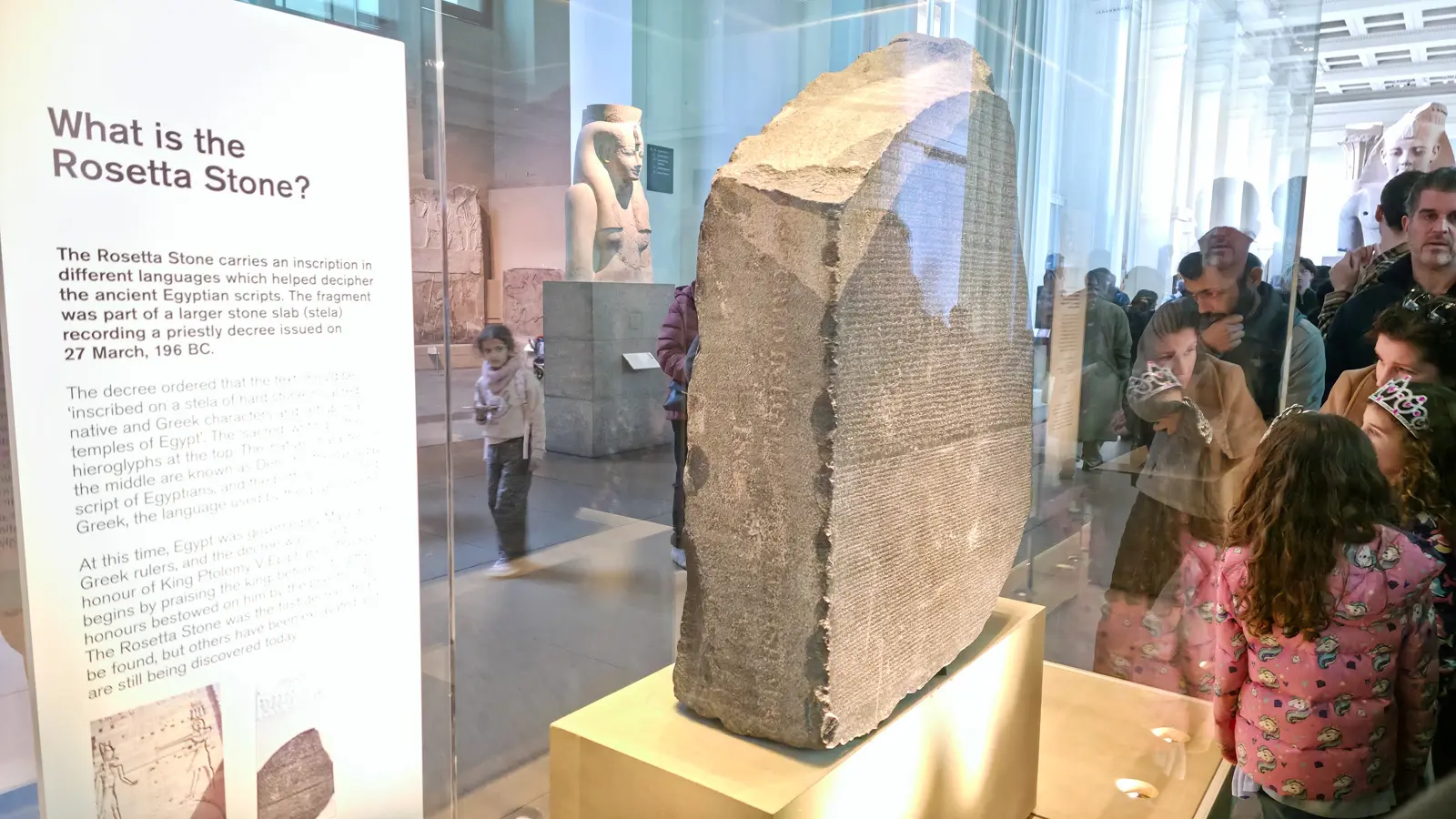
Start where everyone starts, because you will not get near it later in the day. The Rosetta Stone is a broken slab of a larger stone carved with a priestly decree for King Ptolemy V, issued in 196 BC. The same text runs three times, in Egyptian hieroglyphs, in Egyptian Demotic, and in ancient Greek. Because scholars could already read the Greek, the stone handed them a way into the hieroglyphs, and in 1822 Jean-Francois Champollion used it to crack the script and reopen 3,000 years of Egyptian writing. French soldiers found it in 1799 near the town of Rosetta during Napoleon‘s campaign. It passed to Britain after the French defeat in 1801 and reached the Museum in 1802. It is smaller and darker than most people expect, and Egypt has asked for it back.
Standing in front of it, the thing that got me was the wait. Found in 1799, not read until 1822, more than twenty years of work treating it like a cipher, which is really what it was. And before that, for well over a thousand years, nobody alive could read a single hieroglyph. A whole civilisation’s writing had gone silent in plain sight until one broken slab gave up the key. We have only known how to read ancient Egypt for about two hundred years.
The hall of colossi
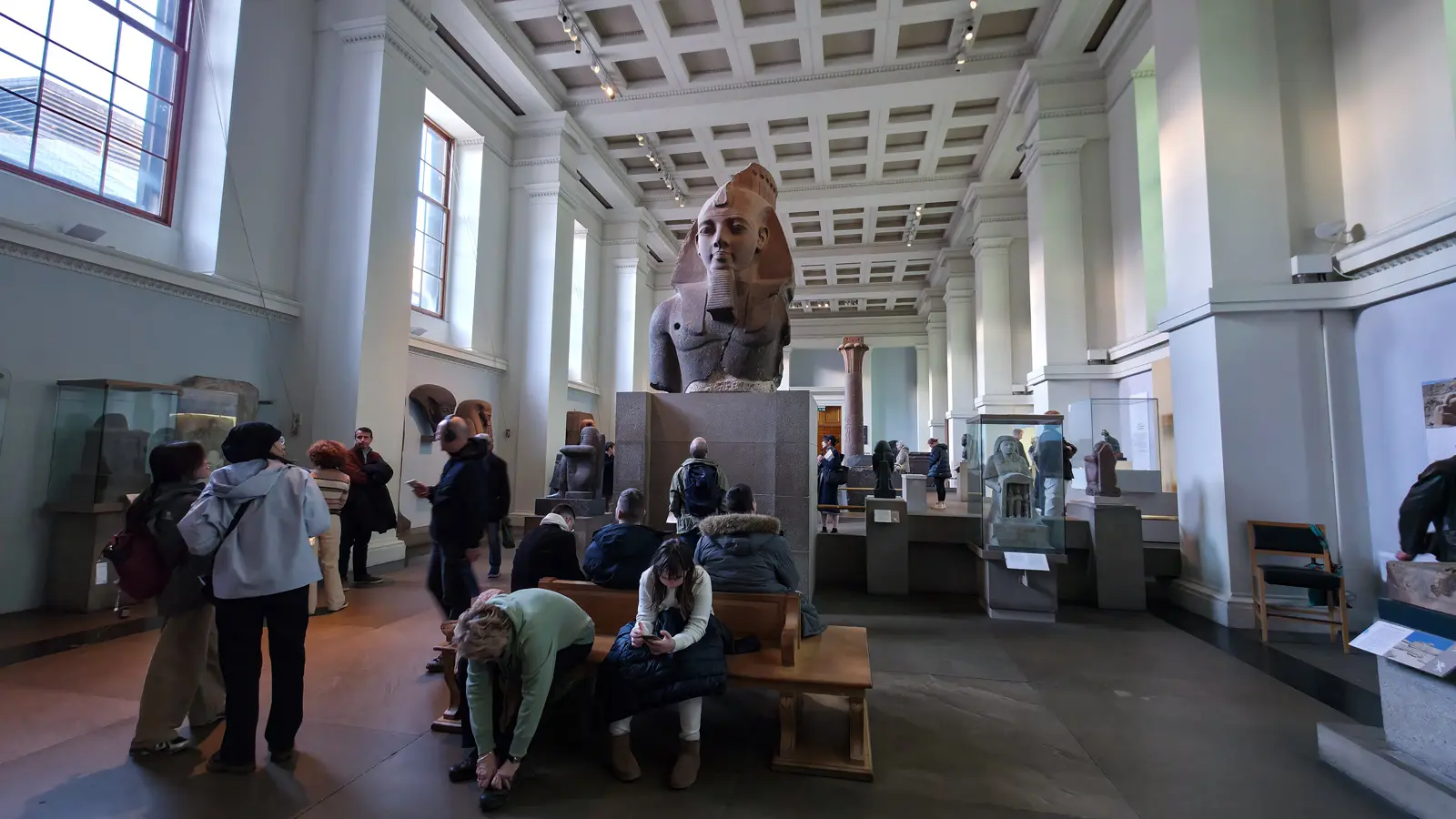
The length of Room 4 is a parade of giant kings. The one to find first is the Younger Memnon, the head and shoulders of Ramesses II from his memorial temple at Thebes. It was hauled out and shipped to England by Giovanni Belzoni, a former circus strongman, in 1816, and its arrival in 1818 prompted Shelley to write “Ozymandias”, the sonnet about a ruined desert colossus. Ozymandias was a Greek version of Ramesses’ name. Further down the hall are colossal heads and a striding king or two, including a colossal granite head of Amenhotep III in the double crown. The trick with this room is to stop fighting the scale and just stand under one of them for a moment.
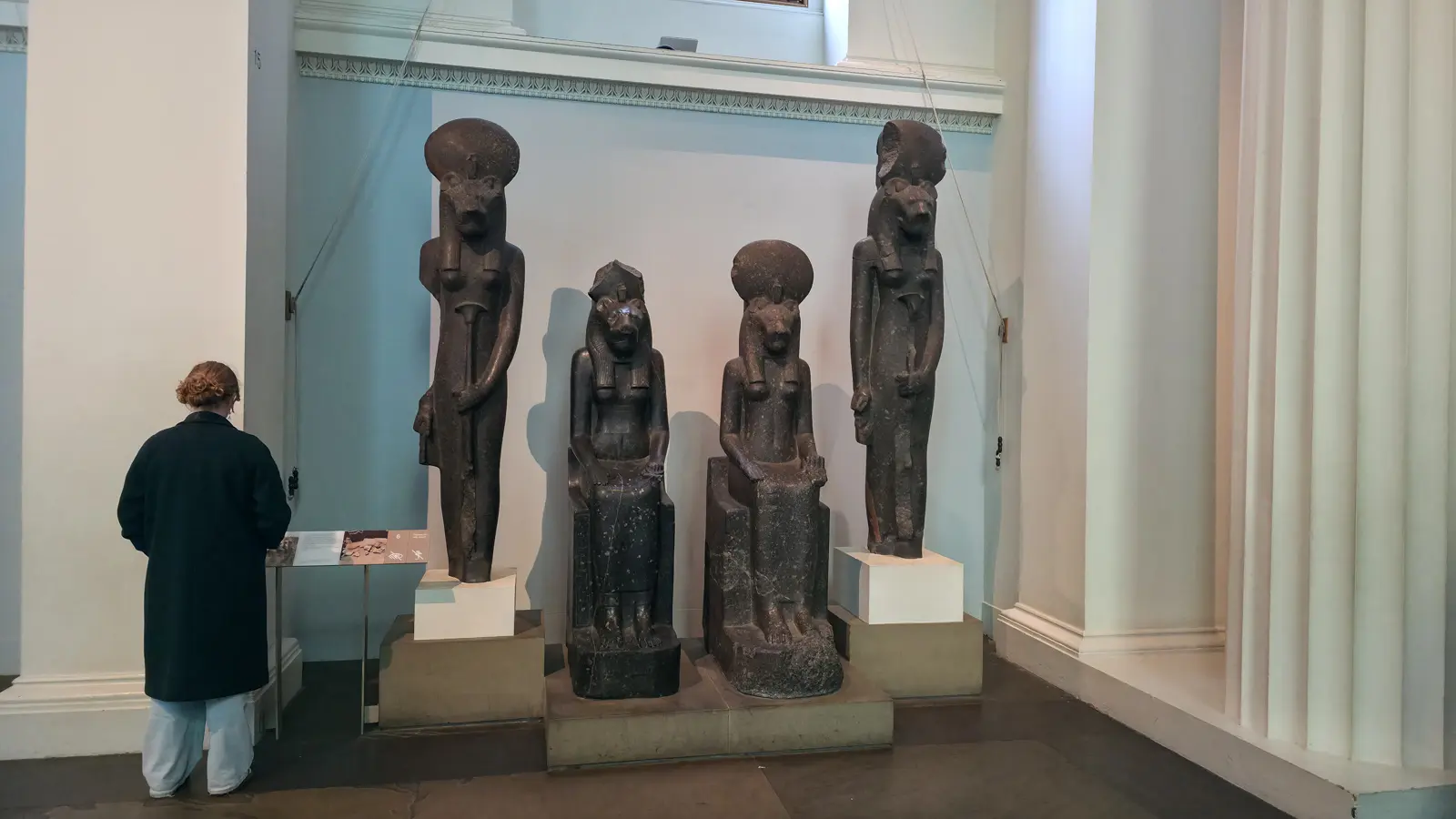
You will also pass rank after rank of Sekhmet, the lioness-headed goddess whose name means “she who is powerful”. She was the fierce, destructive eye of the sun god. King Amenhotep III had an enormous number of her statues carved in granodiorite for his mortuary temple at Thebes, and many were later moved to the Temple of Mut at Karnak. The British Museum holds the largest group outside Egypt, more than thirty of them. Standing among several at once, you understand the point: she was a goddess you wanted on side.
The heretic king
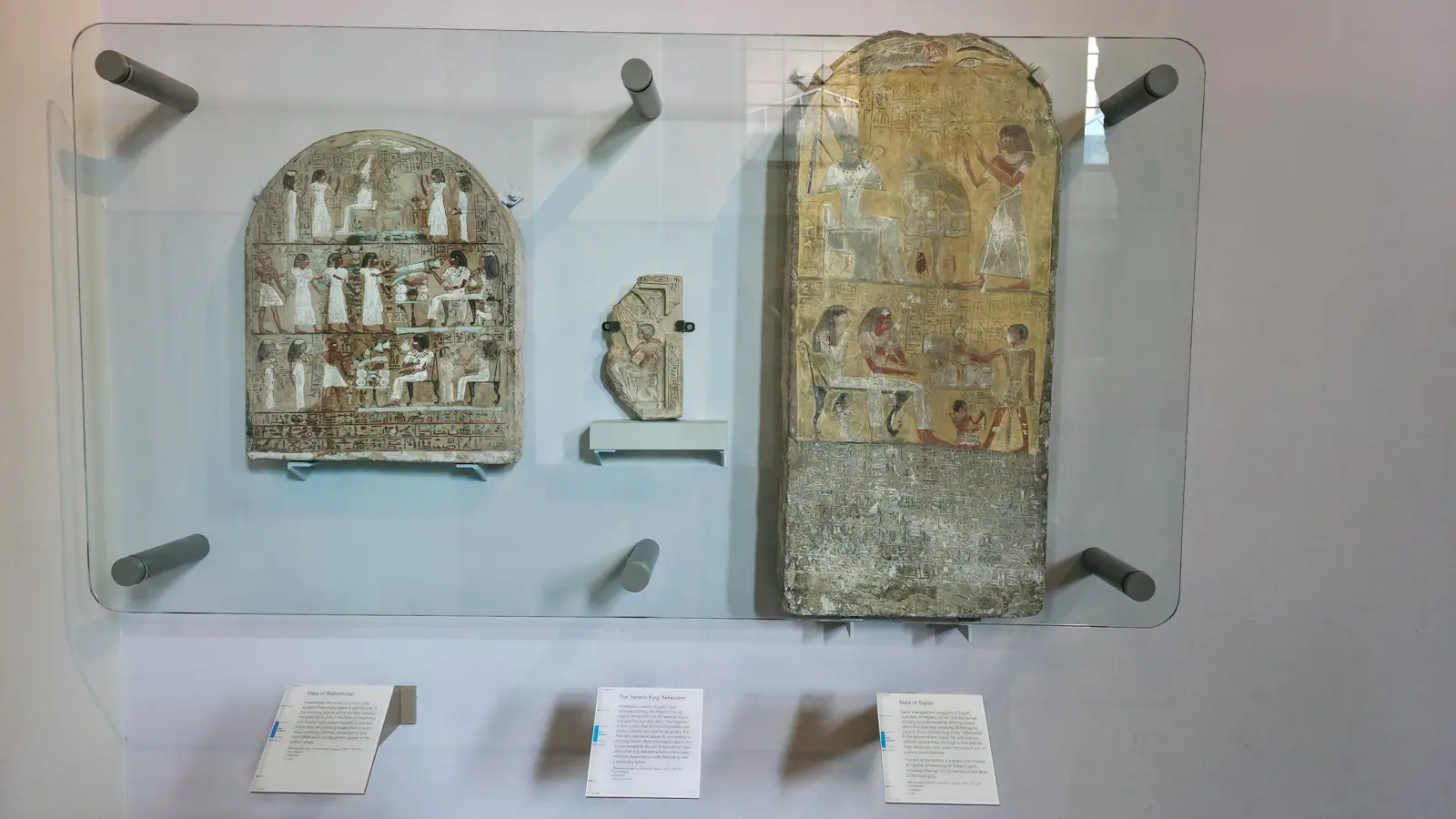
In a case of stelae sits a small, easy-to-miss fragment that carries one of Egypt’s strangest chapters. Akhenaten, born Amenhotep IV, came to the throne around 1352 BC and then did something no pharaoh had done. He pushed aside the old gods, raised a single one above the rest, the sun-disc called the Aten, and built a brand-new capital in the desert at Amarna. On this fragment the Aten appears as a disc whose rays end in little hands, reaching down to bless the royal family. After his death the experiment was undone. The old gods came back under his young son Tutankhamun, and later kings decided Akhenaten had never happened. They tore down his city and left his name off the official record entirely.
The edited record
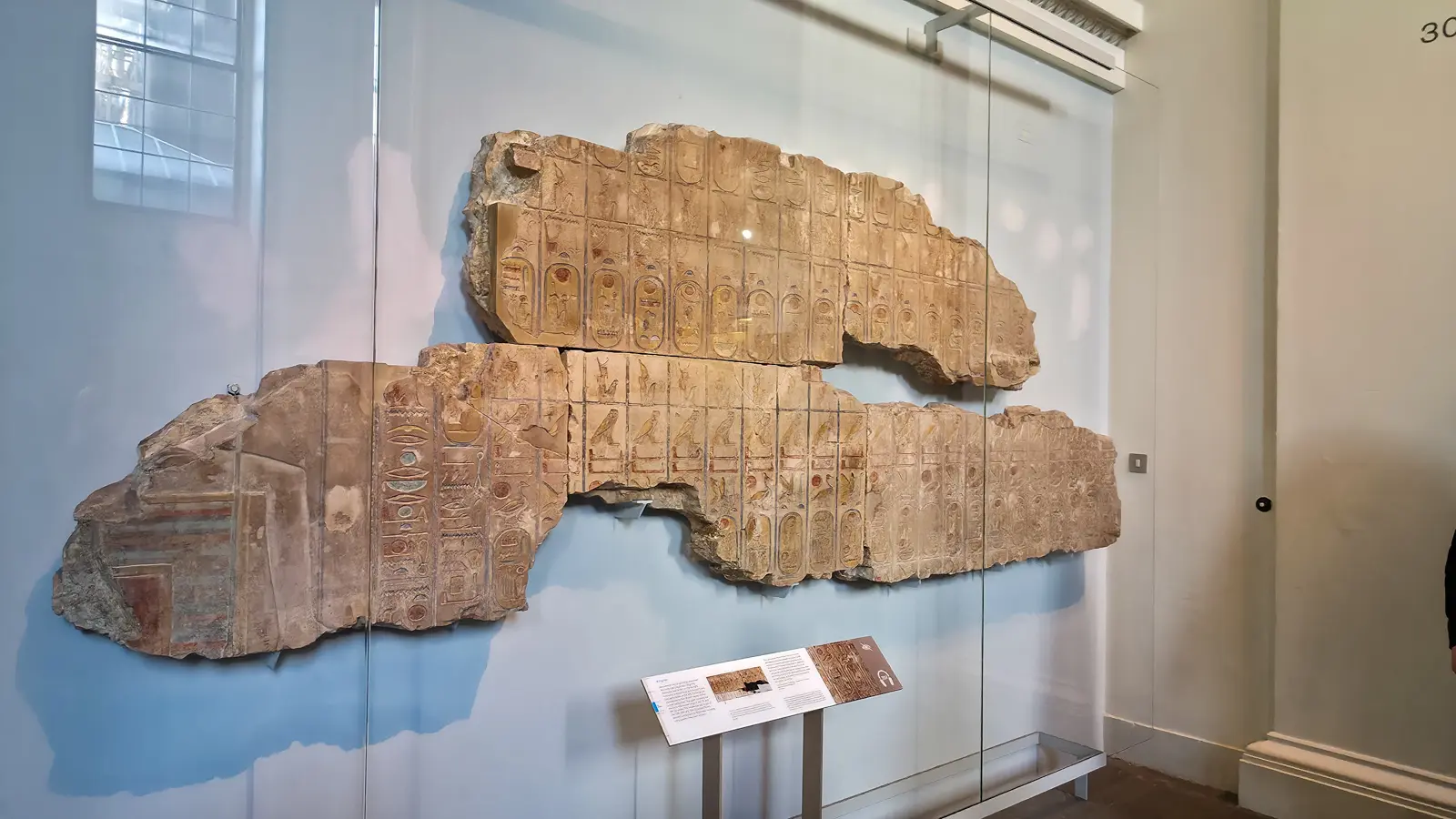
Which brings you to this relief, and it is worth seeing the two together. It is part of a list of the kings of Egypt from the memorial temple of Ramesses II at Abydos, about 1250 BC, with rows of cartouches naming earlier rulers as Ramesses makes offerings to them. Lists like this read as neat history, but they were edited. Rulers a later regime wanted forgotten were simply left out, and Akhenaten was one of them. The record you are looking at is not the whole story. It is the story someone chose to keep.
Egypt’s reach south
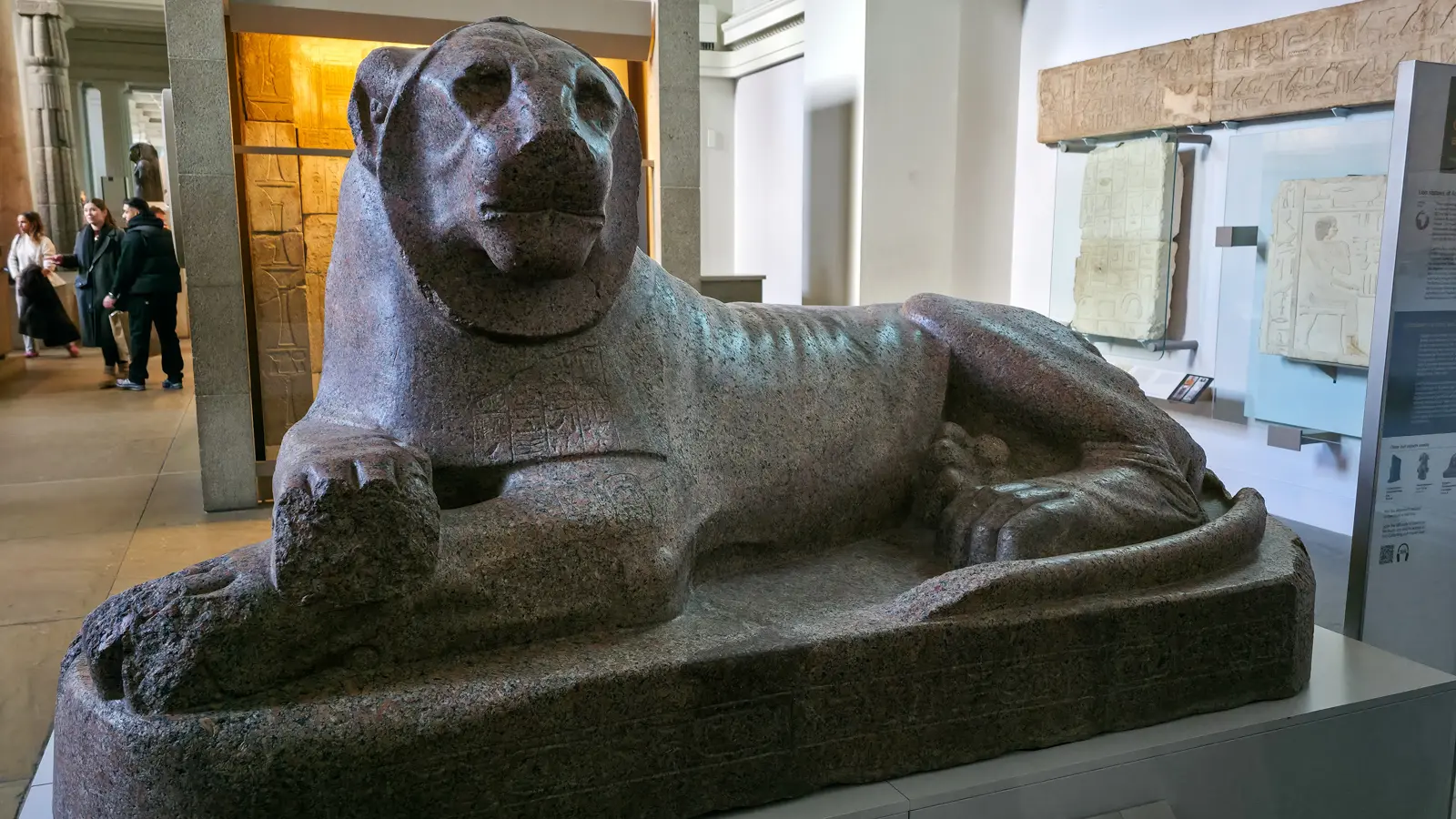
Two of the finest animals in the gallery did not come from Egypt proper but from Nubia, to the south, in what is now Sudan. The red granite lion is one of a pair known as the Prudhoe Lions, carved for Amenhotep III around 1370 BC for his temple at Soleb. It is a lion with many names: Tutankhamun later re-inscribed it, and centuries on the Kushite king Amanislo moved it south to Gebel Barkal and carved his own name on it too. Lord Prudhoe gave the pair to the Museum in 1835.
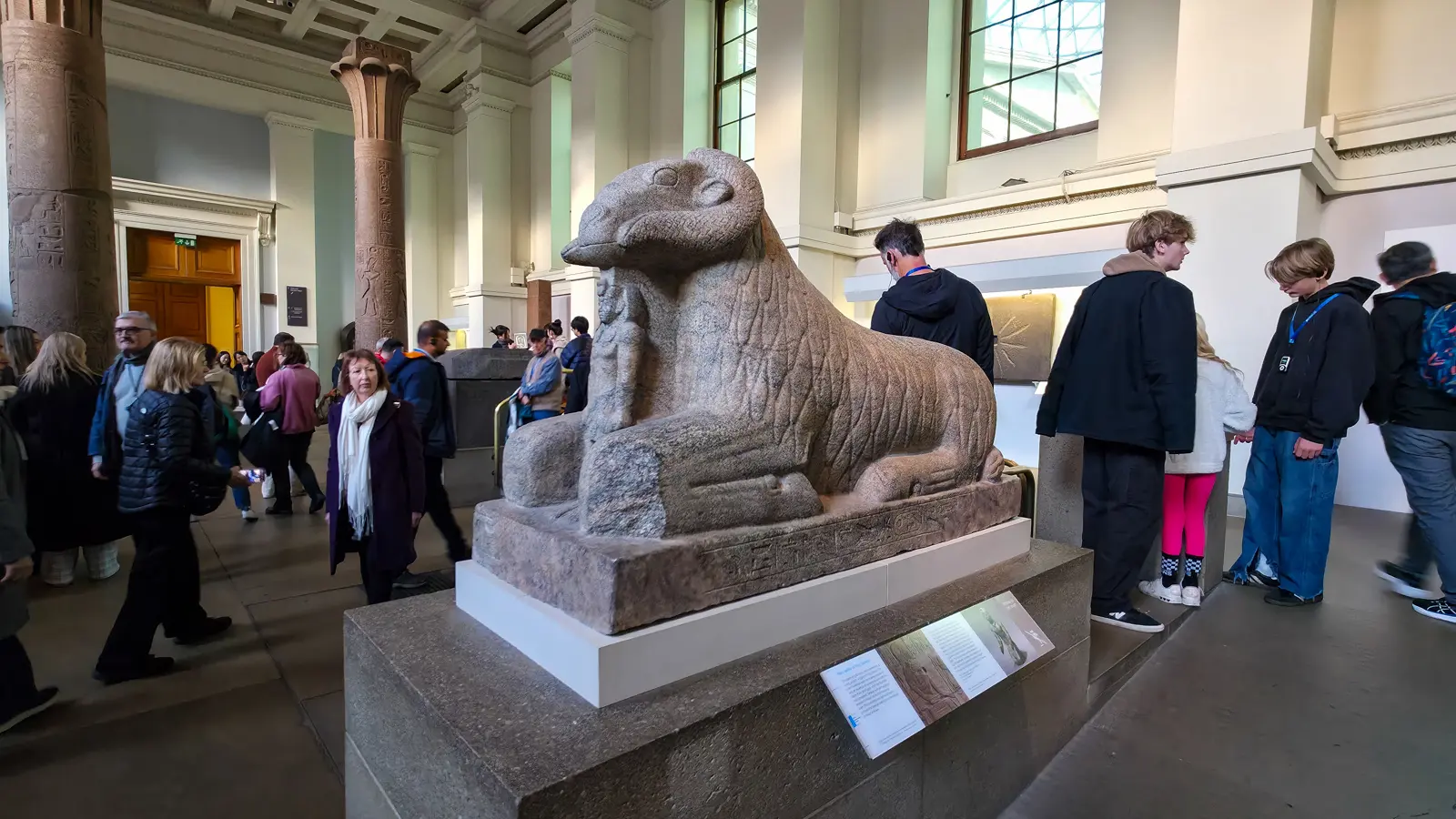
Beside that thread is the ram of Amun protecting King Taharqa, from a temple at Kawa in Nubia, around 690 to 664 BC. Taharqa was the last great king of the Kushite dynasty, the Nubian pharaohs who ruled Egypt itself for a time. The small figure tucked between the ram’s front legs is the king, sheltered by his god. Soon after, the Assyrians swept in and sacked Thebes, and Taharqa fled south. The two pieces together tell a story most Egypt galleries skip: the long, two-way traffic between Egypt and the kingdoms below it.
A coffin with a second life
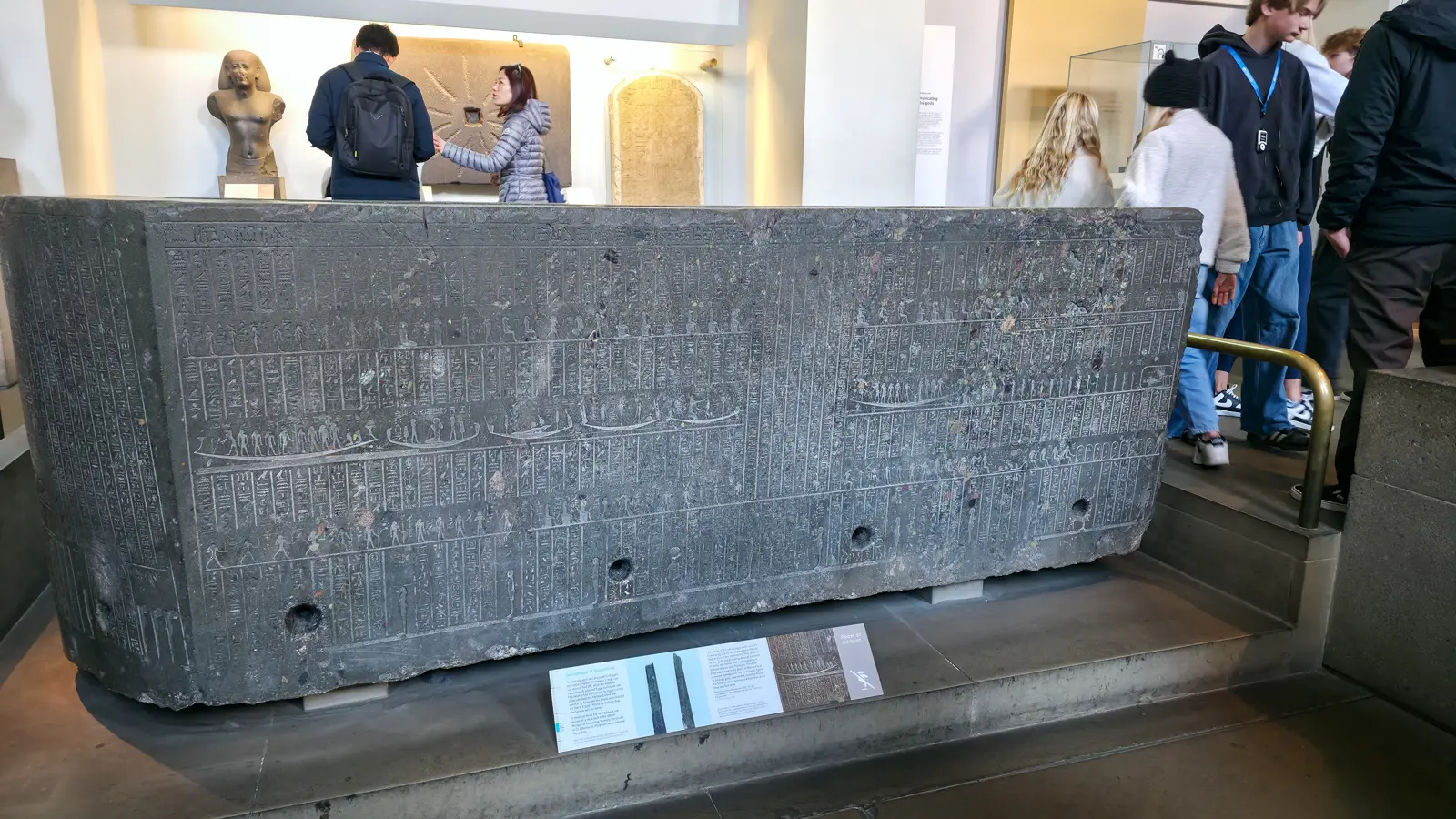
Near the sarcophagi is a dark, inscription-covered coffin with an unusually eventful afterlife of its own. It was made for Nectanebo II, the last native Egyptian pharaoh, around 345 BC, but he never lay in it: he fled south when the Persians invaded and never returned. Centuries later it turned up in a mosque in Alexandria, drilled with twelve holes and reused as a ritual bath. For a long time people insisted it was the tomb of Alexander the Great, until the hieroglyphs were read and named Nectanebo instead. It came to the Museum in 1802, by the same treaty that brought the Rosetta Stone.
Ordinary lives
The same case as the Akhenaten fragment holds two stelae for people who were not kings, and they are quietly some of the most human things in the gallery. One belonged to Sobekhotep, a scribe in charge of a wine-cellar, shown with his wife worshipping Osiris and Anubis. The other belonged to Sapair, who managed the navigators of the royal fleet and built himself an offering chapel at Abydos, near the temple of Osiris, so his spirit would be fed forever. Both come from a world where eternity had to be arranged in advance, in stone, by name. That belief is the thread that runs upstairs.
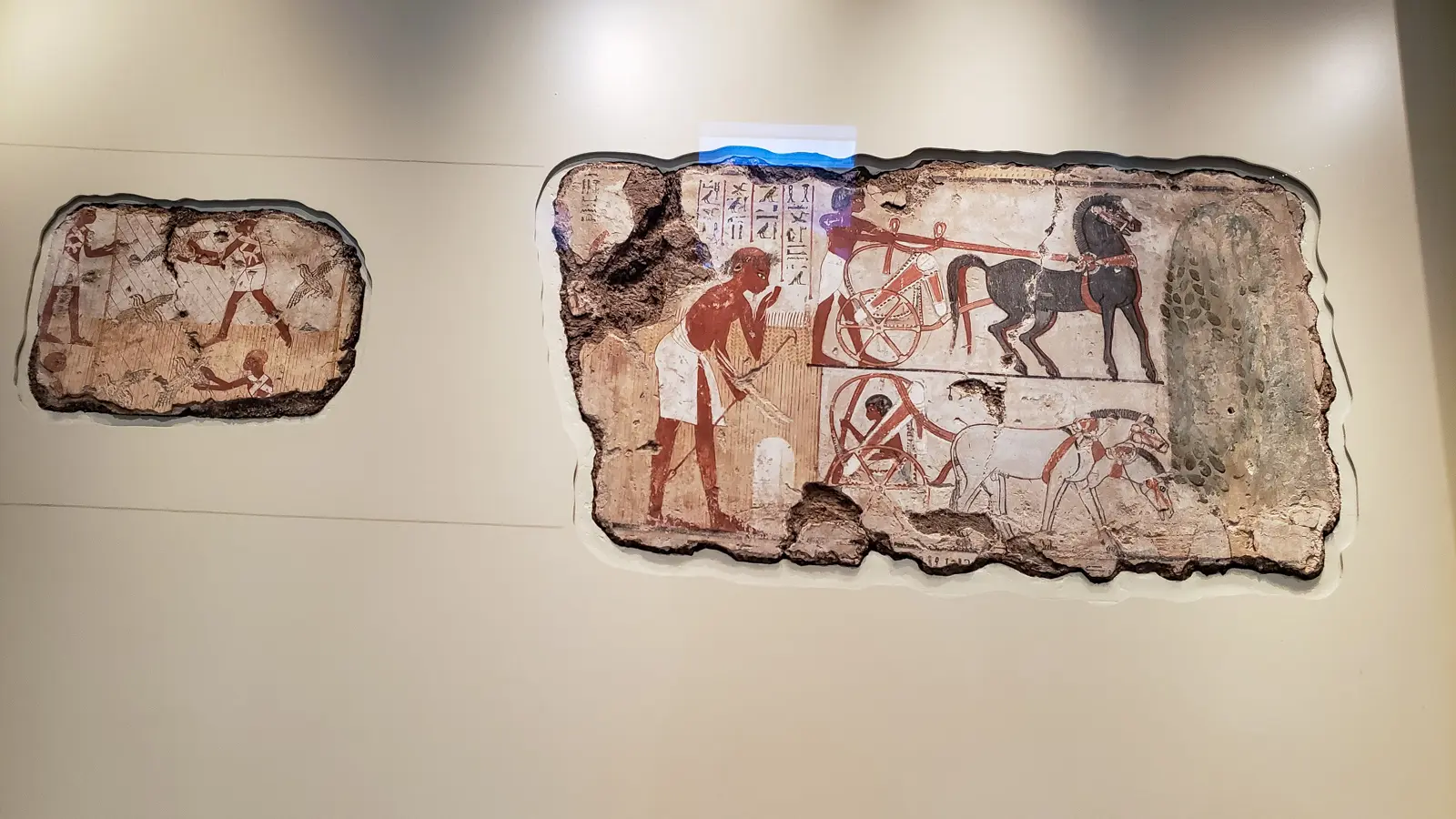
Climb to the upper floor and the material changes from granite to paint and skin. The tomb-chapel paintings of Nebamun are among the finest Egyptian paintings anywhere. Nebamun was a scribe and grain accountant at the Temple of Amun at Karnak who died around 1350 BC, a generation before Tutankhamun. Eleven fragments survive here, full of life: the famous marsh hunt, a garden pond, a banquet, and the field-inspection scene you can see in this photo. There is an uncomfortable footnote. An agent for the British consul hacked them out of the tomb walls with knives and crowbars in the 1820s, destroying everything around them, and the tomb’s location was lost in the process.
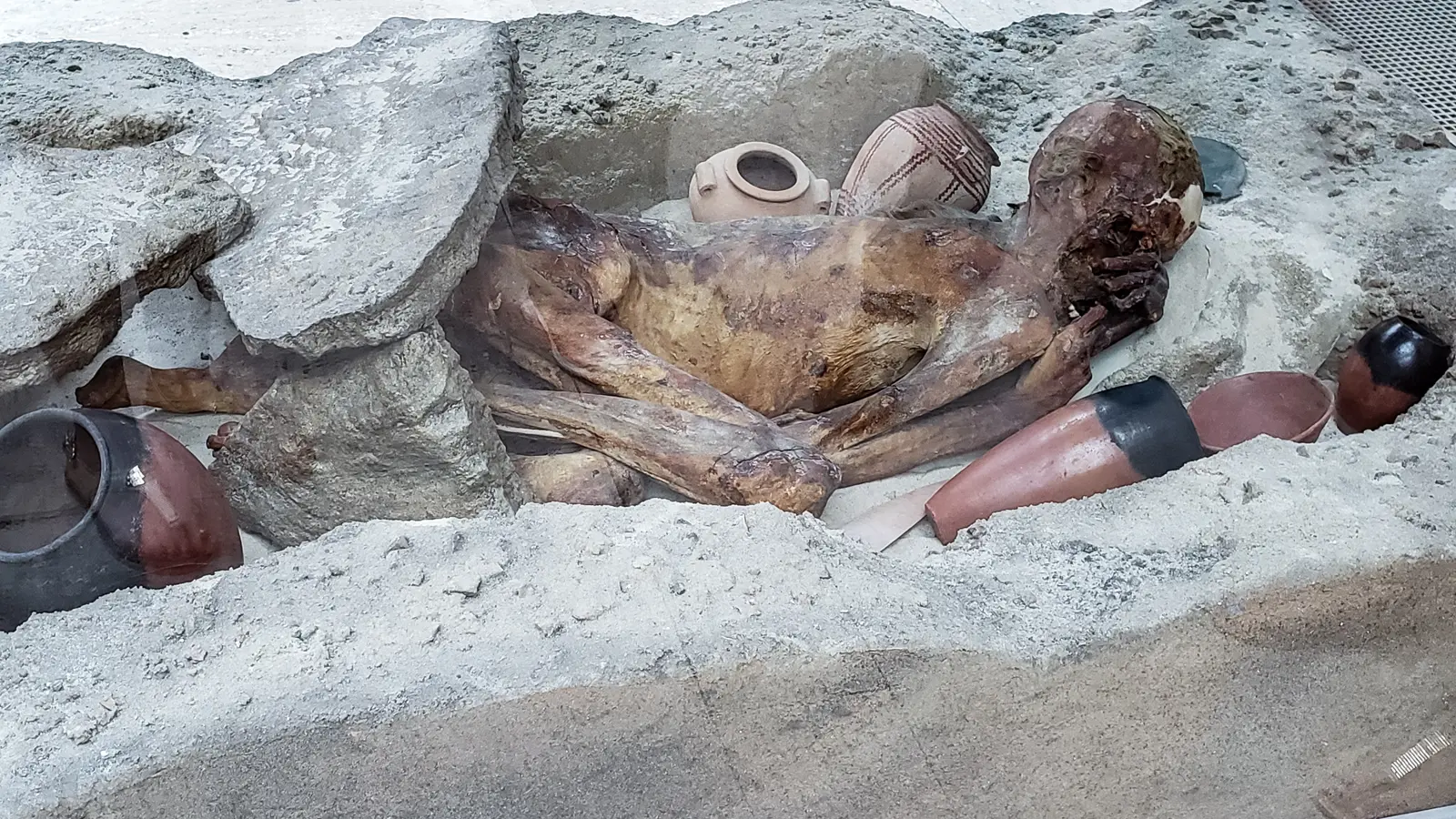
The piece I think about most is the oldest. Gebelein Man is a body from about 3500 BC, older than the pyramids, buried in the desert before anyone in Egypt had thought of deliberate mummification. The hot, dry sand did the work, drying him so completely that his skin, his nails and even some of his organs survived. He has been on display here since 1900, curled on his side with his pots around him. The detail that stays with you is recent: a scan showed he was a young man of eighteen to twenty-one who had been stabbed in the back and killed. A 5,500-year-old murder, still unsolved, lying quietly in a glass case in Bloomsbury.
I expected him to unsettle me and he did the opposite. What I felt was not horror but closeness. A young man with reddish hair, his pots set around him, 5,500 years ago, and the distance between his life and mine felt thinner than it had any right to. That is the quiet gift of this room. It does not make death feel bigger. It makes time feel smaller, and the person on the other side of it seem like someone you might have known.
How it all got here
It is worth saying plainly how this collection was assembled. A good deal of it arrived through the 1801 Treaty of Alexandria, which handed Britain antiquities the French had gathered in Egypt, the Rosetta Stone and the Nectanebo sarcophagus among them. Much of the rest came through 19th-century collectors like Belzoni and the consul Henry Salt, working in an age with few rules and little thought for the places things were taken from. Egypt has formally asked for the Rosetta Stone’s return, and the question of who these objects belong to is a live one. You can hold real wonder at the room and real unease about how it was filled, both at once. That tension is part of an honest visit.
Bubbly Tips
- Start with the Rosetta Stone: It is the most crowded object in the building. See it first thing or late, or you will be looking at the backs of other people’s heads.
- Two floors, not one: The colossal sculpture is in Room 4 on the ground floor, west of the Great Court. The mummies, coffins and Nebamun paintings are upstairs in Rooms 61 to 64. Plan to do both.
- Find Gebelein Man: He is in the early Egypt gallery upstairs, with an interactive screen that walks through his CT scan. Worth the few minutes.
- Look for the Nubian pieces: The Prudhoe Lions and the ram of Taharqa are easy to walk past as “more statues.” They are the most interesting story in the room.
- Photography: Allowed without flash. Room 4 is bright near the windows but dim at the colossi, so brace your phone for a steadier shot.
- Give it time: A focused Egypt visit is two to three hours across both floors. Trying to add the rest of the museum in the same trip is how you end up seeing nothing properly.
- Quietest window: Weekday late afternoons and the Friday late opening until 8:30pm are calmer than weekend mornings.
FAQ
Where is the Egyptian collection in the British Museum? In two places. The monumental sculpture is in Room 4 on the ground floor, to the west of the Great Court. The mummies, coffins, Book of the Dead and tomb paintings are upstairs in Rooms 61 to 64.
Can I see the mummies? Yes. The Egyptian death and afterlife galleries upstairs hold coffins, mummies and the naturally preserved Gebelein Man, alongside the Book of the Dead.
Is the Rosetta Stone in the British Museum? Yes, in Room 4 on the ground floor. It is usually the most crowded spot in the museum, so see it early.
Why does Britain have the Rosetta Stone? It was found by the French in 1799, surrendered to Britain under the 1801 Treaty of Alexandria, and given to the Museum in 1802. Egypt has formally requested its return.
How long do you need for the Egyptian galleries? Two to three hours covers the highlights across both floors at a comfortable pace. A full day if you want to read everything.
Final thoughts
Egypt at the British Museum runs from a seven-tonne pharaoh down to a single murdered young man preserved by the desert, and somewhere in between sits a king who tried to change the gods and got erased for it. You will not take it all in on one visit, and the honest truth is you are not meant to. I have been twice and still have a list. That is the pull of the place. You come back.
Until next time!

🌟 Everything You Need to Plan Your Dream Trip in 2026
- 🌟 Luxury Hotels - Find premium stays with Booking.com & Hotels.com
- 🏡 Vacation Rentals - Discover unique properties on VRBO
- 🏞️ Guided Tours - Explore with Viator or GetYourGuide
- 🎫 Attraction Tickets - Skip the lines with Tiqets
- 🚢 Ocean Cruises - Set sail with Cruise Direct
- 📱 International SIMs - Stay connected with Saily
- 🚗 Car Rentals - Budget-friendly options from Discover Cars
- 🌐 Secure VPNs - Browse safely with NordVPN
- 💶 Currency Exchange - Best rates with Wise
- 🗣️ Learn Languages - Master the local language with Babbel and Rosetta Stone