
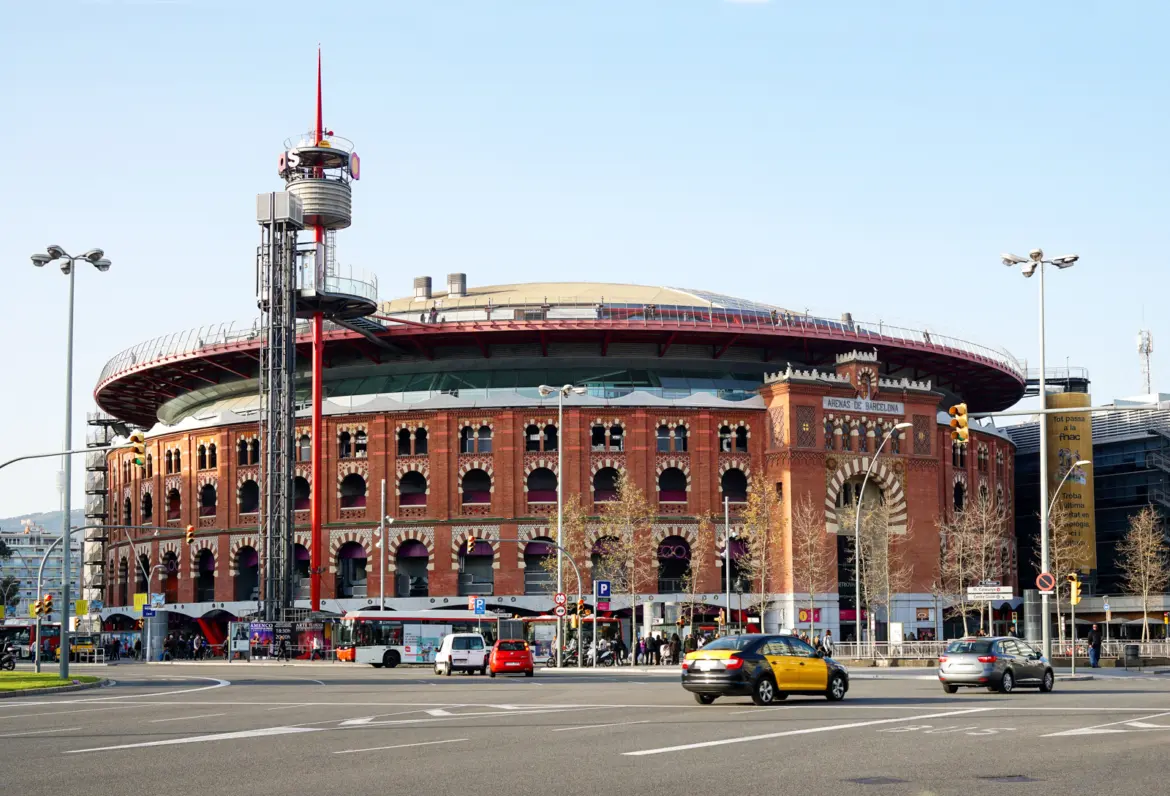
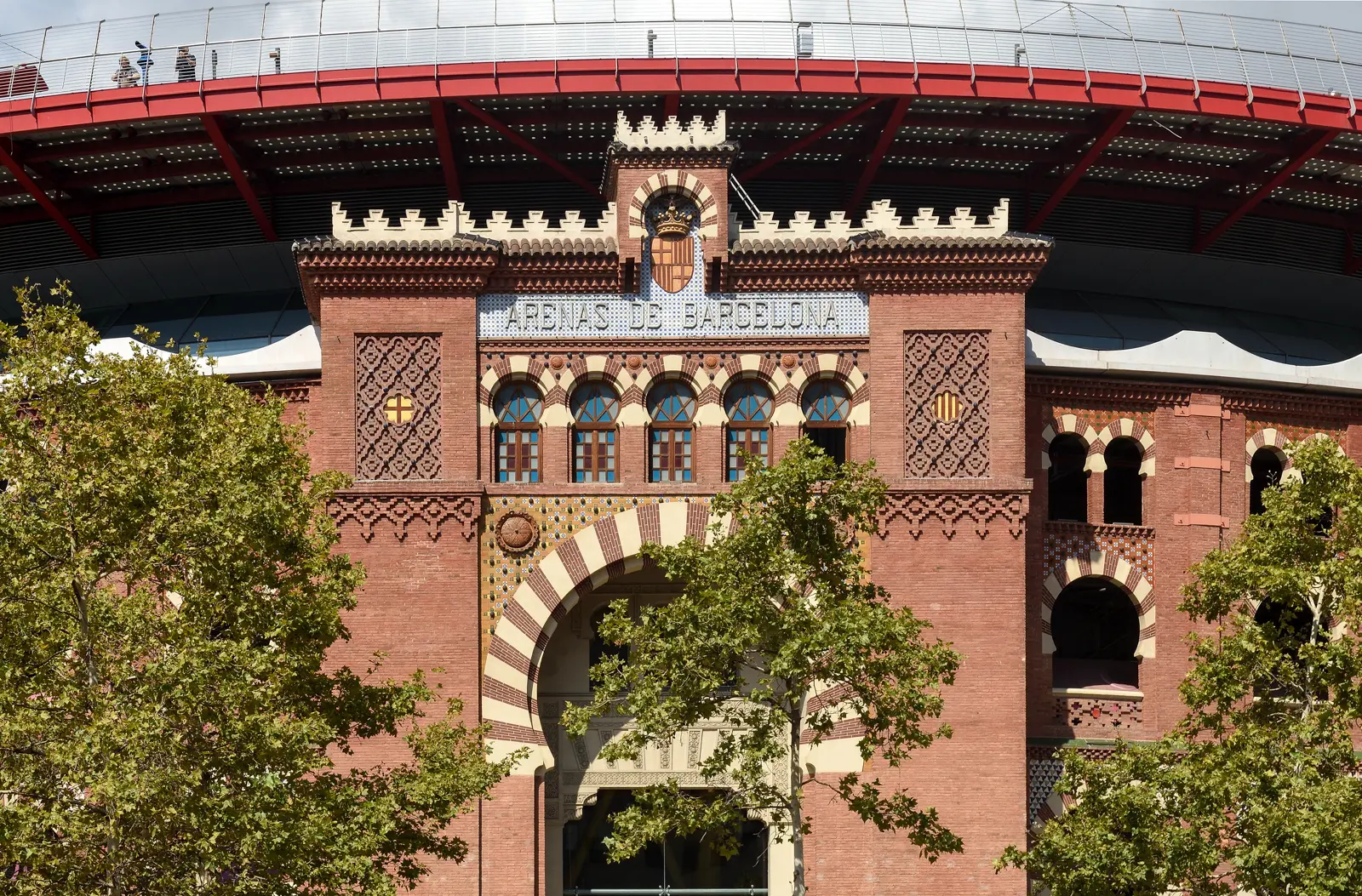
Hola, my friends! After spending the afternoon wandering down from Montjuïc toward Plaça d’Espanya, something circular and beautiful immediately caught my eye – a grand red-brick building with arched windows, intricate tilework, and a hint of mystery. As I drew closer, I realized I was standing before Arenas de Barcelona, a place that felt both historic and surprisingly alive.What struck me first was its contrast: Moorish-inspired façades from another era surrounding a gleaming, glass-roofed world within. The past and present seemed to coexist here, gracefully – a story of transformation, resilience, and reinvention told in architecture.
Arenas de Barcelona at a Glance
🏛️ What it is: A 6-floor shopping center with a free 360° panoramic rooftop terrace inside a former 1900 bullring at Plaça d’Espanya — one of Barcelona’s most striking adaptive-reuse buildings
📅 Built as bullring: June 29, 1900 (designed by Catalan architect August Font i Carreras — who also designed the façade of Barcelona Cathedral — in the Neo-Mudéjar style)
📐 Original capacity: 14,893 spectators
🐂 Last bullfight: June 19, 1977 (Catalonia formally banned bullfighting in 2010; ban overturned by Spain’s Constitutional Court in 2016, but no bullfights have returned)
🎨 Reopened as shopping center: March 24, 2011
🏗️ Restoration architects: British Richard Rogers (also designer of the Pompidou Centre in Paris) + Catalan firm Alonso Balaguer y Arquitectos Asociados
🔧 Engineering feat: The entire 4,000-tonne brick cylinder was lifted 4 metres above ground using 400 hydraulic jacks to permit underground excavation — one of modern Barcelona’s most extraordinary architectural engineering projects
🛍️ Today: 6 floors · 100 stores · 31,918 sqm of commercial space · cinema · fitness club · 27m-high wooden dome (claimed largest in Europe)
🎢 Rooftop: Free via interior escalators · ~€1 for the dramatic exterior glass panoramic elevator · 25m above ground · 360° walkway around the entire former bullring
📍 Address: Gran Via de les Corts Catalanes, 373-385 · 08015 Barcelona · Sants-Montjuïc district
🚇 Metro: Espanya (L1 red · L3 green · L8 FGC)
🕰️ Hours: Daily 10:00 a.m.–10:00 p.m. (rooftop terrace dining open later)
🌅 Best time: Sunset for warm light on the Palau Nacional; arrive 30 minutes before the Magic Fountain show for the best aerial view
A Place with a Past
The Plaza de Toros de las Arenas opened on June 29, 1900, designed by Catalan architect August Font i Carreras in the Neo-Mudéjar style — characterised by ornate horseshoe arches, patterned tiles, and rhythmic brickwork that echo Andalusian and Islamic influences. Font i Carreras was no minor figure: he also designed the façade of Barcelona Cathedral, the city’s Gothic centerpiece in the Barri Gòtic. The fact that the same hand drew the cathedral’s carved stone tracery and the Arenas’ polychrome brickwork tells you something about how seriously turn-of-the-century Barcelona took its architectural commissions, even for a bullring.
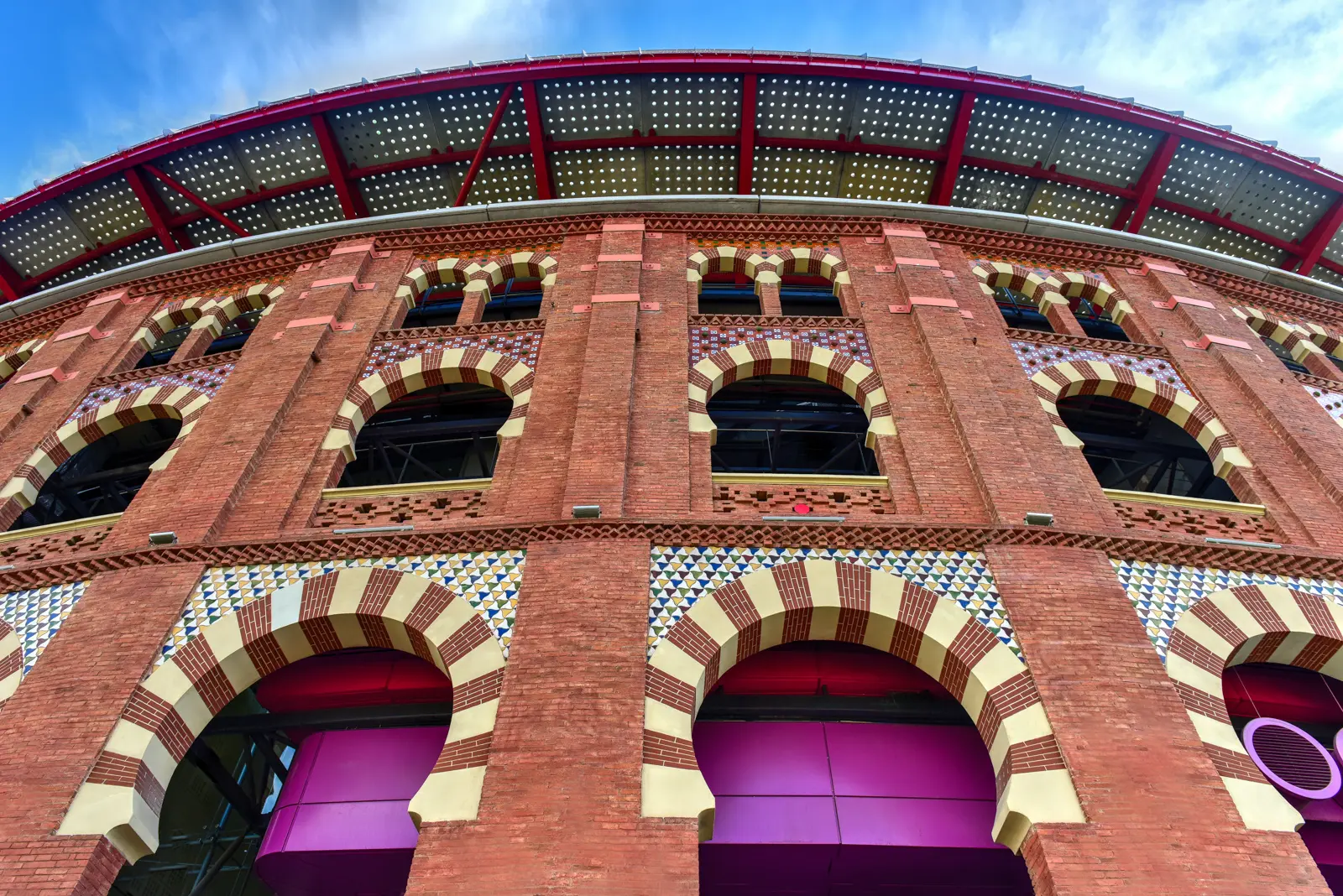
In its prime, the stands could hold 14,893 spectators, and its circular form became a recognisable silhouette on the city’s skyline. But the arena hosted far more than bullfights over its 77-year run. During the Spanish Civil War, it served as a Republican headquarters. In the 1940s and 1950s, a removable velodrome was installed inside for cycling races at the height of Catalonia’s competitive sports boom. Boxing matches, circuses, and political rallies all passed through its circular walls. And in its final years as an active venue, it became one of Barcelona’s most unlikely concert halls — Carlos Santana and Paco de Lucia both performed in 1977, and on June 30, 1980, Bob Marley & The Wailers played here on the European leg of their Uprising Tour, just months before Marley’s death.
But as Catalonia’s cultural identity evolved, bullfighting fell out of favour. Attendance collapsed through the 1970s, and the last bullfight was held on June 19, 1977. The arena stood largely abandoned for decades. Catalonia formally banned bullfighting in 2010 — a decision Spain’s Constitutional Court overturned in 2016, though no bullfights have ever returned to Las Arenas.
A Modern Reinvention
In the early 2000s, an ambitious restoration project began, led by British architect Richard Rogers — also designer of the Pompidou Centre in Paris — partnering with Catalan firm Alonso Balaguer y Arquitectos Asociados. Their challenge was to preserve the historical façade while creating a modern, sustainable space underneath.
The engineering required to preserve the historic façade is one of modern Barcelona’s most extraordinary feats. To create four levels of underground parking and lower the ground floor to match Plaça d’Espanya street level (the original arena sat on a mound), workers used 400 hydraulic jacks to lift the entire 4,000-tonne, 300-metre-circumference brick cylinder 4 metres above ground. With the historic façade suspended in mid-air, the interior was demolished, the ground was excavated, and a steel-and-prestressed-concrete ring was built beneath to permanently hold the original walls one floor above the new street-level entrance. Two Barcelona Metro lines run beneath the building at just 5 metres depth.
The crowning element is the wooden dome itself — 27 metres high, 90 metres in diameter, and 330 metres in circumference, claimed at the time of construction to be the largest wooden dome in Europe. Developer Metrovacesa invested €70 million in the eight-year project, with Rogers’ signature exposed structural steel painted bright yellow throughout the interior — exactly as at the Pompidou Centre — to celebrate rather than hide the modern intervention.
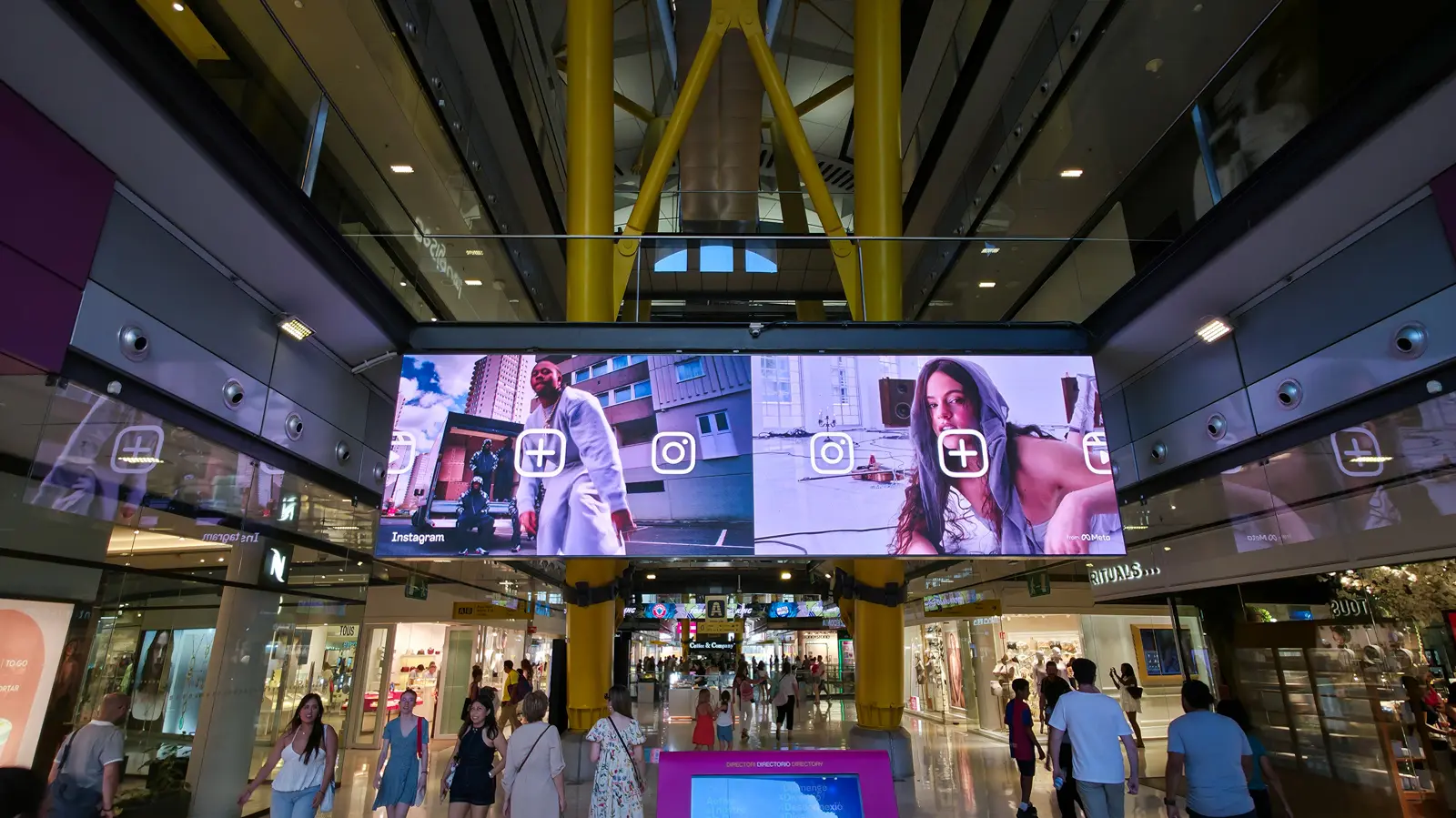
When the Arenas de Barcelona reopened on March 24, 2011, it had been transformed into a cultural and lifestyle hub:
- Over 100 stores and restaurants fill the interior atrium across 6 floors and 31,918 square metres of commercial space.
- A cinema, fitness club, and exhibition spaces bring in locals and travelers alike.
- The glass dome ceiling floods the circular space with natural light, a nod to Barcelona’s Mediterranean soul.
The building’s motto could easily be: “Preserve the past. Embrace the future”.
The Rooftop with the Best Views in Barcelona
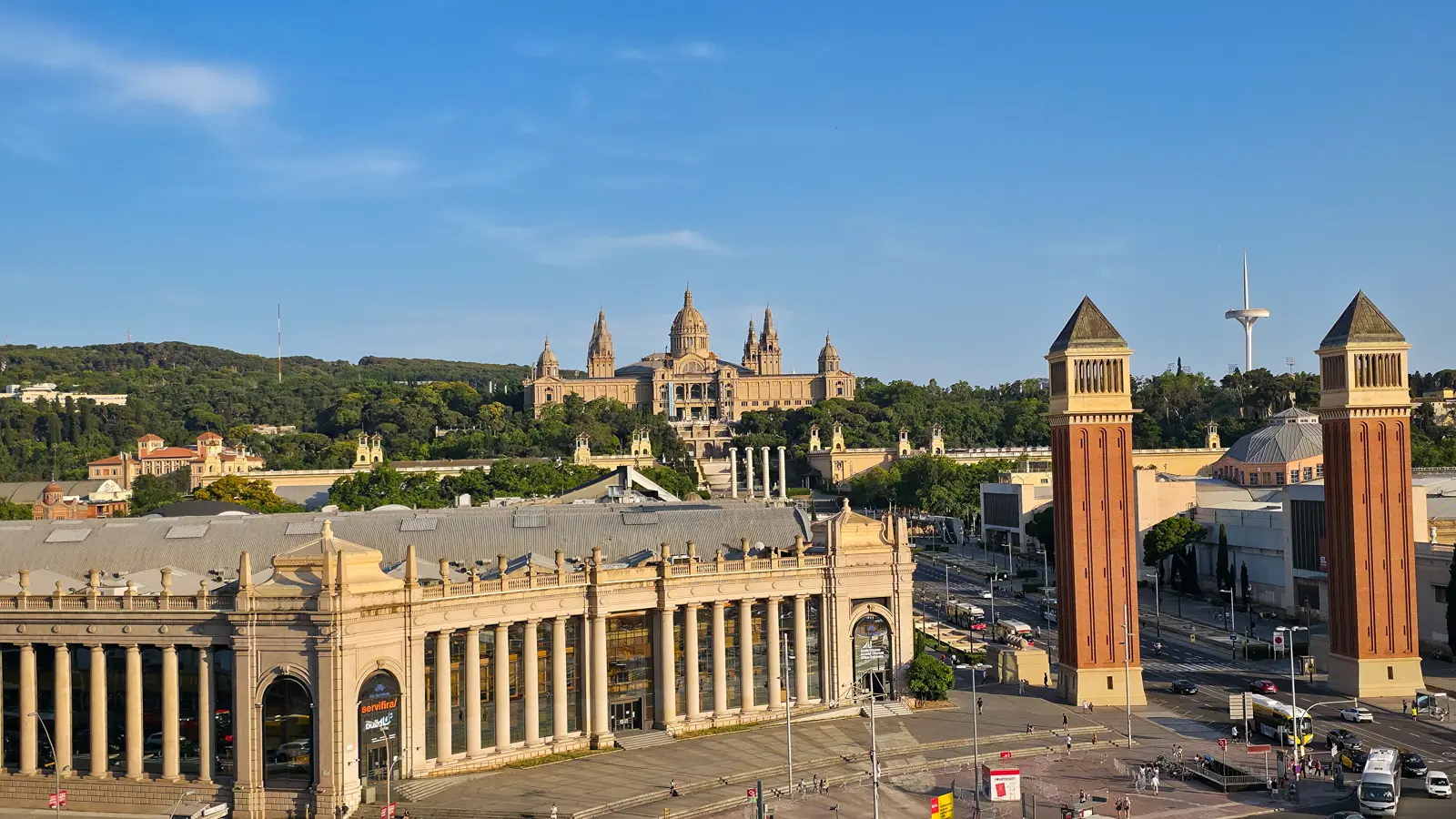
What You’ll See from the Rooftop
🏛️ Palau Nacional (MNAC) — Centre-stage, the magnificent neo-baroque palace on Montjuïc that houses the Museu Nacional d’Art de Catalunya, built for the 1929 Barcelona International Exposition
🗼 Venetian Towers (Torres Venecianes) — The iconic twin red-brick towers at the entrance to Avinguda de la Reina Maria Cristina, designed by Ramon Reventós for the 1929 Exposition (modeled on the Campanile of San Marco in Venice)
⛲ Magic Fountain (Font Màgica de Montjuïc) — Visible at the base of the staircase climbing toward the Palau Nacional · choreographed water-and-light shows weekend evenings
🏛️ Four Columns (Quatre Columnes) — Four white Doric columns by Josep Puig i Cadafalch in front of the Magic Fountain — symbol of Catalan identity (originally erected 1919, demolished by the dictatorship in 1928, reconstructed in 2010)
🏔️ Montjuïc hill — The full green expanse rising behind the Palau Nacional
📡 Calatrava’s Montjuïc Communications Tower — The white sculptural needle on the right horizon, designed by Santiago Calatrava for the 1992 Barcelona Olympics
🏟️ Fira de Barcelona — The Trade Fair pavilions in the foreground with the long classical-style colonnade
📸 Photo tip: Sunset is the magic hour — the Palau Nacional façade turns golden, and you can stay to watch the city lights come on. Bring a light jacket; the rooftop catches the breeze.
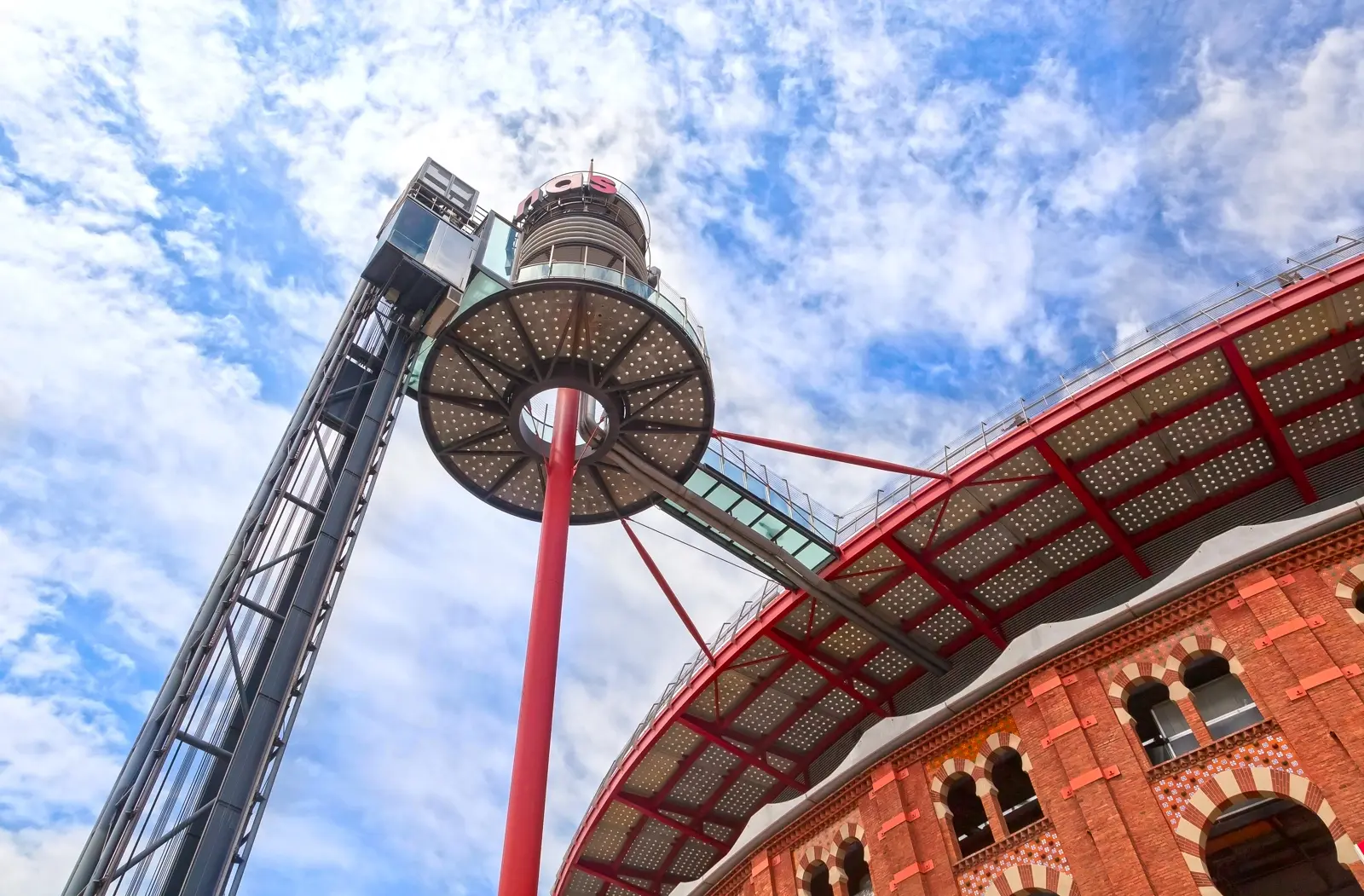
If you visit, don’t miss the panoramic rooftop terrace – one of the most stunning (and free!) viewpoints in Barcelona. A 360° walkway encircles the top, offering sweeping vistas of Plaça d’Espanya, the Venetian Towers, the Magic Fountain, and the Palau Nacional rising in the distance. Come at sunset, when the city glows rose-gold and Montjuïc’s lights begin to sparkle. You can reach the terrace via a glass-walled exterior elevator, which feels like a short but spectacular ascent above the square. The rooftop is lined with cafés and restaurants – perfect for sipping cava, sharing tapas, or simply letting the city unfold beneath you.
Through My Eyes
As I stepped out onto the rooftop, a soft wind brushed past, carrying the hum of traffic and laughter from below. The same circular walls that once held spectacle now held light and conversation. Families gathered for dinner, friends leaned on the railing to take photos, and the faint sound of music drifted up from Plaça d’Espanya.
I paused at the edge, watching the sun sink behind Montjuïc. The domes of the Palau Nacional turned golden, the Magic Fountain shimmered in anticipation, and the Venetian Towers framed the evening like an old photograph. It’s hard not to be moved by the symbolism – how a place once associated with conflict and tradition now radiates community and creativity. Standing there, I thought: This is Barcelona at its best; not erasing the past but transforming it with grace.
A small coincidence I only noticed later: the photos for this post were taken on June 19, 2025 — exactly 48 years to the day after the last bullfight ever held at Las Arenas, on June 19, 1977. The space that once hosted a final corrida now hosted a tourist taking sunset photos for a travel blog. The building’s whole history is in that gap.
Practical Tips
- Location: Gran Via de les Corts Catalanes, 373–385 (Plaça d’Espanya), Sants-Montjuïc district
- Metro: Espanya (L1 red, L3 green, L8 FGC pink)
- Opening Hours: 10:00 a.m. – 10:00 p.m. daily (rooftop terrace dining open later)
- Rooftop Access: Free via interior escalators · approximately €1 for the dramatic exterior glass panoramic elevator
- Best Time to Visit: Late afternoon through sunset for golden light on the Palau Nacional and the chance to stay for the Magic Fountain show after dark
- Shops: Fashion, local brands, and Spanish favourites — ideal for a relaxed shopping break between cultural visits
Final Thoughts
The Arenas de Barcelona isn’t just a building; it’s a story of how cities evolve and how beauty can emerge from change. Its circular form has witnessed every era: tradition, silence, renewal, and today, vibrancy.
As night fell, the red-brick façade glowed softly under the streetlights, its arches reflecting in the glass of the new structure behind it. I lingered there a moment longer, thinking how Barcelona never forgets its past, it reimagines it!
And that, perhaps, is what makes this city so endlessly inspiring.

🌟 Everything You Need to Plan Your Dream Trip in 2026
- 🌟 Luxury Hotels - Find premium stays with Booking.com & Hotels.com
- 🏡 Vacation Rentals - Discover unique properties on VRBO
- 🏞️ Guided Tours - Explore with Viator or GetYourGuide
- 🎫 Attraction Tickets - Skip the lines with Tiqets
- 🚢 Ocean Cruises - Set sail with Cruise Direct
- 📱 International SIMs - Stay connected with Saily
- 🚗 Car Rentals - Budget-friendly options from Discover Cars
- 🌐 Secure VPNs - Browse safely with NordVPN
- 💶 Currency Exchange - Best rates with Wise
- 🗣️ Learn Languages - Master the local language with Babbel and Rosetta Stone