
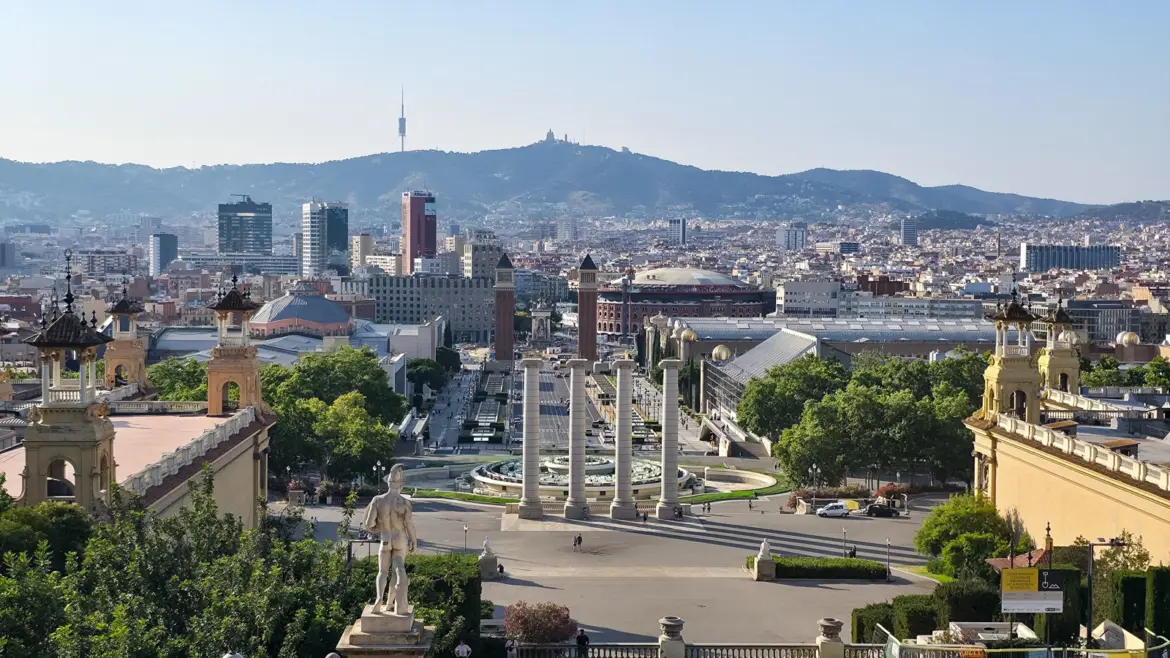
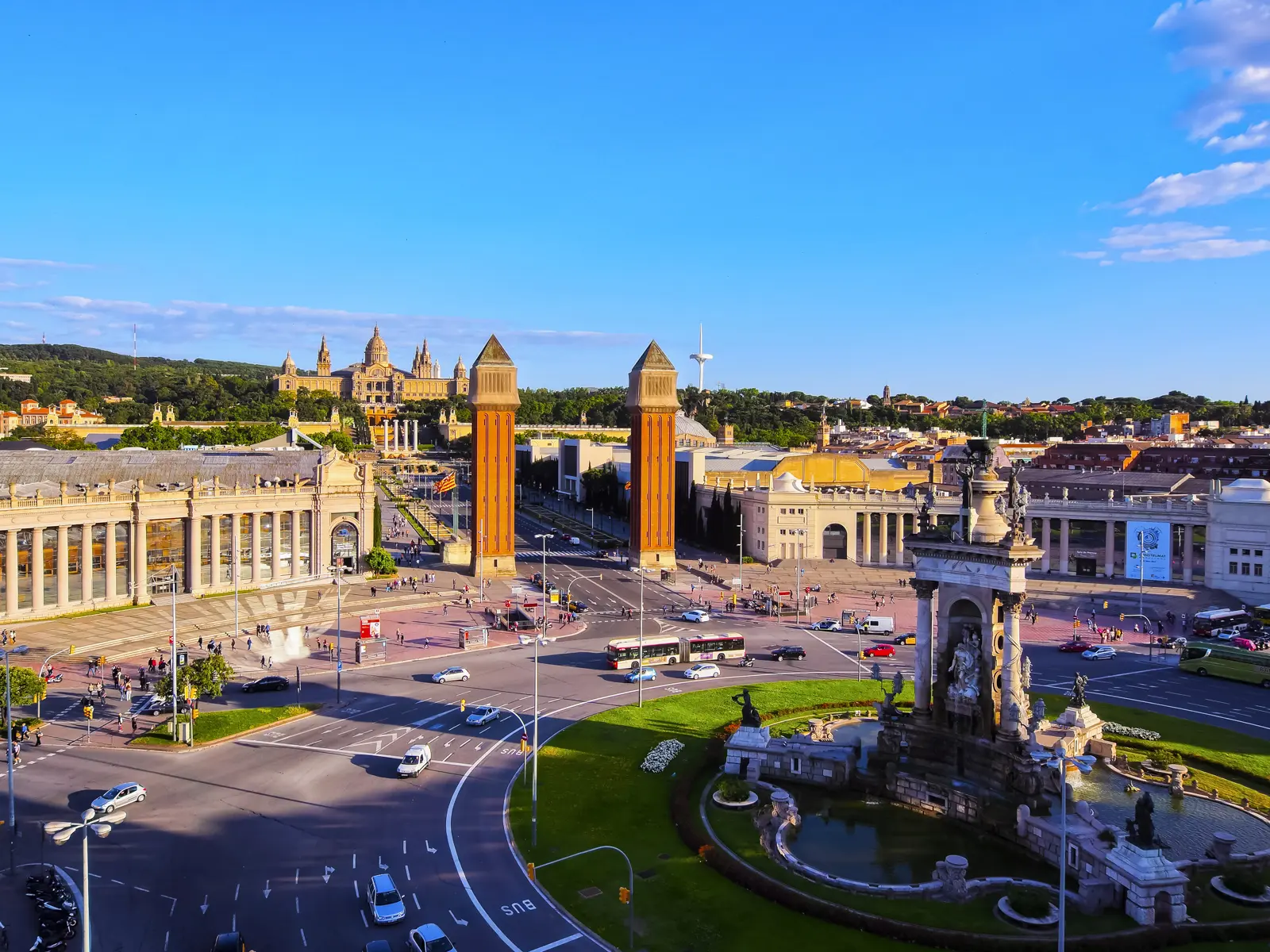
Hola, travel enthusiasts! As I made my way down from Montjuïc, passing the grand stairways of the Palau Nacional and the terrace overlooking the city, I suddenly found myself before Plaça d’Espanya – vast, elegant, and alive with movement. From above, it appeared like a grand compass of Barcelona, every avenue radiating outward toward a different part of the city. The fountain shimmered at its center, framed by the Venetian Towers, with the hum of buses, laughter, and music drifting through the air.
It’s one of those places that captures Barcelona’s modern soul while honoring its past – a meeting point of cultures, a gateway from Montjuïc’s serene heights to the city’s vibrant rhythm, and an open-air museum of early 20th-century ambition.
Plaça d’Espanya at a Glance
🏛️ What it is: Barcelona’s second-largest square and the grand gateway to Montjuïc, built for the 1929 International Exposition
⛲ The fountain: Font dels Tres Mars — a 33-meter monument by Josep Maria Jujol, Gaudí’s collaborator, celebrating Spain’s three seas and great rivers
🏗️ The Venetian Towers: Twin 47-meter towers by Ramon Reventós, modeled on St. Mark’s Campanile in Venice — they framed the entrance to the 1929 Expo
🏛️ MNAC: The Palau Nacional crowns Montjuïc at the end of the avenue — home to the National Art Museum of Catalonia with Romanesque frescoes to Catalan Modernisme
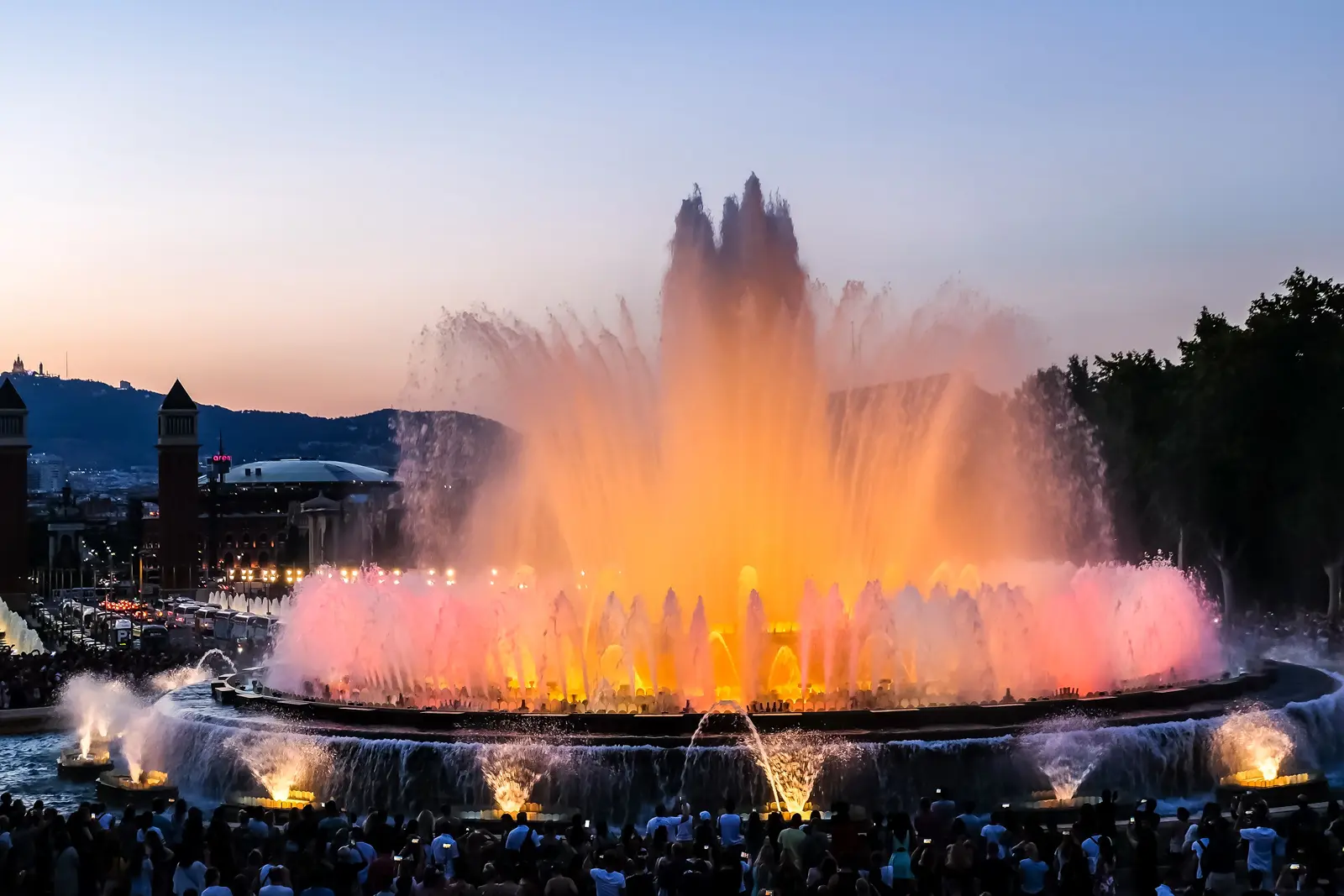
💧 Magic Fountain: Carles Buïgas’ 1929 water-and-light spectacle — reopened September 2025 after a three-year drought closure, free nightly shows
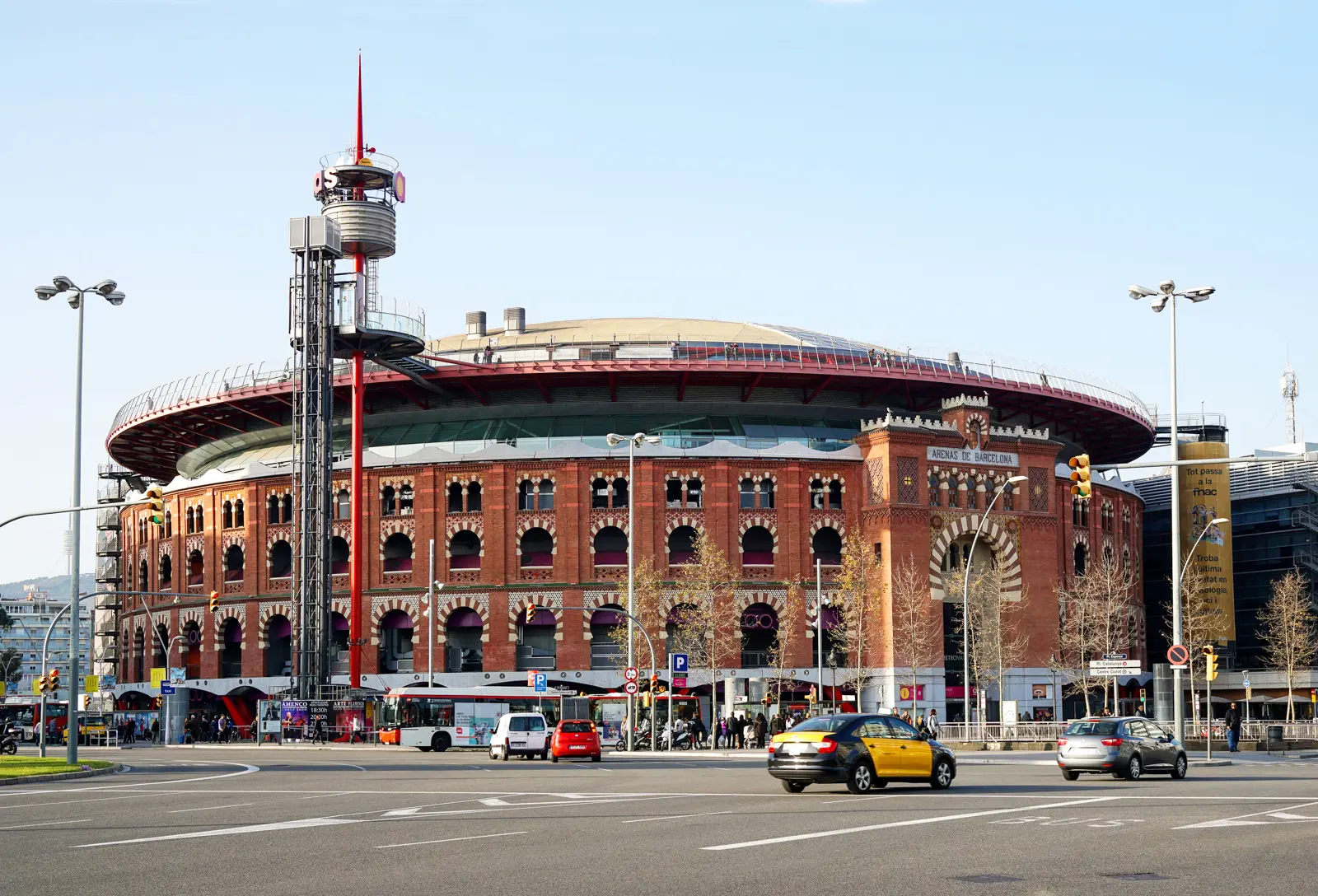
🏟️ Arenas de Barcelona: A 1900 bullring converted in 2011 into a shopping center by Richard Rogers — free 360° rooftop views from the terrace
🚇 Getting there: Metro L1, L3 / FGC L8 — Espanya station. Also the departure point for the R5 train to Montserrat
⏰ Best time: Late afternoon for golden light on the Venetian Towers; sunset from the Arenas rooftop or MNAC steps
A Square Born for a World Fair
Plaça d’Espanya was built for the 1929 International Exposition, a world’s fair that transformed Barcelona’s skyline. The city wanted a grand entrance to Montjuïc, where pavilions from around the world would celebrate innovation, art, and architecture.
The design came from architects Josep Puig i Cadafalch and Guillem Busquets, later completed by Antoni Darder after political changes led to their removal from the project. The goal was to create a square that mirrored the great piazzas of Europe, with wide avenues, monumental fountains, and a panoramic view leading straight to the Palau Nacional (now the MNAC – National Art Museum of Catalonia).
The result is one of Barcelona’s most elegant spaces: a circular plaza framed by six avenues, dominated by classical symmetry yet softened by Mediterranean light.
What to See Around Plaça d’Espanya
1. The Monumental Fountain
At the center of the square stands the Font dels Tres Mars (“Fountain of the Three Seas”), a spectacular 33-meter monument designed by Josep Maria Jujol, one of Gaudí’s most imaginative collaborators. Built for the 1929 International Exposition, it was conceived as a poetic tribute to Spain’s geography and virtues.
- The central column symbolizes the Iberian Peninsula, surrounded by water basins representing the Ebro, Tagus, and Guadalquivir rivers, whose waters sustain and connect the land.
- At the corners, figures by the Oslé brothers personify Abundance, Health, and Navigation, while the main sculptural groups by Miquel Blay represent the three seas surrounding the Iberian Peninsula.
- Bronze figures and stone reliefs celebrate Spain’s cultural legacy, honoring writers, saints, and explorers whose stories shaped its identity.
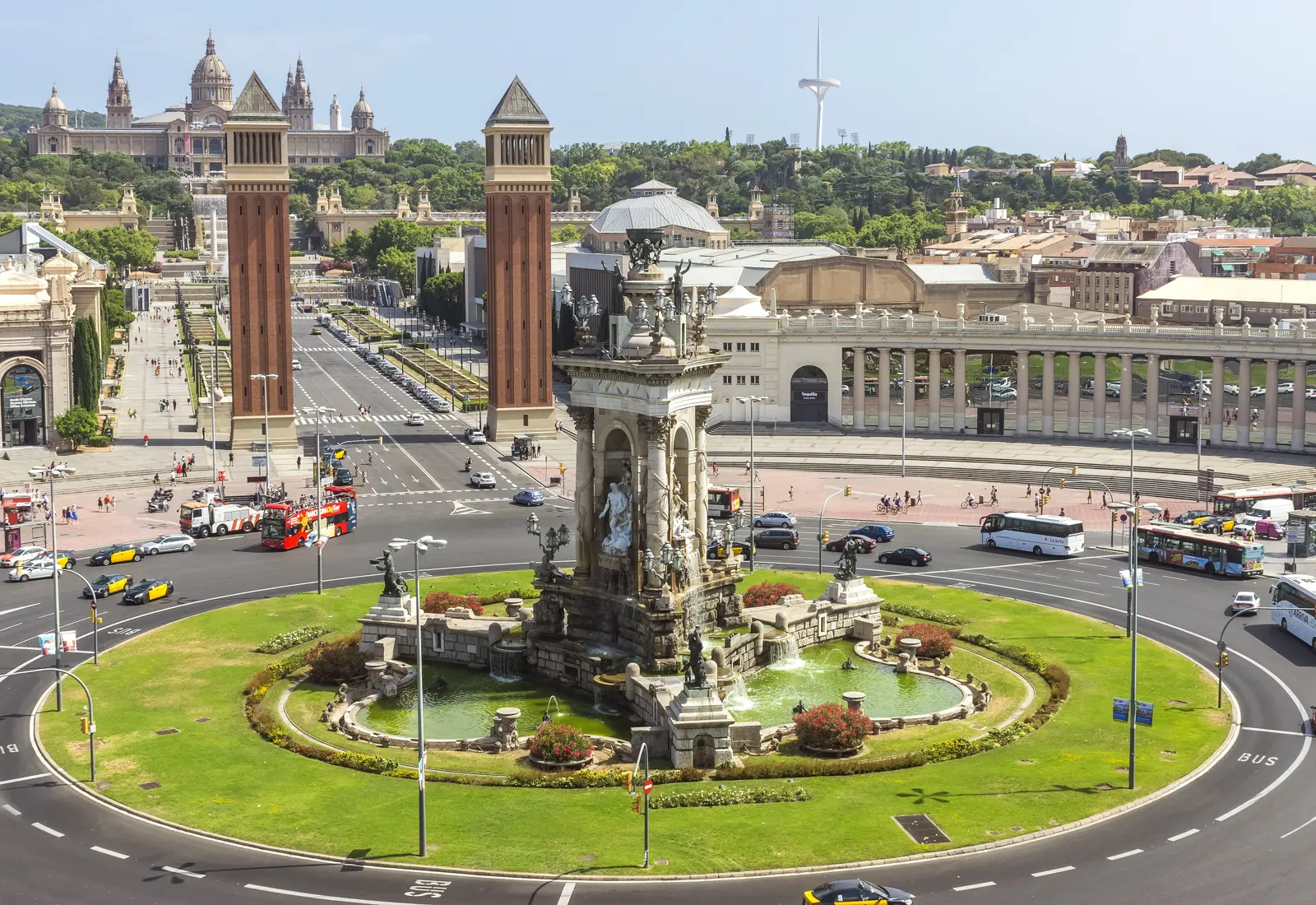
As you walk around, notice how the Magic Fountain of Montjuïc, visible just beyond the Venetian Towers, feels like a distant echo of Jujol’s masterpiece, water and light continuing the dialogue between past and present.
2. The Venetian Towers
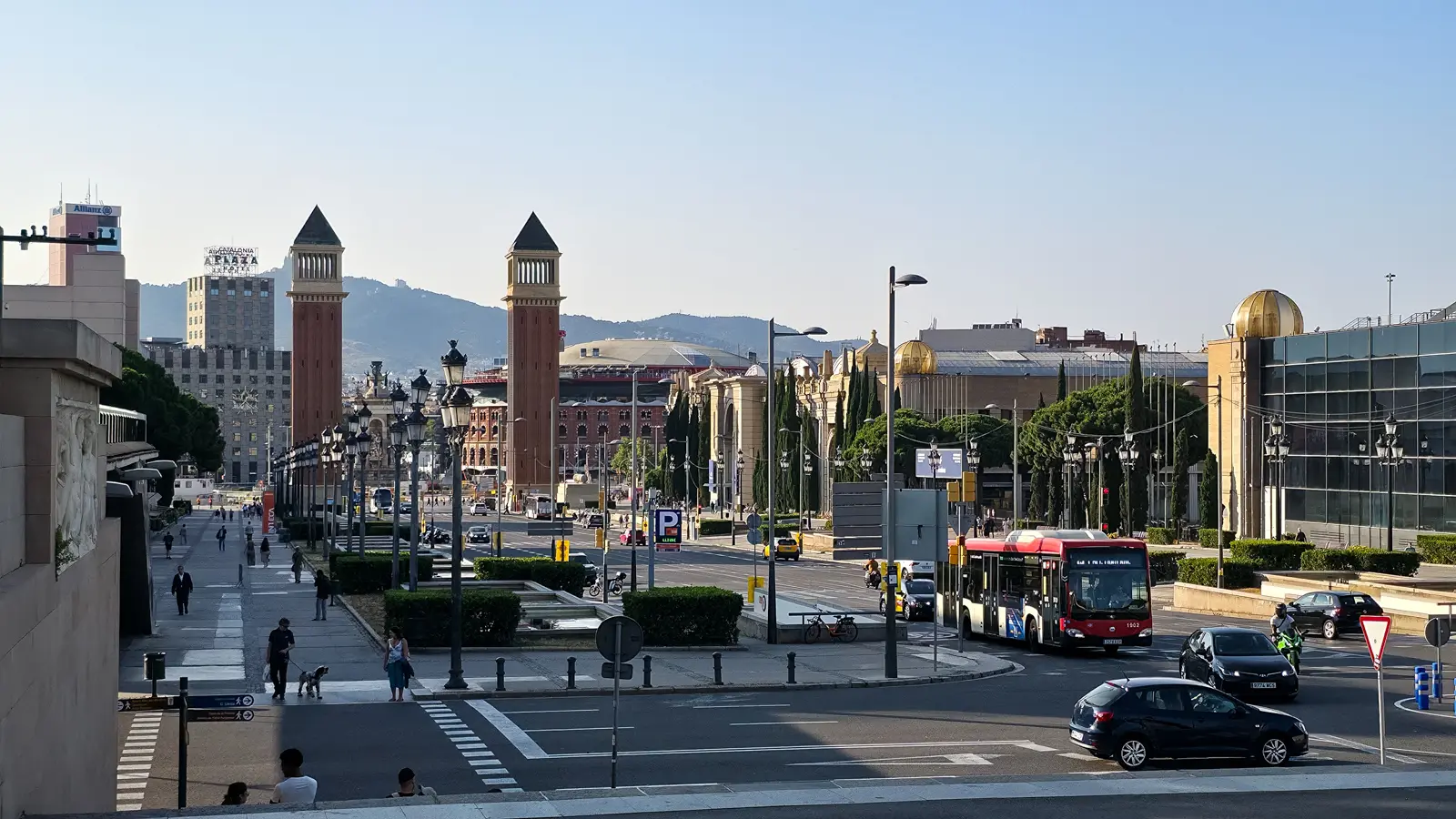
Flanking the avenue leading toward Montjuïc are two 47-meter towers inspired by St. Mark’s Campanile in Venice. Designed by Ramon Reventós, they once served as gateways to the International Exposition.
Their red-brick façades and slender design have become symbolic of Barcelona’s architectural elegance, merging Catalan craftsmanship with cosmopolitan flair.
3. The Palau Nacional & MNAC
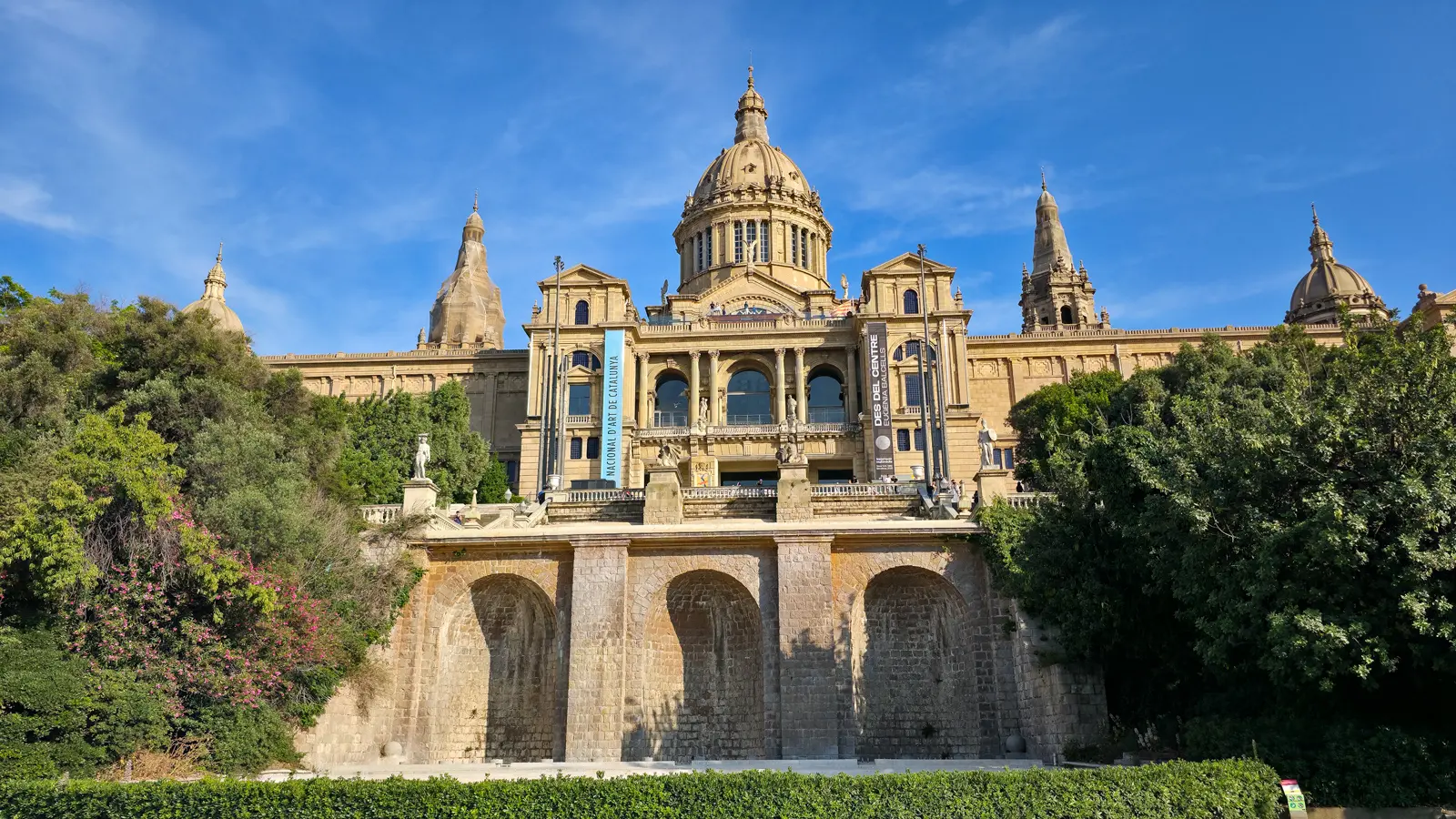
In the distance, crowning Montjuïc’s slope, rises the Palau Nacional, a monumental palace built for the 1929 Expo. Today it houses the National Art Museum of Catalonia (MNAC), with masterpieces spanning Romanesque frescoes to Catalan Modernism. From Plaça d’Espanya, its cascading stairways and domes form one of the city’s most iconic views, especially when illuminated at night.
4. The Magic Fountain of Montjuïc
Just beyond the Venetian Towers lies the Magic Fountain, created by Carles Buïgas for the 1929 Exposition. When active, it dances nightly in a symphony of color, music, and light, a dazzling performance that feels both nostalgic and futuristic. After a three-year closure due to drought conservation measures, the fountain returned to life in September 2025 during La Mercè, Barcelona’s biggest annual festival. Shows run Thursday through Saturday in spring and fall, and Wednesday through Sunday in summer — best enjoyed from the steps of MNAC at sunset, one of the most cinematic views in Barcelona.
5. Arenas de Barcelona
Originally built in 1900 by architect August Font i Carreras as a bullring in the neo-Mudéjar style, this circular landmark was reimagined by British architect Richard Rogers and reopened in March 2011 as a shopping and cultural center. The original Moorish-inspired brick façade was preserved, while a modern glass dome now crowns the interior.
Through My Eyes
I visited Plaça d’Espanya late in the afternoon, when the sun dipped low and the terracotta towers glowed like embers. The air hummed with life – street musicians by the metro, couples holding hands, children chasing pigeons. From the Arenas rooftop, I watched the Magic Fountain begin to shimmer to life, the Palau Nacional glowing above it. For a moment, the entire city seemed to breathe in rhythm – fountains, traffic, laughter, light – all part of one great choreography.
There’s something deeply moving about being in a space that was built to celebrate progress, yet still feels timeless. Plaça d’Espanya is both a stage and a mirror – it reflects Barcelona’s optimism, creativity, and endless energy.
Practical Tips
- Location: At the crossroads of Eixample and Montjuïc.
- Metro/Train: Lines L1 (red) and L3 (green), plus FGC Lines L8, S33, S4, S8 — stop: Espanya. This is also the departure station for the R5 train to Montserrat.
- Bus: Multiple routes, including Bus 150 to Montjuïc and the Aerobus to the airport.
- Best Time to Visit: Late afternoon for golden light. Magic Fountain shows run Thursday–Saturday in spring (9 PM–10 PM) and Wednesday–Sunday in summer (9:30 PM–10:30 PM). Check barcelona.cat for the current schedule.
- Rooftop Views: Free 360º views from Arenas de Barcelona via interior elevators.
- Nearby Attractions: MNAC, Magic Fountain, Montjuïc Park, CaixaForum, and Poble Espanyol.
Final Thoughts
Plaça d’Espanya isn’t just a traffic circle, it’s the gateway to Barcelona’s imagination. Built to welcome the world in 1929, it continues to do so every single day – through art, architecture, and the simple poetry of city life.
As evening falls and lights ripple across the fountains, you can feel Barcelona’s dual nature: grand yet human, bold yet serene. Standing there, watching the city come alive, I thought – this is the Barcelona I love best: where every street leads not just somewhere, but toward something beautiful.

🌟 Everything You Need to Plan Your Dream Trip in 2026
- 🌟 Luxury Hotels - Find premium stays with Booking.com & Hotels.com
- 🏡 Vacation Rentals - Discover unique properties on VRBO
- 🏞️ Guided Tours - Explore with Viator or GetYourGuide
- 🎫 Attraction Tickets - Skip the lines with Tiqets
- 🚢 Ocean Cruises - Set sail with Cruise Direct
- 📱 International SIMs - Stay connected with Saily
- 🚗 Car Rentals - Budget-friendly options from Discover Cars
- 🌐 Secure VPNs - Browse safely with NordVPN
- 💶 Currency Exchange - Best rates with Wise
- 🗣️ Learn Languages - Master the local language with Babbel and Rosetta Stone