
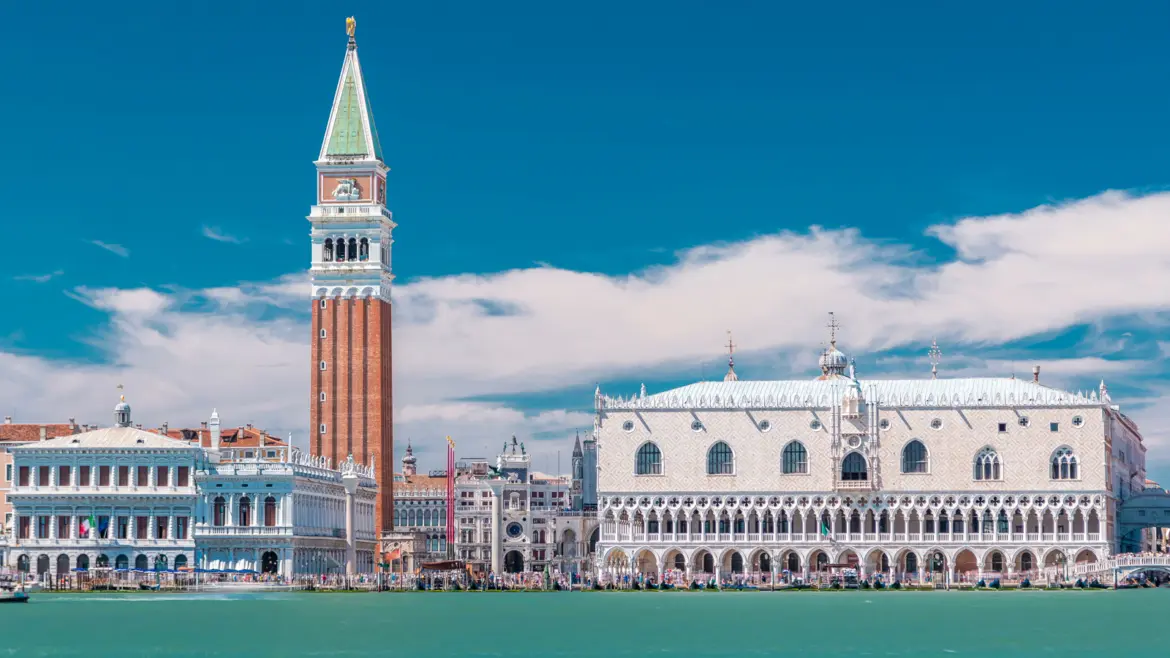
Hello, lovely travelers! Venice is a city that reveals itself slowly – through reflections on water, worn stone steps, and quiet passages that feel untouched by time. But to truly grasp its scale, fragility, and brilliance, you need to rise above it. Standing watch over Piazza San Marco (St Mark’s Square), St. Mark’s Campanile – the iconic bell tower of St Mark’s Basilica – offers one of the most extraordinary perspectives in Venice, both visually and historically. This is not just the city’s tallest structure. It’s its sentinel. Its storyteller. And one of the clearest windows into Venice’s soul.
St. Mark’s Campanile at a Glance
🔔 What it is: Venice’s tallest structure — nearly 99 metres of brick, history, and the best panoramic view in the city
📅 Origins: Dating back to the early 10th century; current form with belfry by Giorgio Spavento completed in 1514
💥 1902 collapse: The original tower fell on July 14, 1902 — no one was killed. Venice rebuilt it exactly as it was by 1912: dov’era e com’era
🛗 Access: Modern elevator to the top — no stairs
🔭 Galileo: According to tradition, Galileo demonstrated his telescope to the Venetian Senate from this tower
🔔 Five bells: Each bell once regulated a different aspect of Venetian civic and religious life
🏛️ Loggetta: The richly decorated Renaissance structure by Jacopo Sansovino at the base — damaged in 1902, painstakingly restored
🌄 The view: Venice, the lagoon, the islands — and on clear days, the Dolomites on the horizon
💡 Tip: Visit early morning or late afternoon for softer light, fewer crowds, and the best photography conditions
A Tower That Has Watched Venice for Over a Thousand Years
The origins of St. Mark’s Campanile date back to the early 10th century, when it was first constructed as a watchtower and lighthouse to guide ships safely into the Venetian Lagoon. At a time when Venice’s power depended on maritime trade, visibility from afar mattered, and this tower was both a warning and a welcome.
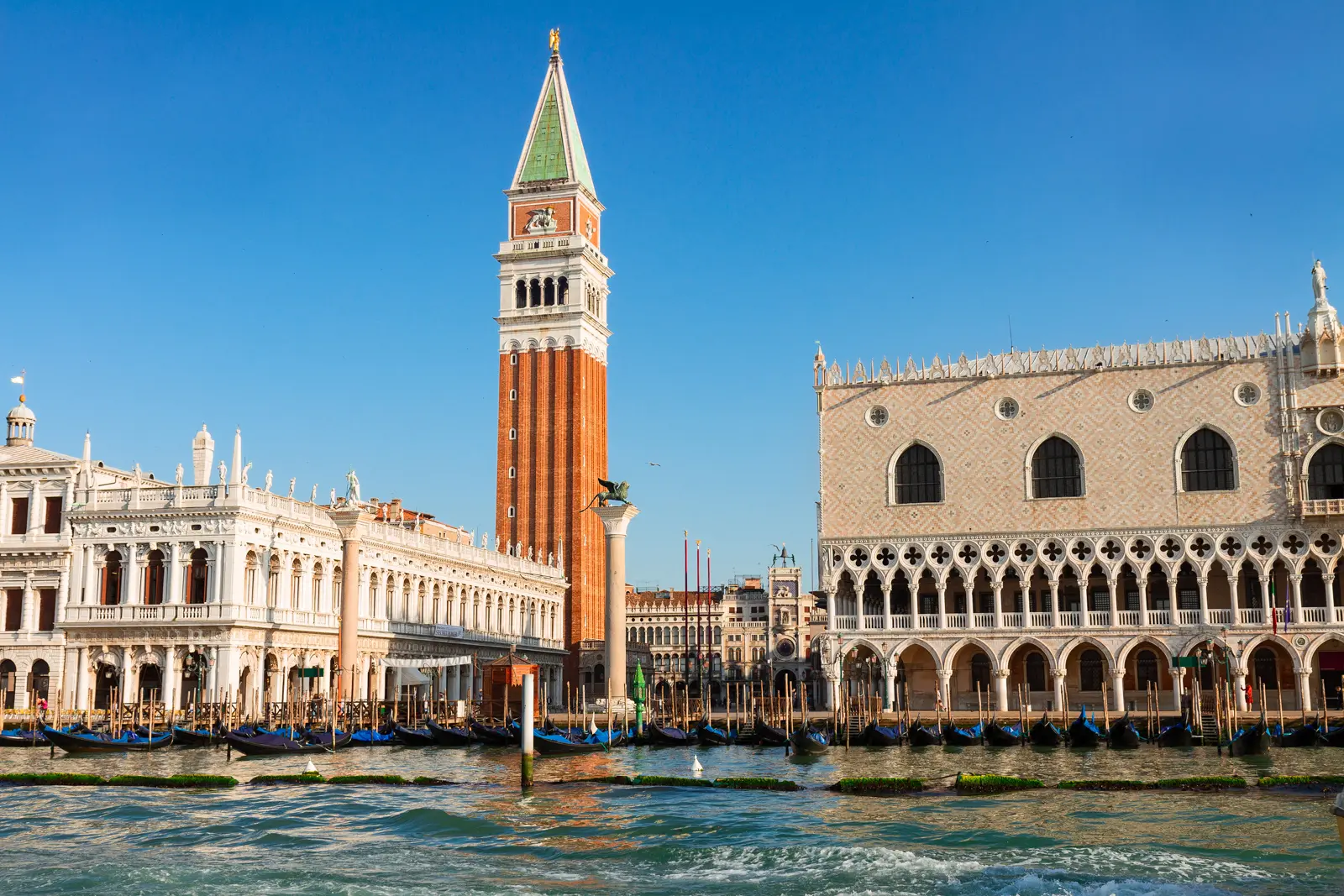
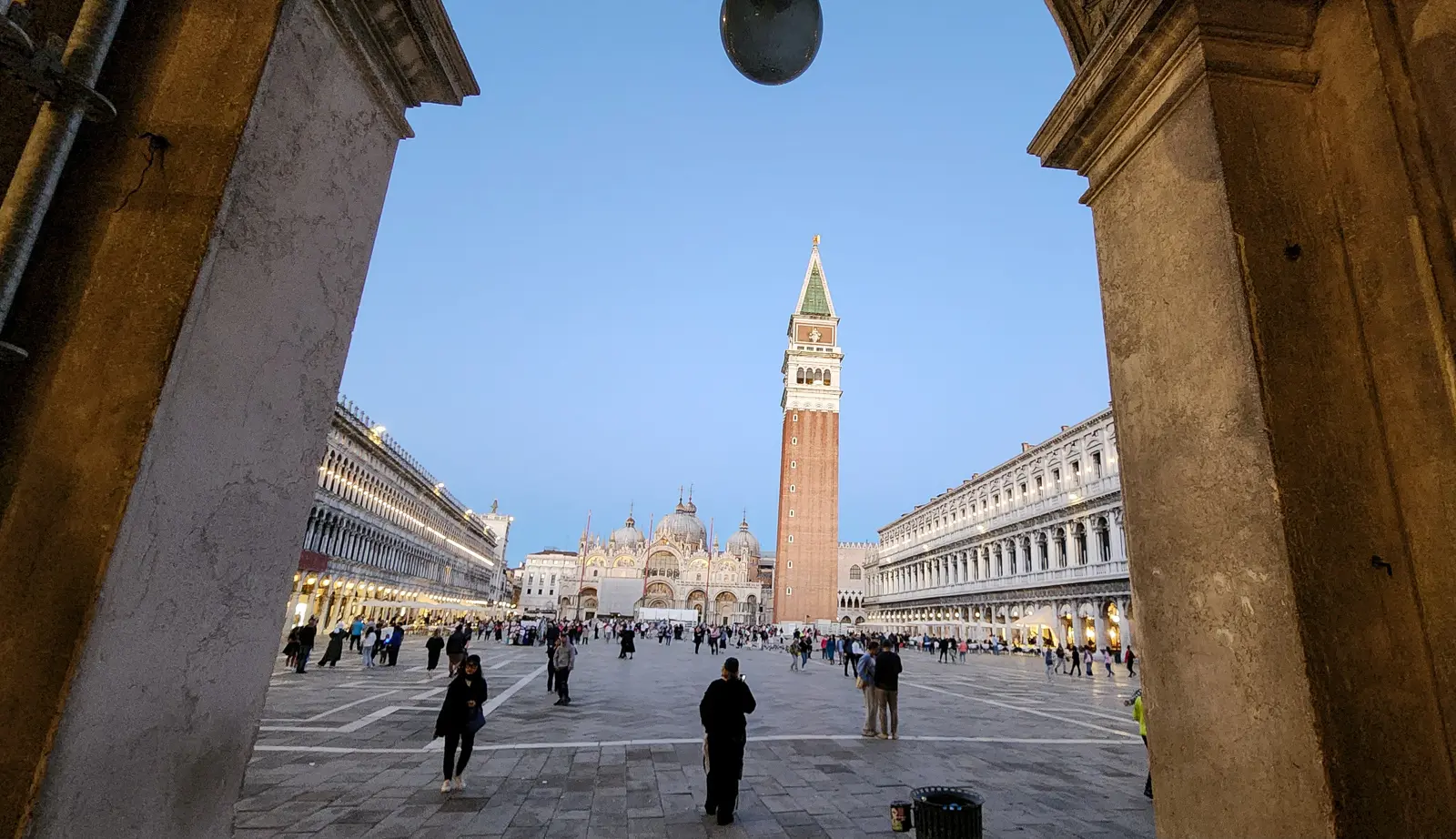
Over centuries, the Campanile evolved into a bell tower closely tied to the political and religious life of the Republic of Venice. The structure reached its familiar height – just under 99 meters (324 feet) – in the early 16th century, with its distinctive belfry completed in 1514. Its elegant simplicity contrasts with the ornate richness of St. Mark’s Basilica beside it, creating a balance that defines Piazza San Marco.
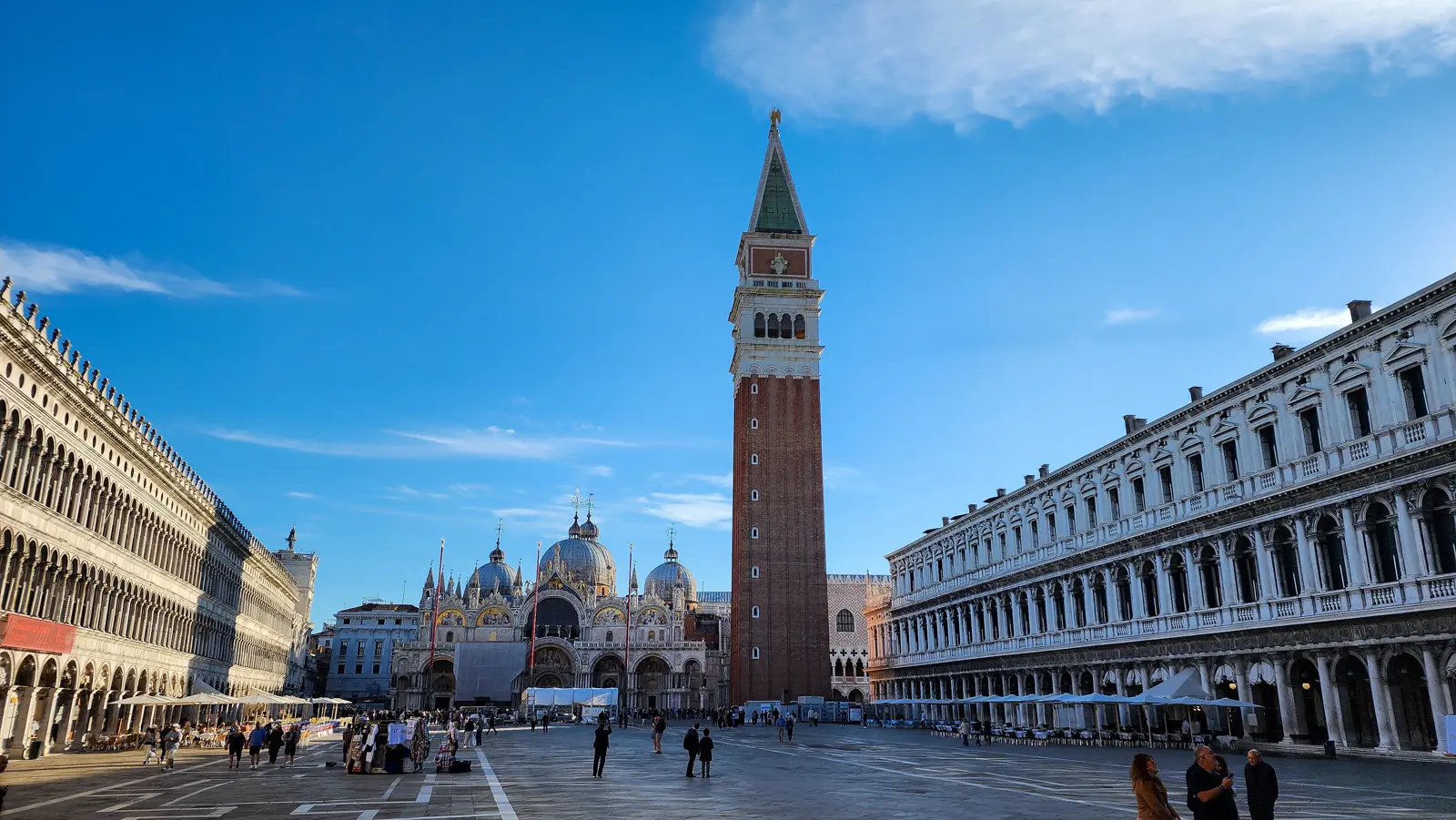
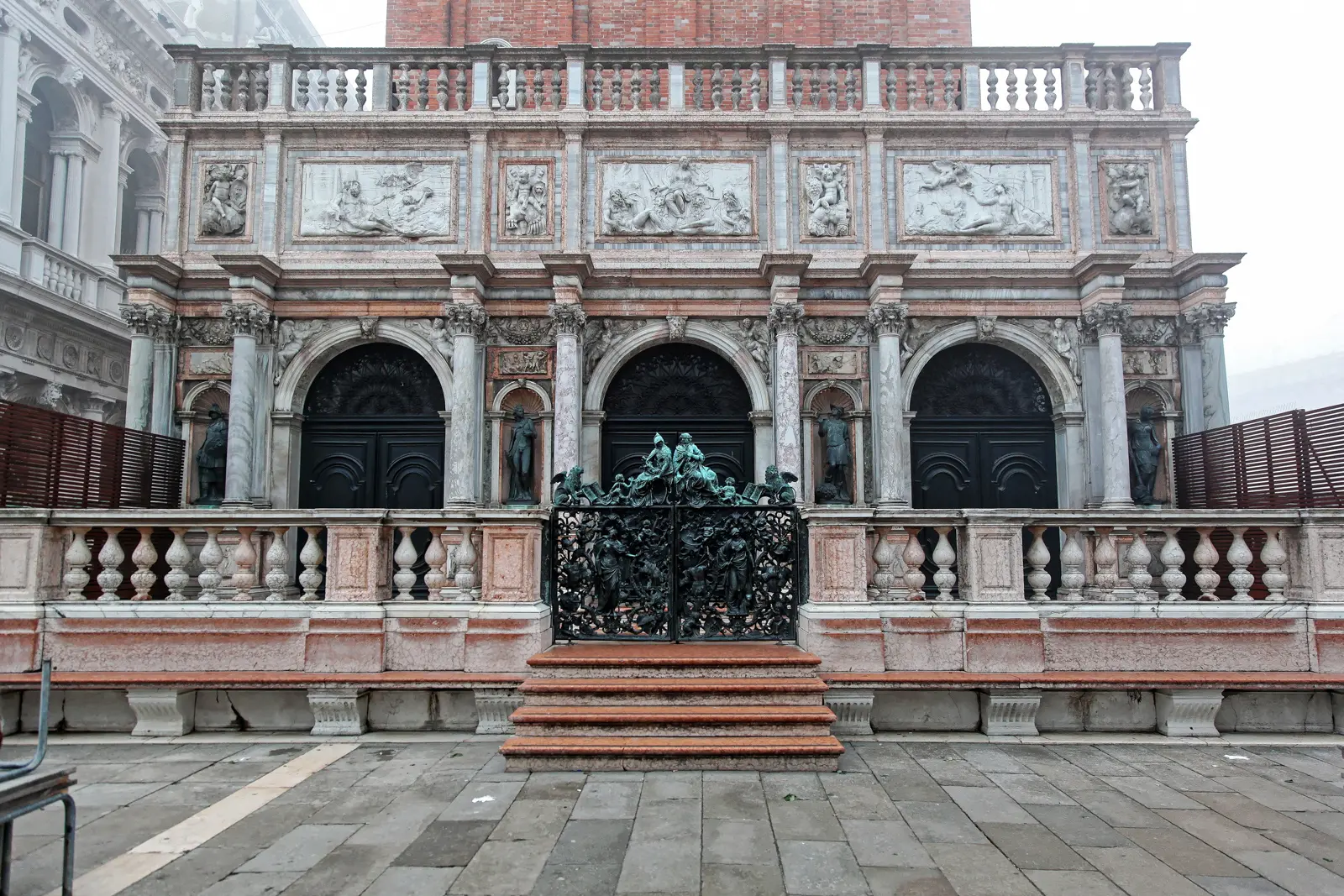
What we see today is a faithful reconstruction. In 1902, after years of structural stress, the original Campanile collapsed completely. Remarkably, no human lives were lost, though the custodian’s cat perished, and the adjacent Loggetta, a richly decorated Renaissance structure by Jacopo Sansovino, was severely damaged. Venetians immediately committed to rebuilding the tower exactly as it was, guided by the phrase “com’era, dov’era” (as it was, where it was). The new Campanile was completed in 1912, using reinforced internal materials while preserving its historic appearance. That decision speaks volumes about Venice: preservation over reinvention, continuity over replacement.
The Bells That Once Governed Venetian Life
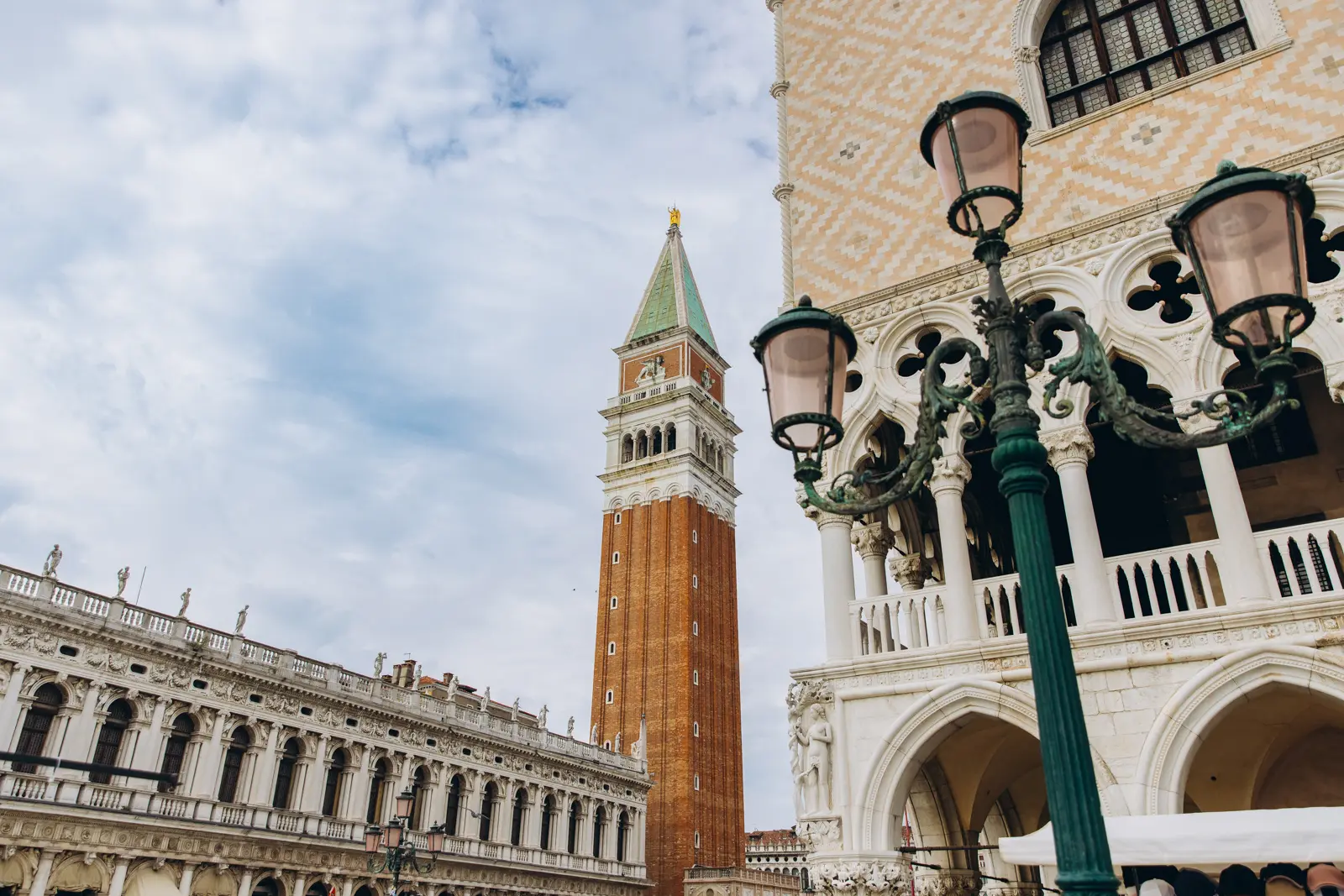
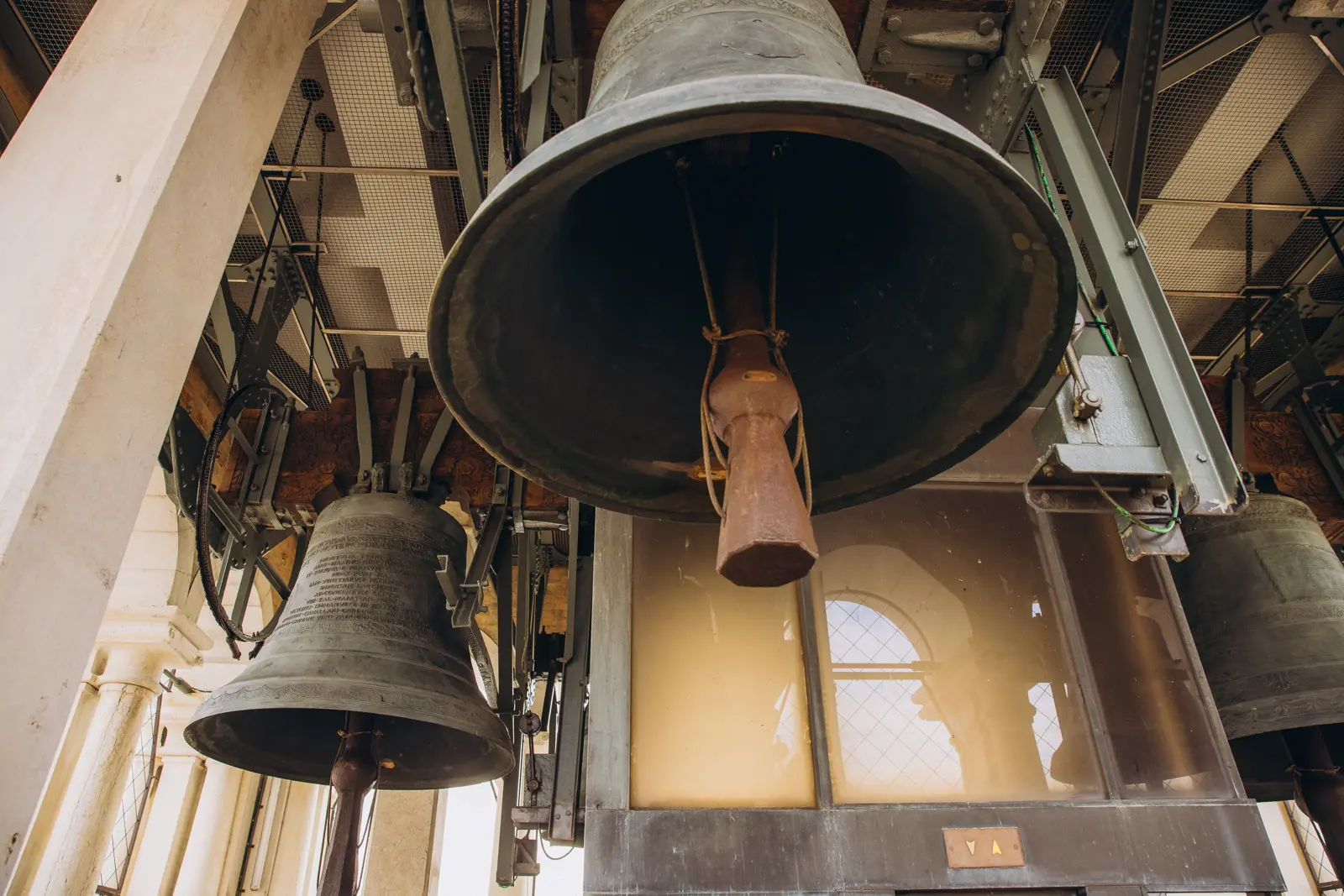
For centuries, the Campanile’s bells structured daily life in Venice. There were five principal bells, each with a specific civic function. The Marangona marked the beginning and end of the workday. The Nona announced midday. The Trottiera called members of the Great Council to meetings. The Pregadi signaled Senate sessions. The Renghiera tolled solemnly for executions.
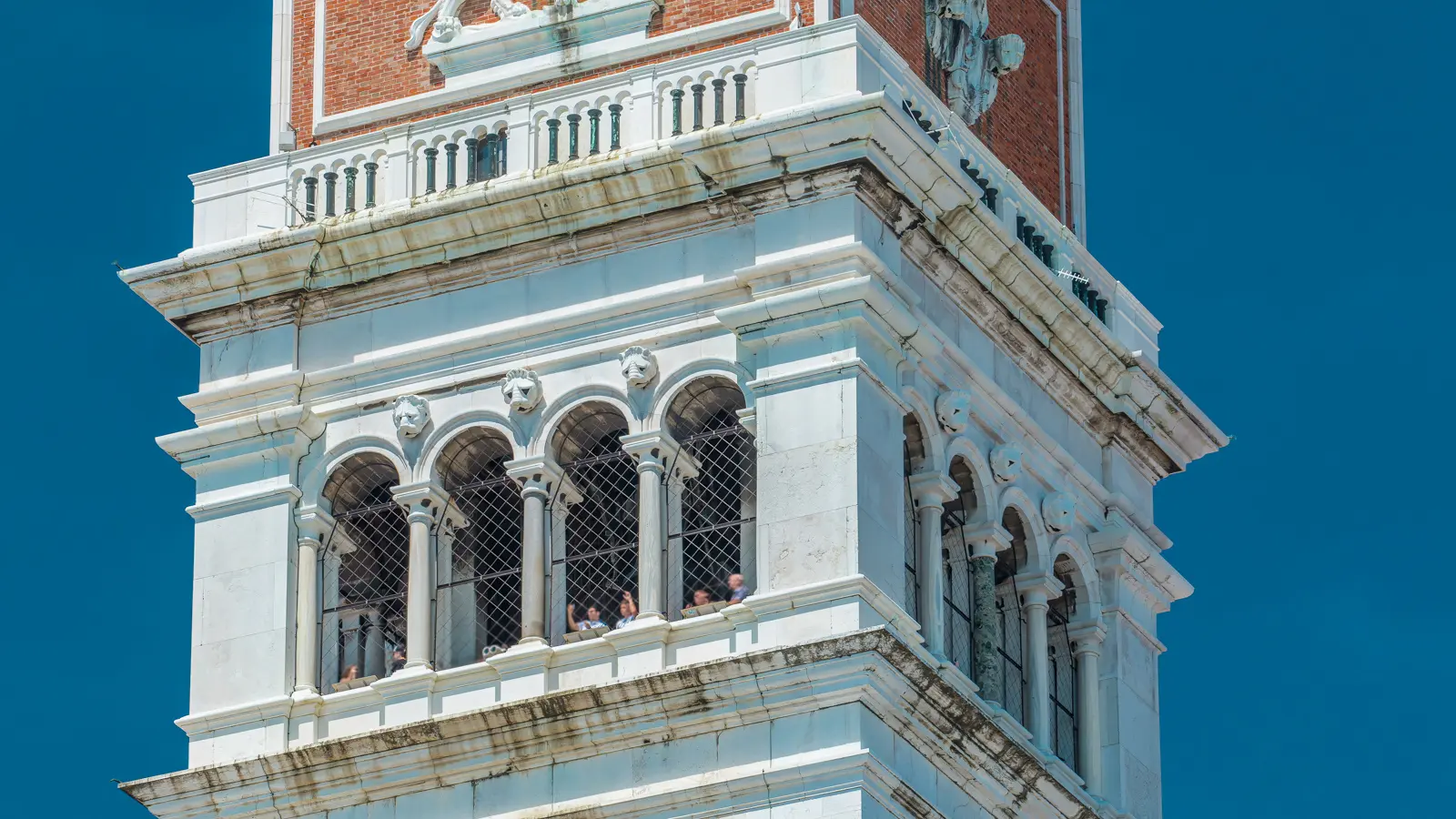
Long before watches or public clocks were common, Venetians lived by sound. These bells regulated governance, labor, justice, and ceremony – making the Campanile not just symbolic, but operationally essential to the Republic. Today, the bells remain largely ceremonial, but standing beneath the tower, it’s easy to imagine how deeply their sound once shaped the rhythm of the city.
Rising Above Piazza San Marco
Unlike many historic towers, St. Mark’s Campanile is accessible without effort. A modern elevator carries visitors smoothly upward, a thoughtful adaptation that allows everyone to experience the view without physical strain. As the elevator doors open at the top, Venice unfolds in full clarity.
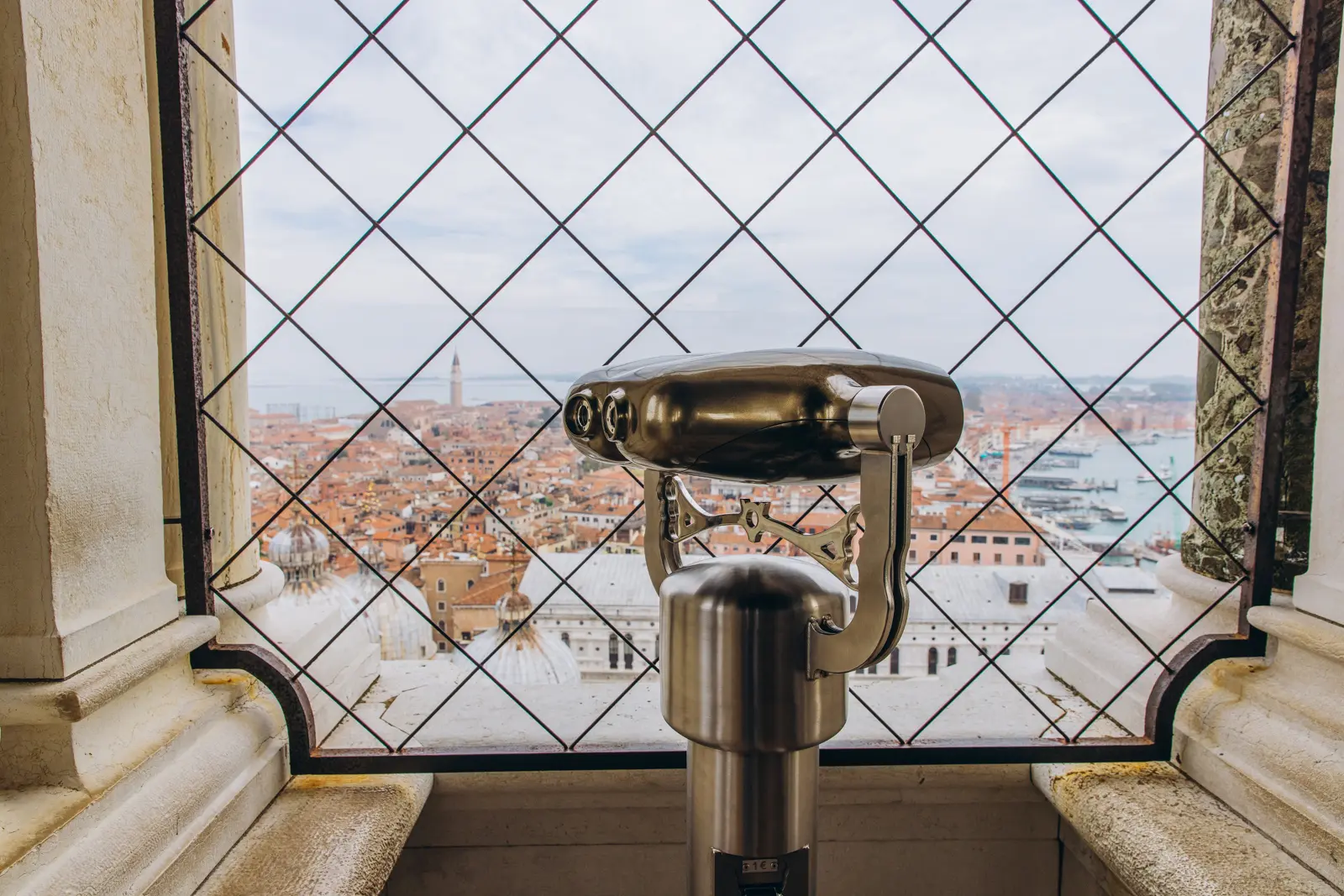
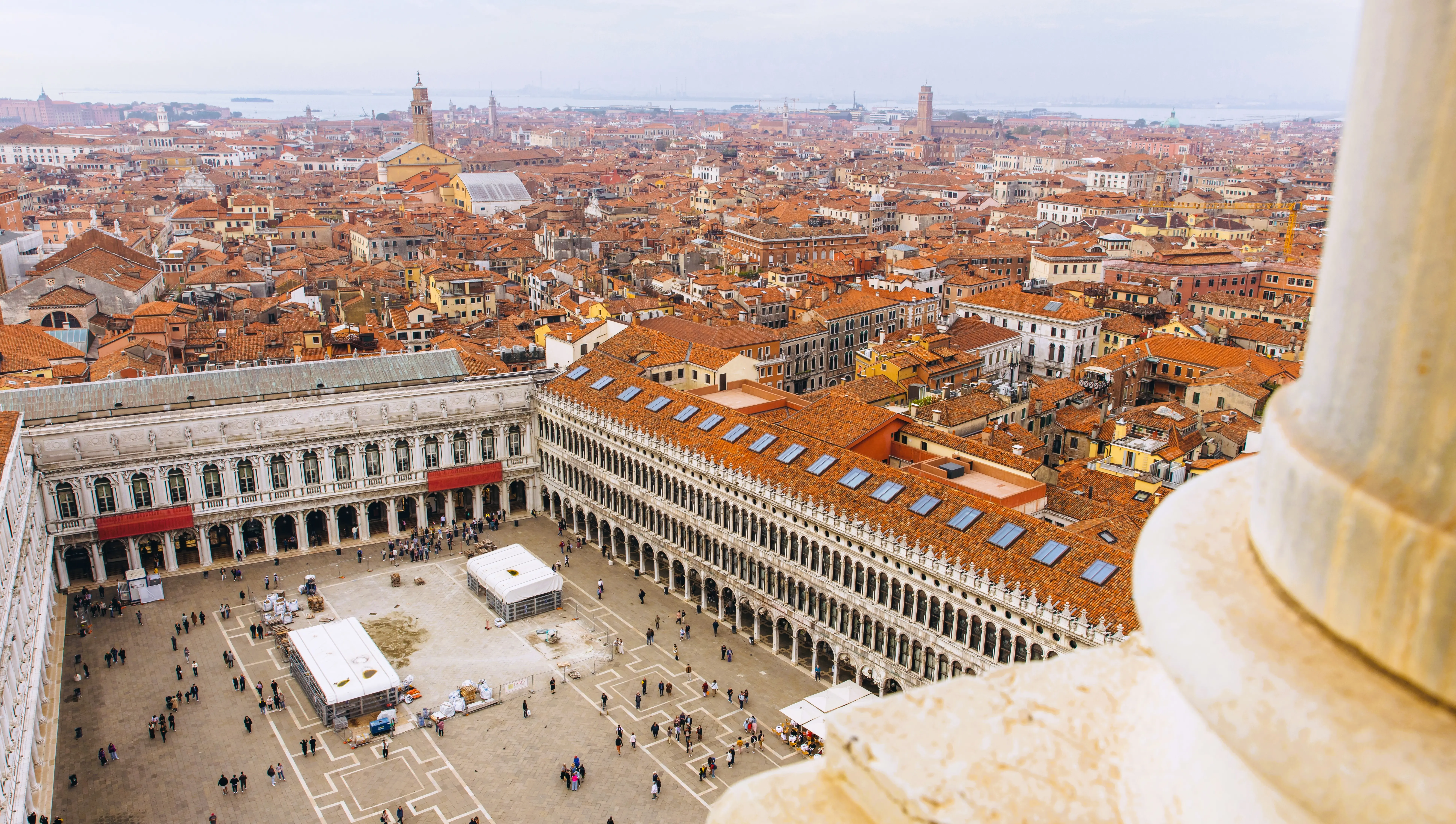
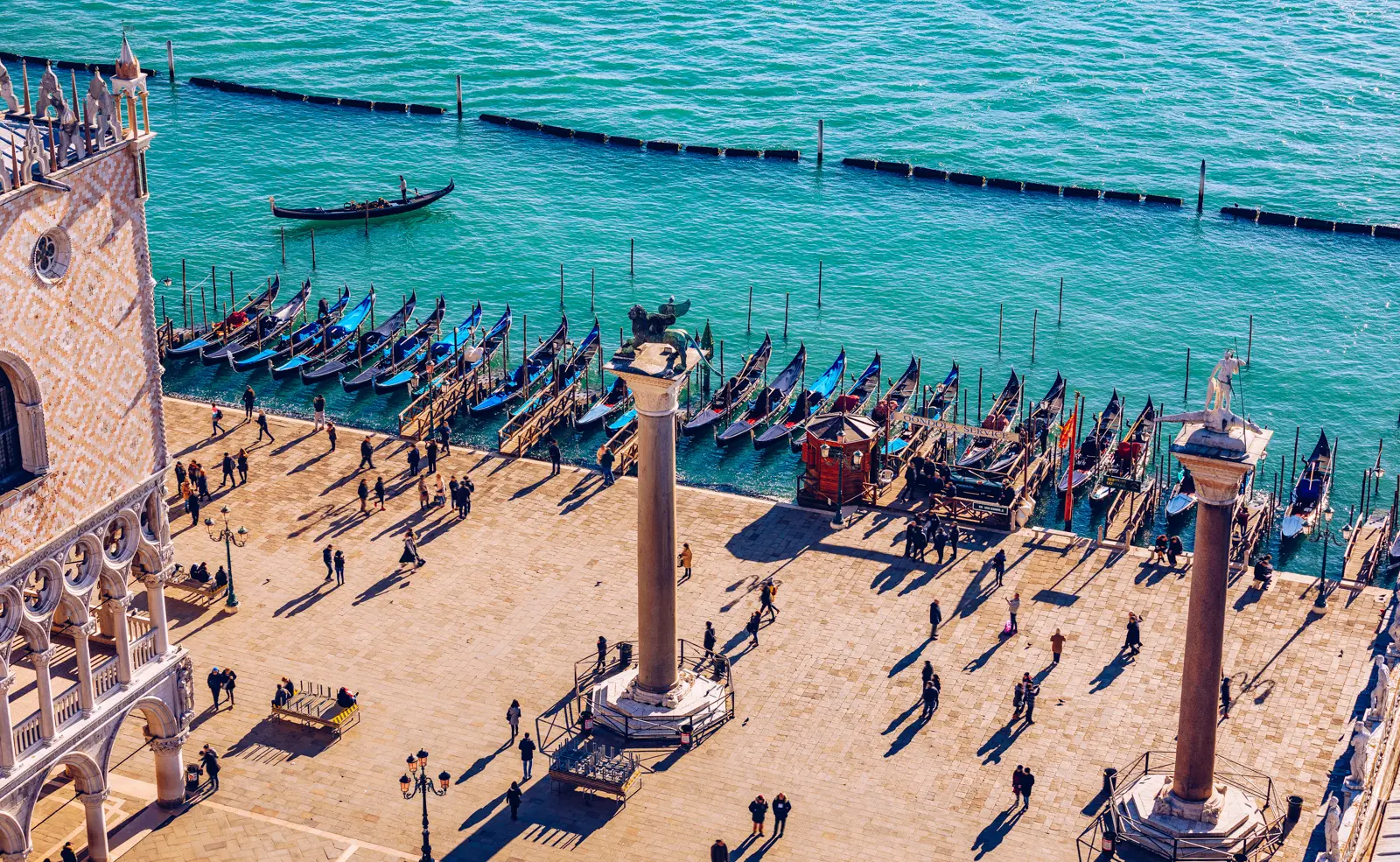
Directly below, Piazza San Marco reveals its precise geometry – the Basilica’s domes, the arcades of the Procuratie, the steady movement of people tracing paths centuries old. Beyond the square, Venice stretches outward in every direction: rooftops in warm terracotta tones, church towers punctuating the skyline, canals threading through the city like veins.
To the east and south, the Venetian Lagoon glimmers endlessly, dotted with islands, boats, and shifting light. On exceptionally clear days, the faint outline of the Dolomites appears on the horizon, a reminder of how improbably Venice exists between land and sea.
The View That Changes How Venice Feels
What makes this view extraordinary isn’t just its beauty, it’s the perspective it provides on the city itself. From above, Venice appears impossibly delicate. There are no highways, no glass towers, no interruptions to its historic fabric. Just water, stone, and human ingenuity layered across centuries. From this height, Venice reads as a living organism – adaptive, vulnerable, and resilient – and the urgency of its preservation becomes unmistakable. You begin to understand why this city inspires such devotion, and why its future matters so deeply. It’s a moment of clarity about the city. One that stays with you long after you descend.
Why St. Mark’s Campanile Stays with You
St. Mark’s Campanile stays with you because it gives context not only to Venice, but to your experience of it. From above, the city stops feeling overwhelming and starts to feel intelligible. Streets make sense. Waterways align. History feels tangible rather than abstract. What lingers most is the stillness at the top – the hush, the soft wind from the lagoon, the awareness that this tower has witnessed floods, fires, revolutions, and reinvention – and still stands. It reminds you that perspective doesn’t just change what you see. It changes how you understand. And few places offer that kind of quiet clarity.
Bubbly Tips
- Location: Piazza San Marco, Venice
- Height: Approx. 99 meters (324 feet)
- Access: Elevator (no stairs)
- Best time to visit: Early morning or late afternoon for softer light
- Pair it with: St. Mark’s Basilica, the Doge’s Palace, or a quiet lagoon walk afterward
- Fun fact: According to Venetian tradition, Galileo Galilei demonstrated his telescope to city officials from the Campanile in 1609, though the exact location of this historic demonstration remains uncertain.
Final Thoughts
If Venice is a city best understood through layers, St. Mark’s Campanile is where those layers finally align. It doesn’t overwhelm or distract. It clarifies.
From above, you don’t just see Venice – you understand it.
Have you stood at the top of St. Mark’s Campanile, or is it on your Venice wish list? I’d love to hear in the comments section below!

🌟 Everything You Need to Plan Your Dream Trip in 2026
- 🌟 Luxury Hotels - Find premium stays with Booking.com & Hotels.com
- 🏡 Vacation Rentals - Discover unique properties on VRBO
- 🏞️ Guided Tours - Explore with Viator or GetYourGuide
- 🎫 Attraction Tickets - Skip the lines with Tiqets
- 🚢 Ocean Cruises - Set sail with Cruise Direct
- 📱 International SIMs - Stay connected with Saily
- 🚗 Car Rentals - Budget-friendly options from Discover Cars
- 🌐 Secure VPNs - Browse safely with NordVPN
- 💶 Currency Exchange - Best rates with Wise
- 🗣️ Learn Languages - Master the local language with Babbel and Rosetta Stone