
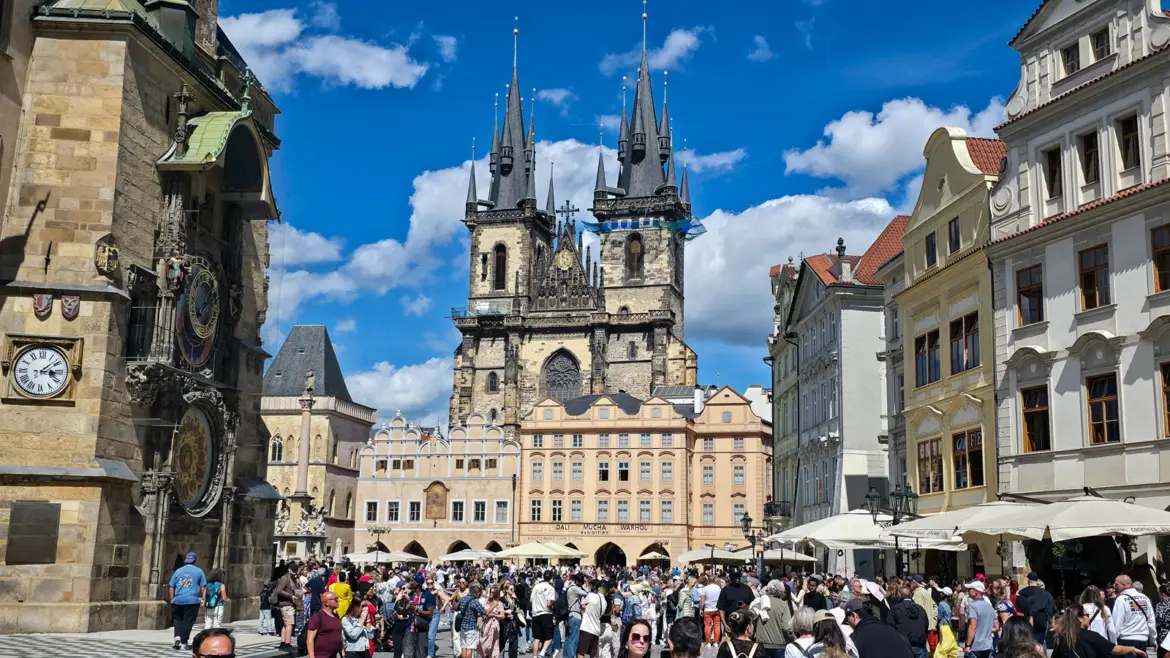
Old Town Square is the heart of Prague. There is so much to see and do: restaurants and cafés, the famous astronomical clock, two grand churches and monuments in every direction. It is so historic. On a beautiful sunny day, it is a great place to sit with a lemonade and people-watch.
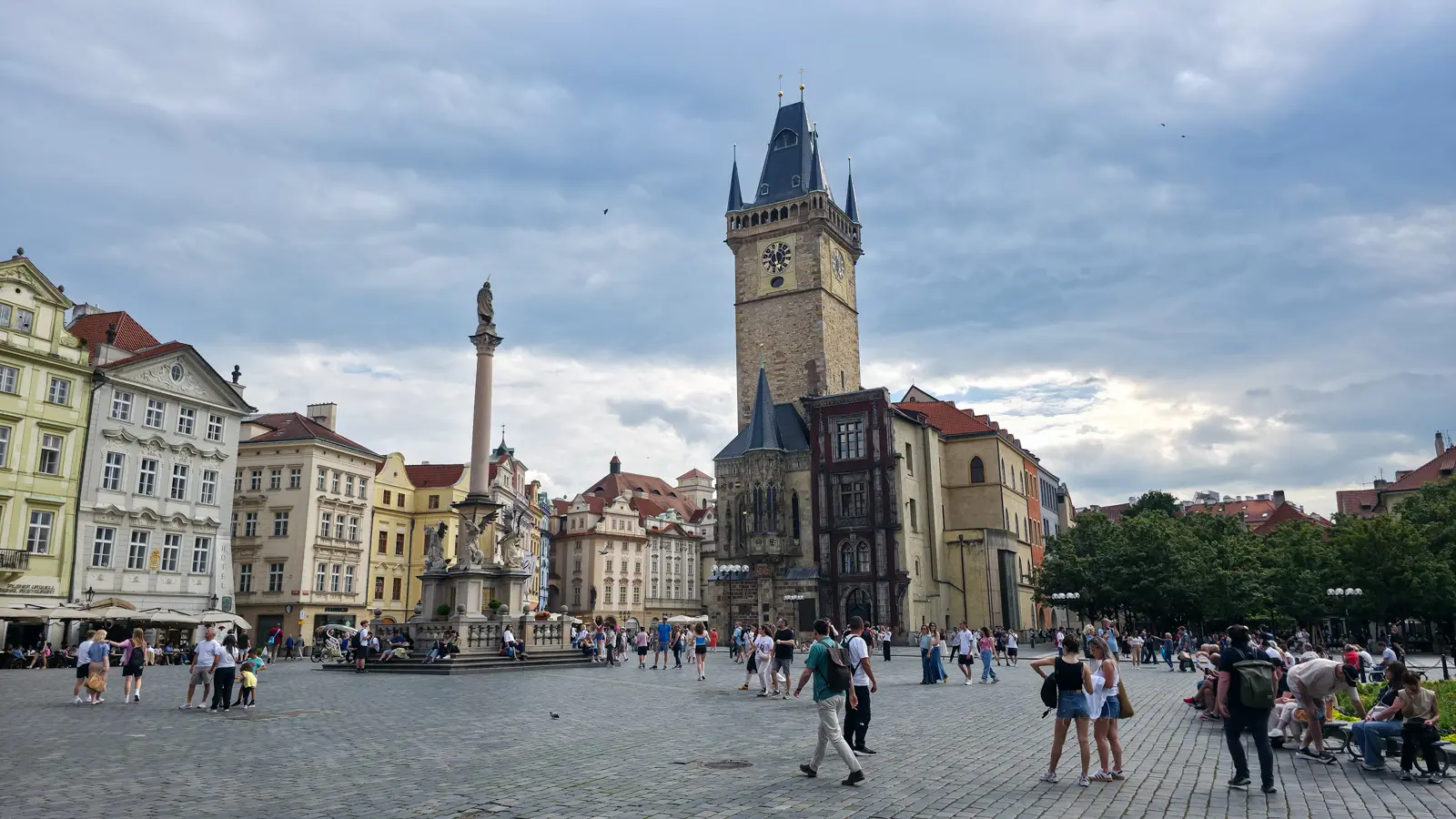
We passed through it again and again during our stay, because it sits on the way to Charles Bridge. We saw it under blue skies one day and heavy clouds a few days later.
Old Town Square at a Glance
🕰️ The astronomical clock · On the Old Town Hall tower, the oldest working astronomical clock in the world; the twelve apostles appear on the hour, 8 am to 11 pm.
⛪ Two grand churches · Gothic Týn, with its 80-metre twin towers, faces Baroque St Nicholas across the square.
🔥 The Jan Hus Memorial · The Art Nouveau monument at the centre, unveiled in 1915, 500 years after the reformer was burned at the stake.
✝️ The Marian Column · Toppled in 1918 and returned as a replica in June 2020, standing again near the Old Town Hall.
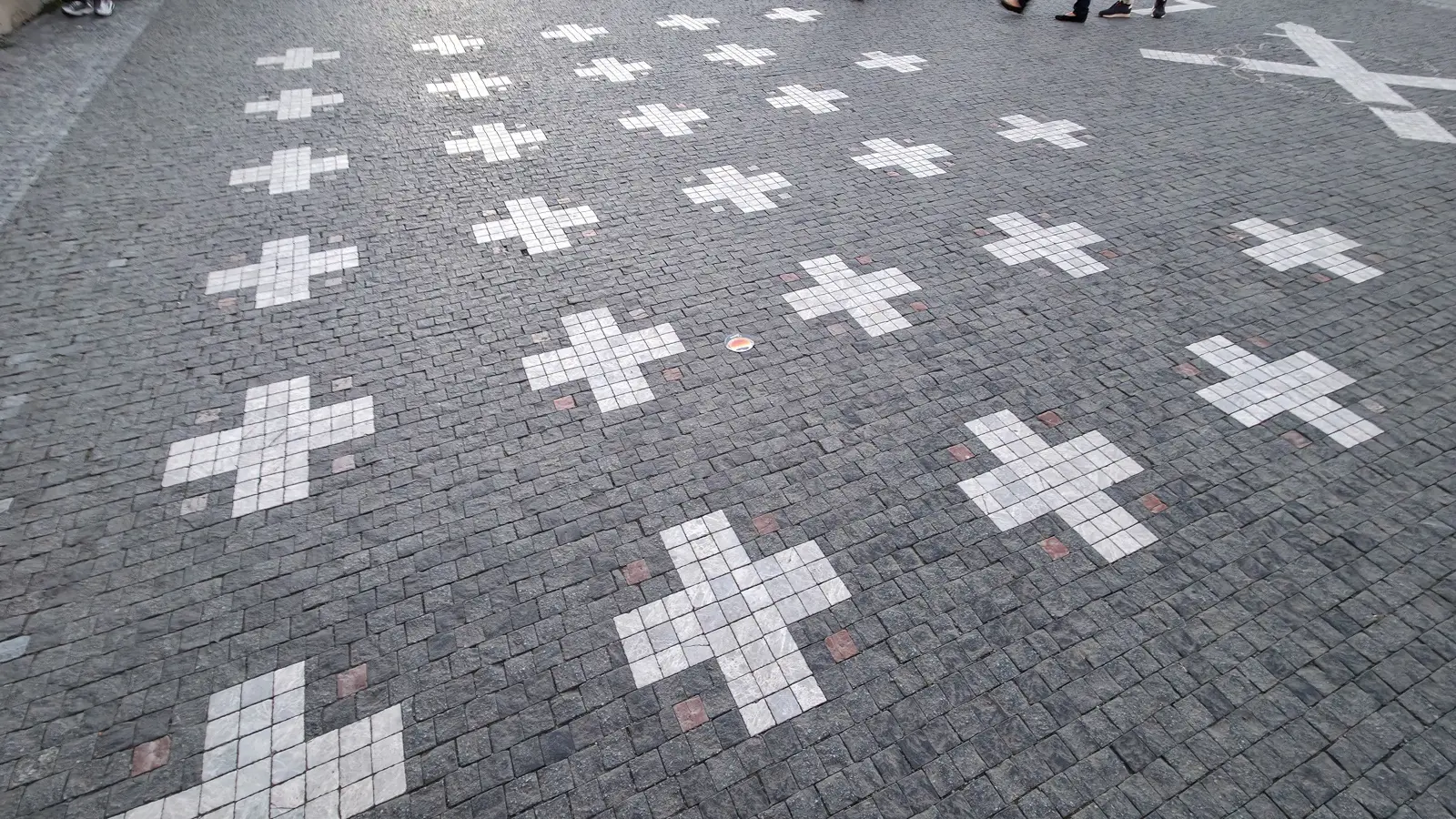
⬜ Look down · 27 crosses mark an execution of 1621, and a line of stones traces the old Prague meridian.
🛍️ Cafés and Pařížská · Café terraces for a homemade lemonade, and Prague’s most prestigious shopping street starts right on the square.
The Heart of the Old Town
Prague’s tourist board describes Old Town Square as the oldest and most significant square in the historic centre, and the main streets of the Old Town all lead into it. For centuries it was a working marketplace. Bakers, potters, herbalists and gingerbread makers sold from stalls here, and the most expensive imported cloth was sold from stone stalls around the base of the town hall tower.
The square also sits on the Royal Route, the path once taken by processions of Czech kings and queens on their way to be crowned at St Vitus Cathedral in Prague Castle. From the square, the route continues through Malé Square and Charles Street to Charles Bridge, which is exactly the way we kept walking.
The Old Town Hall and the Astronomical Clock
The Old Town Hall was founded in 1338, when King John of Luxembourg granted the Old Town its own council. Its Gothic tower was finished in 1364, and its most famous feature is the astronomical clock on the tower’s south wall.
We stopped and watched it, but we were not there on the hour, when the twelve apostles appear in the windows above the dials. That is on my list for next time.
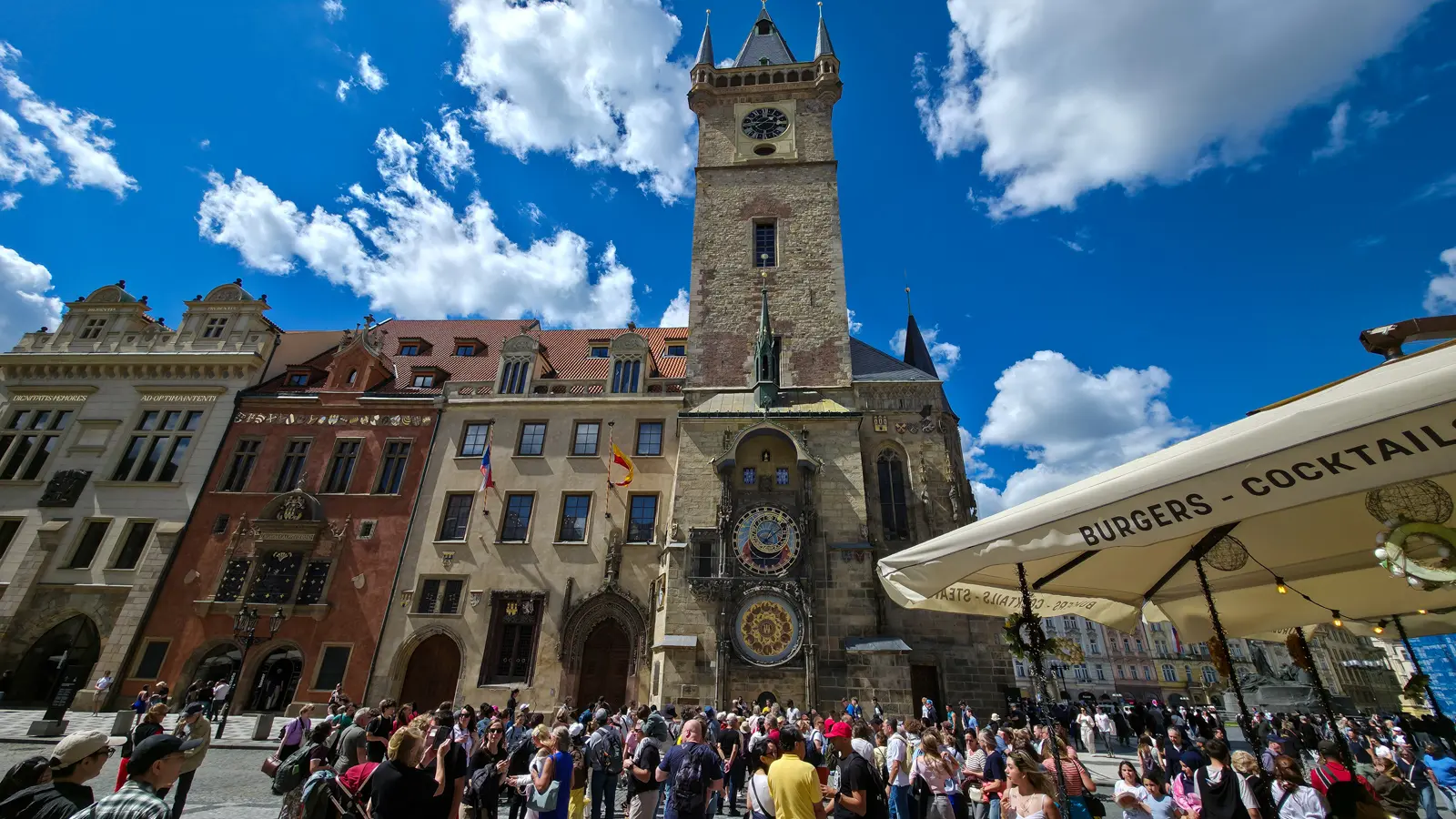
During the Prague Uprising in May 1945, two wings of the Old Town Hall were destroyed and the tower and clock were badly damaged. The ruins of the wings were cleared away rather than rebuilt.
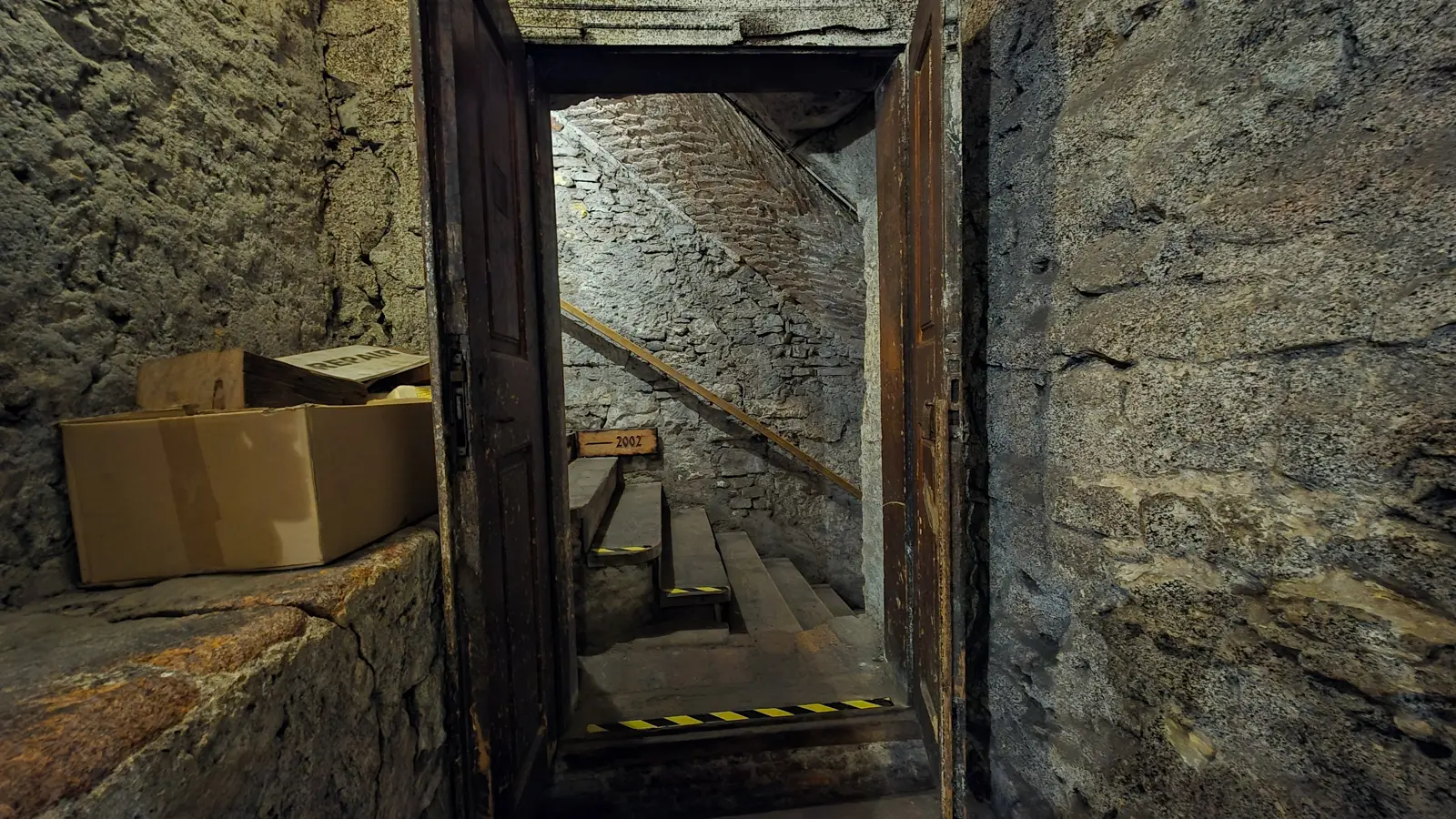
There is more to the Old Town Hall than the clock. Beneath it lies a web of Romanesque and Gothic cellars that are older than the town hall itself. The Vltava flooded this area so often that the ground level was raised in the 13th century, and the ground floors of Romanesque houses became cellars under today’s streets. We saw this hidden world for ourselves on a tour of Prague’s underground cellars.
In front of the Old Town Hall, 27 crosses are set into the paving. They mark the execution of 27 leaders of a failed uprising against Habsburg rule, on 21 June 1621.
Two Churches
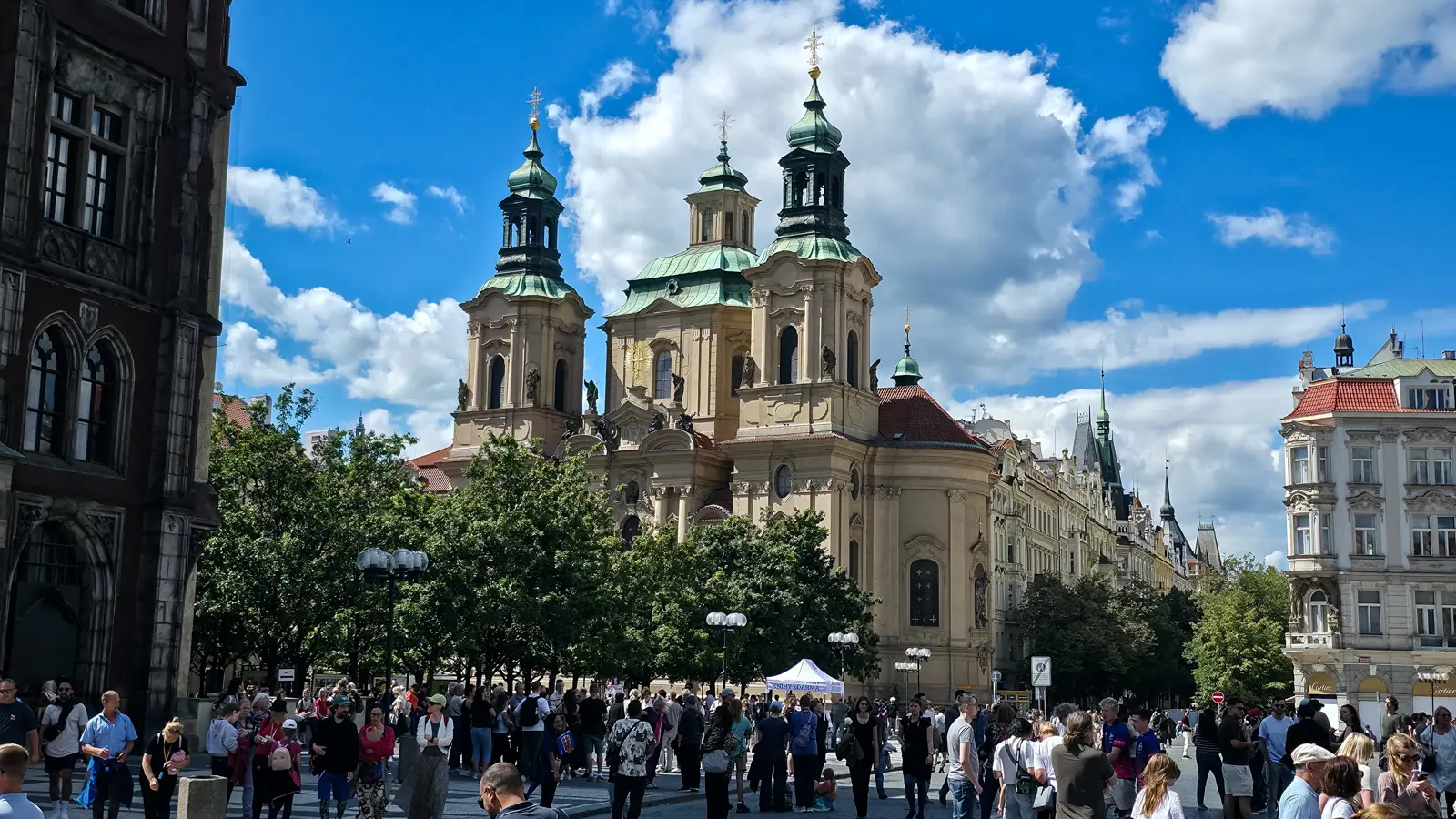
Two churches face each other across the square. The Gothic Church of Our Lady before Týn, with its twin spiked towers, was built from the mid-14th to the early 16th century. The south tower was the last part finished, in 1511, and both towers are 80 metres high.
From the square, the church is partly hidden behind the arcaded Týn School, and there is no direct way in from the open square. The entrance is through a passage under the third arch from the left. Inside is the tombstone of the astronomer Tycho Brahe.
In the 15th century, Týn was the main church of the Hussites, the followers of Jan Hus. Their symbol, a large chalice, hung on the facade. In 1626, after the Catholic victory, it was melted down and turned into the golden halo around the Madonna that still shines between the towers.
On the opposite corner stands the Baroque Church of St Nicholas, built between 1732 and 1737 by the architect Kilian Ignaz Dientzenhofer on the site of a much older church.
Palaces and Galleries
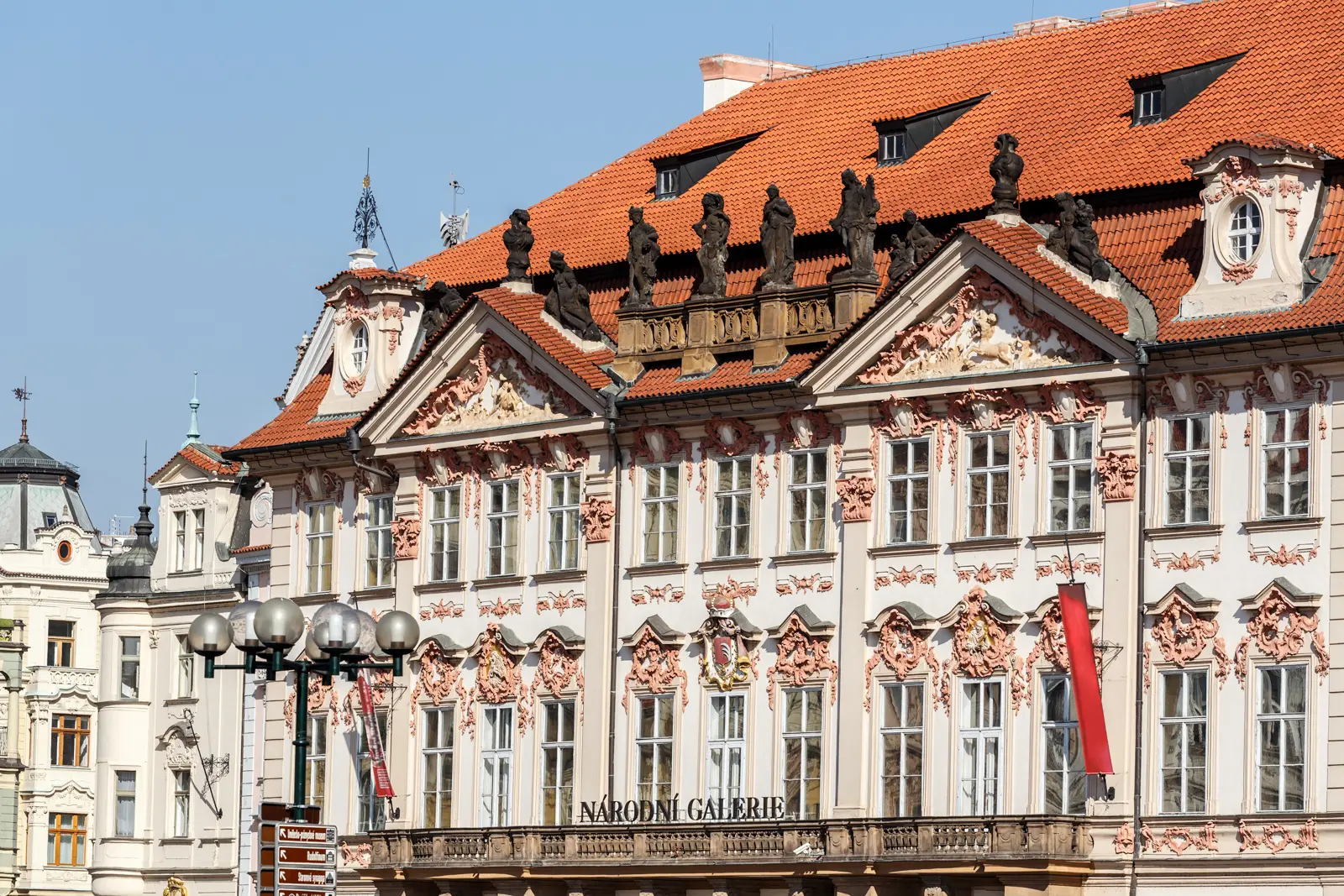
For art lovers like me, two galleries sit right on the square. The Rococo Kinský Palace has been run by the National Gallery Prague since 1949 and hosts its exhibitions. It was designed by Kilian Ignaz Dientzenhofer, the same architect as St Nicholas. Its pink and white facade is covered in stucco ornament and topped with statues, and the words Národní galerie, National Gallery, run above the balcony.
Next door, the House at the Stone Bell is one of the most important Gothic buildings in Prague. A Baroque facade hid it for years, until restorers stripped it away in the 1980s and uncovered the original 14th-century stonework. It takes its name from the stone bell on its corner, and since 1988 it has been an exhibition space for the Prague City Gallery.
The Jan Hus Memorial
In the middle of the square stands the Jan Hus Memorial. Jan Hus was a Czech religious reformer who was burned at the stake as a heretic on 6 July 1415. The memorial was unveiled on 6 July 1915, exactly 500 years later, and was paid for entirely by public donations. The sculptor, Ladislav Šaloun, worked on it from 1901 to 1915.
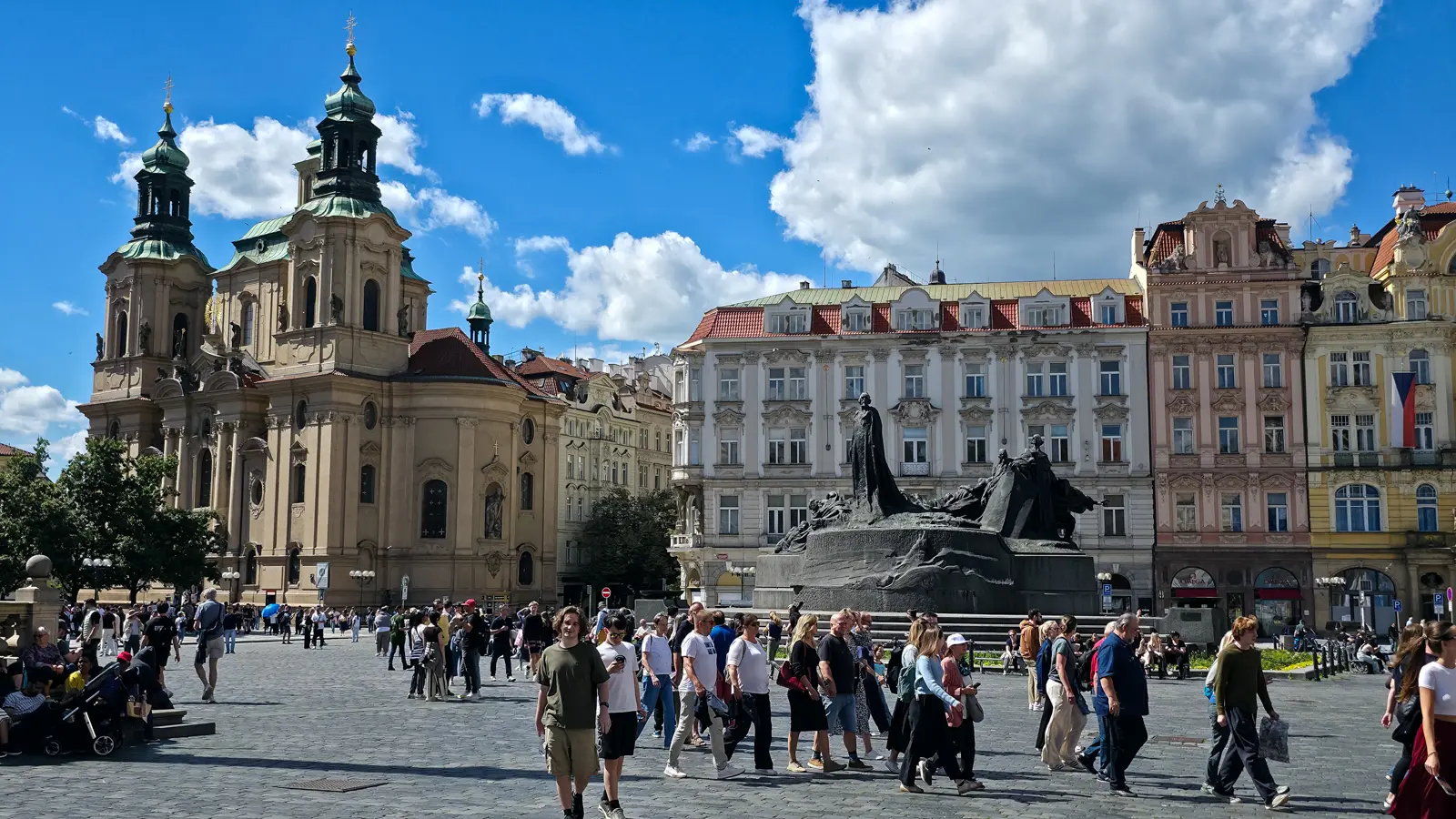
Hus was a priest and university master in Prague who spoke out against corruption in the Church. Summoned to the Council of Constance, he refused to recant his teachings and was burned at the stake. His death sparked the Hussite Wars, and 6 July is still a public holiday in the Czech Republic.
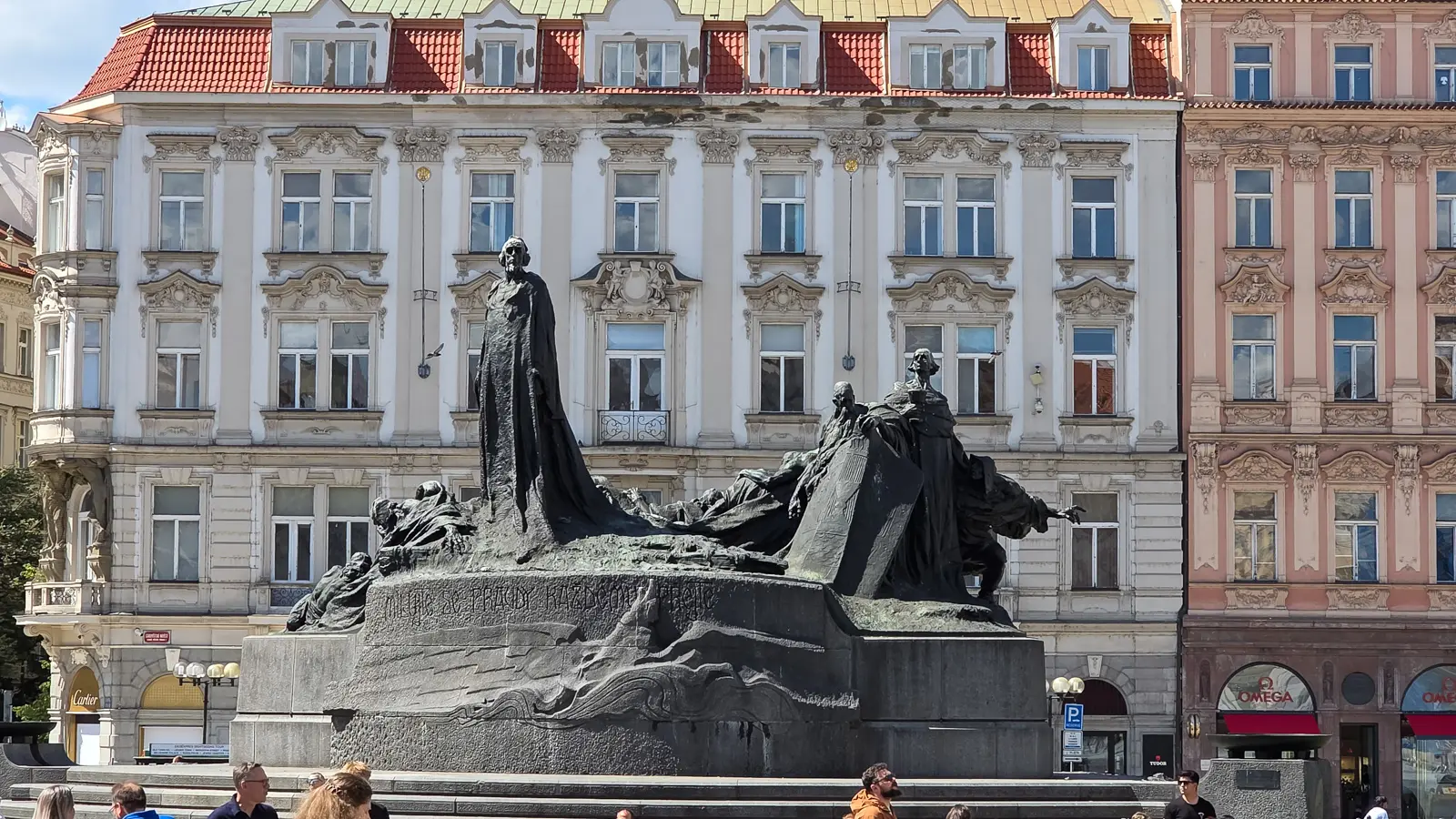
It is worth walking all the way around the memorial, because each side carries an inscription. The front quotes Hus himself: Milujte se, pravdy každému přejte, “Love one another and wish the truth to everyone”. One side reads Živ buď, národe posvěcený v Bohu, neumírej, “Live, nation consecrated in God, do not die”. The other quotes the 17th-century scholar Comenius, who wrote that once the storms of anger had passed, rule over their own affairs would return to the Czech people. The back carries the opening line of the Hussite battle hymn, Kdož jsú boží bojovníci, “Ye Who Are Warriors of God”.
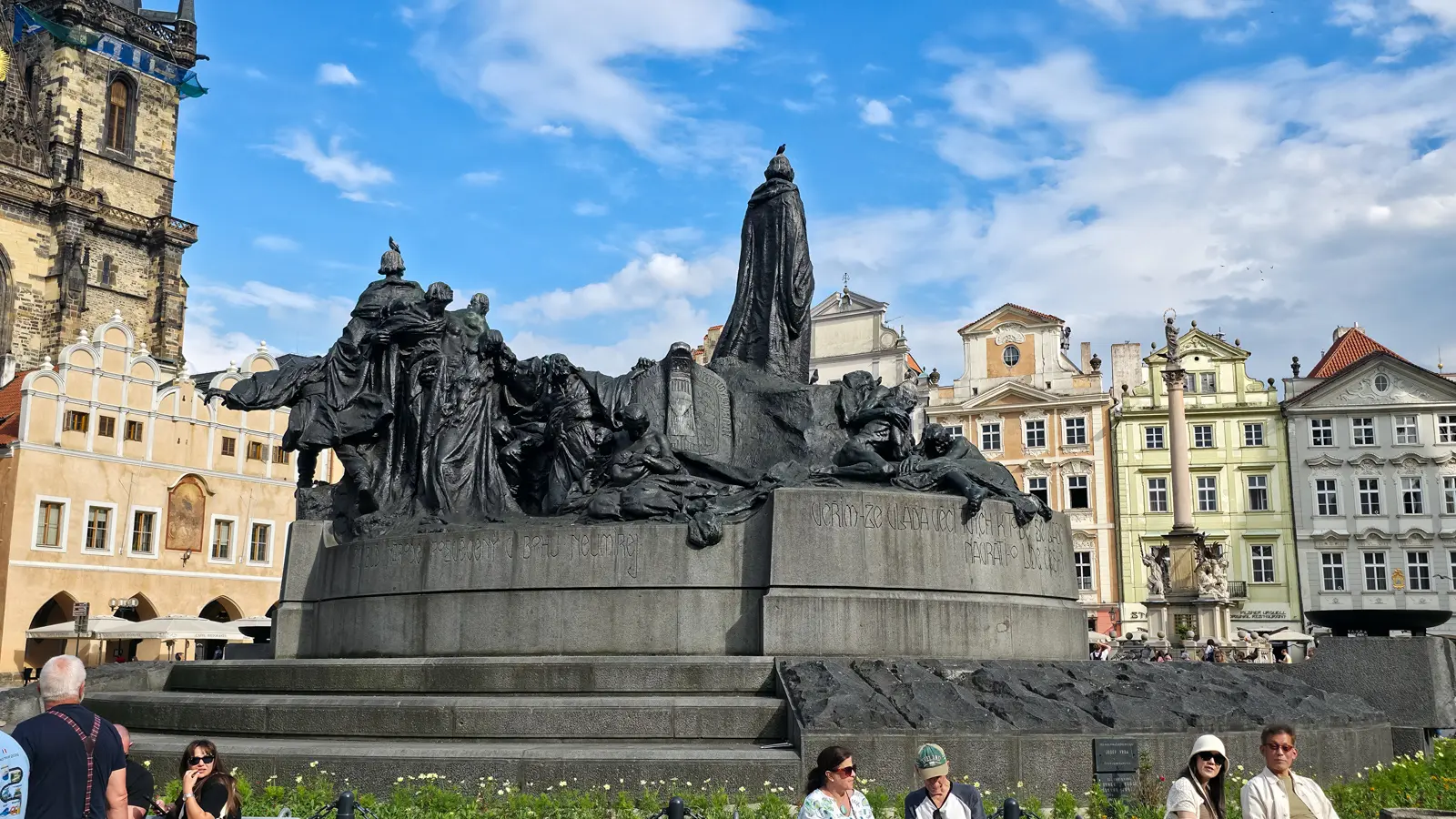
From the start, the memorial stood for more than one man. It became a symbol of Czech independence, and under Communist rule, sitting at its feet became a quiet way of showing opposition without saying a word.
The Marian Column
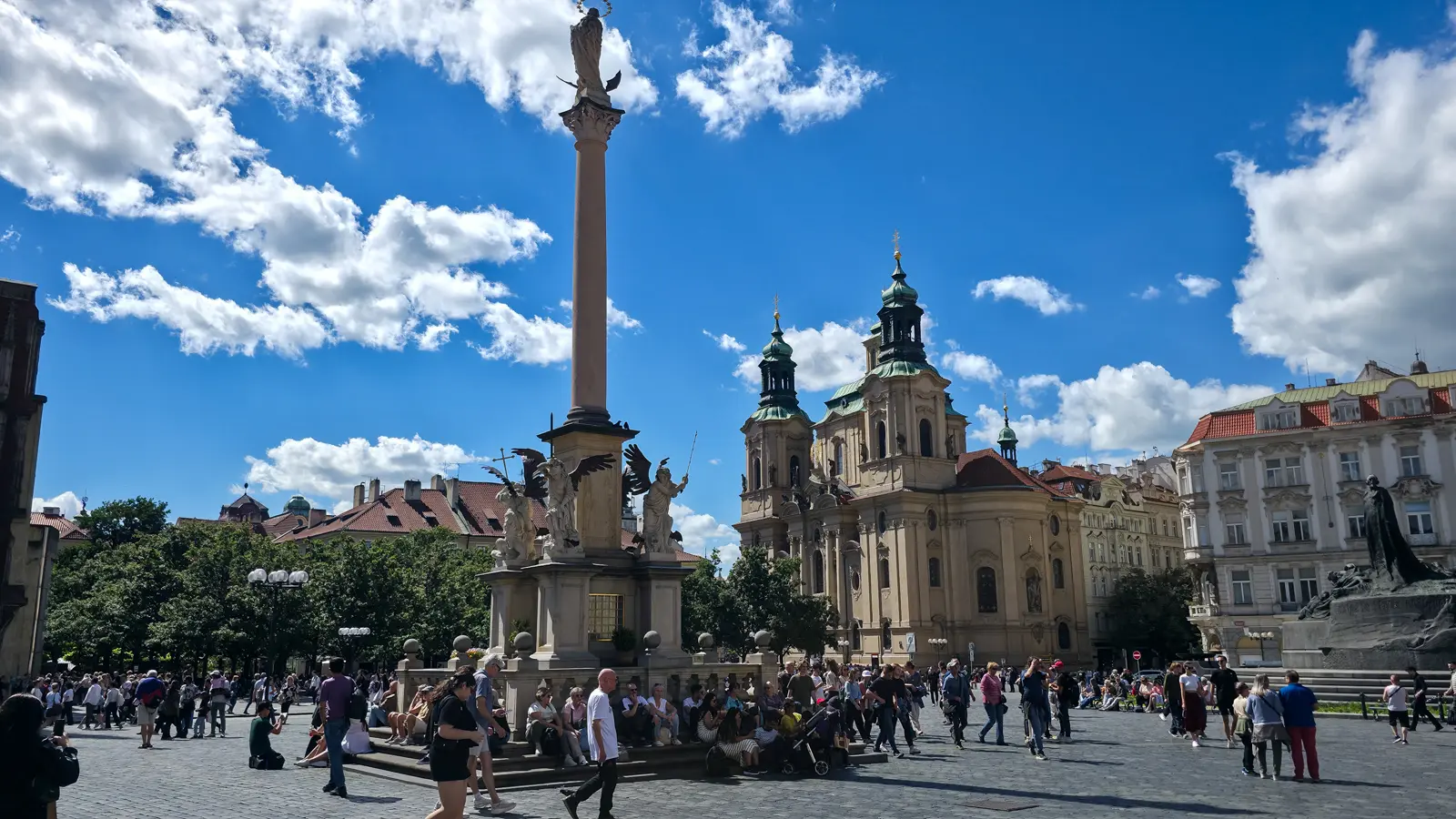
Near the Old Town Hall stands the Marian Column, topped by a statue of the Virgin Mary. The original was erected in 1650 to commemorate Prague’s successful defence against the Swedish siege of 1648. On 3 November 1918, shortly after Czechoslovakia gained independence, a crowd pulled it down. Many viewed the monument as a symbol of Habsburg rule and Counter-Reformation Catholicism, while others regarded it as a religious memorial. After decades of debate, a replica was returned to the square in June 2020.
Cafés, Lemonade and People-Watching
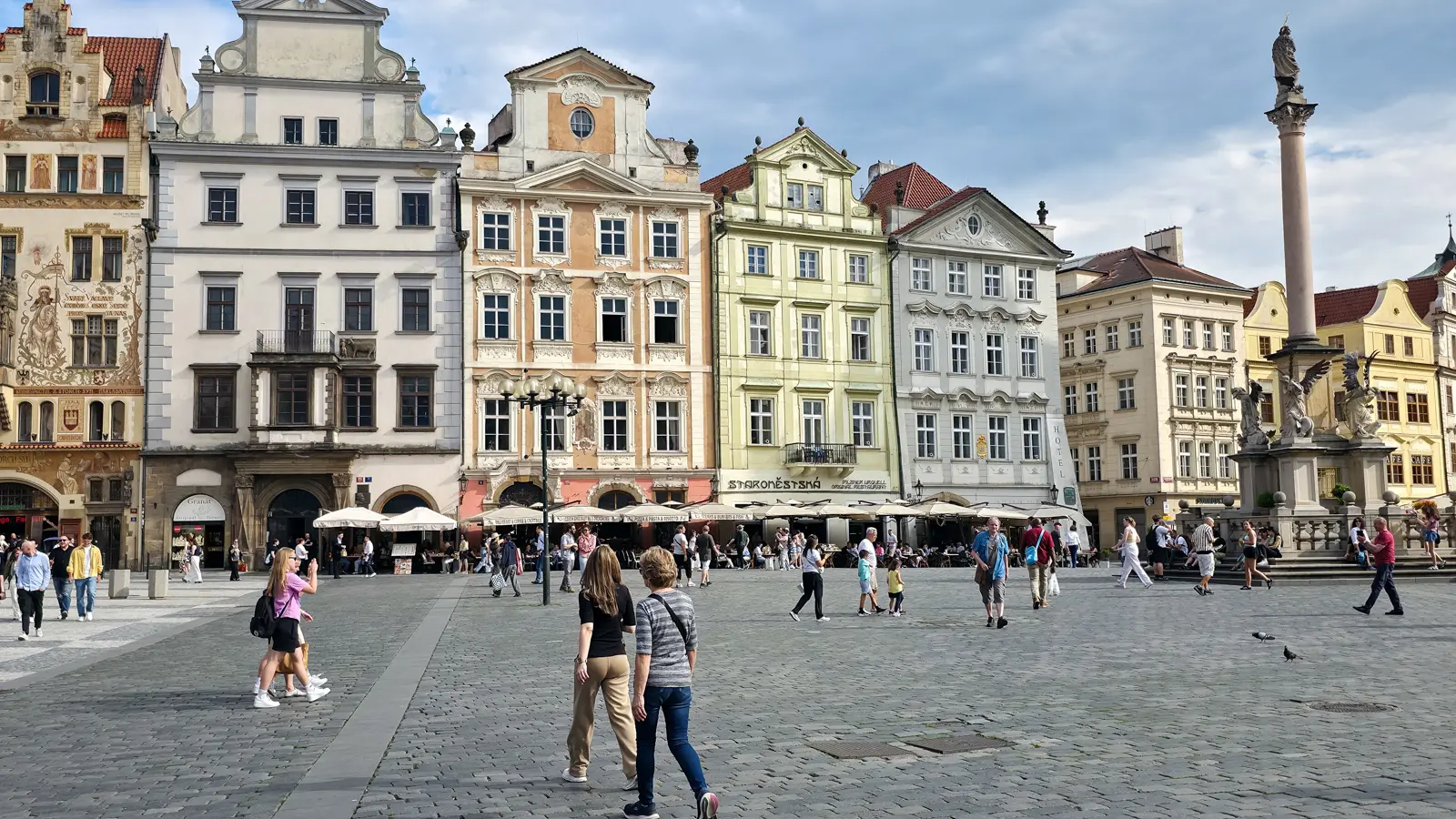
Colourful houses line every side of the square, with restaurants and café terraces at street level. Many of the cafés serve homemade lemonade, and on a beautiful sunny day it is a great place to sit with one and people-watch.
One house to look for is the Storch House, at the entrance to Celetná Street, with St Wenceslas on horseback painted across its facade. The inscription beside him, Svatý Václave, vévodo české země, pros za nás, asks: “Saint Wenceslas, Duke of Bohemia, pray for us”.
Pařížská Street
For shoppers, Pařížská Street starts right on the square and runs north towards the Vltava, through the old Jewish Town. Prague’s tourist board calls it the city’s most prestigious boulevard, lined with luxury boutiques from the world’s best-known fashion brands. Its stately townhouses combine historicist features with Art Nouveau detail, and most date from the first decade of the 20th century.
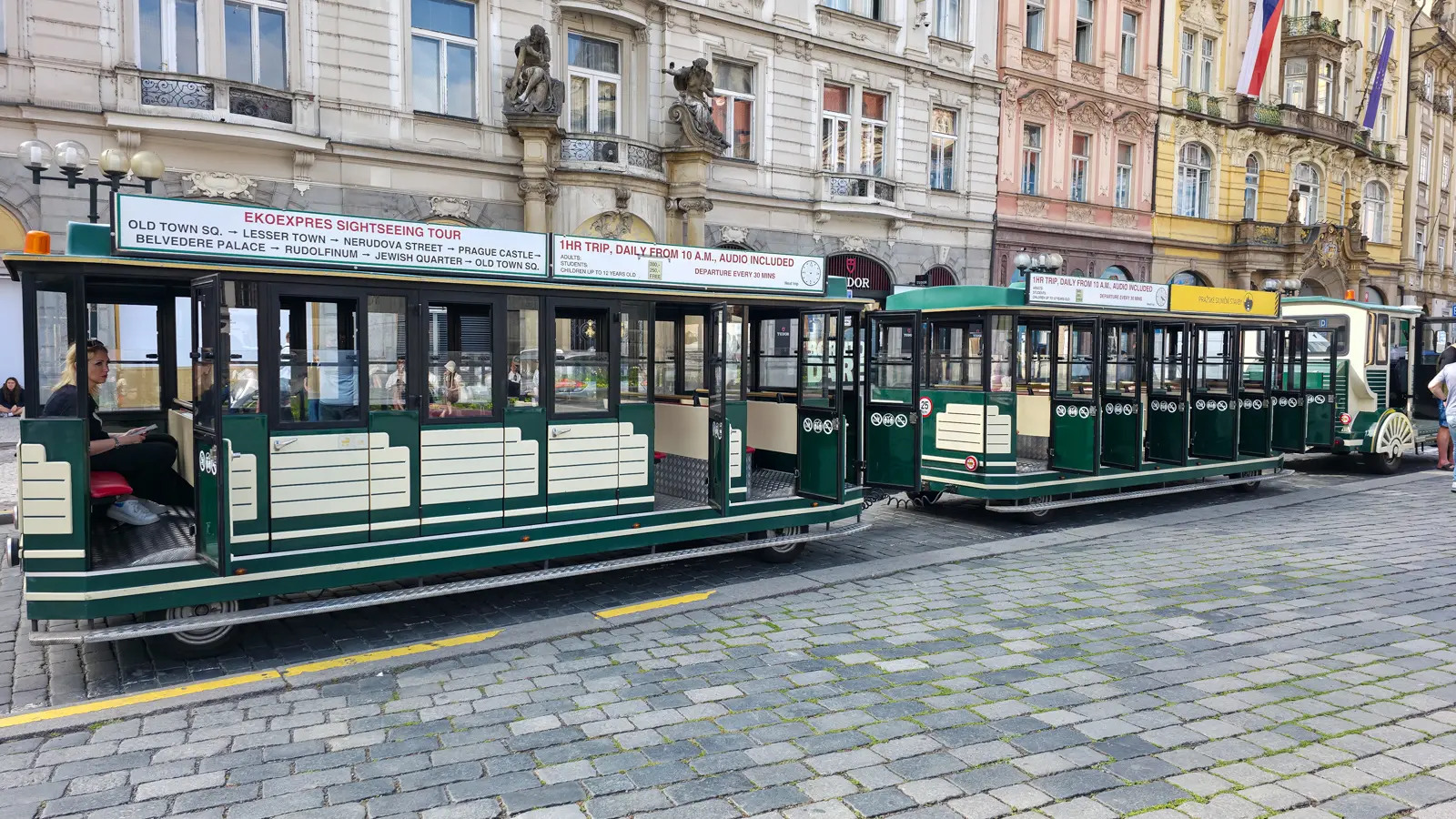
In fact, the luxury shopping starts on the square itself. Cartier, Omega and Tudor all have boutiques on Old Town Square, in the row of houses behind the Jan Hus Memorial, close to the corner where Pařížská begins. The same stretch is the stop for the Ekoexpres, a little sightseeing train that waits for passengers outside the shopfronts.
Bubbly Tips
- Be there on the hour. The twelve apostles appear in the clock’s windows every hour between 8 am and 11 pm. We missed it, so learn from us.
- Look down. Find the 27 crosses in front of the Old Town Hall and the line of the Prague meridian in the paving.
- Go up, then down. The Old Town Hall tower has a lift and panoramic views, and the guided tour includes the Romanesque and Gothic cellars below.
- Walk all the way around the Hus Memorial. Each side has its own inscription.
- Stop for a homemade lemonade. Many of the café terraces serve it, and the people-watching is free.
- Find the Týn Church entrance. Walk through the third arch from the left of the Týn School.
- Make time for art or music. The Kinský Palace and the House at the Stone Bell host exhibitions, and St Nicholas Church holds regular classical concerts.
- Use the square as your compass. The Royal Route continues from here through Malé Square and Charles Street to Charles Bridge.
- Save time for Pařížská Street. It starts on the square and is Prague’s top address for luxury fashion.
- Come back more than once. The square changes with the light, so pass through at different times of day.
Final Thoughts
Old Town Square is so historic, and there is so much to see and do in one place: the clock, the churches, the monuments and the cafés. We passed through it again and again on our way to Charles Bridge.
Next time, I will make sure to be standing in front of the astronomical clock on the hour.
Until next time!

🌟 Everything You Need to Plan Your Dream Trip in 2026
- 🌟 Luxury Hotels - Find premium stays with Booking.com & Hotels.com
- 🏡 Vacation Rentals - Discover unique properties on VRBO
- 🏞️ Guided Tours - Explore with Viator or GetYourGuide
- 🎫 Attraction Tickets - Skip the lines with Tiqets
- 🚢 Ocean Cruises - Set sail with Cruise Direct
- 📱 International SIMs - Stay connected with Saily
- 🚗 Car Rentals - Budget-friendly options from Discover Cars
- 🌐 Secure VPNs - Browse safely with NordVPN
- 💶 Currency Exchange - Best rates with Wise
- 🗣️ Learn Languages - Master the local language with Babbel and Rosetta Stone