
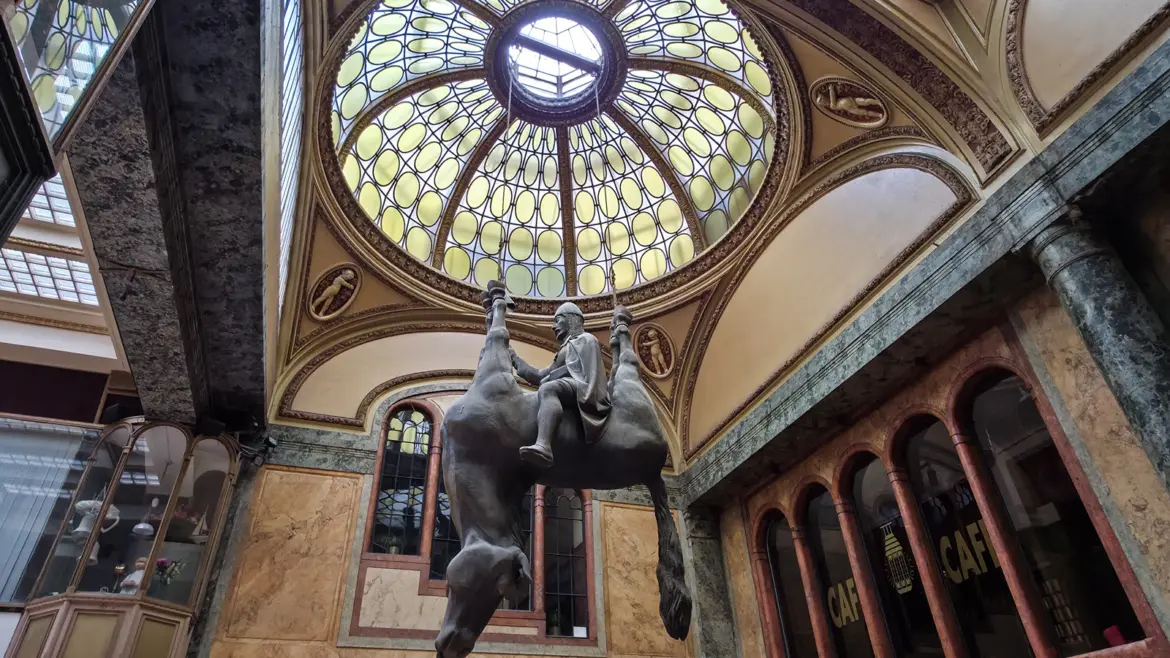
On one of our Prague mornings, we took a walk with a local historian. In about an hour, without ever straying far from Wenceslas Square, we found a saint riding an upside-down horse, a garden behind a passage, a medieval cemetery under the pavement and a giant head that takes itself apart. All of them are a street or a doorway away from the crowds, and all of them are easy to miss without someone who knows where to turn.
This is that walk, in the order we did it.
Hidden Corners off Wenceslas Square at a Glance
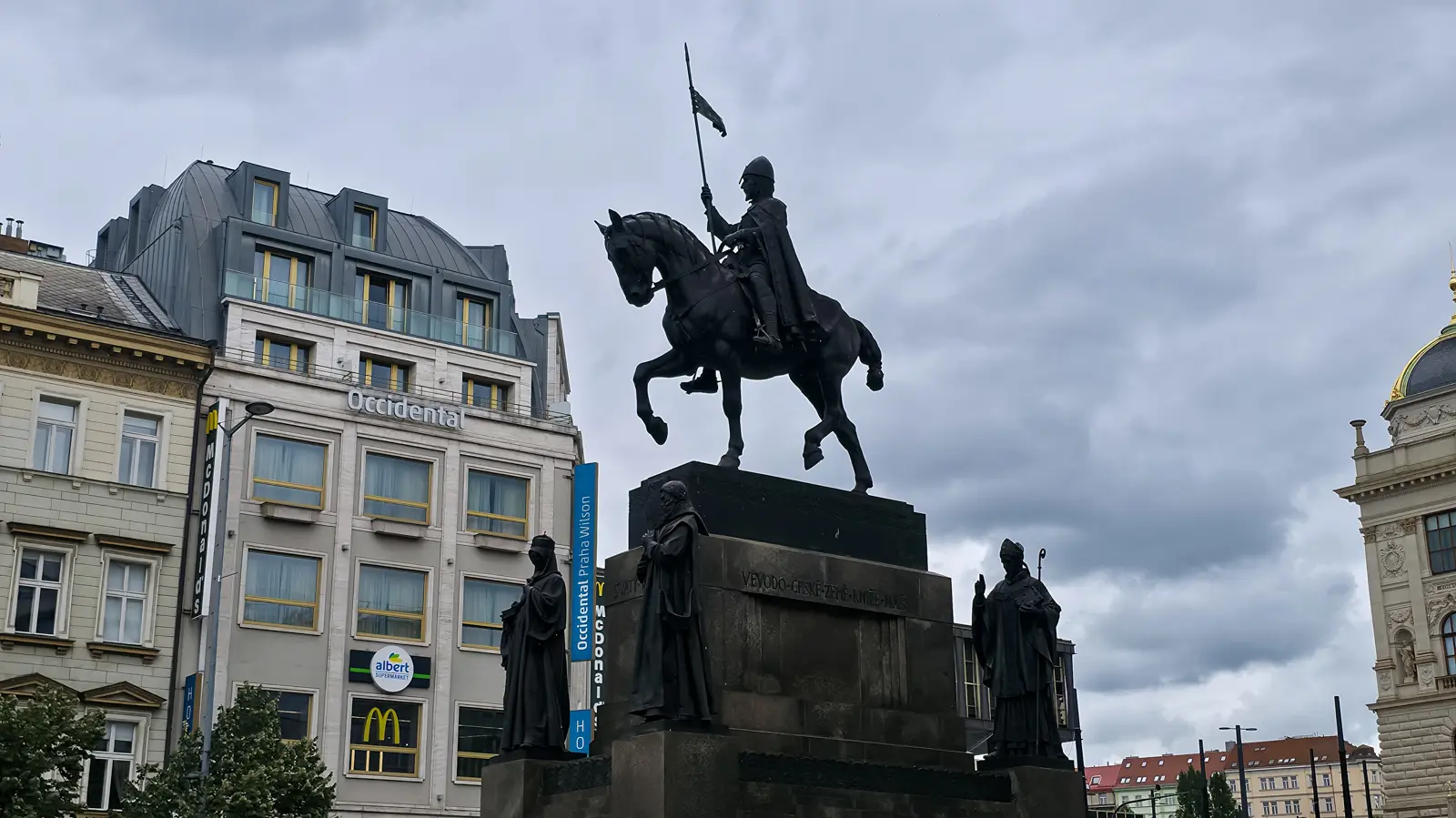
🐴 A saint and his upside-down horse · Start at Myslbek’s St Wenceslas, then find David Černý’s version hanging in Lucerna Passage, the saint astride a dead horse.
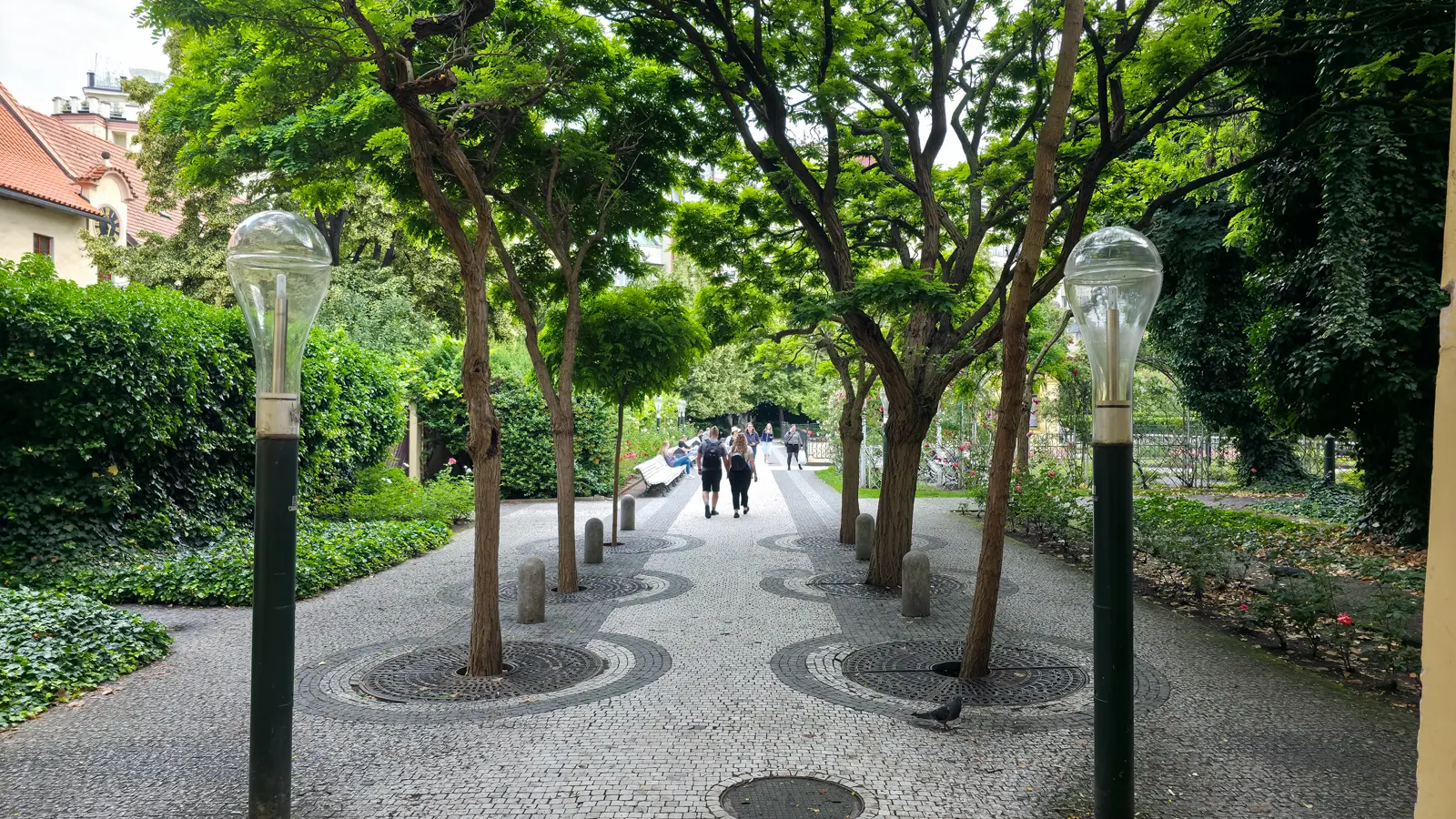
🌳 A monastery garden behind a passage · A cut-through from Lucerna opens into the Franciscan Garden, a quiet square of trees, benches and roses.
📖 A statue for the Czech language · On Jungmannovo náměstí, Josef Jungmann, the National Revival linguist, sits before the Austrian Cultural Forum.
🕯️ A cemetery under the street · On Vladislavova Street, a stone memorial marks a medieval Jewish cemetery that now lies beneath the buildings.
🪞 Kafka’s head that takes itself apart · At Quadrio, Černý’s 11-metre mirrored head of Franz Kafka splits into 42 layers, spins and reassembles.
🕒 One hour, no tickets · All six stops are free and fit into about an hour without ever straying far from the square.
Start with the Real St Wenceslas
The walk begins at the obvious landmark: the bronze statue of Saint Wenceslas at the top of Wenceslas Square. Josef Václav Myslbek worked on it from 1887. It was first unveiled in 1913 but only completed in 1924, two years after his death. Four Czech patron saints stand around the base: Ludmila, Agnes, Prokop and Adalbert.
Wenceslas himself was a 10th-century duke of Bohemia, murdered by his brother Boleslaus and soon venerated as a martyr. English speakers know him better as the Good King Wenceslas of the Christmas carol, and Czechs mark his feast on 28 September as Czech Statehood Day. The square was not always his, either. Charles IV laid it out in 1348 as the Horse Market of his New Town, and it took the saint’s name only in the 19th century.
The inscription below the horse is a prayer: Saint Wenceslas, duke of the Czech land, our prince, do not let us or our descendants perish. The statue has been the gathering point for the square’s biggest moments, from the founding of Czechoslovakia in 1918 to the demonstrations of 1989. Take a good look at it, because the next stop answers it.
Lucerna Passage and the Upside-Down Horse
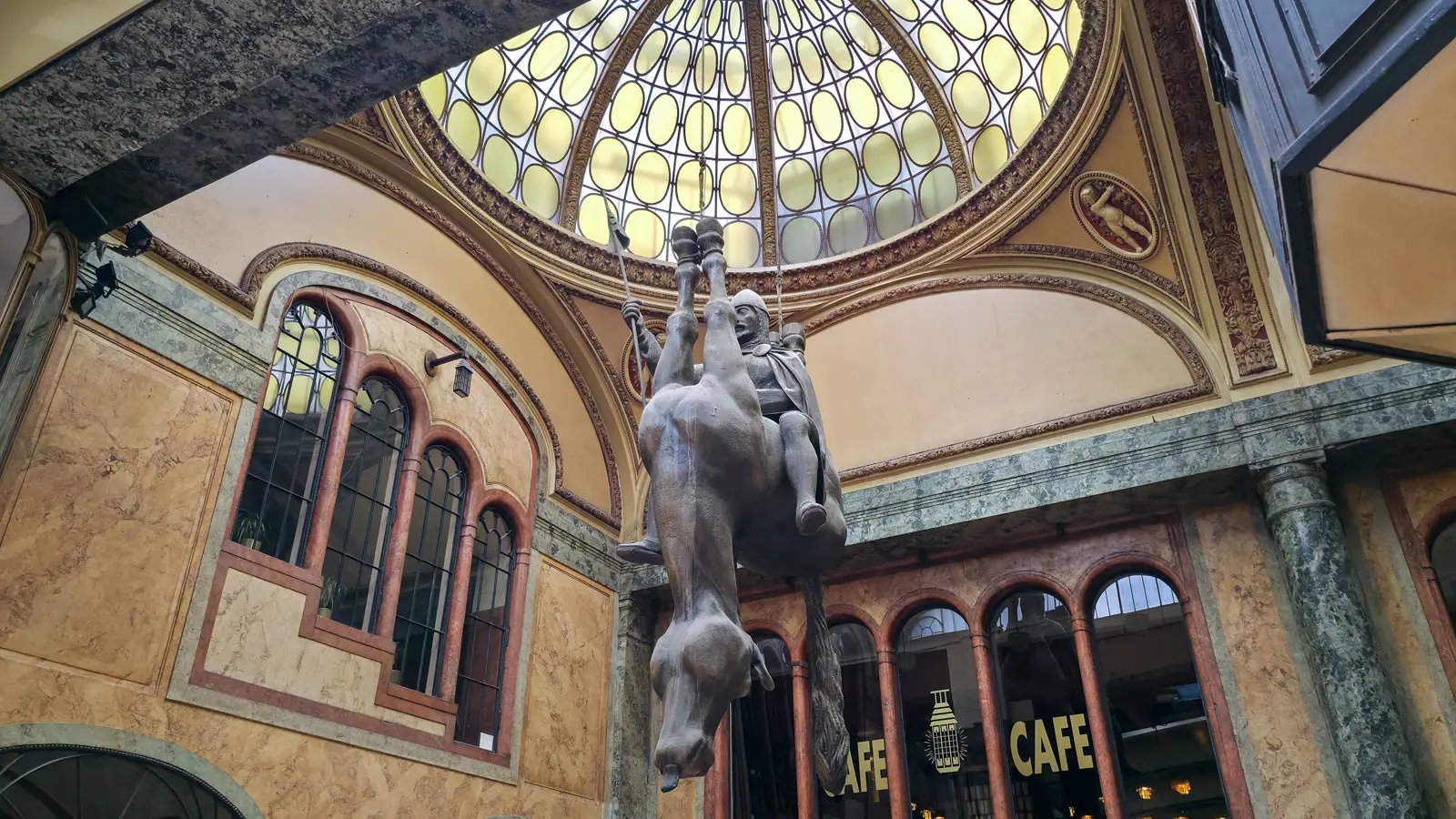
A few minutes down the square, a doorway leads into the Lucerna Passage, an arcade inside Lucerna Palace. Vácslav Havel, grandfather of the playwright and president Václav Havel, built the palace between 1907 and 1921 as a hub of shops, cafés, a cinema and a great hall. He was an engineer as well as an entrepreneur, and he designed it himself with J. Čamský, around a reinforced-concrete frame by the structural engineer Stanislav Bechyně. Havel died in September 1921, just after seeing it finished.
We stopped to see historic Lucerna, and above all its statue. In the round hall at the centre of the arcade, under a glass dome, hangs Horse (Kůň) by David Černý. It is the same Saint Wenceslas we had just left, with one change: he sits astride the belly of a horse hanging upside down, its head drooping towards the floor. Černý made it in 1999. It first hung at the lower end of Wenceslas Square during an exhibition that autumn and moved into Lucerna in February 2000. Seeing it right after the real statue is the best part of the walk.
So why is the horse upside down? Černý rarely explains his work, so there is no official answer. The details make the joke plain, though: the horse is dead, strung up by its tied hooves with its tongue hanging out, while Wenceslas sits on its belly with the same dignified bearing as Myslbek’s saint. Most readings see it as a send-up of the solemn statue up the square, and of the way a nation treats its heroes. Many also read it as a comment on Czech politics after 1989, with the patron saint proudly riding a horse that is going nowhere. Some guides go further and link it to Václav Klaus, a leading politician of the day who shares the saint’s Czech name, Václav. Černý has never confirmed any of it.
Černý is known for provocative public art, and his works turn up all over Prague, often where nobody expects them. This is one of his older public pieces, and it is not the last of his works on this walk.
A Green Detour: The Franciscan Garden
From the passages around Lucerna, a short cut-through leads into the Franciscan Garden, a quiet square of trees, benches and roses tucked behind the buildings of Wenceslas Square. It began after 1348 as the much larger garden of the Carmelite monastery of Our Lady of the Snows, passed to the Franciscans in 1604, and opened to the public in 1950, when the communists expelled the friars.
The church it belonged to, Our Lady of the Snows, was founded in 1347 to mark the coronation of Charles IV and was meant to be one of the largest churches in Prague. Wars and money troubles stopped the work, and only the tall Gothic chancel was ever finished. That chancel is the church that stands beside the garden today. The garden keeps an early Baroque cross-shaped layout, aligned with the church. At its centre is a small pavilion, now a shop, surrounded by herb beds, and rose bushes line the paths. Locals come here for a takeaway lunch on the benches, and it doubles as a shortcut between Wenceslas Square and Jungmannovo náměstí.
A Statue for the Czech Language: Jungmannovo náměstí
One of the garden’s exits leads out onto Jungmannovo náměstí, a small square where a bronze figure sits in an armchair on a tall granite pedestal. This is Josef Jungmann (1773 to 1847), a linguist and poet and one of the leading figures of the Czech National Revival. He championed written Czech, wrote his own works in it and coined new words where the language had gaps, and many of them became a permanent part of the language. His five-volume Czech-German dictionary appeared in the 1830s, and together with his teacher Josef Dobrovský he is regarded as one of the creators of modern Czech. In 1840 he became rector of Charles University, and he lived just around the corner, on the street that now bears his name.
The statue took years to make. The sculptor Václav Levý began it, and after his death in 1870, Ludvík Šimek completed it from Levý’s original sketch, on a pedestal designed by the architect Antonín Barvitius.
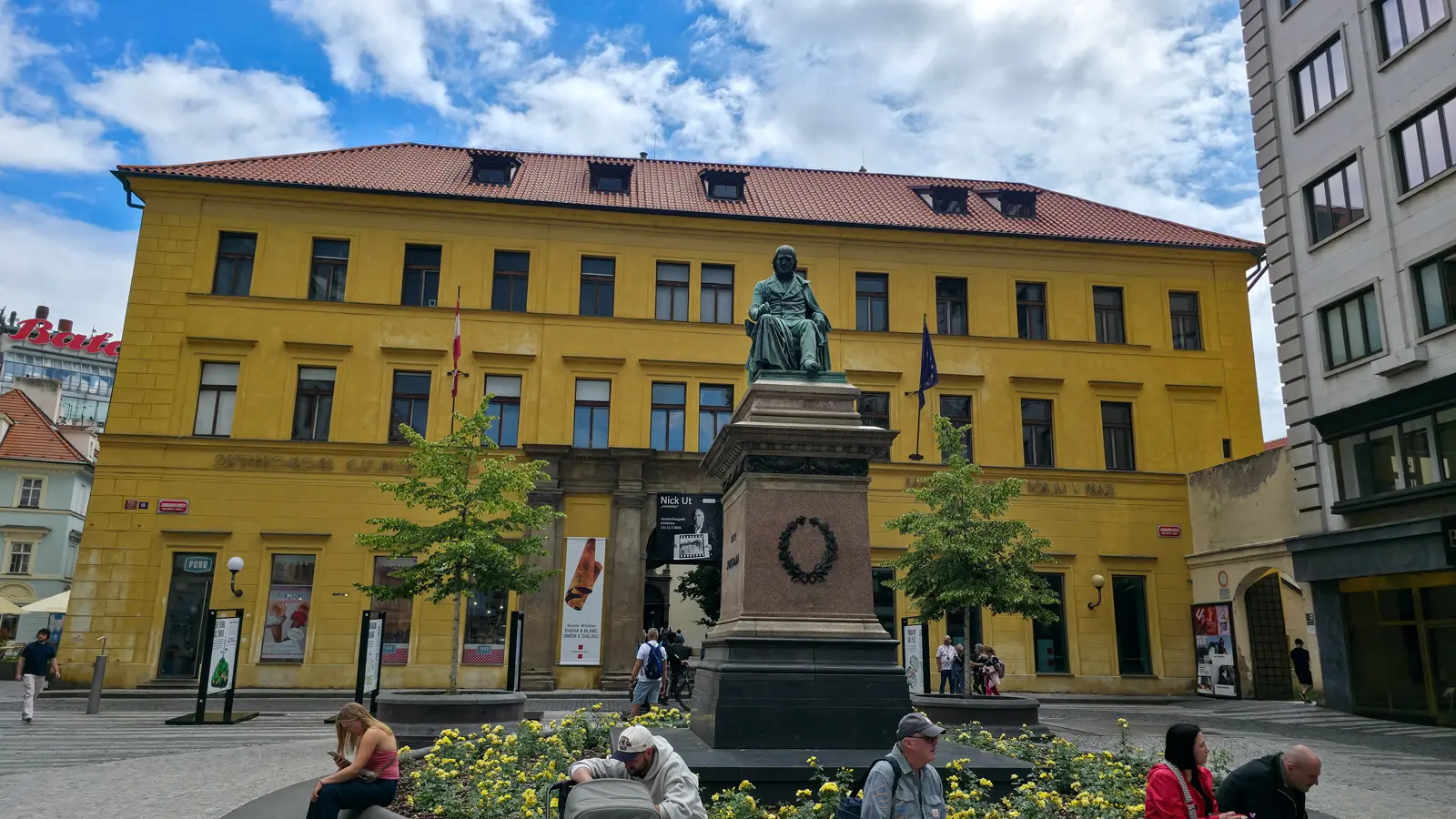
Behind him, the yellow building flying the Austrian and EU flags is the Austrian Cultural Forum. It has had its own premises here since 1996, with a contemporary art gallery and a library of about 8,000 books, and it organises around 250 events a year. When we passed, banners for a photography exhibition and an art show hung at the entrance. It makes for an interesting pairing: a monument to the champion of the Czech language, with the Austrian flag flying behind it.
Sacred Ground on Vladislavova Street
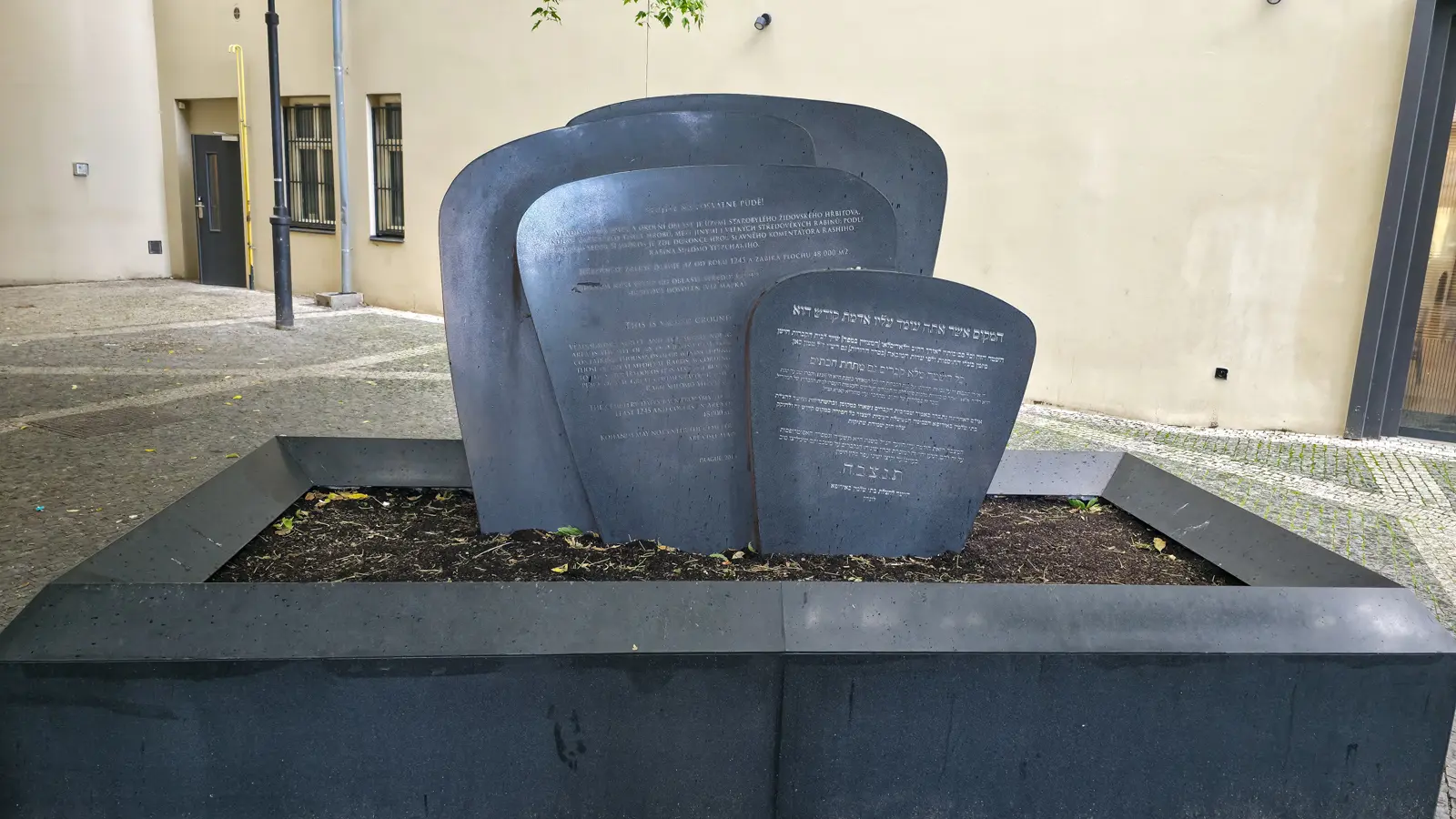
This was the stop that surprised me most. On Vladislavova Street, in a quiet corner by a building entrance, a group of dark stones shaped like gravestones carries an inscription in Czech, English and Hebrew. The English text opens with “This is sacred ground”, and the Hebrew quotes the words spoken to Moses at the burning bush.
The memorial marks a medieval Jewish cemetery, known as the Jewish Garden, used from the 13th century until 1478, when King Vladislaus II abolished it and the land was divided into building plots. Today the whole cemetery lies under houses and pavement. Its replacement was the Old Jewish Cemetery in Josefov, the famous burial ground most visitors to Prague queue to see, which served the community from the early 15th century until 1787. Its story came back to the surface in the late 1990s, when excavations for a new office building uncovered hundreds of graves. Orthodox groups protested at the site and abroad, some remains were reburied at the New Jewish Cemetery, and many graves were sealed in concrete beneath the new building.
The Jewish Garden had surfaced before. In 1866, fragments of tombstones from the second half of the 14th century turned up during construction work on Vladislavova Street and were moved to the Old Jewish Cemetery, where they were set into the wall. So the two cemeteries are linked: a few stones from this lost burial ground now stand among the graves of the one that replaced it.
Kafka’s Head at Quadrio
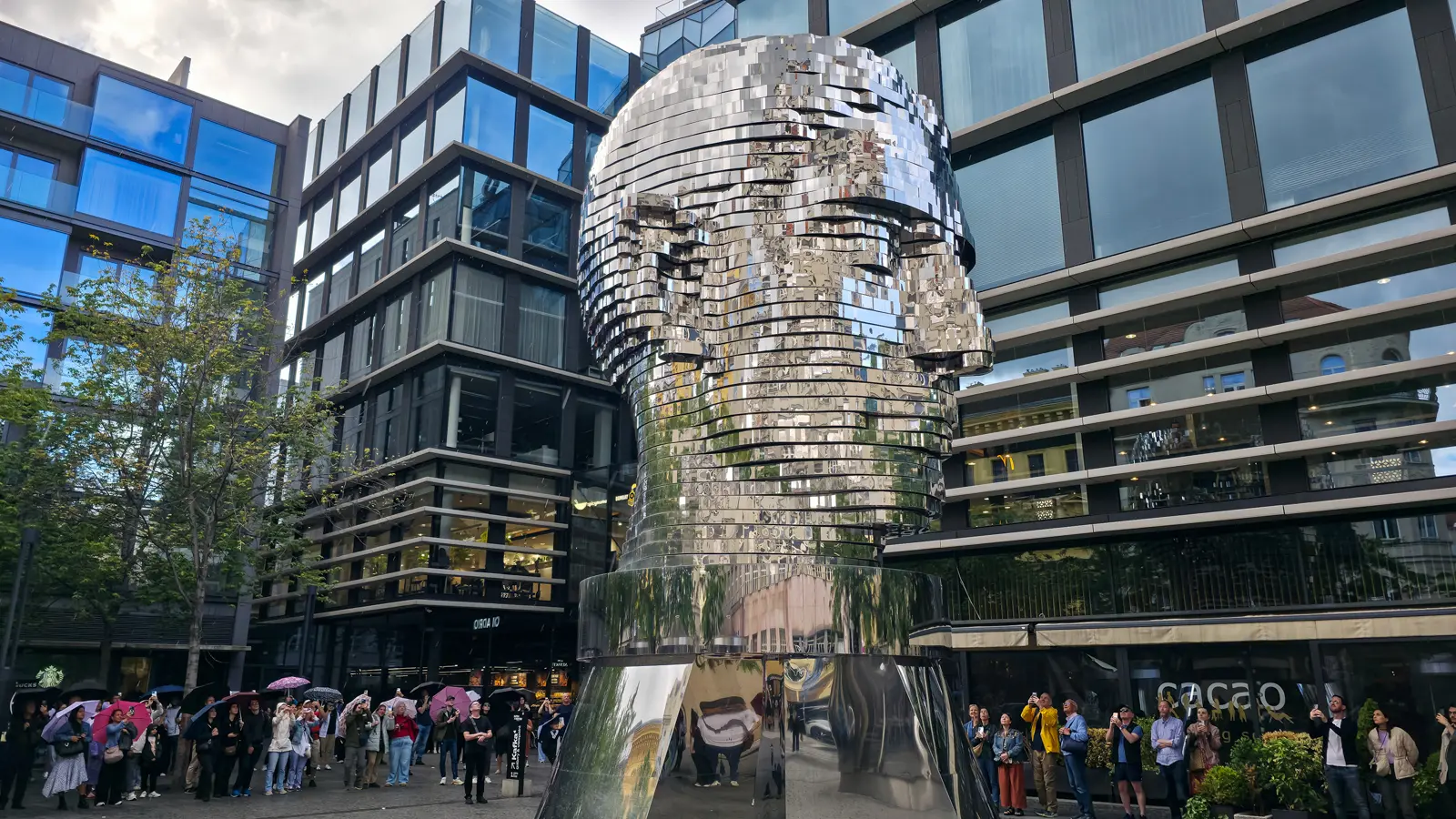
A minute later, we were standing in front of the Quadrio centre, where David Černý struck again. His head of Franz Kafka, unveiled on 31 October 2014, rises about 11 metres and is built from 42 layers of polished stainless steel. Each layer turns on its own, so the face breaks apart into slices, spins and reassembles itself.
Kafka was born in Prague in 1883 and wrote in German, and his best-known story, The Metamorphosis, is about a man who wakes up transformed. A head that keeps falling apart and putting itself back together suits him, and the piece is often read as a portrait of a restless, many-layered mind. In the mirrored steel, the reflections of the surrounding buildings break up along with the face.
We saw it rotate, and it was amazing. A whole crowd stood around it, umbrellas up and phones raised, and we all waited for the moment the layers started to move.
Bubbly Tips
- Walk it in this order. Start at the St Wenceslas statue, then Lucerna, the Franciscan Garden, Jungmannovo náměstí, Vladislavova Street and Quadrio. Allow about an hour with stops.
- See the statue first. The upside-down horse in Lucerna only lands properly once you have the real statue fresh in your mind.
- Enter Lucerna from either side. The passage runs between Wenceslas Square and Vodičkova Street, and the horse hangs in the central hall.
- Use the garden as a shortcut. The Franciscan Garden is free and has entrances from Jungmannovo náměstí, the Světozor passage off Vodičkova Street and a passage from Wenceslas Square. It closes at night, with hours that change by season.
- Find the Cubist lamp post. It is tucked into a corner of Jungmannovo náměstí. The architect Emil Králíček designed it in 1912 to 1913 as part of his rebuilding of the Adam Pharmacy on Wenceslas Square, and it is billed as the only Cubist lamp post in the world. The lantern on top is a copy; the original went to a museum.
- Check what is on at the Austrian Cultural Forum. It is open on weekdays, from 10 a.m. to 5 p.m. for most of the year and until 4 p.m. in July and August.
- Look for the memorial on the way to Kafka. The Vladislavova Street stones are only a minute’s walk from Quadrio, so they are easy to fit in and just as easy to walk past.
- Be patient at Kafka’s head. It rotates in cycles, so join the crowd and wait for the layers to start moving.
- Be respectful at the Vladislavova memorial. It marks a burial ground, so keep voices low and don’t sit or lean on the stones.
- Consider a local guide. We would have walked straight past half of these places without one.
Final Thoughts
In one short walk, Prague showed us a saint on his horse and the same saint on a dead one, a monastery garden behind a shopping passage, the man who championed the Czech language, and a medieval cemetery hidden under an ordinary street. And at the end, Kafka’s head came apart and put itself back together in front of a crowd with umbrellas up.
None of these stops needs a ticket, and all of them fit into an hour, which makes this an easy walk to slot into a first day in Prague.
Until next time!

🌟 Everything You Need to Plan Your Dream Trip in 2026
- 🌟 Luxury Hotels - Find premium stays with Booking.com & Hotels.com
- 🏡 Vacation Rentals - Discover unique properties on VRBO
- 🏞️ Guided Tours - Explore with Viator or GetYourGuide
- 🎫 Attraction Tickets - Skip the lines with Tiqets
- 🚢 Ocean Cruises - Set sail with Cruise Direct
- 📱 International SIMs - Stay connected with Saily
- 🚗 Car Rentals - Budget-friendly options from Discover Cars
- 🌐 Secure VPNs - Browse safely with NordVPN
- 💶 Currency Exchange - Best rates with Wise
- 🗣️ Learn Languages - Master the local language with Babbel and Rosetta Stone