
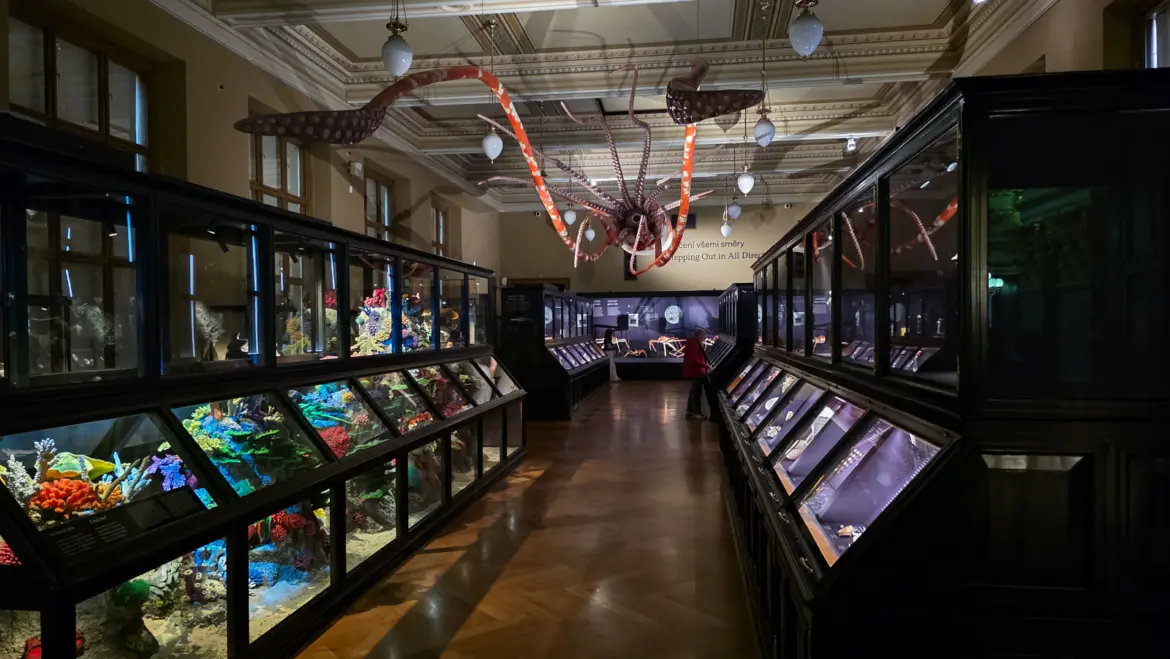
The first room of the Miracles of Evolution at Prague’s National Museum is filled with sea creatures, spiders and a giant squid. The colours were vivid, and the explanations and visuals were stunning. I learned so many things in that one room.
The hall is called Stepping Out in All Directions, and it is devoted to invertebrates, the animals without a backbone. It is the opening hall of the whole exhibition, so it sets the tone for everything after it. It also tested me. I thought my fear of spiders was over, and by the end of this room it was back.
The Giant Squid Room at a Glance
🦑 The world’s largest squid model · A 17-metre giant squid hangs over the first hall of the Miracles of Evolution, repainted to match rare 2006 footage of a live one.
🪸 A coral reef, alive and bare · Beneath it runs a reef in every colour, beside a wall of bleached skeletons that explains how reefs are built on the dead.
⭐ Sea stars and urchins · Cases of Atlantic, Mediterranean, Pacific and Caribbean sea stars, plus an “urchin desert” with a warning about ecosystems out of balance.
🦀 Crabs that look like spiders · Crustaceans by region, including Japanese spider crabs with a four-metre leg span and the lightning-fast mantis shrimp.
🕷️ A fright among the fish · A spiders case and a giant castor-bean-tick model sit among the sea life, with no warning for arachnophobes.
🕒 Half an hour, one ticket · The hall is the opening room of the Miracles of Evolution, covered by the standard museum ticket.
The Giant Squid Overhead
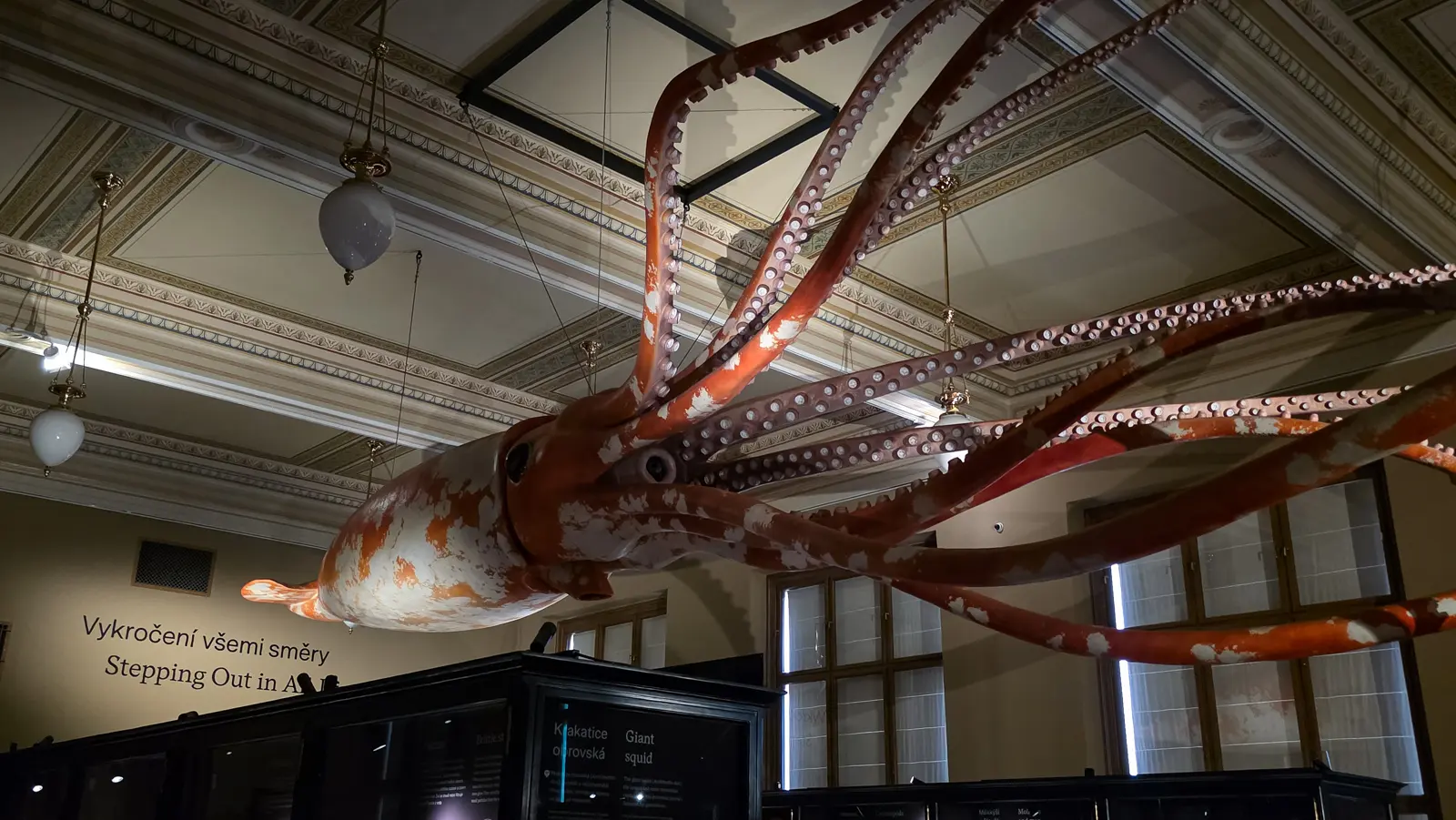
The first thing anyone sees is the giant squid. It hangs from the ceiling, 17 metres long, and the museum describes it as the largest model of a giant squid in the world. It hovers over a coral reef, inside a building that opened in 1891.
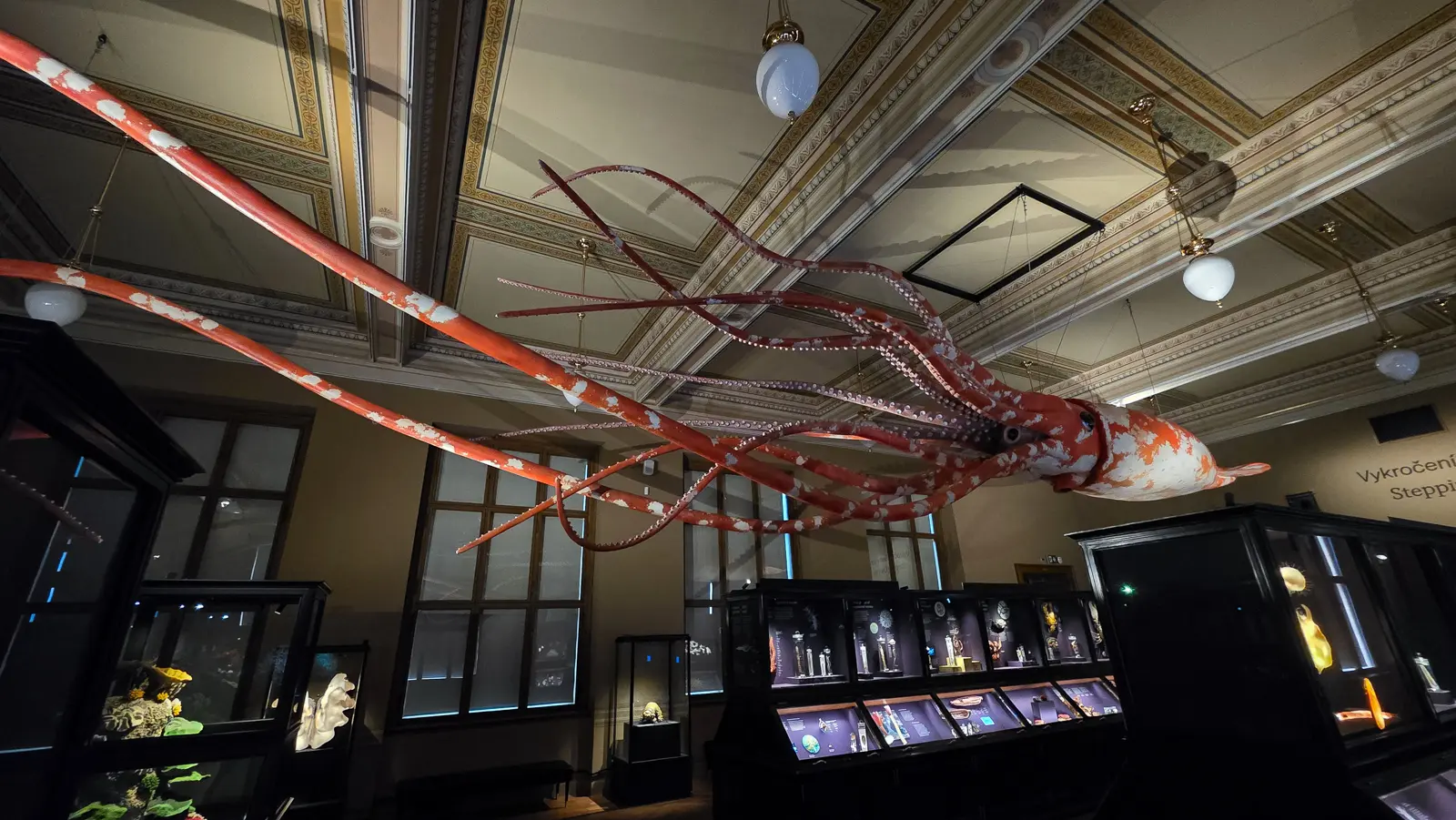
The colouring is not guesswork. The giant squid lives at great depths and is rarely seen alive, but in 2006 a Japanese robotic camera filmed a young one. The museum had its model repainted to match that footage, which is why it is a mottled orange and white rather than the grey of most illustrations.
Coral Reefs, Alive and Bare
Beneath the squid runs a long reef of corals in every colour: pink, yellow, lime green, orange and electric blue. Fan corals and sponges grow out of grey rock, and the lower windows open onto white sand.
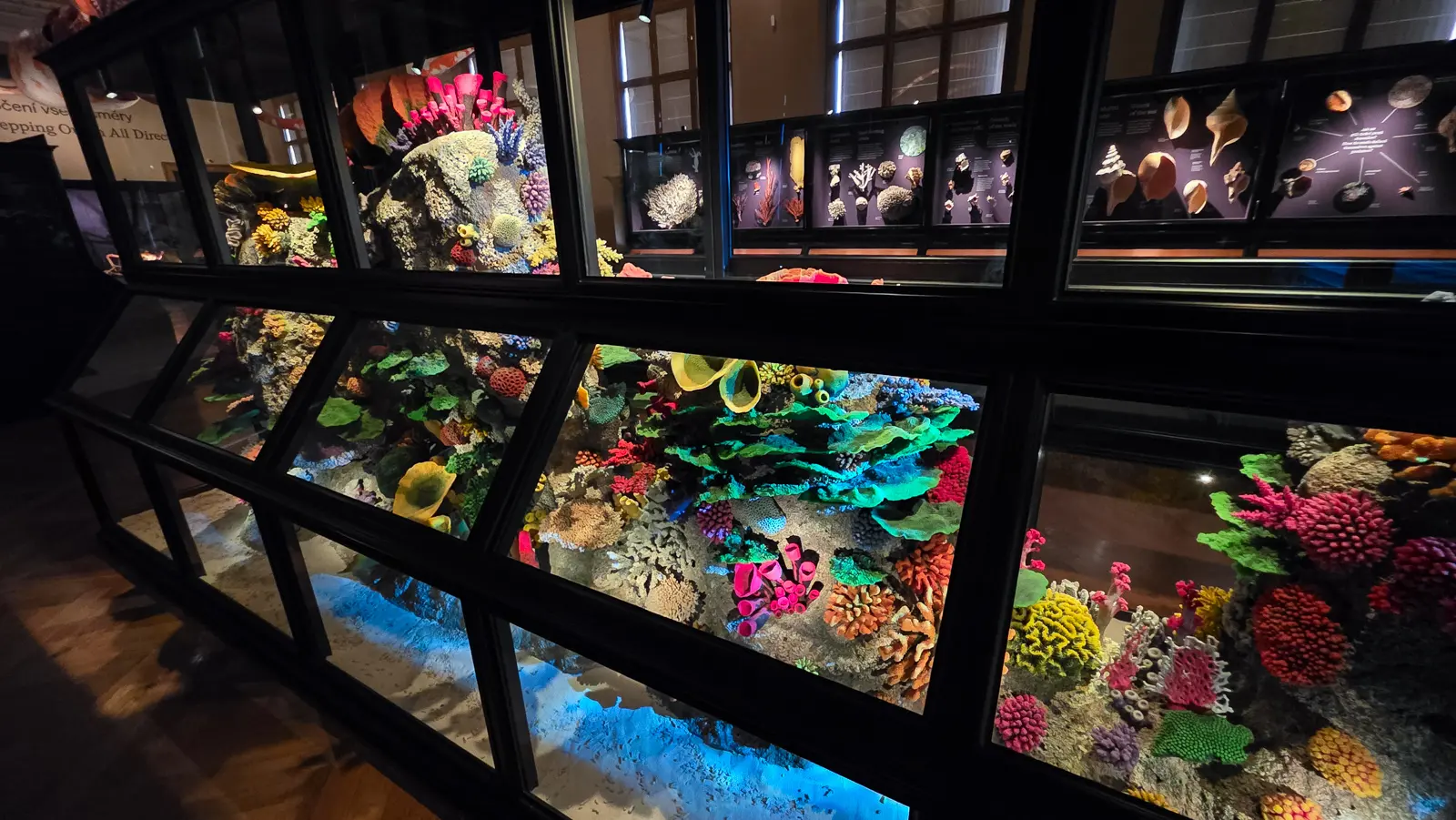
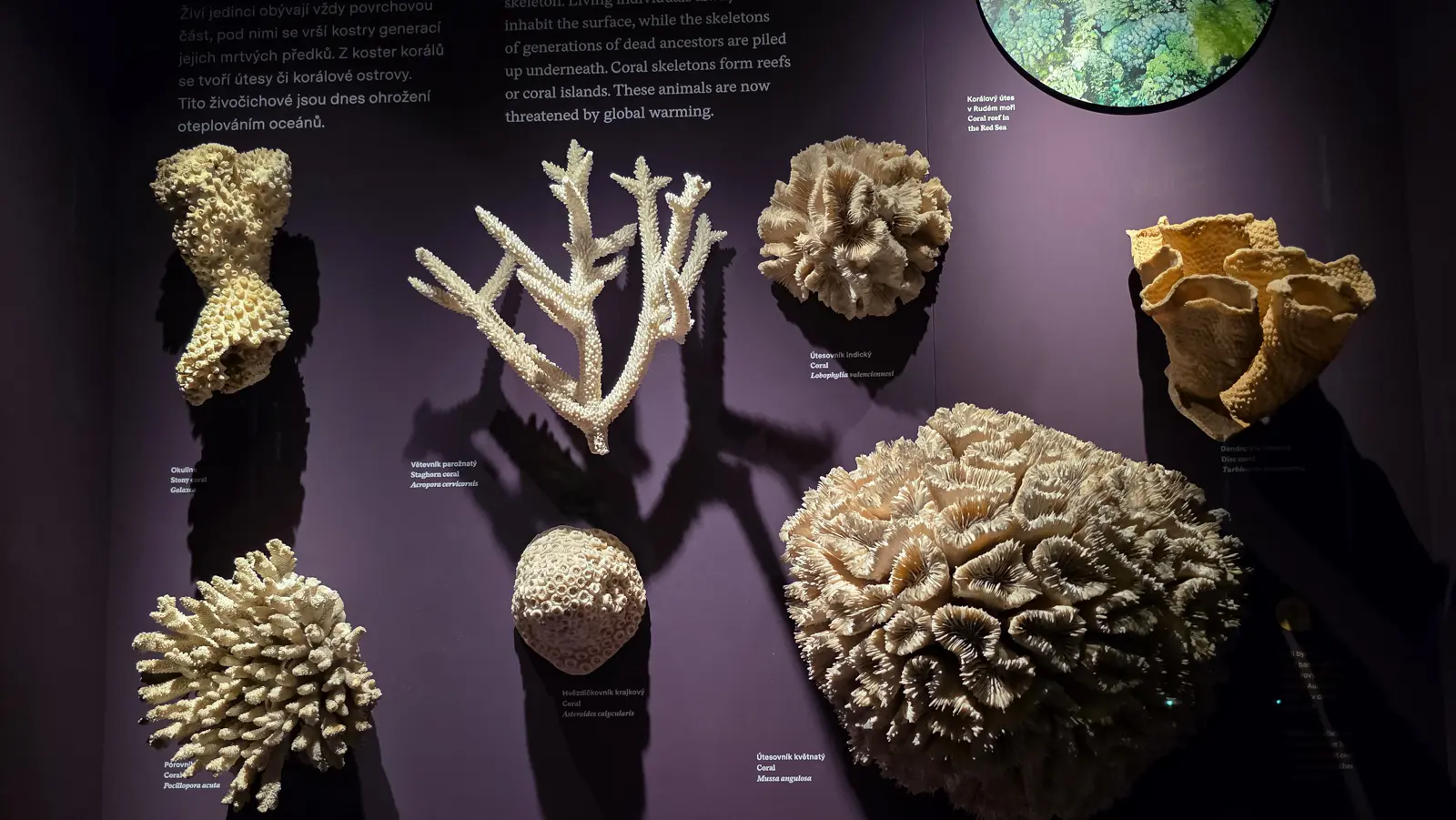
I loved the story of the corals. A label beside a wall of bleached coral skeletons explains that the living animals only occupy the surface of a reef. Underneath them lie the skeletons of generations of their dead ancestors, piled up over time, and those skeletons are what build reefs and even whole coral islands. A photograph of a living reef in the Red Sea hangs above the bare white skeletons. The same label adds that corals are now threatened by global warming.
Sea Stars
The sea stars brought a smile to my face. I remembered my mom telling me how she had found a few on a beach on a Greek island.
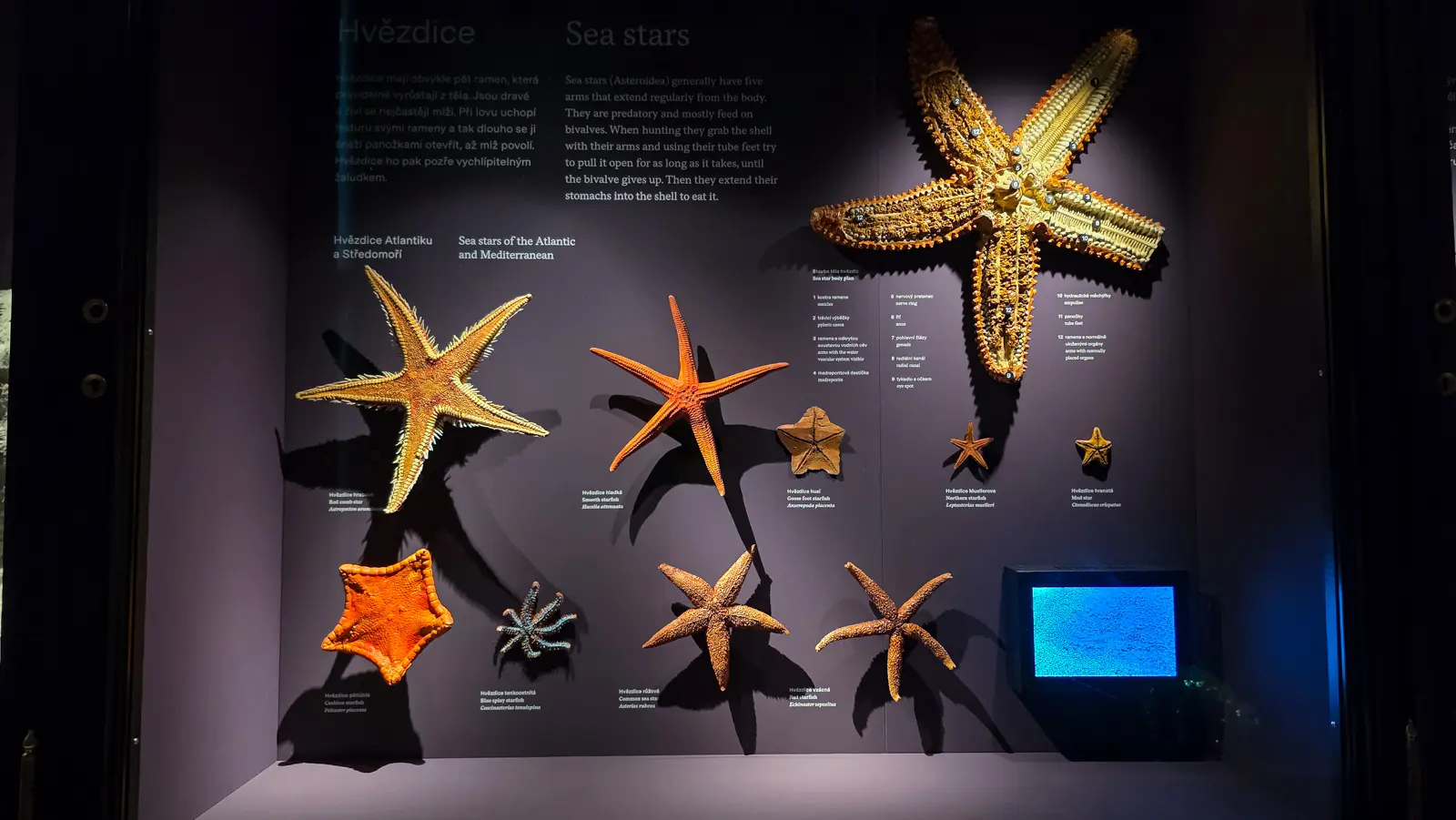
The labels are full of surprises. Sea stars usually have five arms, and they are predators. They feed mostly on bivalves such as mussels, grabbing the shell with their arms and pulling at it with their tube feet for as long as it takes, until the shell gives way. Then they push their stomach out into the shell to eat. One case groups sea stars of the Atlantic and Mediterranean, so the red starfish of the Mediterranean is here too.
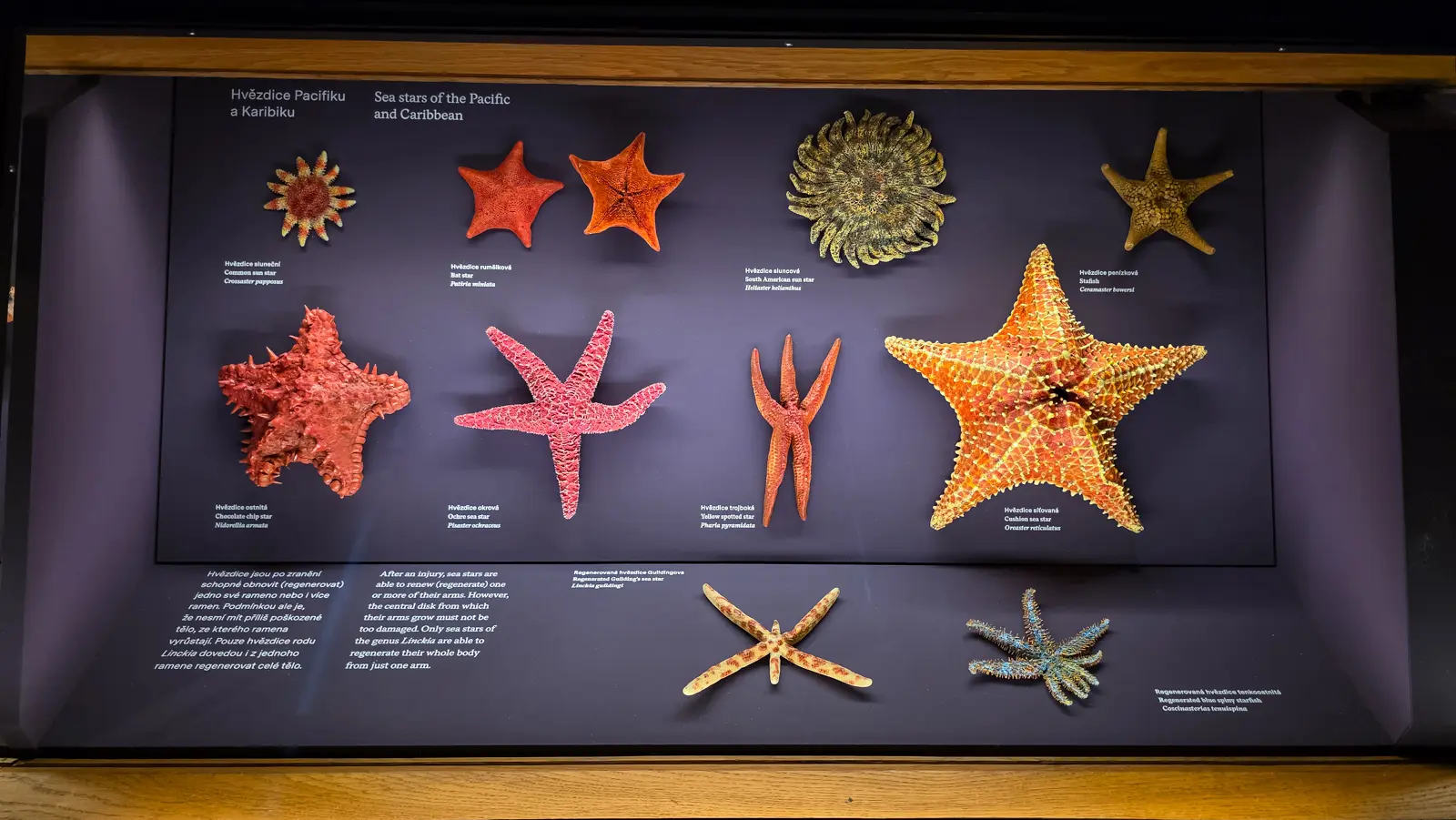
A second case gathers sea stars of the Pacific and the Caribbean, from a spiky chocolate chip star to a South American sun star with dozens of arms. Its label explains that after an injury, a sea star can regrow one or more arms, as long as the central disc is not too damaged. Only sea stars of the genus Linckia can regenerate their whole body from a single arm.
Sea Urchins and a Czech Puzzle
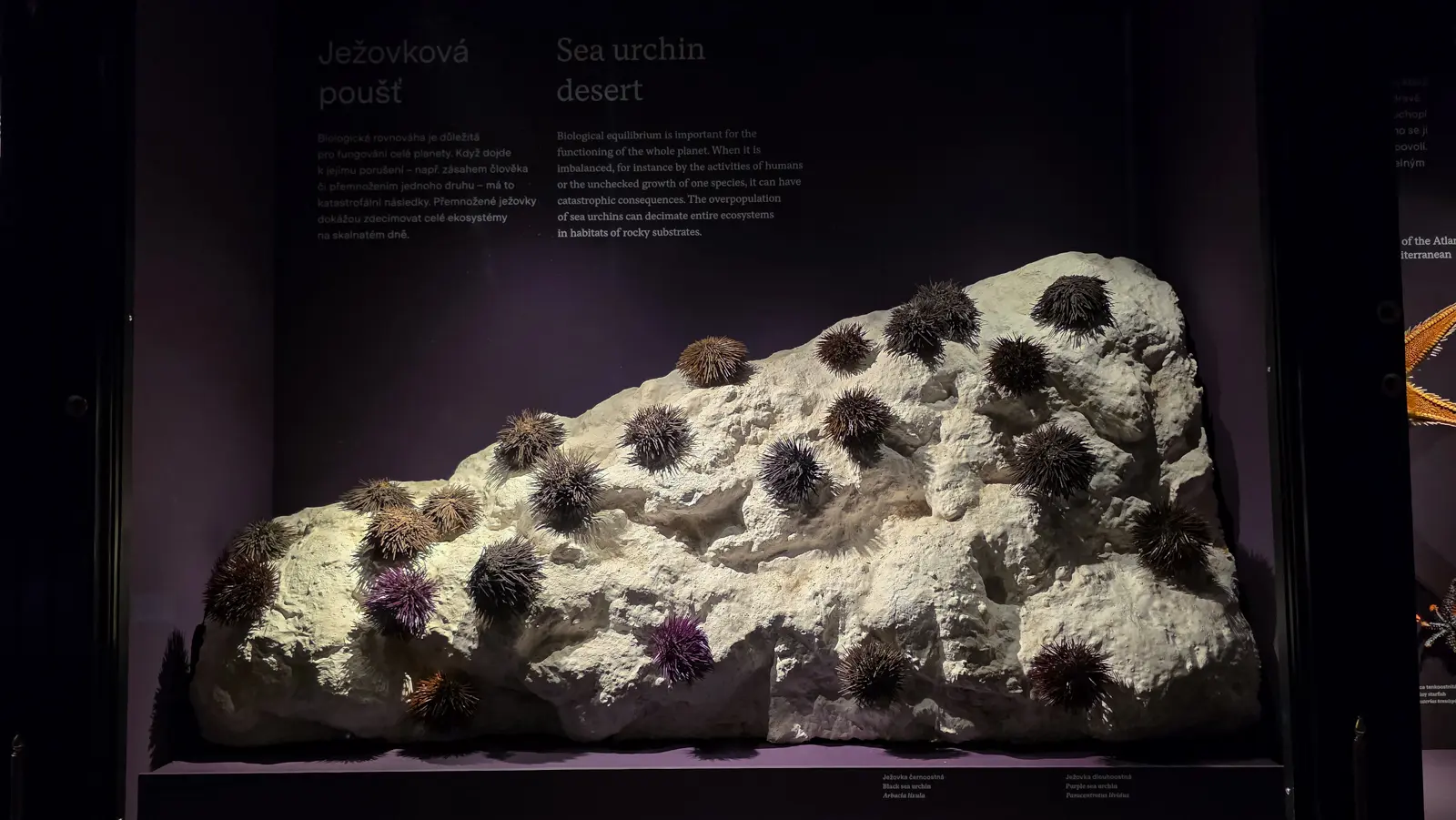
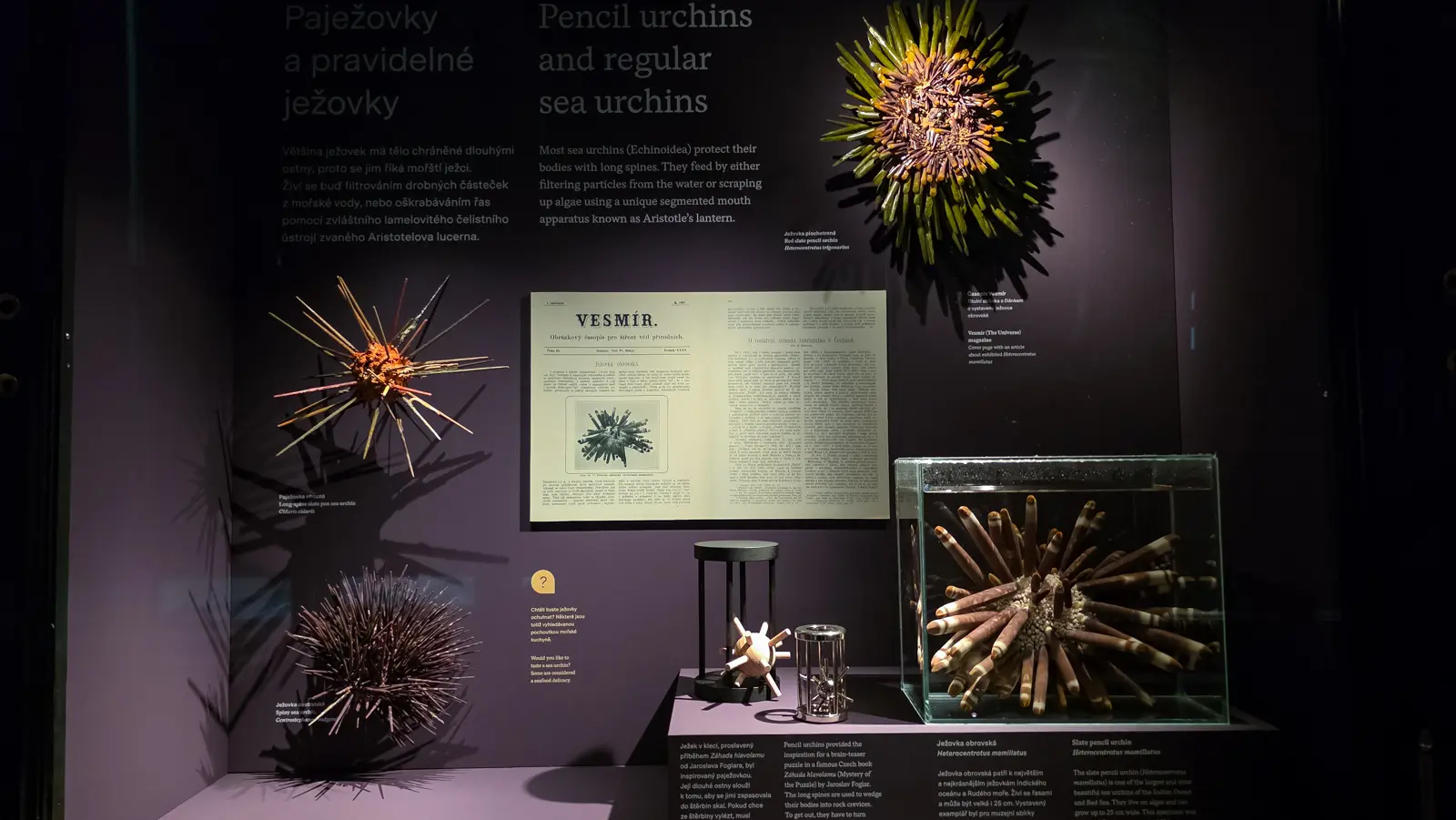
One case is simply a block of pale rock covered in sea urchins. It is called the urchin desert, and the point is a serious one. The label explains that when the balance of an ecosystem is upset, by people or by one species multiplying unchecked, the results can be catastrophic. Too many sea urchins can strip a rocky sea floor bare.
Pencil urchins have thick, blunt spines that they use to wedge themselves into rock crevices, and to get out again they have to turn their body the right way. That habit inspired a brain-teaser in a famous Czech children’s book, Záhada hlavolamu (The Mystery of the Puzzle) by Jaroslav Foglar: the hedgehog in a cage. The museum displays the puzzle right next to the urchins, with a page from the Czech science magazine Vesmír.
Crustaceans and a Lightning Strike
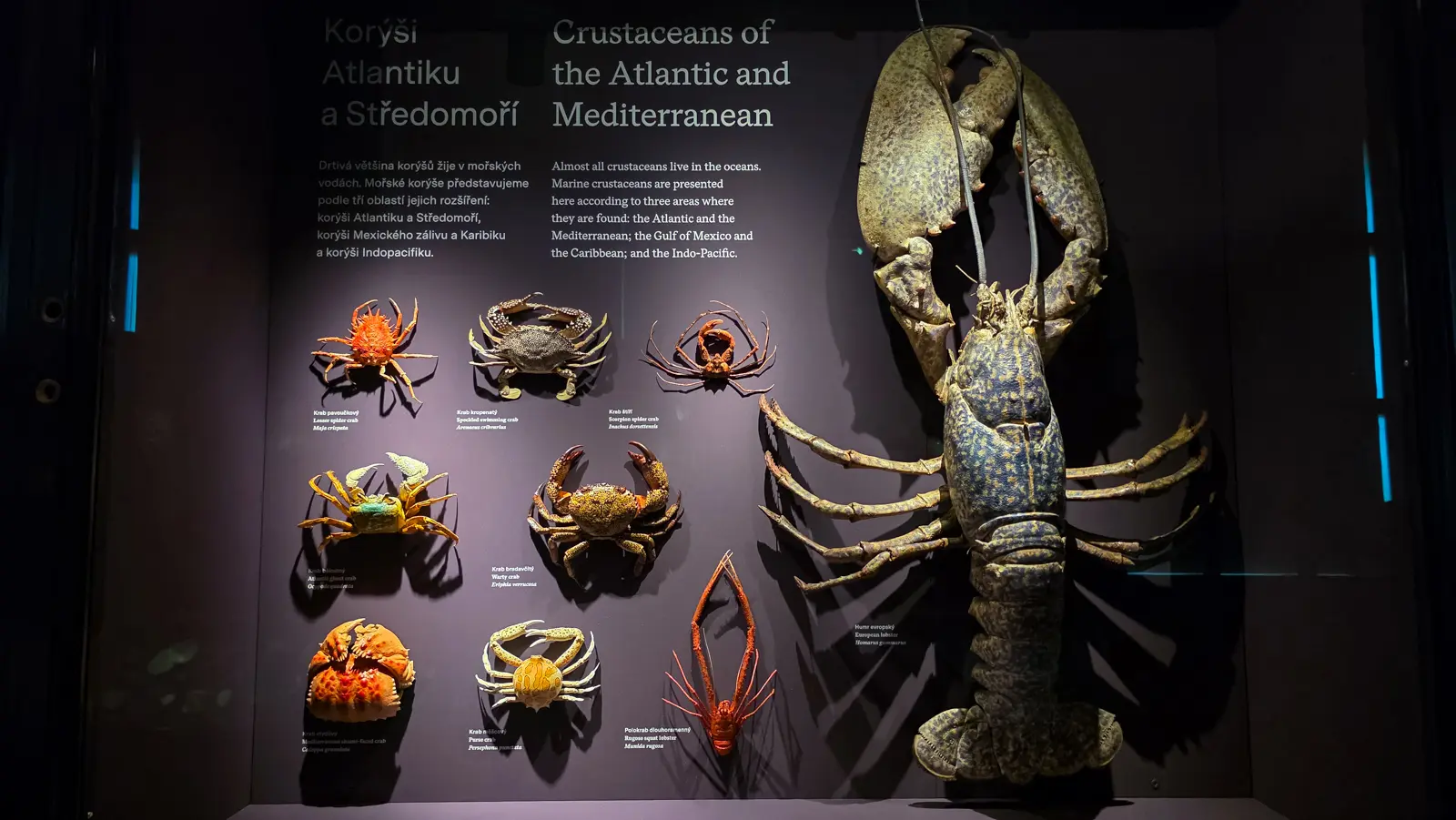
Almost all crustaceans live in the oceans, and the museum groups them by three regions: the Atlantic and Mediterranean, the Gulf of Mexico and the Caribbean, and the Indo-Pacific. The Atlantic and Mediterranean case is dominated by a European lobster, its claws as long as my forearm, surrounded by crabs of every shape.
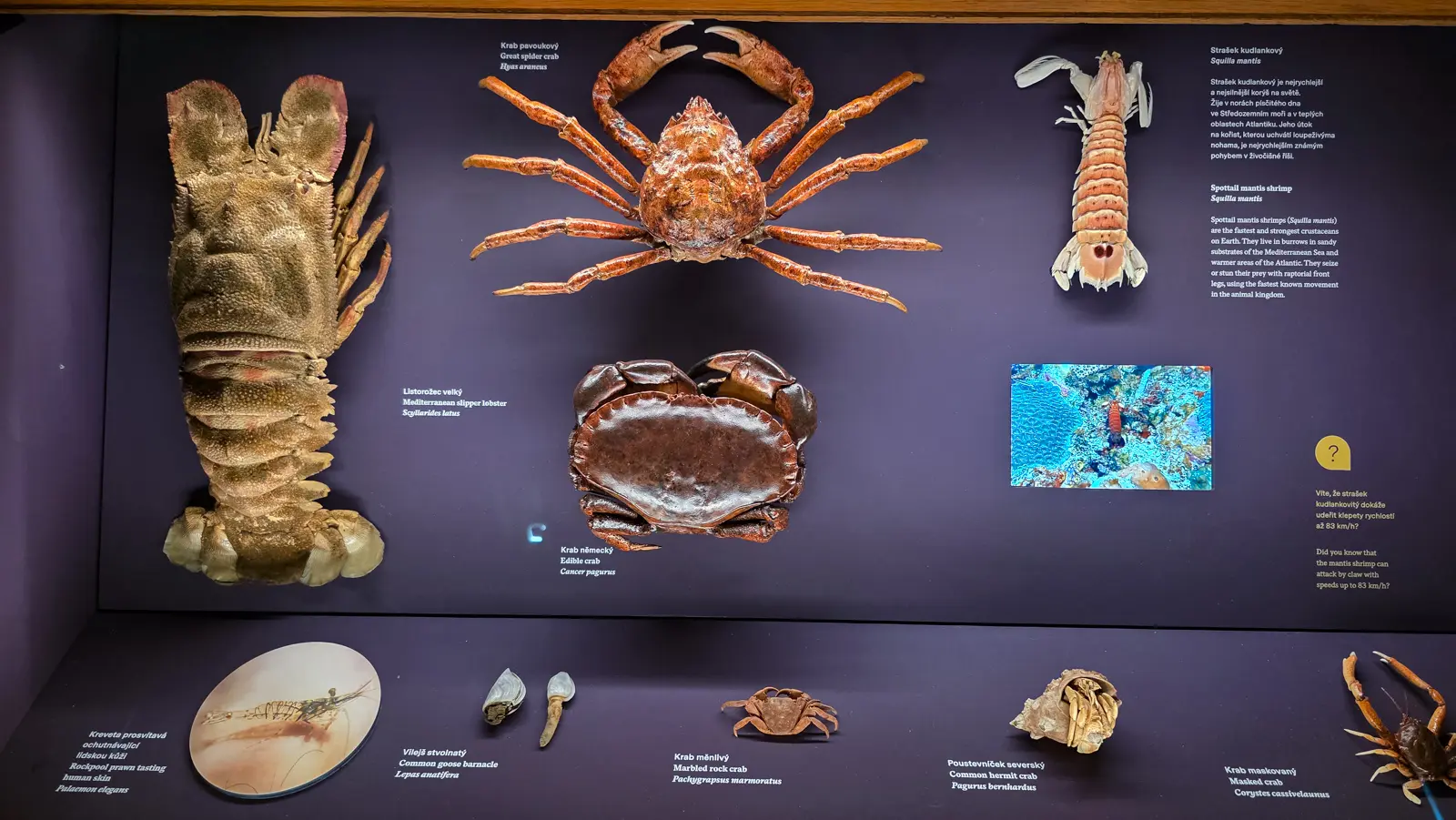
The star of the next case is the spottail mantis shrimp, which lives in burrows in the sandy floor of the Mediterranean and the warmer Atlantic. According to its label, it is the fastest and strongest crustacean on Earth. It seizes or stuns prey with its front legs, using the fastest known movement in the animal kingdom, and a question bubble beside it asks whether visitors know that it can strike at up to 83 km/h.
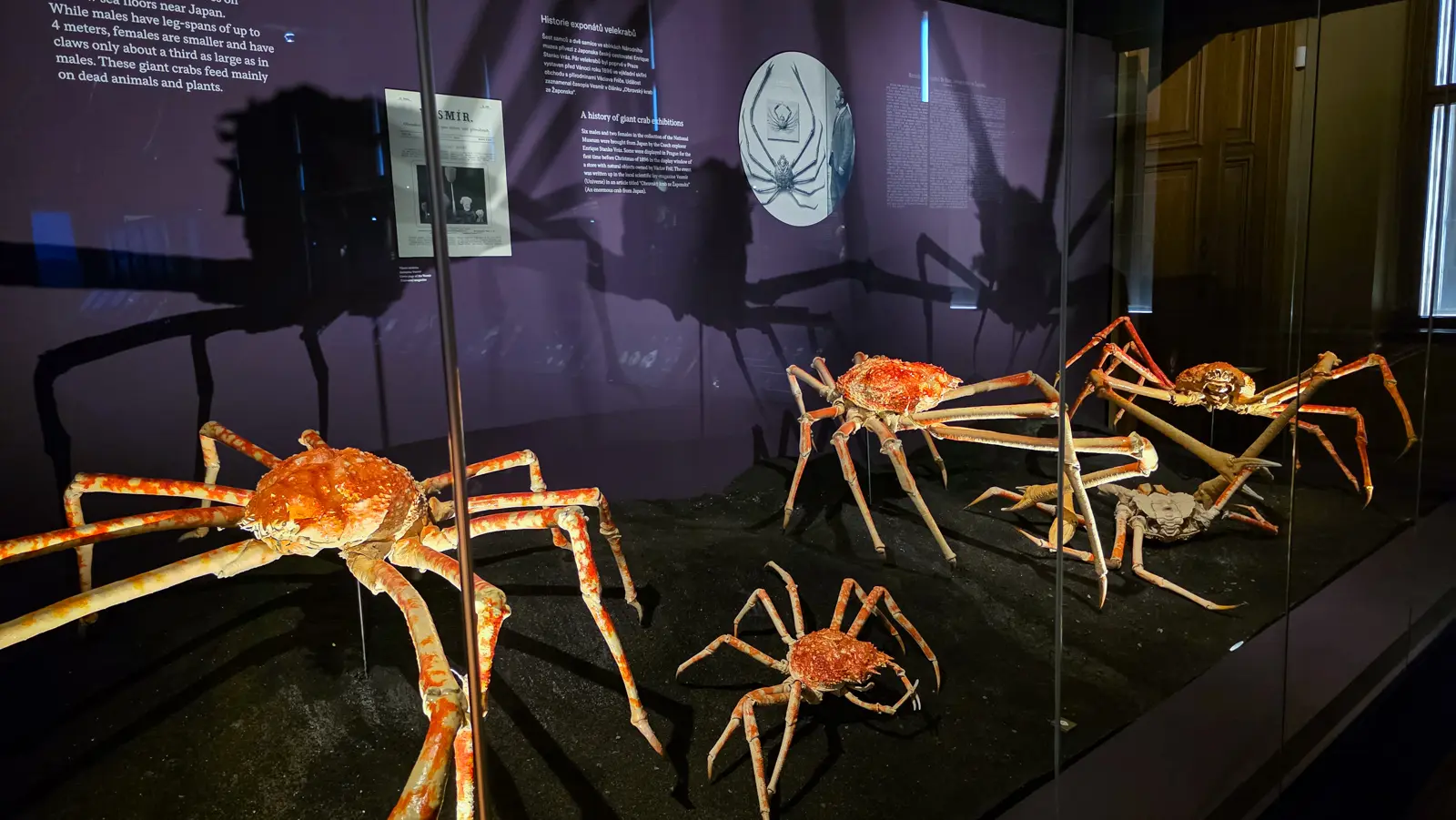
Then came the Japanese spider crabs, and this is where my fear of spiders started to stir. They are crustaceans, not spiders, but with their long, jointed legs and their shadows stretching across the wall, they look exactly like giant spiders. According to the label, males have a leg span of up to 4 metres, while females are smaller, with claws about a third the size. They live on the sea floor near Japan and feed mainly on dead animals and plants.
Not Everything Here Swims
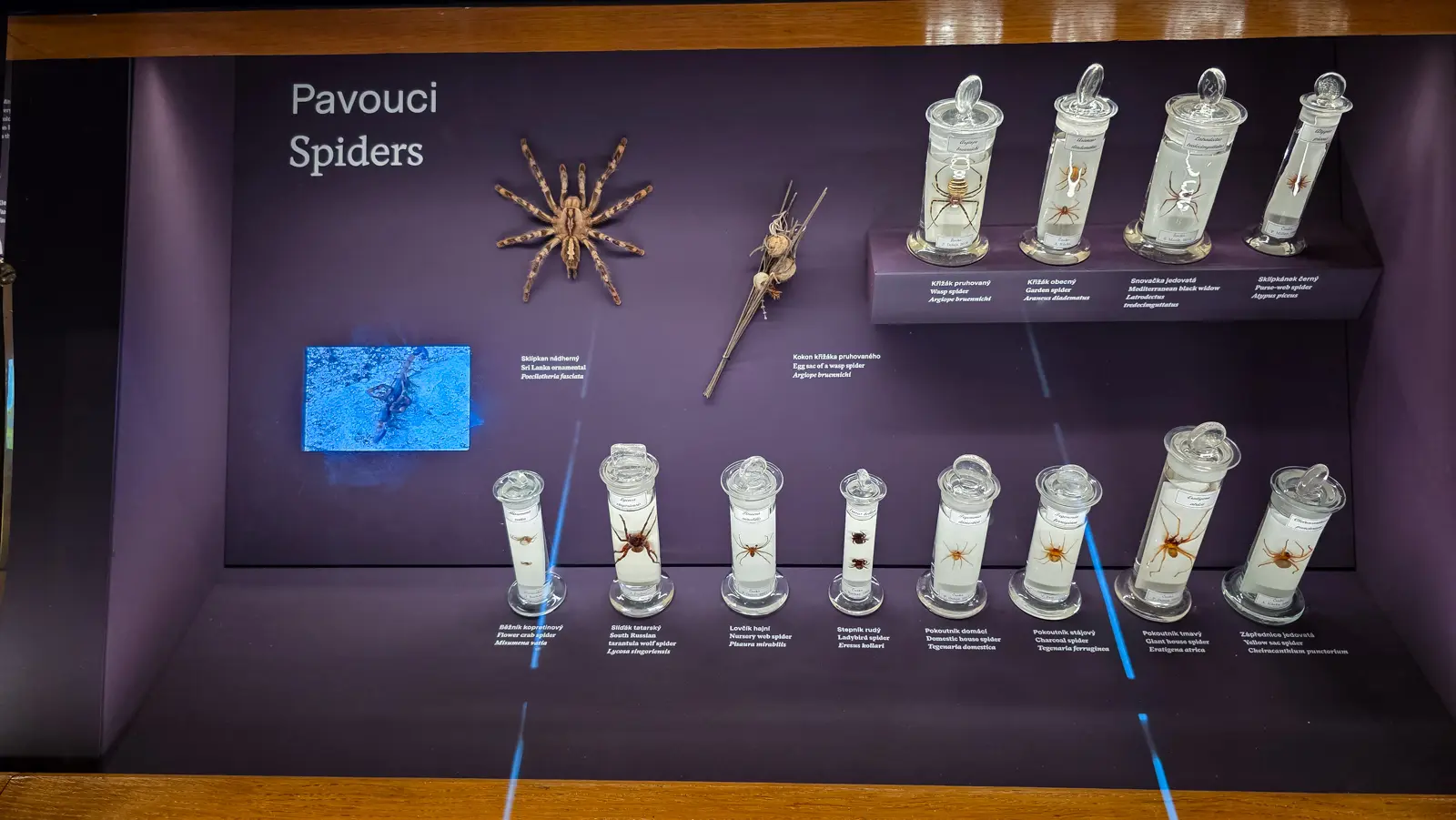
This hall covers invertebrates on land as well, so in the middle of all the ocean life sits a case labelled Pavouci, Spiders. A Sri Lanka ornamental tarantula is pinned at the top, and a row of glass jars holds a wasp spider, a garden spider and a Mediterranean black widow, among others. My fear of spiders was officially back.
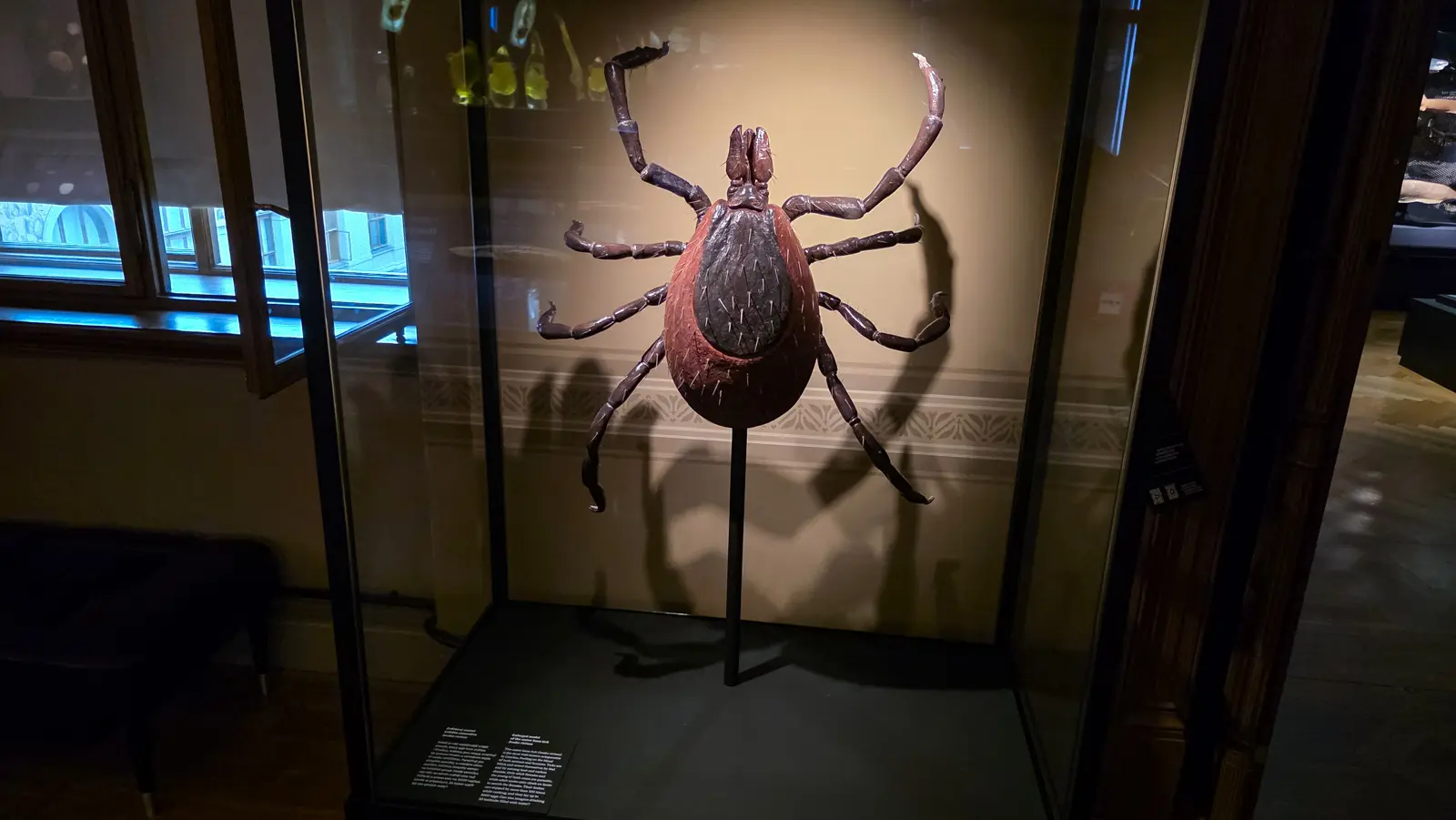
Then I saw what looked like a giant beetle standing in a glass case on a pole. What? It turned out to be no beetle at all. It is an enlarged model of the castor bean tick, Ixodes ricinus, which the label calls the best-known external parasite in Czechia. Ticks are arachnids, close relatives of spiders, so my instinct was not that far off.
Unknown, but Surprising
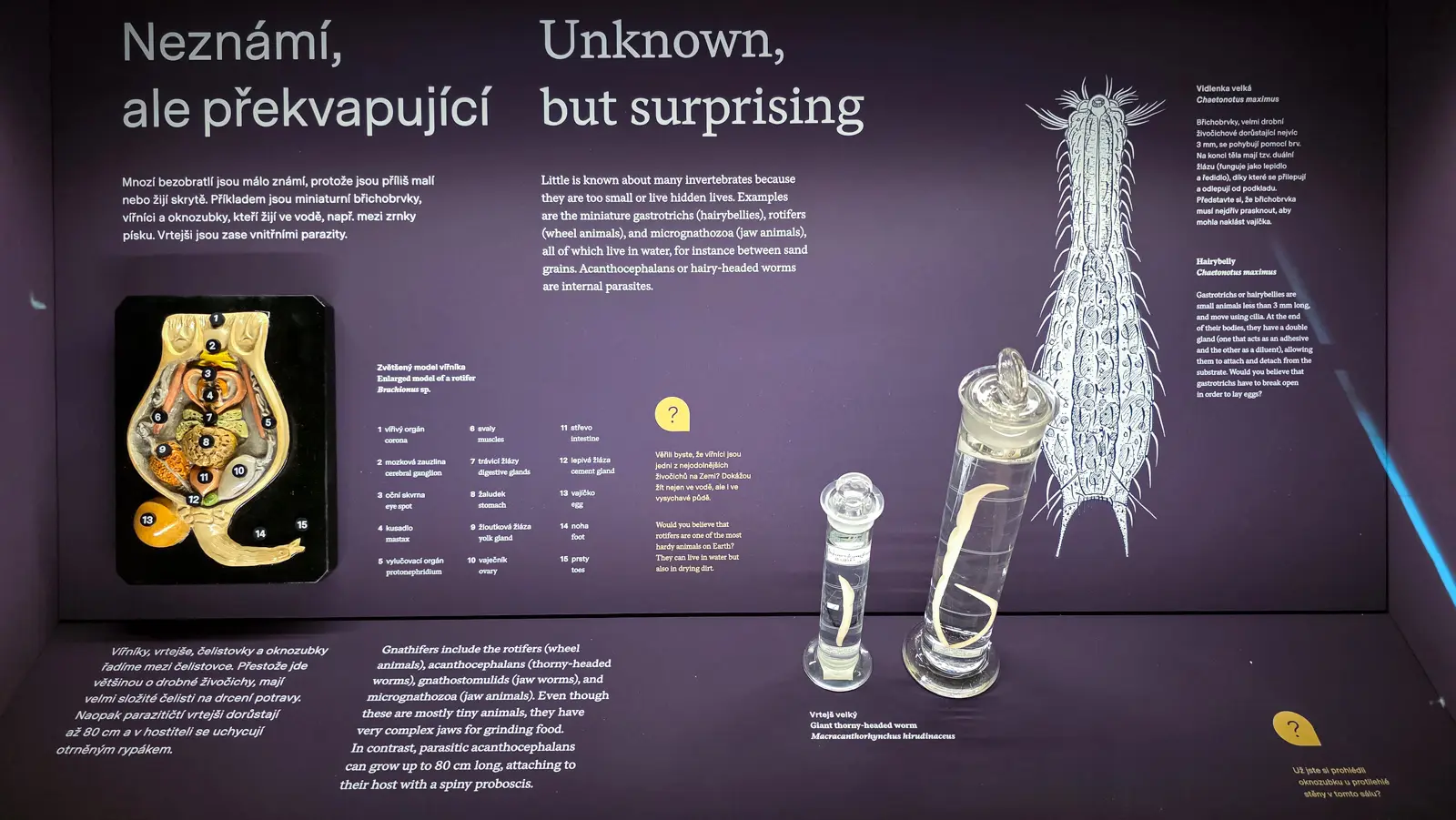
One case is about animals we rarely think about. Its title is Unknown, but surprising, and it covers tiny invertebrates that are too small to notice or live hidden lives. Hairybellies are less than 3 mm long and move with tiny hairs called cilia. Rotifers, or wheel animals, are some of the hardiest animals on Earth, able to live not only in water but also in drying dirt. At the other extreme, the parasitic thorny-headed worms can grow up to 80 cm long.
What a vast, unknown world it is. Several cases here are devoted to the Atlantic and the Mediterranean, and I had no idea how much of this lives in the Mediterranean, the sea around the Greek islands where my mom found her sea stars.
Bubbly Tips
- Start here. Stepping Out in All Directions is the opening hall of the Miracles of Evolution, so it is the natural place to begin.
- Look up first, then down. The squid hangs above head height, so the best views are from the far end of the room, before you walk under it.
- Read the labels. Everything is labelled in Czech and English, and the English texts are worth the time.
- Watch for the yellow question bubbles. They hold the best facts in the room, like the mantis shrimp’s 83 km/h strike.
- Arachnophobes, be warned. The spiders case and the giant tick model sit among the sea creatures, with no warning. The Japanese spider crabs are not spiders, but they look like them.
- Find the puzzle. The hedgehog in a cage puzzle sits in the pencil urchin case, and Czech visitors will recognise it at once.
- Bring children. The cases are colourful and the labels are written to spark questions, so this room works for every age.
- Allow time. This one room can easily take half an hour, and the Miracles of Evolution has several more halls after it.
- One ticket covers it. The standard ticket covers the whole museum complex, including this exhibition, but not the Children’s Museum.
Final Thoughts
This one room covers giant squid, coral reefs, sea stars, urchins, crabs, spiders and animals too small to see. The colours were vivid, the labels were clear, and I learned so many things.
My fear of spiders came back, helped along by a tick I mistook for a beetle. I loved the story of the corals building on their ancestors, and the sea stars made me smile and think of my mom on a Greek island.
Until next time!

🌟 Everything You Need to Plan Your Dream Trip in 2026
- 🌟 Luxury Hotels - Find premium stays with Booking.com & Hotels.com
- 🏡 Vacation Rentals - Discover unique properties on VRBO
- 🏞️ Guided Tours - Explore with Viator or GetYourGuide
- 🎫 Attraction Tickets - Skip the lines with Tiqets
- 🚢 Ocean Cruises - Set sail with Cruise Direct
- 📱 International SIMs - Stay connected with Saily
- 🚗 Car Rentals - Budget-friendly options from Discover Cars
- 🌐 Secure VPNs - Browse safely with NordVPN
- 💶 Currency Exchange - Best rates with Wise
- 🗣️ Learn Languages - Master the local language with Babbel and Rosetta Stone