
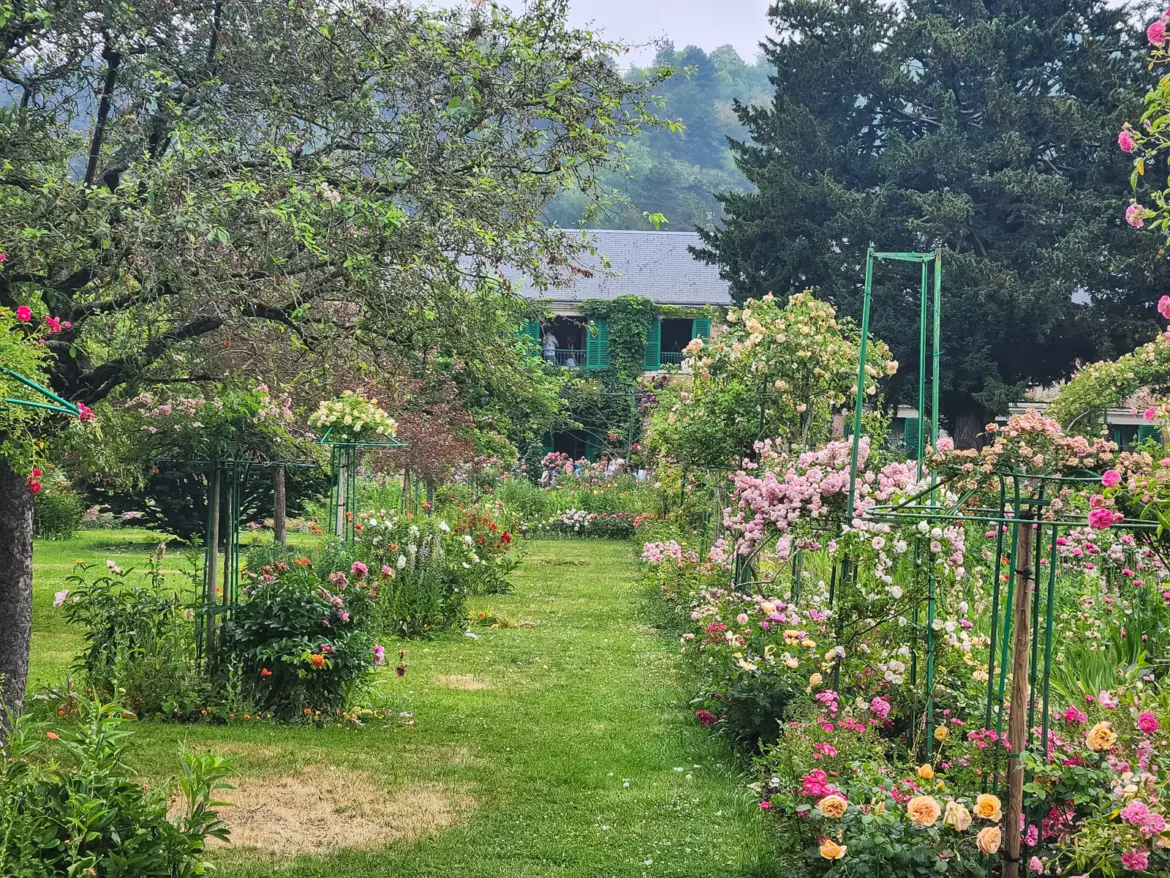
I had seen the paintings for years before I saw the place, and I had the relationship the wrong way round.
Impressionism, as most of us first meet it, is a story about looking. Painters went outdoors, worked fast, and caught the light before it changed. The assumption that follows from that is that Monet found a beautiful garden and painted it. What actually happened is that he bought a plot with an orchard on it, spent thirty years rebuilding the ground itself, hired staff, diverted a river, argued with the local authority, and then painted the result. The garden is not the subject of the work. It is part of the work.
That is the thing I did not understand until I stood in it.
Giverny at a Glance
🎨 What it is · Monet’s house and gardens at Giverny, 80 km west of Paris, where he lived from 1883 to 1926 and built the garden he then spent decades painting.
🌸 Two gardens · The Clos Normand flower garden by the house, and the Japanese-inspired water garden with the pond and green bridge across the road.
🌉 Why the bridge is green · Monet painted his Japanese-style bridge his own green, not the traditional red, so it sits inside the planting rather than standing out.
🖼️ Where the paintings went · Around 250 pond canvases; eight great panels in two oval rooms at the Orangerie; the 1899 Water-Lily Pond in London’s National Gallery.
💡 Tip · Give it a full day if you can, and see the Orangerie on the same trip. Each explains the other.
Getting there, and arriving
Giverny sits about eighty kilometres west of Paris, close enough for a day and far enough that the city stops mattering.
Monet did not arrive here as a wealthy man buying an estate. He moved in on 29 April 1883 as a tenant, with a blended household: his own two sons, Alice Hoschedé, and her six children. Alice’s first husband was still living at that stage. She and Monet married in 1892, the year after Ernest Hoschedé died, and she ran the house at Giverny until her own death in 1911. He rented the property for six years before he could afford to buy it. The purchase went through at the end of 1889 with financial help from his dealer Paul Durand-Ruel. Everything that follows, the eight gardeners, the second plot of land and the pond, was paid for out of a painting career that only became reliable afterwards.
I took an organised day tour from Paris, which meant somebody else dealt with the timings. That is not the only way to do it. Tickets can be bought directly and Giverny is reachable by train and a short local connection, so anyone who would rather set their own pace can.
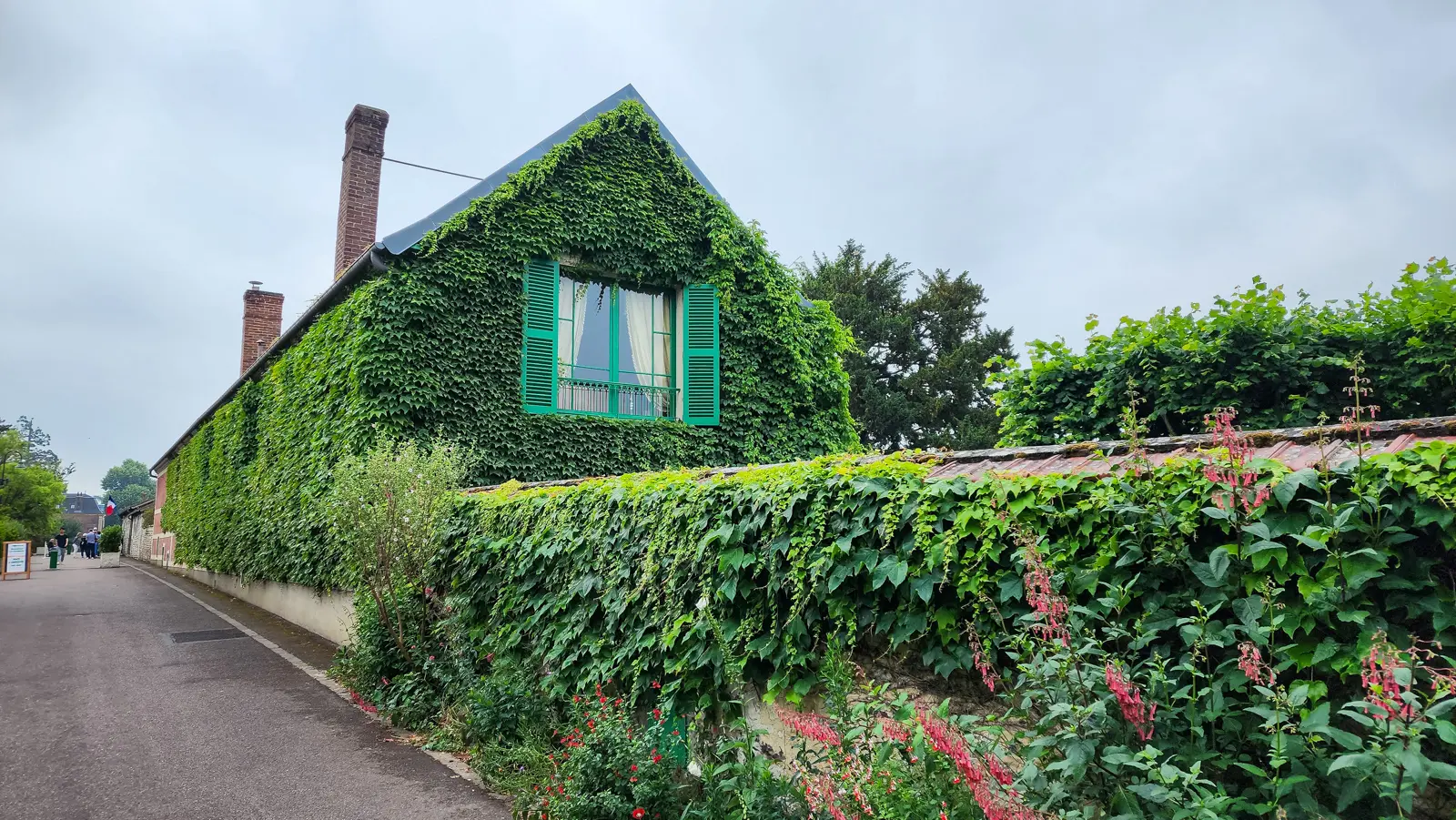
Whichever way a visitor arrives, the approach is the same and it is not what the paintings prepare anyone for. There is no gatehouse, no drive and no forecourt. The house runs along the edge of the village street, its gable end smothered in ivy, its shutters the same green as everything else on the property, with a wall below it that the creeper has taken over completely. Most people walk past that side of it without registering what it is.
The Clos Normand
The flower garden comes first, between the gate and the house, and almost everybody walks through it on the way to somewhere else.
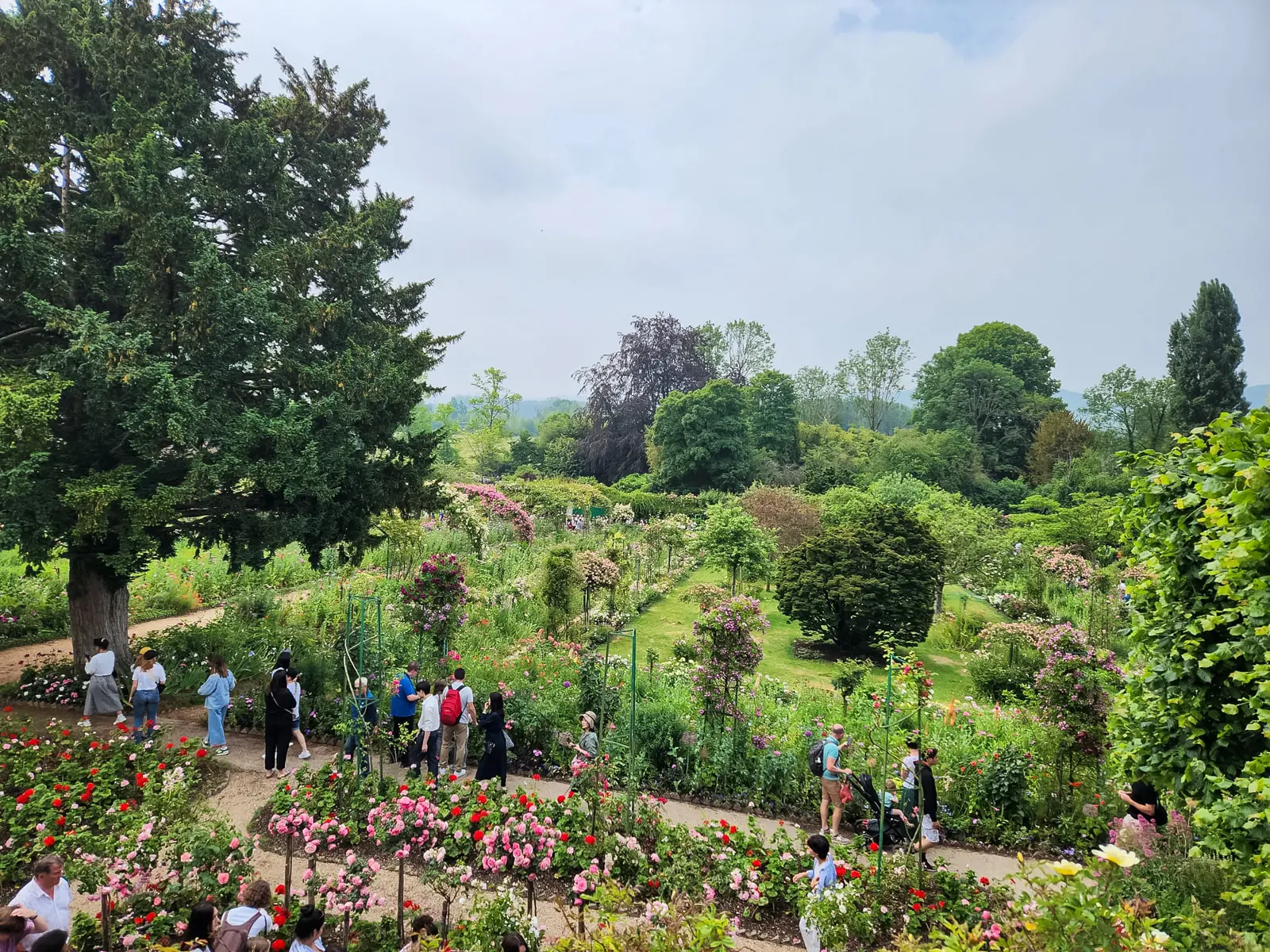
Here is what I was not prepared for: the sheer number of different plants.
I had expected water lilies, willows and a bridge. What is in front of the house is something else entirely, a hectare of flower beds worked into rows and arches, with roses climbing metal frames, hollyhocks going up behind them and banks of annuals underneath. Flower clumps at different heights, so the beds have volume rather than being flat colour.
None of this is accidental and none of it is amateur. By the 1890s Monet was employing as many as eight gardeners. He read catalogues, went to plant shows and botanical gardens, and took advice from Georges Truffaut, who was a serious horticulturalist, and from two painter friends who gardened seriously themselves, Gustave Caillebotte and Octave Mirbeau.
The man was not dabbling. He was running a horticultural operation and funding it out of a painting career.
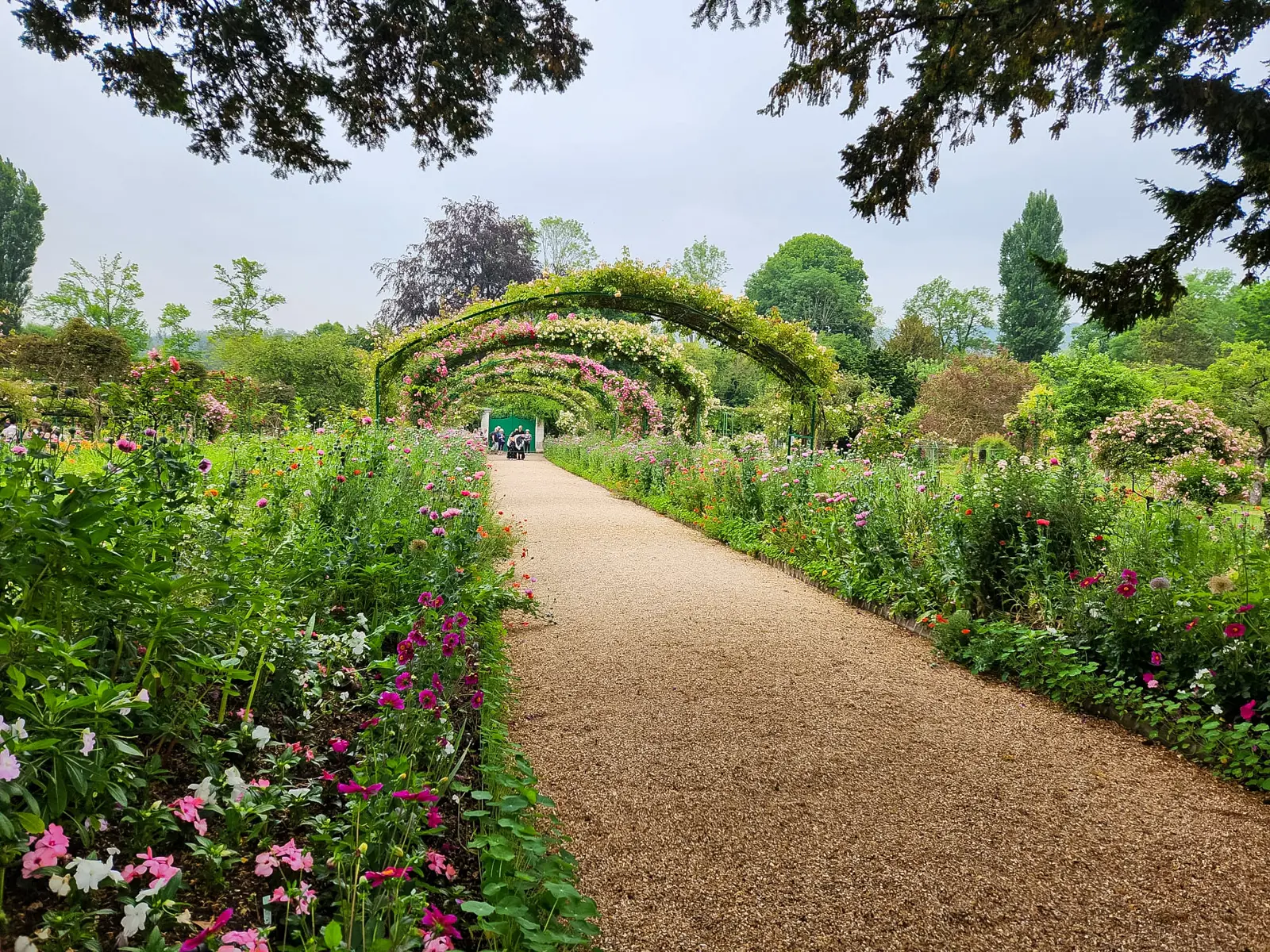
Running through the middle of it is the Grande Allée, the wide gravel path that goes from the road gate straight up to the front door. When Monet took the place on, that avenue was lined with cypress and spruce. He wanted them gone. Alice wanted them kept. They argued about it at length and he cut them down anyway, then put up the metal arches that are still standing, and trained climbing roses over them. Nasturtiums were planted along both edges, and by late summer they creep so far across the gravel that the path almost disappears underneath them.
It is worth knowing that the beds are laid out on a grid of straight paths, and that the inner ones are closed to visitors so the planting does not get trampled. Everyone walks the outer edges. The photograph everybody wants, straight down the arches, is taken from the end.
The house
The house is open as part of the same ticket, and the queue for it moves faster than it looks.
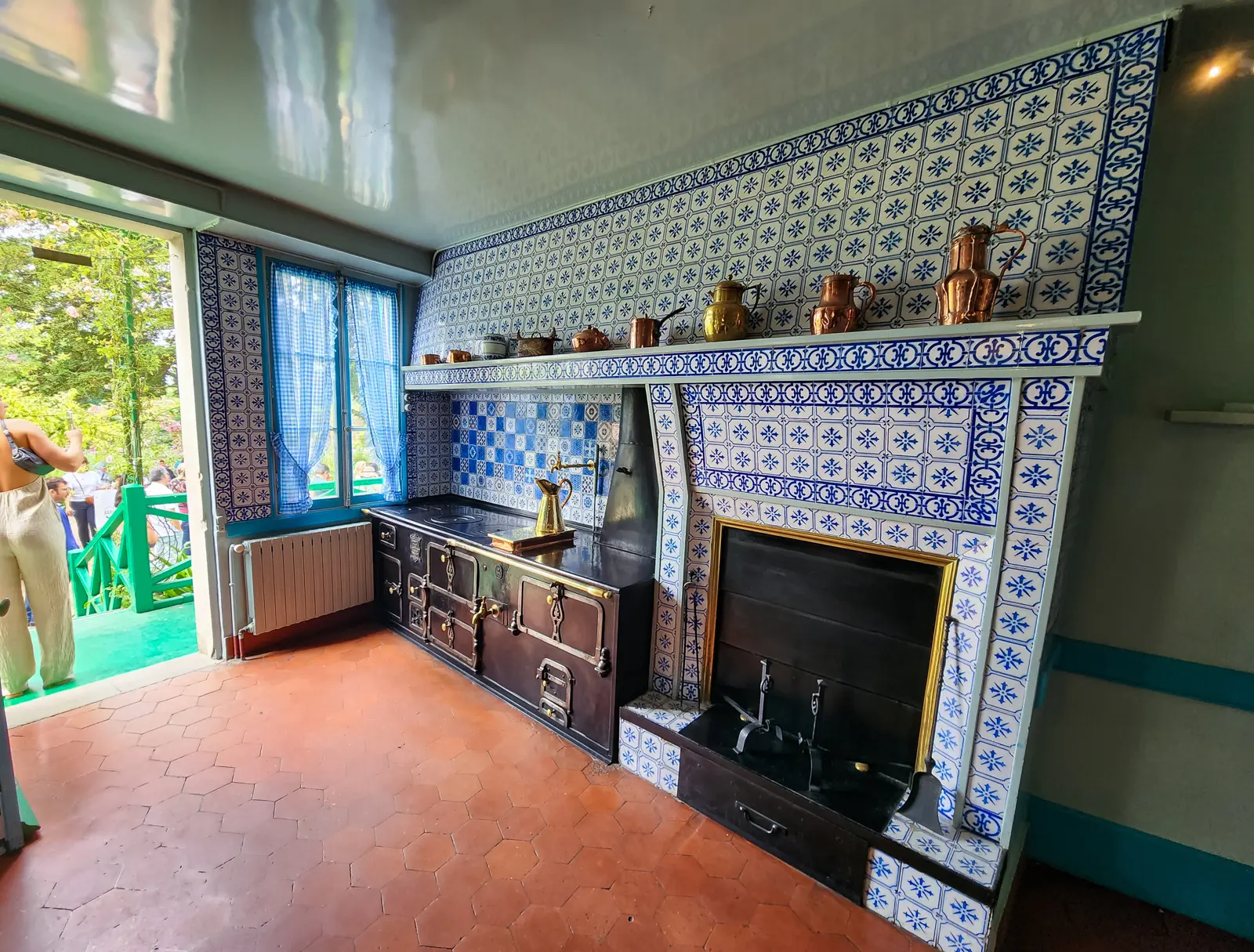
The house is pink with green shutters and it is smaller inside than the gardens lead anyone to expect.
The kitchen stopped me. Blue and white tiles from floor to ceiling, a black range along one wall, copper and brass on the shelf above the hearth, terracotta tiles underfoot. Next door the dining room is yellow, and not a soft yellow. A man who spent his working life on the behaviour of colour was not going to leave his own walls to chance.
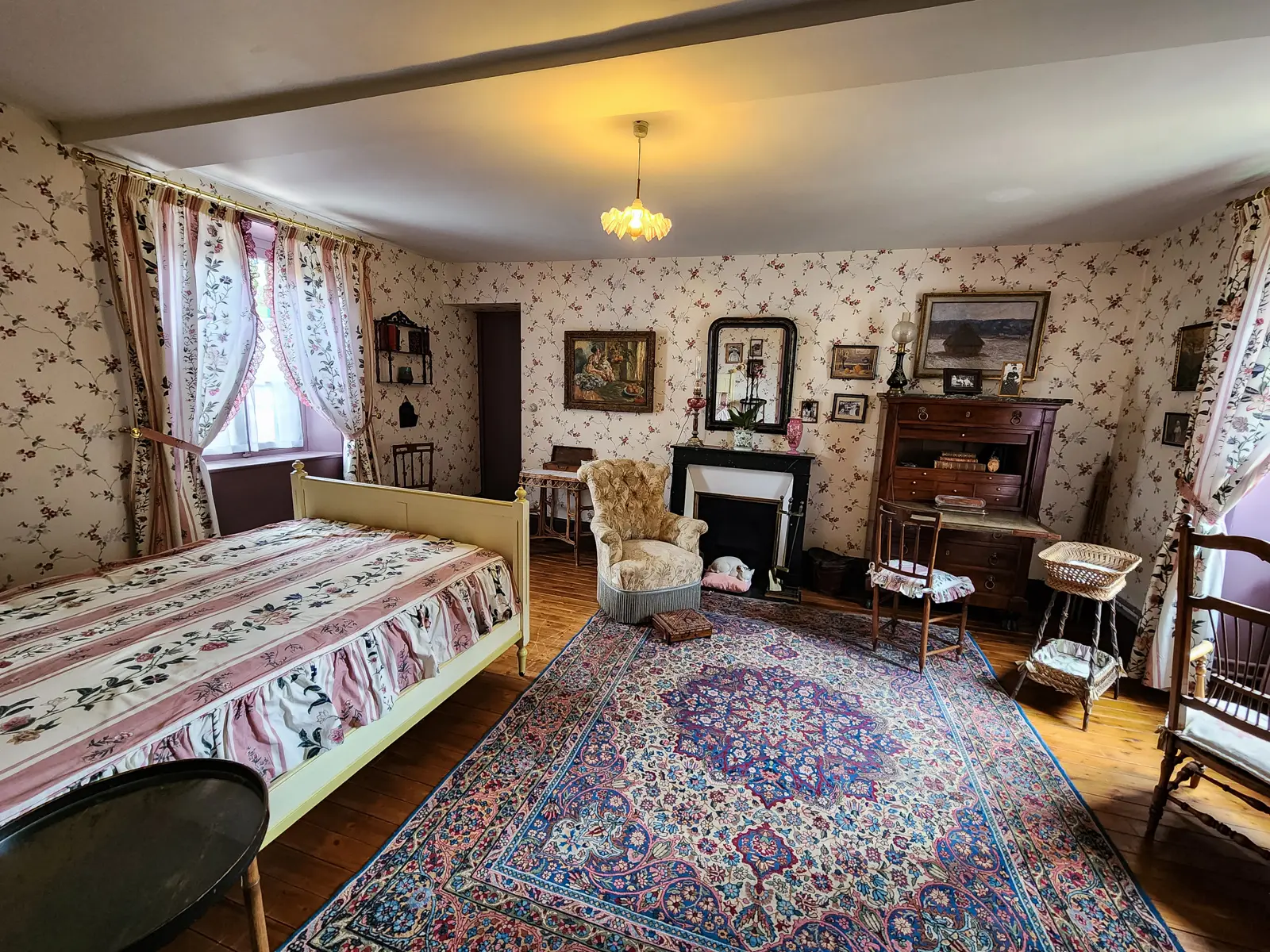
Upstairs the rooms are domestic in scale, papered in florals, hung with pictures and photographs, with a writing desk in one corner and windows looking down into the garden he had made. It is the house of a working painter with a large blended family, not a monument.
The water garden
The pond is on the far side of the road, reached now through an underpass, and it is a different garden in every respect.
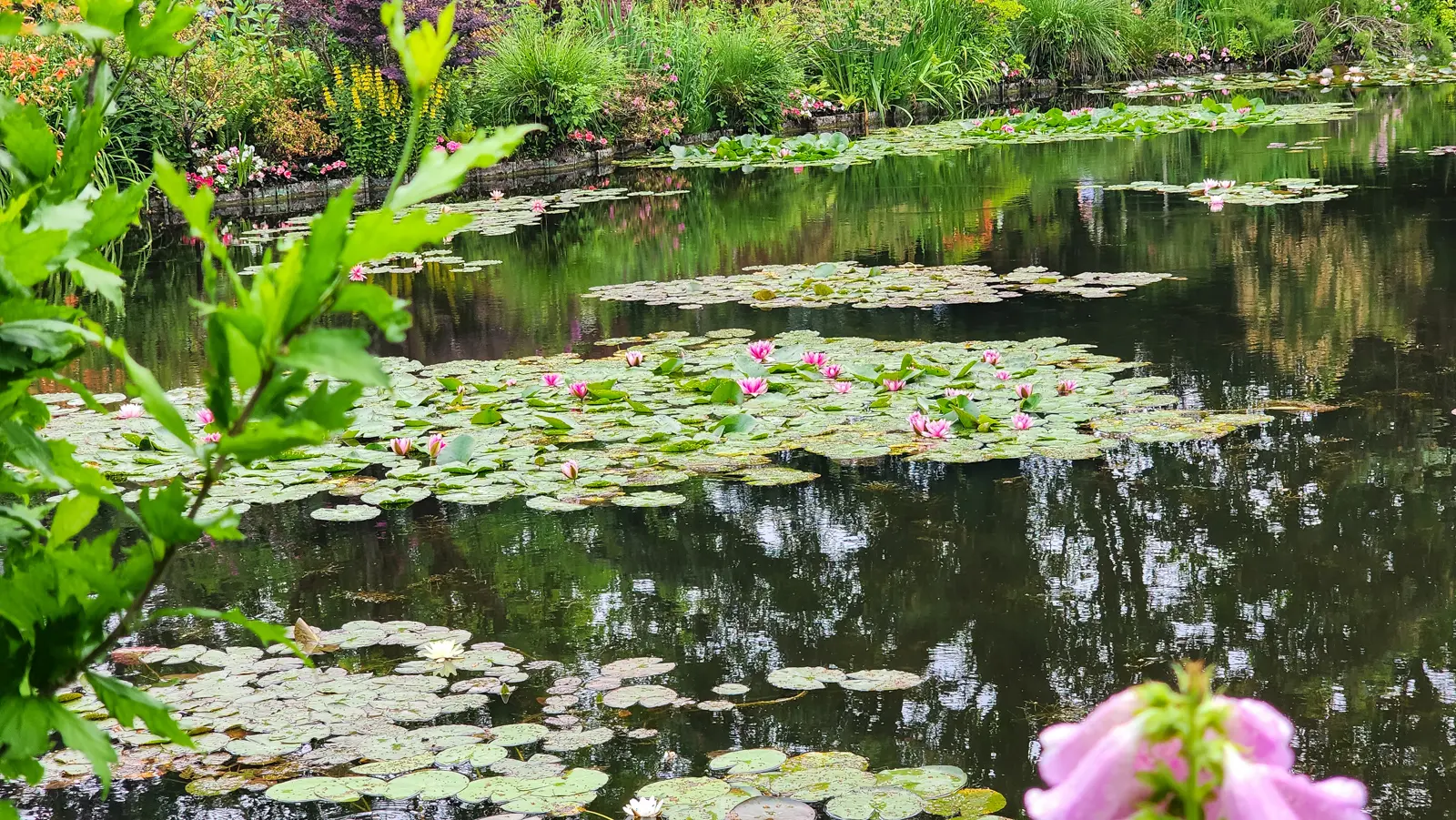
The water garden did not exist when Monet arrived, and getting it built was not straightforward.
He bought the plot in 1893, ten years after moving in. To fill the pond he needed to divert water from the Ru, which required official permission, and his neighbours objected. They were farmers, and they were worried that his strange foreign plants would poison the water their animals drank. He got the permission anyway, dug the first pond, and enlarged it later.
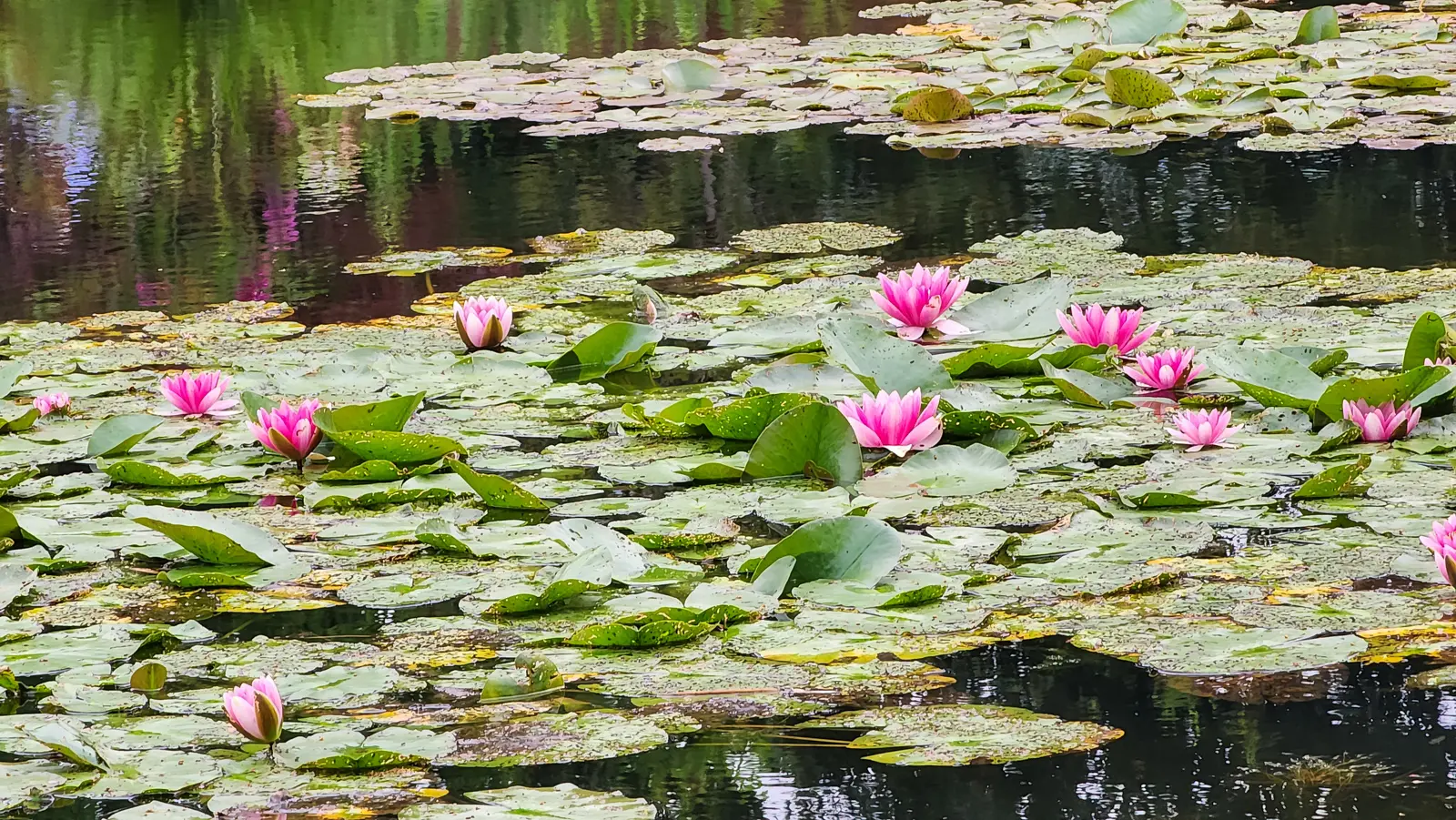
Standing at the edge, the thing that struck me was how much of the pond is not lilies. Great stretches of dark water, doubling everything planted along the banks. The flowers are scattered across it rather than covering it.
Which is exactly what the late paintings do. Over the last two decades of his life Monet produced around 250 canvases of this pond, and across that run they lose interest in the banks, then the bridge, then the sky, until there is nothing left in the frame but water, pads and reflection.
I had always read those canvases as abstraction arriving in Monet’s old age. Standing there, they look like observation.
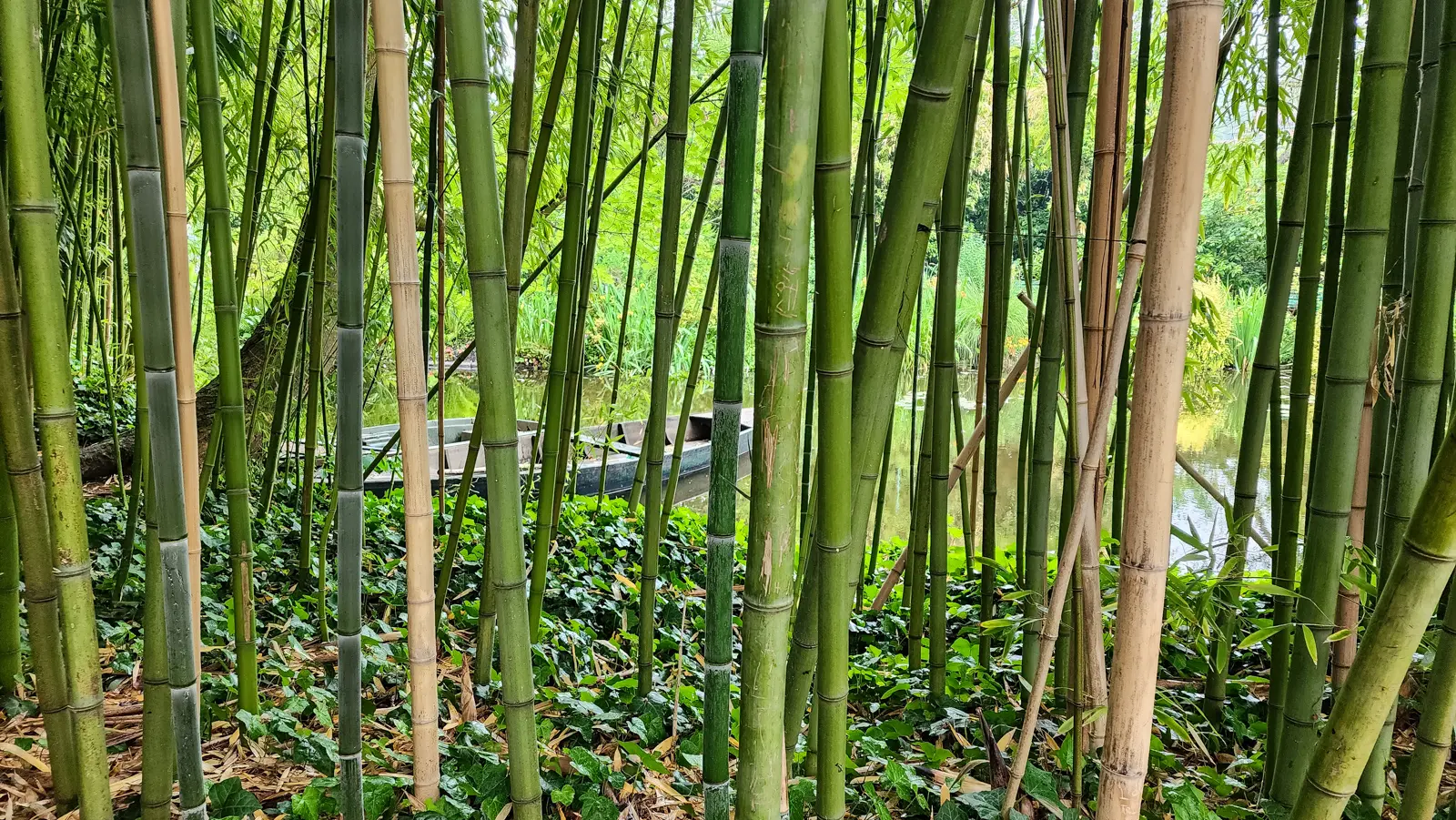
There is bamboo along one edge, thick enough to walk behind, and a flat wooden boat moored in the shade. Monet used a boat like it as a floating studio.
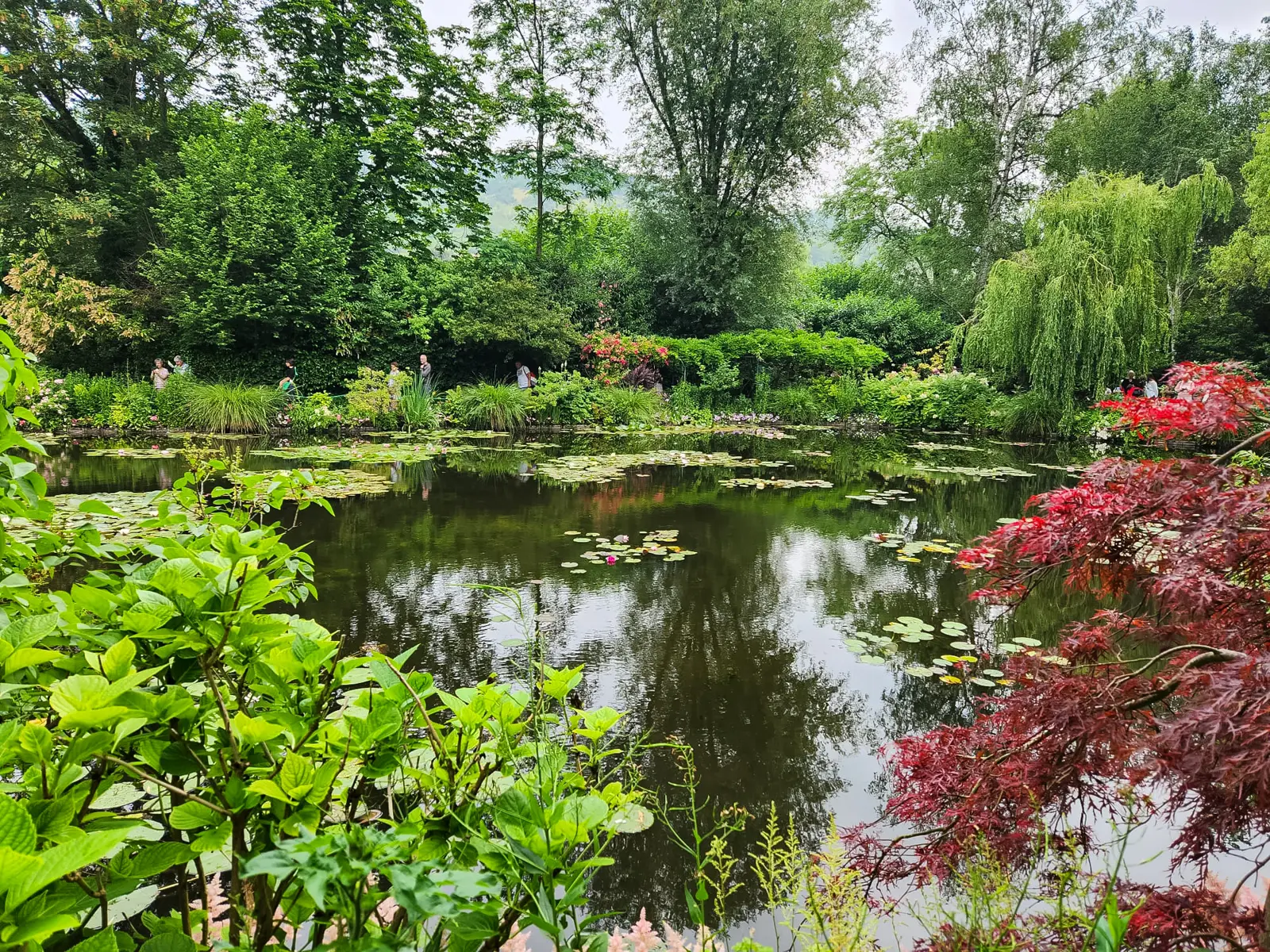
The far bank is willows, the near side has a Japanese maple in deep red, and the whole thing is enclosed so that very little of the surrounding countryside gets in. It is a room made out of planting.
The bridge
Everybody comes for this and everybody photographs it, which does not make it less worth doing. But the word Japanese in front of it is not decoration, and I had never bothered to ask what it was doing there.
Monet never went to Japan. What he did was collect it. From 1871, when he bought his first Japanese woodblock print, he went on acquiring them for the rest of his life, and by his death in 1926 he owned 231. Landscapes by Hiroshige and Hokusai, women by Utamaro, all of them ukiyo-e, the pictures of the floating world that came out of Edo in the eighteenth and nineteenth centuries. He hung them through the house, including in the dining room and the bedrooms, and he studied them closely. He never travelled to see the country that produced them; he had friends who did, and they steered him to the good ones.
This was not an eccentricity. Japan had been closed to European trade for two centuries and reopened in the middle of the nineteenth, and the prints that followed set off a craze in Paris that the French called japonisme. Ukiyo-e were exhibited in galleries and sold in shops across the city, and the Impressionists were among the most enthusiastic buyers. Pissarro wrote to his son after one exhibition that Hiroshige was a marvellous impressionist and that the Japanese confirmed his own position.
So the water garden is not a Norman pond with an ornament on it. Monet laid it out in the manner of the prints on his walls: asymmetrical, curved, screened, planted with bamboo, ginkgo and Japanese fruit trees rather than with anything local. Then he had a Japanese-style footbridge built across the narrow end.
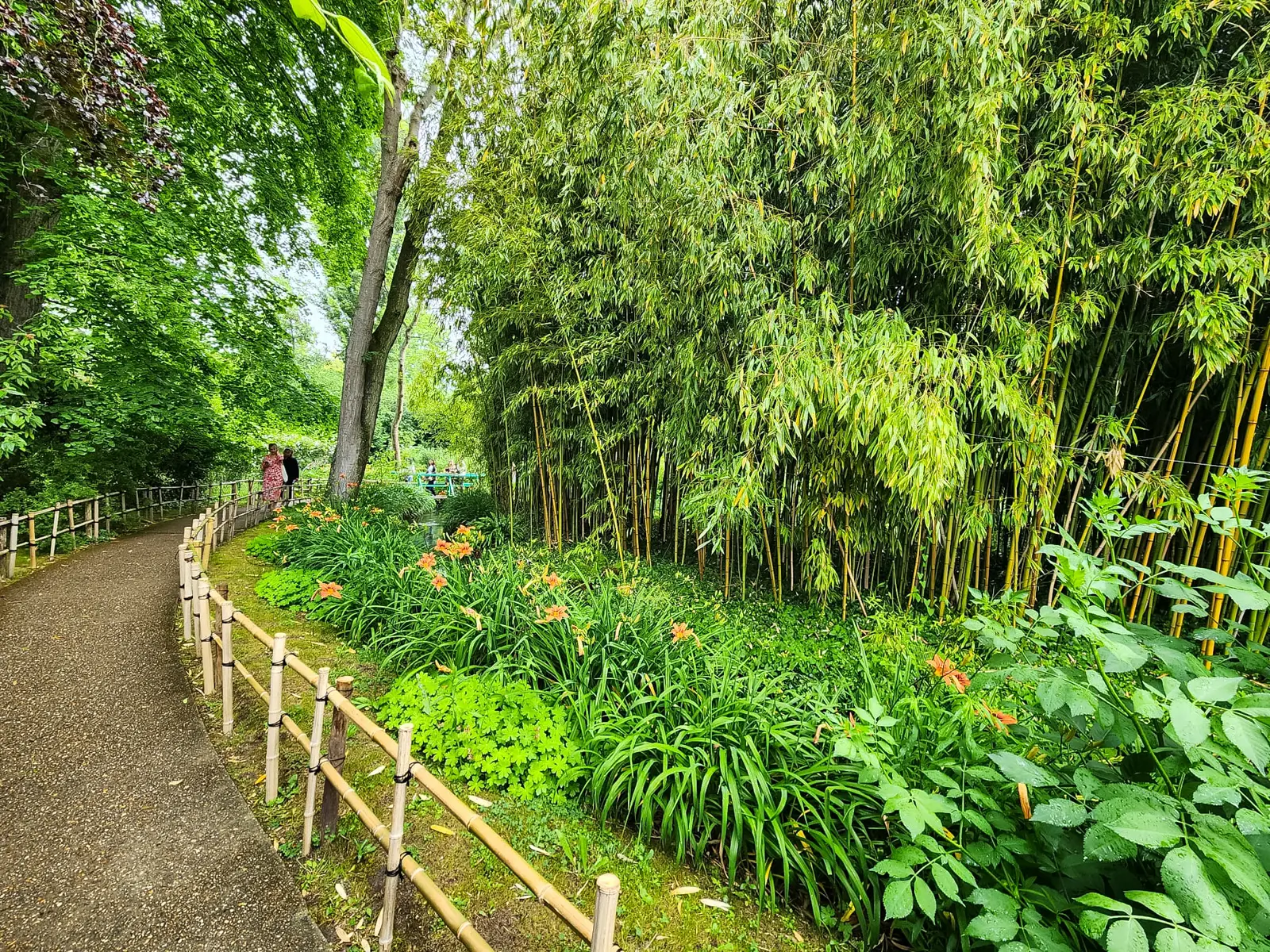
And then he did something that anyone expecting a Japanese bridge notices immediately. He painted it green.
The traditional colour for that form is red. Monet chose the green he used throughout the property, the same green as the shutters on the house, the benches and the garden furniture, so that the structure sits inside the planting rather than announcing itself against it. Wisteria was trained over the frame later, and in flower it drops straight down over the handrail.
The approach is down a path, through bamboo and day lilies, and the bridge appears at the end of it in green.
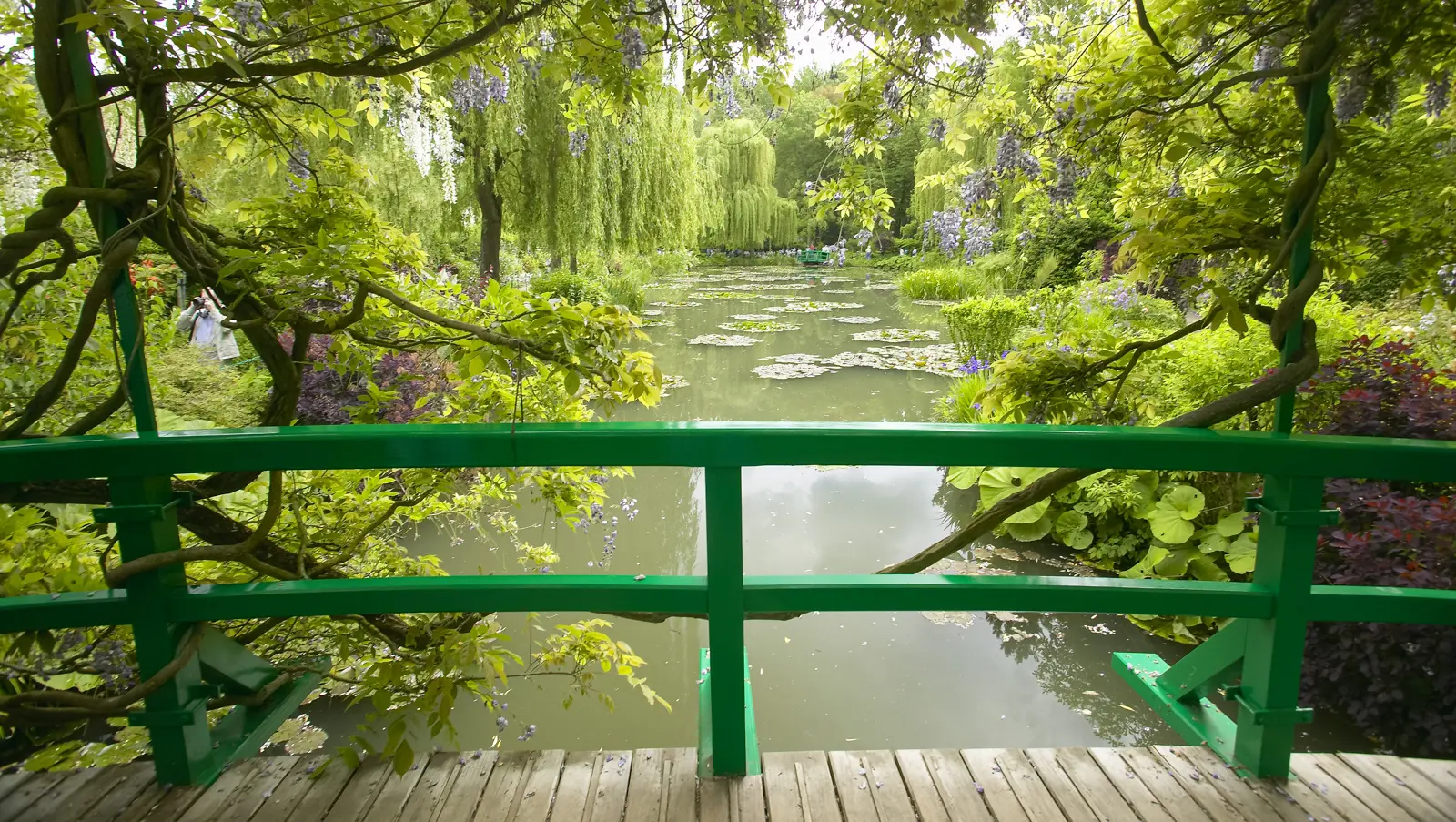
And then I was standing on it, looking down the length of the pond.
Between 1895 and 1900 Monet painted almost twenty variations of that view, from that position, changing only the light, the season and the density of the planting. Not one painting of a bridge. Twenty attempts at one thing, over five years, from a spot roughly a metre wide.
That is the fact that reorganised the whole visit for me.
Giverny, Paris, London
I have now seen this pond three times, in three places, and only the first was in Normandy.
The second was at the Orangerie in Paris, where eight enormous compositions are installed in two oval rooms built to hold them. Curved walls, no corners, daylight from above. Each panel is about two metres high and runs for several metres along a bending wall, so there is no point at which a visitor can see one whole and no corner to break the sequence.
What is on them is water, and almost nothing else. No bank, no sky, no bridge. Willow trunks come down at the edges of some of the panels and the rest is surface, reflection and lilies, wrapping right the way round the room.
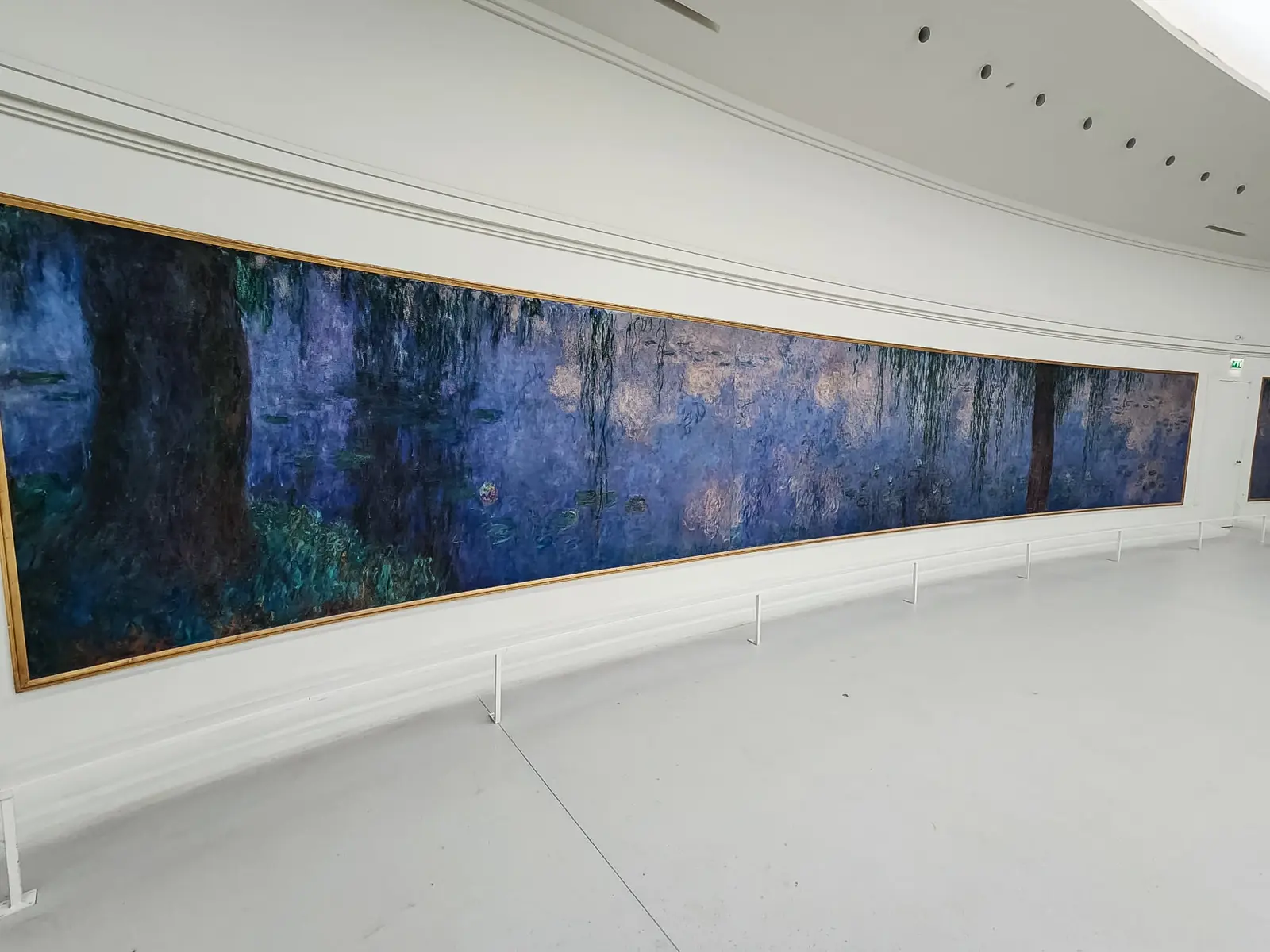
The third was on a December afternoon in London.
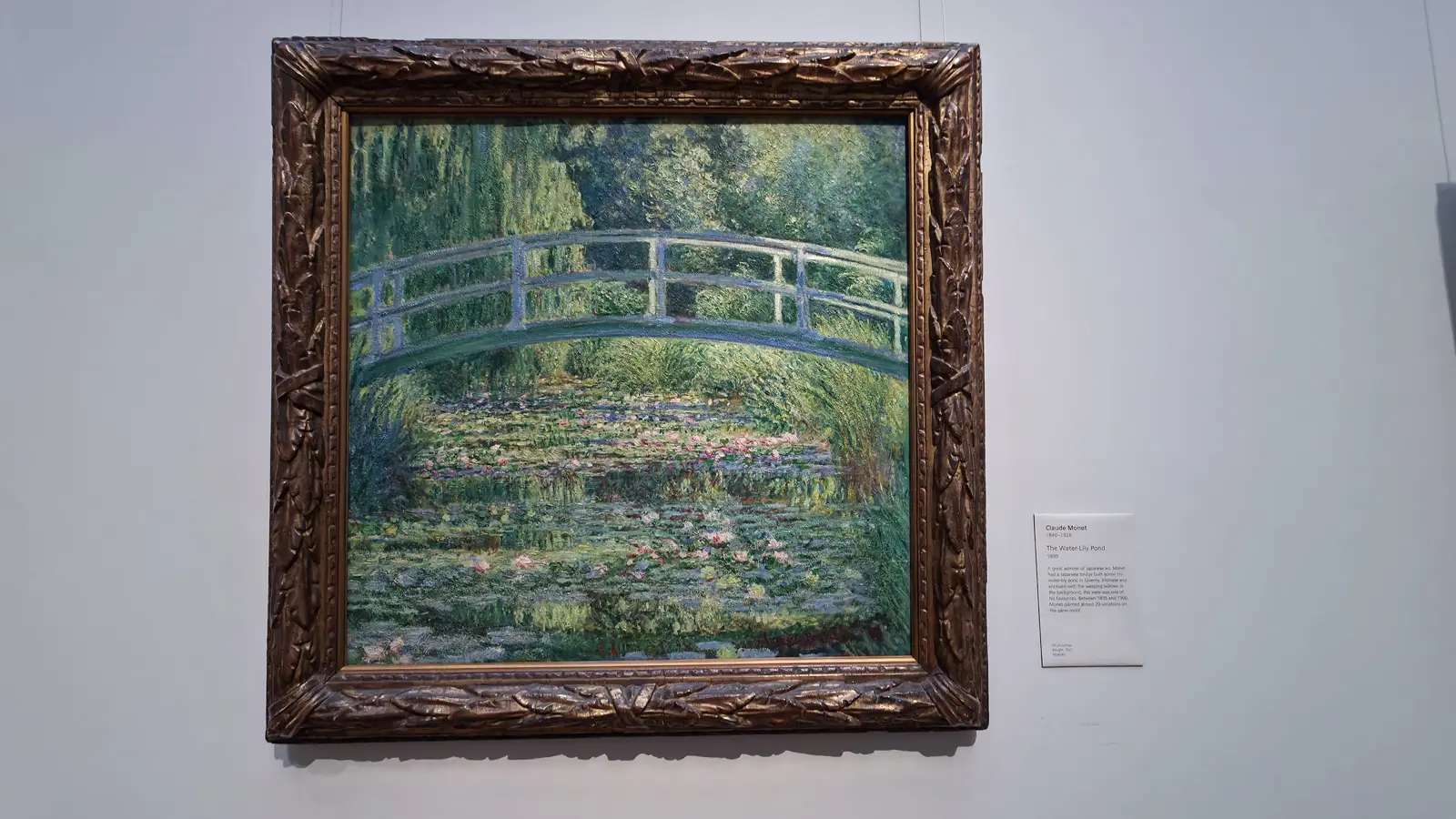
The National Gallery has one of the 1899 canvases from that series. I walked round a corner and there was the bridge, green, seen from the exact patch of wood I had been standing on.
Seeing them in that order changed what the last ones mean. Giverny explains the Orangerie. The pond really is that dark, the reflections really do sit on the surface like that, and the reason the late canvases have no horizon is that a man who spent thirty years building a pond eventually stopped looking at anything except the water.
Who keeps it, and how
The garden a visitor walks round today is a reconstruction, and the story of how it survived is not a gentle one.
Monet died in 1926. His daughter-in-law Blanche Hoschedé-Monet, herself a painter, looked after the property until her death in 1947. After that it emptied out. His son Michel inherited it, did not live there, and bequeathed it to the Académie des Beaux-Arts on his death in 1966. The Académie could not afford to restore it. They put a roof on, protected the Japanese prints, and moved the remaining canvases to safety.
By the time Gérald Van der Kemp took it on as curator in 1977, his own report described rotten panelling and floorboards, furniture broken and mouldy, plants growing up through the floor of the big studio, greenhouses with no glass left in them, the Clos Normand under brambles, and the Japanese bridge rotting in black, choked water.
Restoration took about ten years and was funded very largely by American donors. The Fondation Claude Monet was created in 1980 and the gardens opened to the public on 1 June that year.
So when the ticket money goes back into the upkeep, that is not a nice line in a brochure. It is the mechanism that keeps the thing from going back to brambles.
The village
The estate is not the whole of Giverny, and the rest of it takes about ten minutes to reach.
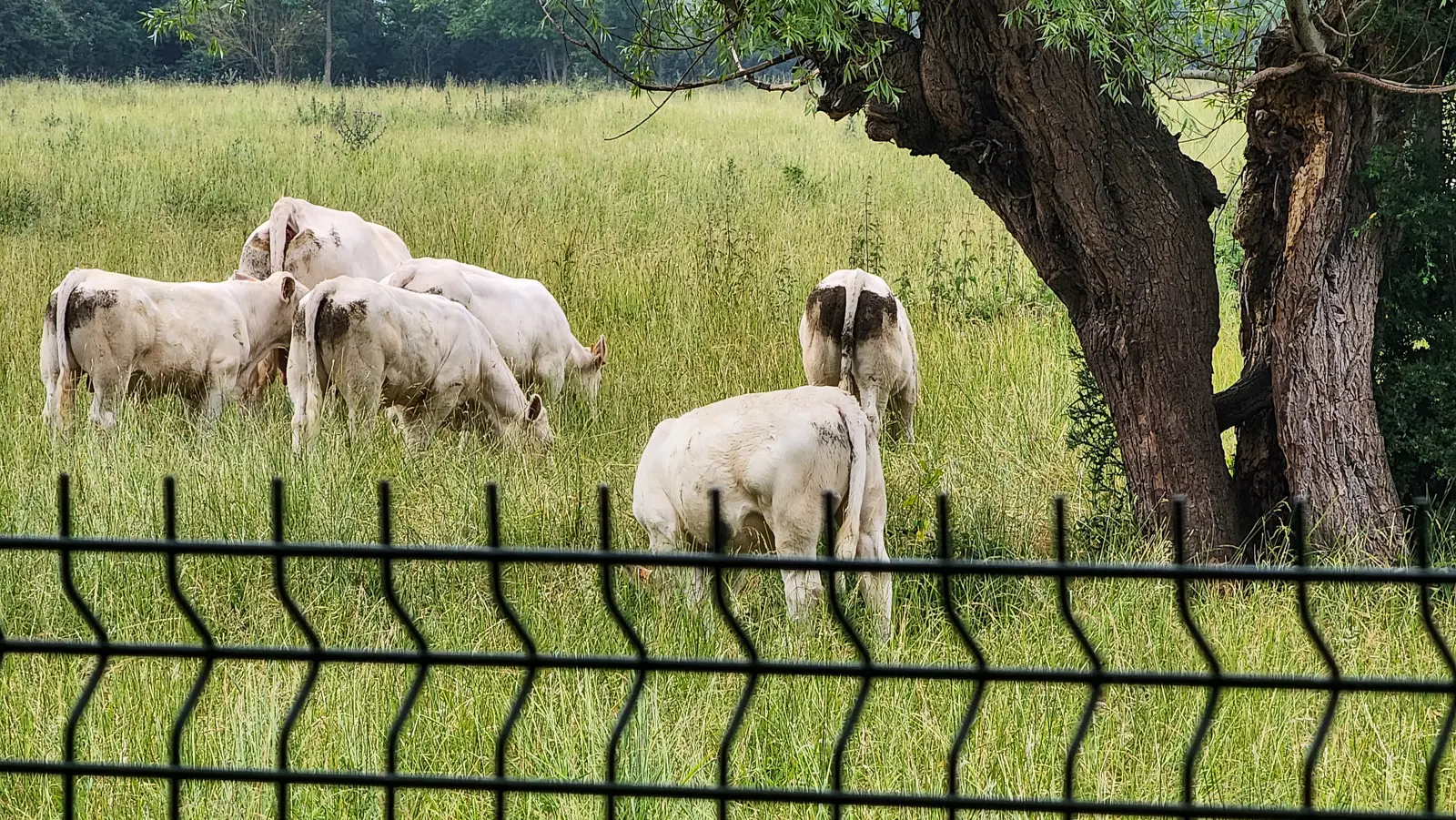
Giverny itself is small and worth the extra hour. Shops, a couple of places to eat, and then farmland straight away. I walked past a field of cattle standing under a willow within a few minutes of leaving the estate.
The village is where it becomes obvious that this was never a resort. It was somewhere a painter moved his family because it was cheap, quiet and had the right light.
Bubbly Tips
- Go between April and October. The gardens close from 1 November to the end of March. That is not a scheduling decision, it is when there is nothing in flower.
- A tour is easier, independent is cheaper. A day trip from Paris removes all the logistics. Tickets bought directly plus a train and a local connection cost less and let you stay as long as you want, which matters here.
- Give it longer than a tour allows. Two hours is enough to see it and not enough to sit anywhere. If you can build your own day, do.
- Do the water garden first if you arrive early. It is the part everyone photographs, and it is smaller than the flower garden, so it fills up first.
- Then give the Clos Normand real time. Most visitors treat it as the walk to the pond. It is a hectare of planting and the most technically impressive thing on the site.
- Look at the pond, not just the lilies. The dark water and the reflections are what the late paintings are about, and they are easy to walk past while hunting for flowers.
- Stand on the bridge and look down the length of the pond. That is the position Monet painted from about twenty times between 1895 and 1900.
- Do not skip the house. It takes twenty minutes and the blue kitchen and yellow dining room tell you more about how he thought about colour than any wall panel.
- Walk into the village afterwards. Ten minutes out and you are among fields. It is the fastest way to understand why he chose the place.
- See the Orangerie and Giverny in the same trip if you can, in either order. Each one explains the other, and doing both is a different experience from doing one.
Final Thoughts
I came to Giverny already loving the paintings, which meant I arrived with the story backwards. I thought I was going to see the place that inspired the pictures.
What I found was a construction project. Thirty years of buying land, diverting water, arguing with a prefecture and eight gardeners’ wages, so that a man could stand in one spot on a green bridge and paint the same view twenty times.
I would go back and stay all day. And I would still be thinking about a canvas in London, painted in 1899 from the exact patch of wood I was standing on.
Until next time!

🌟 Everything You Need to Plan Your Dream Trip in 2026
- 🌟 Luxury Hotels - Find premium stays with Booking.com & Hotels.com
- 🏡 Vacation Rentals - Discover unique properties on VRBO
- 🏞️ Guided Tours - Explore with Viator or GetYourGuide
- 🎫 Attraction Tickets - Skip the lines with Tiqets
- 🚢 Ocean Cruises - Set sail with Cruise Direct
- 📱 International SIMs - Stay connected with Saily
- 🚗 Car Rentals - Budget-friendly options from Discover Cars
- 🌐 Secure VPNs - Browse safely with NordVPN
- 💶 Currency Exchange - Best rates with Wise
- 🗣️ Learn Languages - Master the local language with Babbel and Rosetta Stone