
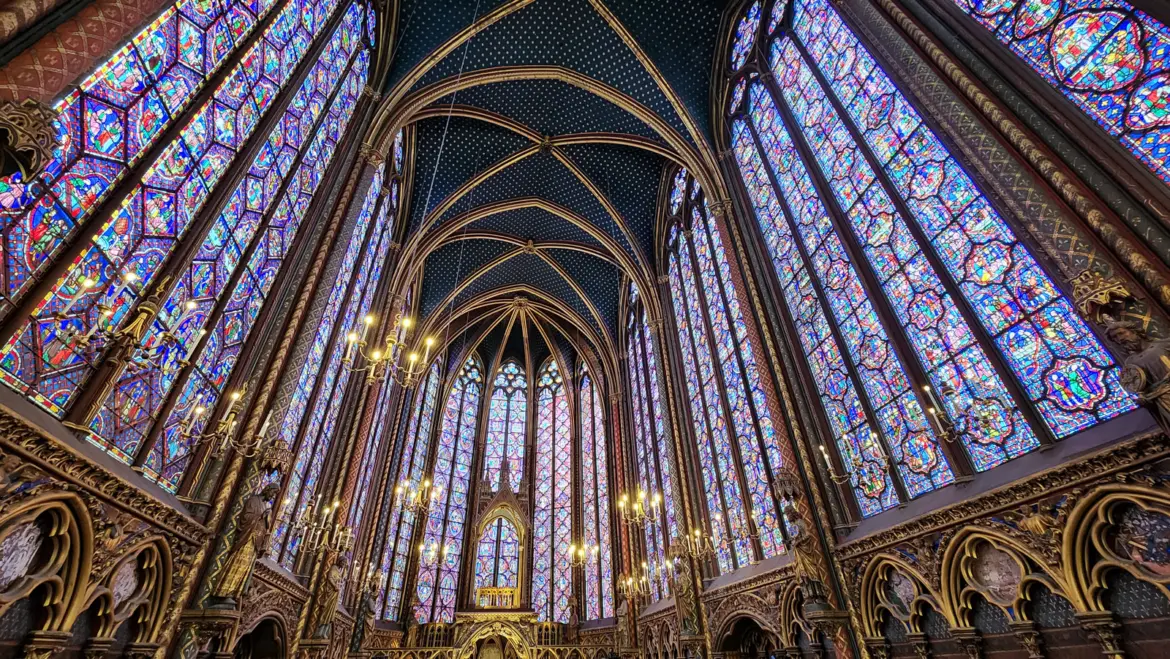
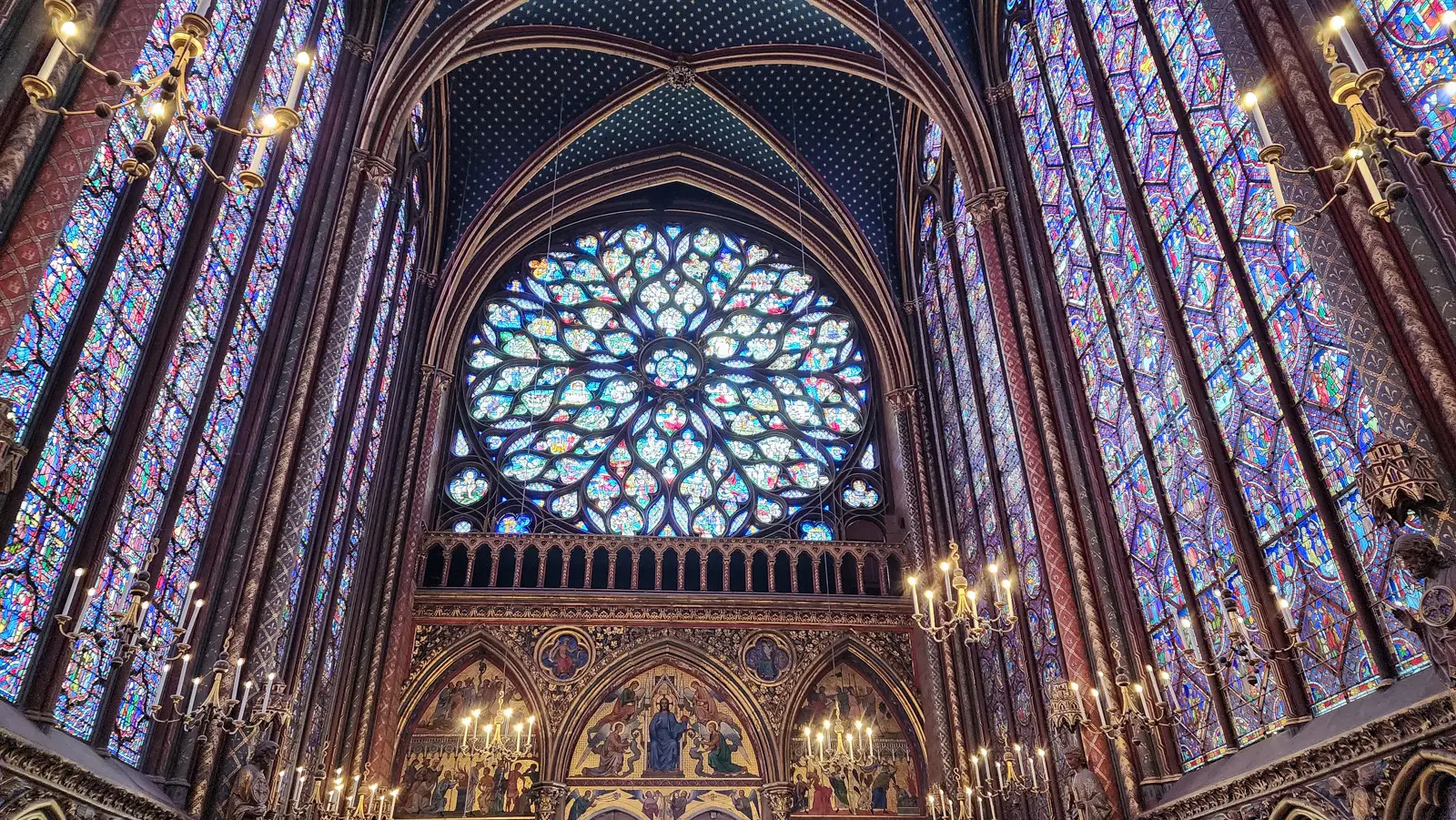
Our guide in Sainte-Chapelle had a lot to say about kings, relics and restorers. I caught very little of it. I was standing in the upper chapel with my head tipped back, looking at the best stained glass I have ever seen, and I couldn’t look away.
The glass here doesn’t fill a few windows. It takes up almost the entire wall of the upper chapel, on every side, so wherever I turned there was more of it. I visited Paris in June 2023, on a grey, overcast day, and the colour still glowed.
Sainte-Chapelle at a Glance
🪟 What · A 13th-century royal chapel on the Île de la Cité in Paris, famous for stained glass that fills almost the entire wall of its upper chapel.
👑 Why it exists · Louis IX built it to hold the Crown of Thorns and other relics of the Passion; it was consecrated in 1248.
🎟️ 2026 tickets · Since 12 January 2026, €22 for visitors from outside the EEA and €16 for EEA residents; under-18s free, and the Paris Museum Pass is accepted.
⛅ No sun needed · The windows glow even under a flat grey sky — a cloudy day is no reason to postpone.
💡 Tip · Book a timed slot, pack light (it’s inside the Palais de Justice, so security is tight), and take Line 4 to Cité.
A Grey Chapel in a Courthouse Courtyard
Sainte-Chapelle stands on the Île de la Cité, the island in the Seine that also holds Notre-Dame Cathedral. It doesn’t stand on its own street, though. The chapel sits inside the Palais de Justice, the Paris law courts, so the way in runs through the court complex and its security checks. When I visited, a Gendarmerie van was parked outside the gates, and scaffolding covered one side of the west front, wrapped in a sheet printed with a large drawing of an angel.
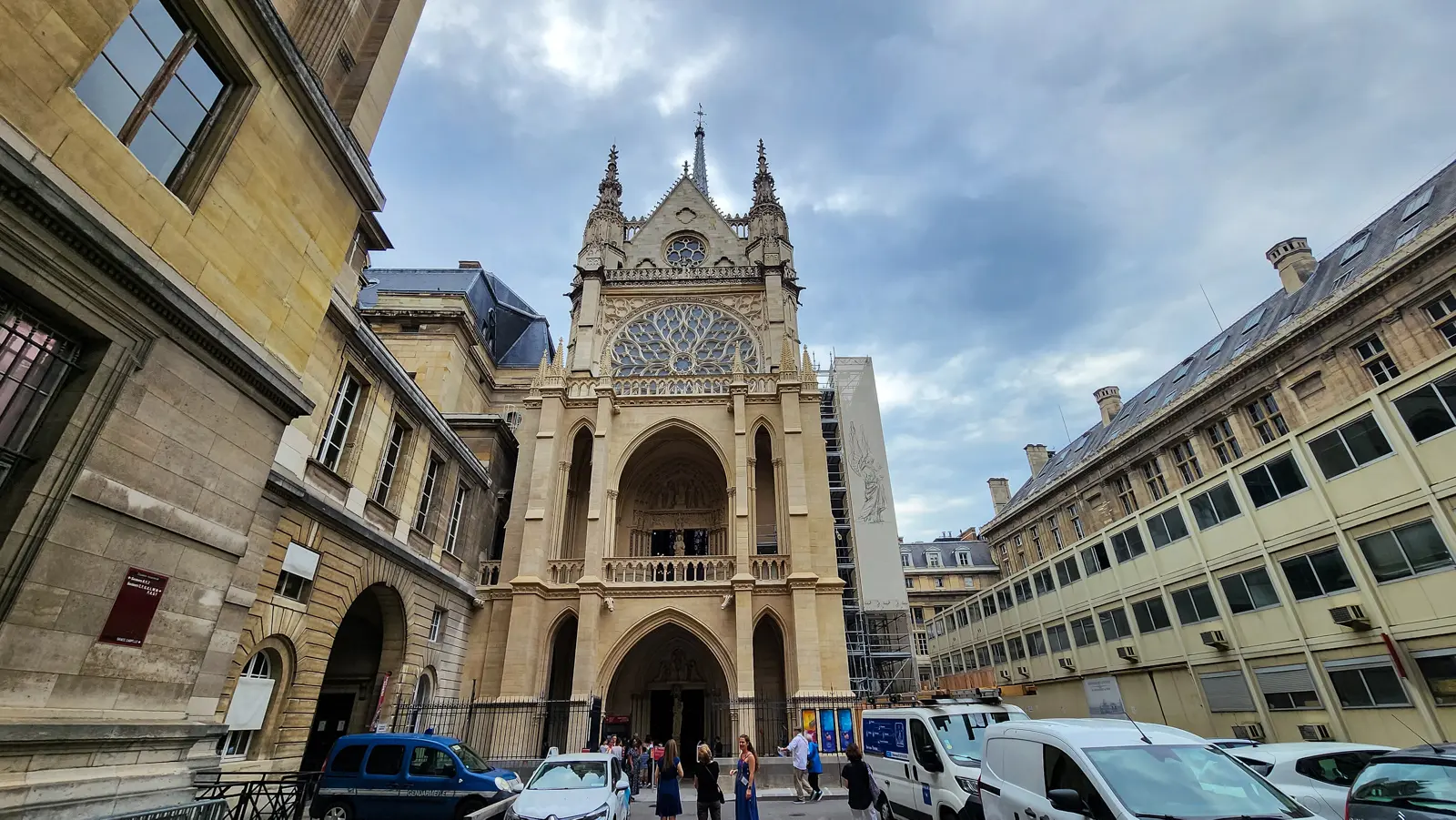
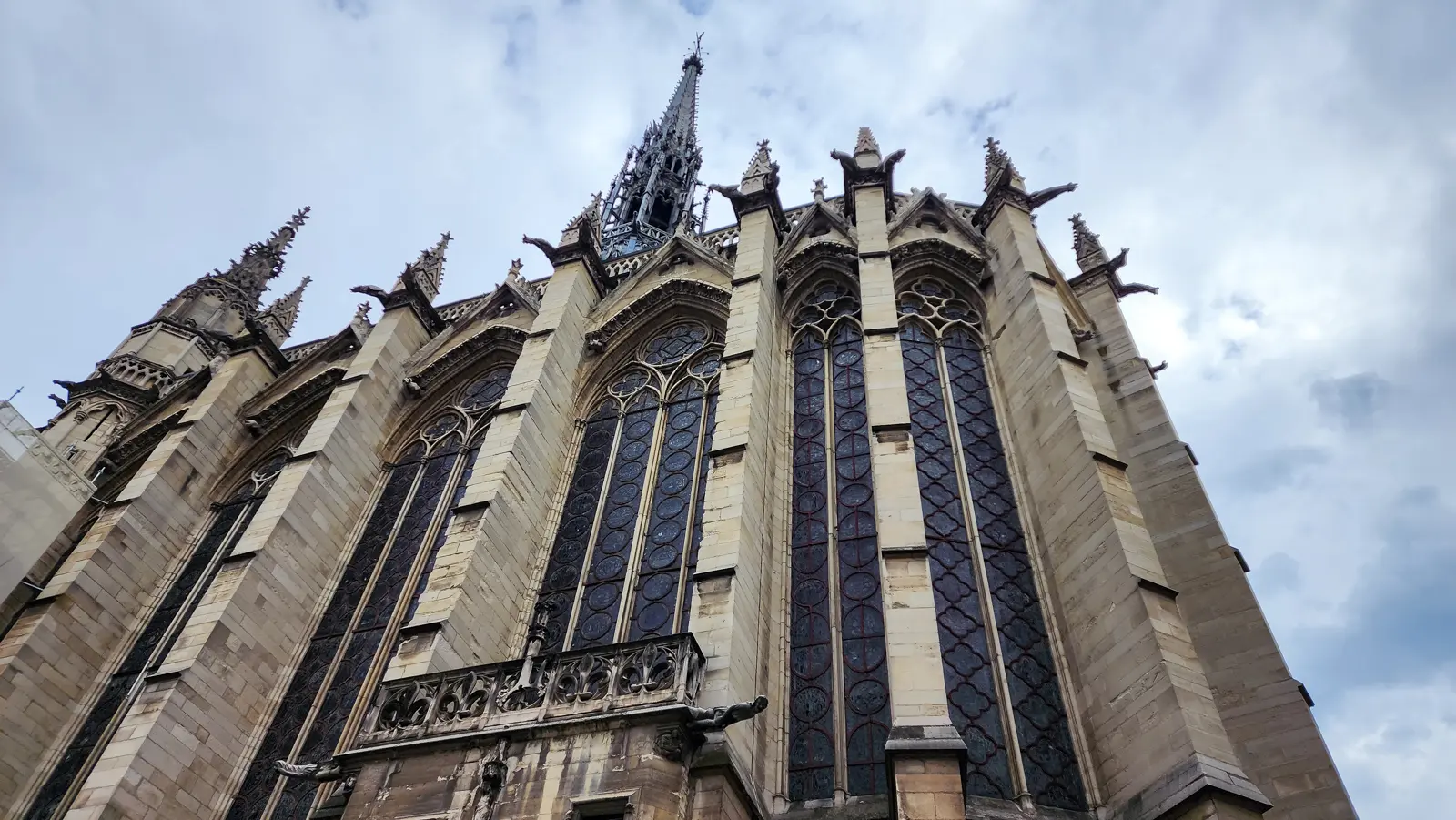
From the street, the chapel gives almost nothing away. The outside is all pale stone: buttresses, pinnacles, gargoyles and a slim spire on the roof. The windows are tall and set close together, but from outside the glass looks dark grey, nearly black. Nothing about it prepared me for what was inside.
A Chapel Built for a Crown
Louis IX bought the Crown of Thorns from Baldwin II, the Latin emperor of Constantinople, and it arrived in Paris in 1239. He built Sainte-Chapelle to hold it, along with fragments of the True Cross and other relics of the Passion that he added to his collection over the next few years. The chapel was consecrated on 26 April 1248, less than a decade after the Crown arrived. Louis was later canonised as Saint Louis.
Sainte-Chapelle is really two chapels, one stacked on top of the other. The lower chapel served the palace staff. The upper chapel, where the relics were kept, was reserved for the king, the royal family and their guests.
The French Revolution emptied it. The relics left the chapel, and the Crown of Thorns eventually went to Notre-Dame, a short walk away. It was still there in April 2019, when firefighters, led by their chaplain, carried it out of the burning cathedral.
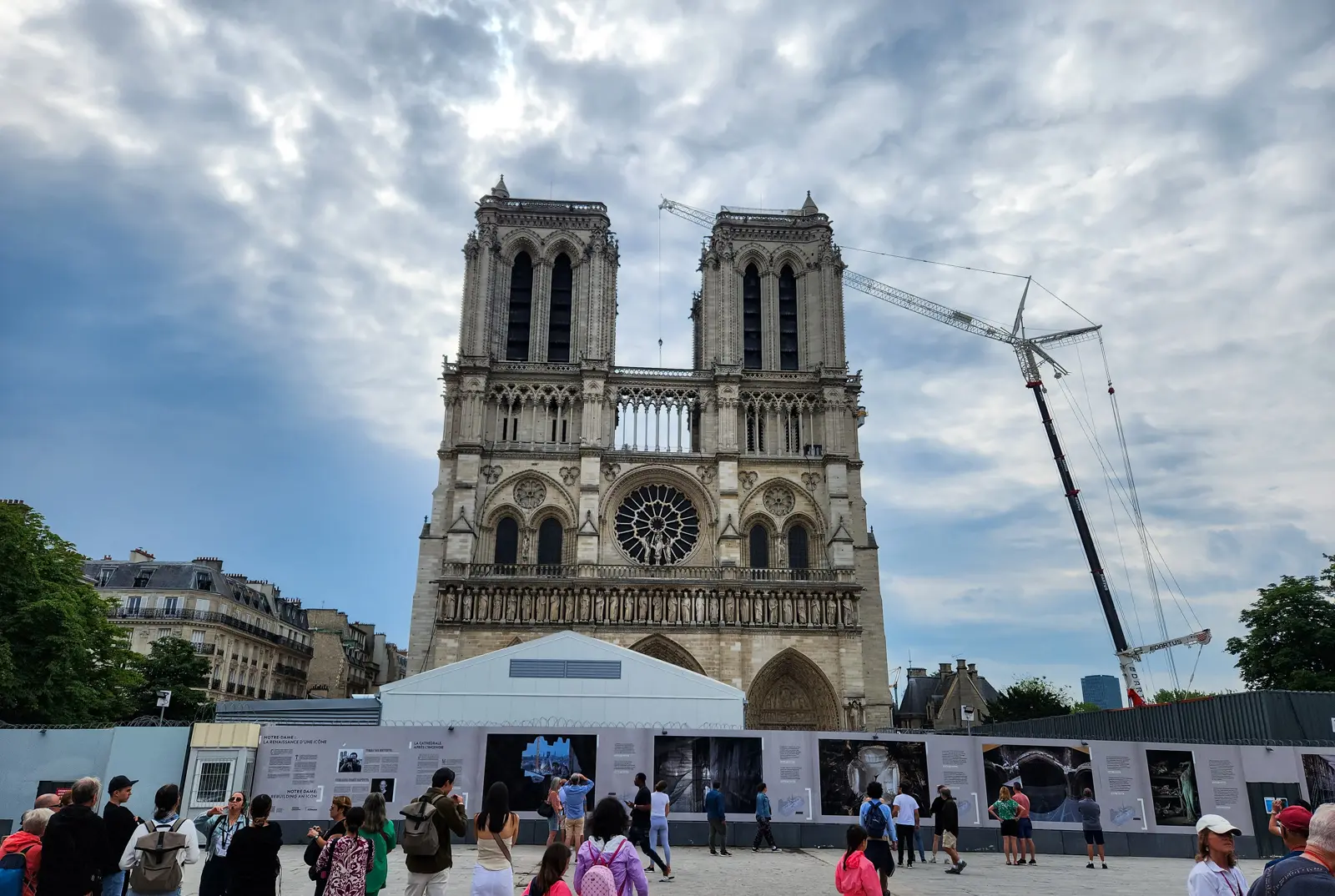
On the day I visited Sainte-Chapelle, Notre-Dame was still closed for repairs. A tall crane stood beside the west front, a white tent sat in front of the main doors, and the square was fenced off with hoarding that carried a photo exhibition about the rebuilding.
Sainte-Chapelle had a long restoration of its own, almost two centuries earlier. After the Revolution the chapel was secularised, and in the middle of the 19th century it was restored in a project led by Félix Duban with Jean-Baptiste Lassus and a young Eugène Viollet-le-Duc, who later restored Notre-Dame as well.
Surrounded by Glass
The upper chapel has 15 windows, each about 15 metres tall, holding 1,113 scenes from the Bible. Read in order, they run from Genesis through the Passion of Christ and finish with the story of how the relics came to Paris. One window shows Louis IX himself carrying the Crown of Thorns into the city.
I had read that the windows need sunshine. They don’t. Under a flat grey sky the blues and reds were deep and rich, and the light seemed to come from the glass itself rather than from outside. This is where I lost the guide completely. I stood and stared, and I found the glass almost hypnotic.
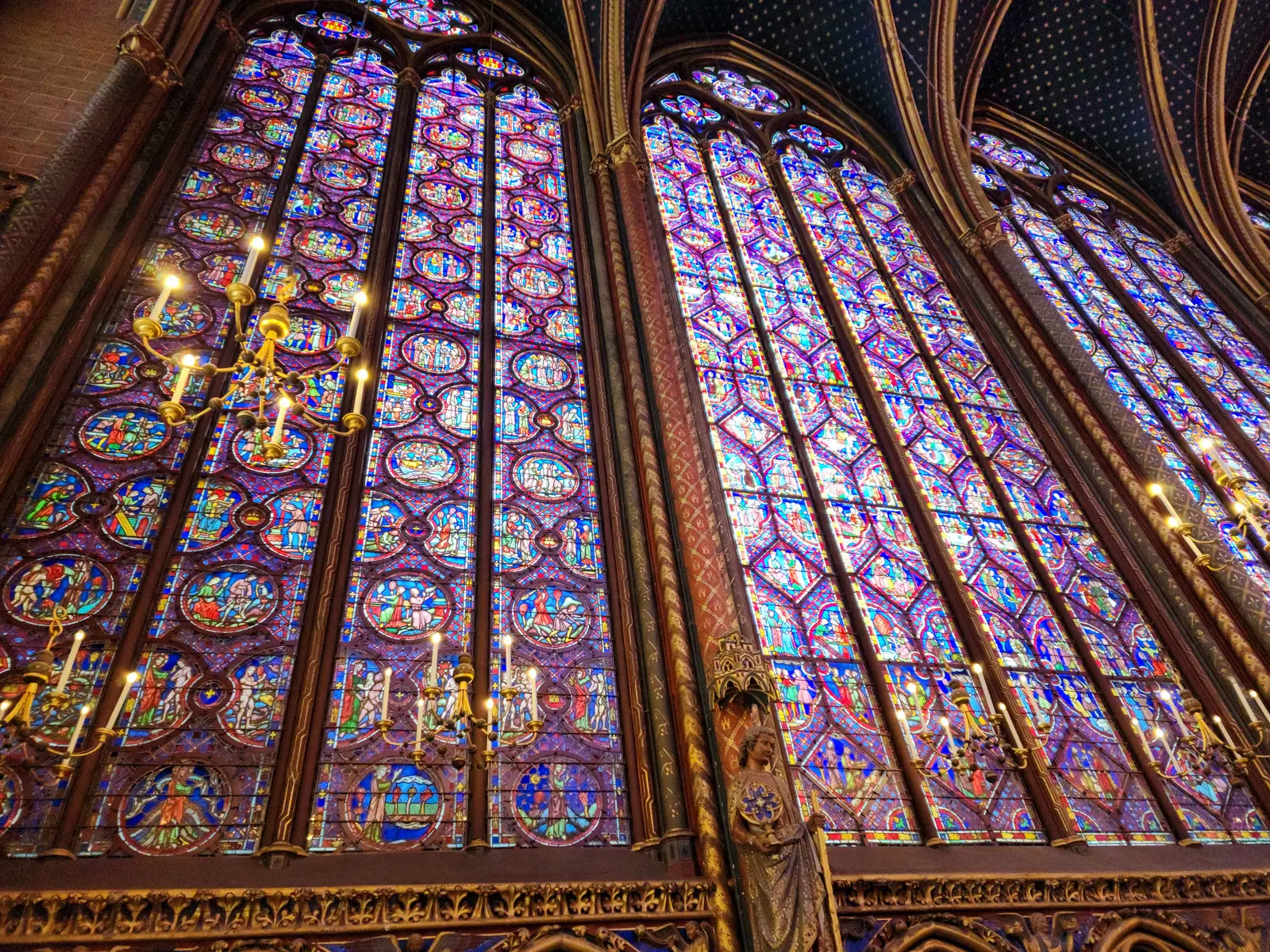
Between the windows, statues of the apostles stand against the piers, just below the glass. At the far end, in the apse, a gilded tribune with a pointed canopy rises in front of the windows. This is the platform where Louis IX’s relics were displayed.
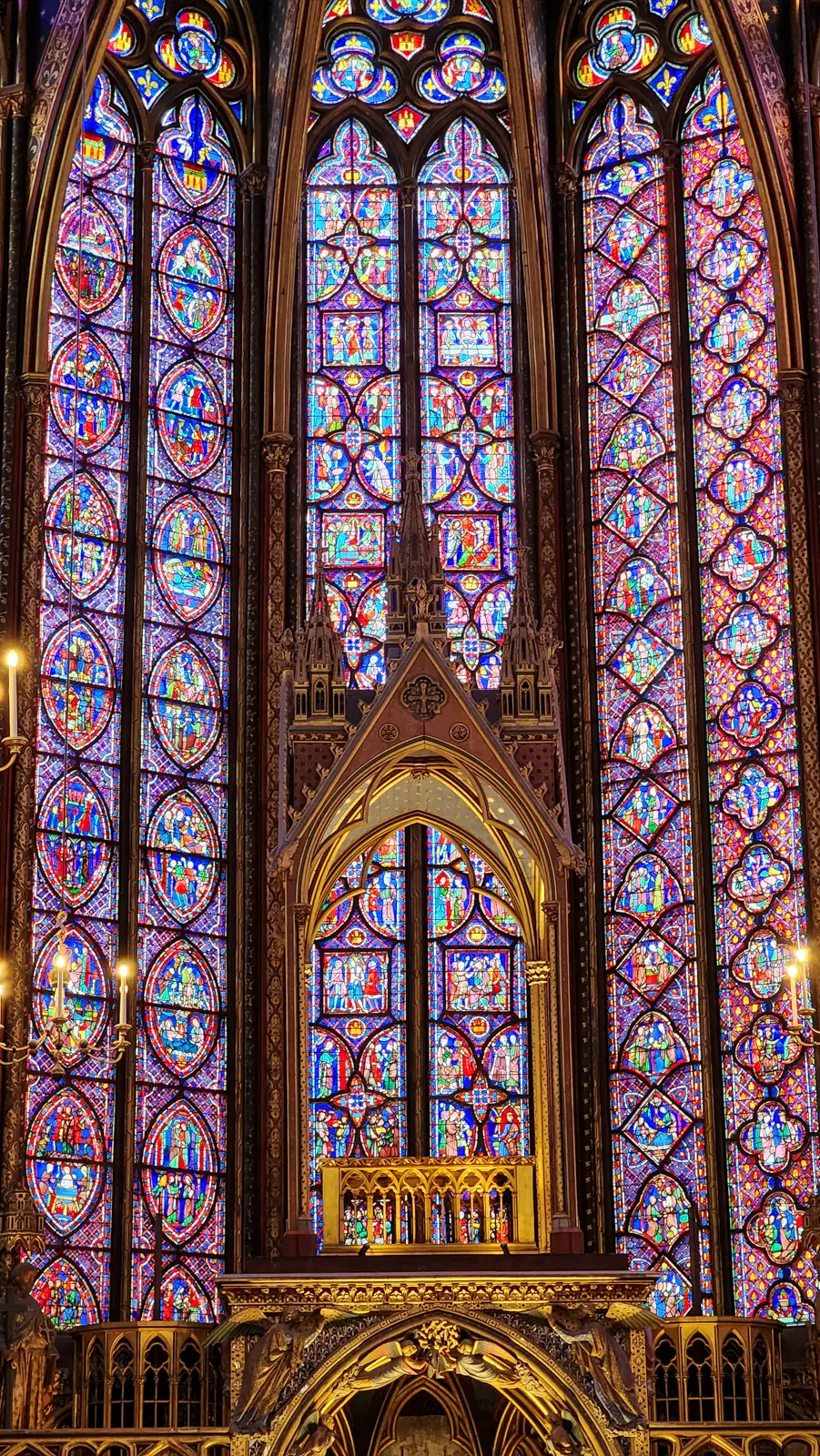
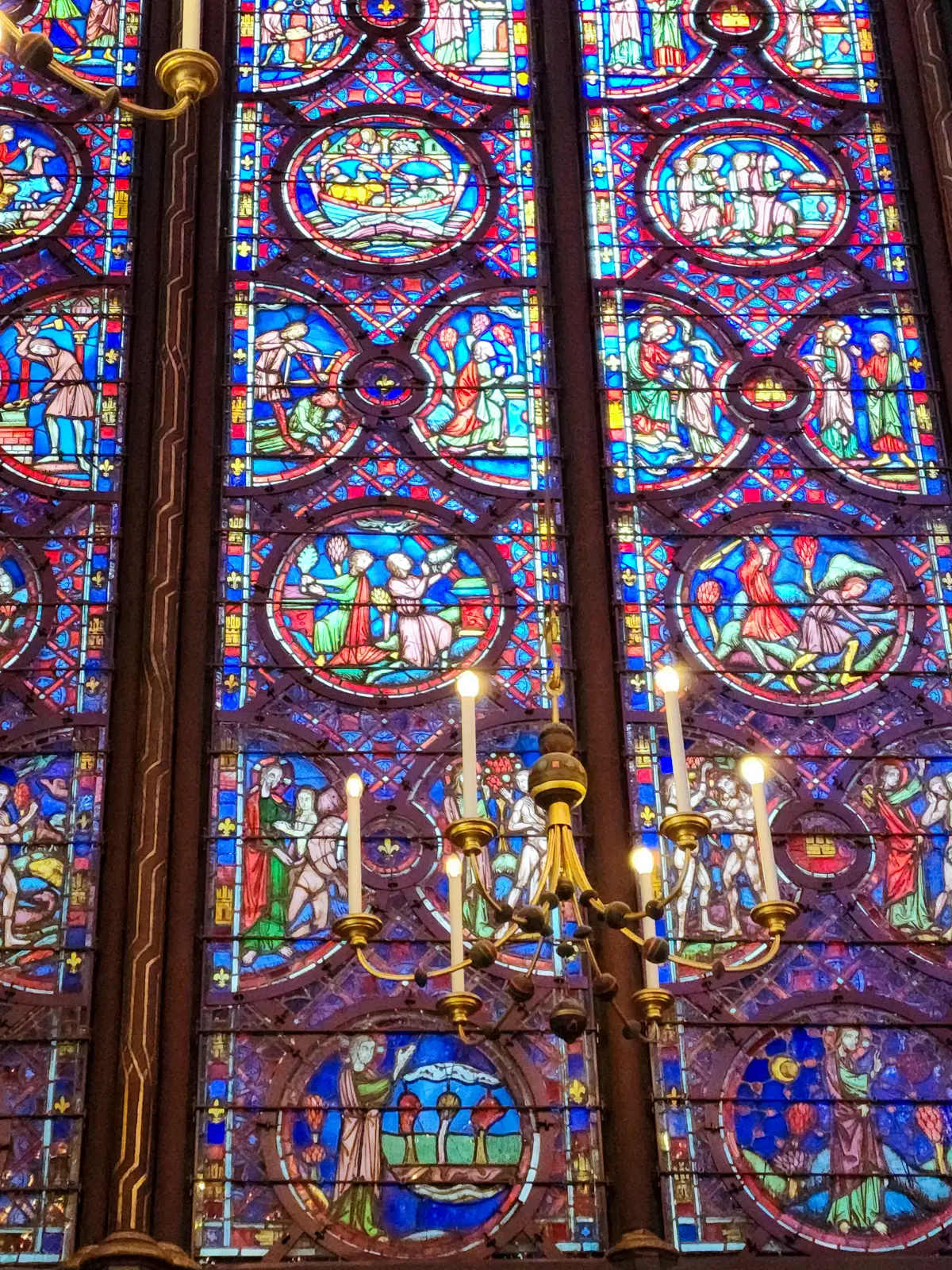
Up close, each window breaks down into small medallions, every one a separate scene with its own figures, trees, buildings and boats. They are packed so tightly that it is hard to follow a single story from the floor, and the candelabra hang right in front of some of them.
The Rose of the Apocalypse
The rose window fills the west wall, above the entrance. It is younger than the rest of the glass, remade in the 15th century in the Flamboyant Gothic style, and its scenes come from the Book of Revelation, the Apocalypse. When I turned around to face it, the doors below stood open and a crowd had gathered underneath.
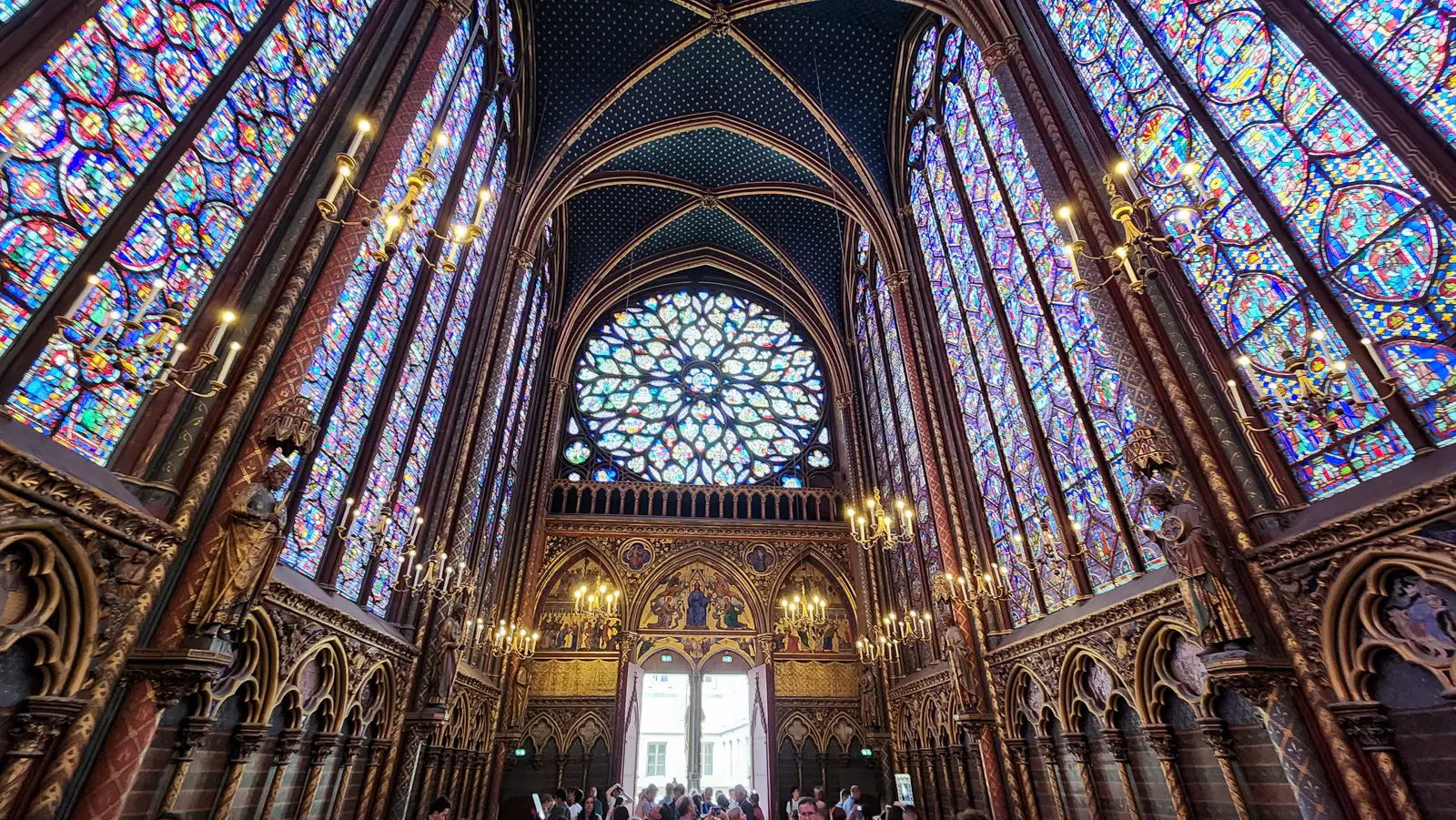
Next to the 13th-century windows along the sides, the rose looks lighter to my eye, with more white and pale green in it. Below it, the wall is painted with gilded arches and figures, and lit candelabra stand along the gallery.
Bubbly Tips
- Book a timed slot. Tickets come with a 30-minute entry window, and you must arrive within it. There is also a second security check before you enter the chapel, so build in extra time, especially in summer.
- Know the 2026 prices. Since 12 January 2026, a standard ticket costs €22 for visitors from outside the European Economic Area and €16 for EEA residents. Under-18s go free, and the Paris Museum Pass covers entry.
- Consider the combined ticket. You can book Sainte-Chapelle together with the Conciergerie, the former royal palace and prison right next door.
- Pack light. The chapel sits inside the Palais de Justice, so security is tighter than at most Paris sights. Leave large bags, pocket knives and scissors at your hotel.
- Take Line 4 to Cité. The Cité metro station is a short walk from the entrance on Boulevard du Palais. RER B and C stop at Saint-Michel, just across the river.
- Check the season’s hours. The chapel opens 9 a.m. to 7 p.m. from April to September and 9 a.m. to 5 p.m. from October to March, with last entry 30 minutes before closing. It closes on 1 January, 1 May and 25 December.
- Don’t wait for sunshine. The windows held their colour on the grey day I visited. A cloudy day is no reason to postpone.
- Bring binoculars. The upper scenes sit far above eye level. With binoculars you can follow individual stories, including the window of Louis IX carrying the Crown of Thorns into Paris.
Final Thoughts
I left Sainte-Chapelle knowing much more about the glass than about the history, which is entirely my fault and not the guide’s.
I’m going back to Paris this year, and this time I’ll take my time. I didn’t see the lower chapel on my first visit, with its vault painted with gold fleurs-de-lis, and I want to find that window of Louis IX and his Crown. I suspect I’ll end up standing in the middle of the upper chapel again, staring.
Until next time!

🌟 Everything You Need to Plan Your Dream Trip in 2026
- 🌟 Luxury Hotels - Find premium stays with Booking.com & Hotels.com
- 🏡 Vacation Rentals - Discover unique properties on VRBO
- 🏞️ Guided Tours - Explore with Viator or GetYourGuide
- 🎫 Attraction Tickets - Skip the lines with Tiqets
- 🚢 Ocean Cruises - Set sail with Cruise Direct
- 📱 International SIMs - Stay connected with Saily
- 🚗 Car Rentals - Budget-friendly options from Discover Cars
- 🌐 Secure VPNs - Browse safely with NordVPN
- 💶 Currency Exchange - Best rates with Wise
- 🗣️ Learn Languages - Master the local language with Babbel and Rosetta Stone