
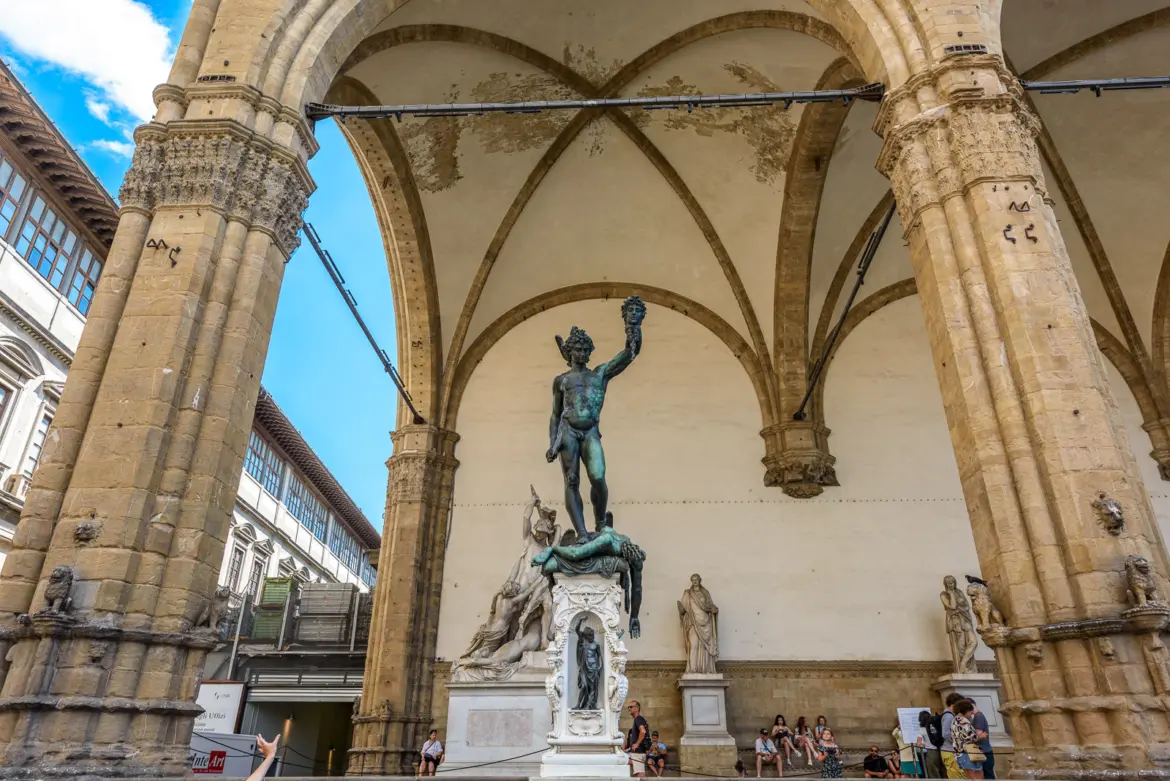
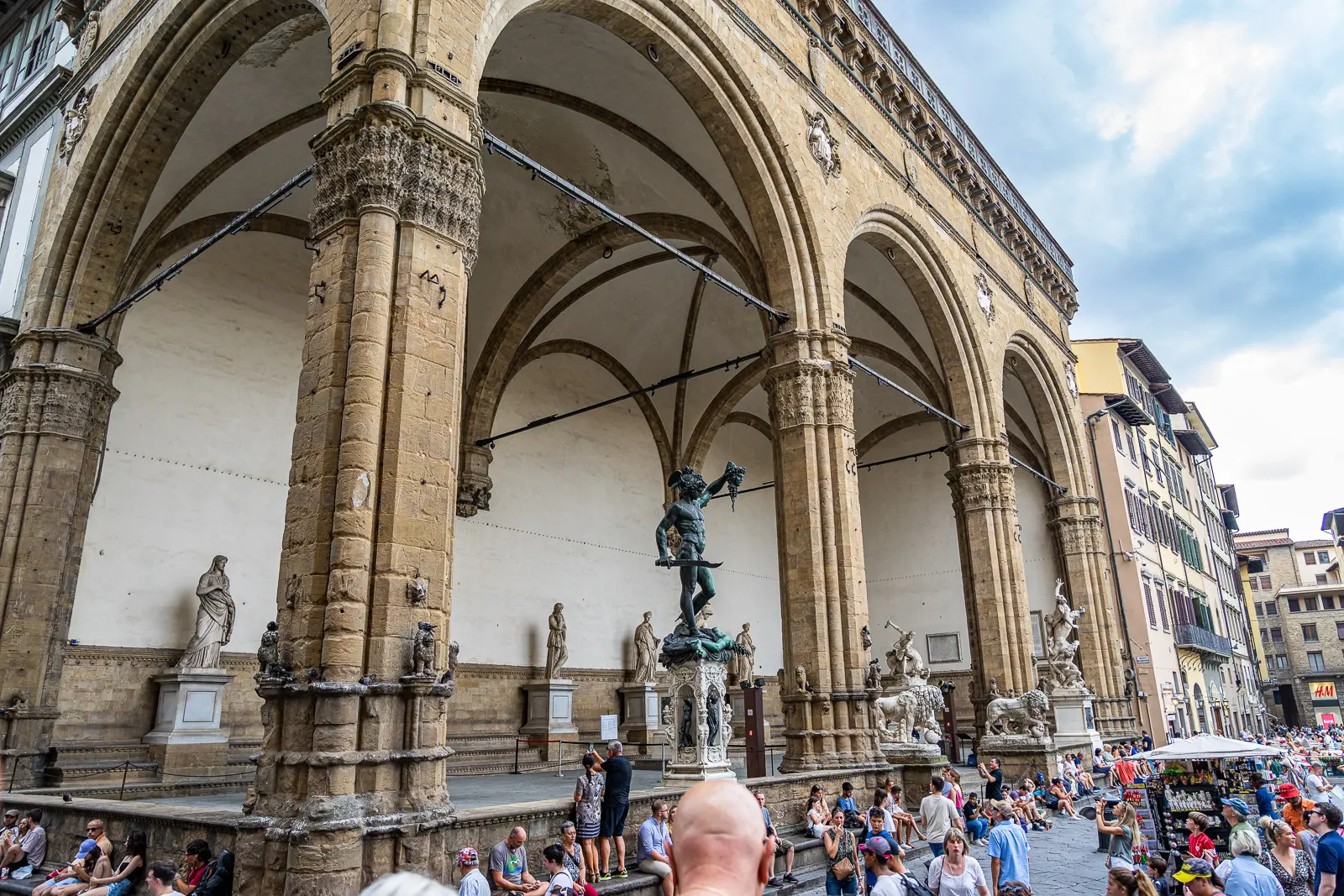
Hello beautiful explorers! In the heart of Florence, where Piazza della Signoria unfolds like a living stage, stands one of the city’s most remarkable spaces – the Loggia dei Lanzi. Many visitors pass through quickly, snapping photos of the statues before moving on to nearby landmarks. But pause for a moment, and you begin to realize that this elegant open structure is much more than a backdrop. It is a place where politics, mythology, and artistic genius come together in the open air, accessible to everyone without a ticket or a threshold.
The Loggia dei Lanzi is not simply an architectural feature of the square. It is an open-air museum, a civic monument, and a carefully curated display of power that reflects Florence’s evolving identity over centuries. Standing beneath its arches, you are surrounded by stories carved in marble and bronze – stories of heroism, struggle, transformation, and human emotion. This is a space that invites you to slow down, look closely, and allow art to speak.
Loggia dei Lanzi at a Glance
📍 Location: Piazza della Signoria, Florence, Italy (adjacent to Uffizi Gallery and Palazzo Vecchio)
🎨 Key Sculptures: Perseus with the Head of Medusa (Cellini), Abduction of the Sabine Women (Giambologna), Hercules and the Centaur Nessus, Ajax and Achilles, Medici Lions
🏛️ Built: 1376–1382 for the Florentine Republic
🎟️ Admission: Free — open 24/7, no tickets required
⏱️ Time Needed: 30 minutes to 1 hour (longer if you study the details)
💡 Tip: Visit early morning or late afternoon for softer light and fewer crowds — walk around each sculpture to see them from all angles
A Stage for the Republic: The History of the Loggia
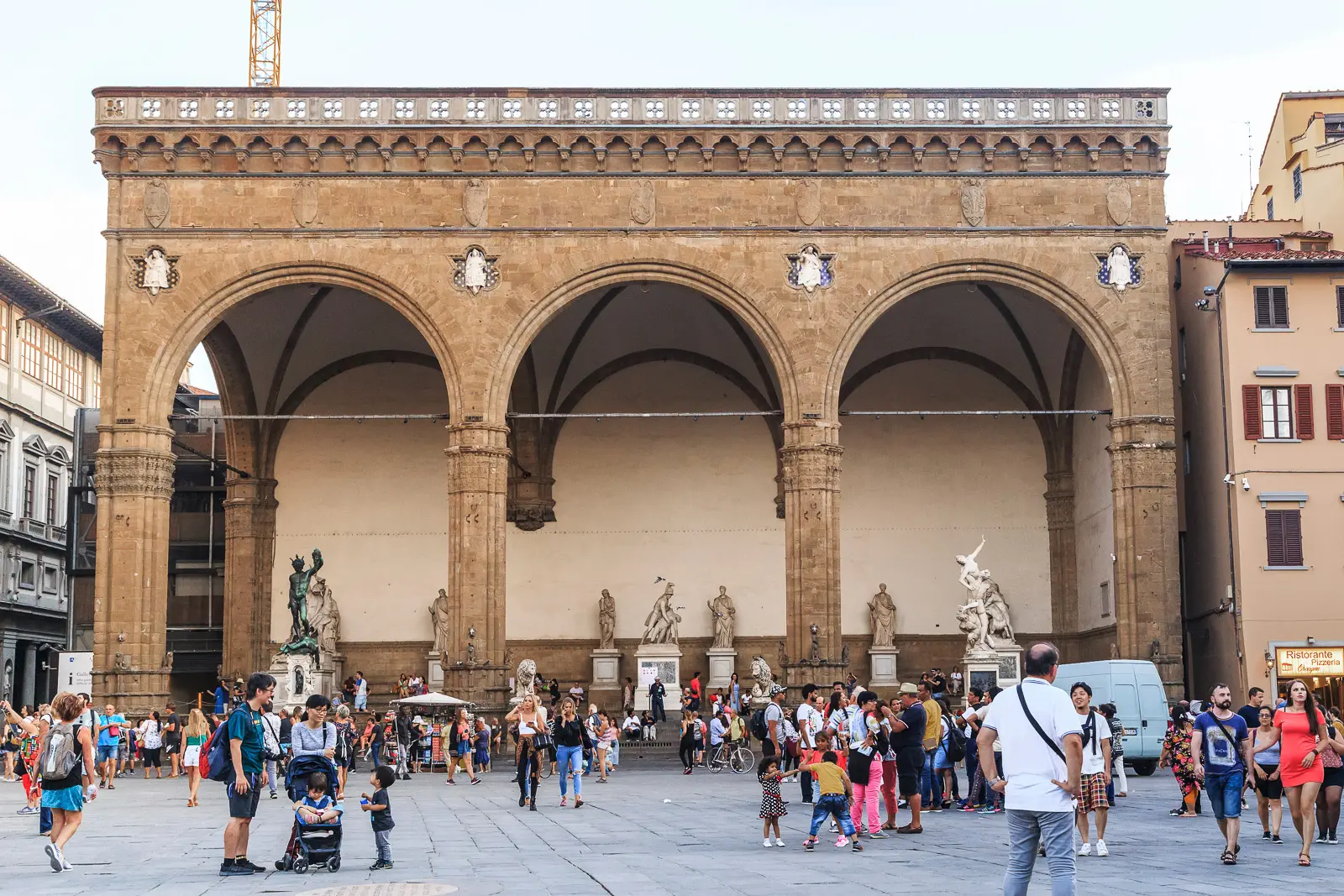
The Loggia dei Lanzi was constructed between 1376 and 1382, designed by architects Benci di Cione and Simone di Francesco Talenti during the period of the Florentine Republic. Originally known as the Loggia della Signoria, it was created as a public platform where civic ceremonies, official announcements, and political gatherings could take place. Unlike enclosed palaces or churches, this space was deliberately open – a symbolic gesture reflecting the idea that governance should unfold in view of the people.
Its wide arches and elevated platform created a natural stage facing the square, allowing citizens to witness events that shaped the city’s future. The name we use today, Loggia dei Lanzi, came later during Medici rule. It derives from the Lanzichenecchi – German mercenary guards stationed nearby under Cosimo I de’ Medici – and reflects Florence’s transformation from a republican city to a ducal power. Even the evolution of the name quietly tells the story of changing political authority.
Over time, as Florence transitioned from republic to Medici rule, the function of the loggia evolved. What began as a civic space gradually transformed into a display of artistic and political messaging. Sculptures were installed not merely as decoration but as visual narratives reinforcing authority, power, and cultural sophistication.
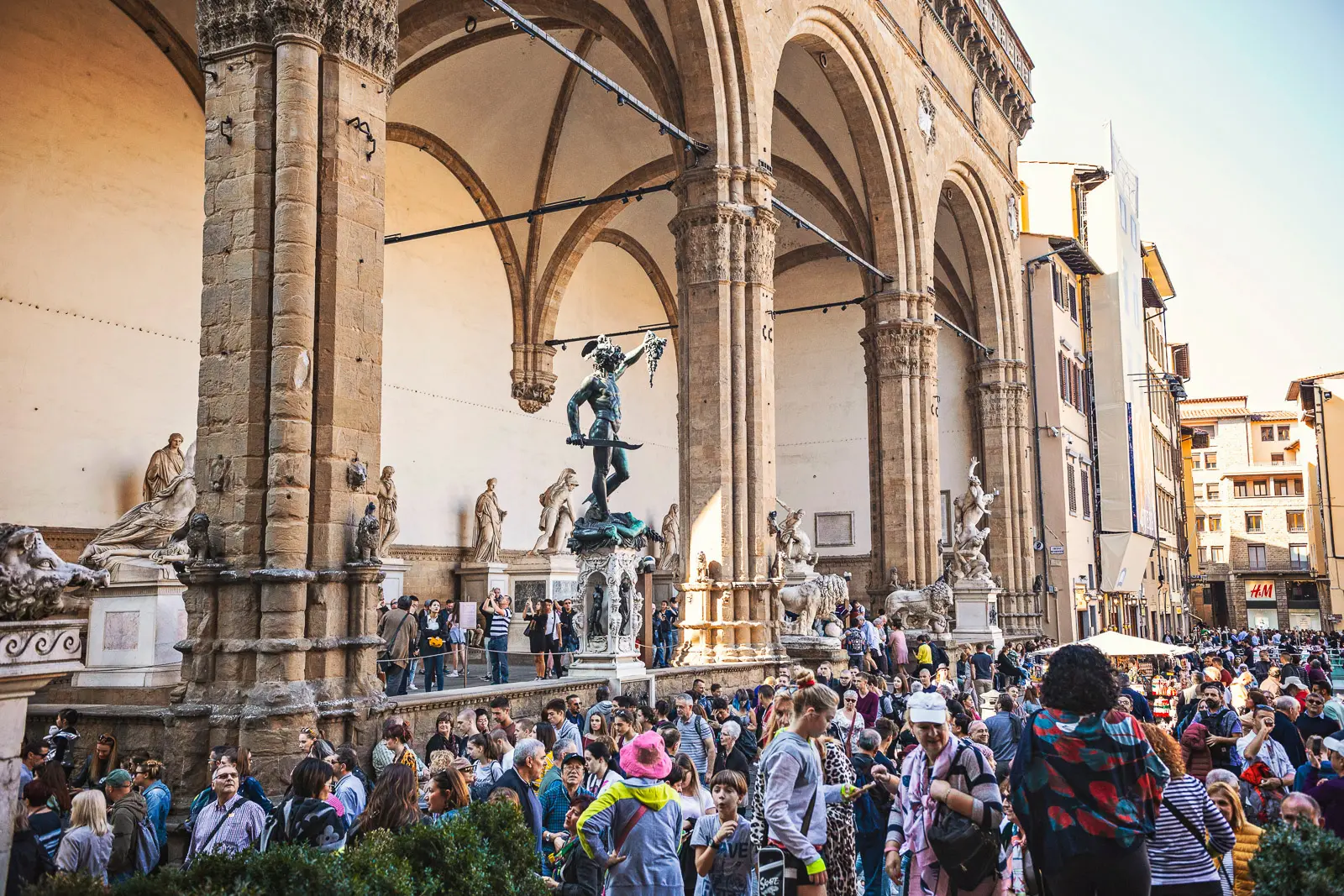
Even today, the structure itself retains a sense of dignity and restraint. Its Gothic arches frame the sculptures like a theatrical set, reminding visitors that Florence has always understood the power of art as public communication.
Perseus and Medusa: Art as Political Symbol
Among the most striking works inside the Loggia is Benvenuto Cellini’s bronze masterpiece, Perseus with the Head of Medusa, completed in 1554. At first glance, the sculpture appears dramatic and mythological – Perseus stands triumphant, holding Medusa’s severed head high as her body collapses beneath him. Yet this work is far more than a retelling of ancient myth.
Commissioned by Cosimo I de’ Medici, the sculpture carried clear political symbolism. Perseus, victorious and controlled, represented order triumphing over chaos – a message aligned with Medici authority in a city that had experienced political upheaval. The technical achievement was equally extraordinary. Cellini cast the main bronze figure in a single monumental pour – an immense challenge for the period – while additional elements were completed separately, demonstrating both artistic daring and remarkable technical skill.
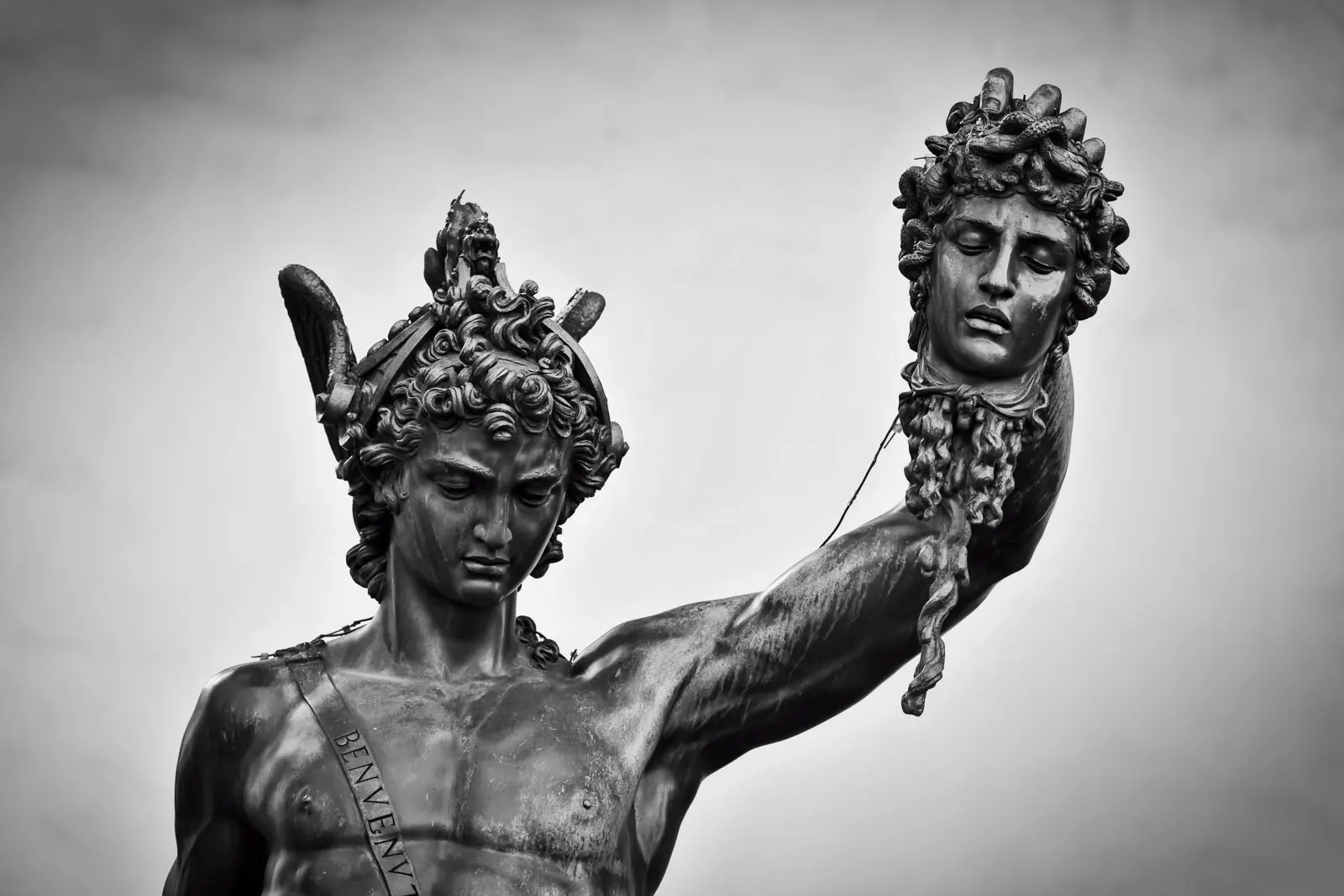
Standing before the statue today, you feel both awe and tension. The dramatic movement, the polished bronze surface, and the intensity of expression reveal the Renaissance fascination with human emotion and physical realism. It is impossible to look away.
Giambologna’s Masterpiece: The Abduction of the Sabine Women
Another highlight of the Loggia is Giambologna’s Abduction of the Sabine Women, completed in 1583. Carved from the largest single block of marble ever transported to Florence at that time, the sculpture spirals upward in a dynamic composition that seems to defy gravity. Unlike many Renaissance works, it was not originally conceived to depict a specific story. Instead, Giambologna focused purely on movement and form, creating what is considered a masterpiece of Italian Mannerism and the first sculpture in European history designed to be admired equally from all sides.
The three figures tell a story of extraordinary tension: a young man raises a woman above him while an older man is trapped beneath his legs – a composition sometimes described as representing the three ages of man. Only after completion was the subject identified as the Roman myth of the Sabine women, with the title suggested by Vincenzo Borghini. It is worth noting that the Italian word “ratto” means abduction rather than rape in the modern sense, which is why the work is increasingly referred to today as the Abduction rather than the Rape of the Sabine Women.
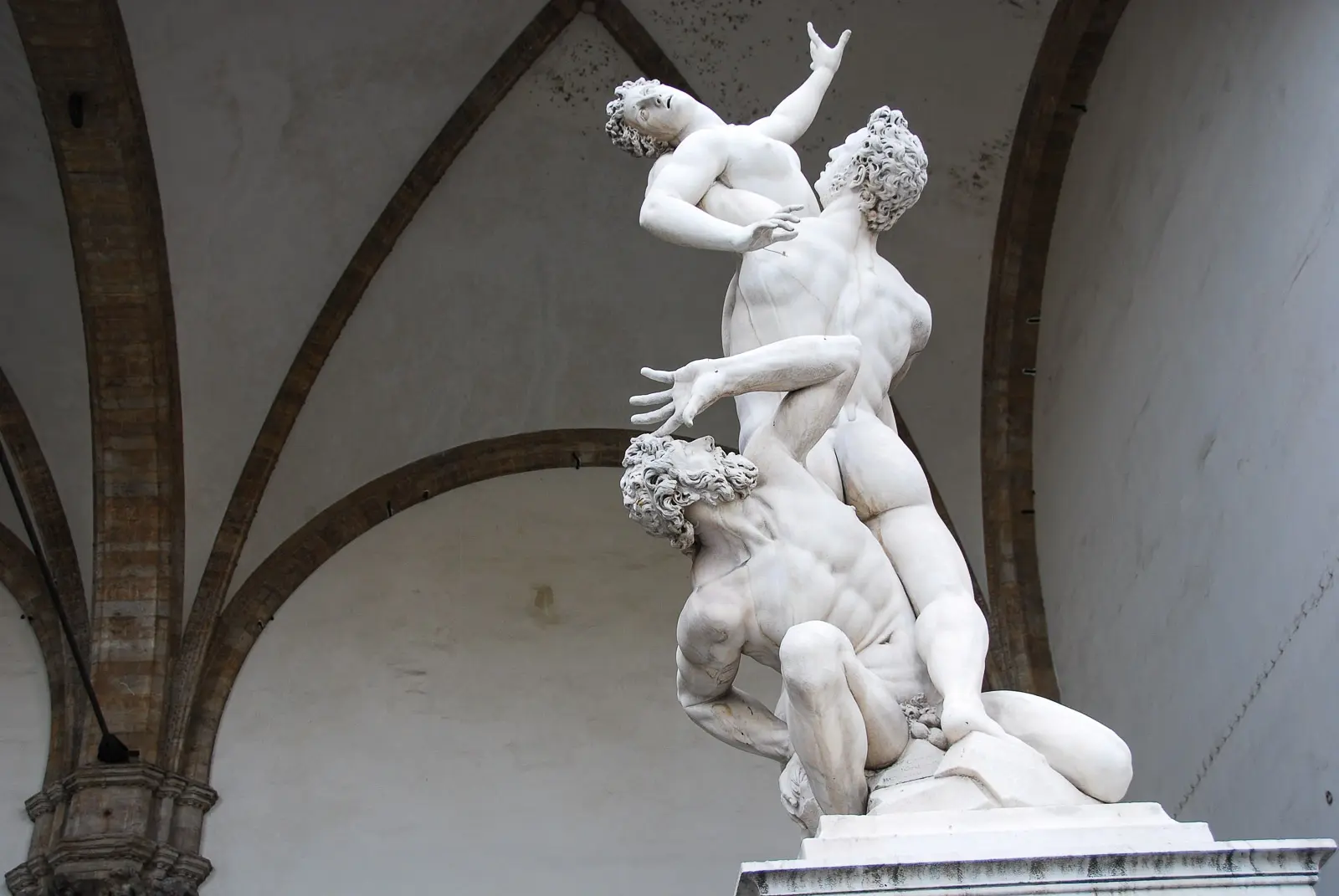
The sculpture captures a moment of intense motion – bodies twisting, reaching, resisting – and showcases Giambologna’s extraordinary ability to transform stone into living movement. As you walk around it, the figures reveal new perspectives, encouraging viewers to engage actively rather than passively observe.
Other Figures, Quiet Stories
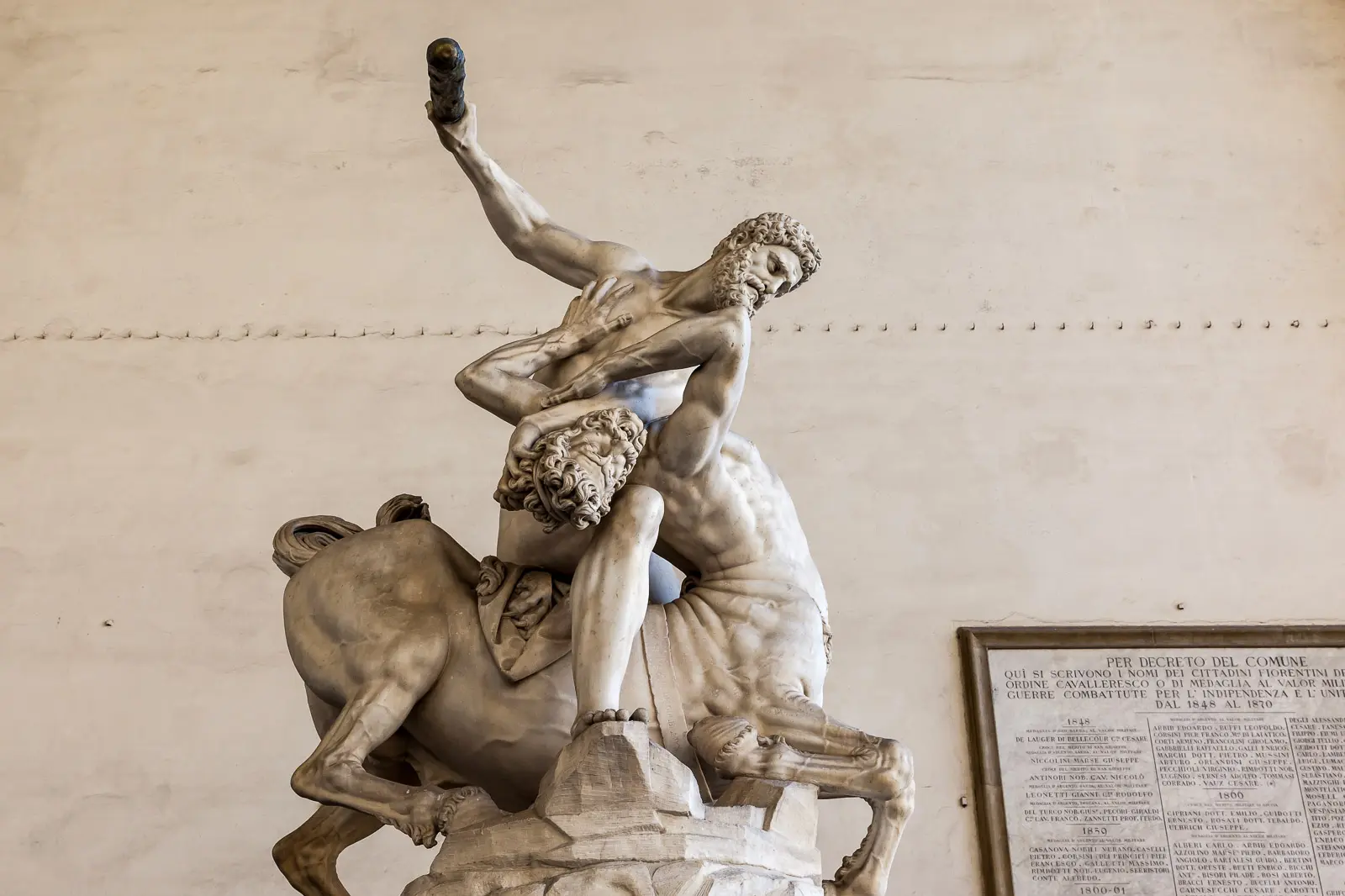
While Perseus and the Sabine group often draw the most attention, the Loggia houses several other significant works that reward closer observation. Giambologna’s Hercules and the Centaur Nessus, completed in 1599 though only installed in the Loggia in 1841, captures a moment of struggle frozen in marble, embodying themes of strength and conflict that echo the political messaging of the space as a whole.
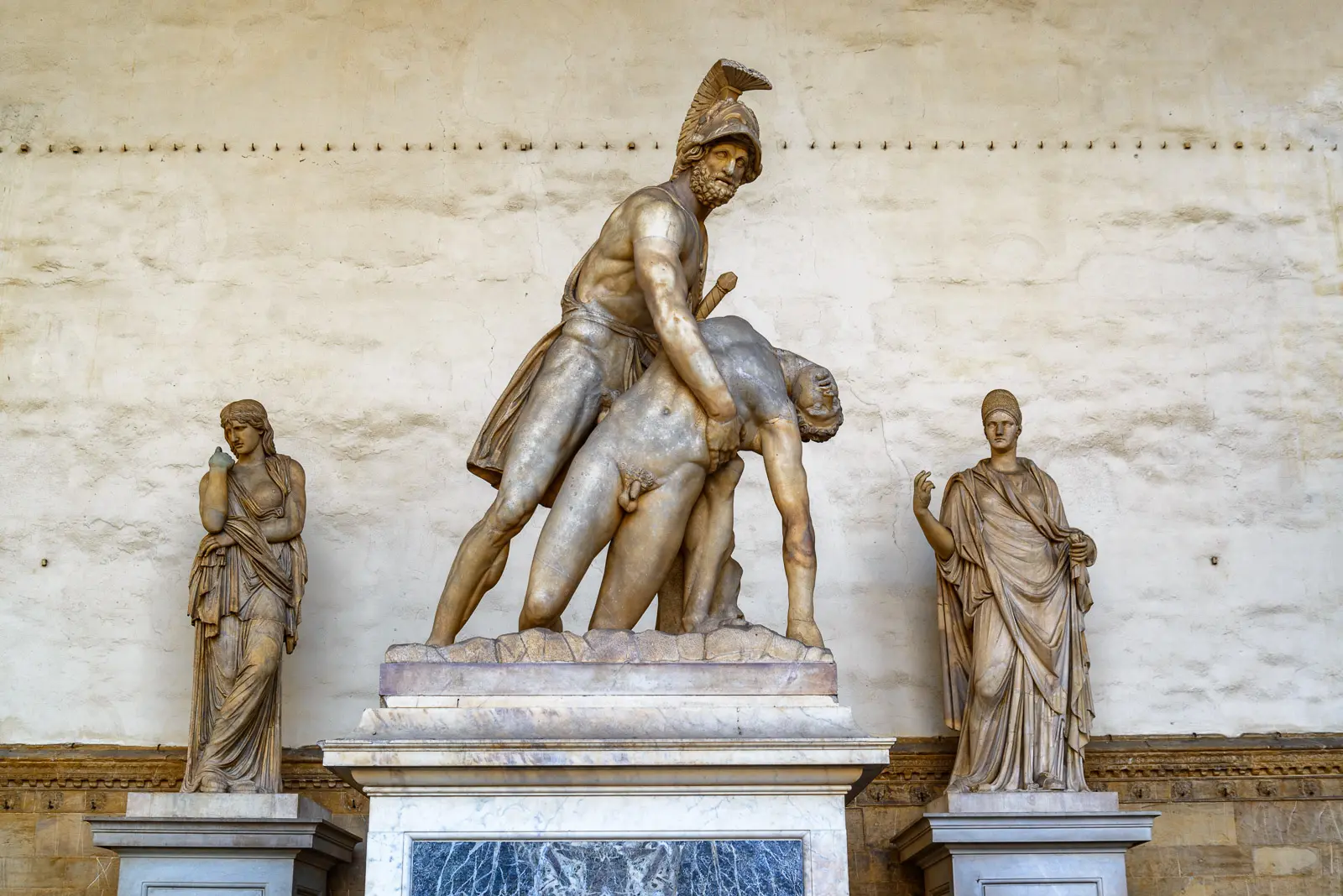
Nearby stands an ancient Roman sculptural group traditionally identified as Menelaus supporting the body of Patroclus, though many scholars now favour the identification of Ajax carrying the body of Achilles. Whichever reading is correct, the work links Florence’s artistic ambitions directly to classical antiquity, reminding visitors that the Loggia was conceived as much as a display of cultural authority as a civic space.
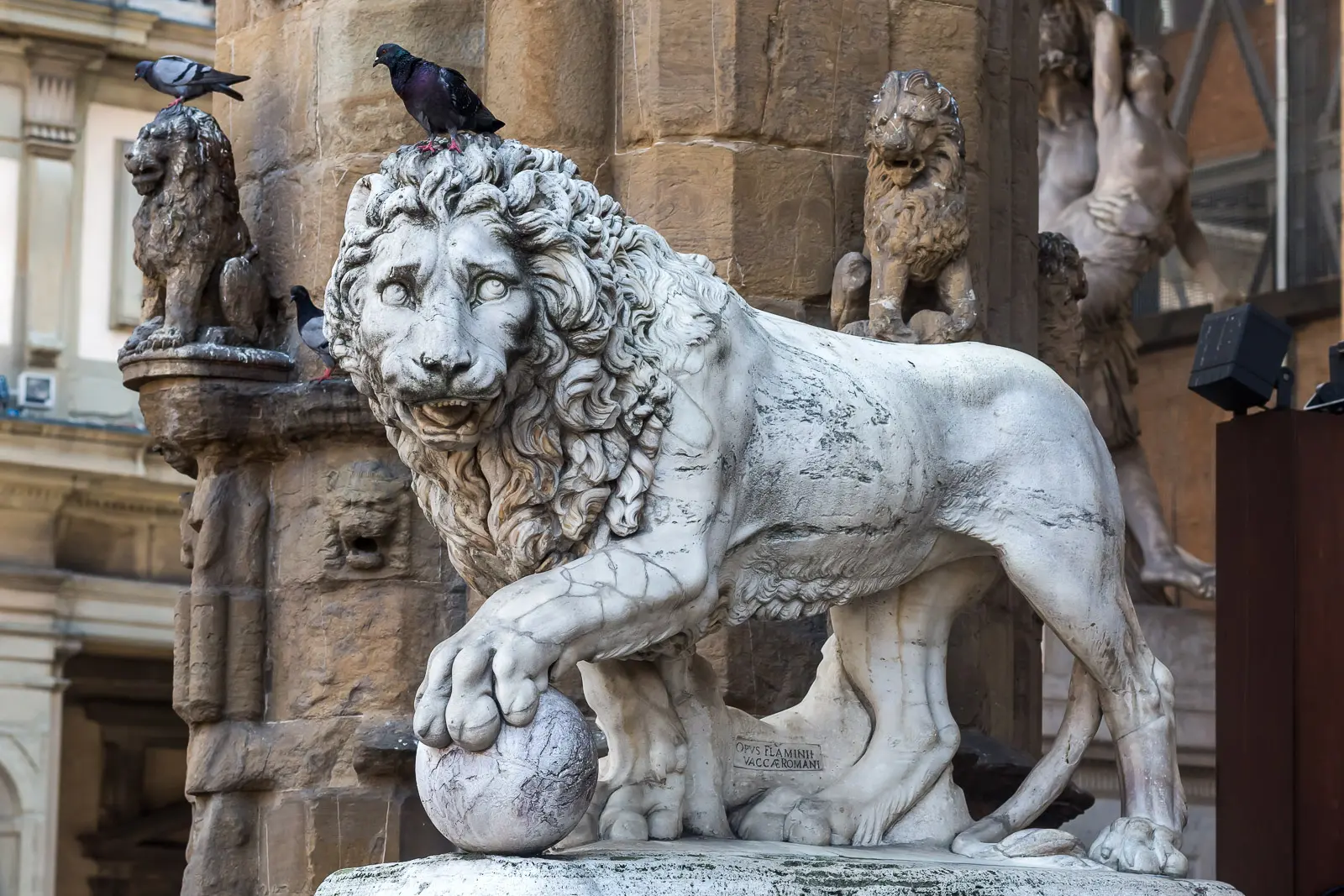
At the entrance, two lions guard the space, though they are not a matched pair. The lion on the right dates from Roman times, while the one on the left was sculpted by Flaminio Vacca in 1598, originally placed at the Villa Medici in Rome before being moved to the Loggia in 1789. One ancient, one Renaissance – they quietly embody the Loggia’s layered identity. Along the rear wall, six ancient Roman female figures, thought to have originated from Trajan’s Forum in Rome, line the space with a serene classical presence.
Together, these works create a dialogue between ancient Rome, Renaissance innovation, and Florentine identity – a visual timeline carved in stone, bronze, and marble, open to the sky and to anyone who pauses long enough to look.
The Experience: Art Without Walls
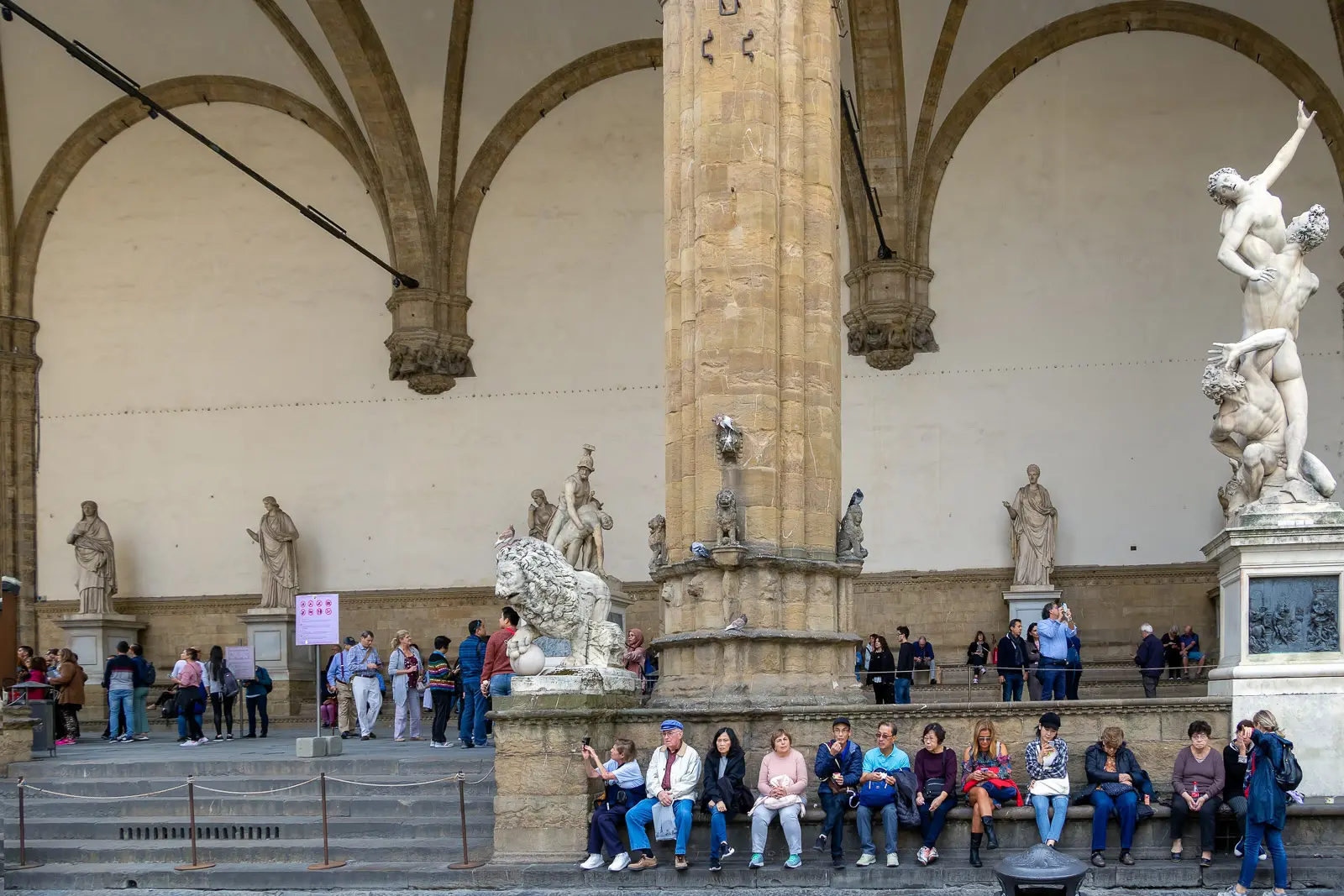
What makes the Loggia dei Lanzi truly special is not only the art itself but the way it exists within the life of the city. There are no barriers separating the sculptures from daily movement. People walk past on their way to work, musicians play nearby, and conversations echo through the square. Art here is not distant or protected behind glass; it is part of the rhythm of Florence.
Standing beneath the arches, you feel both sheltered and connected to the open space of Piazza della Signoria. The contrast between the monumental sculptures and the everyday life unfolding around them creates a unique atmosphere – one where history feels alive rather than preserved. This openness reflects Florence’s long tradition of integrating art into public space. The Loggia reminds us that beauty was meant to be shared, not hidden.
Why the Loggia Still Matters Today
The Loggia dei Lanzi continues to matter because it embodies Florence’s belief that art is not merely decoration but dialogue. Each sculpture communicates ideas about power, heroism, humanity, and transformation. The space itself reflects the evolution of the city – from republic to ducal rule, from medieval governance to Renaissance cultural dominance.
Visitors often arrive expecting a quick photo stop and leave surprised by how long they linger. The longer you stay, the more details emerge – the tension in a marble muscle, the expression on a face, the way light moves across stone as the day changes. In a city filled with museums and masterpieces, the Loggia offers something rare: art experienced freely, under the open sky, exactly as the city intended.
Bubbly Tips for Visiting Loggia dei Lanzi
- Visit early or late: Softer light enhances the sculptures and the square feels calmer
- Walk around each statue: Many works were designed to be viewed from multiple angles
- Look for symbolism: The sculptures often carried political messages, not just mythological meaning
- Pause under the arches: Standing inside the loggia changes your perspective of the piazza
- Pair your visit: Combine with Palazzo Vecchio, Piazza della Signoria, and the Uffizi for a deeper understanding of Florence’s civic heart
Final Thoughts
The Loggia dei Lanzi reminds us that some of the greatest museums have no walls. Here, art breathes alongside the city, shaped by light, weather, and the movement of people passing through. It is a place where myth becomes political, sculpture becomes storytelling, and history becomes something you can stand within rather than simply observe.
If you find yourself in Florence, take a moment to step beneath its arches. Look slowly. Let the stories unfold around you.
Have you visited the Loggia dei Lanzi? I’d love to hear your thoughts and impressions, share them in the comments below!
With love,
Bubbly💫

🌟 Everything You Need to Plan Your Dream Trip in 2026
- 🌟 Luxury Hotels - Find premium stays with Booking.com & Hotels.com
- 🏡 Vacation Rentals - Discover unique properties on VRBO
- 🏞️ Guided Tours - Explore with Viator or GetYourGuide
- 🎫 Attraction Tickets - Skip the lines with Tiqets
- 🚢 Ocean Cruises - Set sail with Cruise Direct
- 📱 International SIMs - Stay connected with Saily
- 🚗 Car Rentals - Budget-friendly options from Discover Cars
- 🌐 Secure VPNs - Browse safely with NordVPN
- 💶 Currency Exchange - Best rates with Wise
- 🗣️ Learn Languages - Master the local language with Babbel and Rosetta Stone