
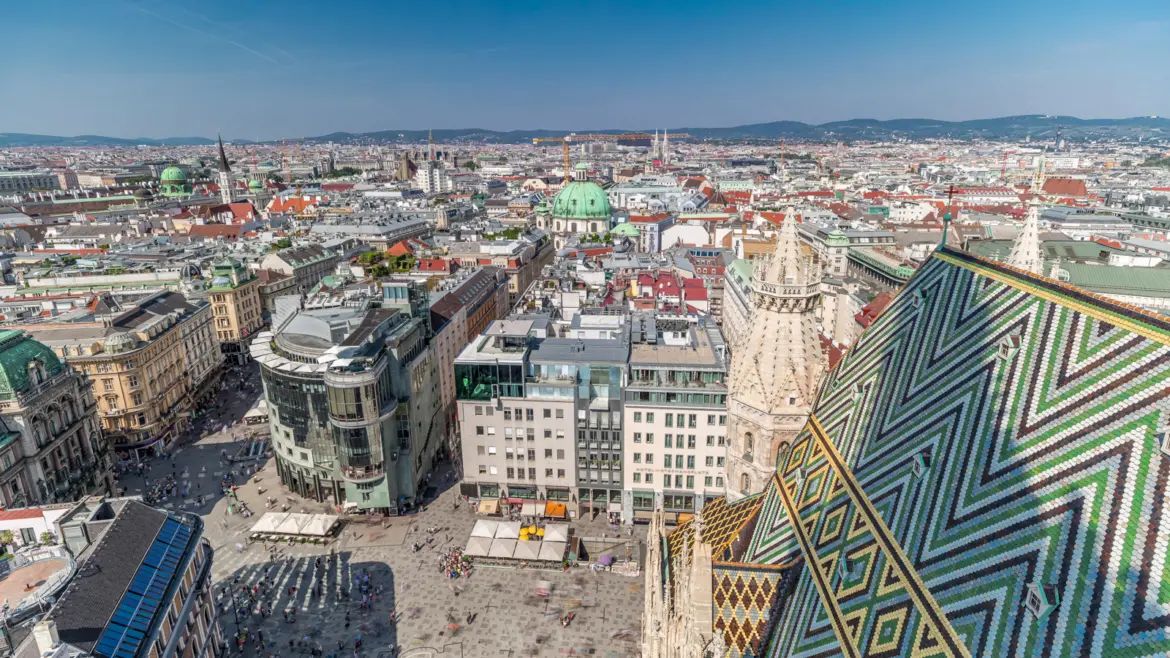
There are places in every city where everything seems to converge – where history, movement, and everyday life come together in a way that feels almost cinematic. In Stephansplatz, you don’t just arrive… you step into the rhythm of Vienna itself.
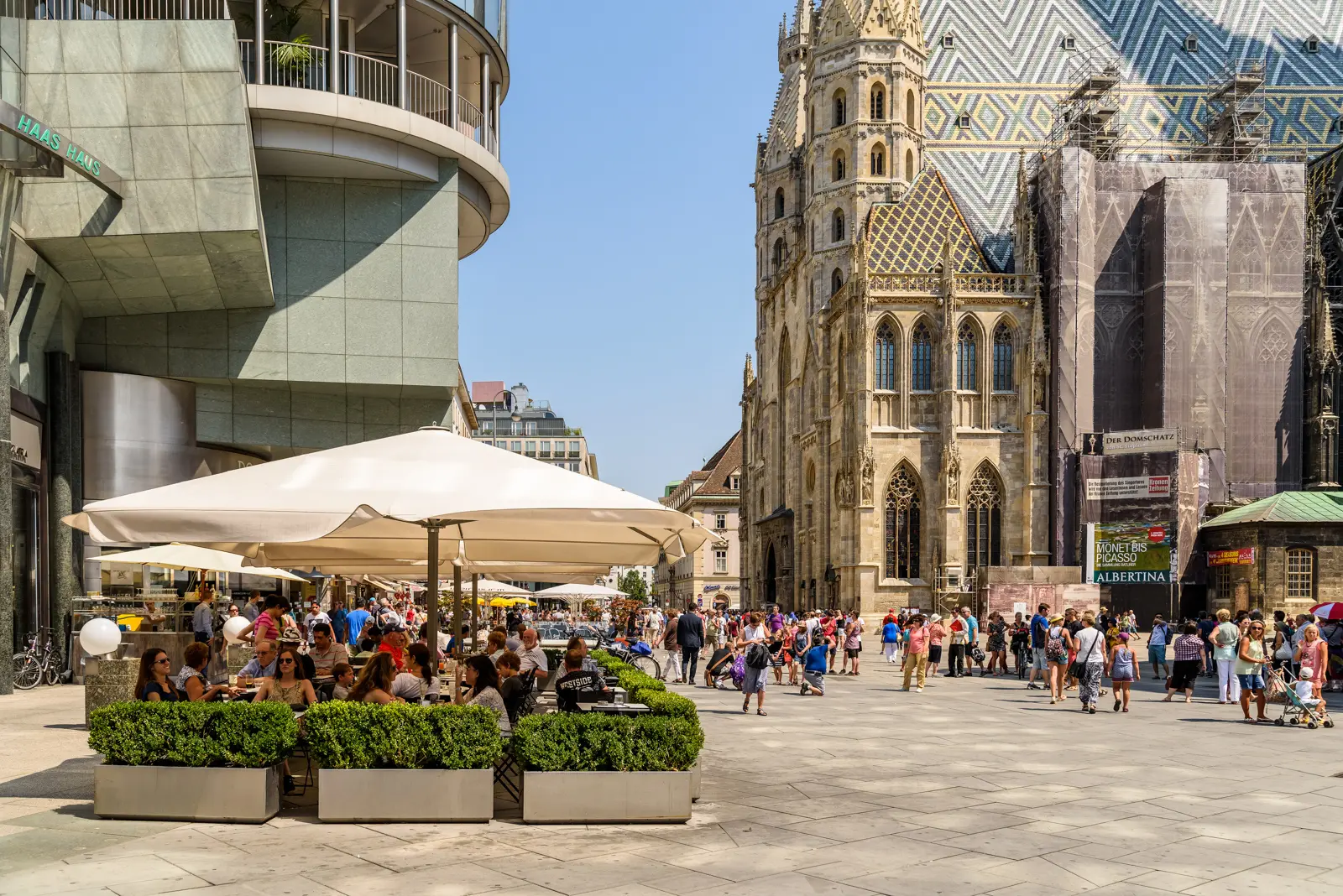
The moment you enter the square, there is a shift. Streets open up, the space breathes, and suddenly you are surrounded by a mix of grandeur and motion. At its center rises the unmistakable silhouette of St. Stephen’s Cathedral – a structure so iconic that it feels less like a landmark and more like a presence. Its patterned roof, towering spire, and intricate façade anchor the square, giving everything around it a sense of orientation and scale. And yet, despite its magnitude, Stephansplatz is not still. It moves, constantly.
Stephansplatz at a Glance
📍 What it is: Vienna’s central square — the geographic heart of the city, where St Stephen’s Cathedral, pedestrian boulevards, and everyday Viennese life all converge
⛪ St Stephen’s Cathedral: Gothic masterpiece with a patterned roof, soaring spire, and a presence that dominates the square without overwhelming it
🛍️ Graben: Elegant pedestrian boulevard extending from Stephansplatz — historic architecture, shops, and cafés
🛍️ Kärntner Strasse: Vienna’s other major pedestrian street, connecting Stephansplatz to the Vienna State Opera and the Ringstrasse
🏛️ Palais Equitable: An ornate Neo-Renaissance facade on the edge of the square — a hidden detail most visitors walk past
☕ Cafés: Outdoor terraces with direct views of the cathedral — Vienna’s everyday luxury
🌅 Best time: Early morning for a near-empty square and soft light; daytime for energy; evening for atmosphere
🆓 Entry: The square is free and open at all times; cathedral nave free, tower/catacombs require tickets
💡 Tip: Visit at dawn and again in the evening — the square transforms completely, and both versions of Stephansplatz are worth experiencing
The Cathedral as a Living Backdrop
Even if you’ve already explored St. Stephen’s Cathedral in depth, experiencing it from Stephansplatz is something entirely different. Here, it is not simply a destination or a monument to be admired from a distance, but a constant presence woven into the rhythm of the city. The cathedral rises above the square with unmistakable authority – its patterned roof catching the light, its spire drawing the eye upward – and yet, at ground level, life moves continuously around it. It does not interrupt the flow of the square; it anchors it.
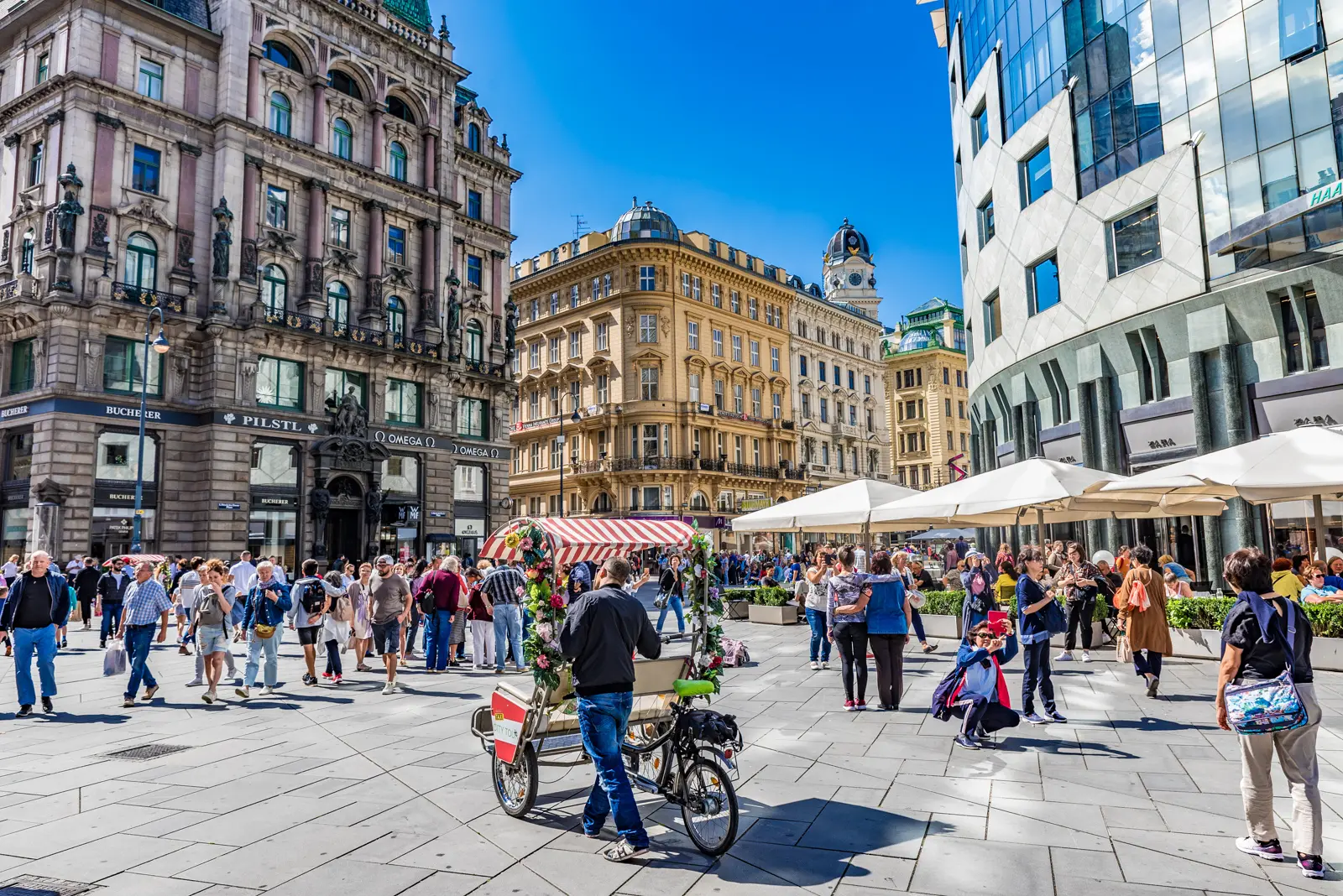
People pass by without looking up, their attention fixed on the movement of the city, while others pause mid-step, drawn into the intricate details of the façade. Horse-drawn carriages cross the open space at a measured pace, their quiet rhythm contrasting with the steady flow of pedestrians weaving in every direction. Conversations unfold, footsteps echo, cameras pause and click – and through it all, the cathedral remains unchanged, a silent witness to centuries of daily life. There is something striking in that coexistence, in the way the monumental and the ordinary meet so effortlessly in the same space.
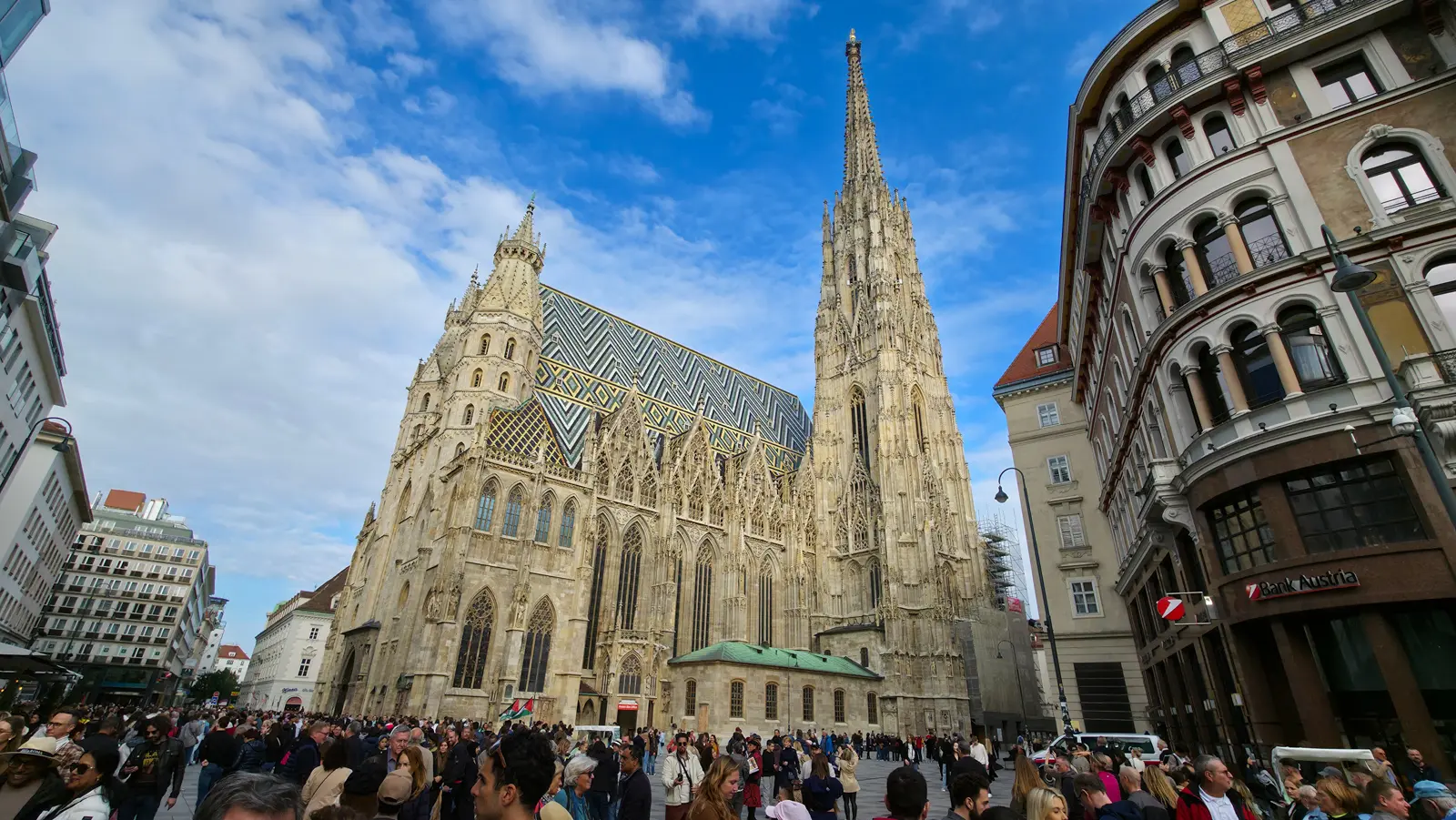
Seen from Stephansplatz, the cathedral feels less like a singular attraction and more like a living backdrop – one that shapes the experience without demanding it. It frames the square, gives it scale and identity, yet allows the life unfolding around it to take center stage. It is not just something to visit, but something to live alongside, even if only for a moment.
The Atmosphere: Movement, Sound, and Energy
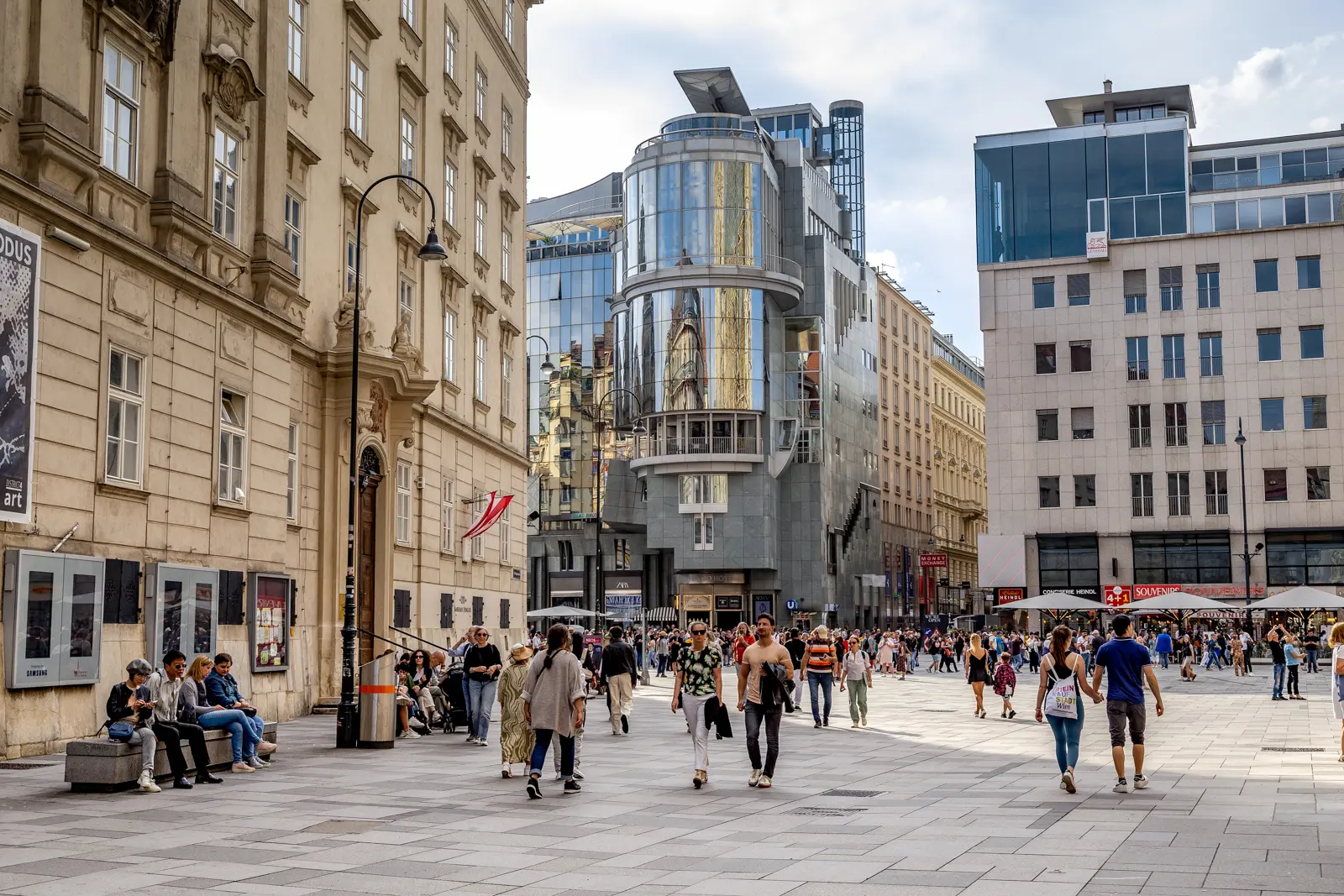
Stephansplatz is never quiet, but it is never overwhelming either. There is a balance to the energy, a kind of organized spontaneity that feels uniquely Viennese. The square hums with life, yet it never feels chaotic. Instead, everything seems to move with an unspoken rhythm, as though the space itself quietly guides the flow of people, sound, and activity. It is a place where movement is constant, but never rushed, where even the busiest moments feel measured and somehow composed.
Street musicians fill the air with music that drifts effortlessly across the square, blending with conversation, footsteps, and the soft echo of carriage wheels passing over stone. Performers gather small crowds, creating brief moments of stillness within the motion, as people pause, watch, and then continue on their way. Visitors move in every direction, guided less by structure than by curiosity – drawn by a detail, a sound, or simply the feeling of being in the center of it all. There is no single path to follow here, only a shared experience unfolding in real time.
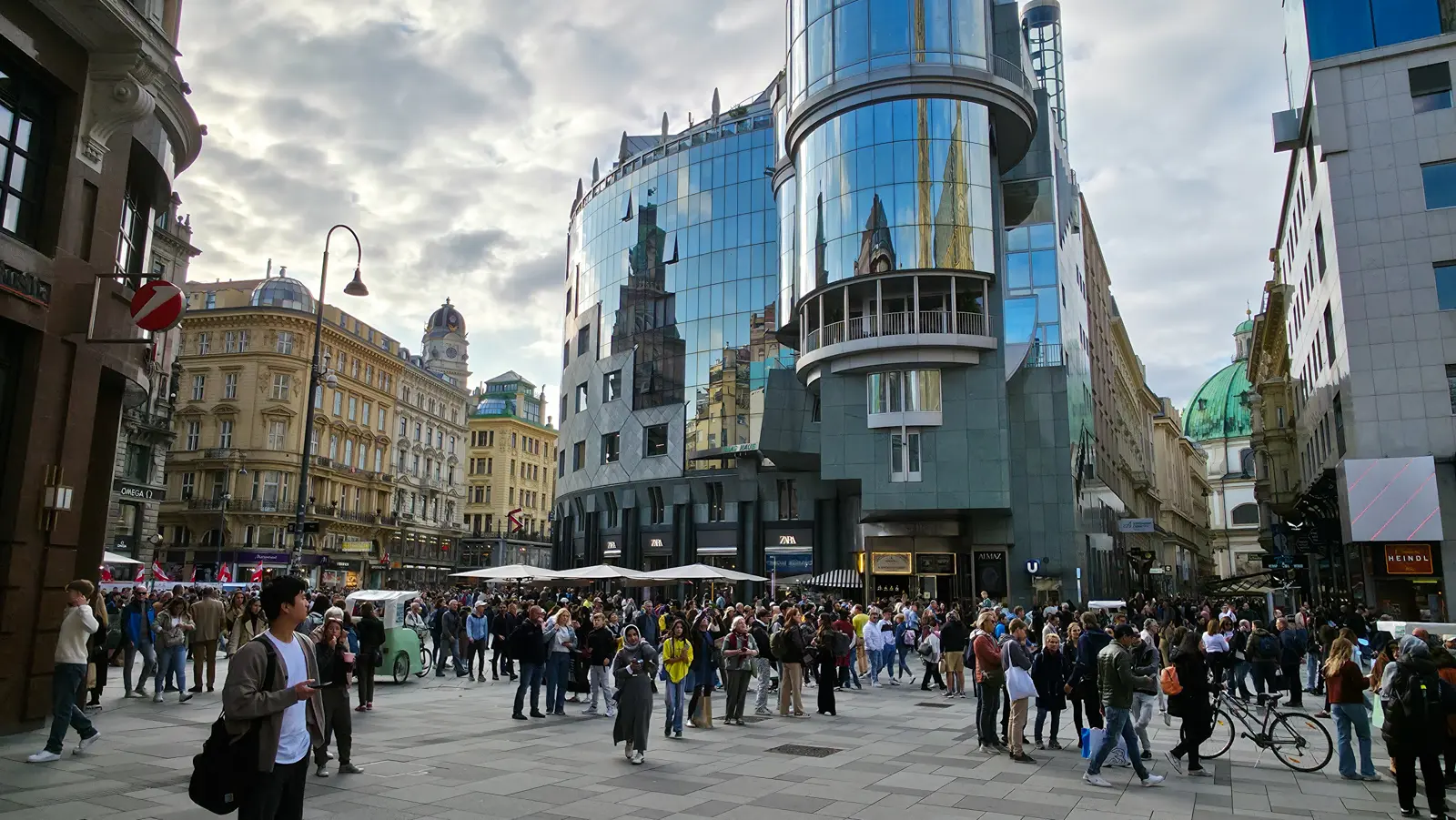
And yet, within this constant movement, there are quiet moments that reveal themselves almost unexpectedly. A pause before crossing the square. A glance upward toward the cathedral. A shift in attention as the noise softens, even if only for a second. These fleeting moments create a subtle contrast, reminding you that beneath the energy lies something deeper, something enduring. It is in these pauses that you become aware of where you are, standing in a space that has remained at the heart of Vienna for centuries, where history and everyday life continue to meet in the most natural way.
Everyday Vienna: Cafés, Shops, and Street Life
Beyond the square itself, Stephansplatz gently unfolds into surrounding streets that feel just as vibrant and inviting. The transition is almost seamless: one moment you are in the open space of the square, and the next, you find yourself drawn into narrower streets lined with elegant storefronts, cafés, and historic passageways. These spaces carry the same energy, but in a more intimate way, encouraging you to slow down, wander, and explore without a set direction. It is here that Vienna begins to feel less like a destination and more like a city to be experienced moment by moment.
Nearby, streets like Graben and Kärntner Strasse extend the life of the square into a broader urban rhythm. The atmosphere shifts slightly – still lively, but more refined – as people pause at café terraces, step in and out of boutiques, or linger just long enough to take in their surroundings. The scent of coffee drifts through the air, conversations blend softly into the background, and the pace of movement becomes more relaxed. These are the kinds of moments that invite you to sit, observe, and let the city reveal itself gradually.
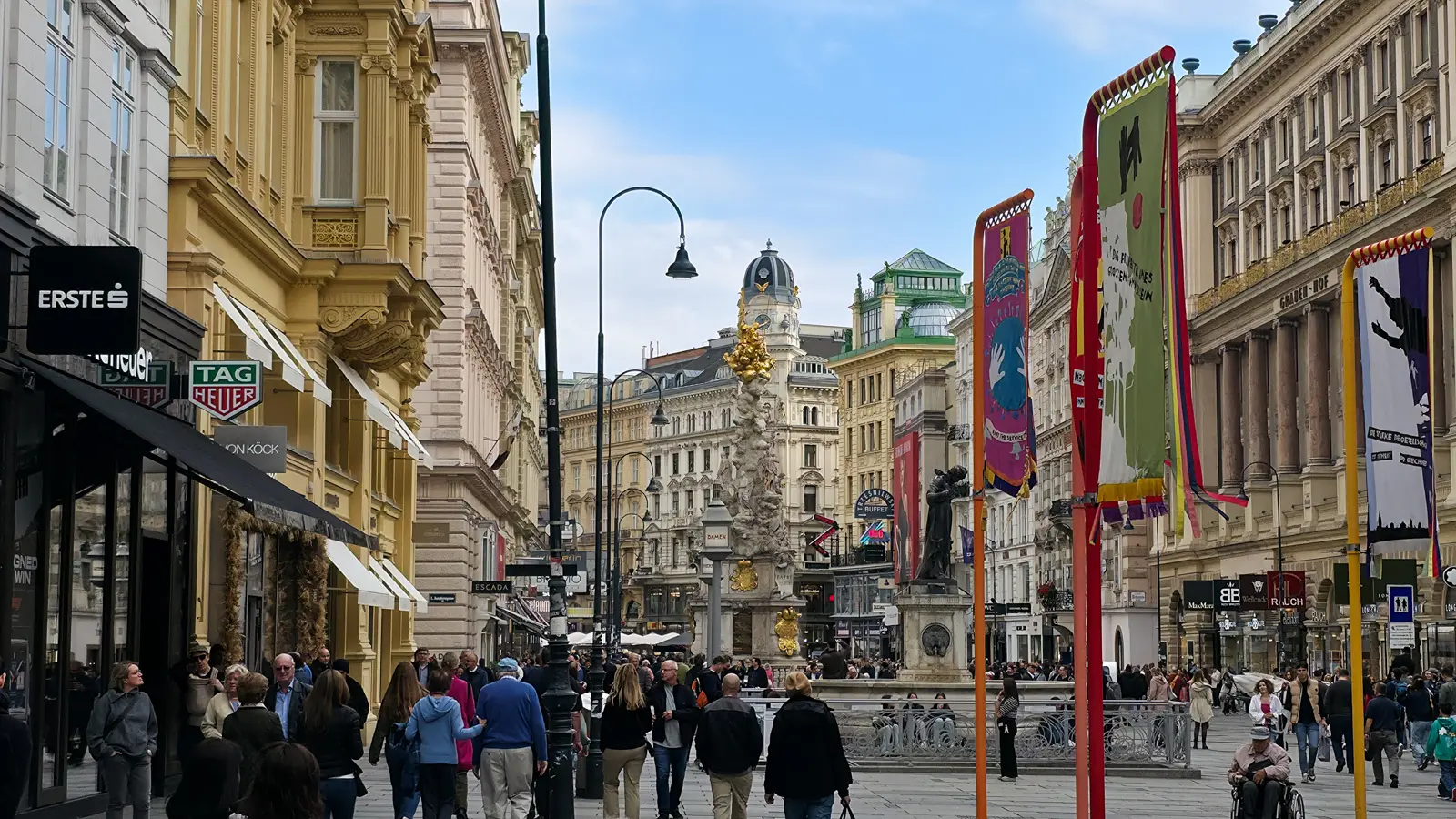
It is in these quieter, everyday interactions that Stephansplatz reveals another layer of its character. The grandeur of the cathedral and the energy of the square remain close, but here they are softened by routine and familiarity. Locals pass through with ease, visitors linger with curiosity, and the space becomes something more than a landmark, it becomes part of daily life. This coexistence of past and present, of movement and pause, is what gives Stephansplatz its depth, allowing it to feel both historically significant and effortlessly alive at the same time.
A Hidden Detail: Palais Equitable
At the edge of Stephansplatz, just steps from the cathedral, stands a building that is easy to pass without a second glance – yet once noticed, it becomes impossible to ignore. The Palais Equitable introduces a different architectural rhythm to the square, its arcaded façade and warm tones offering a subtle contrast to the vertical drama of St. Stephen’s Cathedral. Look a little closer, and the richness of its detailing begins to reveal itself – ornate elements, sculptural features, and decorative eagles that add texture and character to the façade, quietly grounding the building in Vienna’s architectural and symbolic tradition.
There is something quietly intriguing about it. Built in the late 19th century for an American insurance company, it reflects a moment when Vienna was opening itself to international influence, blending styles and ideas into its already rich urban fabric. Today, it feels both distinct and perfectly integrated, a reminder that Stephansplatz is not defined by a single era or identity, but by layers of history that continue to coexist. It is the kind of detail you might miss at first, but one that adds depth to the experience once you begin to notice it.
Light, Time, and Changing Moods
Stephansplatz is not the same place throughout the day. It shifts – subtly, beautifully – with the light and the passing hours, revealing different layers of its character depending on when you arrive. In the early morning, the square feels softer and more open, as the city begins to wake and the first light settles gently across the stone.

By midday, it becomes vibrant and animated, filled with movement, conversation, and the steady rhythm of daily life. As the afternoon unfolds, the light begins to change again, catching the cathedral’s façade at an angle that brings out its textures, patterns, and depth, casting shadows that add a quiet sense of drama to the scene. By evening, the atmosphere softens once more. The crowds begin to thin, the energy settles, and the square takes on a more reflective quality. The cathedral, illuminated against the darkening sky, feels even more monumental – not louder, but deeper – as if the passage of time itself becomes part of the experience.
The Experience: Where Past Meets Present
What makes Stephansplatz truly unforgettable is not only its architecture or its history, but the way it allows both to exist effortlessly within the present moment. You are standing in a medieval square, surrounded by centuries of history, and yet nothing feels distant. Life unfolds naturally around you, without ceremony. People move through the space, pause, gather, and continue on, weaving their own stories into a setting that has held countless others before them. The past is not something you observe from afar; it is something you experience from within.
There is something grounding in that realization. A sense that time here is layered rather than linear – that history is not behind you, but all around you, integrated into the rhythm of everyday life. Stephansplatz is not a place you simply visit. It is a place you move through, absorb, and carry with you long after you leave.
Bubbly Tips: Visiting Stephansplatz Vienna
To make the most of your time at Stephansplatz, here are a few helpful tips:
- Visit early in the morning or later in the evening for a quieter, more atmospheric experience
- Take time to walk around the entire square, not just the front of the cathedral
- Explore nearby streets like Graben and Kärntner Strasse for cafés, shopping, and beautiful architecture
- Pause and look up – the cathedral’s details are best appreciated when you slow down
- Watch the square for a few minutes – the movement and energy are part of the experience
- Bring your camera – this is one of Vienna’s most photogenic locations at any time of day
Final Thoughts
Stephansplatz is more than a central square, it is the heartbeat of Vienna. A place where history is not preserved behind glass, but lived, walked through, and experienced in real time.
Whether you spend a few minutes passing through or linger longer to take it all in, it leaves an impression. Not because of any single moment, but because of the way everything comes together – architecture, movement, sound, and light – to create something that feels both timeless and alive.
I’d love to hear from you, have you experienced Stephansplatz, or is it on your Vienna itinerary?
Happy travels!

🌟 Everything You Need to Plan Your Dream Trip in 2026
- 🌟 Luxury Hotels - Find premium stays with Booking.com & Hotels.com
- 🏡 Vacation Rentals - Discover unique properties on VRBO
- 🏞️ Guided Tours - Explore with Viator or GetYourGuide
- 🎫 Attraction Tickets - Skip the lines with Tiqets
- 🚢 Ocean Cruises - Set sail with Cruise Direct
- 📱 International SIMs - Stay connected with Saily
- 🚗 Car Rentals - Budget-friendly options from Discover Cars
- 🌐 Secure VPNs - Browse safely with NordVPN
- 💶 Currency Exchange - Best rates with Wise
- 🗣️ Learn Languages - Master the local language with Babbel and Rosetta Stone