
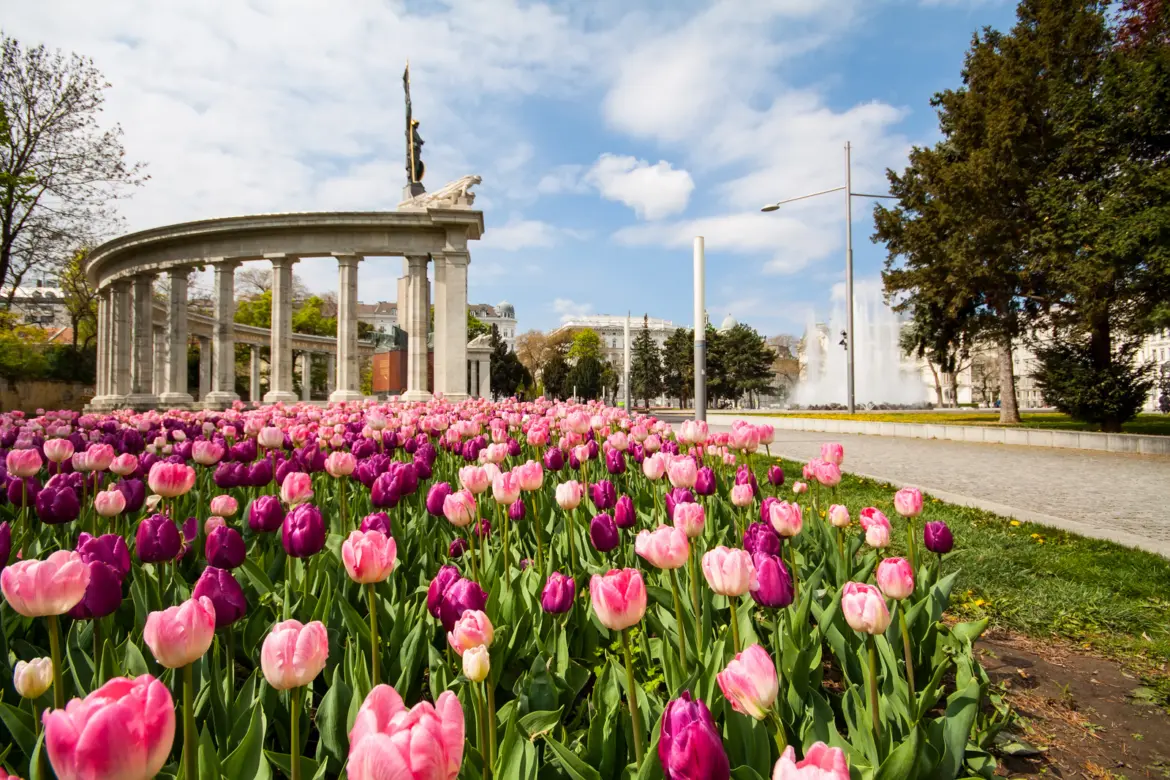
There are places in Vienna that draw you in with detail, and others that invite you to pause through space. Schwarzenbergplatz is unmistakably the latter. Open, expansive, and quietly monumental, it unfolds differently from the city’s more intricate streets. Here, the rhythm slows not because there is less to see, but because there is more space in which to see it. The openness allows each element – water, monument, architecture – to stand clearly within your field of vision.
At first glance, it feels defined by symmetry and light: the long axis stretching toward the Belvedere Palace, the reflective surface of the fountain, the measured presence of surrounding architecture. And yet, beneath that visual harmony lies a deeper narrative – one shaped by imperial ambition, war, memory, and the quiet coexistence of past and present.
Schwarzenbergplatz at a Glance
📐 Developed: Mid-19th century on the Vienna Glacis — named 1880
⛲ Hochstrahlbrunnen: 1873 fountain celebrating Alpine water pipeline — illuminated at night seasonally
🐴 Schwarzenberg Monument: 1867 equestrian statue by Ernst Julius Hähnel — Battle of Leipzig commander
🏛️ Soviet War Memorial: 1945 — 20m+ obelisk commemorating ~17,000 Red Army soldiers — maintained under 1955 State Treaty
🌷 Seasonal blooms: Vibrant tulips in spring surrounding the memorial
🔭 Visual axis: Extends toward Belvedere Palace
⛪ Nearby: Karlskirche, Belvedere Palace, Ringstrasse
💡 Tip: Visit at different times — morning calm, evening illumination, night fountain drama
A Square Defined by Space and Perspective
What distinguishes Schwarzenbergplatz is its scale. Unlike the narrower streets of Vienna’s historic center, this space opens outward in a way that feels rare in a European capital. The wide boulevard, framed by elegant buildings, creates long, uninterrupted sightlines that guide the eye forward, emphasizing distance and perspective rather than enclosure. The square was developed in the mid-19th century on parts of the Vienna Glacis following the demolition of the city’s old fortifications – part of the same transformative impulse that gave rise to the Ringstrasse – and only received its current name in 1880, in honor of Karl Philipp Schwarzenberg.
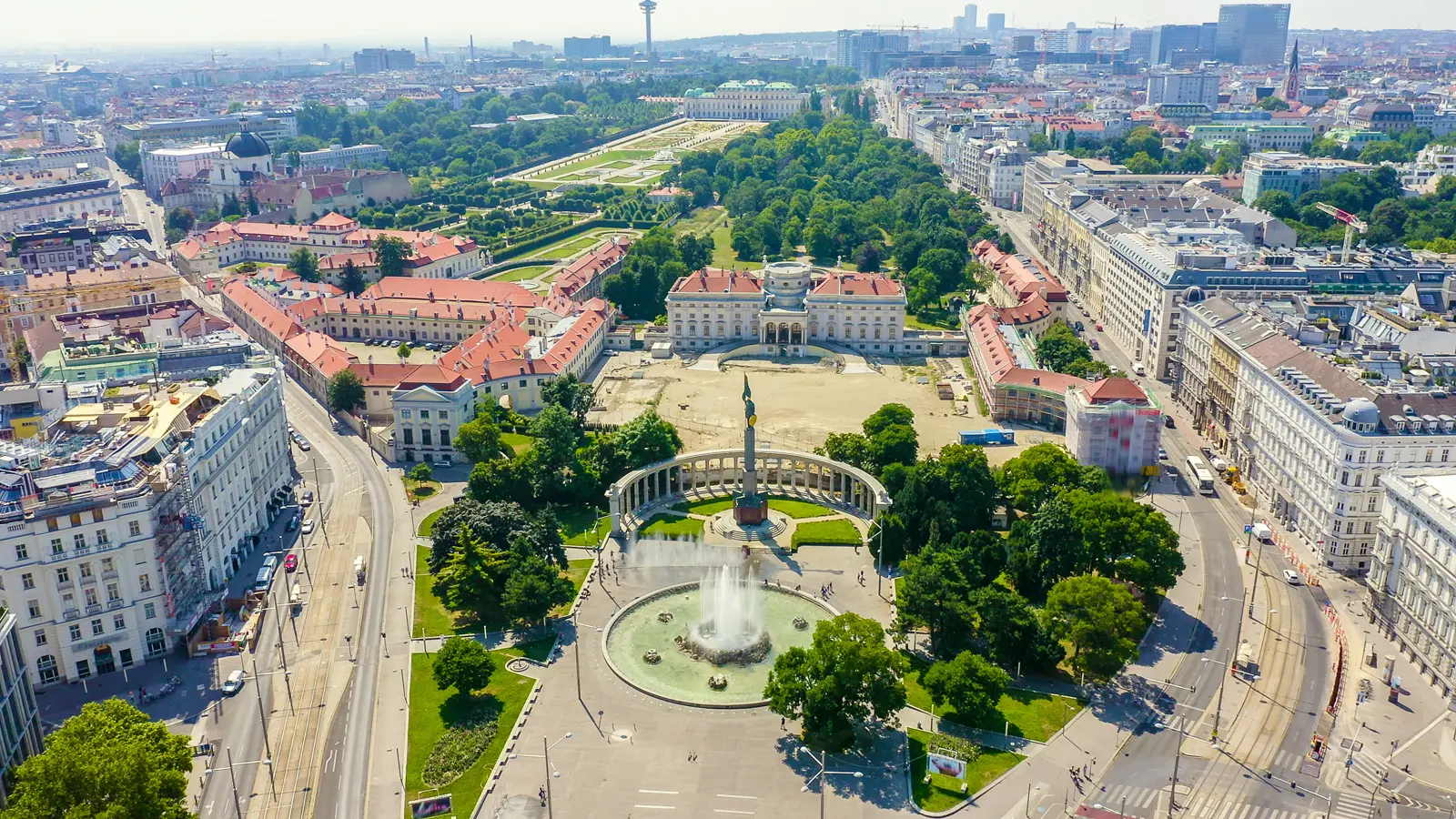
It is worth being honest about the square’s present character. Tram rails and busy roads intersect the space, effectively dividing it into a series of traffic islands that can make it feel less cohesive than its scale suggests. And yet, despite this, the underlying spatial ambition remains legible. The alignment of monuments, fountains, and architecture still creates a sense of composition, a feeling that this space was designed with intention, even if the traffic has complicated the experience.
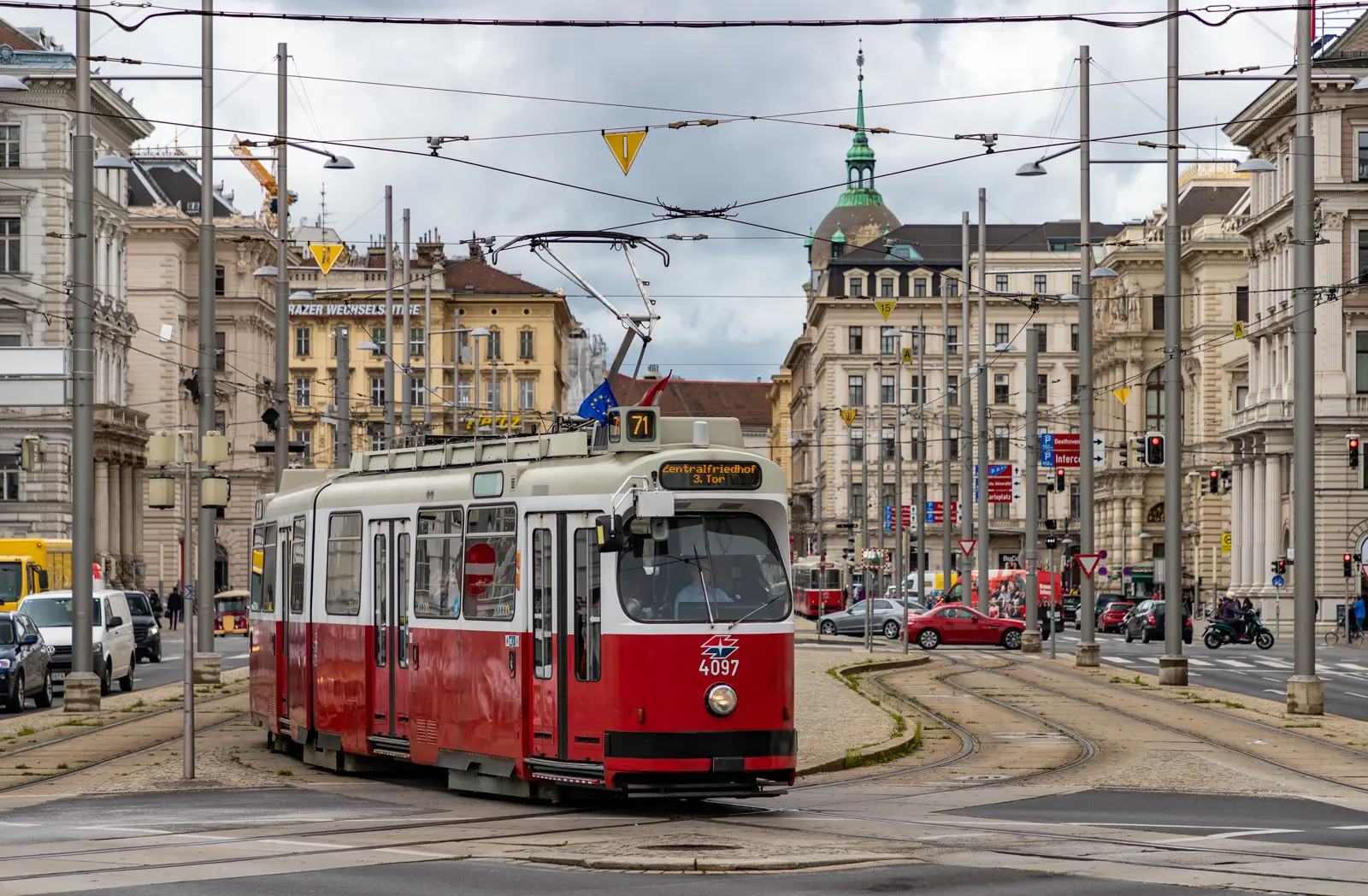
Those who take the time to navigate it find moments of genuine calm along its edges. There is always space to step back, to observe, and to take in the broader composition – understanding how the elements relate to one another within what remains one of Vienna’s most expansive and architecturally significant urban spaces.
The Hochstrahlbrunnen: Light, Reflection, and Movement
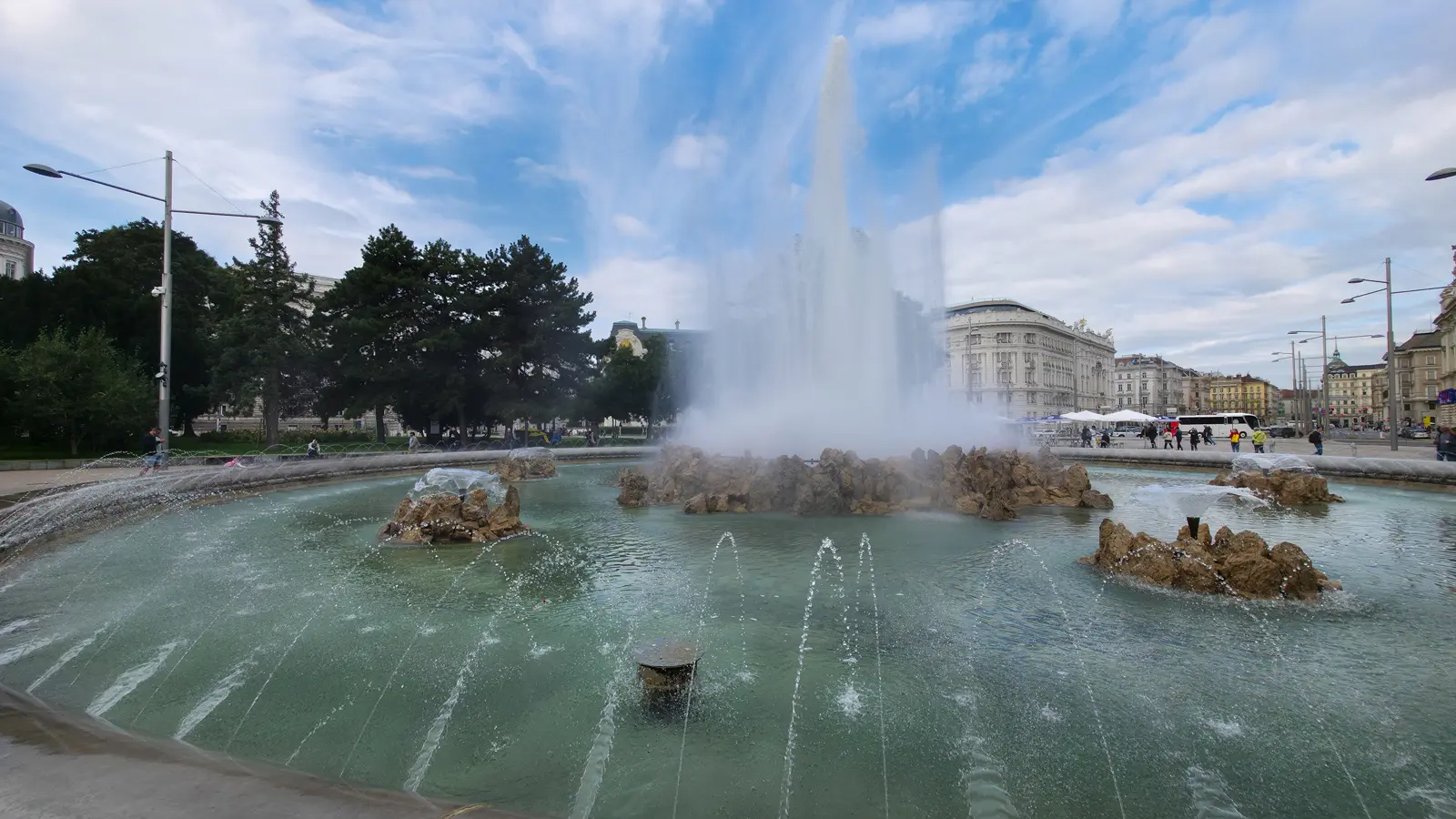
At the center of Schwarzenbergplatz, the Hochstrahlbrunnen introduces motion into an otherwise composed setting. Inaugurated in 1873, in the presence of Franz Joseph I, the fountain was created to celebrate the completion of the First Vienna High Spring Water Pipeline, a major engineering achievement that brought fresh Alpine water directly to the city. It quickly became a symbol of modern infrastructure and civic progress, reflecting Vienna’s transformation during the late 19th century.
Look more closely and the fountain reveals layers of structure and rhythm that have often been interpreted symbolically. Its arrangement of jets – from smaller streams to the powerful central column – has been read by some as echoing cycles of time: days, months, and the passage of the year. Whether intentional or not, this reading adds a poetic dimension to the fountain, connecting the movement of water with the passage of time itself.
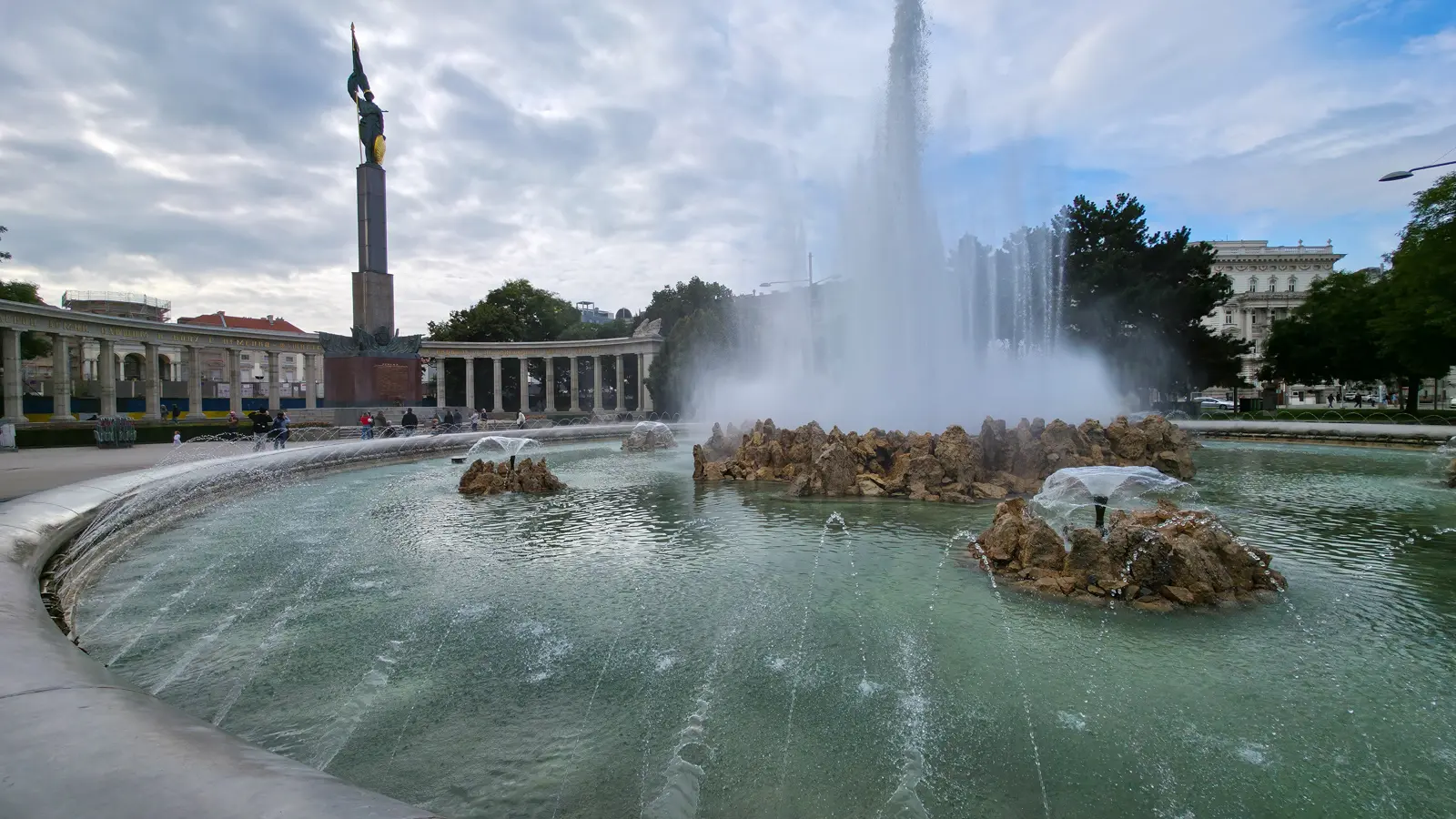
Throughout the day, the fountain transforms subtly. In the morning, it reflects softer tones and a quieter atmosphere. By midday, it becomes brighter and more dynamic, catching light in sharper, more defined ways. In the evening, when illuminated in color – a tradition introduced in the early 20th century – it takes on a more atmospheric quality, reflections deepening and the water becoming almost sculptural in its presence.
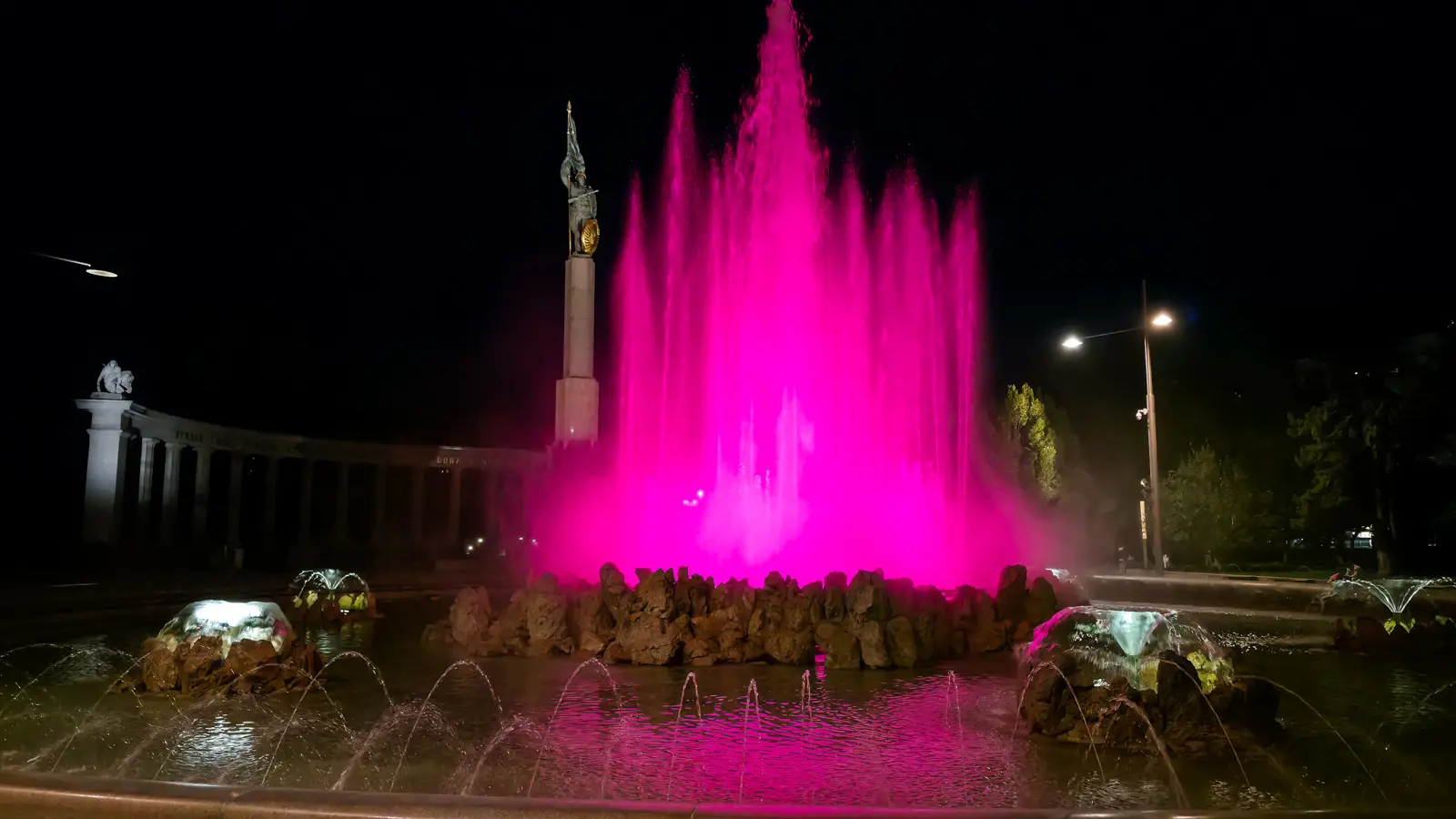
The fountain operates seasonally, typically from spring through autumn, becoming a focal point of the square during the warmer months. Whether viewed from a distance or experienced up close, it remains one of Vienna’s most elegant expressions of movement, light, and urban design.
The Schwarzenberg Monument: Echoes of Imperial Power
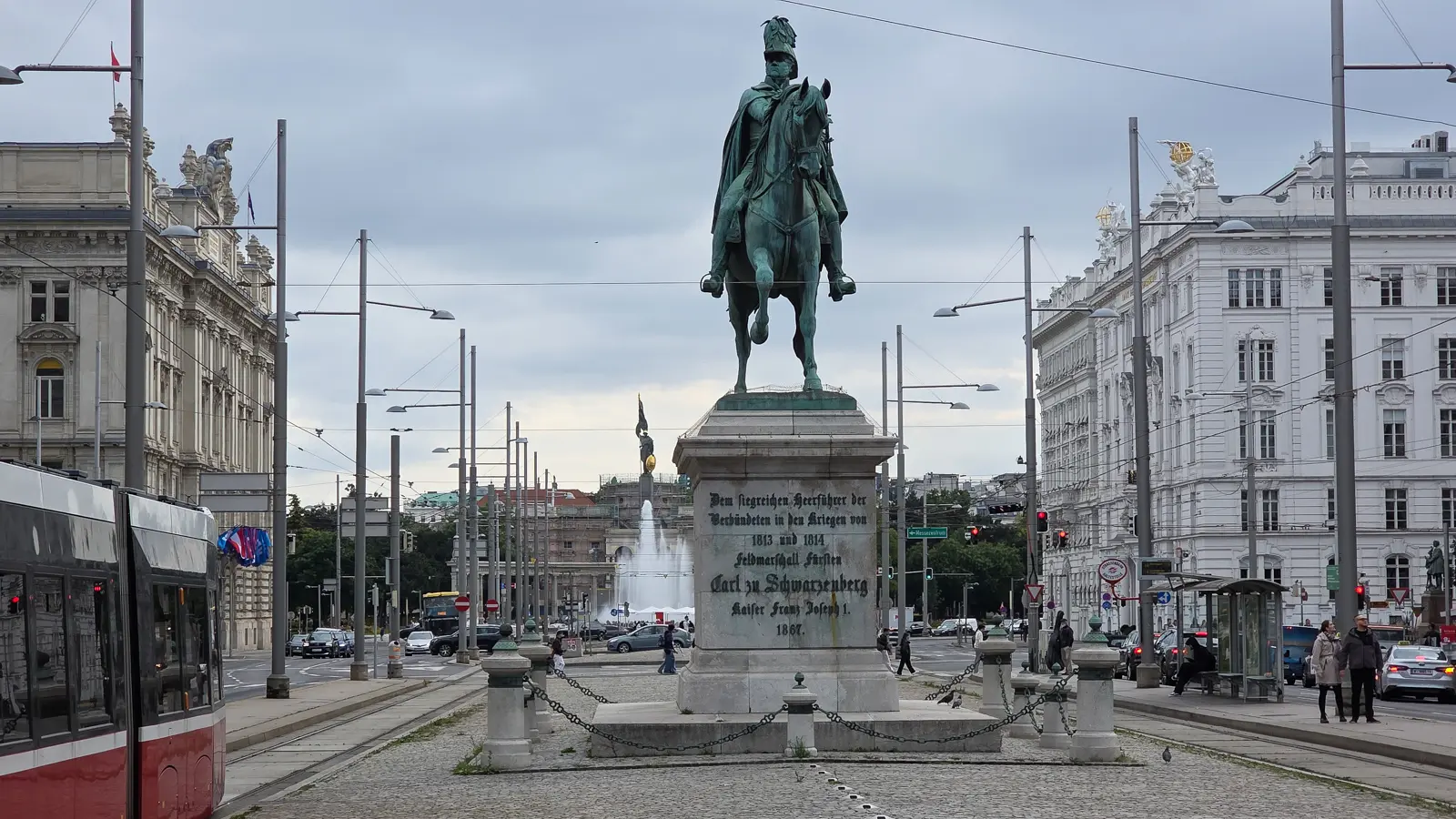
Along the axis of Schwarzenbergplatz stands the equestrian statue of Karl Philipp Schwarzenberg, a commanding presence that anchors the square in Vienna’s imperial past. Created by Dresden sculptor Ernst Julius Hähnel and erected in 1867, the monument depicts Schwarzenberg on horseback, a figure of authority and forward motion that reflects Austria’s role in shaping the course of European history.
Schwarzenberg is best known for his leadership against Napoleon Bonaparte during the Battle of Leipzig – the so-called Battle of Nations – where he served as commander-in-chief of the allied forces in one of the most decisive conflicts in European history. The following year, he played a key role in the allied advance that led to the capture of Paris and Napoleon’s eventual abdication. The foundation stone of the monument was laid on October 18, 1863 – the 50th anniversary of the Battle of Leipzig – a date chosen with clear symbolic intent.
The monument, therefore, is not simply decorative, it represents a moment of profound geopolitical significance, embedded within the everyday landscape of the city. What is particularly striking is how naturally it fits within the square. It does not dominate the space, but contributes to its layered narrative, a reminder of 19th-century imperial identity set within a modern urban environment.
The Soviet War Memorial: Memory in the Open
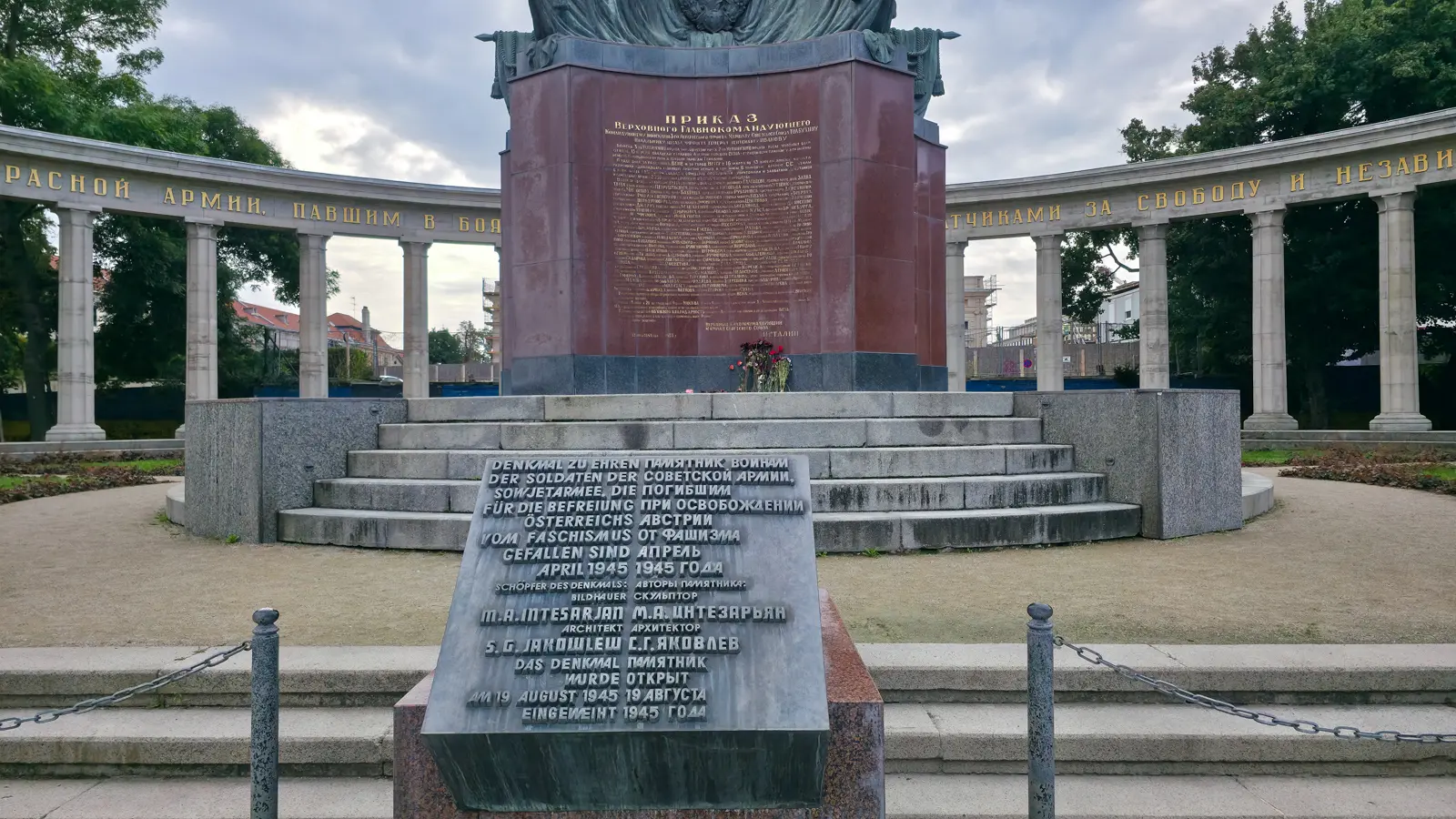
At the opposite end of Schwarzenbergplatz, the Soviet War Memorial introduces a very different kind of presence, one shaped by the aftermath of World War II. Unveiled on August 19, 1945, the memorial commemorates the approximately 17,000 Red Army soldiers who lost their lives during the Battle of Vienna in April of that year. Its form is monumental: a central obelisk rising over 20 metres, flanked by a semicircular white marble colonnade, with a forward statue of a Red Army soldier bearing a laurel wreath and banner, a composition that conveys permanence and gravity in equal measure.
The memorial’s meaning has never been singular. For some, it represents liberation; for others, it remains tied to the complex legacy of post-war occupation. This tension has shaped how the monument is perceived over time, reflecting broader conversations about Austria’s history and its relationship to the events of 1945. Under the 1955 Austrian State Treaty, Austria is obligated to maintain Soviet war memorials, ensuring that its presence in the square remains not only historical, but ongoing and politically relevant.
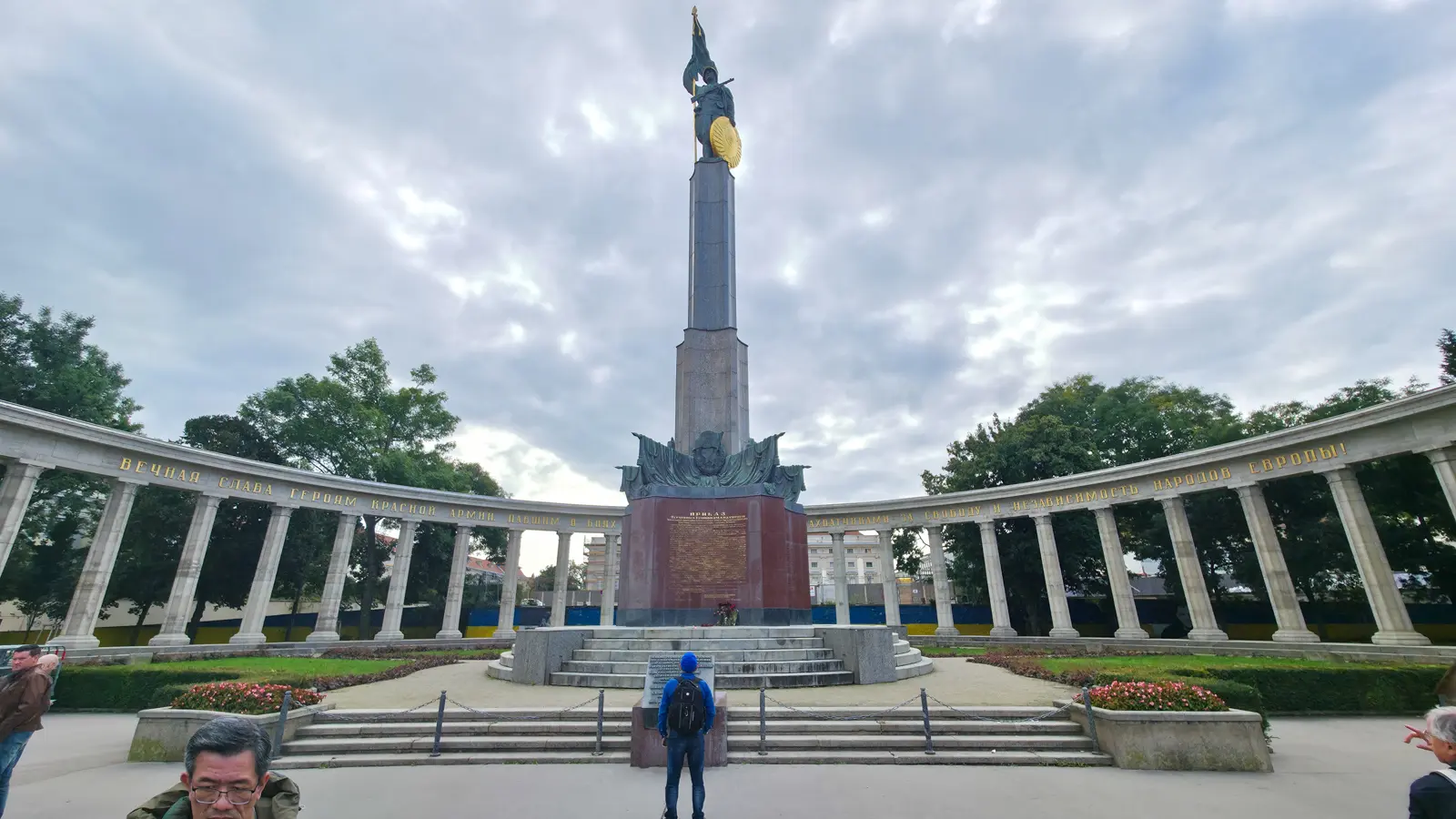
What makes its presence particularly powerful is its integration into the square. Unlike memorials that are set apart or enclosed, this one exists fully within the flow of everyday life. People pass by it, walk around it, and continue through the space – not in disregard, but in coexistence. There is a quiet tension here. The openness of the square contrasts with the weight of what the memorial represents. It does not demand attention, yet it holds it, especially once you begin to understand its context.
The Experience: Movement, Stillness, and Contrast
Experiencing Schwarzenbergplatz is less about moving through individual sights and more about sensing how they relate to one another. The fountain, the monuments, the surrounding architecture, and the distant axis leading toward the Belvedere Palace all exist within a shared visual field, creating a composition that feels intentional yet open. Movement through the square becomes part of that experience, not something separate from it. As people cross, pause, or continue along its axis, they contribute to the rhythm of the space, reinforcing the idea that this is not a static setting, but one that is constantly unfolding.
There are moments of stillness here: standing near the fountain, watching reflections shift, or observing how light changes across the square. And there are moments of contrast, between openness and weight, movement and pause, past and present. The space reveals itself gradually. The longer you remain, the more its relationships become clear. It is not overwhelming, but quietly complex – a place that invites reflection without imposing it, allowing you to engage with it at your own pace and to carry a sense of its balance with you as you leave.
Beyond the Square: Connections Across Vienna
Schwarzenbergplatz connects seamlessly to the wider fabric of Vienna, both physically and visually. Walking along its axis, the space gradually extends toward the Belvedere Palace – not always as a direct visual endpoint, but as a clear spatial direction embedded within the city’s design. This alignment reinforces the sense that the square is part of a larger composition, linking urban planning with imperial architecture and cultural heritage. The movement outward from the square feels natural, as though the city itself is guiding you forward.
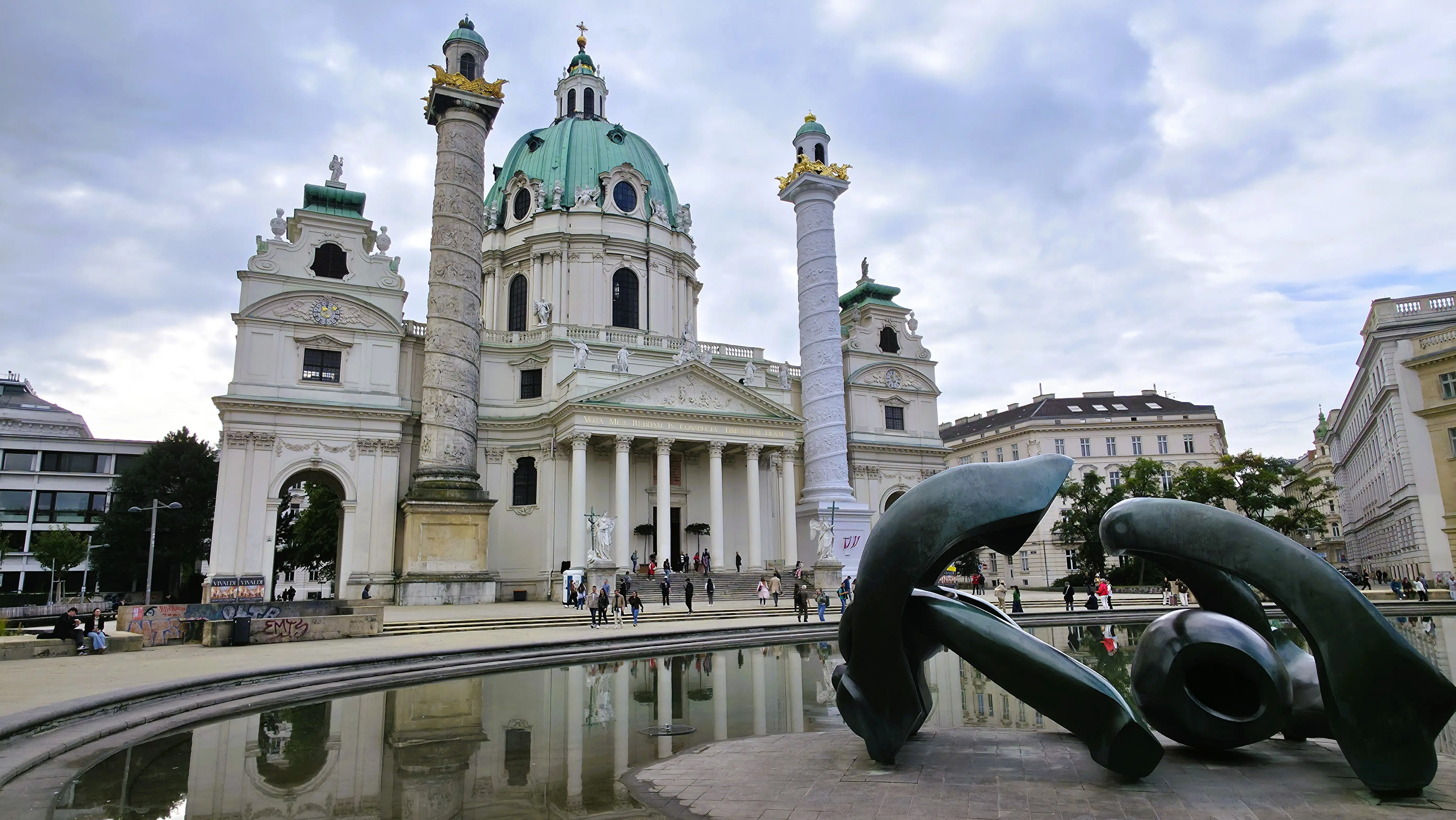
In another direction, Vienna begins to shift. The openness of the square gives way to more intimate streets, where the rhythm becomes denser and more detailed. Nearby landmarks such as Karlskirche introduce yet another layer, blending architectural grandeur with a quieter, more contemplative atmosphere. This continuity is what makes the experience so compelling. Each space leads naturally into the next, creating a city that feels cohesive rather than fragmented – a place where transitions are not abrupt, but gently unfolding.
Bubbly Tips: Visiting Schwarzenbergplatz
To make the most of your visit to Schwarzenbergplatz:
- Visit during different times of day – morning, sunset, and evening offer very different atmospheres
- See the fountain illuminated at night for a more dramatic and reflective experience
- Walk the full axis toward the Belvedere to appreciate the square’s symmetry
- Take time at both monuments – they represent very different historical moments
- Pause rather than rush through – the space reveals itself gradually
- Combine with nearby landmarks like Belvedere Palace and Karlskirche
Final Thoughts
Schwarzenbergplatz is not defined by a single landmark, but by the dialogue between them. It is a space where history unfolds across centuries, from imperial ambition to the memory of war, yet remains fully integrated into the life of the city. Nothing feels isolated, and nothing feels forced. Instead, everything exists in quiet balance.
In a city known for its detail and density, Schwarzenbergplatz offers something different: a moment of clarity. A place where space allows you to step back, to see more, and to reflect – not only on what is in front of you, but on the layers of history that continue to shape it.
I’d love to hear your thoughts. Would you add Schwarzenbergplatz to your Vienna itinerary?
Happy travels!

🌟 Everything You Need to Plan Your Dream Trip in 2026
- 🌟 Luxury Hotels - Find premium stays with Booking.com & Hotels.com
- 🏡 Vacation Rentals - Discover unique properties on VRBO
- 🏞️ Guided Tours - Explore with Viator or GetYourGuide
- 🎫 Attraction Tickets - Skip the lines with Tiqets
- 🚢 Ocean Cruises - Set sail with Cruise Direct
- 📱 International SIMs - Stay connected with Saily
- 🚗 Car Rentals - Budget-friendly options from Discover Cars
- 🌐 Secure VPNs - Browse safely with NordVPN
- 💶 Currency Exchange - Best rates with Wise
- 🗣️ Learn Languages - Master the local language with Babbel and Rosetta Stone