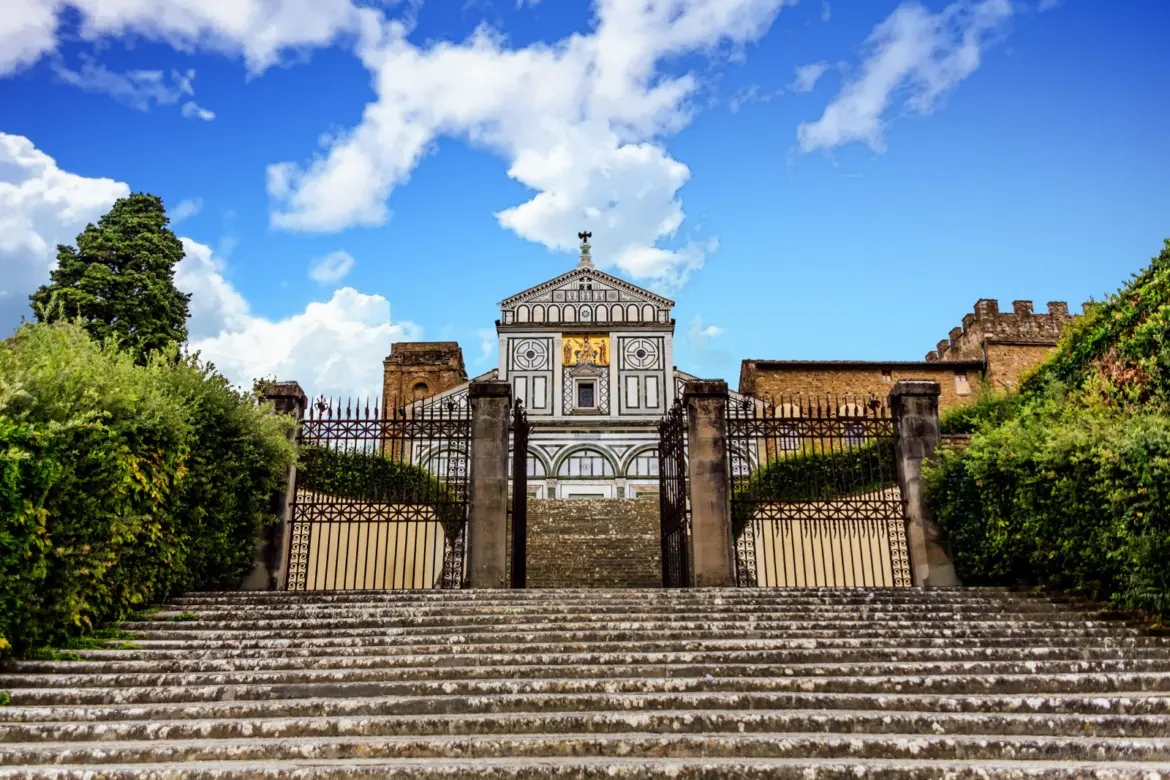
Ciao my friends! There are places in Florence where beauty feels immediate – crowded piazzas, famous masterpieces, lively streets filled with movement and sound. And then there are places like San Miniato al Monte, where beauty arrives slowly, quietly, almost like a whisper carried on the wind.
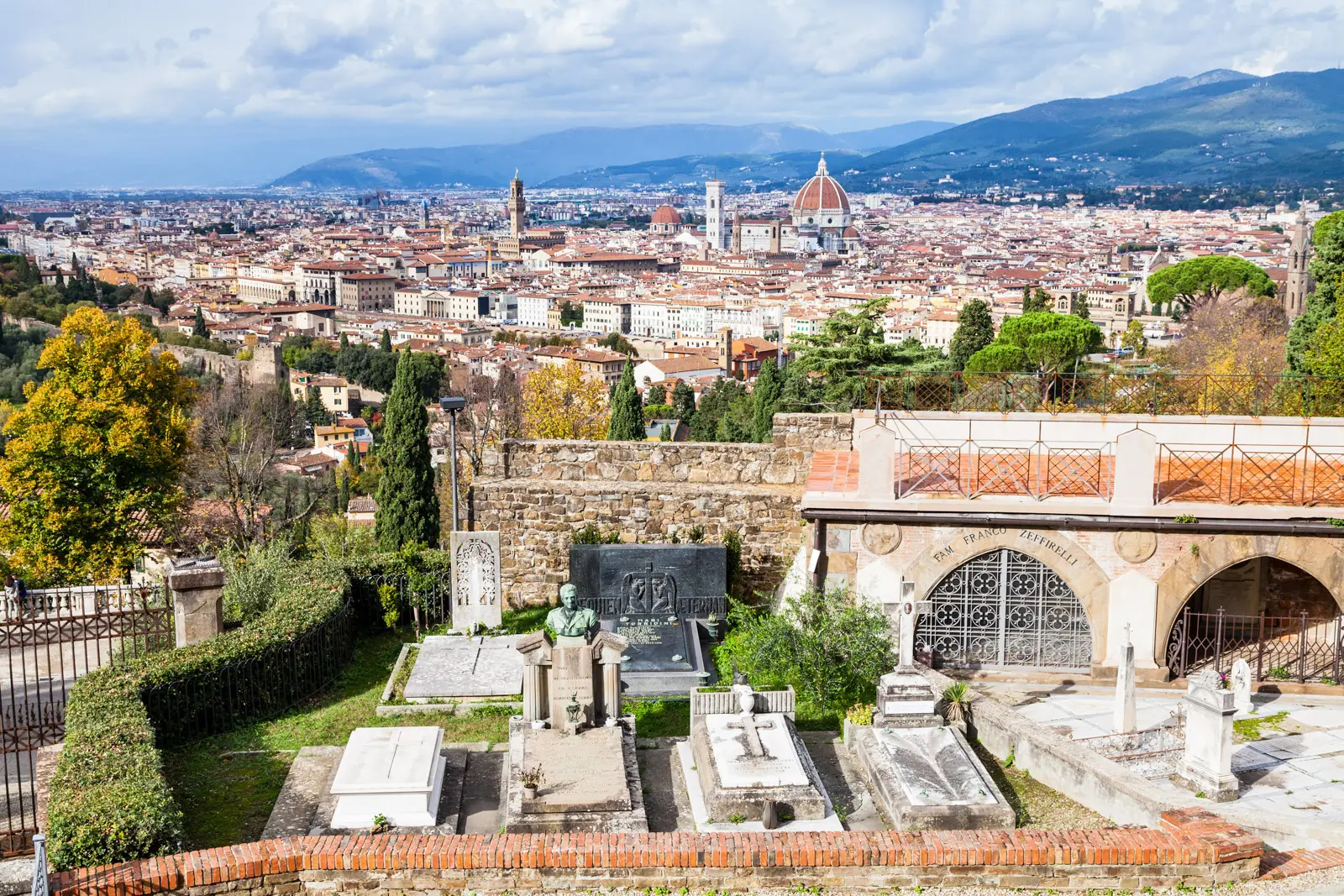
Perched high above the city on the slopes of Monte alle Croci, this extraordinary basilica offers something rare: a moment of stillness. The climb itself feels symbolic – leaving behind the rhythm of the historic center and ascending toward a space where history, faith, art, and landscape meet in perfect balance. From here, Florence stretches below like a living painting, the Arno River winding through terracotta rooftops, the Duomo rising gracefully above it all.
San Miniato al Monte is not simply a viewpoint. It is one of Florence’s oldest and most spiritually resonant places, a sanctuary where architecture and silence work together to create something timeless.
San Miniato al Monte at a Glance
📍 Location: Via delle Porte Sante, 34 — atop Monte alle Croci, above Piazzale Michelangelo
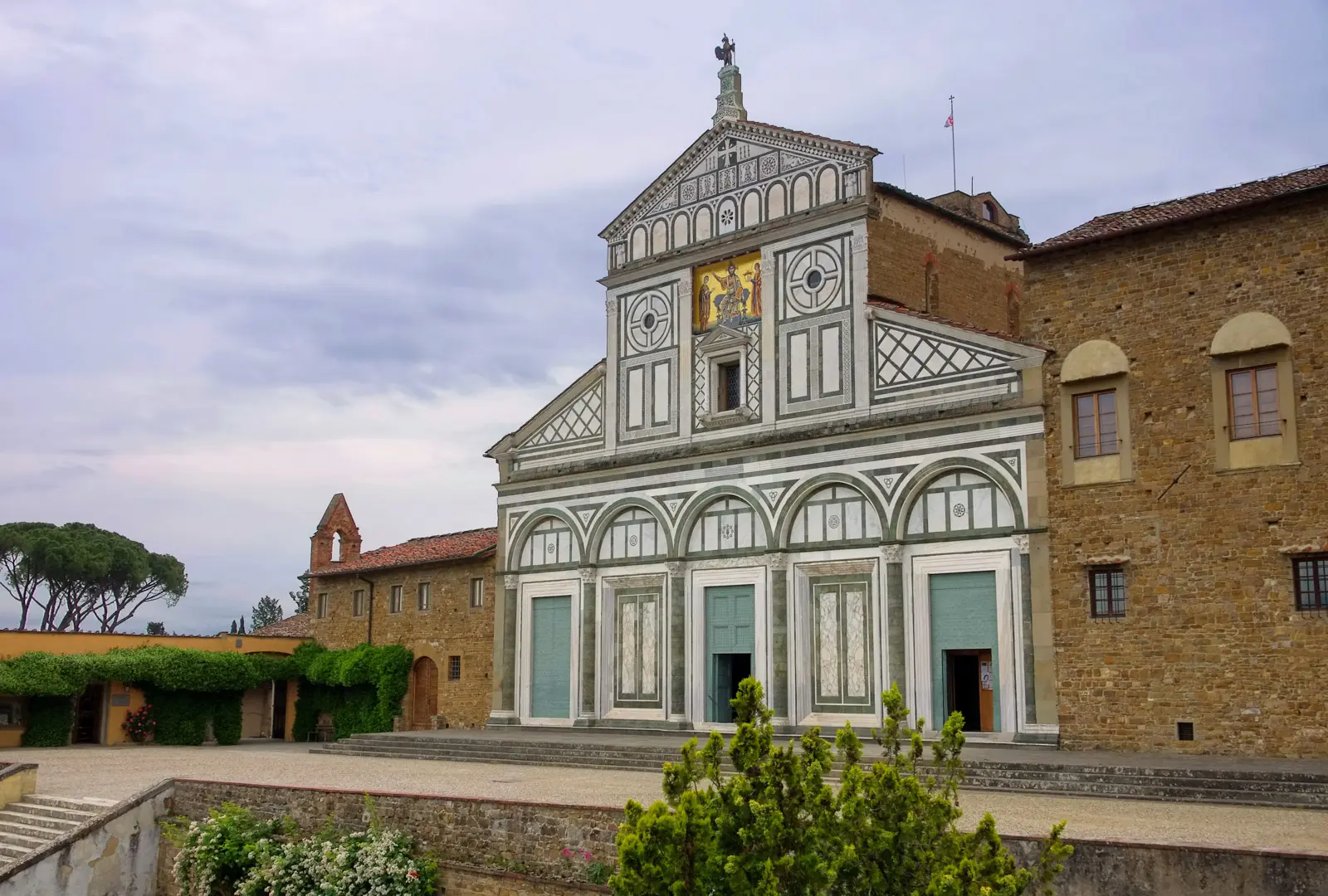
🏛️ What It Is: One of Florence’s oldest Romanesque basilicas, commissioned in 1018 by Bishop Ildebrando, dedicated to 3rd-century martyr Saint Minias
🎨 Highlights: White Carrara and green Prato marble façade, 13th-century golden mosaics (façade + apse), raised choir above the crypt, geometric inlaid floor
🎵 Don’t Miss: Gregorian chant sung by the Olivetan monks (check service times)
⚰️ Hidden Gem: Cimitero delle Porte Sante — a monumental cemetery designed by Niccolò Matas with Neoclassical, Art Nouveau, and Art Deco tombs
🏙️ Views: Panoramic views over Florence — Duomo, Palazzo Vecchio, Arno River
🎟️ Entrance: Free (donations welcome)
⏱️ Time Needed: 45–90 minutes (basilica + cemetery + views)
💡 Tip: Visit late afternoon for golden light on the marble and a chance to hear vespers; combine with Giardino delle Rose and Piazzale Michelangelo
The Story Behind San Miniato al Monte
The basilica is dedicated to Saint Minias (San Miniato), an early Christian martyr whose legend dates back to the 3rd century. Minias was an Armenian prince or nobleman, according to tradition, who withdrew to live as a hermit on the hill above Florence after embracing Christianity. When Emperor Decius ordered his arrest, Minias was brought to the amphitheatre and thrown to a panther – which, according to legend, refused to attack him. He was subsequently beheaded, and tradition holds that he then miraculously picked up his own head, crossed the Arno River, and walked back up the hill to the place where he wished to be buried. It is on that very spot that the basilica now stands.
By the 8th century, a shrine already marked the site. In 1018, Bishop Ildebrando of Florence commissioned the construction of the basilica visitors see today, a project that would produce one of the finest and most intact examples of Romanesque architecture in Florence and in Tuscany as a whole. Over the centuries, monks, patrons, and artists shaped the church while preserving its essential character, and the adjoining monastery continues to be maintained by Olivetan monks, a branch of the Benedictine family.
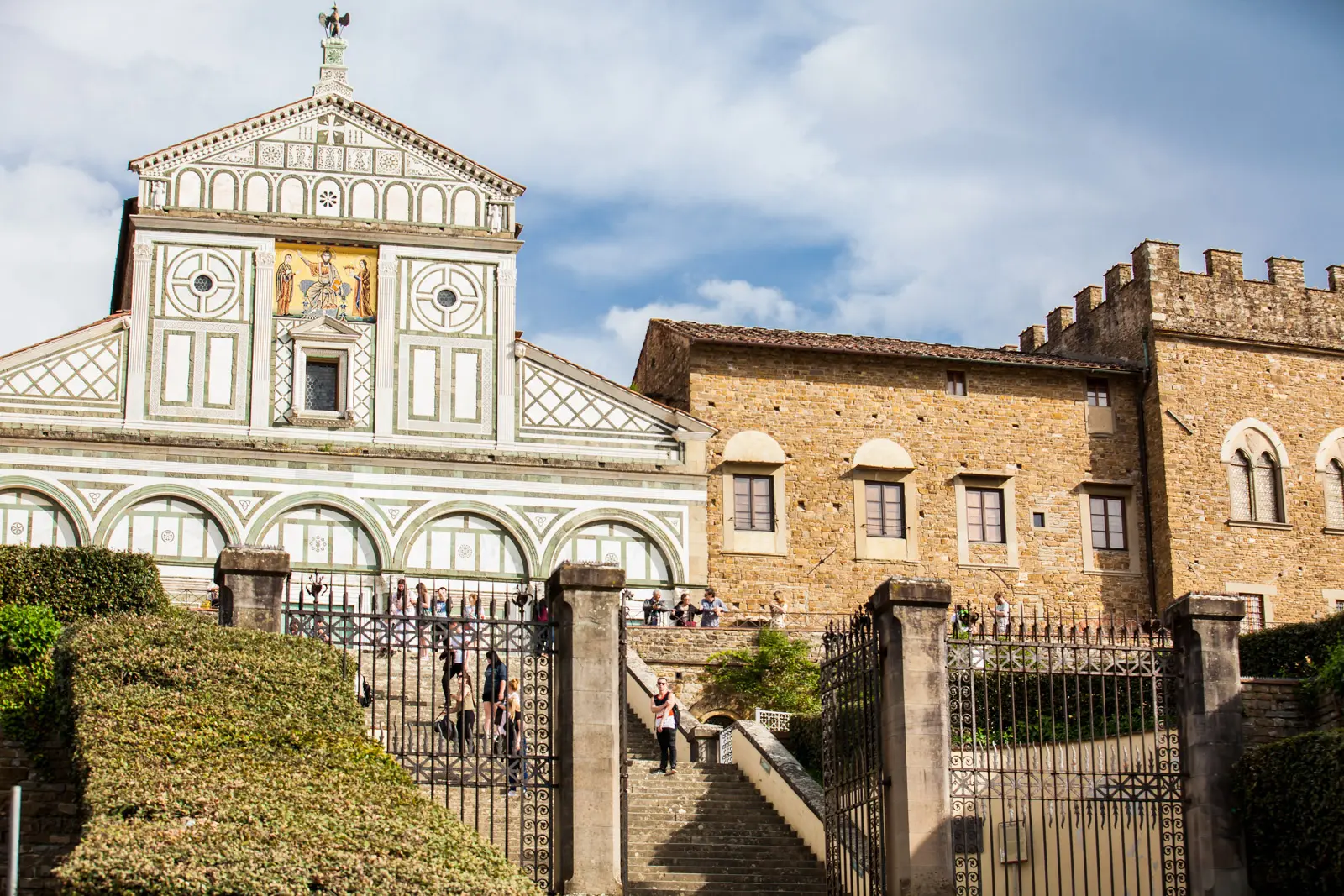
Unlike many Florentine landmarks transformed heavily by later styles, San Miniato has remained remarkably faithful to its origins. Walking here feels like stepping into a deeper layer of Florence, one that predates the Renaissance yet quietly influenced everything that came after.
The Façade: Geometry, Marble, and Harmony
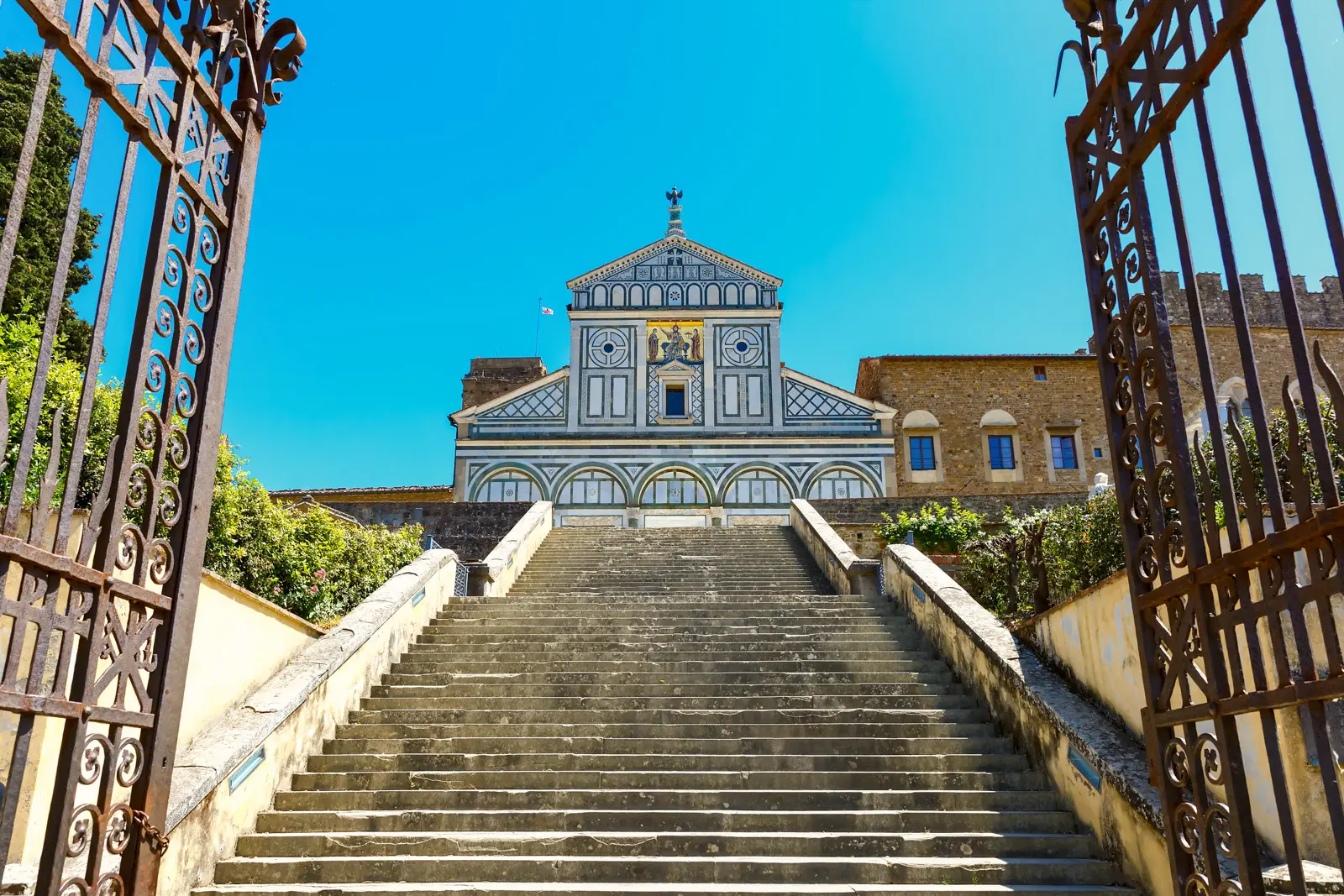
One of the first things visitors notice is the basilica’s striking façade. Clad in white Carrara and green Prato marble, it reflects the same Florentine love of geometric order seen in other iconic churches, yet it feels older, more serene, almost meditative. The design is deeply symbolic. Patterns of circles, arches, and symmetrical lines create a sense of balance that echoes medieval ideas about cosmic harmony – architecture as a reflection of divine order.
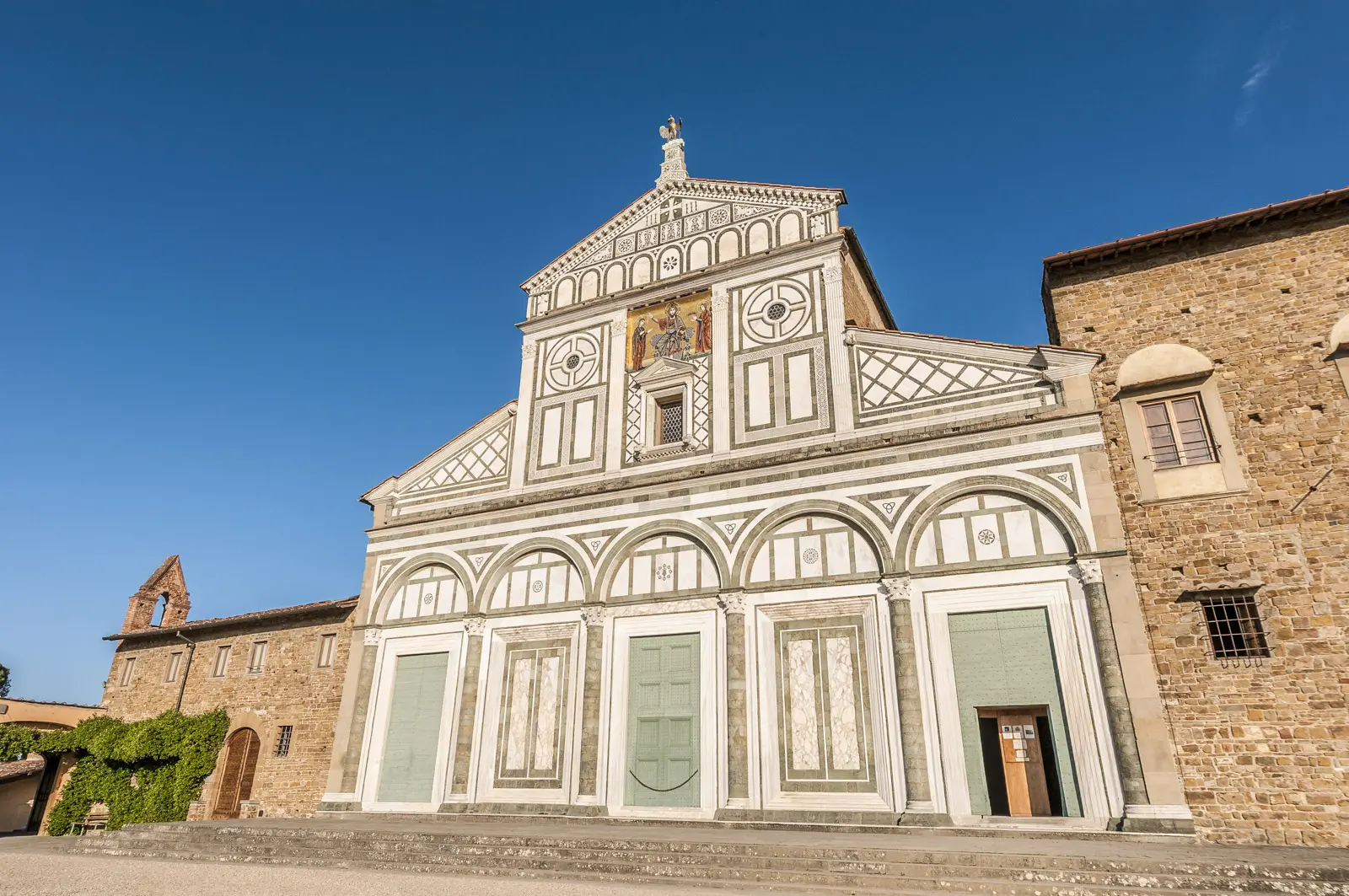
The façade was built in stages. The lower section dates to the late 11th and early 12th centuries, while the upper portions were completed later, with the golden mosaic of Christ between the Virgin Mary and Saint Minias added in the 13th century – shimmering softly in the light and visible even from a distance. Crowning the entire composition is an eagle, the symbol of the Arte di Calimala – the powerful cloth merchants’ guild that financed the upper façade and took responsibility for the church’s upkeep from 1288 onward. It is a reminder that in medieval Florence, faith and commerce were rarely far apart.
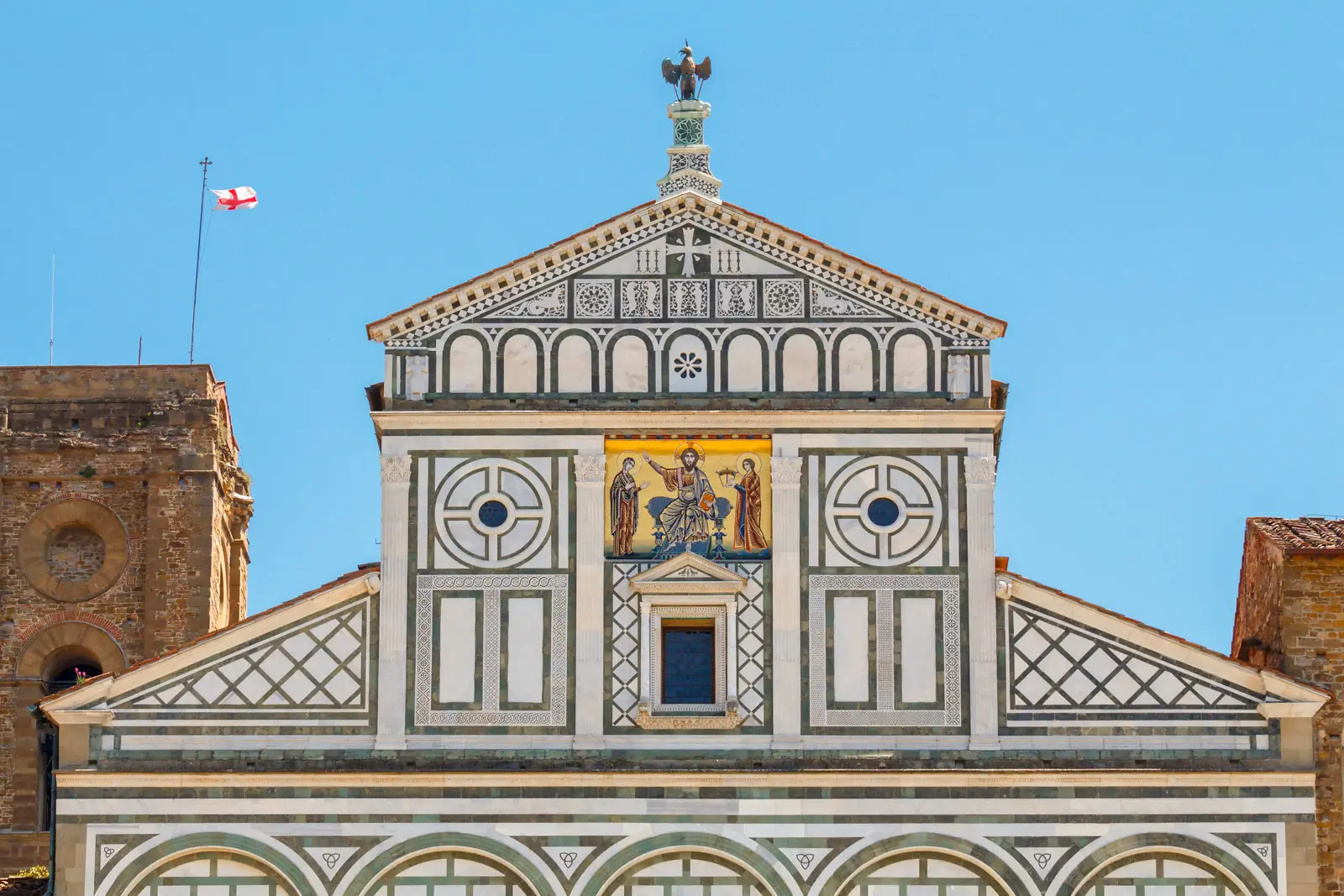
Standing before the façade, you feel the quiet confidence of Romanesque design. It does not seek drama or theatricality; instead, it offers clarity, stability, and calm — a visual introduction to the atmosphere waiting inside.
Inside the Basilica: A Space of Light and Silence
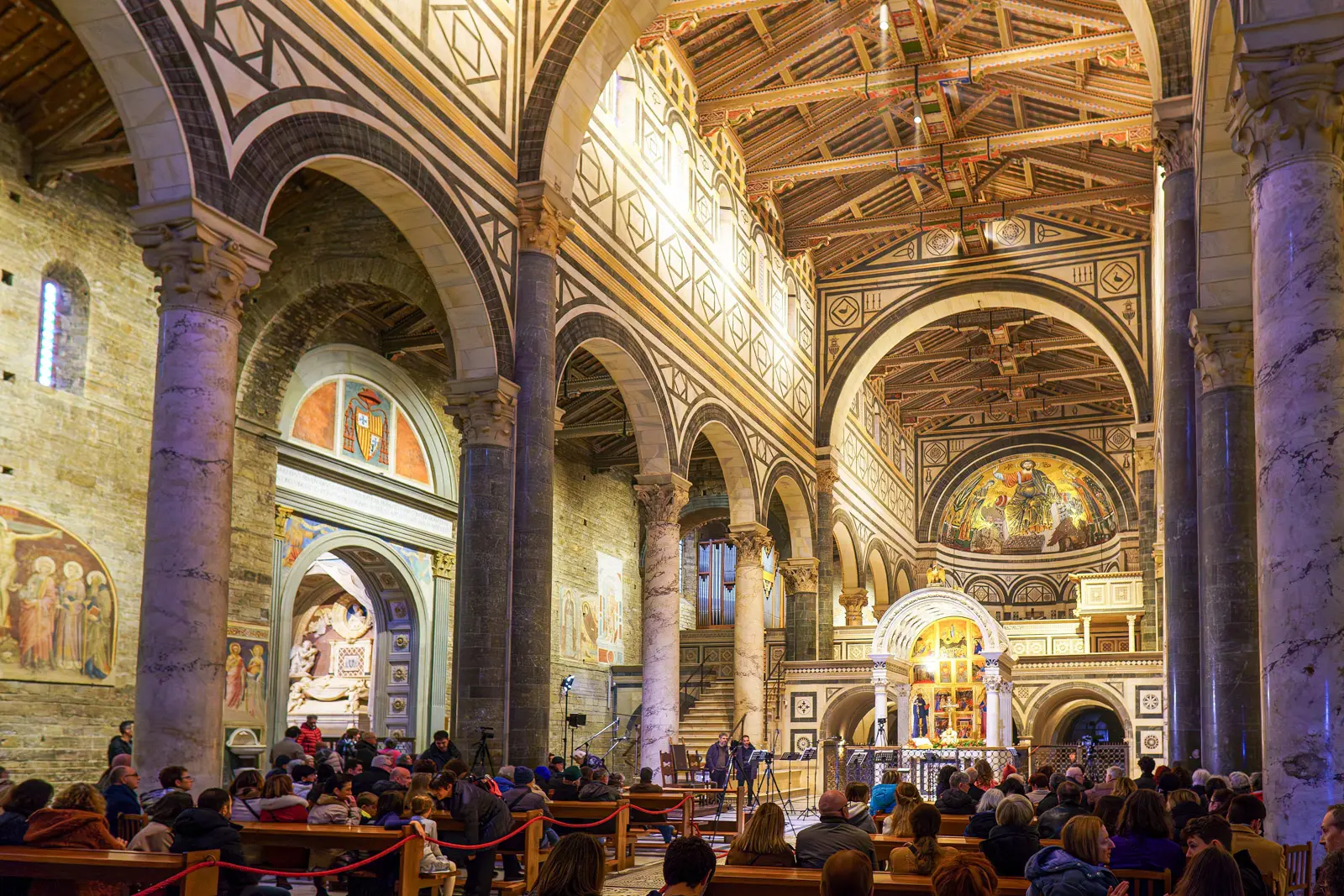
Stepping inside San Miniato al Monte feels like entering a space designed for contemplation rather than spectacle. The interior is luminous yet restrained, defined by rhythmic columns and clean Romanesque lines that guide the eye forward and upward. Unlike many later Florentine churches filled with dramatic decoration, this basilica relies on proportion, light, and balance to create emotion. The atmosphere encourages stillness – visitors instinctively slow down, their attention drawn toward the elevated sacred space at the far end of the nave.
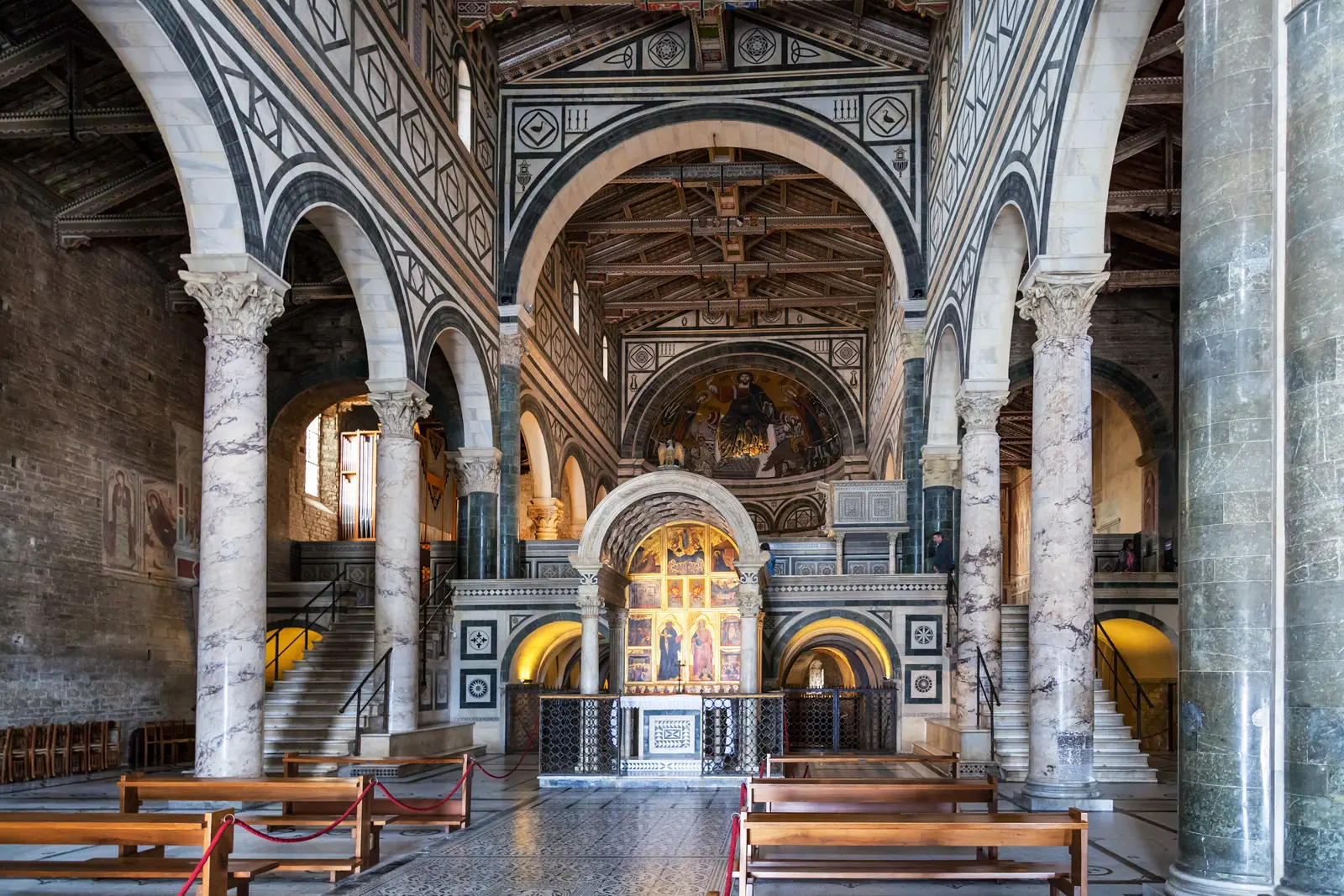
One of the most distinctive features is the raised choir, positioned above the crypt and accessed by side stairways. This architectural arrangement creates a subtle sense of ascent, both physical and spiritual, as the altar and apse appear almost suspended above the main space. Behind the altar, the golden apse mosaic glows softly, depicting Christ enthroned between the Virgin Mary and Saint Miniato. The saint appears holding a crown, and the inscription S. MINIATUS REX ERMINIE identifies him as the “King of Armenia,” reflecting the medieval tradition of his noble origins and martyrdom. The mosaic’s calm symmetry and Byzantine-inspired style connect the church to an earlier artistic world, reminding visitors that Florence’s spiritual roots extend far beyond the Renaissance.
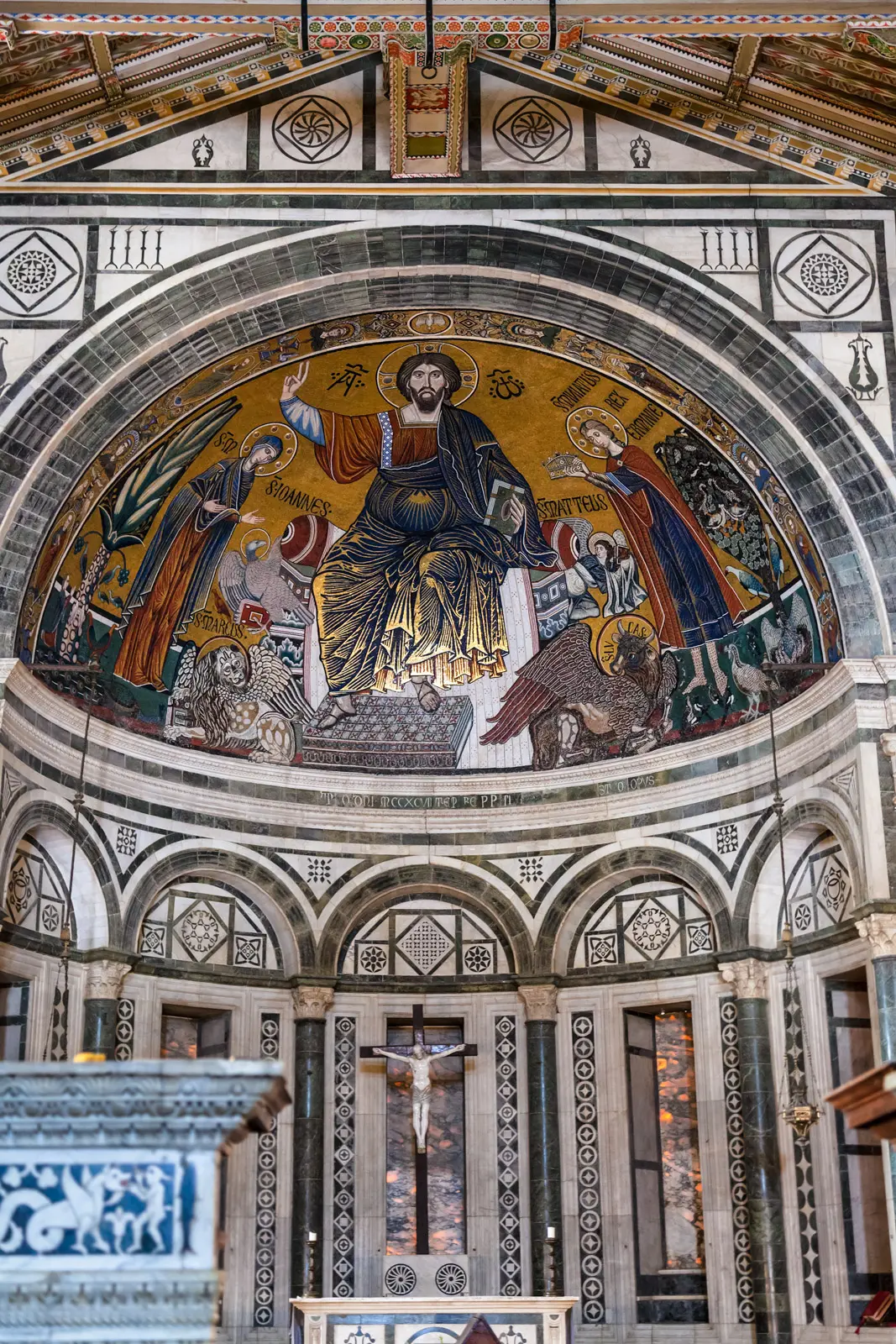
Here, beauty is experienced gradually. Light filters gently across stone and gold, creating an atmosphere that feels timeless rather than theatrical. The basilica does not demand attention – it invites quiet observation, rewarding those who pause long enough to absorb its harmony.
A Living Monastic Tradition
San Miniato al Monte is not a museum frozen in time. It remains an active spiritual space cared for by a community of Olivetan monks, a branch of the Benedictine family who have been present here since 1373. At certain hours, Gregorian chant fills the church, transforming the architecture into something almost ethereal. Hearing ancient melodies echo through stone walls reminds visitors that this basilica has been a place of prayer for nearly a thousand years. The continuity is powerful. Past and present feel intertwined, as though centuries overlap in a single moment.
If your schedule allows, timing your visit around evening prayer or vespers is one of the most memorable experiences Florence quietly offers. The chants rise gently through the Romanesque space, creating an atmosphere of profound calm and reflection. Even for travelers who are not religious, the experience feels universal, a reminder that some places are designed simply to help us pause. (Service times may vary, so it is worth checking the current schedule before visiting.)
Views Over Florence: A Perspective That Feels Earned
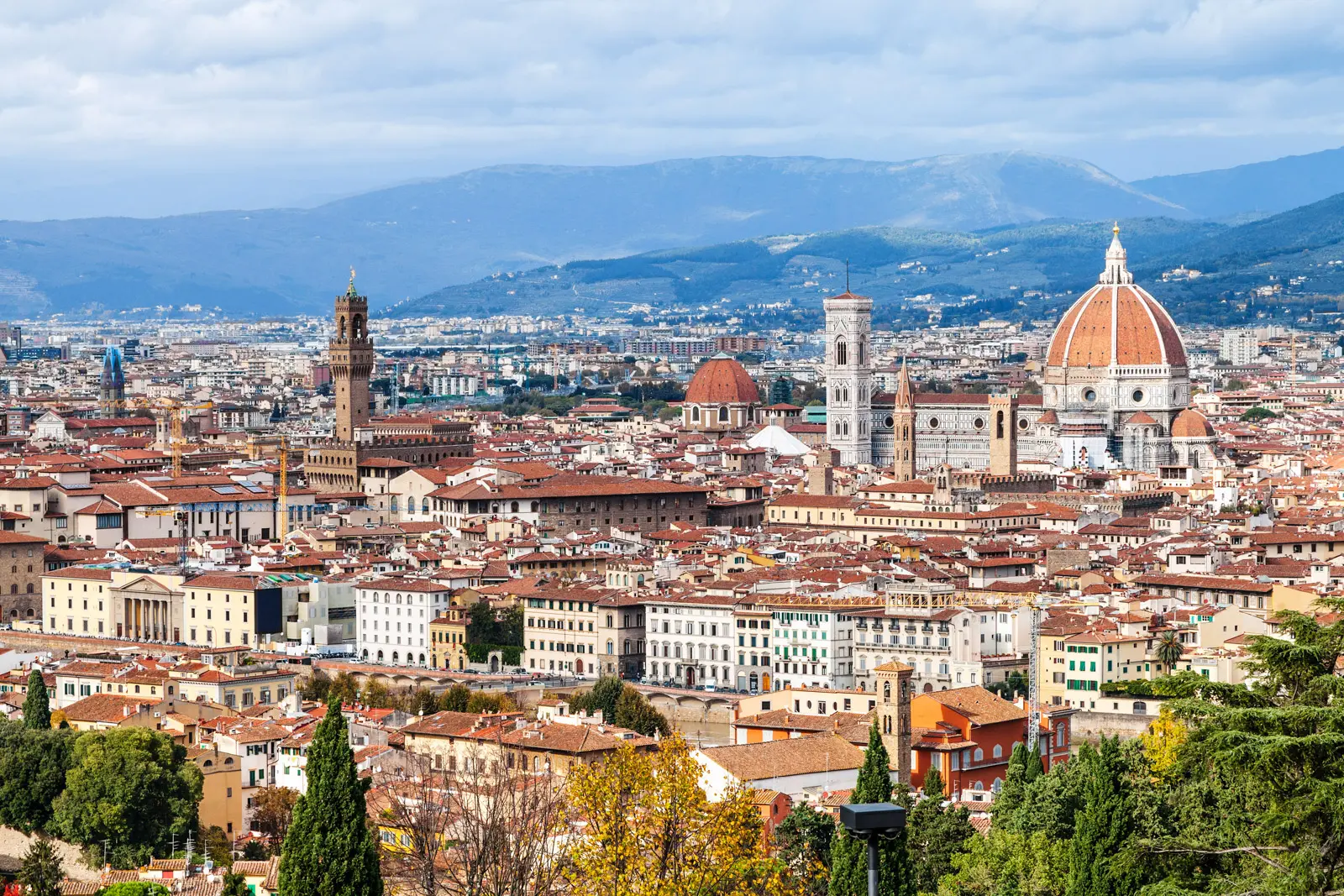
While many travelers flock to Piazzale Michelangelo, the views from San Miniato al Monte feel more intimate and serene. From the terraces surrounding the basilica, Florence unfolds in breathtaking detail. You can see the Arno River winding through the city, the iconic Palazzo Vecchio, the vast dome of Santa Maria del Fiore, and the layered rooftops of the historic center stretching toward the horizon. The city feels close enough to study yet distant enough to admire as a whole. What makes this viewpoint special is the atmosphere. There are fewer crowds, more silence, and a sense that the panorama belongs to those willing to climb a little higher. It is a place where Florence feels less like a checklist and more like a living landscape shaped by centuries of human creativity.
The Cemetery & Quiet Corners
Adjacent to the basilica lies one of Florence’s most overlooked treasures: the Cimitero delle Porte Sante – the Cemetery of the Sacred Doors – laid out within the fortified terraces of the basilica and designed by Niccolò Matas, the same architect responsible for the façade of Santa Croce. The connection is a small but pleasing thread linking two of Florence’s most significant religious sites.
Far from a simple burial ground, the cemetery functions as an open-air museum, its tombs and private chapels built in styles ranging from Neoclassical to Art Nouveau and Art Deco, interspersed with cypress trees and marble sculptures that create a deeply contemplative atmosphere. Among those buried here are Carlo Collodi, the creator of Pinocchio, and film director Franco Zeffirelli – a reminder that this hill has long been a place where Florentine life, in all its creativity, comes to rest.
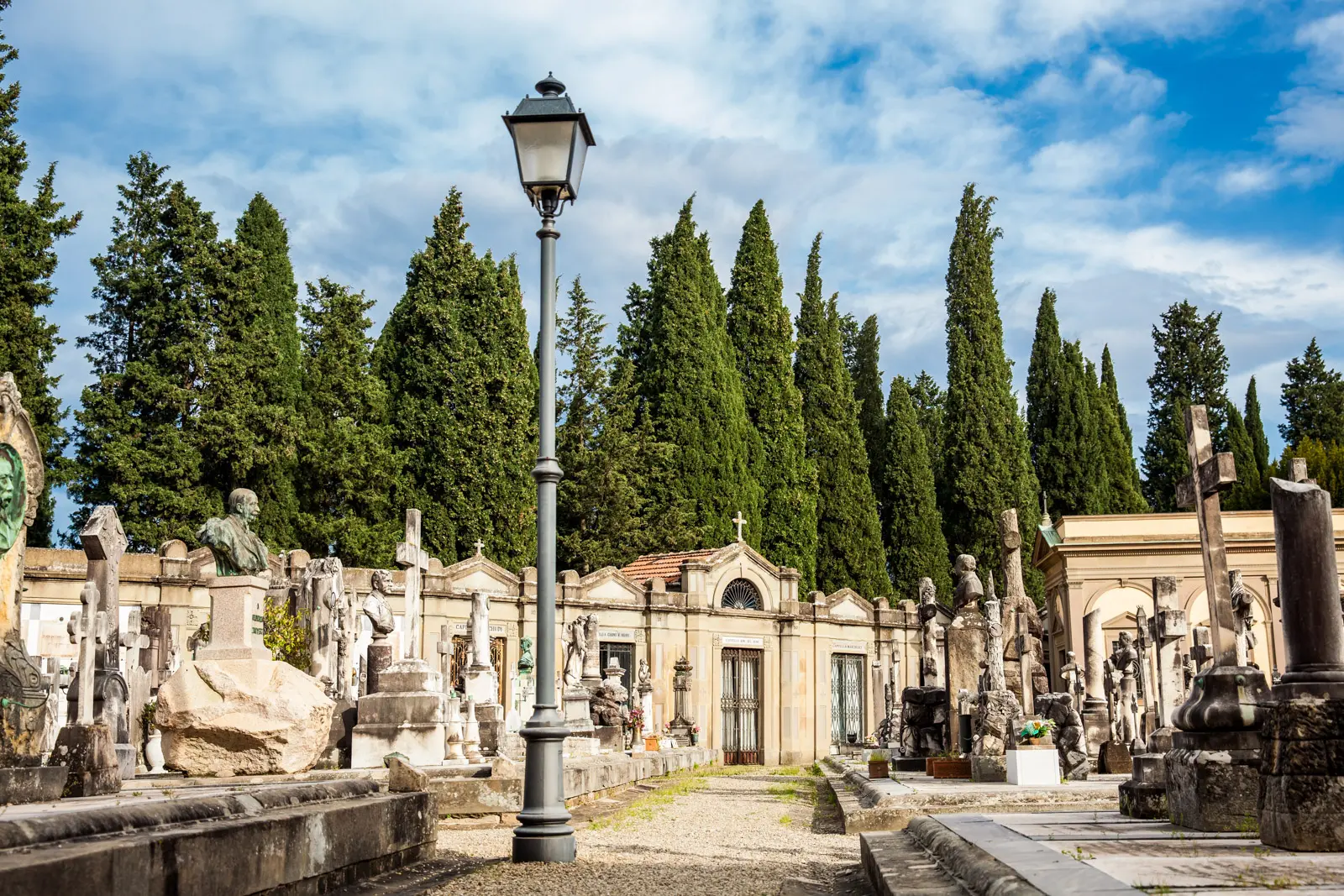
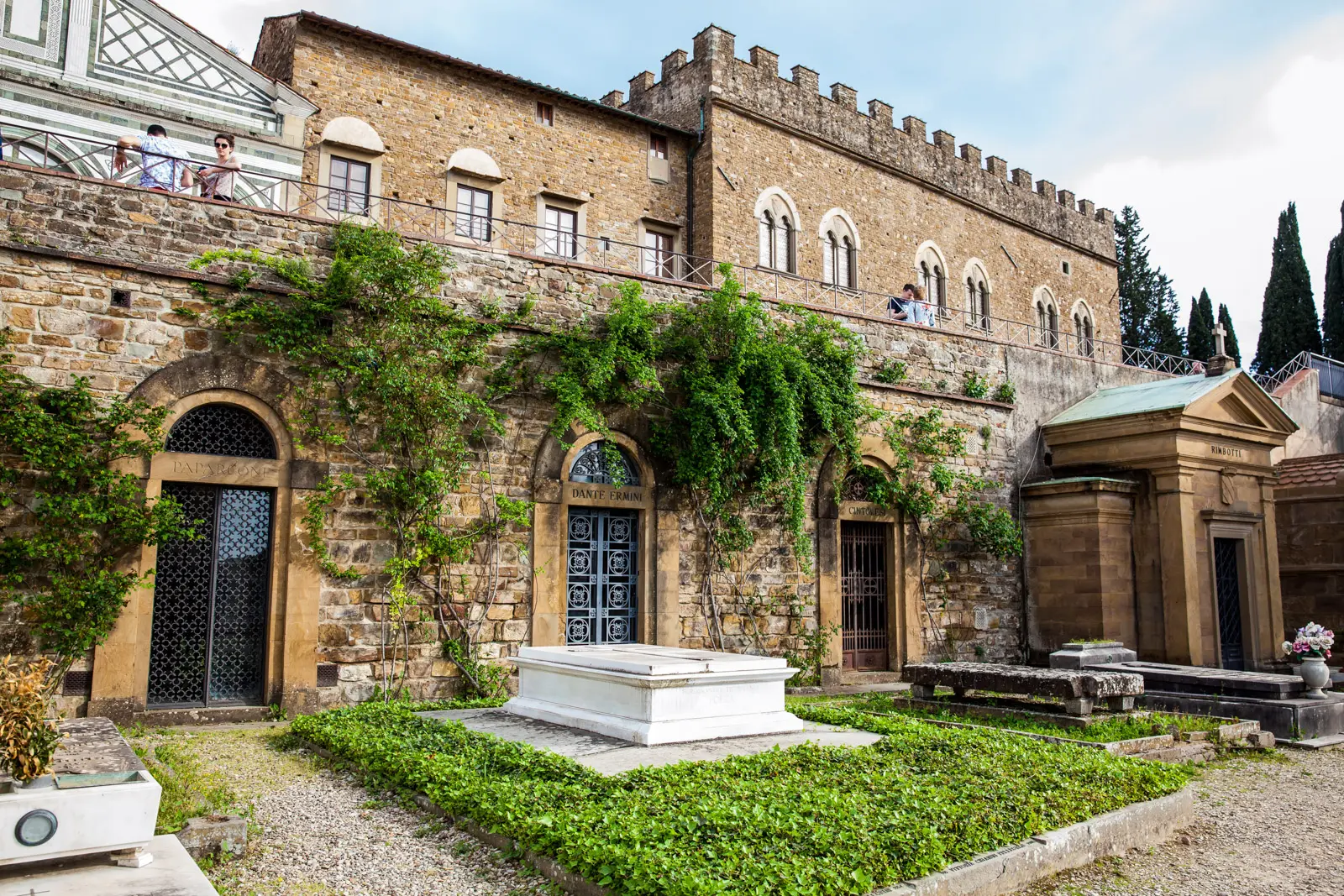
Walking here feels deeply respectful and quietly surprising. Unexpected frames of Florence appear between trees and through arches – glimpses of the city below that often become the most personally memorable moments of the entire visit. Not dramatic, but deeply felt.
The Atmosphere & Why San Miniato Still Matters
San Miniato al Monte attracts travelers, locals, artists, and pilgrims alike, yet it never feels overwhelmed. Some arrive after wandering through nearby gardens, others climb intentionally toward the basilica for the view, especially when late afternoon light warms the marble façade and Florence below begins to glow. Despite its growing popularity, the atmosphere remains gentle. Visitors sit quietly on the steps, sketch the skyline, or simply pause to breathe – moments that feel increasingly rare in modern travel.
In a city celebrated for Renaissance brilliance, San Miniato offers something older and perhaps more profound. It reminds us that Florence’s story did not begin with artistic fame but with centuries of faith, craftsmanship, and devotion layered into the landscape itself. Here, art and architecture feel inseparable from silence and perspective. The experience becomes less about checking landmarks and more about presence, about slowing down enough to feel where you are.
Standing on the terrace, watching the city unfold below, you begin to understand why travelers return again and again. Some places stay with us not because they demand attention, but because they quietly shift how we see the world – and San Miniato al Monte is one of those rare places.
Bubbly Tips for Visiting San Miniato al Monte
- When to visit: Late afternoon or sunset offers magical light over Florence and a peaceful atmosphere.
- Entrance: Admission to the basilica is free (donations are welcome) – one of Florence’s most rewarding experiences without a ticket.
- Opening hours: Check current visiting and service times before you go, especially if you hope to hear Gregorian chants.
- The climb: Wear comfortable shoes – the walk uphill from Piazzale Michelangelo is part of the experience.
- Pair your visit: Combine with Piazzale Michelangelo or Giardino delle Rose for a beautiful hillside itinerary above Florence.
- Slow down: Sit on the steps or terraces for a few minutes – the view deserves unhurried attention.
Final Thoughts
San Miniato al Monte feels like Florence’s quiet heartbeat – steady, timeless, and deeply grounding. High above the city, where marble meets sky and history meets silence, you discover a different side of Florence: one that invites reflection rather than rush.
And perhaps that is the true gift of this place. Not just the view, not just the architecture, but the feeling of stepping outside time, if only for a little while, and seeing Florence exactly as it was meant to be seen: slowly, thoughtfully, and with wonder.
Have you visited San Miniato al Monte or discovered a peaceful corner of Florence that stayed with you? I’d love to hear about your experience, feel free to share in the comments below.
With love,
Bubbly✨
🌟 Everything You Need to Plan Your Dream Trip in 2026
- 🌟 Luxury Hotels - Find premium stays with Booking.com & Hotels.com
- 🏡 Vacation Rentals - Discover unique properties on VRBO
- 🏞️ Guided Tours - Explore with Viator or GetYourGuide
- 🎫 Attraction Tickets - Skip the lines with Tiqets
- 🚢 Ocean Cruises - Set sail with Cruise Direct
- 📱 International SIMs - Stay connected with Saily
- 🚗 Car Rentals - Budget-friendly options from Discover Cars
- 🌐 Secure VPNs - Browse safely with NordVPN
- 💶 Currency Exchange - Best rates with Wise
- 🗣️ Learn Languages - Master the local language with Babbel and Rosetta Stone