
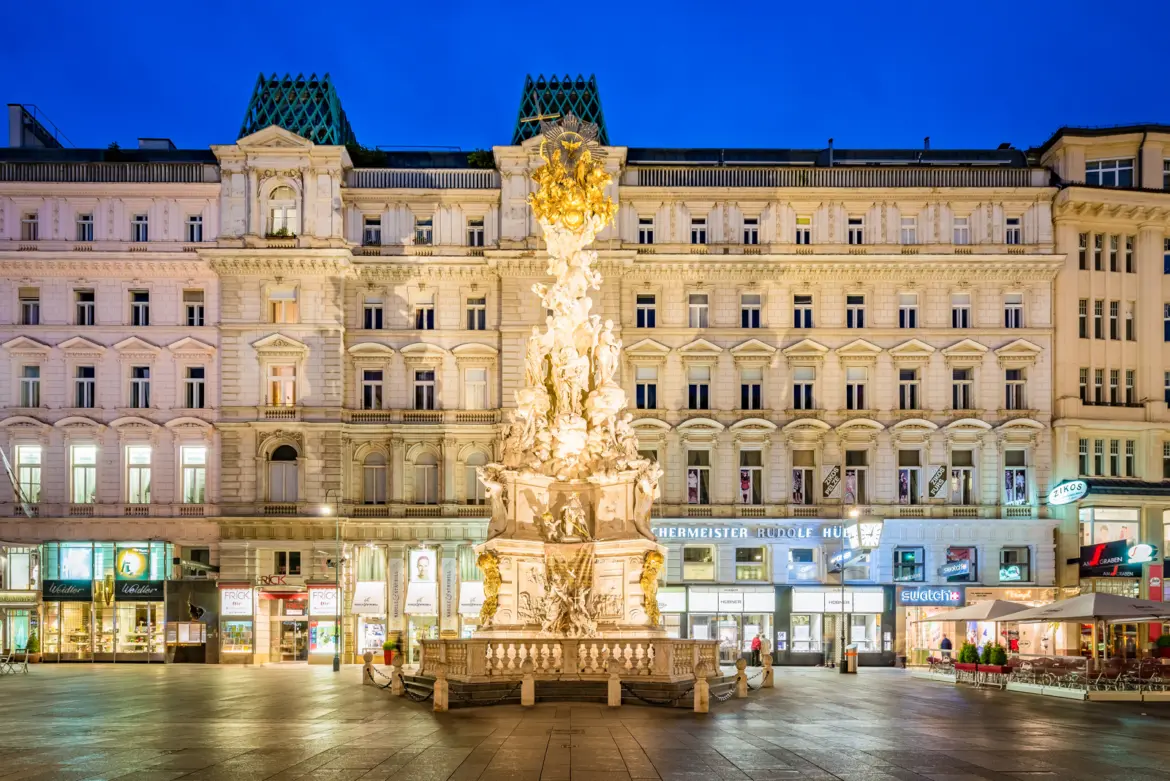
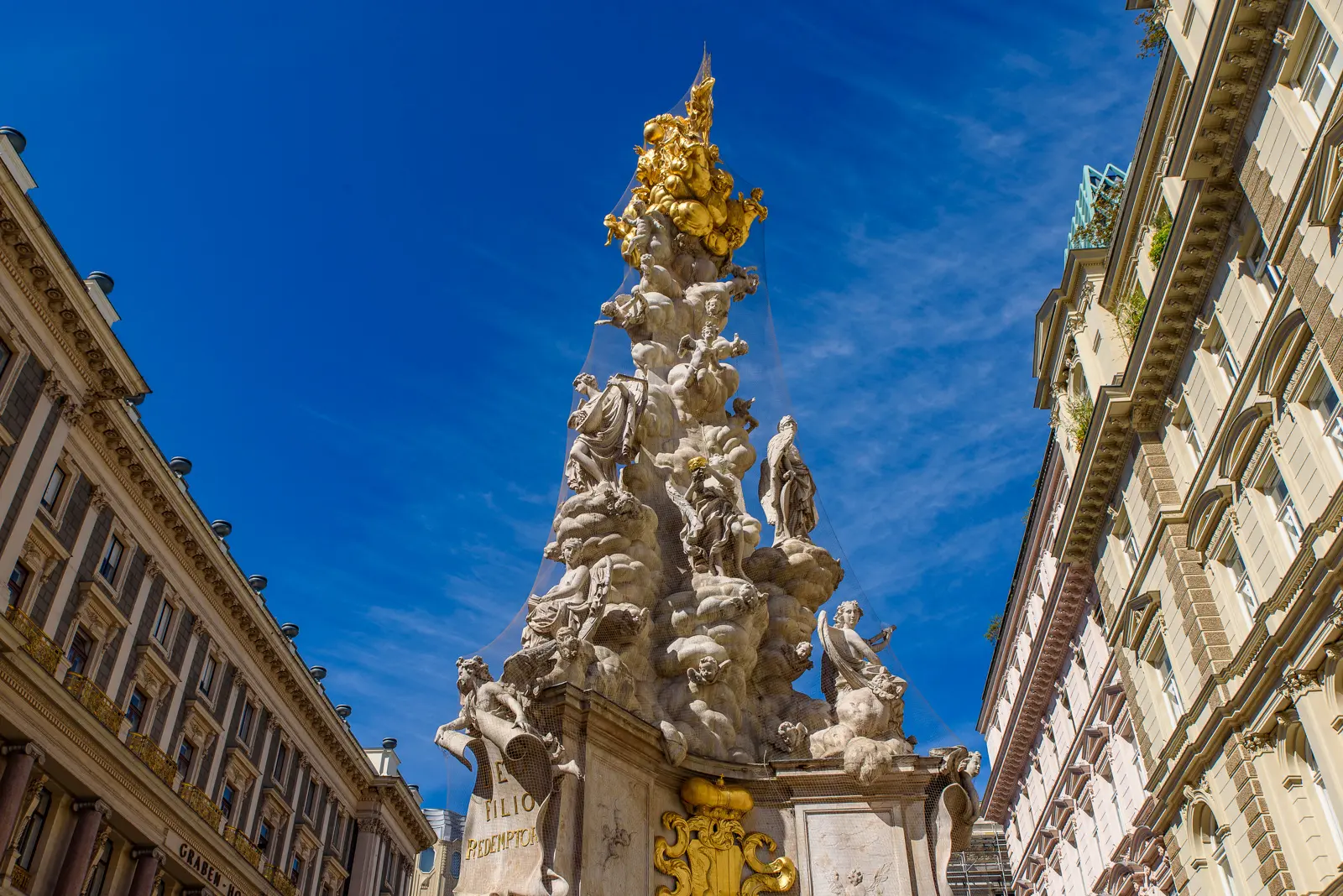
There are landmarks that draw your attention, and then there are those that hold it. Rising from the heart of Graben, the Plague Column is one of Vienna’s most striking and intricate monuments. At first glance, it feels almost theatrical – a cascade of clouds, angels, and sculptural movement spiraling upward into the sky, catching the light and shifting with it throughout the day. It stands at the center of movement and modern life, yet seems to exist within its own space, drawing the eye upward and inward at the same time.
And yet, behind its beauty lies a story rooted not in celebration, but in crisis, loss, and the human search for meaning in the face of uncertainty. Standing before it, you are not just looking at a monument – you are looking at a moment in history, one that has been transformed into art, symbolism, and memory, layered carefully into every detail. The longer you look, the more it reveals itself – not all at once, but gradually, as if inviting you to slow down and read it, piece by piece.
Plague Column at a Glance
🏛️ Completed: 1693–1694 — approximately 21 metres tall
⚕️ Origin: Commissioned by Emperor Leopold I after the plague of 1679 (~70,000 deaths)
✏️ Artists: Johann Bernhard Fischer von Erlach, Lodovico Burnacini, Paul Strudel
🎨 Style: High Baroque — one of the earliest major Baroque sculptural works in Vienna
👑 Base: Emperor Leopold I kneeling in prayer; plague allegory driven away by an angel
😇 Middle: Nine Choirs of Angels — dynamic, layered transition between earth and heaven
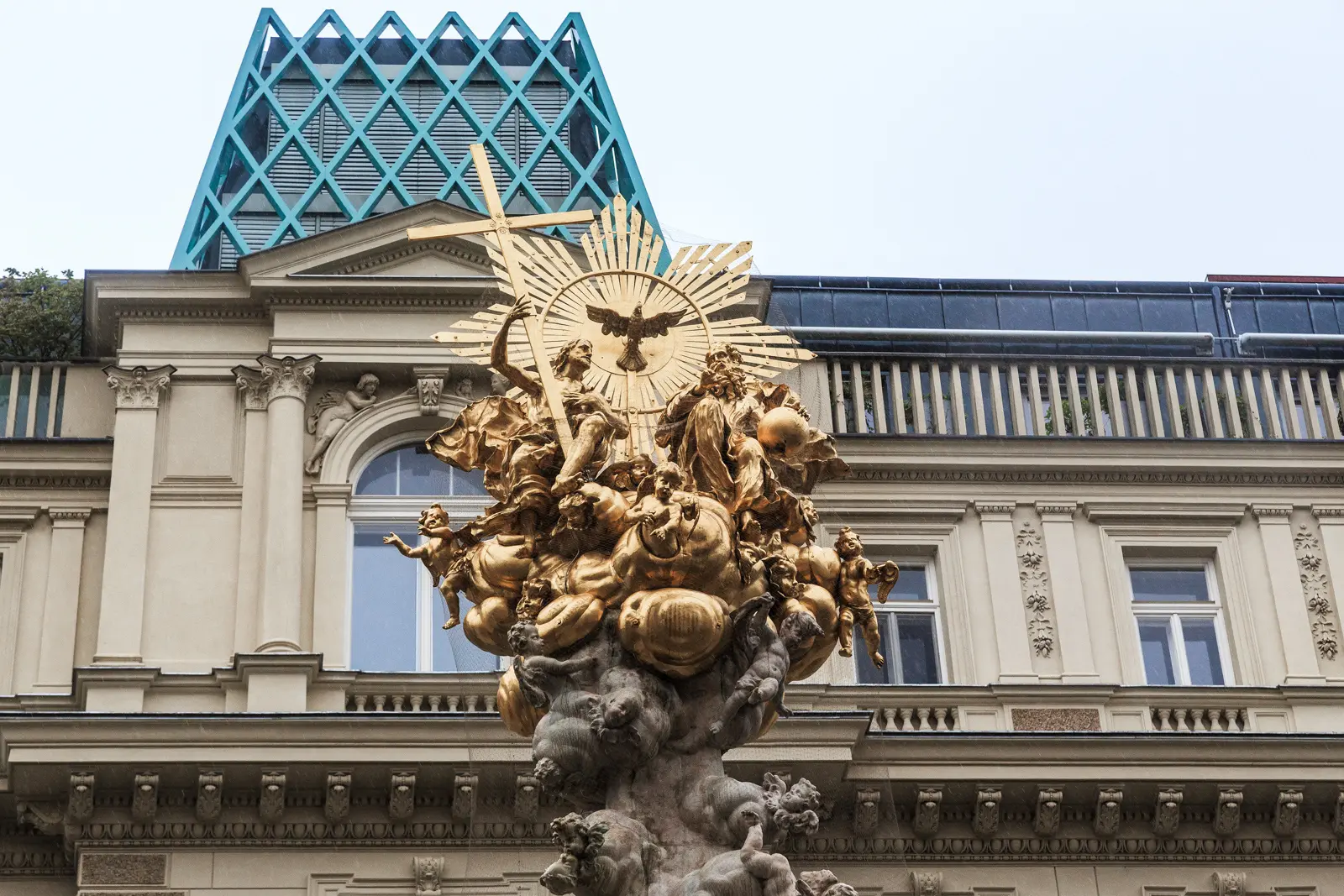
✝️ Top: Gilded Holy Trinity — God the Father, Jesus with cross, Holy Spirit as dove
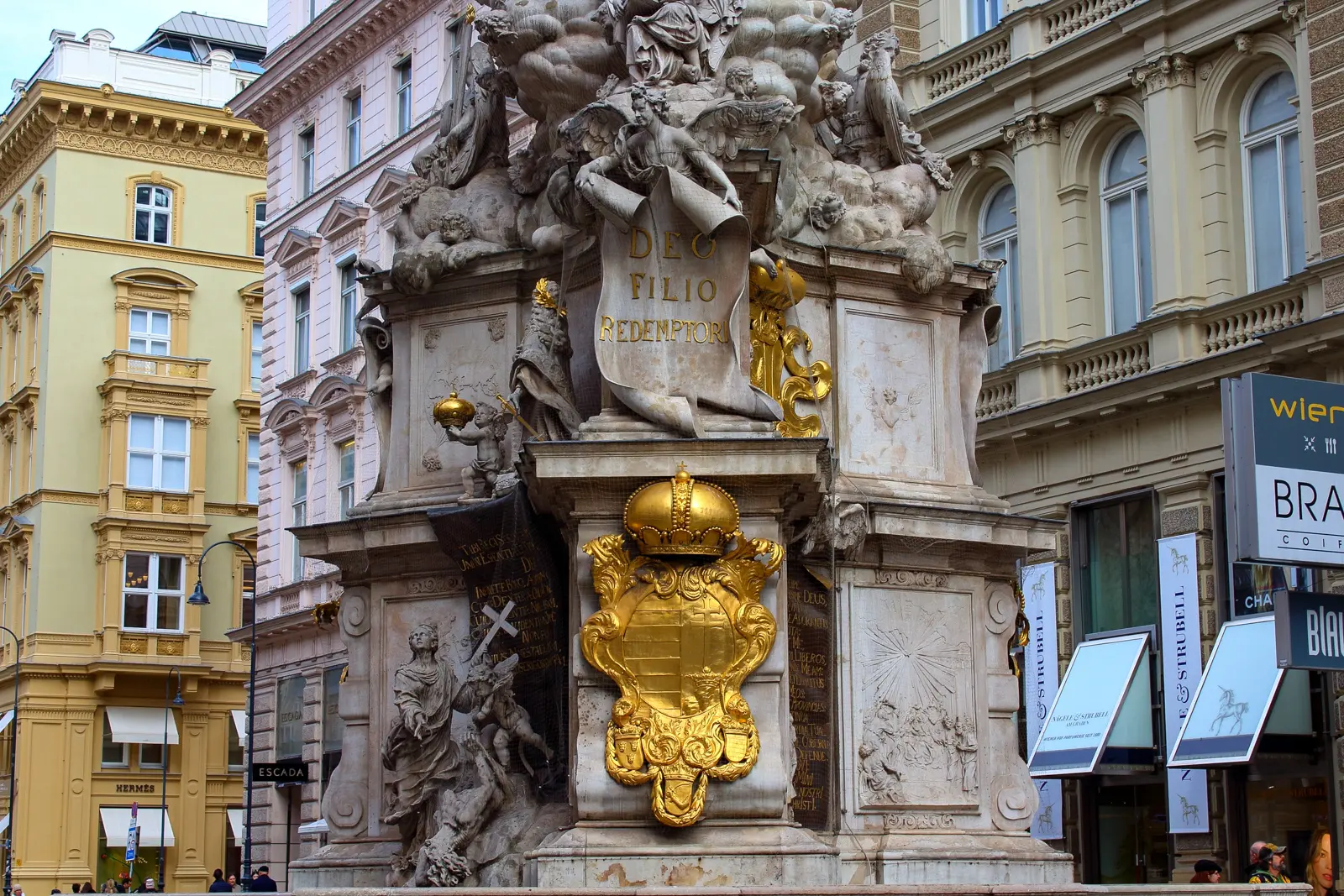
🛡️ Habsburg symbols: Coats of arms of Austria and Hungary embedded in the design
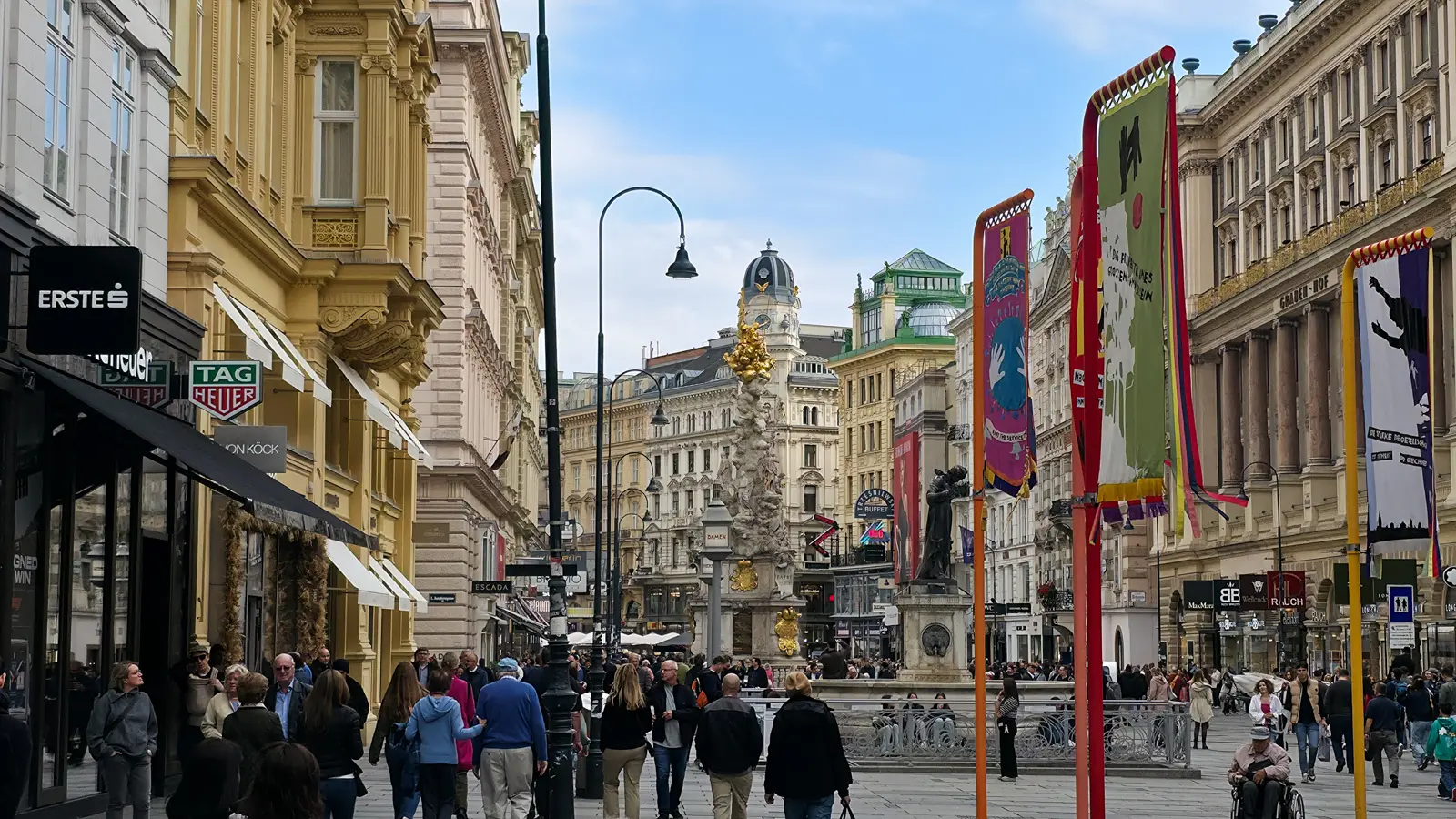
📍 Location: Center of Graben, 1st district, near St. Stephen’s Cathedral
💡 Tip: Visit at different times of day — morning softness, evening depth, night illumination
A Monument Born from Crisis
The origins of the Plague Column trace back to one of the darkest chapters in Vienna’s history: the devastating plague of 1679. As the epidemic spread through the city, fear and uncertainty became part of everyday life. Tens of thousands lost their lives, with some estimates reaching as high as 70,000, and the social fabric of the city was profoundly shaken.
In the midst of this crisis, Emperor Leopold I made a vow: if the city were delivered from the plague, he would commission a monument of gratitude to the Holy Trinity. It is worth noting that Leopold made this vow having already fled Vienna when the epidemic broke out, a detail that adds a layer of complexity to the story of faith and gratitude that followed. As an immediate gesture, a provisional wooden column was erected in the same year, featuring the Holy Trinity on a Corinthian column surrounded by nine sculpted angels, created by Johann Frühwirth. This temporary structure stood as a placeholder for something far more ambitious.
The permanent column that stands today, rising approximately 21 metres above Graben, was completed in 1693-1694, the result of nearly fifteen years of artistic collaboration. It is not merely a memorial to suffering, but an expression of relief, faith, and the desire to make sense of a moment that had reshaped the city.
A Baroque Masterpiece in Motion
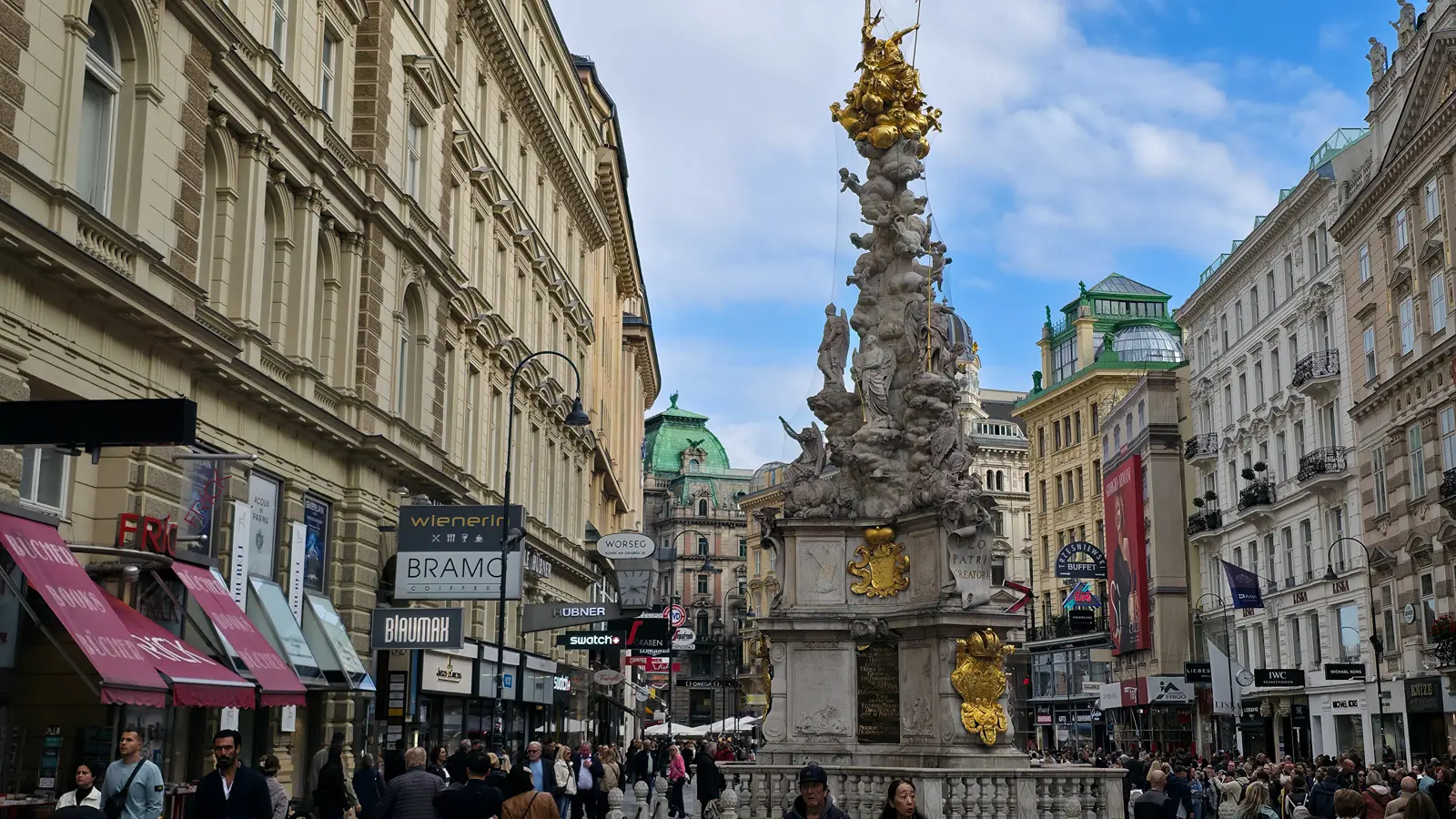
What makes the Plague Column so captivating is its sense of movement. Unlike traditional columns, which emphasize symmetry and restraint, this monument feels alive, almost in motion. Figures emerge from clouds, forms twist and rise, and the eye is drawn upward in a continuous, almost effortless flow. It does not simply stand in place; it unfolds, guiding your gaze through layers of form and meaning.
Created through the collaboration of several prominent artists, including Johann Bernhard Fischer von Erlach, Lodovico Burnacini, and Paul Strudel, the column is widely regarded as one of the earliest major works of the High Baroque in Vienna, and one of the most ambitious Baroque sculptural compositions in Europe. Art historians often point to it as an innovative ensemble that reflects the dramatic, expressive language of sculpture that developed in the wake of Gian Lorenzo Bernini.
There is a theatrical quality to it – not exaggerated, but intentional. Light shifts across its surfaces throughout the day, revealing new details with every glance. From a distance, it reads as a unified form. Up close, it becomes a world of intricate figures, gestures, and symbolic layers waiting to be discovered.
Reading the Column: A Vertical Narrative
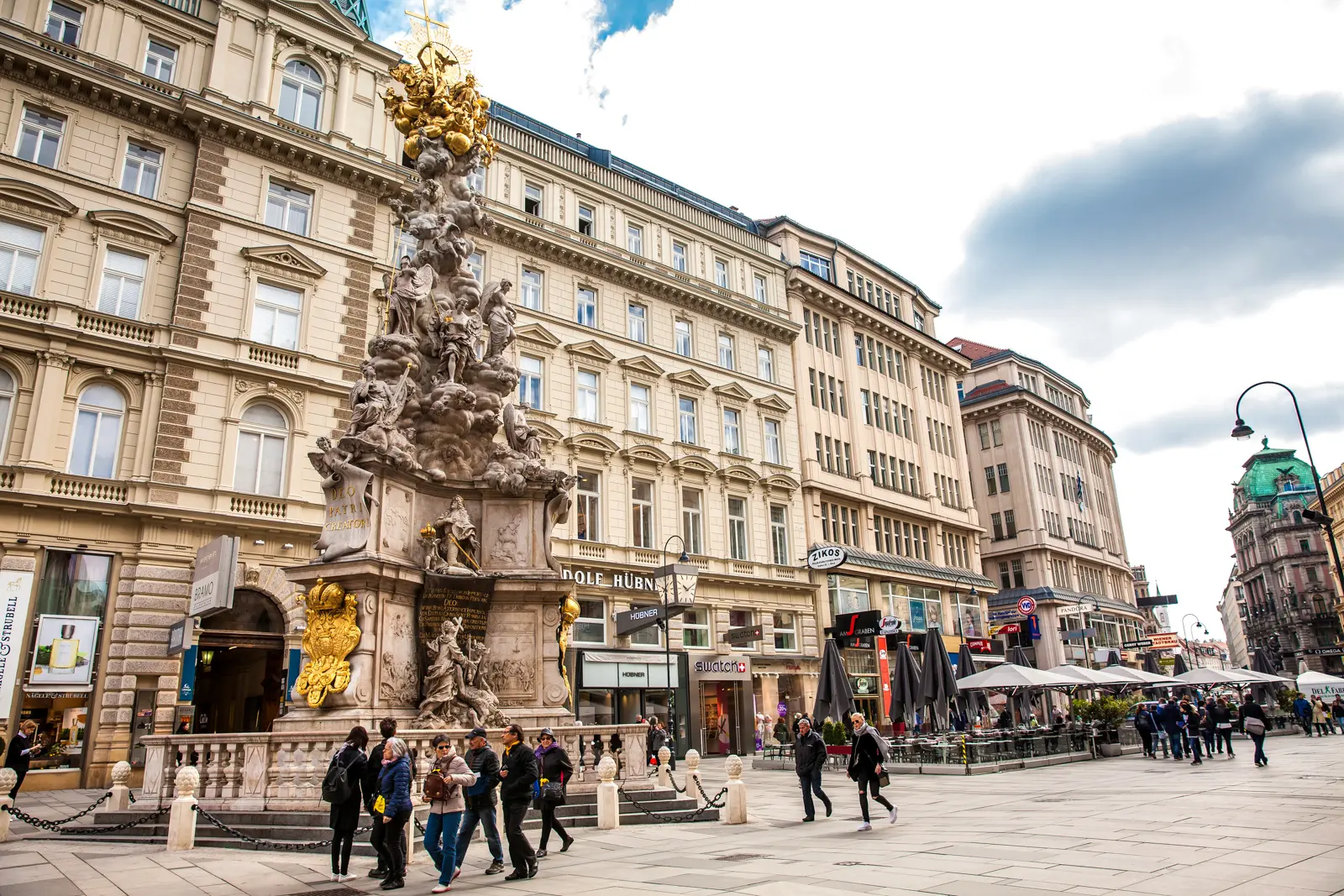
One of the most fascinating aspects of the Plague Column is how it is structured – not just physically, but symbolically. At the base, the human world is represented. Here, Leopold I is depicted kneeling in prayer, eyes raised toward heaven, wearing a gilded crown and holding the ceremonial imperial sword, a posture of humility that reflects the vulnerability and suffering of the plague years. Also at this level, the plague itself is commonly interpreted as a personified figure being driven away by an angel and a young woman holding a cross, a vivid depiction of divine intervention over human suffering.
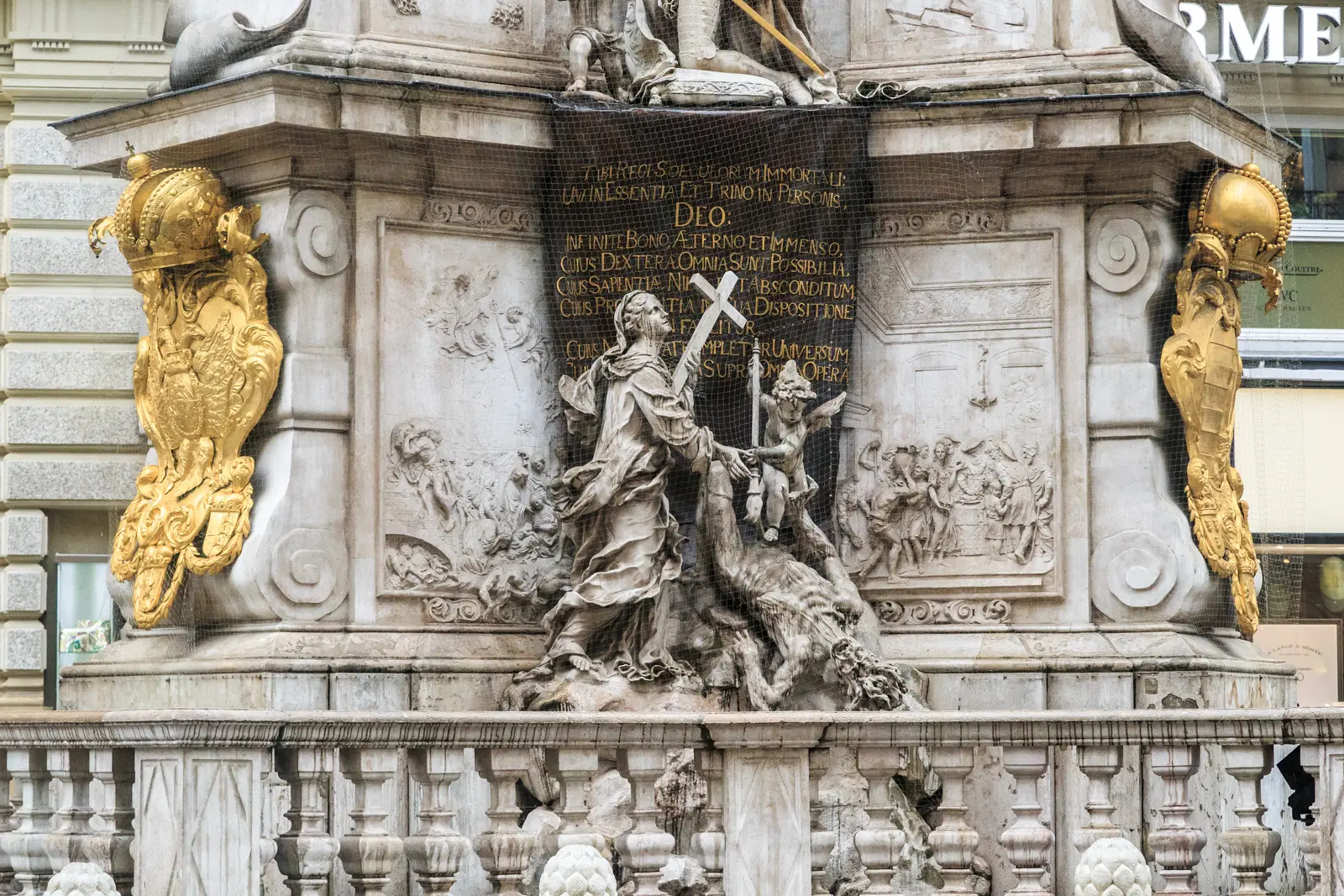
As your gaze moves upward, the composition shifts. Nine large angels – corresponding to the Nine Choirs of Angels – fill the middle register alongside allegorical figures, creating a sense of transition between the earthly and the divine. This level feels dynamic and layered, capturing the tension between despair and hope. It is worth noting that the number three is woven throughout the entire composition – three vertical levels, a triangular structural arrangement, nine angels, and three bronze scrolls – a deliberate echo of the column’s dedication to the Holy Trinity.
At the very top, the narrative resolves in a gilded representation of the Holy Trinity – God the Father, Jesus the Son holding a cross, and the Holy Spirit represented by a dove at the center of a radiant glory. This vertical progression, from human suffering to divine transcendence, is not accidental. It reflects a worldview in which meaning is found through ascent, both physical and spiritual.
Power and Identity: The Language of Empire
Beyond its religious symbolism, the Plague Column also communicates something else: power. Embedded within its design are the coats of arms of the Habsburg territories, including those of the Archduchy of Austria and the Kingdom of Hungary. These elements are subtle, but significant. They situate the monument not only within a spiritual narrative, but within a political one as well.
This duality is essential to understanding the column. It is a monument of faith, but also of identity, a statement about the reach and continuity of the Habsburg Empire. In this sense, the column becomes more than a response to the plague; it becomes part of a broader effort to define stability, legitimacy, and order in a time of uncertainty.
The Experience: A Monument Within Movement
What makes encountering the Plague Column particularly compelling is its setting. Located in the center of Graben, one of Vienna’s most elegant and lively streets, it exists within the flow of everyday life. People pass by, pause, gather, or simply continue on their way. Luxury storefronts reflect light onto its surface, conversations unfold nearby, and the rhythm of the city continues uninterrupted. And yet, the column remains present – not imposing, but impossible to ignore. It seems to exist slightly apart from the movement around it, creating a subtle shift in attention for those who notice it.
There is something striking about that coexistence. A monument born from crisis, standing quietly within a space defined by movement, commerce, and modern life. It does not demand attention, but it rewards it, offering layers of meaning to those who choose to look more closely. The longer you remain, the more the contrast reveals itself – between past and present, stillness and motion, memory and everyday life. It is this quiet tension that gives the space its depth, transforming what might seem like a simple passageway into something far more reflective.
Bubbly Tips: Visiting the Plague Column in Vienna
To fully experience the Plague Column:
- Visit at different times of day – morning light reveals softness, while evening adds depth and contrast
- Walk around the entire column – each angle reveals different sculptural details
- Look upward slowly – the vertical narrative unfolds best when experienced gradually
- Notice the smaller details – coats of arms, gestures, expressions, and textures
- Stand at a slight distance first, then move closer – the contrast enhances appreciation
- Combine with nearby landmarks along Graben like St. Stephen’s Cathedral for a complete experience
- Allow time to pause – this is a monument that reveals itself through attention
Final Thoughts
The Plague Column is, at its core, a monument of transformation. What began as a response to fear and uncertainty has become something enduring – a work of art that captures not only a moment in history, but the way people sought to understand it. It is both intricate and expansive, immediate and layered, rooted in the past yet fully present within the rhythm of the city.
And perhaps that is what makes it so compelling. It does not stand apart from Vienna – it exists within it, quietly reminding those who pass by that even in the most difficult moments, there is a desire to create meaning, to express gratitude, and to leave something lasting behind.
I’d love to hear your thoughts in the comments section below. Have you seen the Plague Column on Graben, or is it something you would add to your Vienna itinerary?
Happy travels!

🌟 Everything You Need to Plan Your Dream Trip in 2026
- 🌟 Luxury Hotels - Find premium stays with Booking.com & Hotels.com
- 🏡 Vacation Rentals - Discover unique properties on VRBO
- 🏞️ Guided Tours - Explore with Viator or GetYourGuide
- 🎫 Attraction Tickets - Skip the lines with Tiqets
- 🚢 Ocean Cruises - Set sail with Cruise Direct
- 📱 International SIMs - Stay connected with Saily
- 🚗 Car Rentals - Budget-friendly options from Discover Cars
- 🌐 Secure VPNs - Browse safely with NordVPN
- 💶 Currency Exchange - Best rates with Wise
- 🗣️ Learn Languages - Master the local language with Babbel and Rosetta Stone