
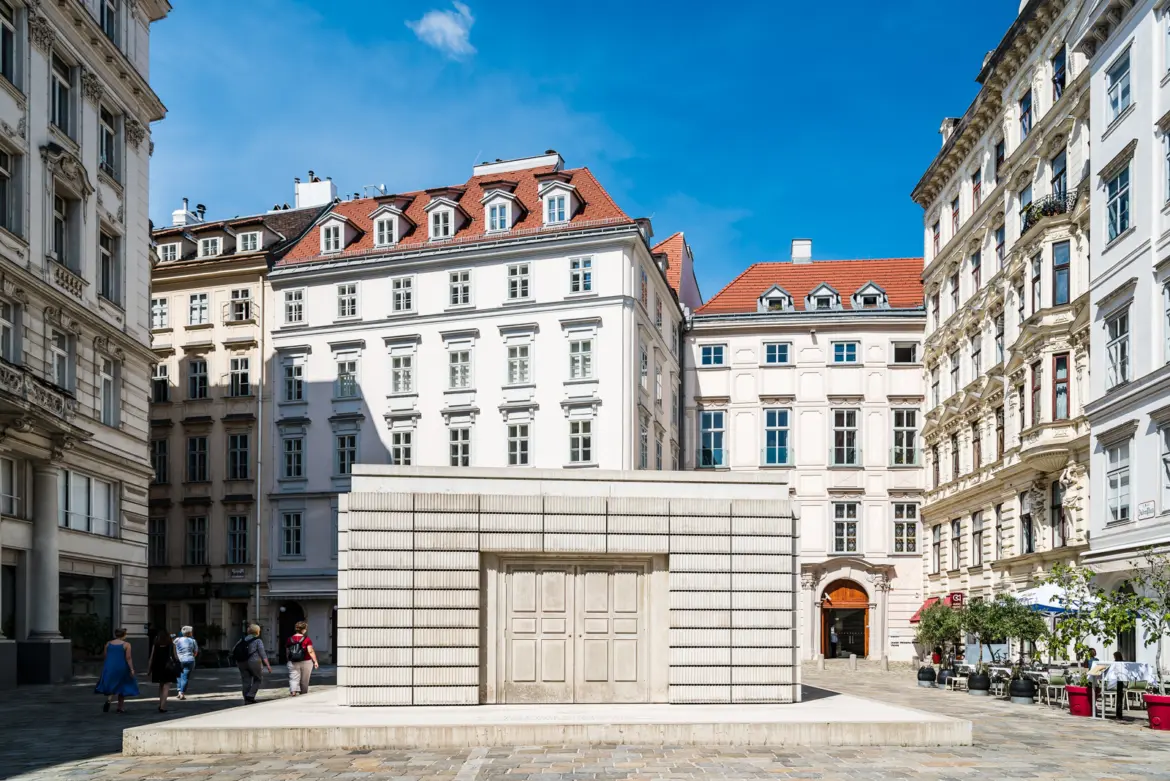
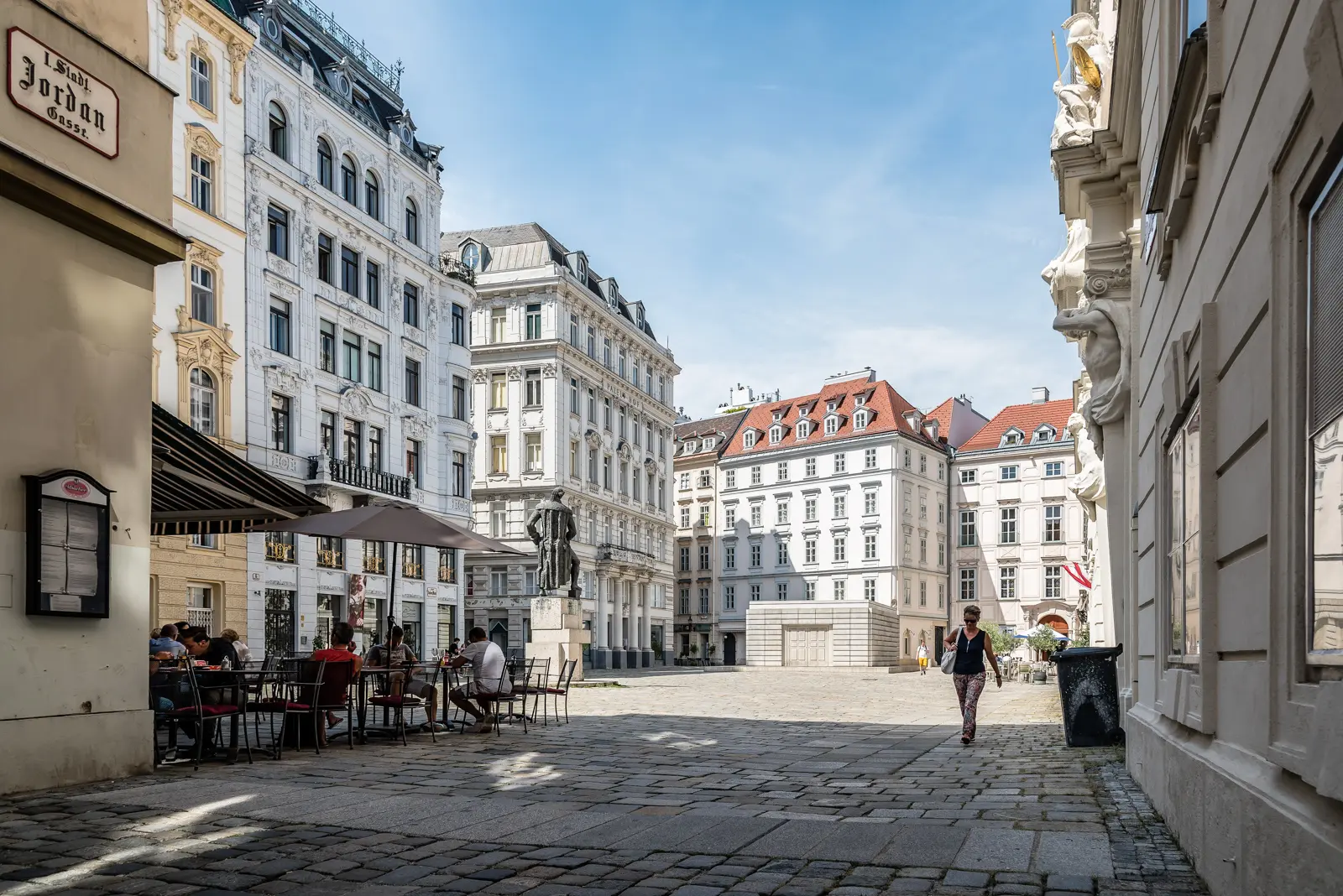
There are places in Vienna that impress with scale, elegance, and movement – and then there are those that invite something quieter, more introspective. Judenplatz belongs to the latter. Tucked away within the historic center, it does not immediately reveal itself. You arrive almost gradually, as the surrounding streets narrow and the city’s rhythm softens, giving way to a space that feels more contained, more deliberate. There is no grand axis or sweeping perspective here. Instead, the square unfolds with restraint, asking not to be admired at a distance, but experienced more closely.
Standing here, the atmosphere shifts in a way that is difficult to define but immediately felt. The sounds of the city seem to recede, footsteps become more noticeable, and movement slows. It is not silence, but something quieter, a presence that encourages awareness. You are not simply passing through; you are invited to pause, to observe, and to take in the weight of what the space represents.
Judenplatz at a Glance
🕊️ Holocaust Memorial: Designed by Rachel Whiteread, unveiled October 2000 — a concrete “Nameless Library” with books turned inward, symbolizing 65,000 Austrian Jewish lives lost
📚 The books: Spines face inward, titles hidden — evoking Jewish scholarly tradition and knowledge interrupted or lost forever
🏛️ Medieval synagogue: Excavated foundations beneath the square, destroyed during the Vienna Gesera of 1420–1421 — accessible through the Jewish Museum Judenplatz
🏫 Jewish Museum Judenplatz: Housed in Misrachi House (Judenplatz 8) — permanent exhibition on medieval Jewish Vienna with underground synagogue access
🗿 Lessing Monument: Honors Enlightenment writer Gotthold Ephraim Lessing and his ideals of tolerance and dialogue across religious boundaries
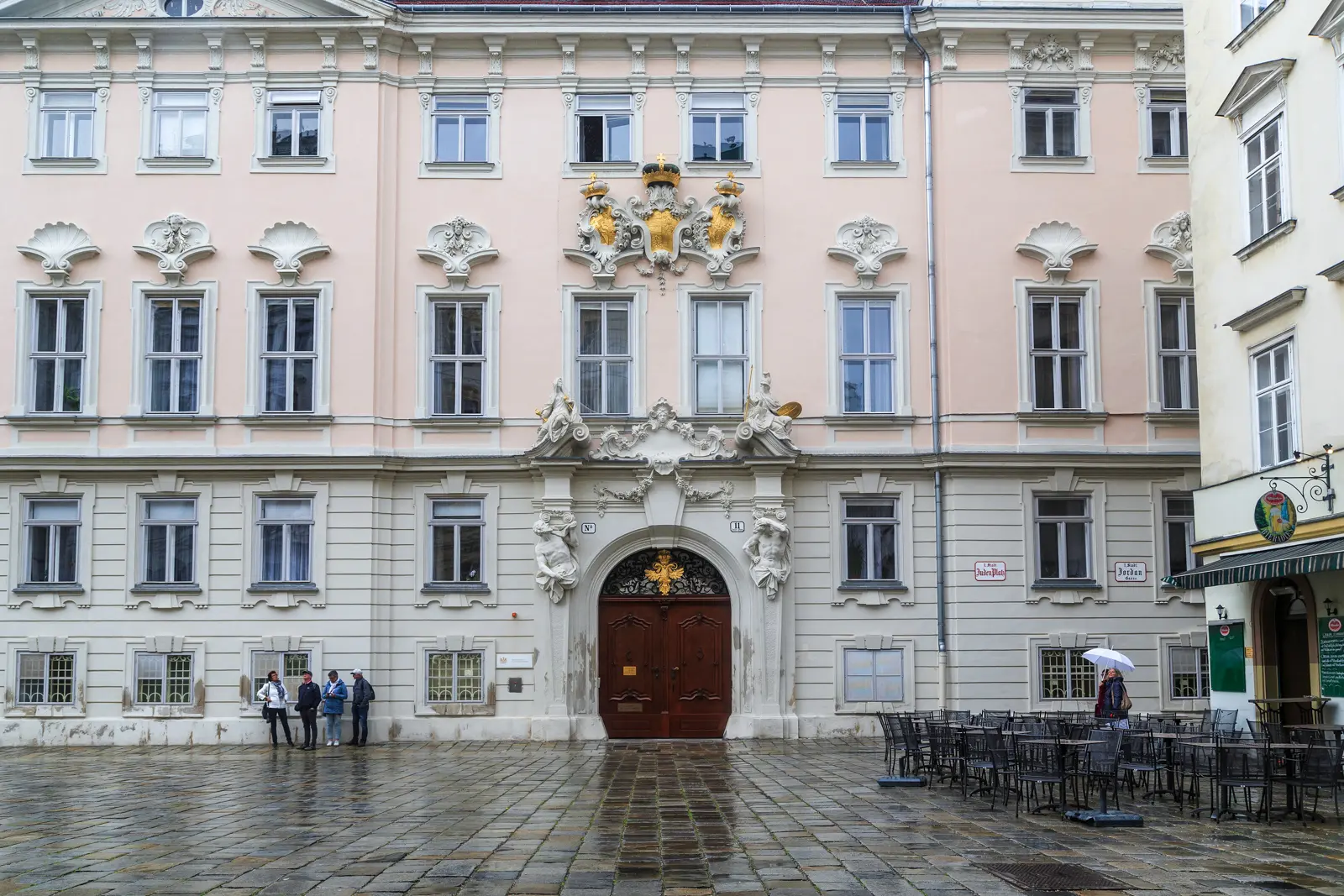
🏰 Bohemian Court Chancellery: Baroque façade reflecting Habsburg administrative history — a visual counterpoint to the memorial’s stark geometry
🚇 Getting there: U-Bahn Stephansplatz (U1/U3), Herrengasse (U3), or Schottentor (U2) — all a short walk
💡 Tip: Arrive early morning or late afternoon for the quietest, most reflective experience
A Square of Quiet Presence
Judenplatz is modest in scale, yet deeply expressive in its simplicity. Surrounded by historic façades, the square feels enclosed without ever feeling confined, creating a sense of intimacy that stands in contrast to Vienna’s more expansive and monumental public spaces. The buildings that frame it are elegant but restrained, their proportions and muted tones allowing the space itself to take precedence. There is a quiet coherence here – nothing calls for attention, yet everything contributes to a setting that feels considered, balanced, and grounded in time.
Light plays an essential role in shaping the experience of the square. As it shifts throughout the day, it moves gently across the stone surfaces, softening edges and subtly altering the atmosphere. In the morning, the light feels clearer and more defined, revealing textures and details; by late afternoon, it becomes warmer, settling more softly across façades and open space. There are no dramatic gestures here – only gradual transitions that reward attentiveness. The openness at the center, combined with the stillness of the surrounding architecture, creates a sense of equilibrium that feels both natural and intentional.
People move differently in this space. Conversations lower, pauses become longer, and there is a noticeable absence of urgency. Some walk slowly across the square, others stop and remain still, taking in the surroundings without distraction. It is not a space designed for activity, but for presence – a place where simply being there becomes the experience. The atmosphere does not impose silence, but it encourages it, creating a subtle shift in awareness that distinguishes Judenplatz from the rest of the city.
The Holocaust Memorial: A Library That Cannot Be Read
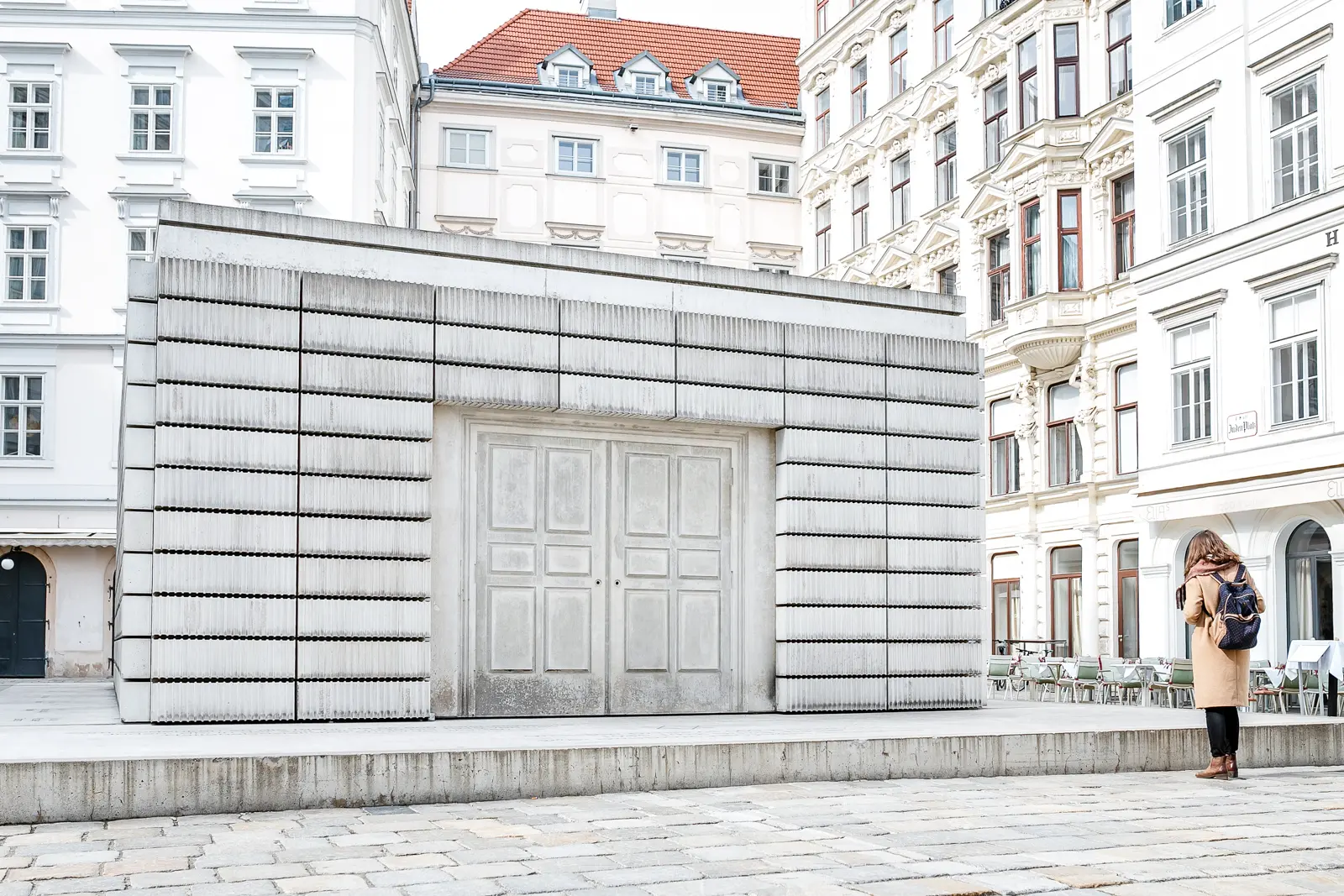
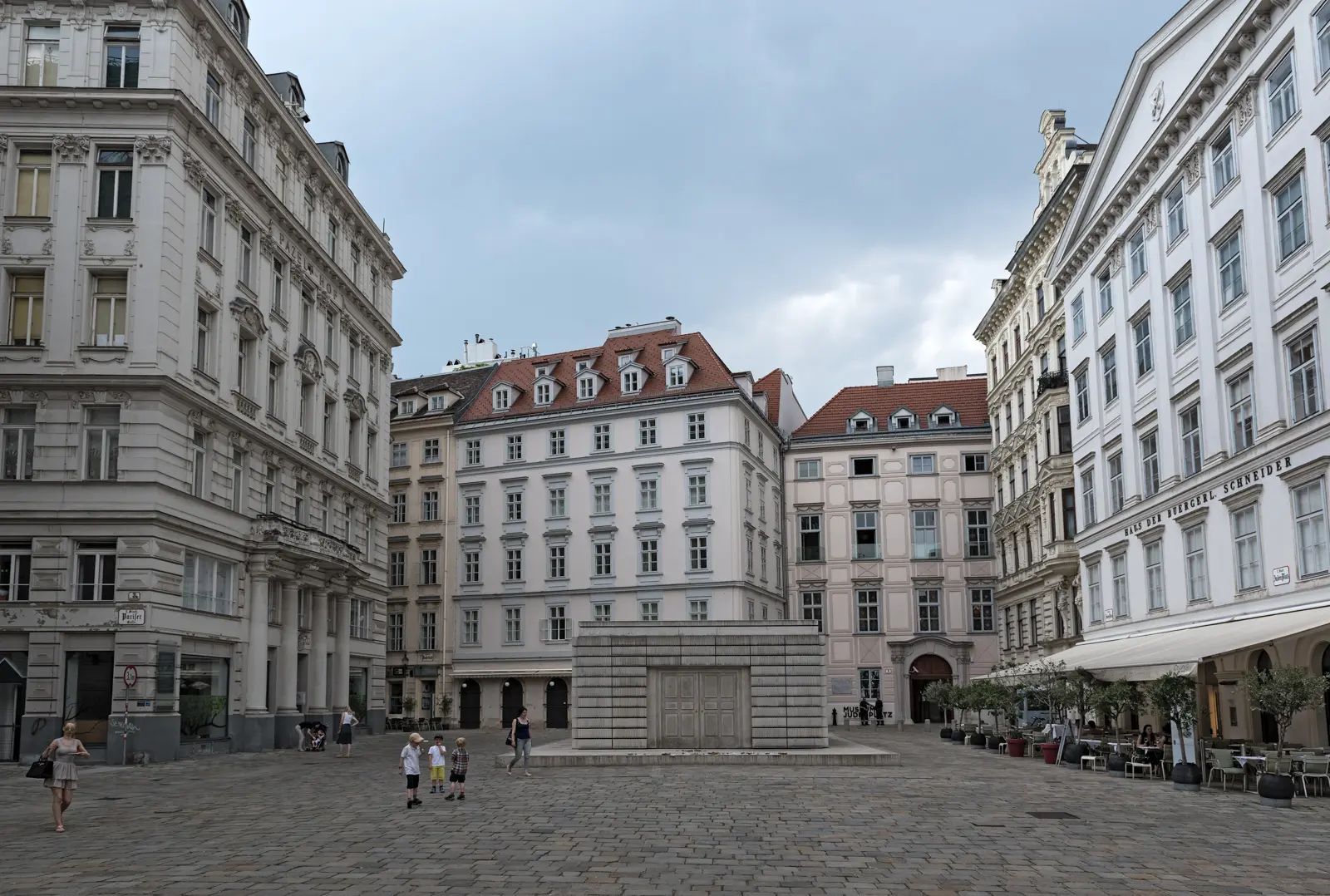
In Judenplatz stands the Holocaust Memorial, designed by Rachel Whiteread. Its form is deliberately restrained – a monolithic concrete structure whose surface is composed of rows of books, their spines turned inward, their titles hidden from view. The effect is immediate yet quietly complex: it resembles a library, but one that cannot be entered, read, or accessed.
This inversion carries profound meaning. The books can be understood as evoking a long tradition of scholarship, religious life, and intellectual heritage within Jewish culture. Here, however, they are sealed and unreadable, their titles inaccessible. They suggest lives, stories, and histories that can no longer be told – knowledge that has been interrupted or lost. The closed nature of the structure reinforces this absence. There are no doors, no openings, no points of entry. It resists interaction in the traditional sense, offering instead a space for reflection.
What is particularly striking is how the memorial interacts with its surroundings. It does not dominate the square, nor does it recede into it. It exists in a careful balance: present, grounded, and quietly insistent. The more time you spend with it, the more its meaning unfolds, not through explanation, but through observation and contemplation.
Layers Beneath the Surface: Jewish Vienna
The significance of Judenplatz extends far beyond what is visible today. Beneath the square lie the remains of Vienna’s medieval synagogue, once the center of a vibrant and established Jewish community that contributed to the city’s cultural and economic life. This community formed an integral part of Vienna’s early urban fabric, shaping its intellectual and commercial character during the Middle Ages. Its presence, though no longer visible at the surface, remains embedded in the very ground beneath the square.
That community came to a devastating end in 1421 during the Vienna Gesera, when Jews were expelled, killed, or forced to convert, and the synagogue was destroyed. The square retained its name – Judenplatz, “Jews’ Square” – but the physical remains and much of this history remained largely absent from the visible urban landscape for centuries. Today, these layers have been carefully uncovered and preserved through the Jewish Museum Vienna’s Judenplatz location, housed in the historic Misrachi House on the square itself. Its permanent exhibition traces the religious, cultural, and social life of Vienna’s medieval Jewish community, while underground corridors lead visitors down to the excavated foundations of the synagogue – a quiet, grounded experience that connects history to place in a direct and tangible way.
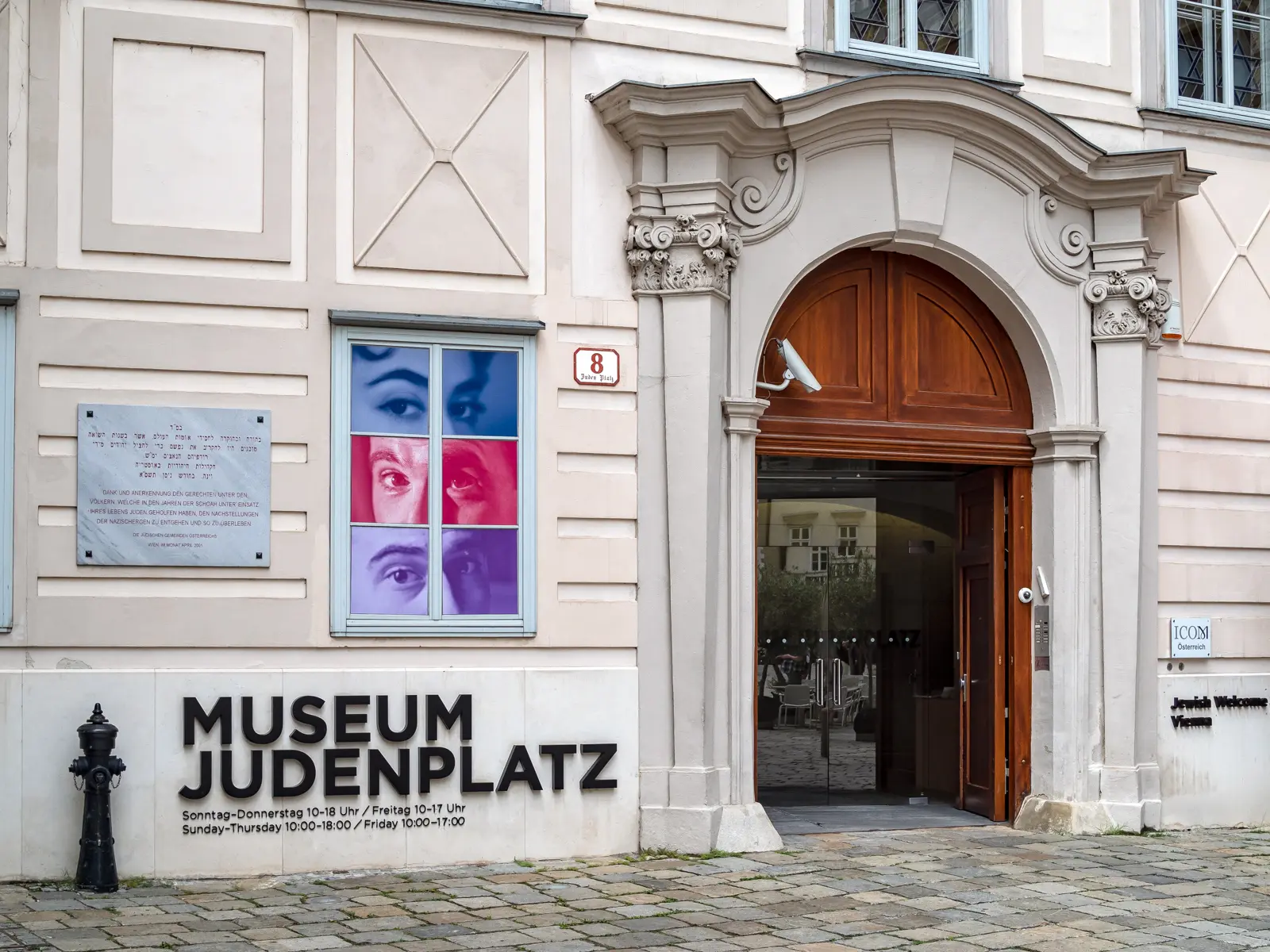
This layering – medieval foundations beneath a modern memorial, history beneath presence – gives the square a depth that is both physical and symbolic. What lies below is not separate from what stands above; the two exist in dialogue. The memorial above does not replace the past, but rests upon it, allowing the space to be understood as both a site of memory and a continuation of history. The experience becomes one of awareness – of what is seen, and what remains just beneath the surface.
Surrounding Landmarks: History in Dialogue
The buildings and monuments surrounding Judenplatz contribute to its layered meaning, each adding a different perspective to the narrative. The Lessing Monument honors Gotthold Ephraim Lessing, a central figure of the Enlightenment whose work emphasized tolerance, reason, and dialogue across religious and cultural boundaries. His presence here is both symbolic and deliberate. Positioned within a space marked by historical loss, the monument introduces a counterpoint – a reminder of ideas that sought understanding and coexistence, and of the enduring relevance of those ideals.
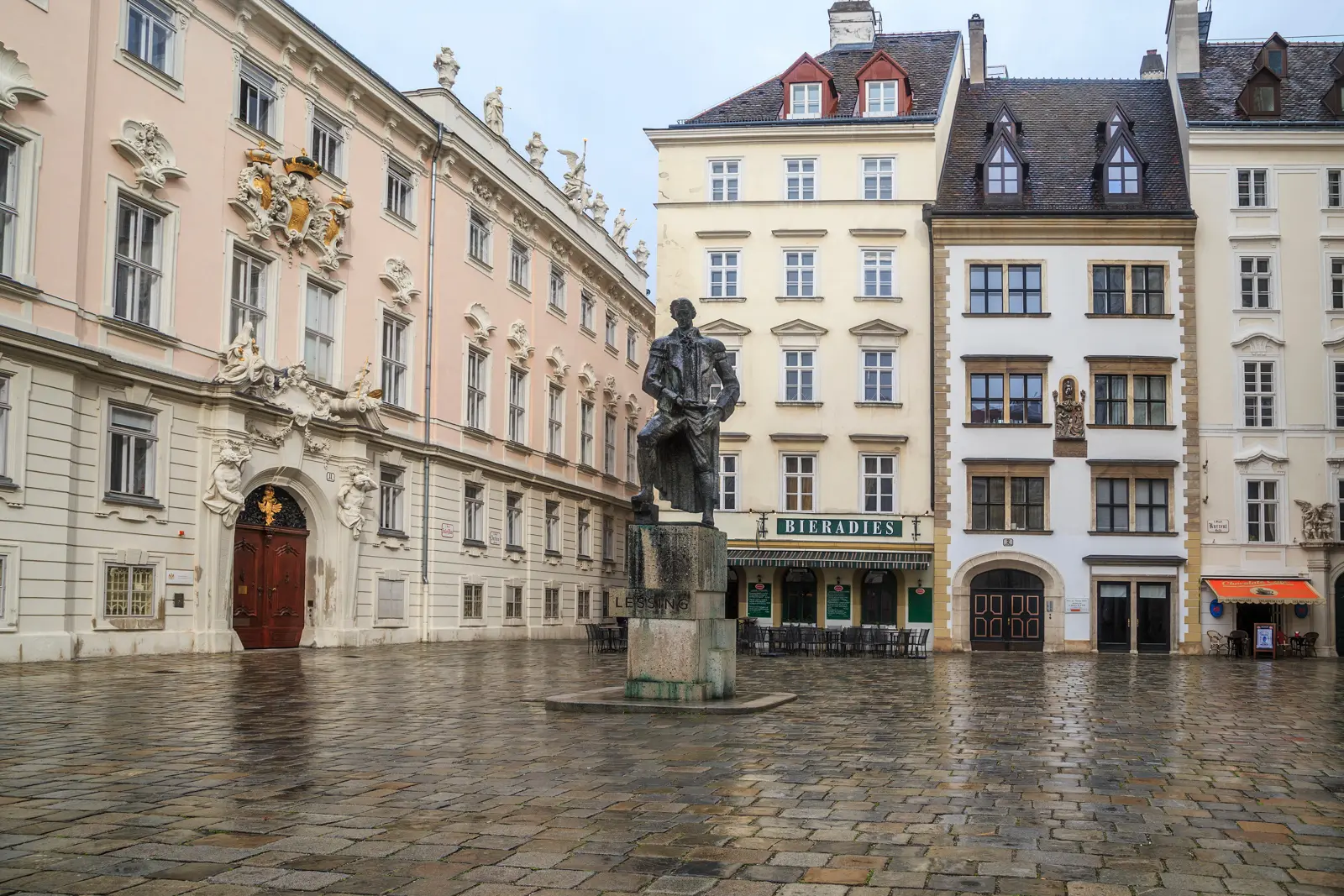
Nearby, the Bohemian Court Chancellery reflects the administrative and political history of the Habsburg Empire. Its Baroque façade, refined and carefully composed, brings a different visual language to the square – one defined by symmetry, ornamentation, and order. This stands in quiet contrast to the stark geometry of the Holocaust Memorial. The juxtaposition is striking, yet not discordant. Instead, it highlights how different moments in history – imperial authority, intellectual thought, and collective memory – can coexist within a single, shared space.
Together, these elements do not compete for attention. Instead, they form a quiet dialogue, each contributing to a broader understanding of the square and its significance. The space becomes not a collection of individual landmarks, but a composition – one where meaning emerges through relationships, contrasts, and proximity. It is this interplay that gives Judenplatz its depth, allowing it to be experienced not only as a place, but as a layered reflection of Vienna’s history.
The Experience: Stillness and Reflection
Experiencing Judenplatz is less about movement and more about presence. Unlike other parts of Vienna, where exploration is defined by progression from one landmark to another, here the experience unfolds through a subtle shift in awareness. There is no clear path to follow, no sequence to complete. Instead, the space invites you to remain – to take in the square as a whole, to notice how its elements relate, and to engage with it on your own terms. This openness allows for different forms of attention, whether walking slowly across the space or pausing at its edges.
There is a perceptible change in pace. People arrive and instinctively slow down. Some move quietly around the memorial, others stand at a distance, taking it in from different perspectives. Time seems to extend slightly, not dramatically, but enough to be felt. Attention becomes more focused, and the surrounding details – the weight of the materials, the texture of the surfaces, the muted sounds of the square – come into sharper awareness. It is not a space that overwhelms, but one that reveals itself gradually, offering depth to those willing to remain, even briefly, within its atmosphere
Bubbly Tips: Visiting Judenplatz in Vienna
To experience Judenplatz meaningfully:
- For a quieter and more reflective visit: Arrive in the early morning or later in the evening, when the square is less busy and its atmosphere is more pronounced
- To understand its historical depth: Visit the Jewish Museum Vienna at Judenplatz to explore the remains of the medieval synagogue and the history of Vienna’s Jewish community
- For a moment of reflection: Spend time near the memorial without rushing — allowing the space to be experienced rather than simply observed
- To appreciate the surrounding context: Notice the relationship between the memorial, the Lessing Monument, and the Bohemian Court Chancellery
- For a broader exploration: Combine your visit with nearby streets in Vienna’s first district, allowing the transition from movement to stillness to unfold naturally
Final Thoughts
Judenplatz is not defined by what it shows, but by what it holds. It is a place where history is present without being imposed, where meaning is felt rather than explained. Its strength lies in its restraint – in its ability to create space for reflection without directing it, to hold complexity without resolving it.
What remains, after you leave, is not a single image or moment, but a quiet awareness – of presence, of absence, and of the layers that continue to exist beneath the surface. It is a space that does not seek to be understood all at once, but one that stays with you, returning in small, reflective ways long after your visit.
Have you experienced Judenplatz, or would you include it in your next visit to Vienna? I’d love to hear your thoughts in the comments section below.
Happy travels!

🌟 Everything You Need to Plan Your Dream Trip in 2026
- 🌟 Luxury Hotels - Find premium stays with Booking.com & Hotels.com
- 🏡 Vacation Rentals - Discover unique properties on VRBO
- 🏞️ Guided Tours - Explore with Viator or GetYourGuide
- 🎫 Attraction Tickets - Skip the lines with Tiqets
- 🚢 Ocean Cruises - Set sail with Cruise Direct
- 📱 International SIMs - Stay connected with Saily
- 🚗 Car Rentals - Budget-friendly options from Discover Cars
- 🌐 Secure VPNs - Browse safely with NordVPN
- 💶 Currency Exchange - Best rates with Wise
- 🗣️ Learn Languages - Master the local language with Babbel and Rosetta Stone