
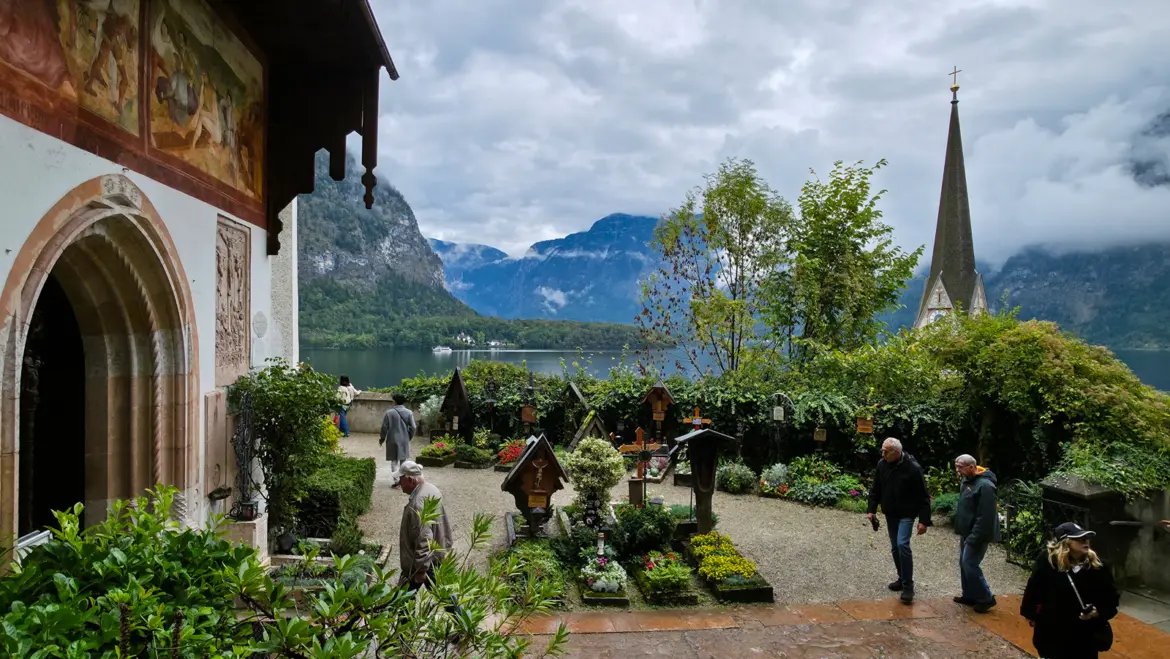
There are places in the world that invite admiration, and then there are places that invite reflection. Hallstatt’s ossuary, quietly tucked above the village within the grounds of the Pfarrkirche Mariä Himmelfahrt, belongs firmly to the latter. Perched along the mountainside and overlooking the lake below, this small and unassuming chapel holds one of the most distinctive and meaningful traditions in Austria.
At first glance, the idea may feel unexpected, even slightly unsettling, to encounter a space where human skulls are carefully arranged and preserved. But Hallstatt has a way of gently shifting your perspective. As you begin to understand the story behind this place, what initially feels unfamiliar transforms into something deeply human, rooted in memory, respect, and continuity across generations.
Hallstatt Ossuary at a Glance
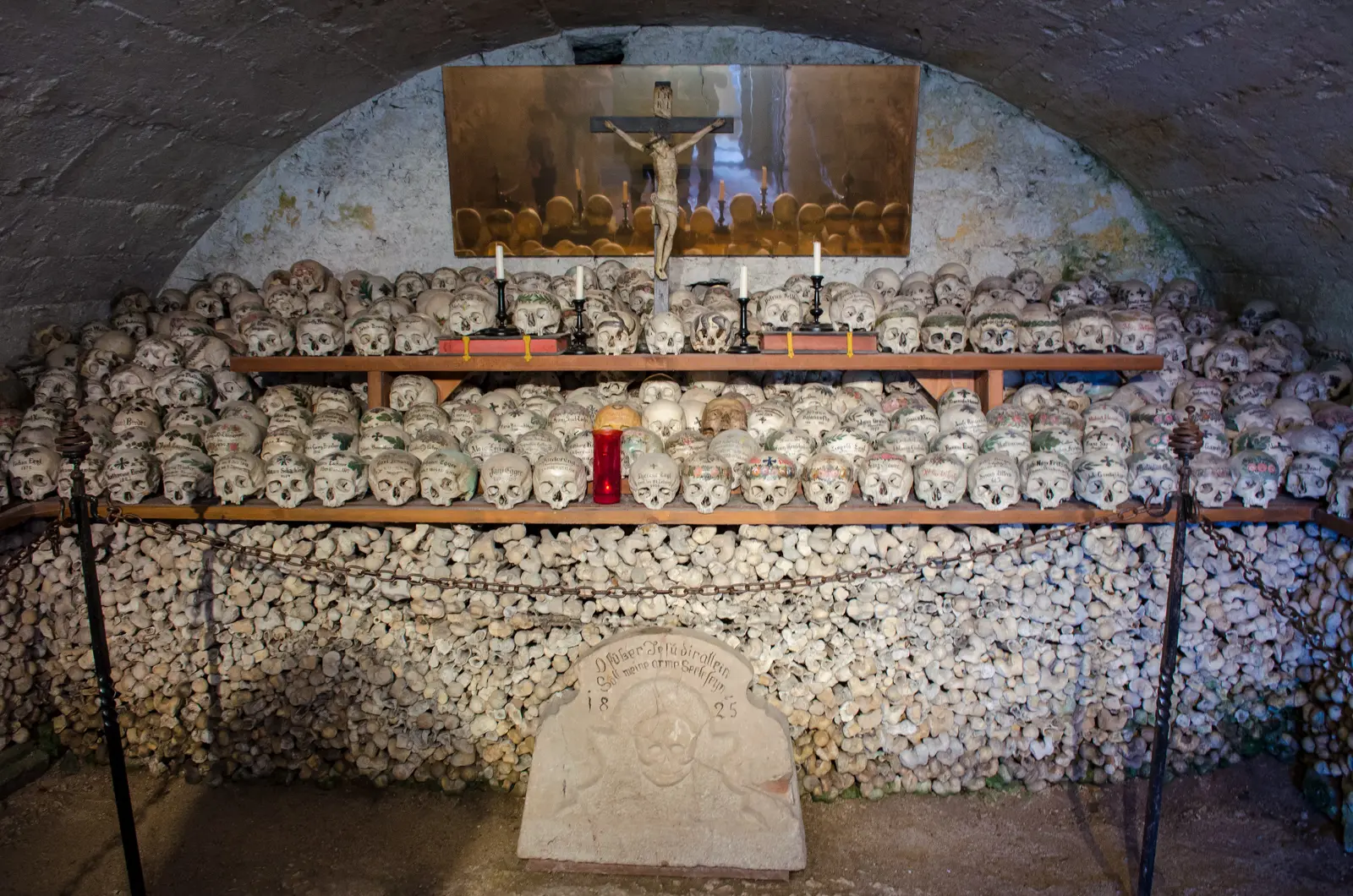
💀 What: Beinhaus (“Bone House”) with 1,200+ skulls, 610+ hand-painted — Europe’s largest intact collection of painted skulls
⛪ Where: St. Michael’s Chapel (12th century), adjacent to Pfarrkirche Mariä Himmelfahrt, above Hallstatt village
🎨 Painting tradition: Began ~1720 — women painted with floral wreaths, men with ivy
📅 Last skull added: 1995 — a woman who died in 1983, identifiable by her gold tooth
⛰️ Why the tradition: Steep terrain between lake and mountain limited cemetery space; graves reused after 10–15 years
💶 Entry: €2 adults, €0.50 children — cash only
🕙 Hours: Daily 10:00–18:00 (closed Nov 1 & 2)
🚆 From Vienna: ~3–3.5 hrs (train + ferry crossing)
💡 Tip: Visit early in summer (July–August) to avoid crowds; no dress code
The Setting: Church, Cemetery, and Mountain
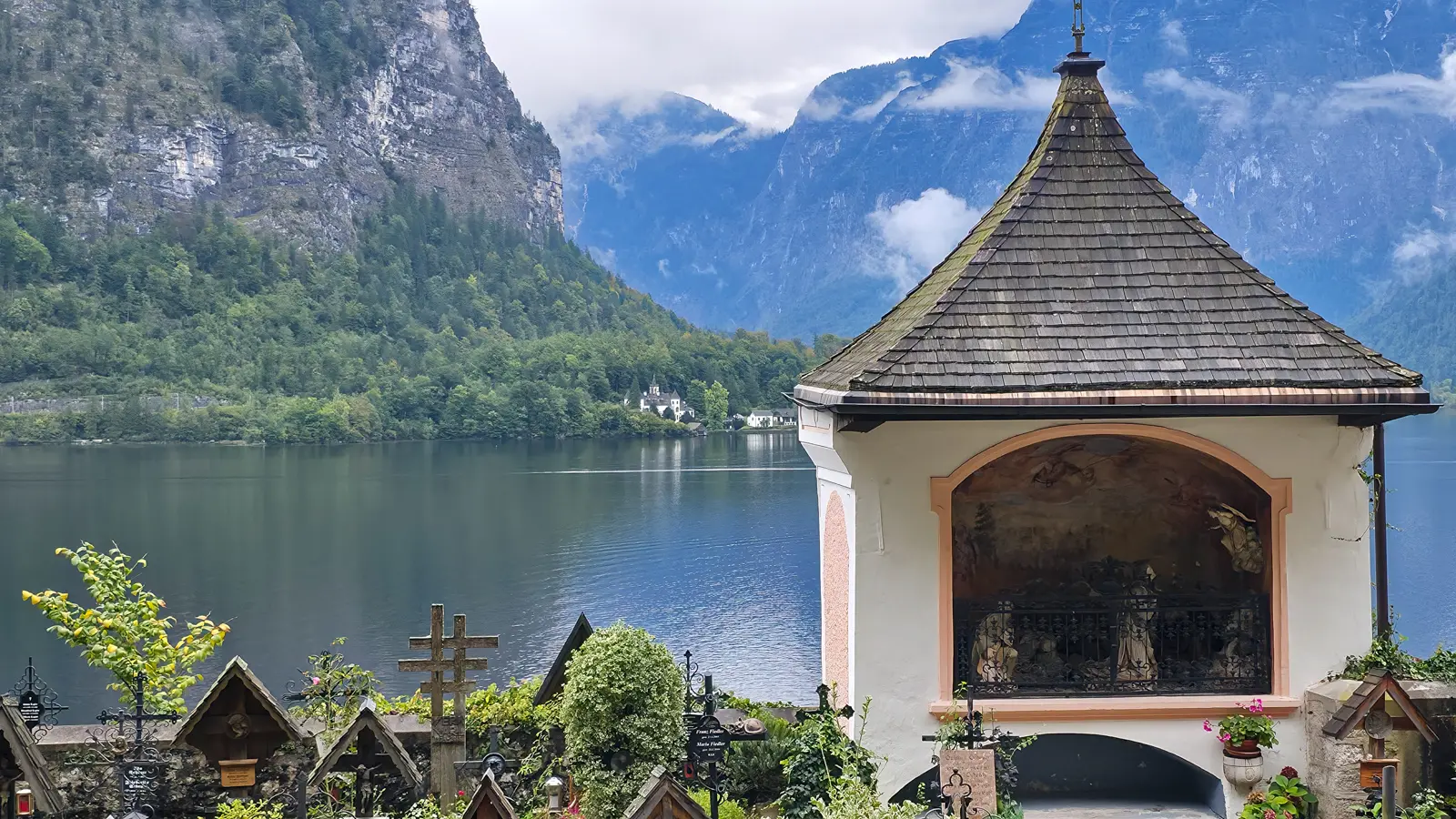
The ossuary is part of a larger, interconnected space that includes the Pfarrkirche Mariä Himmelfahrt and its hillside cemetery, creating an environment that feels both intimate and elevated. Set against the steep mountainside, the entire area seems naturally carved into the landscape, shaped as much by geography as by human presence.
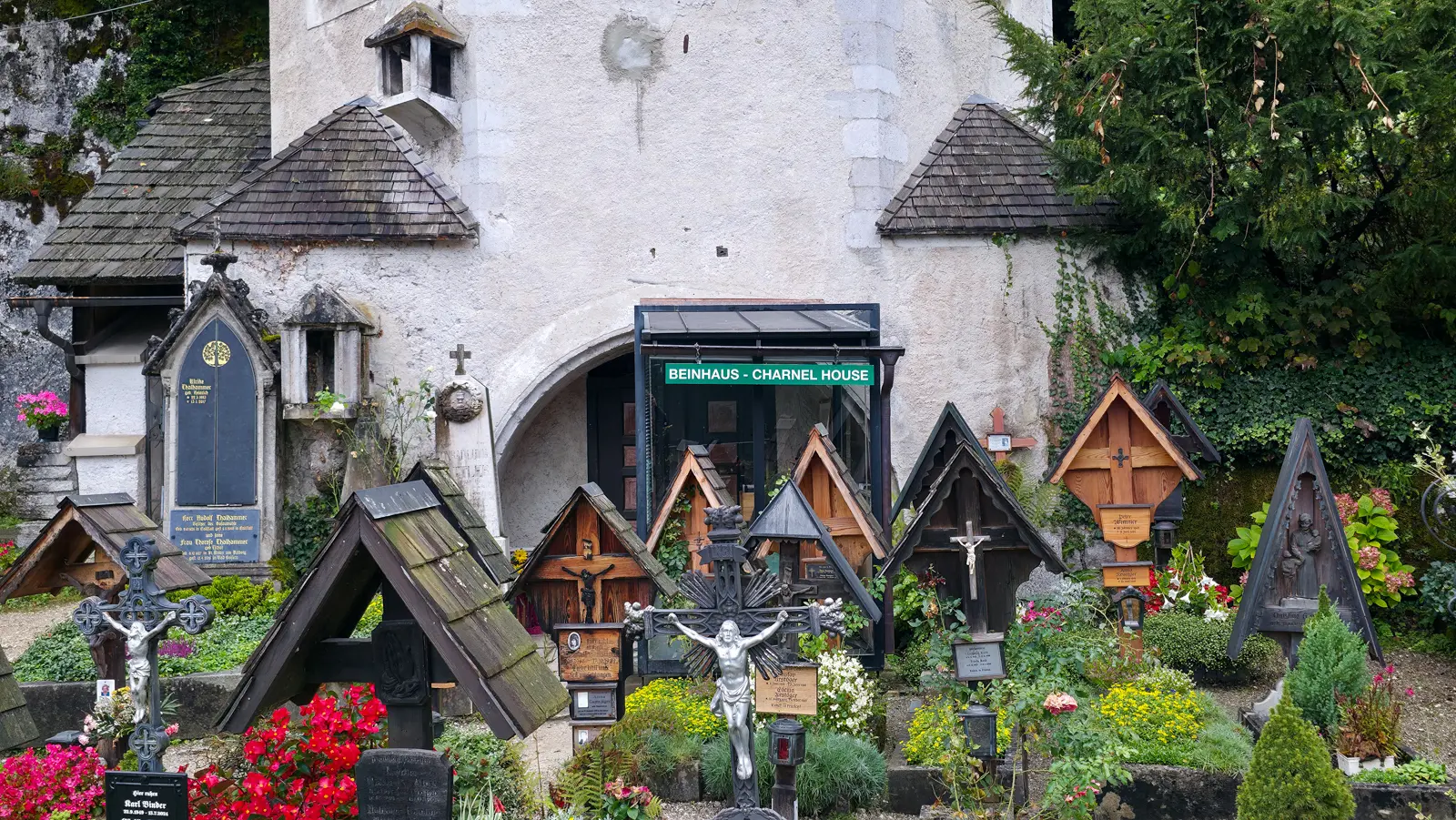
The cemetery itself is small but beautifully maintained, with graves arranged closely together and adorned with flowers, personal details, and the elaborate wrought ironwork crosses that are one of the cemetery’s most distinctive visual features, a reflection of the skilled metalwork traditions of the region. There is a quiet dignity here, enhanced by the surrounding views of the lake and village below. The contrast between the stillness of the cemetery and the dramatic alpine backdrop creates a sense of balance, a space where nature and human history exist in quiet harmony. Standing here, you begin to understand that this is not simply a place of burial, but a place of continuity. Life in Hallstatt has always been closely tied to its environment, and this setting reflects that connection in a deeply tangible way.
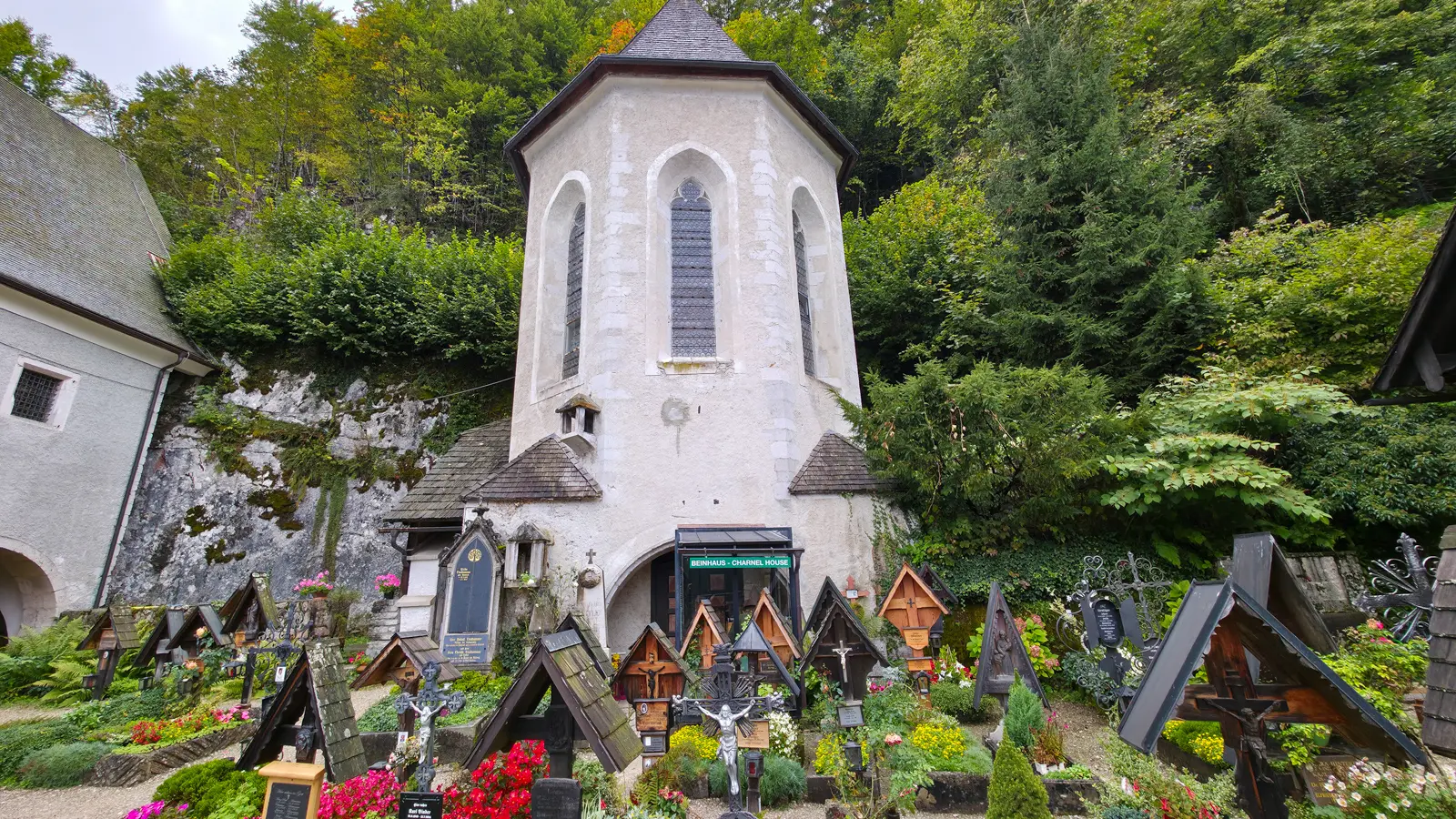
The Ossuary (Beinhaus): A Tradition Born of Necessity
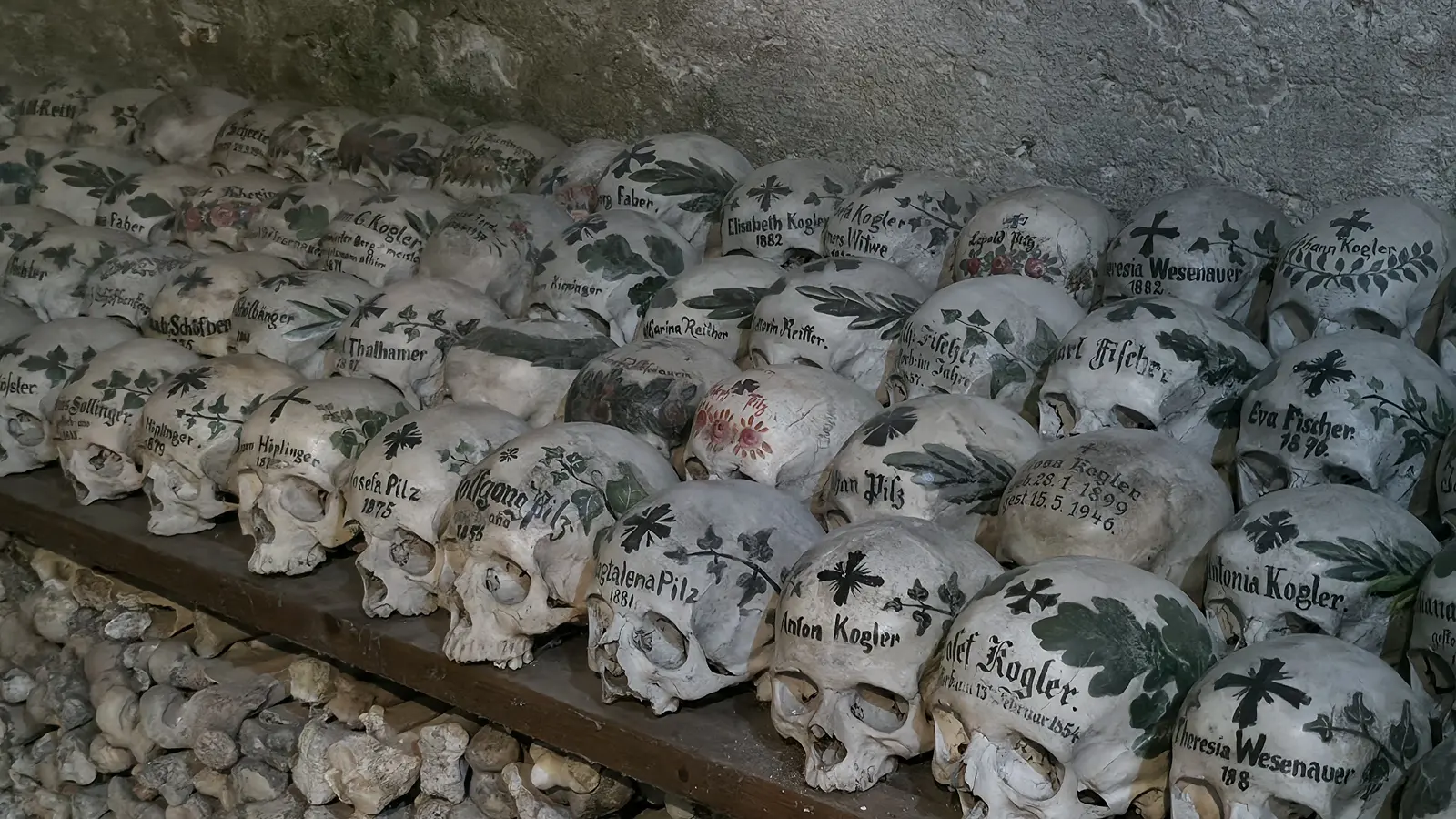
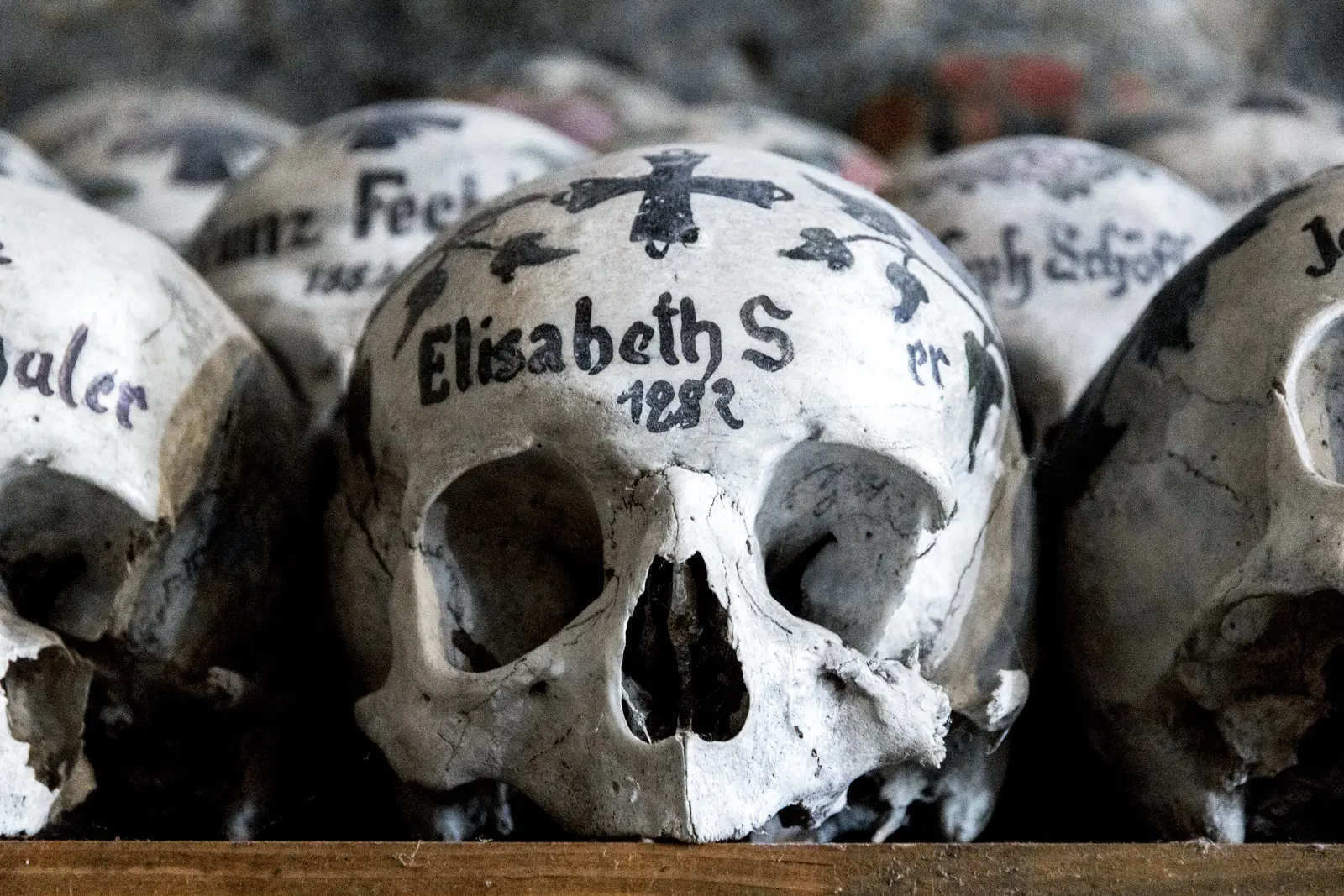
Inside the ossuary, known locally as the Beinhaus – meaning “Bone House” – you will find rows of carefully arranged skulls and bones, with tibias and other remains carefully stacked alongside, each bearing traces of individual identity. Many skulls are hand-painted with names, dates, and delicate floral motifs, transforming them from anonymous remains into deeply personal markers of remembrance. The visual impact is immediate, but the meaning behind it unfolds gradually.
This tradition was not born out of symbolism alone, but out of necessity. Hallstatt’s cemetery, limited by the steep terrain, could not expand over time. As a result, it became customary to exhume remains after a number of years to make space for new burials. Rather than discarding the bones, the community chose to preserve them, an act that reflects both practicality and respect.
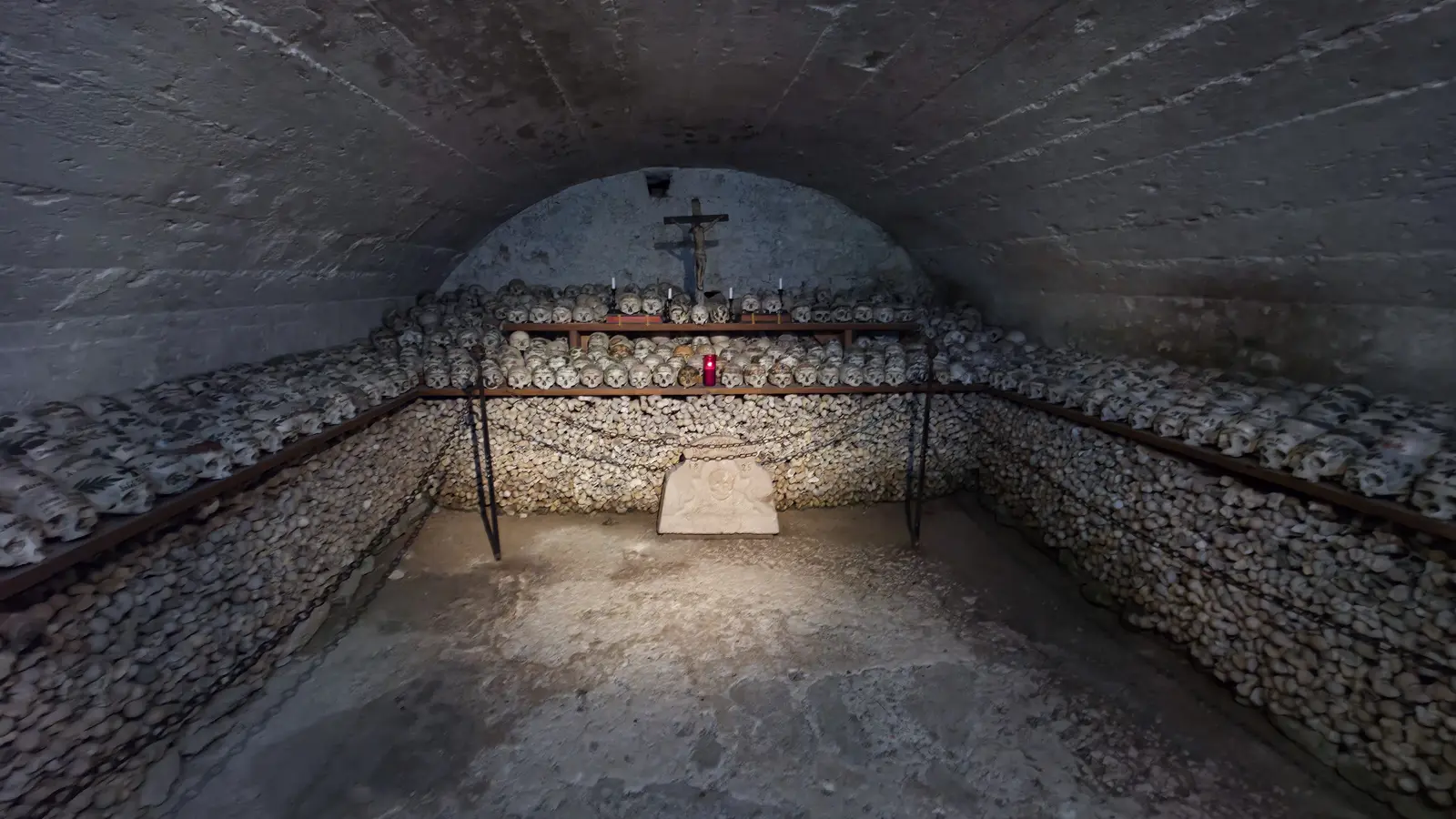
Each skull was carefully cleaned and naturally bleached over time, and, in many cases, decorated with thoughtful detail. The addition of names and dates ensured that identity was not lost, while the floral designs added a layer of care and intention. What might initially appear unusual becomes, upon closer understanding, a deeply meaningful expression of remembrance, continuity, and care.
A Living Tradition
What makes Hallstatt’s ossuary particularly remarkable is that this practice did not disappear into the distant past. It continued into relatively recent history, with the last skull added to the collection as recently as 1995. This detail shifts the experience from something purely historical into something that feels much closer, more immediate, and more connected to the present.
The continuation of this tradition reflects a worldview in which death is not hidden away, but acknowledged as a natural part of life. Rather than creating distance, the ossuary maintains a sense of connection between past and present, allowing memory to remain visible within the community. In this way, the ossuary becomes more than a physical space; it becomes a reflection of cultural values. It speaks to a relationship with mortality that is both accepting and respectful, grounded in the idea that remembrance is an essential part of human experience.
The Experience: From Curiosity to Reflection
Visiting the ossuary is an experience that evolves as you move through it. What begins as curiosity gradually transforms into reflection, shaped by both the atmosphere of the space and the understanding of its meaning. The initial visual impression gives way to something quieter, more contemplative, as you begin to take in the details and the stories they represent.
The atmosphere inside is calm and respectful. Visitors move slowly, often speaking in hushed tones, aware of the significance of what surrounds them. There is a shared sense of understanding that this is not simply a place to observe, but a place to reflect. The experience encourages stillness, inviting you to pause and consider the passage of time in a way that feels both personal and universal. What stays with you is not only what you see, but what you feel. A sense of connection, of continuity, of being part of a larger human story that extends far beyond a single moment or place.
A Place of Memory Within a Place of Beauty
Hallstatt is often defined by its extraordinary beauty: its lake, its mountains, its perfectly composed views. And yet, within that beauty, places like the ossuary reveal a deeper dimension, one that adds complexity and meaning to the experience. There is something profoundly striking about encountering such a space in a setting that feels so serene and idyllic. The contrast does not diminish the beauty of Hallstatt; rather, it enriches it. It reminds you that behind every picturesque landscape lies a history shaped by real lives, real challenges, and real moments of loss and remembrance.
Standing there, overlooking the village and the lake beyond, you begin to see Hallstatt not only as a destination, but as a place of continuity. A place where beauty and memory coexist, where the past remains present, and where every layer of history contributes to the story you experience today.
Bubbly Tips for Visiting the Hallstatt Ossuary
- Location: The ossuary is located within the grounds of the Pfarrkirche Mariä Himmelfahrt, perched above the village with views over Lake Hallstatt.
- Getting there from Vienna: Hallstatt is approximately 3 to 3.5 hours from Vienna by train or car. The journey typically involves a train to Hallstatt station followed by a short ferry crossing to the village, a scenic and memorable arrival in itself.
- Entrance fee: A small fee (typically a few euros) is required – bring cash, as smaller sites may not always accept cards.
- Opening hours: Hours vary depending on the season, so it’s best to check in advance or plan your visit during mid-day when sites are most likely open.
- Respectful visit: This is an active cultural and memorial site – photography may be permitted, but it should always be done thoughtfully and respectfully.
- Combine your visit: Take time to explore the church and cemetery together, as they provide important context for understanding the ossuary.
Final Thoughts
The ossuary of Hallstatt is not simply a place to visit, it is a place to reflect, to learn, and to understand a different perspective on life and memory. It challenges expectations in a quiet and thoughtful way, inviting you to look beyond initial impressions and into the deeper meaning behind what you see.
In a village known for its beauty, the ossuary adds something more: a sense of depth, of continuity, of connection. It reminds us that every place carries layers of history, and that understanding those layers allows us to experience it more fully.
Would you include the ossuary in your Hallstatt visit, or would you find it unexpected? I’d love to hear your thoughts.
Happy travels!

🌟 Everything You Need to Plan Your Dream Trip in 2026
- 🌟 Luxury Hotels - Find premium stays with Booking.com & Hotels.com
- 🏡 Vacation Rentals - Discover unique properties on VRBO
- 🏞️ Guided Tours - Explore with Viator or GetYourGuide
- 🎫 Attraction Tickets - Skip the lines with Tiqets
- 🚢 Ocean Cruises - Set sail with Cruise Direct
- 📱 International SIMs - Stay connected with Saily
- 🚗 Car Rentals - Budget-friendly options from Discover Cars
- 🌐 Secure VPNs - Browse safely with NordVPN
- 💶 Currency Exchange - Best rates with Wise
- 🗣️ Learn Languages - Master the local language with Babbel and Rosetta Stone